1. Introduction
Analytic hyperbolic geometry is the hyperbolic geometry of Lobachevsky and Bolyai, studied analytically since 1988 [
1]. In order to demonstrate the power and elegance of the novel discipline of analytic hyperbolic geometry, we review topics of analytic hyperbolic geometry, including the theory of gyrogroups and gyrovector spaces and gyrotrigonometry, which enable Ptolemy’s Theorem to be translated in an elegant way from analytic Euclidean geometry into analytic hyperbolic geometry. Analytic Euclidean geometry involves vector addition and, in full analogy, analytic hyperbolic geometry involves Einstein addition.
Nature organizes itself using the language of symmetries. In particular, the symmetry group that regulates Einstein’s special relativity theory is the Lorentz group. The Lorentz group, in turn, is parametrized by the velocity parameter which is governed by Einstein addition and multiplication. As such, the spaces of the velocity parameter give rise to gyrogroups, gyrovector spaces, and analytic hyperbolic geometry which are, respectively, fully analogous to groups, vector spaces, and analytic Euclidean geometry. These analogies are vividly demonstrated in several books [
2,
3,
4,
5,
6,
7,
8,
9,
10] and many papers.
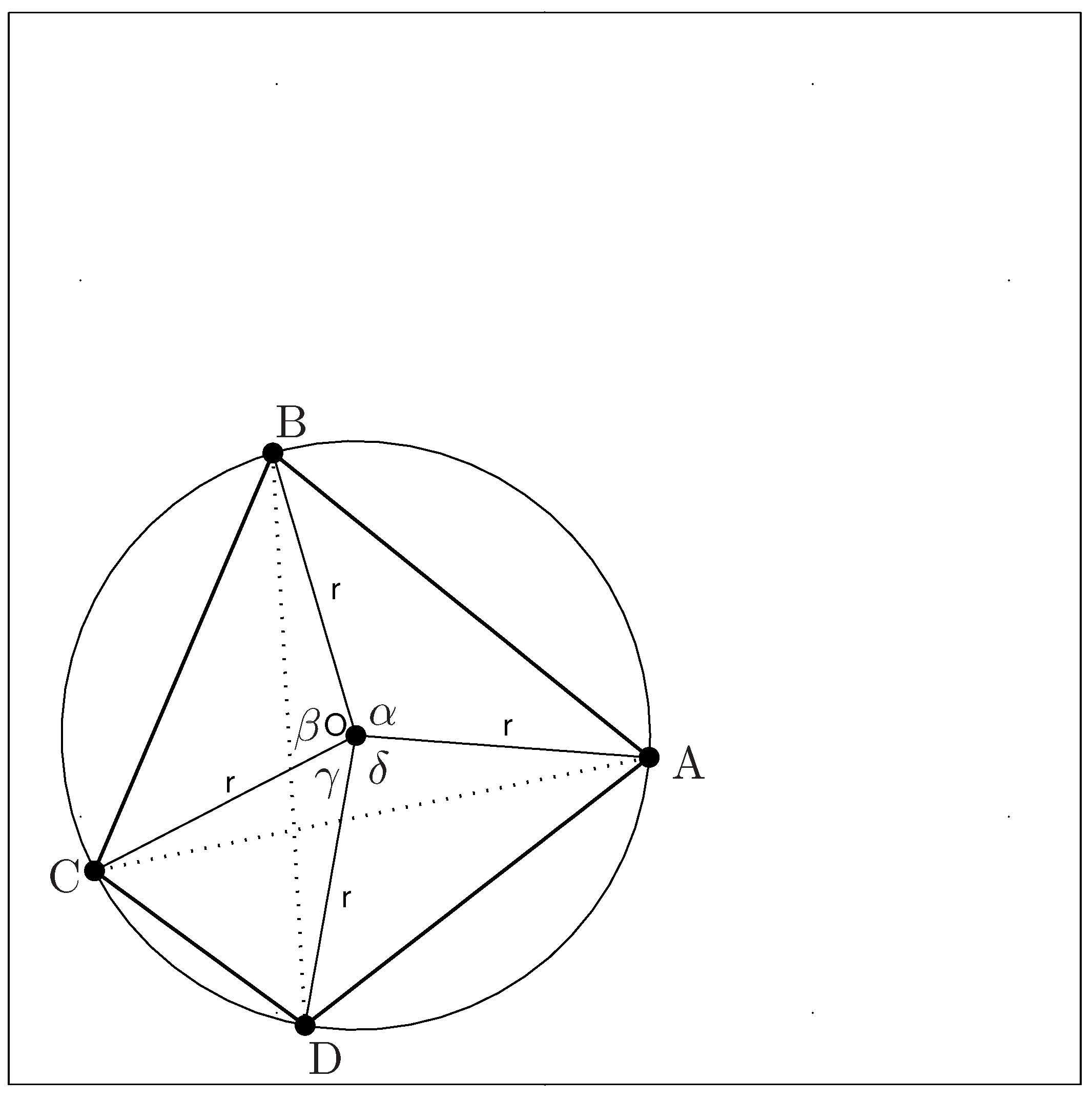
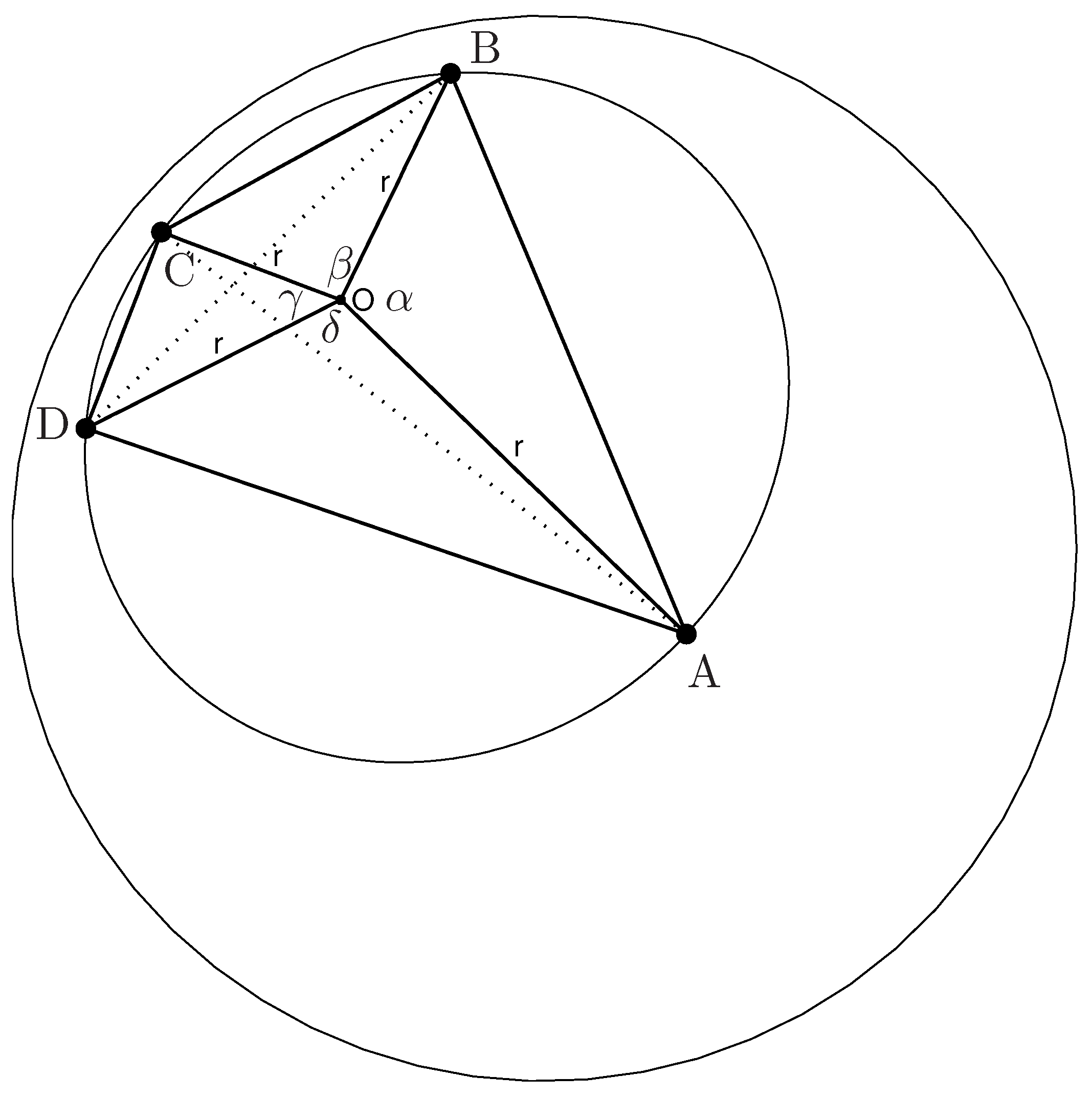
Unexpectedly, the resulting analogies that the Einstein addition captures enable Ptolemy’s Theorem to be translated from Euclidean geometry into hyperbolic geometry. Ptolemy’s Theorem concerns the situation depicted in Figure 5 and its hyperbolic counterpart is depicted in Figure 6.
Seemingly structureless, the Einstein addition of relativistically admissible velocities is neither commutative nor associative. However, it has been known since 1988 [
1,
2,
11,
12] that Einstein addition is both
gyrocommutative and
gyroassociative, thus forming a gyrocommutative gyrogroup operation in Einstein gyrogroups. Moreover, Einstein addition admits scalar multiplication, giving rise to Einstein gyrovector spaces. The latter form the algebraic setting for analytic hyperbolic geometry, just as vector spaces form the algebraic setting for analytic Euclidean geometry.
Analytic hyperbolic geometry, in turn, admits hyperbolic trigonometry, called
gyrotrigonometry, which is analogous to trigonometry. Ptolemy’s Theorem in Euclidean geometry can be verified by means of trigonometry, as shown in
Section 13. Accordingly, the
trigonometry–gyrotrigonometry duality enables Ptolemy’s Theorem to be translated from Euclidean geometry into hyperbolic geometry. Various different attempts to extend Ptolemy’s Theorem to non-Euclidean geometries have been found in the literature as, for instance, in the Refs. [
13,
14], and references cited therein.
The gyrocommutative gyrogroup structure that the Einstein addition encodes gives rise to our
gyrolanguage in which we prefix a gyro to any term that describes a concept in Euclidean geometry and in associative algebra to mean the analogous concept in hyperbolic geometry and in nonassociative algebra. The prefix “gyro” stems from “gyration”, which is the mathematical abstraction of the special relativistic effect known as
“Thomas precession” [
2]. In gyrolanguage, thus, Einstein addition of vectors is a gyroaddition of gyrovectors.
In
Section 2,
Section 3,
Section 4,
Section 5,
Section 6,
Section 7,
Section 8,
Section 9,
Section 10,
Section 11,
Section 12 and
Section 13 we review topics from the theory of gyrogroups, gyrovector spaces and analytic hyperbolic geometry and present a trigonometric proof of Ptolemy’s Theorem. The reviewed topics are necessary for the introduction of the novel hyperbolic Ptolemy’s Theorem and its application in
Section 14 and
Section 15. As such, the present article is a review paper into which the novel hyperbolic Ptolemy’s Theorem has been incorporated.
Accordingly, we start the unexpected journey to the hyperbolic Ptolemy’s Theorem with a review of Einstein addition and the gyrogroup and gyrovector space structures that it encodes [
15].
2. Einstein Addition
Let
be any positive constant and let
be the Euclidean
n-space,
, endowed with the common vector addition, +, and inner product, ·. The space of all
n-dimensional relativistically admissible velocities is the
c-ball
,
Einstein velocity addition is a binary operation, ⊕, in the
c-ball
given by
Refs. [
2,
4], ([
16], Equation (2.9.2)), ([
17], p. 55), [
18], for all
. In physical applications
, but in geometry
is any natural number. Here,
is the Lorentz gamma factor,
and
and
are the inner product and the norm in the ball, which the ball
inherits from its ambient space
, and
. A nonempty set with a binary operation is called a
groupoid, so that the pair
is an
Einstein groupoid.
A useful identity that follows immediately from (
3) is
The constant
represents the vacuum speed of light. In the Euclidean–Newtonian limit of large
c,
, the ball
expands to the whole of its ambient space
, as we see from (
1), and the Einstein addition ⊕ in
descends to the common vector addition + in
, as we see from (
2) and (
3).
3. The Elegant Gyroformalism That Regulates Einstein Addition
Vector addition, +, in
is both commutative and associative. In contrast, Einstein addition, ⊕, in
, given by (
2), is seemingly structureless, being neither commutative nor associative. Strikingly, the deviation from both commutativity and associativity in Einstein addition is controlled by
gyrations, as evidenced from (
5)–(
7).
Gyrations
,
are automorphisms given in terms of Einstein addition by the
gyrator equation
for all
. Equation (
5) presents the application to
of the gyration
generated by
and
. Gyrations are automorphisms of the Einstein groupoid
, so that the
gyrator is the map
An automorphism of a groupoid is a bijective map f of S onto itself that respects the binary operation, that is, for all . The set of all automorphisms of a groupoid forms a group, denoted by , where the group operation is given by automorphism composition. To emphasize that the gyrations of an Einstein groupoid are automorphisms of the groupoid, gyrations are also called gyroautomorphisms.
Possessing their own rich structure, gyrations measure the extent to which Einstein addition deviates from commutativity and associativity, as we see from the gyrocommutative law and the gyroassociative law in the following list of identities [
2,
3,
4,
5]:
for all
.
4. From Einstein Velocity Addition to Gyrogroups
Guided by analogies with groups, the key features of Einstein groupoids , , suggest the formal gyrogroup Definition in which gyrogroups form a most natural generalization of groups.
Definition 1 (Binary Operations). A binary operation + in a set S is a function . We use the notation to denote for any .
Definition 2 (Groupoids, Automorphisms). A groupoid is a nonempty set, S, with a binary operation, +. An automorphism ϕ of a groupoid is a bijective self-map of S which respects its groupoid operation, that is, for all . The automorphisms of a groupoid form a group denoted by .
Definition 3 Gyrogroups ([
3], Definition 2.5)).
A groupoid is a gyrogroup if its binary operation satisfies the following axioms. In G there is at least one element, 0,
called a left identity, satisfyingMoreover, for any there exists an automorphism such that the binary operation obeys the left gyroassociative law
- (G3)
The automorphism of G is called the gyroautomorphism, or the gyration, of G generated by . The operator is called the gyrator of G. Finally, the gyroautomorphism generated by any obeys the left reduction axiom
- (G4)
As in group theory, we use the notation in gyrogroup theory as well.
In full analogy with groups, gyrogroups split up into gyrocommutative and non-gyrocommutative ones.
Definition 4 (Gyrocommutative Gyrogroup ([
3], Definition 2.6)).
A gyrogroup is gyrocommutative if its binary operation obeys the gyrocommutative law- (G5)
The theory of gyrogroups and gyrovector spaces was studied in [
2,
3,
4,
5,
6,
7,
8,
9,
10]. An attractive review of gyrogroup theory can be found in ([
19], Sections 2–12), and an attractive review of gyrogroup and gyrovector space theory can be found in [
15].
The abstract gyrocommutative gyrogroup is an algebraic structure derived from Einstein addition ⊕ in
. Indeed, Einstein groupoids
,
, are gyrocommutative gyrogroups. Gyrogroups, both gyrocommutative and nongyrocommutative, abound in group theory as demonstrated, for instance, in the Refs. [
19,
20,
21,
22,
23,
24]. Gyrogroups share Remarkable analogies with groups studied, for instance, in the Refs. [
25,
26,
27,
28,
29,
30,
31].
5. Gyrovector Spaces
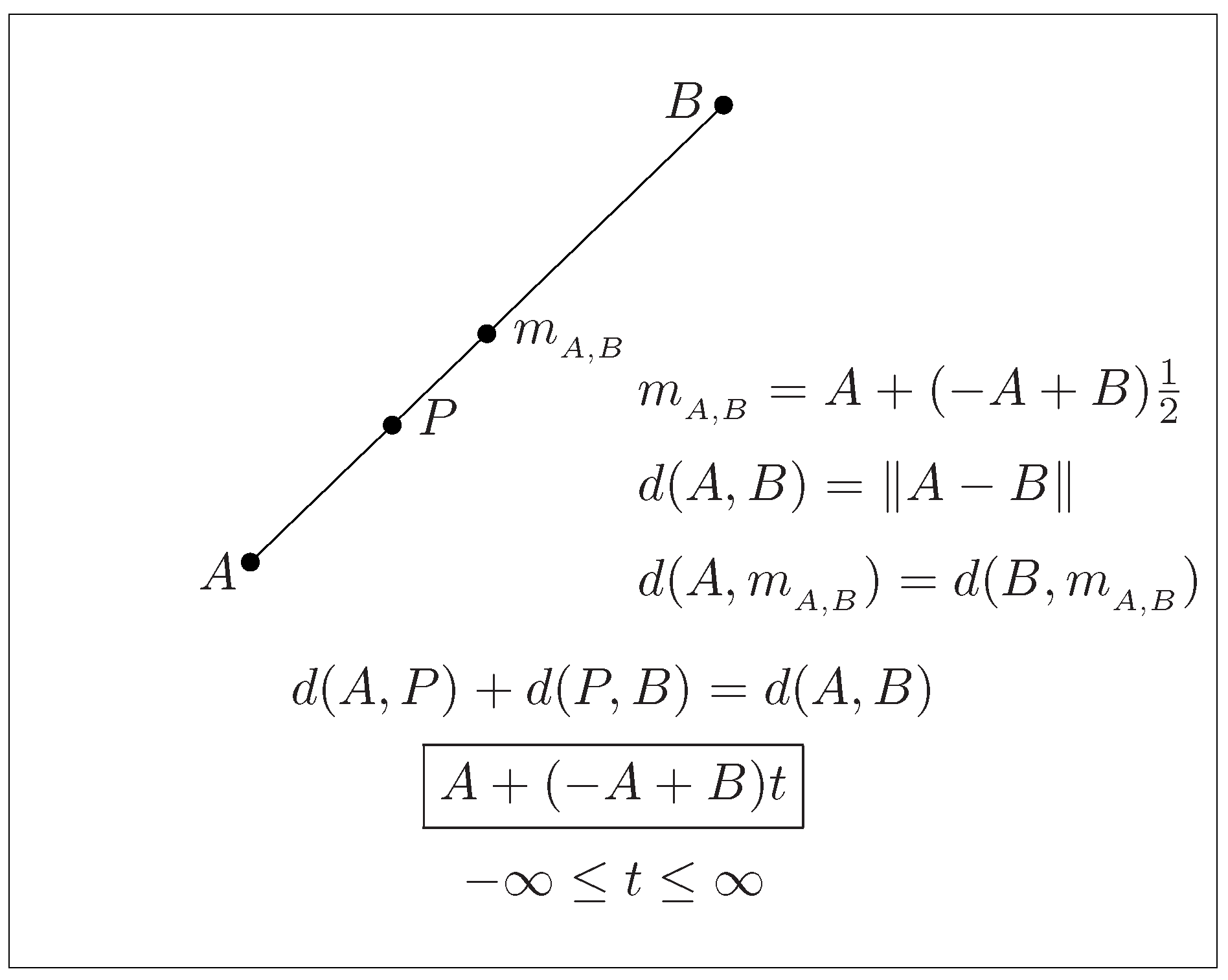
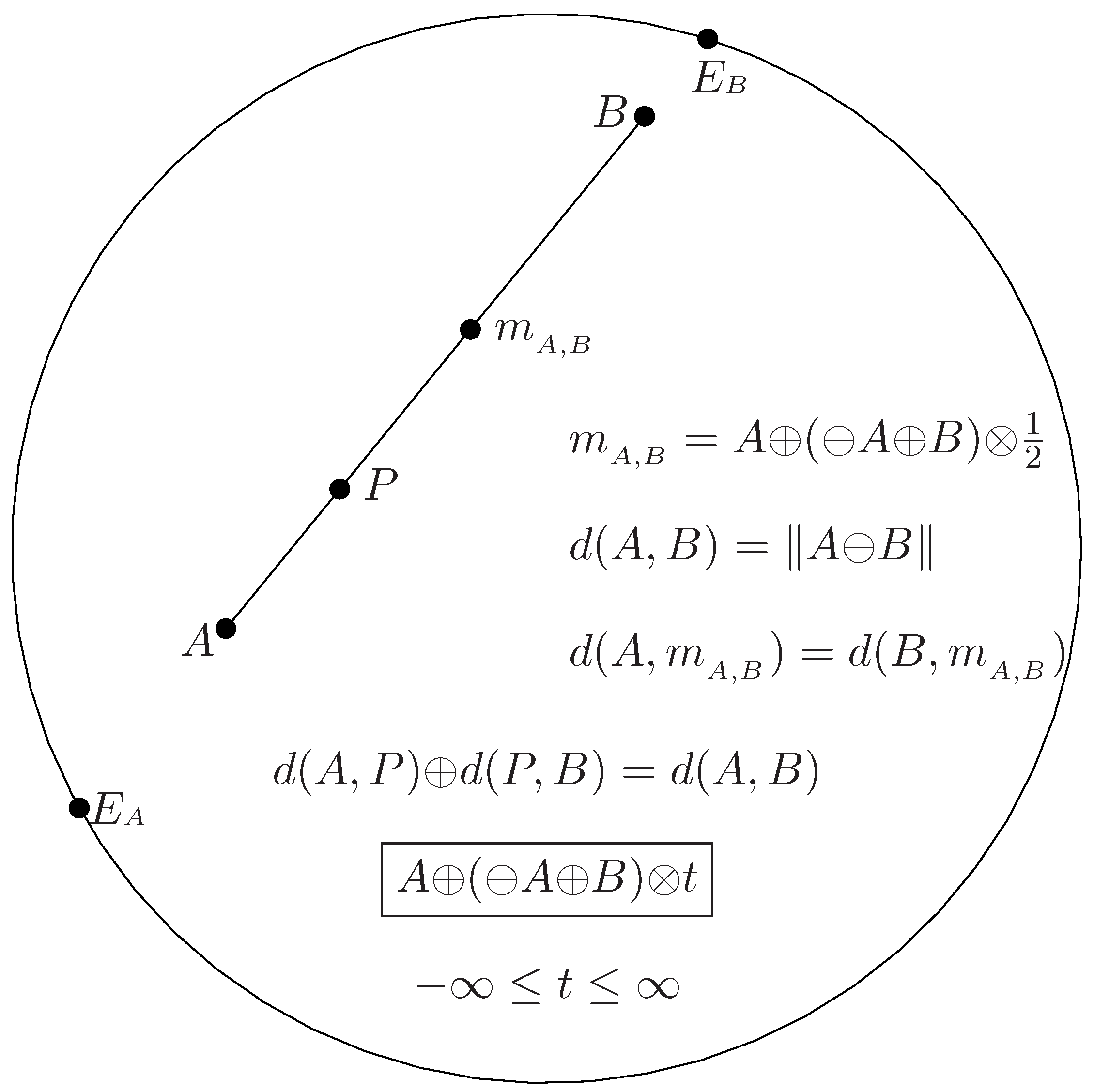
Einstein addition admits scalar multiplication between real numbers and relativistically admissible velocity vectors, giving rise to Einstein gyrovector spaces. As an example, Einstein scalar multiplication enables hyperbolic lines to be determined analytically (see Figure 2), just as Euclidean lines are commonly determined analytically (see Figure 1). Along with Remarkable analogies that Einstein scalar multiplication shares with the common scalar multiplication in vector spaces there is a striking disanalogy. Einstein scalar multiplication does not distribute over Einstein addition. However, a weaker law, called the monodistributive law, remains valid. Einstein gyrovector spaces form the algebraic setting for the Cartesian–Beltrami–Klein ball model of hyperbolic geometry, just as how vector spaces form the algebraic setting for the standard Cartesian model of Euclidean geometry.
Guided by properties of Einstein scalar multiplication, the formal Definition of real inner product gyrovector spaces (gyrovector spaces in short) follows in Definition 6.
Definition 5 (Real Inner Product Vector Spaces).
A real inner product vector space (vector space, in short) is a real vector space together with a map called a real inner product, satisfying the following properties for all and
:
- (1)
, with equality if, and only if,.
- (2)
- (3)
- (4)
.
The norm of is given by the equation .
Note that the properties of vector spaces imply (i) the Cauchy–Schwarz inequality
for all
; and (ii) the
positive definiteness of the inner product, according to which
for all
implies
[
32].
Definition 6 (Real Inner Product Gyrovector Spaces ([
9], Definition 3.2)).
A real inner product gyrovector space (
gyrovector space, in short) is a gyrocommutative gyrogroup that obeys the following axioms:- (1)
is a subset of a real inner product vector spacecalled the ambient space of G,, from which it inherits its inner product, ·, and norm,, which are invariant under gyroautomorphisms, that is,
- (V1)
Inner Product Gyroinvariance
for all points.
- (2)
admits a scalar multiplication, ⊗, possessing the following properties. For all real numbers and all points :
- (V2)
Identity Scalar Multiplication
- (V3)
Scalar Distributive Law
- (V4)
Scalar Associative Law
- (V5)
,
Scaling Property
- (V6)
Gyroautomorphism Property
- (V7)
Identity Gyroautomorphism.
- (3)
Real, one-dimensional vector space structurefor the setof one-dimensional “vectors” (see, for instance, [33]) - (V8)
Vector Space
with vector addition ⊕ and scalar multiplication ⊗, such that for all and ,
- (V9)
Homogeneity Property
- (V10)
Gyrotriangle Inequality.
Remark 1. We use the notation , and . Our ambiguous use of ⊕ and ⊗ in Definition 6 as interrelated operations in the gyrovector space and in its associated vector space should raise no confusion since the sets in which these operations operate are always clear from the context. These operations in the former (gyrovector space ) are nonassociative–nondistributive gyrovector space operations, and in the latter (vector space ) are associative–distributive vector space operations. Additionally, the gyro-addition ⊕ is gyrocommutative in the former and commutative in the latter.
While each of the operations ⊕ and ⊗ has distinct interpretations in the gyrovector space G and in the vector space , they are related to one another by the gyrovector space axioms and . The analogies that conventions about the ambiguous use of ⊕ and ⊗ in G and share with similar vector space conventions are obvious. Indeed, in vector spaces we use (i) the same notation, +, for the addition operation between vectors and between their magnitudes, and (ii) the same notation for the scalar multiplication between two scalars and between a scalar and a vector. In full analogy, in gyrovector spaces we use (i) the same notation, ⊕, for the gyroaddition operation between gyrovectors and between their magnitudes, in (V10), and (ii) the same notation, ⊗, for the scalar gyromultiplication between two scalars and between a scalar and a gyrovector, in (V9).
Immediate consequences of the gyrovector space axioms are presented in the following Theorem.
Theorem 1. Letbe a gyrovector space whose ambient vector space is, and letandbe the neutral elements of, and, respectively. Then, for all, , and
- (1)
- (2)
(n terms).
- (3)
- (4)
- (5)
- (6)
- (7)
- (8)
.
Proof. (1) follows from the scalar distributive law
,
- (2)
follows from
, and the scalar distributive law
. Indeed, with “
…” signifying “
n terms”, we have
- (3)
results from (1) and the scalar distributive law
,
implying
.
- (4)
results from (3) and the scalar associative law,
- (5)
follows from (1),
,
, (3),
- (6)
follows from (3), the homogeneity property
, and
,
- (7)
results from (5),
, and
as follows.
implying
in the vector space
. This equation,
, is valid in the vector space
as well, where it implies
.
- (8)
results from the following considerations. Suppose
, but
. Then, by
,
and (5) we have
The proof is thus complete. □
Clearly, in the special case when all the gyrations of a gyrovector space are trivial, the gyrovector space descends to a vector space.
In general, gyroaddition does not distribute with scalar multiplication,
However, gyrovector spaces possess a weak distributive law, called the monodistributive law, presented in the following Theorem.
Theorem 2 (The Monodistributive Law).
A gyrovector space possesses the monodistributive lawfor all and . Proof. The proof follows from the scalar distributive law
and the scalar associative law
,
□
6. Einstein Gyrovector Spaces
The rich structure of Einstein addition is not limited to its gyrocommutative gyrogroup structure. Indeed, Einstein addition admits scalar multiplication, giving rise to the Einstein gyrovector space. Remarkably, the resulting Einstein gyrovector spaces form the algebraic setting for the Cartesian–Beltrami–Klein ball model of hyperbolic geometry, just as vector spaces form the algebraic setting for the standard Cartesian model of Euclidean geometry.
Let
(
k terms) be the Einstein addition, (
2), of
k copies of
, defined inductively as
for any
. Then,
The Definition of scalar multiplication in an Einstein gyrovector space requires analytically continuing
k off the positive integers. Accordingly, the integer multiplication (
22) suggests the following Definition of scalar multiplication.
Definition 7 (Einstein Scalar Multiplication; Einstein Gyrovector Spaces).
An Einstein gyrovector space is an Einstein gyrogroup with scalar multiplication ⊗ given bywhere r is any real number, , , , and , and with which we use the notation . Einstein gyrovector spaces turn out to be concrete realizations of the abstract gyrovector space in Definition 6. In fact, Definition 6 is motivated by considering key features of Einstein addition and scalar multiplication as axioms.
7. Linking Einstein Addition to Hyperbolic Geometry
The Einstein distance function,
in an Einstein gyrovector space
is given by the equation
. We call it a
gyrodistance function in order to emphasize the analogies it shares with its Euclidean counterpart, the distance function
in
. Among these analogies is the gyrotriangle inequality according to which ([
4], Theorem 3.46)
for all
.
In a two-dimensional Einstein gyrovector space
the squared gyrodistance between a point
and an infinitesimally nearby point
,
, is defined by the equation ([
4], Section 7.5) ([
3], Section 7.5) ([
5], Section 7.5)
where, if we use the notation
, we have
The triple
along with
is known in differential geometry as the metric tensor
[
34]. It turns out to be the metric tensor of the Beltrami–Klein disc model of hyperbolic geometry ([
35], p. 220). Hence,
in (
26) and (
27) is the Riemannian line element of the Beltrami–Klein disc model of hyperbolic geometry, linked to Einstein velocity addition (
2), and to Einstein gyrodistance function (
24) [
36].
The link between Einstein gyrovector spaces and the Beltrami–Klein ball model of hyperbolic geometry, already anticipated by Fock ([
18], p. 39), has thus been established in (
24)–(
27) in two dimensions. The extension of the link to higher dimensions is presented in ([
2], Section 9, Chaper 3), ([
3], Section 7.5), ([
4], Section 7.5) and [
36]. For a brief account of the history of linking Einstein’s velocity addition law with hyperbolic geometry, see ([
37], p. 943). A study of Einstein addition within the framework of differential geometry is presented in [
38,
39,
40].
8. Euclidean Lines
In order to set the road to lines in analytic hyperbolic geometry, in this section we present analytically the well-known Euclidean lines. We introduce Cartesian coordinates into in the usual way in order to specify uniquely each point P of the Euclidean n-space by an n-tuple of real numbers, called the coordinates, or components, of P. Cartesian coordinates provide a method of indicating the position of points and rendering graphs on a two-dimensional Euclidean plane and in a three-dimensional Euclidean space .
As an example,
Figure 1 presents a Euclidean plane
equipped with an unseen Cartesian coordinate system
. The position of points
A and
B and their midpoint
with respect to
are shown. The missing Cartesian coordinates in
Figure 1 are shown in ([
9], Figure 3.3).
The set of all points
, forms a Euclidean line. The segment
on this line, corresponding to
, and a generic point
P on the segment, are shown in
Figure 1. Being collinear, the points
and
B obey the triangle equality
where
is the Euclidean distance function in
.
Figure 1 demonstrates the use of the standard Cartesian model of Euclidean geometry for graphical presentations. In a fully analogous way, Figure 2 demonstrates the use of the Cartesian–Beltrami–Klein model of hyperbolic geometry, as we will see in
Section 9.
9. Gyrolines—The Hyperbolic Lines
Let
be two distinct points of the Einstein gyrovector space
, and let
be a real parameter. Then, in full analogy with the Euclidean line (
28), shown in
Figure 1, the graph of the set of all points
, in the Einstein gyrovector space
is a chord of the ball
. This chord is a geodesic line of the Cartesian–Beltrami–Klein ball model of hyperbolic geometry, shown in
Figure 2 for
. The geodesic line (
31) is the unique geodesic passing through the points
A and
B. It passes through the point
A when
and, owing to the left cancellation law in (
7), it passes through the point
B when
. Furthermore, it passes through the midpoint
of
A and
B when
. Accordingly, the
gyrosegment that joins the points
A and
B in
Figure 2 is obtained from the gyroline (
31) with
.
Each point of (
31) with
is said to lie
between A and
B. Thus, for instance, the point
P in
Figure 2 lies between the points
A and
B. As such, the points
A,
P and
B obey the
gyrotriangle equality according to which
where
is the hyperbolic distance function in
, called the
gyrodistance function, in full analogy with the triangle equality (
29) in Euclidean geometry shown in
Figure 1. The points in
Figure 2 are drawn with respect to an unseen Cartesian coordinate system. The missing Cartesian coordinates for the hyperbolic disc in
Figure 2 are shown in ([
9], Figure 3.4).
10. Gyroangles—The Hyperbolic Angles
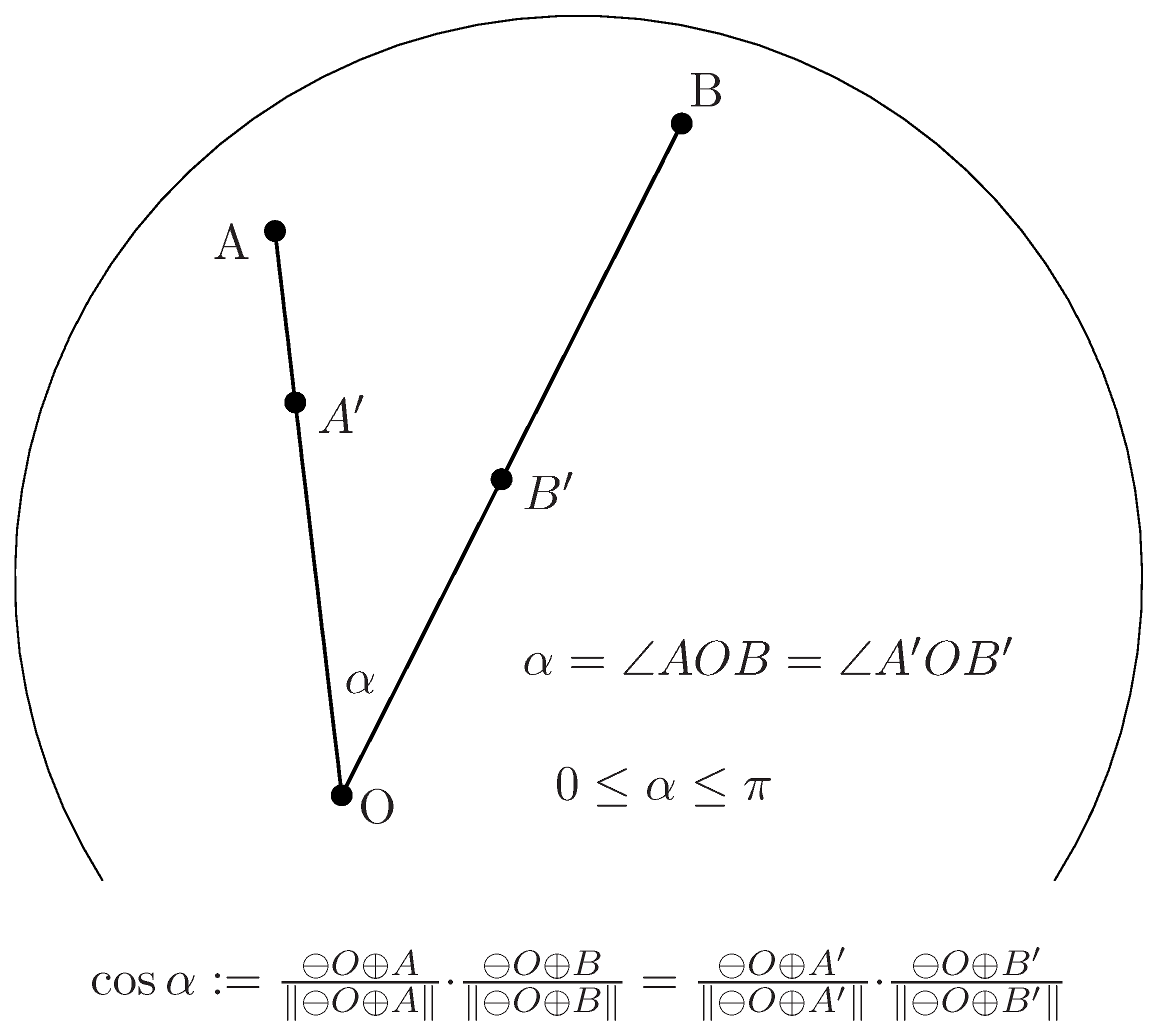
Viewed in the Euclidean plane, the angle
in
Figure 3 is given by the equation
We wish to find the analogous counterpart of (
34) in the hyperbolic plane, in order to translate the common trigonometry in the Euclidean plane into gyrotrigonometry in the hyperbolic plane.
The analogies between lines and gyrolines boil down to the translation of + and − into ⊕ and ⊖. These, in turn, suggest corresponding analogies between angles and gyroangles. Indeed, in full analogy with the notions of distance and angle, the notion of the gyroangle is deduced from the notion of the gyrodistance. Let
O,
A and
B be any three distinct points in an Einstein gyrovector space
. The resulting gyrosegments
and
that emanate from the point
O include a gyroangle
with vertex
O, as shown in
Figure 3 for
.
Following the analogies between gyrolines and lines, the radian measure of gyroangle
in
Figure 3 is, suggestively, given by the equation
Here,
and
are unit
gyrovectors, and cos is the common cosine function of trigonometry, which we apply to the inner product between unit gyrovectors rather than unit vectors. Accordingly, in the context of gyrovector spaces rather than vector spaces, we refer the function “cosine” of trigonometry to as the function “gyrocosine” of gyrotrigonometry. Similarly, all the other elementary trigonometric functions and their interrelationships survive unimpaired in their transition from the common trigonometry in Euclidean spaces
to a corresponding gyrotrigonometry in Einstein gyrovector spaces
, as demonstrated in ([
9], Chaper 7).
The center
of the ball
is conformal (to Euclidean geometry) in the sense that the measure of any gyroangle with vertex
is equal to the measure of its Euclidean counterpart. Indeed, if
then (
35) descends to
which is indistinguishable from its Euclidean counterpart.
We thus encounter the
cosine—gyrocosine duality, according to which
can be viewed simultaneously as (i) the cosine of an angle
; and as (ii) the gyrocosine of a gyroangle
. More about the trigonometric–gyrotrigonometric duality is presented in
Section 11. It is this duality that enables Ptolemy’s Theorem to be translated from Euclidean geometry into hyperbolic geometry, as we will see in Secttions
Section 13 and
Section 14.
Unlike Euclidean geometry, where the differences
and
are equal, in general, the gyrodifferences
and
are distinct. The presence of the gyrodifferences
and
in the gyroangle (
35), rather then
and
, is dictated by the demand that gyroangles must be
gyroinvariant, that is, invariant under gyromotions. Being invariant under the gyromotions of
, which are left gyrotranslations and rotations about the origin, gyroangles gain geometric significance, so that they are geometric objects of the hyperbolic geometry of the Einstein gyrovector space
. In more detail, this study is found in ([
9], Chaper 3).
11. Trigonometry—Gyrotrigonometry Duality
The special positions of a gyroangle are positions where the gyroangle vertex coincides with the origin
O of its gyrovector space. The measure of a gyroangle in a special position in
equals its measure when viewed as a corresponding angle in the Euclidean geometry of
, as demonstrated in (
36). Hence, the origin of an Einstein gyrovector space
is said to be
conformal.
The result that every gyroangle can be left gyrotranslated without distortion to special positions where it can be viewed, without distorting its measure, as a Euclidean angle is crucially important in the gyrotrigonometry of Einstein gyrovector spaces. It implies that every trigonometric identity of trigonometric functions remains valid in gyrotrigonometry, giving rise to a corresponding gyrotrigonometric identity of gyrotrigonometric functions. Accordingly, we refer to these identities as trigonometric/gyrotrigonometric identities.
Thus, for instance, the familiar trigonometric identities
, are valid trigonometrically, where
is given by (
34). Remarkably, they remain valid gyrotrigonometrically as well, where
is given by (
35).
To see that trigonometric identities such as (
37) remain valid in gyrotrigonometry, we left gyrotranslate the gyroangle
to a special position, where it can be viewed as an angle satisfying (
37). This angle
can be left gyrotranslated back to its original position, where it can no longer be viewed as an angle. However, since gyroangles are invariant under left gyrotranslations, gyroangle
still obeys (
37) regardless of whether it is located in a special position. Accordingly, one can use a computer algebra system for symbolic manipulation, like Mathematica or Maple, to manipulate gyrotrigonometric expressions in gyrotrigonometry. Accordingly, while a computer algebra system such as Mathematica or Maple is designed to deal with symbolic manipulation in trigonometry, it can be used to deal with symbolic manipulation in gyrotrigonometry as well.
As a Remarkable consequence of this intimate relationship between trigonometric and gyrotrigonometric functions, we find in the Ref. [
8] the following result: Gyrobarycentric coordinates of gyrotriangle gyrocenters that are determined in terms of gyrotriangle gyroangles survive unimpaired, in form, in the transition from hyperbolic to Euclidean geometry.
A vivid example of the use of the trigonometry–gyrotrigonometry duality, according to which every trigonometric identity can simultaneously be viewed both trigonometrically and gyrotrigonometrically, is provided by the trigonometric identity
for any
, where
. Identity (
38) can be realized both trigonometrically and gyrotrigonometrically.
Realizing identity (
38) trigonometrically yields in
Section 13 the famous Ptolemy’s Theorem in the Euclidean plane.
In full analogy, realizing identity (
38) gyrotrigonometrically yields in
Section 14 the novel Ptolemy’s Theorem in the hyperbolic plane.
12. The Law of Gyrocosines
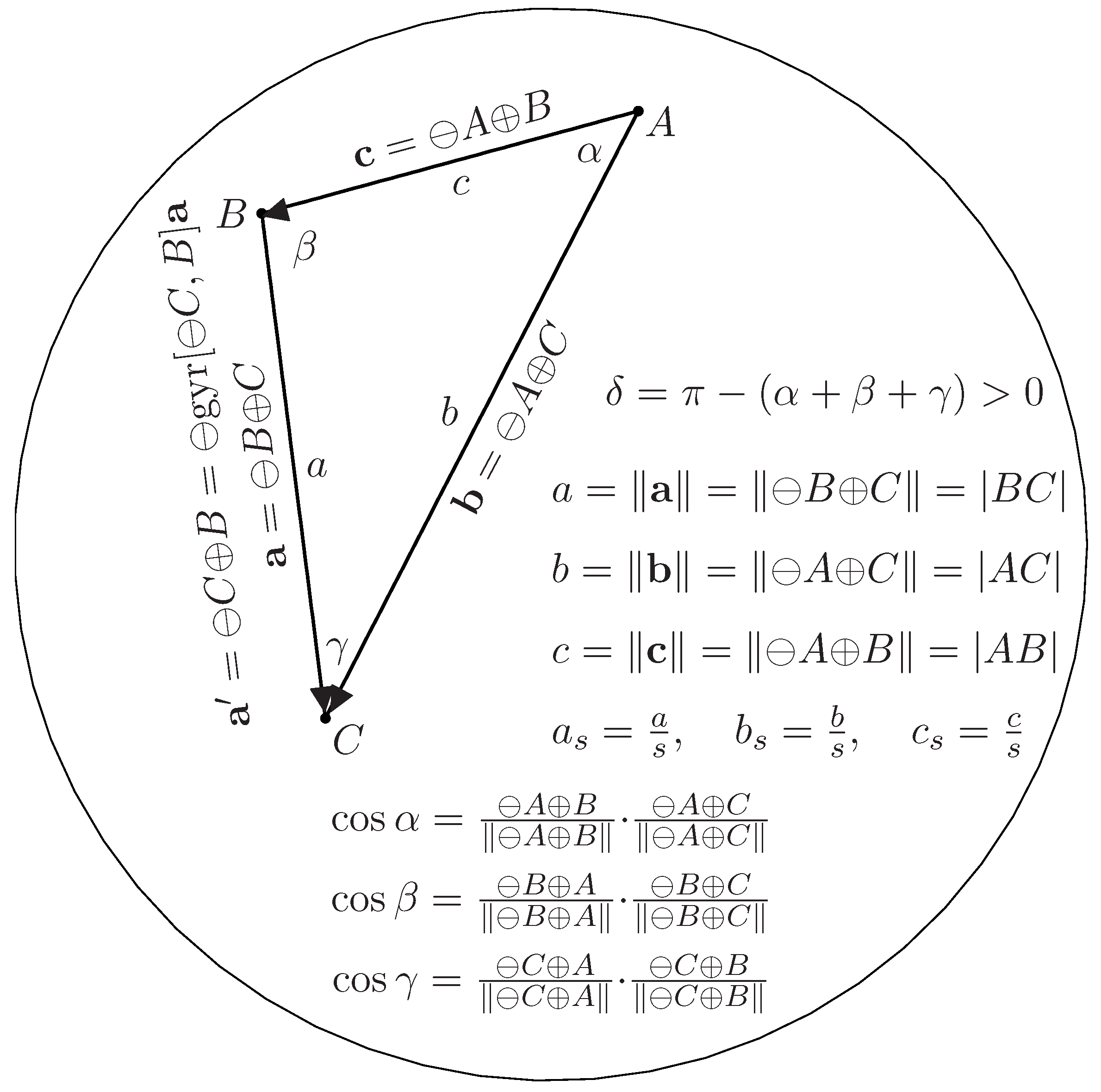
Let
be a gyrotriangle in an Einstein gyrovector space
along with its standard notation shown in
Figure 4. According to ([
9], Section 7.3), the gyrotriangle
obeys the following three identities, each of which represents its
law of gyrocosines,
The elements
and
and the gyroangles
in the law of gyrocosines (
39) are defined in
Figure 4. The gamma factors in (
39) are defined in (
3).
In
Section 13 we will apply the common law of cosines in trigonometry and, in full analogy, In
Section 14 we will apply the law of gyrocosines (
39) in gyrotrigonometry.
13. Ptolemy’s Theorem in the Euclidean Plane
The proof of the hyperbolic Ptolemy’s Theorem is a vivid example of the use of the trigonometry–gyrotrigonometry duality.
Let us consider the trigonometric identity
for all angles
, where
. Note that owing to the condition
the angle
can be replaced with the angle
in (
40).
In this section we show that the trigonometric identity (
40) is equivalent to Ptolemy’s Theorem in the Euclidean plane, described in
Figure 5.
Being a trigonometric identity, (
40) can be viewed as a gyrotrigonometric identity as well, as explained in
Section 11.
In
Section 14 we will show that Identity (
40), viewed gyrotrigonometrically, gives rise to the hyperbolic Ptolemy’s Theorem in the hyperbolic plane.
In the context of Euclidean geometry, we use the notation
for any
. Let
be four points such that
is a cyclic quadrilateral inscribed in a circle centered at
O with radius
in a Euclidean plane, as shown in
Figure 5.
As indicated in
Figure 5 and
Figure 6,
are points lying on a circle and so arranged that the order of the points as one traverses the circle either anticlockwise or clockwise, as shown. Accordingly, the sides
and
do not intersect inside the circle.
Then, by the law of cosines, applied to triangle
in
Figure 5, we have
Accordingly, in the notation of
Figure 5, we have
By means of (
44) and (
40) we obtain Identity (
45) of the following Ptolemy’s Theorem.
Theorem 3 (Ptolemy’s Theorem in the Eucledean Plane).
Let be a cyclic quadrilateral, shown in Figure 5. Then, the product of the diagonals equals the sum of the products of the opposite sides, that is, In the special case when the two diagonals
and
of the cyclic quadrilateral
in
Figure 5 intersect at the circumcenter
O, we have
,
and
, implying
,
and
. Consequently, in this special case triangle
is right-angled, and Ptolemy’s Identity (
45) descends to the Pythagorean identity
14. Ptolemy’s Theorem in the Hyperbolic Plane
Identity (
40) is viewed in
Section 13 trigonometrically. Contrastingly, in this section we view it gyrotrigonometrically.
Accordingly, let us consider the gyrotrigonometric identity
for all gyroangles
, where
. Note that owing to the condition
the gyroangle
can be replaced with the gyroangle
in (
47).
In this section we show that the gyrotrigonometric identity (
47) gives rise to Ptolemy’s Theorem in the hyperbolic plane.
In full analogy with (
41), in the context of hyperbolic geometry we use the notation
for any
, where ⊕ denotes Einstein addition in
.
It should be noted that in the Euclidean limit,
, the hyperbolic
, given by (
48), descends to the Euclidean
, given by (
41), since
Let
be four points such that
is a gyrocyclic gyroquadrilateral inscribed in a gyrocircle gyrocentered at
O, with gyroradius
in the hyperbolic plane regulated by the Einstein gyrovector plane
, as shown in
Figure 6.
Then, by the law of gyrocosines (
39) applied to gyrotriangle
in
Figure 6, we have
where we use the usual notation
and
,
.
Solving (
50) for
, noting (
4), yields
so that
and, hence,
Repeating the result in (
53) to the
O-gyrovertex gyroangles
and
in
Figure 6, where
, yields
By means of (
4) we have
so that
and, hence,
Repeating the result in (
57) to the gyrocircle gyrochords
and
in
Figure 6 yields
where we define
and so forth. We call
the
h-modified
.
The equations in (
54) and (
58) yield
Finally, the gyrotrigonometric identity (
47) along with (
60) yields Identity (
61) of the following Hyperbolic Ptolemy’s Theorem.
Theorem 4 (Ptolemy’s Theorem in the Hyperbolic Plane).
Let be a gyrocyclic gyroquadrilateral, shown in Figure 6. Then, the product of the h-modified gyrodiagonals equals the sum of the products of the h-modified opposite gyrosides, that is, Clearly, in the Euclidean limit,
, the hyperbolic Ptolemy’s Identity (
61) descends to its Euclidean counterpart (
45).
15. Gyrodiametric Gyrotriangles
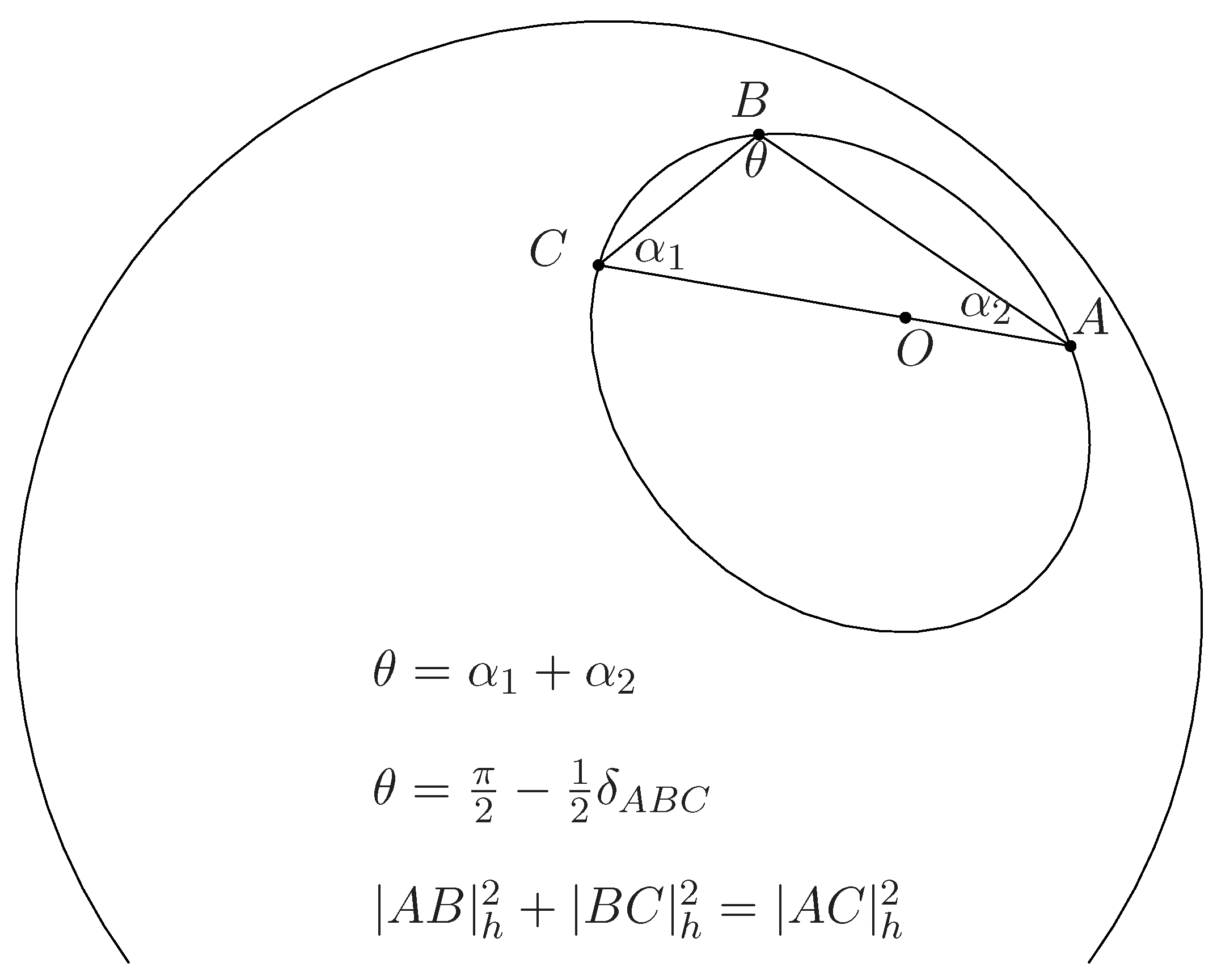
Definition 8. (Gyrodiametric Gyrotriangles).A triangle is diametric if one of its sides coincides with a diameter of its circumcircle. In full analogy, a gyrotriangle is gyrodiametric if one of its gyrosides coincides with a gyrodiameter of its circumgyrocircle.
A diametric triangle is right-angled, the angle opposite to the diametric side being
. In contrast, non-Euclidean gyrodiametric gyrotriangles are not right gyroangled. However, they obey the three equations that are shown in
Figure 7.
The first two properties of gyrodiametric gyrotriangles in
Figure 7 are
where
is the defect of gyrotriangle
. These properties are established in ([
9], Section 8.11). The third property of gyrodiametric gyrotriangles in
Figure 7 is a Pythagorean-like identity. It is established in (
63) as a special case of Ptolemy’s Theorem in the hyperbolic plane.
In the special case when the two gyrodiagonals
and
of the gyrocyclic gyroquadrilateral
in
Figure 6 intersect at the circumgyrocenter
O, we have the gyroangle equalities
,
and
, implying by (
60) the equations
,
and
. Consequently, In this special case the hyperbolic Ptolemy Identity (
61) descends to the Pythagorean-like identity
for the gyrodiametric gyrotriangle
, shown in
Figure 7.
Clearly, in the Euclidean limit,
, the Pythagorean-like identity (
63) descends to the Pythagorean identity (
46).
By means of (
58), the Pythagorean-like identity (
63) can be written as
However, in the Euclidean limit,
, (
64) tends to the trivial identity
.