1. Introduction
For a subset
X of the state space
S of a
-algebra
A we have a positive “state evaluation map”
given by
for
and
. For
the result of Choi [
1] gave the pure state space as
. We use the KSGNS construction [
2] to analyse the case
and
and then consider the differentiability of the state evaluation map. To do this, we begin by constructing the Hilbert
-bimodule giving the state evaluation map. Then, we use the methods of connections on bimodules to connect the differential structure on
(we take the universal calculus) to that on
(the usual calculus). Here, we follow the methods in [
3] but then find that the conditions required there do not apply, so in
Section 5.1 we consider a more general theory extending the results in [
3]. As a result, Proposition 12 on an induced functor from left
-modules to holomorphic bundles on
is phrased in terms of holomorphic bundles rather than flat bundles on
. For brevity, we often refer to
just as
. Additionally, our main result Theorem 1 on extending the state evaluation map to a cochain map uses the
calculus on projective space.
The main reason why we chose to do this construction with
is the concrete construction of the state space. More generally, it might be possible to put a differential structure on the pure state space of a
-algebra, even if we know little about the state space. For this one thing, it is important to remember that there is a very general idea of calculus on infinite dimensional spaces [
4] using directional derivatives. It would be interesting to see whether the constraint of having bimodule connections, similar to the one in this paper, for smooth subalgebras of more general
-algebras would shed light on possible calculi on the algebras.
Apart from the concrete description of the state space, another reason why we are interested in the calculi on matrix algebras and the link with representations and states is Connes’ noncommutative derivation of the standard model [
5]. The fact is that from a relatively simple noncommutative beginning involving matrices Connes constructs the standard model indicates that there probably something very interesting in the geometry of the initial noncommutative space. Most gauge theories in physics are described in terms of calculi, so we are naturally led to questions about calculi on matrices and how they relate to states. The unitary symmetry described in
Section 3.1 is then related to gauge transformations.
The construction of the state evaluation map and its associated bimodule implies the existence of various functors between categories of modules, including one from
modules to holomorphic bundles on
, which is described in
Section 6.
We use the notation that is the column vector with 1 in position i and zero elsewhere, and that in the matrix with 1 in row i and column j and zero elsewhere. An element of is written in homogenous coordinates as , where we suppose . We sum over repeated indices unless otherwise indicated.
2. Preliminaries
2.1. Calculi and Connections
Definition 1. Given a first order calculus on an algebra A, the maximal prolongation calculus has relations for every relation on , where .
Definition 2. The universal first order calculus on a unital algebra A is defined bywhere · is the algebra product and . The maximal prolongation of the universal calculus has
, which is the intersection of all the kernels of the multiplication maps between neighbouring factors, i.e.,
We now assume that the unital algebras A and B have calculi and , respectively.
Definition 3. A right connection on a right B-module E is a linear map obeying the right Leibniz rule for and Definition 4. Given the right connection in Definition 3, we define for by and for The curvature of E is the right bimodule mapand then for The idea of a bimodule connection was introduced in [
6,
7,
8] and used in [
9,
10]. It was used to construct connections on tensor products in [
11] (see Proposition 1).
Definition 5. If E is an A-B bimodule, then is a right bimodule connection where is a right connection and there is a bimodule mapso that 2.2. Hilbert Bimodules
Note that, unlike most of the literature on Hilbert -modules, we explicitly use conjugate bundles and modules. This is required to make the usual tensor products and connections work with inner products. Suppose that A and B are *-algebras. For a left A-module is the conjugate vector space with right A-action , and for a right A module F, is the conjugate vector space with left A-action . For our A-B module E, is a B-A bimodule with and .
Definition 6. A differential calculus on a *-algebra A is a *-differential calculus if there are antilinear operators so that where is the degree of η, i.e., and .
We now suppose that A and B have *-calculi. Then, for our right bimodule connection , we have a corresponding left bimodule connection on given by where (sum implicit) and where .
We give a definition of inner product on an
A-
B bimodule
E, where
A and
B are *-algebras. This is taken from the definition of Hilbert bimodules in [
2], omitting norms and completion as we will need smooth function algebras. Of course, the modules with inner product we will talk about have completions which really are Hilbert bimodules.
Definition 7. -valued inner product on an A-B bimodule E is a B-bimodule map obeying for all (the Hermitian condition) and and only where .
Given an inner product
the right connection
preserves the inner product if
2.3. Line Bundles and Calculus in
On
we have homogenous coordinates
for
. We take
to lie on the sphere
in
, i.e.,
. There is an action of the unit norm complex numbers
on
by
We define
as
quotiented by this circle action, identifying points
for all
. We use notation
for the equivalence classes. We consider subsets of continuous functions on
, defining for integer
m
and similarly
to be smooth functions. Then,
is the usual smooth functions on
. There is an alternative view given by grading monomials in
and
by
and
. Then, a monomial of grade
m is in
. A grade zero monomial such as
is invariant for the circle action and so gives a function on
.
An element of the tautological bundle
at
is given by
for
and the inner product on
is given by
noting the use of the conjugate bundle to give bilinearity and be consistent with the earlier Hilbert
-bimodule inner product. A section of the tautological bundle is a function
so that
is a multiple of
. We have a
correspondence between continuous sections of
and
. If
, then
is a section, and if
is a section, then
is in
.
Recalling that and applying gives , and as we require a complex calculus on , we obtain both and as relations on . Applying again gives in .
2.4. Categories of Modules and Connections
For an algebra
A, we take
to be the category of right
A-modules and right module maps. If
A has a differential calculus, we take
to be the category with objects
, where
E is a right
A-module and
is a right connection on
E. A morphism
T from
to be
consists of a right module map
, which commutes with the connections, i.e.,
Proposition 1. For a right A-B bimodule connection , there is a functor sending to , where is 2.5. Holomorphic Bundles
Let
B be a *-algebra with a *-differential calculus. We use the noncommutative complex calculi from [
12,
13]. Suppose we have a direct sum decomposition
as bimodules, and that
;
; and
. Using the projection operations for the direct sum
, we can define
which gives a holomorphic calculus. Given a right connection
, then we define
. The holomorphic curvature of
G is defined to be the curvature of the
connection, i.e.,
Definition 8. Suppose that we have a right connection with holomorphic curvature zero. Then, is called a holomorphic right module.
3. The KSGNS Construction of the State Evaluation Map
For a subset
of the state spaces of a
-algebra
A, the positive map
is given by
for
and
. We use a standard construction of a completely positive map using a Hilbert
-bimodule, and this is part of the KSGNS construction [
2]. We start with
as an
A-
bimodule and the semi-inner product
defined by
Set
N to be the space of zero length vectors, i.e.,
so that
Now, we define
. This has completion a Hilbert
A-
-bimodule, and given
, we have
3.1. The Matrix Algebra Case
The pure states on
are parametrised by
by
where
for normalisation [
1]. Because scalar multiplication of
by a unit norm complex number leaves the state unaffected the space of pure states is the quotient
of unit vectors in
, i.e.,
quotiented by the circle group
. We take the positive map
defined by
for
.
There is a unitary symmetry of the matrix algebra by inner automorphisms for and . There is also a action on the pure state space given by for . The map intertwines these actions.
We carry out the KSGNS construction given at the beginning of this section for
. We write
as
, which are isomorphic as
is finite dimensional. For
, the inner product in (
4) is
for
, a row vector representing an element
of
.
Proposition 2. The quotient ofby the length zero vectors N is isomorphic to, where is the continuous sections of the tautological bundle τ.
Proof. For
, we look at the conditions for
to be in
N, which is
using (
6). Using the projection matrix
, we see that
just using the fact
(summing over
i). Thus, the null space
N includes all
, and the only possible non-null elements are
, which is
where
s is a multiple of
. A quick check shows that all these are not null (except 0). □
The sections
of
are identified with
, and so we have
with inner product
and this a Hilbert
-
-bimodule. Finally, we consider
and find
under our isomorphism from Proposition 2. Take
to be the column vector with 1 in position
i and zero elsewhere. Then, in
corresponds to
summing over
i. Using the isomorphism from
Section 2.3 between
and
,
corresponds to
summing over
i. Under the isomorphism, we adapt (
5) to give
, for
and this is the state evaluation map.
5. Differentiating Positive Maps
We wish to extend the map
defined by
in (
8) to a map of differential forms
. A theory of how to do this is set down in [
3], (using left instead of right connections), but it assumes conditions on the curvature that we do not have and results in a cochain map, so we need to be more careful and give a more general account of the theory, beginning with how
extends to a map of differential forms, with general algebras
, and bimodule
W.
5.1. General Theory of Extendability and Curvature
We begin with a right handed version of Lemma 3.72 in [
3]. For algebras
with calculi, we suppose that
is a bimodule connection on an
A-
B bimodule
W. The curvature
of a right bimodule connection must be a right module map but not necessarily a bimodule map.
Lemma 1. Given an A-B bimodule W with a right bimodule connection and , for the curvature, we have Proof. Now, multiply the first equation in the statement by
to obtain
and use the definition of
again to obtain the second equation. □
The following definition is a right version of extendability from [
3].
Definition 9. Given an A-B bimodule W with a right bimodule connection and , we say that is extendable if extends to a map such that for all Corollary 1. The in Lemma 1 is extendable for the maximal prolongation calculus if and only if, for all , with Proof. To define a map
by (
25) where
,
, we require the RHS of (
25) to vanish for all
(summation implicit). This is easiest if we have as few relations
as possible; thus we consider the maximal prolongation. In more detail, if we have
in
then
is in the kernel of ∧ and we then have from Lemma 1
Thus, we need to show that for all
we have the LHS of (
27) vanishing. □
Corollary 2. Either of the following conditions imply the condition (
26)
in Corollary 1: - (a)
is a left module map,
- (b)
is the universal calculus.
Proof. (a) is obvious from Corollary 1. For (b), by definition of the first order universal calculus, we have
and if this vanishes, then so does the LHS of (
27). □
Now, we assume extendability for and work out the consequences.
Proposition 4. Given the conditions of Lemma 1 and assuming that is extendable, the map defined byis a well defined bimodule map, and For the derivative of , we have Proof. To check that it is well defined, we use
by Definition 9. To check that it is a right module map we use, where
To check that it is a left module map we use
To verify the product rule for
, consider
and use the Leibniz rule for
and extendability. For the last formula (
30), we use
and standard manipulations. Recall that
is not necessarily a left module map, but use of (
29) shows that (
30) is well defined on
. □
Now suppose that
A and
B are *-algebras with *-calculi. Given an inner product
, which is preserved by
, we extend
defined by
where
to
by
Under the more restrictive conditions where
is a bimodule map [
3]
would be a cochain map. However, more generally we find a correction term.
Proposition 5. Assume the conditions of 1 and that is extendable. If and preserves the inner product then Proof. Apply (
28) to the formula obtained by differentiating (
32). □
In Proposition 1, we see that under the condition of Lemma 1 there is a functor
from
to
, using the specified connection on the tensor product. We would like to calculate the curvature of this tensor product connection, but as we noted before the curvature of
W is not necessarily a left module map, so we need more generality than in [
3].
Proposition 6. If and is an extendable right bimodule connection on then the curvature of the tensor product connection is Note: The first and last terms are not well defined on , only their sum is.
Proof. Standard manipulation. □
5.2. Applications to the State Map on Matrices
We return to our specific case of matrices, projective space and bimodule
E. As we are using the universal calculus for matrices, by Corollary 2 we know that
from
Section 4.1 is extendable. It will be convenient to extend the domain of definition of
given in Proposition 3 from
to
, etc.
Proposition 7. Regarding as a subset of , we find the formulawhich restricts to the extension offrom Section 4.1 given by Proof. By induction. From Proposition 3, the formula works for
. Assume that it works for
m, and then for
, given
and
Now, put
to obtain
and this is exactly what the formula gives on applying
to
given
□
We can now extend the state evaluation map
from (
5) and (
8) to forms by using (
32).
Corollary 3. The function is given bysumming over . Proposition 8. Similarly to , we can calculate an extension of to instead of just , givingand this extends to higher forms bywhere the wedge products alternate in sign and contain exactly one X factor. Proof. We use (
14) and (
31) to find the first equation, using
The rest is a proof by induction, similar to Proposition 7 using Proposition 4. □
6. Matrix Modules and Sheaves on
6.1. Differentiating the State Evaluation Map
We would like the state evaluation map extended to forms in Corollary 3 to be a cochain map, i.e., . However, Proposition 5 gives an additional term that we must evaluate.
Proposition 9. For the usual calculus on projective space, the state evaluation map (8) is not a cochain map to the standard calculus on . Proof. Using Proposition 8 and (
24), we evaluate the last term in (
33)
which is nonzero. Now, if
, then
. □
This may seen disappointing, but it is an opportunity to consider the holomorphic structure or projective space. From Definition 8 and using (
22), we see that
with the connection in
Section 4.1 is a holomorphic bundle over
.
Theorem 1. For the calculus on and the universal calculus on the state evaluation map (2) and its extension to forms in Corollary 3 is a cochain map. Proof. Proposition 5 will give the result if the
then gives zero in the
calculus. This can be seen from Proposition 8 and (
24). □
Using the calculus on raises the possibility that the bimodule could be use to give a functor from modules on . First, we need to consider modules with connection.
6.2. Connections on Right Modules over
In this subsection and the next, we take to be the row vector with 1 in position i and zero elsewhere.
Proposition 10. Take the right module for a vector space V, with action given by the matrix multiplication Then, a general right connection for the universal calculus on isand using the fact that every 1-form on can be written as a sum of , we can writefor linear with . The curvature of the connection is Proof. By using the
, we obtain
where
. We write summing over
,
and for this to be in
we need
, i.e.,
for all
. We will also write
and these are the same under the isomorphism as
The condition to be a right connection is, for all
,
which gives, summing over
This has general solution
where
. □
If we take to be the category of left modules and module maps, then there is a functor to the category of right modules with right connections for the universal calculus. This is given by , and this is given the connection in Proposition 10, where we define by the right action . The condition is simply . Note that this will not give the most general for Proposition 10, but the restriction to certain is what we need in the next part.
6.3. Induced Holomorphic Bundles on
From Proposition 1, we know that there is a functor
from
to
. At the end of the last section, we had a functor from
to
, and of course these can be composed. However, we know that the state evaluation map
is not a cochain map for the ordinary calculus on
(using the choice of connection in
Section 4.2), but it is for the
calculus. It is then natural to ask if we obtain a functor into holomorphic bundles on
. We use
for the projection from
to
.
Given a connection for the calculus
, we can obtain a
connection (see
Section 2.5) simply by composing with
. Then, to ensure that
is a homomorphic bimodule, we require that the
part of its curvature
vanishes.
Proposition 11. The component of the curvature of isand in particular, if then . Proof. From Proposition 6,
splits into three bits, and the
term does not have a
part as computed in (
22). By Proposition 8 and Equation (
24), the last term in the formula for
in Proposition 6 does not have a
part either, so we are left with
Using (
12) twice, we obtain
taking only the
component.
We are left with, using (
37)
and for this to vanish, we need for all
,
If
; then, the result of (
38) is
□
Note that the conditions
, and that in Proposition 11 they correspond to
being the left action of the matrix unit
in a representation of
. Set
as in Proposition 10, then
For
, using (
9), Proposition (10) and (
12)
Note
by
. Look at the last two terms of the last line of (
40) using this isomorphism
by Proposition (10). Thus, we can use the isomorphism to give a connection on
given by
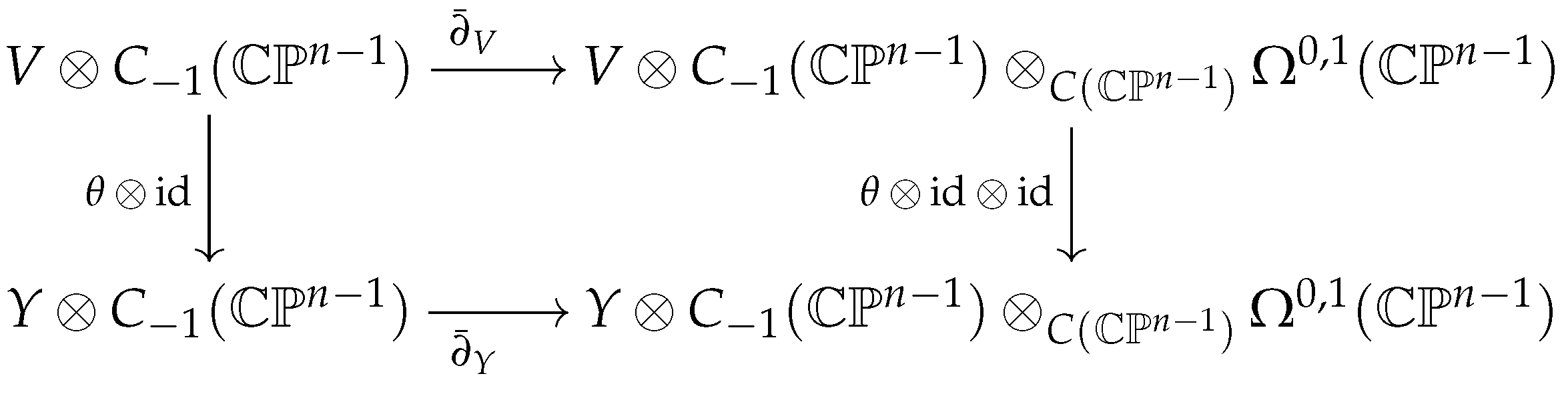
Corollary 4. For the special case of the connection in (23), we findand this splits into a ∂ and a connection Proposition 12. The composition of the given functor and the functor in Section 6.2 gives a functor from to holomorphic bundles on . It is given by V mapping to with the connections given in Corollary 4. Proof. The category of holomorphic bundles is given morphisms being module maps commutating with
operators as in
Section 2.4. Most of this has been proved in the discussion previously. We explicitly check that we have a functor, i.e., that a
module map
gives a commutating diagram
which happens because the
maps commute with
in the formula (
41). □