


Abstract
In this article, the fractional–space stochastic (2+1)-dimensional breaking soliton equation (SFSBSE) is taken into account in the sense of M-Truncated derivative. To get the exact solutions to the SFSBSE, we use the modified F-expansion method. There are several varieties of obtained exact solutions, including trigonometric and hyperbolic functions. The attained solutions of the SFSBSE established in this paper extend a number of previously attained results. Moreover, in order to clarify the influence of multiplicative noise and M-Truncated derivative on the behavior and symmetry of the solutions for the SFSBSE, we employ Matlab to plot three-dimensional and two-dimensional diagrams of the exact fractional–stochastic solutions achieved here. In general, a noise term that destroy the symmetry of the solutions increases the solution’s stability.
Keywords:
fractional breaking soliton equation; stochastic solutions; truncated M-fractional derivative; modified F-expansion method MSC:
35A20; 83C15; 35C05; 35C07; 35C08
1. Introduction
Fractional differential equations (FDEs) are applied to analyze a diverse range of physical phenomena in mathematical biology, signal processing, engineering disciplines, electromagnetic theory, and other scientific studies [1,2,3,4,5]. Furthermore, the fractional-order derivative may be used to depict a broad range of scientific phenomena, such as heat, elasticity, fluid dynamics, quantum mechanics, gravity, electrodynamics, sound electrostatics, and so on. Because of the significance of the fractional-order derivative, numerous definitions have been proposed, including the Riemann-Liouville, Caputo, He’s fractional derivative, beta derivative, truncated M-fractional derivative, the Weyl derivative, Riesz, Grunwald-Letnikov, and conformable fractional definitions [6,7,8,9,10,11,12,13].
Sousa et al. [13] have proposed a new fractional derivative titled truncated M-fractional derivative. From here, we define the truncated M-fractional derivative for function of order as follows:
where the truncated Mittag-Leffler function for and , is defined as
For any constants a and b, the truncated M-fractional derivative fulfills the following features:
Due to the significance of FDEs, a number of strong and effective techniques have been created to determine the exact solutions to these equations. Several of these techniques are -expansion [14,15], Jacobi elliptic function [16], perturbation [17,18], -expansion [19], sine-cosine [20,21] Hirota’s [22], tanh-sech [23,24], Lie symmetry method [25,26,27], Riccati-Bernoulli sub-ODE [28], etc.
On the other hand, in biology, physics, climatic dynamics, geophysics, and other domains, the significance of adding random effects in the study, prediction, and modeling of complex events has acquired considerable interest. In the presence of noise or fluctuations, partial differential equations are perfect mathematical concepts for expressing complex systems [29,30].
Recent study on stochastic FDEs has been examined, for example, [31,32,33,34,35,36], and the references therein. Consequently, it appears that investigating models of FDEs with some random force is more essential. Therefore, we look at the SFSBSE in this type [37]:
where is a real stochastic function of the variable and, is the noise strength, and is a one dimensional Wiener process.
The breaking soliton equations (BSE) explain the (2+1)-dimensional interaction of a Riemann wave moving down the y-axis and a long wave moving along the x-axis. The BSE (1) with and is utilized to clarify the plasma physics, fluid wave leading flow, and hydrodynamic problem of shallow-water waves. Many researchers have derived exact solution to the deterministic breaking soliton problem using different approaches including tanh–coth [38], Hirota bilinear [39], the improved -expansion and the extended tanh-method [40], the three-wave methods [41], the Jacobi elliptic functions [42], -expansion [43], generalized auxiliary equation [44], and the Riccati equation [45]. The exact solutions to the fractional-stochastic breaking soliton equations with the truncated M-fractional derivative and stochastic term have still not been established.
This work aims to elucidate the analytical solutions of the SFSBSE (1). We use the modified F-expansion method to get various kinds of solutions, including the hyperbolic, rational and trigonometric functions. The acquired exact solutions of the SFSBSE (1) established in this paper extend a number of previously attained results, such as the result described in [38,40]. Additionally, the MATLAB tool was used to show certain graphical representations, and we analyzed the influence of the truncated M-fractional derivative and stochastic term on the analytical solutions of the SFSBSE (1).
The structure of this article is as follows: To obtain the SFSBSE’s (1) wave equation, go to the next section. In Section 3, we find the exact solutions of the SFSBSE (1). In Section 4, we investigate how the truncated M-fractional derivative and stochastic term affect the solutions of the SFSBSE (1). Finally, the conclusions of this paper are presented.
2. The SFSBSE’s Wave Equation
The wave equation of the SFSBSE is attained utilizing the next wave transformation
where the real function u is a deterministic, are constants. We note that
Plugging Equation (2) into (1) and utilizing (3), we get
We obtain by considering expectation on both sides of (4)
where the function u is a deterministic. For each real integer and any Gaussian process Z, we see that
Hence, Equation (5) becomes
Integrating Equation (7) once with regard to and ignoring the constant of integral, we attain
Setting
in Equation (8), we have
where
Modified F-Expansion Method
Here, we use the modified F-expansion method. We suppose the solution of Equation (10) takes the form (with ):
where F solves
where is a real constant. The solutions of Equation (12) are:
if or
if or
if
Substituting Equation (11) into Equation (10), we get
Putting the coefficients of each power of F to zero:
and
We attain a four different sets by solving these equations as follows:
First set:
Second set:
Third set:
Fourth set:
First set: The solution of Equation (10) is
For , there are three cases:
Case 1: If then by using (13) we get
and
Thus, the FSQZKE (1), by using Equations (2) and (9), has the solutions
and
where
Case 2: If then by using (14) we get
and
Thus, the FSQZKE (1), by using Equations (2) and (9), has the solutions
and
where
Case 3: If then by using (15) we get
Thus, the FSQZKE (1), by using Equations (2) and (9), has the solution
where
Second set: The solution of Equation (10) in this case is
For , there are three cases:
Case 1: If then by using (13) we get
and
Thus, the FSQZKE (1), by using Equations (2) and (9), has the solutions
and
where
Case 2: If then by using (14) we get
and
Thus, the FSQZKE (1), by using Equations (2) and (9), has the solutions
and
Third set: The solution of Equation (10) is
For , there are three cases:
Case 1: If then by using (13) we get
Thus, the FSQZKE (1), by using Equations (2) and (9), has the solution
Case 2: If then by using (14) we get
Thus, the solution of FSQZKE (1), by using Equations (2) and (9), is
Case 3: If then by using (15) we get
Thus, the solution of FSQZKE (1), by using Equations (2) and (9), is
Fourth set: The solution of Equation (10) is
For , there are three cases:
Case 1: If then by using (13) we get
Thus, the FSQZKE (1), by using Equations (2) and (9), has the solutions
Case 2: If then by using (14) we get
Thus, the solution of FSQZKE (1), by using Equations (2) and (9), is
3. The Impact of M-Truncated Derivative and Noise
Here, we study the impact of the M-truncated derivative and multiplicative noise on the solutions of the SFSBSE (1). We exhibit various figures to show how the behavior of these solutions is affected by the M-truncated derivative and noise. The solutions of (1) are plotted via the MATLAB software. The fixed parameters and , , as well as and , are as follows:
First the impact of noise:
When the noise is ignored (i.e., at ), we can conclude from Figure 1 and Figure 2 that there are various forms of solutions, including periodic solutions, dark solutions, and others. When noise is considered, the surface after minor transit patterns flattens out and gains strength by . This shows that the stochastic term has an effect on the SFSBSE solutions and stabilizes the solutions around zero.

Figure 1.
For Equation (20), with , exhibits the three-dimensional style.
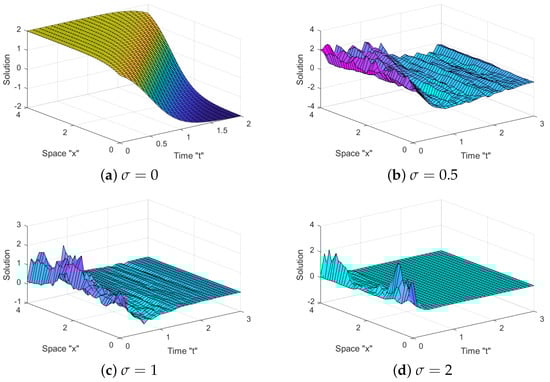
Figure 2.
Equation (22), with , exhibits the three-dimensional style.
Second the impact of the M-truncated derivative:
Finally, we deduced from Figure 3 and Figure 4 that the curves do not overlap. Moreover, the solutions shift to the right as the order of the fractional derivative decreases.
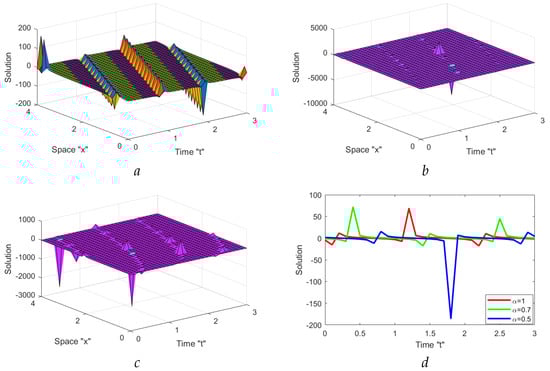
Figure 3.
For Equation (20), (a–c) with parameters , exhibits three-dimensional style, and (d) represents the two-dimensional graph for different values of at , and the solution’s curves do not overlap.and (c) .
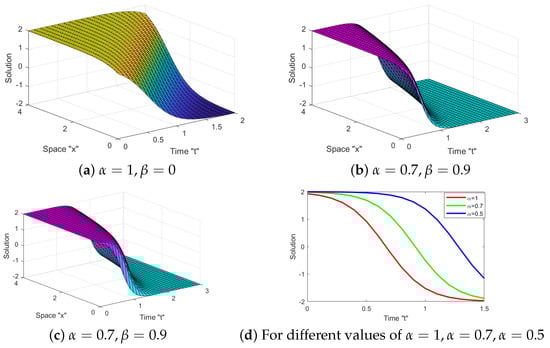
Figure 4.
For Equation (22), (a–c), with parameters , exhibits three-dimensional style, and (d) represents the two-dimensional graph for different values of at , and the solution’s curves do not overlap.
4. Conclusions
In this article, we obtained the exact solutions of the fractional–space stochastic (2+1)-dimensional breaking soliton equation (SFSBSE) in the sense of being M-truncated (1). We applied the modified F-expansion method to obtain the exact solutions of the SFSBSE. The modified F-expansion method works consistently and successfully, and it may be used to solve a wide range of partial differential equations. This method gives us a variety of solutions, including rational, trigonometric, and hyperbolic functions, but it excludes elliptic ones. The obtained exact solutions are far more accurate and necessary in comprehending certain exceedingly complicated physical events. We expanded certain previously obtained results, such as those published in [38,40]. Finally, we demonstrated how the solutions of SFSBSE were impacted by the M-truncated derivative and noise.
Author Contributions
Data curation, M.E.-M., A.E.A., A.M., M.B., E.E.A. and M.E.-M.; Formal analysis, W.W.M., E.E.A. and A.M.; Funding acquisition, A.M., M.B. and E.E.A.; Methodology, W.W.M. and M.E.-M.; Project administration, W.W.M.; Software, W.W.M. and M.E.-M.; Writing—original draft, M.E.-M., A.E.A., A.M., M.B., E.E.A. and M.E.-M.; Writing—review and editing, W.W.M. and M.E.-M. All authors have read and agreed to the published version of the manuscript.
Funding
This research received no external funding.
Data Availability Statement
Not applicable.
Acknowledgments
This research has been funded by Scientific Research Deanship at University of Ha’il-Saudi Arabia through project number RG-21021.
Conflicts of Interest
The authors declare no conflict of interest.
References
- Oldham, K.B.; Spanier, J. The Fractional Calculus: Theory and Applications of Differentiation and Ntegration to Arbitrary Order; Volume 11 of Mathematics in Science and Engineering; Academic Press: New York, NY, USA, 1974. [Google Scholar]
- Mohammed, W.W.; Cesarano, C.; Al-Askar, F.M. Solutions to the (4+1)-Dimensional Time-Fractional Fokas Equation with M-Truncated Derivative. Mathematics 2022, 11, 194. [Google Scholar] [CrossRef]
- Podlubny, I. Fractional Differential Equations, Vol. 198 of Mathematics in Science and Engineering; Academic Press: San Diego, CA, USA, 1999. [Google Scholar]
- Hilfer, R. Applications of Fractional Calculus in Physics; World Scientific Publishing: Singapore, 2000. [Google Scholar]
- Alshammari, M.; Iqbal, N.; Mohammed, W.W.; Botmart, T. The solution of fractional-order system of KdV equations with exponential-decay kernel. Results Phys. 2022, 38, 105615. [Google Scholar] [CrossRef]
- Riesz, M. L’intégrale de Riemann-Liouville et le problème de Cauchy pour l’équation des ondes. Bulletin de la Société Mathématique de France 1939, 67, 153–170. [Google Scholar] [CrossRef]
- Wang, K.L.; Liu, S.Y. He’s fractional derivative and its application for fractional Fornberg-Whitham equation. Therm. Sci. 2016, 1, 54. [Google Scholar] [CrossRef]
- Miller, S.; Ross, B. An Introduction to the Fractional Calculus and Fractional Differential Equations; Wiley: New York, NY, USA, 1993. [Google Scholar]
- Caputo, M.; Fabrizio, M. A new definition of fractional differential without singular kernel. Prog. Fract. Differ. Appl. 2015, 1, 1–13. [Google Scholar]
- Atangana, A.; Baleanu, D. New fractional derivatives with non-local and non-singular kernel. Theory and application to heat transfer model. Therm. Sci. 2016, 20, 763–769. [Google Scholar] [CrossRef]
- Khalil, R.; Horani, M.A.; Yousef, A.; Sababheh, M. A new definition of fractional derivative. J. Comput. Appl. Math. 2014, 264, 65–70. [Google Scholar] [CrossRef]
- Atangana, A.; Baleanu, D.; Alsaedi, A. New properties of conformable derivative. Open Math. 2015, 13, 889–898. [Google Scholar] [CrossRef]
- Sousa, J.V.; de Oliveira, E.C. A new truncated M-fractional derivative type unifying some fractional derivative types with classical properties. Int. J. Anal. Appl. 2018, 16, 83–96. [Google Scholar]
- Wang, M.L.; Li, X.Z.; Zhang, J.L. The ()-expansion method and travelling wave solutions of nonlinear evolution equations in mathematical physics. Phys. Lett. A 2008, 372, 417–423. [Google Scholar] [CrossRef]
- Zhang, H. New application of the ()-expansion method. Commun. Nonlinear Sci. Numer. Simul. 2009, 14, 3220–3225. [Google Scholar] [CrossRef]
- Yan, Z.L. Abunbant families of Jacobi elliptic function solutions of the-dimensional integrable Davey-Stewartson-type equation via a new method. Chaos Solitons Fractals 2003, 18, 299–309. [Google Scholar] [CrossRef]
- Mohammed, W.W. Approximate solution of the Kuramoto-Shivashinsky equation on an unbounded domain. Chin. Ann. Math. Ser. B 2018, 39, 145–162. [Google Scholar] [CrossRef]
- Mohammed, W.W. Fast-diffusion limit for reaction–diffusion equations with degenerate multiplicative and additive noise. J. Dyn. Differ. Equ. 2021, 33, 577–592. [Google Scholar] [CrossRef]
- Khan, K.; Akbar, M.A. The exp(-φ(ς))-expansion method for finding travelling wave solutions of Vakhnenko-Parkes equation. Int. J. Dyn. Syst. Differ. Equ. 2014, 5, 72–83. [Google Scholar]
- Wazwaz, A.M. A sine-cosine method for handling nonlinear wave equations. Math. Comput. Model. 2004, 40, 499–508. [Google Scholar] [CrossRef]
- Yan, C. A simple transformation for nonlinear waves. Phys. Lett. A 1996, 224, 77–84. [Google Scholar] [CrossRef]
- Hirota, R. Exact solution of the Korteweg-de Vries equation for multiple collisions of solitons. Phys. Rev. Lett. 1971, 27, 1192–1194. [Google Scholar] [CrossRef]
- Mohammed, W.W.; Alshammari, M.; Cesarano, C.; El-Morshedy, M. Brownian Motion Effects on the Stabilization of Stochastic Solutions to Fractional Diffusion Equations with Polynomials. Mathematics 2022, 10, 1458. [Google Scholar] [CrossRef]
- Al-Askar, E.M.; Mohammed, W.W.; Albalahi, A.M.; El-Morshedy, M. The Impact of the Wiener process on the analytical solutions of the stochastic (2+ 1)-dimensional breaking soliton equation by using tanh–coth method. Mathematics 2022, 10, 817. [Google Scholar] [CrossRef]
- Wang, Z.L.; Sun, L.J.; Hua, R.; Zhang, L.H.; Wang, H.F. Lie Symmetry Analysis, Particular Solutions and Conservation Laws of Benjiamin Ono Equation. Symmetry 2022, 14, 9. [Google Scholar] [CrossRef]
- Huo, C.; Li, L. Lie Symmetry Analysis, Particular Solutions and Conservation Laws of a New Extended (3+1)-Dimensional Shallow Water Wave Equation. Symmetry 2022, 14, 1855. [Google Scholar] [CrossRef]
- Kumar, S.; Kour, B.; Yao, S.-W.; Inc, M.; Osman, M.S. Invariance Analysis, Exact Solution and Conservation Laws of (2+1) Dim Fractional Kadomtsev-Petviashvili (KP) System. Symmetry 2021, 13, 477. [Google Scholar] [CrossRef]
- Yang, X.F.; Deng, Z.C.; Wei, Y. A Riccati-Bernoulli sub-ODE method for nonlinear partial differential equations and its application. Adv. Diff. Equ. 2015, 1, 117–133. [Google Scholar] [CrossRef]
- Mohammed, W.W.; Blömker, D. Fast-diffusion limit for reaction-diffusion equations with multiplicative noise. Stoch. Anal. Appl. 2016, 34, 961–978. [Google Scholar] [CrossRef]
- Imkeller, P.; Monahan, A.H. Conceptual stochastic climate models. Stoch. Dynam. 2002, 2, 311–326. [Google Scholar] [CrossRef]
- Eftekhari, T.; Rashidinia, J. A novel and efficient operational matrix for solving nonlinear stochastic differential equations driven by multi-fractional Gaussian noise. Appl. Math. Comput. 2022, 429, 127218. [Google Scholar] [CrossRef]
- Mohammed, W.W.; Cesarano, C.; Al-Askar, F.M.; El-Morshedy, M. Solitary Wave Solutions for the Stochastic Fractional-Space KdV in the Sense of the M-Truncated Derivative. Mathematics 2022, 10, 4792. [Google Scholar] [CrossRef]
- Al-Askar, F.M.; Cesarano, C.; Mohammed, W.W. The Analytical Solutions of Stochastic-Fractional Drinfel’d-Sokolov-Wilson Equations via (G’/G)-Expansion Method. Symmetry 2022, 14, 2105. [Google Scholar] [CrossRef]
- Al-Askar, F.M.; Mohammed, W.W. The analytical solutions of the stochastic fractional RKL equation via Jacobi elliptic function method. Adv. Math. Phys. 2022, 2022, 1534067. [Google Scholar] [CrossRef]
- Alshammari, S.; Mohammed, W.W.; Samura, S.K.; Faleh, S. The analytical solutions for the stochastic-fractional Broer–Kaup equations. Math. Probl. Eng. 2022, 2022, 6895875. [Google Scholar] [CrossRef]
- Mohammed, W.W.; Al-Askar, F.M.; Cesarano, C.; El-Morshedy, M. The optical solutions of the stochastic fractional Kundu-Mukherjee-Naskar model by two different methods. Mathematics 2022, 10, 1465. [Google Scholar] [CrossRef]
- Wazwaz, A.M. Integrable (2+1)-dimensional and (3+1)-dimensional breaking soliton equations. Phys. Scr. 2010, 81, 035005. [Google Scholar] [CrossRef]
- Bekir, A. Exact solutions for some (2+1)-dimensional nonlinear evolution equations by using tanh-coth method. World Appl. Sci. J. 2010, 9, 1–6. [Google Scholar]
- Ilhan, O.P.; Manafian, J. Periodic type and periodic cross-kink wave solutions to the (2+1)-dimensional breaking soliton equation arising in fluid dynamics. Mod. Phys. Lett. B 2019, 33, 1950277. [Google Scholar] [CrossRef]
- Akbar, M.A.; Ali, N.H.M.; Mohyud-Din, S.T. Assessment of the further improved ()-expansion method and the extended tanh-method in probing exact solutions of nonlinear PDEs. SpringerPlus 2013, 2, 326. [Google Scholar] [CrossRef] [PubMed]
- Darvishi, M.T.; Najafi, M. Some exact solutions of the (2+1)-dimensional breaking soliton equation using the three-wave method. Int. J. Math. Comput. Sci. 2012, 87, 31–34. [Google Scholar]
- Yan-Ze, P. New Exact Solutions for (2+1)-Dimensional Breaking Soliton Equation. Commun. Theor. Phys. 2005, 43, 205–207. [Google Scholar] [CrossRef]
- Chen, Y.; Ma, S. Non-Traveling Wave Solutions for the (2+1)-Dimensional Breaking Soliton System. Appl. Math. 2012, 3, 813–818. [Google Scholar] [CrossRef]
- Zhang, S. New exact non-traveling wave and coefficient function solutions of the (2+1)-dimensional breaking soliton equations. Phys. Lett. A 2007, 368, 470–475. [Google Scholar] [CrossRef]
- Mei, J.Q.; Zhang, H.Q. New types of exact solutions for a breaking soliton equation. Chaos Solitons Fractals 2004, 20, 771–777. [Google Scholar] [CrossRef]
Disclaimer/Publisher’s Note: The statements, opinions and data contained in all publications are solely those of the individual author(s) and contributor(s) and not of MDPI and/or the editor(s). MDPI and/or the editor(s) disclaim responsibility for any injury to people or property resulting from any ideas, methods, instructions or products referred to in the content. |
© 2023 by the authors. Licensee MDPI, Basel, Switzerland. This article is an open access article distributed under the terms and conditions of the Creative Commons Attribution (CC BY) license (https://creativecommons.org/licenses/by/4.0/).