Abstract
The main aim of this study is to implement the general integral transform technique to determine Ulam-type stability and Ulam–Hyers–Mittag–Leffer stability. We are given suitable examples to validate and support the theoretical results. As an application, the general integral transform is used to find Ulam stability of differential equations arising in Thevenin equivalent electrical circuit system. The results are graphically represented, which provides a clear and thorough explanation of the suggested method.
Keywords:
general integral transform; linear differential equation; Thevenin equivalent electrical circuit; Ulam–Hyers and Ulam–Hyers ϕ-stability MSC:
34A40; 39B82; 26D10; 34K20
1. Introduction
By way of historical background, the Hyers–Ulam stability was introduced in the twentieth century. In a seminar at Wisconsin University, Ulam [1] described a class of stability involving a functional equation that Hyers solved [2]. Hyers’s result has been widely generalized in terms of the control conditions used to define the concept of an approximate solution by Aoki [3] and Rassias [4]. The new approaches and techniques developed in the field of Ulam–Hyers stability in differential equations find a lot of applications in other areas such as physics, electronics, biology, economics, mechanics, etc. [5,6,7]. The stability of functional equations is studied in [8] and the application of parallel electrical circuits. Khan and co-authors [9] investigated the Ulam–Hyers stability through fractal-fractional derivative with power law kernel and the chaotic system based on circuit design. As a result, a great number of papers (see, for instance, monographs [10,11], survey articles [12,13] and the references given there) on the subject have been published, generalizing Ulam’s problem and Hyers’s theorem in various directions and to other equations [14,15].
Integral transformations have been highly effective in addressing a wide range of challenges in applied mathematics, mathematical physics, and engineering science for nearly two centuries. The origins of integral transforms trace back to the groundbreaking contributions of P. S. Laplace (1749–1827) on probability theory during the 1780s and the renowned work of J. Fourier (1768–1830) in 1822. These transformations have introduced potent methodologies for addressing both integral and differential equations.
The Laplace integral transforms a fundamental element in the mathematical literature. Equally noteworthy is Fourier’s introduction of the theory of Fourier series and Fourier integrals, a framework that has found extensive practical applications. The fundamental role of integral transforms lies in their capacity to map a function from its original space into a new space through integration. This transition often facilitates more manageable manipulation of the function’s properties within the new space compared to the original context. In the class of Laplace transforms, famous researchers have introduced different integral transforms over the past two decades [16,17,18].
The general integral transform was initially proposed by Jafari [19] in 2021, which is later called the Jafari transform, and Jafari–Yang transform [20,21,22]. In [23], the authors employed both the Haar wavelets collocation method and the Homotopy perturbation general transform technique. In [24], the authors proposed the Atangana–Baleanu–Caputo fractional derivative operator in the generalized integral transform sense.
In [25], the authors studied the generalized stability results of the linear differential equation for the higher order of the form
through the Laplace transform technique. The results of the Ulam–Hyers stability for various earlier outcomes have been proved or discussed in the recent monograph [26,27] and in the papers [28,29,30]. The results obtained through general integral transform are very close to those obtained by Laplace transform [31]. A novel general integral transform that covered all integral transforms in the class of Laplace transform. In order to convey that the general integral transform can be replaced with the Laplace transform to solve differential equations, we have considered the general integral transform in this study.
Inspired by the interesting and significant results of the above review of the literature, the main intention of this work is to present general transform efficiently to derive the Ulam–Hyers and Ulam–Hyers -stability of the following first-order linear differential equations of the form:
and
where is a constant and is a continuously differentiable function of exponential order. Moreover, we extend the results related to the Mittag–Leffler–Ulam–Hyers and Mittag–Leffler–Ulam–Hyers -stability of these differential equations. From an application point of view, the general integral transform is used to find Ulam stability of differential equations arising in Thevenin equivalent electrical circuit system.
The entire study is categorized as follows: The first segment provides an overview of the Ulam–Hyers stability and some elementary results. In the second segment, we recall some basic concepts related to our considerations. In the third segment, the general integral transform is used to solve the Ulam-type stability of the (1) and (2). The stability result obtained in the third segment is extended to obtain Mittag–Leffer–Ulam–Hyers stability in the fourth segment. Examples are illustrated to validate the results obtained in this study in the fifth segment. We present some discussions about the application of Thevenin equivalent electrical circuit system in the sixth segment. The results of this study are concluded in the last section.
2. Preliminary Results
This segment briefly discusses some basic concepts from the literature on general integral transforms. Throughout this article, the symbol refers to either the real field or the complex field . A function is said to be of the exponential order if there exist constants such that for all .
Definition 1
([19]). Let be an integrable function defined for , and are positive real functions; we define the general integral transform of by the formula
provided the integral exists for some . Thus, we can obtain the integral transform of any general function. In Table 1, we have presented a novel integral transform for several fundamental functions.
Table 1.
Table of general integral transform.
Definition 2
([19]). Let and have new integral transforms and , respectively. Then, the new integral transform of their convolution is given as
Theorem 1
([19]). Let is differentiable, and considering the positive real functions and , then
- ,
- ,
- .
3. Main Stability Results
To establish the Ulam–Hyers stability of (1) and (2) through general integral transform. The following definition is provided from [18] and changed for the mentioned technique.
Definition 3
([18]).
Definition 4
([18]). Let be an integrable function.
Theorem 2.
Assume that γ is a constant with . The Equation (1) has Ulam–Hyers stability.
Proof.
Assume that a continuously differentiable function satisfies inequality (3) for each . Choosing a function as follows:
Now, the general integral transform derivative properties given in Theorem 1 applying the (7), we obtain
hence, we have
If we put , then we obtain . The function is a exponential order and general integral transform of yields the following:
Hence, we obtain
Then, by using (9), we have
Since is an one-to-one operator, we obtain that
Here is a solution of (1). Now, plugging the (8) and (9), we obtain
These equalities show that
Now, taking modulus on both sides, we have
In view of the inequality (3), , we have
Therefore, the (1) has Ulam–Hyers stability. □
Theorem 3.
If γ is a constant with . The Equation (2) has Ulam–Hyers stability.
Proof.
Assume that a continuously differentiable function satisfies the (4) for each . Let us consider a function as follows:
Now, the general integral transform derivative properties given in Theorem 1 applying the (10), we have
If we put , then and general integral transform of yields the following:
Hence, we obtain
Then, by using (12), we have
Since is one-to-one operator,
Here is a solution of (2). By, utilizing the (11) and (12), we obtain
These equalities show that
Now, applying modulus on both sides, we have
In view of the inequality (4), , we have
Therefore, the (2) has Ulam–Hyers stability. □
Corollary 1.
Consider is a function. If γ is a constant with , then the Equation (1) has Ulam–Hyers ϕ-stability.
Proof.
Assume that a continuously differentiable function satisfies (4) for each . Define a function as follows:
Utilizing the same approach as in Theorem 2. Also, one can easily reach at
Therefore, the (1) has Ulam–Hyers -stability. □
Corollary 2.
Consider is a function. If γ is a constant with , then the Equation (2) has Ulam–Hyers ϕ-stability.
4. Discussion on Additional Stability
We can present here the Mittag–Leffler–Ulam–Hyers and Mittag–Leffler–Ulam–Hyers -stability of the suggested equations.
Definition 5
([10]). The Mittag–Leffler function denoted by is defined as
where and . If we put then the (13) as follows:
The generalization of is defined as
where , and .
Remark 1.
If we replace ε by in Theorem 2, the (1) has Mittag–Leffler–Ulam–Hyers stability.
Remark 2.
If ε is replaced with in Theorem 3, then the (2) has Mittag–Leffler–Ulam–Hyers stability.
Remark 3.
If we replace ε by in Theorem 2, the (1) has Mittag–Leffler–Ulam–Hyers ϕ-stability.
Remark 4.
If ε is replaced with in Theorem 3, then the (2) has Mittag–Leffler–Ulam–Hyers ϕ-stability.
It is important to note that the method described in this context is well-suited for linear equations of the first order; this approach is applicable to linear differential equations of higher order.
Remark 5.
The higher order linear differential equations have Ulam–Hyers stability, if for any and continuously differentiable function satisfies
then there exists a solution of higher order linear differential equations, with
5. Examples
We provide suitable examples to solve the Ulam–Hyers stability of the proposed equations with general integral transform to justify our main results.
Example 1.
Let us consider the following linear differential equation of the form
with initial condition and . Letting in Theorem 1 and taking the general integral transform, we get
If a differentiable function of exponential order satisfies
for each , then by Theorem 2, there exists a solution of (14) with
where,
In particular for some constant .
Example 2.
Let us consider the following linear differential equation of the form
with initial condition , and . Letting , if a differentiable function of exponential order satisfies
for each , then by Theorem 3, there exists a solution of (15) with
where, . In particular for some constant .
6. Applications of General Integral Transform
In this segment, we are inspired by [7] their application to examine the Ulam-type stability of the proposed equations as the Thevenin equivalent electrical circuit system under the general integral transform.
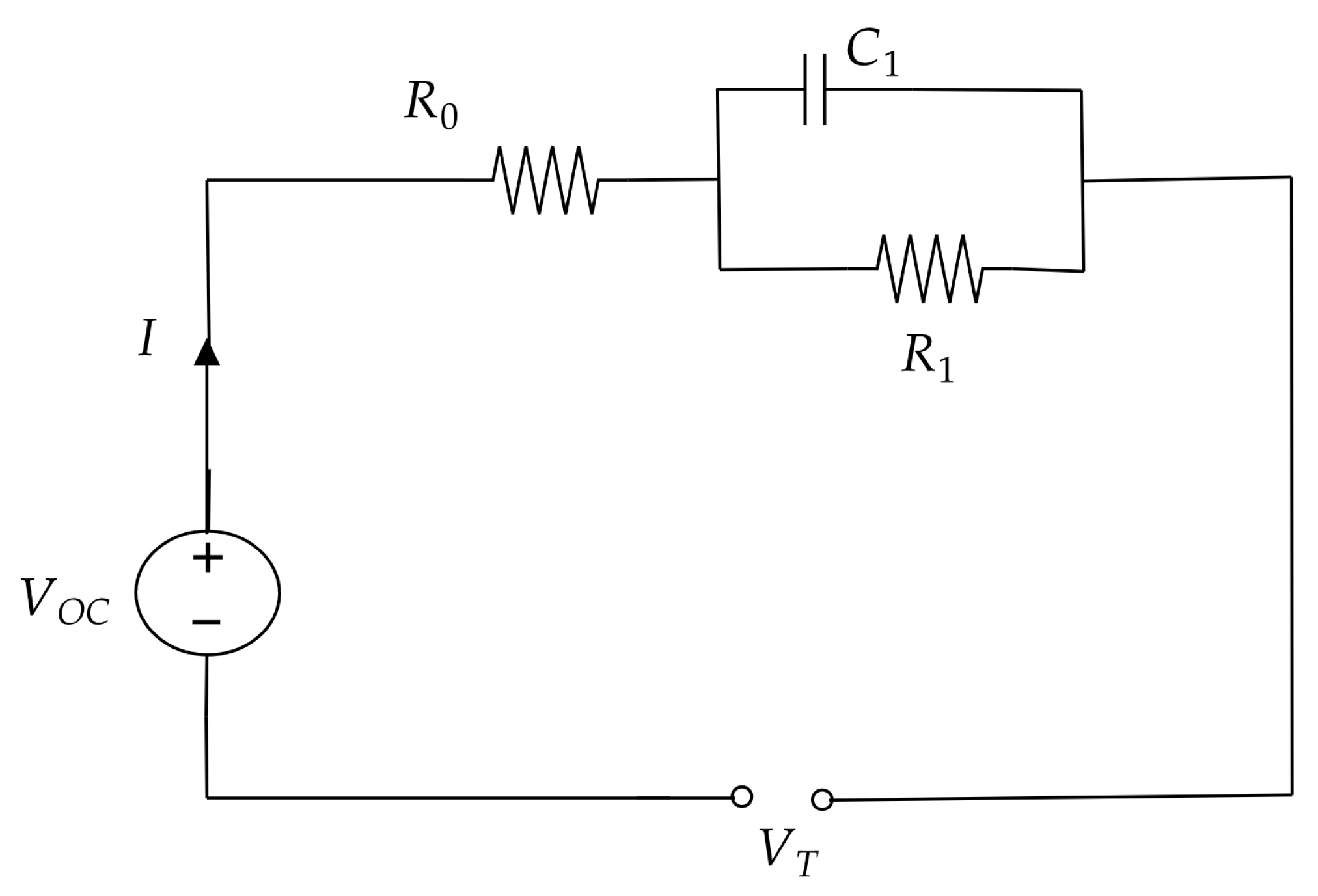
In real-world application, a voltage magnification circuit uses the Thevenin equivalent circuit for voltage amplification without any external power supply, which includes the parameters of current I in amperes at an open circuit voltage , resistor in ohm () and a resistor-capacitor pair as displayed in Figure 1. The terminal voltage of such a battery system can be defined as follows:
where is the potential drop caused by the pair and the voltage drop caused by the ohmic resistance. The current I is called the response of the system. The first order differential equation of Thevenin equivalent electrical circuit system is as follows:
Figure 1.
Schematic of the first order electrical circuit system.
Let a differentiable function of exponential order satisfies
Letting . Applying the general integral transform to function, we obtain
Let us set,
then, based on Theorem 3, there exists a solution of (16) such that
Therefore, the (16) is Ulam–Hyers stable.
Example 3.
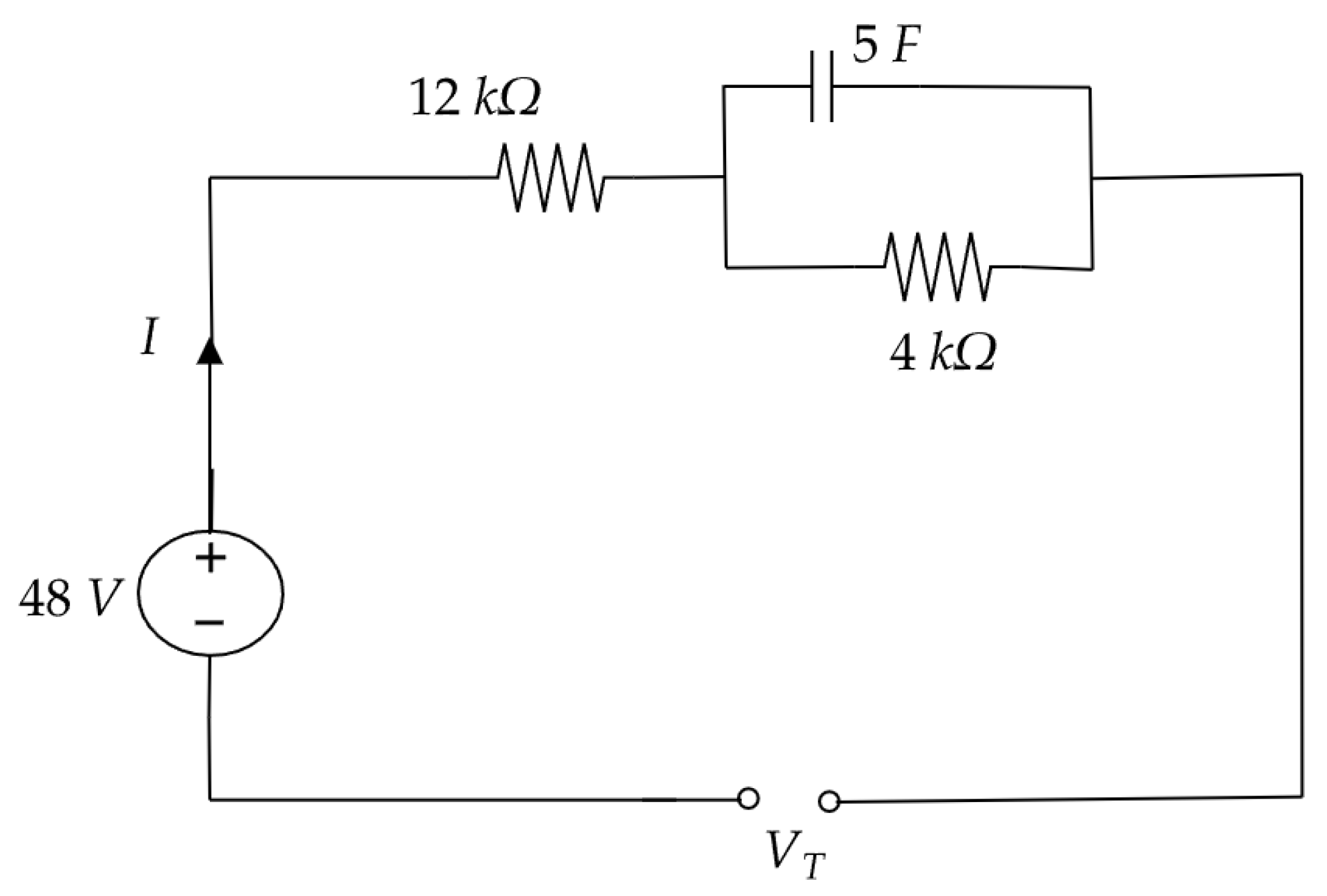
Obtain the Thevenin equivalent circuit concerning the problem shown in Figure 2.
Figure 2.
Schematic of the first order electrical circuit system with problem.
Solution: As both the resistors are in series, the current that flows across them can be calculated as follows:
Consider the Thevenin equivalent electrical circuit equation form:
Let . Suppose that satisfies inequality
Choosing a function Using a similar approach as in Theorem 3, one can easily arrive at
Therefore, the (17) is Ulam–Hyers stable.
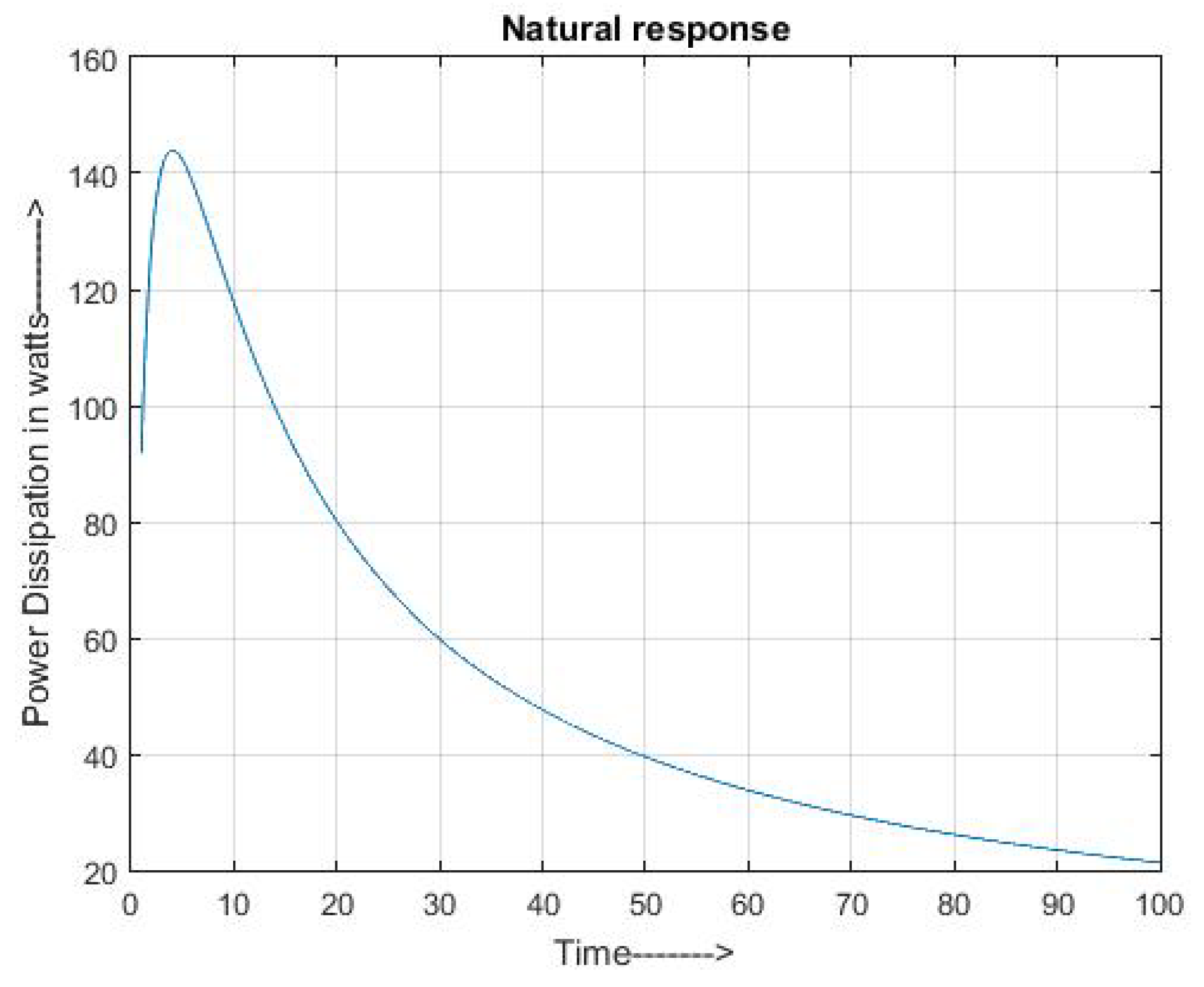
The Thevenin equivalent circuit system for voltage amplification without any external power supply for the considered electrical circuit and supply voltage values. In Figure 3, the result shows the power dissipation of the system against time, and it comes to nearly zero, indicating its system stability.
Figure 3.
Power dissipation of the system and time variations.
7. Conclusions
The proposed method is stability results are new in the research field of stability theory. A novel general integral transform is employed to solve the Ulam–Hyers stability problem. Moreover, the results indicate that the general integral transform is more effective and convenient for the Ulam stability research area. The Ulam–Hyers stability is also discussed as an extension of the Mittag–Leffer–Ulam–Hyers stability of the proposed equations. Relevant examples and electrical circuit applications are validated by the results obtained in this study. Future work recommends investigating by researchers interested the differential equations with various integral transforms to implement the suitable electrical circuit in an innovative method.
Author Contributions
Conceptualization, S.P., A.S. and S.S.; Formal analysis, S.P., A.S. and S.S.; Methodology, S.P., A.S. and S.S.; Project administration, S.P. and S.S.; Validation, S.P., A.S. and S.S.; Visualization, S.P., A.S. and S.S.; Writing-original draft, S.P., A.S. and S.S. All authors have read and agreed to the published version of the manuscript.
Funding
This research received no external funding.
Data Availability Statement
Not applicable.
Acknowledgments
This work is supported by The Center for Research and Development in Mathematics and Applications (CIDMA) through the Portuguese Foundation for Science and Technology (FCT—Fundação para a Ciência e a Tecnologia), references UIDB/04106/2020 and UIDP/04106/2020.
Conflicts of Interest
The authors declare no conflict of interest.
References
- Ulam, S.M. Problems in Modern Mathematics; John Wiley and Sons: New York, NY, USA, 1964. [Google Scholar]
- Hyers, D.H. On the stability of the linear functional equation. Proc. Natl. Acad. Sci. USA 1941, 27, 222–224. [Google Scholar] [CrossRef] [PubMed]
- Aoki, T. On the stability of the linear transformation in Banach spaces. J. Math. Soc. Jpn. 1950, 2, 64–66. [Google Scholar] [CrossRef]
- Rassias, T.M. On the stability of the linear mapping in Banach spaces. Proc. Am. Math. Soc. 1978, 72, 297–300. [Google Scholar] [CrossRef]
- Selvam, A.; Sabarinathan, S.; Kumar, B.V.S.; Byeon, H.; Guedri, K.; Eldin, S.M.; Khan, M.I.; Govindan, V. Ulam-Hyers stability of tuberculosis and COVID-19 co-infection model under Atangana-Baleanu fractal-fractional operator. Sci. Rep. 2023, 13, 9012. [Google Scholar] [CrossRef]
- Sivashankar, M.; Sabarinathan, S.; Nisar, K.S.; Ravichandran, C.; Kumar, B.V.S. Some properties and stability of Helmholtz model involved with nonlinear fractional difference equations and its relevance with quadcopter. Chaos Solitons Fractals 2023, 168, 113161. [Google Scholar] [CrossRef]
- Yin, L.; Geng, Z.; Björneklett, A.; Söderlund, E.; Thiringer, T.; Brandell, D. An integrated flow electric thermal model for a cylindrical Li-I on battery module with a direct liquid cooling strategy. Energy Technol. 2022, 10, 2101131. [Google Scholar] [CrossRef]
- Pachaiyappan, D.; Murali, R.; Park, C.; Lee, J.R. Relation between electrical resistance and conductance using multifarious functional equations and applications to parallel circuit. J. Inequal. Appl. 2022, 2022, 60. [Google Scholar] [CrossRef]
- Khan, N.; Ahmad, Z.; Shah, J.; Murtaza, S.; Albalwi, M.D.; Ahmad, H.; Baili, J.; Yao, S.W. Dynamics of chaotic system based on circuit design with Ulam stability through fractal-fractional derivative with power law kernel. Sci. Rep. 2023, 13, 5043. [Google Scholar] [CrossRef] [PubMed]
- Kalvandi, V.; Eghbali, N.; Rassias, J.M. Mittag-Leffler-Hyers-Ulam stability of fractional differential equations of second order. J. Math. Ext. 2019, 13, 29–43. [Google Scholar]
- Selvam, A.; Sabarinathan, S.; Pinelas, S. The Aboodh transform techniques to Ulam type stability of linear delay differential equation. Int. J. Appl. Comput. Math. 2023, 9, 105. [Google Scholar] [CrossRef]
- Rezaei, H.; Jung, S.M.; Rassias, T.M. Laplace transform and Hyers-Ulam stability of linear differential equations. J. Math. Anal. Appl. 2013, 403, 244–251. [Google Scholar] [CrossRef]
- Selvam, A.; Sabarinathan, S.; Noeiaghdam, S.; Govindan, V. Fractional Fourier transform and Ulam stability of fractional differential equation with fractional Caputo-type derivative. J. Funct. Spaces 2022, 2022, 3777566. [Google Scholar] [CrossRef]
- Murali, R.; Selvan, A.P.; Park, C. Ulam stability of linear differential equations using Fourier transform. Aims Math. 2020, 5, 766–780. [Google Scholar]
- Sivashankar, M.; Sabarinathan, S.; Govindan, V.; Fernandez-Gamiz, U. Noeiaghdam, Stability analysis of COVID-19 outbreak using Caputo-Fabrizio fractional differential equation. Aims Math. 2023, 8, 2720–2735. [Google Scholar] [CrossRef]
- Murali, R.; Selvan, A.P.; Park, C.; Lee, J.R. Aboodh transform and the stability of second order linear differential equations. Adv. Differ. Equ. 2021, 2021, 296. [Google Scholar] [CrossRef]
- Aruldass, A.R.; Divyakumari, P.; Park, C. Hyers-Ulam stability of second-order differential equations using Mahgoub transform. Adv. Differ. Equ. 2021, 2021, 23. [Google Scholar] [CrossRef]
- Rassias, J.M.; Murali, R.; Selvan, A.P. Mittag-Leffler-Hyers-Ulam stability of linear differential equations using Fourier transforms. J. Comput. Anal. Appl. 2021, 29, 68–85. [Google Scholar]
- Jafari, H. A new general integral transform for solving integral equations. J. Adv. Res. 2021, 32, 133–138. [Google Scholar] [CrossRef] [PubMed]
- El-Mesady, A.I.; Hamed, Y.S.; Alsharif, A.M. Jafari transformation for solving a system of ordinary differential equations with medical application. Fractal Fract. 2021, 130, 130. [Google Scholar] [CrossRef]
- Jafari, H.; Manjarekar, S. A modification on the new general integral transform. Adv. Math. Model. Appl. 2022, 7, 253–263. [Google Scholar]
- Meddahi, M.; Jafari, H.; Yang, X.J. Towards new general double integral transform and its applications to differential equations. Math. Methods Appl. Sci. 2022, 45, 1916–1933. [Google Scholar] [CrossRef]
- Khirsariya, S.R.; Rao, S.B.; Chauhan, J.P. A novel hybrid technique to obtain the solution of generalized fractional-order differential equations. Math. Comput. Simul. 2023, 205, 272–290. [Google Scholar] [CrossRef]
- Meddahi, M.; Jafari, H.; Ncube, M.N. New general integral transform via Atangana-Baleanu derivatives. Adv. Differ. Equ. 2021, 385, 1–14. [Google Scholar] [CrossRef]
- Alqifiary, Q.H.; Jung, S.M. Laplace transform and generalized Hyers-Ulam stability of linear differential equations. Electron. J. Differ. Equ. 2014, 2014, 1–11. [Google Scholar]
- Găvruţa, P.; Jung, S.M.; Li, Y. Hyers-Ulam stability for second-order linear differential equations with boundary conditions. Electron. J. Differ. Equ. 2011, 2011, 1–5. [Google Scholar]
- Qarawani, M.N. Hyers-Ulam stability of a generalized second order nonlinear differential equation. Appl. Math. 2012, 3, 1857–1861. [Google Scholar] [CrossRef]
- Alqhtani, M.; Saad, K.M.; Shah, R.; Hamanah, W.M. Discovering novel soliton solutions for (3+1)-modified fractional Zakharov-Kuznetsov equation in electrical engineering through an analytical approach. Opt. Quantum Electron. 2023, 55, 1149. [Google Scholar] [CrossRef]
- Alshehry, A.S.; Yasmin, H.; Shah, R.; Ullah, R.; Khan, A. Fractional-order modeling: Analysis of foam drainage and Fisher’s equations. Open Phys. 2023, 21, 20230115. [Google Scholar] [CrossRef]
- Yasmin, H.; Aljahdaly, N.H.; Saeed, A.M.; Shah, R. Probing families of optical soliton solutions in fractional perturbed Radhakrishnan-Kundu-Lakshmanan model with improved versions of extended direct algebraic method. Fractal Fract. 2023, 7, 512. [Google Scholar] [CrossRef]
- Aggarwal, S.; Chaudhary, R. A comparative study of Mohand and Laplace transforms. J. Emerg. Technol. Innov. Res. 2019, 6, 230–240. [Google Scholar]
Disclaimer/Publisher’s Note: The statements, opinions and data contained in all publications are solely those of the individual author(s) and contributor(s) and not of MDPI and/or the editor(s). MDPI and/or the editor(s) disclaim responsibility for any injury to people or property resulting from any ideas, methods, instructions or products referred to in the content. |
© 2023 by the authors. Licensee MDPI, Basel, Switzerland. This article is an open access article distributed under the terms and conditions of the Creative Commons Attribution (CC BY) license (https://creativecommons.org/licenses/by/4.0/).