Abstract
This paper presents a geometric approach to the problems in differential subordination theory. The necessary conditions for a function to be in various subfamilies of the class of starlike functions and the class of Carathéodory functions are studied, respectively. Further, several consequences of the findings are derived.
MSC:
Primary 30C45; 30C50; 30C80; Secondary 11B65; 47B38
1. Introduction
Let be the complex plane and and be the open unit disk. Let represent the collection of all analytic functions, u, defined on and fulfill the criteria and . Thus, each function, u, in class has the following Taylor series expansion:
The various subclasses of have been studied intensively, for instance, Ref. [1]. Further, let denote a subfamily of , whose members are univalent in unit disk . Let and be the subfamilies of for , where represents starlike functions of order , and represents convex functions of order . Analytically, these families are represented by
and
In particular, if , then we can observe that and are well-known families of starlike functions and convex functions, respectively.
Moreover, for two functions, , the expression denotes that the function is subordinate to the function if there exists an analytic function, , with the following properties:
such that
In addition, if , then the aforementioned conditions can be expressed as follows:
In 1992, Ma and Minda defined [2]
with in . Additionally, the function maps onto a star-shaped region, and the image domain is symmetric about the real axis and starlike with respect to , with . The set generalizes several subfamilies of the function class . Here are seven examples.
1. The class of Janowski starlike functions (see [3,4]) can be viewed by
where and .
2. For the family was established by Sokól et al. [5].
For the class was introduced and studied by Cho et al. [6].
Considering the function we get the family which was introduced and investigated recently by Wani and Swaminathan [7]. The image of under the function is bounded by a nephroid-shaped region.
5. For the class has been defined and studied by Mendiratta [8].
Taking we then get the family which maps to a crescent-shaped region and was given by Raina et al. [9].
The function gives the following class introduced by Kumar and Arora [10]:
The natural extensions of differential inequalities on the real line into the complex plane are known as differential subordinations. Derivatives are an essential tool for understanding the properties of real-valued functions. Differential implications can be found in the complex plane when a function is described using differential subordinations. For example, Noshiro and Warschawski provided the univalency criteria for the analytical function theorem, which showed such differential implications. The range of the combination of the function’s derivatives is frequently used to determine the properties of a function.
Let h be an analytic function defined on , with Recently, Ali et al. [11] have investigated some differential subordination results. More specifically, they studied the following differential subordinations for some particular ranges of
which can ensure that
Similar type results have been investigated by various authors. For example, the articles contributed by Kumar et al. [12,13], Paprocki et al. [14], Raza et al. [15] and Shi et al. [16].
In this paper, we consider the following two subfamilies of analytic functions.
and
where the family defined in Equation (3) was introduced by Kumar and Kamaljeet [17], and the family defined in Equation (4) was introduced by Gandhi [18].
The lemma below underlies our considerations in the following sections.
Lemma 1.
[19] For the univalent function and the analytic functions λ and v in with for define
Suppose that
- 1.
- is convex, or is starlike.
- 2.
- .
If with and
then and q is the best dominant.
2. Subordination Results for the Class
Theorem 1.
Let h be an analytic function with in the unit disc and satisfy
Then, we have the following.
- 1.
- for
- 2.
- for
- 3.
- for
- 4.
- for
- 5.
- for
- 6.
- for
Proof.
Consider the analytic function
which is a solution of the differential subordination equation
Let us take , , and in Lemma 1. Then, the function is given by , so . Since the function maps into a starlike region (with respect to 1), the function h is starlike. Further, h satisfies As an application to Lemma 1, we possess the following property:
Each subordination of Theorem 1, is similar to
for each subordinate function in the theorem, which is valid if , . Then,
This yields the necessary condition for which . Looking at the geometry of each of these functions , it is noticed that the condition is also sufficient.
1. Let then
and these inequalities can be reduced to and We note that and hence the following subordination holds.
2. Let then by (5),
Notice that Thus, the following subordination holds.
3. Let then the inequality gives for , and gives for Moreover, since
4. Let then
and these two inequalities yield and Thus,
5. Let then by Equation (5) we have
Therefore, the subordination holds if .
6. Let then
Thus, two inequalities above yield and and hence
□
Corollary 1.
Let that satisfies the following subordination:
Then, we have the following results.
- 1.
- for
- 2.
- for
- 3.
- for
- 4.
- for
- 5.
- for
- 6.
- for
Theorem 2.
Let h be analytic with in unit disc and assume that
Then, we have the following.
- 1.
- for
- 2.
- for
- 3.
- for
- 4.
- for
- 5.
- for
- 6.
- for
Proof.
Consider the analytic function , defined by
Then, is a solution of the differential equation
If we take , , and in Lemma 1, then the function is given by , so
Since the function maps into a starlike region (w.r.to 1), the function h is starlike. Further, h satisfies Applying this to Lemma 1, we possess that
Each subordination of Theorem 1 is similar to
for each subordinate function in the theorem, which is valid if . Here, we use the same technique as in Theorem 1, omitting the rest of the proof. □
Corollary 2.
Let that satisfies the following subordination:
Then, we have
- 1.
- for
- 2.
- for
- 3.
- for
- 4.
- for
- 5.
- for
- 6.
- for
Theorem 3.
Let h be an analytic function with
in unit disc and satisfy that
Then, the following results.
- 1.
- for
- 2.
- for
- 3.
- for
- 4.
- for
- 5.
- for
- 6.
- for
Proof.
Consider the function , defined by
which is the solution of the differential equation:
In Lemma 1, let , , and . Then, the function is given by , so Since the function maps into a starlike region (w.r.to 1), the function h is starlike. Further, h satisfies Therefore, from Lemma 1, we possess that
Each subordination of Theorem 2 is similar to
for each subordinate function in the theorem, which is valid if
. Here, we use the same technique as we used in Theorem 1, so we omit the rest of the proof. □
Corollary 3.
Let that satisfies the following subordination:
Then, we have
- 1.
- for
- 2.
- for
- 3.
- for
- 4.
- for
- 5.
- for
- 6.
- for
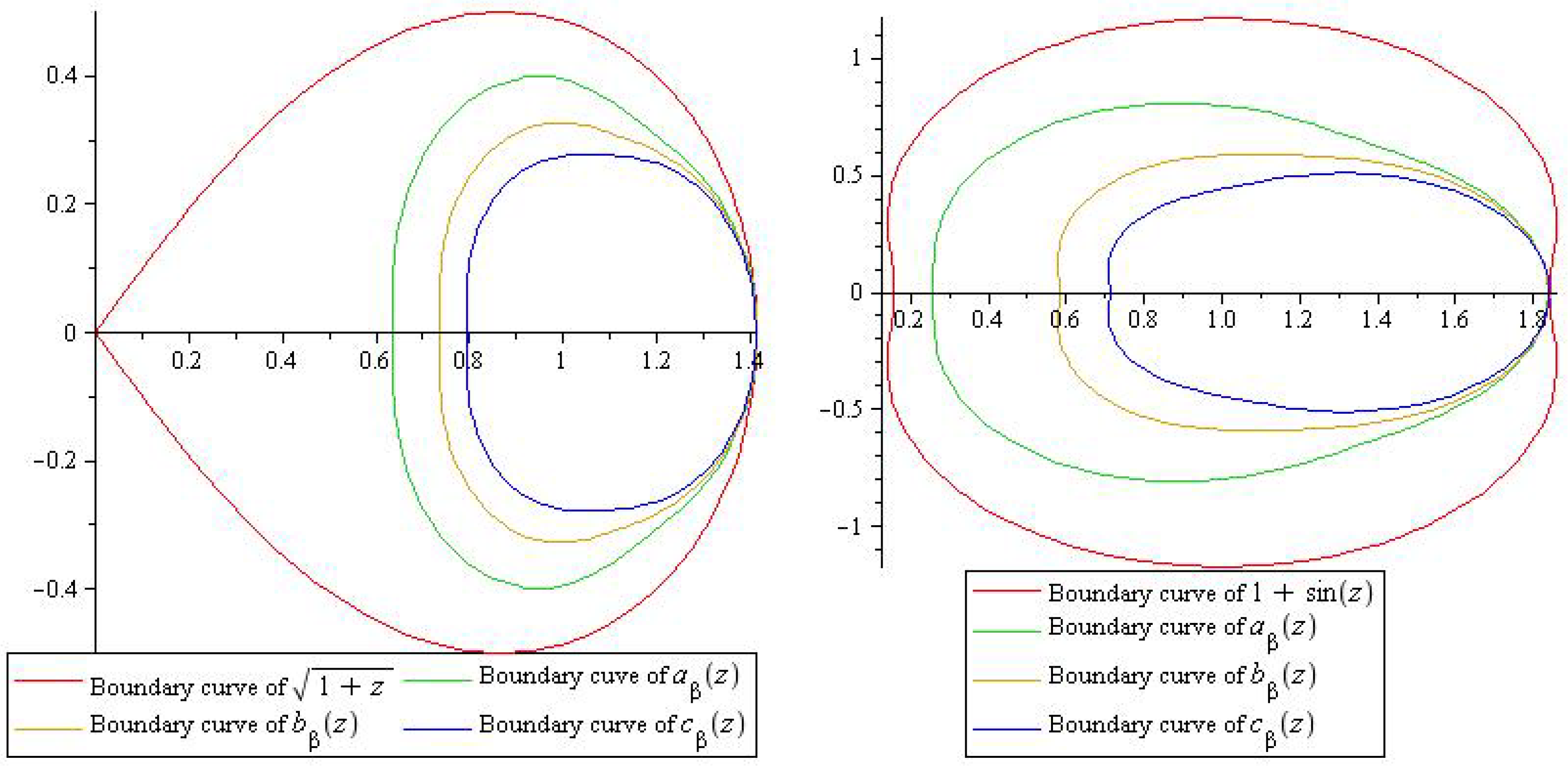
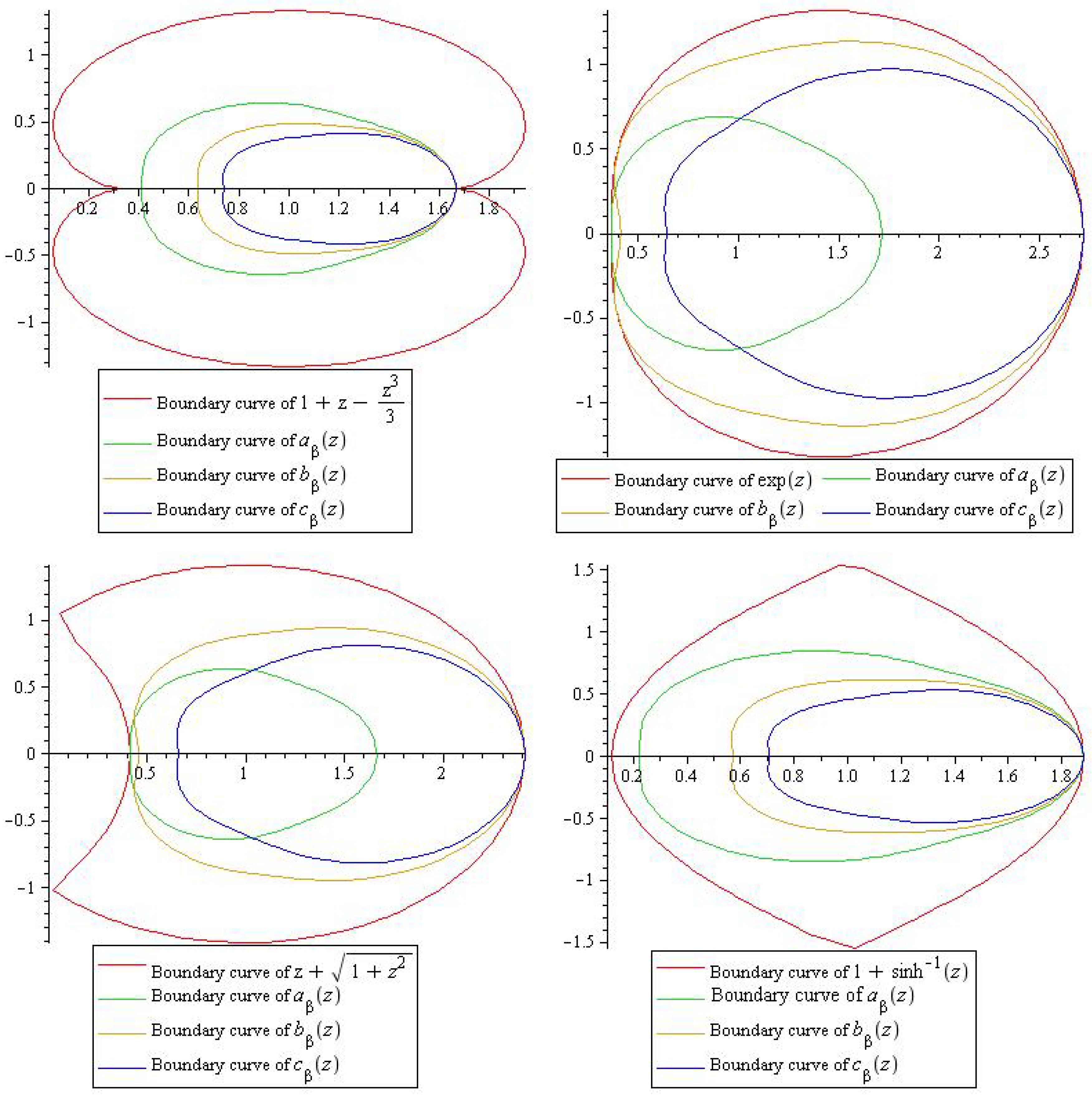
At the end of Section 2, as a geometric approach to the problems in differential subordination theory, the following figures in Figure 1 graphically represent the results in the section.

Figure 1.
Graphical Representation of Results in Section 2.
3. Subordination Results for Class
Theorem 4.
Let h be an analytic function with in unit disc and satisfy that
Then, we have the following.
- 1.
- for
- 2.
- for
- 3.
- for
- 4.
- for
- 5.
- for
- 6.
- for
Proof.
Consider the differential equation
It is easy to verify that the analytic function , defined by
is the solution of Equation (6) In Lemma 1, let , , , and . Then, the function is given by , so Since the function maps into a starlike region (w.r.to 1), the function h is starlike. Further, h satisfies It follows from Lemma 1 that
Each subordination of Theorem 1 is similar to
for each subordinate function in the theorem, which is valid if . Then
This yields the necessary condition for which . Looking at each of these functions’ geometry, it can be seen that this condition is also sufficient.
1. Let then
and the above inequalities reduce to and We note that Thus,
2. Let then from Equation (5) we have
We observe that Therefore the subordination holds if
3. Let then the inequality gives where , and gives where Further, we note that Therefore,
4. Let then
and these two inequalities yield to and Thus,
5. Let then from Equation (5)
Therefore, the subordination holds if where
6. Let then
and these two inequalities yield and Thus,
□
Corollary 4.
Let that satisfies the following subordination:
Then,
- for
- for
- for
- for
- for
- for
Theorem 5.
Let h be an analytic function with in open unit disc and satisfy that
Then, we have the following results.
- 1.
- for
- 2.
- for
- 3.
- for
- 4.
- for
- 5.
- for
- 6.
- for
Proof.
Consider the analytic function , defined by
Then, is a solution of the differential equation:
Let , , , and . Applying for Lemma 1, the function is given by , and so Since the function maps into a starlike region (w.r.to 1), the function h is starlike. Further, h satisfies Applying Lemma 1, we possess that
Each subordination of Theorem 1 is similar to
for each subordinate function in the theorem, which is valid if . Here, we use the same technique as in Theorem 1, omitting the rest of the proof. □
Corollary 5.
Let that satisfies the following subordination.
Then, we have
- for
- for
- for
- for
- for
- for
Theorem 6.
Let h be an analytic function with in unit disc and satisfy that
Then, we have the following.
- for
- for
- for
- for
- for
- for
Proof.
Consider the function , defined by
which is the solution of the following differential equation.
Let take , , and in Lemma 1. Then, the function is given by , and so Since the function maps into a starlike region (with respect to 1), the function h is starlike. Further, h satisfies Applying this to Lemma 1, we find that
Each subordination of Theorem 2 is similar to
for each subordinate function in the theorem, which is valid if . Here, we use the same technique as in Theorem 1, omitting the rest of the proof. □
Corollary 6.
Let that satisfies the following subordination.
Then, we have the following results.
- 1.
- for
- 2.
- for
- 3.
- for
- 4.
- for
- 5.
- for
- 6.
- for
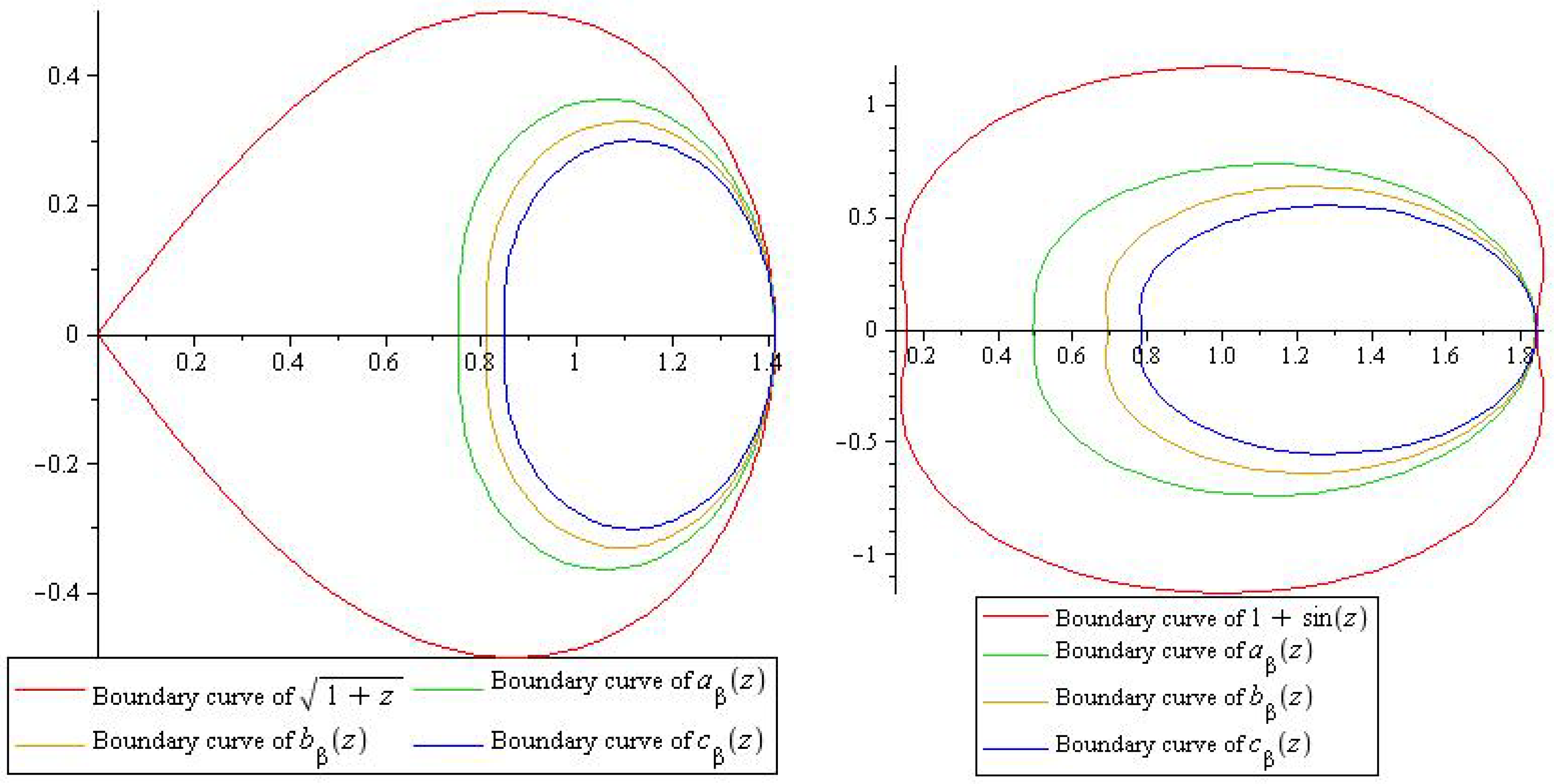
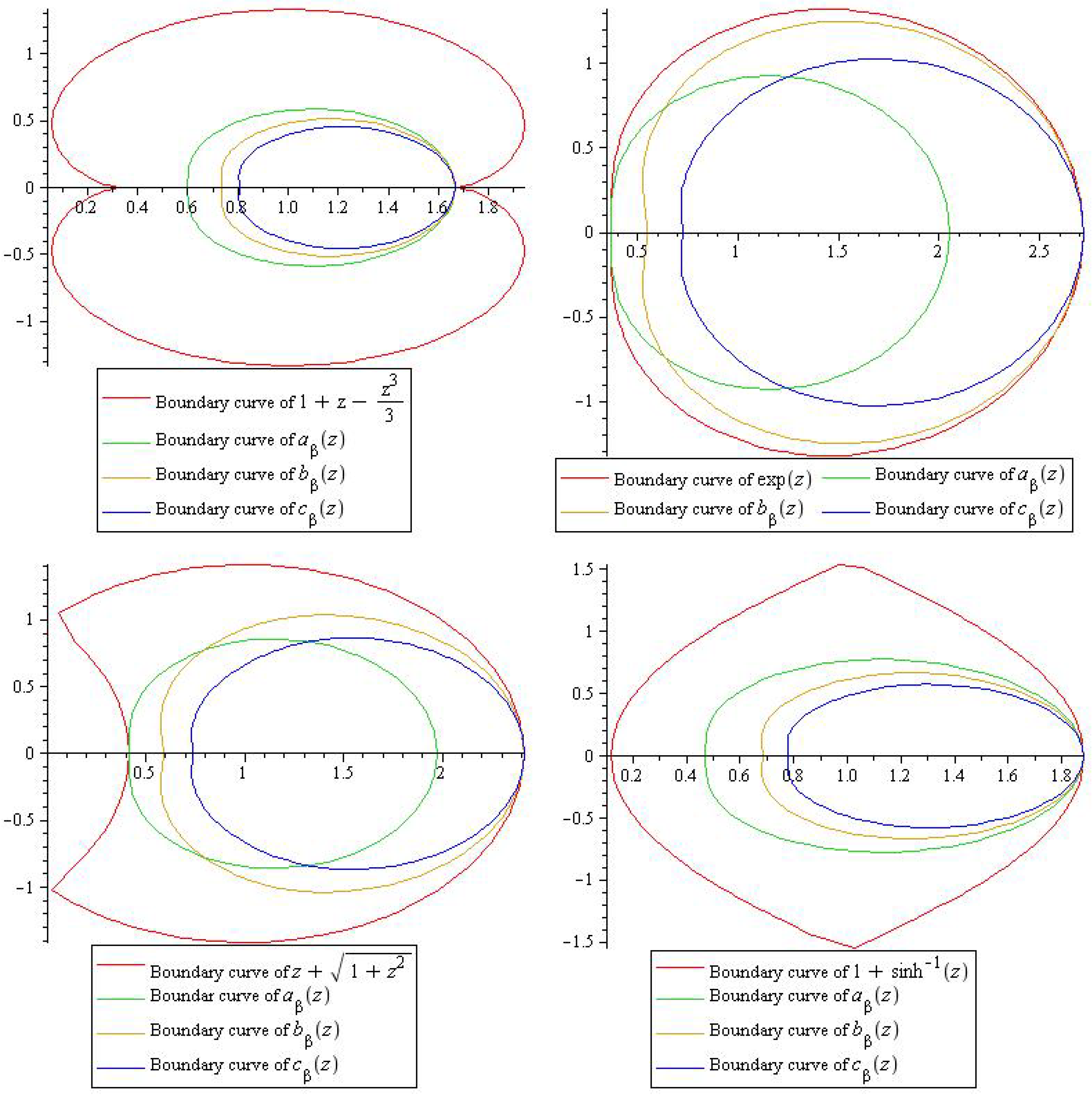
We finish Section 3 with the following figures in Figure 2, graphically illustrating the results in this section.

Figure 2.
Graphical Representation of Results in Section 3.
4. Conclusions
In this article, we have studied the first-order differential subordination for two symmetric image domains, namely the cardioid domain and the domain bounded by three leaf functions. Further, we examined some graphical interpretations of these results. Moreover, this concept can be extended to meromorphic, multivalent, and quantum calculus functions.
Author Contributions
All authors equally contributed to this article as follows. Conceptualization, M.G.K., B.K., J.G., F.T. and F.M.O.T.; methodology, M.G.K., B.K., J.G., F.T. and F.M.O.T.; formal analysis, M.G.K., B.K., J.G., F.T. and F.M.O.T.; investigation, M.G.K., B.K., J.G., F.T. and F.M.O.T.; resources, M.G.K., B.K., J.G., F.T. and F.M.O.T.; writing—original draft preparation, M.G.K., B.K., J.G., F.T. and F.M.O.T.; writing—review and editing, M.G.K., B.K., J.G., F.T. and F.M.O.T. All authors have read and agreed to the published version of the manuscript.
Funding
The authors acknowledge the funding UAEU Program for Advanced Research (UPAR12S127) from United Arab Emirates University and the Researchers Supporting Project (RSP2023R440) from King Saud University.
Data Availability Statement
Not Applicable.
Conflicts of Interest
The authors declare no conflict of interest.
References
- Khan, M.F.; Al-shbeil, I.; Khan, S.; Khan, N.; Haq, W.U.; Gong, J. Applications of a q-Differential Operator to a Class of Harmonic Mappings Defined by q-Mittag–Leffler Functions. Symmetry 2022, 14, 1905. [Google Scholar] [CrossRef]
- Ma, W.; Minda, D. A Unified Treatment of Some Special Classes of Univalent Functions. In Proceeding of Conference on Complex Analytic; Li, Z., Ren, F., Yang, L., Zhang, S., Eds.; International Press: New York, NY, USA, 1994; pp. 157–169. [Google Scholar]
- Janowski, W. Extremal problems for a family of functions with a positive real part and for some related families. Ann. Polonici Math. 1971, 23, 159–177. [Google Scholar] [CrossRef]
- Ur Rehman, M.S.; Ahmad, Q.Z.; Al-Shbeil, I.; Ahmad, S.; Khan, A.; Khan, B.; Gong, J. Coefficient Inequalities for Multivalent Janowski Type q-Starlike Functions Involving Certain Conic Domains. Axioms 2022, 11, 494. [Google Scholar] [CrossRef]
- Sokól, J.; Kanas, S. Radius of convexity of some subclasses of strongly starlike functions. Zesz. Nauk. Politech. Rzeszowskiej Mat. 1996, 19, 101–105. [Google Scholar]
- Cho, N.E.; Kumar, V.; Kumar, S.S.; Ravichandran, V. Radius problems for starlike functions associated with the sine function. Bull. Iran. Math. Soc. 2019, 45, 213–232. [Google Scholar] [CrossRef]
- Wani, L.A.; Swaminathan, A. Starlike and convex functions associated with a Nephroid domain. Bull. Malays. Math. Sci. Soc. 2021, 44, 79–104. [Google Scholar] [CrossRef]
- Mendiratta, R.; Nagpal, S.; Ravichandran, V. On a subclass of strongly starlike functions associated with an exponential function. Bull. Malays. Math. Sci. Soc. 2015, 38, 365–386. [Google Scholar] [CrossRef]
- Raina, R.K.; Sokól, J. On Coefficient estimates for a certain class of starlike functions, Hacettepe. J. Math. Statist. 2015, 44, 1427–1433. [Google Scholar]
- Kumar, S.S.; Arora, K. Starlike functions associated with a petal shaped domain. arXiv 2020, arXiv:2010.10072. [Google Scholar]
- Ali, R.M.; Cho, N.E.; Ravichandran, V.; Kumar, S.S. Differential subordination for functions associated with the lemniscate of Bernoulli. Taiwan. J. Math. 2012, 16, 1017–1026. [Google Scholar] [CrossRef]
- Kumar, S.S.; Kumar, V.; Ravichandran, V.; Cho, N.E. Sufficient conditions for starlike functions associated with the lemniscate of Bernoulli. J. Inequal. Appl. 2013, 176. [Google Scholar] [CrossRef]
- Kumar, S.; Ravichandran, V. Subordinations for functions with positive real part. Complex Anal. Oper. Theory 2018, 12, 1179–1191. [Google Scholar] [CrossRef]
- Paprocki, E.; Sokól, J. The extremal problems in some subclass of strongly starlike functions. Zeszyty Nauk. Politech. Rzeszowskiej Mat 1996, 20, 89–94. [Google Scholar]
- Raza, M.; Sokól, J.; Mushtaq, S. Differential subordinations for analytic functions. Iran. J. Sci. Technol. Trans. A Sci. 2019, 43, 883–890. [Google Scholar] [CrossRef]
- Shi, L.; Srivastava, H.M.; Khan, M.G.; Khan, N.; Ahmad, B.; Khan, B.; Mashwani, W.K. Certain subclasses of analytic multivalent functions associated with petal-shape domain. Axioms 2021, 10, 291. [Google Scholar] [CrossRef]
- Gupta, P.; Nagpal, S.; Ravichandran, V. Inclusion relations and radius problems for a subclass of starlike functions. arXiv 2020, arXiv:2012.1351v1. [Google Scholar]
- Gandhi, S. Radius estimates for three leaf function and convex combination of starlike functions. In Mathematical. Analysis 1: Approximation Theory. ICRAPAM; Deo, N., Gupta, V., Acu, A., Agrawal, P., Eds.; Springer: Singapore, 2018; Volume 306. [Google Scholar]
- Miller, S.S.; Mocanu, P.T. Differential Subordinations Theory and Its Applications; Series of Monographs and Textbooks in Pure and Applied Mathematics; Marcel Dekker Inc.: New York, NY, USA, 2000; Volume 225. [Google Scholar]
Disclaimer/Publisher’s Note: The statements, opinions and data contained in all publications are solely those of the individual author(s) and contributor(s) and not of MDPI and/or the editor(s). MDPI and/or the editor(s) disclaim responsibility for any injury to people or property resulting from any ideas, methods, instructions or products referred to in the content. |
© 2023 by the authors. Licensee MDPI, Basel, Switzerland. This article is an open access article distributed under the terms and conditions of the Creative Commons Attribution (CC BY) license (https://creativecommons.org/licenses/by/4.0/).