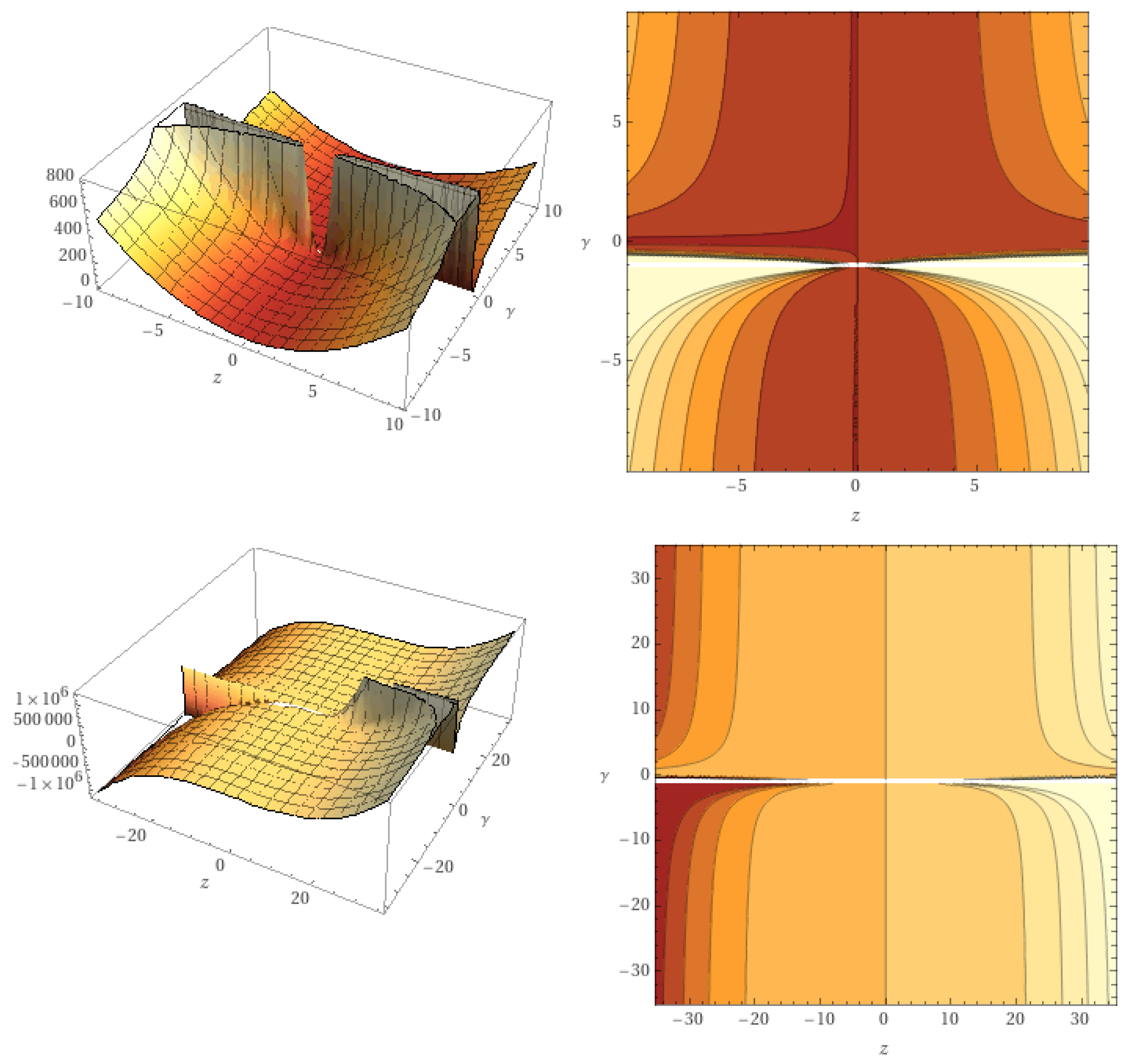
Abstract
The symmetric Schur process has many different types of formals, such as the functional differential, functional integral, and special functional processes based on special functions. In this effort, the normalized symmetric Schur process (NSSP) is defined and then used to determine the geometric and symmetric interpretations of mathematical expressions in a complex symmetric domain (the open unit disk). To obtain more symmetric properties involving NSSP, we consider a symmetric differential operator. The outcome is a symmetric convoluted operator. Geometrically, studies are presented for the suggested operator. Our method is based on the theory of differential subordination.
Keywords:
analytic function; subordination and superordination; univalent function; differential operator; Mittag-Leffler function; special functions; convolution (Hadamard) product; fractional calculus JEL Classification:
Primary 30C45; 30C50
1. Introduction and Preliminaries
The class of analytic functions from the open unit disk to its closure are what make-up the symmetric Schur functions. These functions, along with their matrices and operator-valued variations, are key elements in harmonic analysis, while their relevance extends far beyond complex analyses to a variety of fields, including linear system concepts, signal processing, electrical engineering, stochastic processes, geophysics, functional principles, interpolation issues, the class of polynomials with orthogonality properties on the unit circle, and quantum calculus. The description of these functions by a series of complex factors and the Schur strictures resulting from the so-called Schur process are their key and most advantageous characteristics [1,2]. This process is formulated by different types of functional expressions starting from the basic formula, as follows:
where is analytic at the origin. The modified process is presented by using the Möbius transformation [3]
Moreover, it can be suggested by some functional integrals, such as the Stieltjes function, Nevanlinna function, and Carathéodory function [2].
In this work, the normalized symmetric Schur process (NSSP) is introduced by using a functional integral and utilized to interpret mathematical expressions in a complex symmetric domain in terms of geometry functional formula in the open unit disk. The Fekete–Szegö problem (for specific subclasses of starlike univalent functions) is considered based on the proposed convoluted operator. This problem was studied recently in [4].
The class of normalized analytic functions admits the following power series
where represent the coefficients of the analytic function satisfying the equality
Two functions and in are convoluted if and only if
where
such that indicate the coefficients of the analytic function
We take into account symmetric integral operators to obtain additional symmetric features involving NSSP. A symmetric convoluted operator is the result. Studies in geometry are provided for the proposed operator. Our approach is created by the differential subordination scheme. Two analytic functions and are subordinated if the analytic function in with and occur, such that
Additionally, the following equivalence holds if the function is univalent in :
The rest of the paper is as follows: Section 2 deals with the suggested NSSP; Section 3 includes the main results involving the suggested NSSP, and Section 4 presents the conclusion and future works.
2. The Iteration of NSSP
The process NSSP is suggested in terms of functional integrals, as follows: for a normalized function the process is defined by the iteration
It is clear that
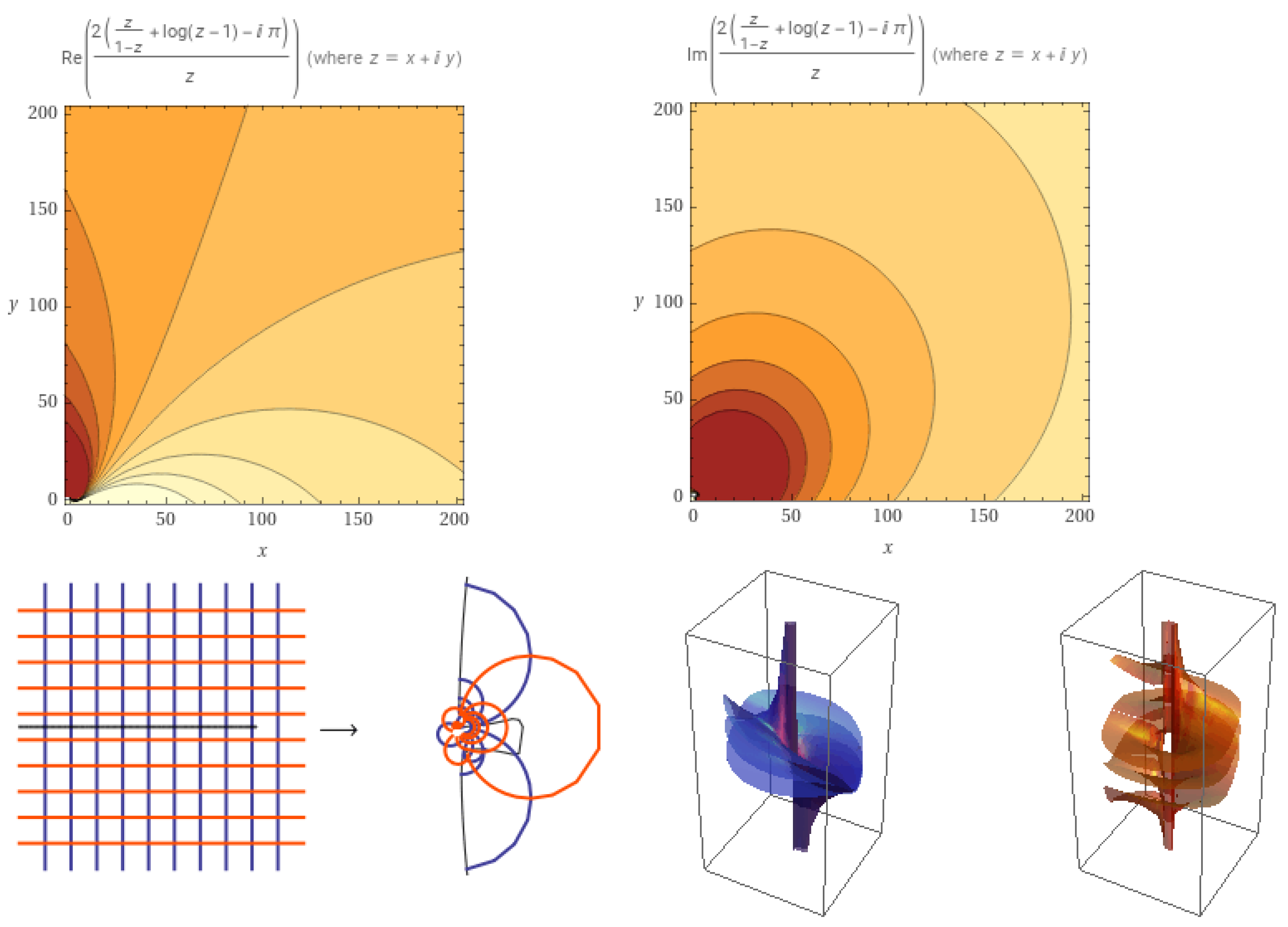
For example, let then (see Figure 1)
Moreover, let then (see Figure 2)
Note that for
where indicates the Riemann–Zeta function. Moreover, for the second sum is converge as follows:
where indicates the generalized Riemann–Zeta function. Moreover, NSSP satisfies the convoluted product
Another new formula is given as an integro-differential expression, as follows:
Thus,
It is clear that The boundedness of the expression implies the boundedness of (see Theorem 1 of [5]). Moreover, it is a univalent starlike of the order (Theorem 2 of [5]). Table 1 shows the convergence of the coefficients of the function , in terms of special functions, where indicates the Euler–Mascheroni constant, I is the modified Bessel function of the first kind, and is the polygamma function and the generalized hypergeometric function.
Figure 1.
Plot of .
Figure 2.
Plot of .
Table 1.
Convergence of coefficients of .
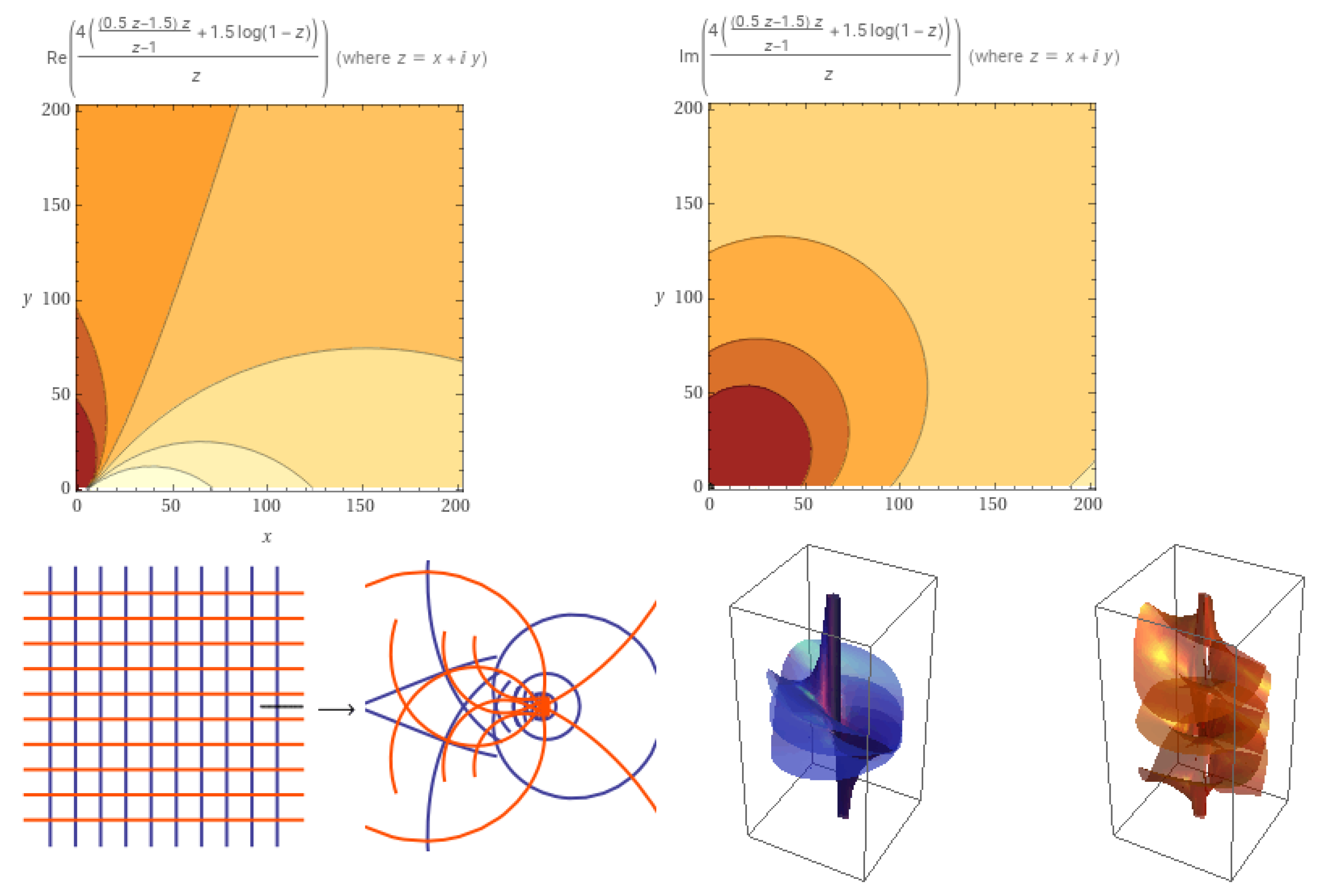
Figure 3.
Plot of when .
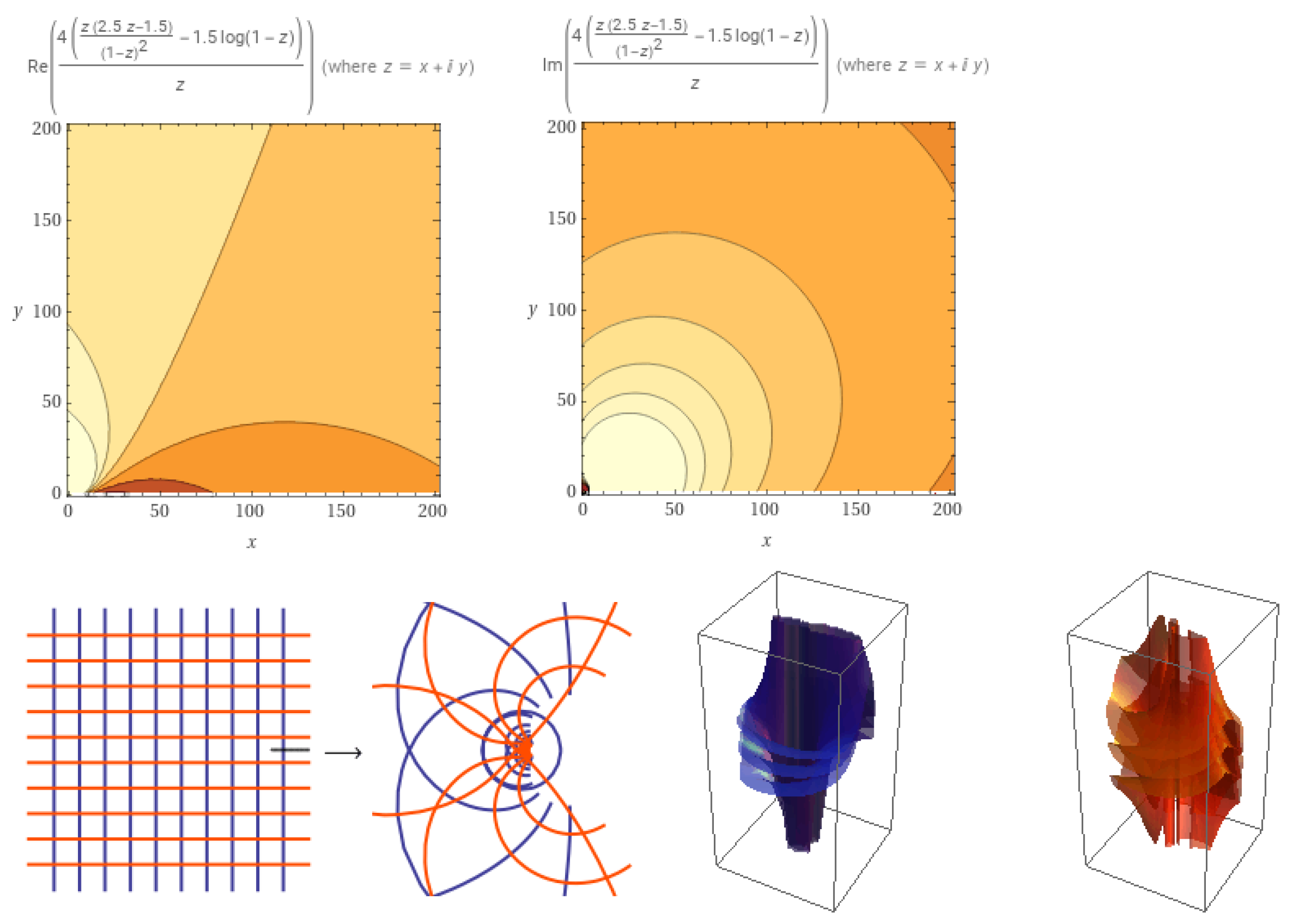
Figure 4.
Plot of when .
3. Results
We aim to explore more properties of the NSSP.
Theorem 1.
Suppose that the NSSP: satisfies the inequality
Then
and
Moreover, for the Fekete–Szegö functional becomes
when . Moreover,
when
Proof.
The subordination inequality implies the functional formula
where such that . A computation yields that
On the other hand, we have
Comparing the last two qualities, we have
and
Since where then
and
Obviously, we have the equality
where
In view of the Fekete–Szegö theory, we obtain the last inequalities. □
Theorem 2.
Suppose that the NSSP: fulfills the inequality
Then
and
Moreover, for the Fekete–Szegö functional becomes
when . Moreover,
when
Proof.
The subordination inequality implies the functional formula
where such that . A computation yields that
On the other hand, we have
Comparing the last two qualities, we have
and
where Since where then
and
Furthermore, we have the equality
where
In view of the Fekete–Szegö theory, we obtain the last inequalities. □
In general, we have the following results that describe the upper bound of
Theorem 3.
Let
Then
and
where
Proof.
It is clear that
Moreover, by the definition of we have
Now there is an analytic function in , such that satisfies the equation
In terms of the power series, we have
As a result of comparing the coefficients, we now have
which implies
Thus,
However,
then we obtain
For we have
For we have
Consequently, for
Thus, by induction, we have
□
Corollary 1.
Let
Then
where and represents the Mittag-Leffler function.
Proof.
In view of Theorem 3 and by using the power series together with the definition of the Mittag-Leffler function, we conclude from the results
□
Similarly, we have the following coefficient bounds of
Theorem 4.
Let
Then
and
where
Proof.
It is clear that
In addition, by the definition of we have
Now there is the analytic function in , such that satisfies the equation
In terms of the power series, we have
As an outcome of comparing the coefficients, we then have
which yields
Thus, we find the next inequality
However,
then we obtain
For we receive
For we have
Consequently, for
Thus, by induction, we have
□
Corollary 2.
Let
Then
and
where and represents the Mittag-Leffler function.
Proof.
We draw conclusions from the findings in light of Theorem 4 by combining the definition of the Mittag-Leffler function with the power series.
□
Additionally, the upper bound of the coefficient can be determined by using the integral formula when is selected as the Euler–Mascheroni constant.
Corollary 3.
Let
Then
where and represents the Mittag-Leffler function.
Proof.
In view of Theorem 4 and by using the integral form, we obtain the results
□
Corollary 4.
Let
Then
where and represents the Mittag-Leffler function.
Proof.
In view of Theorem 4 and by using the integral form, we have the results
□
Corollary 5.
Let
Then
where represents the digamma function, where .
Example 1.
Consider the process satisfying the condition of Theorem 3. Then in view of Theorem 3, the result is sharp and the maximum function is given by the formula
and for all n
Figure 5 shows the symmetric behavior of the functional process
Figure 5.
Plot of when and n = 2, 3, respectively.
Example 2.
Consider the process satisfying the condition of Theorem 4. Then in view of Theorem 4, the result is sharp and the maximum function is given by the formula
and for all n
Figure 6 shows the symmetric behavior of the functional process
Figure 6.
Plot of when and n = 2, 3, respectively.
4. Conclusions
New symmetric Schur functions associated with integral and integro-differential operators in a complex domain are suggested. Geometric results are investigated using the Janowski functions of the starlike formula. The two processes admitted special functional coefficients, the Zeta function, and the hypergeometric function, respectively. We computed the upper bounds of the coefficients for joining the normalized function based on these special functions. The consequences are introduced by describing functional formulas of the maximum bound, including the Mittag-Leffler function and integral functional presentation.
This study will serve as a model for many properties in subsequent works because it is the first to examine a symmetric process from the perspective of the geometric function theory.
Author Contributions
Methodology, R.W.I. and S.B.H.; software, R.W.I.; validation, R.W.I. and S.B.H.; formal analysis, R.W.I.; writing—revised copy, S.B.H.; funding acquisition, S.B.H. All authors have read and agreed to the published version of the manuscript.
Funding
This work is supported by the Ajman University fund: 2022-IRG-HBS-8.
Informed Consent Statement
Not applicable.
Data Availability Statement
Data sharing is not applicable to this article as no data sets were generated or analyzed during the current study.
Conflicts of Interest
The authors declare no conflict of interest.
References
- van Doorn, E.A.; Schrijner, P. Geomatric ergodicity and quasi-stationarity in discrete-time birth-death processes. ANZIAM J. 1995, 37, 121–144. [Google Scholar] [CrossRef]
- Grunbaum, F.A.; Velazquez, L. A generalization of Schur functions: Applications to Nevanlinna functions, orthogonal polynomials, random walks and unitary and open quantum walks. Adv. Math. 2018, 326, 352–464. [Google Scholar] [CrossRef]
- Simon, B. Orthogonal Polynomials on the Unit Circle; American Mathematical Society: Providence, RI, USA, 2005. [Google Scholar]
- Seoudy, T.; Aouf, M.K. Fekete-Szego problem for certain subclass of analytic functions with complex order defined by q-analogue of Ruscheweyh operator. Constr. Math. Anal. 2020, 3, 36–44. [Google Scholar] [CrossRef]
- Tuneski, N. Some simple sufficient conditions for starlikeness and convexity. Appl. Math. Lett. 2009, 22, 693–697. [Google Scholar] [CrossRef]
Disclaimer/Publisher’s Note: The statements, opinions and data contained in all publications are solely those of the individual author(s) and contributor(s) and not of MDPI and/or the editor(s). MDPI and/or the editor(s) disclaim responsibility for any injury to people or property resulting from any ideas, methods, instructions or products referred to in the content. |
© 2023 by the authors. Licensee MDPI, Basel, Switzerland. This article is an open access article distributed under the terms and conditions of the Creative Commons Attribution (CC BY) license (https://creativecommons.org/licenses/by/4.0/).