1. Introduction
In this study, we illustrate a procedure for the evaluation of the Laplace Transform (LT) of multi-nested analytic functions. To this end, we make use of Bell’s polynomials [
1,
2,
3,
4,
5], which constitute the essential tool for computing the subsequent derivatives of composite functions.
The Bell’s polynomials appear in many different fields, ranging from number theory [
6,
7,
8] to operator theory [
9], and from differential equations [
4] to integral transforms [
10,
11]. It is worth noting here that Bell’s polynomials are closely related to and can be written in terms of symmetric functions in combinatorial Hopf algebras [
12].
The importance of the LT [
13,
14] is well known and it is redundant to remind it here.
We use the classic definition of the LT:
The LT converts a function of a real variable t (usually representing the time) to a function of a complex variable s (which represents the complex frequency). The LT holds for locally integrable functions on . It is convergent in every half-plane , where a is the so-called convergence abscissa, depending on the growth rate at infinity of .
Our procedure is as follows: we use Taylor’s expansion of the considered analytic function, and express the relevant coefficients in terms of Bell’s polynomials; then, we approximate the LT of the given nested function by a series expansion, which provides an asymptotic representation of the LT when that exists.
We start from the easier case of the LT of a nested exponential function, considering the first few values of the complete Bell’s polynomials. The result is a Laurent expansion which approximates the relevant LT.
Then, we consider the case of the LT of general nested functions. The main problem is to provide a table of Bell’s polynomials. These exhibit higher complexity, but their evaluation can be easily performed through a dedicated computer code.
Our results can be compared with the LT of nested functions appearing in the literature only in a few cases [
15], but the results we have obtained in these cases are completely satisfactory.
All the computations reported in this study have been performed using the computer algebra program Mathematica.
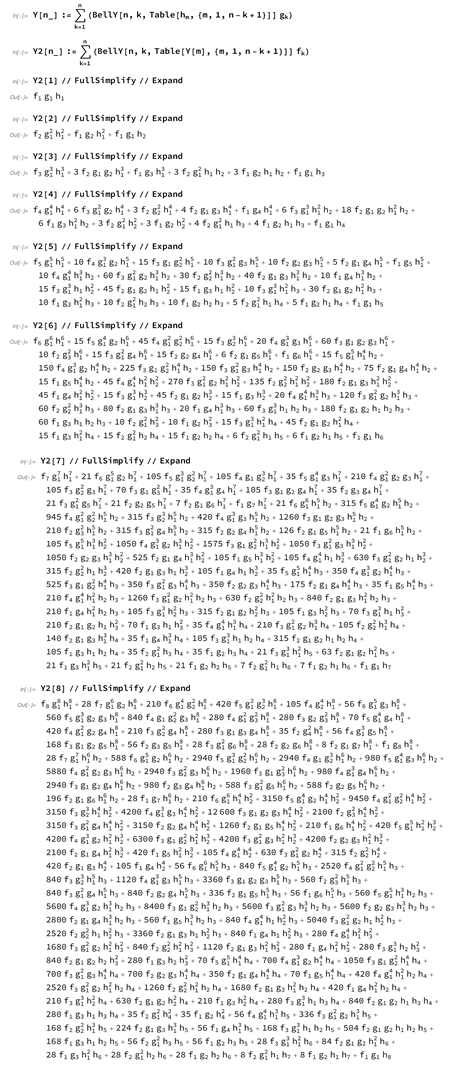
The second-order Bell’s polynomials , representing the derivatives of nested functions of the type are then introduced, and two examples of LT of these functions are given.
In
Appendix A a table of the second-order Bell’s polynomials is reported.
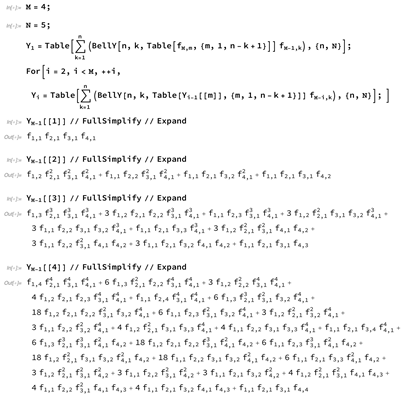
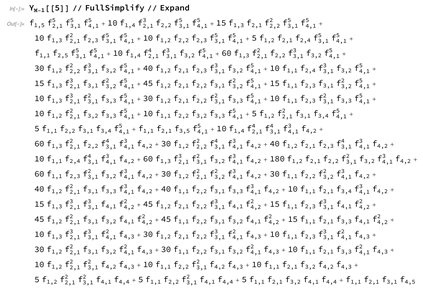
Lastly, we give some examples to show that the same methodology can be used even for the LT of higher-order nested functions. The first few terms of the corresponding generalized Bell’s polynomials, of order 4,
, are shown in
Appendix B The polynomials
have been computed in the same way but are not reported here owing to the lack of space.
It is worth noting that more general extensions of Bell’s polynomials have been introduced in the past, including those appearing in the two-variable case [
16], as well as the multi-variable case [
17]. Since all the aforementioned extensions have been proven through the classical case, more general results could be obtained by applying the methods described in this article.
2. Definition of Bell’s Polynomials
The
n-th derivative of the composite (differentiable) function
, as evaluated by the chain rule, is expressed by Bell’s polynomials as follows
where
The coefficients for all are polynomials of the variables that are homogeneous of degree k and isobaric of weight n (i.e., they are a linear combination of monomials whose weight is constantly given by ); in the literature, they are also referred to as partial Bell’s polynomials.
Bell’s polynomials satisfy the recursion
An explicit representation is given by the Faà di Bruno’s formula
where the sum runs over all the partitions
of the integer
n,
denotes the number of parts of size
i, and
denotes the number of parts of the considered partition [
5].
The
coefficients satisfy the recursion
3. LT of Composite Functions
Let
be a composite function that is analytic in a neighborhood of the origin, and whose Taylor’s expansion is given by
According to the preceding equations, it results in
where
Then, the following result easily follows.
Theorem 1. Consider a composite function that is analytic in a neighborhood of the origin, and can be expressed by Taylor’s expansion in (6). For its LT the following asymptotic representation holdswhere N denotes a finite expansion order. 3.1. The Particular Case of the Exponential Function
In the particular case when
, that is considering the function
, and assuming
, we have the simple form
where the
are the
complete Bell’s polynomials. It results
, and the first few values of
, for
, are given by
The values of the complete Bell’s polynomials for particular choices of the relevant parameters can be found in [
6].
The complete Bell’s polynomials satisfy the identity (see, e.g., [
4])
In this case Equation (
9) reduces to
In what follows, we evaluate the approximation of the LT of nested functions. The reported results have been obtained using the computer algebra program Mathematica.
Examples
We first recall the case of the LT of nested exponential functions, showing two particular examples.
4. LT in Two Known Cases
We considered two cases concerning composite functions whose transform and anti-transform are known (see [
15]). By using the computer algebra program Mathematica
, we have been able to prove the correctness of the methodology used.
4.1. Case #1
Consider the function
. The LT of
is found to be [
15]:
for
, and where
is the logarithmic derivative of the gamma function, given by
Using our methodology, we find that
so that, the inverse Laplace transformation is given by
with
denoting the Heaviside distribution which can be defined as follows:
in terms of the Dirac delta distribution
.
4.2. Case #2
Let us consider the function
. The LT of
is found to be [
15]:
for
.
Using our methodology, we find that
so that, the inverse Laplace transformation is given by
5. A First Extension of Bell’s Polynomials
We consider the second-order Bell’s polynomials, , defined by the n-th derivative of the composite function .
Consider the functions , , and , and suppose that , , and are n times differentiable with respect to their variables, so that the composite function can be differentiated n times with respect to t, by using the chain rule.
We use, as before, the following notation:
Then, the
n-th derivative can be represented by the compact symbol:
where the
are defined as the second order Bell’s polynomials.
The first few terms are as follows.
The connections to the ordinary Bell’s polynomials are highlighted below.
Theorem 2. For every integer n, the polynomials are represented in terms of the ordinary Bell’s polynomials by the following equation, where a compact notation similar to the one in (23) is used: Proof. Using induction, we can conclude that (
24) is true for
, since
Then, assuming that (
24) is true for every
n, it follows that
□
Consequently, we have the theorem:
Theorem 3. The second-order Bell’s polynomials verify the recursion Proof. By means of (
24) we express
in terms of
Then, by using the recursion (
9) and again Equation (
24), the expression (
26) follows. □
6. LT of Second-Order Nested Functions
Let be
be a composite function that is analytic in a neighborhood of the origin and, therefore, can be expressed by the Taylor’s expansion
According to the preceding equations, it results
where
This expansion can be used to evaluate the LT of analytic nested functions.
Theorem 4. Consider a nested function that is analytic in a neighborhood of the origin, and whose Taylor’s expansion is given by (27). For its LT, the following asymptotic representation holdswhere N denotes a finite expansion order. Proof. It is a straightforward application of the definition of the second-order Bell’s polynomials. □
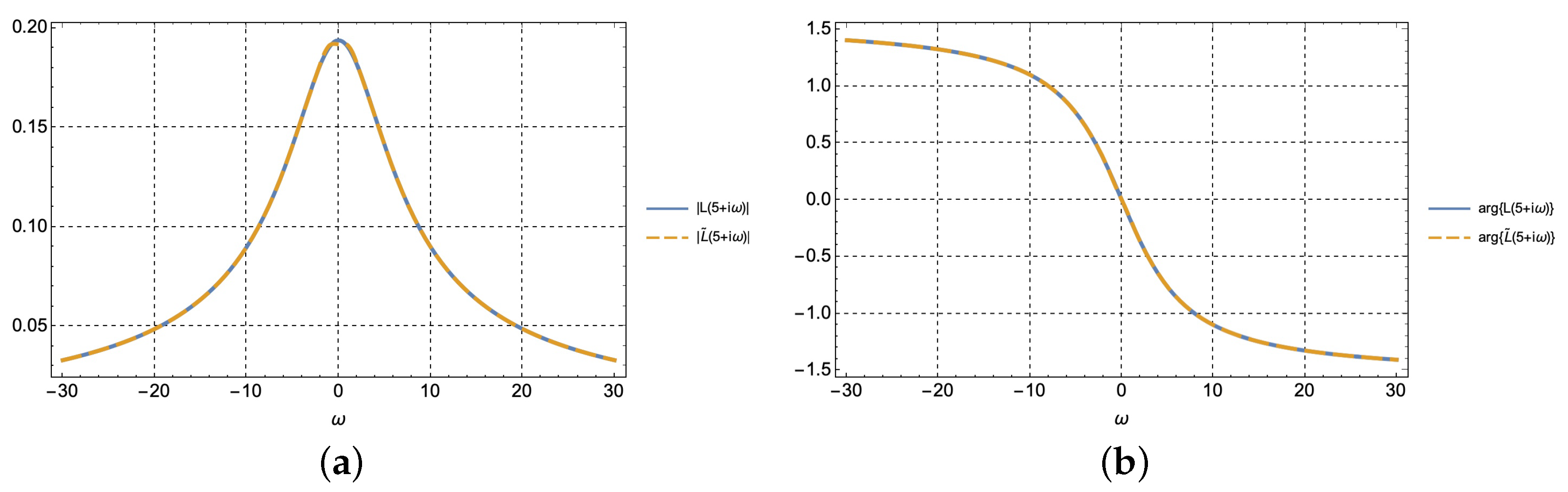
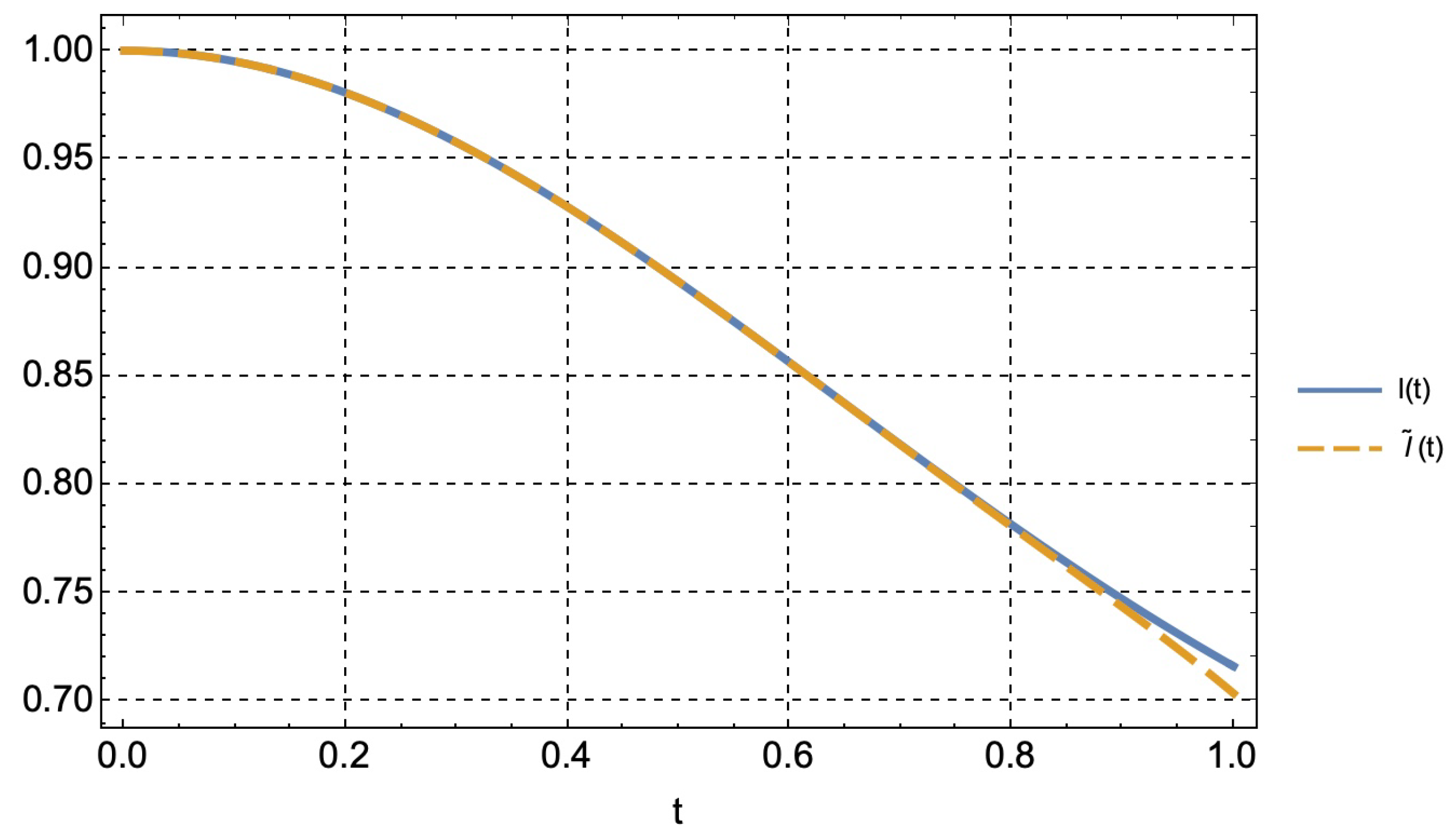
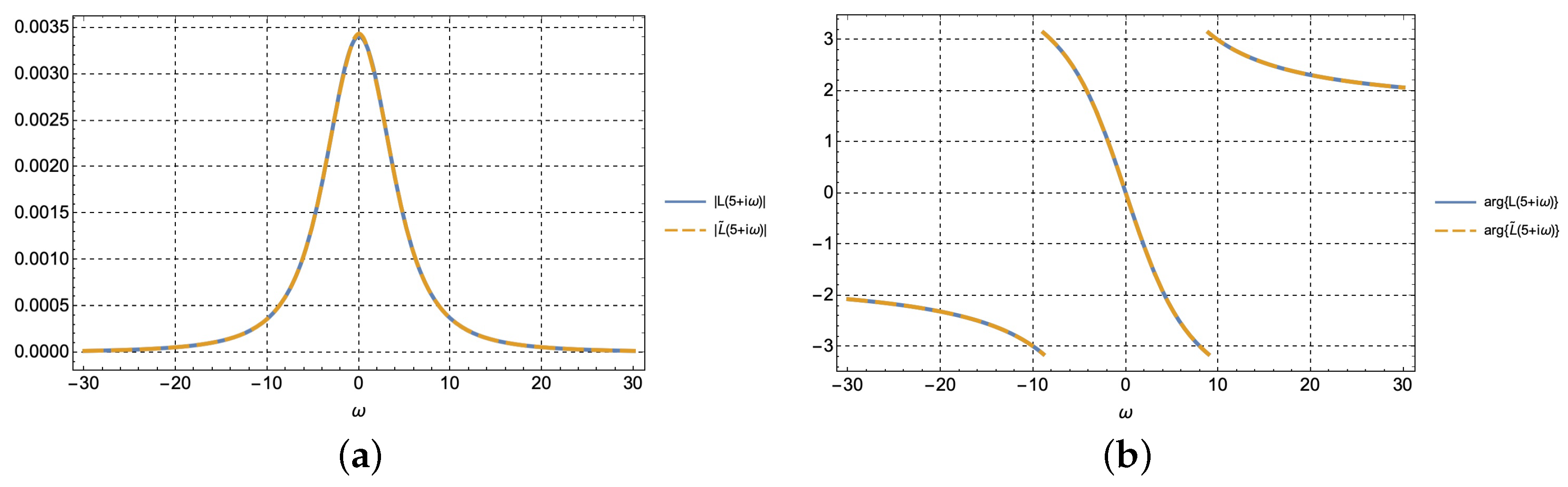
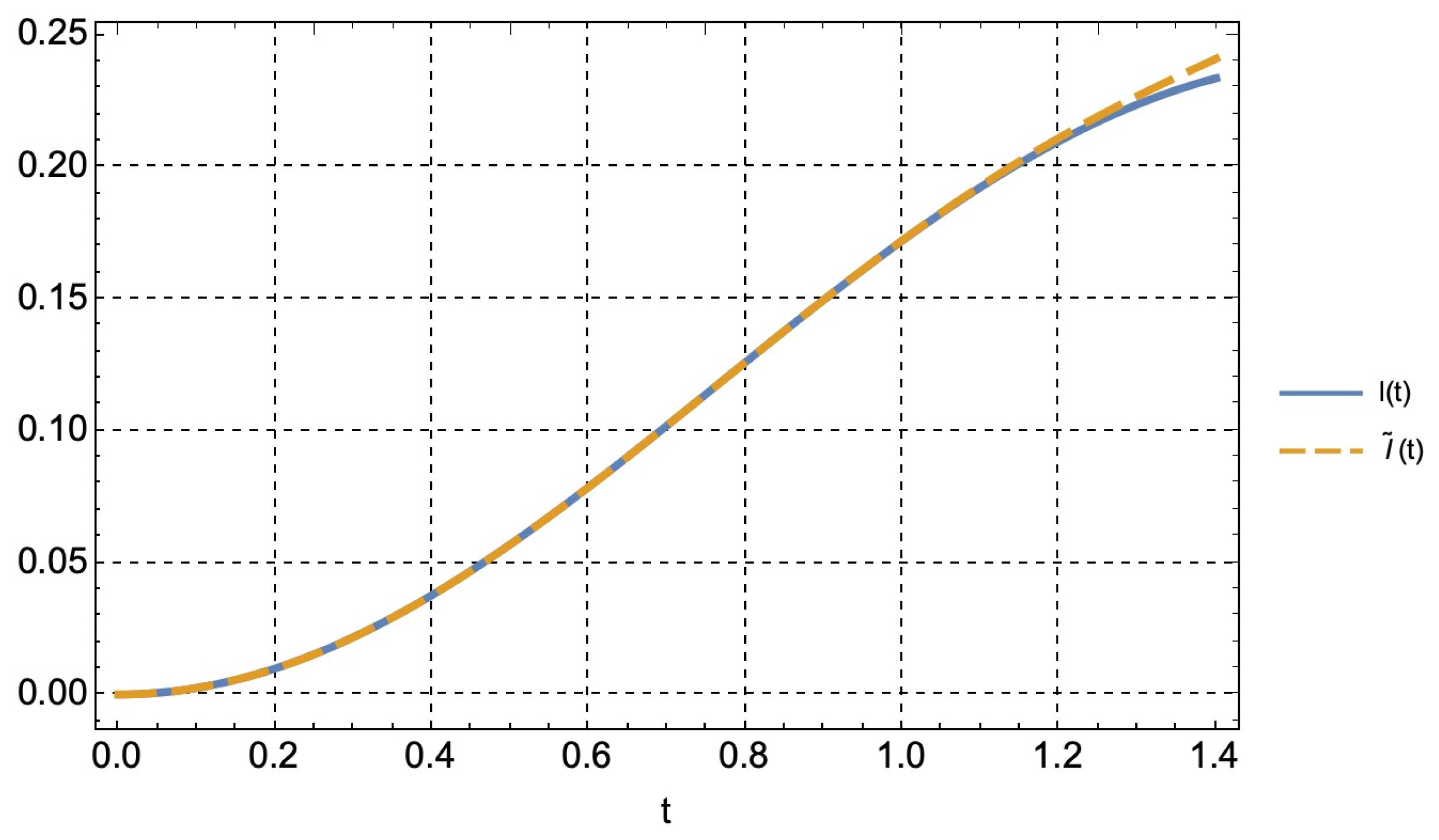
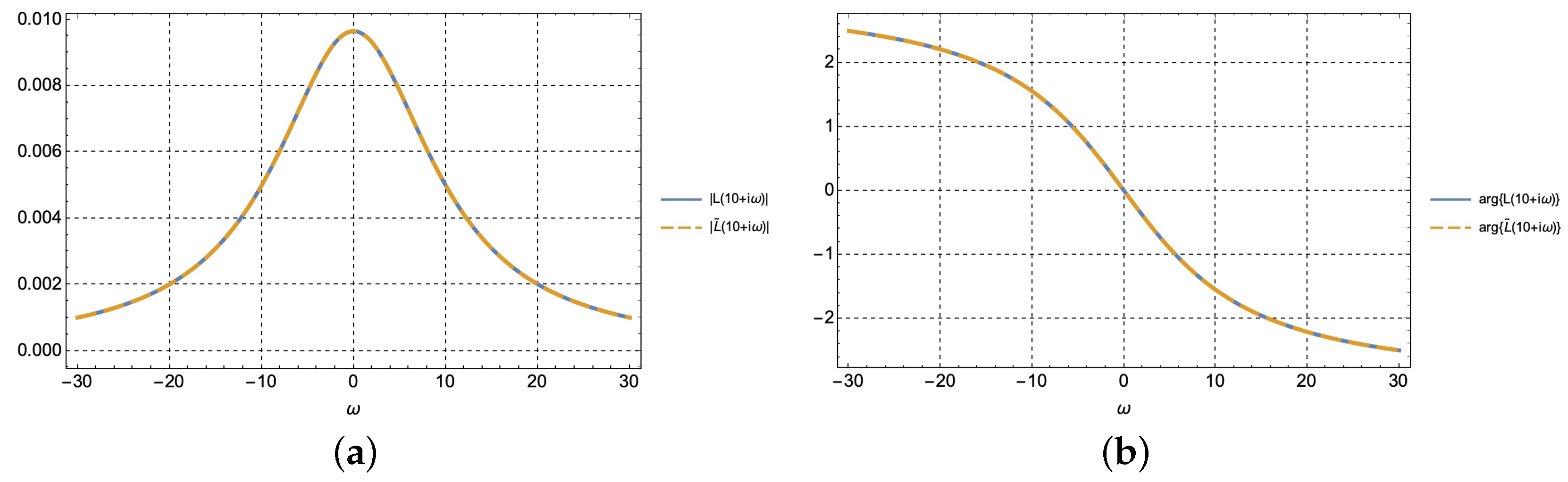
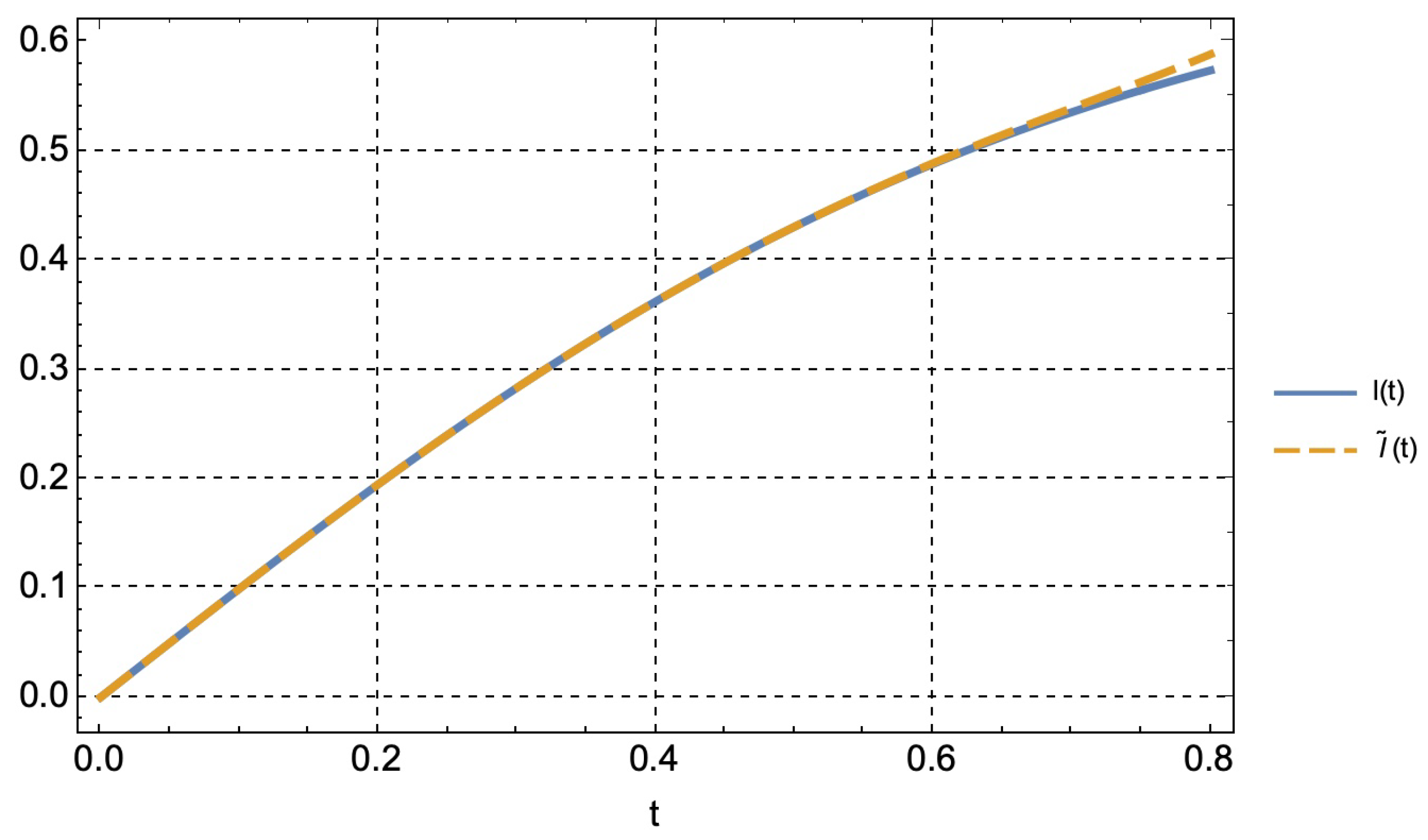
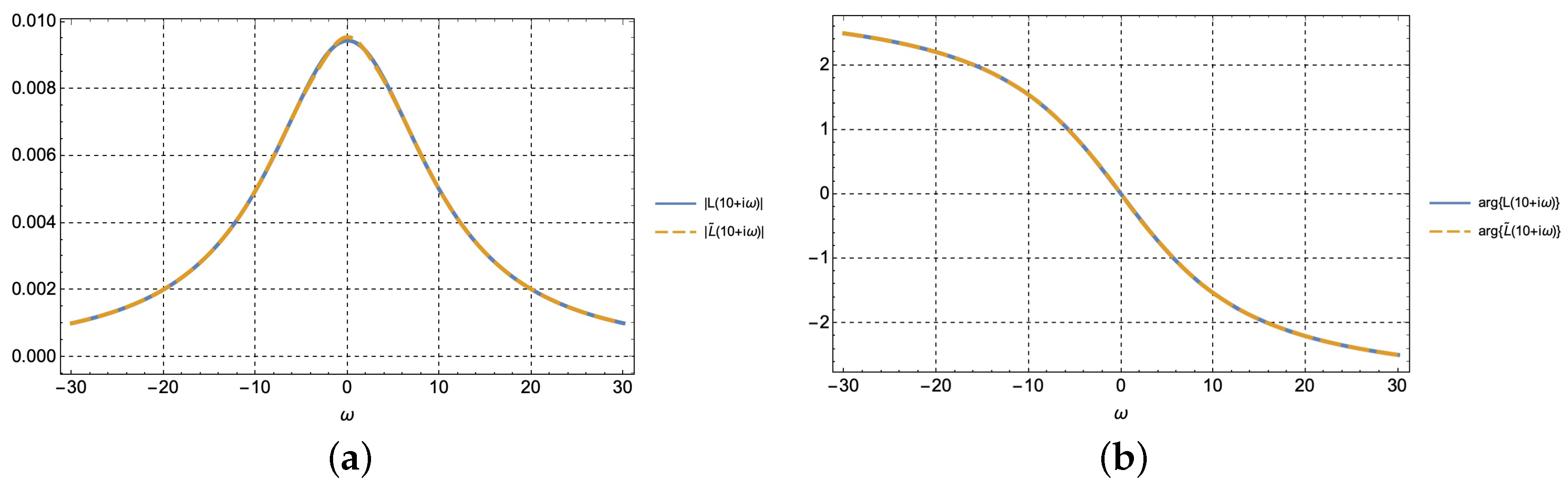
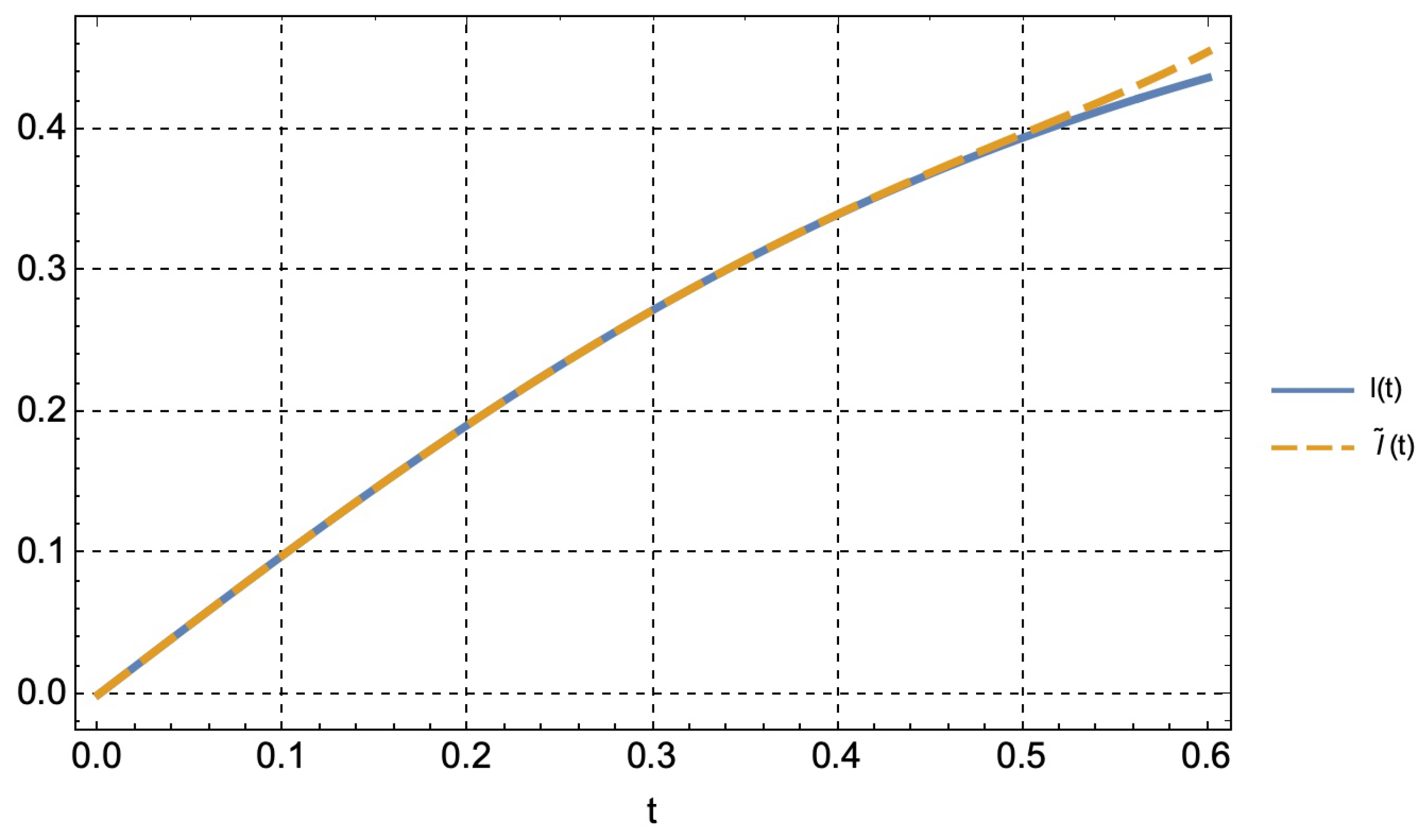
Example 1. • Assuming , , , it results in (see Figure 1)for . The corresponding inverse LT is approximated by (see Figure 2) Example 2. • Upon assuming , , , it results in (see Figure 3)for . The corresponding inverse LT can be approximated as (see Figure 4) 7. Higher Order Bell’s Polynomials
Consider the nested function , i.e., the composition of the functions , …, , , and suppose that , …, , are n times differentiable with respect to their independent variables. Then, can be differentiated n times with respect to t using the chain rule. By definition we put , so that .
We use the following notation:
Then, the
n-th derivative can be represented as
where the
are, by definition, Bell’s polynomials of order
.
The above Theorems 2 and 3 can be generalized as follows.
Theorem 5. For every integer n, the polynomials are expressed in terms of Bell’s polynomials of a lower order, through the following equation: Theorem 6. The following recurrence relation for the Bell’s polynomials of order holds true: Example 3. We apply the above results to the case of the LT of nested sine functions, assuming and .
• Let be . We have (see Figure 5): for .
The corresponding inverse LT is approximated by (see Figure 6). • Let be . We have (see Figure 7): for .
The corresponding inverse LT is approximated by (see Figure 8). 8. Conclusions
We have presented a method for approximating the integral of analytic composite functions. We started from the Taylor expansion of the considered function in a neighborhood of the origin. Since the coefficients can be expressed in terms of Bell’s polynomials, the integral is reduced to the computation of an approximating series, which obviously converges if the integral is convergent. Then, this methodology has been applied to the case of the LT of an analytic composite function, starting from the case of analytic nested exponential functions. Furthermore, the evaluation of the LT of analytic nested functions is discussed, and the first few second-order Bell’s polynomials used in the framework of the presented methodology are reported in
Appendix A, whereas those of order 4 are given in
Appendix B. A graphical verification of the proposed technique, performed in the case when the analytical forms of both the transform and anti-transform are known, proved the correctness of our results. In future studies, attention will be devoted to the evaluation of more complex functions, such as the basic class of symmetric orthogonal polynomials (BCSOP) introduced in [
18].