Abstract
Nonlinear electrodynamics is known as the generalizations of Maxwell electrodynamics at strong fields and presents interesting features such as curing the classical divergences present in the linear theory when coupled to general relativity. In this paper, we consider the asymptotically flat Reissner–Nordström black hole solution with higher-order magnetic correction in Einstein-nonlinear-Maxwell fields. We study the effect of the magnetic charge parameters on the black hole, viz., weak deflection angle of photons and massive particles using the Gauss–Bonnet theorem. Moreover, we apply Keeton–Petters formalism to confirm our results concerning the weak deflection angle. Apart from a vacuum, their influence in the presence of different media such as plasma and dark matter are probed as well. Finally, we examine the black hole shadow cast using the null-geodesics method and investigate its spherically in-falling thin accretion disk. Our inferences show how the magnetic charge parameter p affects the other physical quantities; so, we impose some constraints on this parameter using observations from the Event Horizon Telescope.
Keywords:
relativity; gravitation lensing; black hole; nonlinear electrodynamics; Gauss–Bonnet theorem; deflection angle; plasma medium; shadow PACS:
95.30.Sf; 98.62.Sb; 97.60.Lf
1. Introduction
Gravity is the weakest force in the universe that we live in today. While it can pull everything reachable inwards, its effect decreases with (the square of) distance until it is no longer significant, according to Newtonian physics. However, when the mass of the gravitating object increases, gravity starts to behave differently. With a mass high enough, collapsing on itself and concentrated at a single point, it can not only overcome the other three natural forces, but also crush the familiar laws of physics that are known to govern our universe. This object of extreme mass, infinite density, no volume and dominating gravity—so strong that nothing that goes in comes out—is a black hole [1]. Black holes have been particularly of interest since their discovery by the Event Horizon Telescope [2,3].
A black hole is surrounded by an accretion disk in which matter, dust and photons are stuck in unstable orbits around it [4,5]. The not-so-circular photon sphere gives rise to the phenomenon of gravitational lensing. When a massive cluster falls in the light trajectory aimed at an observer, the gravitational fields of the clusters act as a lens deflecting the rays of light, causing distortions of the light source in its background [6]. This fascinating phenomenon was particularly prominent in the first images from the James Webb Space Telescope, especially of the galaxy cluster called SMACS 0723, which was reportedly due to an astronomical quantity of matter in view on the speck of sky almost as big as a sand grain at arm’s length [7].
Gravitational lensing can be classified into strong lensing and weak lensing; this paper is built on the latter. It majorly depends on the mass distribution of the lensing cluster. Weak lensing is a consequence of general relativity arising from minor distortions that are too small to be detected in terms of magnification, yet sufficient enough to distinguish between various mass distributions [8,9,10,11,12,13,14,15,16,17]. It is known in astrophysics that distances have a dominant role in obtaining the properties of astrophysical objects. However, Virbhadra proved that just observation of relativistic images can also have an incredibly accurate value for the upper bound to the compactness of massive dark objects [18] and then Virbhadra showed that there exists a distortion parameter such that the signed sum of all images of singular gravitational lensing of a source identically vanishes by testing this with images of Schwarzschild case (SC) lensing in weak and strong gravitational fields [19].
Weak lensing utilizes the fine property of differential deflection exhibited by the bending of light to explore the structures of the deeper cosmos. In order to achieve this, the angle of deflection is calculated using the optical geometry derived from the Gauss–Bonnet theorem given by [20]
where is the Euler characteristic of the topology, g is a Riemannian metric of the manifold of the symmetric lens, represents the domain of the surface, is the Gaussian curvature, is the geodesic curvature, and is the exterior angle at the ith vertex. In the literature, there are various studies of this method on black holes, wormholes and other spacetimes [21,22,23,24,25,26,27,28,29,30,31,32,33,34,35,36,37,38,39,40,41,42,43,44,45,46,47,48,49,50,51,52,53,54,55,56,57,58].
The scope of this paper extends to evaluating the weak deflection angle through two different approaches: the Gibbons and Werner (GW) method [20] and Keeton–Petters formalism [59]. Moreover, we study the shadow cast by the black hole with a thin-accretion disk.
The accretion disk, along with the lensing effect, creates the appearance of a shadow of the black hole. This is due to the emission region that is geometrically thick but optically thin and is accompanied by a distant, homogeneous, isotropic emission ring [60,61,62].
The shadow is essentially illustrated as the critical curve interior which separates the capture orbits that spiral into the black hole from the scattering orbits that swerve away from the black hole, i.e., entering versus exiting photon orbits. Although the size of the shadow is primarily dependant on the intrinsic parameters of the black hole and its contour is determined by the orbital instability of the light rays from the photon sphere, it merely appears to be a dark, two-dimensional disk for a distant observer illuminated by its bright, uniform surroundings [30,31,45,46,47,48,63,64,65,66,67,68,69,70,71,72,73,74,75,76,77,78,79,80,81,82,83,84,85,86,87,88,89,90,91,92,93,94,95,96,97,98,99,100,101,102,103,104,105,106,107,108,109,110,111,112,113,114,115,116,117].
A factor of interest that affects the radius of the shadow is the effect of magnetic charge, especially since it cannot be neutralized with regular matter unlike electric charge in a conductive medium [118]. The presence of magnetic charge tends to increase the curvature of the spacetime, resulting in more photons being pulled into the black hole and hence decreasing the radius of the shadow [77]. Along with black hole spin, magnetic charge is found to create two distinct horizons, namely the inner and the outer horizons, defined by stable and unstable photon orbits [78]. For a negligible charge, they are one and indistinguishable. However, as the value of the charge increases towards a critical value, Sun et al. have obtained that these horizons become more prominent as the inner horizon appears from the center, with the outer horizon existing sensitive to the charge. Other studies have shown the influence of magnetic charge on the shadow for different cases of black holes [62,63,64,77,119].
Here, we will proceed to discuss how magnetic charges affect the shadow of a black hole starting with the black hole solution from a new model of nonlinear electrodynamics proposed by [120] coupled in Einstein’s gravity. The paper is organized as follows: the black hole solution is introduced in Section 2. This is followed by calculating the weak deflection angle using the Gauss–Bonnet theorem in Section 3 along with determining the deflection angle and the observables using Keeton–Petters formalism. Then, the weak deflection angle for massive particles is computed in Section 4 with the help of the Jacobi metric. Furthermore, the weak deflection angle is calculated in the presence of plasma and dark matter in Section 5. With inferences and comments about shadows in Section 6, we finish with concluding remarks about our results in Section 7.
2. Brief Review of Reissner–Nordström Black Hole with Higher-Order Magnetic Correction in Einstein-Nonlinear-Maxwell Fields

From the beginning of the universe to the black holes, singularity has been a matter of question, hindering general relativity from being unified to the other models of the universe. Researchers have been working on finding the solution for a black hole without singularities pioneered by Bardeen [121,122].
Building on this attempt to eliminate singularity, the black hole solution presented by [120] brings nonlinear electrodynamics into play. They have provided an analytical black hole solution much like the Born–Infeld-type corrections to the linear Maxwell theory in the weak field limit [123]. The governing equations for a pure magnetic field are
where p is the magnetic charge construed as a magnetic monopole, is a dimensional constant with a dimension of , g is the metric, R is the Ricci scalar, G is Newton’s gravitational constant in four-dimensional spacetime and .
The line element of a spherically symmetric spacetime is written as
Given a radial magnetic field, , using the set of equations from (2)
and a new nonlinear electrodynamics Lagrangian is proposed in [120] by Mazharimousavi and Halilsoy satisfying the Maxwell-nonlinear equations and - to be
Then, the corresponding energy-momentum tensor for the nonlinear electrodynamics is calculated as follows
On the other hand, using the spherically symmetric spacetime in Equation (3), Einstein’s tensor is obtained as follows
Then, using the relation between Einstein’s tensor and the energy-momentum tensor
where ; components of the Einstein’s field equations become
which gives the metric function
that reduces in the weak field limit to the non-asymptotic behavior of the magnetic Reissner–Nordström black hole [120]
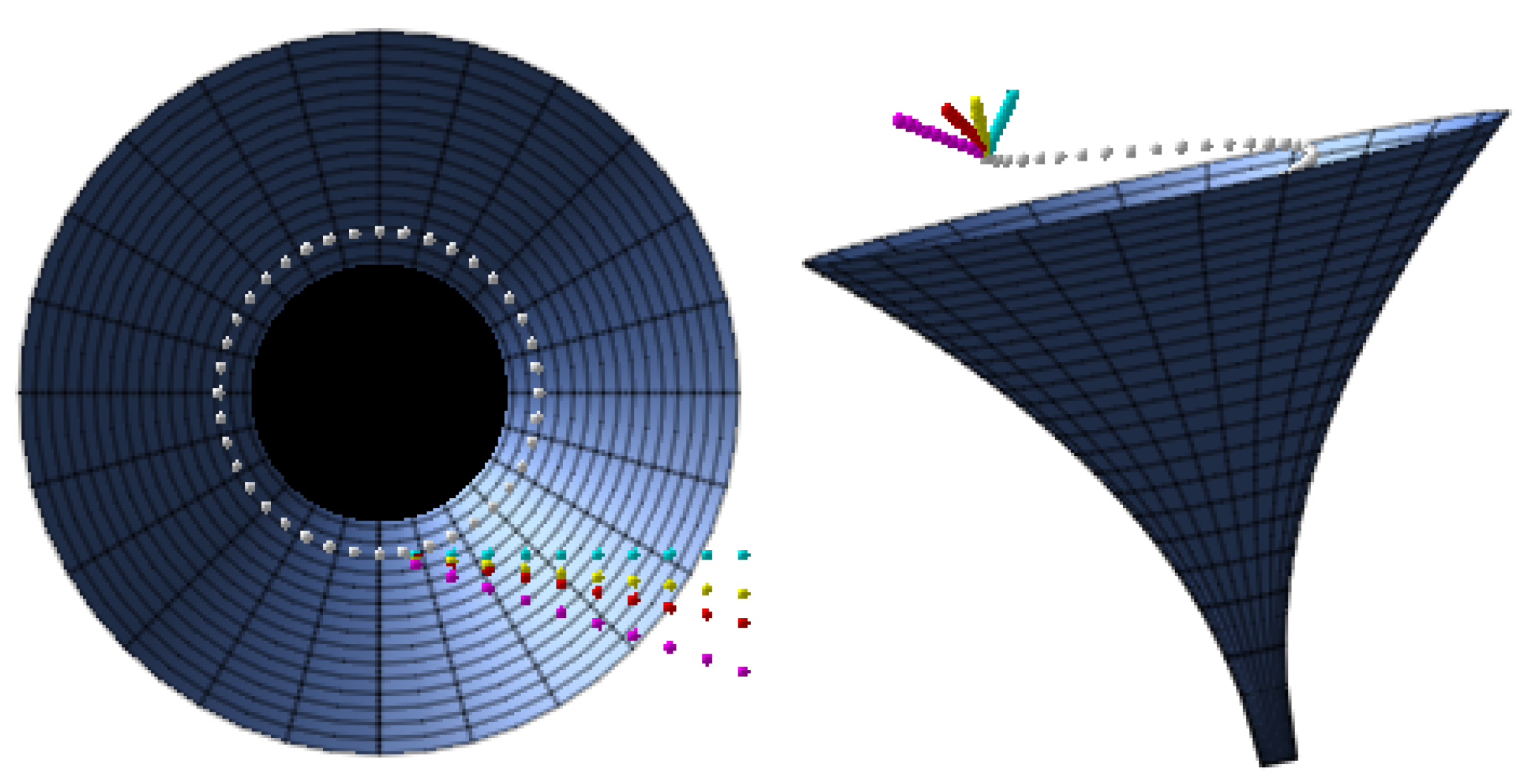
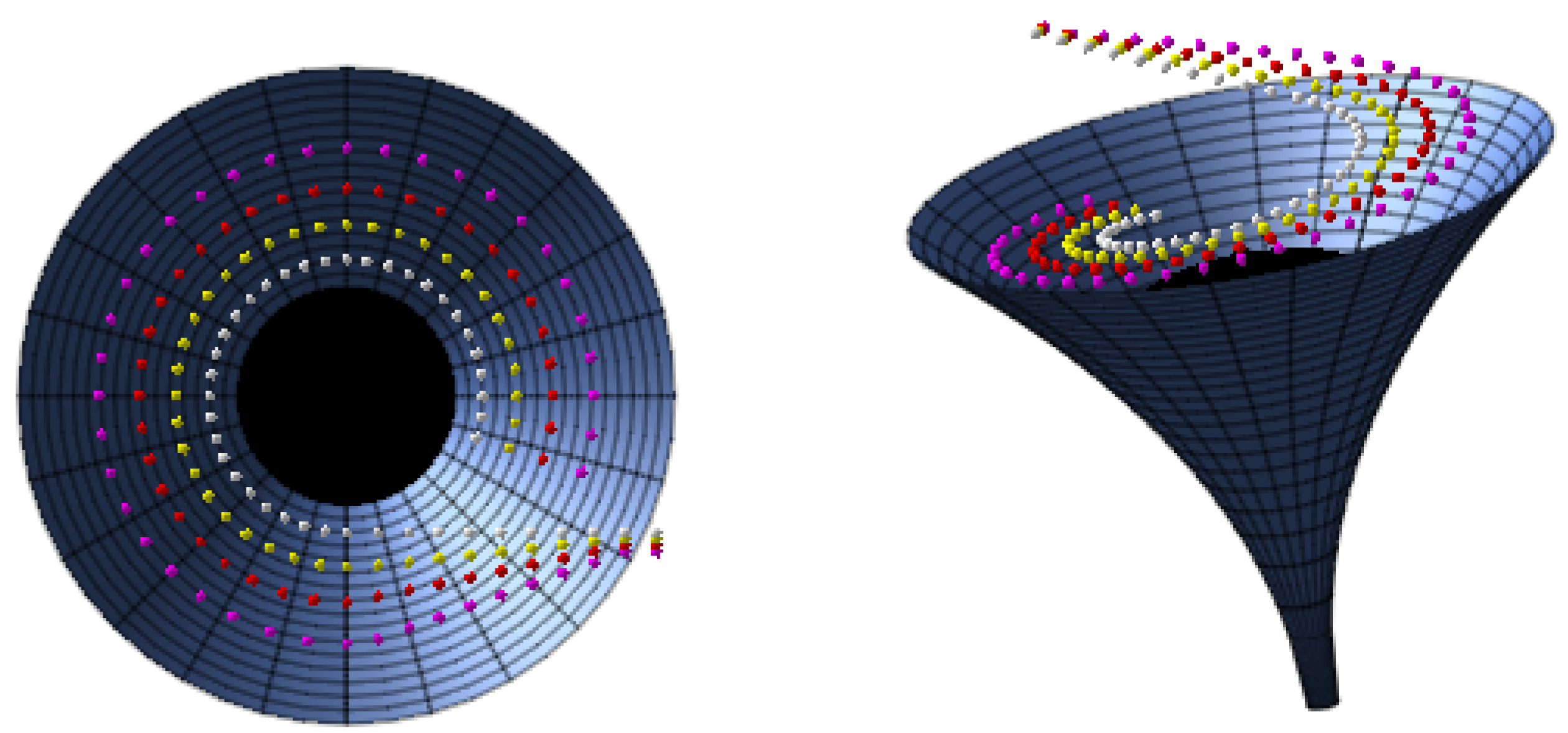
This magnetic black hole solution will be the center of analyses henceforth. Figure 1 illustrates the effect of the magnetic charge on incoming light rays. Note that the Reissner–Nordström metric belongs to the class of Stackel spaces. Geodesic equations can be exactly reintegrated (or reliably solved approximately) only in such spaces because the Hamilton–Jacobi equation (for light rays—eikonal equation) admits in these spaces a complete separation of the variables; Obukhov presents the method of complete separation of variables; this can be found in [124].
Figure 1.
Illustration of the function in the Cartesian coordinates. The first figure shows the top view and the second figure shows an angular view. The white circles represent the Schwarzschild case (SC); the yellow, red and purple circles correspond to different values of magnetic charge, , and , respectively.
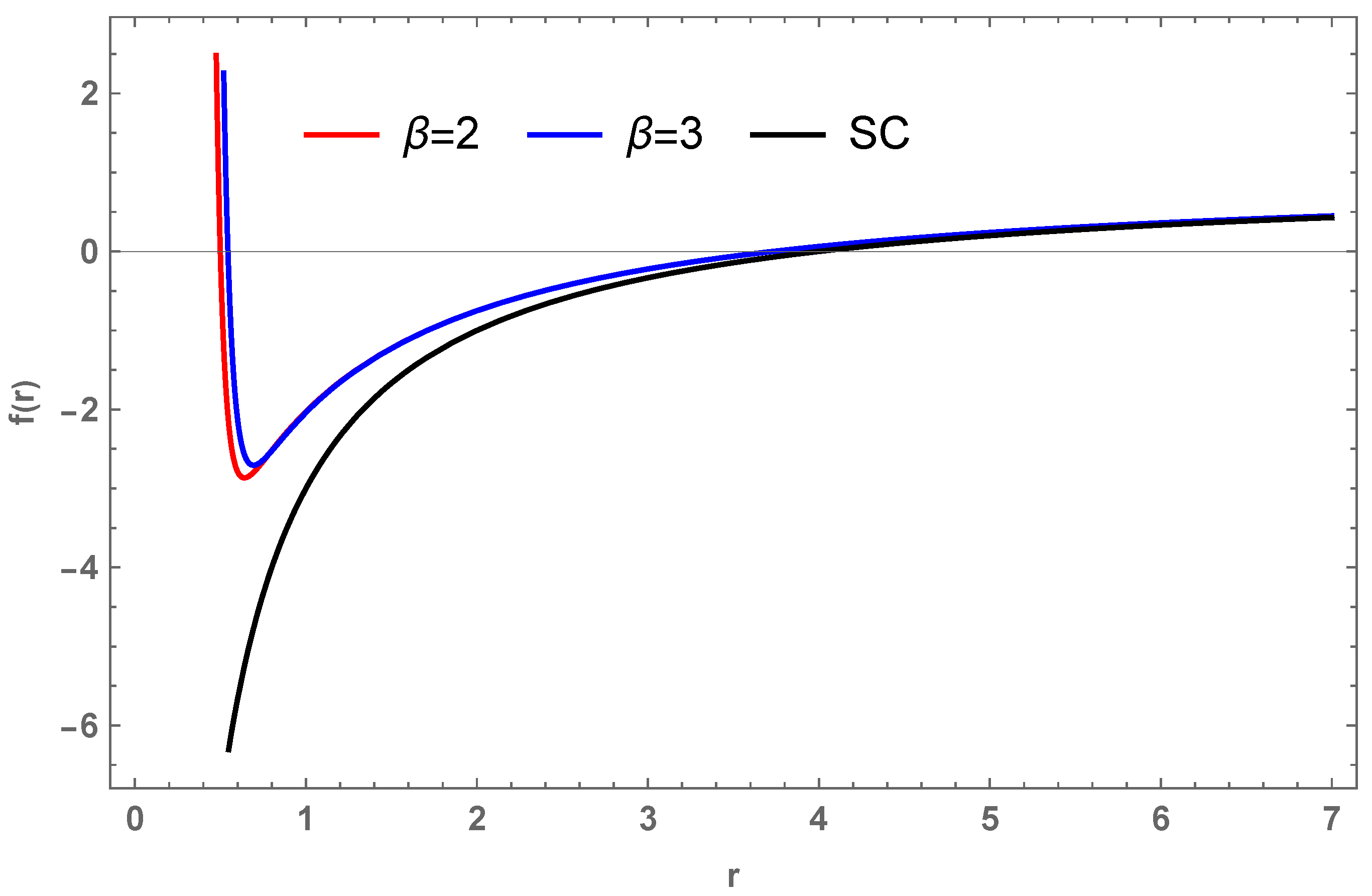
The event horizon radius of a black hole is the larger root of the above equation—where the outer horizon is located—with . As shown in Figure 2, the number of horizons is dependant on the parameters of f.
Figure 2.
The lapse function as a function of r for , , and for the different values of .
The 4 velocity is determined by
accompanied by the satisfying normalization condition
where . Correspondingly, the particle acceleration is given by [125]
as the metric components exist as functions of r and . The surface gravity is defined as
which helps in finding the black hole temperature
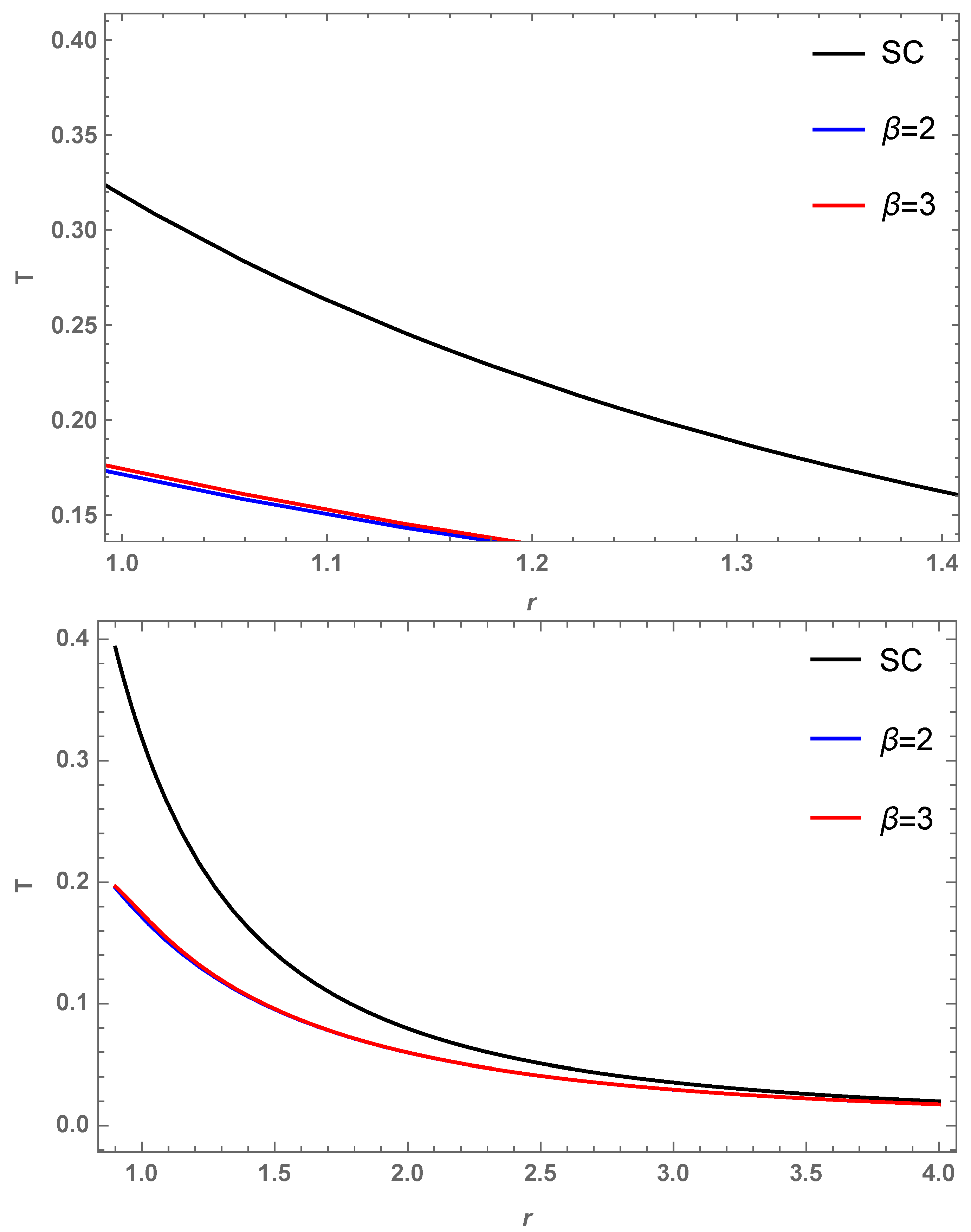
as shown in Figure 3 for different values of . The horizon area is plainly calculated as
giving the black hole entropy to be
Figure 3.
Hawking temperature T (unit of 1/m in Geometrized units) versus r for , , and for the different values of . The plot above is a zoomed in version of the plot below.
As for the thermodynamic properties of a black hole, the mass of a black hole described by is
At the limit of the Gauss–Bonnet coupling and the magnetic parameters vanishing , the black hole mass and temperature reduce to the Schwarzschild case, and , respectively.
3. Weak Deflection Angle Using Gauss–Bonnet Theorem
For the equatorial plane , applying null geodesics to the line element in Equation (3) yields the optical metric
where the determinant of the optical metric . In order to calculate the deflection angle while accounting for the optical geometry using a domain outside the light rays’ trajectory, the Gauss–Bonnet theorem introduced by Gibbons and Werner is employed [20]. The light rays are treated as spatial geodesics in the optical metric, which induces a topological effect. The Gaussian curvature is found to be proportional to the Ricci scalar computed from the non-zero Christoffel symbols as .
To calculate the deflection angle utilizing the optical Gaussian curvature, a non-singular region with a boundary of is selected. Alternatively, a non-singular domain outside of the light trajectory where the Euler characteristic can also be chosen. For this region, the GBT can be stated as [20]
As , the jump angles (, ) can be equated to which says that the sum of the jump angles of the source , and of the observer transpires as . Defining as the unit acceleration vector, the geodesic curvature
along with the unit speed condition affects Equation (21) to become
Since is a geodesic and , choosing , the geodesic curvature becomes
where the radial part can be evaluated as
While the first term vanishes, the second term is determined under the unit speed condition to be
On the other hand, when the radial distance is very large
by combining the last two equations, . Then we use the straight-line approximation as , where b is the impact parameter. Thus the deflection angle can be determined by the Gibbons and Werner method through the Gauss–Bonnet theorem to be [20]
where differential surface . Substituting Equation (11) in Equation (20), the optical metric for a magnetic black hole using the new solution gives the Gaussian curvature evaluated from the non-zero Christoffel symbols as
Ignoring the higher order terms, the above equations simplify to the asymptotic deflection angle given by
This reduces to the Schwarzschild case in the absence of the magnetic charge, . Owing to the topological effects that exist as its salient features, the GBT method can be used in any asymptotically flat Riemannian optical metrics.
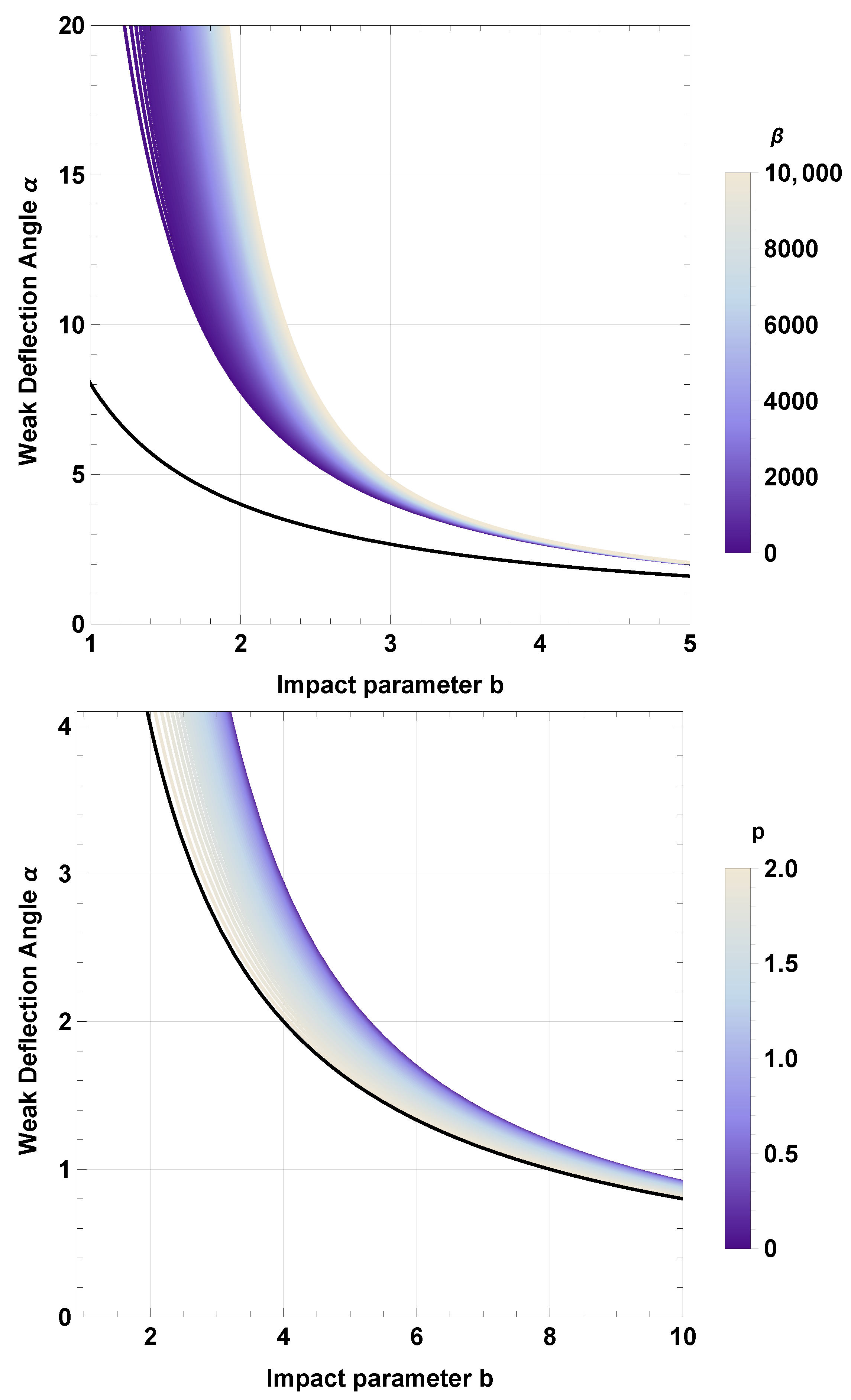
Figure 4 was plotted to examine the effects of and p more closely and separately. It is interesting to compare the variation scales of both figures: while does not show much difference for small changes, it tends to increase as b increases, whereas p appears to be quite sensitive to any change and tends to decrease as b increases. Therefore, for a given impact parameter, the greater the magnetic charge, the greater the deflection. It is interesting to note that although both parameters tend to merge with the Schwarzschild case for high values of the impact parameter, is close to the Schwarzschild case in the lower range, while p is closer to the same in the higher range. This emphasizes the nature of influence of and p on the deflection angle and the inverse proportionality between each. Figure 5 illustrates the effect of the magnetic charge on the bending of an outgoing light ray.
Figure 4.
The first figure shows the weak deflection angle versus the impact parameter b with and for different values of . The second figure shows versus b with and for different values of p. The solid black line represents the Schwarzschild case.
Figure 5.
Illustration of the function deflecting a ray of light for different values of p. The first figure shows the top view and the second figure shows an angular view. The white circles represent the ray of light; the cyan circles represent the Schwarzschild case; the yellow, red and purple circles correspond to different values of magnetic charge, , and , respectively.
Calculation of Weak Deflection Angle Using Keeton–Petters Formalism
Keeton–Petters formalism is a general PPN (post-post-Newtonian) approach [59,126] showing that (30) for the weak field deflection angle can be exactly obtained. The light propagation in the metric (3) can be studied by following the general approach mentioned in [59] for arbitrary spacetimes that are static and spherically symmetric. Specifically, the deflection of the light in the metric of the black hole and, more importantly, the corrections imposed for a few lensing observables owing to the non-linearity of the Lagrangian are focused on.
Consider the following metric
such that the coefficients are expressed in power series as
where is defined as the Newtonian potential. Comparing this to the metric in Equation (3), and . Setting leads to Equations (3), (32) and (33) yielding
In General Relativity (GR), expanded as a series expresses the corrected deflection angle in the weak-field limit. Defining as the gravitational radius of the source, the GR bending that can be seen as a consequence of mass M is . The bending angle derived from the aforementioned metric in Equation (31) for the first order of M will be
The coefficients do not depend on . As for the coefficients , they become and . With respect to Equation (34)
Since the metric Equation (31) is of the linear order of , the contribution of the term proportional to can be neglected. Subsequently, the bending angle given by Equation (35) evolves into
which agrees with Equation (30) to the first order of .
The angular position of the source is B and that of the image is with the bending angle ; D is the distance and the subscripts S, L, and correspond to observer source, observer lens, and lens source. An observer at point O views the image at point S of the source as though it was at . The location of the lens is at L. Applying the thin-lens approximation, all the light trajectories are approximated to straight lines. The impact parameter b becomes a constant of motion in terms of the propagation of light: relative to an inertial observer at infinity, it is essentially the perpendicular distance from the point of the lens center at the asymptotic tangent to the line connecting the path of the ray of light to the observer. It is evident that . Hence, the lens equation can be derived by using elementary geometry [126]
This can be used to determine (angular position of the image) as a function of B (angular position of the source) and . Some underlying assumptions here are the lens being static and spherically symmetric, the source and the observer being asymptotically flat, and the light rays being propagated external to , i.e., say, is the distance of the nearest approach, then, .
For small angles due to weak-lens approximation, the preceding lens equation Equation (38) can be written as . By employing the GR expression for both and , the subsequent lens equation can be written as
When , the solution of this equation implies that the source, the lens, and the observer are all aligned to be on the same line, giving rise to a characteristic angular scale called the Einstein angle, is expressed as
Sequentially, a characteristic length scale called the Einstein radius is also defined. All angular positions are scaled with respect to as
where is identified as the angle subtended by the lens’ gravitational radius. The lensing observables are expanded in power series with the help of the parameter . The lens equation from Equation (38), rendered similar to in the form of Equation (35), for the position of the image becomes
where, is the position of the image in the weak-field limit solved as
The images position, one of the observables, is accordingly obtained to be
where denotes the parity image with respect to the lens; the positive sign implies that the image lies on the same side as the source () while the negative sign implies that the image lies on its other side opposite to the source (). Here, the second-order term becomes [59]
Therefore, the image position up to the first order of is found to be
Considering the values of and in Equation (36), the image position for the said black hole metric is written as
The actual angular positions defined as can be corrected as ; for small angles, this is determined to be
The next observable is the magnification of an image at that can be obtained with its sign in this formalism. Having the expression
for general case, the series expansion in gives
where
Once again, taking the values of and from Equation (36) into account for the metric in question
Naturally, corresponds to , the positive parity image, and to , the negative parity image. The sign of P is seen to influence the magnification; if , then and the positive parity image appears faint while the negative parity image is bright. Technically, this condition can be utilized as a test in observation for the theoretical quantity P. Since the total magnification is not altered to the first order of when the second-order term is rather proportional to , it is found to be null in this approximation.
The last observable is the time delay, which is defined as the travelling time difference (due to the lens) between the actual time that light takes and the time that it would take if there were no lens, and it is given by
which becomes
for the case under scrutiny. In physical units, while in natural units, the gravitational constant G and the speed of light c are taken to be unity and thus is obtained for the regarded system in the natural time scale. The differential time delay can be calculated between the negative and the positive parity images as
where
The time delay corrected to the first order gives an order of magnitude
4. Weak Deflection Angle of Massive Particles
For a static and spherically symmetric (SSS) spacetime, the general form
can be rewritten for the Jacobi metric as
where E is the particle energy per unit mass m and is the line element of the unit two-sphere. The Jacobi metric can be utilized to derive the radius of the circular photon orbit using a geometric method for a particle in the equatorial plane. The Jacobi metric obviously reduces to the optical metric for null particles with and (a non-zero mass term implies that the particle under consideration is a massive particle and thus not travelling at the speed of light c). An asymptotic observer perceives one of the constants of motion, the particle energy, far away from the black hole as
where v is the particle velocity prevailing as a fraction of c. In the equatorial plane , the Jacobi metric is [127]
maintaining the generality. The determinant of the above metric is determined to be
Using GBT to find the weak deflection angle,
for the Jacobi metric defined above, the weak deflection angle of massive particles is written as
For null particles, which in turn gives
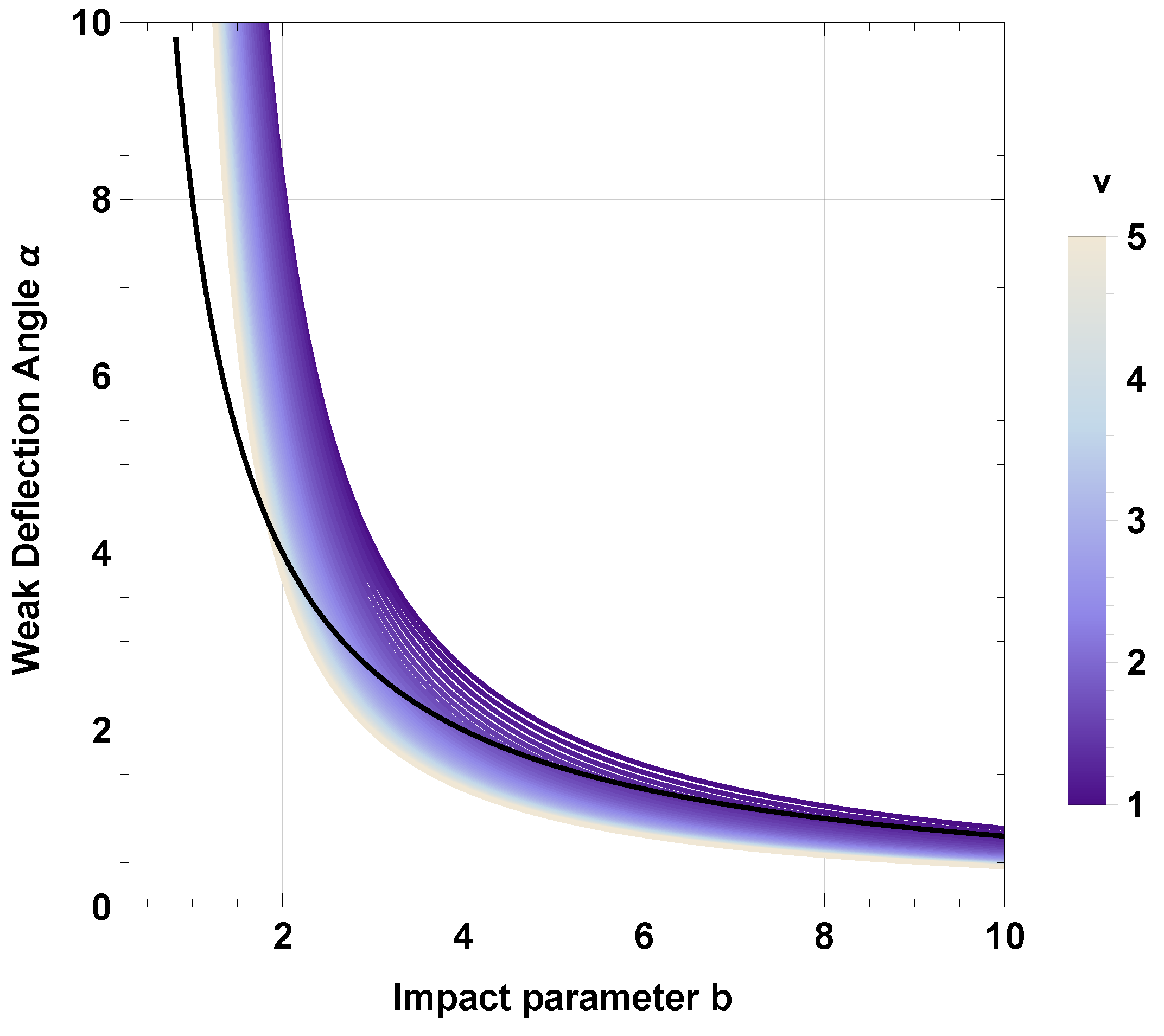
as expected. Furthermore, when there is no charge, the Schwarzschild case is recovered. In Figure 6, the case of the deflection angle due to a massive particle is plotted against the impact parameter. The parameter v is observed to reduce the value of , approaching the Schwarzschild case as .
Figure 6.
The figure shows the weak deflection angle versus impact parameter b for , and for different values of v. The solid black line corresponds to a photon with .
5. Weak Deflection Angle in Plasma Medium and Dark Matter
5.1. Weak Deflection Angle in Plasma Medium
Another non-trivial factor influencing a gravitational lens is plasma. Refraction arises in a plasma medium, causing more deflection. It is particularly eminent in the radio regime and is described by the refractive index, which aims to acquire auxiliary components.
To encompass the effects of plasma, let v be the velocity of light travelling through hot, ionized gas. The refractive index, for the magnetic black hole in question is expressed by [58]
where , is the electron plasma frequency and is the photon frequency measured by an observer at infinity. The line element in Equation (3) is rewritten as
This yields the optical Gaussian curvature
With the GBT becoming
where
for very large radial distances. Therefore, for this profile of number density and the physical metric that indicates an asymptotically Euclidean optical metric, it can be seen that
as expected. For the linear order of M, using Equation (72) in the limit of , and taking , the geodesic curve that is approximated by its flat Euclidean counterpart parameterized as , in the physical spacetime gives
The deflection angle of the black hole in a medium for the leading order terms is calculated non-trivially to be
which agrees with the conventional results in the limit where its presence is insignificant (), reducing to the familiar expression in a vacuum, . Note that GBT is exhibiting a topological effect partially.
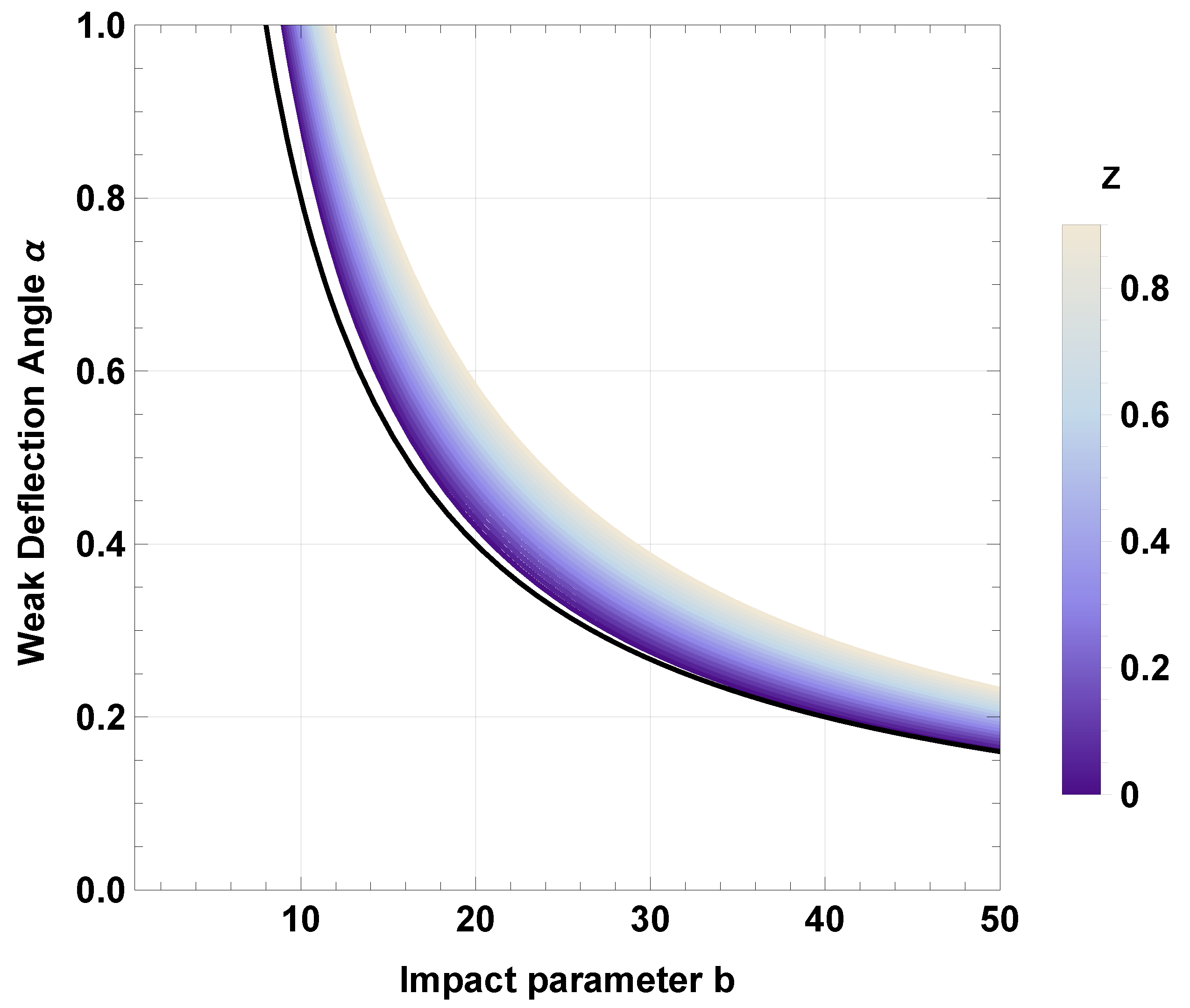
Figure 7 is plotted to study the effects of plasma. For obvious reasons, the range of the refraction parameter, is set to be . Evidently, plasma appears to increase the deflection angle for a given value of b: this is expected as the bending that occurs in this case is due to both gravity and refraction, resulting in a distinctly additional component.
Figure 7.
The figure shows the weak deflection angle versus impact parameter b for , , and for different values of the refraction parameter, . The solid black line represents the Schwarzschild case.
5.2. Weak Deflection Angle in Dark Matter Medium
The refractive index is defined for the dark matter medium as [24,53,128]
where, w is the frequency of light, with is the mass density of the scattered particles of dark matter, with is the charge of the scatterer in units of e, and . The order of terms in and higher are associated with the polarizability of the dark matter particles. This is the anticipated refractive index for an optically inactive medium. The order of corresponds to a dark matter candidate that is charged and to a dark matter candidate that is neutral. Additionally, a linear term in w is a possibility when parity and charge parity asymmetries exist. Consequently, the Gaussian curvature is obtained as
prompting the deflection angle to be
Therefore, the dark matter medium can be seen to affect the deflection angle by inducing small deflections in comparison to the standard case of a Schwarzschild black hole.
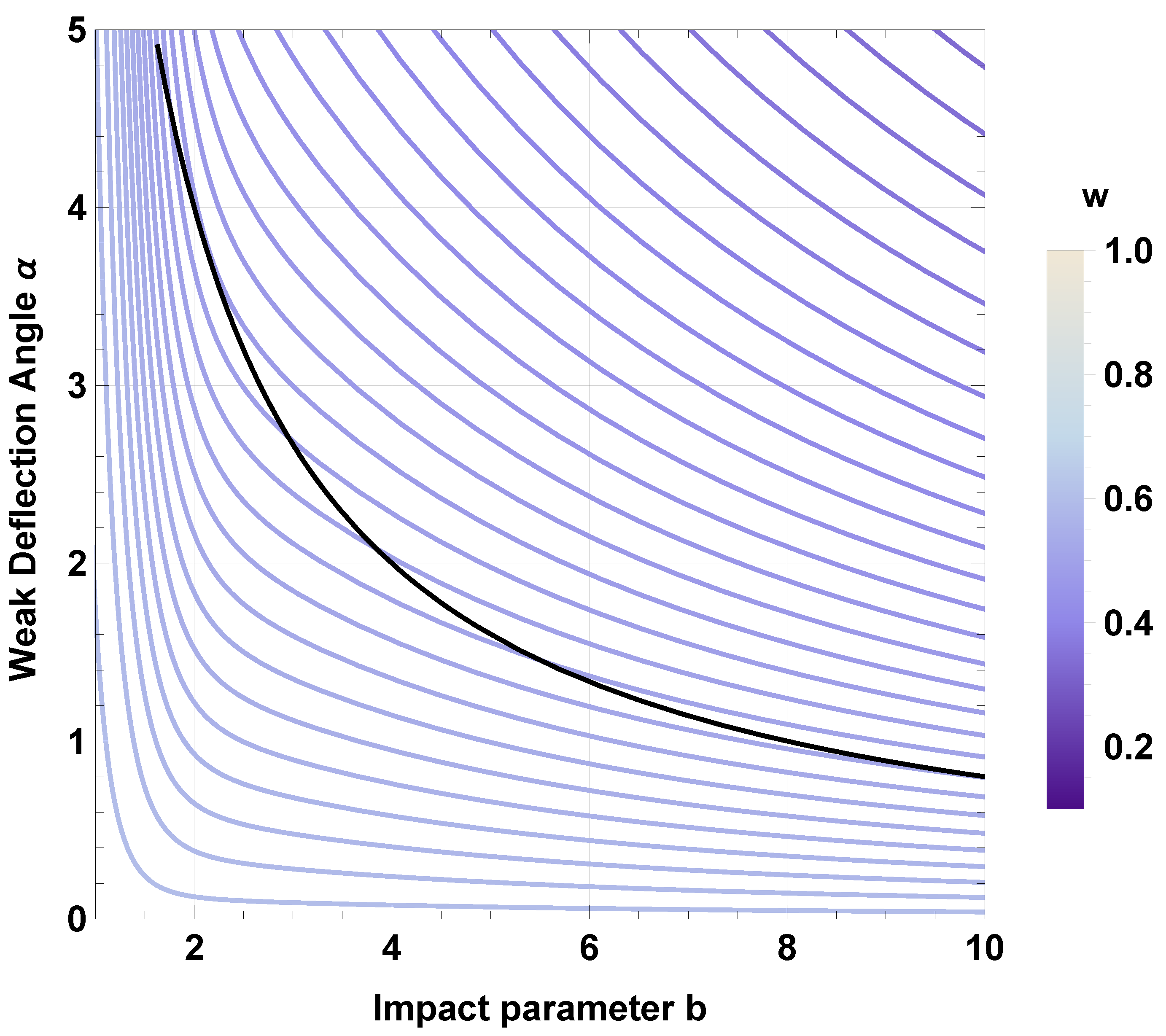
Figure 8 shows the variation of the bending angle with respect to the impact parameter in the presence of dark matter. Its effect is more spaced out than the other cases that were examined—dark matter is observed to impact the deflection angle drastically. Apparently, low values of the dark matter parameter w are seen to produce a high deflection, whereas high values of w give low deflection.
Figure 8.
The figure shows the weak deflection angle versus impact parameter b for , , , , , and for different values of w. The solid black line represents the case of a vacuum containing no dark matter.
6. Shadow of the Black Hole
Here, the shadow of a black hole is analyzed and the effect of the magnetic charge on the shadow cast is studied. A black hole shadow represents the interior of the so-called apparent boundary or the critical curve, the latter being such that the light rays that are a part of it approach a bound orbit of photons asymptotically when a distant observer traces it back to the black hole. The Hamilton–Jacobi approach in the equatorial plane for a photon is expressed as [116]
where is the momentum of the photon, is its angular momentum, is its energy, and . Using the above equation, a complete dynamics with an effective potential V is described by
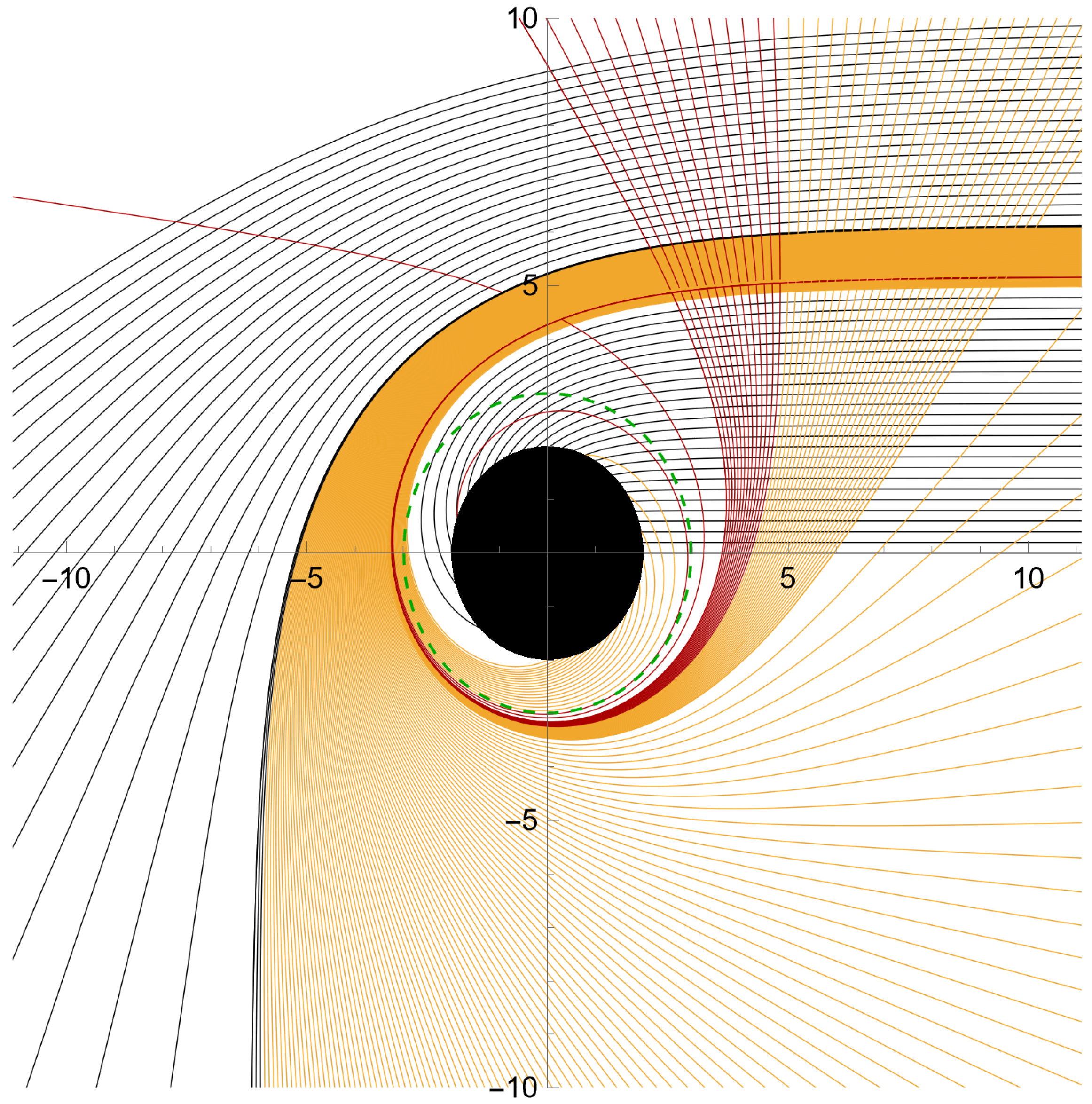
The circular null geodesics, as depicted by Figure 9, holds the stability condition and . For circular photon orbits, the instability is linked to the maximum value of V as
where the impact parameter and is the radius of the photon sphere: the latter can be computed from the largest root of the relation
Figure 9.
Spacetime traced out by null geodesics. The plot shows the orbit of light near the black hole in different colors correspond to direct orbits (black), lensing orbits (yellow) and photon ring orbits (red) and at the center there is a black disk which shows the black hole.
Analytically, this is a complicated equation to solve—numerical methods are employed to obtain the radius of the photon sphere to find that as the value of the confining charge parameter increases, the photon sphere tends to increase as well.
The radius of the shadow of a black hole with respect to a static observer at a position is [129]
and for a distant observer (), it is
Therefore,
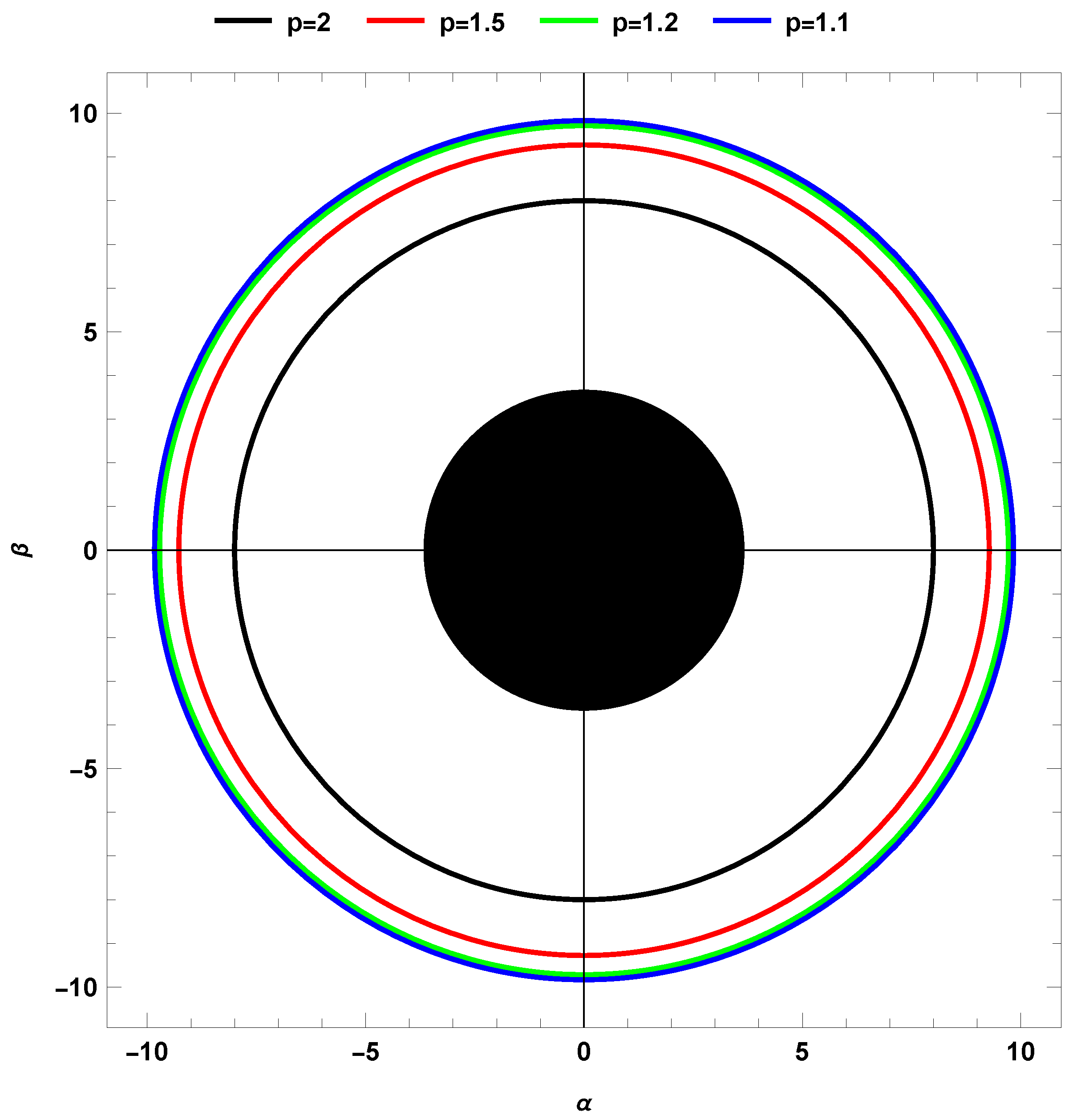
To gather more perspective in this context, Figure 10 is plotted for different values of p. The inverse proportionality between the shadow radius and the magnetic charge can be noticed, implying that the greater the magnetic influence, smaller the radius.
Figure 10.
The figure shows the shadow of the black hole with and for different values of p.
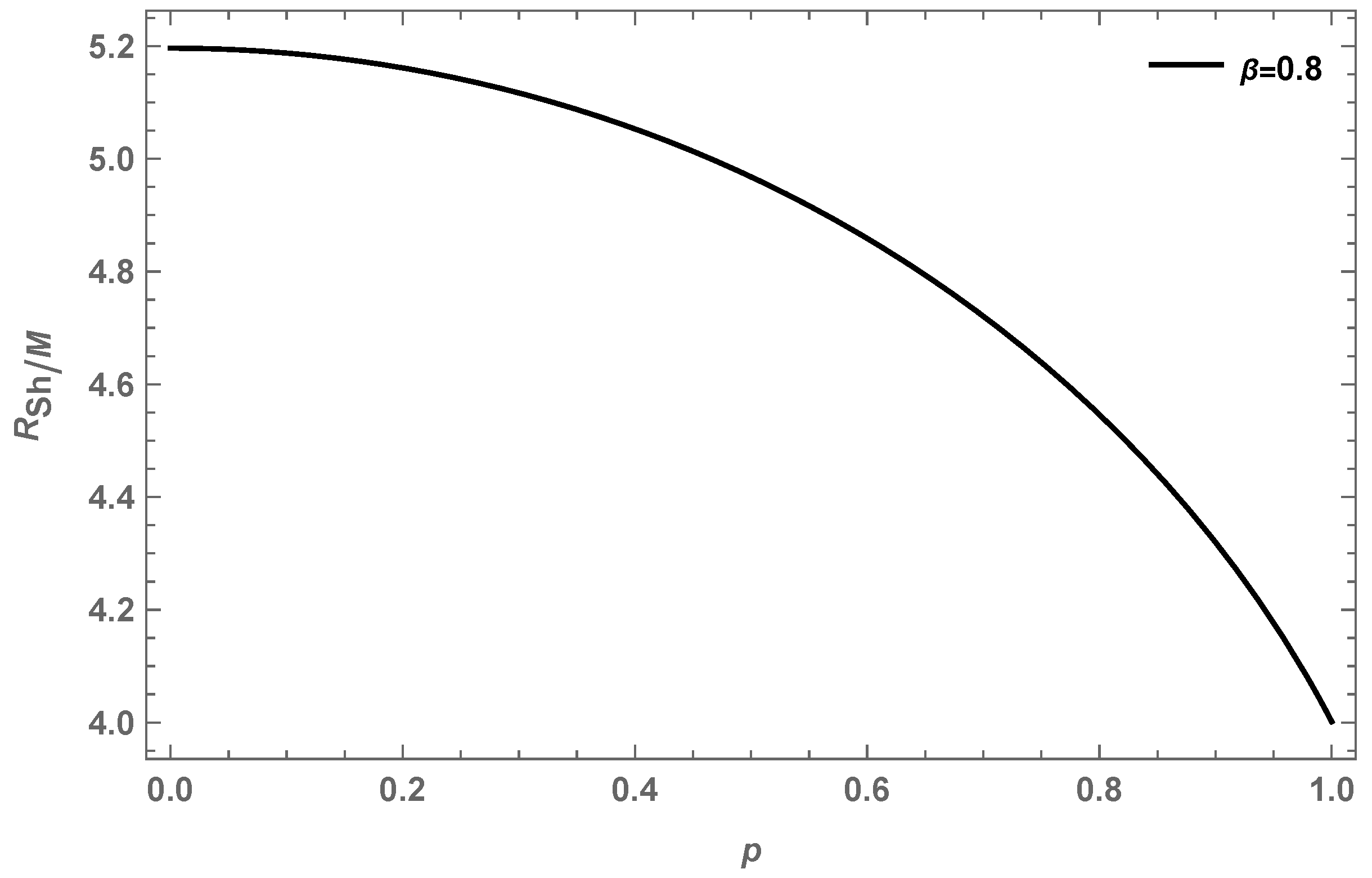
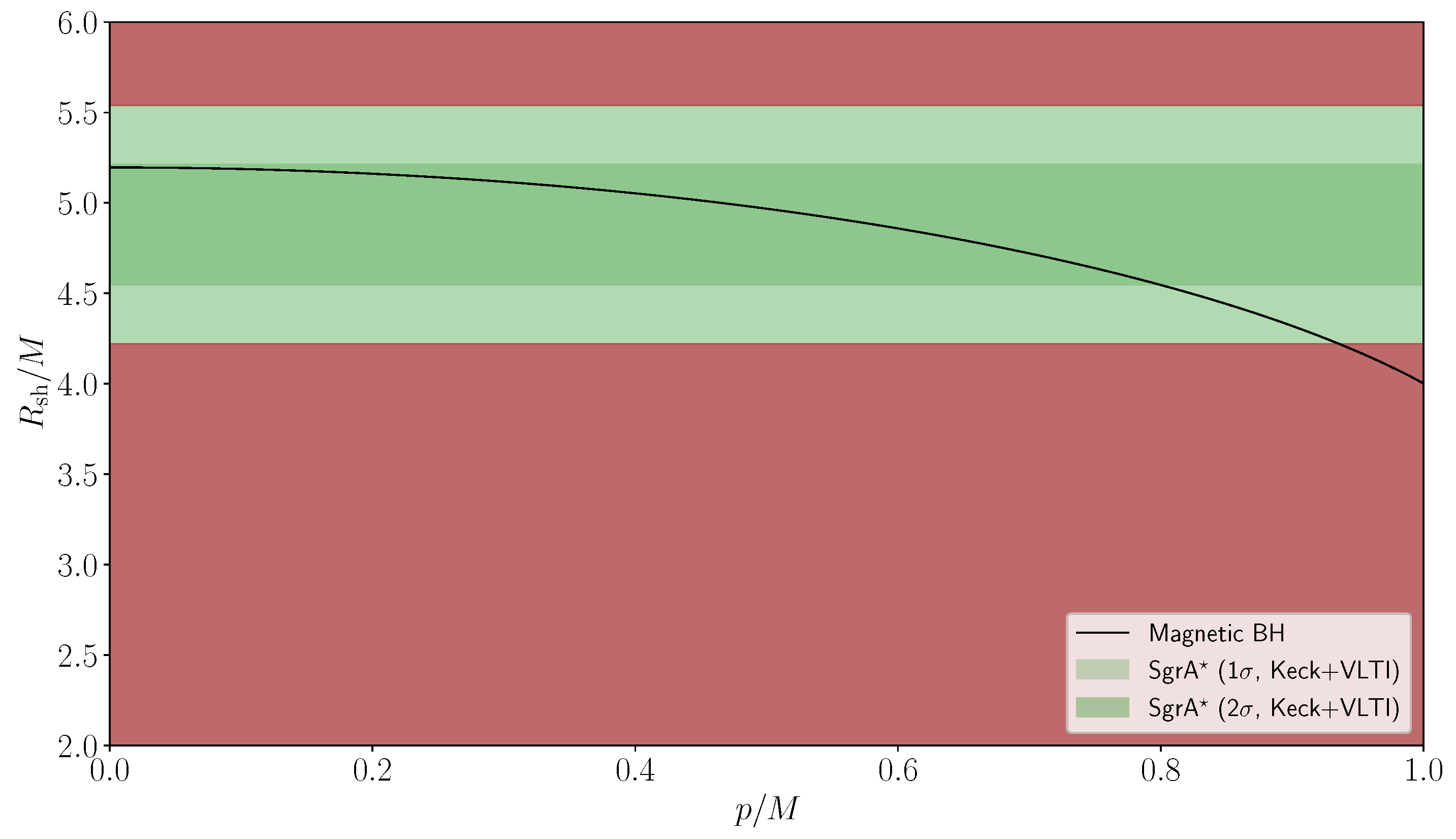
Figure 11 plots numerically the radius of the black hole () shadow with variation of p. The exponential and inverse dependence of p is intriguing, aside from the range of variation that is observed in either of the parameters. Figure 12 shows the upper limit of p from the EHT observations concerning the confidence level (C.L.) [64] upper limit and the C.L. upper limit .
Figure 11.
The first plot shows the shadow of the black hole with varying p and fixed values of and .
Figure 12.
Constraints from the EHT horizon-scale image of SgrA* at and after averaging the Keck and VLTI mass to distance ratio priors for SgrA* , and .
Recently, EHT confirmed that the effect of spin for Sgr A* is negligible [130]. Thus, we only study the non-rotating black holes, which is also the same argument that led the authors in Ref. [64] to provide a number of constraint plots due to various gravity theories and fundamental physics (where ). These authors also validate the EHT statement above by providing a visualization that the spin a indeed does not affect the shadow size considerably if a is not so large and the shadow of a rotating black hole is a distorted circle.
Spherically in-Falling Accretion
Following the technique of [131], spherically free-falling accretion is investigated in this section. The accretion disk is dynamic and spherical, unlike the static disc that was inspected before. The number of orbit formalism of [79] is implemented again for this dynamic model, except that the crossings are throughout the entire spherical accretion and not at the equatorial plane. The integrated intensity observed at a specific frequency expressed as an integral over the null geodesic is
where is the null geodesic of the impact parameter, j is the emissivity per unit volume as a function of the emitted frequency, is the infinitesimal (proper) length. and g is the redshift factor altered as
with as the 4-velocity of the photon, as the 4-velocity of a static observer at infinity, and as the 4-velocity of the in-falling accretion such that
allowing
The proper distance along can be represented in terms of an affine parameter besides proper time as
For the sake of simplicity, a monochromatic emission with a rest-frame frequency and a radial profile is assumed in this model such as
where is the delta function. Integrating Equation (87) over all frequencies gives the total observed flux to be
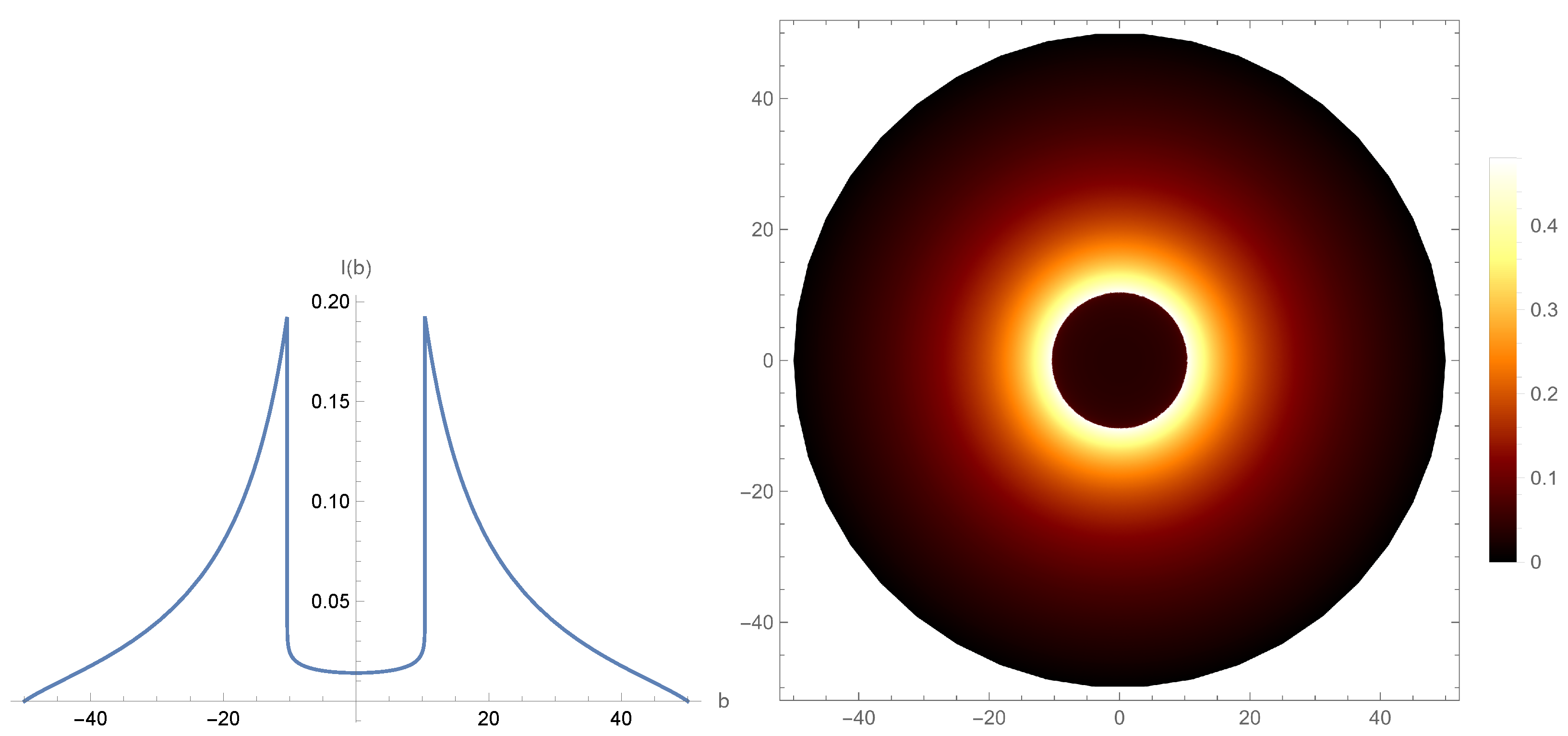
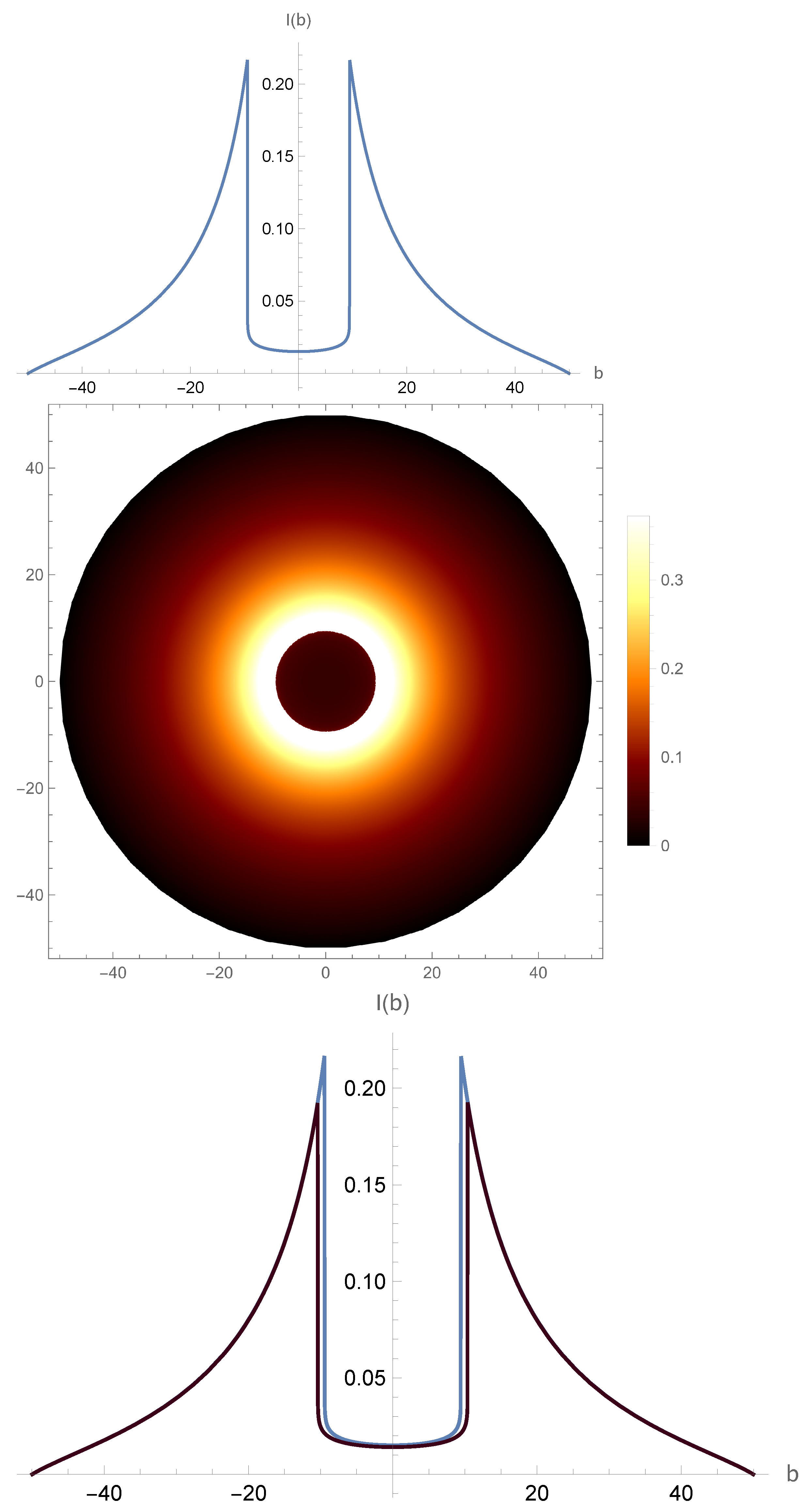
With the expressions for the flux, we used the Okyay–Övgün Mathematica notebook package [31], (used in [48,86,115]) and numerically integrated the flux to see the effects of the charge parameters. See Figure 13 and Figure 14 for examples.
Figure 13.
Observational appearance of a spherically free-falling accretion emission near a black hole of charge , , and .
Figure 14.
Observational appearance of a spherically free-falling accretion emission near a black hole of charge , , and . Note that in the last figure, the black line is for () and the blue line stands for ().
With the help of stereo-graphic projection in the celestial coordinates X and Y, the apparent shape of the black hole shadow is plotted in Figure 13 and Figure 14. Evidently, the shadow radius increases as the value of p increases, proving that the magnetic charge has a strong effect on the black hole shadow size.
Therefore, it is seen that the introduction of a charge term greatly increases the apparent size of the shadow, but decreases the intensity of the incoming light.
7. Conclusions
In this paper, we examined the weak deflection angle and the shadow of the Reissner–Nordström black hole under the influence of a magnetic charge for various conditions. We considered higher-order magnetic correction in the Einstein-nonlinear-Maxwell fields to explore the extent of its impact. We defined the function as the solution of a magnetic black hole. Then, we calculated the weak deflection angle using the Gauss–Bonnet theorem and we found that the magnetic charge had a direct proportionality to the deflection angle for a given impact parameter. We used the Keeton–Petters formalism to verify our result and extended it to determine three observables, namely, angular position, magnification, and time delay.
In addition to that, we calculated the deflection angle of massive particles using the Jacobi metric in which the velocity of the particles was inversely proportional to the deflection angle and seems to converge into the Schwarzschild case for higher values of the impact parameter. Furthermore, we computed the deflection angle in the presence of plasma and dark matter. The deflection angle was found to be directly dependant on the ratio of electron frequency to photon frequency, suggesting that more refraction led to more bending. On the other hand, the deflection decreased with more dark matter activity. Finally, the shadow of a black hole was studied with respect to the black hole solution, and a special case of a spherically in-falling accretion was probed, studying some parameters of interest. Moreover, we show in Figure 12 that, concerning the upper limit of p from the EHT observations, there is confidence level (C.L.) upper limit , and C.L. upper limit .
Author Contributions
Conceptualization, Y.K. and A.Ö.; methodology, A.Ö.; validation, Y.K. and A.Ö.; formal analysis, Y.K.; investigation, Y.K.; resources, Y.K. and A.Ö.; writing—original draft preparation, Y.K. and A.Ö.; writing—review and editing, Y.K. and A.Ö.; visualization, Y.K. and A.Ö.; supervision, A.Ö. All authors have read and agreed to the published version of the manuscript.
Funding
This research received no external funding.
Institutional Review Board Statement
Not applicable.
Informed Consent Statement
Not applicable.
Data Availability Statement
Not applicable.
Acknowledgments
A.Ö. would like to acknowledge networking support by the COST Action CA18108-Quantum gravity phenomenology in the multi-messenger approach (QG-MM).
Conflicts of Interest
The authors declare no conflict of interest.
References
- Einstein, A. The Foundation of the General Theory of Relativity. Ann. Phys. 1916, 49, 769–822. [Google Scholar] [CrossRef]
- Akiyama, K. First M87 Event Horizon Telescope Results. I. The Shadow of the Supermassive Black Hole. Astrophys. J. Lett. 2019, 875, L1. [Google Scholar] [CrossRef]
- Akiyama, K.; Alberdi, A.; Alef, W.; Algaba, J.C.; Anantua, R.; Asada, K.; Martí-Vidal, I. First Sagittarius A* Event Horizon Telescope Results. I. The Shadow of the Supermassive Black Hole in the Center of the Milky Way. Astrophys. J. Lett. 2022, 930, L12. [Google Scholar] [CrossRef]
- Synge, J.L. The Escape of Photons from Gravitationally Intense Stars. Mon. Not. R. Astron. Soc. 1966, 131, 463–466. [Google Scholar] [CrossRef]
- Luminet, J.P. Image of a spherical black hole with thin accretion disk. Astron. Astrophys. 1979, 75, 228–235. [Google Scholar]
- Bozza, V. Gravitational lensing in the strong field limit. Phys. Rev. D 2002, 66, 103001. [Google Scholar] [CrossRef]
- NASA_ESA_CSA; STScI. First Images from the James Webb Space Telescope. 2022. Available online: https://doi.org/nasa.gov/webbfirstimages#tab1-5 (accessed on 1 July 2021).
- Virbhadra, K.S.; Ellis, G.F.R. Schwarzschild black hole lensing. Phys. Rev. D 2000, 62, 084003. [Google Scholar] [CrossRef]
- Virbhadra, K.S.; Ellis, G.F.R. Gravitational lensing by naked singularities. Phys. Rev. D 2002, 65, 103004. [Google Scholar] [CrossRef]
- Virbhadra, K.S.; Narasimha, D.; Chitre, S.M. Role of the scalar field in gravitational lensing. Astron. Astrophys. 1998, 337, 1–8. [Google Scholar]
- Virbhadra, K.S.; Keeton, C.R. Time delay and magnification centroid due to gravitational lensing by black holes and naked singularities. Phys. Rev. D 2008, 77, 124014. [Google Scholar] [CrossRef]
- Virbhadra, K.S. Relativistic images of Schwarzschild black hole lensing. Phys. Rev. D 2009, 79, 083004. [Google Scholar] [CrossRef]
- Adler, S.L.; Virbhadra, K.S. Cosmological constant corrections to the photon sphere and black hole shadow radii. arXiv 2022, arXiv:2205.04628. [Google Scholar] [CrossRef]
- Hasse, W.; Perlick, V. Gravitational lensing in spherically symmetric static space-times with centrifugal force reversal. Gen. Rel. Grav. 2002, 34, 415–433. [Google Scholar] [CrossRef]
- Perlick, V. On the Exact gravitational lens equation in spherically symmetric and static space-times. Phys. Rev. D 2004, 69, 064017. [Google Scholar] [CrossRef]
- Perlick, V.; Tsupko, O.Y.; Bisnovatyi-Kogan, G.S. Black hole shadow in an expanding universe with a cosmological constant. Phys. Rev. D 2018, 97, 104062. [Google Scholar] [CrossRef]
- He, G.; Zhou, X.; Feng, Z.; Mu, X.; Wang, H.; Li, W.; Pan, C.; Lin, W. Gravitational deflection of massive particles in Schwarzschild-de Sitter spacetime. Eur. Phys. J. C 2020, 80, 835. [Google Scholar] [CrossRef]
- Virbhadra, K.S. Compactness of supermassive dark objects at galactic centers. arXiv 2022, arXiv:2204.01792. [Google Scholar]
- Virbhadra, K.S. Distortions of images of Schwarzschild lensing. arXiv 2022, arXiv:2204.01879. [Google Scholar] [CrossRef]
- Gibbons, G.W.; Werner, M.C. Applications of the Gauss–Bonnet theorem to gravitational lensing. Class. Quant. Grav. 2008, 25, 235009. [Google Scholar] [CrossRef]
- Werner, M.C. Gravitational lensing in the Kerr-Randers optical geometry. Gen. Rel. Grav. 2012, 44, 3047–3057. [Google Scholar] [CrossRef]
- Övgün, A. Light deflection by Damour-Solodukhin wormholes and Gauss–Bonnet theorem. Phys. Rev. D 2018, 98, 044033. [Google Scholar] [CrossRef]
- Övgün, A. Weak field deflection angle by regular black holes with cosmic strings using the Gauss–Bonnet theorem. Phys. Rev. D 2019, 99, 104075. [Google Scholar] [CrossRef]
- Övgün, A. Deflection Angle of Photons through Dark Matter by Black Holes and Wormholes Using Gauss–Bonnet Theorem. Universe 2019, 5, 115. [Google Scholar] [CrossRef]
- Li, Z.; Övgün, A. Finite-distance gravitational deflection of massive particles by a Kerr-like black hole in the bumblebee gravity model. Phys. Rev. D 2020, 101, 024040. [Google Scholar] [CrossRef]
- Li, Z.; Zhang, G.; Övgün, A. Circular Orbit of a Particle and Weak Gravitational Lensing. Phys. Rev. D 2020, 101, 124058. [Google Scholar] [CrossRef]
- Kumaran, Y.; Övgün, A. Weak Deflection Angle of Extended Uncertainty Principle Black Holes. Chin. Phys. C 2020, 44, 025101. [Google Scholar] [CrossRef]
- Kumaran, Y.; Övgün, A. Deriving weak deflection angle by black holes or wormholes using Gauss–Bonnet theorem. Turk. J. Phys. 2021, 45, 247–267. [Google Scholar] [CrossRef]
- Övgün, A.; Kumaran, Y.; Javed, W.; Abbas, J. Effect of Horndeski theory on weak deflection angle using the Gauss–Bonnet theorem. Int. J. Geom. Meth. Mod. Phys. 2022, 2250192. [Google Scholar] [CrossRef]
- Övgün, A.; Sakallı, I.; Saavedra, J. Shadow cast and Deflection angle of Kerr-Newman-Kasuya spacetime. JCAP 2018, 10, 41. [Google Scholar] [CrossRef]
- Okyay, M.; Övgün, A. Nonlinear electrodynamics effects on the black hole shadow, deflection angle, quasinormal modes and greybody factors. JCAP 2022, 1, 9. [Google Scholar] [CrossRef]
- Javed, W.; Abbas, J.; Övgün, A. Deflection angle of photon from magnetized black hole and effect of nonlinear electrodynamics. Eur. Phys. J. C 2019, 79, 694. [Google Scholar] [CrossRef]
- Javed, W.; Abbas, J.; Övgün, A. Effect of the Hair on Deflection Angle by Asymptotically Flat Black Holes in Einstein-Maxwell-Dilaton Theory. Phys. Rev. D 2019, 100, 044052. [Google Scholar] [CrossRef]
- Javed, W.; Babar, R.; Övgün, A. Effect of the dilaton field and plasma medium on deflection angle by black holes in Einstein-Maxwell-dilaton-axion theory. Phys. Rev. D 2019, 100, 104032. [Google Scholar] [CrossRef]
- Javed, W.; Hamza, A.; Övgün, A. Effect of nonlinear electrodynamics on the weak field deflection angle by a black hole. Phys. Rev. D 2020, 101, 103521. [Google Scholar] [CrossRef]
- Javed, W.; Babar, R.; Övgün, A. The effect of the Brane-Dicke coupling parameter on weak gravitational lensing by wormholes and naked singularities. Phys. Rev. D 2019, 99, 084012. [Google Scholar] [CrossRef]
- Javed, W.; Abbas, J.; Övgün, A. Effect of the Quintessential Dark Energy on Weak Deflection Angle by Kerr-Newmann Black Hole. Ann. Phys. 2020, 418, 168183. [Google Scholar] [CrossRef]
- Ishihara, A.; Suzuki, Y.; Ono, T.; Kitamura, T.; Asada, H. Gravitational bending angle of light for finite distance and the Gauss–Bonnet theorem. Phys. Rev. D 2016, 94, 084015. [Google Scholar] [CrossRef]
- Takizawa, K.; Ono, T.; Asada, H. Gravitational deflection angle of light: Definition by an observer and its application to an asymptotically nonflat spacetime. Phys. Rev. D 2020, 101, 104032. [Google Scholar] [CrossRef]
- Ono, T.; Asada, H. The effects of finite distance on the gravitational deflection angle of light. Universe 2019, 5, 218. [Google Scholar] [CrossRef]
- Ishihara, A.; Suzuki, Y.; Ono, T.; Asada, H. Finite-distance corrections to the gravitational bending angle of light in the strong deflection limit. Phys. Rev. D 2017, 95, 044017. [Google Scholar] [CrossRef]
- Ono, T.; Ishihara, A.; Asada, H. Gravitomagnetic bending angle of light with finite-distance corrections in stationary axisymmetric spacetimes. Phys. Rev. D 2017, 96, 104037. [Google Scholar] [CrossRef]
- Pantig, R.C.; Rodulfo, E.T. Weak deflection angle of a dirty black hole. Chin. J. Phys. 2020, 66, 691–702. [Google Scholar] [CrossRef]
- Rayimbaev, J.; Pantig, R.C.; Övgün, A.; Abdujabbarov, A.; Demir, D. Quasiperiodic oscillations, weak field lensing and shadow cast around black holes in Symmergent gravity. arXiv 2022, arXiv:2206.06599. [Google Scholar]
- Pantig, R.C.; Övgün, A. Dark matter effect on the weak deflection angle by black holes at the center of Milky Way and M87 galaxies. Eur. Phys. J. C 2022, 82, 391. [Google Scholar] [CrossRef]
- Pantig, R.C.; Övgün, A. Testing dynamical torsion effects on the charged black hole’s shadow, deflection angle and greybody with M87* and Sgr A* from EHT. arXiv 2022, arXiv:2206.02161. [Google Scholar]
- Pantig, R.C.; Övgün, A. Dehnen halo effect on a black hole in an ultra-faint dwarf galaxy. arXiv 2022, arXiv:2202.07404. [Google Scholar] [CrossRef]
- Uniyal, A.; Pantig, R.C.; Övgün, A. Probing a nonlinear electrodynamics black hole with thin accretion disk, shadow and deflection angle with M87* and Sgr A* from EHT. arXiv 2022, arXiv:2205.11072. [Google Scholar]
- Javed, W.; Aqib, M.; Övgün, A. Effect of the magnetic charge on weak deflection angle and greybody bound of the black hole in Einstein-Gauss–Bonnet gravity. Phys. Lett. B 2022, 829, 137114. [Google Scholar] [CrossRef]
- Jusufi, K.; Werner, M.C.; Banerjee, A.; Övgün, A. Light Deflection by a Rotating Global Monopole Spacetime. Phys. Rev. D 2017, 95, 104012. [Google Scholar] [CrossRef]
- Javed, W.; Hussain, I.; Övgün, A. Weak deflection angle of Kazakov–Solodukhin black hole in plasma medium using Gauss–Bonnet theorem and its greybody bonding. Eur. Phys. J. Plus 2022, 137, 148. [Google Scholar] [CrossRef]
- Javed, W.; Abbas, J.; Kumaran, Y.; Övgün, A. Weak deflection angle by asymptotically flat black holes in Horndeski theory using Gauss–Bonnet theorem. Int. J. Geom. Meth. Mod. Phys. 2021, 18, 2150003. [Google Scholar] [CrossRef]
- Övgün, A. Weak Deflection Angle of Black-bounce Traversable Wormholes Using Gauss–Bonnet Theorem in the Dark Matter Medium. Turk. J. Phys. 2020, 44, 465–471. [Google Scholar] [CrossRef]
- El Moumni, H.; Masmar, K.; Övgün, A. Weak deflection angle of light in two classes of black holes in nonlinear electrodynamics via Gauss–Bonnet theorem. Int. J. Geom. Meth. Mod. Phys. 2022, 19, 2250094. [Google Scholar] [CrossRef]
- Javed, W.; Khadim, M.B.; Övgün, A.; Abbas, J. Weak gravitational lensing by stringy black holes. Eur. Phys. J. Plus 2020, 135, 314. [Google Scholar] [CrossRef]
- Jusufi, K.; Övgün, A. Gravitational Lensing by Rotating Wormholes. Phys. Rev. D 2018, 97, 024042. [Google Scholar] [CrossRef]
- Fu, Q.M.; Zhao, L.; Liu, Y.X. Weak deflection angle by electrically and magnetically charged black holes from nonlinear electrodynamics. Phys. Rev. D 2021, 104, 024033. [Google Scholar] [CrossRef]
- Crisnejo, G.; Gallo, E. Weak lensing in a plasma medium and gravitational deflection of massive particles using the Gauss–Bonnet theorem. A unified treatment. Phys. Rev. D 2018, 97, 124016. [Google Scholar] [CrossRef]
- Keeton, C.R.; Petters, A.O. Formalism for testing theories of gravity using lensing by compact objects. I. Static, spherically symmetric case. Phys. Rev. D 2005, 72, 104006. [Google Scholar] [CrossRef]
- Jaroszynski, M.; Kurpiewski, A. Optics near kerr black holes: Spectra of advection dominated accretion flows. Astron. Astrophys. 1997, 326, 419. [Google Scholar]
- Bambi, C. A code to compute the emission of thin accretion disks in non-Kerr space-times and test the nature of black hole candidates. Astrophys. J. 2012, 761, 174. [Google Scholar] [CrossRef]
- Kruglov, S.I. The shadow of M87* black hole within rational nonlinear electrodynamics. Mod. Phys. Lett. A 2020, 35, 2050291. [Google Scholar] [CrossRef]
- Allahyari, A.; Khodadi, M.; Vagnozzi, S.; Mota, D.F. Magnetically charged black holes from non-linear electrodynamics and the Event Horizon Telescope. JCAP 2020, 2, 3. [Google Scholar] [CrossRef]
- Vagnozzi, S.; Roy, R.; Tsai, Y.D.; Visinelli, L. Horizon-scale tests of gravity theories and fundamental physics from the Event Horizon Telescope image of Sagittarius A*. arXiv 2022, arXiv:2205.07787. [Google Scholar]
- Roy, R.; Vagnozzi, S.; Visinelli, L. Superradiance evolution of black hole shadows revisited. Phys. Rev. D 2022, 105, 083002. [Google Scholar] [CrossRef]
- Vagnozzi, S.; Visinelli, L. Hunting for extra dimensions in the shadow of M87*. Phys. Rev. D 2019, 100, 024020. [Google Scholar] [CrossRef]
- Khodadi, M.; Lambiase, G.; Mota, D.F. No-hair theorem in the wake of Event Horizon Telescope. JCAP 2021, 09, 028. [Google Scholar] [CrossRef]
- Khodadi, M.; Allahyari, A.; Vagnozzi, S.; Mota, D.F. Black holes with scalar hair in light of the Event Horizon Telescope. JCAP 2020, 09, 026. [Google Scholar] [CrossRef]
- Kumar, R.; Ghosh, S.G. Black Hole Parameter Estimation from Its Shadow. Astrophys. J. 2020, 892, 78. [Google Scholar] [CrossRef]
- Khodadi, M.; Lambiase, G. Probing the Lorentz Symmetry Violation Using the First Image of Sagittarius A*: Constraints on Standard-Model Extension Coefficients. arXiv 2022, arXiv:2206.08601. [Google Scholar]
- Lambiase, G.; Mastrototaro, L. Neutrino pair annihilation above black-hole accretion disks in modified gravity. arXiv 2022, arXiv:2205.09785. [Google Scholar] [CrossRef]
- Kumar, R.; Ghosh, S.G. Rotating black holes in 4D Einstein-Gauss–Bonnet gravity and its shadow. JCAP 2020, 7, 053. [Google Scholar] [CrossRef]
- Rahaman, F.; Singh, K.N.; Shaikh, R.; Manna, T.; Aktar, S. Shadows of Lorentzian traversable wormholes. Class. Quant. Grav. 2021, 38, 215007. [Google Scholar] [CrossRef]
- Belhaj, A.; Benali, M.; El Balali, A.; El Moumni, H.; Ennadifi, S.E. Deflection angle and shadow behaviors of quintessential black holes in arbitrary dimensions. Class. Quant. Grav. 2020, 37, 215004. [Google Scholar] [CrossRef]
- Belhaj, A.; Belmahi, H.; Benali, M.; El Hadri, W.; El Moumni, H.; Torrente-Lujan, E. Shadows of 5D black holes from string theory. Phys. Lett. B 2021, 812, 136025. [Google Scholar] [CrossRef]
- Belhaj, A.; Belmahi, H.; Benali, M. Superentropic AdS black hole shadows. Phys. Lett. B 2021, 821, 136619. [Google Scholar] [CrossRef]
- Guo, S.; Li, G.R.; Liang, E.W. Influence of accretion flow and magnetic charge on the observed shadows and rings of the Hayward black hole. Phys. Rev. D 2022, 105, 023024. [Google Scholar] [CrossRef]
- Sun, C.; Liu, Y.; Qian, W.L.; Yue, R. Shadows of magnetically charged rotating black holes surrounded by quintessence *. Chin. Phys. C 2022, 46, 065103. [Google Scholar] [CrossRef]
- Gralla, S.E.; Holz, D.E.; Wald, R.M. Black Hole Shadows, Photon Rings, and Lensing Rings. Phys. Rev. D 2019, 100, 024018. [Google Scholar] [CrossRef]
- Ma, T.C.; Zhang, H.X.; He, P.Z.; Zhang, H.R.; Chen, Y.; Deng, J.B. Shadow cast by a rotating and nonlinear magnetic-charged black hole in perfect fluid dark matter. Mod. Phys. Lett. A 2021, 36, 2150112. [Google Scholar] [CrossRef]
- Övgün, A.; Sakallı, I. Testing generalized Einstein–Cartan–Kibble–Sciama gravity using weak deflection angle and shadow cast. Class. Quant. Grav. 2020, 37, 225003. [Google Scholar] [CrossRef]
- Pantig, R.C.; Rodulfo, E.T. Rotating dirty black hole and its shadow. Chin. J. Phys. 2020, 68, 236. [Google Scholar] [CrossRef]
- Reggie, P.C.; Paul, K.Y.; Rodulfo, E.T.; Ali, O. Shadow and weak deflection angle of extended uncertainty principle black hole surrounded with dark matter. Ann. Phys. 2022, 436, 168722. [Google Scholar] [CrossRef]
- Övgün, A. Black hole with confining electric potential in scalar-tensor description of regularized 4-dimensional Einstein-Gauss–Bonnet gravity. Phys. Lett. B 2021, 820, 136517. [Google Scholar] [CrossRef]
- Çimdiker, I.; Demir, D.; Övgün, A. Black hole shadow in symmergent gravity. Phys. Dark Univ. 2021, 34, 100900. [Google Scholar] [CrossRef]
- Kuang, X.M.; Övgün, A. Strong gravitational lensing and shadow constraint from M87* of slowly rotating Kerr-like black hole. arXiv 2022, arXiv:2205.11003. [Google Scholar]
- Herdeiro, C.A.R.; Pombo, A.M.; Radu, E.; Cunha, P.V.P.; Sanchis-Gual, N. The imitation game: Proca stars that can mimic the Schwarzschild shadow. JCAP 2021, 4, 51. [Google Scholar] [CrossRef]
- Shaikh, R.; Kocherlakota, P.; Narayan, R.; Joshi, P.S. Shadows of spherically symmetric black holes and naked singularities. Mon. Not. Roy. Astron. Soc. 2019, 482, 52–64. [Google Scholar] [CrossRef]
- Shaikh, R. Black hole shadow in a general rotating spacetime obtained through Newman-Janis algorithm. Phys. Rev. D 2019, 100, 024028. [Google Scholar] [CrossRef]
- Cunha, P.V.P.; Eiró, N.A.; Herdeiro, C.A.R.; Lemos, J.P.S. Lensing and shadow of a black hole surrounded by a heavy accretion disk. JCAP 2020, 3, 35. [Google Scholar] [CrossRef]
- Cunha, P.V.P.; Herdeiro, C.A.R.; Radu, E. EHT constraint on the ultralight scalar hair of the M87 supermassive black hole. Universe 2019, 5, 220. [Google Scholar] [CrossRef]
- Cunha, P.V.P.; Herdeiro, C.A.R. Shadows and strong gravitational lensing: A brief review. Gen. Rel. Grav. 2018, 50, 42. [Google Scholar] [CrossRef]
- Cunha, P.V.P.; Herdeiro, C.A.R.; Kleihaus, B.; Kunz, J.; Radu, E. Shadows of Einstein–dilaton–Gauss–Bonnet black holes. Phys. Lett. B 2017, 768, 373–379. [Google Scholar] [CrossRef]
- Vincent, F.H.; Gourgoulhon, E.; Herdeiro, C.; Radu, E. Astrophysical imaging of Kerr black holes with scalar hair. Phys. Rev. D 2016, 94, 084045. [Google Scholar] [CrossRef]
- Afrin, M.; Kumar, R.; Ghosh, S.G. Parameter estimation of hairy Kerr black holes from its shadow and constraints from M87*. Mon. Not. Roy. Astron. Soc. 2021, 504, 5927–5940. [Google Scholar] [CrossRef]
- Jha, S.K.; Rahaman, A. Lorentz violation and noncommutative effect on superradiance scattering off Kerr-like black hole and on the shadow of it. arXiv 2021, arXiv:2111.02817. [Google Scholar]
- Zeng, X.X.; Zhang, H.Q.; Zhang, H. Shadows and photon spheres with spherical accretions in the four-dimensional Gauss–Bonnet black hole. Eur. Phys. J. C 2020, 80, 872. [Google Scholar] [CrossRef]
- He, K.J.; Tan, S.C.; Li, G.P. Influence of torsion charge on shadow and observation signature of black hole surrounded by various profiles of accretions. Eur. Phys. J. C 2022, 82, 81. [Google Scholar] [CrossRef]
- Dokuchaev, V.I.; Nazarova, N.O. Visible shapes of black holes M87* and SgrA*. Universe 2020, 6, 154. [Google Scholar] [CrossRef]
- Bambi, C.; Freese, K.; Vagnozzi, S.; Visinelli, L. Testing the rotational nature of the supermassive object M87* from the circularity and size of its first image. Phys. Rev. D 2019, 100, 044057. [Google Scholar] [CrossRef]
- Meng, Y.; Kuang, X.M.; Tang, Z.Y. Photon regions, shadow observables and constraints from M87* of a charged rotating black hole. arXiv 2022, arXiv:2204.00897. [Google Scholar] [CrossRef]
- Chen, C.Y. Testing black hole equatorial reflection symmetry using Sgr A* shadow images. arXiv 2022, arXiv:2205.06962. [Google Scholar] [CrossRef]
- Chen, Y.; Roy, R.; Vagnozzi, S.; Visinelli, L. Superradiant evolution of the shadow and photon ring of Sgr A*. arXiv 2022, arXiv:2205.06238. [Google Scholar] [CrossRef]
- Wang, M.; Chen, S.; Jing, J. Chaotic Shadows of Black Holes: A Short Review. arXiv 2022, arXiv:2205.05855. [Google Scholar] [CrossRef]
- Bronzwaer, T.; Falcke, H. The Nature of Black Hole Shadows. Astrophys. J. 2021, 920, 155. [Google Scholar] [CrossRef]
- Falcke, H.; Melia, F.; Agol, E. Viewing the shadow of the black hole at the galactic center. Astrophys. J. Lett. 2000, 528, L13. [Google Scholar] [CrossRef]
- Wei, S.W.; Zou, Y.C.; Liu, Y.X.; Mann, R.B. Curvature radius and Kerr black hole shadow. JCAP 2019, 8, 30. [Google Scholar] [CrossRef]
- Wei, S.W.; Liu, Y.X.; Mann, R.B. Intrinsic curvature and topology of shadows in Kerr spacetime. Phys. Rev. D 2019, 99, 041303. [Google Scholar] [CrossRef]
- Abdolrahimi, S.; Mann, R.B.; Tzounis, C. Distorted Local Shadows. Phys. Rev. D 2015, 91, 084052. [Google Scholar] [CrossRef]
- Adair, C.; Bueno, P.; Cano, P.A.; Hennigar, R.A.; Mann, R.B. Slowly rotating black holes in Einsteinian cubic gravity. Phys. Rev. D 2020, 102, 084001. [Google Scholar] [CrossRef]
- Abdolrahimi, S.; Mann, R.B.; Tzounis, C. Double Images from a Single Black Hole. Phys. Rev. D 2015, 92, 124011. [Google Scholar] [CrossRef]
- Konoplya, R.A.; Zinhailo, A.F. Quasinormal modes, stability and shadows of a black hole in the 4D Einstein–Gauss–Bonnet gravity. Eur. Phys. J. C 2020, 80, 1049. [Google Scholar] [CrossRef]
- Konoplya, R.A. Shadow of a black hole surrounded by dark matter. Phys. Lett. B 2019, 795, 1–6. [Google Scholar] [CrossRef]
- Konoplya, R.A. Quantum corrected black holes: Quasinormal modes, scattering, shadows. Phys. Lett. B 2020, 804, 135363. [Google Scholar] [CrossRef]
- Chakhchi, L.; El Moumni, H.; Masmar, K. Shadows and optical appearance of a power-Yang-Mills black hole surrounded by different accretion disk profiles. Phys. Rev. D 2022, 105, 064031. [Google Scholar] [CrossRef]
- Perlick, V.; Tsupko, O.Y. Calculating black hole shadows: Review of analytical studies. Phys. Rept. 2022, 947, 1–39. [Google Scholar] [CrossRef]
- Clifton, T.; Carrilho, P.; Fernandes, P.G.S.; Mulryne, D.J. Observational Constraints on the Regularized 4D Einstein-Gauss–Bonnet Theory of Gravity. Phys. Rev. D 2020, 102, 084005. [Google Scholar] [CrossRef]
- Maldacena, J. Comments on magnetic black holes. JHEP 2021, 4, 79. [Google Scholar] [CrossRef]
- Zhang, S.J.; Zhang, H.X.; Shao, L.; Deng, J.B.; Hu, X.R. Bardeen black hole in magnetically charged four-dimensional Einstein-Gauss–Bonnet gravity. arXiv 2021, arXiv:2112.11869. [Google Scholar]
- Mazharimousavi, S.H.; Halilsoy, M. Electric and magnetic black holes in a new nonlinear electrodynamics model. Ann. Phys. 2021, 433, 168579. [Google Scholar] [CrossRef]
- Bardeen, J. Non-singular general-relativistic gravitational collapse. In Proceedings of the International Conference GR5, Tbilisi, USSR, 1968; p. 174. [Google Scholar]
- Frolov, V.P. Remarks on non-singular black holes. EPJ Web Conf. 2018, 168, 01001. [Google Scholar] [CrossRef]
- Falciano, F.T.; Peñafiel, M.L.; Perez Bergliaffa, S.E. Entropy bounds and nonlinear electrodynamics. Phys. Rev. D 2019, 100, 125008. [Google Scholar] [CrossRef]
- Obukhov, V.V. Algebra of symmetry operators for Klein-Gordon-Fock equation. Symmetry 2021, 13, 727. [Google Scholar] [CrossRef]
- Wald, R.M. General Relativity; Chicago University Press: Chicago, IL, USA, 1984. [Google Scholar] [CrossRef]
- Ruggiero, M.L. Light bending in f(T) gravity. Int. J. Mod. Phys. D 2016, 25, 1650073. [Google Scholar] [CrossRef]
- Li, Z.; He, G.; Zhou, T. Gravitational deflection of relativistic massive particles by wormholes. Phys. Rev. D 2020, 101, 044001. [Google Scholar] [CrossRef]
- Latimer, D.C. Dispersive Light Propagation at Cosmological Distances: Matter Effects. Phys. Rev. D 2013, 88, 063517. [Google Scholar] [CrossRef]
- Psaltis, D. Gravitational Test Beyond the First Post-Newtonian Order with the Shadow of the M87 Black Hole. Phys. Rev. Lett. 2020, 125, 141104. [Google Scholar] [CrossRef]
- Akiyama, K.; Alberdi, A.; Alef, W.; Algaba, J.C.; Anantua, R.; Asada, K.; Martí-Vidal, I. First Sagittarius A* Event Horizon Telescope Results. VI. Testing the Black Hole Metric. Astrophys. J. Lett. 2022, 930, L17. [Google Scholar]
- Bambi, C. Can the supermassive objects at the centers of galaxies be traversable wormholes? The first test of strong gravity for mm/sub-mm very long baseline interferometry facilities. Phys. Rev. D 2013, 87, 107501. [Google Scholar] [CrossRef]
Publisher’s Note: MDPI stays neutral with regard to jurisdictional claims in published maps and institutional affiliations. |
© 2022 by the authors. Licensee MDPI, Basel, Switzerland. This article is an open access article distributed under the terms and conditions of the Creative Commons Attribution (CC BY) license (https://creativecommons.org/licenses/by/4.0/).