New Soliton Solutions of Fractional Jaulent-Miodek System with Symmetry Analysis

 and
and
Abstract
1. Introduction
2. Theory of Fractional Operators
2.1. Riemann–Liouville (RL) Fractional Derivative
2.2. Local Fractional-Order Derivative
3. The Brief Descriptions of the Fractional Logistic Function Method and Implementations
3.1. Brief Description of the Proposed Method
3.2. Soliton Solutions for JM System
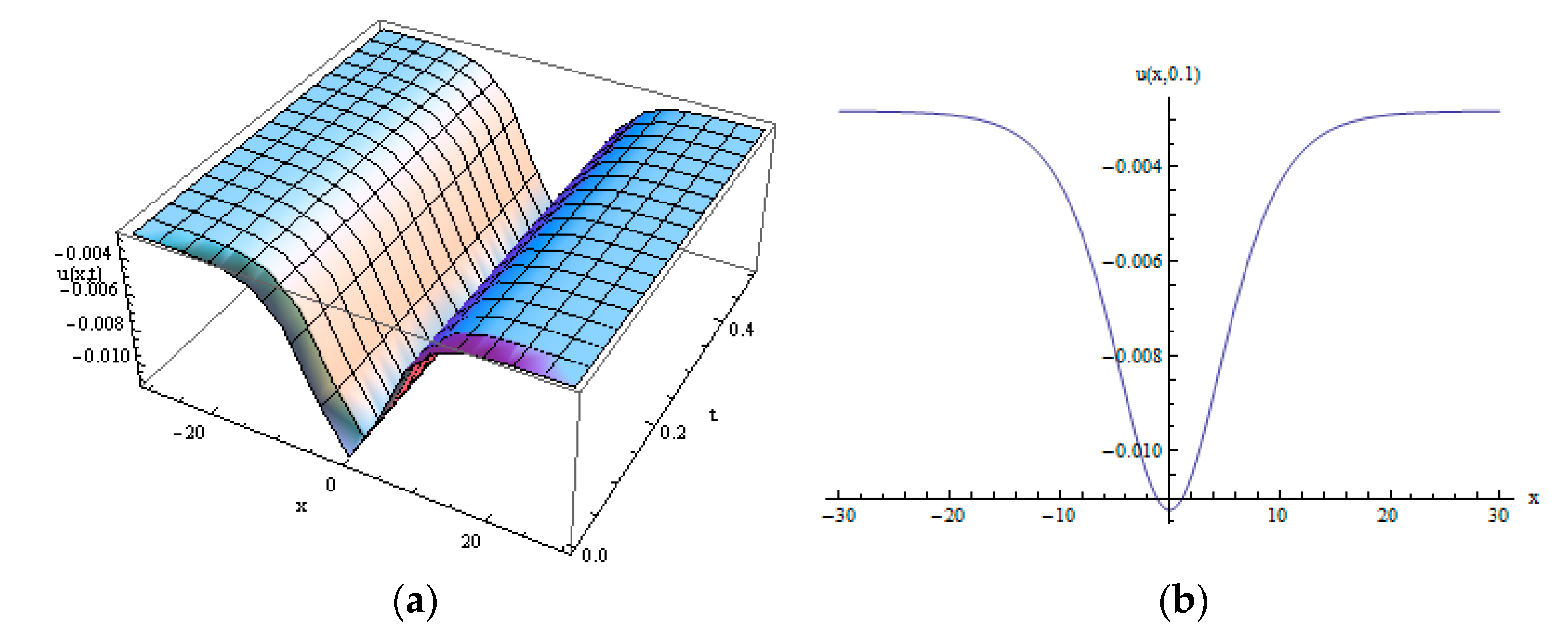
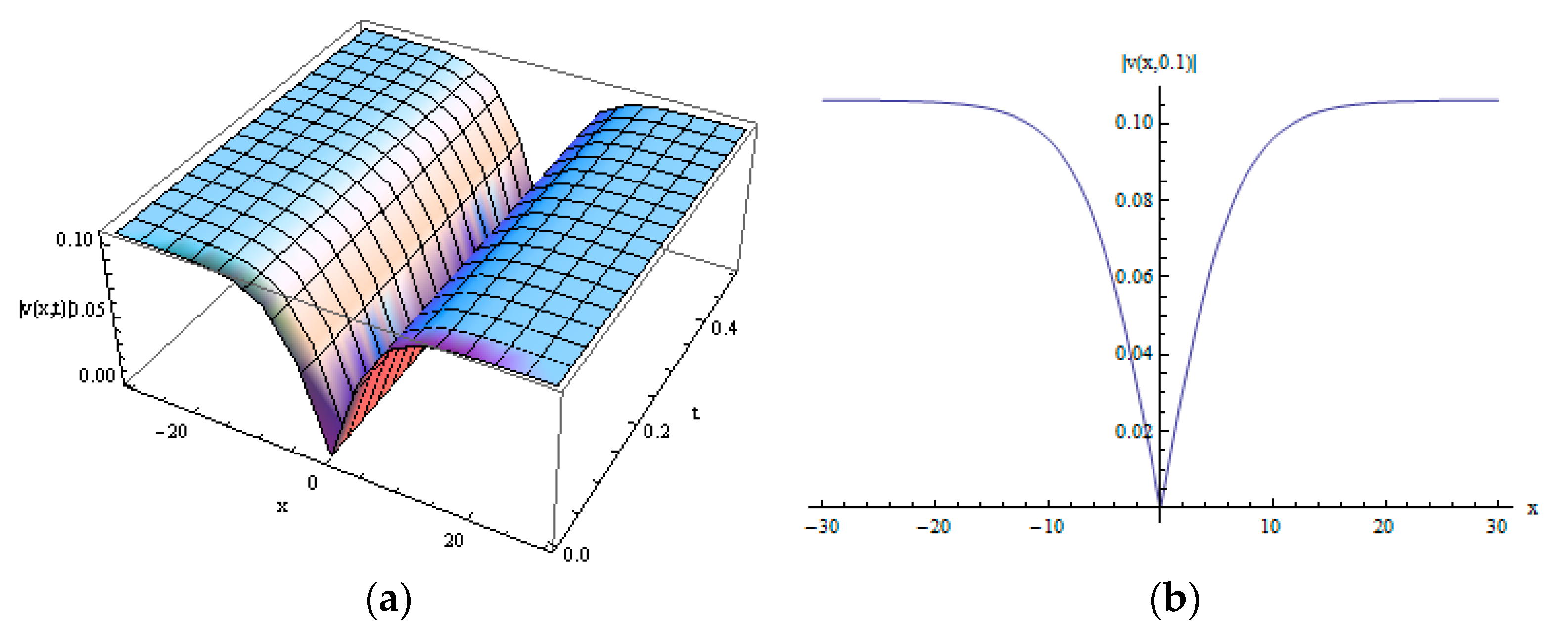
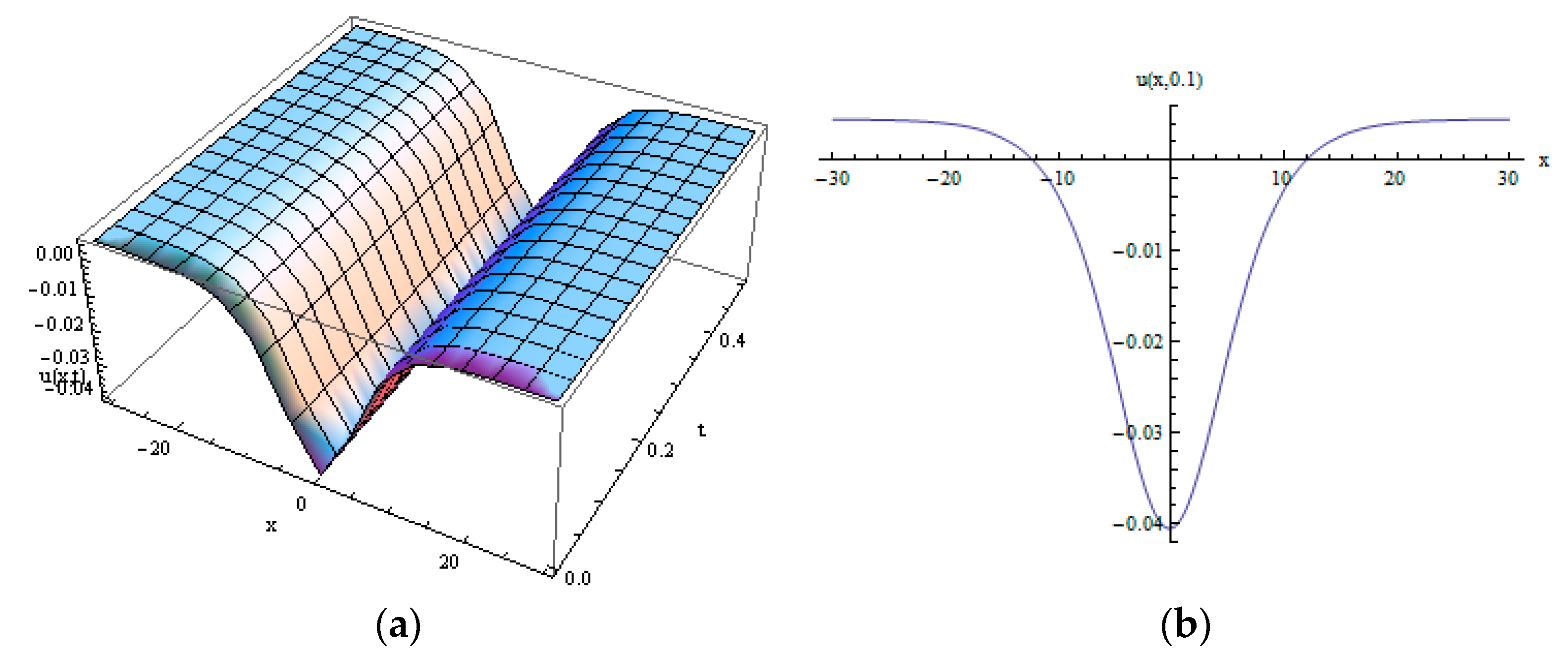
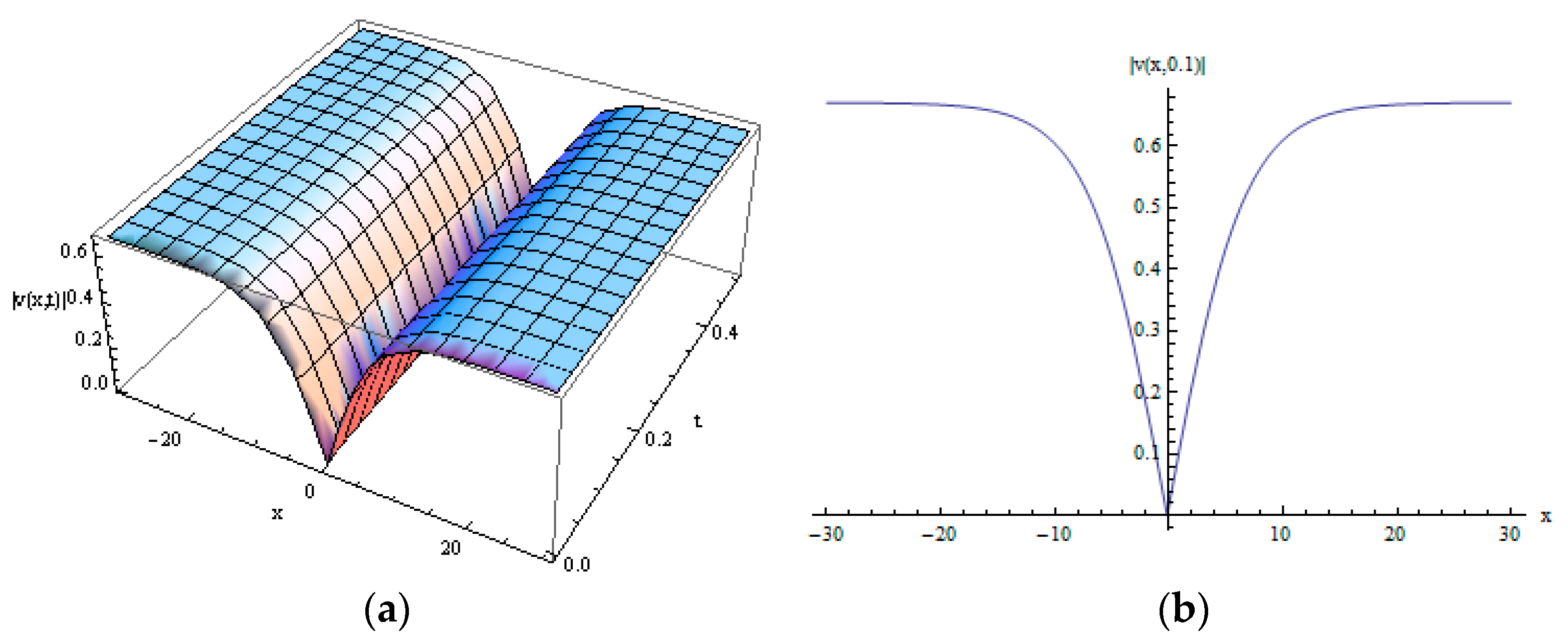
3.3. Numerical Simulations
4. Lie Symmetry Analysis Method
4.1. Theory of Symmetry Analysis Method
4.2. Lie Symmetry
4.3. Similarity Reduction
4.4. Conservation Laws of Time-Fractional Coupled JM Equations
5. Conclusions
Author Contributions
Funding
Conflicts of Interest
References
- Podlubny, I. Fractional Differential Equation; Academic Press: New York, NY, USA, 1999. [Google Scholar]
- Miller, K.S.; Ross, B. An Introduction to the Fractional Calculus and Fractional Differential Equations; Wiley: New York, NY, USA, 1993; pp. 1–39. [Google Scholar] [CrossRef]
- Samko, S.G.; Kilbas, A.A.; Marichev, O.I. Fractional Integrals and Derivatives: Theory and Applications; Taylor and Francis: London, UK, 2002. [Google Scholar]
- Saha Ray, S.; Sahoo, S. Generalized Fractional Order Differential Equations Arising in Physical Models; Chapman and Hall/CRC: London, UK, 2018; p. 314. [Google Scholar]
- Saha Ray, S. Dispersive Optical Solitons of Time-Fractional Schrödinger–Hirota Equation in Nonlinear Optical Fibers. Phys. A Stat. Mech. Its Appl. 2020, 537, 122619. [Google Scholar] [CrossRef]
- Sadat, R.; Kassem, M.M. Lie Analysis and Novel Analytical Solutions for the Time-Fractional Coupled Whitham–Broer–Kaup Equations. Int. J. Appl. Comput. Math 2019, 5, 28. [Google Scholar] [CrossRef]
- Olver, P.J. Applications of Lie Groups to Differential Equations; Springer Nature: New York, NY, USA, 1993. [Google Scholar] [CrossRef]
- Oliveri, F. Lie Symmetries of Differential Equations: Classical Results and Recent Contributions. Symmetry 2010, 2, 658–706. [Google Scholar] [CrossRef]
- Nadjafikhah, M.; Shirvani-Sh, V. Lie Symmetry Analysis of Kudryashov-Sinelshchikov Equation. Math. Probl. Eng. 2011, 2011, 1–9. [Google Scholar] [CrossRef]
- Liu, H.; Li, J.; Zhang, Q. Lie Symmetry Analysis and Exact Explicit Solutions for General Burgers’ Equation. J. Comput. Appl. Math. 2009, 228, 1–9. [Google Scholar] [CrossRef]
- Sahoo, S.; Garai, G.; Saha Ray, S. Lie Symmetry Analysis for Similarity Reduction and Exact Solutions of Modified KdV–Zakharov–Kuznetsov Equation. Nonlinear Dyn. 2017, 87, 1995–2000. [Google Scholar] [CrossRef]
- Dorodnitsyn, V.; Winternitz, P. Lie Point Symmetry Preserving Discretizations for Variable Coefficient Korteweg–De Vries Equations. Nonlinear Dyn. 2000, 22, 49–59. [Google Scholar] [CrossRef]
- Baumann, G. Symmetry Analysis of Differential Equations with Mathematica; Springer: New York, NY, USA, 2000. [Google Scholar]
- Sahoo, S.; Saha Ray, S. Lie Symmetry Analysis and Exact Solutions of (3 + 1) Dimensional Yu–Toda–Sasa–Fukuyama Equation in Mathematical Physics. Comput. Math. Appl. 2017, 73, 253–260. [Google Scholar] [CrossRef]
- Atangana, A.; Baleanu, D. Nonlinear Fractional Jaulent-Miodek and Whitham-Broer-Kaup Equations within Sumudu Transform. Abstr. Appl. Anal. 2013, 2013, 1–8. [Google Scholar] [CrossRef]
- Sahoo, S.; Saha Ray, S. New Solitary Wave Solutions of Time-Fractional Coupled Jaulent–Miodek Equation by Using Two Reliable Methods. Nonlinear Dyn. 2016, 85, 1167–1176. [Google Scholar] [CrossRef]
- Şenol, M.; Iyiola, O.S.; Daei Kasmaei, H.; Akinyemi, L. Efficient Analytical Techniques for Solving Time-Fractional Nonlinear Coupled Jaulent–Miodek System with Energy-Dependent Schrödinger Potential. Adv. Differ. Equ. 2019. [Google Scholar] [CrossRef]
- Jaulent, M.; Miodek, I. Nonlinear Evolution Equations Associated with ‘Energy–Dependent Schrödinger Potentials’. Lett. Math. Phys. 1976, 1, 243–250. [Google Scholar] [CrossRef]
- Matsuno, Y. Reduction of Dispersionless Coupled Korteweg–De Vries Equations to the Euler–Darboux Equation. J. Math. Phys. 2001, 42, 1744–1760. [Google Scholar] [CrossRef]
- Xu, G. N-fold Darboux Transformation of the Jaulent-Miodek Equation. Appl. Math. 2014, 5, 2657–2663. [Google Scholar] [CrossRef]
- Ruan, H.; Lou, S. New Symmetries of the Jaulent-Miodek Hierarchy. J. Phys. Soc. Jpn. 1993, 62, 1917–1921. [Google Scholar] [CrossRef]
- Wazwaz, A.M. The Tanh–Coth and the Sech Methods for Exact Solutions of the Jaulent–Miodek Equation. Phys. Lett. A 2007, 366, 85–90. [Google Scholar] [CrossRef]
- Rashidi, M.M.; Domairry, G.; Dinarvand, S. The Homotopy Analysis Method for Explicit Analytical Solutions of Jaulent-Miodek Equations. Numer. Methods Part. Differ. Equ. 2009, 25, 430–439. [Google Scholar] [CrossRef]
- He, J.H.; Zhang, L.N. Generalized Solitary Solution and Compacton-Like Solution of the Jaulent–Miodek Equations Using the Exp-Function Method. Phys. Lett. A 2008, 372, 1044–1047. [Google Scholar] [CrossRef]
- Zayed, E.M.E.; Rahman, H.M.A. The Extended Tanh-Method for Finding Traveling Wave Solutions of Nonlinear Evolution Equations. Appl. Math. 2010, 10, 235–245. [Google Scholar]
- Malfliet, W. Solitary Wave Solutions of Nonlinear Wave Equations. Am. J. Phys. 1992, 60, 650–654. [Google Scholar] [CrossRef]
- Atangana, A.; Cloot, A.H. Stability and Convergence of the Space Fractional Variable-Order Schrödinger Equation. Adv. Differ. Equ. 2013, 2013. [Google Scholar] [CrossRef]
- Das, G.C.; Sarma, J.; Uberoi, C. Explosion of Soliton in a Multicomponent Plasma. Phys. Plasmas 1997, 4, 2095–2100. [Google Scholar] [CrossRef]
- Hong, T.; Wang, Y.-z.; Huo, Y.-s. Bogoliubov Quasiparticles Carried by Dark Solitonic Excitations in Nonuniform Bose-Einstein Condensates. Chin. Phys. Lett. 1998, 15, 550–552. [Google Scholar] [CrossRef]
- Lou, S.-y. A Direct Perturbation Method: Nonlinear Schrödinger Equation with Loss. Chin. Phys. Lett. 1999, 16, 659–661. [Google Scholar] [CrossRef]
- Ma, W.-X.; Li, C.-X.; He, J. A Second Wronskian Formulation of the Boussinesq Equation. Nonlinear Anal. Theory Methods Appl. 2009, 70, 4245–4258. [Google Scholar] [CrossRef]
- Zhang, J.-F. Multiple Soliton Solutions of the Dispersive Long-Wave Equations. Chin. Phys. Lett. 1999, 16, 4–5. [Google Scholar] [CrossRef]
- Wang, H.; Xia, T.-C. The Fractional Supertrace Identity and Its Application to the Super Jaulent–Miodek Hierarchy. Commun. Nonlinear Sci. Numer. Simul. 2013, 18, 2859–2867. [Google Scholar] [CrossRef]
- Abedl-Rady, A.S.; Rida, S.Z.; Arafa, A.A.M.; Abedl-Rahim, H.R. Fractional Physical Models via Natural Transform. IOSR J. Math. 2016, 12, 31–37. [Google Scholar]
- Gupta, A.K.; Saha Ray, S. An Investigation with Hermite Wavelets for Accurate Solution of Fractional Jaulent–Miodek Equation Associated with Energy-Dependent Schrödinger Potential. Appl. Math. Comput. 2015, 270, 458–471. [Google Scholar] [CrossRef]
- Sahoo, S.; Ray, S.S. A New Method for Exact Solutions of Variant Types of Time-Fractional Korteweg-De Vries Equations in Shallow Water Waves. Math. Methods Appl. Sci. 2017, 40, 106–114. [Google Scholar] [CrossRef]
- Ibragimov, N.H. A New Conservation Theorem. J. Math. Anal. Appl. 2007, 333, 311–328. [Google Scholar] [CrossRef]
- Yaşar, E. On the Conservation Laws and Invariant Solutions of the mKdV Equation. J. Math. Anal. Appl. 2010, 363, 174–181. [Google Scholar] [CrossRef]
- Hu, J.; Ye, Y.; Shen, S.; Zhang, J. Lie Symmetry Analysis of the Time Fractional KdV-Type Equation. Appl. Math. Comput. 2014, 233, 439–444. [Google Scholar] [CrossRef]
- Lukashchuk, S.Y. Conservation Laws for Time-Fractional Subdiffusion and Diffusion-Wave Equations. Nonlinear Dyn. 2015, 80, 791–802. [Google Scholar] [CrossRef]
- Gazizov, R.K.; Ibragimov, N.H.; Lukashchuk, S.Y. Nonlinear Self-Adjointness, Conservation Laws and Exact Solutions of Time-Fractional Kompaneets Equations. Commun. Nonlinear Sci. Numer. Simul. 2015, 23, 153–163. [Google Scholar] [CrossRef]
- Hu, M.S.; Baleanu, D.; Yang, X.J. One-Phase Problems for Discontinuous Heat Transfer in Fractal Media. Math. Probl. Eng. 2013, 2013, 358473. [Google Scholar] [CrossRef]
- Yang, X.J. The Zero-Mass Renormalization Group Differential Equations and Limit Cycles in Non-Smooth Initial Value Problems. Prespacetime J. 2012, 3, 913–923. [Google Scholar]
- Su, W.H.; Yang, X.J.; Jafari, H.; Baleanu, D. Fractional Complex Transform Method for Wave Equations on Cantor sets Within Local Fractional Differential Operator. Adv. Differ. Equ. 2013, 2013, 1–8. [Google Scholar] [CrossRef]
- Bekir, A.; Güner, Ö.; Cevikel, A.C. Fractional Complex Transform and Exp-Function Methods for Fractional Differential Equations. Abstr. Appl. Anal. 2013, 2013, 426462. [Google Scholar] [CrossRef]
- Kudryashov, N.A. Polynomials in Logistic Function and Solitary Waves of Nonlinear Differential Equations. Appl. Math. Comput. 2013, 219, 9245–9253. [Google Scholar] [CrossRef]
- Kudryashov, N.A. Logistic Function as Solution of Many Nonlinear Differential Equations. Appl. Math. Model. 2015, 39, 5733–5742. [Google Scholar] [CrossRef]
- Senthilvelan, M. On the Extended Applications of Homogenous Balance Method. Appl. Math. Comput. 2001, 123, 381–388. [Google Scholar] [CrossRef]
- Sirisubtawee, S.; Koonprasert, S. Exact Traveling Wave Solutions of Certain Nonlinear Partial Differential Equations Using the G′/G2-Expansion Method. Adv. Math. Phys. 2018, 2018, 1–15. [Google Scholar] [CrossRef]
- Djordjevic, V.D.; Atanackovic, T.M. Similarity Solutions to Nonlinear Heat Conduction and Burgers/Korteweg–deVries Fractional Equations. J. Comput. Appl. Math. 2008, 222, 701–714. [Google Scholar] [CrossRef]
- Gazizov, R.K.; Kasatkin, A.A.; Lukashchuk, S.Y. Symmetry Properties of Fractional Diffusion Equations. Phys. Scr. 2009, T136, 014016. [Google Scholar] [CrossRef]
- Sahadevan, R.; Bakkyaraj, T. Invariant Analysis of Time Fractional Generalized BURGERS and Korteweg–De Vries Equations. J. Math. Anal. Appl. 2012, 393, 341–347. [Google Scholar] [CrossRef]

© 2020 by the authors. Licensee MDPI, Basel, Switzerland. This article is an open access article distributed under the terms and conditions of the Creative Commons Attribution (CC BY) license (http://creativecommons.org/licenses/by/4.0/).
Share and Cite
Sahoo, S.; Saha Ray, S.; Abdou, M.A.M.; Inc, M.; Chu, Y.-M. New Soliton Solutions of Fractional Jaulent-Miodek System with Symmetry Analysis. Symmetry 2020, 12, 1001. https://doi.org/10.3390/sym12061001
Sahoo S, Saha Ray S, Abdou MAM, Inc M, Chu Y-M. New Soliton Solutions of Fractional Jaulent-Miodek System with Symmetry Analysis. Symmetry. 2020; 12(6):1001. https://doi.org/10.3390/sym12061001
Chicago/Turabian StyleSahoo, Subhadarshan, Santanu Saha Ray, Mohamed Aly Mohamed Abdou, Mustafa Inc, and Yu-Ming Chu. 2020. "New Soliton Solutions of Fractional Jaulent-Miodek System with Symmetry Analysis" Symmetry 12, no. 6: 1001. https://doi.org/10.3390/sym12061001
APA StyleSahoo, S., Saha Ray, S., Abdou, M. A. M., Inc, M., & Chu, Y.-M. (2020). New Soliton Solutions of Fractional Jaulent-Miodek System with Symmetry Analysis. Symmetry, 12(6), 1001. https://doi.org/10.3390/sym12061001