Abstract
This paper presents a method of establishing the D-stability terms of the symmetric solution of scalar symmetric linear and nonlinear functional differential equations. We determine the general conditions of the unique solvability of the initial value problem for symmetric functional differential equations. Here, we show the conditions of the symmetric property of the unique solution of symmetric functional differential equations. Furthermore, in this paper, an illustration of a particular symmetric equation is presented. In this example, all theoretical investigations referred to earlier are demonstrated. In addition, we graphically demonstrate two possible linear functions with the required symmetry properties.
MSC:
34K10; 34K20; 34K38
1. Introduction
Time-reversal symmetry is one of the fundamental symmetries discussed in natural science. Consequently, it arises in many physically motivated dynamical systems, in particular, in classical and quantum mechanics [1]. There are various approaches which have attracted our interest that utilize the modeling of reversible dynamical systems, such as the study of time-reversal symmetry in nonequilibrium statistical mechanics [2], the time reversibility investigation in nonequilibrium thermodynamics [3], and the evaluation of certain properties of the Liapunov spectrum for the driven Lorentz gas [4].
The investigation of the impact of symmetries in functional differential equations is a topical problem. It is known that the well-posed problem or stability of solutions is one of the most important properties of functional differential equations. There are many publications that study this problem (herein, we only cite some of them: see, for example, [5,6,7,8,9,10] and the references therein). Using the results from [5,6,11,12,13,14], we investigate the D-stability of the symmetric solutions for functional differential equations. Here, the general symmetry of the solution (see (3)) is studied, which is a generalization of the periodicity of solutions. A similar problem is studied, for example, in [11,15,16,17].
The main focus of our research was to obtain the conditions of D-stability of functional differential equations. A similar topic was studied by Azbelev et al. in [5,6]. However, much more research is devoted to differential equations with delays (see, for example, [7,8,9,18,19] and the references therein). Moreover, the big amount of the theorems in this field is based on Schauder’s theorem or Banach’s theorem of contractive mapping for the unique solvability or the Bohl–Perron theorem to prove the exponential stability, which imposes serious restrictions. In the present paper, an alternative research method that can be applied to a wide range of differential equations is described. It allows one to obtain not only unique solvability conditions but also a representation of the unique solution in the form of a functional series. Then, the symmetry conditions of the unique solution can be easily obtained. The principles of the obtained results for linear functional differential equations, the conditions of D-stability, and the symmetry of nonlinear equations were established. Thanks to the symmetry conditions, the examination of the equations is now possible on the full axis, using the theory of boundary value problems. We see the limitations of this method only in its application to positive operators.
The present paper was mainly motivated by several papers that deal with the conditions of stability and solvability of differential equations with delay. For example, the solution estimate for a differential equation with delay was obtained in [7]. New explicit conditions of exponential stability for the nonautonomous linear equation were studied in [8]. In [9], they deal with the influence of “mistakes” in coefficients and delays on a solutions’ behavior in the delay differential neutral system , .
Our investigation of functional differential equations with symmetric properties starts in [11,12]. They present the applicability of the theory of boundary value problems in the investigation of functional differential equations with symmetric properties on . Then, the unique solvability conditions of linear functional differential equations were established in [13,14,20], which represent the unique solution in view of the functional series.
2. Problem Formulation
A class of symmetric solutions of the scalar nonlinear functional differential equations is considered here
where , is continuous, , are measurable functions, and , .
Definition 1
The main focus of this paper was to obtain the D-stability conditions (see Definition 4) for the unique solution for Equation (1), with initial value condition
and with the symmetric property
where is a monotonously increasing -function. The value of alpha in Formula (2) is selected by Condition (8). A typical example is a periodicity with . Because in reality there is no periodic symmetry, since there are always small noises, we demonstrate our theory in an example with a perturbation of periodic symmetry in Section 8. Of course, we develop our results for the more general introduced above.
The paper is structured as follows: the main result of this investigation is presented in Section 7, in which we establish the D-stability conditions for the trivial solution of the nonlinear scalar initial value Problems (1) and (2) with the symmetric property (3). Notation and definitions can be found in Section 3 and Section 5, respectively. In Section 4, we summarize the conditions from [11,12] under which the symmetric functional differential Equation (1) setting on can be studied using boundary value theory. In Section 6.1, we establish the conditions for a unique solution for the initial value linear symmetric scalar problem, where we also find conditions under which the unique solution is symmetrical (see Section 6.2).
3. Notation
- is the space of real numbers with norm ;
- ;
- L is the Banach space of Lebesgue integrable functions , with norm ;
- D is the Banach space of absolutely continuous functions , with norm ;
- , , q are Lebesgue measurable functions, , , are essentially bounded functions on ;
- The function defined by is called the composite function (or superposition) of , and means that .
4. Symmetric Properties
Let us consider the special case in which deviations of the arguments , , , m, and function in Equation (1), as described in the next lemma.
Lemma 1
(Lemma 3.1 [12]). If there exist such integers , , , that deviations of the argument and , have the following properties:
then
for all , , with Property (3) and every .
From the problem formulation, it is clear that a restriction of every solution x on the interval satisfies a two-point boundary value condition
Introducing the following notation and assumptions are necessary for further investigation:
Definition 2
([12]). For every , we define the number by a number of the interval (10) that contains the point t.
Taking into account the definition of the function , then the next lemma is true.
Lemma 2
Let us consider operators for ,
where is the number of the intervals that contain a point (see Definition 2).
5. Definitions of the -Stability
Definition 3
Let us consider the nonlinear functional differential Equation
where operator and .
Definition 4
([5]). The nonlinear equation has a -stable property in the vicinity of the trivial solution if there exist such that for every pair , satisfying conditions , , the problem (19) has a unique solution and for arbitrary there exists such that if , , where is the solution of the problem (19) with , and , .
6. A Unique and Symmetric Solution for the Initial Value Problem for Linear Scalar Functional Differential Equations
Remark 1.
6.1. Unique Solvability
Here, we consider symmetric linear functional differential Equation (16) as a homogenous initial value problem
and a nonhomogenous initial value problem
where operators and , are defined by (12) and (13) with properties (4) and (5) and
For the following investigation, we use the well-known result from the general theory of boundary value problems for the functional differential equation.
Lemma 4.
The nonhomogeneous Problem (23) for linear Equation (22) is uniquely solvable if the corresponding homogeneous Problem (21) for linear Equation (20) only has a trivial solution.
In Section 6.1, theorems are established regarding the conditions of the existence of a trivial solution for the homogenous Problem (21) for linear Equation (20) and regarding a unique solution for the corresponding nonhomogeneous Problem (23) for linear Equation (22). Furthermore, in Section 6.2, we find conditions in from (2) sufficient for the symmetric property of the unique solution from Section 6.1.
Lemma 5.
Let us specify an arbitrary absolutely continuous and construct a sequence of functions defined by the recurrence relation
where functions have the properties (25) and functions
In the case where and , Equality (28) can be rewritten as
where functions have properties (25). Obviously, Formula (30) defines the standard iteration sequence used in studies of the uniqueness of the trivial solution of the integral functional equation
which, obviously, is equivalent to the homogeneous problem ((27) and (21)).
Definition 5.
Consider the following equation:
An operator l is said to be positive if for all , the relation implies that for almost every .
Lemma 6.
Proof.
In Theorems 1, 3, and Corollaries 1–3, the conditions regarding the existence of trivial solution of the linear Cauchy problem (21) for the Equation (20) are established, and correspondingly, on a unique solution for the linear Cauchy problem (23) for the Equation (22) with a variable deviation (not only a delay deviation).
Theorem 1.
Suppose that (32) is true and functions and , , have the properties (24) and (25). Assume also that one can specify some integers r and m, , a real number , some constants and , and certain absolutely continuous vector-functions satisfying Conditions (28) and (29), and the relation
such that the functional differential inequality
is satisfied for almost every t from , where, by definition
for , , and .
Then, the homogenous linear initial value problem (21) for the Equation (27) only has a trivial solution and the nonhomogeneous linear Cauchy problem (23) for the Equation (26) is uniquely solvable for an arbitrary and an arbitrary function . The unique solution of the problem (23) for the Equation (26) is representable in the form of a functional series
where
is uniformly convergent on .
Proof.
For further investigation, we need Theorem 2.2 from [13]. □
Theorem 2
(Theorem 2.2 [13]). Suppose that the operator in the linear functional differential Equation (31) is positive. Assume also that one can specify some integers r and m, , a real number , some constants and , and certain absolutely continuous vector-functions constructed by the recurrence relation
satisfying Condition (29), and relation (34) such that the functional differential inequality
is satisfied for almost every t from , where, by definition is defined by (36) for , , and .
Then, the homogeneous linear Cauchy problem (21) for the Equation (31) (with ) only has a trivial solution and the inhomogeneous linear Cauchy problem (23) for the Equation (31) is uniquely solvable for an arbitrary and an arbitrary function . The unique solution of the problem (23) for the Equation (31) is representable in the form of a functional series uniformly convergent on , namely,
where is defined by (38).
Now, let us put operator l by (33). Obviously, operator l in (33) is positive. Using Formula (33), it is easy to verify that, in this case, (35) coincides with Inequality (40). Applying Theorem 2, we obtain Theorem 1.
Remark 2.
For an arbitrary integer k such that , a number j belongs to the set if and only if either or , i.e., . Therefore, with these values of the parameters, the differential inequality (35) has the form
Let us assume that
Then, the following Corollary is true.
Corollary 1.
Proof.
Theorem 3.
Suppose that (32) is true and functions and , , have properties (24) and (25), and, moreover, there exist an absolutely continuous function with properties
a natural number m, non-negative integers k and , and real numbers ρ, , such that, for almost every t from the interval , the following inequality is satisfied:
where is constructed by (30).
Then, the assertion of Theorem 1 is true.
Proof.
To prove Theorem 3, we need Theorem 2 from [14]. □
Theorem 4
(Theorem 2 [14]). Suppose that in the linear functional differential equation (31) with initial condition (23), operator is positive and, moreover, there exists an absolutely continuous function with property (45), a natural number m, non-negative integers k and , and real numbers ρ, , such that, for almost every t from the interval , the following inequality is satisfied:
Then, the assertion of Theorem 2 is true.
It is easy to see that (46) is Inequality (47) with operator l defined by (33). Condition (32) ensures the positivity of the operator from Equations (20) and (22). Applying Theorem 4, we adhere to the conditions of Theorem 3.
Corollary 2.
Suppose that (32) is true and functions and , , have the properties (24) and (25). Moreover, let there exist real numbers and , non-negative integers k and such that, for almost every t from the interval , the following inequalities are satisfied:
Then, the assertion of Theorem 1 is true.
Proof.
To prove Theorem 2, we need Theorem 3. Here, we have function defined by
In this case, according to (49),
Corollary 3.
Suppose that (32) is true, functions and , , have the properties (24) and (25), and inequality
is fulfilled, where is a certain constant.
Then, the assertion of Theorem 1 is true.
Proof.
For and , we choose number c and such that
This can obviously be done. In view of (32) for and , , with properties (24) and (25) for such c and , the relation (51) yields
and
Let us define by (49). In view of (50), implies that the condition (46) is satisfied for the values of c and specified above and the positivity of the operator (33) (in view of Lemma 6). It is easy to verify that Inequality (51) is a particular case of (46) for , , and, in this case, according to (30), we have
Applying Theorem 3, we obtain Corollary 3. □
There are many more other conditions on the unique solvability of the initial value problem for functional differential equations, for example, in [13,14,20,21,22,23] and the references therein.
6.2. Symmetric Solution
The objective of our investigation was to find not only a unique solution for the linear problem (23) for the Equation (22) but also a symmetric solution (solution with Property (3)).
It is a well-known representation of the solution (37) of the problem (23) for the Equation (26) from
where
is the solution (37) of Equation (26) with and ; and
is the solution (37) of Equation (26) with and arbitrary . Assume that (which means that this is not case of resonance), then from (8) and (52), we have
where and are defined by (53) and (54), respectively.
If we have the resonance case , then this is Fredholm’s alternative, and a solution exists only for such that , which is not unique and the kernel is 1-dimensional.
Now, we are ready to establish the next Theorem.
7. -Stability of Nonlinear Functional Differential Equations

In this section, we assume that operator from (19) has the representation
where is a linear bounded operator from (16) and is a nonlinear operator from (17) and has the property and .
In further investigations, we only study the D-stability of the trivial solution of Equation (1), as more general cases come down to this one.
Theorem 6.
Proof.
In view of Lemmas 1 and 3, the initial value problem ((1) and (2)) is equivalent to the following equation:
From the conditions of our theorem, we have that for some positive there exists such that for arbitrary , , , the inequalities (59)–(61) are fulfilled. Taking into account (59)–(61) and the local Banach theorem regarding contractive mapping in a sphere with , where
there exists a unique solution for Equation (63) and, in view of Lemmas 1 and 3, correspondingly, there exists a unique solution to the problem ((1) and (2)). Furthermore, for the solutions , , of this problem with the condition
where
we have that
Taking into account Theorem 6, the next obvious Corollary, i.e., 4, and Theorem 7 from Theorem 1, Theorem 3, Corollary 1, Corollary 2, or Corollary 3, are true.
Corollary 4.
Assume that the conditions from Theorem 1, Theorem 3, Corollary 1, Corollary 2, or Corollary 3 are true. Then, the linear problem ((22) and (23)) is D-stable (see Definition 3).
Theorem 7.
Assume that the conditions from Theorem 1, Theorem 3, Corollary 1, Corollary 2, or Corollary 3 are true, and for any , there is a such that inequality (60) holds for all , , and (62) is also satisfied. Then, the problem ((1) and (2)) is D-stable in the vicinity of the trivial solution (see Definition 4). If the assumptions of Theorem 5 are true, then the symmetric problem ((1) and (3)) is D-stable in the vicinity of the trivial solution.
8. Application
Here, we investigate the more interesting case of Equation (1):
with symmetric property (3), in view of
and the initial value condition (2), where , , , , are measurable functions, , , and a, , c are functions integrable on every bounded interval, such that
for all . Property (70) has, for example, functions ; .
It is easy to see that the problem ((68) and (69)) is a particular case of the general problem from (1) and (3) with on , , , .
It is easy to see that in Term (70), Equation (68) has the properties (4)–(7)
for any t with the given and , .
Consequently, taking into account Lemmas 1, 3, and 5, the problem of finding solutions of (68) possessing property (69) can be replaced by the corresponding two-point problem
on a bounded interval .
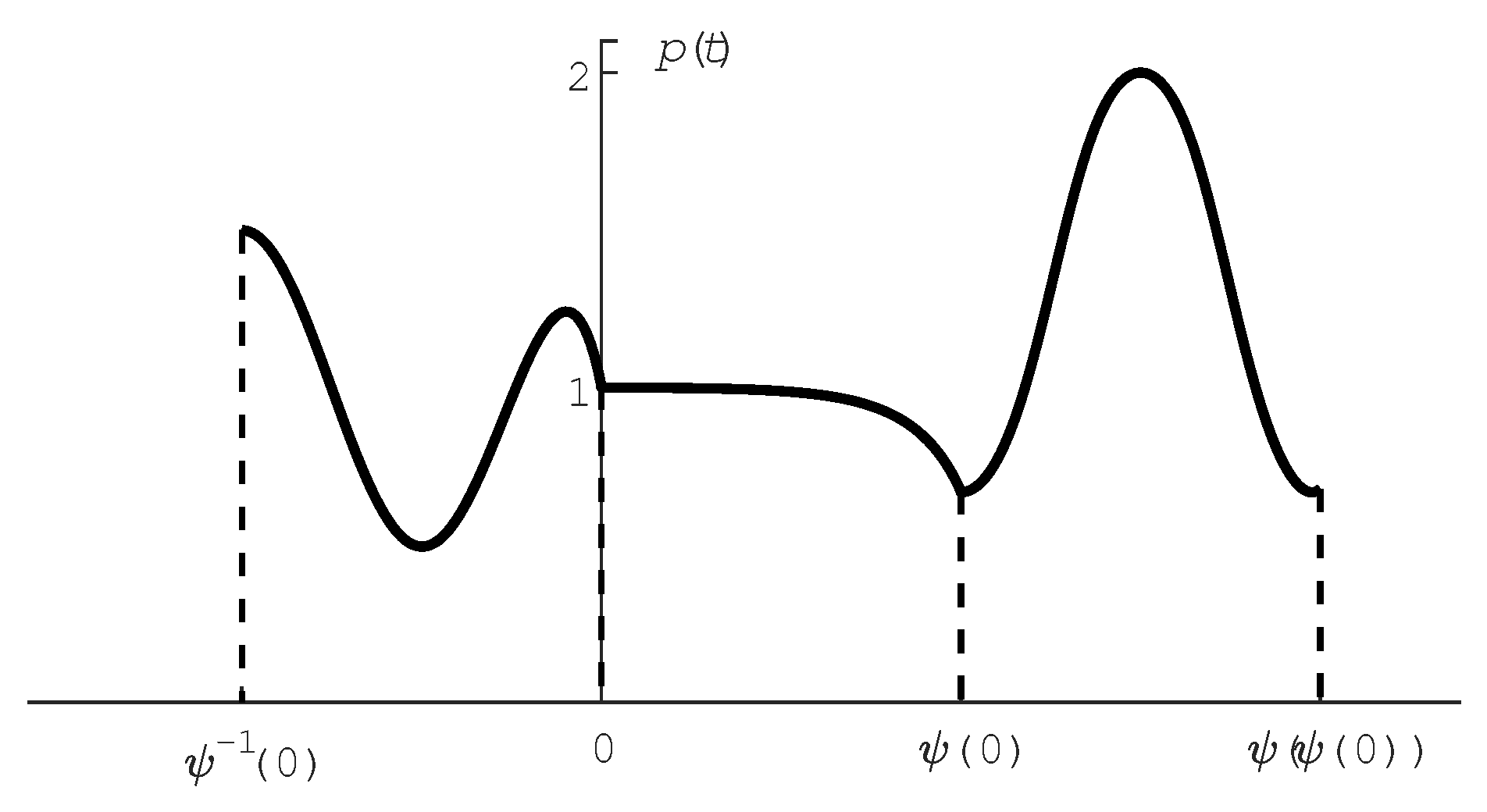
Function in the general case can be represented, for example, by the graph in Figure 1.
Figure 1.
Function on the interval
Here,
where
is the inverse Taylor series for function . Note, that in a general case, if , then for .
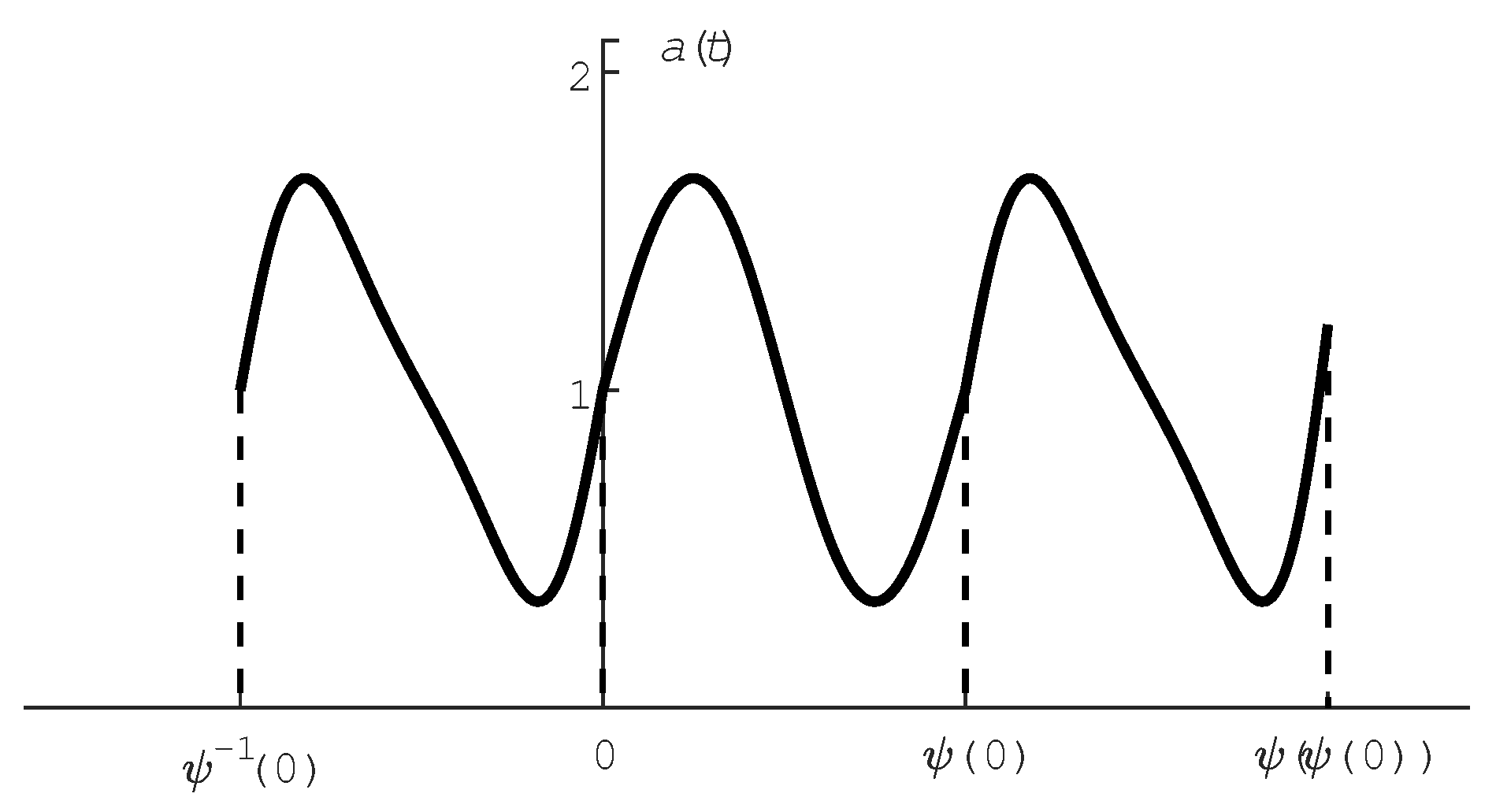
Analogically, function in the general case can be represented, for example, by the graph in Figure 2.
Figure 2.
Function on the interval
Here,
where is defined by (74) and, in the general case, if , then for .
8.1. Unique Solvability of the Initial Value Problem for Linear Scalar Functional Differential Equations
Here, we establish conditions sufficient for the unique solvability of the initial value problem for the following linear scalar functional differential equation:
The next Theorem is true.
Theorem 8.
Suppose that (70) is true, and for a certain constant and d satisfying condition , the following inequality holds almost everywhere on :
Proof.
Taking into account Corollary 3, where : , and , we obtain the assertion of Theorem 8. □
Remark 4.
Note that function p(t) cannot be a constant function because p(t) = constant does not fulfil the symmetric property (7).
8.2. Symmetric Property of the Unique Solution of the Initial Value Problem for Linear Scalar Functional Differential Equations
Here, we investigate a unique solution (78) with symmetric property (72). Assuming that (which means that this is not a resonance case), then is defined by (53):
then the next Theorem is true.
Theorem 9.
Proof.
It is easy to see that Theorem 9 is a particular case of Theorem 5. □
8.3. D-Stability of Nonlinear Functional Differential Equations

Remark 5.
In further investigations, we only study the D-stability of the trivial solution of Equation (1), as more general cases come down to this one.
Taking into account Definition 4, the next obvious Corollary 5, from Corollary 4 and Theorem 8, is true.
Corollary 5.
Assume that the conditions from Theorem 8 are true. Then, the linear problem ((75) and (76)) is D-stable (see Definition 4).
Theorem 10.
Assume that the conditions of Theorem 8 are fulfilled and for arbitrary there exists , such that
for all , .
Proof.
It is easy to see that Theorem 10 is a particular case of the Theorem 7. □
9. Conclusions
The aim of the present manuscript was to establish conditions on the D-stability of the initial value problem for a class of nonlinear symmetric functional differential equations. Furthermore, we construct conditions on the unique solvability of the initial value problem for a class of linear symmetric functional differential equations. In view of the symmetric properties and our previous results, we study the aforementioned problem on using the theory of boundary value problems. The unique solution is represented in the form of a functional series. The conditions of the symmetric property of the unique solution of the symmetric functional differential equations are also given. In addition, we present the application of the obtained results in an example.
The question of the D-stability of functional differential equations with symmetries in remains open, i.e., considering the D-stability of symmetric solutions of higher dimensional functional differential equations satisfying for a matrix A.
Author Contributions
Conceptualization, N.D., M.F.; investigation and methodology, N.D., M.F.; software and visualization, N.D., M.S.; validation, writing–original draft preparation, N.D.; writing–review and editing, N.D., M.F., M.S. All authors have read and agreed to the published version of the manuscript.
Funding
This research was supported in part by the Slovak Grant Agency VEGA-SAV, Grants No. 2/0127/20 (N. Dilna, M. Fečkan) and No. 1/0358/20 (M. Fečkan); Slovak Research and Development Agency, Contract No. APVV-18-0308 (M. Fečkan); Slovak Research and Development Agency, Contract No. APVV-16–0418 (M. Solovyov).
Acknowledgments
We thank to the reviewers for the variable and constructive comments to our paper.
Conflicts of Interest
The authors declare no conflict of interest.
References
- Lamb, J.S.W.; Roberts, J.A.G. Time-reversal symmetry in dynamical systems: A survey. Phys.-Sect. D 1998, 112, 1–39. [Google Scholar] [CrossRef]
- Gallavotti, G. Breakdown and regeneration of time reversal symmetry in nonequilibrium statistical mechanics. Phys. D Nonlinear Phenom. 1998, 111. [Google Scholar] [CrossRef]
- Hoover, W.G. Time-reversibility in nonequilibrium thermomechanics. Phys. D Nonlinear Phenom. 1998, 112, 225–240. [Google Scholar] [CrossRef]
- Dellago, C.; Posch, H.A. Field and density dependence of the Liapunov spectrum for the driven random Lorentz gas. Phys. D Nonlinear Phenom. 1998, 112, 241–249. [Google Scholar] [CrossRef]
- Azbelev, N.V.; Ermolaev, M.B.; Simonov, P.M. On the stability of functional-differential equations with respect to the first approximation. Izv. Vyss. Uchebnykh Zaved. Mat. 1995, 39, 3–9. [Google Scholar]
- Azbelev, N.V.; Simonov, P.M. Stability of Differential equations with aftereffect. In Stability and Control: Theory, Methods and Applications; Taylor and Francis: London, UK, 2003; Volume 20. [Google Scholar]
- Berezansky, L.; Braverman, E. Solution estimates for linear differential equations with delay. Appl. Math. Comput. 2020, 372, 124962. [Google Scholar] [CrossRef]
- Berezansky, L.; Braverman, E. On exponential stability of linear differential equations with several delays. J. Math. Anal. Appl. 2006, 324, 1336–1355. [Google Scholar] [CrossRef]
- Domoshnitsky, A.; Gitman, M.; Shklyar, R. Stability and estimate of solution to uncertainneutral delay systems. Bound. Value Probl. 2014, 2014, 55. [Google Scholar] [CrossRef]
- Liz, E.; Pituk, M. Exponential stability in a scalar functional differential equation. J. Inequal. Appl. 2006, 2006, 37195. [Google Scholar] [CrossRef]
- Dilna, N.; Fečkan, M.; Rontó, A. On a class of functional differential equations with symmetries. Symmetry 2019, 11, 1456. [Google Scholar] [CrossRef]
- Dilna, N.; Fečkan, M.; Solovyov, M.; Wang, J.R. Symmetric nonlinear functional differential equations at resonance. Electron. J. Qual. Theory Differ. Equ. 2019, 1–16. [Google Scholar] [CrossRef]
- Dilnaya, N.; Rontó, A. Multistage iterations and solvability of linear Cauchy Problems. Miskolc Math. Notes 2003, 4, 89–102. [Google Scholar] [CrossRef]
- Dil’naya, N.; Ronto, A. Some new conditions for the solvability of the Cauchy problem for systems of linear functional-differential equations. Ukr. Math. J. 2004, 56, 1033–1053. [Google Scholar] [CrossRef]
- Dilna, N.; Fečkan, M. On the uniqueness, stability and hyperbolicity of symmetric and periodic solutions of weaker nonlinear ordinary differential equations. Miskolc Math. Notes 2009, 10, 11–40. [Google Scholar] [CrossRef]
- Vanderbauwhede, A. Local Bifurcation and Symmetry, Research Notes in Mathematics; Pitman (Advanced Publishing Program): Boston, MA, USA, 1982; Volume 75. [Google Scholar]
- Wang, H.; Yang, X.; Li, Y. Rotating-Symmetric Solutions for Nonlinear Systems with Symmetry. Acta Math. Appl. Sin. Engl. Ser. 2015, 31. [Google Scholar] [CrossRef]
- Drozdov, A.D.; Kolmanovskii, V.B. Stability in Viscoelasticity. Chapter 7—Stability of Functional Differential Equations. North-Holl. Ser. Appl. Math. Mech. 1994, 38. [Google Scholar] [CrossRef]
- Hale, J.K. A stability theorem for functional differential equations. Proc. Natl. Acad. Sci. USA 1963, 50, 942–946. [Google Scholar] [CrossRef]
- Dilna, N. On unique solvability of the initial value problem for nonlinear functional differential equations. Mem. Differ. Equ. Math. Phys. 2008, 44, 45–57. [Google Scholar]
- Bravyi, E. Conditions for the solvability of the Cauchy problem for linear first-order functional differential equations. Electron. J. Qual. Theory Differ. Equ. 2013, 1–8. [Google Scholar] [CrossRef]
- Ronto, A.N. Exact solvability conditions for the Cauchy problem for systems of first-order linear functional-differential equations determined by (σ1, σ2,…, σn; τ)-positive operators. Ukr. Math. J. 2003, 55, 1853–1884. [Google Scholar] [CrossRef]
- Opluštil, Z.; Šremr, J. On a non-local boundary value problem for linear functional differential equations. Electron. J. Qual. Theory Differ. Equ. 2009, 36, 1–13. [Google Scholar] [CrossRef]
Publisher’s Note: MDPI stays neutral with regard to jurisdictional claims in published maps and institutional affiliations. |
© 2020 by the authors. Licensee MDPI, Basel, Switzerland. This article is an open access article distributed under the terms and conditions of the Creative Commons Attribution (CC BY) license (http://creativecommons.org/licenses/by/4.0/).