Abstract
The aim of this paper is to present an application of a fixed point iterative process in generation of fractals namely Julia and Mandelbrot sets for the complex polynomials of the form where and . Fractals represent the phenomena of expanding or unfolding symmetries which exhibit similar patterns displayed at every scale. We prove some escape time results for the generation of Julia and Mandelbrot sets using a Picard Ishikawa type iterative process. A visualization of the Julia and Mandelbrot sets for certain complex polynomials is presented and their graphical behaviour is examined. We also discuss the effects of parameters on the color variation and shape of fractals.
MSC:
Primary: 47H10; Secondary:47J25
1. Introduction
Fixed point theory provides a suitable framework to investigate various nonlinear phenomena arising in the applied sciences including complex graphics, geometry, biology and physics [1,2,3,4]. Complex graphical shapes such as fractals, were discovered as fixed points of certain set maps [1]. Informally, fractals can be treated as self similar mathematical structures which have similarity and symmetry such that considerably small parts of the shape are geometrically akin to the whole shape. Fractals are also known as expanding symmetries or unfolding symmetries. Although, fractals do not have a formal definition, however they are identified through their irregular structure that cannot be found in Euclidean geometry. Julia [5] who is considered as one of the pioneers of fractal geometry, studied iterated complex polynomials and introduced Julia set as a classical example of fractals. Let be the complex space, be a complex polynomial of degree with complex coefficients and be the iterate of x. The behaviour of the iterates for large i determine the Julia set (see [1,6,7,8]).
Definition 1
([1]). The set of points in whose orbits do not converge to a point at infinity is known as filled Julia set, , that is,
Julia set of T denoted by is the boundary of filled Julia set, that is, .
Therefore, we may say that if for every neighborhood of x there exist points w and v such that and . The complement of a Julia set is a Fatou set.
Let be a fixed point of T and , where prime denotes the complex differentiation. A point p is called a periodic point if for some integer . Let be an orbit of p. The point p is called an attracting point if and a repelling point if [6,7]. The following result gives a significant connection between repelling points of a polynomial and the Julia set.
Theorem 1
([6]). If T is a complex polynomial, then is the closure of the repelling periodic points of T.
Let p be an attracting fixed point of T. Then, the set is called the basin of attraction of p if
The basin of attraction of infinity, , is defined in the same way. The following lemma is pivotal in determining Julia sets.
Lemma 1.
[7] Let p be an attracting fixed point of T. Then, .
Thus, the Julia set is the boundary of the basin of attraction of each attracting fixed point of T, including ∞. The existence of the fixed point p for any complex polynomial is guaranteed by Brouwer fixed point theorem [9]. However, the existence of an attracting fixed point depends on the choice of the parameters. Consider the polynomial Then it has two fixed points excluding infinity. In this case, a fixed point p is attracting if i.e., . Fix , then the set of parameters r such that has an attracting fixed point is given by . Julia sets, , on the real axis i.e., are reflection symmetric while those with complex parameter values, demonstrate rotational symmetry.
Mandelbrot [10] extended the idea of Julia sets and presented the notion of fractals. He investigated the graphical behaviour of connected Julia sets and plotted them for complex function, , where is a complex variable and is an input parameter. He noted that various geometrical properties involving dimension, symmetry and similarity play consequential role in the study of fractal geometry.
Definition 2
([6]). Let T be any complex polynomial of degree . A Mandelbrot set M is the set consisting of all parameters r for which the Julia set, , is connected, that is,
or an equivalent definition is
Mandelbrot [10,11] noted that records of heart beat, irregular coastal structures, variations of traffic flow and many naturally existing textures are examples of fractals.
In order to generate and analyze fractals, various techniques are used such as iterated function systems, random fractals, escape time criterion etc. The escape time algorithm is the stopping criterion that is based on the number of iterations necessary to determine if the orbit sequence tends to infinity or not. This algorithm provides a suitable mechanism used to demonstrate some attributes of dynamic system under iterative process. Generally, the escape criterion for Julia and Mandelbrot sets is given by:
Theorem 2
([6]). For , , if there exists such that
then as .
The term is also known as escape radius threshold. The escape radius varies in each iteration. The escape radius has a key role in visualizing the fractals.
Historically, Julia and Mandelbrot sets are investigated for the polynomials but the study has been extended to quadratic, cubic, and degree complex polynomials. Lakhtakia et al. [12] explored the Julia sets for general complex function of the form where . The superior Julia and superior Mandelbrot sets for such complex polynomials in the context of noises arising in the objects were analyzed by Negi et al. [13,14]. Rochon [15] considered a more generalized form of Mandelbrot sets in bi-complex planes, see also [16,17].
Many authors have utilized various iterative processes to generate fractals. Julia and Mandelbrot sets have usually been studied for quadratic, cubic and higher degree polynomials in Picard orbit [8]. Let and . The Picard orbit [6] is a sequence which is given by
where .
Since the convergence of Picard process is slow, various faster converging iterative processes have been introduced to generate Julia and Mandelbrot sets. Rani and Kumar [18,19] used one-step Mann iterative process to generate superior Julia and Mandelbrot sets for degree complex polynomials of the form . The Mann orbit, for any , is a sequence which is given by
where and .
In 2010, a two-step Ishikawa iteration was used by Rana and Kumar [20] and Chauhan et al. [21] to study relative superior Julia and relative superior Mandelbrot sets, respectively. The dynamics of the nth order complex polynomial for non integer values were investigated in [22]. The authors also obtained new Julia and Mandelbrot sets via Ishikawa orbit. The Ishikawa orbit, for any , is a sequence which is given by
where and .
Ashish and Rani [23] investigated the three-step Noor iteration process for Julia and Mandelbrot sets. The Noor orbit, for any , is a sequence which is given by
where and .
The modified Ishikawa process, S-iteration, was employed by Kang et al. [24,25] to study relative superior Mandelbrot sets, tricorn and multicorns. The S-orbit, for any , is a sequence given by
where and .
Kumari et al. [26] used a four-step iterative process which is faster than of Picard, Mann and S-iteration processes and obtained some generalizations of Julia and Mandelbrot sets for quadratic, cubic and higher degree polynomials.
It is noteworthy that for each iterative process the behaviour and dynamics of the Julia and Mandelbrot sets differ. For some thought-provoking and fascinating comparisons, the reader may refer to [1,24,27,28,29] and references therein.
Complex polynomials of the form , where occur in various engineering problems including digital signal processing. These complex polynomials are used to determine the pole-zero plots for signals and the study of the structure and solutions of linear time invariant (LTI) state-space models, for details see [30]. Thus the study of behaviour of these polynomials and their Julia and Mandelbrot sets has gained immense interest among researchers. Kang et al. [28] introduced Julia and Mandelbrot sets in implicit Jungck Mann and Jungck Ishikawa orbits. Later, several researchers [27,29,31,32,33] employed this implicit iterative process to generate graphs of such complex polynomials. In order to achieve this, they split the polynomial T into two functions and . However, the Jungck iterative process and its variants are used to determine the common fixed points of two mappings. Therefore, the question arises whether we can obtain an escape criterion and generate fractals for polynomials of the form T using explicit iterative processes.
The purpose of this paper is to answer this question. In this paper, we discuss the graphical behaviour of the complex polynomial of the form where and using Picard Ishikawa type fixed point iteration process for the generation of fractals. Note that the Julia and Mandelbrot sets generated have distinctive shapes for the proposed iterative process as compared to already present iterative processes in the literature. Further, we show the effect of change of parameters on color variation and graph of the sets.
The Picard Ishikawa type iteration process was introduced by Piri et al. [34]. They claimed that this iterative process converges faster than Mann and Ishikawa iteration processes. Let D be a subset of a Banach space and then the three step iteration process is given by
where .
2. Main Results
In this section, we use a Picard Ishikawa type iterative process and some prove escape criterions to determine the escape radius for this process. Throughout this paper we assume that for any complex polynomial the parameters are chosen in a way that at the least one attracting fixed point exists.
Let be a complex space and be a complex polynomial with complex coefficients. The Picard Ishikawa type orbit around any , is a sequence given by
where and .
We need the following escape criterions for the quadratics, cubic and higher degree polynomials.
2.1. Escape Criterion for Quadratic Complex Polynomials in a Picard Ishikawa Type Orbit
For the quadratic polynomial where , we have the following result.
Theorem 3.
Suppose that , . Define as in (2) where , , and . Then, as .
Proof.
As, . From (2), we have
The assumption yields
Since , we obtain which implies that
Thus, we have
Therefore,
From our assumption; we get
Now, (3) gives that
As , (2) gives
Moreover, let , . Then, by an assumption , (8) and the fact that we obtain
This implies
Finally, we have
Furthermore, from and (9) we get that
As we obtain
By (9), we have
From our given assumption, we have and hence . Thus, there exists a real number such that
It follows that
In particular, . Continuing in the same manner yields
Therefore, the orbit of x tends to infinity. □
The following corollary is the refinement of the Theorem 3.
Corollary 1.
Suppose that where then as .
2.2. Escape Criterion for Cubic Complex Polynomials in a Picard Ishikawa Type Orbit
For the cubic polynomial where , we have the following result.
Theorem 4.
Suppose , . Define a sequence as in (2) where , , and . Then, as .
Proof.
As , from (2) we have
The assumption yields that
As ,
Therefore,
The assumption, implies that
It follows from (10) that
As by (2) we have
Also, , . Then, the given assumption , (8) and the fact that yield
Thus
Lastly, we have
From , (16) and we have
From (16), we have
By our assumption we have and hence . Thus, there exists a real number such that
It follows that
Continuing in the same manner, we obtain
Therefore, the orbit of x tends to infinity. □
The following corollary is the refinement of the Theorem 4.
Corollary 2.
Suppose that where then as .
2.3. Escape Criterion for General Complex Polynomials in a Picard Ishikawa Type Orbit
For the general complex polynomial where , we have the following result.
Theorem 5.
Suppose , with and . Define a sequence as in (2) where , , and . Then, as .
Proof.
Let . Note that (2), assumptions and give
Therefore,
By our assumption, we have and hence
It follows from (17) that
Since , so from (2) we obtain
As , from (19) and assumption we have
Hence,
As , , so using the similar arguments as before we obtain
Also, from , (22), and we have
Furthermore, from our assumption we have and thus . Thus, there exists a real number such that
Finally, we obtain
Now, continuing this process
Therefore, the orbit of x tends to infinity. □
The following corollary is the refinement of the Theorem 5.
Corollary 3.
Suppose that where and then as .
Theorem 6.
Suppose that is a sequence in the Picard Ishikawa type orbit for the complex polynomial where with such that as , then and , .
Proof.
Let be a sequence in Picard Ishikawa type orbit. First, we prove that . According to hypothesis, as , the sequence must be unbounded. Hence, for all and therefore . Let , where , , and then implies that
Thus,
implies
Here, we have two possibilities; either or . If we have
which implies that
and hence
a contradiction. Indeed, is not bounded where . Therefore, we must have . Thus, . Now, inequality (23) implies that
Furthermore, and give
As so we have
As a consequence we obtain
Thus,
Similarly, , and imply that
Consequently,
Finally, we have
Hence
Using arguments similar to those as before, we only have one possibility that . Therefore, . This completes the proof. □
3. Visualization of Fractals
In this section, we present some Julia and Mandelbrot sets for quadratic and higher order polynomials. We found several captivating new fractals having various geometric shapes. However, we have chosen some figures. The color variation occurs due to the change of input parameters. We have also investigated the effect of change of parameters and on the shape and the variation of colors. The number of iterations was fixed at 10.
3.1. Generation of Julia sets
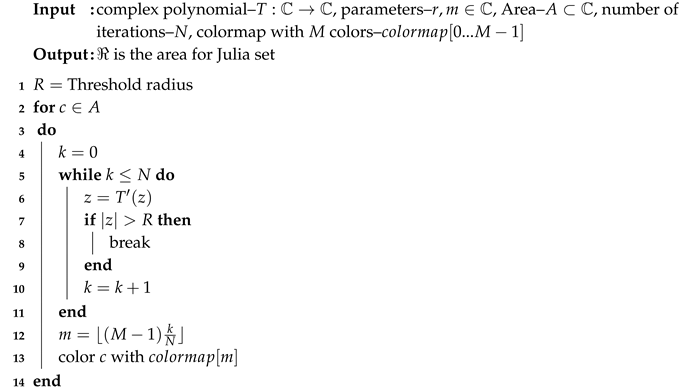
Following Algorithm 1 is the pseudocode for the generation of Julia sets. Note that represents the iteration process.
| Algorithm 1: Generation of Julia Set. |
![]() |
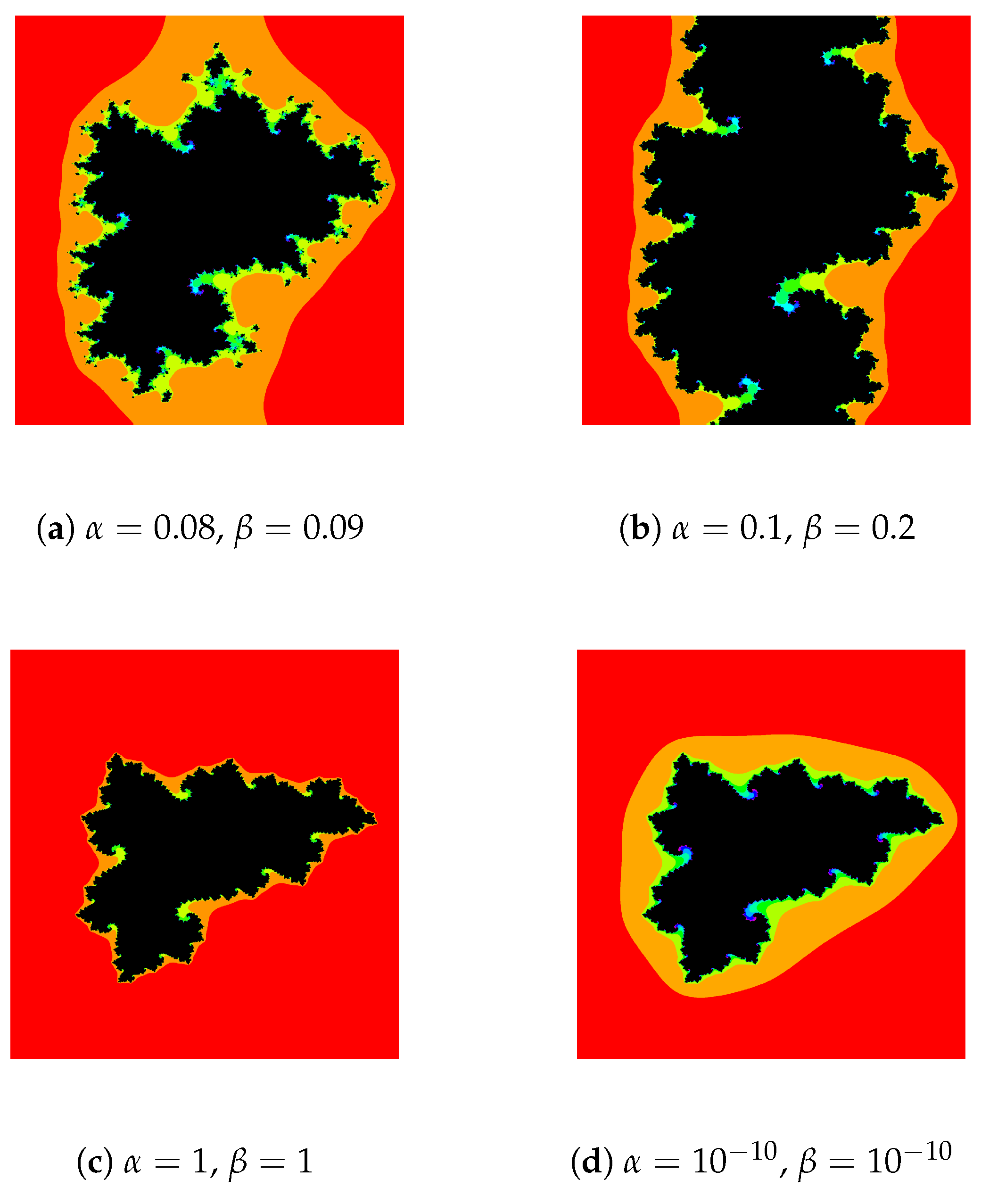
Now, we present quadratic, cubic and septic Julia sets in Picard Ishikawa type orbit for the complex polynomial, .
- For Figure 1, we consider the polynomial and . It is easy to see that T has one attracting fixed point, . Observe that for , and , we obtain different images due to color variation caused by parameters. It is interesting to note that for , and , we have similar shapes but there is clear variation of colors.
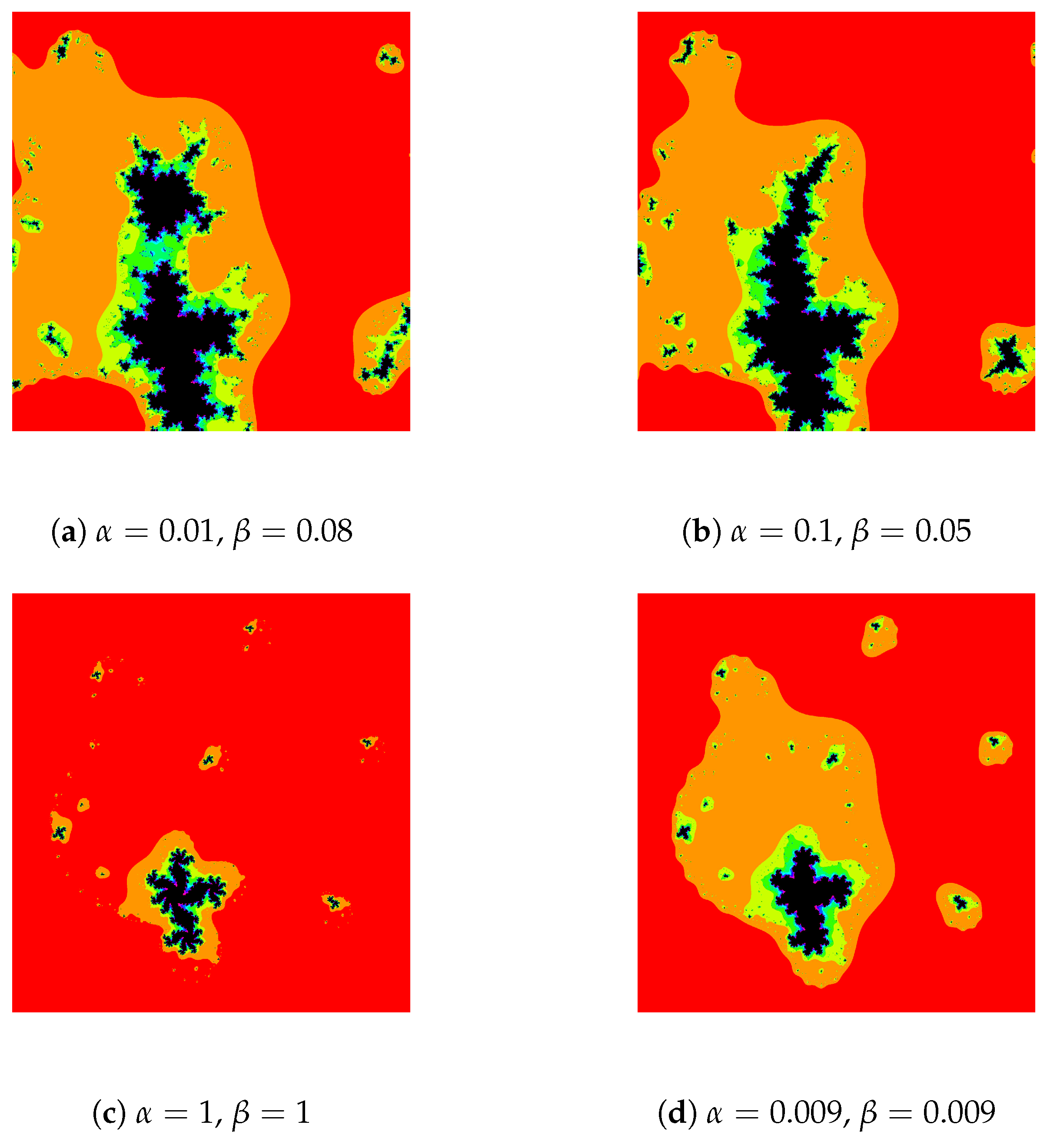
Figure 1. Quadratic Julia sets. - For Figure 2, we consider the polynomial and . The polynomial T has attracting fixed point in A. Note that the cubic Julia sets for and have more color variation as compared to the Julia sets for , and . Again, for , and , the shapes are same but there is variability in colors.
Figure 2. Cubic Julia sets. - For Figure 3, we input and . The attracting fixed point of the polynomial is . We can see that for and the shape is spread and stretched while the shape is dense and neatly packed for and . Note the variation of colors in figures (C) and (D) as well.
Figure 3. Septic Julia sets.
3.2. Generation of Mandelbrot Sets
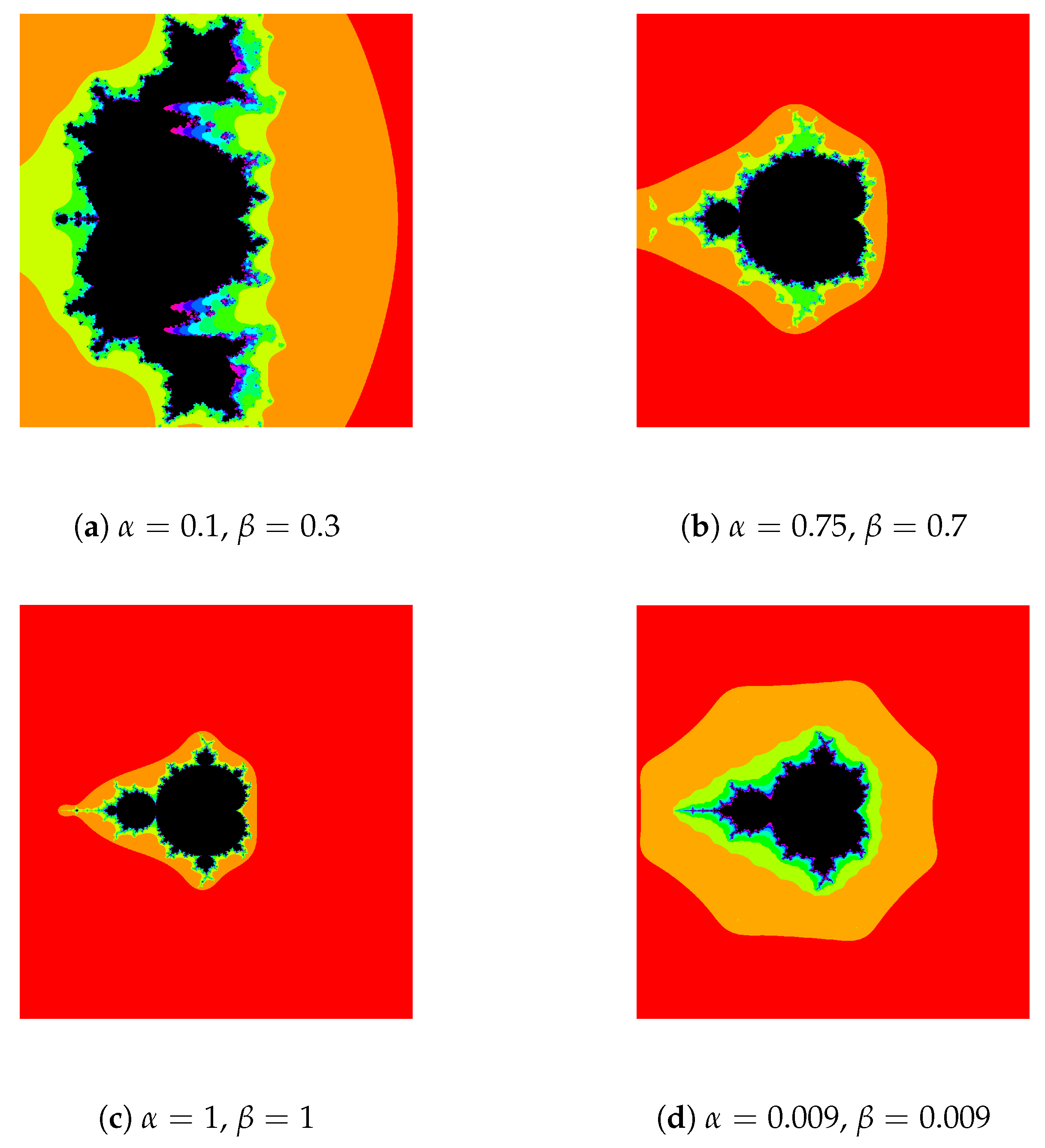
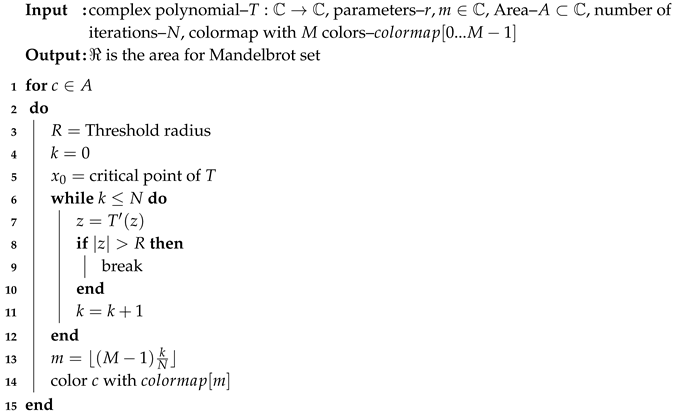
Following Algorithm 2 is the pseudocode for the generation of Mandelbrot sets. Note that represents the iteration process.
| Algorithm 2: Generation of Mandelbrot set. |
![]() |
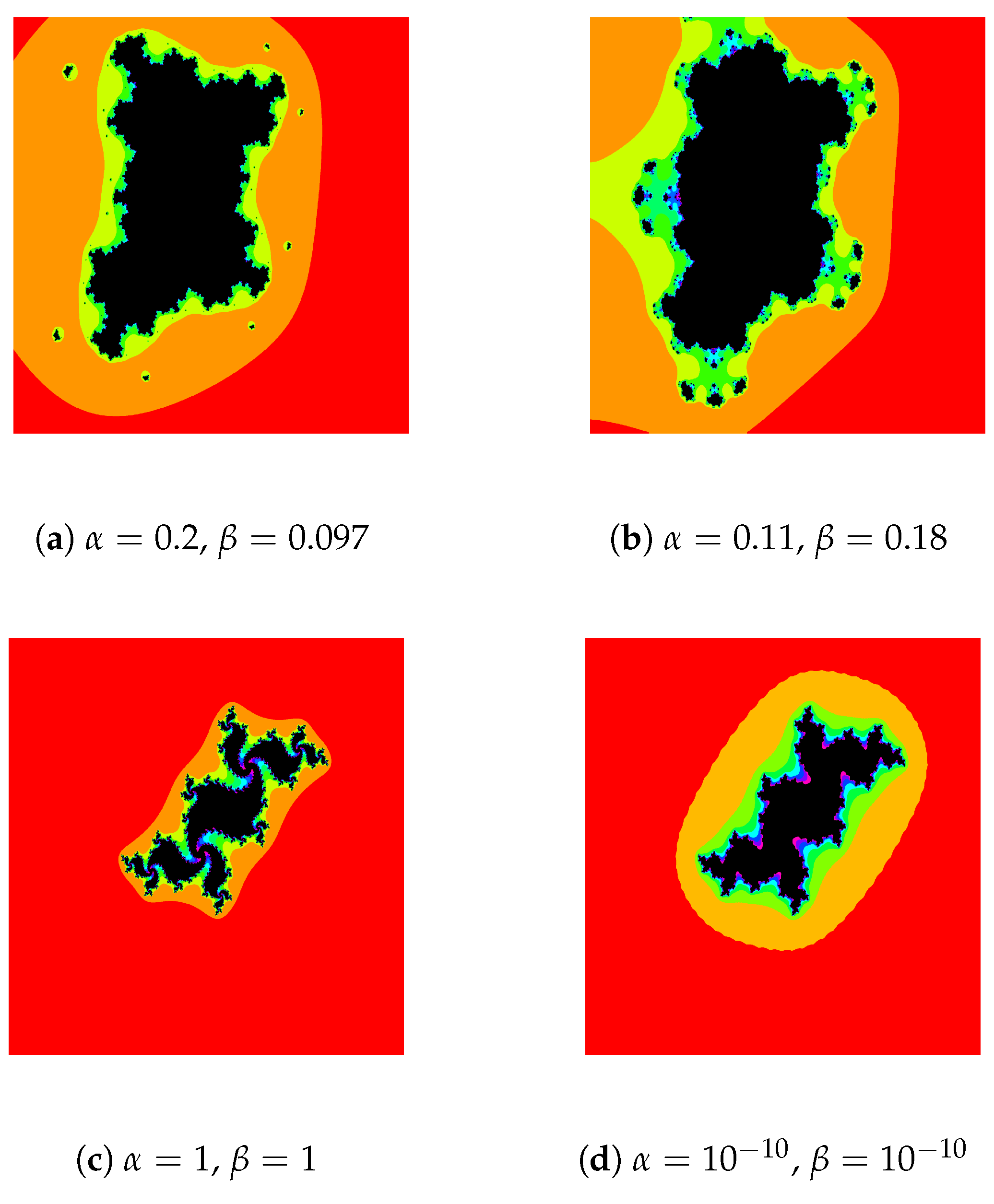
For Figure 4 we input and observe that for and , the shape is stretched and the bulb is wider and for and the shape is compact with defined bulb. Notice the variation of colors for Mandelbrot sets for , and , . Also, observe that Mandelbot sets generated are symmetric about origin.
Figure 4.
Mandelbrot sets.
4. Conclusions
In this paper, a Picard Ishikawa type orbit was used to study the behaviour of complex poylnomials. We obtained escape criterions for complex quadratic, cubic and higher degree polynomials. Some alluring Julia and Mandelbrot sets have been generated. We also observed that the variation of parameters has shown eminent changes in the Julia and Mandelbrot sets. Our results are different from comparable existing results as we obtain escape criterion and fractals for polynomials of the form where without using the Jungck iterative process. It is also worth mentioning that the behaviour of the polynomial and shape of the fractal generated under the iterative process (2) is different and unique as compared to the iterative process studied before in the literature [1,24,29,32].
Author Contributions
Conceptualization, M.A. and H.I.; methodology, M.A. and H.I.; validation, M.A. and M.D.l.S., formal analysis H.I.; investigation, H.I. and M.A.; writing—original draft preparation, H I.; writing—review and editing, H.I.; visualization, M.D.l.S.; supervision, M.A. and M.D.l.S.; project administration, M.D.l.S.; funding acquisition, M.D.l.S. All authors have read and agreed to the published version of the manuscript.
Funding
This research was funded by Basque Government through grant number IT 1207-19.
Acknowledgments
All the authors are grateful to the referees for their critical remarks and valuable suggestions which helped to improve the presentation of the paper.
Conflicts of Interest
The authors declare no conflict of interest.
References
- Barnsley, M. Fractals Everywhere, 2nd ed.; Academic Press: San Diego, CA, USA, 1993. [Google Scholar]
- Hundertmark-Zauôkovù, A. On the convergence of fixed point iterations for the moving geometry in a fluid-structure interaction problem. J. Differ. Equ. 2019, 267, 7002–7046. [Google Scholar] [CrossRef]
- Rahmani, M.; Koutsopoulos, H.N.; Jenelius, E. Travel time estimation from sparse floating car data with consistent path inference: A fixed point approach. Transp. Res. Part C Emerg. Technol. 2017, 85, 628–643. [Google Scholar] [CrossRef]
- Strogatz, S.H. Nonlinear Dynamics and Chaos With Applications to Physics, Biology, Chemistry, and Engineering, 2nd ed.; CRC Press: Boca Raton, FL, USA, 2018. [Google Scholar]
- Julia, G. Memoire sur l’iteration des functions rationnelles. J. Math. Pures Appl. 1918, 8, 737–747. [Google Scholar]
- Devaney, R.L. A First Course in Chaotic Dynamical Systems: Theory and Experiment, 2nd ed.; Addison-Wesley: Boston, MA, USA, 1992. [Google Scholar]
- Falconer, K. Fractal Geometry: Mathematical Foundations and Applications, 2nd ed.; John Wiley & Sons: Chichester, UK, 2004. [Google Scholar]
- Frame, M.; Robertson, J. A generalized Mandelbrot set and the role of critical points. Comput. Graph. 1992, 16, 35–40. [Google Scholar] [CrossRef]
- Brouwer, L.E.J. Über Abbildungen von Mannigfaltigkeiten. Math. Ann. 1912, 71, 97–115. [Google Scholar] [CrossRef]
- Mandelbrot, B.B. The Fractal Geometry of Nature; W.H. Freeman: New York, NY, USA, 1983; Volume 2. [Google Scholar]
- Debnath, L. A brief historical introduction to fractals and fractal geometry. Int. J. Math. Educ. Sci. Technol. 2006, 37, 29–50. [Google Scholar] [CrossRef]
- Lakhtakia, A.; Varadan, W.; Messier, R.; Varadan, V.K. On the symmetries of the Julia sets for the process zp + c. J. Phys. A Math. Gen. 1987, 20, 3533–3535. [Google Scholar] [CrossRef]
- Negi, A.; Rani, M. Midgets of superior Mandelbrot set. Chaos Solitons Fract. 2008, 36, 237–245. [Google Scholar] [CrossRef]
- Negi, A.; Rani, M. A new approach to dynamic noise on superior Mandelbrot set. Chaos Solitons Fract. 2008, 36, 1089–1096. [Google Scholar] [CrossRef]
- Rochon, D. A generalized Mandelbrot set for bicomplex numbers. Fractals 2000, 8, 355–368. [Google Scholar] [CrossRef]
- Wang, X.; Sun, Y. The general quaternionic M-J sets on the mapping z ← zα + c(α ∈ ℕ). Comput. Math. Appl. 2007, 53, 1718–1732. [Google Scholar] [CrossRef]
- Rani, M. Theoretical Framework for Fractal Models under Two-Step Feedback Process. Ph.D. Thesis, Kumaun University, Nainital, India, 2016. [Google Scholar]
- Rani, M.; Kumar, V. Superior Julia set. Res. Math. Educ. 2004, 8, 261–277. [Google Scholar]
- Rani, M.; Kumar, V. Superior Mandelbrot set. Res. Math. Educ. 2004, 8, 279–291. [Google Scholar]
- Rani, M.; Chauhan, Y.S.; Negi, A. Non linear dynamics of Ishikawa iteration. Int. J. Comput. Appl. 2010, 7, 43–49. [Google Scholar] [CrossRef]
- Chauhan, Y.S.; Rana, R.; Negi, A. New Julia sets of Ishikawa iterates. Int. J. Comput. Appl. 2010, 7, 34–42. [Google Scholar] [CrossRef]
- Chauhan, Y.S.; Rana, R.; Negi, A. Complex dynamics of Ishikawa iterates for non integer values. Int. J. Comput. Appl. 2010, 9, 9–16. [Google Scholar] [CrossRef]
- Ashish; Rani, M.; Chugh, R. Julia sets and Mandelbrot sets in Noor orbit. Appl. Math. Comput. 2014, 228, 615–631. [Google Scholar]
- Kang, S.M.; Rafiq, A.; Latif, A.; Shahid, A.A.; Ali, F. Fractals through modified iteration scheme. Filomat 2016, 30, 3033–3046. [Google Scholar] [CrossRef][Green Version]
- Kang, S.M.; Rafiq, A.; Latif, A.; Shahid, A.A.; Kwun, Y.C. Tricorns and multicorns of S-iteration scheme. J. Funct. Spaces 2015, 2015, 417167. [Google Scholar]
- Kumari, M.; Ashish, R.C. New Julia and Mandelbrot sets for a new faster iterative process. Int. J. Pure Appl. Math. 2016, 107, 161–177. [Google Scholar] [CrossRef]
- Kang, S.M.; Nazeer, W.; Tanveer, M.; Shahid, A.A. New fixed point results for fractal generation in Jungck Noor orbit with s-convexity. J. Funct. Spaces 2015, 2015, 963016. [Google Scholar] [CrossRef]
- Kang, S.M.; Rafiq, A.; Tanveer, M.; Ali, F.; Kwun, Y.C. Julia and Mandelbrot sets in modified Jungck three-step orbit. Wulfenia J. 2015, 22, 167–185. [Google Scholar]
- Kwun, Y.C.; Tanveer, M.; Nazeer, W.; Abbas, M.; Kang, S.M. Fractal generation in modified Jungck-S orbit. IEEE Access 2019, 7, 35060–35071. [Google Scholar] [CrossRef]
- Proakis, J.G.; Manolakis, D.G. Digital Signal Processing: Principles, Algorithms and Applications, 4th ed.; Pearson: Bengaluru, India, 2007. [Google Scholar]
- Mishra, M.K.; Ojha, D.B.; Sharma, D. Fixed point results in tricorn and multicorns of Ishikawa iteration and s-convexity. IJEST 2011, 2, 157–160. [Google Scholar]
- Cho, S.Y.; Shahid, A.A.; Nazeer, W.; Kang, S.M. Fixed point results for fractal generation in noor orbit and s-convexity. SpringerPlus 2016, 5, 1843. [Google Scholar] [CrossRef] [PubMed]
- Nazeer, W.; Kang, S.M.; Tanveer, M.; Shahid, A.A. Fixed point results in the generation of Julia and Mandelbrot sets. J. Inequal. Appl. 2015, 2015, 298. [Google Scholar] [CrossRef]
- Piri, H.; Daraby, B.; Rahrovi, S.; Ghasemi, M. Approximating fixed points of generalized α-nonexpansive mappings Banach spaces by new faster iteration process. Numer. Algorithms 2018, 81, 1129–1148. [Google Scholar] [CrossRef]
© 2020 by the authors. Licensee MDPI, Basel, Switzerland. This article is an open access article distributed under the terms and conditions of the Creative Commons Attribution (CC BY) license (http://creativecommons.org/licenses/by/4.0/).