Abstract
We prove the existence of radially symmetric solutions and the validity of Euler–Lagrange necessary conditions for a class of variational problems with slow growth. The results are obtained through the construction of suitable superlinear perturbations of the functional having the same minimizers of the original one.
MSC:
49J30; 49K21
1. Introduction
This paper is concerned with the variational problem
where is the open ball centered at the origin and with radius .
Under the sole assumptions of increasing monotonicity of the Lagrangian with respect to the gradient variable, one can prove, by means of a symmetrization procedure proposed in Reference [1], that the problem admits a one–dimensional reduction, obtained by evaluating the functional only on the set of radially symmetric functions (see Section 3).
This reduction step leads to consideration of the minimum problem
on the space
The qualitative features of the Lagrangian are that is convex (in fact this assumption can be dropped in the autonomous case, see Corollary 2) and with, at least, linear growth, while is Lipschitz continuous in the t variable. These assumptions do not assure that every minimizing sequence of the functional is precompact in , and hence the direct methods of Calculus of Variations fail.
For this reason, indirect methods, based on the solvability of the associated Euler–Lagrange equations, have often been adopted in the literature (see References [2,3,4,5,6,7,8,9,10,11,12,13]). Specifically, if the Lagrangian is convex with respect to both variables u and , then any solution of the Euler–Lagrange conditions provides a minimizer, and vice-versa.
The main feature of the present work is that we do not require convexity of the Lagrangian in the u variable, so that the above mentioned indirect methods cannot be implemented, and a brand-new approach is needed.
Our starting points are an existence result and the validity of the Euler–Lagrange necessary conditions under the additional requirement that has superlinear growth. These properties can be easily obtained by applying well-known results (see Step 1 of the proof of Theorem 2). Exploiting the necessary conditions, we obtain explicit a-priori estimates on the derivative of minimizers of superlinear functionals, that depend on the Lipschitz constant of .
When satisfies only a linear growth condition, say for some positive constants M and C, and the Lipschitz constant of is not too large compared with M (see the compatibility relation (hgr) between g and h in the statement of Theorem 2), then we proceed as follows. As a first step, we construct an ad-hoc superlinear perturbation of the slow growth functional, for which we have a Lipschitz minimizer satisfying some a-priori estimates. Then, relying on these estimates, we show that this function is in fact a minimizer of the original slow-growth problem.
In some sense, our technique is reminiscent of the semiclassical approach, based on the construction of barrier functions, for the minimization of functionals of the type on functions satisfying some prescribed boundary condition (see, e.g., Reference [14], Chapter 1).
As an application of our results, in Section 5 we prove existence of convex Lipschitz continuous minimizers for variational problems with a constraint on the gradient. For related convexity results, obtained by means of convex rearrangements, see Reference [15,16].
Finally, we believe that our techniques can also be successfully implemented for minimization problems related to slow-growth integral functionals in a space of functions depending only on the distance from the boundary of (see, e.g., References [17,18,19,20,21,22,23,24,25,26,27,28]).
2. Notation and Preliminaries
In what follows will denote the Euclidean norm in , , and is the open ball centered at the origin and with radius .
We shall denote by and respectively the closure and the interior of a set A, and by the essential domain of an extended real–valued function , that is, . We shall always consider proper functions, that is .
Given a locally Lipschitz function , for every we denote by its generalized gradient at x in the sense of Clarke (see Reference [29], Chapter 2). We recall that, if x is an interior point of A, then is a non-empty, convex, compact set (see Reference [29], Proposition 2.1.2(a)). Moreover, if denotes the set of points where is differentiable, then
(see Reference [29], Theorem 2.5.1). Hence, if is a monotone non-decreasing K-Lipschitz function, then for every .
For notational convenience, if also depends on an additional variable , we denote by the generalized gradient of the function .
If is a lower semicontinuous convex function, the generalized gradient coincides with the subgradient (in the sense of convex analysis) at every point , and hence , where and are the left and right derivative of at x (see Reference [29], Proposition 2.2.7). We shall often use the following implication, due to the monotonicity of the subgradient:
If , we denote by its Fenchel–Legendre transform, or conjugate function (see Reference [30], Section I.4). With some abuse of notation, if , we use to denote the Fenchel–Legendre transform of the even function , so that
We remark that, in this case, is a lower semicontinuous convex even function.
If is a lower semicontinuous convex function, its subgradient and the subgradient of the conjugate function are related in the following way:
(see Reference [30], Corollary I.5.2).
We say that is a normal integrand if is lower semicontinuous for almost every (a.e.) , and there exists a Borel function such that for a.e. (see Reference [30], Definition VIII.1.1).
3. Symmetry of Minimizers
In this section we deal with the symmetry properties of minimizers in of functionals of the form
under very mild assumptions on the Lagrangian f.
Our aim is to prove that the minimization problem for F in is, in fact, equivalent to the minimization problem for the one–dimensional functional
in the functional space
Remark 1.
Notice that the functional is, up to a constant factor, the functional F evaluated on the radially symmetric functions belonging to . In particular, we underline that every function satisfies
so that .
We adopt a symmetrization procedure introduced in Reference [1]. Given a representative of , and , let
be the radial symmetric function obtained from the profile of u along the straight line through 0 and with direction .
In Reference [1], Lemma 3.1, it is proved that for a.e. , and
Following the lines of the proof of Reference [1], Theorem 3.4, we show that, for some , is a better competitor than u in the minimization problem for F.
Theorem 1.
Let be a normal integrand such that for almost every , the map is monotone non-decreasing. Then for every there exists a radially symmetric function such that . In particular, if F admits minimizers in , then it admits a radially symmetric minimizer.
If, in addition, for almost every , the map is strictly monotone increasing, then every minimizer of F in is a radially symmetric function.
Proof.
Let u be a function in such that , and let be the radially symmetric function defined in (3). We claim that,
where is the -dimensional Hausdorff measure. Namely, observing that
using (4) and the monotonicity property of the Lagrangian f, we obtain that
From (5) follows that there exists a set , with , such that for every . Moreover, if u is a minimizer for F, then for a.e. , and (5) implies that
hence almost every is a (radially symmetric) minimizer of F.
Assume now that for almost every , the map is strictly monotone increasing, and let u be a minimizer for F. From the computation above, we deduce that (6) holds if and only if
Since for a.e. , from the strict monotonicity assumption on f we deduce that for –a.e. , hence, from (4), we obtain that is parallel to and then u is radially symmetric (see Reference [1], Lemma 3.3). □
As a consequence of Theorem 1, we obtain the following 1–dimensional reduction of the minimum problem.
Corollary 1.
4. Existence of Minimizers and Euler–Lagrange Inclusions
In this section, we focus our attention on functionals of the form
whose corresponding one-dimensional functional is
We prove the existence of radially symmetric Lipschitz continuous minimizers, and the validity of necessary optimality conditions of Euler–Lagrange type, when g is a convex function with possibly linear growth in the gradient variable, and h is a Lipschitz continuous function with respect to u.
As usual, the Euler–Lagrange conditions involve a pair , where is a minimizer in , while the function p belongs to the space
We call p a momentum associated with .
Theorem 2.
Let , and satisfy:
- (g1r)
- g is a normal integrand, the function is convex for a.e. , and .
- (g2r)
- There exists a function such thatand .
- (h1r)
- h is a Borel function, , and there exists such that
- (hgr)
- The functions g and h are related by the condition
Then the following holds true.
- (i)
- F admits a radially symmetric minimizer in , and admits a minimizer in .
- (ii)
- Every minimizer of is Lipschitz continuous.
- (iii)
- For every minimizer of there exists such that the following Euler–Lagrange inclusions hold:
Remark 2.
In (g2r) it is not restrictive to assume that ψ is a non-decreasing function, with , and that is convex and smooth (possibly replacing ψ with a suitable regularization of its convex envelope). As a consequence of these assumptions, the function turns out to be strictly increasing in , where , and hence, for every , there exists (a unique) such that . In the following we shall always assume that the function ψ in (g2r) satisfies these additional properties. We recall that, if , such a function is called a Nagumo function (see, e.g., Reference [31], Section 10.3).
Remark 3.
If g satisfies (g1r) and (g2r), then
Remark 4.
If h satisfies (h1r), then the quantity defined in (hgr) is always finite, since
We start by proving some a-priori estimates for the solutions of the Euler–Lagrange inclusions.
Lemma 1.
Let . Then the following hold:
- (i)
- If h satisfies (h1r) and satisfies (9), then for every , where is the (finite) quantity defined in (hgr).
- (ii)
Proof.
(i) From Remark 4, the quantity defined in (hgr) is finite. By (h1r) we have that for a.e. , so that (9) gives the estimate
and hence
(ii) From (10) we have that , and, from (16), we deduce that
so that (13) holds. Moreover, if is defined by (14), then, by the convexity assumption on , we obtain the estimate
(with the convention if ). On the other hand, by the very definition of , we have that , hence
which in turn implies that for a.e. , and (15) follows. □
The proof of Theorem 2 is divided into two steps: first we show that the result is valid in the superlinear case, that is, when , and then we obtain the result when by constructing, with the help of the a-priori estimates obtained by the Euler–Lagrange conditions, a family of superlinear functionals whose radially symmetric minimizers also minimize the functional F.
Proof of Theorem 2.
Step 1: superlinear Lagrangians.
(i) In order to use a standard existence result for coercive functionals (see, e.g., Reference [30], Theorem 2.2), we need to rewrite the functional F in a suitable form.
Let us define
Since, by (h1r), it holds that
then for all and . Moreover, we have that
Since , it holds that
(see, e.g., the derivation of formula (13) in Reference [9]). Setting , we get
Observe that, by (g2r), it holds
Since is a Nagumo function, then by Theorem 2.2 in Reference [30] the functional
admits a minimizer in . Hence, by Corollary 1, the functional admits a minimizer in .
(ii)–(iii) Let us prove that, for every minimizer of F in , there exists a momemtum associated with . (Hence, the Lipschitz continuity of will follow from Lemma 1). Specifically, the conclusion follows from Reference [29], Theorem 4.2.2, once we show that all the assumptions are satisfied. The Lagrangian is convex with respect to s, and satisfies the Basic Hypotheses 4.1.2 in Reference [29]. Moreover, the Hamiltonian of the problem, that is, the Fenchel–Legendre transform of L with respect to the last variable:
satisfies the strong Lipschitz condition near every arc, since, by (h1r),
Finally, the minimization problem is calm, since it is a free-endpoint problem, hence all assumptions of Theorem 4.2.2 in Reference [29] are satisfied.
Step 2: slow growth Lagrangians.
(i) Let be defined by (14), and, for given, let be the class of all convex superlinear non-decreasing functions , such that for every .
Given and , let us define the superlinear Lagrangian
and the corresponding functional
For every and the functional satisfies the assumptions of Step 1, hence there exist a minimizer of in and an associated momentum , such that
By Lemma 1(i), we obtain that for every . On the other hand, since
and, by Lemma 1(ii), with , we obtain that
Hence, a.e. in , so that , and .
By the discussion above, for every and every , we have that
hence we conclude that is independent of and .
We claim that . Specifically, assume by contradiction that there exists such that . Since , by the de La Vallée Poussin criterion (see, e.g., Reference [31], Theorem 10.3.i), there exists a function such that , i.e.,
By (17), for small enough we have that , a contradiction.
(ii) Let be a minimizer of F in , and let us prove that is Lipschitz continuous.
Assume by contradiction that is not Lipschitz continuous, that is, for every (here denotes the Lebesgue measure on ).
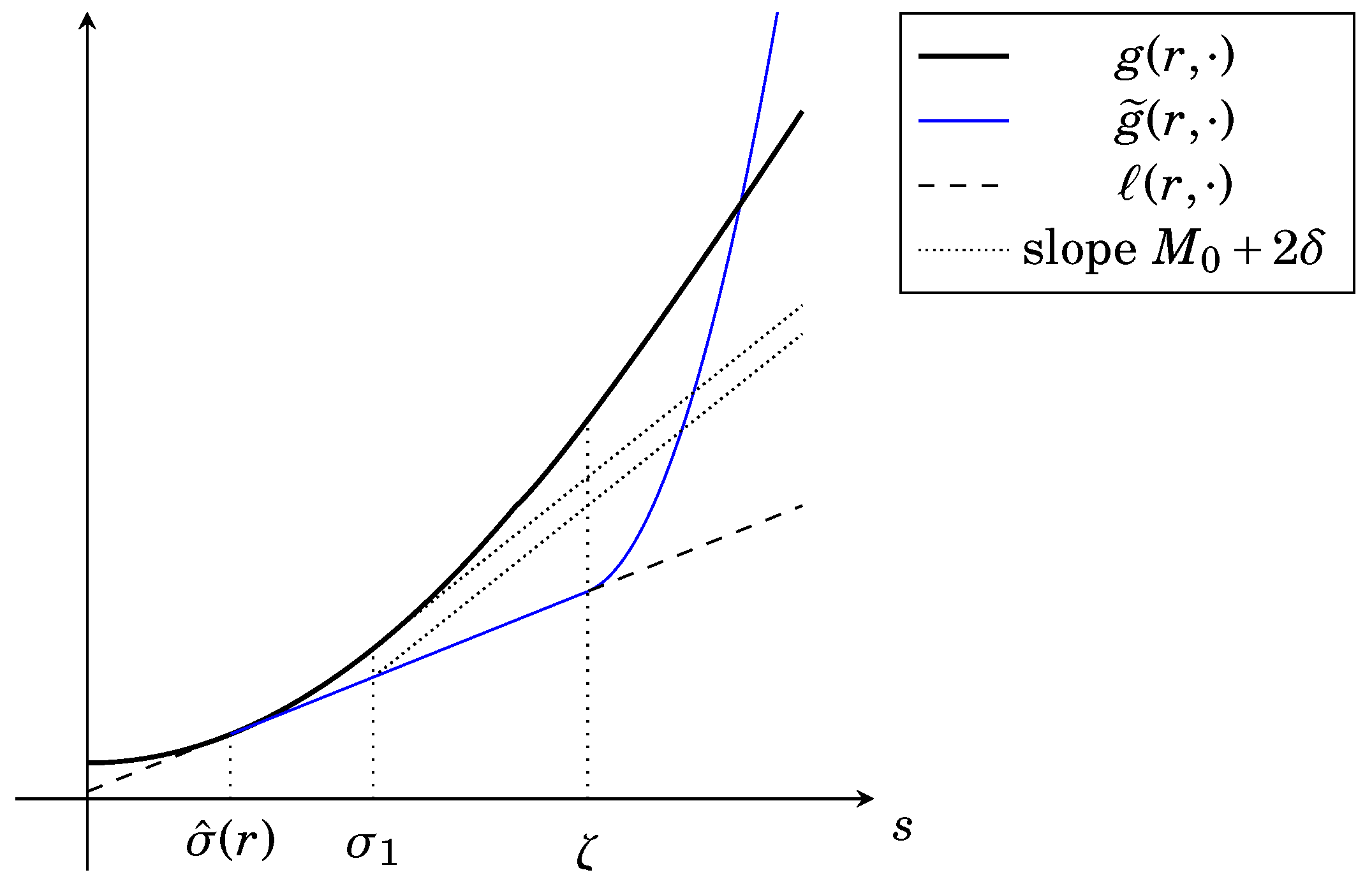
Let us define , and by:
Observe that, by (g2r),
so that for every . (The inequality is trivially satisfied for those values of r such that .) Let us define the function
Since , we have that for every and .
Let be a Nagumo function such that . Given , let us define . Since , we have that
whereas
hence there exists such that
Figure 1.
Construction of .
Since , for every we have that
On the other hand, if is a minimizer of , then by Step 1 there exists such that satisfies the Euler–Lagrange inclusions (9) and (10) with g replaced by . From Lemma 1(i) we deduce that
(where the last inequality follows from ), hence
and, in conclusion,
in contradiction with the assumption that is a minimizer of F.
(iii) Finally, let us prove that satisfies the Euler–Lagrange inclusions. Let be such that a.e. in . Reasoning as in the existence proof, is a minimizer of for every and , with . Hence, satisfies the Euler–Lagrange inclusions with instead of g. Since for a.e. , the conclusion follows. □
5. Convex Solutions of Variational Problems with Gradient Constraints
As an application of the previous results, we obtain the existence of convex radially symmetric minimizers for autonomous functionals of the form
in the space
of Sobolev functions with gradient constraint given by a monotone non-decreasing function .
Theorem 3.
Let us consider the integral functional (20), where and satisfy the following assumptions:
- (g1)
- is a convex function;
- (g2)
- ;
- (h1)
- h is a convex function;
- (hg)
- .
Then the following hold.
- (i)
- F admits a radially symmetric minimizer in .
- (ii)
- There exists a momentum such that the following Euler–Lagrange inclusions hold:where
- (iii)
- If [resp. ], then u is a convex [resp. concave] function.
- (iv)
- If, in addition, g has a strict minimum point at 0, or h is a strictly monotone function, then every minimizer of F in is radially symmetric.
Proof.
The constraint in the definition of the functional space can be incorporated into the Lagrangian. Specifically, let us define
where is the indicator function of a set B, defined by if and otherwise. Then minimizing F in is equivalent to minimizing in .
We remark that, if g satisfies (g1)–(g2), then satisfies (g1r)–(g2r) and
We shall prove the theorem only in the case (since the case can be handled similarly).
If 0 is a minimum point of h, then clearly parts (i)–(ii)–(iii) are satisfied choosing and . Hence, it is not restrictive to prove (i)–(ii)–(iii) under the additional assumption that 0 is not a minimum point of h. Since , and h is a convex function, we have that .
Since , the (possibly empty) convex and closed set is contained in the open half-line . If , let , otherwise let . Let us define
(the first condition is empty if ) and
Given , let , and observe that . If u is a minimizer of , then also is a minimizer of ; moreover, we have that
so that is a minimizer of .
Hence, we have proved the following
Claim 1: If u is a minimizer of , then is a minimizer of both and .
After this preliminary reduction, let us prove (i)–(iv).
(i) Thanks to Claim 1 and Theorem 1, assertion (i) is a consequence of the following
Claim 2: There exists a Lipschitz continuous, monotone non-decreasing minimizer of in satisfying .
Specifically, from (hg) we have that
Hence, from Theorem 2 the functional admits a Lipschitz continuous minimizer .
Let us define
By Riesz’s Rising Sun Lemma, we have that S is the union of a finite or countable family , , of pairwise disjoint open intervals, with for every k (unless , in which case ). Hence, the function
is a Lipschitz continuous, monotone non-decreasing function and , i.e., is a minimizer of with the required properties, and Claim 2 is proved.
(ii) Here and in the following, will denote the minimizer of constructed in Claim 2. By Theorem 2, there exists a momentum such that the Euler–Lagrange inclusions (21) and (22) are satisfied with h replaced by . Observing that , and that
we conclude that the same pair satisfies also the Euler–Lagrange inclusions (21) and (22) (with the original h).
(iii) Let us first prove the claim under the additional assumption that . In this case, the inclusion (21) is, in fact, the equation
p is monotone non-decreasing, and is Lipschitz continuous.
Since is monotone non-decreasing, there exists such that for every , and for every . Hence, to prove that is convex in , it is enough to prove that is (equivalent to) a non-decreasing function in .
Moreover, by (22), the explicit form (23) of , and the monotonicity of , this property will follow once we prove that is strictly increasing in .
For , we have that , hence . As a consequence, p is strictly positive and strictly monotone increasing in .
Let us fix . We have that
Since , the function is absolutely continuous in and . Moreover, since the function is monotone non-decreasing,
Hence, for every r, so that from (24) we deduce that the function is monotone non-decreasing. As a consequence, the function is strictly increasing in .
Finally, the assumption can be dropped as in Reference [8] (§4, Step 3) (see also References [11,12]).
(iv) If 0 is a strict minimum point of g, then g is strictly monotone increasing in , and the result follows from Theorem 1. If h is a strictly monotone function, the proof can be found in Reference [32] (step (c) in the proof of Theorem 1). □
Example 1
(The case N = 1). Let , let be a non-decreasing function, let g satisfy (g1)–(g2), and let be a function satisfying for every . Then every minimizer u of F in is convex. Specifically, let and let be an associated momentum. From (9) we deduce that for every , hence p is a strictly increasing function. Since and , we conclude that is non-decreasing, hence is a convex function.
Example 2.
We show that, if and h is not convex, then a minimizer of F need not be convex. Let , , , , , and consider the function
We claim that the non-convex function
is a minimizer of . Specifically, the family of all solution of the Euler–Lagrange inclusions (9) and (10) is given by the trivial pair and by the pairs of the form , with , , and
so that . A direct computation shows that , for every , and , hence the claim follows.
From the analysis above we can prove the following result without requiring the convexity of g. In the following, denotes the bi-conjugate function of .
Corollary 2.
Let us consider the integral functional (20), where satisfies the following assumptions:
- (g0)
- g is a lower semicontinuous proper function, such that ;
- (g2)
- .
Moreover, assume that satisfies (h1) and (hg). Then F admits a radially symmetric minimizer in .
Proof.
The relaxed functional
satisfies all the assumptions of Theorem 3, hence there exist a radial minimizer of in and a momentum such that (21) and (22) hold.
As in the proof of Theorem 3(iii), considering without loss of generality and , we have already proved that u is convex and there exists such that for every , and for every . Moreover, the function is strictly increasing in .
Let P be the set of all such that belongs to the set of the extremal points of the epigraph of . We recall that for every (see Reference [9], Remark 5.3). Reasoning as in Reference [32] (see the proof of Theorem 2), from the strict monotonicity of in follows that for a.e. . Since for every , we conclude that , hence is a minimizer of . □
Author Contributions
All authors contributed equally to this work.
Funding
The authors have been partially supported by the Gruppo Nazionale per l’Analisi Matematica, la Probabilità e le loro Applicazioni (GNAMPA) of the Istituto Nazionale di Alta Matematica (INdAM).
Conflicts of Interest
The authors declare no conflict of interest.
References
- Krömer, S. Existence and symmetry of minimizers for nonconvex radially symmetric variational problems. Calc. Var. Partial Differ. Equ. 2008, 32, 219–236. [Google Scholar] [CrossRef][Green Version]
- Cellina, A. The classical problem of the calculus of variations in the autonomous case: Relaxation and Lipschitzianity of solutions. Trans. Am. Math. Soc. 2004, 356, 415–426. [Google Scholar] [CrossRef]
- Cellina, A.; Treu, G.; Zagatti, S. On the minimum problem for a class of non-coercive functionals. J. Differ. Equ. 1996, 127, 225–262. [Google Scholar] [CrossRef]
- Clarke, F.H. An indirect method in the calculus of variations. Trans. Am. Math. Soc. 1993, 336, 655–673. [Google Scholar] [CrossRef]
- Clarke, F.H.; Loewen, P.D. An intermediate existence theory in the calculus of variations. Annali della Scuola Normale Superiore di Pisa Classe di Scienze 1989, 16, 487–526. [Google Scholar]
- Crasta, G. An existence result for noncoercive nonconvex problems in the calculus of variations. Nonlinear Anal. 1996, 26, 1527–1533. [Google Scholar] [CrossRef]
- Crasta, G. Existence of minimizers for nonconvex variational problems with slow growth. J. Optim. Theory Appl. 1998, 99, 381–401. [Google Scholar] [CrossRef]
- Crasta, G. On the minimum problem for a class of noncoercive nonconvex functionals. SIAM J. Control Optim. 1999, 38, 237–253. [Google Scholar] [CrossRef]
- Crasta, G. Existence, uniqueness and qualitative properties of minima to radially symmetric non-coercive non-convex variational problems. Math. Z. 2000, 235, 569–589. [Google Scholar] [CrossRef]
- Crasta, G.; Malusa, A. Existence results for noncoercive variational problems. SIAM J. Control Optim. 1996, 34, 2064–2076. [Google Scholar] [CrossRef]
- Crasta, G.; Malusa, A. Euler-Lagrange inclusions and existence of minimizers for a class of non-coercive variational problems. J. Convex Anal. 2000, 7, 167–181. [Google Scholar]
- Crasta, G.; Malusa, A. Nonconvex minimization problems for functionals defined on vector valued functions. J. Math. Anal. Appl. 2001, 254, 538–557. [Google Scholar] [CrossRef]
- Rockafellar, R.T. Existence and duality theorems for convex problems of Bolza. Trans. Am. Math. Soc. 1971, 159, 1–40. [Google Scholar] [CrossRef]
- Giusti, E. Direct Methods in the Calculus of Variations; World Scientific Publishing Co., Inc.: River Edge, NJ, USA, 2003; ISBN 981-238-043-4. [Google Scholar]
- Carlson, D.A. Minimizers for nonconvex variational problems in the plane via convex/concave rearrangements. J. Math. Anal. Appl. 2017, 451, 175–196. [Google Scholar] [CrossRef]
- Greco, A. Minimization of non-coercive integrals by means of convex rearrangement. Adv. Calc. Var. 2012, 5, 231–249. [Google Scholar] [CrossRef]
- Crasta, G. Variational problems for a class of functionals on convex domains. J. Differ. Equ. 2002, 178, 608–629. [Google Scholar] [CrossRef][Green Version]
- Crasta, G. Estimates for the energy of the solutions to elliptic Dirichlet problems on convex domains. Proc. R. Soc. Edinb. Sect. A 2004, 134, 89–107. [Google Scholar] [CrossRef]
- Crasta, G. A symmetry problem in the calculus of variations. J. Eur. Math. Soc. (JEMS) 2006, 8, 139–154. [Google Scholar] [CrossRef]
- Crasta, G.; Fragalà, I.; Gazzola, F. A sharp upper bound for the torsional rigidity of rods by means of web functions. Arch. Ration. Mech. Anal. 2002, 164, 189–211. [Google Scholar] [CrossRef]
- Crasta, G.; Fragalà, I.; Gazzola, F. On a long-standing conjecture by Pólya-Szegö and related topics. Z. Angew. Math. Phys. 2005, 56, 763–782. [Google Scholar] [CrossRef]
- Crasta, G.; Fragalà, I.; Gazzola, F. On the role of energy convexity in the web function approximation. NoDEA Nonlinear Differ. Equ. Appl. 2005, 12, 93–109. [Google Scholar] [CrossRef]
- Crasta, G.; Fragalà, I.; Gazzola, F. Some estimates for the torsional rigidity of composite rods. Math. Nachr. 2007, 280, 242–255. [Google Scholar] [CrossRef]
- Crasta, G.; Gazzola, F. Web functions: Survey of results and perspectives. Rendiconti dell’Istituto di Matematica dell’Università di Trieste 2001, 33, 313–326. [Google Scholar]
- Crasta, G.; Gazzola, F. Some estimates of the minimizing properties of web functions. Calc. Var. Partial Differ. Equ. 2002, 15, 45–66. [Google Scholar] [CrossRef]
- Crasta, G.; Malusa, A. Geometric constraints on the domain for a class of minimum problems. ESAIM Control Optim. Calc. Var. 2003, 9, 125–133. [Google Scholar] [CrossRef]
- Crasta, G.; Malusa, A. On the existence and uniqueness of minimizers for a class of integral functionals. NoDEA Nonlinear Differ. Equ. Appl. 2005, 12, 129–150. [Google Scholar] [CrossRef]
- Crasta, G.; Malusa, A. A sharp uniqueness result for a class of variational problems solved by a distance function. J. Differ. Equ. 2007, 243, 427–447. [Google Scholar] [CrossRef]
- Clarke, F.H. Optimization and Nonsmooth Analysis; Canadian Mathematical Society Series in Mathematics; John Wiley and Sons: Toronto, ON, Canada, 1983. [Google Scholar]
- Ekeland, I.; Témam, R. Convex Analysis and Variational Problems; Classics in Applied Mathematics; Society for Industrial and Applied Mathematics (SIAM): Philadelphia, PA, USA, 1999; p. 28. ISBN 0-89871-450-8. [Google Scholar]
- Cesari, L. Optimization—Theory And Applications; Applications of Mathematics (New York); Springer: New York, NY, USA, 1983; p. 17. ISBN 0-387-90676-2. [Google Scholar]
- Cellina, A.; Perrotta, S. On minima of radially symmetric functionals of the gradient. Nonlinear Anal. 1994, 23, 239–249. [Google Scholar] [CrossRef]
© 2019 by the authors. Licensee MDPI, Basel, Switzerland. This article is an open access article distributed under the terms and conditions of the Creative Commons Attribution (CC BY) license (http://creativecommons.org/licenses/by/4.0/).