Abstract
This paper investigates the asymptotic tracking control problem of the chaotic system. Firstly, a reference system is presented, the output of which can asymptotically track a given command. Then, a both physically implementable and simple controller is designed, by which the given chaotic system synchronizes the reference system, and thus the output of such chaotic systems can asymptotically track the given command. It should be pointed out that the output of the given chaotic system can asymptotically track arbitrary desired periodic orbits. Finally, several illustrative examples are taken as example to show the validity and effectiveness of the obtained results.
1. Introduction
Since Lorenz firstly found the chaos phenomenon when investigating the atmosphere in 1963, both chaotic systems and chaotic dynamics have been investigated extensively in many kinds of fields, e.g., physics, engineering, biology, ecology, economics, and even in some fields of the social sciences. In 1990, chaos control was firstly proposed by Ott, Grebogi and York, and this method is called the OGY method [1]. Meanwhile, the PC method [2] for chaos synchronization (i.e., complete synchronization) was firstly presented by Pecora and Carroll. Up to date, many types of chaos synchronization have been proposed, see Refs. [2,3,4,5,6,7,8,9,10,11,12,13,14,15]. However, for the chaotic systems, there still are many both interesting and valuable questions that need to be investigated further.
It is well known that the asymptotic tracking control problem of the chaotic systems is very important in both theorem and applications. However, for such a problem there exist some important things which should be considered. On the one hand, in most of the existing results, it should be pointed out that the asymptotic tracking performance cannot be achieved. In fact, instead of asymptotic tracking performance, only the so-called bounded-error trajectory tracking was ensured, see Refs. [16,17,18]. On the other hand, the aim of most of the tracking control methods is to force the states of a given arbitrary dimensional chaotic system to its equilibrium point, e.g., origin. In this case, the given chaotic system is stabilized. Although some approaches can track arbitrary desired trajectories, most of them only force one state of a given system to an arbitrary desired trajectory [19,20,21]. As far as we know, there are very few published papers about driving some states of a given chaotic system to arbitrary desired periodic orbits, and the designed controllers are too complicated to be utilized in applications. Therefore, driving some states of a chaotic system to arbitrary desired trajectories has not been fully completed yet, which motivates our present work.
This paper investigates the asymptotic tracking control of the chaotic systems. A reference system is firstly presented, the output of which can asymptotically track a given command. A physically implementable controller is then designed to guarantee the given chaotic system synchronizes the reference system, and thus the output of such chaotic systems can asymptotically track the given command.
2. Problem Formation
Consider the following n-dimensional autonomous chaotic system:
where stands for the derivative of w about time t, is the state and is a continuous vector function.
For the system (1), the corresponding controlled system is given as:
where is the controller to be designed, is the output of the system (2) and , .
For the system (2), we can make a non-singular transform: which can transfer the system (2) into the following system:
where is the state, , , , , is a continuous function vector, is the control matrix having full column rank, , is a controllable pair, .
Remark 1.
The aim of this paper is to study the asymptotic tracking control problem of the given system (3), i.e., to design a both physically implementable and simple controller to meet the following performance:
where is given as
and assumed to be piecewise smooth (or continuous) and uniformly bounded.
3. Main Result
In order to realize the asymptotic tracking control of the given n-dimensional chaotic system (3), a reference system is firstly proposed to asymptotically track the given command, then a both physically implementable and simple controller is designed to guarantee the complete synchronization between the reference system and the given chaotic system. In other words, two steps are provided to solve such a problem. One step is to present a reference system, the other step is to design a both physically implementable and simple controller.
3.1. The Reference Model
The n-dimensional reference chaotic system is designed as follows:
where is the state, , , C is given in (3), is given in (5), is a feedback gain matrix with appropriate dimension, which is chosen to make the matrix be Hurwitz with two blocks , i.e.,
where , is a matrix and
is the identify matrix.
Remark 2.
The following theorem presents the asymptotically convergence of the reference model (6).
Theorem 1.
Consider the system (6). The state can globally asymptotically track any piecewise smooth (or continuous) and uniformly bounded command .
Proof.
Let , we obtain that the system is globally asymptotically stable with respect to the origin since the matrix is Hurwitz. Thus, , i.e., , as . About the system , we can achieve that
i.e.,
Further, it results in
After simple computation, it becomes
that is
This completes the proof. □
3.2. Control Design
In the next, designing a both physically implementable and simple controller for (3) to make x asymptotically track the command is equivalent to designing a both physically implementable and simple controller to make x asymptotically track the reference trajectory , i.e., the tracking error asymptotically converges to zero. The desired error dynamics system is specified as
where is designed in the reference model (6).
Based on (10), then control signal should satisfy
The control law is obtained, i.e.,
where is the pseudo-inverse of B.
Remark 3.
About the controller given in (12), three cases are stated as follows:
Case 1: If exists, then the controller given in (12) is an accurate solution of (11). In this case, the state x of the system (3) asymptotically tracks the state of the reference system (6), and asymptotically tracks the command , .
Case 2: If B is not invertible, then the controller given in (12) is an accurate solution of (11) if and only if the following structural constraint
is satisfied. In this case, the state x of the system (3) asymptotically tracks the state of the reference system (6), and asymptotically tracks the constant command , .
4. Numerical Examples
In the next, we take three systems for example to show how to use the proposed results in Section 3.
Example 1.
Lorenz model [22]:
Let , then the controlled Lorenz chaotic system is expressed as follows:
where ,
and
The objective is to design a controller which can ensure the following performance:
where is the given command.
The first step is to design the reference system. For the matrix given as (16), one feasible choice of the feedback gain is designed as follows:
Then, the reference system is expressed as follows:
where .
The second step is to design the controller . According to the Equation (12), the controller is designed as
Thus, the system (15) and the reference system (19) is synchronized, and thus asymptotically tracks the command .
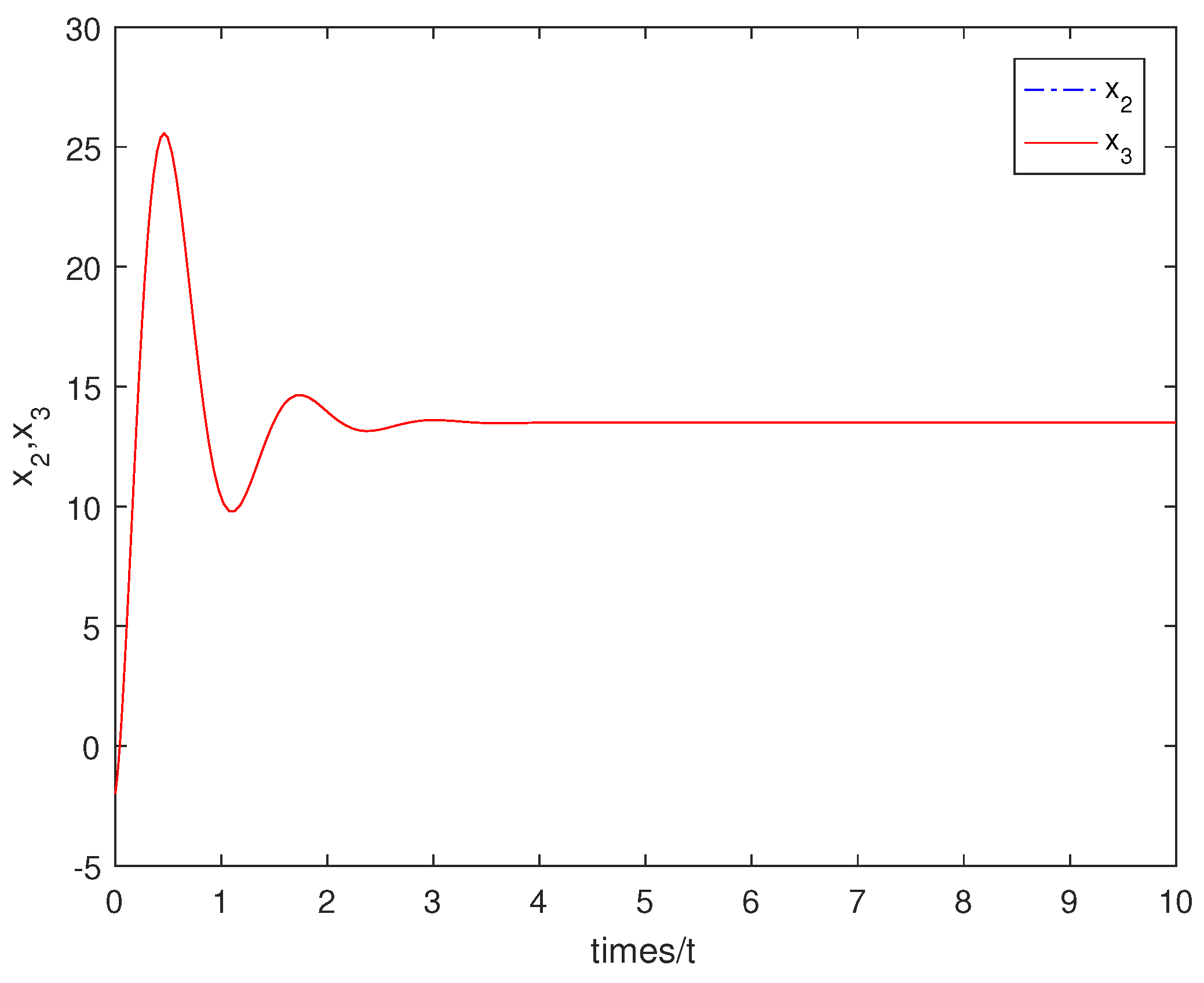
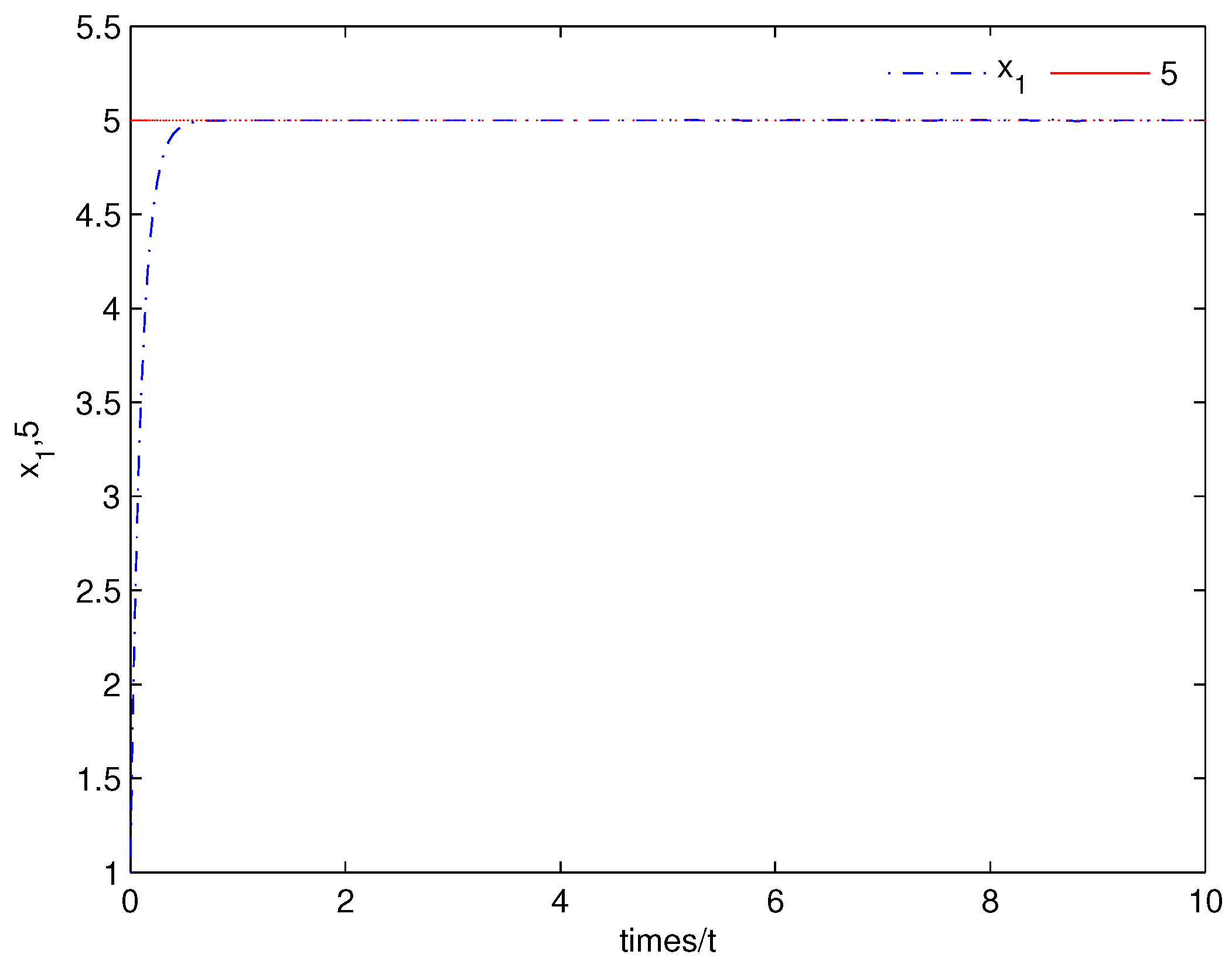
In the next, with initial conditions: =, numerical simulation is made. The simulation result is shown by the following figure. From Figure 1, we can see that tends to the given command quickly. Figure 2 shows the state of the system (15) converges to a constant as .
Figure 1.
Shows that the state of the system (15) converges to as .
Figure 2.
Shows the state of the system (15) converges to a constant as .
Example 2.
The Chen-Lee chaotic system [23]:
Let , then the controlled Chen-Lee chaotic system is expressed as follows:
where ,
and
The objective is to design a controller which can ensure the following performance:
where is the given command.
The first step is to design the reference system. For the matrix , one feasible choice of the feedback gain is obtained as follows:
Then, the reference system which is described as follows:
where .
The second step is to design the controller . According to the Equation (12), the controller is designed as follows:
Therefore, the system (22) and the reference system (26) is synchronized, and thus asymptotically tracks the command .
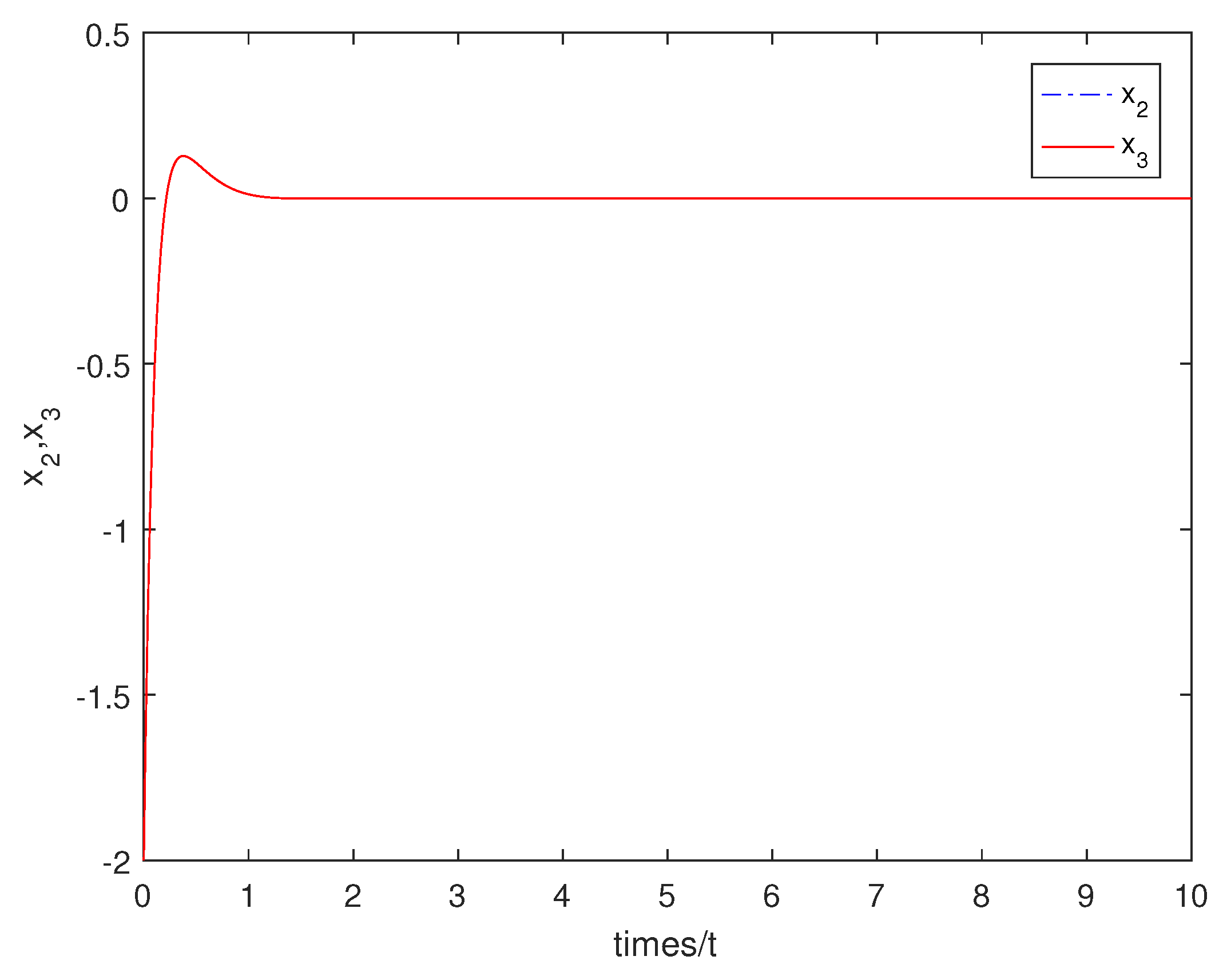
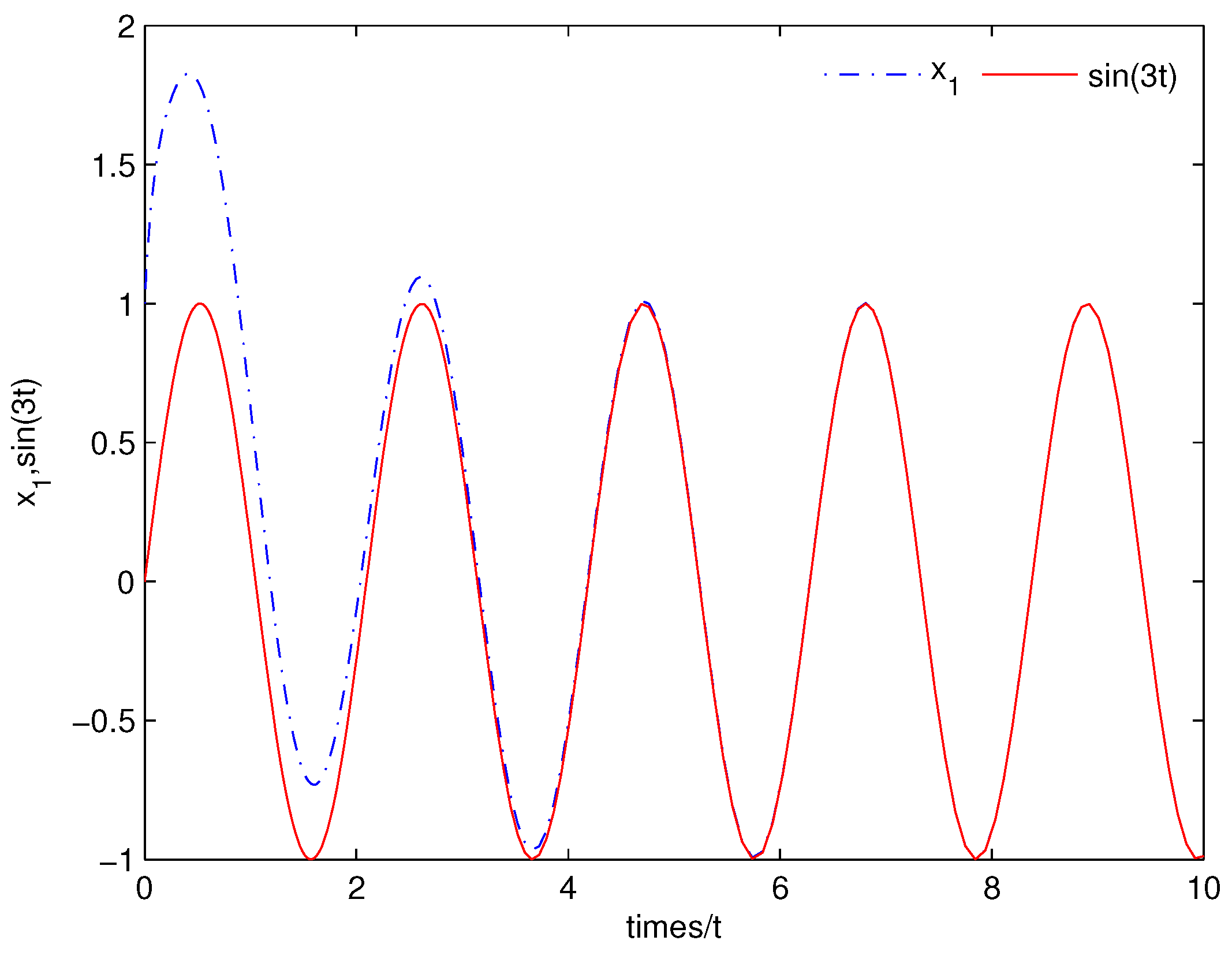
In the next, with initial conditions: = , numerical simulation is made. The simulation result is shown by the following figure. From Figure 3, we can see that tends to the given command quickly. Figure 4 shows the state of the system (22) converges to a constant as .
Figure 3.
Shows the state of the system (22) converges to as .
Figure 4.
Shows the state of the system (22) converges to a constant as .
Example 3.
Consider the following 4D hyper-chaotic system [24]:
The objective is to design a controller which can ensure the following performance:
where the given command is given as
The first step is to design the reference system. For the matrix , one feasible choice of the feedback gain is designed as
Then, the reference system which is described as
where and
The second step is to design the controller . According to the Equation (12), the control law is obtained as
Thus, the system (29) and the reference system (34) is synchronized, and thus asymptotically tracks the command .
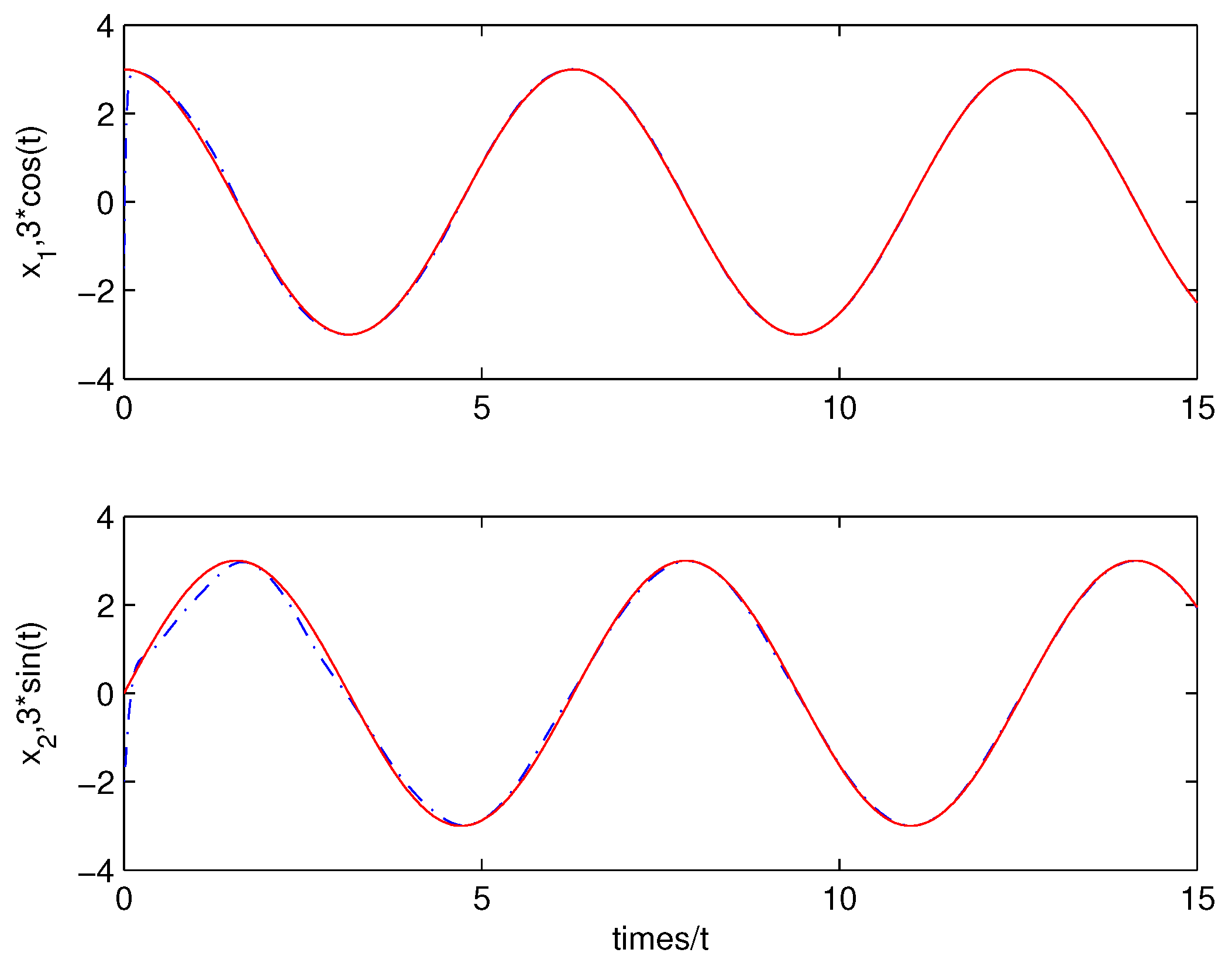
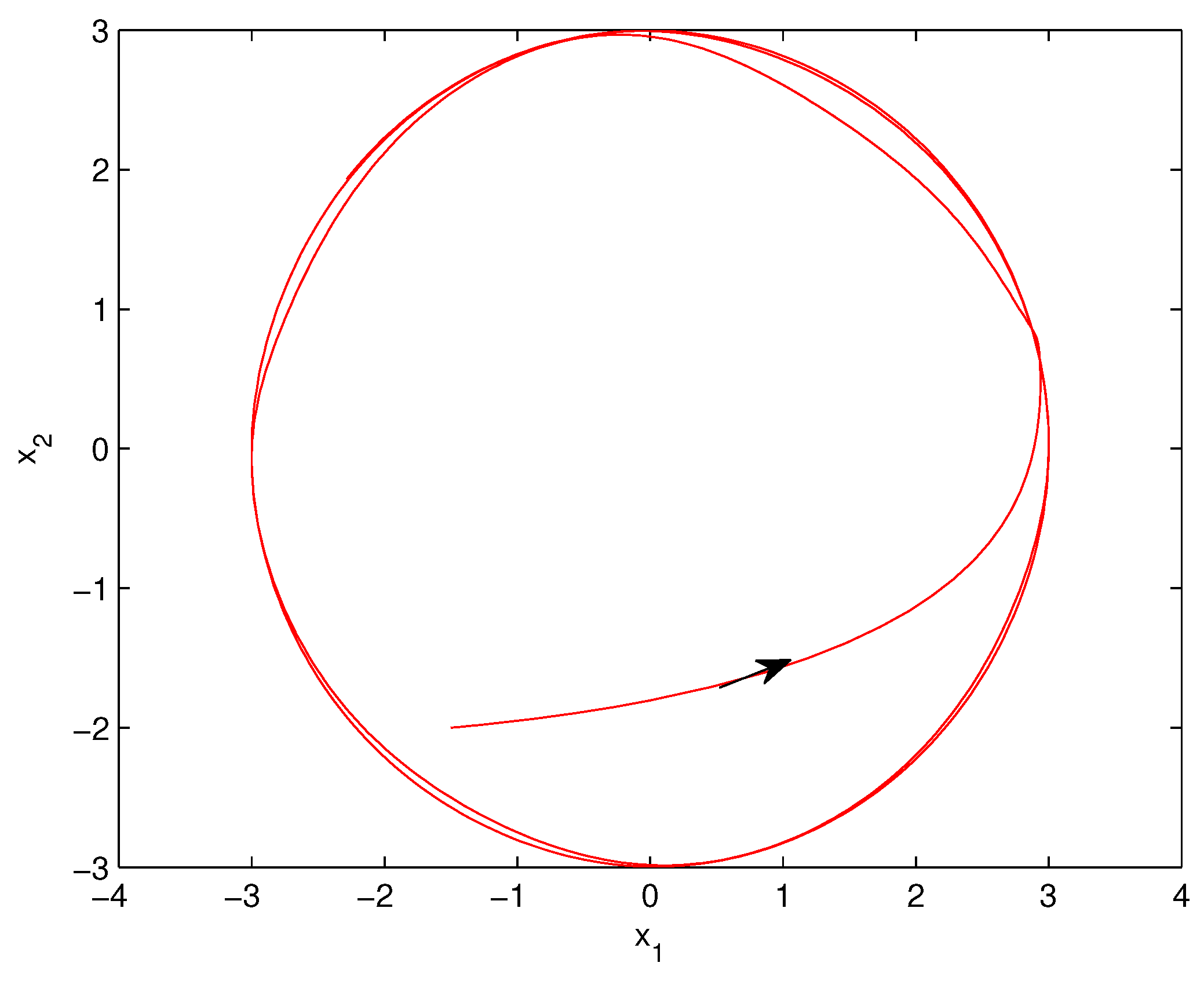
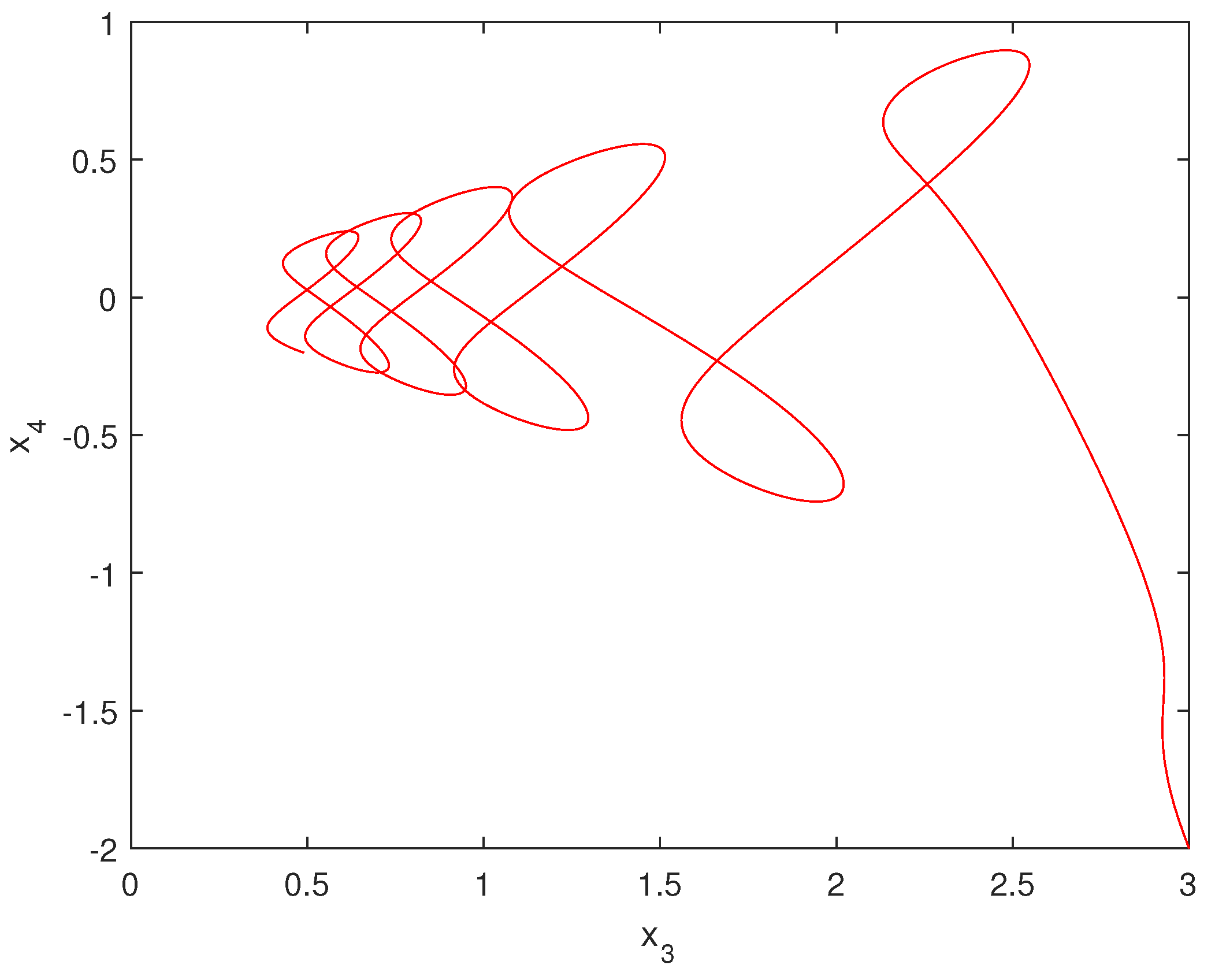
In the next, with initial conditions: =, numerical simulation is carried out. The simulation result is shown by the following two figures. From Figure 3, we can see that the states of the system (22) converges to the given command quickly. From Figure 5, it can be seen that phase portrait of the states of the system (29) converges to a circle with radius 3 quickly. Figure 6 shows phase portrait of the states of the system (29) converges to a circle with radius 3 as . Figure 7 shows phase portrait of the states of the system (29).
Figure 5.
Shows the states of the system (22) converges to as .
Figure 6.
Shows phase portrait of the states of the system (29) converges to a circle with radius 3 as .
Figure 7.
Shows phase portrait of the states of the system (29).
5. Conclusions
The asymptotic tracking control problem of the arbitrary dimensional chaotic system has been studied in this paper. Firstly, a reference system has been presented, the output of which can asymptotically track a given command. Secondly, a both physically implementable and simple controller has been designed to ensure that the given chaotic system synchronizes the reference system, and thus the output of the given chaotic system can asymptotically track the given command. It is noted that the output of the given chaotic system can asymptotically track the arbitrary desired periodic orbit. Finally, three numerical examples have been used to show how to apply and demonstrate the validity and effectiveness of the obtained results.
Author Contributions
The first and second author of this paper deal with the numerical simulation, the third author deduces the main results, and the last author and writes this paper.
Funding
This work is supported by Shandong Natural Science Foundation [ZR2018MF016] and National Natural Science Foundation of China [61877062].
Acknowledgments
The authors would like to thank the anonymous Reviewers and the Editors for their constructive comments and suggestions, which have helped enhance the presentation of this paper.
Conflicts of Interest
The authors declare no conflict of interest. The funders had no role in the design of the study; in the collection, analyses, or interpretation of data; in the writing of the manuscript, or in the decision to publish the results.
References
- Ott, E.; Gerbogi, C.; Yorke, J.A. Controlling Chaos. Phys. Rev. Lett. 1990, 64, 1196–1199. [Google Scholar] [CrossRef]
- Pecora, L.; Carroll, T. Synchronization in Chaotic Systems. Phys. Rev. Lett. 1990, 64, 821–824. [Google Scholar] [CrossRef]
- Rosenblum, M.G.; Pikovsky, A.S.; Kurths, J. Phase synchronization of chaotic oscillators. Phys. Rev. Lett. 1996, 76, 1804–1807. [Google Scholar] [CrossRef] [PubMed]
- Rosenblum, M.G.; Pikovsky, A.S.; Kurths, J. From phase to lag synchronization in coupled chaotic oscillators. Phys. Rev. Lett. 1997, 78, 4193–4196. [Google Scholar] [CrossRef]
- Hu, J.; Chen, S.; Chen, L. Adaptive control for anti-synchronization of Chua’s chaotic system. Phys. Lett. A 2005, 339, 455–460. [Google Scholar] [CrossRef]
- Mainieri, R.; Rehacek, J. Projective synchronization in three-dimensional chaotic systems. Phys. Rev. Lett. 1999, 82, 3042–3045. [Google Scholar] [CrossRef]
- Ren, L.; Guo, R.W.; Vincent, U.E. Coexistence of synchronization and anti-synchronization in chaotic systems. Arch. Control Sci. 2016, 26, 69–79. [Google Scholar] [CrossRef]
- Guo, R.W. Simultaneous synchronization and anti-synchronization of two identical new 4D chaotic systems. Chin. Phys. Lett. 2011, 28, 040205. [Google Scholar] [CrossRef]
- Guo, R. A simple adaptive controller for chaos and hyperchaos synchronization. Phys. Lett. A 2008, 372, 5593–5597. [Google Scholar] [CrossRef]
- Yu, W.G. Stabilization of three-dimensional chaotic systems via single state feedback controller. Phys. Lett. A 2010, 374, 1488–1492. [Google Scholar] [CrossRef]
- Wang, Z.F.; Shi, X.R. Anti-synchronization of liu system and Lorenz system with known and unknown parameters. Nonlinear Dyn. 2009, 57, 425–430. [Google Scholar] [CrossRef]
- Al-mahbashi, G.; Md Noorani, M.S.; Bakar, S.A. Projective lag synchronization in drive-response dynamical networks with delay coupling via hybrid feedback control. Nonlinear Dyn. 2015, 82, 1569–1579. [Google Scholar] [CrossRef]
- Du, H.Y.; Shi, P. A new robust adaptive control method for modified function projective synchronization with unknown bounded parametric uncertainties and external disturbances. Nonlinear Dyn. 2016, 85, 355–363. [Google Scholar] [CrossRef]
- Liu, L.X.; Guo, R.W. Control problems of Chen-Lee system by adaptive control method. Nonlinear Dyn. 2017, 87, 503–510. [Google Scholar] [CrossRef]
- Guo, R.W. Projective synchronization of a class of chaotic systems by dynamic feedback control method. Nonlinear Dyn. 2017, 90, 53–64. [Google Scholar] [CrossRef]
- Selmic, R.R.; Lewis, F.L. Deadzone compensation in motion control systems using neural networks. IEEE Trans. Autom. Control 2000, 45, 602–613. [Google Scholar] [CrossRef]
- Selmic, R.R.; Lewis, F.L. Neural net backlash compensation with Hebbian tuning using dynamic inversion. Automatica 2001, 37, 1269–1277. [Google Scholar] [CrossRef]
- Zhou, J.; Zhang, C.; Wen, C. Robust adaptive output control of uncertain nonlinear plants with unknown backlash nonlinearity. IEEE Trans. Autom. Control 2007, 52, 503–509. [Google Scholar] [CrossRef]
- Yu, D.C.; Wu, A.G.; Yang, C.P. A novel sliding mode nonlinear proportional-integral control scheme for controlling chaos. Chin. Phys. 2005, 14, 914–921. [Google Scholar]
- Yu, D.C.; Wu, A.G.; Wang, D.Q. A simple asymptotic trajectory control of full states of a unified chaotic system. Chin. Phys. 2006, 15, 306–309. [Google Scholar]
- Bazhenov, V.A.; Pogorelova, O.S.; Postnikova, T.G. Intermittent transition to chaos in vibroimpact system. Appl. Math. Nonlinear Sci. 2018, 3, 475–486. [Google Scholar] [CrossRef]
- Lorenz, E.N. Deterministic nonperiodic flow. J. Atmos. Sci. 1963, 20, 130–141. [Google Scholar] [CrossRef]
- Tam, L.M.; Si Tou, W.M. Parametric study of the fractional order Chen-Lee system. Chaos Solitons Fractals 2008, 37, 817–826. [Google Scholar] [CrossRef]
- Qi, G.Y.; Du, S.Z.; Chen, G.R.; Chen, Z.Q.; Yuan, Z.Z. On a four-dimensional chaotic system. Chaos Solitons Fractals 2005, 23, 1671–1682. [Google Scholar] [CrossRef]
© 2019 by the authors. Licensee MDPI, Basel, Switzerland. This article is an open access article distributed under the terms and conditions of the Creative Commons Attribution (CC BY) license (http://creativecommons.org/licenses/by/4.0/).