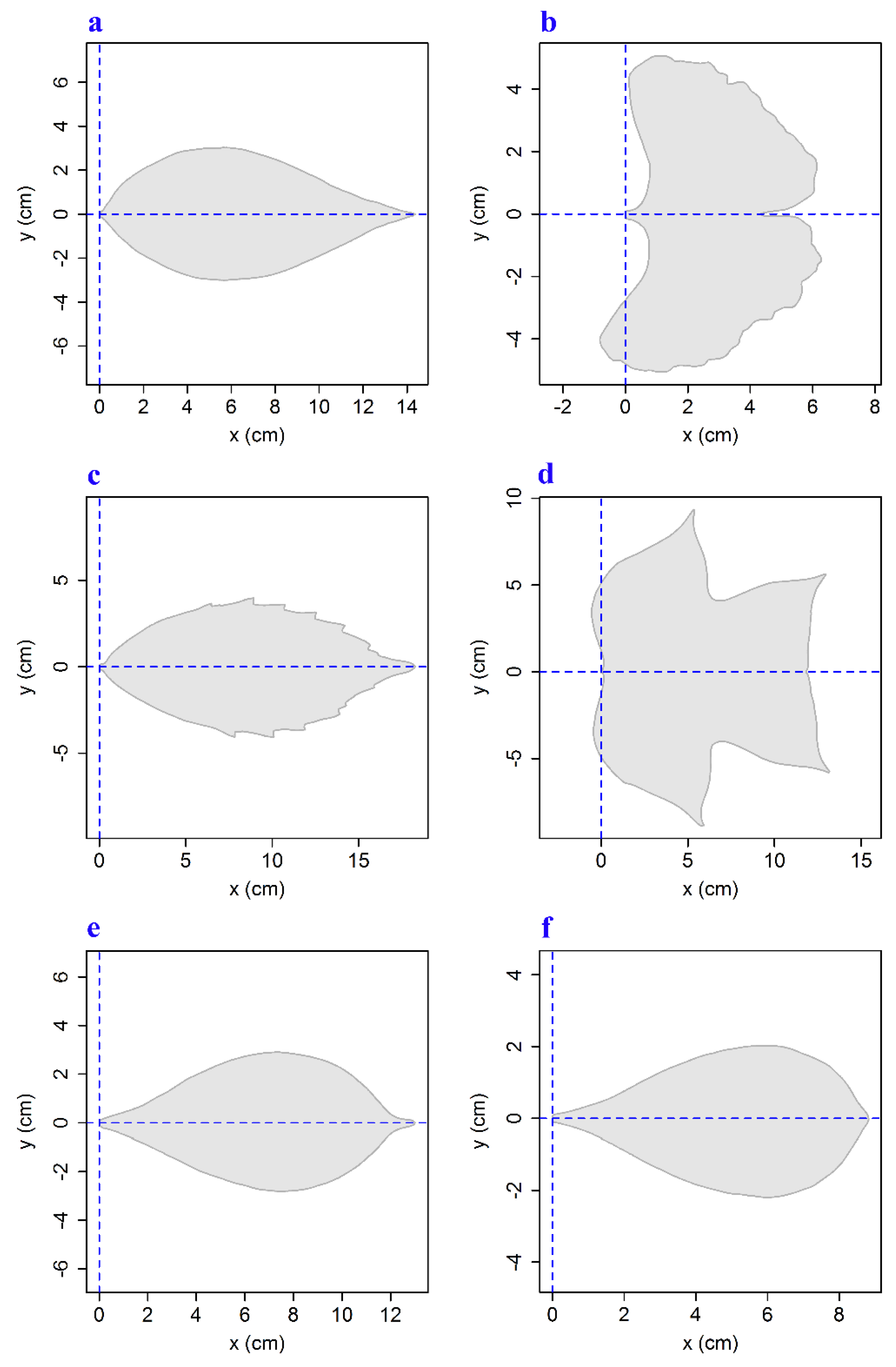

A Simple Method for Measuring the Bilateral Symmetry of Leaves



Abstract
1. Introduction
2. Materials and Methods
2.1. Materials
2.2. Methods
3. Results and Discussion
4. Conclusions
Supplementary Materials
Acknowledgments
Author Contributions
Conflicts of Interest
References
- Thompson, D.W. On Growth and Form; Cambridge University Press: London, UK, 1917. [Google Scholar]
- Van Valen, L. A study of fluctuating asymmetry. Evolution 1961, 16, 125–142. [Google Scholar] [CrossRef] [Scilit]
- Palmer, A.R.; Strobeck, C. Fluctuating asymmetry: Measurement, analysis, patterns. Ann. Rev. Ecol. Syst. 1986, 17, 391–421. [Google Scholar] [CrossRef]
- Fischer, C.; Neuhaus, G. Influence of auxin on the establishment of bilateral symmetry in monocots. Plant J. 1996, 9, 659–669. [Google Scholar] [CrossRef] [Scilit]
- Mardia, K.V.; Bookstein, F.L.; Moreton, I.J. Statistical assessment of bilateral symmetry of shapes. Biometrika 2000, 87, 285–300. [Google Scholar] [CrossRef] [Scilit]
- Klingenberg, C.P.; Barluenga, M.; Meyer, A. Shape analysis of symmetric structures: quantifying variation among individuals and asymmetry. Evolution 2002, 56, 1909–1920. [Google Scholar] [CrossRef] [Scilit] [PubMed]
- Klingenberg, C.P. Analyzing fluctuating asymmetry with geometric morphometrics: Concepts, methods, and applications. Symmetry 2015, 7, 843–934. [Google Scholar] [CrossRef] [Scilit]
- Gielis, J. The Geometrical Beauty of Plants; Atlantis Press: Paris, France, 2017. [Google Scholar] [CrossRef] [Scilit]
- Tucić, B.; Budečević, S.; Jovanović, S.M.; Vuleta, A.; Klingenberg, C.P. Phenotypic plasticity in response to environmental heterogeneity contributes to fluctuating asymmetry in plants: first empirical evidence. J. Evol. Biol. 2018, 31, 197–210. [Google Scholar] [CrossRef] [Scilit] [PubMed]
- Nicotra, A.B.; Cosgrove, M.J.; Cowling, A.; Schlichting, C.D.; Jones, C.S. Leaf shape linked to photosynthetic rates and temperature optima in South African Pelargonium species. Oecologia 2008, 154, 625–635. [Google Scholar] [CrossRef] [Scilit] [PubMed]
- Barabé, D.; Daigle, S.; Brouillet, L. On the interpretation of the asymmetrical leaf of Begonia by D’Arcy Thompson. Acta Biotheor. 1992, 40, 329–332. [Google Scholar] [CrossRef] [Scilit]
- Shi, P.J.; Huang, J.G.; Hui, C.; Grissino-Mayer, H.D.; Tardif, J.; Zhai, L.H.; Wang, F.S.; Li, B.L. Capturing spiral radial growth of conifers using the superellipse to model tree-ring geometric shape. Front. Plant Sci. 2015, 6, 856. [Google Scholar] [CrossRef] [Scilit] [PubMed]
- Wright, I.J.; Dong, N.; Maire, V.; Prentice, C.; Westoby, M.; Díaz, S.; Gallagher, R.V.; Jacobs, B.F.; Kooyman, R.; Law, E.A.; et al. Global climatic derivers of leaf size. Science 2017, 357, 917–921. [Google Scholar] [CrossRef] [Scilit] [PubMed]
- R Core Team. R: A Language and Environment for Statistical Computing. Vienna, Austria: R Foundation for Statistical Computing. 2015. Available online: https://www.R-project.org/ (accessed on 17 April 2018).
- Baddeley, A.; Rubak, E.; Turner, R. Spatial Point Patterns: Methodology and Applications with R; Chapman and Hall/CRC Press: London, UK, 2015. [Google Scholar]
- De Mendiburu, F. Agricolae: Statistical Procedures for Agricultural Research. R Package Version 1.2-4. Available online: https://CRAN.R-project.org/package=agricolae (accessed on 17 April 2018).
- Lin, S.; Zhang, L.; Reddy, G.V.P.; Hui, C.; Gielis, J.; Ding, Y.; Shi, P. A geometrical model for testing bilateral symmetry of bamboo leaf with a simplified Gielis equation. Ecol. Evol. 2016, 6, 6798–6806. [Google Scholar] [CrossRef] [Scilit] [PubMed]
- Milla, R.; Reich, P.B. The scaling of leaf area and mass: The cost of light interception increases with leaf size. Proc. R. Soc. Lond. B Biol. Sci. 2007, 274, 2109–2114. [Google Scholar] [CrossRef] [Scilit] [PubMed]
- Lin, S.; Shao, L.; Hui, C.; Song, Y.; Reddy, G.V.P.; Gielis, J.; Li, F.; Ding, Y.; Wei, Q.; Shi, P. Why does not the leaf weight-area allometry of bamboos follow the 3/2-power law? Fron. Plant Sci. 2018, in press. [Google Scholar] [CrossRef] [Scilit]
- Oren, R.; Schulze, E.-D.; Matyssek, R.; Zimmermann, R. Estimating photosynthetic rate and annual carbon gain in conifer from specific leaf weight and leaf biomass. Oecologia 1986, 70, 187–193. [Google Scholar] [CrossRef] [Scilit] [PubMed]
- Niinemets, Ü.; Kull, K. Leaf weight per area and leaf size of 85 Estonian woody species in relation to shade tolerance and light availability. For. Ecol. Manag. 1994, 70, 1–10. [Google Scholar] [CrossRef] [Scilit]
- Smith, W.K.; Vogelmann, T.C.; DeLucia, E.H.; Bell, D.T.; Shepherd, K.A. Leaf form and photosynthesis: Do leaf structure and orientation interact to regulate internal light and carbon dioxide? BioScience 1997, 47, 785–793. [Google Scholar] [CrossRef] [Scilit]
- Semiarti, E.; Ueno, Y.; Tsukaya, H.; Iwakawa, H.; Machida, C.; Machida, Y. The ASYMMETRIC LEAVES2 gene of Arabidopsis thaliana regulates formation of a symmetric lamina, establishment of venation and repression of meristem-related homeobox genes in leaves. Development 2001, 128, 1771–1783. [Google Scholar]
- Sandhu, H.S.; Shi, P.; Kuang, X.; Xue, F.; Ge, F. Applications of the bootstrap to insect physiology. Fla. Entomol. 2011, 94, 1036–1041. [Google Scholar] [CrossRef] [Scilit]
- Taylor, L.R. Aggregation, variance and the mean. Nature 1961, 189, 732–735. [Google Scholar] [CrossRef] [Scilit]
- Cohen, J.E.; Xu, M. Random sampling of skewed distributions implies Taylor’s power law of fluctuation scaling. Proc. Natl. Acad. Sci. USA 2015, 112, 7749–7754. [Google Scholar] [CrossRef] [Scilit] [PubMed]
- Cohen, J.E.; Lai, J.; Coomes, D.A.; Allen, R.B. Taylor’s law and related allometric power laws in New Zealand mountain beech forests: The roles of space, time and environment. Oikos 2016, 125, 1342–1357. [Google Scholar] [CrossRef] [Scilit]
- Shi, P.J.; Sandhu, H.S.; Reddy, G.V.P. Dispersal distance determines the exponent of the spatial Taylor’s power law. Ecol. Model. 2016, 335, 48–53. [Google Scholar] [CrossRef] [Scilit]
- Cheng, L.; Hui, C.; Reddy, G.V.P.; Ding, Y.-L.; Shi, P.-J. Internode morphometrics and allometry of Tonkin Cane Pseudosasa amabilis McClure. Front. Ecol. Evol. 2017, 7, 9651–9660. [Google Scholar] [CrossRef] [Scilit] [PubMed]
- Valladares, F.; Brites, D. Leaf phyllotaxis: Does it really affect light capture? Plant Ecol. 2004, 174, 11–17. [Google Scholar] [CrossRef] [Scilit]
- Jurik, T.W. Temporal and spatial patterns of specific leaf weight in successional northern hardwood trees species. Am. J. Bot. 1986, 73, 1083–1092. [Google Scholar] [CrossRef] [Scilit]
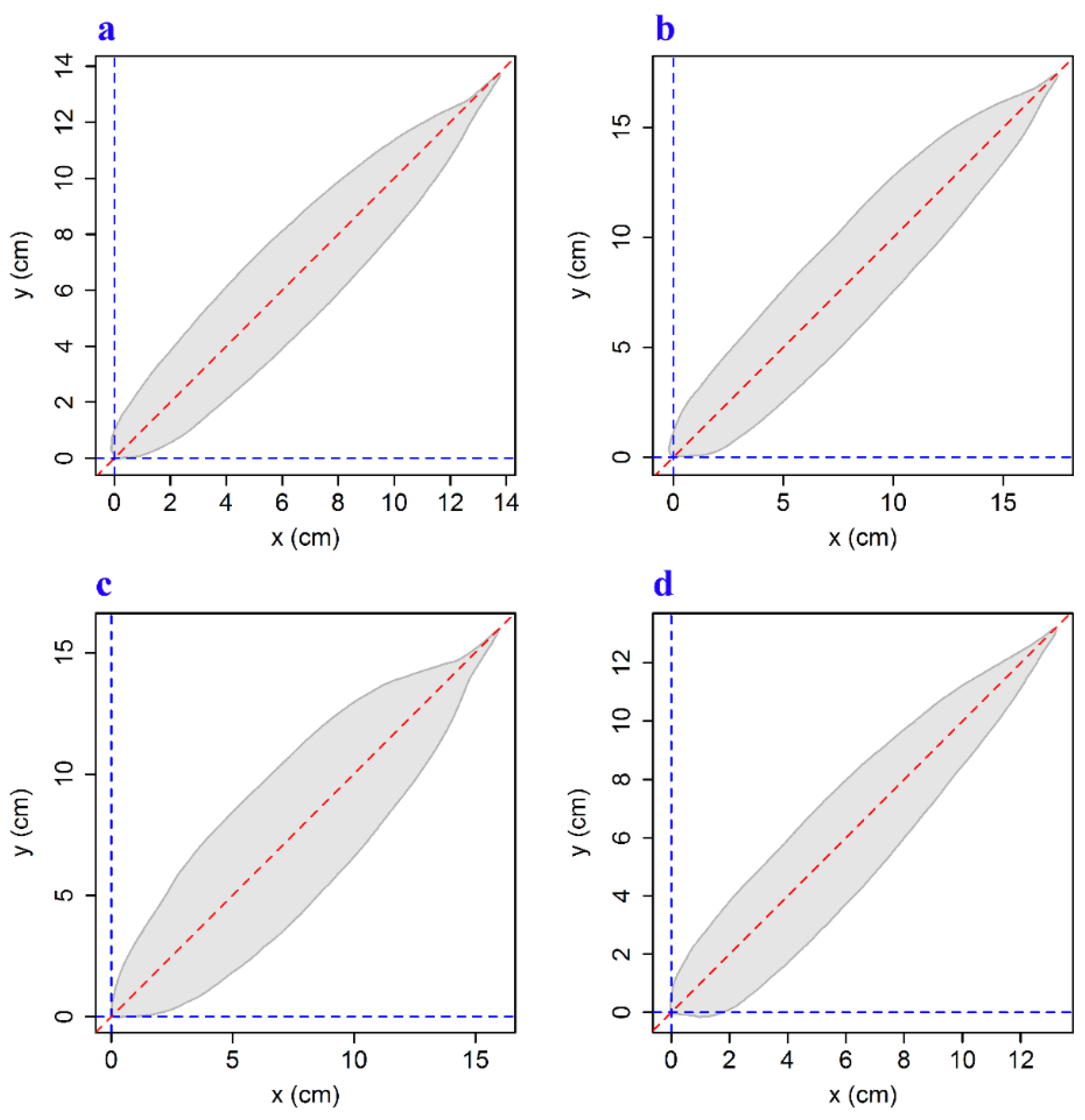

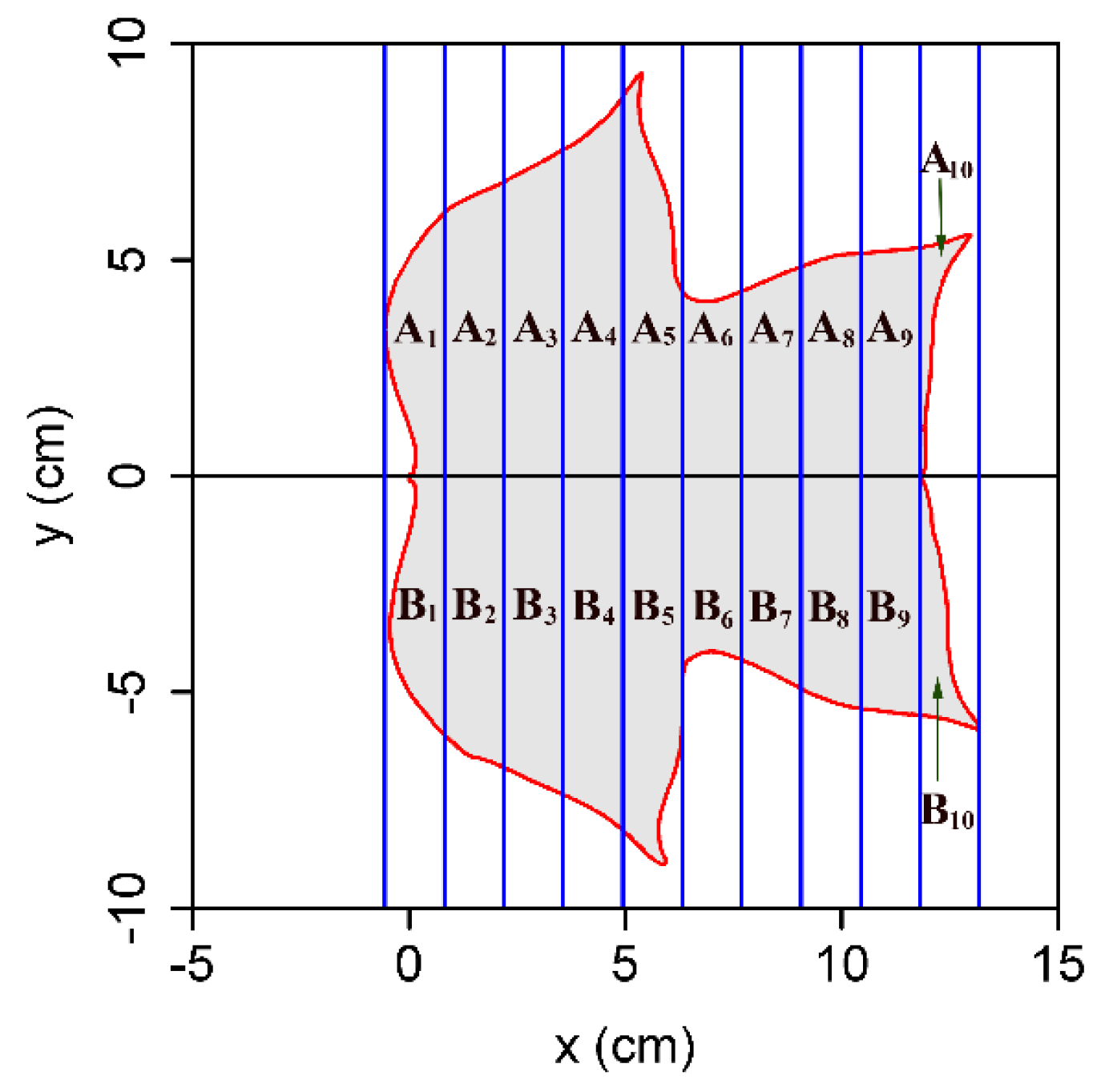
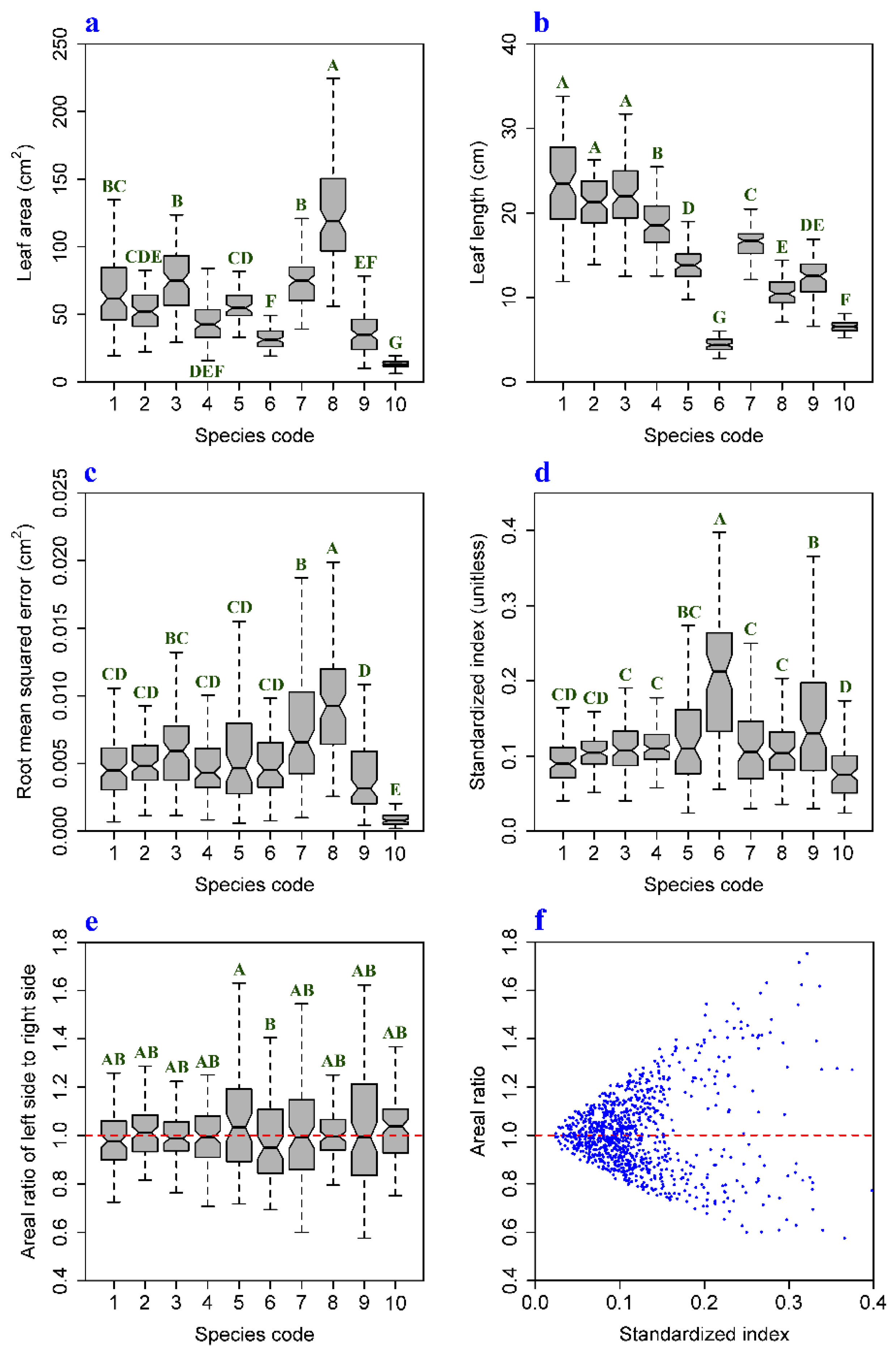

| Species Code | Latin Name | Family | Leaves | Sampling Time |
|---|---|---|---|---|
| 1 | Indocalamus pedalis (Keng) P. C. Keng | Poaceae | 100 | early July 2014 |
| 2 | Indocalamus barbatus McClure | Poaceae | 100 | early July 2014 |
| 3 | Indocalamus victorialis P. C. Keng | Poaceae | 100 | early July 2014 |
| 4 | Indocalamus pumilus Q. H. Dai et C. F. Keng | Poaceae | 100 | early July 2014 |
| 5 | Chimonanthus praecox (Linn.) Link | Calycanthaceae | 72 | 20 October 2017 |
| 6 | Ginkgo biloba L. | Ginkgoaceae | 84 | 20 October 2017 |
| 7 | Aucuba japonica Thunb. var. variegata D’ombr. | Cornaceae | 100 | 20 October 2017 |
| 8 | Liriodendron tulipifera L. | Magnoliaceae | 100 | 11 October 2017 |
| 9 | Phoebe sheareri (Hemsl.) Gamble | Lauraceae | 100 | 26 October 2017 |
| 10 | Pittosporum tobira (Thunb.) Ait. | Pittosporaceae | 100 | 27 October 2017 |
| Species | r (RMSE 1, LA 2) | r (SI 3, LA) | r (AR 4, LA) | CVRMSE | CVSI | CVAR |
|---|---|---|---|---|---|---|
| 1 | 0.686 (p < 0.01) | 0.013 (p > 0.05) | −0.182 (p > 0.05) | 52.3% | 37.2% | 12.1% |
| 2 | 0.786 (p < 0.01) | 0.192 (p > 0.05) | −0.025 (p > 0.05) | 40.2% | 21.8% | 9.9% |
| 3 | 0.500 (p < 0.01) | −0.21 (p = 0.036) | −0.139 (p > 0.05) | 50.4% | 35.8% | 10.7% |
| 4 | 0.753 (p < 0.01) | 0.132 (p > 0.05) | 0.172 (p > 0.05) | 43.4% | 24.1% | 12.0% |
| 5 | 0.263 (p < 0.05) | −0.071 (p > 0.05) | −0.053 (p > 0.05) | 65.2% | 54.2% | 20.9% |
| 6 | 0.467 (p < 0.01) | 0.119 (p > 0.05) | −0.160 (p > 0.05) | 47.7% | 42.4% | 17.2% |
| 7 | 0.345 (p < 0.01) | −0.048 (p > 0.05) | 0.041 (p > 0.05) | 59.8% | 51.4% | 21.3% |
| 8 | 0.545 (p < 0.01) | −0.101 (p > 0.05) | −0.008 (p > 0.05) | 48.2% | 42.4% | 10.9% |
| 9 | 0.472 (p < 0.01) | −0.143 (p > 0.05) | −0.090 (p > 0.05) | 69.5% | 54.3% | 24.7% |
| 10 | 0.290 (p < 0.01) | −0.027 (p > 0.05) | −0.008 (p > 0.05) | 55.6% | 46.5% | 12.6% |
© 2018 by the authors. Licensee MDPI, Basel, Switzerland. This article is an open access article distributed under the terms and conditions of the Creative Commons Attribution (CC BY) license (http://creativecommons.org/licenses/by/4.0/).
Share and Cite
Shi, P.; Zheng, X.; Ratkowsky, D.A.; Li, Y.; Wang, P.; Cheng, L. A Simple Method for Measuring the Bilateral Symmetry of Leaves. Symmetry 2018, 10, 118. https://doi.org/10.3390/sym10040118
Shi P, Zheng X, Ratkowsky DA, Li Y, Wang P, Cheng L. A Simple Method for Measuring the Bilateral Symmetry of Leaves. Symmetry. 2018; 10(4):118. https://doi.org/10.3390/sym10040118
Chicago/Turabian StyleShi, Peijian, Xiao Zheng, David A. Ratkowsky, Yang Li, Ping Wang, and Liang Cheng. 2018. "A Simple Method for Measuring the Bilateral Symmetry of Leaves" Symmetry 10, no. 4: 118. https://doi.org/10.3390/sym10040118
APA StyleShi, P., Zheng, X., Ratkowsky, D. A., Li, Y., Wang, P., & Cheng, L. (2018). A Simple Method for Measuring the Bilateral Symmetry of Leaves. Symmetry, 10(4), 118. https://doi.org/10.3390/sym10040118