Abstract
Topological indices are graph invariants computed by the distance or degree of vertices of the molecular graph. In chemical graph theory, topological indices have been successfully used in describing the structures and predicting certain physicochemical properties of chemical compounds. In this paper, we propose a definition of generalized bridge molecular graphs that can model more kinds of long chain polymerization products than the bridge molecular graphs, and provide some results of the edge versions of atom-bond connectivity () and geometric arithmetic () indices for some generalized bridge molecular graphs, which have regular, periodic and symmetrical structures. The results of this paper offer promising prospects in the applications for chemical and material engineering, especially in chemical industry research.
1. Introduction
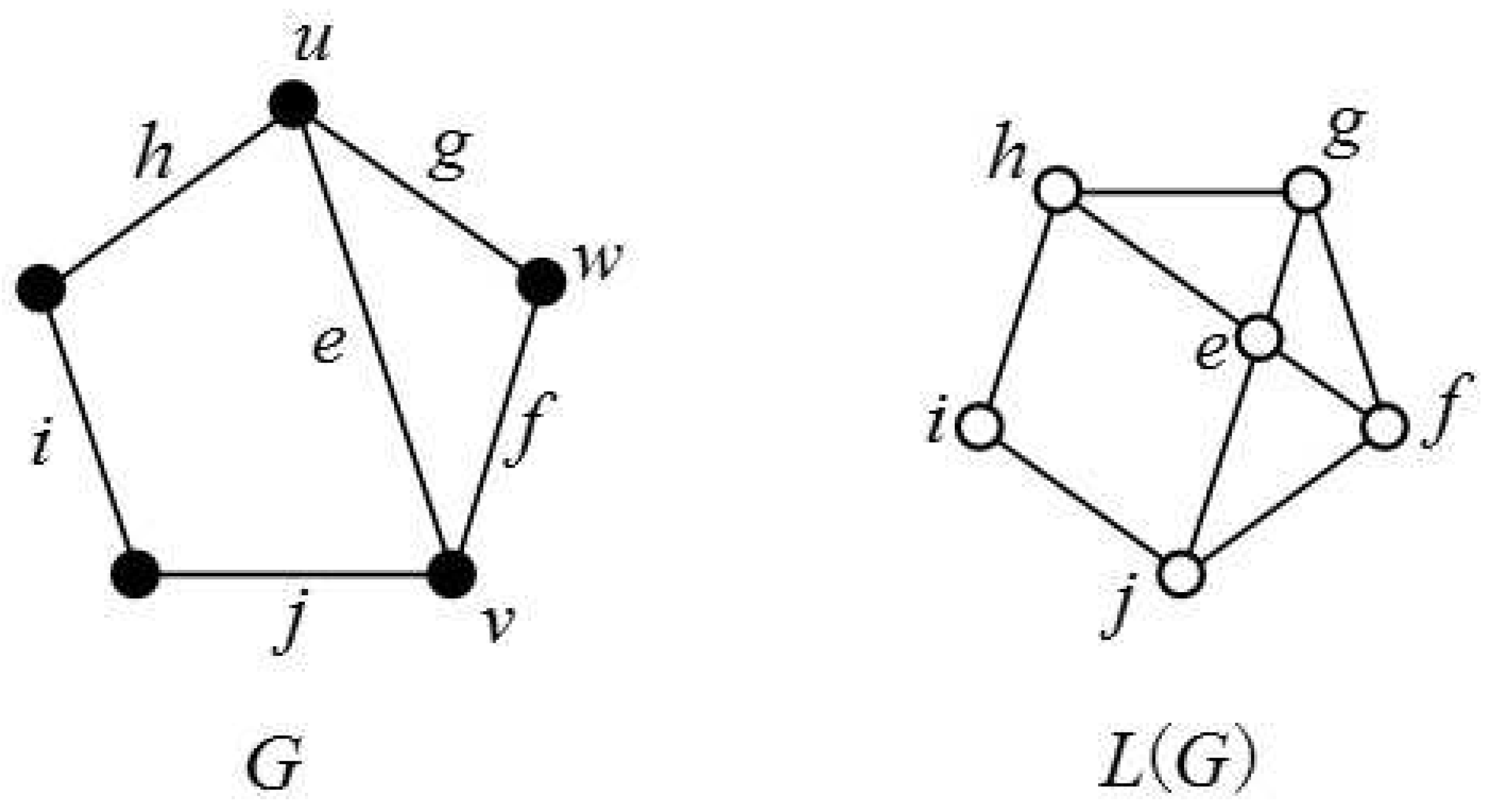
Let G be an undirected simple graph without loops or multiple edges. We denote by the vertex set of G and we denote by the edge set of G. We denote by the edge connect vertices u and v or vertices u and v adjacent. We denote by , , and the path, cycle, and star of n vertices, respectively. We denote by the open neighborhood of vertex v, i.e., . We denote by or the degree of a vertex v of a graph G, i.e., . Let or be a line graph of G, so each vertex of corresponds an edge of G. Two vertices of are adjacent if and only if a common endpoint is shared by their corresponding edges in G [1]. The degree of edge e in G is denoted by , which is the number of edges that share common endpoint with edge e in G; it is also the degree of vertex e in . We give simple a illustration to explain the relationship of original graph and corresponding line graph in Figure 1. We can see denote corresponding vertexes, and denote corresponding edges in original graph G and denote corresponding vertices in line graph . We get . , which is the degree of vertex e in , is also the degree of edge e in G, thus in Figure 1.
Figure 1.
The original graph G and corresponding line graph .
Topological indices are graph invariants, which are obtained by performing some numerical operations on the distance or degree of vertices of the molecular graph. In chemical graph theory, topological indices are the molecular descriptors. They have been successfully used in describing the structures and predicting certain physicochemical properties of chemical compounds. To study the relationship between molecular structure and physical properties of saturated hydrocarbons, Wiener index was first published in 1947 [2], and the edge version of Wiener index, which can be considered as the Wiener index of line graph of G, was proposed by Iranmanesh et al. in 2009 [3]. As the important role of topological indices in chemical research has been confirmed, more topological indices appeared, which include atom-bond connectivity index and geometric arithmetic index.
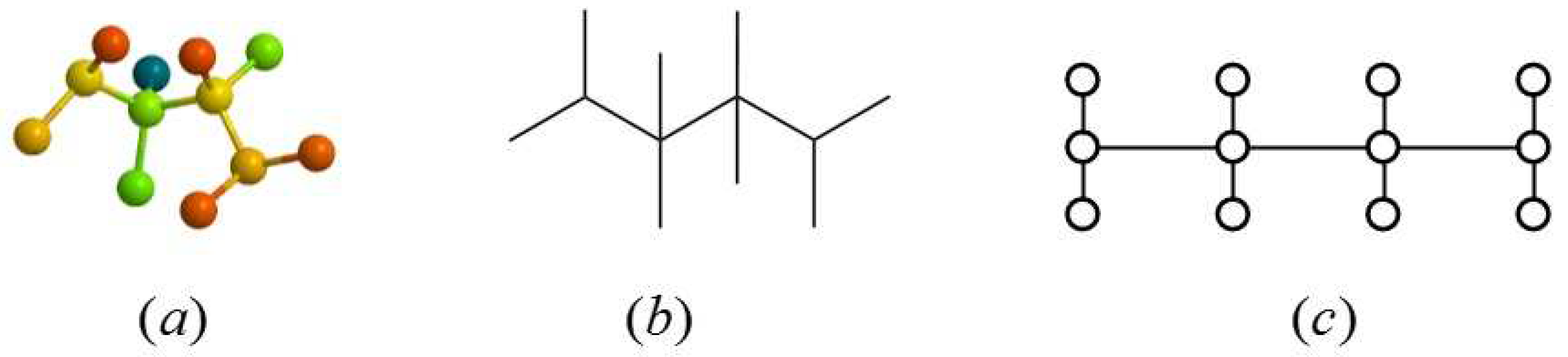
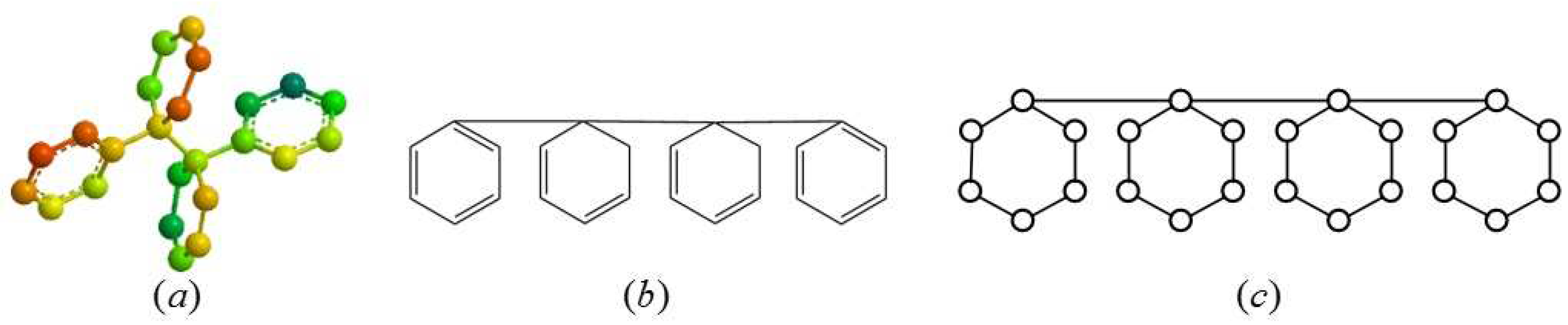
In chemical graph theory, hydrogen atoms are usually ignored when the topological indices are calculated, which is very similar to how organic chemists usually simply write a benzene ring as a hexagon [4]. Now, three types of graphs of are illustrated in Figure 2.
Figure 2.
(a) ball and stick model graph in ; (b) chemical structure graph; and (c) model graph in chemical graph theory.
To explore the properties of simple short chain compound products, Gao et al. [5] defined some join graphs such as , , , , and , created by , and and obtained the and indices of these graphs. In another paper, Gao et al. [6] defined the bridge molecular structures, which can be used to research some long chain polymerization products, and the forgotten indices () formulae of some simple bridge molecular structures constructed by , or are presented. The forgotten index is defined as [7]. In this paper, we define generalized bridge molecular graphs that could cover more kinds of long chain polymerization products, and the edge-version atom-bond connectivity and geometric arithmetic indices of generalized bridge molecular graphs are calculated.
To facilitate the reader, the topological indices discussed in this thesis are all given in Table 1.
Table 1.
The definition of topological indices.
In Table 1, and are the degrees of the vertices u and v in G, and and are the degrees of the edges and in G.
2. Main Results and Proofs
2.1. Definition of the Generalized Bridge Molecular Graph
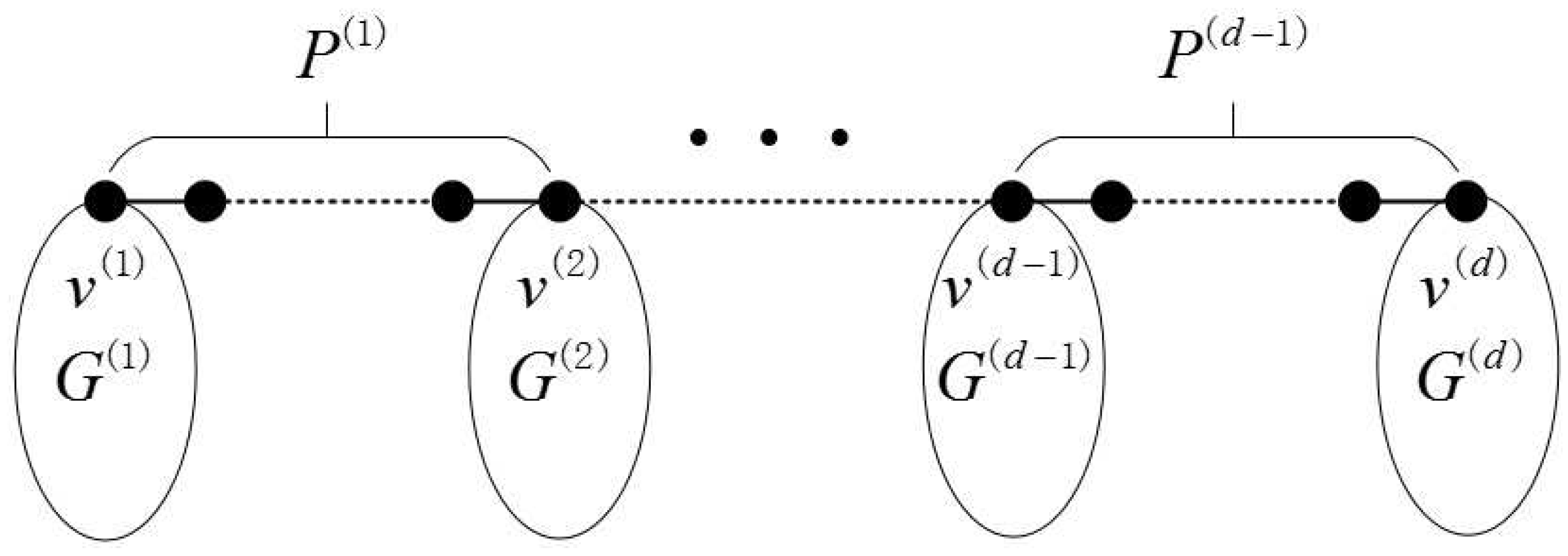
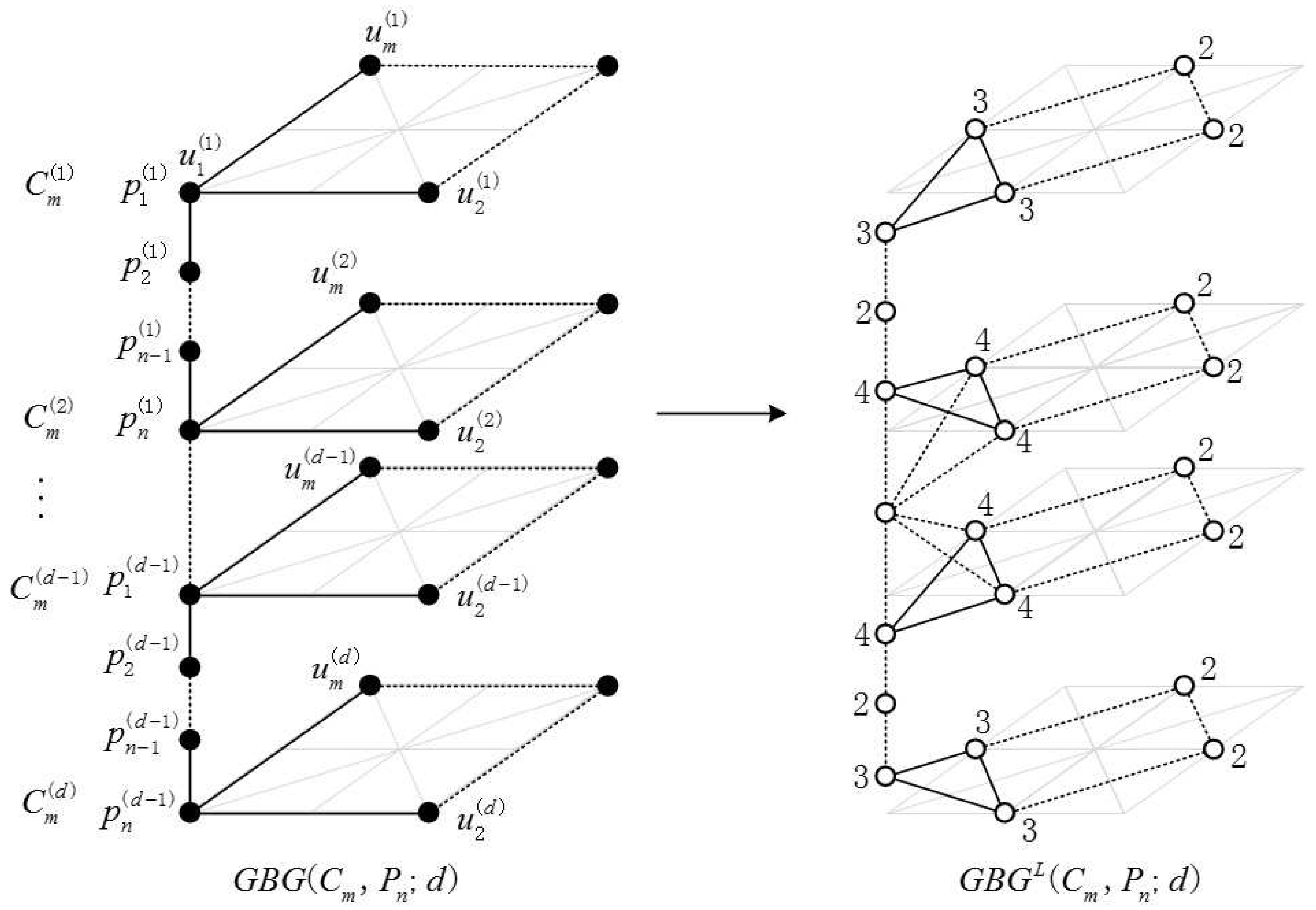
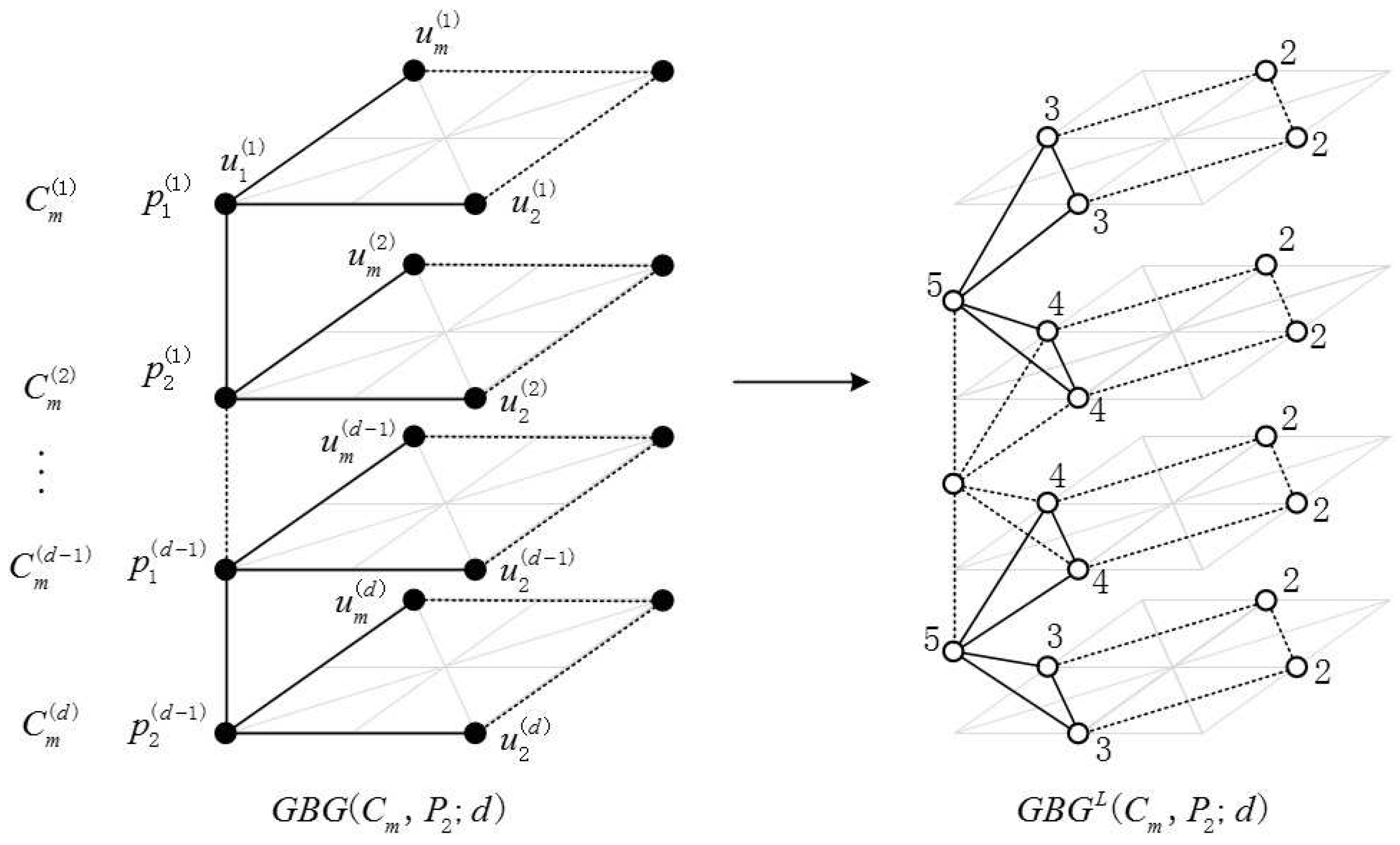
Before we start a discussion, we give the definition of the generalized bridge molecular graph as follows. For a positive integer d, d pairwise disjoint molecular graphs with for each , and pairwise disjoint path molecular graphs (called bridges), the generalized bridge molecular graph , , , , ⋯, , , , ⋯, is the graph obtained by connecting the vertices and by a path for which two end vertices are identified with and for (See Figure 3). When , , for each i, we simplify , , , , ⋯, , , , ⋯, to be . In this paper, if G is a star, then v is the central vertex and if G is a cycle, v is considered as any vertex. In such cases, we further simplify to be . The bridge molecular graph’s bridge is strictly in [6], which limits the scope of modeling objects. The generalized bridge molecular graphs can model more kinds of long chain polymerization products than the bridge molecular graphs, because the bridge can be either or and .
Figure 3.
The generalized bridge molecular graph .
2.2. Results and Discussion
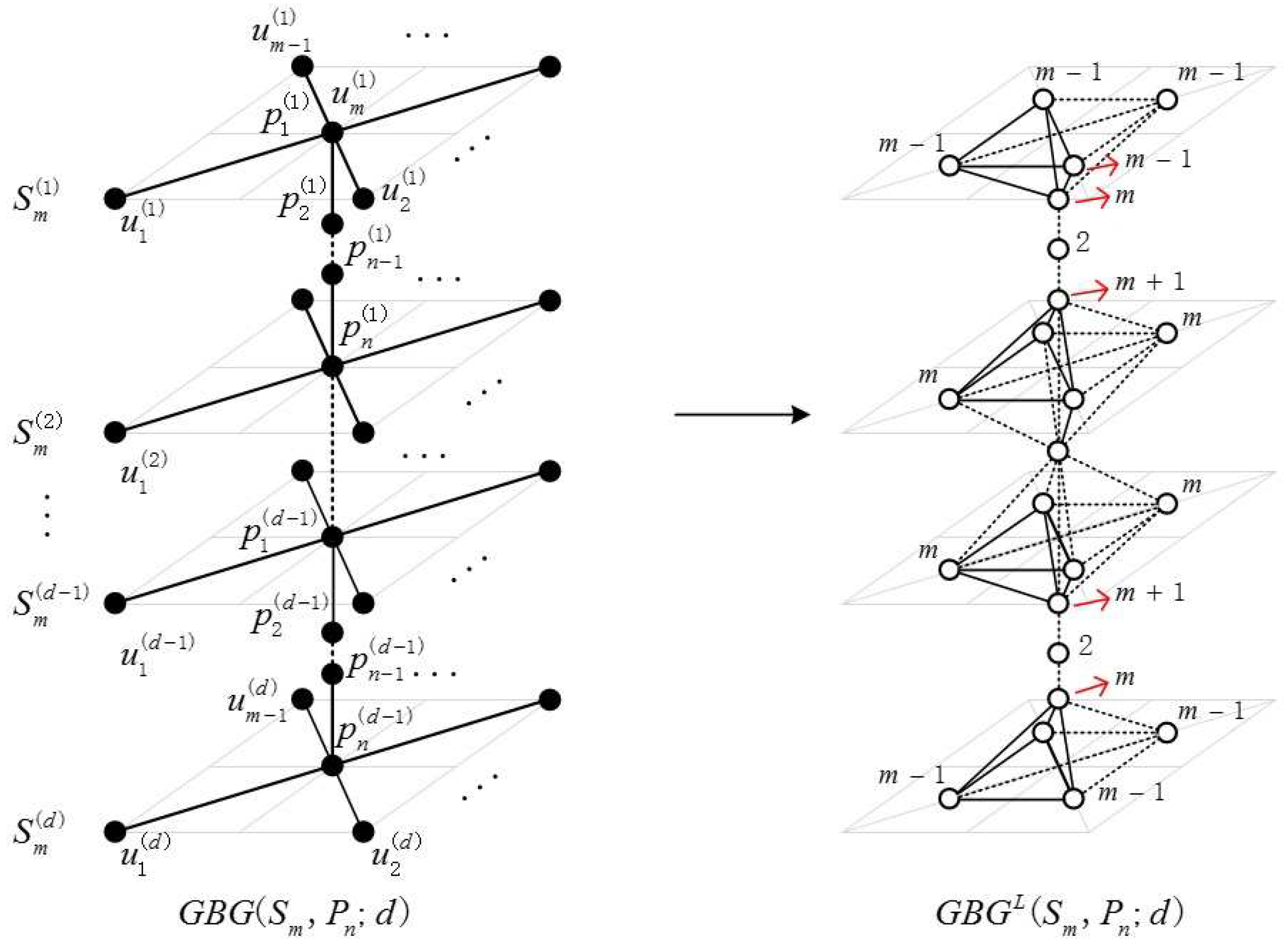
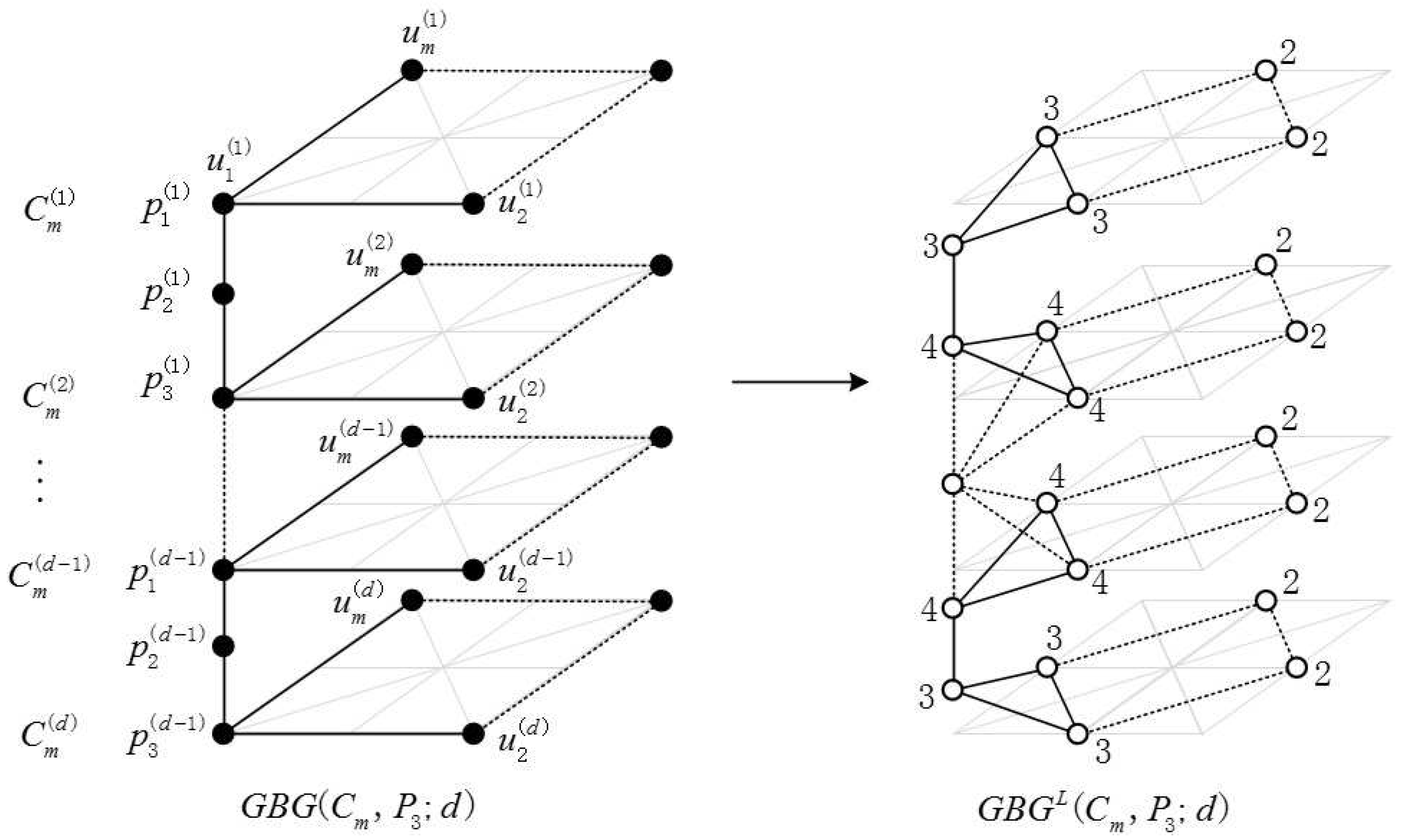
In the following, we discuss the edge-version atom-bond connectivity and geometric arithmetic indices of some generalized bridge molecular graph. The line graph of is illustrated in Figure 4.
Figure 4.
The generalized bridge molecular graph of and .
Theorem 1.
Proof.
This line graph has edges. If and are the degree of edge of and , then there are 2 edges of type , , edges of type , , edges of type , edges of type , edges of type , , edges of type , , edges of type , and edges of type . Hence, we get
The proof is complete. □
For Example 1, in Figure 5, can be modeled by , so and .
Figure 5.
(a) - ball and stick model graph in ; (b) - chemical structure graph; and (c) - model graph in chemical graph theory.
Theorem 2.
Figure 6.
The generalized bridge molecular graph of and .
Proof.
This line graph has edges. If and are the degree of edge of and , then there are 2 edges of type , , edges of type , , edges of type , , edges of type , , edges of type , and edges of type . Hence, we get
The proof is complete. □
For Example 2, in Figure 7, can be modeled by , so and .
Figure 7.
(a) - ball and stick model graph in ; (b) - chemical structure graph; and (c) - model graph in chemical graph theory.
Theorem 3.
Figure 8.
The generalized bridge molecular graph of and .
Proof.
This line graph has edges. If and are the degree of edge of and , then there are edges of type ,, edges of type ,, edges of type ,, edges of type , edges of type , 2 edges of type ,, and edges of type . Hence, we get
The proof is complete. □
For Example 3, in Figure 9, - can be modeled by , so and .
Figure 9.
(a) - ball and stick model graph in ; (b) - chemical structure graph; and (c) - model graph in chemical graph theory.
Theorem 4.
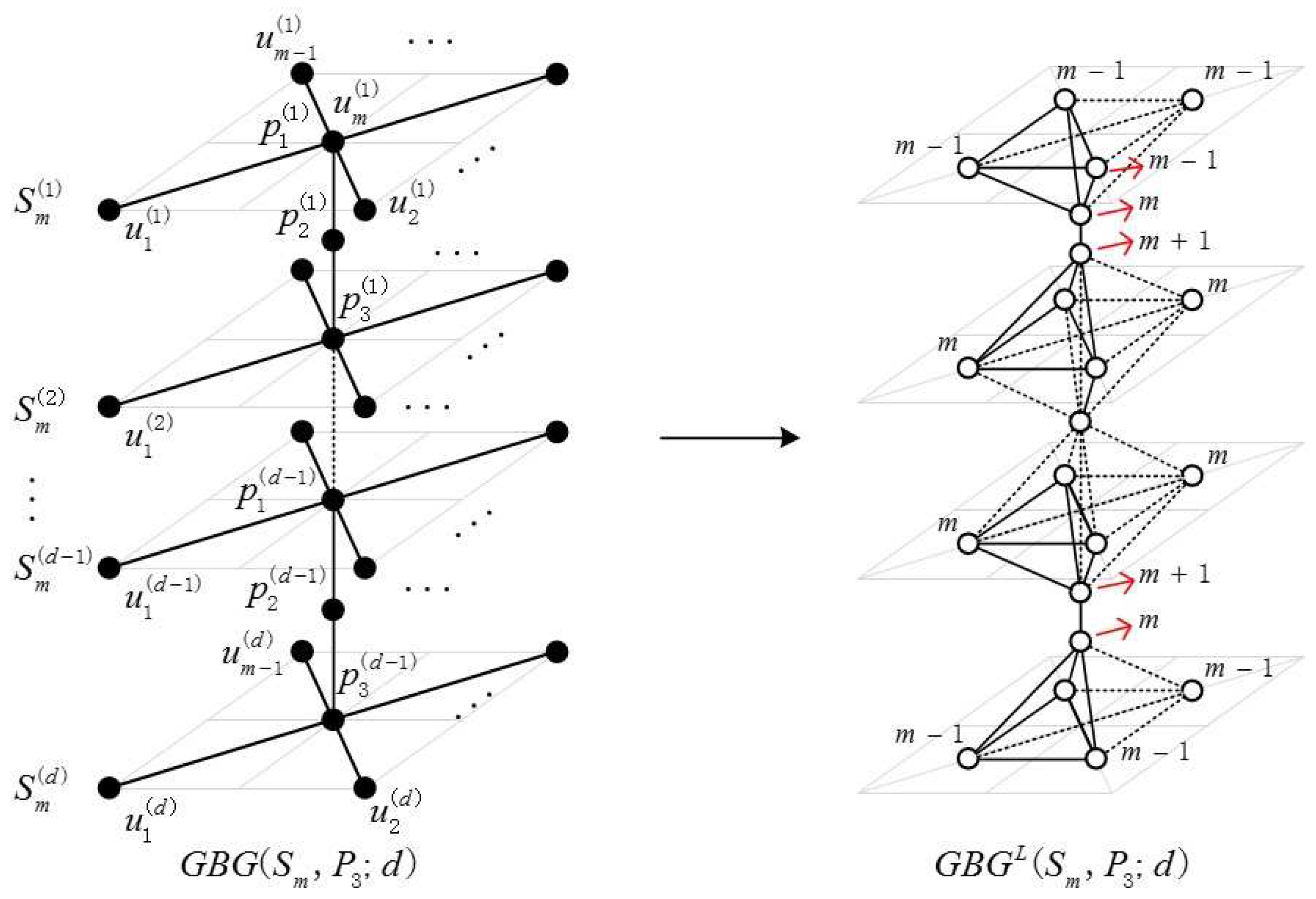
Figure 10.
The generalized bridge molecular graph of and .
Proof.
In Figure 10, the degrees of vertices in line graph are displayed near by the corresponding vertices. This line graph has edges. In addition, there are edges of type , 6 edges of type and , 6 edges of type , edges of type and , and edges of type . Hence, we have
The proof is complete. □
For Example 4, in Figure 2, is ------, which can be modeled by , so and .
Theorem 5.
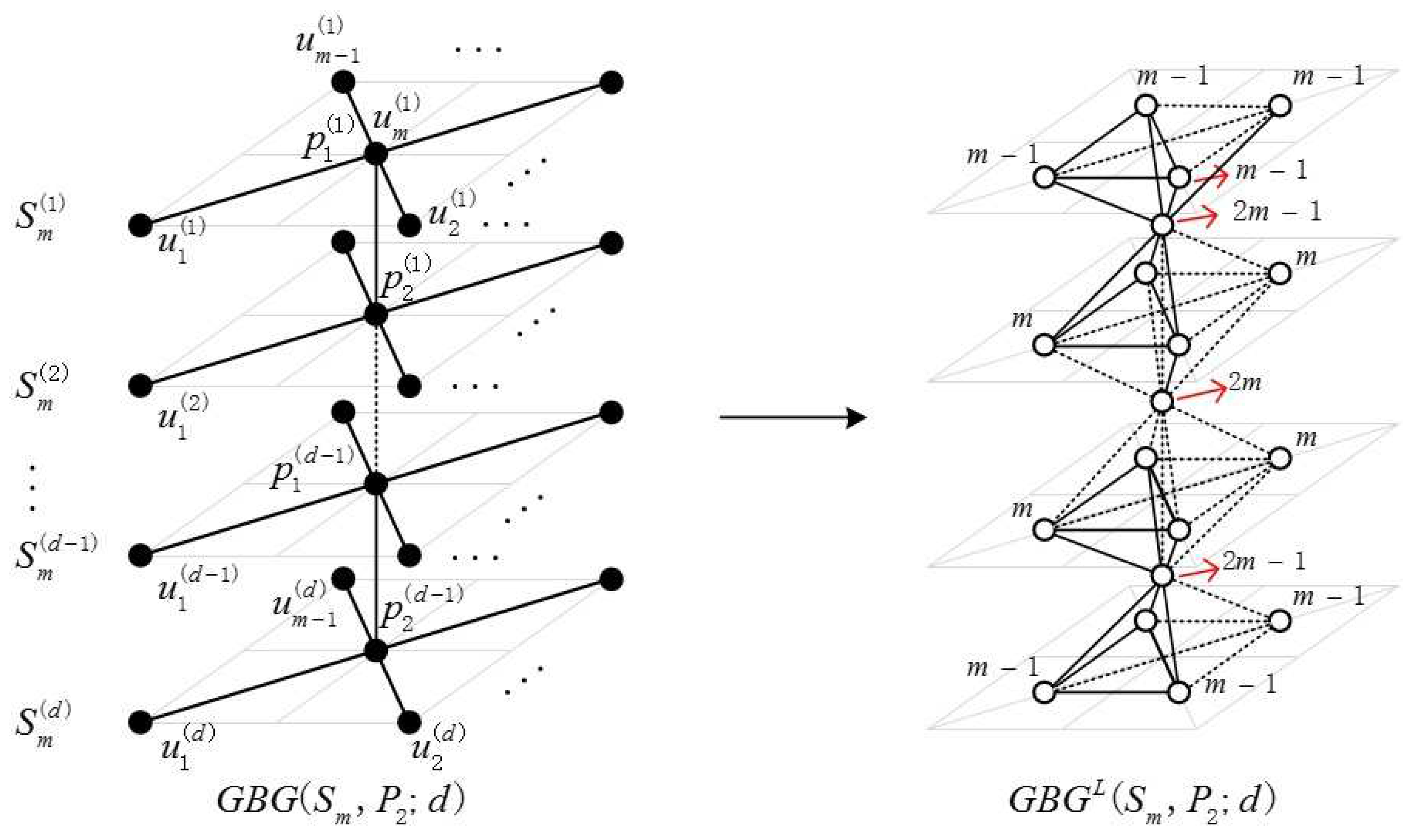
Let be the generalized bridge molecular graph for , , and (see Figure 11), then the and of are
Figure 11.
The generalized bridge molecular graph of and .
,
.
Proof.
In Figure 11, the degrees of vertices in line graph are displayed near by the corresponding vertices. This line graph has edges. In addition, there are edges of type , 4 edges of type and , edges of type and , 6 edges of type , 2 edges of type and , and edges of type . Hence, we have
The proof is complete. □
For Example 5, in Figure 12, -- can be modeled by , so and .
Figure 12.
(a) -- ball and stick model graph in ; (b) -- chemical structure graph; and (c) -- model graph in chemical graph theory.
Theorem 6.
Figure 13.
The generalized bridge molecular graph of and .
Proof.
In Figure 13, the degrees of vertices in line graph are displayed near by the corresponding vertices. This line graph has edges. In addition, there are edges of type , 4 edges of type , , edges of type ,, 2 edges of type , 4 edges of type , , edges of type , 4 edges of type , , edges of type , , 2 edges of type , , and edges of type . Hence, we have
The proof is complete. □
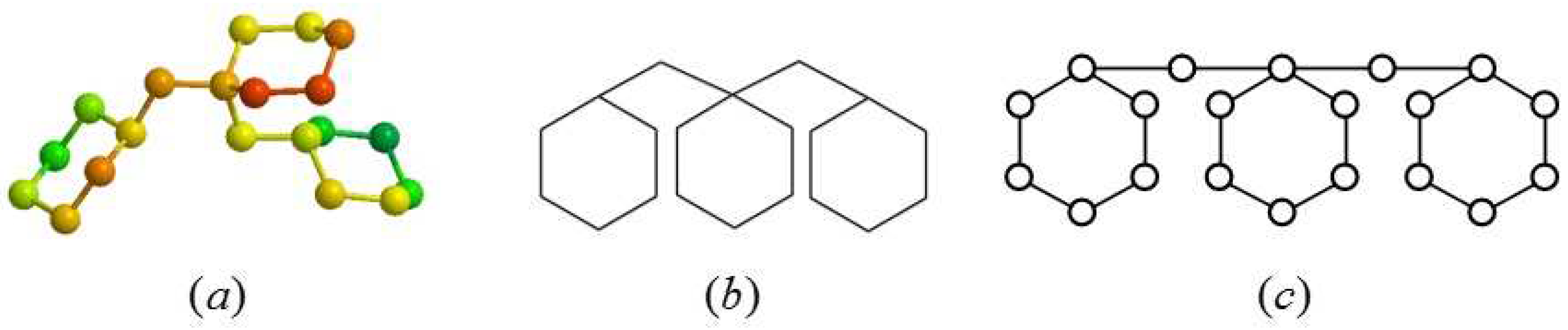
For Example 6, in Figure 14, -- can be modeled by , so and .
Figure 14.
(a) -- ball and stick model graph in ; (b) -- chemical structure graph; and (c) -- model graph in chemical graph theory.
3. Conclusions
Topological indices are proven to be very helpful to test the chemical properties of new chemical or physical materials. To describe more kinds of long chain polymerization products than the bridge molecular graphs, we propose the generalized bridge molecular graph structures. In this paper, we focus on some generalized bridge molecular graphs such as and and give the formulas of the edge version ABC and GA indices of these generalized bridge molecular graphs. By demonstrating the calculation of real molecules, we find that some long chain molecular graphs can be quickly modeled and their topological indices can be calculated using generalized bridge molecular graphs. The results of this paper also offer promising prospects in the applications for chemical and material engineering, especially in chemical industry research.
Author Contributions
X.Z. contribute for conceptualization, designing the experiments, wrote original draft preparation and funding; J.-B.L. contribute for supervision, methodology, project administration and formal analysing; X.W. contribute for performed experiments, validation. M.K.J. for resources, software, some computations; S.A. reviewed and edited initial draft and wrote the final draft; M.R.F. analyzed the data curation; All authors read and approved the final version of the paper.
Funding
This work was supported by the key project of the Sichuan Provincial Department of Education under Grant No. 17ZA0079 and 18ZA0118, partially supported by China Postdoctoral Science Foundation under Grant No. 2017M621579 and Postdoctoral Science Foundation of Jiangsu Province under Grant No. 1701081B, Project of Anhui Jianzhu University under Grant No. 2016QD116 and 2017dc03, and the Soft Scientific Research Foundation of Sichuan Provincial Science and Technology Department under Grant No. 2018ZR0265.
Acknowledgments
The authors are grateful to the anonymous reviewers and the editor for the valuable comments and suggestions.
Conflicts of Interest
The authors declare no conflict of interest.
References
- Harary, F.; Norman, R.Z. Some properties of line digraphs. Rendiconti del Circolo Matematico di Palermo 1960, 9, 161–169. [Google Scholar] [CrossRef]
- Wiener, H. Structural determination of paraffin boiling points. J. Am. Chem. Soc. 1947, 69, 7–20. [Google Scholar] [CrossRef]
- Iranmanesh, A.; Gutman, I.; Khormali, O.; Mahmiani, A. The edge versions of the wiener index. MATCH Commun. Math. Comput. Chem. 2009, 61, 663–672. [Google Scholar]
- Devillers, J.; Balaban, A.T. Topological Indices and Related Descriptors in QSAR and QSPR; CRC Press: Boca Raton, FL, USA, 1999. [Google Scholar]
- Gao, W.; Farahani, M.R.; Wang, S.H.; Husin, M.N. On the edge-version atom-bond connectivity and geometric arithmetic indices of certain graph operations. Appl. Math. Comput. 2017, 308, 11–17. [Google Scholar] [CrossRef]
- Gao, W.; Siddiqui, M.K.; Imran, M.; Jamil, M.K.; Farahani, M.R. Forgotten topological index of chemical structure in drugs. Saudi Pharm. J. 2016, 24, 258. [Google Scholar] [CrossRef] [PubMed]
- Nikolić, S.; Kovačević, G.; Miličević, A.; Trinajstić, N. The Zagreb indices 30 years after. Croat. Chem. Acta 2003, 76, 113–124. [Google Scholar]
- Estrada, E.; Torres, L.; Rodriguez, L.; Gutman, I. An atom-bond connectivity index: Modelling the enthalpy of formation of Alkanes. Indian J. Chem. 1998, 37A, 849–855. [Google Scholar]
- Dimitrov, D. Efficient computation of trees with minimal atom–bond connectivity index. Appl. Math. Comput. 2013, 224, 663–670. [Google Scholar] [CrossRef]
- Shao, Z.; Wu, P.; Gao, Y.; Gutman, I.; Zhang, X.J. On the maximum ABC index of graphs without pendent vertices. Appl. Math. Comput. 2017, 315, 298–312. [Google Scholar] [CrossRef]
- Shao, Z.; Wu, P.; Zhang, X.; Dimitrov, D.; Liu, J.B. On the maximum ABC index of graphs with prescribed size and without pendent vertices. IEEE Access 2018, 6, 27604–27616. [Google Scholar] [CrossRef]
- Farahani, M.R. The edge version of atom bond connectivity index of connected graph. Acta Univ. Apul. 2012, 36, 277–284. [Google Scholar]
- Gao, W.; Husin, M.N.; Farahani, M.R.; Imran, M. On the Edges Version of Atom-Bond Connectivity Index of Nanotubes. J. Comput. Theor. Nanosci. 2017, 13, 6733–6740. [Google Scholar] [CrossRef]
- Farahani, M.R. The Edge Version of Geometric-Arithmetic Index of Benzenoid Graph. Proc. Romanian Acad. Ser. B 2013, 15, 95–98. [Google Scholar]
- Vukicevic, D.; Furtula, B. Topological index based on the ratios of geometric and arithmetical means of end-vertex degrees of edges. J. Math. Chem. 2009, 46, 1369–1376. [Google Scholar] [CrossRef]
- Martińez–Peŕez, A.; Rodriǵuez, J.M.; Sigarreta, J.M. CMMSE: A new approximation to the geometric–arithmetic index. J. Math. Chem. 2017, 4, 1–19. [Google Scholar]
- Baig, A.Q.; Imran, M.; Khalid, W.; Naeem, M. Molecular description of carbon graphite and crystal cubic carbon structures. Can. J. Chem. 2017, 95, 674–686. [Google Scholar] [CrossRef]
- Gutman, I.; Furtula, B.; Das, K.C. Extended energy and its dependence on molecular structure. Can. J. Chem. 2017, 95, 526–529. [Google Scholar] [CrossRef]
- Mahmiani, A.; Khormali, O.; Iranmanesh, A. On the edge version of geometric-arithmetic index. Dig. J. Nanomater. Biostruct. 2012, 7, 411–414. [Google Scholar]
- Zafar, S.; Nadeem, M.F.; Zahid, Z. On the edge version of geometric-arithmetic index of nanocones. Stud. Univ. Babes-Bolyai Chem. 2016, 61, 273–282. [Google Scholar]
- Gao, W.; Husin, M.N.; Farahani, M.R.; Imran, M. On the Edges Version of Atom-Bond Connectivity and Geometric Arithmetic Indices of Nanocones CNCk. J. Comput. Theor. Nanosci. 2016, 13, 6741–6746. [Google Scholar] [CrossRef]
© 2018 by the authors. Licensee MDPI, Basel, Switzerland. This article is an open access article distributed under the terms and conditions of the Creative Commons Attribution (CC BY) license (http://creativecommons.org/licenses/by/4.0/).