
Computational Study of Antibody Binding to SARS-CoV-2 Variants


Abstract
1. Introduction
2. Materials and Methods
2.1. Molecular Models
2.2. Molecular Dynamics
2.3. Endpoint Free Energy Analysis
2.4. Statistical Significance
2.5. Interfacial Hydrogen Bonds Population Analysis
3. Results
3.1. Interfacial Hydrogen Bond Counts
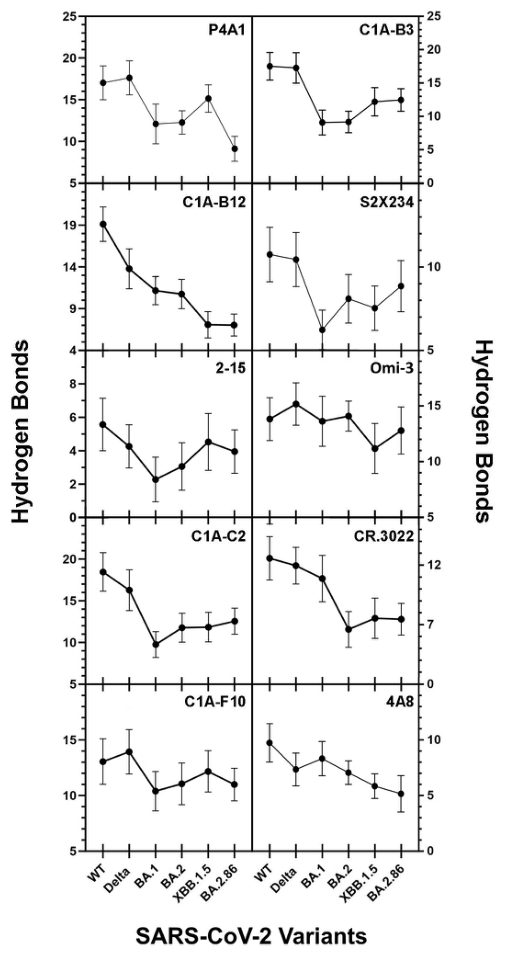
- P4A1 Differences between BA.1 and BA.2 are not statistically significant () nor are the differences between XBB.1.5 and BA.2.86. All other differences are statistically significant.
- C1A-B3 Differences between WT and Delta, between BA.1 and BA2, and between XBB.1.5 and BA.2.86 are not statistically significant, but all other differences are. Hence, the observed re-entrance is statistically significant.
- C1A-B12 Differences between BA.1 and BA2, and differences between XBB.1.5 and BA.2.86 are not statistically significant, but all others are.
- S2X234 Differences between WT and Delta are not statistically significant, but all other differences are, so that the observed re-entrance for BA.2.86 is statistically significant.
- 2-15 Differences between Delta and XBB.1.5 and between Delta and BA.2.86 are not statistically significant, but all other differences are, so the observed re-entrance is statistically significant.
- Omi-3 Differences between WT and BA.1, BA.2, and between BA.1 and BA.2 are not statistically significant, but all others are, so the observed re-entrance observed for XBB.1.5 and BA.2.86 is statistically significant.
- CA1-C2 Differences between BA.2 and XBB.1.5 are not statistically significant, all others are. Hence the observed re-entrance for BA2, XBB.1.5, and BA.2.86 are statistically significant.
- CR.3022 Differences between WT and Delta, and between XBB.1.5 and BA.2.86 are not statistically significant, but all others are. Hence the re-entrance for BA.2.86 and XBB.1.5 is statistically significant.
- C1A-F10 Differences between BA.1 and between BA.2, and BA.2 and BA.2.86 are not statistically significant, but all others are. Hence the re-entrance for BA.2, XBB.1.5, and BA.2.86 is statistically significant.
- 4A8 Differences between Delta and BA.2 are not statistically significant, but all others are. Hence, the re-entrance observed for BA2, XBB.1.5, BA.2.86 is statistically significant.
3.2. Binding Free Energy
3.3. Population Analysis of Hydrogen Bonds
- P4A1 For the P4A1 Ab, hydrogen bonds between the side chain of D420 on the RBD to S56 on the heavy chain are preserved, and between N487 on the RBD and R97 on the heavy chain are preserved. One bond gains considerable strength (population) for omicron and descendants: the S53 of the heavy chain donates to the main chain R457 of the RBD.
- C1A-B12 Side chain hydrogen bonds between R94 of the heavy chain and N487 of the RBD generally increase with mutation (except for the BA.2 variant). Side chain bonding between Y473 of the RBD and the main chain of S31 in the heavy chain is conserved apart from the XBB.1.5 variant.
- C1A-C2 Side chain–side chain binding of the T56 heavy chain residue to D420 of the RBD is highly conserved. Side chain–side chain binding of the R94 or R97 heavy chain residues to N487 of the RBD is highly conserved. Side chain–main chain binding of the Y473 residue of the RBD to the N31 of the heavy chain is conserved apart from the BA.1 variant.
- C1A-F10 Side chain–side chain bonds between R94 or R97 of the heavy chain and N487 of the RBD are strongly conserved. Side chain–side chain bonding between Y473 of the RBD and S31 of the heavy chain are highly conserved. Side chain to side chain or main chain bonding of the R403 residue of the RBD to the N92 residue of the light chain is conserved through XBB.1.5, but K403 of the BA.2.86 variant does not strongly bind to the light chain.
- C1A-B3 Side chain–side chain bonding of the R97 or R94 of the heavy chain to the N487 of the RBD is conserved apart from BA.1.
- Omi-3 Heavy chain S56 to RBD N420 side chain–side chain hydrogen bonding is conserved with variants. So is heavy chain R97 to RBD N487 side chain–side chain binding, as well as Y473 of the RBD side chain to main chain R31 of the heavy chain.
- S2X234 Salt bridge bonding of the K444 RBD residue to the heavy chain D56 and D58 residues is conserved throughout. Side chain binding of the R60 heavy chain residue to the main chain of the G447 RBD is strong throughout the viral evolution. The T500 residue of the RBD exhibits significant main chain bonding to the main chain atoms of N32 of the light chain (apart from BA.1).
3.4. Comments on Structural Assumptions
4. Discussion
Author Contributions
Funding
Data Availability Statement
Acknowledgments
Conflicts of Interest
References
- Jawaid, M.Z.; Baidya, A.; Mahboubi-Ardakani, R.; Davis, R.L.; Cox, D.L. SARS-CoV-2 omicron spike simulations: Broad antibody escape, weakened ACE2 binding, and modest furin cleavage. Microbiol. Spectr. 2023, 11, e01213-22. [Google Scholar] [CrossRef] [Scilit]
- SARS-CoV-2 Sequences. 2025. Available online: https://viralzone.expasy.org/9556 (accessed on 15 April 2026).
- Sequence of Original SARS-CoV-2 Spike Protein. 2025. Available online: https://viralzone.expasy.org/ (accessed on 15 April 2026).
- Guo, Y.; Huang, L.; Zhang, G.; Yao, Y.; Zhou, H.; Shen, S.; Shen, B.; Li, B.; Li, X.; Zhang, Q.; et al. A SARS-CoV-2 neutralizing antibody with extensive Spike binding coverage and modified for optimal therapeutic outcomes. Nat. Commun. 2021, 12, 2623. [Google Scholar] [CrossRef] [Scilit] [PubMed]
- Clark, S.A.; Clark, L.E.; Pan, J.; Coscia, A.; McKay, L.G.A.; Shankar, S.; Johnson, R.I.; Brusic, V.; Choudhary, M.C.; Regan, J.; et al. SARS-CoV-2 evolution in an immunocompromised host reveals shared neutralization escape mechanisms. Cell 2021, 184, 2605–2617.e18. [Google Scholar] [CrossRef] [Scilit] [PubMed]
- Rapp, M.; Guo, Y.; Reddem, E.R.; Yu, J.; Liu, L.; Wang, P.; Cerutti, G.; Katsamba, P.; Bimela, J.S.; Bahna, F.A.; et al. Modular basis for potent SARS-CoV-2 neutralization by a prevalent VH1-2-derived antibody class. Cell Rep. 2021, 35, 108950. [Google Scholar] [CrossRef] [Scilit]
- Park, Y.J.; Pinto, D.; Walls, A.C.; Liu, Z.; Marco, A.D.; Benigni, F.; Zatta, F.; Silacci-Fregni, C.; Bassi, J.; Sprouse, K.R.; et al. Imprinted antibody responses against SARS-CoV-2 Omicron sublineages. Science 2022, 378, 619–627. [Google Scholar] [CrossRef] [Scilit] [PubMed]
- Nutalai, R.; Zhou, D.; Tuekprakhon, A.; Ginn, H.M.; Supasa, P.; Liu, C.; Huo, J.; Mentzer, A.J.; Duyvesteyn, H.M.; Dijokaite-Guraliuc, A.; et al. Potent cross-reactive antibodies following Omicron breakthrough in vaccinees. Cell 2022, 185, 2116–2131.e18. [Google Scholar] [CrossRef] [Scilit]
- Huo, J.; Zhao, Y.; Ren, J.; Zhou, D.; Duyvesteyn, H.M.E.; Ginn, H.M.; Carrique, L.; Malinauskas, T.; Ruza, R.R.; Shah, P.N.M.; et al. Neutralization of SARS-CoV-2 by Destruction of the Prefusion Spike. Cell Host Microbe 2020, 28, 445–454.e6. [Google Scholar] [CrossRef] [Scilit]
- Chi, X.; Yan, R.; Zhang, J.; Zhang, G.; Zhang, Y.; Hao, M.; Zhang, Z.; Fan, P.; Dong, Y.; Yang, Y.; et al. A neutralizing human antibody binds to the N-terminal domain of the Spike protein of SARS-CoV-2. Science 2020, 369, 650–655. [Google Scholar] [CrossRef] [Scilit]
- Krieger, E.; Vriend, G. YASARA View—Molecular graphics for all devices—From smartphones to workstations. Bioinformatics 2014, 30, 2981–2982. [Google Scholar] [CrossRef] [Scilit]
- Maier, J.A.; Martinez, C.; Kasavajhala, K.; Wickstrom, L.; Hauser, K.E.; Simmerling, C. ff14SB: Improving the accuracy of protein side chain and backbone parameters from ff99SB. J. Chem. Theory Comput. 2015, 11, 3696–3713. [Google Scholar] [CrossRef] [Scilit]
- Wang, J.; Wolf, R.M.; Caldwell, J.W.; Kollman, P.A.; Case, D.A. Development and testing of a general amber force field. J. Comput. Chem. 2004, 25, 1157–1174. [Google Scholar] [CrossRef] [Scilit] [PubMed]
- Jakalian, A.; Jack, D.B.; Bayly, C.I. Fast, efficient generation of high-quality atomic charges. AM1-BCC model: II. Parameterization and validation. J. Comput. Chem. 2002, 23, 1623–1641. [Google Scholar] [CrossRef] [Scilit]
- Hornak, V.; Abel, R.; Okur, A.; Strockbine, B.; Roitberg, A.; Simmerling, C. Comparison of multiple Amber force fields and development of improved protein backbone parameters. Proteins Struct. Funct. Bioinform. 2006, 65, 712–725. [Google Scholar] [CrossRef] [Scilit]
- Essmann, U.; Perera, L.; Berkowitz, M.L.; Darden, T.; Lee, H.; Pedersen, L.G. A smooth particle mesh Ewald method. J. Chem. Phys. 1995, 103, 8577–8593. [Google Scholar] [CrossRef] [Scilit]
- Krieger, E.; Vriend, G. New ways to boost molecular dynamics simulations. J. Comput. Chem. 2015, 36, 996–1007. [Google Scholar] [CrossRef] [Scilit]
- Krieger, E.; Dunbrack, R.L.; Hooft, R.W.; Krieger, B. Assignment of protonation states in proteins and ligands: Combining pK a prediction with hydrogen bonding network optimization. In Computational Drug Discovery and Design; Springer: Berlin/Heidelberg, Germany, 2012; pp. 405–421. [Google Scholar]
- Weng, G.Q.; Wang, E.C.; Wang, Z.; Liu, H.; Li, D.; Zhu, F.; Hou, T.J. HawkDock: A web server to predict and analyze the structures of protein-protein complexes based on computational docking and MM/GBSA. Nucleic Acids Res. 2019, 47, W322–W330. [Google Scholar] [CrossRef] [Scilit]
- Graph Pad Unpaired T-Test Calculator. 2025. Available online: https://www.graphpad.com/quickcalcs/ttest1/ (accessed on 15 April 2026).
- Armstrong, R.A. When to use the Bonferroni correction. Ophthalmic Physiol. Opt. 2014, 34, 502–508. [Google Scholar] [CrossRef] [Scilit]
- Bekker, H.; Berendsen, H.; Dijkstra, E.; Achterop, S.; Vondrumen, R.; Vanderspoel, D.; Sijbers, A.; Keegstra, H.; Renardus, M. Gromacs—A parallel computer for molecular-dynamics simulations. In Proceedings of the Physics Computing ’92: 4th International Conference on Computational Physics (PC 92), Praha, Czech Republic, 24–28 August 1992; DeGroot, R., Nadrchal, J., Eds.; World Scientific Publishing: Singapore, 1993; pp. 252–256. [Google Scholar]
- Humphrey, W.; Dalke, A.; Schulten, K. VMD: Visual Molecular Dynamics. J. Mol. Graph. Modell. 1996, 14, 33–38. [Google Scholar] [CrossRef] [Scilit]
- Jawaid, M.Z.; Baidya, A.; Jakovcevic, S.; Lusk, J.; Mahboubi-Ardakani, R.; Solomon, N.; Gonzalez, G.; Arsuaga, J.; Vazquez, M.; Davis, R.; et al. Computational study of the furin cleavage domain of SARS-CoV-2: Delta binds strongest of extant variants. bioRxiv 2022. [Google Scholar] [CrossRef] [Scilit]
- Walls, A.C.; Park, Y.J.; Tortorici, M.A.; Wall, A.; McGuire, A.T.; Veesler, D. Structure, function, and antigenicity of the SARS-CoV-2 spike glycoprotein. Cell 2020, 181, 281–292.e6. [Google Scholar] [CrossRef] [Scilit] [PubMed]
- Gilson, M.K.; Given, J.A.; Bush, B.L.; McCammon, J.A. The statistical-thermodynamic basis for computation of binding affinities: A critical review. Biophys. J. 1997, 72, 1047–1069. [Google Scholar] [CrossRef] [Scilit] [PubMed]
- Wang, Q.; Guo, Y.; Casner, R.G.; Yu, J.; Nair, M.S.; Ho, J.; Reddem, E.R.; Mellis, I.A.; Wu, M.; Tzang, C.C.; et al. Optimizing a human monoclonal antibody for better neutralization of SARS-CoV-2. Nat. Commun. 2025, 16, 6195. [Google Scholar] [CrossRef] [Scilit] [PubMed]
- Konagurthu, A.S.; Whisstock, J.C.; Stuckey, P.J.; Lesk, A.M. MUSTANG: A multiple structural alignment algorithm. Proteins Struct. Funct. Bioinform. 2006, 64, 559–574. [Google Scholar] [CrossRef] [Scilit] [PubMed]



| Variant | RBD Mutations | N-Terminus Mutations |
|---|---|---|
| Delta (B.1.617.2) | L452R, T478K | T19R, T95I, G142D, Y145H, |
| (156-157), F158G, A222V, | ||
| W258L | ||
| BA.1 | G339D, S371L, S373P, S375F, | A67V, (69-70), T95I, G142D, |
| K417N, N440K, G446S, S477N, | (143-145), N211K, (212), | |
| T478K, E484A, Q493R, G496S, | (R214) | |
| Q498R, N501Y, Y505H | ||
| BA.2 | G339D, S371F, S373P, S375F, | T19I, L24S, (25-27), G142D, |
| T376A, D405N, R408S, K417N, | V213G | |
| N440K, S477N, T478K, E484A, | ||
| Q493R, G496S, Q498R, N501Y, | ||
| Y505H | ||
| XBB.15 | G339H, R346T, L368I, S371F, | T19I, L24S, (25-27), G142D, |
| S373P, S375F, T376A, D405N, | (144), H146Q, Q183E, V213E, | |
| R408S, K417N, N440K, V445P, | G252V | |
| E484A, G446S, N460K, S477N, | ||
| T478K, F486P, F490S, Q498R, | ||
| N501Y, Y505H | ||
| BA.2.86 | G339H, K356T, S371F, S373P, | T19I, R21T, L24S, (25-27), |
| S375F, T376A, R403K, D405N, | S50L, (69-70), V127F, G142D, | |
| R408S, K417N, N440K, V445H, | (144), F157S, R158G, N211I, | |
| G446S, N450D, L452W, N460K, | (212), V213G, L216F, H245N, | |
| S477N, T488K, N481K, (483), | A264D, I332V | |
| E484K, F486P, Q498R, N501Y, | ||
| Y505H |
| Antibody Class | Antibody Label | PDB Entry |
|---|---|---|
| Class I | P4A1 | 7CJF |
| Class I | C1A-B12 | 7KFV |
| Class I | C1A-C2 | 7KFX |
| Class I | C1A-F10 | 7KFY |
| Class I | C1A-B3 | 7KFW |
| Class I | 2-15 | 7L5B |
| Class I | S2X234 | 8ERQ |
| Class I | Omi-3 | 7ZF3 |
| Class III | CR.3022 | 6YOR |
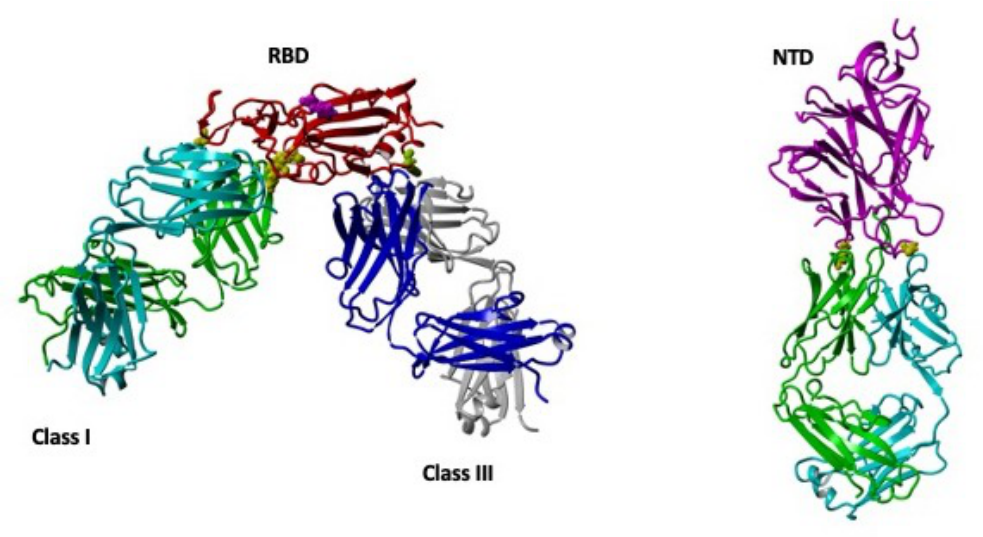
| N-term | 4A8 | 7C2L |
Disclaimer/Publisher’s Note: The statements, opinions and data contained in all publications are solely those of the individual author(s) and contributor(s) and not of MDPI and/or the editor(s). MDPI and/or the editor(s) disclaim responsibility for any injury to people or property resulting from any ideas, methods, instructions or products referred to in the content. |
© 2026 by the authors. Licensee MDPI, Basel, Switzerland. This article is an open access article distributed under the terms and conditions of the Creative Commons Attribution (CC BY) license.
Share and Cite
Chiu, C.; Jawaid, M.Z.; Cox, D.L. Computational Study of Antibody Binding to SARS-CoV-2 Variants. Antibodies 2026, 15, 43. https://doi.org/10.3390/antib15030043
Chiu C, Jawaid MZ, Cox DL. Computational Study of Antibody Binding to SARS-CoV-2 Variants. Antibodies. 2026; 15(3):43. https://doi.org/10.3390/antib15030043
Chicago/Turabian StyleChiu, Carolyn, Muhammad Zaki Jawaid, and Daniel Lee Cox. 2026. "Computational Study of Antibody Binding to SARS-CoV-2 Variants" Antibodies 15, no. 3: 43. https://doi.org/10.3390/antib15030043
APA StyleChiu, C., Jawaid, M. Z., & Cox, D. L. (2026). Computational Study of Antibody Binding to SARS-CoV-2 Variants. Antibodies, 15(3), 43. https://doi.org/10.3390/antib15030043