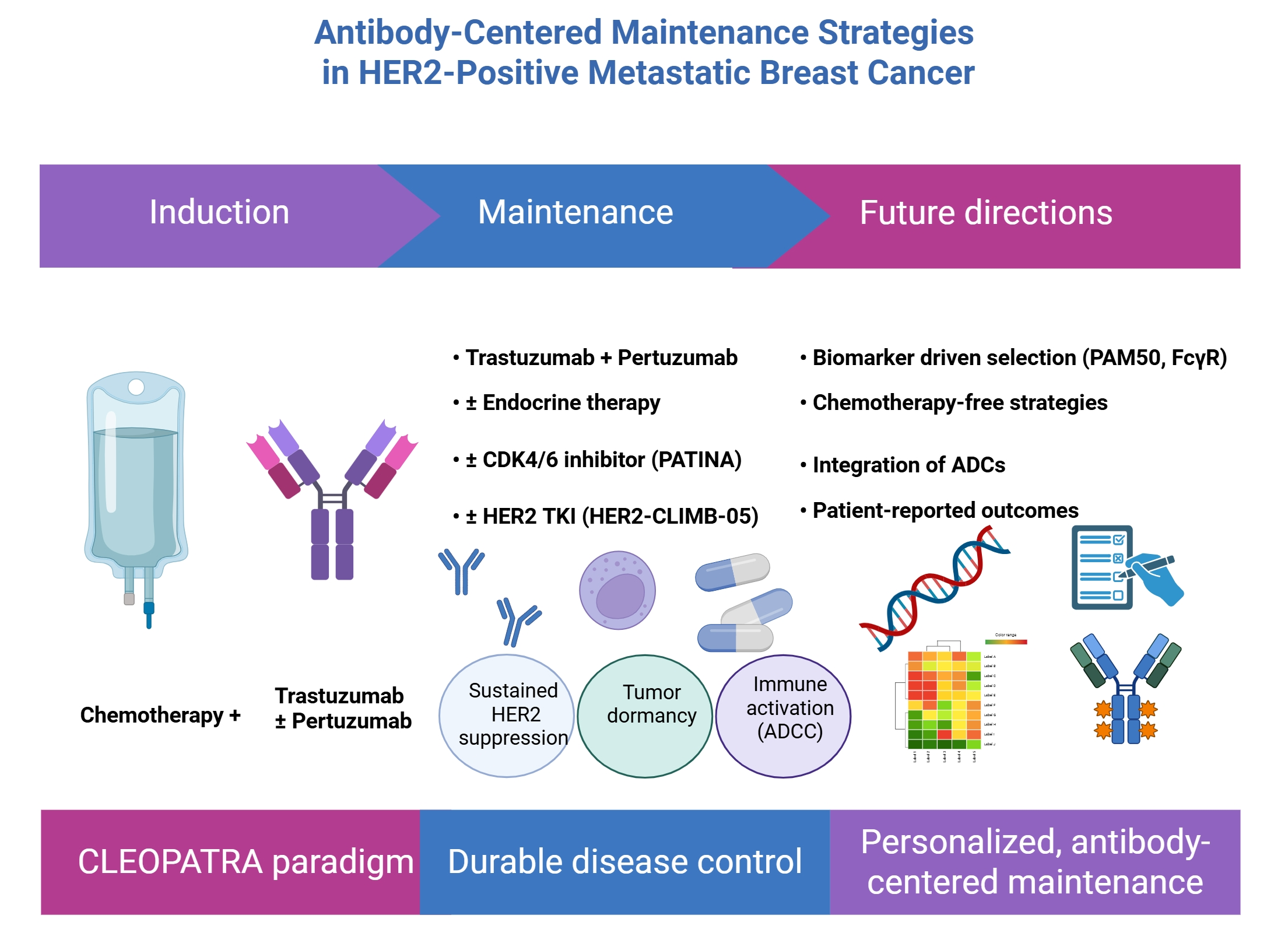

Post-Chemotherapy Antibody-Based Continuation and Maintenance Strategies in HER2-Positive Metastatic Breast Cancer: A Translational Narrative Review

 , , and
Abstract
1. Introduction
2. Biological Rationale for Antibody-Driven Maintenance
2.1. HER2 Pathway Suppression and Tumor Dormancy
2.2. Fc-Mediated Immune Effector Functions
3. Antibody-Based Maintenance After Chemotherapy
3.1. Rationale for Optimizing Antibody Maintenance After Induction Chemotherapy
3.2. PATINA: CDK4/6 Inhibition Plus Dual HER2 Blockade
3.3. HER2 Tyrosine Kinase Inhibitors as Maintenance Partners: HER2-CLIMB-05
4. Chemotherapy-Free Antibody-Based Strategies: Biological Proof-of-Concept
4.1. CDK4/6 Inhibition Without Chemotherapy: monarcHER
4.2. Biomarker-Driven Sensitivity: The PATRICIA Trial
4.3. Chemotherapy De-Escalation and CDK4/6 Integration: The DETECT V Trial
4.4. TOUCH: Neoadjuvant Translational Evidence Supporting Chemotherapy-Free HER2/CDK4/6 Strategies
5. Future Perspectives and Unanswered Questions
5.1. Biomarker-Driven Treatment Selection
5.2. De-Escalation Strategies and Chemotherapy-Free Approaches
5.3. Integration with Novel HER2-Targeted Agents
6. Conclusions
Author Contributions
Funding
Institutional Review Board Statement
Informed Consent Statement
Data Availability Statement
Conflicts of Interest
Abbreviations
| ADCC | Antibody-Dependent Cellular Cytotoxicity |
| ADCP | Antibody-Dependent Cellular Phagocytosis |
| ADC | Antibody–Drug Conjugate |
| AE | Adverse Event |
| AKT | Protein Kinase B |
| CDK4/6 | Cyclin-Dependent Kinase 4 and 6 |
| CI | Confidence Interval |
| ER | Estrogen Receptor |
| G | Grade |
| HER2 | Human Epidermal Growth Factor Receptor 2 |
| HER2+ | Human Epidermal Growth Factor Receptor 2-Positive |
| HR | Hazard Ratio/Hormone Receptor (depending on context) |
| HR+/HR− | Hormone Receptor-Positive/Negative |
| IHC | Immunohistochemistry |
| MBC | Metastatic Breast Cancer |
| OS | Overall Survival |
| pCR | Pathological Complete Response |
| PFS | Progression-Free Survival |
| PI3K | Phosphatidylinositol 3-Kinase |
| TKI | Tyrosine Kinase Inhibitor |
References
- Slamon, D.J.; Leyland-Jones, B.; Shak, S.; Fuchs, H.; Paton, V.; Bajamonde, A.; Fleming, T.; Eiermann, W.; Wolter, J.; Pegram, M.; et al. Use of chemotherapy plus a monoclonal antibody against HER2 for metastatic breast cancer that overexpresses HER2. N. Engl. J. Med. 2001, 344, 783–792. [Google Scholar] [CrossRef]
- Andersson, M.; Lidbrink, E.; Bjerre, K.; Wist, E.; Enevoldsen, K.; Jensen, A.B.; Karlsson, P.; Tange, U.B.; Sørensen, P.G.; Møller, S.; et al. Phase III randomized study comparing docetaxel plus trastuzumab with vinorelbine plus trastuzumab as first-line therapy of metastatic or locally advanced human epidermal growth factor receptor 2-positive breast cancer: The HERNATA study. J. Clin. Oncol. Off. J. Am. Soc. Clin. Oncol. 2011, 29, 264–271. [Google Scholar] [CrossRef] [PubMed]
- Swain, S.M.; Kim, S.B.; Cortés, J.; Ro, J.; Semiglazov, V.; Campone, M.; Ciruelos, E.; Ferrero, J.M.; Schneeweiss, A.; Knott, A.; et al. Pertuzumab, trastuzumab, and docetaxel for HER2-positive metastatic breast cancer (CLEOPATRA study): Overall survival results from a randomised, double-blind, placebo-controlled, phase 3 study. Lancet Oncol. 2013, 14, 461–471. [Google Scholar] [CrossRef] [PubMed]
- Baselga, J.; Cortés, J.; Kim, S.B.; Im, S.A.; Hegg, R.; Im, Y.H.; Roman, L.; Pedrini, J.L.; Pienkowski, T.; Knott, A.; et al. Pertuzumab plus trastuzumab plus docetaxel for metastatic breast cancer. N. Engl. J. Med. 2012, 366, 109–119. [Google Scholar] [CrossRef] [PubMed]
- Miles, D.; Im, Y.H.; Fung, A.; Yoo, B.; Knott, A.; Heeson, S.; Beattie, M.S.; Swain, S.M. Effect of docetaxel duration on clinical outcomes: Exploratory analysis of CLEOPATRA, a phase III randomized controlled trial. Ann. Oncol. Off. J. Eur. Soc. Med. Oncol. 2017, 28, 2761–2767. [Google Scholar] [CrossRef]
- Arpino, G.; de la Haba Rodríguez, J.; Ferrero, J.M.; De Placido, S.; Osborne, C.K.; Klingbiel, D.; Revelant, V.; Wohlfarth, C.; Poppe, R.; Rimawi, M.F. Pertuzumab, Trastuzumab, and an Aromatase Inhibitor for HER2-Positive and Hormone Receptor-Positive Metastatic or Locally Advanced Breast Cancer: PERTAIN Final Analysis. Clin. Cancer Res. Off. J. Am. Assoc. Cancer Res. 2023, 29, 1468–1476. [Google Scholar] [CrossRef]
- Marra, A.; Chandarlapaty, S.; Modi, S. Management of patients with advanced-stage HER2-positive breast cancer: Current evidence and future perspectives. Nat. Rev. Clin. Oncol. 2024, 21, 185–202. [Google Scholar] [CrossRef]
- Perez, E.A.; López-Vega, J.M.; Petit, T.; Zamagni, C.; Easton, V.; Kamber, J.; Restuccia, E.; Andersson, M. Safety and efficacy of vinorelbine in combination with pertuzumab and trastuzumab for first-line treatment of patients with HER2-positive locally advanced or metastatic breast cancer: VELVET Cohort 1 final results. Breast Cancer Res. 2016, 18, 126. [Google Scholar] [CrossRef] [PubMed]
- Martínez-Sáez, O.; Prat, A. Current and Future Management of HER2-Positive Metastatic Breast Cancer. JCO Oncol. Pract. 2021, 17, 594–604. [Google Scholar] [CrossRef]
- Yakes, F.M.; Chinratanalab, W.; Ritter, C.A.; King, W.; Seelig, S.; Arteaga, C.L. Herceptin-induced inhibition of phosphatidylinositol-3 kinase and Akt Is required for antibody-mediated effects on p27, cyclin D1, and antitumor action. Cancer Res. 2002, 62, 4132–4141. [Google Scholar]
- Avelino, A.R.M.; Pulipati, S.; Jamouss, K.; Bhardwaj, P.V. Updates in Treatment of HER2-positive Metastatic Breast Cancer. Curr. Treat. Options Oncol. 2024, 25, 1471–1481. [Google Scholar] [CrossRef] [PubMed]
- Nabieva, N.; Fasching, P.A. CDK4/6 Inhibitors-Overcoming Endocrine Resistance Is the Standard in Patients with Hormone Receptor-Positive Breast Cancer. Cancers 2023, 15, 1763. [Google Scholar] [CrossRef] [PubMed]
- Dieras, V.; Curigliano, G.; Martin, M.; Lerebours, F.; Tsurutani, J.; Savard, M.F.; Jerzak, K.J.; Hu, X.; Martins de Aquino Pimentel, L.C.; O’Sullivan, C.C.; et al. HER2CLIMB-05: A Phase III Study of Tucatinib Versus Placebo in Combination with Trastuzumab and Pertuzumab as First-Line Maintenance Therapy for HER2+ Metastatic Breast Cancer. J. Clin. Oncol. Off. J. Am. Soc. Clin. Oncol. 2025, JCO2502600. [Google Scholar] [CrossRef] [PubMed]
- Tolaney, S.M.; Wardley, A.M.; Zambelli, S.; Hilton, J.F.; Troso-Sandoval, T.A.; Ricci, F.; Im, S.A.; Kim, S.B.; Johnston, S.R.; Chan, A.; et al. Abemaciclib plus trastuzumab with or without fulvestrant versus trastuzumab plus standard-of-care chemotherapy in women with hormone receptor-positive, HER2-positive advanced breast cancer (monarcHER): A randomised, open-label, phase 2 trial. Lancet Oncol. 2020, 21, 763–775. [Google Scholar] [CrossRef] [PubMed]
- Metzger, O.; Mandrekar, S.; Goel, S.; Gligorov, J.; Lim, E.; Ciruelos, E.; Loibl, S.; Dockter, T.; Gonzàlez Farré, X.; Francis, P.A.; et al. Palbociclib for Hormone-Receptor-Positive, HER2-Positive Advanced Breast Cancer. N. Engl. J. Med. 2026, 394, 451–462. [Google Scholar] [CrossRef]
- Janni, W.; Fehm, T.; Müller, V.; Blohmer, J.; De Gregorio, A.; Decker, T.; Hartkopf, A.; Ditsch, N.; Schmidt, M.; Wimberger, P.; et al. Efficacy Analysis of the Randomized Phase III DETECT V trial: Treatment De-escalation by Omission of Chemotherapy and the Effect of Adding Ribociclib in HER2-positive and Hormone-receptor Positive Metastatic Breast Cancer. Clin. Cancer Res. 2026, 32, RF4-02. [Google Scholar] [CrossRef]
- Yarden, Y.; Sliwkowski, M.X. Untangling the ErbB signalling network. Nat. Rev. Mol. Cell Biol. 2001, 2, 127–137. [Google Scholar] [CrossRef]
- Hynes, N.E.; Lane, H.A. ERBB receptors and cancer: The complexity of targeted inhibitors. Nat. Rev. Cancer 2005, 5, 341–354. [Google Scholar] [CrossRef] [PubMed]
- Franklin, M.C.; Carey, K.D.; Vajdos, F.F.; Leahy, D.J.; de Vos, A.M.; Sliwkowski, M.X. Insights into ErbB signaling from the structure of the ErbB2-pertuzumab complex. Cancer Cell 2004, 5, 317–328. [Google Scholar] [CrossRef]
- Giuliano, M.; Trivedi, M.V.; Schiff, R. Bidirectional Crosstalk between the Estrogen Receptor and Human Epidermal Growth Factor Receptor 2 Signaling Pathways in Breast Cancer: Molecular Basis and Clinical Implications. Breast Care 2013, 8, 256–262. [Google Scholar] [CrossRef] [PubMed]
- Goss, P.E.; Chambers, A.F. Does tumour dormancy offer a therapeutic target? Nat. Rev. Cancer 2010, 10, 871–877. [Google Scholar] [CrossRef]
- Almog, N. Molecular mechanisms underlying tumor dormancy. Cancer Lett. 2010, 294, 139–146. [Google Scholar] [CrossRef] [PubMed]
- Moody, S.E.; Sarkisian, C.J.; Hahn, K.T.; Gunther, E.J.; Pickup, S.; Dugan, K.D.; Innocent, N.; Cardiff, R.D.; Schnall, M.D.; Chodosh, L.A. Conditional activation of Neu in the mammary epithelium of transgenic mice results in reversible pulmonary metastasis. Cancer Cell 2002, 2, 451–461. [Google Scholar] [CrossRef] [PubMed]
- Pantel, K.; Brakenhoff, R.H. Dissecting the metastatic cascade. Nat. Rev. Cancer 2004, 4, 448–456. [Google Scholar] [CrossRef] [PubMed]
- Khoirunnisa, S.M.; Suryanegara, F.D.A.; de Jong, L.A.; Setiawan, D.; Postma, M.J. A Systematic Review of Health-Related Quality of Life in Women with HER2-Positive Metastatic Breast Cancer Treated with Trastuzumab. PharmacoEconomics—Open 2024, 8, 511–524. [Google Scholar] [CrossRef]
- Clynes, R.A.; Towers, T.L.; Presta, L.G.; Ravetch, J.V. Inhibitory Fc receptors modulate in vivo cytotoxicity against tumor targets. Nat. Med. 2000, 6, 443–446. [Google Scholar] [CrossRef]
- Arnould, L.; Gelly, M.; Penault-Llorca, F.; Benoit, L.; Bonnetain, F.; Migeon, C.; Cabaret, V.; Fermeaux, V.; Bertheau, P.; Garnier, J.; et al. Trastuzumab-based treatment of HER2-positive breast cancer: An antibody-dependent cellular cytotoxicity mechanism? Br. J. Cancer 2006, 94, 259–267. [Google Scholar] [CrossRef]
- Tamura, K.; Shimizu, C.; Hojo, T.; Akashi-Tanaka, S.; Kinoshita, T.; Yonemori, K.; Kouno, T.; Katsumata, N.; Ando, M.; Aogi, K.; et al. FcγR2A and 3A polymorphisms predict clinical outcome of trastuzumab in both neoadjuvant and metastatic settings in patients with HER2-positive breast cancer. Ann. Oncol. Off. J. Eur. Soc. Med. Oncol. 2011, 22, 1302–1307. [Google Scholar] [CrossRef]
- Scheuer, W.; Friess, T.; Burtscher, H.; Bossenmaier, B.; Endl, J.; Hasmann, M. Strongly enhanced antitumor activity of trastuzumab and pertuzumab combination treatment on HER2-positive human xenograft tumor models. Cancer Res. 2009, 69, 9330–9336. [Google Scholar] [CrossRef] [PubMed]
- Mandó, P.; Rivero, S.G.; Rizzo, M.M.; Pinkasz, M.; Levy, E.M. Targeting ADCC: A different approach to HER2 breast cancer in the immunotherapy era. Breast 2021, 60, 15–25. [Google Scholar] [CrossRef]
- Musolino, A.; Gradishar, W.J.; Rugo, H.S.; Nordstrom, J.L.; Rock, E.P.; Arnaldez, F.; Pegram, M.D. Role of Fcγ receptors in HER2-targeted breast cancer therapy. J. Immunother. Cancer 2022, 10, e003171. [Google Scholar] [CrossRef] [PubMed]
- Rugo, H.S.; Im, S.A.; Cardoso, F.; Cortés, J.; Curigliano, G.; Musolino, A.; Pegram, M.D.; Wright, G.S.; Saura, C.; Escrivá-de-Romaní, S.; et al. Efficacy of Margetuximab vs Trastuzumab in Patients with Pretreated ERBB2-Positive Advanced Breast Cancer: A Phase 3 Randomized Clinical Trial. JAMA Oncol. 2021, 7, 573–584. [Google Scholar] [CrossRef] [PubMed]
- Goel, S.; DeCristo, M.J.; Watt, A.C.; BrinJones, H.; Sceneay, J.; Li, B.B.; Khan, N.; Ubellacker, J.M.; Xie, S.; Metzger-Filho, O.; et al. CDK4/6 inhibition triggers anti-tumour immunity. Nature 2017, 548, 471–475. [Google Scholar] [CrossRef] [PubMed]
- Baselga, J.; Swain, S.M. Novel anticancer targets: Revisiting ERBB2 and discovering ERBB3. Nat. Rev. Cancer 2009, 9, 463–475. [Google Scholar] [CrossRef]
- Zitvogel, L.; Apetoh, L.; Ghiringhelli, F.; Kroemer, G. Immunological aspects of cancer chemotherapy. Nat. Rev. Immunol. 2008, 8, 59–73. [Google Scholar] [CrossRef]
- Swain, S.M.; Miles, D.; Kim, S.B.; Im, Y.H.; Im, S.A.; Semiglazov, V.; Ciruelos, E.; Schneeweiss, A.; Loi, S.; Monturus, E.; et al. Pertuzumab, trastuzumab, and docetaxel for HER2-positive metastatic breast cancer (CLEOPATRA): End-of-study results from a double-blind, randomised, placebo-controlled, phase 3 study. Lancet Oncol. 2020, 21, 519–530. [Google Scholar] [CrossRef] [PubMed]
- Finn, R.S.; Dering, J.; Conklin, D.; Kalous, O.; Cohen, D.J.; Desai, A.J.; Ginther, C.; Atefi, M.; Chen, I.; Fowst, C.; et al. PD 0332991, a selective cyclin D kinase 4/6 inhibitor, preferentially inhibits proliferation of luminal estrogen receptor-positive human breast cancer cell lines in vitro. Breast Cancer Res. 2009, 11, R77. [Google Scholar] [CrossRef]
- Vaz-Luis, I.V.; Mazza, G.; Gligorov, J.; Lim, E.; Ciruelos, E.; Loibl, S.; DeMichele, A.; Fruth, B.; González Farre, X.; Francis, P.; et al. 485MO Health-related quality of life (HRQoL) from the PATINA trial (AFT-38): Impact of adding palbociclib to HER2 and endocrine therapy (ET) after induction in HR+/HER2+ metastatic breast cancer (MBC). Ann. Oncol. 2025, 36, S378. [Google Scholar] [CrossRef]
- Blackwell, K.L.; Burstein, H.J.; Storniolo, A.M.; Rugo, H.; Sledge, G.; Koehler, M.; Ellis, C.; Casey, M.; Vukelja, S.; Bischoff, J.; et al. Randomized study of Lapatinib alone or in combination with trastuzumab in women with ErbB2-positive, trastuzumab-refractory metastatic breast cancer. J. Clin. Oncol. Off. J. Am. Soc. Clin. Oncol. 2010, 28, 1124–1130. [Google Scholar] [CrossRef] [PubMed]
- Murthy, R.K.; Loi, S.; Okines, A.; Paplomata, E.; Hamilton, E.; Hurvitz, S.A.; Lin, N.U.; Borges, V.; Abramson, V.; Anders, C.; et al. Tucatinib, Trastuzumab, and Capecitabine for HER2-Positive Metastatic Breast Cancer. N. Engl. J. Med. 2020, 382, 597–609. [Google Scholar] [CrossRef] [PubMed]
- Curigliano, G.; Mueller, V.; Borges, V.; Hamilton, E.; Hurvitz, S.; Loi, S.; Murthy, R.; Okines, A.; Paplomata, E.; Cameron, D.; et al. Tucatinib versus placebo added to trastuzumab and capecitabine for patients with pretreated HER2+ metastatic breast cancer with and without brain metastases (HER2CLIMB): Final overall survival analysis. Ann. Oncol. Off. J. Eur. Soc. Med. Oncol. 2022, 33, 321–329. [Google Scholar] [CrossRef] [PubMed]
- Scaltriti, M.; Baselga, J. The epidermal growth factor receptor pathway: A model for targeted therapy. Clin. Cancer Res. Off. J. Am. Assoc. Cancer Res. 2006, 12, 5268–5272. [Google Scholar] [CrossRef]
- Moulder, S.L.; Borges, V.F.; Baetz, T.; Mcspadden, T.; Fernetich, G.; Murthy, R.K.; Chavira, R.; Guthrie, K.; Barrett, E.; Chia, S.K. Phase I Study of ONT-380, a HER2 Inhibitor, in Patients with HER2+-Advanced Solid Tumors, with an Expansion Cohort in HER2+ Metastatic Breast Cancer (MBC). Clin. Cancer Res. Off. J. Am. Assoc. Cancer Res. 2017, 23, 3529–3536. [Google Scholar] [CrossRef] [PubMed]
- Kulukian, A.; Lee, P.; Taylor, J.; Rosler, R.; de Vries, P.; Watson, D.; Forero-Torres, A.; Peterson, S. Preclinical Activity of HER2-Selective Tyrosine Kinase Inhibitor Tucatinib as a Single Agent or in Combination with Trastuzumab or Docetaxel in Solid Tumor Models. Mol. Cancer Ther. 2020, 19, 976–987. [Google Scholar] [CrossRef]
- Pascual, T.; Villacampa, G.; Oliveira, M.; Escrivá-de-Romaní, S.; Pernas, S.; Paré, L.; Adamo, B.; Martínez, E.; Cortés, J.; Perelló, A.; et al. Palbociclib and trastuzumab for HER2-positive metastatic breast cancer: Final overall survival results of cohort A and B of SOLTI-1303-PATRICIA trial. ESMO Open 2025, 10, 105572. [Google Scholar] [CrossRef] [PubMed]
- Malorni, L.; Tyekucheva, S.; Gombos, A.; Hasler-Strub, U.; Zamagni, C.; Chakiba-Brugère, C.; Colleoni, M.; Mueller, A.; Minisini, A.M.; Taylor, D.; et al. Palbociclib plus letrozole versus weekly paclitaxel, both in combination with trastuzumab plus pertuzumab, as neoadjuvant treatment for patients with HR-positive/HER2-positive early breast cancer: Primary results from the randomized phase II TOUCH trial (IBCSG 55-17). Ann. Oncol. Off. J. Eur. Soc. Med. Oncol. 2025, 37, 194–205. [Google Scholar]
- Tolaney, S.M.; Goel, S.; Nadal, J.; Denys, H.; Borrego, M.R.; Litchfield, L.M.; Liu, J.; Appiah, A.K.; Chen, Y.; André, F. Overall Survival and Exploratory Biomarker Analyses of Abemaciclib plus Trastuzumab with or without Fulvestrant versus Trastuzumab plus Chemotherapy in HR+, HER2+ Metastatic Breast Cancer Patients. Clin. Cancer Res. Off. J. Am. Assoc. Cancer Res. 2024, 30, 39–49. [Google Scholar] [CrossRef] [PubMed]
- Perou, C.M.; Sørlie, T.; Eisen, M.B.; van de Rijn, M.; Jeffrey, S.S.; Rees, C.A.; Pollack, J.R.; Ross, D.T.; Johnsen, H.; Akslen, L.A.; et al. Molecular portraits of human breast tumours. Nature 2000, 406, 747–752. [Google Scholar] [CrossRef] [PubMed]
- Sørlie, T.; Perou, C.M.; Tibshirani, R.; Aas, T.; Geisler, S.; Johnsen, H.; Hastie, T.; Eisen, M.B.; van de Rijn, M.; Jeffrey, S.S.; et al. Gene expression patterns of breast carcinomas distinguish tumor subclasses with clinical implications. Proc. Natl. Acad. Sci. USA 2001, 98, 10869–10874. [Google Scholar] [CrossRef]
- Gianni, L.; Pienkowski, T.; Im, Y.H.; Tseng, L.M.; Liu, M.C.; Lluch, A.; Starosławska, E.; de la Haba-Rodriguez, J.; Im, S.A.; Pedrini, J.L.; et al. 5-year analysis of neoadjuvant pertuzumab and trastuzumab in patients with locally advanced, inflammatory, or early-stage HER2-positive breast cancer (NeoSphere): A multicentre, open-label, phase 2 randomised trial. Lancet Oncol. 2016, 17, 791–800. [Google Scholar] [CrossRef]
- Schneeweiss, A.; Chia, S.; Hickish, T.; Harvey, V.; Eniu, A.; Waldron-Lynch, M.; Eng-Wong, J.; Kirk, S.; Cortés, J. Long-term efficacy analysis of the randomised, phase II TRYPHAENA cardiac safety study: Evaluating pertuzumab and trastuzumab plus standard neoadjuvant anthracycline-containing and anthracycline-free chemotherapy regimens in patients with HER2-positive early breast cancer. Eur. J. Cancer 2018, 89, 27–35. [Google Scholar] [PubMed]
- Parker, J.S.; Mullins, M.; Cheang, M.C.U.; Leung, S.; Voduc, D.; Vickery, T.; Davies, S.; Fauron, C.; He, X.; Hu, Z.; et al. Supervised Risk Predictor of Breast Cancer Based on Intrinsic Subtypes. J. Clin. Oncol. 2023, 41, 4192–4199. [Google Scholar] [CrossRef] [PubMed]
- Gao, Y.; Yu, Y.; Zhang, M.; Yu, W.; Kang, L. Mechanisms of endocrine resistance in hormone receptor-positive breast cancer. Front. Oncol. 2024, 14, 1448687. [Google Scholar] [CrossRef]
- Ubaid, S.; Kushwaha, R.; Kashif, M.; Singh, V. Comprehensive analysis of oncogenic determinants across tumor types via multi-omics integration. Cancer Genet. 2025, 298–299, 44–62. [Google Scholar] [CrossRef]
- Yasmin, A.; Jha, R.; Passi, A.; Saha, P.; Goyal, J.; Jindal, S.; Goyal, K. Emerging biomarkers in breast cancer: Translational and multi-omics perspectives in precision oncology. Biomarkers 2025, 30, 516–540. [Google Scholar] [CrossRef] [PubMed]
- Prat, A.; Carey, L.A.; Adamo, B.; Vidal, M.; Tabernero, J.; Cortés, J.; Parker, J.S.; Perou, C.M.; Baselga, J. Molecular features and survival outcomes of the intrinsic subtypes within HER2-positive breast cancer. J. Natl. Cancer Inst. 2014, 106, dju152. [Google Scholar] [CrossRef] [PubMed]
- Prat, A.; Perou, C.M. Deconstructing the molecular portraits of breast cancer. Mol. Oncol. 2011, 5, 5–23. [Google Scholar] [CrossRef]
- Prat, A.; Pascual, T.; Adamo, B. Intrinsic molecular subtypes of HER2+ breast cancer. Oncotarget 2017, 8, 73362–73363. [Google Scholar] [CrossRef]
- Berns, K.; Horlings, H.M.; Hennessy, B.T.; Madiredjo, M.; Hijmans, E.M.; Beelen, K.; Linn, S.C.; Gonzalez-Angulo, A.M.; Stemke-Hale, K.; Hauptmann, M.; et al. A functional genetic approach identifies the PI3K pathway as a major determinant of trastuzumab resistance in breast cancer. Cancer Cell 2007, 12, 395–402. [Google Scholar] [CrossRef]
- Razis, E.; Bobos, M.; Kotoula, V.; Eleftheraki, A.G.; Kalofonos, H.P.; Pavlakis, K.; Papakostas, P.; Aravantinos, G.; Rigakos, G.; Efstratiou, I.; et al. Evaluation of the association of PIK3CA mutations and PTEN loss with efficacy of trastuzumab therapy in metastatic breast cancer. Breast Cancer Res. Treat. 2011, 128, 447–456. [Google Scholar] [CrossRef] [PubMed]
- André, F.; Ciruelos, E.M.; Juric, D.; Loibl, S.; Campone, M.; Mayer, I.A.; Rubovszky, G.; Yamashita, T.; Kaufman, B.; Lu, Y.S.; et al. Alpelisib plus fulvestrant for PIK3CA-mutated, hormone receptor-positive, human epidermal growth factor receptor-2-negative advanced breast cancer: Final overall survival results from SOLAR-1. Ann. Oncol. Off. J. Eur. Soc. Med. Oncol. 2021, 32, 208–217. [Google Scholar] [CrossRef] [PubMed]
- Pistilli, B.; Pluard, T.; Urruticoechea, A.; Farci, D.; Kong, A.; Bachelot, T.; Chan, S.; Han, H.S.; Jerusalem, G.; Urban, P.; et al. Phase II study of buparlisib (BKM120) and trastuzumab in patients with HER2+ locally advanced or metastatic breast cancer resistant to trastuzumab-based therapy. Breast Cancer Res. Treat. 2018, 168, 357–364. [Google Scholar] [CrossRef] [PubMed]
- Patel, R.; Cascetta, K.; Klein, P.; Moshier, E.; Kwa, M.; Fasano, J.; Goel, A.; Accordino, M.; Shapiro, C.; Vaccaro, R.; et al. Abstract RF02-01: A Multicenter, Phase I/II Trial of Anastrozole, Palbociclib, Trastuzumab, and Pertuzumab in Hormone Receptor (HR)-Positive, HER2-Positive Metastatic Breast Cancer (ASPIRE). Cancer Res. 2024, 84, RF02-01. [Google Scholar] [CrossRef]
- Cortés, J.; Hurvitz, S.A.; Im, S.A.; Iwata, H.; Curigliano, G.; Kim, S.B.; Chiu, J.W.Y.; Pedrini, J.L.; Li, W.; Yonemori, K.; et al. Trastuzumab deruxtecan versus trastuzumab emtansine in HER2-positive metastatic breast cancer: Long-term survival analysis of the DESTINY-Breast03 trial. Nat. Med. 2024, 30, 2208–2215. [Google Scholar] [CrossRef] [PubMed]
- Song, P.N.; Mansur, A.; Gallegos, C.A.; Ghanate, P.; Lapi, S.E.; Sorace, A.G. Molecular imaging of tucatinib-induced cellular and TME changes in preclinical models of HER2 + breast cancer. Breast Cancer Res. Treat. 2026, 216, 25. [Google Scholar] [CrossRef] [PubMed] [PubMed Central]
- Wong, Y.N.; Ottesen, R.A.; Hughes, M.E.; Niland, J.C.; Theriault, R.; Edge, S.B.; Blayney, D.; Weeks, J.C. Continued use of trastuzumab beyond disease progression in the national comprehensive cancer network: Should we practice ahead of the evidence? Oncologist 2011, 16, 559–565. [Google Scholar] [CrossRef] [PubMed]
- Cardoso, F.; Paluch-Shimon, S.; Schumacher-Wulf, E.; Matos, L.; Gelmon, K.; Aapro, M.S.; Bajpai, J.; Barrios, C.H.; Bergh, J.; Bergsten-Nordström, E.; et al. 6th and 7th International consensus guidelines for the management of advanced breast cancer (ABC guidelines 6 and 7). Breast 2024, 76, 103756. [Google Scholar] [CrossRef]
- Balata, A.; Pogoda, K. Antibody-Based Therapeutics in Breast Cancer: Clinical and Translational Perspectives. Antibodies 2025, 15, 3. [Google Scholar] [CrossRef]
- Meric-Bernstam, F.; Beeram, M.; Hamilton, E.; Oh, D.Y.; Hanna, D.L.; Kang, Y.K.; Elimova, E.; Chaves, J.; Goodwin, R.; Lee, J.; et al. Zanidatamab, a novel bispecific antibody, for the treatment of locally advanced or metastatic HER2-expressing or HER2-amplified cancers: A phase 1, dose-escalation and expansion study. Lancet Oncol. 2022, 23, 1558–1570. [Google Scholar] [CrossRef] [PubMed]
- Escrivá-de-Romani, S.; Cejalvo, J.M.; Alba, E.; Friedmann, J.; Rodríguez Lescure, Á.; Savard, M.F.; Pezo, R.C.; Gion, M.; Ruíz-Borrego, M.; Hamilton, E.; et al. Abstract LBO1-04: Primary results from a phase 2a study of zanidatamab (zani) + palbociclib (palbo) + fulvestrant (fulv) in HER2+/HR+ metastatic breast cancer (mBC). Cancer Res. 2024, 84, LBO1-04. [Google Scholar] [CrossRef]
- Tolaney, S.M.; Jiang, Z.; Zhang, Q.; Barroso-Sousa, R.; Park, Y.H.; Rimawi, M.F.; Saura, C.; Schneeweiss, A.; Toi, M.; Chae, Y.S.; et al. Trastuzumab Deruxtecan plus Pertuzumab for HER2-Positive Metastatic Breast Cancer. N. Engl. J. Med. 2025, 394, 551–562. [Google Scholar] [CrossRef] [PubMed]
- Singh, D.D.; Lee, H.J.; Yadav, D.K. Clinical updates on tyrosine kinase inhibitors in HER2-positive breast cancer. Front. Pharmacol. 2022, 13, 1089066. [Google Scholar] [CrossRef] [PubMed]
- Saura, C.; Oliveira, M.; Feng, Y.H.; Dai, M.S.; Chen, S.W.; Hurvitz, S.A.; Kim, S.B.; Moy, B.; Delaloge, S.; Gradishar, W.; et al. Neratinib Plus Capecitabine Versus Lapatinib Plus Capecitabine in HER2-Positive Metastatic Breast Cancer Previously Treated With ≥2 HER2-Directed Regimens: Phase III NALA Trial. J. Clin. Oncol. Off. J. Am. Soc. Clin. Oncol. 2020, 38, 3138–3149. [Google Scholar] [CrossRef] [PubMed]
- Holmes, F.A.; Moy, B.; Delaloge, S.; Chia, S.K.L.; Ejlertsen, B.; Mansi, J.; Iwata, H.; Gnant, M.; Buyse, M.; Barrios, C.H.; et al. Overall survival with neratinib after trastuzumab-based adjuvant therapy in HER2-positive breast cancer (ExteNET): A randomised, double-blind, placebo-controlled, phase 3 trial. Eur. J. Cancer 2023, 184, 48–59. [Google Scholar] [CrossRef] [PubMed]

| Trial | Phase | Clinical Setting | Population | Induction/Backbone | Maintenance/Combination Strategy | Therapeutic Concept | Key Translational Message |
|---|---|---|---|---|---|---|---|
| CLEOPATRA [4] | III | MBC (1L) | HER2+ (all HR) | Docetaxel + trastuzumab + pertuzumab | Trastuzumab + pertuzumab | Dual HER2 blockade | Established finite chemotherapy induction followed by antibody continuation as standard paradigm |
| PERTAIN [7] | II | MBC (1L) | HR+/HER2+ | Endocrine therapy + trastuzumab ± pertuzumab (± taxane at investigator discretion) | ET + anti-HER2 antibodies | Endocrine–HER2 platform | Defined endocrine therapy plus dual HER2 blockade as a viable antibody-based backbone in HR+ disease |
| PATINA (AFT-38) [15] | III | MBC (1L, post-induction maintenance) | HR+/HER2+ | Taxane or vinorelbine + trastuzumab ± pertuzumab | Palbociclib + ET + trastuzumab ± pertuzumab | Maintenance escalation | Validated CDK4/6 inhibition as a maintenance partner on an antibody backbone |
| HER2-CLIMB-05 [13] | III | MBC (1L, post-induction maintenance) | HER2+ (all HR) | Taxane + trastuzumab + pertuzumab | Tucatinib + trastuzumab + pertuzumab | HER2 pathway intensification | Demonstrated sustained multi-agent HER2 suppression as maintenance strategy |
| monarcHER [14] | II | MBC (later-line, treatment-refractory) | HR+/HER2+ (pretreated) | Trastuzumab-based | Abemaciclib + trastuzumab ± fulvestrant | Chemo-free proof-of-concept | Showed antibody + ET + CDK4/6 inhibition can control disease without chemotherapy |
| PATRICIA (SOLTI-1303) [45] | II | MBC (later-line, treatment-refractory) | HR+/HER2+ | Trastuzumab | Palbociclib + trastuzumab | Biomarker selection | Identified PAM50 luminal subtype as preferentially benefiting from CDK4/6-based strategies |
| TOUCH (IBCSG 55-17) [46] | II | Neoadjuvant (chemo-free strategy) | HR+/HER2+ | — | Palbociclib + ET + trastuzumab + pertuzumab | Chemo-free feasibility | Demonstrated biological activity of chemotherapy-free dual HER2 + CDK4/6 blockade |
| DETECT V [16] | II | MBC (1L, chemotherapy-free strategy) | HR+/HER2+ | Trastuzumab-based | Ribociclib + anti-HER2 therapy | Translational optimization | Supports CDK4/6 inhibition as antibody partner and explores biomarker-driven escalation |
Disclaimer/Publisher’s Note: The statements, opinions and data contained in all publications are solely those of the individual author(s) and contributor(s) and not of MDPI and/or the editor(s). MDPI and/or the editor(s) disclaim responsibility for any injury to people or property resulting from any ideas, methods, instructions or products referred to in the content. |
© 2026 by the authors. Licensee MDPI, Basel, Switzerland. This article is an open access article distributed under the terms and conditions of the Creative Commons Attribution (CC BY) license.
Share and Cite
Pogoda, K.; Lewińska, K.; Kalman, P.; Bałata, A.; Wysocki, P.J. Post-Chemotherapy Antibody-Based Continuation and Maintenance Strategies in HER2-Positive Metastatic Breast Cancer: A Translational Narrative Review. Antibodies 2026, 15, 36. https://doi.org/10.3390/antib15020036
Pogoda K, Lewińska K, Kalman P, Bałata A, Wysocki PJ. Post-Chemotherapy Antibody-Based Continuation and Maintenance Strategies in HER2-Positive Metastatic Breast Cancer: A Translational Narrative Review. Antibodies. 2026; 15(2):36. https://doi.org/10.3390/antib15020036
Chicago/Turabian StylePogoda, Katarzyna, Karolina Lewińska, Paulina Kalman, Anna Bałata, and Piotr J. Wysocki. 2026. "Post-Chemotherapy Antibody-Based Continuation and Maintenance Strategies in HER2-Positive Metastatic Breast Cancer: A Translational Narrative Review" Antibodies 15, no. 2: 36. https://doi.org/10.3390/antib15020036
APA StylePogoda, K., Lewińska, K., Kalman, P., Bałata, A., & Wysocki, P. J. (2026). Post-Chemotherapy Antibody-Based Continuation and Maintenance Strategies in HER2-Positive Metastatic Breast Cancer: A Translational Narrative Review. Antibodies, 15(2), 36. https://doi.org/10.3390/antib15020036