
Article

Profiling the Biophysical Developability Properties of Common IgG1 Fc Effector Silencing Variants

by
Robert Pejchal
1,*,
Anthony B. Cooper
2,
Michael E. Brown
1,
Maximiliano Vásquez
1 and
Eric M. Krauland
1
1
Adimab LLC, Lebanon, NH 03766, USA
2
Aclys Bio, Lebanon, NH 03766, USA
*
Author to whom correspondence should be addressed.
Antibodies 2023, 12(3), 54; https://doi.org/10.3390/antib12030054
Submission received: 10 July 2023 / Revised: 9 August 2023 / Accepted: 18 August 2023 / Published: 22 August 2023

Abstract

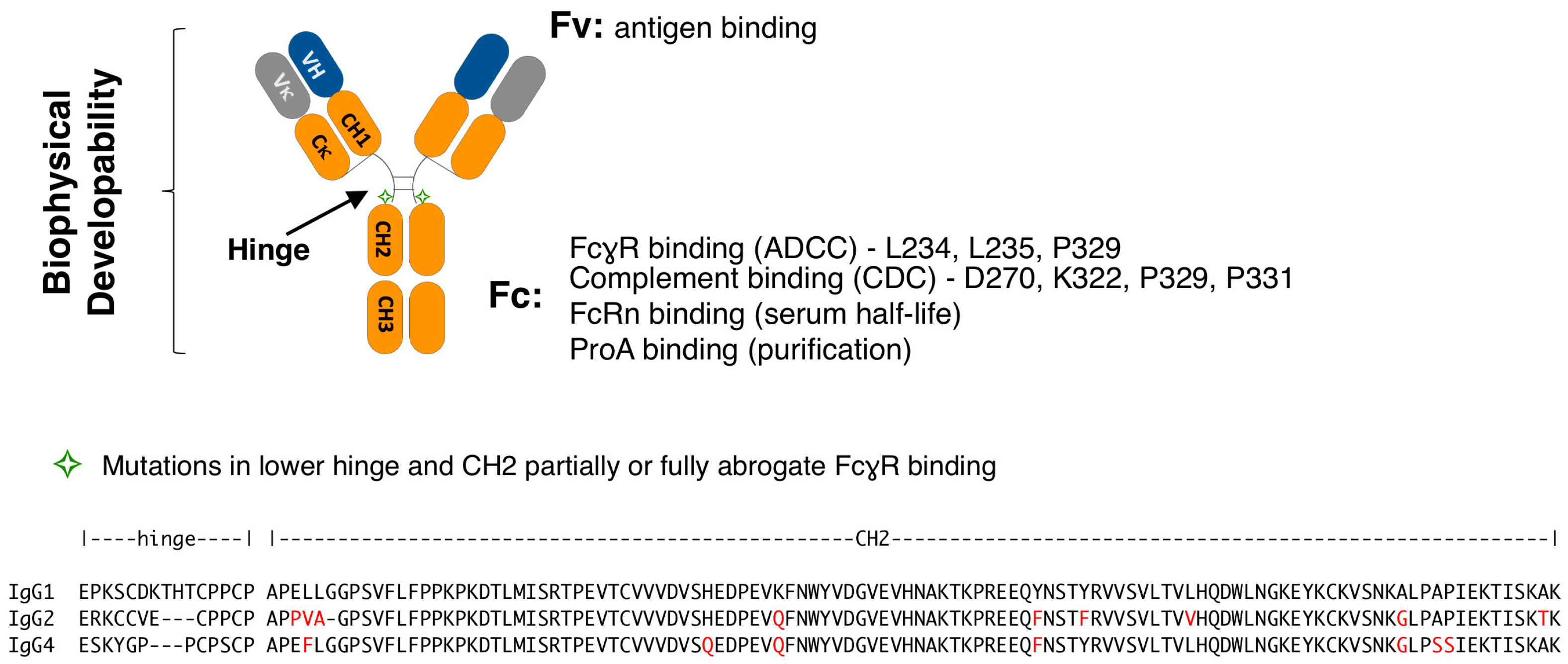
Therapeutic antibodies represent the most significant modality in biologics, with around 150 approved drugs on the market. In addition to specific target binding mediated by the variable fragments (Fvs) of the heavy and light chains, antibodies possess effector functions through binding of the constant region (Fc) to Fcγ receptors (FcγR), which allow immune cells to attack and kill target cells using a variety of mechanisms. However, for some applications, including T-cell-engaging bispecifics, this effector function is typically undesired. Mutations within the lower hinge and the second constant domain (CH2) of IgG1 that comprise the FcγR binding interface reduce or eliminate effector function (“Fc silencing”) while retaining binding to the neonatal Fc receptor (FcRn), important for normal antibody pharmacokinetics (PKs). Comprehensive profiling of biophysical developability properties would benefit the choice of constant region variants for development. Here, we produce a large panel of representative mutations previously described in the literature and in many cases in clinical or approved molecules, generate select combinations thereof, and characterize their binding and biophysical properties. We find that some commonly used CH2 mutations, including D265A and P331S, are effective in reducing binding to FcγR but significantly reduce stability, promoting aggregation, particularly under acidic conditions commonly employed in manufacturing. We highlight mutation sets that are particularly effective for eliminating Fc effector function with the retention of WT-like stability, including L234A, L235A, and S267K (LALA-S267K), L234A, L235E, and S267K (LALE-S267K), L234A, L235A, and P329A (LALA-P329A), and L234A, L235E, and P329G (LALE-P329G).
Keywords: antibody; CD3; T-cell engager; Fcγ receptor; Fc effector silencing; C1q antibody; CD3; T-cell engager; Fcγ receptor; Fc effector silencing; C1q