Article

New Contribution to Knowledge on Pleistocene Pediment Deposits in the Montefeltro Region (Marche–Romagna Apennines, Italy)


1
Department of Biomolecular Sciences, University of Urbino, 61029 Urbino, Italy
2
Interdepartmental Research Centre “Urbino e la Prospettiva”, University of Urbino, 61029 Urbino, Italy
3
Civil Protection Service, 47890 City of San Marino, San Marino
4
Department of Civil, Chemical, Environmental and Materials Engineering, Alma Mater Studiorum University of Bologna, 40136 Bologna, Italy
*
Author to whom correspondence should be addressed.
Land 2026, 15(4), 525; https://doi.org/10.3390/land15040525
Submission received: 13 February 2026 / Revised: 19 March 2026 / Accepted: 21 March 2026 / Published: 24 March 2026

Abstract

The study presents new data on the distribution, mapping, and morphostratigraphic characteristics of pediment deposits in the Montefeltro region (Italian Apennines), within the Val Marecchia Nappe. The Montefeltro landscape represents a clear example of morphology controlled by lithostructural features, with reliefs emerging from the surrounding terrain due to selective erosion. Its evolution has also been strongly influenced by climatic variations during the Middle–Late Pleistocene and the Holocene. Broad, gently sloping surfaces at the base of structural reliefs, together with associated debris deposits, are interpreted as erosional–depositional pediments formed under cold-climate, periglacial conditions during major Pleistocene glacial phases. Stratigraphic data from boreholes allowed the identification of pediment boundaries, thicknesses, and spatial extent, enabling reconstruction of the relict paleotopography and correlation with fluvial terraces. Two distinct lithological assemblages indicate different sediment sources and slope evolution pathways. Over time, pediments became disconnected from the present topography and were progressively dissected and terraced by fluvial incision, while recent slope adjustment is limited to modern drainage systems. This evolution reflects the combined influence of tectonic structure, lithology, and Quaternary climate change, confirming a regional trend of intensified fluvial deepening in the Marche Apennines. The study focuses on three representative areas: San Marino, Montecopiolo and Sassi Simone and Simoncello.

1. Introduction

The Montefeltro region is characterized by pronounced lithological and structural variability, resulting in a highly diversified landscape mosaic that makes this area one of the most geomorphologically distinctive in Italy. A landscape that consists of a wide variety of forms which sometimes merge gradually, while at other times diverge abruptly, creating strong morphological contrasts. This geomorphodiversity is undoubtedly fascinating for its intrinsic beauty and for the history and culture that have developed around it [1,2,3,4,5]. As in much of the Italian territory, morphogenetic processes were particularly active in this area during the cold climatic phases of the Middle–Upper Pleistocene, leaving a clear imprint on the present-day landscape [6].
Specifically, landforms consisting of extensive surfaces that geometrically connect mountain fronts with valley floors are still well preserved and clearly recognizable. The preservation of these landforms and their associated deposits makes the Marche–Romagna Apennines a key area for Quaternary geomorphological research.
In this context, periglacial landforms and deposits in the Marche region are widely documented in the literature [7,8,9,10]. Current research indicates that periglacial conditions during the Middle–Late Pleistocene produced landscapes dominated by alluvial and slope processes.
In the European literature, particularly within the French and Spanish traditions, comparable landforms are commonly referred to as “glacis” [11,12,13]. This term indicates gently sloping surfaces that connect mountain fronts to valley floors. A fundamental distinction is made between erosional glacis (glacis d’érosion), carved into bedrock, and accumulation glacis (glacis d’accumulation), formed in debris [14,15,16,17]. While Anglo-Saxon researchers frequently group analogous landforms under the overarching category of pediments [18], the glacis term specifically highlights the transitional character of these slopes, primarily shaped by surface runoff processes.
The pediments found in the Umbria–Marche Apennines have been stratigraphically correlated with the Quaternary fluvial terraces of the same area and are generally interpreted as having formed under periglacial environmental conditions [6]. However, despite these established interpretations, the terminology and genetic origin of these surfaces remain a subject of significant debate. While broadly classified as pediments to describe smooth, gently inclined erosional surfaces [19,20], their origin is controversial. Some authors link them to semi-arid landscape evolution [21,22], while others interpret them as basal weathering surfaces [23]. The climatic interpretation of pediments is still widely debated [24]. French suggested that these landforms are often inherited from earlier periods and merely overprinted by cold climate processes [25]. Furthermore, the initial mechanism of pediment formation remains unclear, with little evidence for their development under present-day conditions [26]. Consequently, the use of the term “pediment” in cold-climate contexts is often disputed, as these landforms are not diagnostic of a specific climate but rather of their morphostratigraphic position.
To resolve these terminological and genetic ambiguities, this study focuses on the complex slope processes typical of cold–arid climates in the Montefeltro area. The main objective is to characterize these extensive surfaces—herein classified as pediments—to understand their formation in relation to the retreat of mountain fronts and the infilling of pre-existing topography. Specifically, the work aims to clarify the relationship between these landforms and the specific geological conditions of the Montefeltro region.
This work presents data on pediment deposits, focusing on three sample areas: San Marino, Montecopiolo, and the Sassi Simone and Simoncello area. The data presented here derive from a three decades-long program of geological surveying, field measurements, boreholes, comparisons between recent and historical aerial photographs, analysis of historical cartography, and the acquisition of drone imagery and video.
The analysis highlights that, despite the terminological debate, the morphological and sedimentological characteristics observed in the Montefeltro pediments are directly related to cold-climate slope processes rather than hot-arid cycles. Key evidence includes boulder accumulations from mechanical weathering, debris and earth flows triggered by snowmelt, and soil creeping. This study concludes that slope evolution in this area was primarily controlled by the combined action of mass movements and cryoclastism, while slope geometry was strongly influenced by the lithological properties of the bedrock [27,28,29].

2. Materials and Methods

2.1. Geological Framework of the Study Area

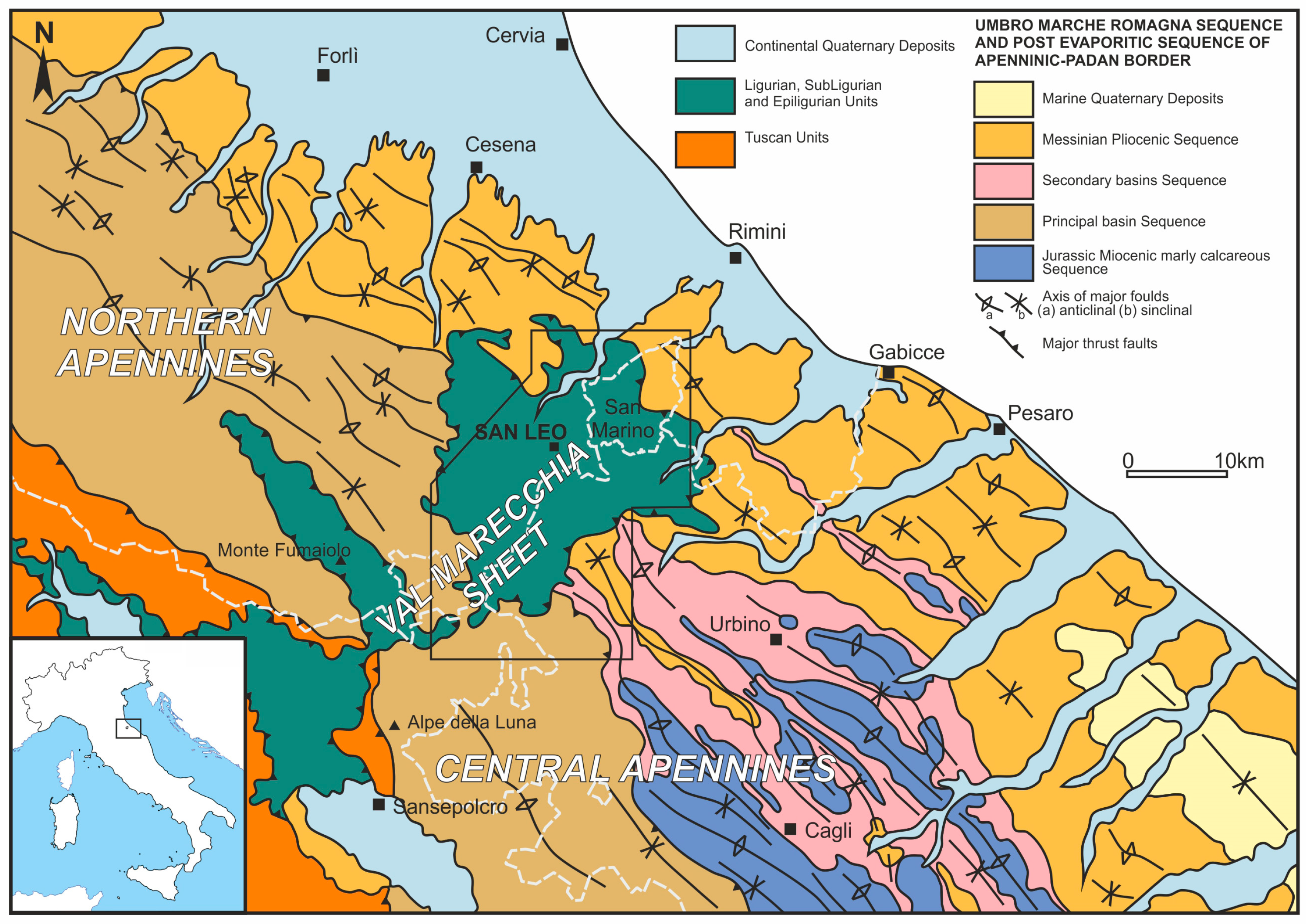
The study area (Figure 1) extends across the Marecchia valley, the Foglia valley, the Conca valley and all adjacent streams that drain directly into the sea (Figure 2). The Marecchia valley is conventionally regarded as the natural border between northern and central Italy. The area includes the Alpe della Luna ridge and the Fumaiolo massif (Figure 1), which represent the main reliefs of the region. The Marecchia River rises between the Alpe della Luna and Mt. Fumaiolo, and flows for nearly 70 km toward the southeastern margin of the Po Plain near Rimini (Figure 2). Its anti-Apennine course reflects the superimposition of the drainage network favored by fracturing and joint systems during the uplift of the Apennine chain [30,31,32]. Human settlements historically developed on rocky spurs above the valley floor, whereas only a few centres occupy the valley bottom.
The area is characterised by the Valmarecchia thrust sheet (Valmarecchia Nappe) [33,34], resulting from the tectonic juxtaposition of the allochthonous oceanic Ligurian Unit and the Neogene foredeep successions forming the clastic wedge of the late Alpine orogenic phase related to the collision between the European and Adria plates [35,36]. The present-day landscape reflects this complex tectonic evolution. During the Miocene, platform sedimentation developed in basins established above the migrating Ligurian units toward the Po Plain foreland, giving rise to the Epiligurian deposits (in several depositional cycles), which are currently preserved as rigid slabs overlying the predominantly clay-rich Ligurian formations.
The Valmarecchia Nappe has been extensively studied due to its structural complexity [36,37,38,39,40,41,42,43,44,45,46,47,48]. It consists of stacked slices of Ligurian and Epiligurian rocks overthrusting the Tuscan and Umbro-Marchean units [49,50,51,52,53,54,55]. These units, originally deposited in distinct sub-basins, were translated along the Marecchia line [49], a structural depression oriented orthogonally to the main Apennine structures. The argillitic nature of the Ligurian Units provided an effective detachment level facilitating nappe transport during Miocene uplift. Nappe emplacement has been interpreted as the result of combined tectonic and gravitational processes, involving thrusting related to the Mt. Nero Thrust and submarine sliding within the foredeep basin [34].
Two main tectono-stratigraphic complexes are recognized in the study area: the autochthonous complex and the allochthonous complex (Valmarecchia Nappe). The former comprises the Umbro-Marchean-Romagna Pre-Evaporite (late Burdigalian–early Messinian) and the Padano-Adriatic Post-Evaporite (late Messinian–Pleistocene) Successions. These deposits accumulated within a complex foredeep basin system [35,39,56] and include the Marnoso-Arenacea, Gessoso-Solfifera, Argille Azzurre, and Arenarie di Monte Perticara formations. This succession is further subdivided based on tectonic relationships; the older portion (Burdigalian to early Pliocene) consists of turbiditic sandstones and marls deposited in inner and outer thrusted basins [57,58,59], while the most recent post-evaporite units rest upon a regional unconformity driven by intra-Messinian tectonics and eustatic sea-level fall [45,46,60].
The allochthonous complex (Valmarecchia Nappe) represents the deformed orogenic wedge, consisting of the Cretaceous–Middle Eocene Ligurian Unit (Argille Varicolori and Arenarie di Monte Borello formations). This is unconformably overlain by the semi-allochthonous Epiligurian Succession [61], including the San Marino, Acquaviva, and Monte Fumaiolo formations, which were hosted within thrust-top (satellite or piggy-back) basins [39,58]. Finally, Quaternary alluvial and littoral deposits unconformably overlie all aforementioned units, marking the most recent stratigraphic stage.

2.2. Field Investigations, Boreholes and Other

The data presented in this work are the result of an extensive research effort carried out over a thirty-year period both during the professional activities of some of the authors and by local administration (available on site). The research involved systematic geological surveys, detailed field observations and measurements, the execution and analysis of boreholes, careful comparisons between recent and historical aerial photographs, the examination of historical cartographic sources, as well as the collection and interpretation of high-resolution drone imagery and video footage.
As regards aerial photographs, several series available for the area of interest were examined, dating from the period between 1949 and the present day, with varying scales (~1:9000 to ~1:30,000).
In San Marino area, there are over 600 stratigraphic boreholes available, with depths ranging from 10 m to over 50 m, excavated from the 1990s to the present day. Ten stratigraphic boreholes are also available for the Montecopiolo area and no boreholes for the Sassi Simone and Simoncello area.
In many cases, soil samples were taken during drilling and then subjected to laboratory tests to determine their geotechnical characteristics, thus creating an extensive database.
Specific applied geology studies are also available, particularly in the San Marino area, as well as detailed surveys of the location of a large number of “migrating boulders”. Scientific literature provides a definition of “erratic boulder”: erratics are large rocks or boulders, typically different in type and age from the surrounding rocks, which have been transported and deposited by glacial ice in places other than their place of origin. In this research, we propose the term “migrating boulders” for the first time, in a different sense, to refer to boulders that have been transported on a gently sloping clay substrate in periglacial climatic conditions.

3. Results

3.1. Geomorphologic Description of the Study Area

The landforms of the elevated areas of Marecchia and Montefeltro regions are strongly controlled by the litho-structural setting of the Valmarecchia Nappe, reflecting both the complex geological architecture and the contrasting resistance of clays, arenites, limestones to weathering and erosion. Resistant rock slabs embedded within clay-rich formations promote selective erosion, leading to the development of steep cliffs. Undermining of these slabs by the underlying clays results in cliff retreat, widespread slope reshaping by mass movements and extensive badlands [62], as well as rill and gully erosion in sparsely vegetated or cultivated areas.
The rocky slabs are intensely tectonised and characterized by complex fault-and-joint systems that facilitate lateral spreading, a pervasive process throughout the valley and a primary driver of topples, tilting, and rockfalls, along the borders of the rocky slabs. Earth flows and slides are widespread within the underlying clayey formations, which undergo plastic deformation [63]. This instability is mainly related to the strong mechanical contrast between calcareous rock masses and subjacent clay [64], and is further enhanced by structural conditions, groundwater circulation and its effects on basal clays, as well as by creep processes. Creep processes mean usually slow deformations, with plastic and visco-plastic behaviors, sometimes without an evident slide surface. These mechanisms lead to the initiation and progressive widening of sub-vertical fractures within the calcareous blocks [33].
Fluvial processes represent another major geomorphological component of the area. The main fluvial terraces are extensively developed, particularly in the middle and lower sectors of the Marecchia River valley, where alternating phases of aggradation and incision are observed. While the oldest terrace (T1) is poorly represented, two subsequent orders are preserved: the second order (T2), situated at 40–35 m above the current riverbed, is often fragmented and obscured by hillslope debris; conversely, the third order (T3), located at 20–25 m, is significantly more continuous and well-preserved, especially within the coastal sector. These two terrace levels are of stratigraphic significance as they are physically and chronologically interfingered with the pediment deposits. In the upper valley, the Marecchia River incises the Marnoso-Arenacea Formation, forming a typical V-shaped valley. In the middle valley (from Pennabilli to Ponte Verucchio, Figure 2), Ligurian and Epiligurian formations crop out, resulting in alternating narrow and wide channel reaches controlled by lithological contrasts in erodibility.
Major hydraulic bottlenecks occur near Ponte Molino Baffoni, Ponte Santa Maria Maddalena and Ponte Verucchio (Figure 2), where sediment deposition dominates upstream and erosional processes prevail towards the coast. Downstream of Ponte Verucchio, Pliocene formations crop out and most terraced alluvial deposits of the Marecchia River are preserved.
Analysis of the drainage network indicates that in the upper valley the Marecchia River initially shifts towards the hydrographic right and subsequently markedly toward the left, favoring the more pronounced development of right tributaries (e.g., Mazzocco and San Marino creeks) [31,32]. Drainage patterns range from dendritic to sub-dendritic in mountainous sectors, corresponding to the outcrops of the Marnoso-Arenacea Formation. In contrast, in the middle part of the valley, pinned or comb-like drainage patterns prevail within the clay-rich Ligurian units, whereas sub-parallel and angular patterns characterise areas underlain by Epiligurian limestone units, locally controlled by tectonic lineaments.
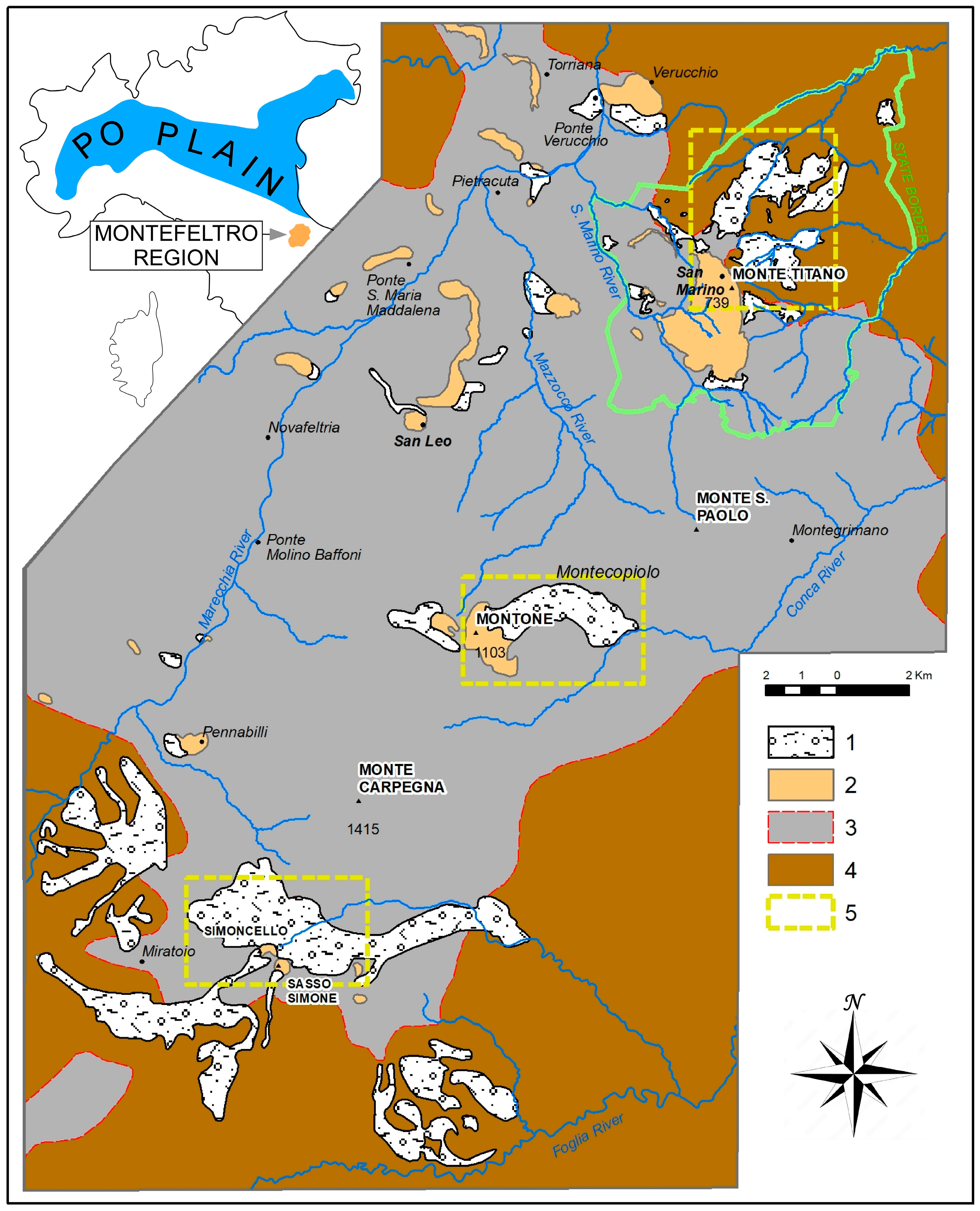
The geomorphological study and interpretation of pediment deposits identified in the Montefeltro and Valmarecchia areas was based mainly on three sample areas, selected for their evident characteristics: San Marino, Montecopiolo and Sassi Simone and Simoncello (Figure 2). Traces typically associated with pediment deposits have also been observed in other parts of the Montefeltro-Valmarecchia sector, such as the Monte Fumaiolo area [5]; however, less data and field surveys are currently available for these locations.

3.2. San Marino Area

The San Marino area is the outermost of the studied sites, situated east of Monte Titano. This zone is heavily urbanized and anthropogenically modified. The Monte Titano Epiligurian slab is among the largest within the Valmarecchia Nappe. It exhibits a predominantly tilted attitude, featuring cliffs and rock faces up to 100 m high, particularly well-exposed on the eastern side. These are bordered by extensive talus slopes characterized by stratification and éboulis ordonné (stratified scree) or grèzes litées structures.
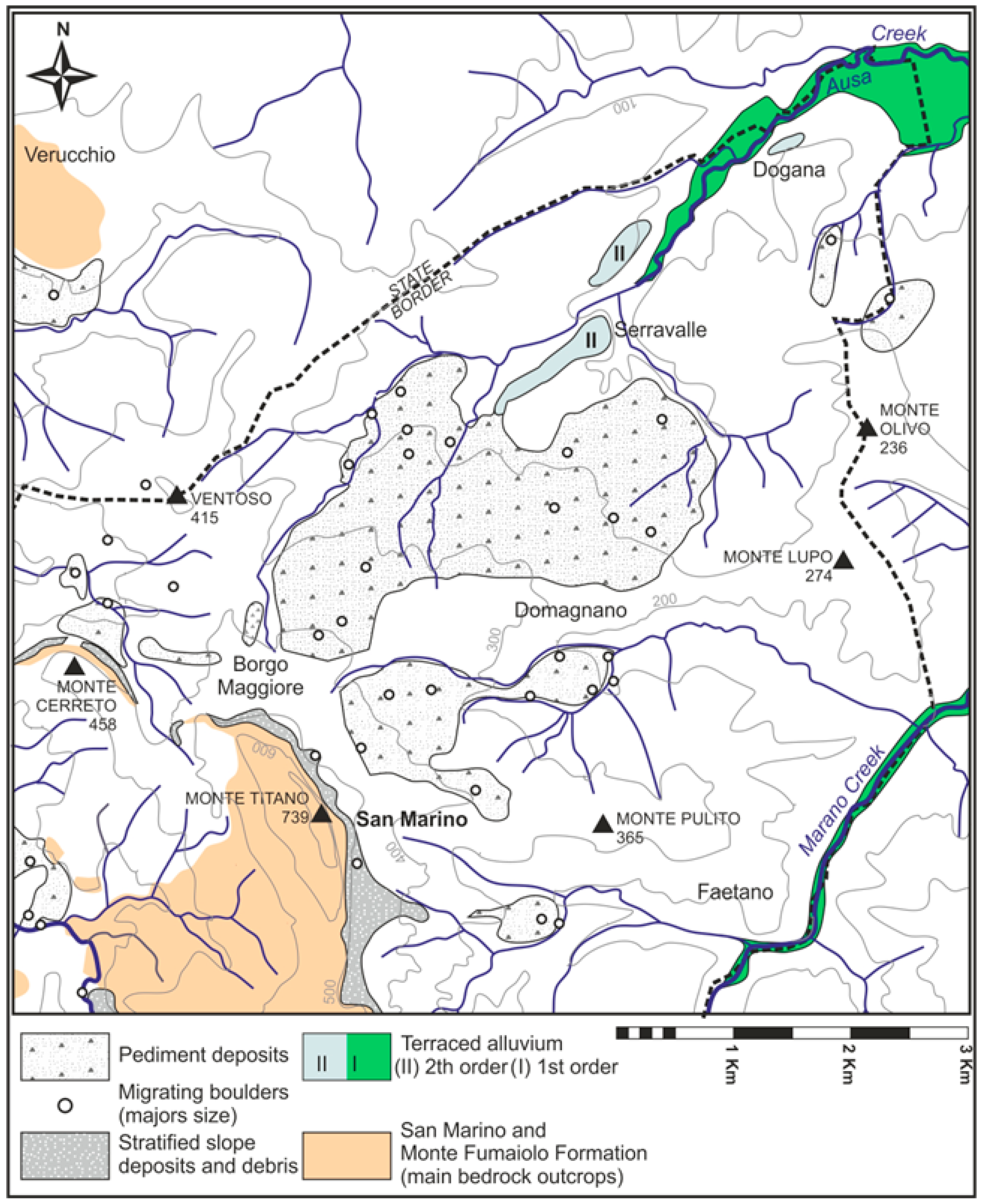
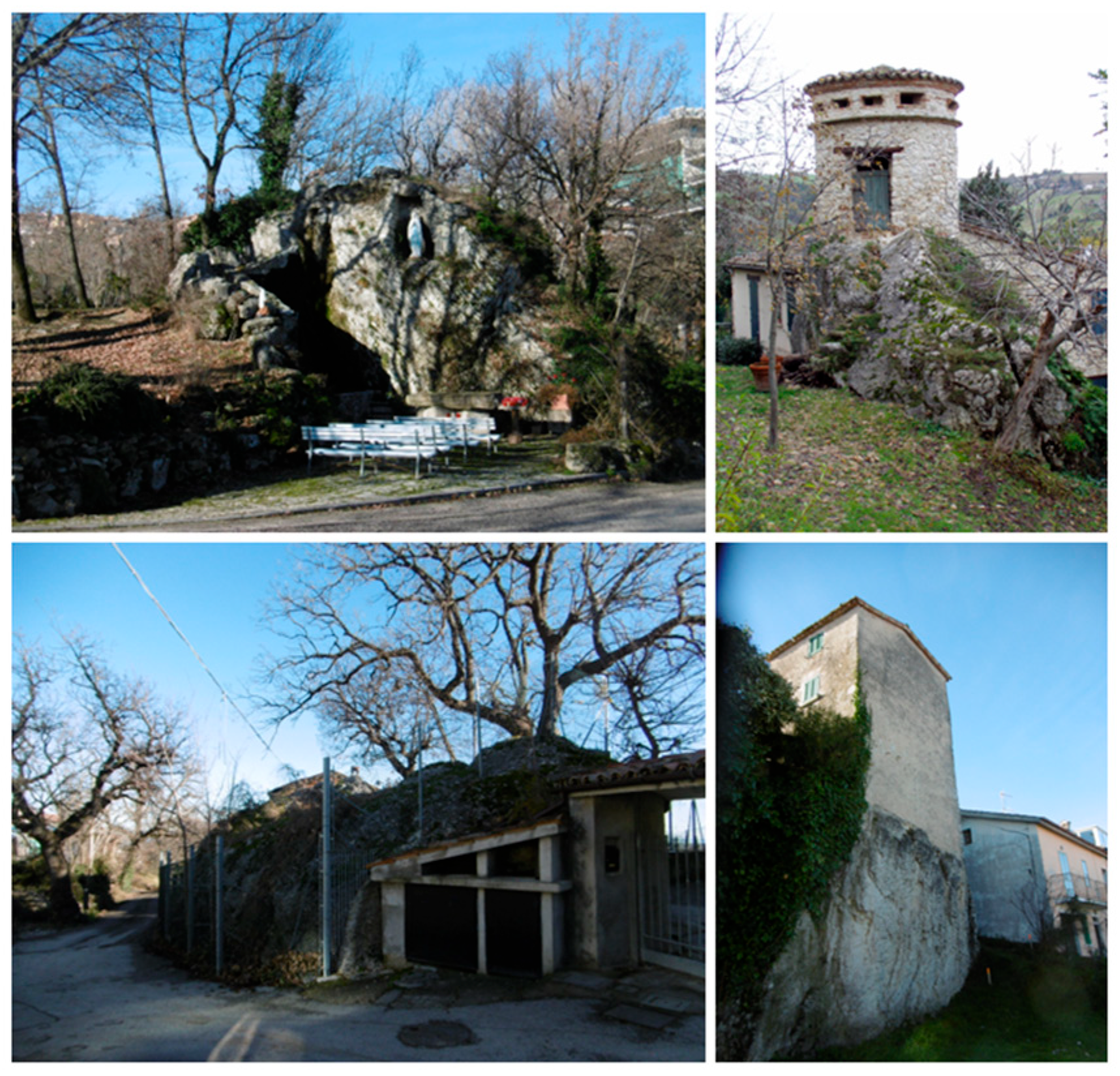
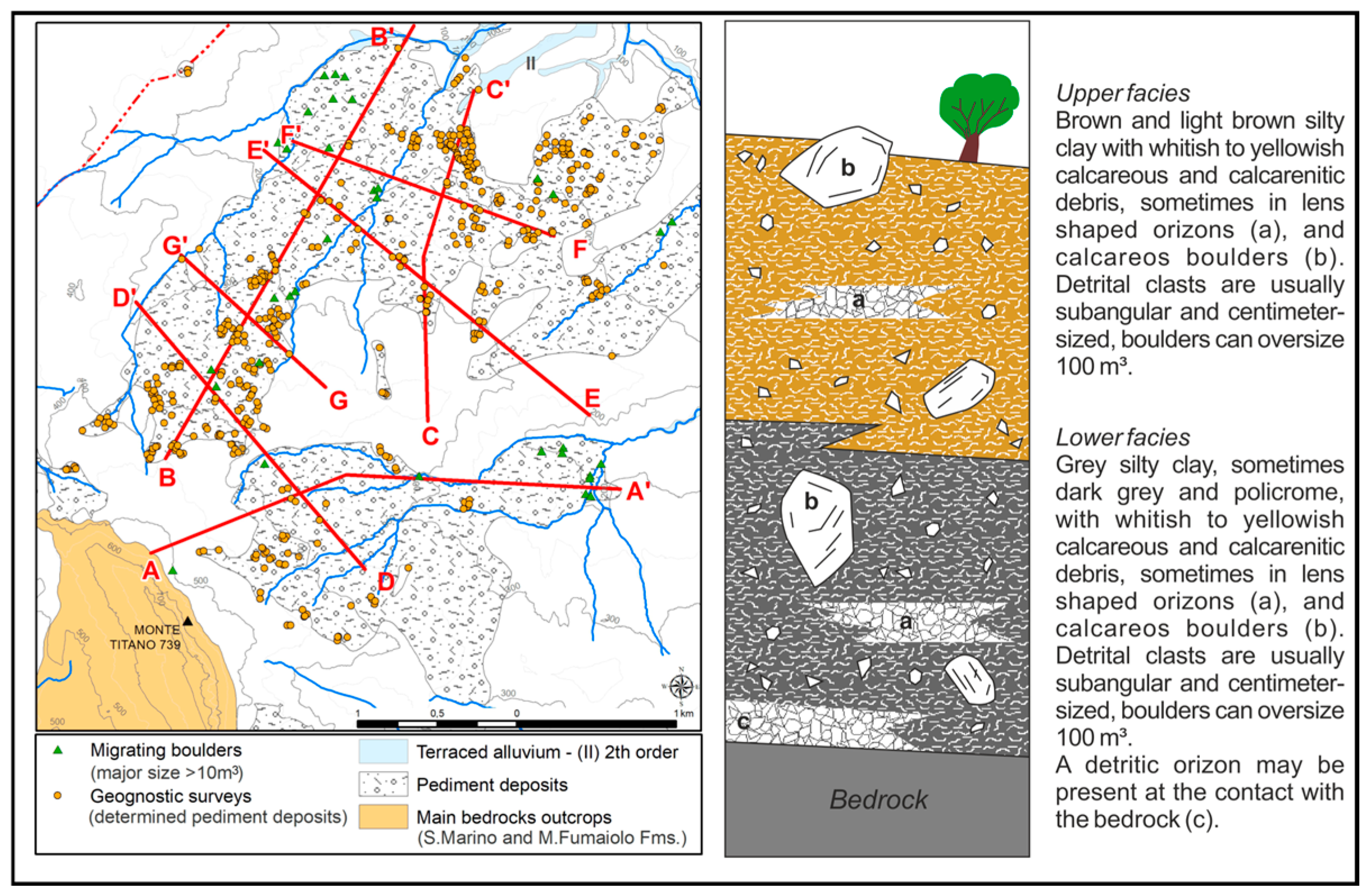
The pediment deposits extending east and northeast of the Monte Titano slab comprise two main bodies and several smaller ones, covering a total area of approximately 6.75 km2. Within the study area, the positions of 265 migrating boulders larger than 1 m3 were mapped (Figure 3). Of these, 70 have an estimated volume exceeding 10 m3, with some massive blocks exceeding 1000 m3 (Table 1). Small boulders, with volumes ranging from 1 to 27 m3, are the most common and are distributed in the proximity of larger ones. Volume estimates are not always accurate, as many boulders do not protrude completely from the surface, making it difficult to determine how deep they extend. These boulders are widespread and frequently host historical structures, such as small towers (torricini), dovecotes, or entire residential buildings (Figure 4).
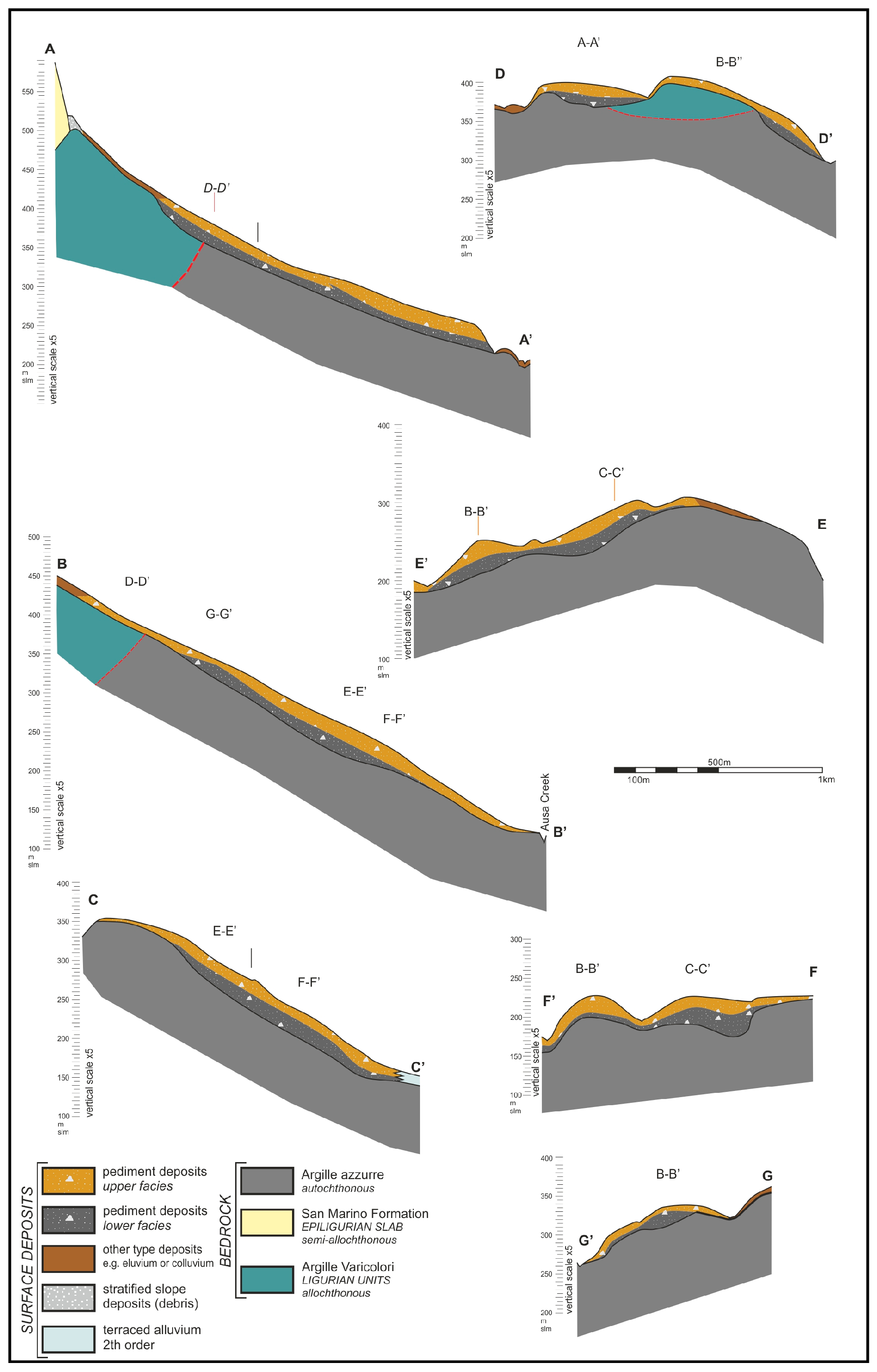
An extensive dataset is available for San Marino, comprising over 600 stratigraphic boreholes, laboratory tests, and specific geological–geotechnical studies carried out mostly over the last 30 years. Cross-sections derived from these data reveal buried morphologies (paleo-topography) featuring scarps and channelized forms filled by pediment deposits, which stand in sharp contrast to the current topography generally characterized by gently dipping surfaces (Figure 5 and Figure 6). The maximum thickness of the pediment deposits in the San Marino area reaches 40 m, with an average estimated thickness of 10–12 m. The abundant geognostic data identify two distinct lithostratigraphic facies within the pediment deposits: the Upper Facies consists of brown to light-brown silty clays containing whitish to yellowish calcareous and calcarenitic debris, sometimes organized in lens-shaped horizons, and calcareous boulders. The Lower Facies consists of grey (occasionally dark grey or polychrome) silty clays containing whitish to yellowish calcareous and calcarenitic debris, also potentially in lens-shaped horizons, and calcareous boulders. A detrital horizon may be present at the contact with the bedrock. The colour is the most noticeable macroscopic difference between the two facies, probably linked to the process of matrix alteration. In both facies, detrital clasts are typically subangular and centimeter-sized. Organic matter, particularly wood or plant remains, is frequently found within the deposits. Extensive laboratory analyses indicate that the clayey matrix of the pediment deposits (in both facies) exhibits very poor geomechanical properties. Residual shear strength angle values are generally lower than 12°, with cohesion near zero under saturated conditions. Furthermore, the presence of clay minerals from the smectite and montmorillonite groups was systematically observed. These results derived from a synthesis of the large number of available laboratory geotechnical data, ranging from grain size analyses, volumetric analyses, determinations of consistency limits (Atterberg limits) and especially direct shear tests with residual values.
In the most advanced part, pediment deposits alternate with second-order terraced alluvial deposits, while it is unclear in relation to other-order alluvial deposits. In this area, in fact, there is no evidence of outcrops that could clarify the relationship between the pediment deposits and the first- and third-order alluvial deposits.

3.3. Montecopiolo Area

The Montecopiolo area is the smallest of the studied sites. The Epiligurian slab of Montecopiolo–Monte Montone exhibits a complex and articulated structural attitude, generally displaying a tilted or arcuate geometry.
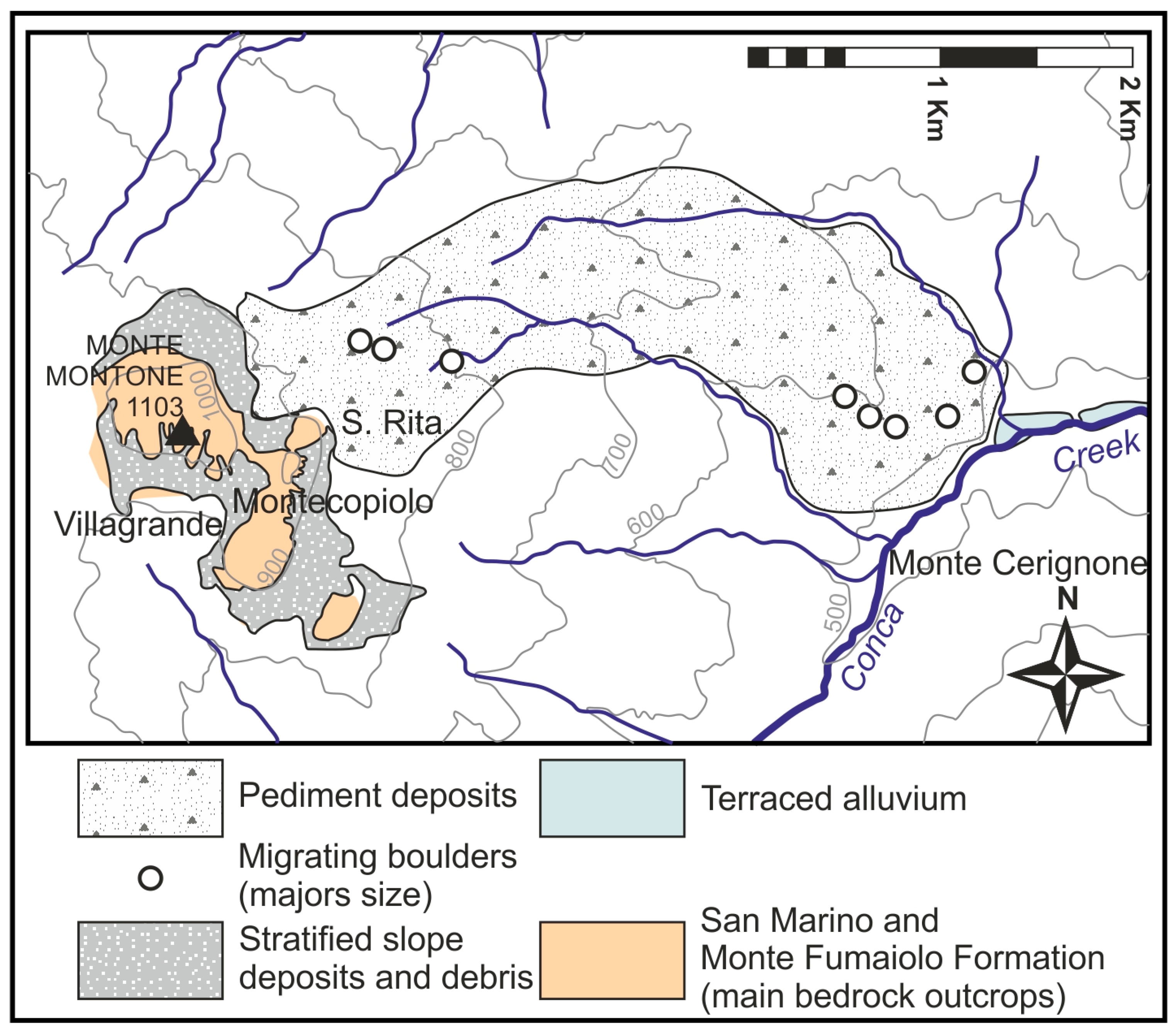
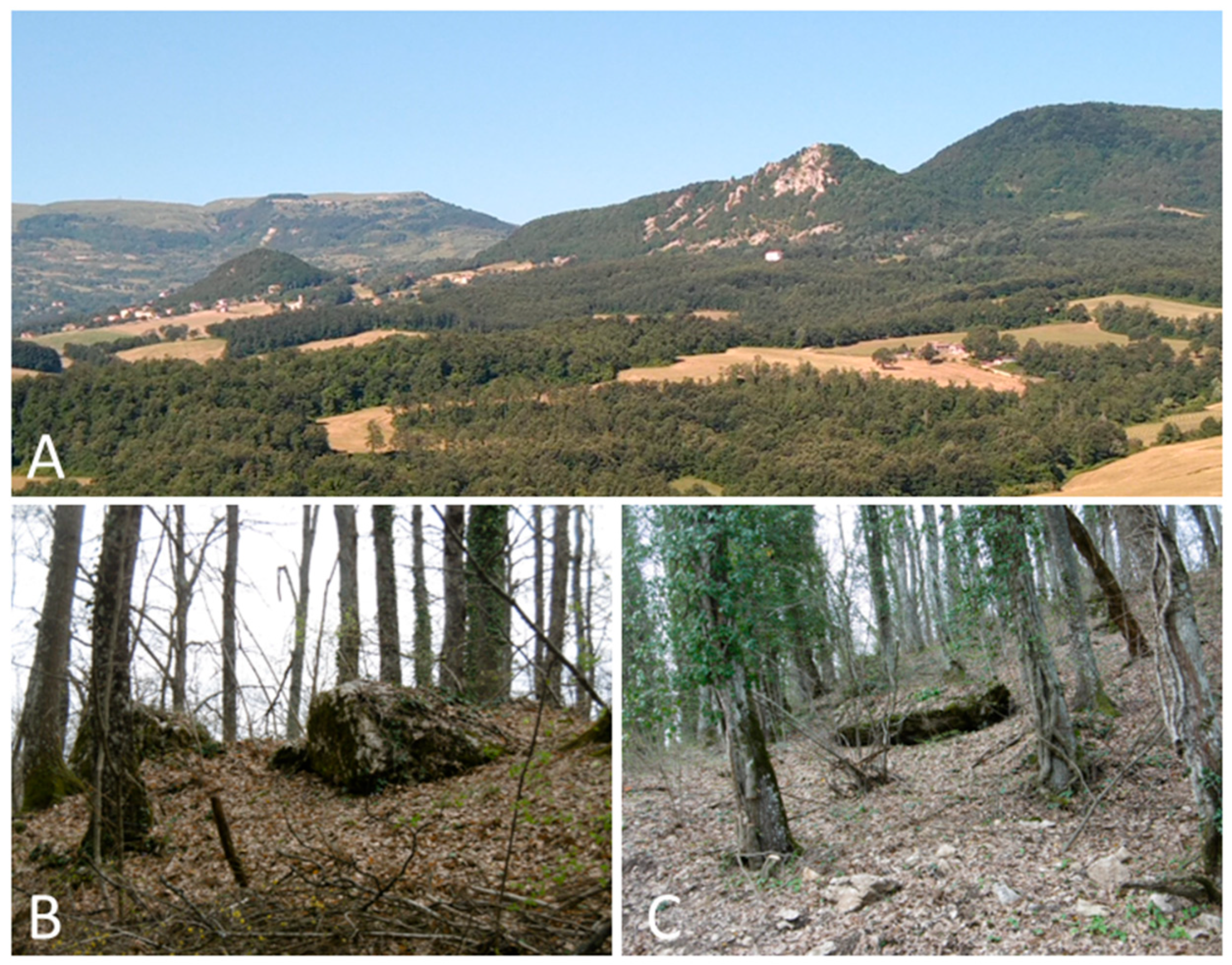
On the eastern flank of Montecopiolo, discontinuous cliffs and rock faces up to 50 m in height are observed; here, very steep slopes predominate, characterized by well-developed and extensive talus deposits (scree slopes). Pediment deposits extend eastward, featuring gentle morphology and low gradients, occasionally exhibiting a channelized appearance (Figure 7). The area occupied by these deposits is estimated at approximately 400 hectares, with the distal limit reaching the course of the Conca Stream. Like the Sassi Simone and Simoncello site, this area is well-preserved with little anthropogenic modification. Several data are available here, including field surveys and geognostic investigations, though the overall dataset remains limited.
Numerous migrating boulders are found, being particularly conspicuous in both the proximal (upper) and distal sectors of the area (Figure 8). In many instances, however, these blocks have been broken up or destroyed due to agricultural activities. In the upper portion of the pediment deposit, the thickness has been determined to be approximately 10 m.

3.4. Sassi Simone and Simoncello Area

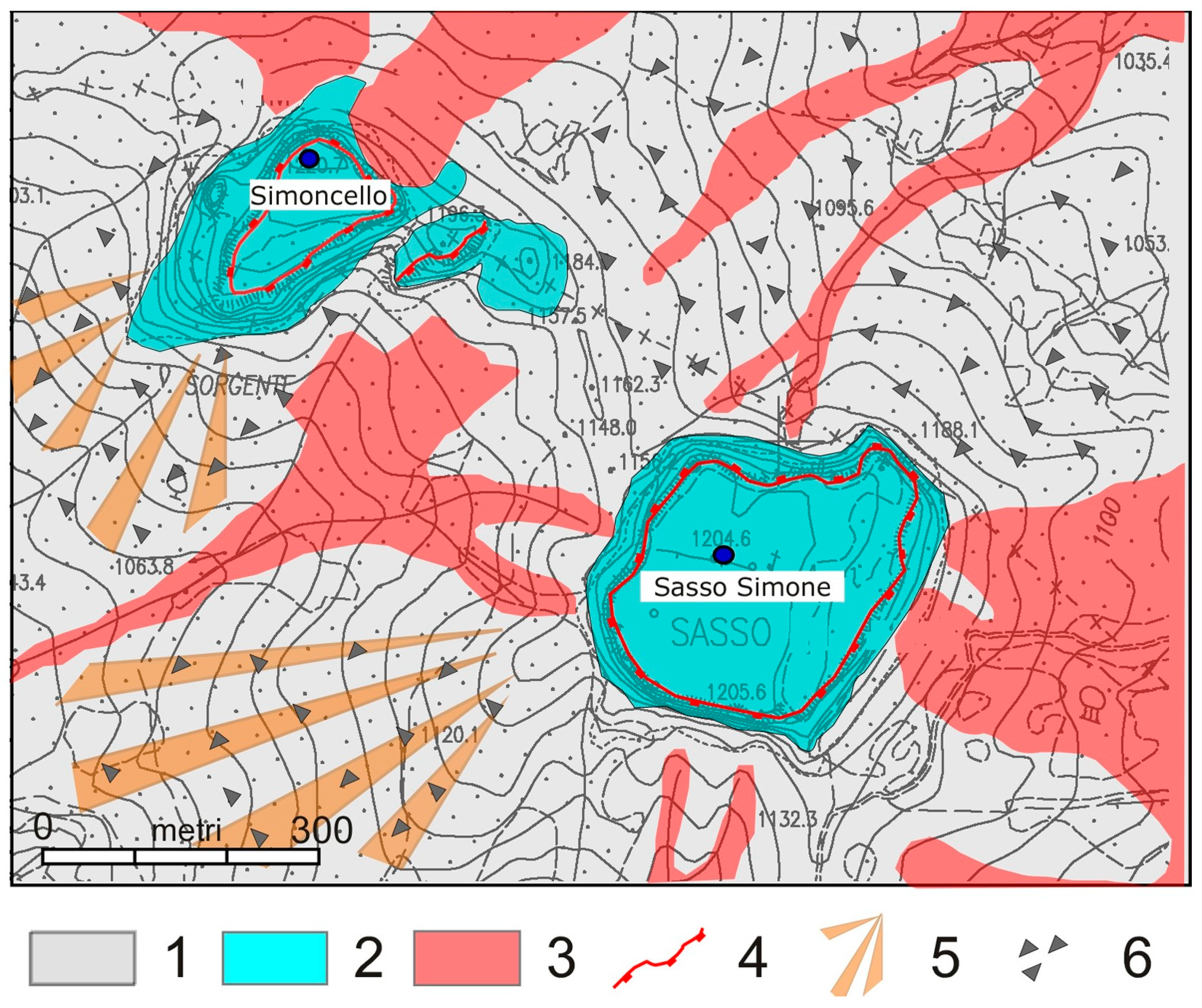
The Sasso Simone and Simoncello area represents the innermost of the selected study sites, situated along the drainage divide separating the Marecchia and Foglia River basins, in close proximity to the main Apennine divide (Figure 9). The area is environmentally pristine, lacking human settlements. From a geological perspective, the reliefs consist of calcarenitic slabs belonging to the San Marino and Monte Fumaiolo Formations (Valmarecchia Nappe).
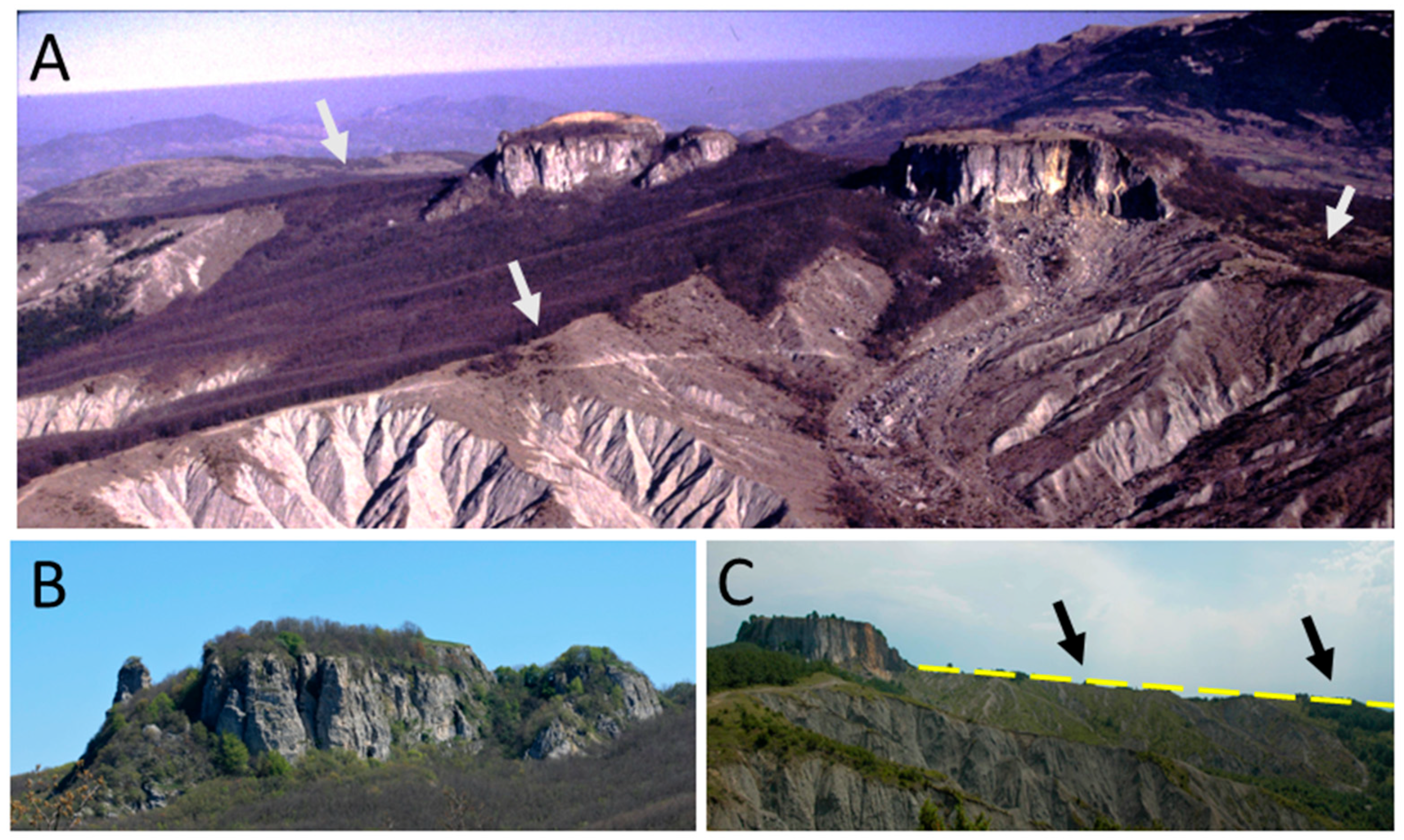
These units lie in an essentially tabular position upon the ductile, clayey bedrock of the Cretaceous Argille Varicolori Formation (Figure 10A). The slabs form prominent topographic features, bounded by continuous rock faces and cliffs up to 80 m high, covering areas of approximately 8.2 hectares (Sasso Simone) and 2.3 hectares (Sasso Simoncello, Figure 10B). Active morphogenetic processes, specifically rockfalls and topples, occur along the slab edges and are particularly intense along the southern margin of Sasso Simone, which borders extensive badlands [66]. The sub-horizontal summit of Sasso Simone is dissected by a network of deep, subvertical fractures clearly visible on the surface and oriented ENE and WSW, which may have facilitated lateral spreading. Pluvial infiltration has progressively widened these discontinuities through karst dissolution, resulting in characteristic aligned karst trenches and closed depressions. These features act as primary structural weaknesses, promoting mechanical instability and driving the lateral spreading processes that affect the entire calcarenitic slab.
Pediment deposits extend primarily along the northern and eastern slopes, covering over 10 km2 with gentle gradients between 4° and 8°. This sector, currently under dense forest cover, is characterized by subdued landforms and widespread scattered boulders. Due to the lack of borehole data or subsurface investigations in this specific area, the stratigraphy of the deposits cannot be directly ascertained. Consequently, the interpretation relies on geomorphological evidence, specifically the low-gradient surfaces extending from the mountain front, the distribution of displaced boulders (Figure 10C), and morphological analogies with other sampled areas.

4. Discussion

The relict geomorphological features allow for the reconstruction of the landscape evolution, which was strongly controlled by distinct climatic phases: under cold climatic conditions, cryoclastism (gelifraction) was the dominant weathering process. Freeze–thaw cycles acting on the fractured calcareous massif caused the detachment of blocks, triggering the gravitational process that leads to significant retreat of the mountain front. The detached blocks were transported across the underlying ductile clayey formations mainly through solifluction, aided by surface runoff and meltwater. This process generated a wide pediment surface allowing blocks to migrate considerable distances even on low-gradient slopes. A subsequent shift to temperate humid conditions increased fluvial energy, promoting the dissection of the pediment. Today, the former extent of the pediment is documented by isolated remnants and blocks resting on ridge crests, separated from the source cliffs by deeply incised gullies. Recent climatic conditions favored the deepening of the drainage network. This erosional phase reduced the reliefs to their current morphology. Debris from retreating scarps is now largely incorporated into earthflows within minor valleys, while sub-vertical fracture systems continue to facilitate mass wasting.
The transition from Lower to Upper Facies highlights a shift in paleoclimatic and morphodynamic conditions. The hazelnut-colored matrix of the Upper Facies presumably suggests a move toward oxidizing conditions and indicating increased water availability. This enhanced moisture likely facilitated and amplified boulder mobility. This facies variation could represent the initial transition toward a warmer climate, corresponding to the Riss–Würm (Eemian) interglacial.
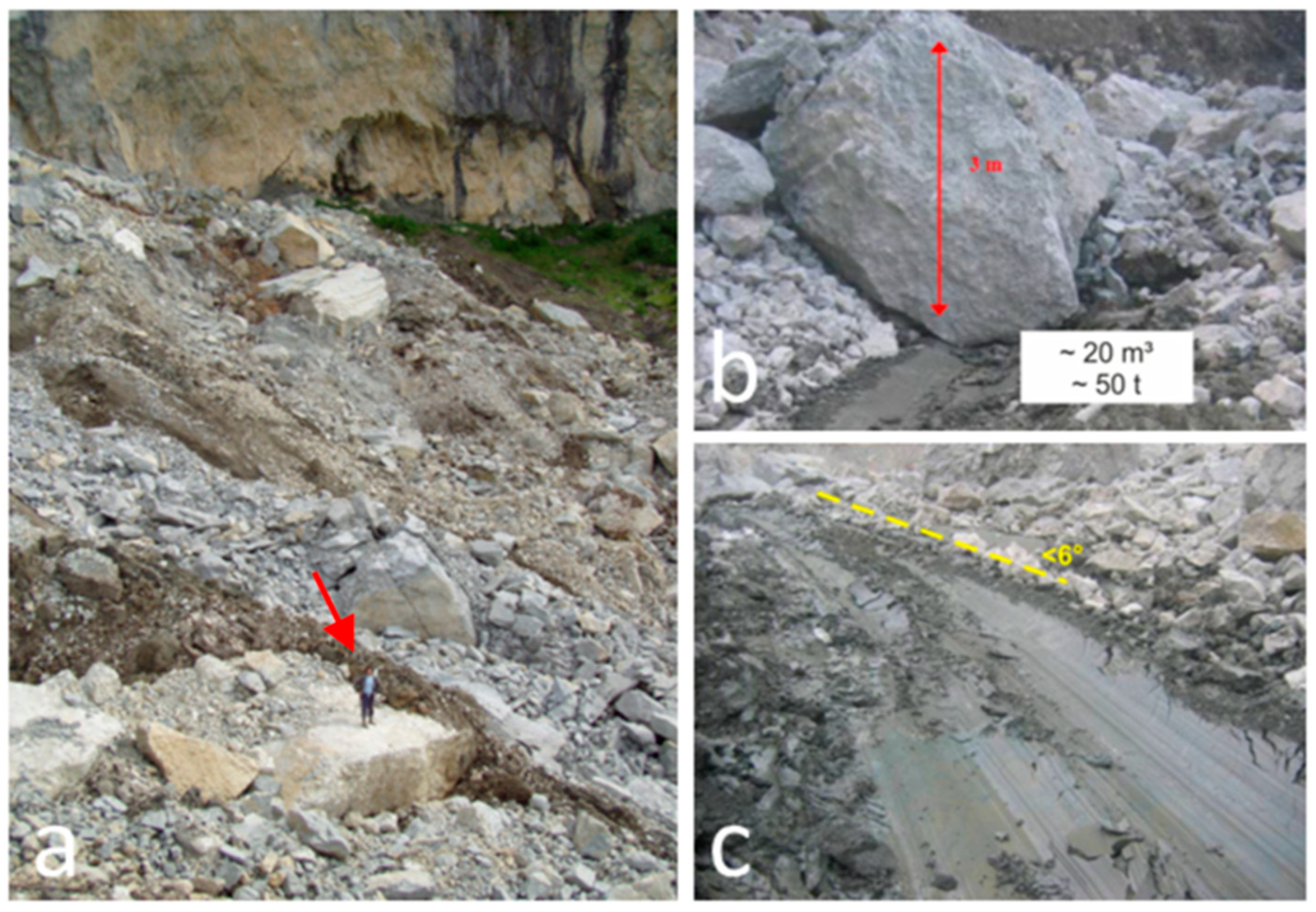
Based on the findings from the surveys and analyses performed, it was possible to propose a geomorphological evolutionary model regarding the formation and emplacement of pediment deposits. The formulation of this hypothesis also drew upon observations following significant instability phenomena affecting the San Leo Epiligurian slab in 2006 [67,68], as well as elements emerging from the study and analysis of historical documentation regarding phenomena at San Leo and other localities [67,69]. For example, following the cited landslide event of 2006, which occurred on the northern edge of the San Leo slab, it was possible to directly observe and document the movement of a large calcareous–calcarenitic block as it slid over the clays. The block, with a volume of approximately 20 m3 and an approximate weight of 50 tons, moved along a surface inclined at less than 6°, covering over 1.5 m in 48 h, with speeds varying from 2 to 15 cm per hour.
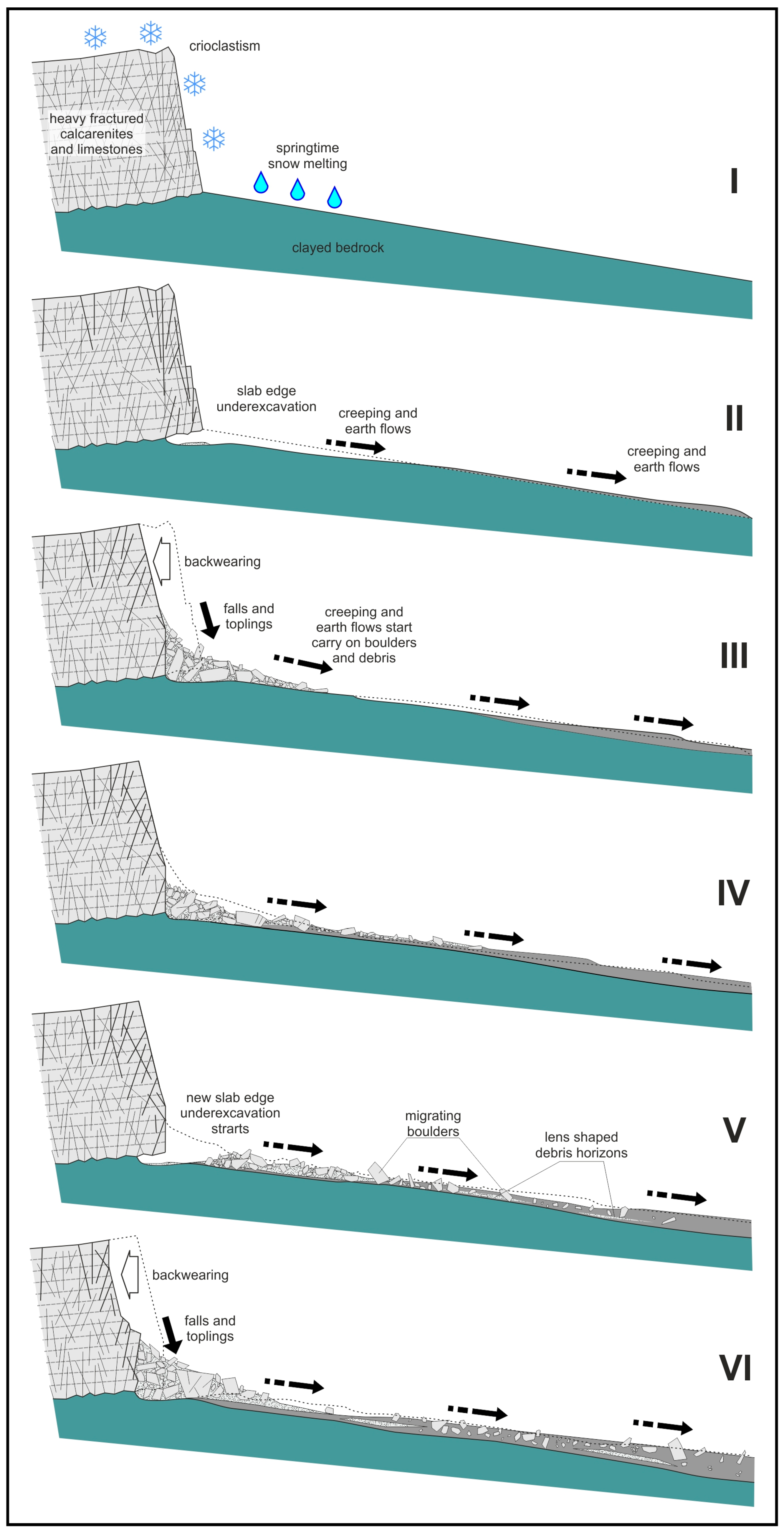
From all these elements, taking into account the climatic conditions existing in the Valmarecchia-Montefeltro area during late glacial periods (long winters with heavy snowfall and months with sub-zero temperatures alternating with short summers featuring rapid snowpack melting) [28], the evolutionary scheme summarized in Figure 11 and described below was hypothesized: (I) The Epiligurian slabs are affected by cryoclastic phenomena favored by the fracturing of the rock mass. During the melting of likely massive snow accumulations, the clayey soils become saturated, leading to a drastic decay in mechanical strength properties. (II) Solifluction and mudflows develop, with progressive undermining of the base of the Epiligurian slabs. (III) Collapse and toppling phenomena occur at the edges of the Epiligurian slabs, with an accumulation of debris and blocks at the base. The debris and blocks are transported by sliding over saturated clays and are involved in new deformation phenomena. (IV) Soil creep and mudflows transport the debris and blocks, emptying the accumulations at the base of the Epiligurian slab walls. Only in this way is the maintenance of the rock walls in a sub-vertical arrangement possible (backwearing, [21]). (V) The base of the Epiligurian slabs is affected by renewed undermining. The pediment deposit assumes typical characteristics, with larger blocks (migrating boulders) becoming morphologically distinct, and lenticular horizons of debris appearing within the moving clay mass. (VI) New collapse and toppling phenomena develop at the edges of the Epiligurian slabs with a new accumulation of debris and blocks at the base. The rock walls undergo renewed retreat (backwearing), and new movements transport debris and blocks downstream. The cycle repeats with new phases analogous to phases IV and V.
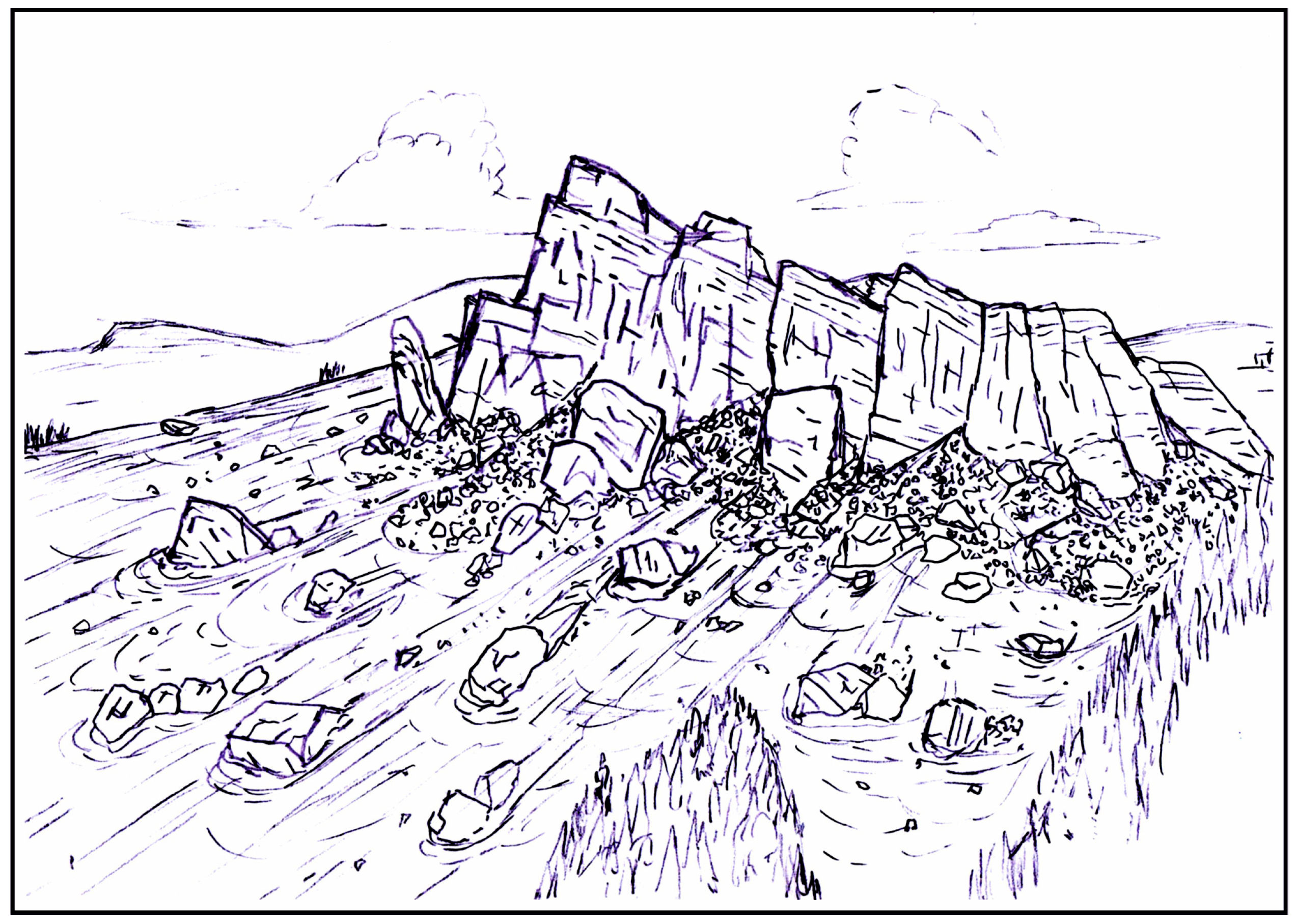
Considering the hypotheses in this evolutionary scheme, one can attempt a paleo-environmental morphological reconstruction of the context in which the formation and emplacement of the pediment deposits and migrating boulders occurred (Figure 12). In a climatic context entirely different from the current one—classifiable as late glacial conditions as previously mentioned—the Epiligurian slabs of Valmarecchia-Montefeltro were subjected to extensive periglacial weathering phenomena [6]. These produced massive debris accumulations at the edges of the slabs, including rock blocks of potentially very large dimensions [70]. The material was then involved in extensive and widespread soil creep and mudflow phenomena, which engulfed, transported, and accumulated the debris and boulders up to several kilometers from the area of origin. This occurred along relatively uniform and gently inclined slopes, defining broad surfaces geomorphologically classifiable as pediments. The largest and most resistant blocks, when remaining in the shallowest parts or when exposed by subsequent selective erosion, constitute the migrating boulders found widely in the zone, becoming a distinctive geomorphological feature of the area. At present the pediment surfaces are deeply incised by the drainage network, and the base of the retreating free escarpment are masked by significant volumes of recent gravity-derived debris (rockfalls, topples, and rolling), which obliterate the upslope boundary of the pediment. Consequently, the migrating boulders located kilometers away from the source area cannot be attributed to modern slope dynamics. Their distal position indicates that the transport mechanism is a relict phenomenon, linked to ancient morphoclimatic phases that are no longer active.
The discovery in this area of a terraced alluvial deposit, referable to a second-order glacial phase that intercalates with the pediment deposit, has made it possible to correlate the latter with the cold phases of the upper Middle Pleistocene (Riss Glaciation). The subsequent interglacial incision (MIS 5e) entrenched the drainage network, decoupling these landforms from modern morphodynamics [6].
This peculiarity of the Valmarecchia–Montefeltro area had long been noted by earth scientists, among whom it is worth remembering Giuseppe Scarabelli (Imola, 1820–1905) [71]. Scarabelli was one of the founders of Italian geology, producing in 1848 the first geological maps performed with modern methods for the territory of the Republic of San Marino. He wrote at the end of the 19th century:“At the same time of alluvium, now displayed in terraced [forms], belong another geological evidence typical of this region (…) that consist in the presence in many place of this slope of big unshaped blocks of Bryozoan Limestone (San Marino Formation), scattered or in groups, far away from their origin.”
In relatively more stable areas, bands of arboreal vegetation develop, which are often subsequently involved in the movements. In subsequent phases, the pediment deposits are reworked by erosive processes. In some cases, they are cut by small valleys belonging to the more recent hydrographic network, while in others, they have significantly conditioned its morphology and trend.
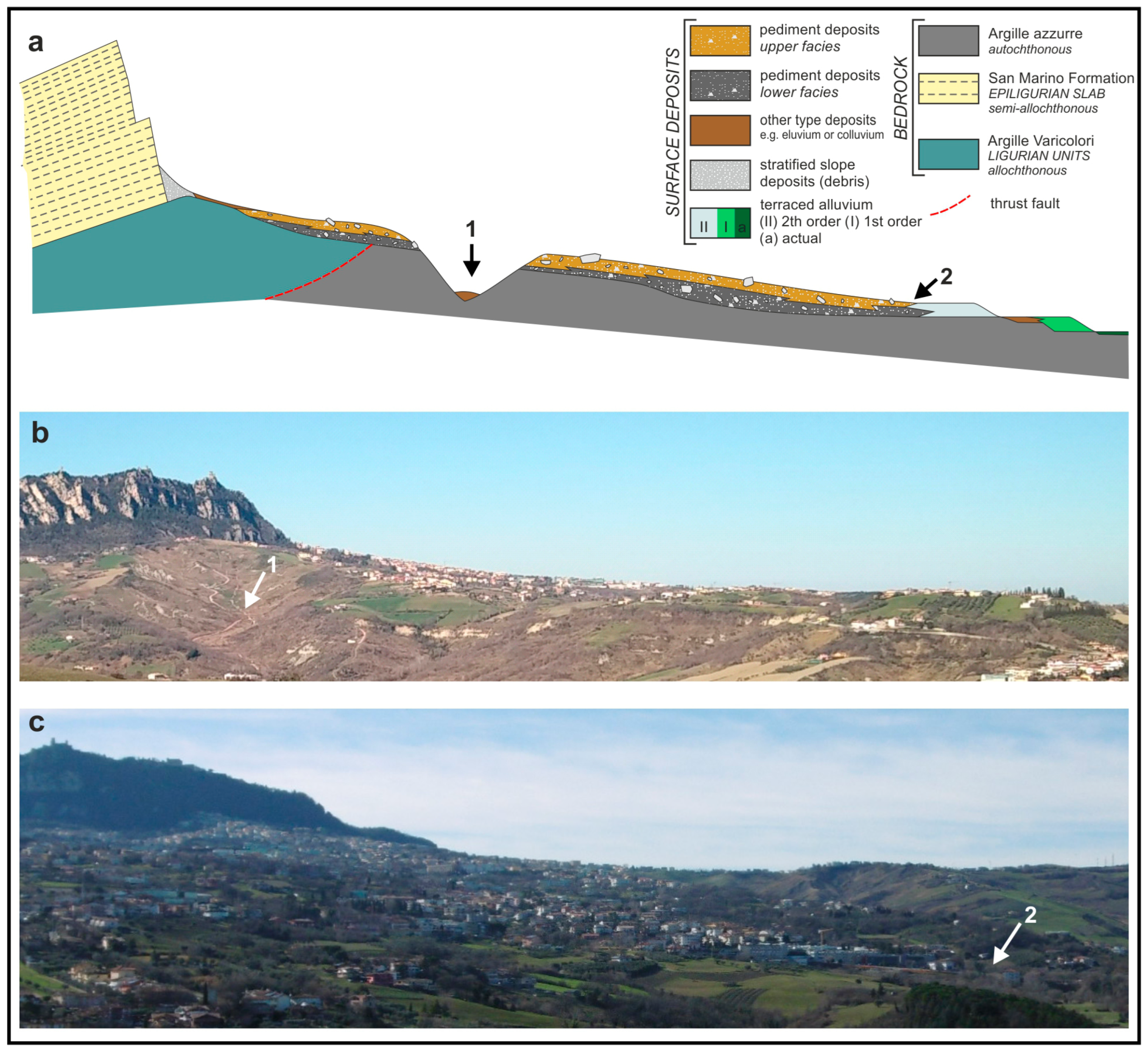
The current arrangement of the pediment deposits is exemplified in Figure 13. From the extent of the pediment deposits, a quantitative assessment can be attempted to estimate the order of magnitude of materials eroded and removed from the Epiligurian slabs, as well as the retreat undergone via backwearing by the cliffs and rock walls at the edges of the slabs. Referring to the San Marino area, the extent of the pediment deposits can be evaluated at 6.75 km2, and an average thickness of 10 m can be hypothesized. Assuming that 15% of the deposit consists of calcareous and calcarenitic material, a volume of debris and boulders embedded in the clay matrix equal to approximately 107 m3 can be quantified. Assuming that the walls and cliffs on the eastern edge of the Monte Titano Epiligurian slab constitute an overall front 100 high and 2 km wide, the retreat is estimated at least 50 m. This is likely a conservative estimate considering that a significant part of the pediment deposits has been eroded and the calcareous elements are now part of the alluvial gravels.

5. Conclusions

Based on the geomorphological surveys and the evolutionary model proposed, the following conclusions can be drawn:
  • Late glacial Evolutionary Context: The genesis of the pediment deposits in the Valmarecchia-Montefeltro area is linked to late glacial climatic conditions. The combination of intense freeze–thaw cycles fracturing the rock mass, followed by rapid snowmelt saturating the underlying clays, triggered extensive soil creep and mudflows.
  • Scientific Innovation and Terminology: This research represents an absolutely innovative contribution to the study of the Montefeltro area. We propose the novel terminology of “Migrating Boulders” to strictly define the large rock blocks that, despite their size, are transported kilometers from their source, moving as distinct kinematic elements within the clay matrix.
  • Transport Mechanism: Field evidence from the 2006 San Leo landslide validates the hypothesis that massive rock volumes (up to 50 tons) can slide along clay surfaces with very low inclination (<6°). This mechanism explains the displacement of the Migrating Boulders found “floating” in pediment deposits far from the original cliffs (Figure 14).
  • Backwearing Dynamics: The continuous evacuation of basal debris by mudflows prevented the burial of the cliff foot. This process maintained the sub-verticality of the Epiligurian slab walls, facilitating a cyclic mechanism of undermining and retreat (backwearing).
  • Quantitative Estimation: Morphometric analysis of the San Marino area estimates the volume of calcareous debris within the pediments at approximately 107 m3. This correlates to a minimum cliff retreat of 50 m for the Monte Titano front, providing a magnitude for these erosive processes over time.
We conclude by emphasising the value of these migrating boulders as characteristic elements of the landscape. In the Republic of San Marino, sites where migrating boulders are well preserved are classified as areas of interest and protected by Law No. 126 of 16 November 1995, the “Framework Law for the Protection of the Environment and the Preservation of the Landscape, Vegetation and Flora”. In addition, the Emilia Romagna Region, with Regional Law 9/2006, has identified several geosites within the study area, as have the Marche and Tuscany Regions.

Author Contributions

Conceptualization, L.V., O.N., V.U. and C.G.; methodology, L.V., O.N., V.U. and C.G.; software, V.U. and C.G.; validation, V.U. and C.G.; formal analysis, V.U. and C.G.; investigation, L.V., O.N., V.U. and C.G.; data curation, L.V., O.N., V.U. and C.G.; writing—original draft preparation, L.V., O.N., V.U. and C.G.; writing—review and editing, L.V., O.N., V.U. and C.G.; supervision, L.V. and C.G.; project administration, L.V. and C.G. All authors have read and agreed to the published version of the manuscript.

Funding

This research received no external funding.

Data Availability Statement

The raw data supporting the conclusions of this article will be made available by the authors on request.

Conflicts of Interest

The authors declare no conflicts of interest.

References

  1. Burnelli, M.; Melelli, L.; Alvioli, M. Land surface diversity: A geomorphodiversity index in Italy. Earth Surf. Process. Landf. 2023, 48, 3025–3040. [Google Scholar] [CrossRef]
  2. Melelli, L.; Vergari, F.; Liucci, L.; Del Monte, M. Geomorphodiversity index: Quantifying the diversity of landforms and physical landscape. Sci. Total Environ. 2017, 584–585, 701–714. [Google Scholar] [CrossRef]
  3. Valentini, L.; Guerra, V.; Lazzari, M. Enhancement of Geoheritage and Development of Geotourism: Comparison and Inferences from Different Experiences of Communication through Art. Geosciences 2022, 12, 264. [Google Scholar] [CrossRef]
  4. Valentini, L.; Guerra, V.; Nesci, O. The Mt. Catria–Mt. Nerone Ridge in the North-Marchean Apennines (Central Italy): A Potential Geopark? Sustainability 2023, 15, 11382. [Google Scholar] [CrossRef]
  5. Nesci, O.; Borchia, R.; Pappafico, G.; Valentini, L. The Background of the Gioconda: Geomorphological and Historical Data from the Montefeltro Area (Tuscan–Emilian Apennines, Central Italy). Land 2025, 14, 1007. [Google Scholar] [CrossRef]
  6. Nesci, O.; Savelli, D.; Troiani, F. Types and development of stream terraces in the Marche Apennines (central Italy): A review and remarks on recent appraisals. Géomorphologie 2012, 2, 215–238. [Google Scholar] [CrossRef]
  7. Coltorti, M.; Dramis, F.; Pambianchi, G. Stratified slope-waste deposits in the Esino River Basin, Umbria-Marche Apennines, Central Italy. Polarforschung 1983, 53, 59–66. [Google Scholar]
  8. Nesci, O.; Savelli, D. Successioni alluvionali terrazzate e variazioni del livello di base nell’area marchigiana settentrionale. Geogr. Fis. Din. Quat. 1991, 14, 149–162. [Google Scholar]
  9. Dramis, F. Il ruolo dei processi periglaciali nell’evoluzione geomorfologica dell’Appennino. Geogr. Fis. Din. Quat. 1992, 15, 219–222. [Google Scholar]
  10. Gentili, B.; Materazzi, M.; Pambianchi, G.; Scalella, G. I depositi di versante del Monte dell’Ascensione (Marche meridionali, Italia). Geogr. Fis. Din. Quat. 1998, 21, 205–214. [Google Scholar]
  11. Dresch, J. Pédiments et glacis d’érosion, pédiplains et inselbergs. Inform. Géogr. 1957, 21, 183–196. [Google Scholar] [CrossRef]
  12. Tricart, J.; Cailleux, A. Introduction to Climatic Geomorphology; de Jonge, C.J.K., Translator; Longman: London, UK; St. Martin’s Press: New York, NY, USA, 1972; pp. 1–295. [Google Scholar]
  13. Gutiérrez Elorza, M. Climatic Geomorphology; Elsevier: Amsterdam, The Netherlands, 2005; pp. 1–760. [Google Scholar]
  14. Mensua, S. El modelado de los piemontes: Los glacis. Ser. Geográfica 1978, 4, 13–26. [Google Scholar]
  15. Castiglioni, G.B.; Girardi, A.; Sauro, U.; Tessari, F. Grèzes litées e falde detritiche stratificate di origine crionivale. Geogr. Fis. Din. Quat. 1979, 2, 64–82. [Google Scholar]
  16. Coltorti, M.; Consoli, M.; Dramis, F.; Gentili, B.; Pambianchi, G. Evoluzione geomorfologica del Bacino del Fiume Esino (Marche—Italia centrale). Geogr. Fis. Din. Quat. 1979, 2, 59–74. [Google Scholar]
  17. Castaldini, D. Superfici Intravallive. Atlante dei Tipi Geografici; Istituto Geografico Militare: Firenze, Italy, 2004; pp. 176–178. [Google Scholar]
  18. Cooke, R.U.; Warren, A. Geomorphology in Deserts; Bastford: London, UK, 1973; pp. 1–436. [Google Scholar]
  19. McGee, W.J. Sheetflood erosion. Geol. Soc. Am. Bull. 1897, 8, 87–112. [Google Scholar] [CrossRef]
  20. White, K. Pediments. In Encyclopedia of Geomorphology; Goudie, A., Ed.; Routledge: London, UK, 2004; pp. 768–771. [Google Scholar]
  21. King, L.C. Canons of landscape evolution. Geol. Soc. Am. Bull. 1953, 64, 721–752. [Google Scholar] [CrossRef]
  22. Johnson, D.W. Rock planes in arid regions. Geogr. Rev. 1932, 22, 656–665. [Google Scholar] [CrossRef]
  23. Büdel, J. Pedimente, rumpffl ächen und rückland Steihänge; deren aktive und passive ruckverlegung in verschiedenen klimaten. Z. Geomorphol. 1970, 14, 1–57. [Google Scholar] [CrossRef]
  24. Dylik, J. Tentative comparison of planation surfaces occurring under warm and under cold semi-arid conditions. Biul. Peryglac. 1957, 5, 175–186. [Google Scholar]
  25. French, H.M. The Periglacial Environment, 3rd ed.; John Wiley & Sons Ltd.: Chichester, UK, 2007; pp. 1–458. [Google Scholar]
  26. French, H.M.; Harry, D.G. Pediments and cold-climate conditions, Barn Mountains, unglaciated northern Yukon, Canada. Geogr. Ann. 1992, 74A, 145–157. [Google Scholar] [CrossRef]
  27. Savelli, D.; Nesci, O.; Mengoni, S. From alluvial fans to intravallive floodplains: A case study from the piedmont terrace alluvium of the upper Musone River basin (Marche Apennines). G. Geol. 1994, 56, 27–42. [Google Scholar]
  28. Guerra, C.; Nesci, O. Glacis Pleistocenici nel Montefeltro (Appennino Marchigiano-Romagnolo). In Studi Geografici in Onore di Severino Belloni; Orombelli, G., Ed.; G. Brigatti: Genova, Italy, 1999; pp. 419–428. [Google Scholar]
  29. Nesci, O.; Savelli, D.; Tramontana, M.; Veneri, F.; De Donatis, M.; Mazzoli, S. The Evolution of Alluvial Fans in the Umbria-Marche-Romagna Apennines (Italy). Boll. Soc. Geol. Ital. 2002, 1, 915–922. [Google Scholar]
  30. Mazzanti, R.; Trevisan, L. Evoluzione della rete idrografica nell’appennino centro-settentrionale. Geogr. Fis. Din. Quat. 1978, 1, 55–62. [Google Scholar]
  31. Guerra, V.; Lazzari, M. Geomorphic Approaches to Estimate Short-Term Erosion Rates. An Example from Valmarecchia River System (Northern Apennines, Italy). Water 2020, 12, 2535. [Google Scholar] [CrossRef]
  32. Guerra, V. Researching Geomorphological Heritage of the Marecchia River Valley. Ph.D. Thesis, University of Urbino, Urbino, Italy, 2022. [Google Scholar]
  33. Spreafico, M.C.; Franci, F.; Bitelli, G.; Girelli, V.A.; Landuzzi, A.; Lucente, C.C.; Mandanici, E.; Tini, M.A.; Borgatti, L. Remote sensing techniques in a multidisciplinary approach for the preservation of cultural heritage sites from natural hazard: The case of Valmarecchia Rock Slabs (RN, Italy). In Engineering Geology for Society and Territory; Lollino, G., Giordan, D., Marunteanu, C., Christaras, B., Yoshinori, I., Margottini, C., Eds.; Springer: Cham, Switzerland, 2015; Volume 8, pp. 317–321. [Google Scholar] [CrossRef]
  34. Cornamusini, G.; Conti, P.; Bonciani, F.; Callegari, I.; Martelli, L. Geology of the ‘Coltre della Val Marecchia’ (Romagna-Marche Northern Apennines, Italy). J. Maps 2017, 13, 207–218. [Google Scholar] [CrossRef]
  35. Argnani, A.; Ricci Lucchi, F. Tertiary silicoclastic turbidite systems of the Northern Apennines. In Anatomy of an Orogen: The Apennines and Adjacent Mediterranean Basins; Vai, G.B., Martini, I.P., Eds.; Kluwer Academic Publishers: Dordrecht, The Netherlands, 2001; pp. 327–350. [Google Scholar] [CrossRef]
  36. Carmignani, L.; Conti, P.; Cornamusini, G.; Meccheri, M. The internal Northern Apennines, the Northern Tyrrhenian Sea and the Sardinia-Corsica Block. In Geology of Italy; Special Volume of the Italian Geological Society for the IGC Florence; Crescenti, S.U., D’Offizi, S., Merlino Sacchi, L., Eds.; Società Geologica Italiana: Rome, Italy, 2004; pp. 59–77. [Google Scholar]
  37. Bonarelli, G. Interpretazione strutturale della regione feltresca. Boll. Soc. Geol. Ital. 1929, 48, 314–316. [Google Scholar]
  38. Selli, R. Il bacino del Metauro. Descrizione geologica, risorse minerarie, idrogeologia. G. Geol. 1954, 24, 1–214. [Google Scholar]
  39. Ricci Lucchi, F. The Oligocene to recent foreland basins of the northern Apennines. In International Association of Sedimentologists Special Publications; Allen, P.A., Homewood, P., Eds.; Blackwell Scientific Publications: Oxford, UK, 1986; Volume 8, pp. 105–139. [Google Scholar]
  40. Conti, S.; Fregni, P.; Gelmin, R. L’età della messa in posto della coltre della Val Marecchia. Implicazioni paleogeografiche e strutturali. Mem. Soc. Geol. Ital. 1987, 39, 143–164. [Google Scholar]
  41. Capozzi, R.; Landuzzi, A.; Negri, A.; Vai, G. Stili deformativi ed evoluzione tettonica della successione neogenica romagnola. Stud. Geol. Camerti 1991, 1, 261–278. [Google Scholar]
  42. Cerrina Feroni, A.; Ghiselli, F.; Leoni, L.; Martelli, L.; Martinelli, P.; Ottria, G.; Sarti, G. L’assenza delle Liguridi nell’Appennino romagnolo: Relazioni tra il sollevamento quaternario e implicazioni strutturali. Alp. Mediterr. Quat. 1997, 10, 371–376. [Google Scholar]
  43. Cerrina Feroni, A.; Ottria, G.; Martinelli, P.; Martelli, L. Carta Geologico-Strutturale dell’Appennino Emiliano-Romagnolo. Scala 1:250.000, Regione Emilia-Romagna; Consiglio Nazionale delle Ricerche: Bologna, Italy, 2002. [Google Scholar]
  44. Conti, P.; Cornamusini, G.; Carmignani, L. An outline of the geology of the Northern Apennines (Italy), with geological map at 1: 250,000 scale. Ital. J. Geosci. 2020, 139, 149–194. [Google Scholar] [CrossRef]
  45. Vai, G.; Castellarin, A. Correlazione sinottica delle unità stratigrafiche nell’Appennino settentrionale. Stud. Geol. Camerti Vol. Spec. 1992, 2, 171–185. [Google Scholar]
  46. Zattin, M.; Picotti, V.; Zuffa, G.G. Fission-track reconstruction of the front of the northern Apennine thrust wedge and overlying Ligurian unit. Am. J. Sci. 2002, 302, 346–379. [Google Scholar] [CrossRef]
  47. Carmignani, L.; Conti, P.; Cornamusini, G.; Pirro, A. Geological map of Tuscany (Italy). J. Maps 2013, 9, 487–497. [Google Scholar] [CrossRef]
  48. Cornamusini, G.; Ielpi, A.; Bonciani, F.; Callegari, I.; Conti, P. Geological map of the Chianti Mts (Northern Apennines, Italy). J. Maps 2012, 8, 22–32. [Google Scholar] [CrossRef]
  49. Conti, S. Geologia dell’Appennino marchigiano-romagnolo tra le valli del Savio e del Foglia. Note illustrative alla carta geologica a scala 1:50,000. Boll. Soc. Geol. Ital. 1990, 108, 453–490. [Google Scholar]
  50. Conti, S. La geologia dell’alta Val Marecchia (Appennino toscomarchigiano). Note illustrative alla carta geologica a scala 1:50.000. Atti Ticinensi Sci. Terra 1995, 37, 51–98. [Google Scholar]
  51. De Feyter, A.J. Gravity tectonics and sedimentation of the Montefeltro, Italy. Geol. Ultraiectina 1991, 35, 1–168. [Google Scholar]
  52. Bonciani, F.; Cornamusini, G.; Callegari, I.; Conti, P.; Foresi, L.M. The role of the “Coltre della Val Marecchia” within the tectonic-sedimentary evolution of the Romagnan-Marchean Apennines. Rend. Soc. Geol. Ital. 2007, 83, 155–190. [Google Scholar]
  53. D’Errico, M.; Di Staso, A.; Morabito, S.; Perrone, V. New stratigraphic data for the Poggio Carnaio Sandstone Fm (Northern Apennines, Italy). Boll. Soc. Geol. Ital. 2014, 133, 5–12. [Google Scholar] [CrossRef]
  54. De Capoa, P.; D’Errico, M.; Di Staso, A.; Perrone, V.; Perrotta, S.; Tiberi, V. The succession of the Val Marecchia Nappe (Northern Apennines, Italy) in the light of new field and biostratigraphic data. Swiss J. Geosci. 2015, 108, 35–54. [Google Scholar] [CrossRef]
  55. Conti, S.; Fioroni, C.; Fontana, D.; Grillenzoni, C. Depositional history of the Epiligurian wedge-top basin in the Val Marecchia area (northern Apennines, Italy): A revision of the Burdigalian-Tortonian succession. Ital. J. Geosci. 2016, 135, 324–335. [Google Scholar] [CrossRef]
  56. Tinterri, R.; Tagliaferri, A. The syntectonic evolution of foredeep turbidites related to basin segmentation: Facies response to the increase in tectonic confinement (Marnoso-arenacea Formation, Miocene, Northern Apennines, Italy). Mar. Pet. Geol. 2015, 67, 81–110. [Google Scholar] [CrossRef]
  57. Ricci Lucchi, F. The foreland basin system of the Northern Apennines and related clastic wedges: A preliminary outline. G. Geol. 1986, 48, 165–185. [Google Scholar]
  58. Cantalamessa, G.; Centamore, E.; Chiocchini, U.; Micarelli, A.; Potetti, M. Il Miocene delle Marche. Stud. Geol. Camerti Geol. Marche 1986, 35–55. Available online: http://193.204.8.201:8080/jspui/bitstream/1336/196/1/Vol.%20Geologia%20Marche%20Capitolo%203.pdf (accessed on 20 March 2026).
  59. Centamore, E.; Chiocchini, U.; Cipriani, N.; Deian, G.; Micarelli, A. Analisi dell’evoluzione tettonico- sedimentaria dei “Bacini Minori” torbiditici del Miocene Medio-Superiore nell’Appennino umbro-marchigiano e laziale-abruzzese. Mem. Soc. Geol. Ital. 1978, 18, 135–170. [Google Scholar]
  60. Roveri, M.; Manzi, V.; Bassetti, M.; Merini, M.; Ricci Lucchi, F. Stratigraphy of the Messinian post-evaporitic stage in eastern-Romagna (northern Apennines, Italy). G. Geol. 1998, 60, 119–142. [Google Scholar]
  61. Ricci Lucchi, F. Semi-allochthonous sedimentation in the Apenninic thrust belt. Sediment. Geol. 1987, 50, 119–134. [Google Scholar] [CrossRef]
  62. Nesci, O.; Savelli, D.; Diligenti, A.; Marinangeli, D. Geomorphological sites in the northern Marche (Italy). Examples from autochthon anticline ridges and from Val Marecchia allochthon. Il Quat. Ital. J. Quat. Sci. 2005, 18, 77–89. [Google Scholar]
  63. Casagli, N. Meccanismi di Instabilità in Indotti dal Contrasto di Competenza in Ammassi Rocciosi su un Substrato Deformabile. Ph.D. Thesis, University of Milan, Milan, Italy, 1994. [Google Scholar]
  64. D’Ambra, S.; Giglio, G.; Lembo-Fazio, A. Interventi di sistemazione e stabilizzazione della Rupe di San Leo. In Proceedings of the 10° Congress INTERPRAEVENT, Riva del Garda, Italy, 24–27 May 2004; Volume 2, pp. 103–114. [Google Scholar]
  65. Carnevali, L.; Nesci, O. Il Paesaggio Marchigiano, Esercizi di Lettura; Quattroventi Ed.: Urbino, Italy, 2005; pp. 1–87. [Google Scholar]
  66. Valentini, L.; Nesci, O. A new approach to enhance the appeal of the Italian territory through art: Three study cases from Marche Region. Arab. J. Geosci. 2021, 14, 144. [Google Scholar] [CrossRef]
  67. Donati, D.; Guerra, C.; Bonaga, G.; Ghirotti, M.; Stead, D.; Borgatti, L. Application of numerical methods for the study of the 2014 San Leo Landslide (Morthern Italy): Challenges and lessons learned. Ital. J. Eng. Geol. Environ. (IJEGE) 2024, 2, 45–56. [Google Scholar] [CrossRef]
  68. Borgatti, L.; Guerra, C.; Nesci, O.; Romeo, R.W.; Veneri, F.; Landuzzi, A.; Benedetti, G.; Marchi, G.; Lucente, C.C. The 27 February 2014 San Leo landslide (northern Italy). Landslides 2015, 12, 387–394. [Google Scholar] [CrossRef]
  69. Benedetti, G.; Bernardi, M.; Borgatti, L.; Ghirotti, M.; Guerra, C.; Landuzzi, A.; Lucente, C.C.; Marchi, G.F. San Leo: Ten centuries of coexistence with landslides. In Landslide Science and Pratice; Margottini, C., Canuti, P., Sassa, K., Eds.; Springer: Berlin/Heidelberg, Germany, 2013. [Google Scholar] [CrossRef]
  70. Luino, F.; Turconi, L. Translational Rock-Block Slides in a Tertiary Flyschoid Complexes of Southern Piedmont Region (North-West Italy). In Landslides—Investigation and Monitoring 2020; IntechOpen: London, UK, 2020. [Google Scholar] [CrossRef]
  71. Scarabelli, G. Descrizione della Carta Geologica del Versante Settentrionale dell’Appennino fra il Montone e la Foglia; Litografia Thumb: Forlì, Italy, 1880. [Google Scholar]
Figure 1. Schematic geological map of the Umbria–Marche–Romagna Apennines. The black box indicates the area covered by the study.
Land 15 00525 g001
Figure 2. Distribution of pediment deposits and migrating boulders over the Valmarecchia sheet. 1. Pediment deposits; 2. San Marino and Monte Fumaiolo Formations; 3. Boundary of the Valmarecchia sheet; 4. Umbria–Marchean Succession; 5. San Marino, Montecopiolo and Simone–Simoncello sample areas; green line: boundary of the Republic of San Marino.
Land 15 00525 g002
Figure 3. Extension of pediment deposits and position of major migrating boulders in the San Marino area.
Land 15 00525 g003
Figure 4. Migrating boulders in San Marino area.
Land 15 00525 g004
Figure 5. (Left): Extension of pediment deposits and position of major migrating boulders in the San Marino area. Red lines: traces of stratigraphic sections. The capital letters (A-A’ etc.) indicate the corresponding stratigraphic section shown in Figure 6. (Right): Stratigraphic sketch of the Upper and Lower Facies of pediment deposits.
Land 15 00525 g005
Figure 6. Stratigraphic sections. The capital letters (A-A’ etc.) indicate the corresponding stratigraphic section shown in Figure 5. The sections highlight the distinction between the Lower and Upper Facies of debris in pediment deposits.
Land 15 00525 g006
Figure 7. Extension of pediment deposits and position of major migrating boulders in the Montecopiolo area.
Land 15 00525 g007
Figure 8. (A) Pediment surface (4–6° deep), (B,C) Migrating boulders in the Montecopiolo area.
Land 15 00525 g008
Figure 9. Geomorphological sketch map of the Sassi Simone and Simoncello area (modified from [65]. Legend: 1. Varicolored Clays of the Val Marecchia; 2. San Marino and Monte Fumaiolo Formations; 3. Rockfalls and debris flows; 4. Erosion scarps; 5. Preserved remnants of the pediment; 6. Landslide blocks originating from Sassi Simone and Simoncello.
Land 15 00525 g009
Figure 10. Overviews of Sassi Simone and Simoncello. (A) Aerial photo of the tabular blocks and the pediments, indicated by the white arrows. (B) Prominent joints along the Sasso Simoncello escarpment. (C) Sasso Simone and the remnants of its pediment, indicated by the yellow shaded line. The black arrows highlight the position of migrating boulders, not visible at this distance.
Land 15 00525 g010
Figure 11. Evolutionary pattern of slope retreat and formation of pediment deposits.
Land 15 00525 g011
Figure 12. Palaeoenvironmental reconstruction (hand drawing by C. Guerra).
Land 15 00525 g012
Figure 13. (a) Morphostratigraphic scheme of the pediment surface evolution. (b,c) represent panoramic views of the pediment surfaces from different perspectives of the San Marino area: (b) arrow 1 indicates the fluvial incision; (c) arrow 2 indicates the second-order terrace and alluvial deposits.
Land 15 00525 g013
Figure 14. (a,b) The 2006 landslide in the San Leo area. Large blocks detached from the wall are visible; (c) example of a sliding surface in the Argille Varicolori Formation behind the block in (b). Scale is indicated by the red arrow (human figure); the yellow dotted line delineates the calculated slope gradient.
Land 15 00525 g014
Table 1. Left: 265 boulders have been recorded in the San Marino area and classified by volume (each boulder was estimated by measuring its three dimensions). The table shows the breakdown by volume category, ranging from 1 to 10,000 m3. Right: The histogram shows the ratio between the number of boulders and their volume.
Size (m3)ClassNumber of Boulders
1 to 3197Land 15 00525 i001
4 to 8266
9 to 27357
28 to 64419
65 to 125510
126 to 21669
217 to 50074
Vol. > 50183
Disclaimer/Publisher’s Note: The statements, opinions and data contained in all publications are solely those of the individual author(s) and contributor(s) and not of MDPI and/or the editor(s). MDPI and/or the editor(s) disclaim responsibility for any injury to people or property resulting from any ideas, methods, instructions or products referred to in the content.