


Abstract
Rapid urbanization has intensified the mismatch between urban green space (UGS) and urban spatial vitality (USV), hindering sustainable development. To address this, we developed the Urban Green Space Vitality Adaptation Model (UGSVAM) and analyzed 64 subdistricts in central Nanjing. Specifically, this study asks: Does the mismatch exist? What are its spatiotemporal patterns? What factors drive it? Methodologically, we use the Gini coefficient and Lorenz curve to assess overall UGS-USV adaptation, then construct the Urban Green Space Vitality Density (UGVD) indicator to quantify the match level, classifying units as overloaded, underloaded, or balanced. OLS and GWR reveal global and local influencing mechanisms, while quadrant analysis supports differentiated planning. Results show: (1) UGS-USV adaptation in Nanjing is weak, with Gini coefficients of 0.466 (weekday) and 0.456 (weekend). UGVD exhibits a spatial pattern of a primary overload core in the central city, a secondary core in the southwest, and peripheral decline, with the southeast underloaded. Overloaded units also show notable temporal variation. (2) Globally POI density and intersection density promote UGVD, while excessive transport facilities, air pollution, and high temperatures inhibit it—ecological factors have stronger weekend effects. (3) Locally, the northeast is more sensitive to POI density, the southwest to transport and heat, and the Jiangbei New Area could enhance green space carrying capacity through transport optimization and spatial integration. The UGSVAM integrates spatial diagnosis, mechanism analysis, and planning response, offering a transferable framework for refining green space governance in high-density cities.
1. Introduction
Urban green spaces (UGSs) are vital components of urban ecosystems, playing a crucial role in modern cities [1]. UGSs like green roofs and parks improve air quality, mitigate the urban heat island effect [2], reduce psychological stress [3], encourage exercise and social interactions, and enhance the quality of life [4,5]. However, rapid urbanization, economic-driven land allocation, and intensive construction pressure UGS distribution [6]. Urban Space Vitality (USV) reflects the capacity and utilization efficiency of the built environment, serving as a crucial benchmark for measuring the intensity of urban economic and social activities [7]. Within this framework, the vitality of urban public green spaces not only concerns residents’ quality of life and psychological well-being but also serves as the foundation for sustaining urban sustainable development capacity [8]. Despite the importance of UGS and urban spatial vitality (USV) as indicators of urban development [9], social economic expansion often reduces and fragments UGSs, weakening their benefits [10].
The equitable distribution of UGS varies significantly across urban patterns and social characteristics [11]. In some areas, excessive development has led to UGS loss, failing to meet residents’ needs, while others suffer from lagging planning or single-function spaces that do not activate spatial vitality [12]. Existing studies often focus on park-type UGS and USV [13,14], overlooking micro-scale UGSs like street trees and lacking in-depth analysis of UGS’s vitality capacity. Additionally, research on green justice mainly examines accessibility [15], without fully addressing the causes of UGS resource inequities or their dynamic balance with urban vitality [7].
Is there a mismatch between urban green space and urban spatial vitality? What spatiotemporal differentiation does it exhibit? Which urban environmental elements dominate its formation? To address these questions, this study innovatively constructs, at the theoretical level, a four-dimensional evaluation system: the Urban Green Space Vitality Adaptability Model (UGSVAM). This model systematically reveals the spatial and temporal heterogeneity of the carrying capacity mechanism of UGS vitality. Through multi-scale analysis, it delves into the intrinsic causes of inequitable urban green resource allocation, thereby addressing the shortcomings of existing research. At the practical level, the study empirically identifies overloaded and underloaded UGS areas in Nanjing, China, providing a scientific basis for reconciling the conflict between UGS and USV and for optimizing the allocation of urban green resources.
The findings provide decision-making support for sustainable planning in Nanjing and similar cities. By optimizing UGS layout and function, resource efficiency can be improved, promoting social equity and ecological benefits. This study expands urban ecology frameworks and offers practical paths for green urban development. The paper includes Section 2, which reviews urban vitality, carrying capacity, and green space equity, Section 3, which introduces the UGSVA model, data, and methods, and Section 4, which presents adaptability analysis, UGVD classification, and environmental mechanisms; Section 5 and Section 6 discuss and conclude the results.
2. Literature Review
2.1. The Evolution of Multi-Dimensional Vitality Indicators Construction
In the 1960s, Jacobs [7] introduced the concept of urban vitality, referring to the dynamic and diverse urban life formed by the interweaving of human activities and living spaces. It is a multi-dimensional composite indicator that comprehensively reflects the performance of the built environment under the combined influence of multiple factors such as population activities, facility density, and socio-economic intensity. Maas [16] further associated it with spatial quality. A vibrant city often presents itself as a well-planned and easily identifiable spatial form [17,18].
Existing studies on vitality indicator construction have developed various proxy methods. Early research used single data sources, such as Flickr images [1], night-time light data (NTL) [19,20], and population heatmaps or shared bike data [21]. With diverse urban data emerging, vitality indicators have shifted to multi-dimensional evaluations, offering richer analytical perspectives.
Zhang, Liu, Tan, Jia, Senousi, Huang, Yin and Zhang [19] used a cellular automaton (CA) model for vitality indicators; Pan et al. [22] developed a multi-scale framework based on population, economy, and function. Xu et al. [23] added commercial indicators like bubble tea and coffee shop density, offering new research perspectives.
Dogan and Lee [24] proposed a three-dimensional vitality assessment framework based on Jacobs’ theory, emphasizing the role of multi-source data in characterizing vitality types. Mouratidis and Delclòs-Alió [25] developed and tested a model linking the built environment, urban vitality, neighborhood satisfaction, and well-being. Ref. [26] established a system for evaluating park vitality from a user perspective. However, existing studies either explore overall urban vitality or assess specific green spaces in isolation. A dedicated indicator system for integrated green space vitality has yet to be established, and its carrying mechanism remains unclear.
2.2. The Development of Urban Carrying Capacity Research
The concept of carrying capacity (CC), introduced by Malthus [27], was later extended from population–resource limits to resource and environmental constraints [28,29]. Bernard and Thom [30] introduced it into urban studies, forming the basis of “Urban Carrying Capacity (UCC).” Subsequent studies expanded UCC from a macro population–environment perspective to multi-dimensional assessments of urban land, resource, and environmental support capacity [31,32,33]. Recent research further emphasizes differentiated land-population strategies, temporal prediction, and micro-scale spatial diagnosis [34,35,36]. Dong et al. [37] expanded to temporal prediction and micro-scale analysis. Importantly, You et al. [38] subdivided carrying capacity into ecological, social, and economic dimensions, indicating that Urban Carrying Capacity should be understood as a composite relationship rather than a single threshold.
Within this broader UCC framework, research on green spaces has mainly developed along two directions. One direction focuses on the ecological or ecotourism carrying capacity of specific green spaces, such as wetland parks, emphasizing environmental protection and threshold-based management [39]. The other direction examines green space capacity from the perspectives of spatial equity, accessibility, and population distribution. Wu et al. [40] showed that green space capacity inequality may vary across spatial scales, while Ye et al. [41] measured green space capacity by integrating a carrying capacity-based accessibility approach with location big data. Zong and Zeng [42] further linked blue-green spatial patterns to population distribution, suggesting that carrying capacity is closely related not only to green space quantity but also to the spatial organization of urban demand. In the context of summer heat periods, the carrying capacity of urban green spaces should also be interpreted with attention to their thermal environment performance. Beyond accommodating human activity, UGSs are expected to provide cooling and heat mitigation services that support outdoor use and urban vitality [43,44]. Therefore, where green spaces have limited effectiveness in mitigating local heating effects, their realized carrying capacity performance may also be constrained.
However, existing research still has limitations. Although studies have demonstrated a close relationship between urban green spaces and human activities [26], most studies remain focused on a single type of green space or assessments based on ecology or accessibility, paying insufficient attention to the adaptive contradiction between the distribution of diverse urban green spaces and human activities. To address this, the “carrying capacity” explored in this study is neither the traditional ecological carrying capacity defined by biophysical thresholds nor economic carrying capacity, but rather the carrying relationship between the supply of urban green spaces and urban spatial vitality (USV) at the subdistrict scale. Based on this, this study introduces a spatiotemporally sensitive framework to assess whether existing green space resources can meet the intensity of human activities across different time periods.
2.3. Theoretical Expansion and Practical Exploration of Green Space Equity Research
Environmental justice theory underpins green space equity research, promoting balanced green infrastructure [45]. The three-dimensional framework of distribution, interaction, and procedure proposed by Enssle and Kabisch [46] has enriched the theoretical implications of environmental justice. Holt and Borsuk [47] used Zillow data and hedonic pricing to assess UGS’s impact on housing prices, focusing on the economic dimension. Guo et al. [48] developed the “node-place-green” model, highlighting UGS’s surrounding attributes but ignoring population flow’s impact on resource demand. While offering diverse perspectives on green space equity, these studies have theoretical and methodological limitations.
Accessibility analysis is key for assessing green space equity. Yang et al. [49] explored rail transit’s impact on UGS equity, but a single accessibility indicator is insufficient. Ke et al. [50] found that including non-park UGS (NPGS) improved equity assessments, emphasizing the need for a multi-dimensional evaluation system. Urban spatial vitality (USV) provides a new perspective on green space equity [9]. Qiu et al. [51] assessed urban trail vitality and green movement spaces, while Lu et al. [52] analyzed road accessibility’s impact on commercial and park vitality, offering valuable insights for refined planning.
Micro-scale research has enhanced understanding of green space equity. Zhou et al. [53] found that street greening, such as tree spacing and shading, boosts vitality in high temperatures. Ma, Pellegrini and Han [26] analyzed small park vitality and usage, recommending optimized layouts. However, studies often overlook seasonal and population flow effects, limiting accuracy. A spatiotemporal dynamic evaluation framework is crucial for future research on green space equity.
3. Methodology
3.1. Theoretical Model
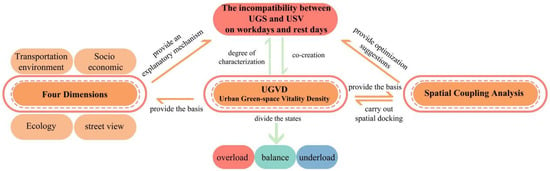
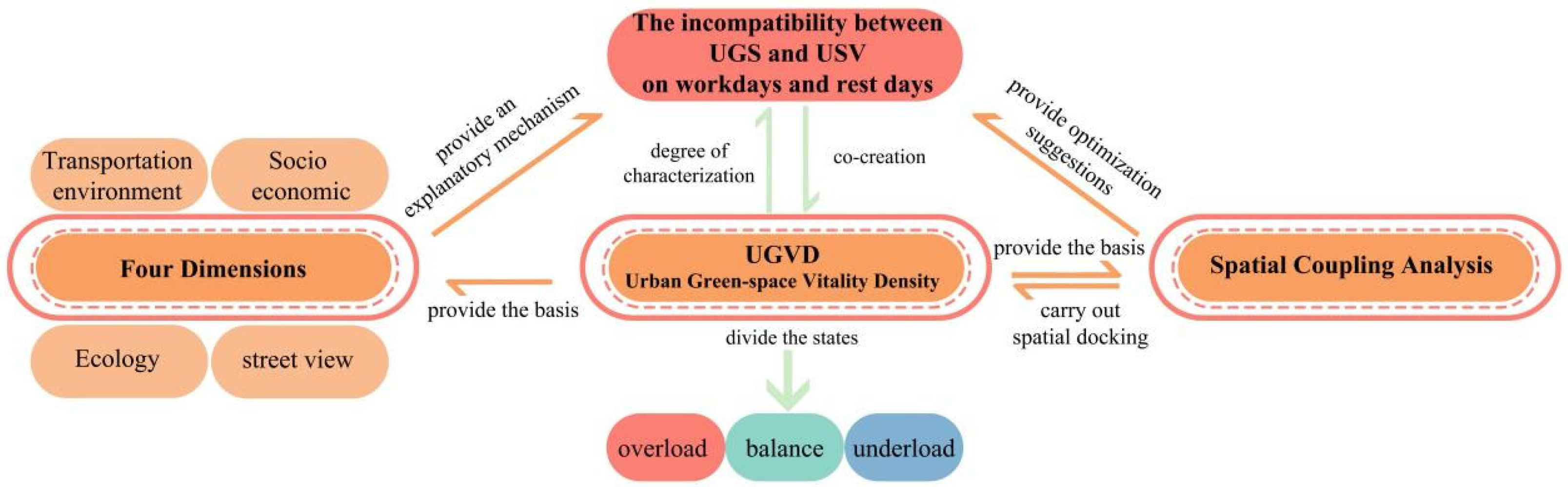
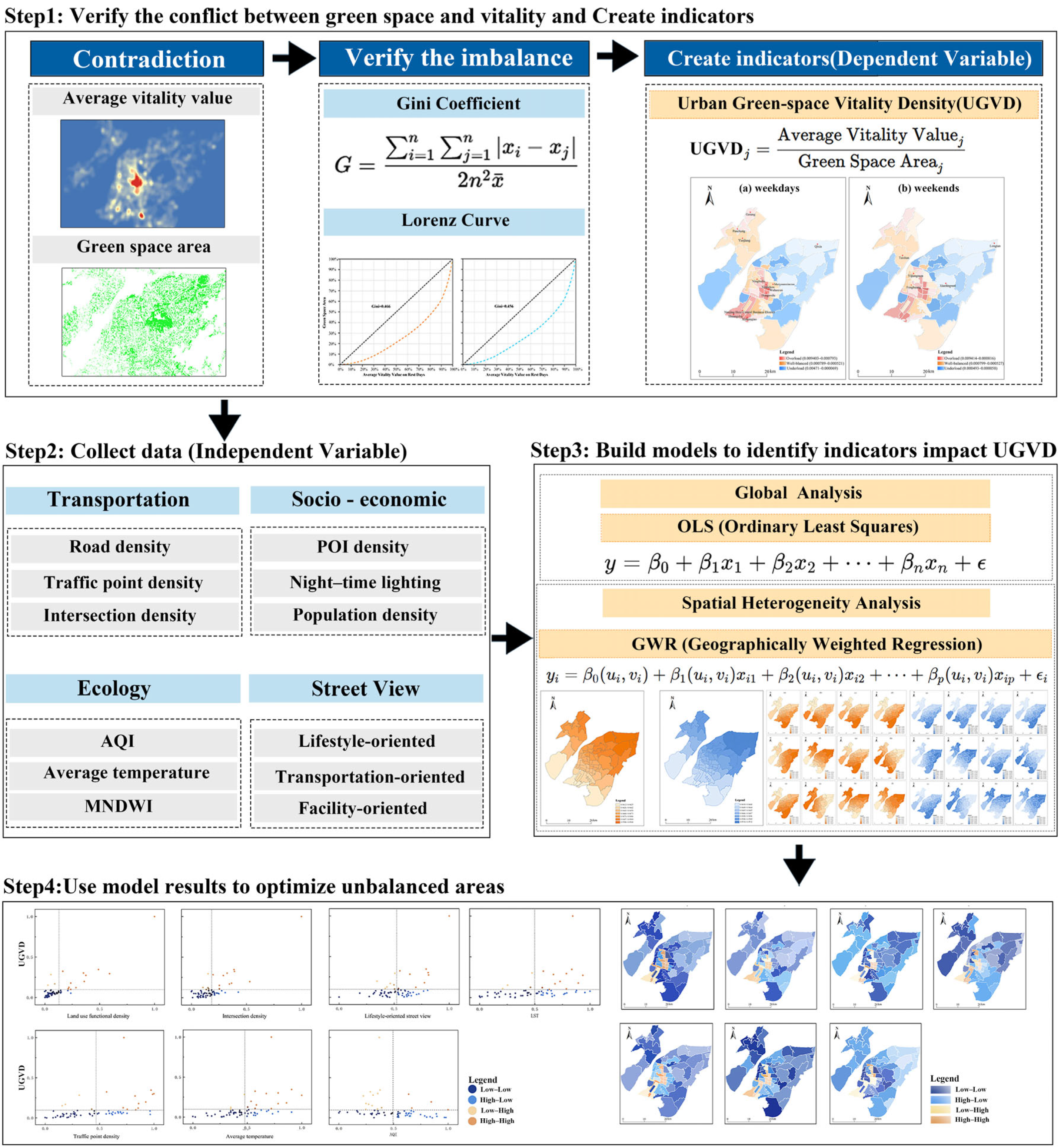
In rapid urban development, urban green spaces (UGSs) face pressure for equitable distribution [11], while high-density urban vitality (USV) exacerbates UGS compression [6]. Addressing the reliance on accessibility and neglect of carrying capacity [54,55], this study constructs the Urban Green Space Vitality Adaptability Model (UGSVAM), shown in Figure 1. The model introduces Urban Green Space Vitality Density (UGVD) and provides a framework for evaluation, analysis, and optimization: it quantifies the carrying capacity of UGS (overloaded, underloaded, balanced), analyzes UGVD’s mechanisms across four dimensions—transportation, socio-economy, ecology, and streetscape—and supports differentiated governance via spatial coupling analysis.
Figure 1.
Urban Green Space Vitality Adaptability Model.
The UGSVAM has three features: (1) the UGVD indicator innovatively enables a multi-temporal quantitative assessment of UGS carrying capacity, providing a unified standard for adaptability analysis; (2) the four-dimensional analysis reveals complex interactions explaining adaptability differences; and (3) the spatial coupling method connects results with planning. These components interrelate: UGVD assessment forms the foundation, four-dimensional analysis explains mechanisms, and spatial coupling guides optimization. This model fills gaps in dynamic assessment and mechanism analysis, offering a tool for coordinating UGS and USV development.
3.2. Study Area
This study selects Nanjing, China, as an empirical case. Nanjing covers 6587.02 square kilometers, with a population of 9.547 million in 2023 (https://tjj.nanjing.gov.cn/site/tjj/ (accessed on 28 November 2024)). As a national ecological garden city, its green space coverage rate is 40.86%, with 16.23 square meters of park green space per capita (https://ylj.nanjing.gov.cn (accessed on 28 November 2024)).
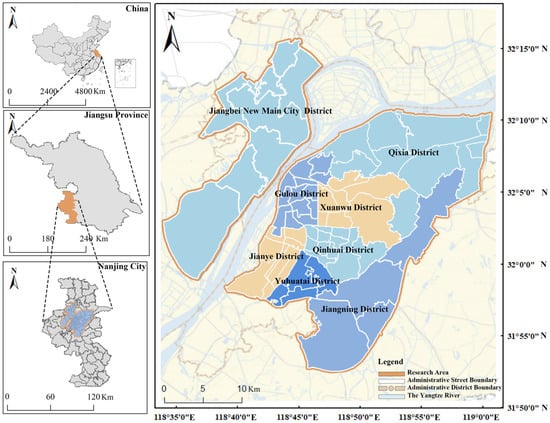
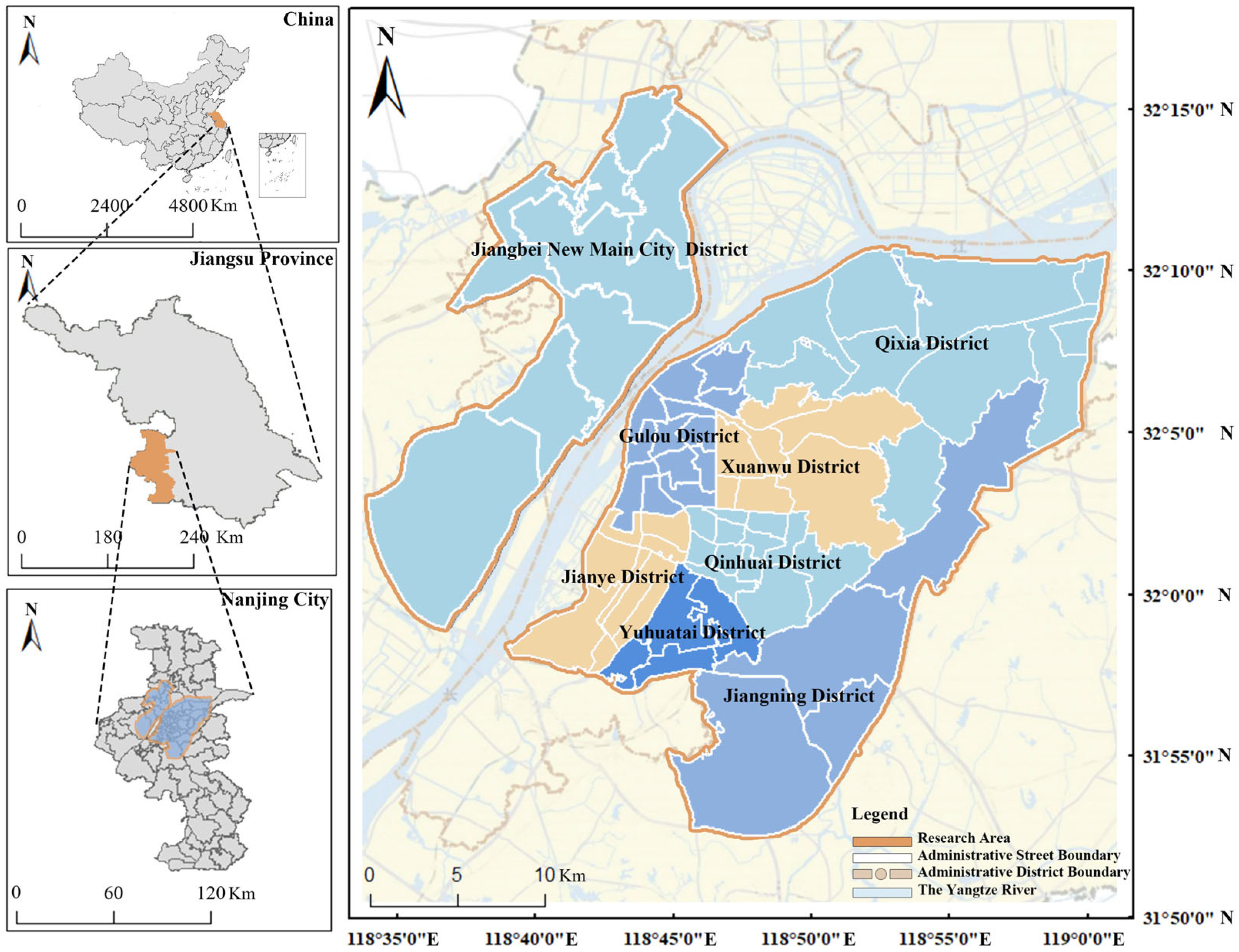
The study focuses on Nanjing’s central urban area (808 square kilometers) (Figure 2), divided into two main sections: Jiangnan Main City and Jiangbei New District, according to the “Nanjing Urban Land Spatial Master Plan (2021–2035)” (https://ghj.nanjing.gov.cn/ (accessed on 28 November 2024)). Since subdistricts are the basic units of urban governance in China and influence residents’ quality of life [56], this study selects 64 subdistricts in the central area as analysis units.
Figure 2.
Study area.
3.3. Research Data
3.3.1. Data Sources
This study integrates three types of multi-source heterogeneous data (Table 1): spatial vector data, remote sensing data, and crowdsourced data. Green space data is from a 1 m UGS fine map using deep learning [57]; road network data is from Open Street Map (OSM) with four road types: highways, main roads, secondary roads, and branch roads; air quality data is from the National Tibetan Plateau Science Data Center (https://data.tpdc.ac.cn (accessed on 15 December 2024)), including six indicators: SO2, NO2, O3, CO, PM10, and PM2.5. The POI data used in this study were obtained from the AutoNavi Map Open Platform (https://lbs.amap.com/ (accessed on 15 December 2024)) for the year 2023, with a total of 226,517 samples collected within the study area covering major functional categories such as catering, shopping, life services, corporate enterprises, and tourist attractions (transportation facilities were excluded to avoid collinearity with traffic point density variables). Night-time light data, serving as a proxy for economic activity intensity, were derived from the “Improved Time-Series DMSP-OLS-Like Data in China” developed by Wu et al. [58]), available via Harvard Dataverse with a 1 km resolution spanning 1992–2024. Population grid data were obtained from the LandScan global population dynamics database (https://landscan.ornl.gov/ (accessed on 16 October 2025)) for the year 2023 at a 1 km spatial resolution. Urban spatial vitality (USV) is characterized by Baidu Huiyan real-time population location data and quantified by the hourly count of active devices from 1 to 7 August 2023, within a 200 m × 200 m grid based on the Baidu Mercator coordinate system. Streetscape data was collected via systematic sampling every 50 m along the road network, with images in four directions (0°, 90°, 180°, 270°). A total of 208,704 images covering central Nanjing (excluding residential areas) were collected, providing a reliable data foundation for subsequent analysis.
Table 1.
Data sources.
3.3.2. Variable Description
The dependent variable is the Urban Green Space Vitality Density (UGVD) indicator, which integrates urban spatial vitality (USV) and urban green space (UGS) area data. Existing studies suggest that the carrying condition of urban green space is shaped not only by ecological constraints, but also by the interplay between green space provision, accessibility, crowding, and human use intensity [40]. In particular, previous research has shown that per-unit-area green space capacity is closely related to use intensity [41]. Following this logic, this study operationalizes UGVD as the ratio of average urban spatial vitality to green space area, in order to capture the relative activity load borne by unit green space area and the supply–demand adaptation between UGS provision and human activity intensity at the subdistrict scale. Variables such as transportation conditions, POI density, AQI, temperature, and streetscape characteristics are not components embedded in the UGVD formula itself, but rather contextual factors shaping the realized carrying performance of UGS (Table 2). The calculation is expressed as follows:
is the average real-time population location data of the i-th administrative street, where T is the total number of hours, t is the time index, represents the real-time population location data of the i-th administrative street at the t-th hour. is the UGVD value of the i-th street. is the average vitality value of the i-th administrative street, and is the green space area of the i-th administrative street.
Table 2.
Variables description.
3.4. Analysis Framework
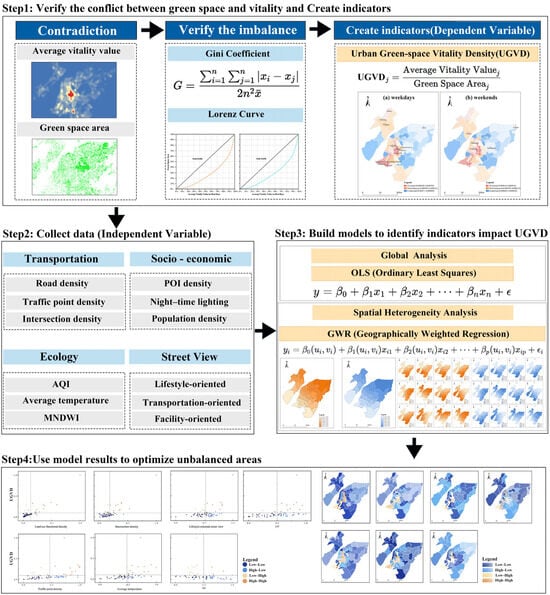
This study constructs a multi-dimensional analysis framework (Figure 3) to assess the carrying capacity of urban green spaces (UGSs). First, based on weekday and weekend dual-time period urban spatial vitality (USV) data and UGS area data, the Gini coefficient and Lorenz curve methods are used to reveal the adaptability characteristics between the distribution of USV and UGS. The Urban Green Space Vitality Density (UGVD) indicator is then constructed as the core dependent variable. Next, a multi-source urban data integration is used to establish an independent variable system comprising four dimensions: transportation environment, socio-economic factors, ecological quality, and street view. Both Ordinary Least Squares (OLS) and Geographically Weighted Regression (GWR) models are employed for dual verification: the former identifies global linear relationships, while the latter reveals the impacts of spatial heterogeneity. Finally, based on the Quadrant Analysis Method, differentiated UGS planning and governance strategies are proposed, providing scientific support for the optimization of urban green spaces.
Figure 3.
Analytical framework.
3.5. Analysis Methods
3.5.1. Gini Coefficient
The Gini coefficient, typically used to study income and wealth distribution, can also measure inequality in other contexts [59]. In this study, it is used to assess the adaptability between UGS and USV. The calculation principle is as follows:
In the formula represents the average vitality value of the i-th unit for either weekdays or weekends is the UGS area of the i-th unit, n is the total number of units, indicates the proportion of the average vitality value of the i-th unit relative to the total average vitality value of all units, and represents the proportion of the UGS area of the i-th subdistrict relative to the total UGS area of all subdistricts is the vitality proportion of the k-th subdistrict, and is the UGS area of the k-th subdistrict. is the cumulative percentage of vitality (after ascending order sorting), and is the cumulative percentage of green space area. Both and are the cumulative percentages after the vitality values are sorted in ascending order. When G = 0, the UGS distribution is completely uniform; as G approaches 1, the mismatch between USV and UGS becomes more pronounced.
3.5.2. Principal Component Analysis (PCA)
To address the 19-dimensional streetscape semantic segmentation data, this study uses Principal Component Analysis (PCA) for dimensionality reduction, mapping high-dimensional data to a lower-dimensional space while retaining key variation [60]. SPSS 27.0 analysis yields a KMO value of 0.771, indicating suitability for factor analysis. Three principal components were extracted (PC1 = 2.898, PC2 = 1.494, PC3 = 1.172), representing three streetscape environments: PC1 for residential streetscapes, PC2 for traffic-oriented streetscapes, and PC3 for facility-oriented streetscapes. This method reduces dimensionality while preserving 85.2% of the original information, providing a clear indicator for further analysis.
3.5.3. Ordinary Least Squares (OLS) Model
This study uses the Ordinary Least Squares (OLS) method to analyze the global linear relationship between multivariate urban big data (independent variables) and UGVD (dependent variable) by minimizing the sum of squared residuals (see Formula (6)).
In the formula, represents the dependent variable (UGVD) for the i-th sample point, is the k-th independent variable for the i-th sample point, is the intercept (constant term) of the linear regression equation, is the regression coefficient for the k-th independent variable, and is the random error.
3.5.4. Geographically Weighted Regression (GWR) Model
This study uses the Geographically Weighted Regression (GWR) model to explore the spatial heterogeneity of the impact of multivariate urban data on UGVD. The GWR model, proposed by Fotheringham et al. [61], introduces spatial location parameters to address non-stationarity caused by spatial distribution heterogeneity. The principle is as follows:
In the formula, represents the dependent variable (UGVD) for the i-th sample; are the spatial longitude and latitude coordinates for the i-th sample; is the k-th independent variable for the i-th sample; represents the regression coefficients for the variable ; and is the random error term.
Furthermore, the core of Geographically Weighted Regression (GWR) lies in controlling the weight decay rate of local regressions through the bandwidth, the selection of which directly affects model goodness-of-fit and the stability of parameter estimates. This study employs the corrected Akaike Information Criterion (AICc) as the fundamental basis for bandwidth optimization. AICc is suitable for small sample correction and achieves an optimal balance between model goodness-of-fit and complexity. To accommodate the inhomogeneous distribution of sample points within the study area, this research adopts an adaptive kernel function and employs the golden section search algorithm for iterative optimization within a preset bandwidth range, aiming to minimize the AICc value to determine the optimal bandwidth. According to the criterion proposed by Wagenmakers [62], when the AICc value of the GWR model decreases by more than 2 units compared to the OLS model, it can be concluded that GWR has significantly better fitting performance. The optimized bandwidth selection results and the comparison of model goodness-of-fit are detailed in Section 4.3.2.
3.5.5. Quadrant Analysis Method
This study innovatively applies the Quadrant Analysis Method to urban green space research. The method constructs a two-dimensional coordinate system with UGVD (vertical axis) and key influencing factors (horizontal axis), dividing the study units into four characteristic quadrants.
4. Research Results
4.1. Adaptability Analysis of UGS and USV
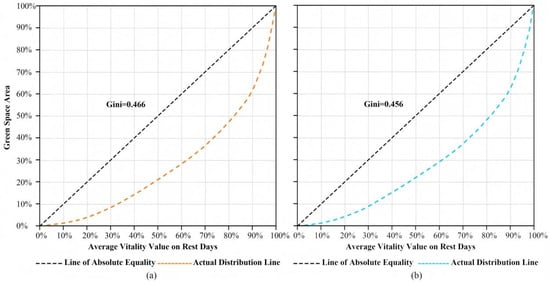
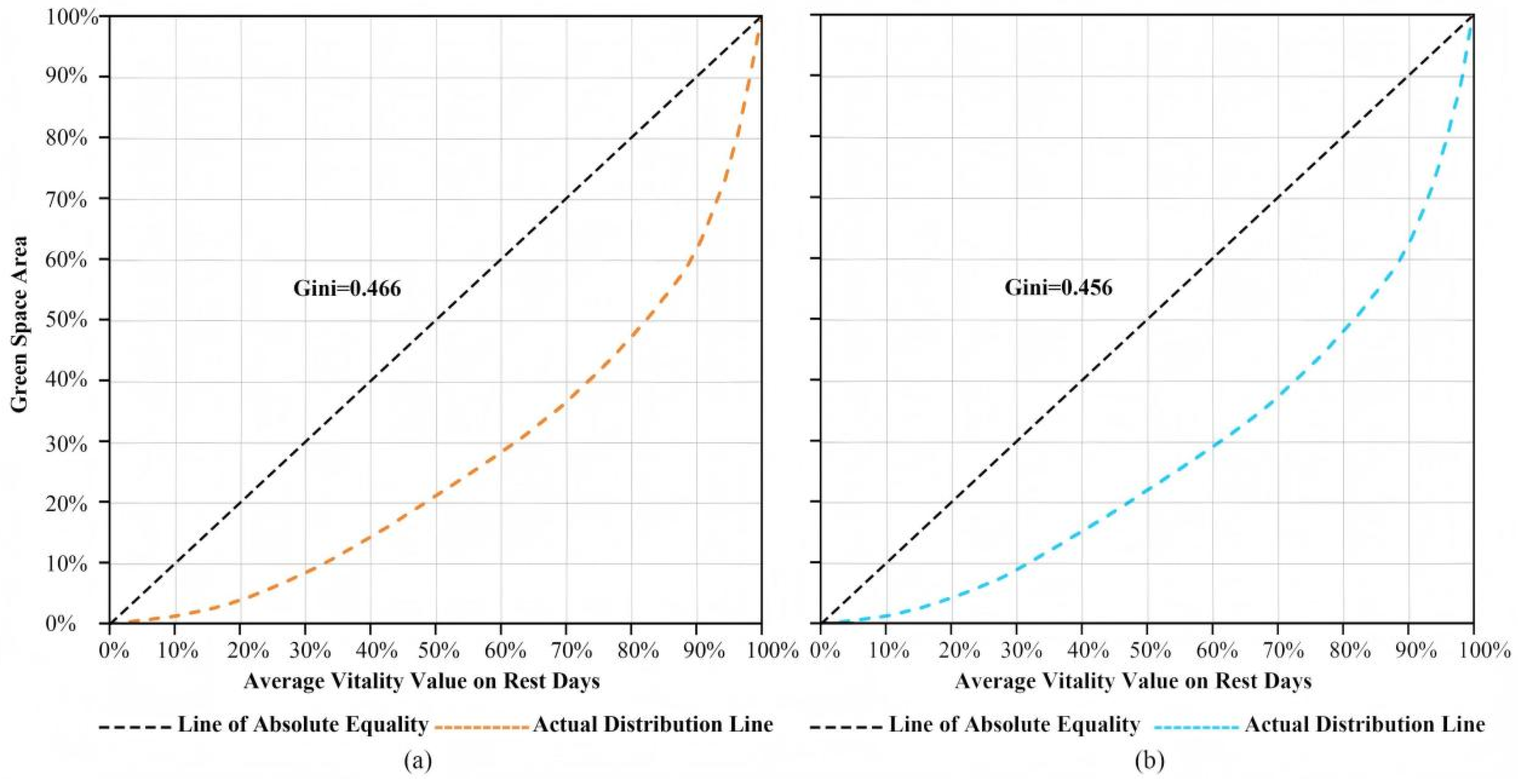
Empirical analysis using the Gini coefficient and Lorenz curve (Figure 4) reveals a significant imbalance between urban green spaces (UGSs) and urban spatial vitality (USV) in Nanjing. The Gini coefficients for weekdays and weekends are 0.466 and 0.456, respectively, indicating substantial equity gaps and a structural contradiction between UGS allocation and USV demand. The study identifies two key characteristics: (1) There is a negative correlation between UGS scale expansion and USV enhancement. Large-scale UGS, due to its single function or fragmentation, suppresses vitality generation, supporting Jiang et al. [63]. (2) The Gini coefficient for weekdays is 0.01 higher than for weekends, reflecting the temporal disparity—weekdays see lower UGS utilization due to commuting, while weekends, with higher recreational demand, allow UGSs to better serve ecological and social functions.
Figure 4.
Gini coefficient: (a) weekdays; (b) weekends.
4.2. Spatial Classification and Characteristics Based on UGVD
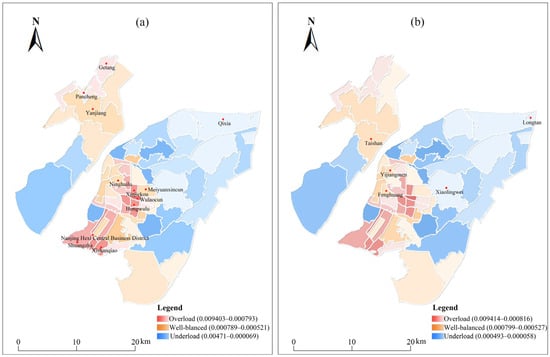
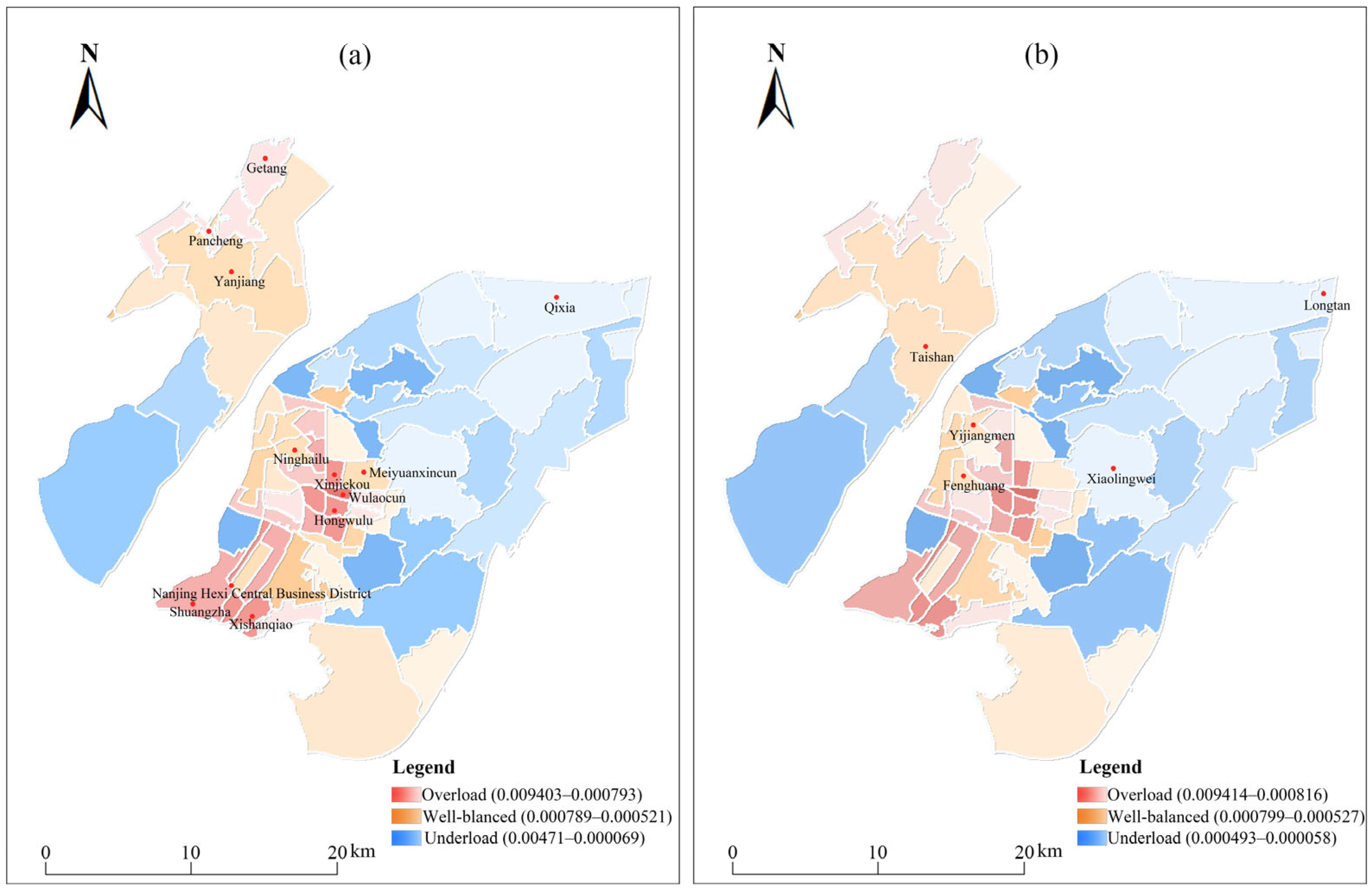
This study uses the quartile method to classify the 64 subdistricts within the study area based on UGVD (see Supplementary Materials) (Figure 5). For weekdays, the classification is as follows: underloaded areas (UGVD ≤ 0.0005208), balanced areas (0.0005208 ≤ UGVD ≤ 0.0007934), and overloaded areas (UGVD ≥ 0.0007934). For weekends, the classification is as follows: underloaded areas (UGVD ≤ 0.0005268), balanced areas (0.0005268 ≤ UGVD ≤ 0.0008153), and overloaded areas (UGVD ≥ 0.0008153). The comparison shows a slight increase in the threshold for underloaded areas on weekends and an expansion of balanced areas, reflecting an overall improvement in the efficiency of UGS resource utilization on weekends. Spatially, a significant “dual-center overload” pattern emerges, with the primary core area (Wulaocun, Xinjiekou) exhibiting the highest UGVD values, and Wulaocun Subdistrict reaching peaks of 0.00940 (weekdays) and 0.00941 (weekends). The secondary core area (Hexi CBD) shows a lower degree of overload, forming a distinct gradient reduction feature.
Figure 5.
Spatial distribution of UGVDs: (a) weekdays; (b) weekends.
The underloaded areas are mainly concentrated in the southeastern part of the central urban area, with Qixia Subdistrict showing the lowest vitality levels in both time periods. Xiaolingwei Subdistrict experiences a significant increase in UGVD on weekends, likely due to tourism activities at the Zhongshan Scenic Area, indicating that tourism and leisure functions enhance UGS utilization efficiency.
Balanced areas show temporal characteristics: on weekdays, subdistricts near core areas, like Ninghai Road Subdistrict, dominate, while on weekends, the focus shifts to Jiangbei New District, such as Taishan and Yijiangmen Subdistricts, suggesting more balanced UGS allocation on weekends. The overall spatial pattern shows that UGS overload is negatively correlated with distance from the city center, with core commercial areas under the most pressure.
4.3. UGVD Regression Results
4.3.1. Global Regression Results
The OLS regression analysis results (Table 3) show adjusted R2 values of 0.891 for weekdays and 0.897 for weekends, indicating strong model explanatory power. A variance inflation factor (VIF) test (with all variables having VIF < 7.5) confirms no multicollinearity. POI density has the most significant impact on UGVD, with standardized coefficients of 0.735 on weekdays and 0.856 on weekends, highlighting the core role of commercial activities in green space vitality. Intersection density shows temporal differences: on weekdays, its influence (0.180) is higher than residential streetscape factors (0.171), but on weekends, it is surpassed by residential streetscape factors (0.232). Notably, the density of transportation facilities, AQI, and average temperature negatively correlate with UGVD.
Table 3.
OLS model on weekdays and (weekends).
4.3.2. Local Regression Results
Based on this, this study employs the GWR model to analyze the spatial and temporal heterogeneity of the influence of significant factors on UGVD (Table 4). Compared with the OLS model, the GWR model exhibits superior fitting performance: R2 (0.923/0.928 vs. 0.912/0.916) and adjusted R2 (0.899/0.905 vs. 0.891/0.897) for weekdays and weekends are both improved; AIC and AICc values decrease significantly; and the residual sum of squares (RSS: 0.098 for weekdays, 0.088 for weekends vs. 0.133/0.101 for OLS) is substantially reduced. Most critically, the test for spatial autocorrelation on the GWR model residuals shows that Moran‘s I is near zero (weekdays: 0.00008, weekends: −0.008) with p-values > 0.35, indicating that the model has successfully captured the spatial structure of the data and that no significant spatial autocorrelation remains in the residuals. This further confirms the applicability and robustness of the GWR model in this study.
Table 4.
Results of GWR on weekdays and (weekends).
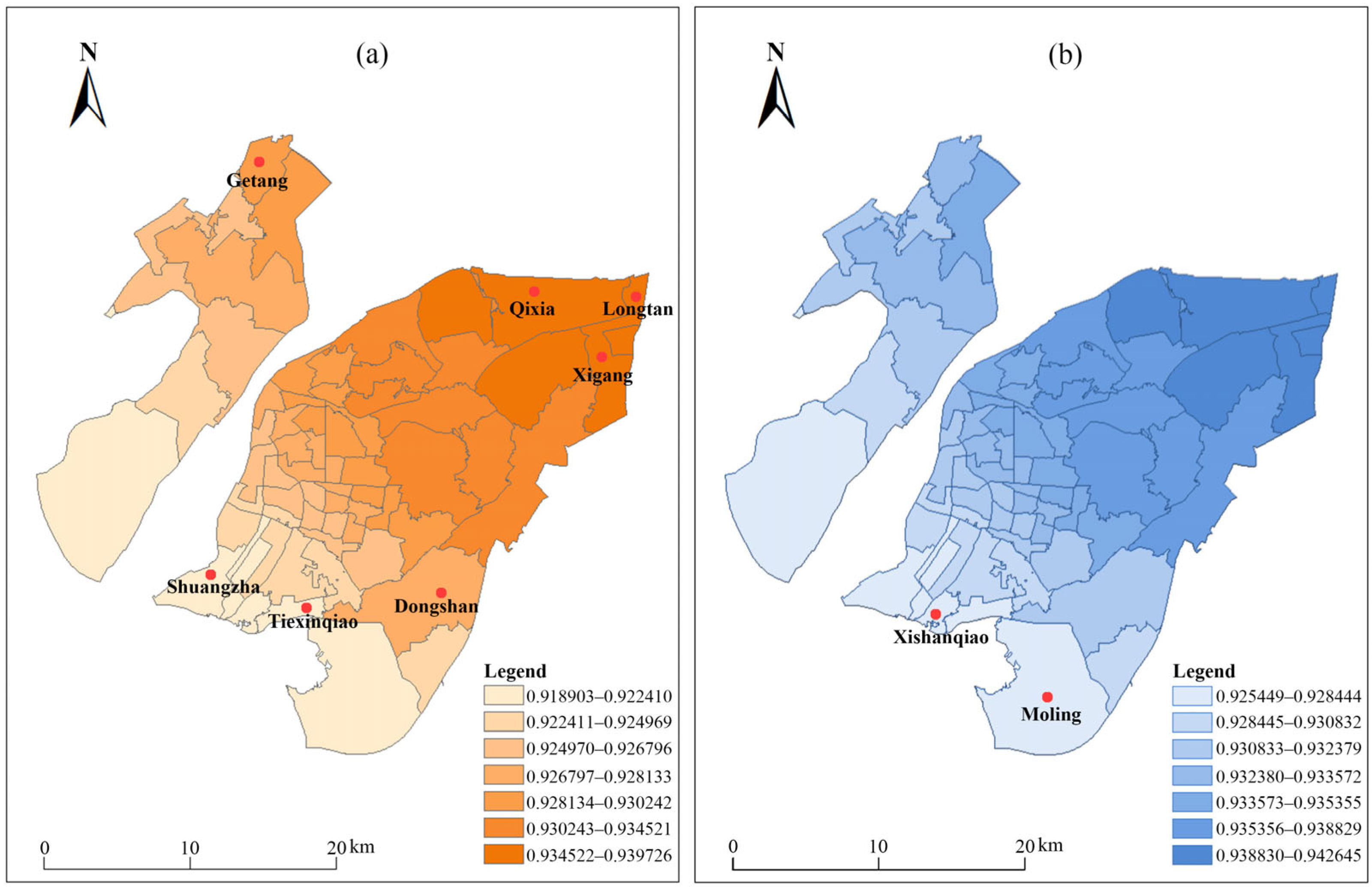
Figure 6 shows the spatial distribution of local R2 values in the GWR model. The explanatory power for weekdays and weekends follows a similar pattern, with a clear northeast–southwest differentiation. The model shows stronger explanatory power in the northeastern units (Longtanqiao, Qixia, Xigang Subdistricts) with local R2 values above 0.93.
Figure 6.
Distribution of local R2: (a) weekdays; (b) weekends.
Figure 7 and Figure 8 show significant spatial differentiation in key factors influencing UGVD. Findings include: (1) Among positive factors, intersection density and residential streetscape exhibit high clustering in Jiangbei New District (Jiangpu, Dingshan Subdistricts). Residential streetscape is slightly lower in Getang and Dachang Subdistricts but remains strong in Hexi Business District and Xishanqiao Subdistricts. High land function density is found in northeastern underloaded areas (Qixia, Xigang Subdistricts), indicating land use mix promotes UGVD growth. (2) Negative factors follow a “northeast high-core low” pattern: transportation point density and average monthly temperature have the strongest inhibitory effects in the northeast, while overloaded core areas are less affected. AQI’s negative impact is concentrated in the southeast (Qilin, Xigang Subdistricts) and some balanced areas (Moling, Chunhua Subdistricts).
4.4. Spatial Correlation Analysis
4.4.1. Spatial Correlation Characteristics Between UGVD and Significant Factor
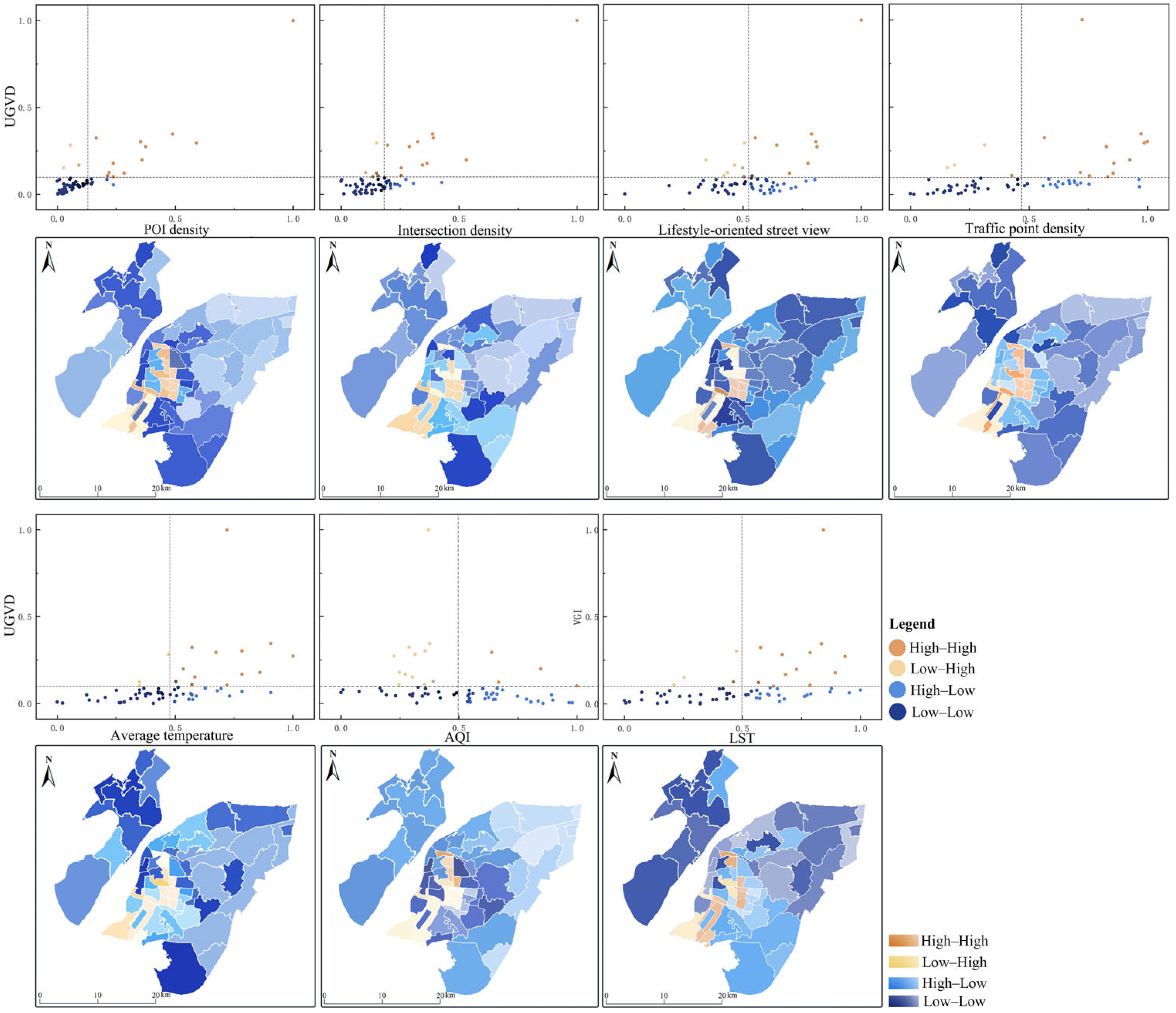
Based on the full-period UGVD data and six significant factors, quadrant analysis (Figure 9) reveals clear regional differentiation in spatial coupling. Positive factors show “high-high” correlation areas in the central urban area, indicating a “high resource-high UGVD” pattern, but also a risk of UGS overload. “Low-low” correlation areas are found in Jiangbei and southeastern regions, reflecting low UGVD due to insufficient resource allocation. Notably, a “low-high” anomaly in the southwest shows high UGVD under relatively low environmental support, indicating efficient patterns.
Negative factors show unique patterns. Transportation point density and average temperature have local inhibitory effects but do not form significant high-low clustering, suggesting interaction with positive factors. Residential streetscape exhibits a “high-low” anomaly in Jiangbei and the southwest, pointing to underutilized resources despite environmental advantages. AQI, with a global negative effect, shows significant spatial coupling: “high AQI–high UGVD” areas in the central and northern parts face ecological pressure, “low AQI–high UGVD” areas in the central and southwest represent an ideal state, and “high AQI–low UGVD” areas in the east show dual disadvantages in ecology and spatial vitality.
Figure 7.
Distribution of urban environmental factor coefficients on weekdays: (a) RD, (b) ID, (c) TP, (d) POD, (e) NT, (f) POP, (g) AT, (h) AQI, (i) MNDWI, (j) LSV, (k) TSV, and (l) FSV.
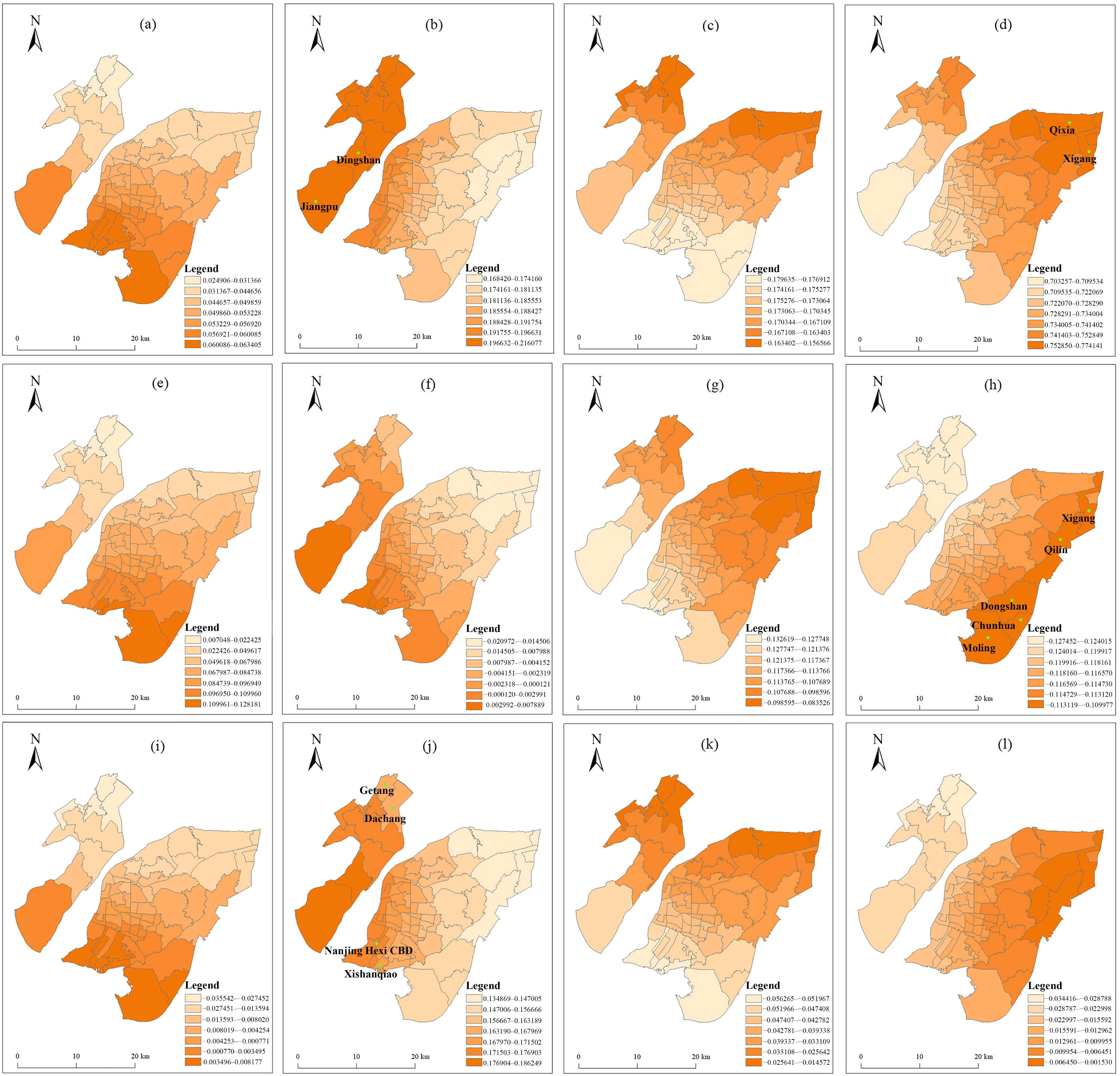
Figure 8.
Distribution of urban environmental factor coefficients on weekends: (a–l) same as Figure 7.
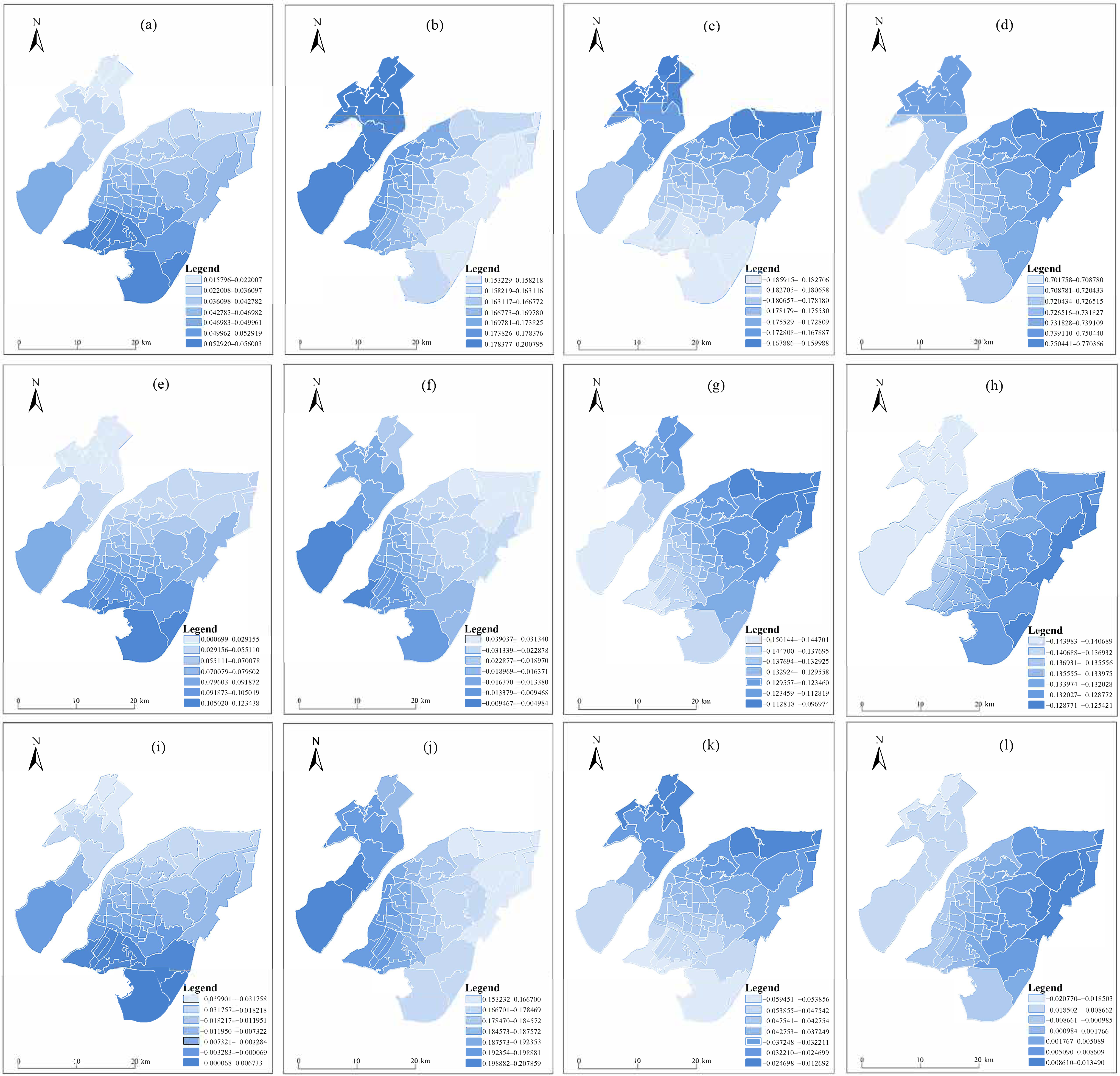
Figure 9.
Spatial correlation between UGVD and significant environmental factors.
4.4.2. Spatial Coupling Relationship Between UGVD and LST
As a core indicator of the urban heat island effect, the spatial correlation between surface temperature (LST) and UGVD (Figure 9) reveals key environmental synergies. Findings include: (1) Twelve units in the central urban area show a “high LST–high UGVD” characteristic, forming an “overload-heat risk” zone, due to high-density development compressing UGS and weakening its cooling effect [64]. (2) Four riverside units in the southwestern and central areas exhibit an ideal “low LST–high UGVD” state, with “low support-high performance” characteristics, providing successful examples for replication. (3) Twenty-two units in Jiangbei New District and the northeastern areas show a “low LST–low UGVD” type, suitable for ecological reserve development. (4) The southern region (Maling Subdistrict) faces a “high LST–low UGVD” issue, indicating that high temperatures inhibit outdoor activities [65]. These findings highlight UGS’s role in mitigating the heat island effect [66,67], offering a basis for UGS planning based on heat environment optimization.
5. Discussion
5.1. The Necessity of Constructing the UGVD Indicator and Carrying Capacity Classification
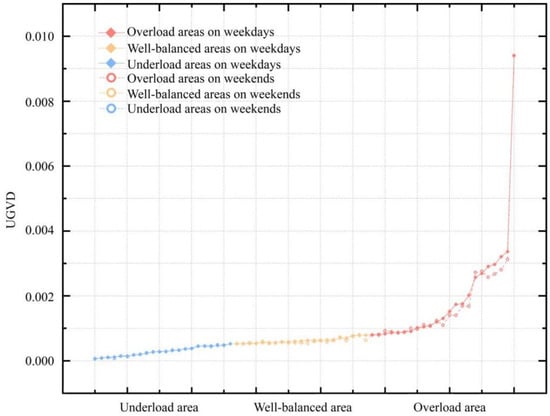
The UGVD indicator proposed in this study overcomes limitations in existing research. While previous studies confirm the positive impact of UGS on USV [54], this study reveals that the relationship is not always positive—over-concentration or inefficient use of UGSs can reduce vitality [63,68]. Unlike traditional indicators focused on USV intensity [69] or UGS scale [70], UGVD integrates both vitality and carrying capacity dimensions. Empirical analysis shows stable spatial patterns in underloaded, balanced, and overloaded areas based on UGVD classification. For example, the UGVD of Fuzimiao only differs by 6.23% between time periods, indicating significant static properties.
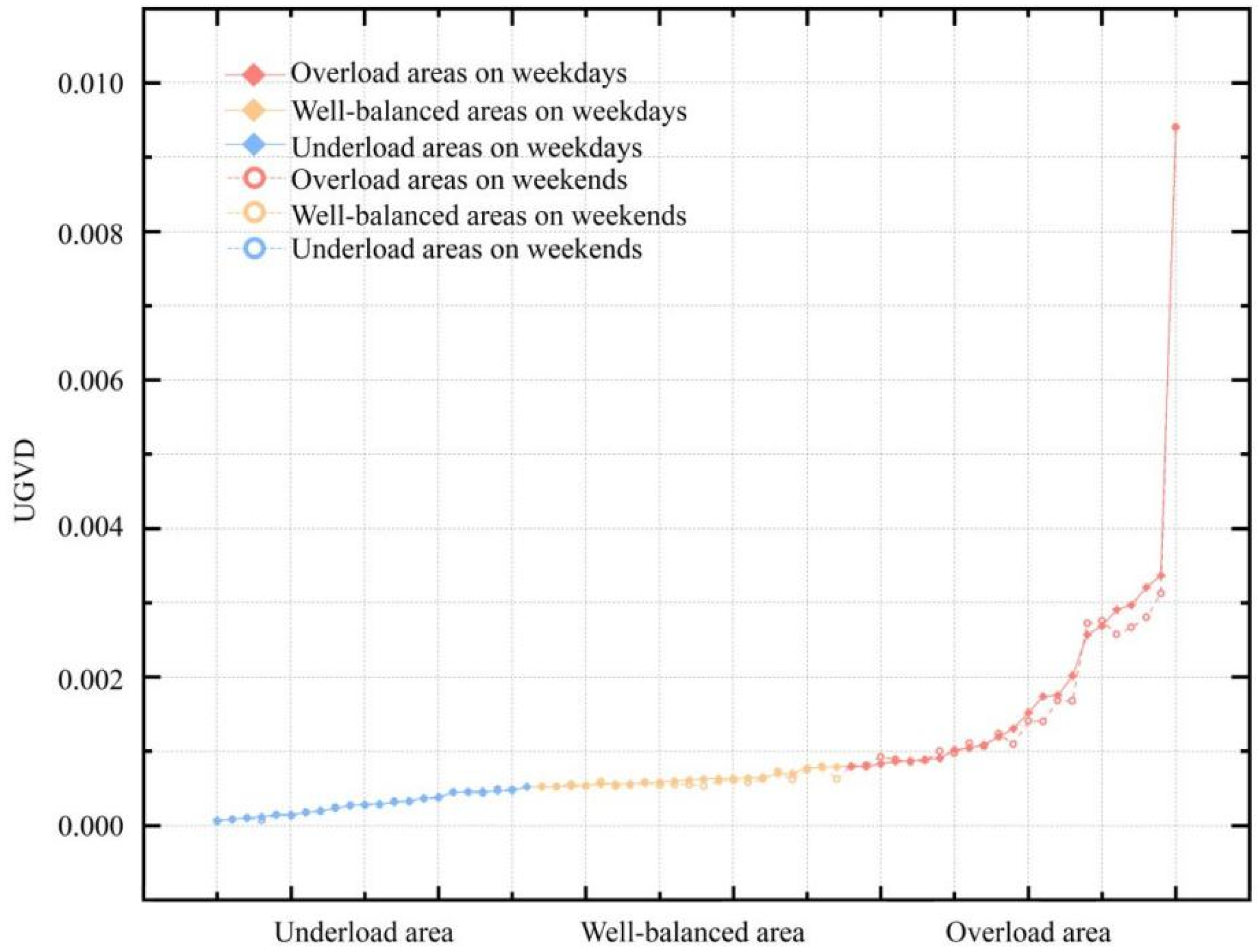
In-depth analysis reveals UGVD’s dynamic monitoring capabilities. On weekends, thresholds shift upward, and UGVD fluctuations in the city center are more pronounced (Figure 10). This is due to: (1) temporal rhythm differences in crowd activities [71]; (2) sensitivity of high-density areas to pedestrian flow changes; (3) differences in UGS functional structure; (4) impact of transportation accessibility; and (5) variations in management strategies. The central area, with its compact space and limited UGS, is more sensitive to time-based changes in carrying capacity.
Figure 10.
Characterization of UGVD’s temporal volatility.
The core value of UGVD lies in its dual evaluation of “static zoning-dynamic monitoring.” It reveals spatial heterogeneity through classification and captures temporal dynamics. This dual evaluation capability gives it a unique advantage in guiding spatial optimization and policy formulation, addressing the shortcomings of traditional indicators in carrying capacity assessment.
5.2. Environmental Mechanisms Affecting UGVD
This study reveals the multi-dimensional mechanisms influencing urban green space (UGS) carrying capacity. On a global scale, POI density has the strongest positive effect, highlighting the importance of POI development in enhancing UGS efficiency. Although previous studies have suggested that transit stations enhance accessibility and attract pedestrian flows [72], this study finds that high-density transportation nodes actually suppress UGVD—a finding that reveals a fundamental paradox of urban design: spaces designed for flow (transportation hubs) inadvertently undermine spaces intended for permanence (urban green spaces).
This inhibitory effect may stem from the inherent transitional nature of spaces surrounding transportation hubs. Taking Seoul as an example, research has found that air pollution has a significantly stronger suppressing effect on subway ridership than on private car usage [73], indicating that public transportation faces a greater decline in usage under adverse environmental conditions. This corroborates the findings of this study: high-density transportation nodes are not inherently attractive for vitality. When factors such as air pollution and high temperatures are compounded, their “transitional” characteristics may further amplify the inhibitory effect on stationary activities. Under such conditions, users prioritize efficient passage rather than lingering [74].
However, the spatial attributes of transportation hubs are not limited to mere “transitionality.” A study on São Paulo’s Sé subway station offers an alternative perspective: the station accommodates a large number of “non-passengers”—individuals who do not use the subway but linger for extended periods in fare-free areas, utilizing the station space in a manner akin to a public square [75]. This suggests that the “publicness” of transportation hubs precisely derives from their non-transit uses and their interactive relationship with surrounding public spaces, such as the Sé Square above the station.
Although the cases of Seoul and São Paulo appear contradictory, they collectively illuminate the dual nature of transportation hubs: on one hand, as “space of flows,” they are highly sensitive to environmental disturbances and prone to losing users; on the other hand, as potential “space of places,” they possess the capacity to accommodate non-transit behaviors and interact with adjacent public spaces. This insight implies that the relationship between transportation hubs and green spaces should not be reduced to simple functional zoning; instead, design should aim for the interpenetration and transformation between “flow” and “stationary activities.”
By contrast, intersection density reflects a finer-grained street network that operates on a different logic. Rather than channeling mass flows through centralized nodes, fine-grained networks distribute pedestrian activity across multiple routes, creating conditions conducive to walking, exploration, and incidental social encounters [76]. This supports longer dwell times and more diverse activities, thereby contributing positively to UGVD.
This paradox carries important implications for urban design: transportation infrastructure should be reconceptualized not merely as conduits for movement, but as potential settings for permanence. Design strategies could include: (1) creating buffered transition zones between high-flow transit areas and green spaces, using vegetation and topography to mitigate noise and visual intrusion [77]; (2) incorporating “lingering-friendly” infrastructure within transport hubs themselves, such as pocket parks, sheltered seating, and green waiting areas that transform waiting time into dwelling time [78,79]; and (3) reimagining the edges where transport meets green space as active interfaces rather than hard boundaries, allowing the benefits of accessibility to coexist with the qualities of permanence [80].
Furthermore, facility-oriented streetscape (FSV) variables did not reach statistical significance (weekday p = 0.838; weekend p = 0.990). This counterintuitive finding suggests that the mere physical presence of street-level facilities, as captured by semantic segmentation, is insufficient to guarantee spatial vitality. We propose that significance may be obscured by two interrelated factors. First, the current FSV classification may over-generalize by conflating ‘active’ social infrastructure (e.g., seating, pavilions that encourage dwelling) with ‘passive’ service elements (e.g., public restrooms or information kiosks) that primarily serve functional needs rather than encouraging lingering [81]. Second, the model’s inability to account for qualitative performance factors—such as outdated design, poor maintenance, or a lack of spatial connectivity—means that physically present facilities may fail to activate the environment or may even deter usage [82]. These nuances suggest that the vitality effect of FSV is subject to a quality threshold: whether facilities can stimulate vitality depends not on their mere presence or absence, but on deeper design qualities.
Environmental factors, particularly AQI and average temperature, have stronger negative impacts on weekends, emphasizing the role of environmental quality during leisure periods.
Spatial heterogeneity analysis shows a “northeast strong–southwest weak” pattern (Figure 6). In the northeastern area, lower development intensity leads to a more stable linear relationship between environmental factors and UGVD. Although the southwestern area exhibits generally high UGVD levels, the reduced model performance in this region may not result from omitted variables, but rather from more complex non-linear relationships and interactions among variables. For instance, in high-density environments, factors such as POI density and intersection density may exhibit threshold effects or other non-linear mechanisms in their relationship with UGVD. Residential streetscape has a stronger influence on weekends than weekdays, highlighting its greater effect on UGS utilization during weekends.
Regional impacts (Figure 7 and Figure 8) show the northeastern underloaded areas are sensitive to POI density, offering improvement potential; the southwestern region is negatively affected by traffic point density and high temperatures, requiring built environment optimization; and in Jiangbei New District, intersection density and residential streetscape strongly impact UGS, suggesting better planning. Specifically, the riverside industrial area faces dual suppression from streetscape and AQI, needing urgent environmental improvements.
5.3. Regulation Strategies for the UGS and USV Conflict
Overloaded areas should focus on spatial restructuring and functional enhancement, as high-intensity development often leads to UGS fragmentation and ecological degradation [83,84]. Recommended strategies include: (1) vertical greening with green roofs and wall plants [85]; (2) in “high-high” areas, focus on shading systems, zoning, and ventilation corridors to improve the thermal environment [86]; (3) protect “low-high” areas from overdevelopment. Some “low LST–high UGVD” units have formed an ideal human–environment model worth promoting.
Revitalizing underloaded areas requires systematic intervention. Despite their abundant UGS resources, these regions are constrained by poor accessibility and functional homogeneity [87]. Recommended strategies include: (1) in “low-low” areas, develop composite UGS by creating 5 min walking green networks to connect fragmented green spaces, embed low-impact functional nodes (e.g., casual dining, community libraries, convenience markets) near green space entrances, and prioritize accessible pedestrian pathways in areas with limited street permeability; (2) in “high-low” areas, integrate ecological functions (e.g., rain gardens, biodiversity patches) with community-based amenities; and (3) innovate governance models by introducing shared mechanisms such as community co-management of green spaces to enhance public participation [13,88].
Differentiated governance strategies should be based on precise diagnosis. Overloaded areas need decongestion and control, while underloaded areas require activation and enhancement. These areas reflect the “excessive concentration” and “insufficient development” problems of urban growth.
5.4. Research Significance and Applicability
This study constructs the UGSVA model and quantifies the adaptability between UGS and USV based on the UGVD indicator. By combining the GWR model, it reveals the spatial heterogeneity of influencing mechanisms and uses quadrant analysis to propose targeted optimization strategies. This framework overcomes traditional research limitations, which focus on a single factor, and provides a tool for urban green space governance with spatial identification and classification capabilities.
The theoretical value of the UGVD indicator is reflected in three aspects: first, its “supply-demand matching” assessment surpasses traditional indicators like population density or coverage, enabling refined classification; second, by integrating carrying capacity and adaptability, it shifts research from static capacity evaluation to dynamic human–environment interaction analysis; third, its spatiotemporal dual sensitivity adapts to management needs across different time periods. Empirical research shows that this indicator not only identifies spatial structural characteristics but also supports holiday configuration optimization and flexible management, providing a scientific basis for urban green space regulation.
The empirical framework, based on Nanjing, has broad applicability. The UGVD indicator can be integrated into policy scenarios like urban renewal and green network development, serving as an important planning tool. The study’s use of open-source data platforms and standardized methods makes it applicable to other high-density cities. The framework can, for example, be used to address the adaptation between green spaces and urban vitality in Barcelona’s streets [89] and provide a reference for small African cities confronting similar challenges [90], thereby improving the efficiency of urban green space use and the adaptive balance with urban spatial vitality.
6. Conclusions
This study analyzes UGS-USV adaptability in Nanjing using the UGSVA model. Key findings: (1) Adaptability is weak, with city center as overload core, southwest as secondary core, and southeast as underloaded area. Overloaded units show temporal UGVD fluctuations. (2) POI and intersection density positively affect UGVD, while excessive transportation, poor air quality, and high temperatures inhibit it. Ecological factors impact weekends more. (3) Regional differences: northeast is POI-sensitive, southwest constrained by traffic and heat, Jiangbei New District can improve via traffic optimization.
The theoretical contribution of this study lies in incorporating the carrying capacity of urban green space (UGS) into the evaluation system of urban spatial vitality (USV), thereby offering a novel analytical perspective for human–environment interaction research. The proposed UGSVA model demonstrates strong transferability and can provide methodological support for green space assessments in other cities. Based on the research findings, this paper proposes four policy recommendations: (1) resolve the “flow-stay” paradox by redesigning high-density transportation hubs as “stay-friendly interfaces” through green buffer zones, sheltered seating with pocket parks, and vibrant adjacent plazas; (2) implement differentiated zoning strategies—experience-oriented planning (vertical greening, shading systems, ventilation corridors, micro-renewals) for overloaded core areas, and vitality-oriented development (five-minute green networks, enhanced pedestrian environments, community co-management) for underloaded areas; (3) strengthen time-sensitive planning with weekend activity enhancements in ecological zones and weekday traffic improvements in commuter areas, given the stronger weekend impacts of AQI and high temperatures; and (4) prioritize quality over quantity by establishing a “vitality impact assessment” mechanism for streetscape projects, as the insignificance of the FSV variable confirms that physical presence alone does not guarantee spatial vitality. These recommendations demonstrate how the UGSVA model supports evidence-based green space governance, providing scientific foundations and practical pathways for building resilient and livable cities.
Two limitations need to be addressed in future work: (1) Due to the limitation of sample size, only the GWR model was used as the analytical method. In the future, more machine learning methods can be introduced for comparison and validation. (2) Although this study reveals the impact on the adaptability between UGS and USV through average temperature, as well as the spatial relationship between UGVD distribution and land surface temperature, it does not directly evaluate the cooling effectiveness of urban green spaces. Given that the thermal regulation performance of urban green spaces is influenced by vegetation configuration, spatial form, and surrounding urban context, future studies should incorporate more detailed indicators of cooling performance and thermal comfort to clarify the mechanism by which heat mitigation capacity affects the adaptive relationship between urban green spaces and urban spatial vitality. (3) The sampling period of this study (August 1st to 7th) coincides with the high-summer season in Nanjing, characterized by elevated temperatures. Consequently, the identified UGVD patterns primarily reflect urban green space adaptability under summer high-temperature conditions, and the conclusions should be interpreted with consideration of seasonal variations. Future research should integrate multi-temporal and cross-seasonal data to validate the temporal stability of UGVD and further explore the dynamic evolution mechanisms of urban green space vitality under different climatic conditions. Furthermore, the mechanisms influencing the suitability between UGS and USV in highly urbanized areas exhibit non-linear characteristics. Future research should employ methods such as threshold models to conduct in-depth investigations.
Supplementary Materials
The following supporting information can be downloaded at: https://www.mdpi.com/article/10.3390/land15040524/s1, Urban Green Space Vitality Density (UGVD) dataset for the 64 subdistricts (https://doi.org/10.6084/m9.figshare.31428125, accessed on 2 February 2026).
Author Contributions
Conceptualization, G.L. and J.D.; methodology, G.L. and Z.G.; software, G.L.; validation, Z.G.; formal analysis, G.L.; investigation, G.L. and Z.G.; resources, J.D.; data curation, G.L.; writing—original draft preparation, G.L.; writing—review and editing, G.L., Z.G., and J.D.; visualization, Z.G.; supervision, J.D.; project administration, J.D.; funding acquisition, J.D. All authors have read and agreed to the published version of the manuscript.
Funding
This study was supported by the National Social Science Foundation of China (NSSFC) (Grant No. 18CG197).
Institutional Review Board Statement
This article does not contain any studies with human participants performed by any of the authors.
Data Availability Statement
The UGVD dataset for the 64 subdistricts generated during this study is available at: https://doi.org/10.6084/m9.figshare.31428125, accessed on 2 February 2026.
Conflicts of Interest
The authors declare no conflicts of interest.
References
- Chen, M.Z.; Cai, Y.X.; Guo, S.Y.; Sun, R.L.; Song, Y.; Shen, X.W. Evaluating implied urban nature vitality in San Francisco: An interdisciplinary approach combining census data, street view images, and social media analysis. Urban For. Urban Green. 2024, 95, 128289. [Google Scholar] [CrossRef] [Scilit]
- Chen, J.; Bach, P.M.; Nice, K.A.; Leitao, J.P. Investigating the efficacy of a fast urban climate model for spatial planning of green and blue spaces for heat mitigation. Sci. Total Environ. 2024, 955, 176925. [Google Scholar] [CrossRef] [Scilit] [PubMed]
- Xie, X.H.; Zhou, H.Z.; Gou, Z.H. Dynamic real-time individual green space exposure indices and the relationship with static green space exposure indices: A study in Shenzhen. Ecol. Indic. 2023, 154, 110557. [Google Scholar] [CrossRef] [Scilit]
- Chen, Y.; Yu, B.J.; Shu, B.; Yang, L.C.; Wang, R.Y. Exploring the spatiotemporal patterns and correlates of urban vitality: Temporal and spatial heterogeneity. Sustain. Cities Soc. 2023, 91, 104440. [Google Scholar] [CrossRef] [Scilit]
- Wang, Q.; Peng, J.; Yu, S.Y.; Dan, Y.Z.; Dong, J.Q.; Zhao, X.; Wu, J.S. Key attributes of greenspace pattern for heat mitigation vary with urban functional zones. Landsc. Ecol. 2023, 38, 2965–2979. [Google Scholar] [CrossRef] [Scilit]
- Artmann, M.; Kohler, M.; Meinel, G.; Gan, J.; Ioja, I.-C. How smart growth and green infrastructure can mutually support each other—A conceptual framework for compact and green cities. Ecol. Indic. 2017, 96, 10–22. [Google Scholar] [CrossRef] [Scilit]
- Jacobs, J.M. The Death and Life of Great American Cities. Yale Law J. 1962, 71, 1597–1602. [Google Scholar] [CrossRef] [Scilit]
- Yen, H.Y.; Chiu, H.L.; Huang, H.Y. Green and blue physical activity for quality of life: A systematic review and meta-analysis of randomized control trials. Landsc. Urban Plan. 2021, 212, 104093. [Google Scholar] [CrossRef] [Scilit]
- Mouratidis, K.; Poortinga, W. Built environment, urban vitality and social cohesion: Do vibrant neighborhoods foster strong communities? Landsc. Urban Plan. 2020, 204, 103951. [Google Scholar] [CrossRef] [Scilit]
- Wei, L.; Liu, Z.H.; Zhou, Y.; Tao, Z.W.; Yang, F. Global urban green spaces in the functional urban areas: Spatial pattern, drivers and size hierarchy. Urban For. Urban Green. 2025, 107, 128770. [Google Scholar] [CrossRef] [Scilit]
- Boulton, C.; Dedekorkut-Howes, A.; Byrne, J. Factors shaping urban greenspace provision: A systematic review of the literature. Landsc. Urban Plan. 2018, 178, 82–101. [Google Scholar] [CrossRef] [Scilit]
- Yue, W.Z.; Chen, Y.; Zhang, Q.; Liu, Y. Spatial Explicit Assessment of Urban Vitality Using Multi-Source Data: A Case of Shanghai, China. Sustainability 2019, 11, 638. [Google Scholar] [CrossRef] [Scilit]
- Wu, G.C.; Yang, D.Q.; Niu, X.; Mi, Z.X. The Impact of Park Green Space Areas on Urban Vitality: A Case Study of 35 Large and Medium-Sized Cities in China. Land 2024, 13, 1560. [Google Scholar] [CrossRef] [Scilit]
- Ding, Z.F.; Wang, H. What are the key and catalytic external factors affecting the vitality of urban blue-green space? a case study of Nanjing Main Districts, China. Ecol. Indic. 2024, 158, 111478. [Google Scholar] [CrossRef] [Scilit]
- Czesak, B.; Rózycka-Czas, R. Assessing accessibility and crowding in urban green spaces: A comparative study of approaches. Landsc. Urban Plan. 2025, 257, 105301. [Google Scholar] [CrossRef] [Scilit]
- Maas, P.R. Towards a Theory of Urban Vitality. Ph.D. Thesis, University of British Columbia, Vancouver, BC, Canada, 1961. [Google Scholar]
- Fang, C.L.; He, S.W.; Wang, L. Spatial Characterization of Urban Vitality and the Association with Various Street Network Metrics From the Multi-Scalar Perspective. Front. Public Health 2021, 9, 677910. [Google Scholar] [CrossRef] [Scilit]
- Landry, C. Urban Vitality: A New Source of Urban Competitivenes. Archis 2000, 12, 8–13. [Google Scholar]
- Zhang, J.W.; Liu, X.T.; Tan, X.Y.; Jia, T.; Senousi, A.M.; Huang, J.W.; Yin, L.; Zhang, F. Nighttime Vitality and Its Relationship to Urban Diversity: An Exploratory Analysis in Shenzhen, China. IEEE J. Sel. Top. Appl. Earth Obs. Remote Sens. 2022, 15, 309–322. [Google Scholar] [CrossRef] [Scilit]
- Cui, Y.Z.; Zha, G.X.; Wang, Q.T.; Dang, Y.X.; Shi, K.F.; Duan, X.J.; Xu, D.; Huang, B. Evaluating the community commercial vitality using multi-source data: A case study of Hangzhou, China. GISci. Remote Sens. 2025, 62, 2451335. [Google Scholar] [CrossRef] [Scilit]
- Jin, A.B.; Ge, Y.Y.; Zhang, S.Y. Spatial Characteristics of Multidimensional Urban Vitality and Its Impact Mechanisms by the Built Environment. Land 2024, 13, 991. [Google Scholar] [CrossRef] [Scilit]
- Pan, J.H.; Zhu, X.W.; Zhang, X. Urban Vitality Measurement and Influence Mechanism Detection in China. Int. J. Environ. Res. Public Health 2023, 20, 46. [Google Scholar] [CrossRef] [Scilit]
- Xu, Z.; Chang, J.; Cheng, F.Y.; Liu, X.Y.; Yao, T.N.; Hu, K.T.; Sun, J.Y. Examining the Impact of the Built Environment on Multidimensional Urban Vitality: Using Milk Tea Shops and Coffee Shops as New Indicators of Urban Vitality. Buildings 2024, 14, 3517. [Google Scholar] [CrossRef] [Scilit]
- Dogan, O.; Lee, S. Jane Jacobs’s urban vitality focusing on three-facet criteria and its confluence with urban physical complexity. Cities 2024, 155, 105446. [Google Scholar] [CrossRef] [Scilit]
- Mouratidis, K.; Delclòs-Alió, X. Urban vitality versus urban livability: Does vibrancy matter for neighborhood satisfaction and neighborhood happiness? Cities 2026, 168, 106473. [Google Scholar] [CrossRef] [Scilit]
- Ma, G.; Pellegrini, P.; Han, H.Q. The vitality of pocket parks in high-density urban areas. An evaluation system from the users’ perspective in Southwest China. Urban For. Urban Green. 2025, 104, 128596. [Google Scholar] [CrossRef] [Scilit]
- Malthus, T.R. An Essay on the Principle of Population; Pickering: London, UK, 1798. [Google Scholar]
- Ehrlich, P.R. The Population Bomb; Ballantine Books: New York, NY, USA, 1968. [Google Scholar]
- Dasmann, R.F. Wildlife Biology; John Wiley: New York, NY, USA, 1964. [Google Scholar]
- Bernard, F.E.; Thom, D.J. Population pressure and human carrying capacity in selected locations of Machakos and Kitui districts. J. Dev. Areas 1981, 15, 381–406. [Google Scholar]
- Onishi, T. A Capacity Approach for Sustainable Urban Development: An Empirical Study. Reg. Stud. 1994, 28, 39–51. [Google Scholar] [CrossRef] [Scilit]
- Daily, G.C.; Ehrlich, P.R. Socioeconomic Equity, Sustainability, and Earth’s Carrying Capacity. Ecol. Appl. 1996, 6, 991–1001. [Google Scholar] [CrossRef] [Scilit]
- Xu, L.Y.; Kamg, P.; Wei, J.J. Evaluation of urban ecological carrying capacity: A case study of Beijing, China. Procedia Environ. Sci. 2010, 2, 1873–1880. [Google Scholar] [CrossRef] [Scilit]
- Wang, H.F.; Cao, Y.; Wu, X.H.; Zhao, A.; Xie, Y. Estimation and Potential Analysis of Land Population Carrying Capacity in Shanghai Metropolis. Int. J. Environ. Res. Public Health 2022, 19, 8240. [Google Scholar] [CrossRef] [Scilit]
- Sun, Y.H.; Zhang, D.X.; Ding, J. A Study on the Prediction of Moderate Population Size of Urban Agglomerations Based on Population Carrying Capacity—Take the Yangtze River Delta Urban Agglomeration as an Example. Popul. Dev. 2023, 29, 49–59. (In Chinese) [Google Scholar]
- Chen, Y.H.; Xu, C.C.; Ge, Y.; Zhang, X.X.; Zhou, Y.N. A 100 m gridded population dataset of China’s seventh census using ensemble learning and big geospatial data. Earth Syst. Sci. Data 2024, 16, 3705–3718. [Google Scholar] [CrossRef] [Scilit]
- Dong, X.Y.; Zhang, X.Y.; Zhou, Q. Underload and overload communities: Revealing the conflicts between population distribution and carrying capacity at an inner-city community scale. Sustain. Cities Soc. 2023, 98, 104793. [Google Scholar] [CrossRef] [Scilit]
- You, H.Y.; Xu, F.Y.; Yan, J.H.; Guo, X.X. Effects of trial urban growth boundary delineation on land carrying capacity in China. Humanit. Soc. Sci. Commun. 2025, 12, 1–14. [Google Scholar] [CrossRef] [Scilit]
- Tan, X.H.; Peng, Y.L.; Liu, S.L.; Liu, P. Landscape pattern and ecotourism carrying capacity of Pan’an Lake wetland park in Xuzhou City, China. Desalination Water Treat. 2020, 188, 288–296. [Google Scholar] [CrossRef] [Scilit]
- Wu, J.; Peng, Y.; Liu, P.; Weng, Y.; Lin, J. Is the green inequality overestimated? Quality reevaluation of green space accessibility. Cities 2022, 130, 103871. [Google Scholar] [CrossRef] [Scilit]
- Ye, Y.; Xiang, Y.; Qiu, H.F.; Li, X. Revealing urban greenspace accessibility inequity using the carrying capacity-based 3SFCA method and location big data. Sustain. Cities Soc. 2024, 108, 105513. [Google Scholar] [CrossRef] [Scilit]
- Zong, C.; Zeng, G. The impact of blue-green spatial landscape pattern on population distribution pattern in Chinese cities. Sci. Rep. 2025, 15, 26047. [Google Scholar] [CrossRef] [Scilit]
- Jang, S.; Jung, J. Urban form and green space structure as drivers of urban heat mitigation. Sustain. Cities Soc. 2025, 130, 106597. [Google Scholar] [CrossRef] [Scilit]
- Pritipadmaja; Garg, R.D.; Sharma, A.K. Assessing the Cooling Effect of Blue-Green Spaces: Implications for Urban Heat Island Mitigation. Water 2023, 15, 2983. [Google Scholar] [CrossRef] [Scilit]
- Liotta, C.; Kervinio, Y.; Levrel, H.; Tardieu, L. Planning for environmental justice—Reducing well-being inequalities through urban greening. Environ. Sci. Policy 2020, 112, 47–60. [Google Scholar] [CrossRef] [Scilit]
- Enssle, F.; Kabisch, N. Urban green spaces for the social interaction, health and well-being of older people—An integrated view of urban ecosystem services and socio-environmental justice. Environ. Sci. Policy 2020, 109, 36–44. [Google Scholar] [CrossRef] [Scilit]
- Holt, J.R.; Borsuk, M.E. Using Zillow data to value green space amenities at the neighborhood scale. Urban For. Urban Green. 2020, 56, 126794. [Google Scholar] [CrossRef] [Scilit]
- Guo, R.; Song, X.Y.; Li, P.; Wu, W.M.; Guo, Z.L. Large-Scale and Refined Green Space Identification-Based Sustainable Urban Renewal Mode Assessment. Math. Probl. Eng. 2020, 2020, 2043019. [Google Scholar] [CrossRef] [Scilit]
- Yang, Q.X.; Zhan, H.Q.; Huang, J. Urban green service equity in Xiamen based on network analysis and concentration degree of resources. Open Geosci. 2022, 14, 304–315. [Google Scholar] [CrossRef] [Scilit]
- Ke, X.l.; Huang, D.Y.; Zhou, T.; Men, H.l. Contribution of non-park green space to the equity of urban green space accessibility. Ecol. Indic. 2023, 146, 109855. [Google Scholar] [CrossRef] [Scilit]
- Qiu, C.L.; Cheng, J.Q.; Lu, Y.; Zhang, T.J. Estimating exercisality on urban trails using physical exercise trajectory data and network-constrained approach. Soc. Sci. Med. 2024, 361, 117361. [Google Scholar] [CrossRef] [Scilit]
- Lu, C.; Deng, Y.; Guo, Z.Q. Association between park vitality and commercial vitality: A case study in Chengdu. J. Asian Archit. Build. Eng. 2025, 24, 3127–3143. [Google Scholar] [CrossRef] [Scilit]
- Zhou, W.Y.; Zhang, J.J.; Li, X.; Guo, F.; Zhu, P.S. Influence of Environmental Factors on Pedestrian Summer Vitality in Urban Pedestrian Streets in Cold Regions Guided by Thermal Comfort: A Case Study of Sanlitun—Beijing, China. Sustainability 2024, 16, 10419. [Google Scholar] [CrossRef] [Scilit]
- Dong, Q.D.; Cai, J.; Chen, S.; He, P.M.; Chen, X.L. Spatiotemporal Analysis of Urban Green Spatial Vitality and the Corresponding Influencing Factors: A Case Study of Chengdu, China. Land 2022, 11, 1820. [Google Scholar] [CrossRef] [Scilit]
- Qin, L.W.; Zong, W.K.; Peng, K.; Zhang, R.P. Assessing Spatial Heterogeneity in Urban Park Vitality for a Sustainable Built Environment: A Case Study of Changsha. Land 2024, 13, 480. [Google Scholar] [CrossRef] [Scilit]
- Liu, H.; Li, X.M. Understanding the Driving Factors for Urban Human Settlement Vitality at Street Level: A Case Study of Dalian, China. Land 2022, 11, 646. [Google Scholar] [CrossRef] [Scilit]
- Shi, Q.; Liu, M.X.; Marinoni, A.; Liu, X.P. UGS-1m: Fine-grained urban green space mapping of 31 major cities in China based on the deep learning framework. Earth Syst. Sci. Data 2023, 15, 555–577. [Google Scholar] [CrossRef] [Scilit]
- Wu, Y.Z.; Shi, K.F.; Chen, Z.Q.; Liu, S.R.; Chang, Z.J. Developing Improved Time-Series DMSP-OLS-Like Data (1992–2019) in China by Integrating DMSP-OLS and SNPP-VIIRS. IEEE Trans. Geosci. Remote Sens. 2022, 60, 1–14. [Google Scholar] [CrossRef] [Scilit]
- dos Santos, C.M.L.; Dias, C.P.S. An assessment of the true Gini coefficient regarding the fulfilment of the basic criteria for inequality measures. Acta Sci.-Technol. 2024, 46, e64563. [Google Scholar] [CrossRef] [Scilit]
- Liu, Y.; Yang, S.T.; Wang, S.J. Heterogeneity Study of the Visual Features Based on Geographically Weighted Principal Components Analysis Applied to an Urban Community. Sustainability 2021, 13, 13488. [Google Scholar] [CrossRef] [Scilit]
- Fotheringham, A.S.; Brunsdon, C.; Charlton, M.E. Geographically Weighted Regression: A Method for Exploring Spatial Nonstationarity. Geogr. Anal. 1996, 28, 281–298. [Google Scholar] [CrossRef] [Scilit]
- Wagenmakers, E.J. Model selection and multimodel inference: A practical information-theoretic approach. J. Math. Psychol. 2003, 47, 580–586. [Google Scholar] [CrossRef] [Scilit]
- Jiang, Y.X.; Huang, Z.; Zhou, X.; Chen, X.J. Evaluating the impact of urban morphology on urban vitality: An exploratory study using big geo-data. Int. J. Digit. Earth 2024, 17, 2327571. [Google Scholar] [CrossRef] [Scilit]
- Ke, X.L.; Men, H.l.; Zhou, T.; Li, Z.Y.; Zhu, F.K. Variance of the impact of urban green space on the urban heat island effect among different urban functional zones: A case study in Wuhan. Urban For. Urban Green. 2021, 62, 127159. [Google Scholar] [CrossRef] [Scilit]
- Han, S.S.; Kwan, M.-P.; Miao, C.H.; Sun, B.D. Exploring the effects of urban spatial structure on green space in Chinese cities proper. Urban For. Urban Green. 2023, 87, 128059. [Google Scholar] [CrossRef] [Scilit]
- Liu, J.; Wu, X.Y.; Pan, L.Y.; Hsieh, C.M. Multi-Scale Analysis of the Mitigation Effect of Green Space Morphology on Urban Heat Islands. Atmosphere 2025, 16, 857. [Google Scholar] [CrossRef] [Scilit]
- Huang, M.; Li, J.; He, X. The Influence of Underlying Surface on Land Surface Temperature—A Case Study of Urban Green Space in Harbin. Energy Procedia 2019, 157, 746–751. [Google Scholar] [CrossRef] [Scilit]
- Lopes, M.N.; Camanho, A.S. Public Green Space Use and Consequences on Urban Vitality: An Assessment of European Cities. Soc. Indic. Res. 2013, 113, 751–767. [Google Scholar] [CrossRef] [Scilit]
- Cui, T.T.; Ye, Y.X.; Zhuang, Y.X.; Lin, Q.L.; Yan, M.L.; Zhang, L.T.; Zhu, L.Y. A study of the changing characteristics and influencing factors of holiday visitor vitality in Urban parks: The case of Fuzhou, China. PLoS ONE 2024, 19, e0311546. [Google Scholar] [CrossRef] [Scilit]
- Ha, J.; Kim, H.J. The restorative effects of campus landscape biodiversity: Assessing visual and auditory perceptions among university students. Urban For. Urban Green. 2021, 64, 127259. [Google Scholar] [CrossRef] [Scilit]
- Wu, W.S.; Xu, L.; Zhao, K. Urban vitality and built environment from the perspective of spatiotemporal heterogeneity. Spat. Econ. Anal. 2025, 20, 218–241. [Google Scholar] [CrossRef] [Scilit]
- Rong, W.Y.; Zhang, Z.K.; Liu, Y.; Yang, Y.; Qu, X.B. Spatiotemporal heterogeneity exploration in the effects of TOD structural characteristics on metro ridership: Evidence from Shanghai. J. Transp. Geogr. 2025, 128, 104339. [Google Scholar] [CrossRef] [Scilit]
- Kim, S.N.; Jung, S.; Joo, Y.; Kim, H. Air pollution hindering a transit-oriented city: Examining the association of particulate matter concentration with public transit ridership and road traffic in Seoul, South Korea. J. Public Transp. 2024, 26, 100111. [Google Scholar] [CrossRef] [Scilit]
- Liu, J.Y.; Yang, X.P.; Luo, L.; Li, J.Y.; Chen, H.F.; An, R.; Li, J.Y. Inspecting urban transit-oriented development from the perspective of human activity: A case study of Xi’an, China. J. Transp. Geogr. 2025, 128, 104381. [Google Scholar] [CrossRef] [Scilit]
- Martin, C. Urban mobility infrastructures as public spaces: The uses of Se subway station in downtown Sao Paulo. Urban Stud. 2023, 60, 3110–3125. [Google Scholar] [CrossRef] [Scilit]
- Patel, N.; Nguyen, H.H.; van de Geest, J.; Wagtendonk, A.; Raju, M.J.S.; Dadvand, P.; de Hoogh, K.; Cirach, M.; Nieuwenhuijsen, M.; Lam, T.M.; et al. A Walk across Europe: Development of a high-resolution walkability index. Health Place 2025, 96, 103544. [Google Scholar] [CrossRef] [Scilit] [PubMed]
- Xiang, Y.; Meng, Q.; Li, M.M.; Yang, D.; Zhang, W.C. Soundscape diversity in urban green spaces: Spatial-temporal variations, influencing factors and optimization strategies. Urban For. Urban Green. 2025, 112, 128929. [Google Scholar] [CrossRef] [Scilit]
- Zhou, C.H.; Xie, M.; Zhao, J.; An, Y.H. What Affects the Use Flexibility of Pocket Parks? Evidence from Nanjing, China. Land 2022, 11, 1419. [Google Scholar] [CrossRef] [Scilit]
- Lu, X.; Yuan, H.; Huang, M.J.; Ke, R.; Wang, H. What Makes a Pocket Park Thrive? Efficiency of Pocket Park Usage in Main Urban Area of Nanjing, China. Land 2025, 14, 1758. [Google Scholar] [CrossRef] [Scilit]
- Lemieux, C.; Bichai, F.; Boisjoly, G. Synergy between green stormwater infrastructure and active mobility: A comprehensive literature review. Sustain. Cities Soc. 2023, 99, 104900. [Google Scholar] [CrossRef] [Scilit]
- Hua, C.J.; Lv, W. Optimizing Semantic Segmentation of Street Views with SP-UNet for Comprehensive Street Quality Evaluation. Sustainability 2025, 17, 1209. [Google Scholar] [CrossRef] [Scilit]
- Cai, Y.; Duan, J.; Qin, L.W.; Jiao, S. Identifying the Nonlinear Impact Mechanisms of Urban Park Vitality: A Case Study of Changsha. Land 2026, 15, 231. [Google Scholar] [CrossRef] [Scilit]
- Aduko, J.; Yakubu, M.A.; Anokye, K. Assessing the environmental impacts of urban sprawl on vegetation cover and ecosystem integrity in Wa municipality, Ghana. World Dev. Sustain. 2025, 6, 100225. [Google Scholar] [CrossRef] [Scilit]
- Ji, X.Y.; Chen, D.; Li, G.W.; Guo, J.K.; Liu, J.F.; Tong, J.; Sun, X.Y.; Du, X.M.; Zhang, W.K. Spatiotemporal Dynamics of Ecosystem Service Value and Its Linkages with Landscape Pattern Changes in Xiong’an New Area, China (2014–2022). Appl. Sci. 2025, 15, 5399. [Google Scholar] [CrossRef] [Scilit]
- Xiao, D.H.; Xun, M.; Fan, J.B. The central vertical regulation and urban green development: A study based on the ambient air quality standards. Appl. Econ. 2025, 1–15. [Google Scholar] [CrossRef] [Scilit]
- Yi, S.G.; Li, X.J.; Ma, C.S.; Wang, R.Y.; Zhou, Y.Y.; Xu, Q.; Zhao, T.H. Assessing the differential impact of vegetated and built-up areas on heat exposure environment: A case study of Los Angeles. Build. Environ. 2025, 271, 112538. [Google Scholar] [CrossRef] [Scilit]
- Shi, L.F.; Leichtle, T.; Wurm, M.; Taubenböck, H. The “ghost neighborhood” phenomenon in China-geographic locations and intra-urban spatial patterns. Environ. Plan. B-Urban Anal. City Sci. 2022, 49, 2363–2377. [Google Scholar] [CrossRef] [Scilit]
- Mattijssen, T.J.M.; Jagt, A.P.N.v.d.; Buijs, A.E.; Elands, B.H.M.; Erlwein, S.; Lafortezza, R. The long-term prospects of citizens managing urban green space: From place making to place-keeping? Urban For. Urban Green. 2017, 26, 78–84. [Google Scholar] [CrossRef] [Scilit]
- Eggimann, S. Expanding urban green space with superblocks. Land Use Policy 2022, 117, 106111. [Google Scholar] [CrossRef] [Scilit]
- Muhoza, J.P.; Zhou, W.Q. Urban Land Expansion and Spatiotemporal Dynamics of Urban Green Spaces in Africa. Sustainability 2025, 17, 2880. [Google Scholar] [CrossRef] [Scilit]

Disclaimer/Publisher’s Note: The statements, opinions and data contained in all publications are solely those of the individual author(s) and contributor(s) and not of MDPI and/or the editor(s). MDPI and/or the editor(s) disclaim responsibility for any injury to people or property resulting from any ideas, methods, instructions or products referred to in the content. |
© 2026 by the authors. Licensee MDPI, Basel, Switzerland. This article is an open access article distributed under the terms and conditions of the Creative Commons Attribution (CC BY) license.