
Land Use Planning and the Configuration of Local Agri-Food Systems (LAFSs): The Triple Border Between the States of Minas Gerais, Rio de Janeiro, and São Paulo, Brazil as a Space of Possibilities


Abstract
1. Introduction
2. Background
Brazilian Experiences and Examples Related to SFSCs
3. Materials and Methods
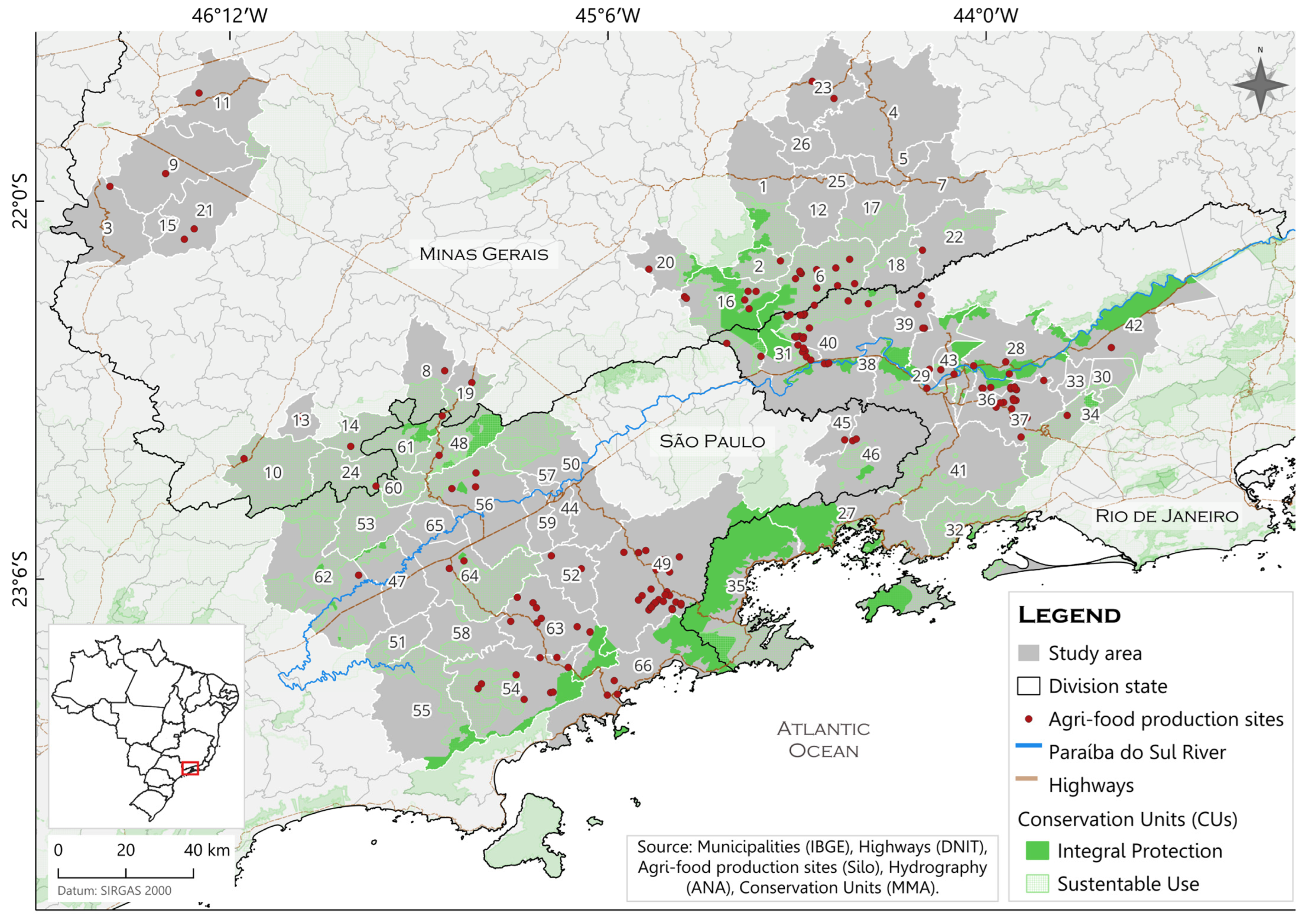
3.1. Study Area
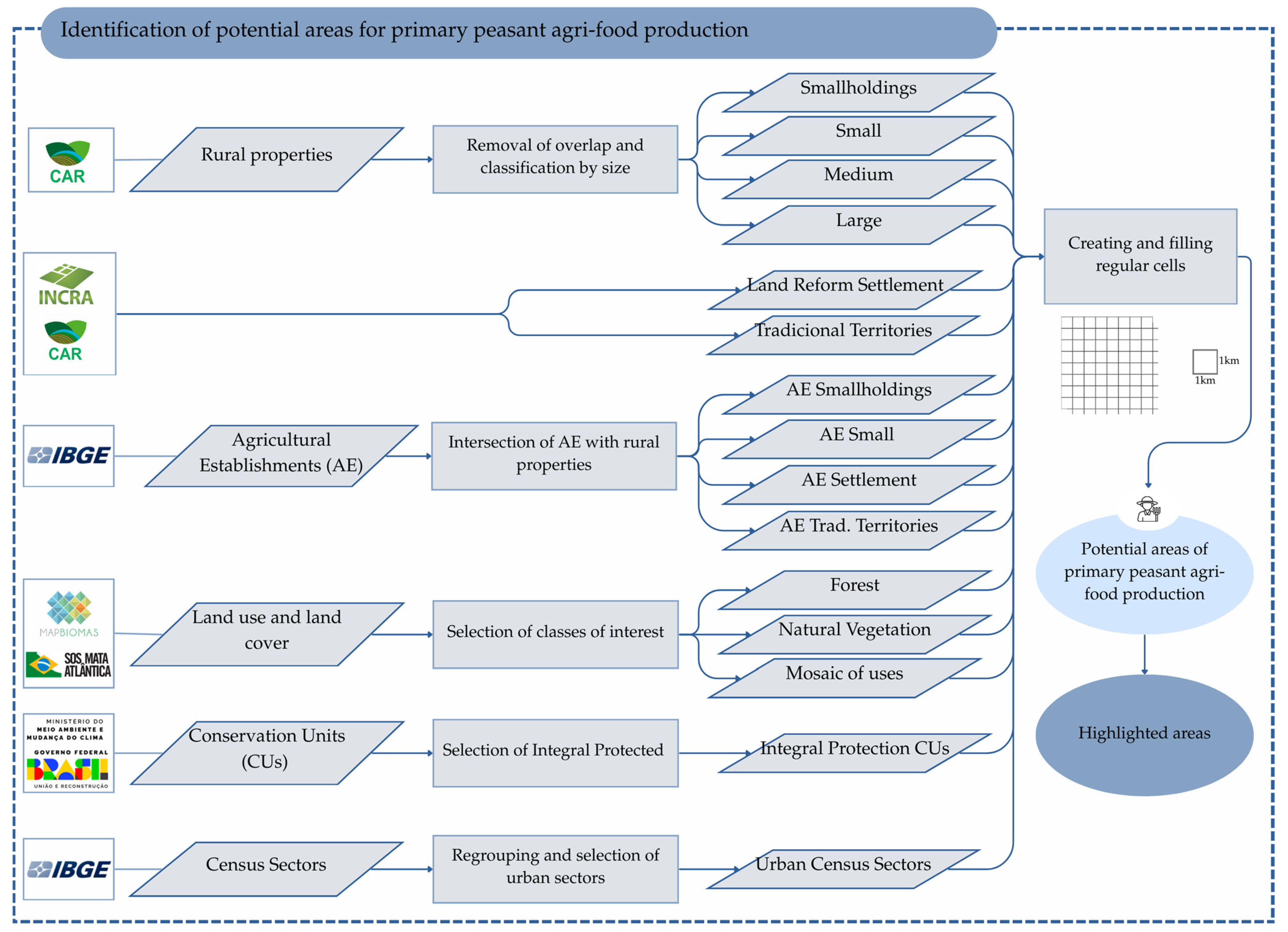
3.2. General Methodological Flowchart
3.3. Data Collection
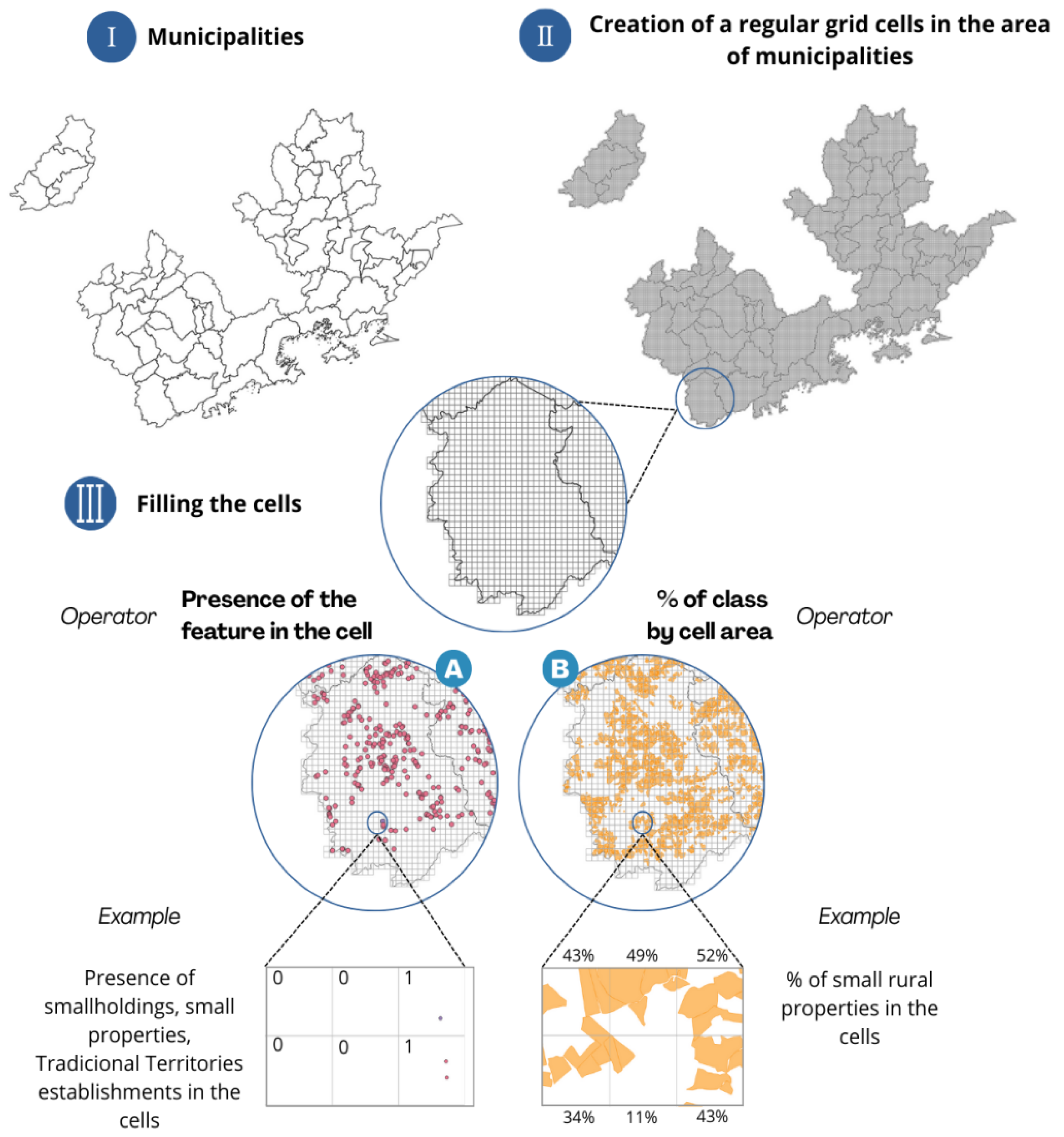
3.4. Filling of Regular Grid Cells
3.5. Classification of Cells Based on the Potential for Peasant Primary Production
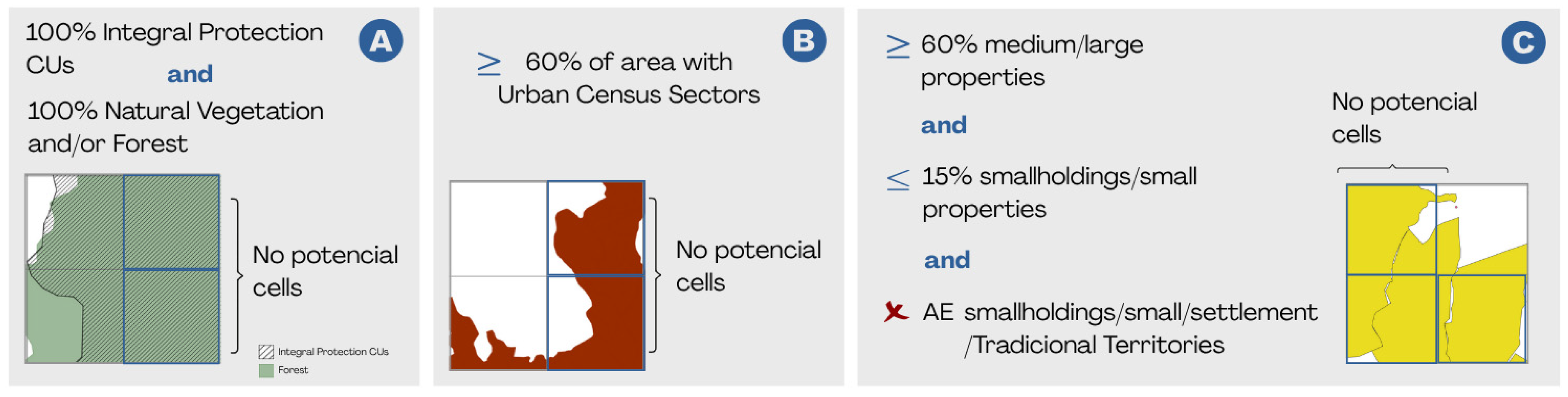
- Situation A: Refers to areas located within Integral Protection Conservation Units (CUs), which are primarily intended for biodiversity preservation. These territories are typically covered by native forest and natural vegetation, emphasizing the need for environmental protection. Such restrictions significantly limit the viability of primary peasant activities.
- Situation B: Concerns areas experiencing urban expansion, which may lead to real estate pressures and land use conflicts. These dynamics make it unfeasible to sustain or establish peasant practices. Furthermore, access to natural resources in such areas tends to be more limited, undermining the continuity of traditional agricultural livelihoods.
- Situation C: Applies to areas where medium and large rural properties account for more than half of the cell’s territory. This land concentration may lead to potential conflicts between large-scale and small-scale producers. It can obstruct the development of peasant practices by limiting access to land and essential resources needed to maintain their production systems and way of life.
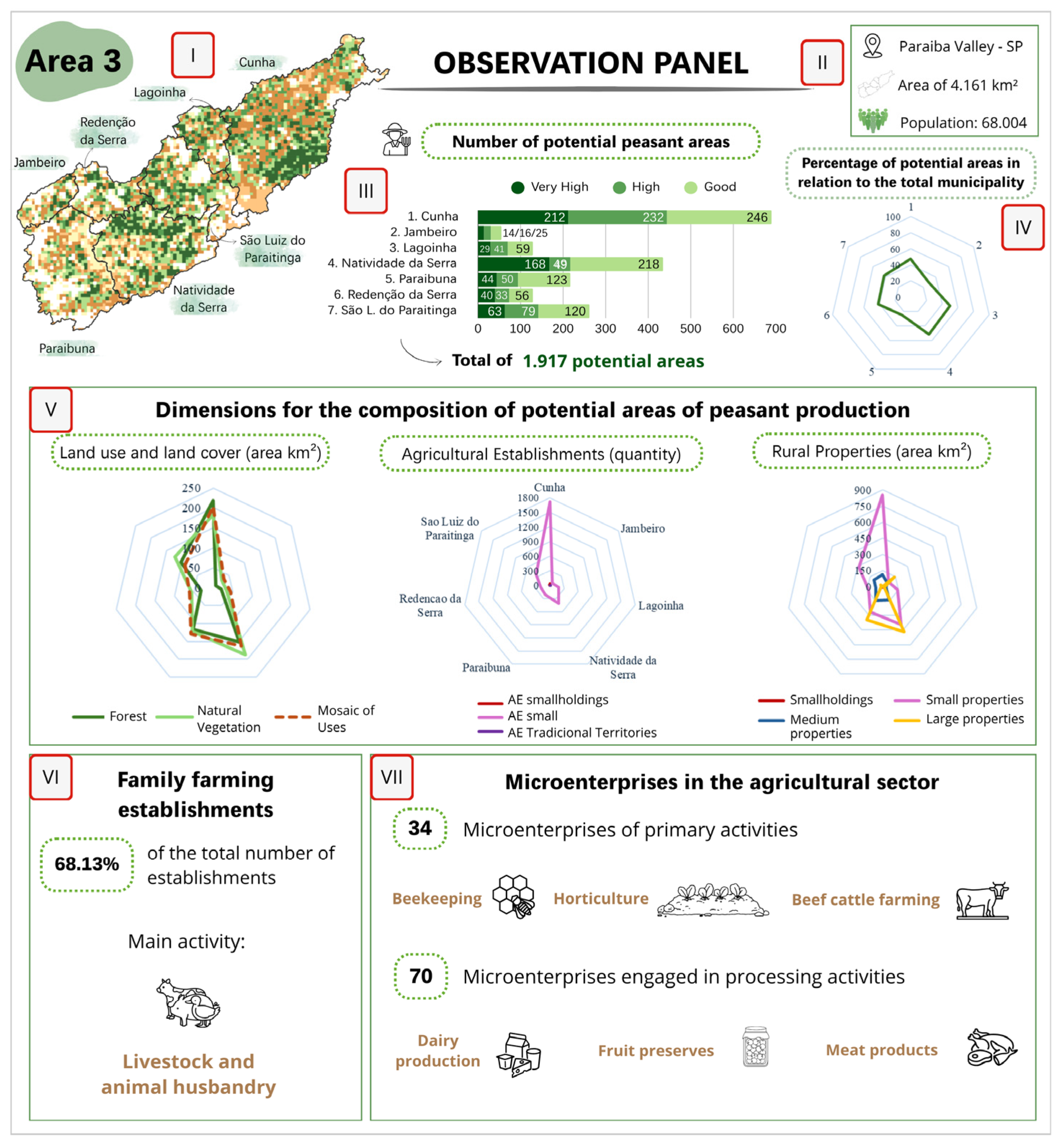
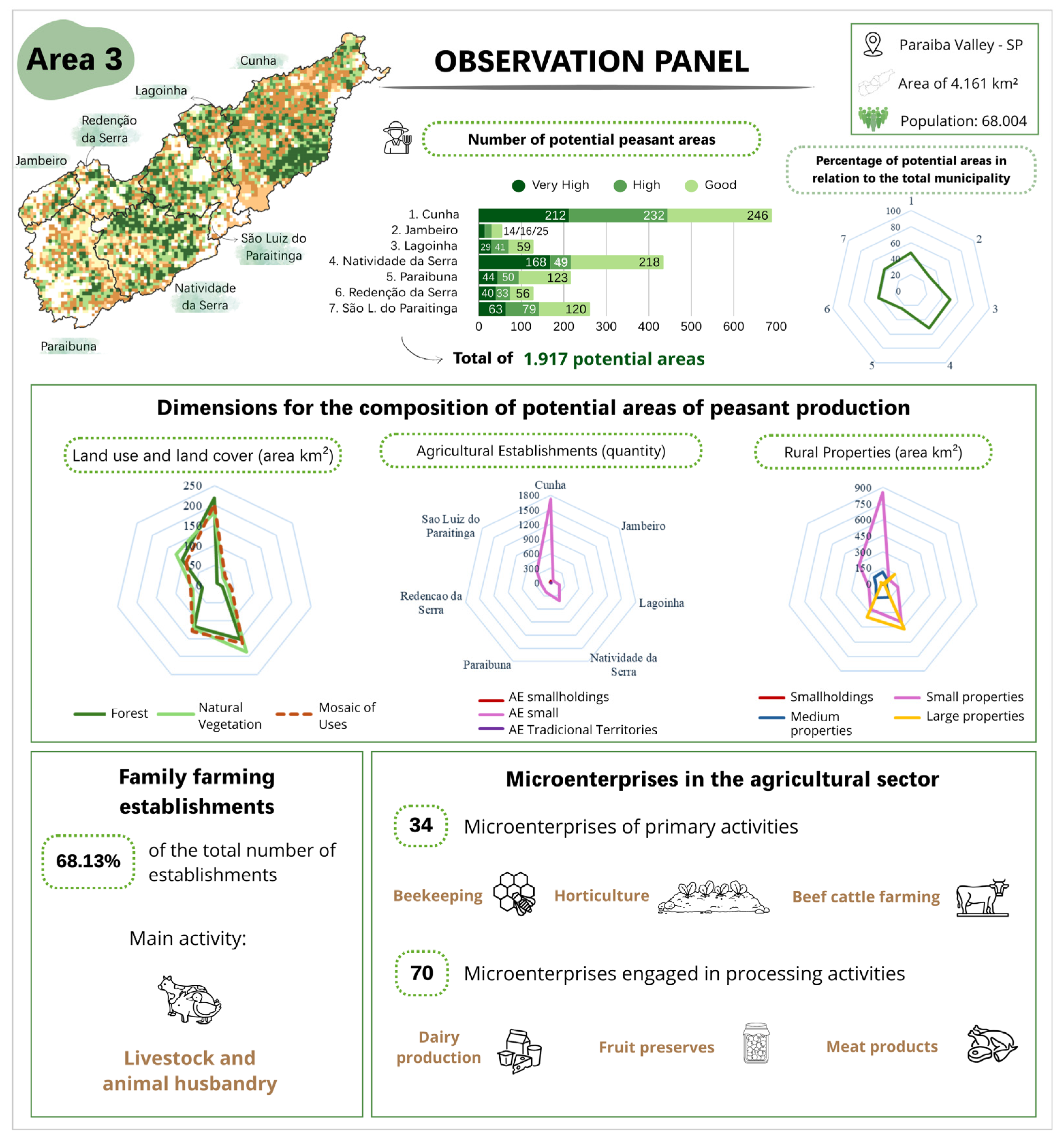
3.6. Observation Panel
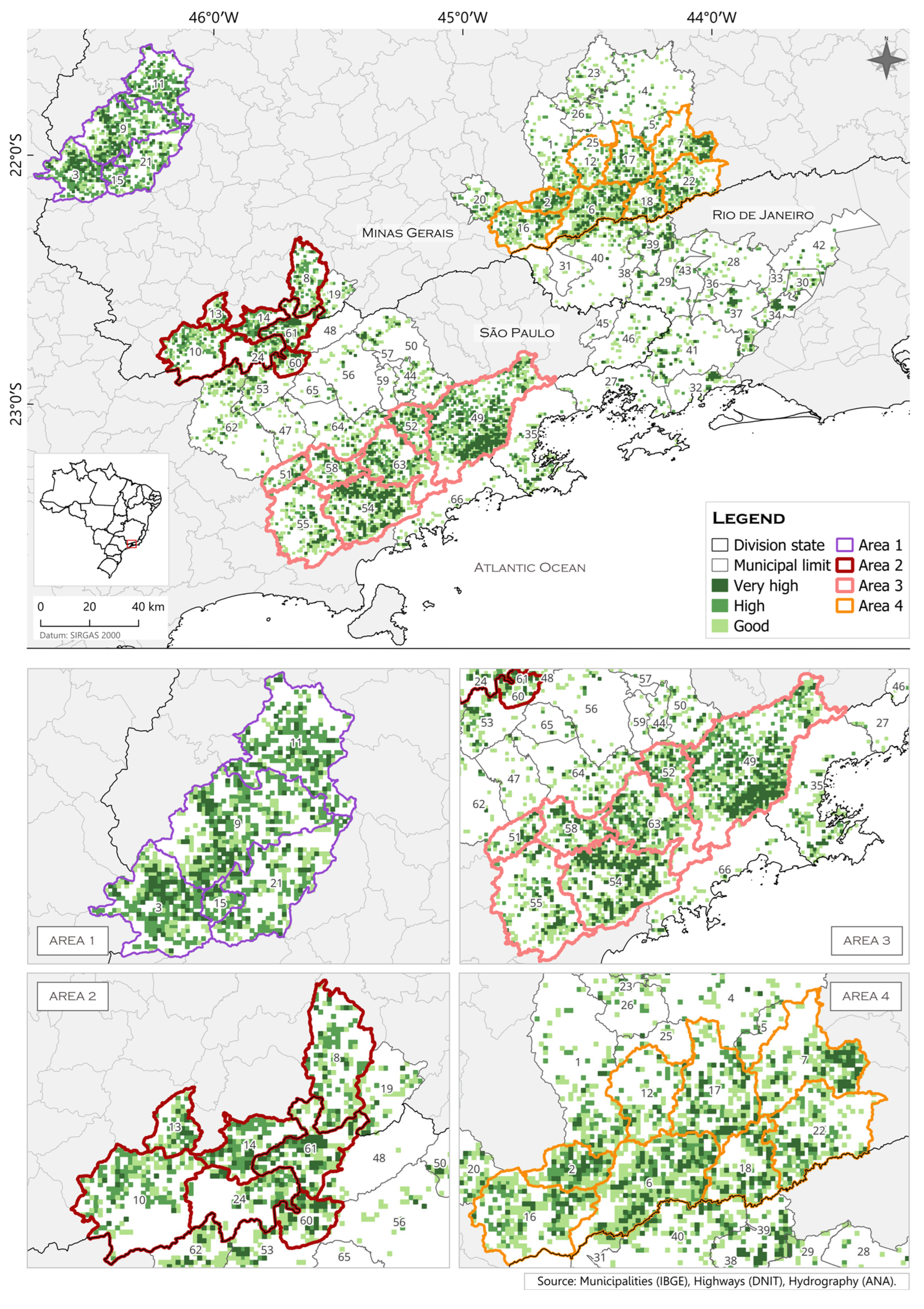
- I—Municipalities within the Area, with the spatial distribution of potential areas for primary peasant agrifood production;
- II—Area Information: location, total area, and population;
- III—Number of potential areas (very high, high, good) per municipality;
- IV—Percentage of potential areas (very high, high, and good) in relation to the total area of the municipality;
- V—Dimensions used to determine potential areas for peasant primary production: area in km2 of land use and land cover classes, number of agricultural establishments (small and small farms), and the area in km2 of small, small, medium, and large rural properties;
- VI—Family farming establishments: percentage of the total number of agricultural establishments in the municipalities of the Area and the main activities carried out;
- VII—Microenterprises in the agricultural sector: total number of CNPJs (Brazilian Corporate Taxpayers’ Registry) for primary and processing activities and the main activities carried out.
4. Results
5. Discussion
Field Visits
6. Conclusions
Supplementary Materials
Author Contributions
Funding
Data Availability Statement
Conflicts of Interest
Abbreviations
| AEs | Agricultural Establishments |
| AAFNs | Alternative Agri-food Networks |
| AFS | Agroforestry System |
| APLIs | Arrangements and Systems |
| CAR | Rural Environmental Registry |
| CNEFE | National Address Registry for Statistical Purposes |
| CSA | Community Supported Agriculture |
| CUs | Conservation Units |
| UFPA | Federal University of Pará |
| IBGE | Brazilian Institute of Geography and Statistics |
| INCRA | National Institute for Colonization and Agrarian Reform |
| INPE | National Institute for Space Research |
| LAFSs | Local Agri-food Systems |
| MMA | Ministry of the Environment and Climate Change |
| PAA | Food Acquisition Program |
| PNAE | National School Feeding Program |
| SFSCs | Short Food Supply Chains |
| 1 | Silo—Art and Rural Latitude is a Civil Society Organization (CSO) established in 2017 and located in the Environmental Protection Area of Serrinha do Alambari, in the Serra da Mantiqueira, at the triple-border region between the states of Minas Gerais, Rio de Janeiro, and São Paulo. |
| 2 | |
| 3 | <https://www.akarui.org.br/a-akarui> (accessed on 5 November 2025). |
| 4 | <https://institutoaua.org.br/> (accessed on 5 November 2025). |
| 5 | <https://www.serracima.org.br/> (accessed 5 on November 2025). |
References
- Onu-Habitat. Diretrizes Internacionais para Planejamento Urbano e Territorial, 1st ed.; Onu-Habitat: Nairobi, Kenya, 2015; Available online: https://unhabitat.org/diretrizes-internacionais-para-planejamento-urbano-e-territorial (accessed on 5 November 2025).
- Monte-Mór, R.L. Urbanização Extensiva e Lógicas de Povoamento: Um Olhar Ambiental. In Território, Globalização e Fragmentação, 1st ed.; Santos, M., Souza, M.A., Silveira, M.L., Eds.; Hucitec/Anpur: São Paulo, Brazil, 1994. [Google Scholar]
- Kneafsey, M.; Venn, L.; Schmutz, U.; Baláza, B.; Trenchard, L.; Eyden-Wood, T.; Bos, E.; Sutton, G.; Blackett, M. Short Food Supply Chains and Local Food Systems in the EU. A State of Play of their Socio-Economic Characteristics, 1st ed.; Joint Research Centre: Sevilla, Spain, 2013; p. 128. Available online: https://publications.jrc.ec.europa.eu/repository/handle/JRC80420 (accessed on 5 November 2025).
- Aguiar, L.C.; Delgrossi, M.E.; Thomé, K.M. Short food supply chain: Characteristics of a family farm. Cienc. Rural 2018, 48, e20170775. [Google Scholar] [CrossRef]
- Gazolla, M.; Schneider, S. Cadeias Curtas e Redes Agroalimentares Alternativas. In Cadeias Curtas e Redes Agroalimentares Alternativas: Negócios e Mercados da Agricultura Familiar, 1st ed.; Gazolla, M., Schneider, S., Eds.; Editora da UFRGS: Porto Alegre, Brazil, 2017; pp. 9–24. Available online: https://www.lume.ufrgs.br/bitstream/handle/10183/232245/001020657.pdf (accessed on 5 November 2025).
- Van der Ploeg, J.D. Sete Teses Sobre a Agricultura Camponesa. In Agricultura Familiar Camponesa na Construção do Futuro; Peterson, P., Ed.; AS-PTA Agricultura Familiar e Agroecologia: Rio de Janeiro, Brazil, 2009; pp. 17–31. Available online: https://www.researchgate.net/publication/283451041_Sete_teses_sobre_a_agricultura_camponesa (accessed on 5 November 2025).
- Acosta, M.D.H.; Colino, E.V.; Savarese, M. De Pandemias y seguridad alimentaria: Mapeo de circuitos cortos de abastecimiento en Río Negro-Datos relevados. Otra Econ. 2022, 15, 166–183. [Google Scholar]
- Bustamante, R.G.; Gracia, A. Construyendo resiliencia alimentaria local: Experiencias de circuitos cortos en el centro y sureste de México. Agric. Soc. Desarro. 2021, 18, 391–412. [Google Scholar] [CrossRef]
- Santos, M. O Retorno do Território. In Território: Globalização e Fragmentação, 4th ed.; Santos, M., Souza, M.A.A., Silveira, M.L., Eds.; Hucitec: São Paulo, Brazil, 1994; pp. 15–20. [Google Scholar]
- Fernàndez, M.C.L. Territorios, Ciudades y Sistemas Alimentarios: Una Visión Estratégica. Estudio de Caso: México. In Sistemas Alimentarios en América Latina y el Caribe-Desafíos en un Escenario Pospandemia; Silva, J.G., Jales, M., Rapallo, R., Días-Bonilla, E., Girardi, G., Del Grossi, M., Luiselli, C., Sotomayor, O., Rodríguez, A., Rodrigues, M., et al., Eds.; FAO y CIDES: Panamá City, Panamá, 2021. [Google Scholar]
- Si, Z.; Schumilas, T.; Scott, S. Um Retrato das Redes Agroalimentares Alternativas na China. In Cadeias Curtas e Redes Agroalimentares Alternativas: Negócios e Mercados da Agricultura Familiar; Gazolla, M., Schneider, S., Eds.; Editora da UFRGS: Porto Alegre, Brazil, 2017; pp. 473–490. [Google Scholar]
- Belletti, G.; Marescotti, A. Inovações Econômicas em Cadeias Curtas de Abastecimento Alimentar. In Cadeias Curtas e Redes Agroalimentares Alternativas: Negócios e Mercados da Agricultura Familiar; Gazolla, M., Schneider, S., Eds.; Editora da UFRGS: Porto Alegre, Brazil, 2017; pp. 129–145. [Google Scholar]
- Folhes, R.T.; Fernandes, D.A. A dominância do paradigma tecnológico mecânico-químico-genético nas políticas para o desenvolvimento da bioeconomia na Amazônia (Paper 540). Pap. NAEA 2022, 1–25. [Google Scholar] [CrossRef]
- Van der Ploeg, J.D.; YE, J.; Schneider, S. Reading markets politically: On the transformativity and relevance of peasant markets. J. Peasant. Stud. 2022, 50, 1852–1877. [Google Scholar] [CrossRef]
- Histórico da Rede Ecovida. 2025. Available online: https://ecovida.org.br/info/sobre/ (accessed on 15 September 2025).
- Ribeiro, A.E.M.; Galizoni, F.M.; Lima, V.M.P.; Cruz, M.S.; Araújo, A.M.; Rocha, C.V. Investigação e Extensão Universitária em Feiras Livres—Experiências no Vale do rio Jequitinhonha, Brasil. In Redes y Circuitos Cortos de Comercialización Agroalimentarios, 1st ed.; Camacho, Y.A., Molina, J.P., Eds.; Universidad Nacional de Colombia: Bogotá, Colombia, 2021; pp. 87–100. [Google Scholar]
- Costa, F.A. Arranjos e Sistemas Produtivos e Inovativos Locais—As possibilidades do Conceito na Constituição de um Sistema de Planejamento para a Amazônia. Rev. Bras. Inov. 2006, 5, 77–98. [Google Scholar] [CrossRef]
- Durr, J.; Costa, F.D.A. Cadeias produtivas de base agrária e desenvolvimento regional: O caso da região do Baixo Tocantins. Amazon. Cienc. Desenvolv. 2008, 3, 55–92. [Google Scholar]
- Mello, D.G.; Costa, F.D.A.; Brienza Júnior, S.; Mello, D.G. Mercado e potencialidades dos produtos oriundos de floresta secundária em áreas de produção familiar. Novos Cad. NAEA 2009, 12, 137–148. [Google Scholar] [CrossRef]
- De Costa, F.A. Economia camponesa referida ao bioma da Amazônia: Atores, territórios e atributos. Pap. NAEA 2020, 29, 11–33. [Google Scholar] [CrossRef]
- Silo Programas. CaipiraTechLab. Available online: https://silo.org.br/caipiratechlab/ (accessed on 15 September 2025).
- Turpin, M.E. A alimentação escolar como fator de desenvolvimento local por meio do apoio aos agricultores familiares. Segur. Aliment. Nutr. 2009, 16, 20–42. [Google Scholar] [CrossRef]
- Valadares, A.A.; Alves, F.; Bastian, L.; Silva, S.P. Da Regra aos Fatos: Condicionantes da Aquisição de Produtos da Agricultura Familiar para a Alimentação Escolar em Municípios Brasileiros; Instituto de Pesquisa Econômica Aplicada (Ipea): Brasília, Brazil, 2022. [Google Scholar]
- Dados da Agricultura Familiar. Available online: https://www.gov.br/fnde/pt-br/acesso-a-informacao/acoes-e-programas/programas/pnae/consultas/pnae-dados-da-agricultura-familiar (accessed on 15 September 2025).
- Tobler, W.R. A computer movie simulating urban growth in the Detroit Region. Econ. Geogr. 1970, 46, 234–240. [Google Scholar] [CrossRef]
- Censo Agropecuário de 2017: Resultados Definitivos. Available online: https://sidra.ibge.gov.br/pesquisa/censo-agropecuario/censo-agropecuario-2017/resultados-definitivos (accessed on 15 September 2025).
- Dean, W. A Ferro e Fogo: A História e a Devastação da Mata Atlântica Brasileira; Companhia das Letras: São Paulo, Brazil, 1996; p. 484. [Google Scholar]
- Cabral, D.C. O ‘Bosque de Madeiras’ e Outras Histórias: A Mata Atlântica no Brasil Colonial (Séculos XVIII e XIX). Ph.D. Thesis, Universidade Federal do Rio de Janeiro (UFRJ), Rio de Janeiro, Brazil, 2012. [Google Scholar]
- Carvalho, D.A.P.; Ribas, R.P. Caderno Regional do Estado do Rio de Janeiro: Região do Médio Paraíba; Imprensa Oficial: Niterói, Brazil, 2017; p. 195. [Google Scholar]
- Serviço Florestal Brasileiro (SFB). Cadastro Ambiental Rural (CAR). Available online: https://consultapublica.car.gov.br/publico/imoveis/index (accessed on 5 November 2025).
- Instituto Brasileiro de Geografia e Estatística (IBGE). Cadastro Nacional de Endereços para Fins Estatísticos (CNEFE). Available online: https://www.ibge.gov.br/estatisticas/sociais/populacao/38734-cadastro-nacional-de-enderecos-para-fins-estatisticos.html?=&t=downloads (accessed on 5 November 2025).
- Instituto Nacional de Colonização e Reforma Agrária (INCRA). Projetos de Reforma Agrária. Available online: https://www.gov.br/incra/pt-br/assuntos/reforma-agraria (accessed on 5 November 2025).
- Ministério do meio Ambiente e Mudança do Clima (MMA). Cadastro Nacional de Unidades de Conservação (CNUC). Available online: https://cnuc.mma.gov.br/map (accessed on 5 November 2025).
- Mapbiomas. Coleções. Available online: https://brasil.mapbiomas.org/colecoes-mapbiomas/ (accessed on 5 November 2025).
- Sos Mata Atlântica. Atlas Dos Remanescentes Florestais. Available online: http://mapas.sosma.org.br/ (accessed on 5 November 2025).
- Brasil. Law 8.629. 1993. Available online: https://www.planalto.gov.br/ccivil_03/LEIS/L8629.htm (accessed on 2 November 2025).
- INCRA—National Institute of Colonization and Agrarian Reform. Módulo fiscal. Available online: https://www.gov.br/incra/pt-br/assuntos/governanca-fundiaria/modulo-fiscal (accessed on 2 November 2025).
- Van der Ploeg, J.D. Camponeses e a Arte da Agricultura: Um Manifesto Chayanoviano, 1st ed.; Editora Unesp: São Paulo, Brazil; Editora UFRGS: Porto Alegre, Brazil, 2016; p. 196. [Google Scholar]
- Wanderley, M.N.B. Raízes históricas do campesinato brasileiro. Agric. Fam. Real. Perspect. 1996, 3, 21–55. [Google Scholar]
- Matias, M.R. Cartografias da Agricultura Urbana: Contribuições ao Planejamento Territorial na Região Metropolitana do Vale do Paraíba e Litoral Norte. Master’s Thesis, Instituto Nacional de Pesquisas Espaciais (INPE), São José dos Campos, SP, Brazil, 2022. [Google Scholar]
- Carvalho, H.M.; Costa, F.A. Agricultura Camponesa. In Dicionário da Educação do Campo; Caldart, R.S., Pereira, I.B., Alentejano, P., Frigotto, G., Eds.; Escola Politécnica de Saúde Joaquim Venâncio: Rio de Janeiro, Brazil; Expressão Popular: São Paulo, Brazil, 2012; pp. 28–34. [Google Scholar]
- Corrêa, V.M.; Carvalho, J.G. Campesinato e neoextrativismo em São Paulo: Dinâmicas e conflitos da atividade sucroenergética na região de Ribeirão Preto. Rev. Bras. Estud. Urbanos Reg. 2024, 26, e202418pt. [Google Scholar] [CrossRef]
- Souza, A.R.; Escada, M.I.S.; Marujo, R.F.B.; Monteiro, A.M.V. Cartografia do invisível: Revelando a agricultura de pequena escala com imagens Rapideye na região do baixo Tocantins. Rev. Dep. Geogr. 2019, 38, 137–153. [Google Scholar] [CrossRef]
- Descrição da Legenda. Available online: https://brasil.mapbiomas.org/codigos-de-legenda/ (accessed on 2 October 2025).
- Brasil. Law 9.985. 2000. Available online: https://www.planalto.gov.br/ccivil_03/leis/l9985.htm (accessed on 2 November 2025).
- Amaral, S.; Gavlak, A.; Escada, M.I.S.; Monteiro, A.M.V. Using remote sensing and census tract data to improve representation of population spatial distribution: Case studies in the Brazilian Amazon. Popul. Environ. 2012, 34, 142–170. [Google Scholar] [CrossRef]
- Bailey, T.C.; Gatrell, A.C. Interactive Spatial Data Analysis; Longman Scientific & Technical: Essex, UK, 1995; p. 413. [Google Scholar]
- Carvalho, M.S.; Câmara, G. Análise Espacial de Eventos Pontuais. In Análise Espacial de Dados Geográficos; Druck, S., Carvalho, M.S., Câmara, G., Monteiro, A.V.M., Eds.; Embrapa: Brasília, Brazil, 2004. [Google Scholar]
- Anazawa, T.M. Vulnerabilidade e Território no Litoral Norte de São Paulo: Indicadores, Perfis de Ativos e Trajetórias. Master’s Thesis, Instituto Nacional de Pesquisas Espaciais (INPE), São José dos Campos, SP, Brazil, 2012. [Google Scholar]
- Anazawa, T.M. A Grave Escassez Hídrica e as Dimensões de um Desastre Socialmente Construído: A Região Metropolitana de Campinas Entre 2013–2015. Ph.D. Thesis, Universidade Estadual de Campinas (UNICAMP), Campinas, SP, Brazil, 2017. [Google Scholar]
- Devide, A.C.P.; Castro, C.M.; Ribeiro, R.L.D.; Abboud, A.C.S.; Pereira, M.G.P.; Rumjanek, N.G. História Ambiental do Vale do Paraíba Paulista, Brasil. Rev. Biocienc. 2014, 20, 12–29. [Google Scholar]
- Comitê Executivo de Estudos Integrados da Bacia Hidrográfica do Rio Paraíba do Sul (CEEIVAP). Plano de Recursos Hídricos da Bacia do Rio Paraíba do Sul: Resumo: Análise dos Impactos e das Medidas Mitigadoras que Envolvem a Construção e Operação de Usinas Hidrelétricas: Relatório; Comitê Executivo de Estudos Integrados da Bacia Hidrográfica do Rio Paraíba do Sul (CEEIVAP): São Paulo, Brazil, 2007; p. 42. [Google Scholar]
- Comitê Executivo de Estudos Integrados da Bacia Hidrográfica do Rio Paraíba do Sul (CEEIVAP). Relatório Técnico Sobre a Situação dos Reservatórios com Subsídios para Ações de Melhoria da Gestão na Bacia do Rio Paraíba do Sul; Comitê Executivo de Estudos Integrados da Bacia Hidrográfica do Rio Paraíba do Sul (CEEIVAP): São Paulo, Brazil, 2010; p. 178. [Google Scholar]
- Galvanese, C.; Puga, B.P.; Grigoletto, F. Desafios à exploração sustentável da sociobiodiversidade como vetor de desenvolvimento de territórios rurais no Brasil. Raízes Rev. Cienc. Sociais Econ. 2024, 43, 366–382. [Google Scholar] [CrossRef]
- Costa, V.F.M.; Vazquez, G.H. Programa de inclusão da polpa do fruto da palmeira juçara na merenda escolar de Caraguatatuba/SP. Rev. Nac. Gerenciamento Cid. 2019, 7, 147–162. [Google Scholar] [CrossRef]
- Rede de Agroecologia do Vale do Paraíba (Akarui, Tekoporã, São Luiz do Paraitinga, São Paulo, Brazil). Personal communication, 2024.
- Elias, L.D.P.; Belik, W.; Cunha, M.P.D.; Guilhoto, J.J.M. Impactos socioeconômicos do Programa Nacional de Alimentação Escolar na agricultura familiar de Santa Catarina. Rev. Econ. Sociol. Rural. 2019, 57, 215–233. [Google Scholar] [CrossRef]
- Marques, P.E.M.; Retière, M.I.H.; Almeida, N.; Dos Santos, C.F. A participação da agricultura familiar no Programa Nacional de Alimentação Escolar: Estudo de casos em municípios paulistas da região administrativa de Campinas. Segur. Aliment. Nutr. 2017, 24, 101–112. [Google Scholar] [CrossRef]
- Oliveira, S.S.; Zanini, M.C.C. Algumas Considerações Sobre a Família Camponesa: Desafios e Estratégias na Reprodução Social do Campesinato no Feirão Colonial de Santa Maria/RS. In Mercados, Campesinato e Cidades: Abordagens Possíveis; Zanini, M.C.C., Ed.; Oikos: São Leopoldo, Brazil, 2015; pp. 163–184. [Google Scholar]
- Cassol, A.; Schneider, S. Construindo a Confiança nas Cadeias Curtas: Interações Sociais, VALORES e qualidade na Feira do Pequeno Produtor de Passo Fundo/RS. In Cadeias Curtas e Redes Agroalimentares Alternativas: Negócios e Mercados da Agricultura Familiar; Gazolla, M., Schneider, S., Eds.; Editora da UFRGS: Porto Alegre, Brazil, 2017; pp. 195–217. [Google Scholar]
- Cruz, M.S.; Ribeiro, E.M.; Perondi, M.A.; Oliveira, D.C.; Costa, H.M. Agricultura familiar, feiras livres e feirantes no Alto Jequitinhonha. Rev. Campo Territ. 2020, 15, 90–120. [Google Scholar] [CrossRef]
- Renting, H.; Marsden, T.K.; Banks, J. Understanding alternative food networks: Exploring the role of short food supply chains in rural development. Environ. Plan. A 2003, 35, 393–411. [Google Scholar] [CrossRef]
- Liu, X.; Liu, C.; Jieying, B. Shortening food supply chain in home-grown school feeding: Experiences and lessons from south central China. Int. Food Agribus. Manag. 2023, 26, 711–728. [Google Scholar] [CrossRef]
- Schwartzman, F. Antecedentes e elementos da vinculação do programa de alimentação escolar do Brasil com a agricultura familiar. Cad. Saúde Publica 2017, 33, 1–15. [Google Scholar] [CrossRef]
- Nsamzinshuti, A.; Janjevic, M.; Rigo, N.; Ndiaye, A.B. Logistics collaboration solutions to improve short food supply chain solution performance. In Proceedings of the World Conference on Supply Chain Management, Colombo, Sri Lanka, 17–19 May 2017; pp. 57–69. [Google Scholar] [CrossRef]
- Bui, T.N.; Nguyen, A.H.; Le, T.T.H.; Nguyen, V.P.; Le, T.T.H.; Tran, T.T.H.; Nguyen, N.M.; Le, T.K.O.; Nguyen, T.K.O.; Nguyen, T.T.T.; et al. Can a short food supply chain create sustainable benefits for small farmers in developing countries? An exploratory study of Vietnam. Sustainability 2021, 13, 2443. [Google Scholar] [CrossRef]
- Cruz, S.F.; Assis, T.R.P. Contribuições de três organizações para a comercialização da agricultura familiar no PNAE, no território sul litorâneo do Espírito Santo. Interações 2019, 20, 737–752. [Google Scholar] [CrossRef]
- Rocha, B.; Pereira, E.L.; Baccarin, J.G. Programa Nacional de Alimentação Escolar e agricultores familiares contemplados: O caso da região metropolitana de São Paulo. Retratos Assentamentos 2024, 27, 48–68. [Google Scholar] [CrossRef]
- Berkhout, E.; Sovová, L.; Sonneveld, A. The role of urban–rural connections in building food system resilience. Sustainability 2023, 15, 1818. [Google Scholar] [CrossRef]
- Monte-Mór, R.L.M. Urbanização Extensiva e Economia dos Setores Populares. In O Brasil, a América Latina e o Mundo: Espacialidades Contemporâneas; Oliveira, M.P., Coelho, M.C.N., Corrêa, A.M., Eds.; Lamparina: São Paulo, Brazil; Federação de Powerlifting do Estado do Rio de Janeiro (FEPERJ): Rio de Janeiro, Brazil; Associação Nacional de Pós-Graduação e Pesquisa em Geografia (Anpege): São Paulo, Brazil, 2008; pp. 1–20. [Google Scholar]
- Miranda, E.E.D.; Carvalho, C.A.D.; Martinho, P.R.R. O Mundo Rural do Censo Agropecuário não é o do Cadastro Ambiental rural? In Uma Jornada Pelos Contrastes do Brasil: Cem anos do Censo Agropecuário; Vieira Filho, J.E.R., Gasques, J.G., Eds.; Instituto de Pesquisa Econômica Aplicada (IPEA): Brasília, Brazil, 2020; pp. 91–104. [Google Scholar]



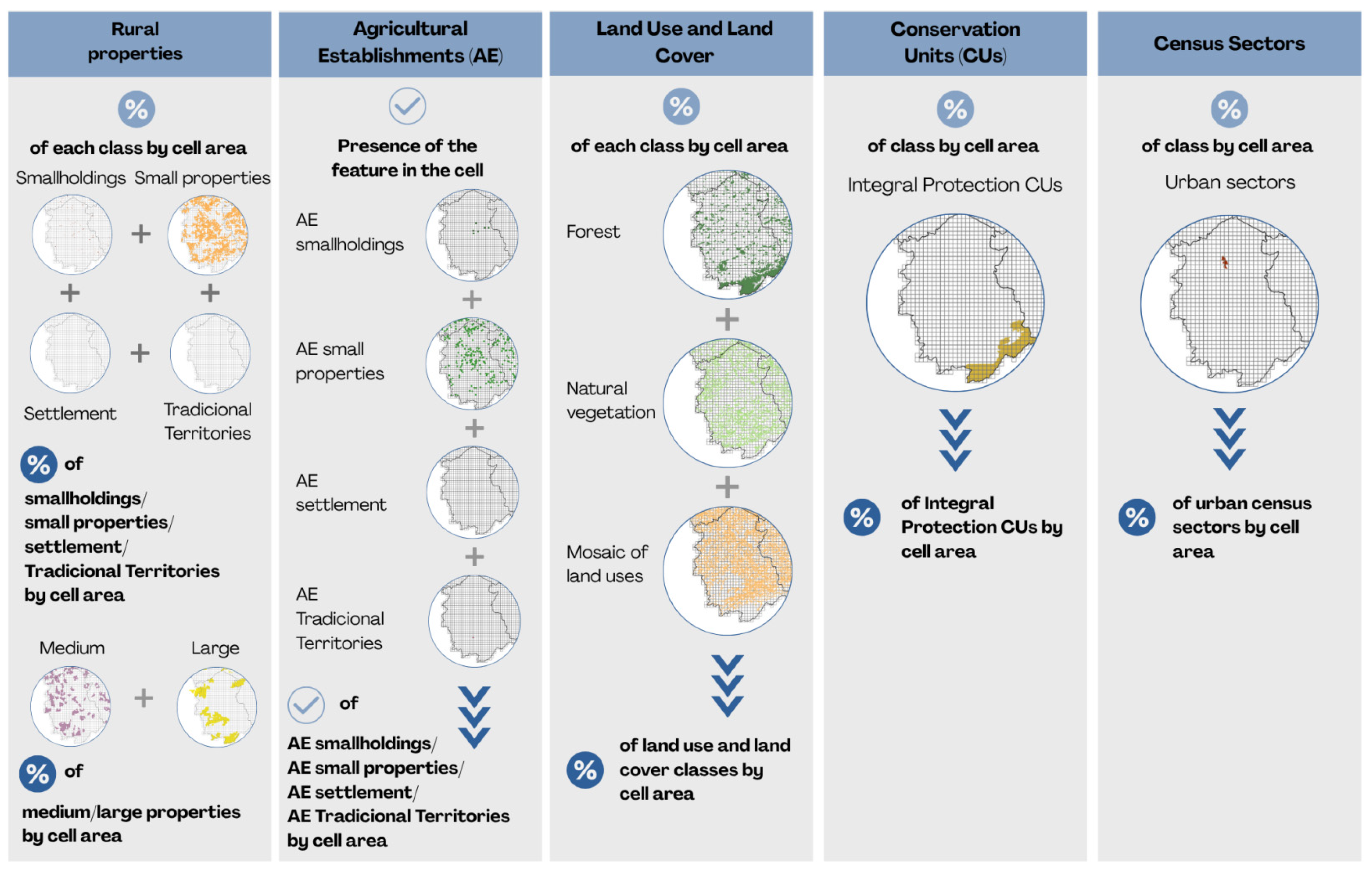
| Data Source | Justification for Use |
|---|---|
| Rural properties | This dataset, later classified by size (smallholding, small, medium, and large) [36,37], allows the identification of potential peasant units. The classification of rural propertis by size can be found in the Supplementary Materials (Table S1). Among these categories, smallholding and small properties have a greater potential for primary peasant production [38,39]. To use this database as an indicator of land size, methodological procedures based on Matias [40] were adopted, due to the overlap in property geometries. |
| Land Reform Settlements and Traditional Territories | Used to indicate the presence of settlements and traditional territories, as they hold high potential for the development of peasant production activities. This mode of production involves a strong relationship with the land (as a space for living and working), centered on the reproduction of family labor [41]. These features are shared by beneficiaries of land reform projects [42] and traditional communities. |
| Agricultural Establishments | Used by intersecting with rural properties classified by size (smallholding and small only) and with settlements and traditional territories. This combination allows for the identification of areas with greater potential for peasant primary production. |
| Land Use and Land Cover | Used to identify primary production activities, whether related to agriculture, livestock, or extractivism. Since there is a lack of specific classes that precisely identify small-scale primary production activities [43], selected categories include the “Mosaic of uses” class from Mapbiomas, and the “forest” and “natural vegetation” (refers to areas where the vegetation cover has developed naturally) classes from the SOS Mata Atlântica’s Atlas of Forest Remnants and the National Institute for Space Research (INPE). These last two classes are relevant because peasant units tend to be closer to landscapes with higher vegetation density, reflecting their continuous interaction with nature—a concept known as co-production [38]. The “Mosaic of uses” is characterized by areas of agricultural use where it was not possible to identify pure pixels of pasture or cropland [44]. In the Atlantic Forest, this may also include peri-urban areas, such as small farms (sítios in Portuguese), small rural properties (sítios in Portuguese) and condos in peri-urban areas (residential complexes). |
| Conservation Units | The Integral Protection Units aim to preserve nature through the indirect use of their natural resources [45]. The natural vegetation/forest cover in these areas highlights the importance of conservation, which limits the possibility of primary peasant agri-food production. Sustainable Use Units were not used to define the class of areas not considered potential for peasant primary agrifood production, as these areas allow traditional populations and historical inhabitants, guided by legal restrictions, to carry out activities associated with the natural resources. According to Law 9.985/200 [45], only in Protection Units are activities related to the use of natural resources prohibited, so only this category was used to classify non-potential areas. |
| Urban Census Sectors | Urban expansion in these areas may create real estate pressures and/or land use conflicts, making it unfeasible for peasant practices to persist or develop. Additionally, access to natural resources in such areas may be more restricted. |
| Municipality | Not Associated | Associated | Total |
|---|---|---|---|
| Cunha | 1.270 (75.10%) | 421 (24.89%) | 1.691 |
| Lagoinha | 49 (31%) | 109 (68.98%) | 158 |
| Natividade da Serra | 287 (83.67%) | 56 (16.32%) | 343 |
| Redenção da Serra | 116 (74.83%) | 39 (25.16%) | 155 |
| São Luiz do Paraitinga | 247 (73.95%) | 87 (26%) | 334 |
Disclaimer/Publisher’s Note: The statements, opinions and data contained in all publications are solely those of the individual author(s) and contributor(s) and not of MDPI and/or the editor(s). MDPI and/or the editor(s) disclaim responsibility for any injury to people or property resulting from any ideas, methods, instructions or products referred to in the content. |
© 2025 by the authors. Licensee MDPI, Basel, Switzerland. This article is an open access article distributed under the terms and conditions of the Creative Commons Attribution (CC BY) license.
Share and Cite
da Silva, B.D.; Anazawa, T.M.; Monteiro, A.M.V. Land Use Planning and the Configuration of Local Agri-Food Systems (LAFSs): The Triple Border Between the States of Minas Gerais, Rio de Janeiro, and São Paulo, Brazil as a Space of Possibilities. Land 2026, 15, 83. https://doi.org/10.3390/land15010083
da Silva BD, Anazawa TM, Monteiro AMV. Land Use Planning and the Configuration of Local Agri-Food Systems (LAFSs): The Triple Border Between the States of Minas Gerais, Rio de Janeiro, and São Paulo, Brazil as a Space of Possibilities. Land. 2026; 15(1):83. https://doi.org/10.3390/land15010083
Chicago/Turabian Styleda Silva, Beatriz Davida, Tathiane Mayumi Anazawa, and Antônio Miguel Vieira Monteiro. 2026. "Land Use Planning and the Configuration of Local Agri-Food Systems (LAFSs): The Triple Border Between the States of Minas Gerais, Rio de Janeiro, and São Paulo, Brazil as a Space of Possibilities" Land 15, no. 1: 83. https://doi.org/10.3390/land15010083
APA Styleda Silva, B. D., Anazawa, T. M., & Monteiro, A. M. V. (2026). Land Use Planning and the Configuration of Local Agri-Food Systems (LAFSs): The Triple Border Between the States of Minas Gerais, Rio de Janeiro, and São Paulo, Brazil as a Space of Possibilities. Land, 15(1), 83. https://doi.org/10.3390/land15010083