

Explainable Machine Learning for Evaluating Coupling and Coordination of the Sustainability Trilemma: A Case Study of Hebei Province
 ,
,
Abstract
1. Introduction
2. Materials and Methods
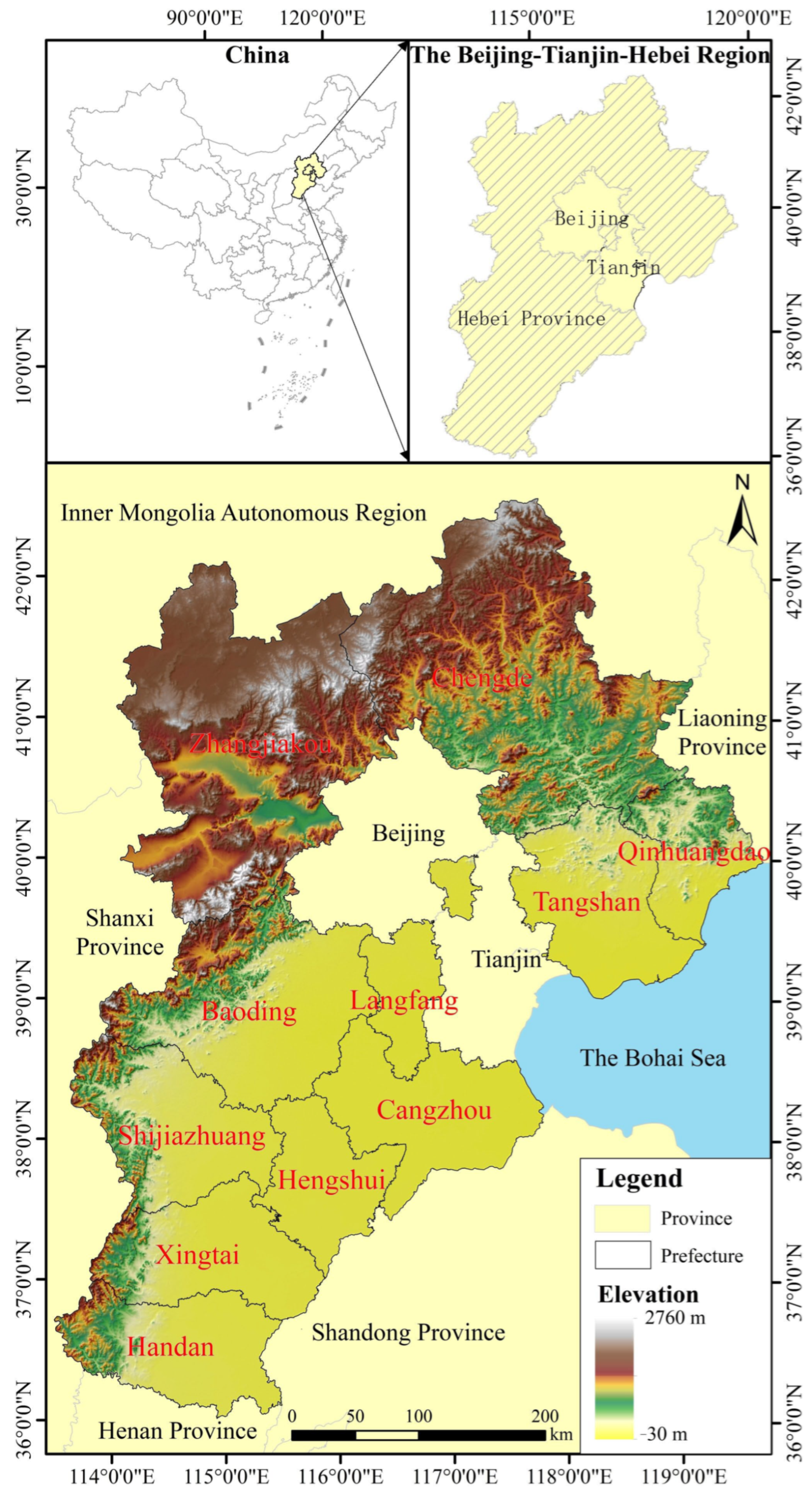
2.1. Study Area
2.2. Data Sources and Preprocessing

| Data | Resolution | Time | Unit | Data Source |
|---|---|---|---|---|
| DEM | 30 m | 2020 | m | National Earth System Science Data Center (https://www.geodata.cn/main/, accessed on 1 July 2025) |
| China Soil Database | 1 km | 2008 | \ | Harmonized World Soil Database (HWSD) |
| PRE | 1 km | 2005–2020 | mm | National Qinghai–Tibet Plateau Science Data Center (https://data.tpdc.ac.cn/home/ (accessed on 8 July 2025)) |
| Evapotranspiration | 1 km | 2005–2020 | mm | |
| TEMP | 1 km | 2005–2020 | °C | |
| Land Use Data | 30 m/1 km | 2005–2020 | \ | Resource and Environment Science Data Center (RESDC) |
| NDVI | 1 km | 2005–2020 | \ | National Ecological Data Center Resource Sharing Service Platform (https://www.nesdc.org.cn/, (accessed on 8 July 2025) |
| Depth to Bedrock Map | 1 km | 2020 | m | https://doi.org/10.1038/s41597-019-0345-6 |
| POP | 1 km | 2005–2020 | persons km−2 | https://landscan.ornl.gov, accessed on 24 July 2025 |
| NL | 1 km | 2005–2020 | nits | Earth Resource Data Cloud (GRDC) |
| River and Road | \ | 2020 | \ | National Administration of Surveying, Mapping and Geoinformation (NASG) |
| POI | \ | 2005–2020 | \ | Gaode, Baidu |
| Socioeconomic Statistics | Prefecture | 2005–2020 | \ | Hebei Statistical Yearbook, China Urban Statistical Yearbook |
| Total Water Resources | Province | 2005–2020 | m3 | Hebei Water Resources Bulletin |
2.3. Methods
2.3.1. Downscaling of Socioeconomic Data
2.3.2. Data Standardization
2.3.3. Determination of Indicator Weights Using the Entropy Method
2.3.4. Comprehensive Evaluation Model Construction
2.3.5. Coupling and Coordination Assessment Model
2.3.6. Time Series Data Clustering Analysis
Elbow Method
Fuzzy C-Means Clustering to Identify the Spatiotemporal Distribution Patterns
2.3.7. XGBoost-SHAP Model
3. Results
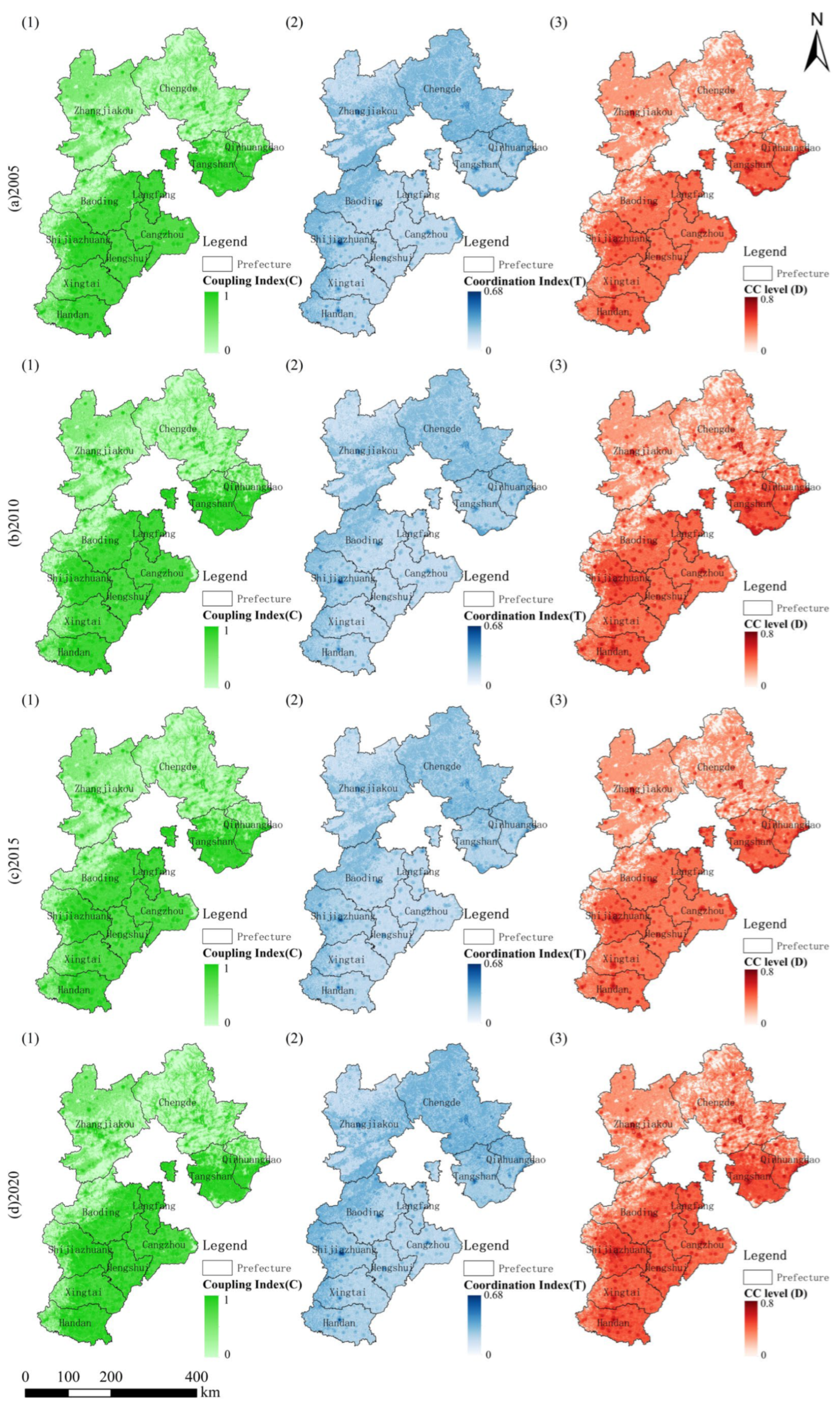
3.1. Spatiotemporal Distributions of C, T, and D
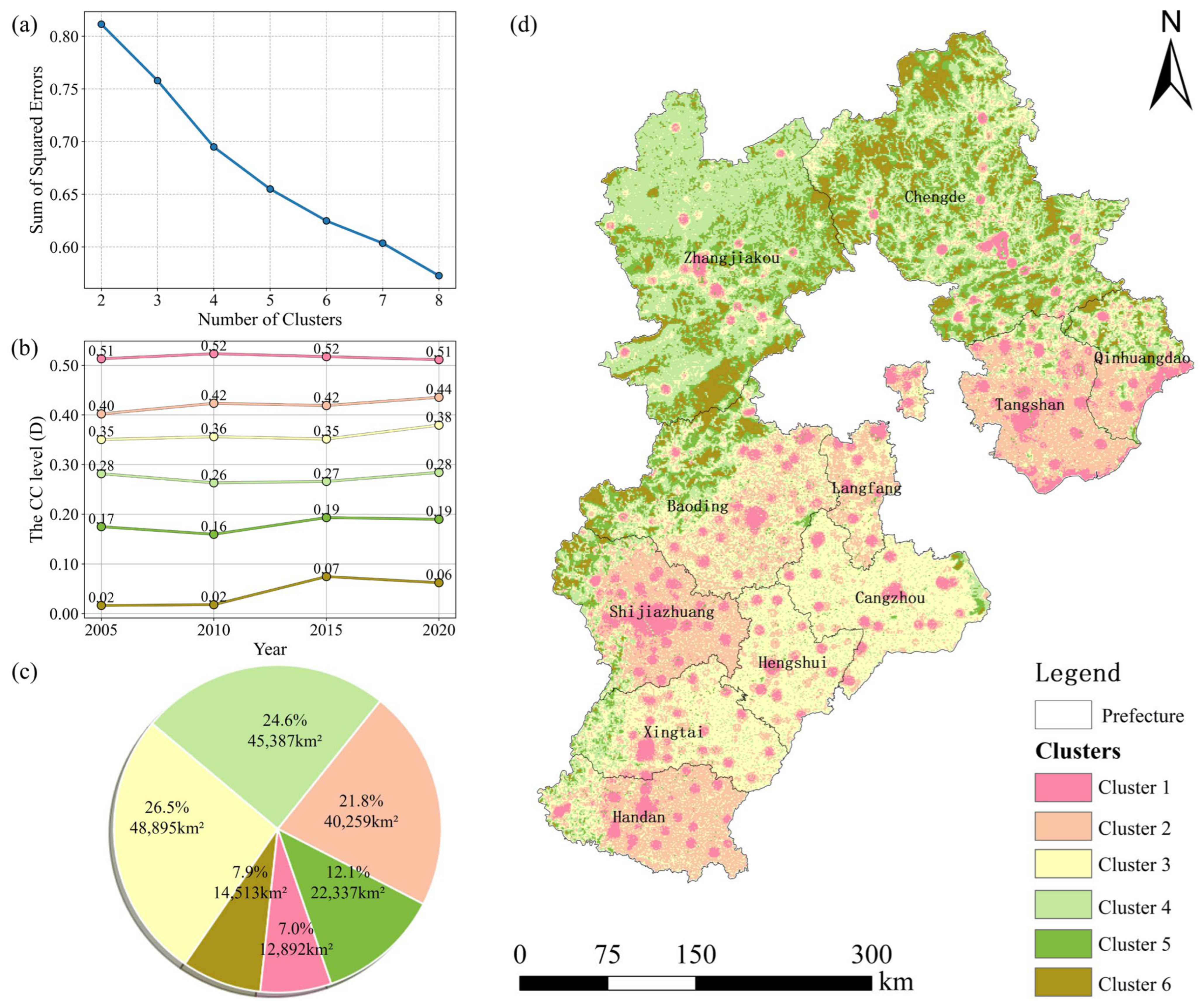
3.2. Clustering Analysis Results for CC Levels
3.3. Quantification of Influencing Factors on Changes in CC Levels
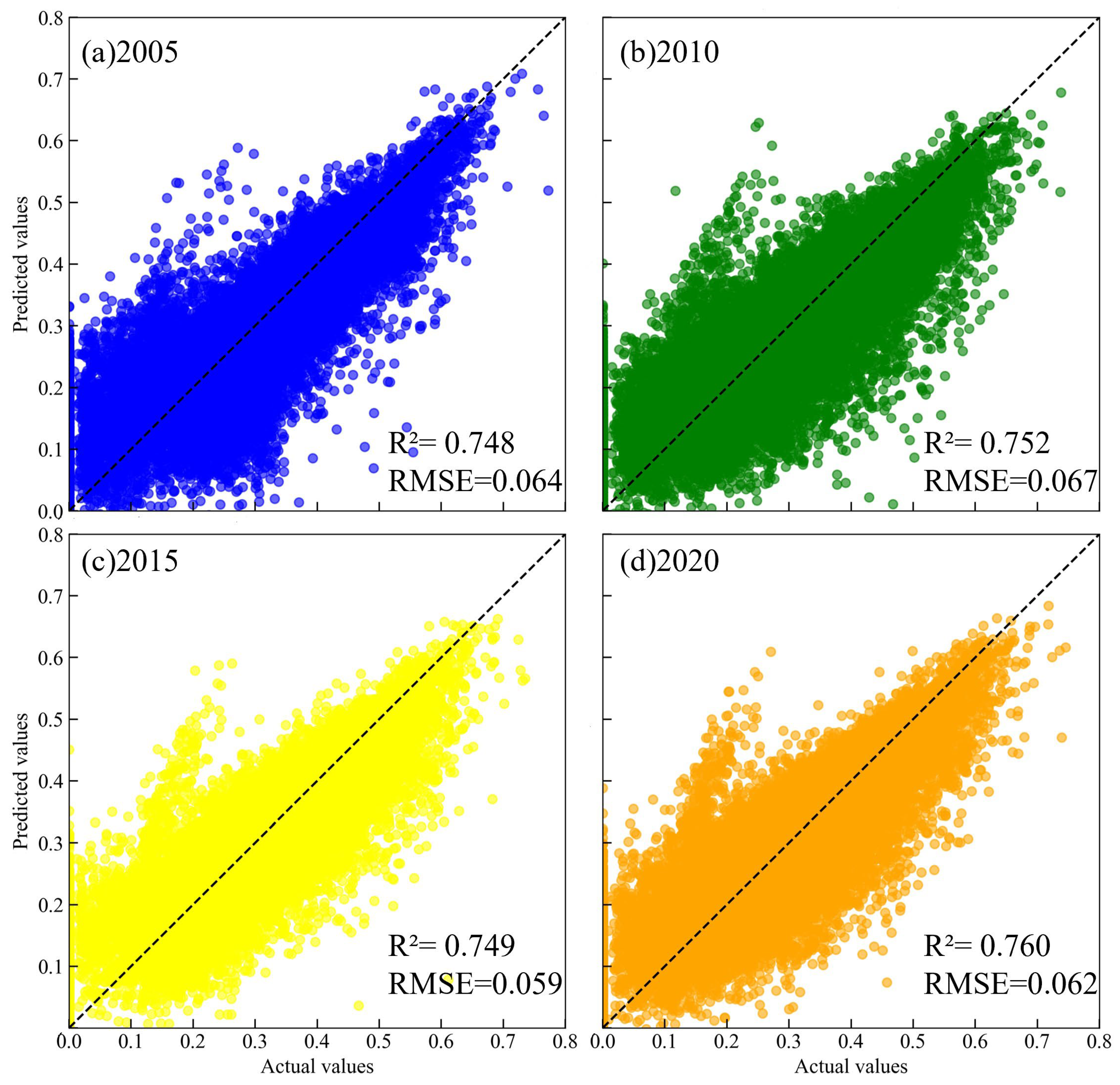
3.3.1. XGBoost Model Performance Evaluation
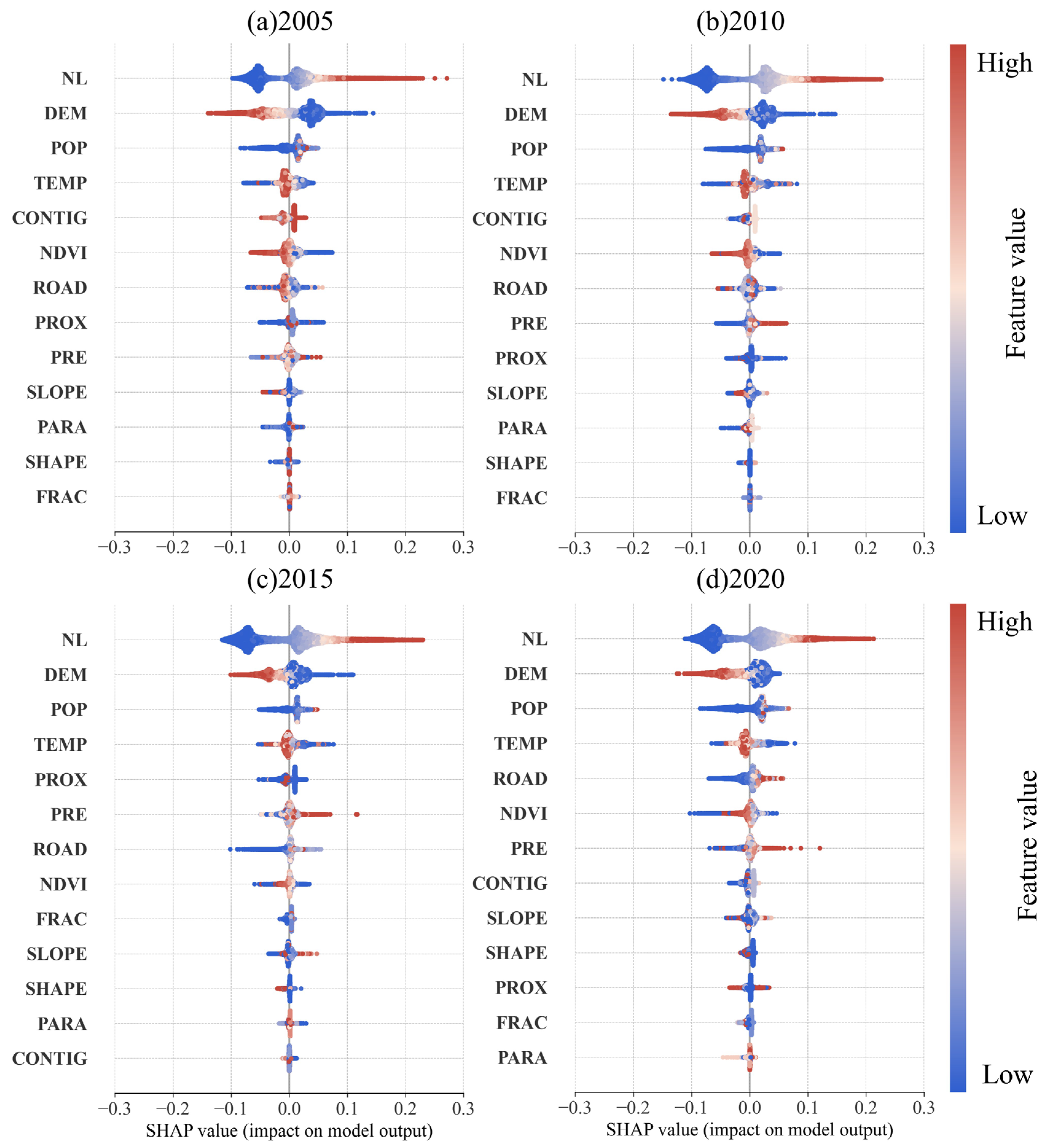
3.3.2. Identification of Dominant Factors for Changes in CC Levels
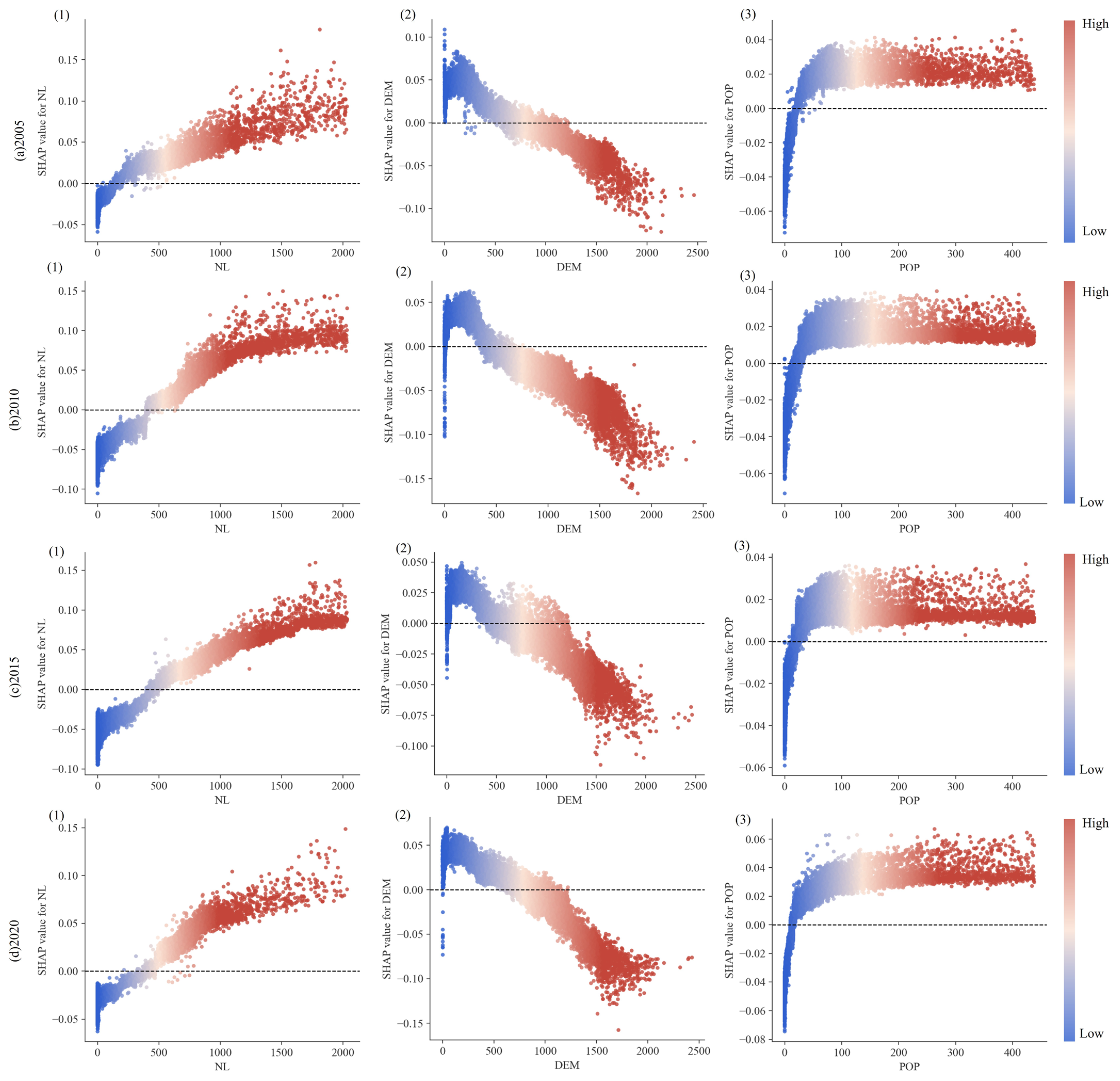
3.3.3. Nonlinear Relationships of Dominant Factors and the Threshold Range of Their Influences
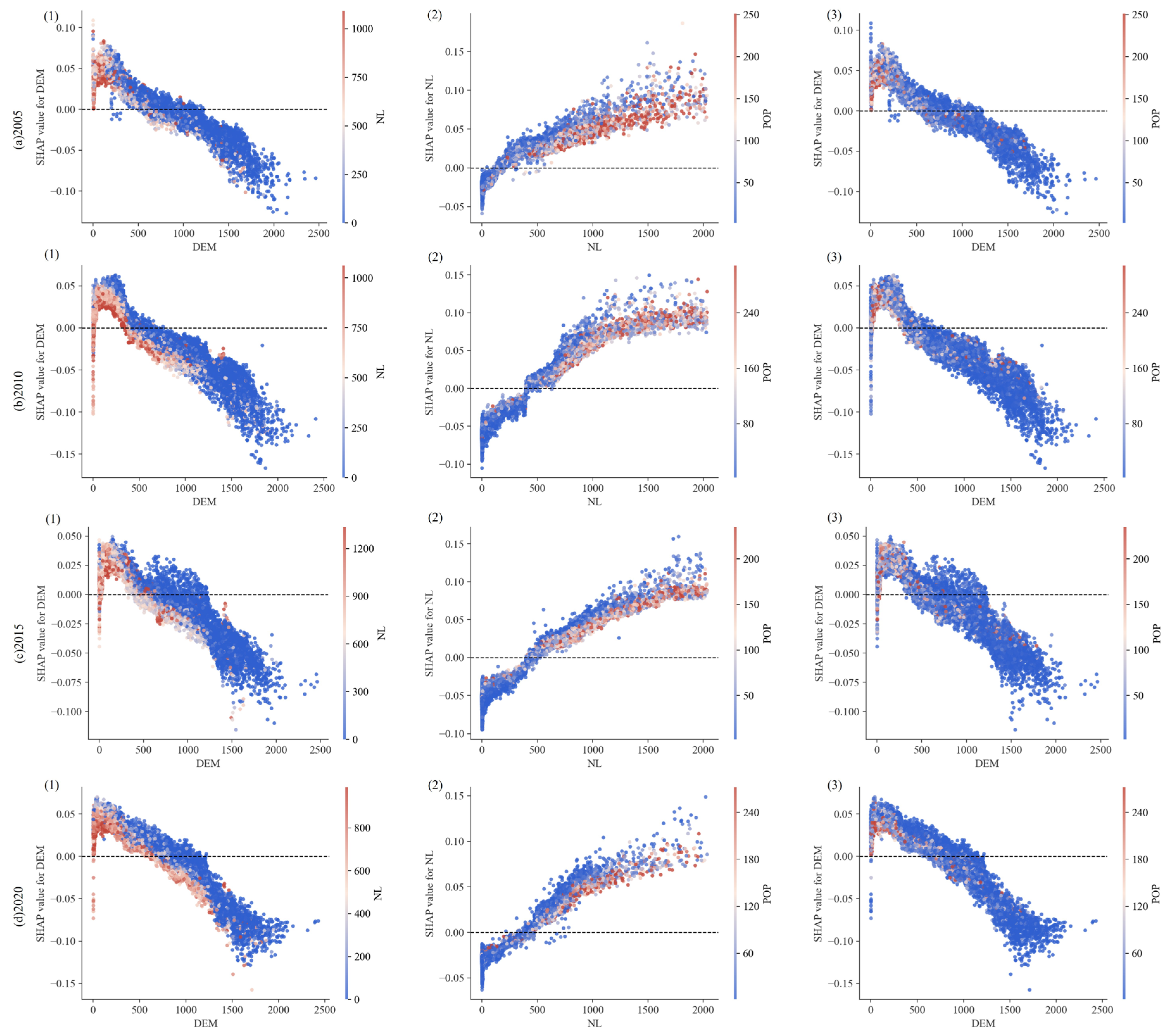
3.3.4. Interpretation of the Interaction of Dominant Factors
4. Discussion
4.1. Implications for Hebei Province’s Green Transformation and High-Quality Development
4.2. Hebei’s Stage Under the United Nations SDGs and International Insights
5. Conclusions
Author Contributions
Funding
Data Availability Statement
Acknowledgments
Conflicts of Interest
References
- Elliott, J. An Introduction to Sustainable Development; Routledge: Milton Park, UK, 2012. [Google Scholar]
- Liu, H.; Xiong, J.; Hong, S.; Zhou, B. Social, economic, and environmental development in China through the lens of synergies and trade-offs. J. Clean. Prod. 2025, 509, 145634. [Google Scholar] [CrossRef]
- Peng, J.; Xia, P.; Liu, Y.; Xu, Z.; Zheng, H.; Lan, T.; Yu, S. Ecosystem services research: From golden era to next crossing. Trans. Earth Environ. Sustain. 2023, 1, 9–19. [Google Scholar] [CrossRef]
- Costanza, R. Valuing natural capital and ecosystem services toward the goals of efficiency, fairness, and sustainability. Ecosyst. Serv. 2020, 43, 101096. [Google Scholar] [CrossRef]
- Karaouzas, I.; Smeti, E.; Vourka, A.; Vardakas, L.; Mentzafou, A.; Tornés, E.; Sabater, S.; Muñoz, I.; Skoulikidis, N.T.; Kalogianni, E. Assessing the ecological effects of water stress and pollution in a temporary river-Implications for water management. Sci. Total Environ. 2018, 618, 1591–1604. [Google Scholar] [CrossRef]
- Han, L.; Zhou, W.; Li, W.; Li, L. Impact of urbanization level on urban air quality: A case of fine particles (PM2.5) in Chinese cities. Environ. Pollut. 2014, 194, 163–170. [Google Scholar] [CrossRef] [PubMed]
- Wang, W.; Wang, H.; Yang, G.; Zhou, X. Interactions between ecosystem services and social economies in the Yangtze River economic belt. Adv. Sustain. Syst. 2023, 7, 2200400. [Google Scholar] [CrossRef]
- Schaafsma, M.; Eigenbrod, F.; Gasparatos, A.; Gross-Camp, N.; Hutton, C.; Nunan, F.; Schreckenberg, K.; Turner, K. Trade-off decisions in ecosystem management for poverty alleviation. Ecol. Econ. 2021, 187, 107103. [Google Scholar] [CrossRef]
- Martine, G.; Alves, J.E.D. Economy, society and environment in the 21st century: Three pillars or trilemma of sustainability? Rev. Bras. De Estud. De Popul. 2015, 32, 433–460. Available online: https://www.scielo.br/j/rbepop/a/pXt5ZtxqShgBKDJVTDjfWRn/?lang=en (accessed on 28 December 2025). [CrossRef]
- Wang, S.; Kong, W.; Ren, L.; ZHI, D. Research on misuses and modification of coupling coordination degree model in China. J. Nat. Resour. 2021, 36, 793–810. [Google Scholar] [CrossRef]
- Zuo, Z.; Guo, H.; Cheng, J.; Li, Y. How to achieve new progress in ecological civilization construction?–Based on cloud model and coupling coordination degree model. J. Nat. Resour. 2021, 127, 107789. [Google Scholar] [CrossRef]
- Wu, J.; Guo, Y.; Zhou, J. Nexus between ecological conservation and socio-economic development and its dynamics: Insights from a case in China. Water 2020, 12, 663. [Google Scholar] [CrossRef]
- Ostrom, E. A general framework for analyzing sustainability of social-ecological systems. Science 2009, 325, 419–422. [Google Scholar] [CrossRef] [PubMed]
- Liu, Y.; Yang, L.; Jiang, W. Coupling coordination and spatiotemporal dynamic evolution between social economy and water environmental quality—A case study from Nansi Lake catchment, China. Ecol. Indic. 2020, 119, 106870. [Google Scholar] [CrossRef]
- Liu, Y.; Zeng, C.; Cui, H.; Song, Y. Sustainable land urbanization and ecological carrying capacity: A spatially explicit perspective. Sustainability 2018, 10, 3070. [Google Scholar] [CrossRef]
- Joore, J.P. New to Improve—The Mutual Influence Between New Products and Societal Change Processes; JP Joore: Delft, The Netherlands, 2010. [Google Scholar]
- Folke, C.; Hahn, T.; Olsson, P.; Norberg, J. Adaptive governance of social-ecological systems. Annu. Rev. Environ. Resour. 2005, 30, 441–473. [Google Scholar] [CrossRef]
- Huang, J.; Li, F. Coupling Coordination Degree Measurement and Spatial Distribution between Economic Development and Ecological Environment of Countries along the Belt and Road. Pol. J. Environ. Stud. 2021, 30, 3615–3626. [Google Scholar] [CrossRef] [PubMed]
- Ren, J.; Ma, R.; Huang, Y.; Wang, Q.; Guo, J.; Li, C.; Zhou, W. Identifying the trade-offs and synergies of land use functions and their influencing factors of Lanzhou-Xining urban agglomeration in the upper reaches of Yellow River Basin, China. Ecol. Indic. 2024, 158, 111279. [Google Scholar] [CrossRef]
- Ge, Y.; Hu, S.; Song, Y.; Zheng, H.; Liu, Y.; Ye, X.; Ma, T.; Liu, M.; Zhou, C. Sustainable poverty reduction models for the coordinated development of the social economy and environment in China. Sci. Bull. 2023, 68, 2236–2246. [Google Scholar] [CrossRef]
- Che, S.; Zhang, X.; Shu, W. Evaluation of internal coupling and coordination degree and diagnosis of obstacle factors for high-quality regional economic development: Evidence from Chongqing’s “One District, Two Groups”. PLoS ONE 2024, 19, e0312820. [Google Scholar] [CrossRef]
- Ye, S.; Wei, C.; Wang, Z. Coupling coordination between resource and environmental carrying capacity and social development quality and its influence mechanism. Ecol. Indic. 2025, 179, 114151. [Google Scholar] [CrossRef]
- Wang, J.; Hou, H.; Zhang, S.; Zhang, S.; Ji, H.; Chen, Z. Coupling Coordination Between Ecosystem Services and Sustainable Development Goals from a County-Level Perspective in Jiangsu Province, China. Land 2025, 14, 1627. [Google Scholar] [CrossRef]
- Xu, Y.; Yang, L.; Sun, K.; Zhu, J. Synergistic security relationships and risk measurement of water resources-social economy-ecological environment in Beijing-Tianjin-Hebei region. Ecol. Indic. 2025, 175, 113512. [Google Scholar] [CrossRef]
- Li, L.; Fan, Z.; Feng, W.; Yuxin, C.; Keyu, Q. Coupling coordination degree spatial analysis and driving factor between socio-economic and eco-environment in northern China. Ecol. Indic. 2022, 135, 108555. [Google Scholar] [CrossRef]
- Sun, X.; Ye, D.; Shan, R.; Peng, Q.; Zhao, Z.; Sun, J. Effect of physical geographic and socioeconomic processes on interactions among ecosystem services based on machine learning. J. Clean. Prod. 2022, 359, 131976. [Google Scholar] [CrossRef]
- Song, Y.; Zhang, D.; Wang, Q.; Liu, Y.; Chen, K.; Sun, J.; Shi, L.; Li, B.; Yang, X.; Mi, W. Prediction models for postoperative delirium in elderly patients with machine-learning algorithms and SHapley Additive exPlanations. Transl. Psychiatry 2024, 14, 57. [Google Scholar] [CrossRef] [PubMed]
- Dong, Q.; Zhong, K.; Liao, Y.; Xiong, R.; Wang, F.; Pang, M. Coupling coordination degree of environment, energy, and economic growth in resource-based provinces of China. Resour. Policy 2023, 81, 103308. [Google Scholar] [CrossRef]
- He, Y.; Liu, G. Coupling coordination analysis of low-carbon development, technology innoation, and new urbanization: Data from 30 provinces and cities in China. Front. Public Health 2022, 10, 1047691. [Google Scholar] [CrossRef]
- Tang, B.; Luo, H. Mismatch and coupling: A study on the synergistic development of tourism-economy-ecology Systems in the Pearl River Delta. Sustainability 2022, 14, 8518. [Google Scholar] [CrossRef]
- Liu, X.; Xin, Y. Exploring the characteristics and driving factors of coupling coordination of regional sustainable development: Evidence from China’s 31 provinces. Environ. Sci. Pollut. Res. 2022, 29, 71075–71099. [Google Scholar] [CrossRef]
- Zhang, J.; Dong, Z. Assessment of coupling coordination degree and water resources carrying capacity of Hebei Province (China) based on WRESP2D2P framework and GTWR approach. Sustain. Cities Soc. 2022, 82, 103862. [Google Scholar] [CrossRef]
- Yuan, Y.; Jingwen, Z.; Xiankai, H.; Jinlian, S. Evaluation of Coupling Coordination and Influencing Factors among Urban Agglomeration Economy, Water Resources, and Ecological Environment: A Case Study of the Beijing-Tianjin-Hebei Region. Arid Zone Resour. Environ. 2025, 39, 13–28. [Google Scholar] [CrossRef]
- Peng, J.; Chen, X.; Liu, Y.; Lü, H.; Hu, X. Spatial identification of multifunctional landscapes and associated influencing factors in the Beijing-Tianjin-Hebei region, China. Appl. Geogr. 2016, 74, 170–181. [Google Scholar] [CrossRef]
- Ren, F.; Yu, X. Coupling analysis of urbanization and ecological total factor energy efficiency—A case study from Hebei province in China. Sustain. Cities Soc. 2021, 74, 103183. [Google Scholar] [CrossRef]
- Kang, L.; Ma, L. Expansion of industrial parks in the Beijing–Tianjin–Hebei urban agglomeration: A spatial analysis. Land 2021, 10, 1118. [Google Scholar] [CrossRef]
- Yuan, C.; Zhang, B.; Xu, J.; Lyu, D.; Liu, J.; Hu, Z.; Han, Y. Impact of new-type urbanization pilot policy on public service provision: Evidence from China. Cities 2025, 161, 105853. [Google Scholar] [CrossRef]
- Arrow, K.J.; Dasgupta, P.; Goulder, L.H.; Mumford, K.J.; Oleson, K. Sustainability and the measurement of wealth. Environ. Dev. Econ. 2012, 17, 317–353. [Google Scholar] [CrossRef]
- Xu, L.; He, J.; He, Y.; Zhang, L.; Xu, H.; Tang, C. Multidimensional factors influencing ecosystem services and their relationships in alpine ecosystems: A case study of the Daxing’anling forest area, Inner Mongolia. For. Ecosyst. 2025, 14, 100383. [Google Scholar] [CrossRef]
- Dang, H.; Lü, Y.; Wang, X.; Hao, Y.; Fu, B. Integrating species diversity, ecosystem services, climate and ecological stability helps to improve spatial representation of protected areas for quadruple win. Geogr. Sustain. 2025, 6, 100205. [Google Scholar] [CrossRef]
- Zhu, Y.; Tian, D.; Yan, F. Effectiveness of entropy weight method in decision-making. Math. Probl. Eng. 2020, 2020, 3564835. [Google Scholar] [CrossRef]
- Dong, L.; Longwu, L.; Zhenbo, W.; Liangkan, C.; Faming, Z. Exploration of coupling effects in the Economy–Society–Environment system in urban areas: Case study of the Yangtze River Delta Urban Agglomeration. Ecol. Indic. 2021, 128, 107858. [Google Scholar] [CrossRef]
- Herdiana, I.; Kamal, M.A.; Estri, M.N. A More Precise Elbow Method for Optimum K-means Clustering. arXiv Prepr. 2025, arXiv:2502.00851. [Google Scholar] [CrossRef]
- Bezdek, J.C. Pattern Recognition with Fuzzy Objective Function Algorithms; Springer Science & Business Media: Berlin/Heidelberg, Germany, 2013. [Google Scholar]
- Bezdek, J.C. FCM: The fuzzy c-means clsutering algorithm. Comput. Geosci. 1984, 10, 191–203. [Google Scholar] [CrossRef]
- Ma, M.; Zhao, G.; He, B.; Li, Q.; Dong, H.; Wang, S.; Wang, Z. XGBoost-based method for flash flood risk assessment. J. Hydrol. 2021, 598, 126382. [Google Scholar] [CrossRef]
- Xu, B.; Li, J.; Liu, Y.; Zhang, T.; Luo, Z.; Pei, X. Disentangling the response of vegetation dynamics to natural and anthropogenic drivers over the Qinghai-Tibet Plateau using dimensionality reduction and structural equation model. For. Ecol. Manag. 2024, 554, 121677. [Google Scholar] [CrossRef]
- Ebrahimi-Khusfi, Z.; Dargahian, F.; Nafarzadegan, A.R. Predicting the dust events frequency around a degraded ecosystem and determining the contribution of their controlling factors using gradient boosting-based approaches and game theory. Environ. Sci. Pollut. Res. 2022, 29, 36655–36673. [Google Scholar] [CrossRef]
- Wang, Y.; Cheng, W.; Jin, Y.; Li, J.; Yang, Y.; Hu, S. An XGBoost-SHAP Model for Energy Demand Prediction with Boruta–Lasso Feature Selection. IEEE Access 2025, 13, 135806–135821. [Google Scholar] [CrossRef]
- Liu, J.; Jiang, W.; Yu, Y.; Gong, J.; Chen, G.; Yang, Y.; Wang, C.; Sun, D.; Lu, X. Applying machine learning to predict bowel preparation adequacy in elderly patients for colonoscopy: Development and validation of a web-based prediction tool. Ann. Med. 2025, 57, 2474172. [Google Scholar] [CrossRef] [PubMed]
- Ren, X.; Tan, X.; Luo, D. Coupling and Spatial Disparities of Regional Economy and Ecosystem in High-Quality Town Development. Res. Ecol. 2025, 7, 15–29. [Google Scholar] [CrossRef]
- Yun, K.; Zhang, M.; Zhang, Y. Investigating the coupled coordination of improved ecological environment and socio-economic development in alpine wetland areas: A case study of southwest China. Ecol. Indic. 2024, 160, 111740. [Google Scholar] [CrossRef]
- Liu, Y.; Yang, R.; Sun, M.; Zhang, L.; Li, X.; Meng, L.; Wang, Y.; Liu, Q. Regional sustainable development strategy based on the coordination between ecology and economy: A case study of Sichuan Province, China. Ecol. Indic. 2022, 134, 108445. [Google Scholar] [CrossRef]
- Tang, L.; Wang, H.; Zhu, X.; Liu, J.; Li, K. Optimization and Scheduling of Green Power System Consumption Based on Multi-Device Coordination and Multi-Objective Optimization. Energy Eng. J. Assoc. Energy Eng. 2025, 122, 2257. [Google Scholar] [CrossRef]
- Shah, K.J.; Pan, S.-Y.; Lee, I.; Kim, H.; You, Z.; Zheng, J.-M.; Chiang, P.-C. Green transportation for sustainability: Review of current barriers, strategies, and innovative technologies. J. Clean. Prod. 2021, 326, 129392. [Google Scholar] [CrossRef]
- Huang, Z.; Chen, Y.; Zheng, Z.; Wu, Z. Spatiotemporal coupling analysis between human footprint and ecosystem service value in the highly urbanized Pearl River Delta urban Agglomeration, China. Ecol. Indic. 2023, 148, 110033. [Google Scholar] [CrossRef]
- Yin, H.; Xiao, R.; Fei, X.; Zhang, Z.; Gao, Z.; Wan, Y.; Tan, W.; Jiang, X.; Cao, W.; Guo, Y. Analyzing “economy-society-environment” sustainability from the perspective of urban spatial structure: A case study of the Yangtze River delta urban agglomeration. Sustain. Cities Soc. 2023, 96, 104691. [Google Scholar] [CrossRef]
- Xiao, Y.; Li, Y.; Huang, H. Conflict or coordination? Assessment of coordinated development between socioeconomic and ecological environment in resource-based cities: Evidence from Sichuan province of China. Environ. Sci. Pollut. Res. 2021, 28, 66327–66339. [Google Scholar] [CrossRef]
- Wei, H.; Xue, D.; Huang, J.; Liu, M.; Li, L. Identification of coupling relationship between ecosystem services and urbanization for supporting ecological management: A case study on areas along the Yellow River of Henan Province. Remote Sens. 2022, 14, 2277. [Google Scholar] [CrossRef]
- Li, H.; Wang, Q.; Zang, X.; Gao, T.; Gu, H. Spatiotemporal differentiation and influencing factors of the degree of resilience coupling coordination in the Beijing–Tianjin–Hebei region. Sci. Rep. 2024, 14, 26394. [Google Scholar] [CrossRef]
- Hu, M.; Chen, P.; Chen, G.; Li, Z. Spatio-temporal influencing effects and mechanisms of the digital economy on eco-urbanization in the Yangtze River Delta region. Environ. Technol. Innov. 2025, 37, 103979. [Google Scholar] [CrossRef]
- Dong, S.; Yao, W. Spatiotemporal Evolution and Drivers of Digital Economy–Green Finance Coupling: Evidence from Guangdong. In Proceedings of the Proceedings of the 2025 International Conference on Digital Economy and Intelligent Computing, Shanghai, China, 23–25 May 2025; pp. 147–153. [Google Scholar]
- Li, C.; Chen, T.; Jia, K.; Plaza, A. Coupling Analysis Between Ecological Environment Change and Urbanization Process in the Middle Reaches of Yangtze River Urban Agglomeration, China. IEEE J. Sel. Top. Appl. Earth Obs. Remote Sens. 2024, 17, 880–892. [Google Scholar] [CrossRef]
- Daduna, J.R. Evolution of public transport in rural areas-new technologies and digitization. In Proceedings of the International Conference on Human-Computer Interaction, Copenhagen, Denmark, 19–24 July 2020; pp. 82–99. [Google Scholar]
- Ling, J.; Liang, X.; Zhang, J.; Xue, Y.; Liu, G. Ecological product value realization: Lessons learned from practice in China. Sustain. Futures 2025, 10, 100911. [Google Scholar] [CrossRef]
- Duranton, G.; Puga, D. The economics of urban density. J. Econ. Perspect. 2020, 34, 3–26. [Google Scholar] [CrossRef]
- Lin, S.; Sun, J.; Marinova, D.; Zhao, D. Evaluation of the green technology innovation efficiency of China’s manufacturing industries: DEA window analysis with ideal window width. Technol. Anal. Strateg. Manag. 2018, 30, 1166–1181. [Google Scholar] [CrossRef]
- Penna, C.C.; Geels, F.W. Multi-dimensional struggles in the greening of industry: A dialectic issue lifecycle model and case study. Technol. Forecast. Soc. Change 2012, 79, 999–1020. [Google Scholar] [CrossRef]
- Lin, Z.; Liao, X.; Jia, H. Could green finance facilitate low-carbon transformation of power generation? Some evidence from China. Int. J. Clim. Chang. Strateg. Manag. 2023, 15, 141–158. [Google Scholar] [CrossRef]
- Wang, H.; Ge, Q. Ecological resilience of three major urban agglomerations in China from the “environment–society” coupling perspective. Ecol. Indic. 2024, 169, 112944. [Google Scholar] [CrossRef]
- Li, W.; Song, H.; Dong, F.; Li, F. The high-quality development in Beijing-Tianjin-Hebei regions: Based on the perspective of comparison. Procedia Comput. Sci. 2022, 199, 1244–1251. [Google Scholar] [CrossRef]
- Yang, Z.; Yang, H.; Wang, H. Evaluating urban sustainability under different development pathways: A case study of the Beijing-Tianjin-Hebei region. Sustain. Cities Soc. 2020, 61, 102226. [Google Scholar] [CrossRef]
- Liu, Y.; Bian, J.; Li, X.; Liu, S.; Lageson, D.; Yin, Y. The optimization of regional industrial structure under the water-energy constraint: A case study on Hebei Province in China. Energy Policy 2020, 143, 111558. [Google Scholar] [CrossRef]
- Liu, X.; Du, H.; Zhang, X.; Feng, K.; Zhao, X.; Zhong, H.; Zhang, N.; Chen, Z. Assessing transboundary impacts of energy-driven water footprint on scarce water resources in China: Catchments under stress and mitigation options. Environ. Sci. Technol. 2023, 57, 9639–9652. [Google Scholar] [CrossRef]
- Du, H.; Zhao, L.; Zhang, P.; Li, J.; Yu, S. Ecological compensation in the Beijing-Tianjin-Hebei region based on ecosystem services flow. J. Environ. Manag. 2023, 331, 117230. [Google Scholar] [CrossRef]
- Tang, F.; Zeng, P.; Guo, Y.; Shen, Y.; Wang, L.; Liu, K.; Zhang, L. Decoding the spatiotemporal dynamics and driving mechanisms of ecological resilience in the Beijing-Tianjin-Hebei urban agglomeration: A deep learning approach. Urban Clim. 2025, 61, 102436. [Google Scholar] [CrossRef]


| Dimension | Indicators | Attribute | Downscaling Basis (Land-Use/POI Types) | Weights |
|---|---|---|---|---|
| Social indications | Total power of agricultural machinery | + | Cropland | 0.080 |
| Year-end number of livestock | + | Rural residential land | 0.082 | |
| Rural fertilizer application | − | Cropland | 0.033 | |
| Total sown area of crops | + | Cropland | 0.027 | |
| Grain yield | + | Cropland | 0.032 | |
| Number of doctors per 10,000 people | + | Hospital POIs | 0.137 | |
| Number of hospital beds per 10,000 people | + | Hospital POIs | 0.135 | |
| Government expenditure on education | + | Education POIs | 0.024 | |
| Number of students enrolled in universities | + | Education POIs | 0.178 | |
| Effectively irrigated farmland area | + | Cropland | 0.068 | |
| Green space area | + | Green land & Scenic POIs | 0.127 | |
| Road area | + | Construction land | 0.077 | |
| Economical indications | GDP | + | Cropland, Other construction land, Commercial & Service POIs | 0.119 |
| Sewage treatment volume | + | Construction land | 0.001 | |
| Science and technology expenditure | + | Research institutes & Universities POIs | 0.104 | |
| Primary industry GDP | + | Cropland | 0.034 | |
| Tertiary industry GDP | + | Commercial & Service POIs | 0.141 | |
| National fixed asset investment | + | Cropland, Other construction land, Commercial & Service POIs | 0.011 | |
| Average wage of employed workers | + | Cropland, Other construction land, Commercial & Service POIs | 0.117 | |
| Secondary industry GDP | + | Other construction land | 0.163 | |
| Industrial smoke and dust emissions | − | Other construction land | 0.001 | |
| Industrial SO2 emissions | − | Other construction land | 0.001 | |
| Total retail sales of consumer goods | + | Commercial POIs (Shopping, catering, services) | 0.178 | |
| Actual use of foreign investment | + | Cropland, Other construction land, Commercial & Service POIs | 0.133 | |
| Ecosystem service indications | Water yield | + | Model-based (InVEST) | 0.001 |
| Carbon storage | + | 0.267 | ||
| Soil retention | + | 0.235 | ||
| Habitat quality | + | 0.497 |
Disclaimer/Publisher’s Note: The statements, opinions and data contained in all publications are solely those of the individual author(s) and contributor(s) and not of MDPI and/or the editor(s). MDPI and/or the editor(s) disclaim responsibility for any injury to people or property resulting from any ideas, methods, instructions or products referred to in the content. |
© 2025 by the authors. Licensee MDPI, Basel, Switzerland. This article is an open access article distributed under the terms and conditions of the Creative Commons Attribution (CC BY) license.
Share and Cite
Chen, Q.; Sun, L.; Zhang, Q.; Zhou, K.; Wang, J.; Bi, J.; Wang, W.; Lu, Y.; Qu, G.; Lu, S. Explainable Machine Learning for Evaluating Coupling and Coordination of the Sustainability Trilemma: A Case Study of Hebei Province. Land 2026, 15, 73. https://doi.org/10.3390/land15010073
Chen Q, Sun L, Zhang Q, Zhou K, Wang J, Bi J, Wang W, Lu Y, Qu G, Lu S. Explainable Machine Learning for Evaluating Coupling and Coordination of the Sustainability Trilemma: A Case Study of Hebei Province. Land. 2026; 15(1):73. https://doi.org/10.3390/land15010073
Chicago/Turabian StyleChen, Qiaobi, Leigang Sun, Qing Zhang, Kefa Zhou, Jinlin Wang, Jiantao Bi, Wei Wang, Yingpeng Lu, Guangjun Qu, and Shulei Lu. 2026. "Explainable Machine Learning for Evaluating Coupling and Coordination of the Sustainability Trilemma: A Case Study of Hebei Province" Land 15, no. 1: 73. https://doi.org/10.3390/land15010073
APA StyleChen, Q., Sun, L., Zhang, Q., Zhou, K., Wang, J., Bi, J., Wang, W., Lu, Y., Qu, G., & Lu, S. (2026). Explainable Machine Learning for Evaluating Coupling and Coordination of the Sustainability Trilemma: A Case Study of Hebei Province. Land, 15(1), 73. https://doi.org/10.3390/land15010073