1. Introduction
Over the past decade, cities worldwide have witnessed the rapid proliferation of e-commerce and its associated logistics infrastructures. Distribution centers, parcel lockers, neighborhood delivery stations, and micro-fulfillment hubs have become common features of the urban landscape, forming a new layer of facilities that mediate the circulation of goods between digital marketplaces and consumers. These spatial nodes are closely intertwined with the rise of digital platforms that manage transactions, logistics coordination, and real-time data flows. As a result, the boundaries between online and offline commerce are increasingly blurred, and new types of spaces devoted to storage, sorting, and delivery have emerged across urban neighborhoods [
1,
2,
3,
4,
5].
E-commerce originally referred to the digitalization of retail transactions. As digital firms evolved into platforms coordinating transactions, logistics, and data across multiple actors, e-commerce became embedded within the broader platform economy—a new organizational logic of capitalism in which value derives from managing digital infrastructures, algorithms, and multi-sided networks rather than direct production [
1,
4]. Within this framework, platformized e-commerce—exemplified by Alibaba, JD.com, and Pinduoduo—integrates logistics, payment systems, data analytics, and user management into a socio-technical system that reorganizes economic and spatial processes. The resulting land-use changes, including retail decline and the proliferation of logistics hubs, are thus outcomes of platform-mediated spatial organization, a defining feature of platform urbanism [
6,
7].
Recent scholarship increasingly examines how the platform economy reshapes spatial structures, regulatory geographies, and urban land-use systems. Studies show that the diffusion of e-commerce is uneven, shaped by infrastructure quality, income, and population density, with coastal or economically advanced regions hosting higher concentrations of digital logistics facilities [
8,
9]. Research on rural and peri-urban China further demonstrates that digital commerce accelerates the conversion of agricultural land into mixed industrial–commercial uses, drives rural industrial upgrading, and supports urban–rural spatial integration [
7,
10,
11,
12,
13]. Collectively, this work shows that the platform economy functions as a spatial mechanism channeling goods, capital, and labor in ways that reshape land allocation and functional zoning.
At the urban scale, scholars have documented how platform ecosystems such as Amazon, Alibaba, and JD.com transform retail geographies, logistics landscapes, and urban form. Online retail reduces demand for malls and high-street retail while expanding warehouses, fulfillment centers, and delivery hubs [
14,
15,
16]. These shifts redirect land demand from central commercial cores to suburban and peri-urban areas, producing hybrid retail–logistics spaces. Such transformations signal a broader shift in urban spatial logic—from site-based production to flow-based organization—enabled by platform infrastructures and data logistics [
1,
6,
7].
Despite growing research on the spatial restructuring of logistics and retail under e-commerce, most studies remain at the regional or macro scale. Little is known about how last-mile facilities affect neighborhood-scale land use and retail vitality. Moreover, although the decline of traditional retail has been widely observed, the relationship between platform logistics and the transformation of large shopping malls remains largely unexplored. Addressing these gaps, this study focuses on Shanghai, China. The rapid growth of platformized e-commerce logistics in Shanghai has intensified a series of emerging land-use challenges, including shifting street-level retail dynamics, increasing hybrid commercial–logistical activities, and the functional restructuring of community shopping malls. As one of China’s most advanced platform economies, Shanghai offers a representative and analytically significant case for examining neighborhood-scale land-use transformations under platform urbanism [
17,
18]. The city thus provides a representative setting for examining how the expansion of platform infrastructures reshapes micro-scale urban retail landscapes.
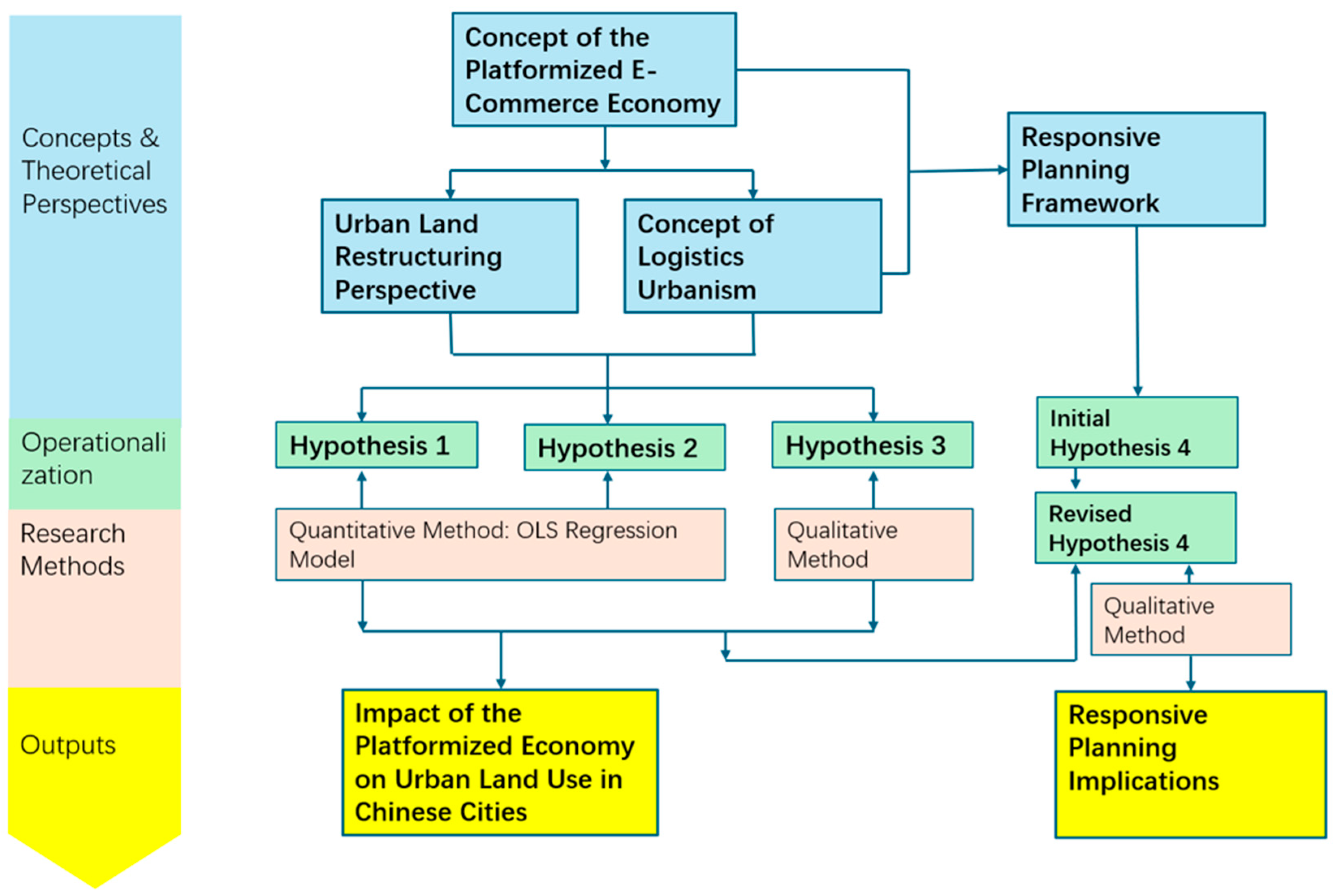
The main research question is two-fold. First, how does the spatial expansion of platformized e-commerce logistics—represented by Cainiao last-mile delivery stations and parcel networks—reshape neighborhood-level land use and retail vitality in Shanghai? Second, how can urban planning better anticipate and adapt to the spatial transformations driven by platform logistics, ensuring a more balanced and sustainable integration of retail, residential, and logistical functions within the framework of the Shanghai City Master Plan (2021–2035)?
To capture the full spatial consequences of platformized e-commerce logistics, this study examines both street-level retail segments and community-oriented shopping malls. These two commercial forms represent distinct positions within the urban commercial hierarchy and therefore interface with platform logistics through different mechanisms: neighborhood retail streets interact closely with everyday parcel pickup and delivery flows, whereas shopping malls encounter platform-driven competition for standardized goods and experience deeper shifts in consumption behavior. Analyzing both scales allows the study to uncover differentiated mechanisms through which digital platforms reorganize commercial land use and reshape neighborhood-level spatial dynamics. Using spatial analysis of street-level vacancy and qualitative investigation of mall adaptation, this study links platform logistics with neighborhood land-use transformation through the lens of platform urbanism, combining insights from logistics urbanism and land-use transformation theory. This study develops a conceptual framework that explains how digital infrastructures reorganize urban space by introducing platform-induced spatial substitution and hybrid spatiality—mechanisms that explain how e-commerce logistics reshape retail, residential, and logistical interfaces.
Extending this framework, the paper incorporates the idea of platform-responsive planning, emphasizing how urban planning can adapt zoning and land-use policy to the hybrid spatial forms emerging from platformized urban development. We focus on the Master Plan because it is the authoritative strategic planning document guiding Shanghai’s urban transformation during the period studied and therefore offers the most appropriate basis for evaluating how planning responds to platformized e-commerce logistics. Methodologically, this study departs from previous macro-scale analyses of e-commerce and land use, which rely mainly on provincial or city-level datasets. It introduces a micro-scale, mixed-method approach that combines field-observed street-segment data on retail vacancy with GIS-based measures of proximity to platform logistics facilities and qualitative case studies of shopping malls, directly linking platform logistics to neighborhood land-use transformation.
This paper argues that platformized e-commerce logistics reshapes urban land use through two intertwined mechanisms: Cainiao stations act simultaneously as physical service nodes that generate localized pedestrian flows sustaining neighborhood retail, and as neighborhood-level execution points within a digitally coordinated logistics system that produces citywide substitution pressures and restructures community shopping malls. This dual mechanism explains the divergent, multi-scalar spatial transformations observed in Shanghai and advances theoretical understandings of platform urbanism beyond a uniform displacement model. It further contends that current planning frameworks remain poorly aligned with these emerging spatial dynamics, underscoring the need for platform-responsive planning tools that recognize hybrid commercial–logistics spaces and digitally coordinated delivery systems.
3. Research Methods
3.1. Data Sources
This study integrates geospatial, statistical, and field-collected data to examine how platformized e-commerce logistics reshape land-use patterns and retail vitality in Shanghai. The core dataset consists of the geographic distribution of Cainiao’s last-mile service stations in 2020 and 2025, obtained from the official logistics data provider (iecity.com) and geocoded in Python 3.11. Subdistrict boundary data were initially acquired through a resale listing on the Xianyu platform; however, for the present study, all spatial boundary files have been verified and replaced with the official versions published by the Shanghai Municipal Planning and Natural Resources Bureau. These authoritative district-level unit plans [
40,
41,
42,
43,
44,
45,
46,
47,
48,
49,
50,
51,
52,
53,
54] provide the legally valid subdistrict boundaries used for spatial mapping and ensure the accuracy and reliability of all subsequent analyses. Four spatial indicators were derived: stations per subdistrict, station density (per km
2), percentage of land within 300-m buffers, and distance to the nearest station-free strip (≥300 m from any station).
To contextualize spatial accessibility and urban form, road networks, metro, and subdistrict base maps were incorporated. These quantitative datasets were complemented by field observations and photographic documentation at street and shopping-mall scales, enabling a mixed-methods approach that links platform logistics infrastructures with micro-scale land-use transformations.
3.2. Sampling Method
A stratified sampling strategy captured variation in Shanghai’s urban morphology and levels of platform logistics exposure. GIS overlay analysis identified twelve candidate subdistricts across Shanghai’s inner, middle, and outer ring roads, representing both historic mixed-use areas and newer residential compounds. Subdistricts were classified by Cainiao station density and buffer coverage into four types:
- (1)
high-density clusters (≥4 stations and ≥40% of land within 300 m);
- (2)
moderate/isolated exposure (1–2 stations or 10–40% coverage);
- (3)
low/no exposure (≥80% of land beyond 500 m);
- (4)
transitional frontier zones with sharply declining buffer coverage.
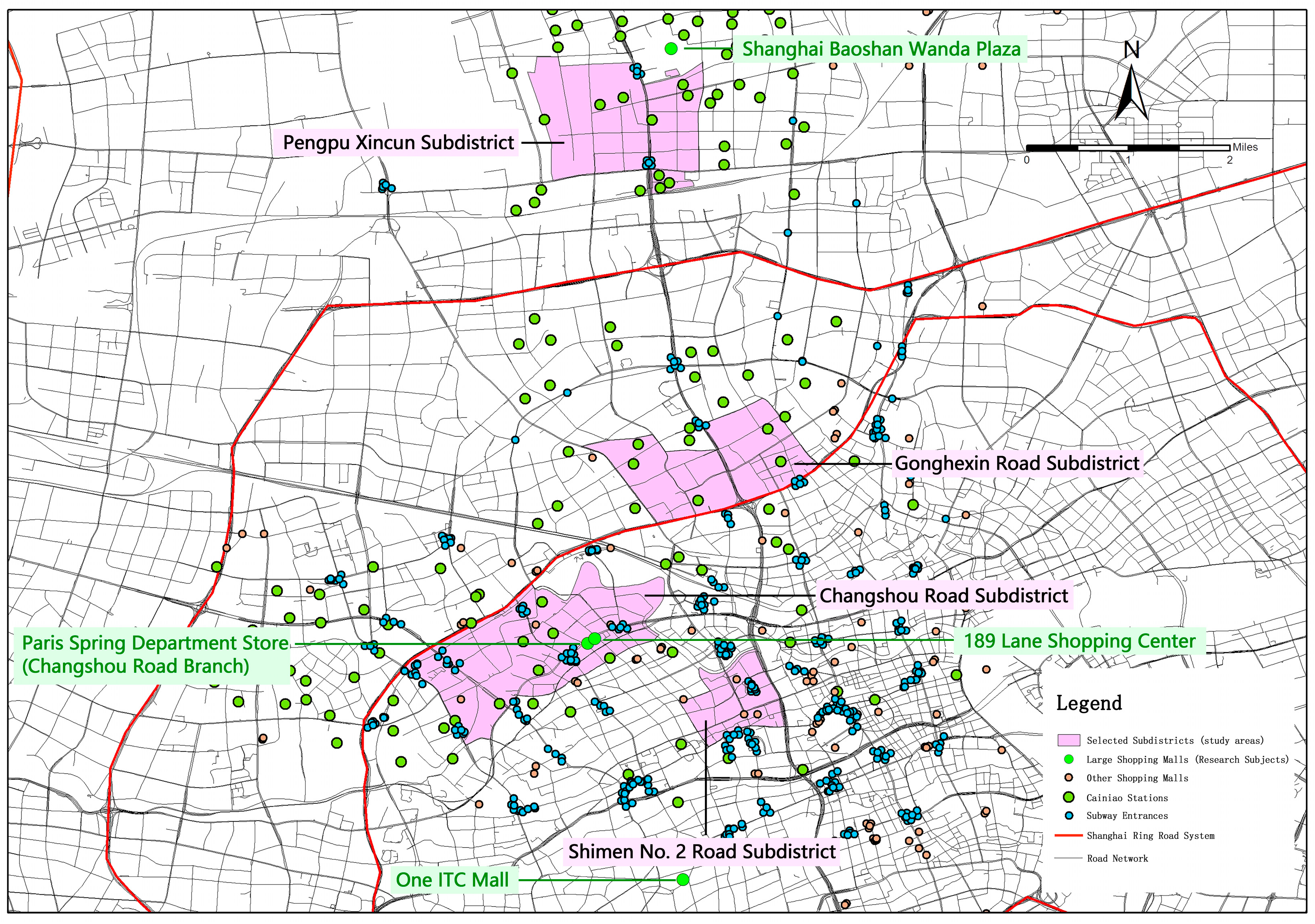
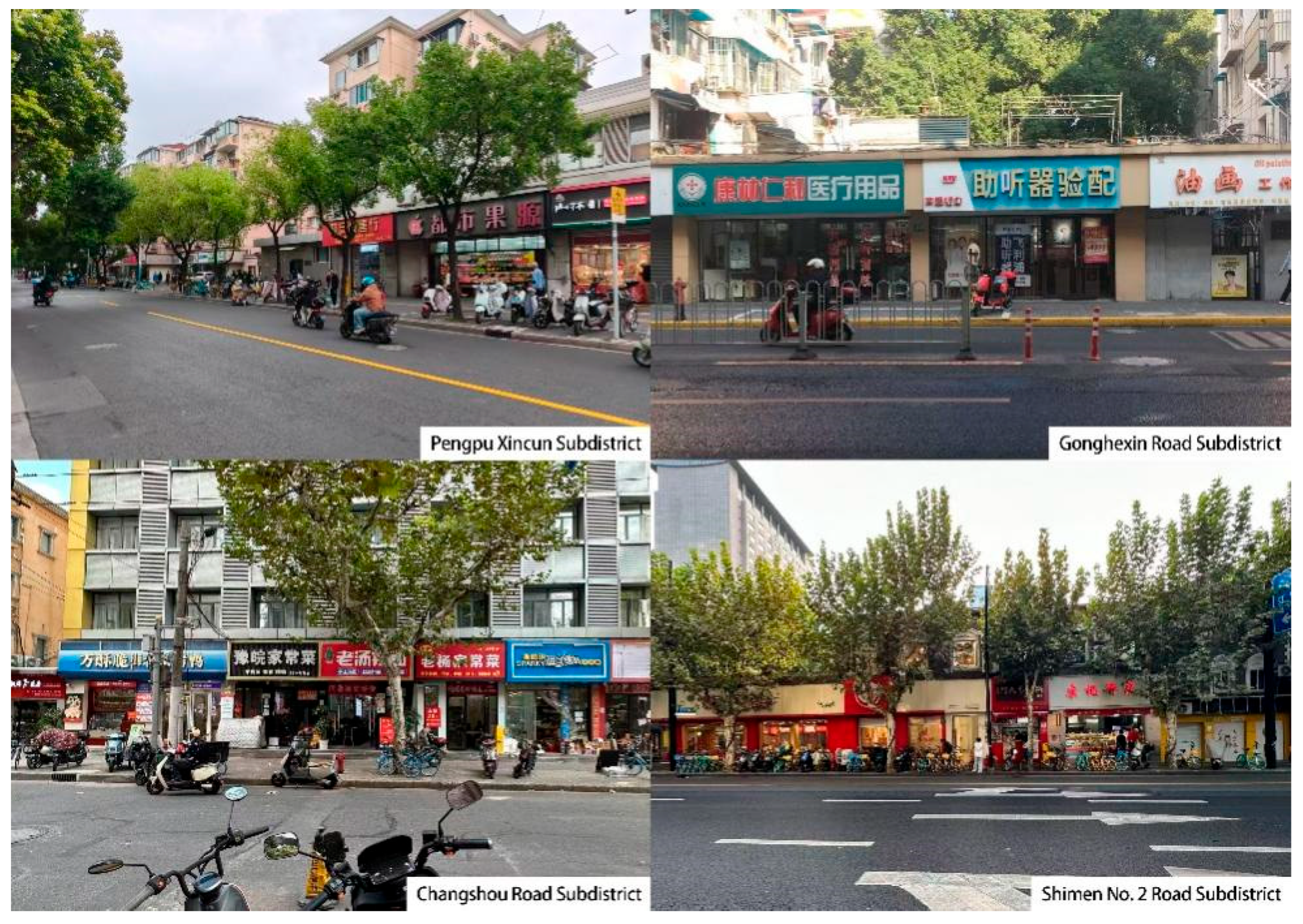
From these categories, four representative neighborhoods were selected—two with strong exposure and two with minimal or no exposure (
Table 3). Within each neighborhood, 100-m street segments with active ground-floor commercial frontages served as observation units. Each neighborhood contributed fifteen to twenty-five segments, yielding a total sample of roughly one hundred. This design enables comparison between areas inside and outside the 300-m station influence radius while controlling for neighborhood heterogeneity using fixed-effects modeling.
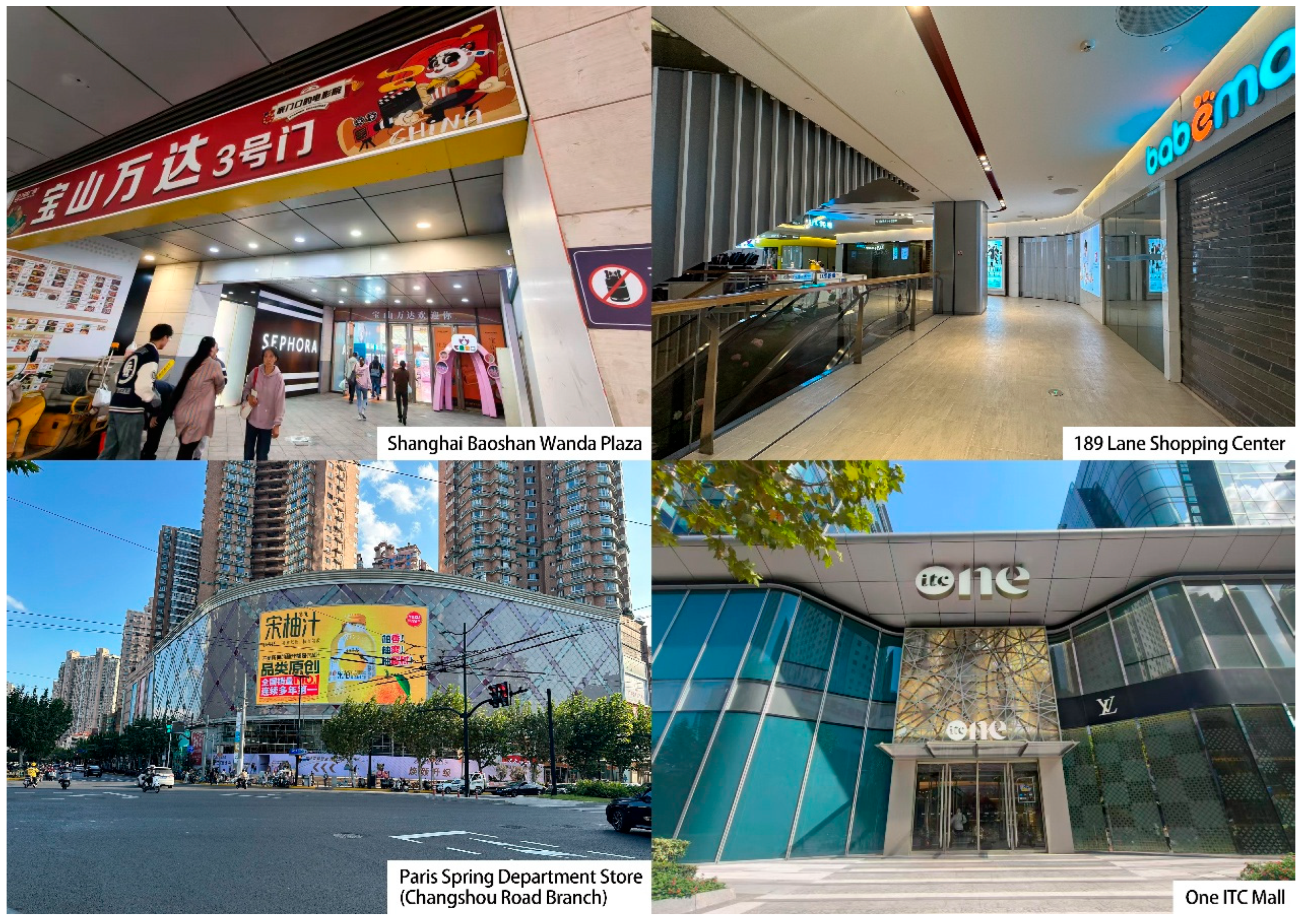
The four selected shopping malls capture Shanghai’s spatial and functional diversity across inner and outer rings, old and new urban forms, and varying levels of Cainiao exposure and metro access. Baoshan Wanda Plaza (988 Yierba Memorial Rd.) represents an outer-ring new-town mall with high Cainiao exposure and strong metro connectivity. 189 Lane Shopping Center (189 Changshou Rd., Putuo) is an inner-ring mall in an older mixed-use district with dense logistics presence and excellent metro access. Paris Spring Department Store (155 Changshou Rd., Putuo), which also has an inner-ring design and is currently under renovation, illustrates how traditional malls adapt to platform-driven consumption. One ITC Mall (1901 Huashan Rd., Xuhui) provides a contrast as an inner-ring, high-end center with low Cainiao exposure.
Figure 2 illustrates the four selected neighborhoods and shopping malls, together with their associated Cainiao stations and related logistics infrastructure.
3.3. Data Collection Procedures
Section 3.1 outlines the data sources; this section describes how those data were collected during fieldwork. Street-segment observations were conducted in a two-week campaign in 2025 following a standardized protocol. For each segment selected through the sampling strategy in
Section 3.2, researchers carried out on-site verification of business status, documented commercial frontage conditions, and recorded parcel-related activities using geotagged photographs. Pedestrian flows were measured through two timed manual counts (weekday evening and weekend late morning), and the nearest Cainiao facility was confirmed on site, including distance and operational characteristics.
For shopping malls, data were collected through structured 45–60-min visits in both high- and low-exposure zones. Researchers followed a unified recording template to document unit occupancy, visible repurposing, logistics integration (e.g., pickup points, parcel lockers), and rider activity. Foot-traffic counts were conducted at main entrances during peak and off-peak periods. Brief interviews with tenants, customers, and mall staff supplemented observational data by providing contextual insights into leasing dynamics and the perceived effects of e-commerce logistics.
3.4. Data Analysis
The analysis proceeded through four stages—spatial analysis, statistical modelling, shopping-mall assessment, and planning document review—linking neighborhood-scale retail patterns with broader planning responses. First, ArcGIS 10.8 was used to geocode Cainiao stations, overlay them with subdistrict and street layers, and generate exposure indicators such as 300-m buffers, station density, and distance-to-station measures; street segments were spatially joined to the nearest facility. Second, street-level data (vacancy, retail mix, road class, accessibility, and neighborhood identifiers) were compiled for OLS regression in R to test whether logistics exposure predicts vacancy, with controls for metro and mall proximity, road hierarchy, and neighborhood fixed effects. VIFs and model-fit statistics guided specification. Third, shopping-mall analysis combined descriptive metrics—vacancy, tenant turnover, retail composition, footfall, and e-commerce activity—with coded interview and observation data to identify patterns of decline, repurposing, experiential consumption, and logistics integration. Fourth, Shanghai’s Master Plan 2017–2035 was evaluated using an eight-dimensional responsive-planning framework, coding plan provisions as present, partially present, implied, or absent. District and subdistrict plans for Jing’an and Putuo enabled cross-comparison of institutional adaptation and remaining gaps in responding to platform-driven land-use change.
4. Shanghai’s Platform E-Commerce Policies and the Development of Cainiao Stations
Shanghai—widely regarded as China’s premier global city—has long positioned itself at the forefront of cultivating new industries, stimulating the new economy, and shaping a competitive, innovation-friendly business environment. This trajectory has been extensively documented across a series of studies [
55,
56,
57,
58], each examining different phases of Shanghai’s institutional strategies, cultural–economic policies, and governance reforms that enabled its transformation into a national leader in creative industries, innovation-led development, and globally oriented urban competitiveness. Collectively, these works demonstrate that Shanghai’s long-standing policy orientation toward economic modernization provides essential context for understanding the rise of platformized e-commerce logistics in the city today.
Municipal policy has played a central enabling role in this process. The “Implementation Opinions on Promoting Coordinated Development of E-Commerce and Express Logistics” issued in 2019 articulate Shanghai’s strategic commitment to integrating e-commerce logistics into urban development [
59]. The document highlights the need for coordinated planning of logistics facilities, the incorporation of express delivery infrastructure into statutory land-use systems, and the flexible adaptation of existing buildings for warehousing, distribution, and community-level service functions. It also formally recognizes parcel lockers, community depots, and service stations as essential public facilities and calls for embedding such infrastructures within neighborhood service networks.
Academic analyses show that these policies have accelerated a spatial restructuring of Shanghai’s logistics system. Logistics facilities have increasingly dispersed away from the urban core toward suburban and peri-urban areas, guided both by market forces—such as rising e-commerce demand and improved transport accessibility—and by planning interventions that support logistics industrial parks and transport–logistics corridors [
60].
Within this broader institutional and spatial context, Cainiao, Alibaba’s logistics arm, has become a defining actor. Its dense portfolio of community-level service stations, smart parcel lockers, and micro-fulfillment nodes has woven a fine-grained logistics layer into residential compounds, commercial blocks, and neighborhood shopping centers. Cainiao’s rapid scaling reflects both Shanghai’s policy commitment to the digital economy and the city’s large, diversified consumer base, which together foster high-frequency parcel circulation and data-driven logistical coordination.
Cainiao Stations have experienced major spatial and organizational shifts in Shanghai, shaped by changes in China’s platformized e-commerce logistics. Around 2015–2017, Cainiao rapidly expanded by partnering with convenience-store chains such as FamilyMart and Nonggongshang. These stores handled parcel pickup and temporary storage, enabling dense coverage within the Inner Ring Road [
61,
62].
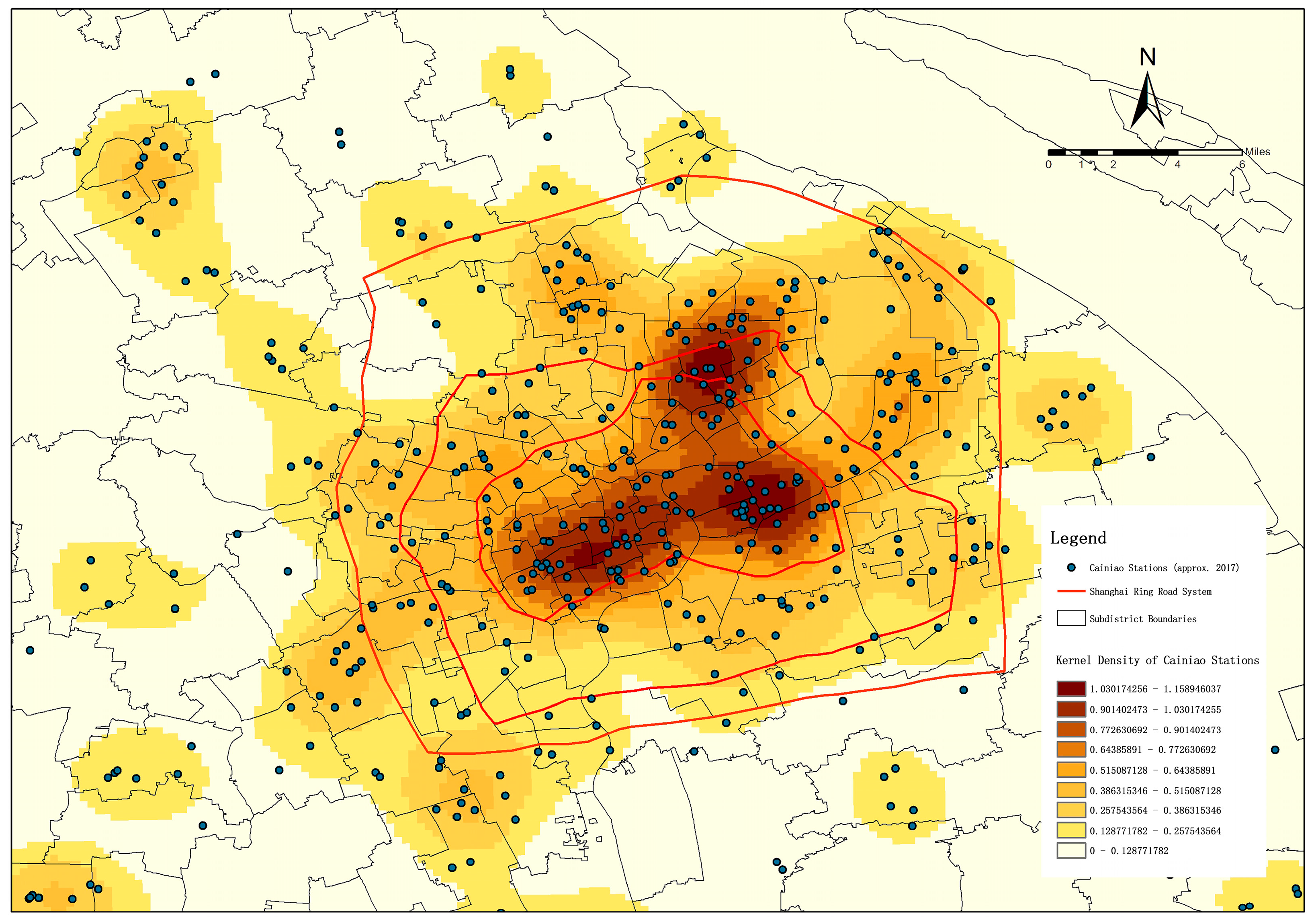
The 2017 map reflects this early model: station clusters were heavily concentrated in central districts where convenience stores were abundant (
Figure 3). However, by 2017, many convenience stores began withdrawing from the partnership due to rising labor and rental costs, inadequate parcel-handling compensation, privacy concerns, and the overwhelming volume of e-commerce deliveries. Some imposed strict daily limits, while others exited entirely, prompting media descriptions of a “last-mile challenge” and forcing Cainiao to restructure its station network [
61,
62].
In response, Cainiao shifted toward independently operated “Cainiao Yizhan” outlets located within residential communities. This transition occurred amid escalating competition from JD, Hive Box, and other logistics platforms, as well as shrinking profit margins across the delivery sector. Station operators faced thin earnings—often needing to process 600–800 parcels per day to break even—while costs for rent, labor, and utilities continued to rise. Although Cainiao experimented with additional services such as community group-buying pickup and recycling, these efforts only partially offset operational pressures [
63].
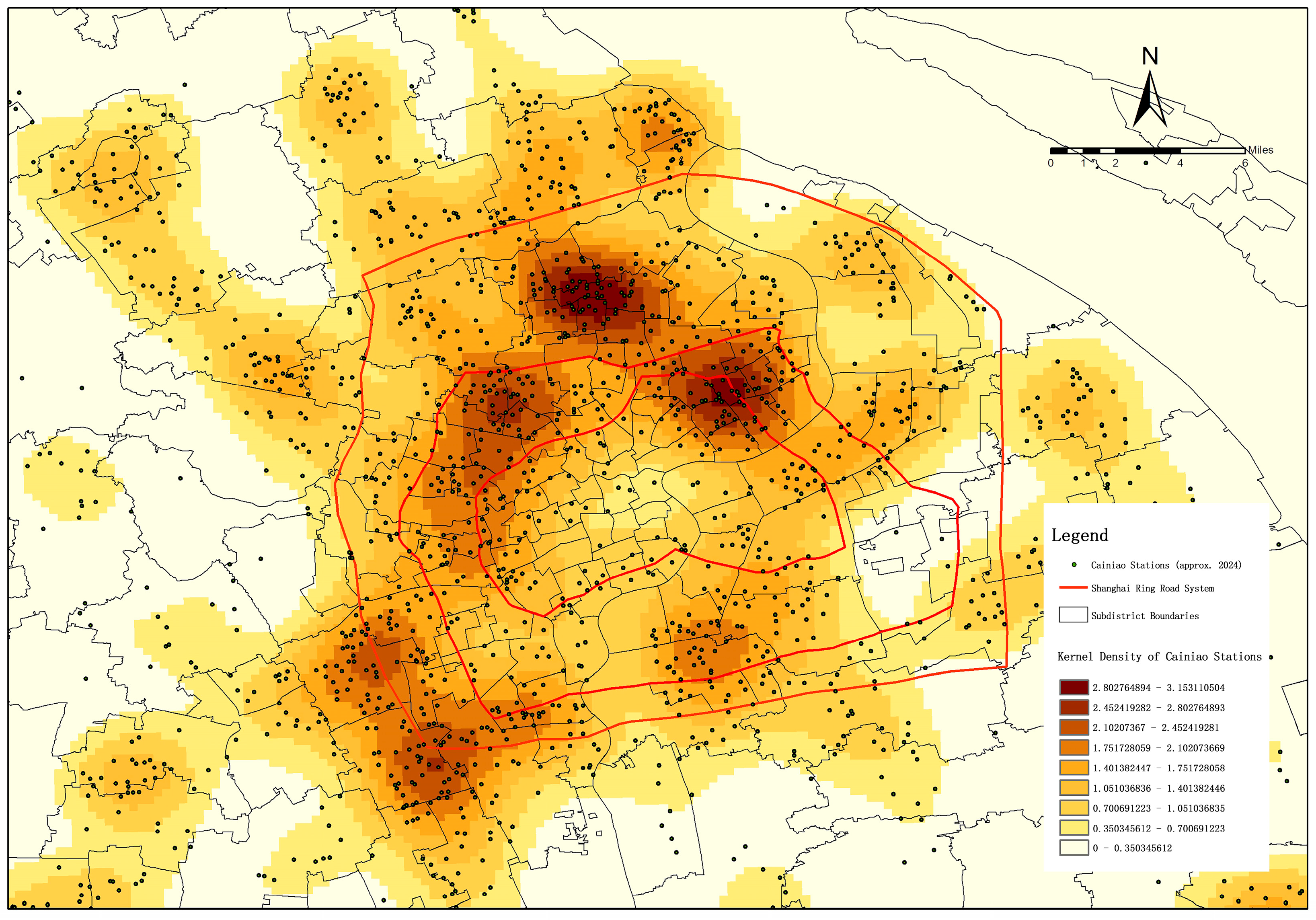
These industry dynamics produced a marked spatial reconfiguration. By 2024, Cainiao Stations had largely migrated outward, with new clusters concentrated beyond the Middle and Outer Ring Roads. The 2024 kernel-density map shows a thinning presence in the urban core and intensified clustering in suburban residential districts where rents are lower and population density supports high parcel volumes (
Figure 4). This outward shift—from convenience-store-based urban stations to dedicated community logistics outlets—captures Cainiao’s strategic adaptation to changing partnership conditions, operational costs, and competitive pressures within China’s rapidly evolving last-mile delivery system.
5. Results
5.1. OLS Results
This section presents the empirical findings of the study (
Figure 5 and
Figure 6), analyzing how proximity to Cainiao’s last-mile logistics infrastructure influences street-level retail vacancy and neighborhood land-use dynamics in Shanghai.
Table 4 reports descriptive statistics for the street-segment dataset collected from the four selected subdistricts in Shanghai, summarizing key indicators related to retail vacancy, logistics proximity, and local built-environment conditions.
The results are organized around two ordinary least squares (OLS) models—Model A (
Table 5) and Model B (
Table 6)—that test the hypothesized relationships between retail vitality and key spatial variables derived from the conceptual framework.
Model A tests the relationship between street-level retail vacancy and proximity to Cainiao’s last-mile logistics facilities using the full set of station-age categories.
Model A achieves modest explanatory power (Adj. R2 = 0.089; F(12, 94) = 1.87; p = 0.048), suggesting that the included predictors jointly account for a limited but statistically meaningful share of variation in retail vitality. The most significant variables are station_age2 (3–4 years) (β = 0.177; p = 0.047) and distance_to_station (β = 2.57 × 10⁻⁴; p = 0.007), indicating that segments farther from logistics nodes—and those near stations established during the mid-development phase—tend to have higher vacancy rates. This pattern supports the idea that logistics proximity can enhance local retail performance, particularly once stations are mature enough to attract steady user flows.
Other predictors—including recent or older station age, metro and mall proximity, street hierarchy, and neighborhood fixed effects—show no significant effects. VIF values (≤7.3) indicate only moderate collinearity. Overall, Model A suggests a localized positive association between Cainiao facilities and retail vitality, aligning with the hypothesis that last-mile logistics nodes generate neighborhood-scale complementarities under platform urbanism, rather than uniformly substituting for traditional commerce.
Based on the VIF result (
Table 7), we combined station_age2 and station_age3, and built an updated model: Model B.
We compared model fit with AIC/BIC and tested whether the two “age” coefficients can be collapsed using R.
An F-test (p = 0.29) indicated no significant difference between mid- and long-established stations, so these categories were merged into a single “mature station” variable to reduce multicollinearity while retaining explanatory power. Model B is therefore the more efficient specification: it remains theoretically meaningful, improves stability, and does not worsen model fit.
Model comparison shows only marginal gains in Model A, which distinguishes the two age groups (Adj. R
2 = 0.089 vs. 0.074; AIC –82.4 vs. –81.5) (
Table 8). The F-test confirms the categories are statistically indistinguishable, justifying consolidation in Model B. We therefore use Model B as the parsimonious specification while confirming that Model A yields consistent results.
Model B assesses retail vacancy after consolidating station ages. It shows modest explanatory power (Adj. R2 = 0.074; F(11,95) = 1.77; p = 0.07). Distance to the nearest Cainiao station is the only significant predictor (β = 2.49 × 10⁻⁴; p = 0.0097), indicating vacancy rises with increasing distance—suggesting localized agglomeration effects in which Cainiao stations help sustain nearby retail by generating pedestrian and consumer flows.
Other predictors—station age, metro and mall proximity, street hierarchy, and neighborhood fixed effects—are insignificant, implying that retail outcomes are shaped primarily by proximity to last-mile logistics infrastructure rather than broader accessibility. All VIFs remain below 4.4, confirming low multicollinearity.
The insignificant station_buffer_300 dummy and the significant distance_to_station coefficient reflect a continuous spatial relationship rather than a threshold effect. Retail vitality does not shift sharply at 300 m; instead, Cainiao’s influence decays gradually with distance. This aligns with spatial interaction theory, indicating that last-mile logistics exert diffuse, distance-sensitive impacts rather than discrete, boundary-based effects.
5.2. Shopping Mall Investigation Outcome
The assessment of four shopping malls—Baoshan Wanda Plaza, 189 Lane Shopping Center, Paris Spring Department Store, and One ITC Mall—reveals clear patterns of structural transformation under platformized e-commerce (
Table 9 and
Supplementary Material).
These results are generated through a standardized evaluation framework incorporating vacancy counts, five-year turnover estimates, tenant classification, public-space vitality scoring, 5:2 weighted foot-traffic counts (weekday/weekend), flow-intensity calculations adjusted for 1 km population catchments, and e-commerce participation indices. Together, the findings demonstrate a consistent pattern: platformized e-commerce does not produce large visible vacancies but instead drives a gradual reconfiguration of mall functions, commercial stability, and customer flows, with community-serving malls most affected and upmarket, experiential malls showing relative resilience.
5.3. Alignment of Shanghai Master Plan (2017–2035) with Platform-Era Spatial Transformations
Evaluation of Shanghai’s 2017–2035 Master Plan across the four subdistricts reveals a consistent pattern: although the plan strongly supports mixed-use, adaptive, and anticipatory development, it does not address the spatial impacts of platformized e-commerce and last-mile logistics (
Table 10). All subdistricts—Pengpu Xincun, Gonghexin Road, Changshou Road, and Shimen No. 2 Road—promote mixed-use layouts, commercial optimization, and improved public-service land, aligning with the first dimension of the analytical framework.
However, responsiveness to logistics- and platform-driven change is limited. Only Changshou Road shows partial alignment through its logistics and digital-industry designation; the other subdistricts lack flexible zoning or provisions for micro-warehousing, livestreaming, or hybrid commercial–logistics uses. The plan also omits digital indicators such as parcel flows and delivery frequency and makes no reference to parcel lockers, community depots, or last-mile corridors. Fieldwork shows these hybrid retail–logistics spaces are widespread, yet the plan offers no tools to manage them. Sustainability and governance sections similarly overlook the environmental and infrastructural impacts of digital logistics, with Changshou Road again the only area explicitly recognizing digital and logistics infrastructures.
Although Shanghai’s Master Plan serves as the empirical basis for evaluating planning responsiveness, the identified gaps—lack of recognition for micro-logistics infrastructures, absence of digital indicators, and insufficient zoning flexibility—are not unique to Shanghai. These issues reflect broader structural challenges facing Chinese cities as platformized e-commerce reshapes land-use patterns. The evaluation framework developed in this study thus provides a transferable tool for other municipalities seeking to integrate platform-era spatial dynamics into comprehensive planning.
6. Discussions
6.1. Response to Research Problems 1 & 2/Hypotheses 1 & 2
Hypothesis 1 proposed that proximity to Cainiao stations would correlate with higher retail vacancy. The regression results only partially support this, and the relationship emerges in the opposite direction. In both Model A and Model B, distance_to_station is positive and significant, indicating that vacancy increases as the distance from a Cainiao station increases. Street segments closer to stations therefore show lower vacancy, suggesting that Cainiao nodes may reinforce rather than weaken local retail vitality—a pattern consistent with field observations showing that parcel pickup and return activities generate steady pedestrian flows that spill over into nearby shops.
Descriptive statistics help clarify this gradient effect. Mean distance to the nearest Cainiao station is 493.94 m, ranging from 33 to 1372 m, indicating substantial spatial variation. This helps explain why station_buffer_300 is insignificant: retail responses are spread across a broad distance band rather than concentrated within a 300-m radius. The weak threshold effect reinforces the interpretation that platform impacts diffuse continuously through neighborhood space.
Vacancy patterns show similar heterogeneity. The mean vacancy rate is 0.22, with a large standard deviation (0.16) and a wide range (0–0.87), making it difficult for a single proximity measure to capture all variation in retail conditions. Even so, the consistent significance of the distance variable indicates that Cainiao proximity remains a meaningful predictor despite noise in the dependent variable.
Hypotheses 2a and 2b expected spatial variation in this relationship across inner vs. outer rings and across neighborhoods with differing station density. However, neighborhood fixed effects are insignificant in both models, and descriptive statistics for neighborhood dummies (neighborhood_a, b, c) show no strong mean differences and moderate variation without clustering. This suggests that the proximity–vacancy relationship is broadly consistent across the sampled areas. Platform logistics thus function as a citywide infrastructure whose land-use effects transcend traditional inner–outer ring divisions and localized station-density differences.
These findings point to a plausible causal mechanism underlying the observed relationship between logistics proximity and retail vitality. Cainiao stations generate repeated micro-flows of pedestrian activity through routine parcel pickup and return, creating small but steady streams of movement that sustain convenience-oriented street retail. This mechanism helps explain why vacancy increases with distance and why proximity continues to matter across broad spatial bands. At the same time, the insignificance of other spatial variables—including metro access, mall proximity, street hierarchy, and neighborhood categories—aligns with Hesse’s [
32] argument that contemporary logistics urbanism is driven less by physical transport infrastructures and more by the circulation of commodities across extended urban networks. Under platformized e-commerce, the influence of logistics is diffused through consumption flows rather than concentrated in fixed infrastructures, meaning that it is the pervasive reach of digital–logistical circulation—not the physical attributes of streets, districts, or transport systems—that shapes neighborhood retail outcomes. In this sense, the citywide penetration of platform logistics renders many conventional predictors less relevant, while distance to the nearest logistics node remains the strongest spatial signal of retail performance.
6.2. Response to Research Problem 3/Hypothesis 3
Hypothesis 3 posits that the expansion of platformized e-commerce logistics undermines shopping-mall vitality through rising tenant turnover, functional restructuring, and reduced foot traffic. Evidence from the four studied malls generally supports this claim, though outcomes differ depending on mall positioning and tenant adaptability.
Although formal vacancy rates remain low (0–14.44%), all malls exhibit a clear “silent decline.” Five-year tenant turnover is exceptionally high—63% at Wanda, 96.72% at 189 Lane, 97.78% at Paris Spring, and 87.23% at One ITC—indicating sustained instability. Interviewees echoed this pattern: a Wanda receptionist noted “constant turnover,” while a Paris Spring boutique reported increasingly unstable sales that were “getting worse year by year.” Tenants across malls described fluctuating customer flows and rising uncertainty.
This instability is accompanied by substantial functional restructuring. Retail has become a minority land use in the three community malls: 9.43% at 189 Lane, 24.68% at Paris Spring, and 30.43% at Wanda. Dining, tutoring, leisure, beauty, and gym uses now dominate. Field observations recorded former fashion units converted into classrooms and activity rooms and consistently weak boutique patronage. Tenants often attributed this to online substitution; customers likewise reported visiting mainly for dining, leisure, or parcel pickup rather than shopping.
Foot-traffic intensity is similarly weak. Entrance and escalator counts show low to medium-low flows, with public spaces underused even during peak hours. Staff at 189 Lane described foot traffic as “very low lately,” and long-time employees noted clear declines compared with earlier months. The rise of pickup and delivery further reduces browsing: Wanda staff observed sharply increased in-store pickup, while a fast-food shop at 189 Lane reported only 10 dine-in versus 20–30 delivery orders per day.
Patterns across the four malls show that platformized e-commerce pressures all malls to some extent, but their responses differ according to positioning and tenant mix. One ITC Mall, despite being located in an area with few nearby Cainiao stations, is not insulated from platform substitution: it also exhibits a high rate of tenant turnover, and many retailers report declining sales due to online competition. Yet the mall maintains strong overall vibrancy because visitors are drawn not primarily for shopping but for the experiential qualities it offers—premium brands, aesthetic interior design, cafés, and social spaces that create a destination environment. In contrast, Paris Spring’s weak foot traffic is further depressed by renovation activities, while Wanda and 189 Lane—serving community-oriented markets—experience more visible erosion of traditional retail as platform logistics outperform them in price, convenience, and product diversity. These contrasting cases demonstrate that while platform e-commerce imposes pressures across all mall types, experiential malls retain relative resilience by offering functions that digital platforms cannot easily substitute.
6.3. Response to Research Problem 4/Hypothesis 4
Hypothesis 4 suggests that Chinese urban planning has not yet adapted to the hybrid land-use forms and decentralized spatial patterns generated by platformized e-commerce logistics. The planning evaluation supports this claim. Although Shanghai’s Master Plan (2017–2035) emphasizes mixed-use development, public-service improvement, and overall urban vitality, it remains largely disconnected from the spatial transformations driven by last-mile logistics, parcel lockers, and platform-mediated consumption.
First, all four subdistricts—Pengpu Xincun, Gonghexin Road, Changshou Road, and Shimen No. 2 Road—align with general principles of mixed-use and anticipatory planning, but this reflects continuity with traditional planning rather than a response to platform-induced change. The plan promotes commercial–residential integration and jobs–housing balance, yet does not acknowledge the hybrid commercial–logistics environments now common along retail streets and within community compounds. Fieldwork confirms that parcel stations and delivery nodes are deeply embedded in everyday spaces, but these facilities remain absent from formal planning instruments.
Second, only Changshou Road shows partial recognition of logistics-oriented development through its smart-logistics designation. Elsewhere, the plan lacks mechanisms—flexible zoning, adaptive reuse, overlay districts—to accommodate micro-warehousing, parcel pickup, self-collection points, or livestreaming studios. These omissions highlight the gap between the spatial demands of platform and logistics urbanism and a regulatory framework that still treats commerce, logistics, and residential uses as separate categories.
Third, the evaluation shows no integration of digital-economy indicators or micro-logistics infrastructures into planning. Metrics such as parcel flows, delivery frequency, or platform-generated mobility are not used, nor are parcel lockers, depots, or delivery nodes recognized as facilities requiring planned locations, design standards, or environmental management. Consequently, logistics functions proliferate informally in street edges, lobbies, and leftover spaces without oversight.
Finally, last-mile transport is not incorporated. Although the plan provides guidance on metro expansion and road hierarchy, it omits courier e-bikes, delivery corridors, or neighborhood-level freight circulation, indicating a continued focus on passenger mobility rather than emerging logistics flows.
Taken together, these findings show that Shanghai’s planning system has not yet adjusted to the hybridized, decentralized, and data-driven spatial patterns produced by platformized e-commerce. The deepening integration of platform and logistics urbanism requires more responsive tools—flexible zoning, performance-based regulation of hybrid spaces, formal recognition of micro-logistics facilities, and the use of digital indicators in neighborhood-scale planning. These results confirm Hypothesis 4 and underscore the need for planning frameworks to evolve alongside platform-mediated urban spatial logics.
7. Conclusions
This study advances empirical and theoretical understanding of how platformized e-commerce logistics reshape urban land use at the neighborhood scale. The paper demonstrates that platform logistics transform urban space through two intertwined mechanisms: localized complementarity, whereby physical service nodes generate pedestrian flows that sustain neighborhood retail, and citywide logistical substitution, whereby digitally coordinated delivery systems restructure and repurpose community-oriented shopping malls.
First, Cainiao stations function as physical service nodes that attract steady pedestrian flows for parcel pickup and returns. These localized micro-flows generate complementary commercial activity in their immediate surroundings: retail vacancy declines as distance to a station decreases, revealing that last-mile nodes create new everyday foot-traffic ecologies. The spatial relationship between logistics proximity and retail vitality is therefore broad, continuous, and citywide rather than confined to narrow radii or specific urban zones.
Second, Cainiao stations operate as neighborhood-level execution points within a digitally coordinated logistics system. Upstream algorithms determine parcel routing and flow, while stations simply materialize these digital processes on the ground, making platform logistics visible in everyday urban space. This circulation system permeates all neighborhood types, regardless of location, age, or transit access. Its effects are most pronounced in community-oriented shopping malls, where platform logistics exert a restructuring—rather than complementary—force. Malls face direct substitution pressure for standardized goods, accelerating tenant turnover and pushing them away from traditional retail functions. Their core value proposition—product variety, brand verification, and on-site browsing—is precisely what platformized e-commerce replaces most efficiently, rendering such malls structurally vulnerable.
Together, these dynamics flatten the previous hierarchy of commercial spaces. Instead of a tiered retail landscape ranging from local shops to mid-range malls, platformization produces a bifurcated system: (1) neighborhood retail streets sustained by logistics-driven everyday flows and (2) a new class of malls that survive not through retailing but through experiential, leisure, and service-oriented functions. Community malls increasingly reposition themselves as multifunctional community-care or lifestyle centers, while high-end malls rely on unique spatial design attributes and immersive place qualities that cannot be replicated by digital platforms.
At the same time, the assessment of Shanghai’s Master Plan (2017–2035) shows that current planning instruments have yet to fully engage with these spatial transformations. Despite strong commitments to mixed-use development and urban vitality, the plan remains largely disconnected from last-mile delivery flows, parcel-locker networks, data-driven consumption patterns, and the emergence of hybrid commercial–logistics spaces. This disconnect underscores the need for platform-responsive planning capable of addressing the new land-use configurations produced by digital logistics systems. Theoretically, this paper advances platform and logistics urbanism by reconceptualizing last-mile e-commerce infrastructure as a dual-role urban system. Building on Zhang’s [
8] cyber–physical view of logistics and Zhang et al.’s [
29] account of commercial restructuring, the study shows that platform logistics produces differentiated land-use effects across spatial scales. At the neighborhood retail scale, logistics proximity generates diffuse, complementary effects that sustain street-level commerce, while at the shopping-mall scale—especially in community malls—it accelerates displacement, tenant turnover, and functional repurposing. This reveals that platformization does not merely flatten commercial hierarchies but reclassifies urban commercial space into product-oriented retail vulnerable to substitution and experience-oriented places that depend on design, leisure, and social functions. Together, these findings extend existing theory by specifying how digital coordination translates into scale-dependent spatial outcomes in platformized cities. Methodologically, existing studies of e-commerce and land use have largely relied on macro-scale panel or spatial analyses at the provincial, municipal, or county level, or on descriptive mappings of logistics facilities. This study instead adopts a micro-scale design centered on street segments and individual shopping malls. By integrating field-observed vacancy rates with GIS-based proximity measures, neighborhood fixed-effects models, and mall-level case studies combining quantitative vitality indicators with qualitative observations, it directly links last-mile logistics exposure to neighborhood-scale land-use outcomes. This mixed-method approach bridges macro-level platform analyses with the fine-grained spatial transformations unfolding in everyday urban space.
Empirically, the evaluation of Shanghai’s 2017–2035 Master Plan reveals a clear governance mismatch between rapid platform-logistics expansion and existing planning frameworks. While the plan promotes mixed-use redevelopment and technological upgrading, it lacks tools to manage hybrid commercial–logistics spaces, integrate last-mile delivery into transport planning, accommodate micro-logistics infrastructure, or incorporate digital-economy indicators into spatial monitoring. By operationalizing a planning-evaluation framework grounded in platform and logistics urbanism, this study offers a practical method for diagnosing these gaps and guiding more adaptive, flexible, and data-informed planning responses to platform-driven spatial restructuring in Chinese cities and beyond.