

Revealing “Unequal Natures”—The Paradox of Water Vulnerability for People on the Periphery of Calakmul Biosphere Reserve, Mexico
 ,
,  ,
,  , , and
Abstract
1. Introduction
Unveiling the Social Dimension of Water Vulnerability
2. Materials and Methods
2.1. Study Area
2.2. Instruments and Data Collection Techniques
2.3. Data Analysis
3. Results
3.1. Navigating Tensions Between Conservation and Development in the Calakmul Biosphere Reserve
3.2. The Challenge of Access to Water in a Promised Land
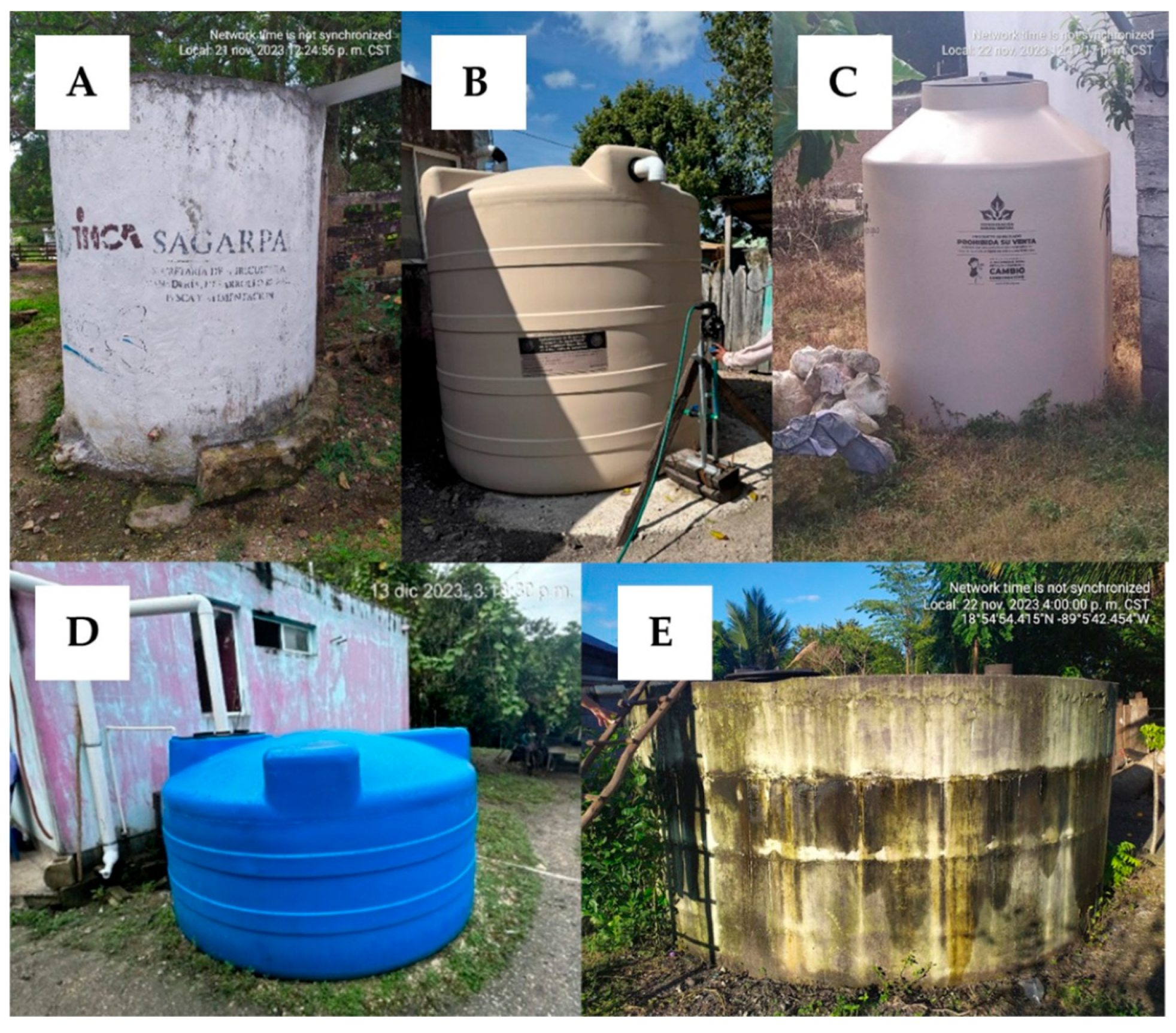
“I arrived in Xpujil around 2002, and the water we used came from jagüeyes—it had a horrible smell. The water we were given had tadpoles in it. (…) We had to treat it with chlorine so the sediment would settle at the bottom. Conditions were critical. In the municipal seat, we were allocated 200 L per week. (…) Back then, at CRIPX, our main social struggle was water. We used to submit formal requests whenever a new municipal administration began. There were no cisterns, only rudimentary water tanks. Around 2005–2006, the first 25,000–30,000-L cisterns appeared, led by the Presbyterian church—foreign churches—but they only gave them to their members. (…) Later, a foundation called SANUT arrived, and a year after that, Fondo para la Paz came in—this was around 2007–2008. That’s when the local government and the reserve also started to get involved. Cistern construction began, and our social struggle was legitimate, supported by all sectors of the community. It gave us a reason to come together, and people became more organized, more determined. Eventually, cisterns became more common. (…) Then came the aqueduct in 2009, and that truly gave us a breather in Xpujil—a huge relief. We finally had two aqueducts. But politicians think that building aqueducts is the solution. They don’t consider all the other factors involved in making one operational.” (N.J., CRIPX Key informant, 4 March 2024)
3.3. Water Insecurity Among Households in Calakmul
“I also interacted with civil society, meeting families, and sometimes the communities complained. They told us, “The projects were the same as always.” The projects are built, but there is no process to involve them in training and maintenance. So [the cisterns] already have cracks and fissures due to lack of maintenance, and there you have a white elephant that is no longer functioning. So, between having to renovate or restore them, it will also require an investment. It is a very heavy investment” (J.R. NGO Key Informant, 22 February 2024).
“Well, the truth is that a lot of progress has been made. For example, in addition to drawing up this work plan, the water committees now have a kit that they use to monitor the quality of different water sources in their community. They carry out the monitoring, collect the data, and interpret it, because they are also taught how to interpret it, of course. They present the results to their assemblies or to their [community] authorities to see what needs to be done to improve water quality. They have been given certain tools so that, for example, if a valve breaks in the community, they don’t have to wait for the municipality to come and replace it. They have the knowledge, and many communities already have the resources. In addition, income-generating projects have been achieved. There are communities that are currently managing a community water purification plant, and a percentage of all the resources obtained from that plant is allocated exclusively to water and sanitation issues. In other words, it is a process that has been going on for 10 years” (M. NGO Key Informant, 21 February 2024).
4. Discussion
5. Conclusions
Supplementary Materials
Author Contributions
Funding
Institutional Review Board Statement
Data Availability Statement
Acknowledgments
Conflicts of Interest
Abbreviations
| CBR | Calakmul Biosphere Reserve |
| NPA | Natural Protected Area |
| MAB | Man and the Biosphere Program |
| SDGs | UN Sustainable Development Goals |
| NGO | Non-governmental organization |
| UNESCO | United Nations Educational, Scientific and Cultural Organization |
| AD | Years after Christ |
| CONANP | National Commission for Protected Natural Areas |
| INAH | National Institute of Anthropology and History |
| PROCAMPO | Direct Support Program for Rural Areas |
| PROREST | Program for the Protection and Restoration of Priority Ecosystems and Species |
| INECOL | Ecology Institute, A. C. |
| ECOSUR | The College of the Southern Border |
| WWF | World Wildlife Fund Inc |
| SEMARNAT | Ministry of Environment and Natural Resources |
| REDD+ | Reducing Emissions from Deforestation and Forest Degradation Program |
| ADVC | Area Voluntarily Designated for Conservation |
| PROAGUA | Drinking Water, Drainage, and Treatment Program |
| CRIPX | Xpujil Regional Indigenous and Popular Council |
Appendix A

| Locality | Community Description of Water | Households Have Received Water Support (%, n) |
|---|---|---|
| Zoh-Laguna (Ejido Alvaro Obregón) | There is a piped water network, and the water distributed comes from a well in the community. There are areas of the community where households receive water seven days a week. Of the households surveyed, 95.4% receive piped water. There is a lagoon, and previously, the water distributed in the network came from it. Of the households surveyed, 86.2% mentioned that they use rainwater (65 N). | 63.1 (65 n) |
| Manuel Crescencio Rejon | There is a piped water network, and the water distributed comes from a well in the community. Households receive water two days a week. Of the households surveyed, 100% receive piped water. In addition, there is a community cistern (aljibe) and a water treatment plant in the community for community use. Of the households surveyed, 82.4% mentioned that they use rainwater (17 N). | 82.4 (17 n) |
| Nuevo Conhuas | There is a piped water network, and the water distributed comes from the Lopez Mateos–Xpujil aqueduct. Households receive water 1 or 2 days a week. Of the households surveyed, 97% receive piped water. In addition, there is a community cistern (aljibe) in the community, and they have their own water truck. Of the households surveyed, 90.9% mentioned that they use rainwater (33 N). | 78.8 (33 n) |
| Centauro del Norte | There is a piped water network, which was installed at the end of 2024. At the time of the surveys in January 2025, the water network was not yet operational. The water to be distributed will come from the Lopez Mateos–Xpujil aqueduct. Of the households surveyed, 53.3% reported being connected to the piped water network. In addition, there is a community cistern (aljibe), a pond liner, and a lagoon in the community. Of the households surveyed, 100% reported using rainwater (15 N). | 86.7 (15 n) |
| Lucha I | There is a piped water network, and the water distributed comes from the Lopez Mateos–Xpujil aqueduct. Households reported receiving water once a year, and only 64.7% reported receiving piped water. In addition, there are 2 community cisterns (aljibes) and a pond liner in the community. Of the households surveyed, 100% mentioned that they use rainwater (17 N). | 70.6 (17 n) |
| Valentin Gomez Faras | There is a piped water network, which was modernized at the end of 2023. The water distributed comes from the Lopez Mateos–Xpujil aqueduct, but according to the households surveyed, since the water network was reopened, it has not been working, and they have not been receiving water. Of the households surveyed, 61.9% reported being connected to the piped water network. In addition, there are two community cisterns (aljibes), a jagüey, and a pond liner in the community. Of the households surveyed, 100% reported using rainwater (21 N). | 81 (21 n) |
| Lucha II | There is no piped water network. According to the households surveyed, they receive water by water truck every month. There is a community cistern (not working) and a pond liner in the community. Of the households surveyed, 100% mentioned that they use rainwater (9 N). | 88.9 (9 n) |
| Nuevo Becal | There is a piped water network, but it does not work. There are two community cisterns (aljibes) and a lagoon in the community. Of the households surveyed, 100% mentioned that they use rainwater (23 N). | 65.2 (23 n) |
| General | 7 of 8 communities surveyed have a piped water network, but it only works in 4 communities. 2 communities have their own wells and the others receive water from the Lopez Mateos–Xpujil aqueduct. The community that does not have a piped water network receives water by tanker truck every month. Of the households surveyed, 71.5% receive piped water and 92.5% use rainwater (200 N). | 73 (200 N) |
| 1 | CRIPX is an intercultural organization with a gender focus that fights for participatory democracy, autonomy, and comprehensive management of natural resources, as well as the management and execution of comprehensive projects for the well-being of the inhabitants of the Calakmul region through the revaluation and strengthening of local capacities and knowledge [96]. |
| 2 | The Tren Maya is one of the megaprojects carried out during the administration of former President Lopez Obrador (2018–2024). It is a railway project covering five states in southeastern Mexico (Chiapas, Tabasco, Campeche, Yucatan, and Quintana Roo), which was inaugurated in 2024. According to the Mexican government, it is a project to promote the social, cultural, and economic development of the Yucatan Peninsula. Among its objectives are to restore the biological connectivity of natural areas, promote the conservation of ecosystems and environmental services, and rehabilitate degraded ecosystems, especially in NPAs, for this reason, the integration of the Calakmul region into the project was of utmost importance [99]. |
References
- Loos, J. Reconciling Conservation and Development in Protected Areas of the Global South. Basic Appl. Ecol. 2021, 54, 108–118. [Google Scholar] [CrossRef]
- Cusack, J.J.; Bradfer-Lawrence, T.; Baynham-Herd, Z.; Tickell, C.Y.; Duporge, I.; Hegre, H.; Moreno Zárate, L.; Naude, V.; Nijhawan, S.; Wilson, J.; et al. Measuring the Intensity of Conflicts in Conservation. Conserv. Lett. 2021, 14, e12783. [Google Scholar] [CrossRef] [PubMed]
- Vaccaro, I.; Beltrán, O.; Paquet, P.A. Political Ecology and Conservation Policies: Some Theoretical Genealogies. J. Political Ecol. 2013, 20, 255–272. [Google Scholar] [CrossRef]
- Bennett, N.J.; Roth, R.; Klain, S.C.; Chan, K.; Christie, P.; Clark, D.A.; Cullman, G.; Curran, D.; Durbin, T.J.; Epstein, G.; et al. Conservation Social Science: Understanding and Integrating Human Dimensions to Improve Conservation. Biol. Conserv. 2017, 205, 93–108. [Google Scholar] [CrossRef]
- Corbera, E.; Maestre-Andrés, S.; Collins, Y.A.; Buchi Mabele, M.; Brockington, D. Decolonizing Biodiversity Conservation. J. Political Ecol. 2024, 28, 889–903. [Google Scholar] [CrossRef]
- Seixas, C.S.; Davy, B. Self-Organization in Integrated Conservation and Development Initiatives. Int. J. Commons 2008, 2, 99–125. [Google Scholar] [CrossRef]
- Le Blanc, D.; Roehrl, R.; Rits, J.; Jussila, R.; Plutakhina, M.; Zubcevic, I.; Soltau, F.; Martinho, M.; O’Connor, D. Global Sustainable Development Report 2015 (Advance Unedited Version) (GSDR 2015); UNDESA: New York, NY, USA, 2015. [Google Scholar]
- Raworth, K. Why It’s Time for Doughnut Economics. Progress. Rev. 2017, 24, 216–222. [Google Scholar] [CrossRef]
- Price, E.A.C.; White, R.M. Education for Sustainable Development: Definitions, Debates and Design. In Perspectives and Practices of Education for Sustainable Development: A Critical Guide for Higuer Education; White, R.M., Kemp, S., Price, E.A.C., Longhurst, J.W.S., Eds.; Routledge: London, UK, 2025; pp. 9–35. ISBN 978-1-003-45156-3. [Google Scholar]
- United Nations. Transforming Our World: The 2030 Agenda for Sustainable Development; Resolution 70/1 Adopted by the General Assembly on 25 September 2015; United Nations: New York, NY, USA, 2015. [Google Scholar]
- Fonseca, L.M.; Domingues, J.P.; Dima, A.M. Mapping the Sustainable Development Goals Relationships. Sustainability 2020, 12, 3359. [Google Scholar] [CrossRef]
- Kroll, C.; Warchold, A.; Pradhan, P. Sustainable Development Goals (SDGs): Are We Successful in Turning Trade-Offs into Synergies? Palgrave Commun. 2019, 5, 140. [Google Scholar] [CrossRef]
- Adams, W.M.; Aveling, R.; Brockington, D.; Dickson, B.; Elliott, J.; Hutton, J.; Roe, D.; Vira, B.; Wolmer, W. Biodiversity Conservation and the Eradication of Poverty. Science 2004, 306, 1146–1149. [Google Scholar] [CrossRef]
- West, P.; Igoe, J.; Brockington, D. Parks and Peoples: The Social Impact of Protected Areas. Annu. Rev. Anthropol. 2006, 35, 251–277. [Google Scholar] [CrossRef]
- Büscher, B.; Fletcher, R. The Conservation Revolution: Radical Ideas for Saving Nature Beyond the Anthropocene; Verso: London, UK, 2020; ISBN 978-1-78873-771-5. [Google Scholar]
- Halffter, G. Las Reservas de La Biosfera: Conservación de La Naturaleza Para El Hombre. Acta Zoológica Mex. 1984, 5, 4–48. [Google Scholar] [CrossRef]
- Halffter, G. El Concepto de Reserva de La Biosfera. In Estudio Integrado de los Recursos Vegetación, Suelo y Agua en la Reserva de la Biosfera de Mapimí; Montaña, C., Ed.; Ambiente Natural y Humano; Instituto de Ecología, A.C.: Xalapa, Mexico, 1988; pp. 19–44. ISBN 968-7213-09-4. [Google Scholar]
- Halffter, G. Reserva de La Biosfera: Problemas y Oportunidades En México. Acta Zoológica Mex. 2011, 177–189. [Google Scholar] [CrossRef]
- Van Coung, C.; Dart, P.; Hockings, M. Biosphere Reserves: Attributes for Success. J. Environ. Manag. 2017, 188, 9–17. [Google Scholar] [CrossRef]
- Borsdorf, A.; Araya Rosas, P. El modelo de Reservas de la Biosfera: Conceptos, características e importancia. In Reservas de la Biosfera de Chile: Laboratorios para la Sustentabilidad; Moreira-Muñoz, A., Borsdorf, A., Eds.; Geolibros; Academia de Ciencias Austriaca, Pontificia Universidad Católica de Chile, Instituto de Geografía: Santiago de Chile, Chile, 2014; pp. 4–20. [Google Scholar]
- Bridgewater, P. The Man and Biosphere Programme of UNESCO: Rambunctious Child of the Sixties, but Was the Promise Fulfilled? Curr. Opin. Environ. Sustain. 2016, 19, 1–6. [Google Scholar] [CrossRef]
- Guevara, S.; Laborde, J. The Landscape Approach: Designing New Reserves for Protection of Biological and Cultural Diversity in Latin America. Environ. Ethics 2008, 30, 251–262. [Google Scholar] [CrossRef]
- Durand, L.; Figueroa, F.; Trench, T. Inclusion and Exclusion in Participation Strategies in the Montes Azules Biosphere Reserve, Chiapas, Mexico. Conserv. Soc. 2014, 12, 175–189. [Google Scholar] [CrossRef]
- Benz, B.F.; Cevallos, J.; Santana, M.F.; Rosales, J.; Graf, M.S. Losing Knowledge about Plant Use in the Sierra de Manantlan Biosphere Reserve, Mexico. Econ. Bot. 2000, 54, 183–191. [Google Scholar] [CrossRef]
- Figueroa, F.; Sánchez-Cordero, V.; Meave, J.A.; Trejo, I. Socioeconomic Context of Land Use and Land Cover Change in Mexican Biosphere Reserves. Environ. Conserv. 2009, 36, 180–191. [Google Scholar] [CrossRef]
- García-Amado, L.R.; Ruiz Pérez, M.; Reyes Escutia, F.; Barrasa García, S.; Contreras Mejía, E. Efficiency of Payments for Environmental Services: Equity and Additionality in a Case Study from a Biosphere Reserve in Chiapas, Mexico. Ecol. Econ. 2011, 70, 2361–2368. [Google Scholar] [CrossRef]
- Brenner, L.; Job, H. Reviewing the Participatory Management of UNESCO Biosphere Reserves: What Do We Miss by Ignoring Local Academic Knowledge in Mexico? Ambio 2021, 51, 1726–1738. [Google Scholar] [CrossRef]
- Durand, L. Naturalezas Desiguales: Discursos Sobre la Conservación de la Biodiversidad en México; Primera; Universidad Nacional Autónoma de México y Centro Regional de Investigaciones Multidisciplinarias: Cuernavaca, Mexico, 2017; ISBN 978-607-02-9138-8. [Google Scholar]
- van Ruymbeke, M.; Tigny, V.; De Badts, E.; Garcia-Moreno, R.; Billen, R. Development and Use of a 4D GIS to Support the Conservation of the Calakmul Site (Mexico, World Heritage Programme); Archeolingua: Budapest, Hungary, 2008; pp. 20–25. [Google Scholar]
- Ericsson, J.A.; Freudenberger, M.S.; Boege, E. Population Dynamics, Migration, and the Future of the Calakmul Biosphere Reserve. In Biological Diversity. Balancing Interests Through Adaptive Collaborative Management; Buck, L.E., Geisler, C.C., Schelhas, J., Wollenberg, E., Eds.; CRC Press: New York, NY, USA, 2001. [Google Scholar]
- Haenn, N. Biodiversity Is Diversity in Use: Community-Based Conservation in the Calakmul Biosphere Reserve; Working Papers Number 7; The Nature Conservancy: Arlington, VA, USA, 2000; ISSN 1098-3848. [Google Scholar]
- Calvo-Boyero, D. Social Vulnerability, Adaptation and Conservation in the Calakmmul Biosphere Reserve, Mexico. Ph.D. Dissertation, Institute of Environmental Sciences and Technology (ICTA), Barcelona, Spain, 2016. [Google Scholar]
- Sánchez-Ramos, M.A. Gobierno abierto: Acciones hacia la gobernanza local en México. RIDE Rev. Iberoam. Investig. Desarro. 2023, 14. [Google Scholar] [CrossRef]
- Mardero, S.; Schmook, B.; Calmé, S.; Casanova, G.; White, R.M. Drifting Past Policy Coherence? Rhetoric and Realities of the Mexican Sembrando Vida Program’s Sustainability Goals. Land 2025, 14, 278. [Google Scholar] [CrossRef]
- UNESCO World Water Assessment Programme. The United Nations World Water Development Report 2024: Water for Prosperity and Peace; Executive Summary; UNESCO: Paris, France, 2024; p. 12. [Google Scholar]
- Mdee, A.; Ofori, A.; Lopez-Gonzalez, G.; Stringer, L.C.; Martin-Ortega, J.; Ahrari, S.; Dougill, A.; Evans, B.; Holden, J.; Kay, P.; et al. The Top 100 Global Water Questions: Results of a Scoping Exercise. One Earth 2022, 5, 563–573. [Google Scholar] [CrossRef]
- Howard, B.C.; Buytaert, W.; Krause, S.; Hannah, D.M. Connecting Global Water Agendas: From Wicked Problematization to Opportunities for Action. Perspect. Earth Space Sci. 2024, 5, e2024CN000248. [Google Scholar] [CrossRef]
- Herrfahrdt-Pähle, E.; Houdret, A.; Dombrowsky, I.; Cullmann, J.; Mukherji, A.; Unver, O.; Varady, R. Empowering Global Water Governance: Taking the 2023 UN Water Conference Outcomes Forward to Address the Current Water Crises. Water Int. 2025, 50, 4–10. [Google Scholar] [CrossRef]
- Falkenmark, M.; Lundqvist, J.; Widstrand, C. Macro-Scale Water Scarcity Requires Micro-Scale Approaches. Aspects of Vulnerability in Semi-Arid Development. Nat. Resour. Forum 1989, 13, 258–267. [Google Scholar] [CrossRef] [PubMed]
- Food and Agriculture Organization of the United Nations. Coping with Water Scarcity: An Action Framework for Agriculture and Food Security; FAO: Rome, Italy, 2012; ISBN 1020-1203. [Google Scholar]
- United Nations. Water Security & the Global Water Agenda: A UN-Water Analytical Brief; United Nations: New York, NY, USA, 2013. [Google Scholar]
- Jepson, W.E.; Wutich, A.; Collins, S.M.; Boateng, G.O.; Young, S.L. Progress in Household Water insecurity Metrics: A Cross-Disciplinary Approach. WiREs Water 2017, 4, e1214. [Google Scholar] [CrossRef]
- Mundo-Rosas, V.; Galarde-López, M.; Galindo-Gómez, C.; García Guerra, A.; Muñoz-Espinosa, A.; Hernández-Palafox, C.; Vizuet-Vega, N.I. Factors Associated with Water Insecurity in Mexican Households Using Nationally Representative Survey Data. Water 2025, 17, 1782. [Google Scholar] [CrossRef]
- Wutich, A. Water Insecurity Is Human: Why Social Science Must Be at the Core of Water Security Research and Practice. Front. Water 2025, 6, 7. [Google Scholar] [CrossRef]
- Biswas, S.; Adhikary, M.; Alam, A.; Islam, N.; Roy, R. Disparities in Access to Water, Sanitation, and Hygiene (WASH) Services and the Status ofSDG-6 Implementation across Districts and States in India. Heliyon 2024, 10, 1–17. [Google Scholar] [CrossRef]
- Shifidi, V.; Sitas, N.; Meissner, R. Maximizing Synergies between State and Nonstate Actors to Enhance Water Governance in the Cubango-Okavango River Basin. World Water Policy 2024, 10, 1187–1222. [Google Scholar] [CrossRef]
- Biancardi Aleu, R.; Klocker Larsen, R.; Methner, N. Participation and Marginalization in Water Governance: Probing the Agency of Powerholders. Ecol. Soc. 2022, 27, 33. [Google Scholar] [CrossRef]
- Voogd, R.; De Vries, J.R.; Beunen, R. Understanding Public Trust in Water Managers: Findings from the Netherlands. J. Environ. Manag. 2021, 300, 113749. [Google Scholar] [CrossRef]
- Bustos Sandoval, E.; Heckler, S.; Aragón Durand, F.; Olivera, F. Vulnerabilidad y Riesgo al Cambio Climático en Reservas de Biosfera y Geoparques Mundiales de la UNESCO en América Latina y el Caribe; UNESCO: París, France, 2023; p. 12. [Google Scholar]
- Adams, W.M.; Hutton, J. People, Parks and Poverty: Political Ecology and Biodiversity Conservation. Conserv. Soc. 2007, 5, 147–183. [Google Scholar]
- Caro-Borrero, A.; Carmona-Jiménez, J.; Figueroa, F. Water Resources Conservation and Rural Livelihoods in Protected Areas of Central Mexico. J. Rural Stud. 2020, 78, 12–24. [Google Scholar] [CrossRef]
- Zeeshan, M.; Kumar Prusty, B.A.; Azeez, P.A. Protected Area Management and Local Access to Natural Resources: A Change Analysis of the Villages Neighboring a World Heritage Site, the Keoladeo National Park, India. Earth Perspect. 2017, 4, 13. [Google Scholar] [CrossRef]
- Sinco-Ramos, P.G.; García-Frapolli, E.; Porter-Bolland, L.; Durand, L. Biospheres Reserves and Social-Ecological Well-Being: The Case of Tehuacán-Cuicatlán, Mexico. Environ. Dev. Sustain. 2025, 18. [Google Scholar] [CrossRef]
- Phuong Thao, N.; Eales, J.; Minh Lam, D.; Thuc Hien, V.; Garside, R. What Are the Impacts of Activities Undertaken in UNESCO Biosphere Reserves on Socio-economic Wellbeing in Southeast Asia? A Systematic Review. Environ. Evid. 2023, 12, 30. [Google Scholar] [CrossRef]
- Gómez-Valenzuela, V.; Van Lentre, H.; Ramírez, K.; Bonilla-Duarte, S. Understanding Governance in the Jaragua-Bahoruco-Enriquillo Biosphere Reserve: An Empirical Approach. Trop. Conserv. Sci. 2023, 16, 1–19. [Google Scholar] [CrossRef]
- Jaafar, M.; Ebekozien, A.; Mohamad, D.; Salman, A. A Systematic Review of Asian Community Participation in Biosphere Reserves. PSU Res. Rev. Int. J. 2023, 184–200. [Google Scholar] [CrossRef]
- Stoll-Kleemann, S.; Welp, M. Participatory and Integrated Management of Biosphere Reserves: Lessons from Case Studiesand a Global Survey. GAIA 2008, 17, 161–168. [Google Scholar] [CrossRef]
- Curtet, M.; Donnellan Barraclough, A.; Maren, I.E. The Evolution of Stakeholder Participation in European UNESCO Biosphere Reserves: Challenges and Opportunities of the COVID Pandemic and the Digital Shift. J. Environ. Policy Plan. 2024, 26, 374–387. [Google Scholar] [CrossRef]
- Gavin, M.C.; McCarter, J.; Mead, A.; Berkes, F.; Stepp, J.R.; Peterson, D.; Tang, R. Defining Biocultural Approaches to Conservation. Trens Ecol. Evol. 2015, 30, 140–145. [Google Scholar] [CrossRef]
- INEGI. Evolución Histórica de Los Municipios de México de 1810 a 2020: Campeche 2023; INEGI: Porto, Portugal, 2023. [Google Scholar]
- Municipio de Calakmul; CONANP. GTZ Programa de ordenamiento ecológico del territorio del municipio Calakmul, Campeche. Periódico Oficial del Estado de Campeche, 1 December 2015; p. 377. [Google Scholar]
- Gunn, J.D.; Foss, J.E.; Folan, W.J.; Domínguez Carrasco, M.d.R.; Faust, B.B. Bajo Sediments and the Hydraulic System of Calakmul, Campeche, Mexico. Anc. Mesoam. 2002, 13, 297–315. [Google Scholar] [CrossRef]
- Metcalfe, S.E.; Schmook, B.; Boyd, D.S.; de la Barreda-Bautista, B.; Endfield, G.E.; Mardero, S.; Manzón-Che, M.d.J.; Medina González, R.; Munguia Gil, M.T.; Navarro Olmedo, S.; et al. Community Perception, Adaptation and Resilience to Extreme Weather in the Yucatan Peninsula, Mexico. Reg. Environ. Change 2020, 20, 25. [Google Scholar] [CrossRef]
- Secretaría de Cultura. INAH World Heritage Property Ancient Maya City and Protected Tropical Forests of Calakmul, Campeche: Update on the State of Conservation of the Anciente Mayan City and Protected Tropical Forests of Calakmul, Campeche 2022–2023; Secretaría de Cultura and INAH: Mexico City, Mexico, 2023; p. 115. [Google Scholar]
- Delgado-Martínez, C.M.; Mendoza, E. La importancia de las sartenejas como fuente de agua para la fauna silvestre en la región de Calakmul, Campeche. Biodiversitas 2020, 151, 1–6. [Google Scholar]
- Pérez-Flores, J.; Mardero, S.; López-Cen, A.; Contreras-Moreno, F.M. Human-Wildlife Conflicts and Drought in the Greater Calakmul Region, Mexico: Implications for Tapir Conservation. Neotrop. Biol. Conserv. 2021, 16, 539–563. [Google Scholar] [CrossRef]
- Mardero, S.; Schmook, B.; Navarro Olmedo, S.; Christman, Z.; Radel, C.; de la Barreda-Bautista, B. Water Scarcity and Agricultural and Conservation Policies: Old and New Challenges for Mexican Smallholder Maize Production in the Protected Forests of the Mexico-Guatemala Border. J. Lat. Am. Geogr. 2020, 19, 112–132. [Google Scholar] [CrossRef]
- UNESCO. World Heritage Committe Ancient Maya City and Protected Tropical Forests of Calakmul, Campeche (Mexico); UNESCO: Paris, France, 2014. [Google Scholar]
- Navarro Olmedo, S.; Haenn, N.; Schmook, B.; Radel, C. The Legacy of Mexico’s Agrarian Counter-Reforms: Reinforcing Social Hierarchies in Calakmul, Campeche. J. Agrar. Change 2016, 16, 145–167. [Google Scholar] [CrossRef]
- Carr, D. Rural Migration: The Driving Force behind Tropical Deforestation on the Settlement Frontier. Prog. Hum. Geogr. 2009, 33, 355–378. [Google Scholar] [CrossRef]
- Instituto Nacional de Estadistica y Geografía, I. Censo de Población y Vivienda 2020; INEGI: Porto, Portugal, 2020. [Google Scholar]
- Schmook, B.; Mardero, S.; Calmé, S.; White, R.M.; Radel, C.; Carte, L.; Casanova, G.; Castelar, J.; Joo Chang, J.C. The Border-Development-Climate Change Nexus: Precarious Campesinos at the Selva Maya Mexico-Guatemala Border. Bord. Glob. Rev. 2022, 3, 38–52. [Google Scholar] [CrossRef]
- Instituto Nacional de Estadística y Geografía. Panorama Sociodemográfico de Campeche: Censo de Población y Vivienda 2020; INEGI: Mexico City, Mexico, 2021; p. 23. [Google Scholar]
- Instituto Nacional de Ecología; Secretaría de Medio Ambiente, Recursos Naturales y Pesca. Programa de Manejo de La Reserva de La Biosfera Calakmul; INE: Mexico City, Mexico, 2000; p. 271. [Google Scholar]
- Guest, G.; Bunce, A.; Johnson, L. How Many Interviews Are Enough? An Experiment with Data Saturation and Variability. Field Methods 2006, 18, 59–82. [Google Scholar] [CrossRef]
- Etikan, I.; Abubakar Musa, S.; Sunusi Alkassim, R. Comparison of Convenience Sampling and PurposiveSampling. Am. J. Theor. Appl. Stat. 2016, 5, 1–4. [Google Scholar] [CrossRef]
- Creswell, J.W.; Creswell, J.D. Reserach Design: Qualitative, Quantitative, and Mixed Methods Approaches, 5th ed.; SAGE Publications: Los Angeles, CA, USA, 2018; ISBN 978-1-5063-8670-6. [Google Scholar]
- Registro Agrario Nacional. Padrón e Historial de Núcleos Agrarios (PHINA). 2025. Available online: https://phina.ran.gob.mx (accessed on 8 November 2024).
- IDESMAC; CMDRS. Acuerdos Municipales para la Gestión Hídrica de Calakmul; IDESMAC: Xpujil, Mexico, 2014; p. 138. [Google Scholar]
- CONANP Lista de Áreas Destinadas Voluntariamente a La Conservación 2025. 2025. Available online: https://advc.conanp.gob.mx/wp-content/uploads/2026/01/Listado_ADVC_diciembre2025.pdf (accessed on 30 October 2025).
- Arreola, A.; Delgadillo, R.; López, A.; García-Gil, G. Diagnóstico de La Situación Del Desarrollo En El Municipio de Calakmul, Campeche; Los Frutos de la Tierra; GTZ, CONANP, IDESMAC, H; Ayuntamiento de Calakmul: Xpujil, Mexico, 2004; p. 284. [Google Scholar]
- Boege, E. El Desarrollo Sustentable y La Reserva de La Biosfera de Calakmul, Campeche, México. Bol. Antropol. Am. 1993, 28, 99–132. [Google Scholar]
- Folan, W.J.; García Ortega, J.M. Reserva de La Biosfera Calakmul: Los Primeros Esfuerzos; Museo Nacional de Arqueología y Etnología, Guatemala: Guatemala, Guatemala, 2001; pp. 383–389. [Google Scholar]
- CONANP; SEMARNAT; INAH. Secretaría de Cultura World Heritage Mixed Property “Ancient Maya City and Protected Tropical Forests of Calakmul, Campeche”. In Progress Report on the Development of the Management Plan for Mixed Property in Attención to Decision 38 Com 8B.16 of the World Heritage Committee at Its 39th Session; CONANP: Mexico City, Mexico, 2016; p. 14. [Google Scholar]
- Instituto Nacional de Ecología Registro Del Sistema Nacional de Áreas Naturales Protegidas. Reserva de La Biosfera Calakmul, Camp. Registro SINAP No. 001. 1999. Available online: https://simec.conanp.gob.mx/pdf_sinap/85_sinap.pdf (accessed on 30 October 2025).
- Cámara de Diputados del Honorable. Constitución Política de Los Estados Unidos Mexicanos; Congreso de la Unión: Mexico City, Mexico, 2025; p. 402. [Google Scholar]
- García Gil, G.; Pat Fernández, J.M. Apropiación Del Espacio y Colonización En La Reserva de La Biosfera Calakmul, Campeche, México. Rev. Mex. Del Caribe 2000, V, 212–231. [Google Scholar]
- SEMARNAT. Calakmul, Declarado Por La UNESCO Bien Mixto Del Patrimonio Mundial; Prensa SEMARNAT. Available online: https://www.gob.mx/semarnat/prensa/calakmul-declarado-por-la-unesco-bien-mixto-del-patrimonio-mundial (accessed on 21 June 2014).
- Díaz-Gallegos, J.R.; Mas, J.-F.; Velázquez Montes, A. Monitoreo de Los Patrones de Deforestación En El Corredor Biológico Mesoamericano, México. Interciencia 2008, 33, 882–890. [Google Scholar]
- Araujo Monroy, R. Programa Municipal de Desarrollo de Gran Visión Para El Municipio de Calakmul, Campeche (2013–2040); Programa Regional Protección y Uso Sostenible de la Selva Maya; Programa Selva Maya, CCD, CONANP y GIZ: Guatemala, Guatemala, 2014; p. 132. [Google Scholar]
- Gobierno de México; SEMARNAT; Secretaría de Cultura; CONANP. INAH Ancient Mayan City and Protected Tropical Forests of Calakmul, Campeche, Mexico Mixed World Heritage Site: Updare of the Report on the State of Conservation of the Property, Mexico, December 2024; Attending to decision 46 COM 7B.46 adopted by the World Heritage Committee at its 46th session (New Delhi, India/2024); CONANP: Mexico City, Mexico, 2024; p. 271. [Google Scholar]
- Olivares Alonso, E. Firman México, Guatemala y Belice Acuerdo Para Proteger y Preservar La Gran Selva Maya. La Jornada, 15 August 2025. [Google Scholar]
- Gobierno de México Informe Anual Sobre La Situación de Pobreza y Rezago Social 2025: 04010 Calakmul; Secretaría de Bienestar: Mexicali, Mexico, 2025.
- Briseño, H.; Sánchez, A. Descentralización, Consolidación y Crisis de La Gestión Urbana Del Agua En México. Tecnol. Y Cienc. Del Agua 2018, 9, 25–47. [Google Scholar] [CrossRef]
- Grasreiner, S. En El Acueducto Xpujil, Agua Contaminada y Fuga de Dinero. Proceso, 30 June 2024. [Google Scholar]
- CRIPX. Consejo Regional Indígena y Popular de Xpujil (CRIPX). Consejo Regional Indigena y Popular de Xpujil. 2019. Available online: https://www.cripx95.com/ (accessed on 20 November 2025).
- Sierra, F. Acueducto Xpujil-López Mateos Aún No Lleva Agua a Todo Calakmul Tras Un Año de Su Inauguración. La Jornada Maya, 19 March 2025. [Google Scholar]
- Magaña, J. Realizarán Mesas de Trabajo Para Resolver Desabasto de Agua En Calakmul. La Jornada Maya, 10 March 2025. [Google Scholar]
- Gobierno de México Tren Maya: Anexo Técnico 2020. Available online: https://www.gob.mx/cms/uploads/attachment/file/513993/TM_ANEXO_TECNICO_VF2__1_.pdf?trk=article-ssr-frontend-pulse_little-text-block (accessed on 10 October 2025).
- Büscher, B.; Dressler, W. Commodity Conservation: The Restructuring of Community Conservation in South Africa and the Philippines. Geoforum 2012, 43, 367–376. [Google Scholar] [CrossRef]
- Bennich, T.; Weitz, N.; Carlsen, H. Deciphering the Scientific Literature on SDG Interactions: A Review and Reading Guide. Sci. Total Environ. 2020, 728, 138405. [Google Scholar] [CrossRef]
- Ruiz-Mallén, I.; Corbera, E.; Calvo-Boyero, D.; Reyes-García, V.; Brown, K. How Do Biosphere Reserves Influence Local Vulnerability and Adaptation? Evidence from Latin America. Glob. Environ. Change 2015, 33, 97–108. [Google Scholar] [CrossRef]
- Falleti, T.G. Decentralization and Subnational Politics in Latin America; Cambridge University Press: Cambridge, UK, 2010; ISBN 978-0-511-77781-3. [Google Scholar]
- Smoke, P. Rethinking Decentralization: Assessing Challenges to a Popular Public Sector Reform. Public Adm. Dev. 2015, 35, 97–112. [Google Scholar] [CrossRef]
- H. Ayuntamiento de Calakmul 2021–2024. In Plan Municipal de Desarrollo de Calakmul 2021–2024; H. Ayuntamiento de Calakmul: Campeche, Mexico, 2021.
- Almendarez-Hernández, M.A.; Avilés Polanco, G.; Hernández Trejo, V.; Ortega-Rubio, A.; Beltrán Morales, L.F. Residential Water Demand in a Mexican Biosphere Reserve: Evidence of the Effects of Perceived Price. Water 2016, 8, 14. [Google Scholar] [CrossRef]
- Romagny, B.; Cibien, C.; Barthes, A. Biosphere Reserve and Sustainable Development Goals 2: Issues, Tensions, Processes and Governance in the Mediterranean, 1st ed.; John Wiley & Sons P&T: Hoboken, NJ, USA, 2024; Volume 4, ISBN 978-1-78630-842-9. [Google Scholar]
- Farfán González, H.; Corvea Porras, J.L.; de Bustamante Gutiérrez, I.; LaMoreaux, J.W. Management of Water Resources in Protected Areas; Springer: Madrid, Spain, 2013; ISBN 978-3-642-16329-6. [Google Scholar]
- Jacobo-Marín, D. Legal Pluralism and Community Water Rights from the Theoretical Prespective of Water Justice. Rev. Fac. Derecho México 2025, 75, 245–270. [Google Scholar] [CrossRef]
- Mundosica. Por El Derecho Humano al Agua, Una Sola y Nueva Ley General de Aguas. OCCAMA; Observatorio Comunitario del Agua: Oaxaca, Mexico, 2025. [Google Scholar]
- Valencia Agudelo, G.D.; Montoya Rodríguez, C.A. Gestión Comunitaria Del Agua En América Latina. Conflictos Sociales y Cambios Institucionales. La Lucha por los Comunes y las Alternativas al Desarrollo Frente al Extractivismo: Miradas Desde las Ecología(s) Política(s) Latinoamericanas; Roca-Servat, D., Perdomo, J., Eds.; CLACSO: Buenos Aires, Argentina, 2020; pp. 325–345. ISBN 978-987-722-813-7. [Google Scholar]
- Boelens, R.; Seeman, M. Forced Engagements: Water Security and Local Rights Formalization in Yanque, Colca Valley, Peru. Hum. Organ. 2014, 73, 1–12. [Google Scholar] [CrossRef]
- Wiechman, A.; Alonso Vicario, S.; Koebele, E.A. The Role of Intermediate Collaborative Forums in Polycentric Environmental Governance. J. Public Adm. Res. Theory 2024, 34, 196–210. [Google Scholar] [CrossRef]
- Espinoza-Villegas, J.R.; Housni, F.E.; Lares-Michel, M.; Salazar Estrada, J.G.; Righini, N.; Aguilera Cervantes, V.G. Water Sustainability Strategies and Policies in Mexico: Comparative Insights from Latin America. Nat.-Based Solut. 2025, 8, 100288. [Google Scholar] [CrossRef]
- Peña-Campello, L.; Espín-Gallardo, E.; López-Sánchez, M.J.; Sánchez, M. Social Learning for Policy Design: A Bibliometric Analysis. Soc. Sci. 2024, 13, 504. [Google Scholar] [CrossRef]


| Rural Localities Studied in Calakmul | |||||||||||||||
|---|---|---|---|---|---|---|---|---|---|---|---|---|---|---|---|
| Area | Microregion | Recognition as Communal Land (ejido) 1 (Year) | Certification of Voluntary Conservation Area (Year) | Total Population (Persons) | Number of Inhabited Dwellings | Households Surveyed (20%) | Age of Respondents (Years) | Years Living in the Community | Main Activities (%) | ||||||
| Media | Min. | Max. | Media | Min. | Max. | 1st Household Tasks | 2nd | ||||||||
| Nuevo Becal | North | Nueva Vida | 1995 | 2018 | 450 | 116 | 23 | 37.4 | 24 | 72 | 23.8 | 1 | 50 | 87 | 39.1 Sembrando Vida 2 (SV) |
| Zoh-Laguna/Ejido Alvaro Obregon | Center | Xpujil | 2005 | N/A | 1144 | 326 | 65 | 49 | 19 | 80 | 36.8 | 0.17 (2 months) | 74 | 60 | 38.5 Small retailer |
| Valentin Gomez Farias | Center | Xpujil | 1996 | 2017 | 386 | 105 | 21 | 45.1 | 21 | 77 | 26.7 | 0.417 (5 months) | 55 | 71.4 | 23.8 Small retailer |
| Lucha I | South | Castilla Brito | 2005 | N/A | 315 | 83 | 17 | 45.6 | 19 | 83 | 27.9 | 6 | 50 | 70.6 | 41.2 Small retailer |
| Centauro del Norte | South | Castilla Brito | 1996 | 2017 | 301 | 72 | 15 | 41.6 | 18 | 78 | 19.8 | 3 | 36 | 86.7 | 20 SV |
| Manuel Crescencio Rejon | Southeast | Civalito | 1996 | 2017 | 324 | 86 | 17 | 45.8 | 19 | 80 | 35.8 | 10 | 52 | 58.8 | 47.1 non-SV agriculture |
| Lucha II | Southeast | Josefa Ortiz de Dominguez | 1997 | N/A | 133 | 44 | 9 | 52.9 | 27 | 80 | 27.6 | 10 | 34 | 88.9 | 22.2 SV |
| Nuevo Conhuas | West | Constitución | 1996 | N/A | 757 | 177 | 33 | 47.9 | 22 | 75 | 25.3 | 0.055 (20 days) | 50 | 72.7 | 36.4 Small retailer |
| General | 1009 | 200 | 46.2 | 18 | 83 | 29.8 | 0.055 | 74 | 70.5 | 29.5 Small retailer | |||||
| Year | Conservation | Development |
|---|---|---|
| 1989 | The CBR is decreed: 723,185 ha. 40% of the area was set aside as a core zone. | |
| 1993 | CBR joins the International Network of UNESCO’s Man and the Biosphere Program. The Advisory Council of the CBR is also constituted. | |
| 1997 | The municipality of Calakmul is established. | |
| 1998 | Construction of 85-km subterranean aqueduct supplying eastern CBR localities from Laguna de Alvarado (16 de Septiembre). | |
| 1999 | The CBR is incorporated into Mexico’s National System of Natural Protected Areas. | |
| 2000 | The CBR Management Program is published. | |
| 2002 | CBR is declared World Heritage: “Ancient Mayan City of Calakmul, Campeche”. | |
| 2005 | Construction of the Santa Rosa-16 de Septiembre aqueduct and the first Lopez Mateos–Xpujil aqueduct. | |
| 2006 | The MAB area expanded from 723,185 to 1.4 million ha incorporating the CBR, Balam Kin and Balam Kú, and Bala’an Ka’ax protected area, now collectively known as the Calakmul Region Biosphere Reserve. | |
| 2007 | Calakmul-Sian Ka’an forest corridor. | |
| 2009 | The 2009–2012 Municipal Plan aimed to improve Calakmul’s water services. E.g. distributing water in Xpujil at least twice a week. | |
| 2013 | The 2013–2040 Grand Vision Development Program sought balanced development in Calakmul and set a target of 50 L of water per person by 2020 and 2030. | |
| 2014 | The World Heritage Cultural Property, nominated in 2002, is re-nominated and expanded to “Ancient Mayan City and Protected Tropical Forests of Calakmul, Campeche”. CBR is the first Mexican Mixed World Heritage Site inscribed on the UNESCO list. | |
| 2015 | The 2015–2018 Municipal Plan, objective 7.4 Efficient and Modern Government, sets to improve water availability and quality in communities through the construction and rehabilitation of community and domestic rainwater harvesting systems, as well as hydraulic infrastructure and the strengthening of municipal management. | |
| 2017 | Friends of Calakmul Community REDD+ program begins. Certification of 9 communities as Area Voluntarily Designated for Conservation (ADVC). | |
| 2018 | CONANP and INAH sign “General Bases for Collaboration” agreement on management and conservation of monuments and archaeological sites within PNAs. Certification of Nuevo Bécal as an ADVC. | |
| 2020 | 10 water treatment plants are inaugurated across 10 locations in Calakmul, an investment of more than 1.1 million dollars. | |
| 2021 | The 2021–2024 Municipal Plan, as part of its mission “Calakmul: Capital of Sustainability,” must align the efforts of the three levels of government, communities, and civil society organizations in comprehensive water management. | |
| 2022 | Creation of the Gran Calakmul region, part of the Tren Maya project. Certification of 8 more communities as ADVCs. | |
| 2023 | Increase of the CBR area and modification of the core zone from 40 to 99% of the decreed area. Balam Ku becomes a Biosphere Reserve and Balam Kin a Flora and Fauna Protection Area. | |
| 2024 | Inauguration of the Lopez Mateos–Xpujil aqueduct, supplying 25 communities. The original aqueduct, built in 2005, was rehabilitated and modernized. In addition, the PROAGUA program improved the municipal water distribution network. | |
| 2025 | Mexico, Guatemala, and Belize sign the Calakmul Declaration: Great Mayan Jungle Biocultural Corridor. | Campeche’s Congress convened inter-institutional roundtables on water shortage (failures in the aqueduct, irregularities in resources), and request state and federal coordination to solve it. Agua para Campeche project is prepared, with federal investment of approximately 5.2 million dollars for Xpujil. |
| Locality | Community Without Water (%) | Community Time Without Water (days) | Households Have Run Out of Water | Household Time Without Water (days) | Households Have Piped Water (%) | Households Use Rainwater (%) | ||||
|---|---|---|---|---|---|---|---|---|---|---|
| Media | Min. | Max. | Media | Min. | Max. | |||||
| Nuevo Becal | 69.9 | 103.9 | 4 | 730 | 91.3 | 12.1 | 1 | 30 | 0 | 100 |
| Zoh-Laguna | 92.3 | 59.9 | 2 | 180 | 53.8 | 33.9 | 1 | 180 | 95.4 | 86.2 |
| Valentin Gomez Farías | 85.7 | 83.7 | 21 | 180 | 81 | 26.7 | 1 | 180 | 61.9 | 100 |
| Lucha I | 82.4 | 40.8 | 4 | 60 | 70.6 | 23 | 1 | 90 | 64.7 | 100 |
| Centauro del Norte | 80 | 113.9 | 7 | 365 | 66.7 | 24.6 | 2 | 90 | 53.3 | 100 |
| Manuel Crescencio Rejon | 76.5 | 21.4 | 7 | 30 | 53 | 51.7 | 3 | 365 | 100 | 82.4 |
| Lucha II | 77.8 | 40 | 3 | 90 | 55.6 | 34.7 | 7 | 90 | 0 | 100 |
| Nuevo Conhuas | 97 | 95.9 | 1 | 912.5 | 81.8 | 50.3 | 2 | 365 | 97 | 90.9 |
| General | 86 | 71.3 | 1 | 912.5 | 68 | 32.5 | 1 | 365 | 71.5 | 92.5 |
Disclaimer/Publisher’s Note: The statements, opinions and data contained in all publications are solely those of the individual author(s) and contributor(s) and not of MDPI and/or the editor(s). MDPI and/or the editor(s) disclaim responsibility for any injury to people or property resulting from any ideas, methods, instructions or products referred to in the content. |
© 2026 by the authors. Licensee MDPI, Basel, Switzerland. This article is an open access article distributed under the terms and conditions of the Creative Commons Attribution (CC BY) license.
Share and Cite
Casanova-Madera, G.; Rivera-Núñez, T.; Schmook, B.; Calmé, S.; Molina-Rosales, D.O.; White, R.M. Revealing “Unequal Natures”—The Paradox of Water Vulnerability for People on the Periphery of Calakmul Biosphere Reserve, Mexico. Land 2026, 15, 124. https://doi.org/10.3390/land15010124
Casanova-Madera G, Rivera-Núñez T, Schmook B, Calmé S, Molina-Rosales DO, White RM. Revealing “Unequal Natures”—The Paradox of Water Vulnerability for People on the Periphery of Calakmul Biosphere Reserve, Mexico. Land. 2026; 15(1):124. https://doi.org/10.3390/land15010124
Chicago/Turabian StyleCasanova-Madera, Grecia, Tlacaelel Rivera-Núñez, Birgit Schmook, Sophie Calmé, Dolores Ofelia Molina-Rosales, and Rehema M. White. 2026. "Revealing “Unequal Natures”—The Paradox of Water Vulnerability for People on the Periphery of Calakmul Biosphere Reserve, Mexico" Land 15, no. 1: 124. https://doi.org/10.3390/land15010124
APA StyleCasanova-Madera, G., Rivera-Núñez, T., Schmook, B., Calmé, S., Molina-Rosales, D. O., & White, R. M. (2026). Revealing “Unequal Natures”—The Paradox of Water Vulnerability for People on the Periphery of Calakmul Biosphere Reserve, Mexico. Land, 15(1), 124. https://doi.org/10.3390/land15010124