Article

Valuation of Potential and Realized Ecosystem Services Based on Land Use Data in Northern Thailand


1
Department of Agroforestry, Maejo University, Phrae Campus, Phrae 54140, Thailand
2
Department of Forest Biology, Faculty of Forestry, Kasetsart University, Bangkok 10900, Thailand
3
Faculty of Environment and Resource Studies, Mahidol University, Nakhonpathom 73170, Thailand
*
Author to whom correspondence should be addressed.
Land 2025, 14(3), 529; https://doi.org/10.3390/land14030529
Submission received: 4 February 2025 / Revised: 18 February 2025 / Accepted: 28 February 2025 / Published: 3 March 2025

Abstract

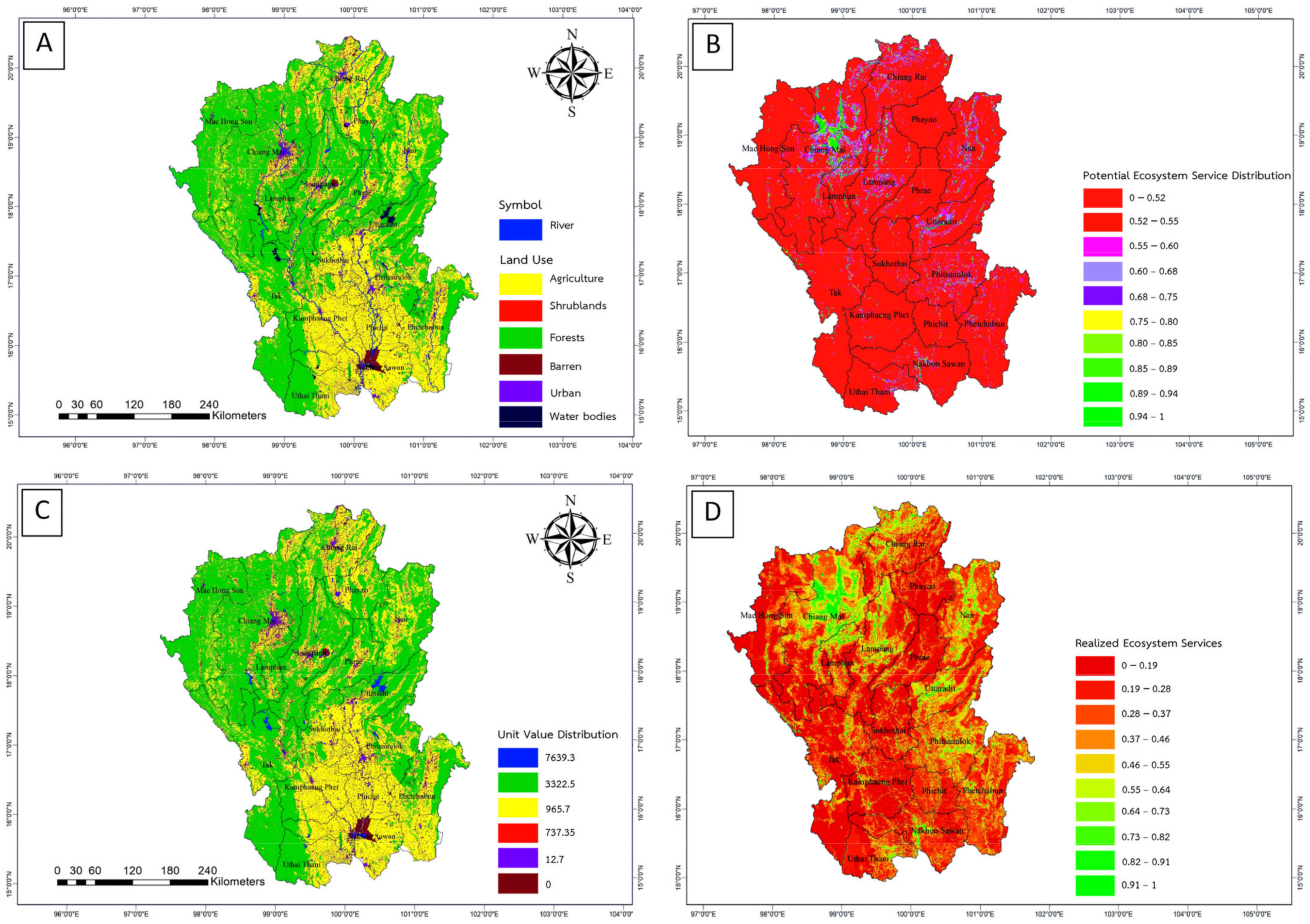
Evaluating potential (PES) and realized (RES) ecosystem services can significantly improve the clarity and understanding of sustainable natural resource management practices. This study determined spatial distribution indices and assessed the economic value of both PES and RES in Northern Thailand. The geographic distribution and intensity of 17 ecological services of six land use categories (i.e., forests, agriculture, shrubland, urban land, water bodies, and barren land) were estimated for the distribution and unit values of PES and RES, by using the Co$ting Nature Model. Our results suggested that the PES and RES values were spatially consistent. The map showing the distribution of PES and RES values revealed high values in the cities of Chiang Mai, Chiang Rai, Lamphun, Lampang, Phitsanulok, and Nakhon Sawan. Nutrient cycling, soil formation, and water supply were identified as the top potential ecological services, while nutrient cycling, water supply, and soil formation were the most realized. The ecosystem service packages in Northern Thailand had a potential annual value of 36.31 billion USD per year. However, after adjusting for relative indices, the realized ecosystem services were valued at 13.44 billion USD per year, representing only one-third of the potential value. To manage resources effectively and make informed decisions, it is essential to comprehend the gap between possible and actual ecosystem services. This research underscores the financial worth of ecosystem services and emphasizes the significance of using them sustainably to enhance human well-being and conserve the environment in Northern Thailand.
Keywords: ecosystem service; economic valuation; Co$ting Nature Modeling; sustainable development; tropical region ecosystem service; economic valuation; Co$ting Nature Modeling; sustainable development; tropical region