
The Core–Periphery Patterns in Land-Use Benefits: Spatiotemporal Patterns and Driving Mechanisms in the Chengdu–Chongqing Urban Agglomeration


Abstract
1. Introduction
2. Study Area and Methodology
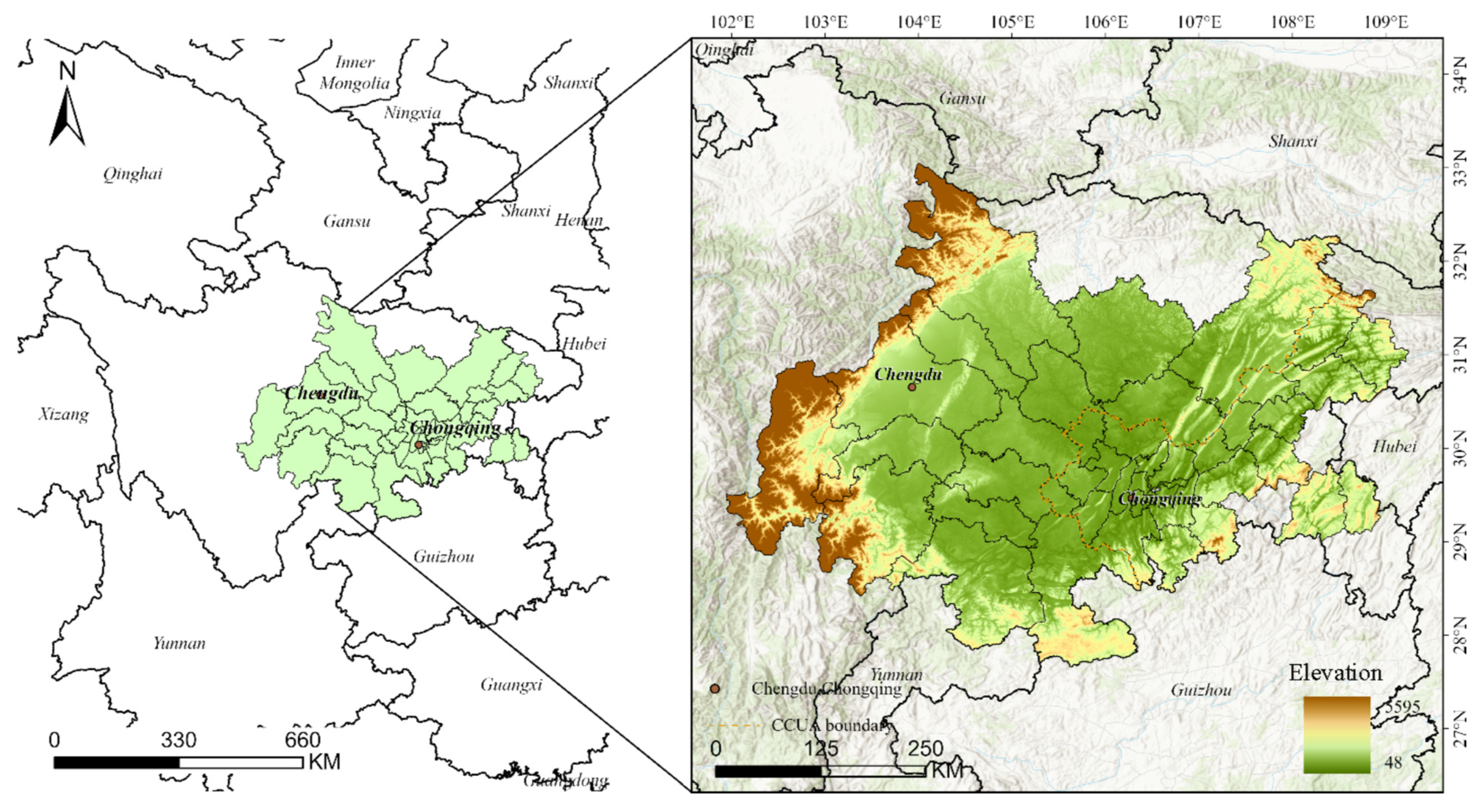
2.1. Study Area and Data Sources
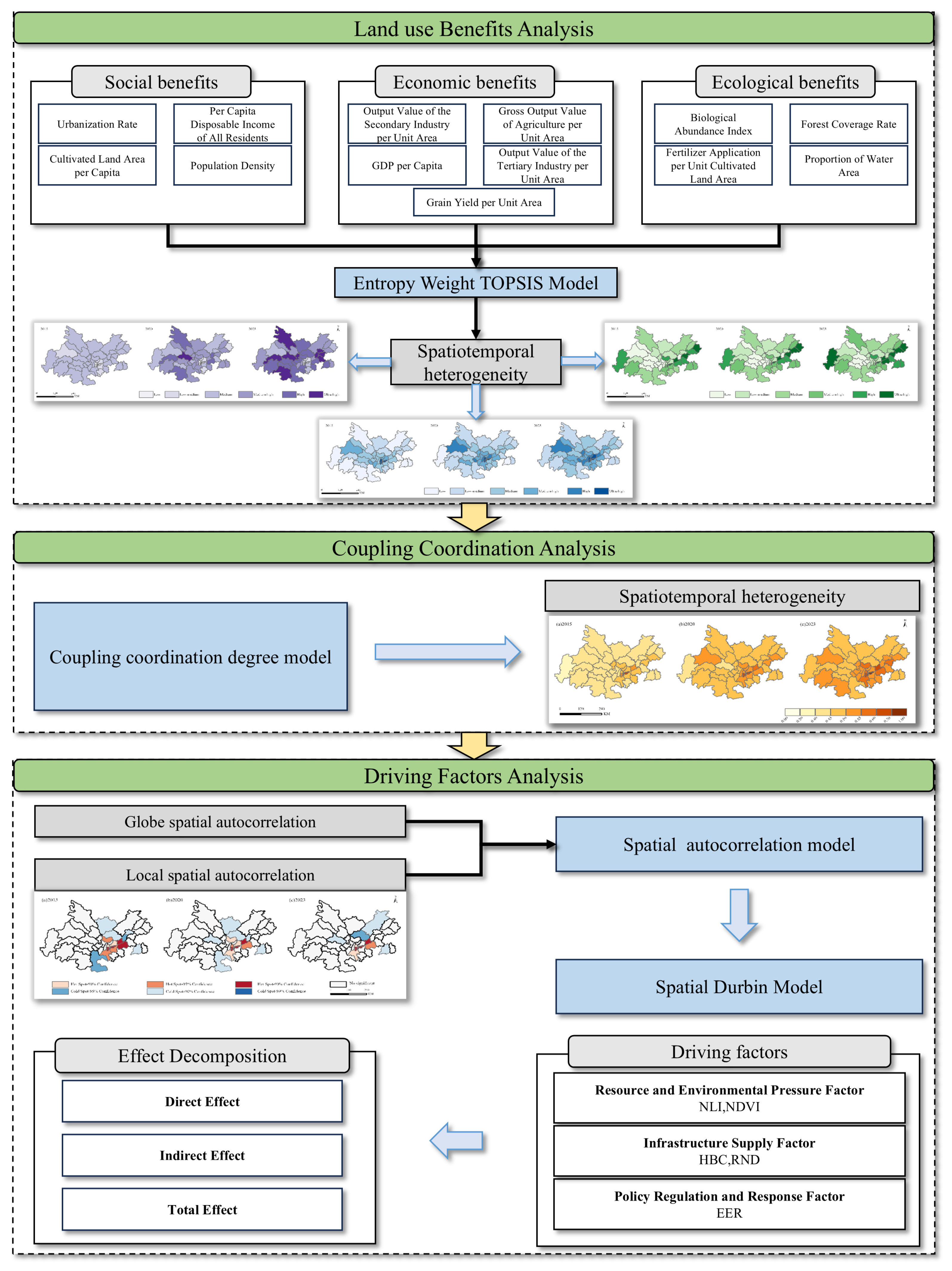
2.2. Methodology
2.2.1. Construction of the Indicator System
2.2.2. Entropy TOPSIS Method
2.2.3. Degree of Coupling Coordination
2.2.4. Spatial Autocorrelation
2.2.5. Spatial Measurement Models
- (1)
- Construction of Driver Indicator System
- (2)
- Model Construction and Specification
3. Results
3.1. Temporal and Spatial Patterns of Economic, Social, and Ecological Benefits from Land Use
- (1)
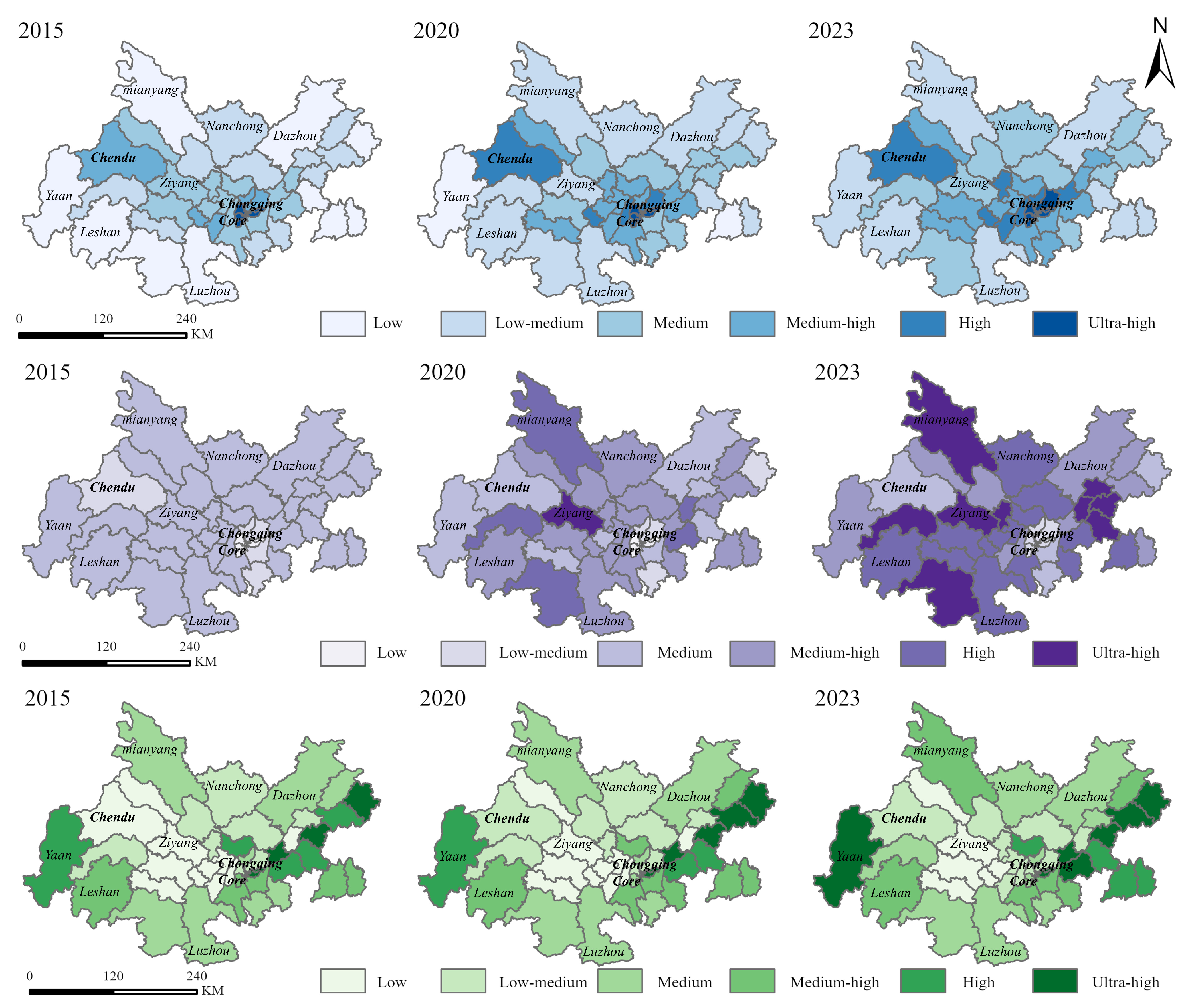
- Economic Benefits: Uneven Growth and North–South Spatial Polarization
- (2)
- Social Benefits: Multi-Center Synergy and Gradient Evolution
- (3)
- Ecological benefits: gradient differentiation and restoration effects
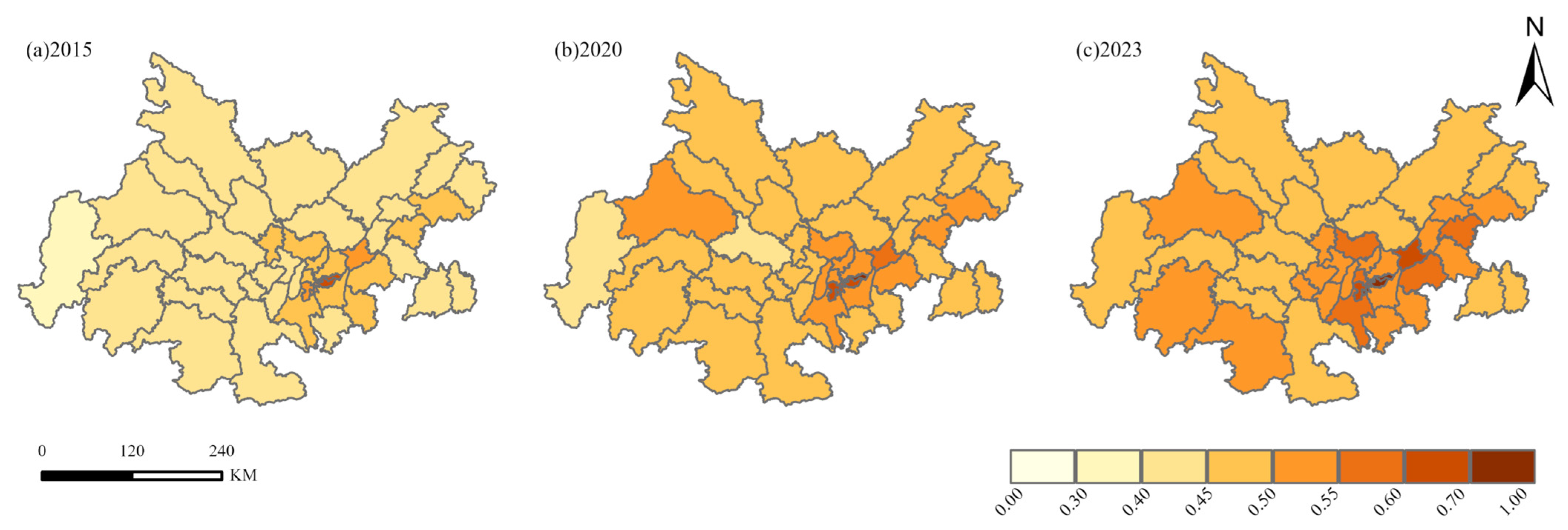
3.2. Spatial and Temporal Distribution Pattern of the Coupled Coordination Degree of the Three Benefits of Land Use
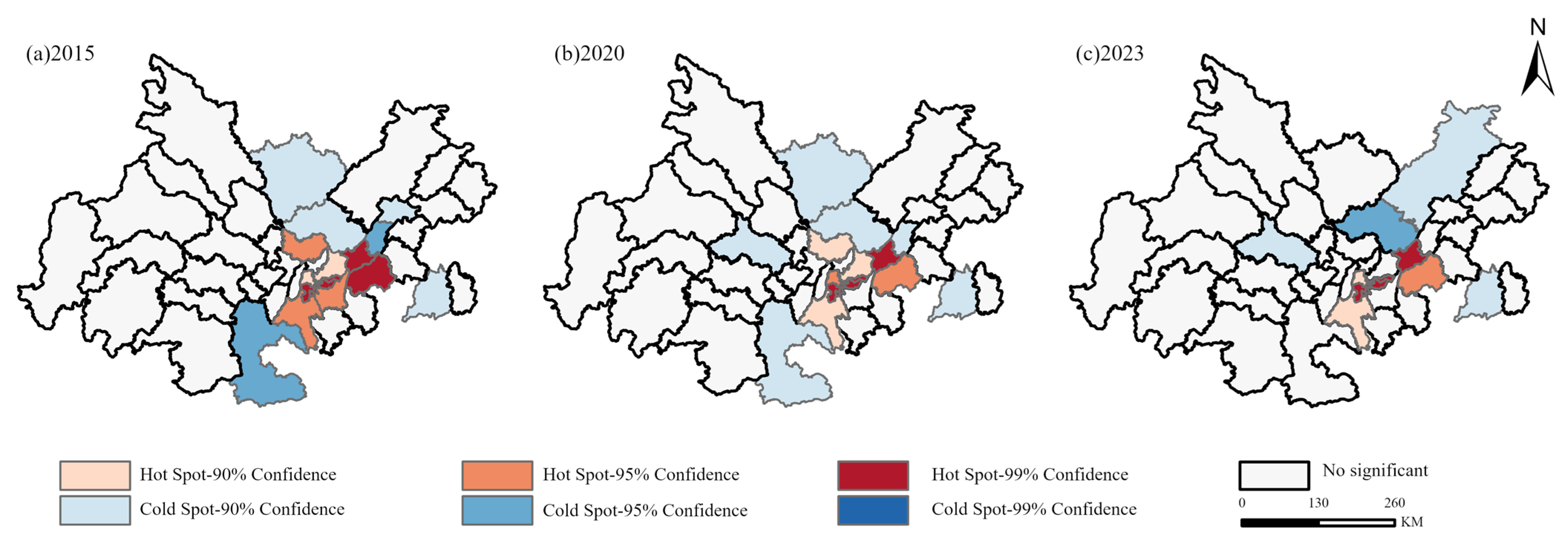
3.3. Spatial Autocorrelation Analysis
3.4. Land Use Three-Benefit Coupling Harmonization Degree Correlation Analysis with Drivers
4. Discussion
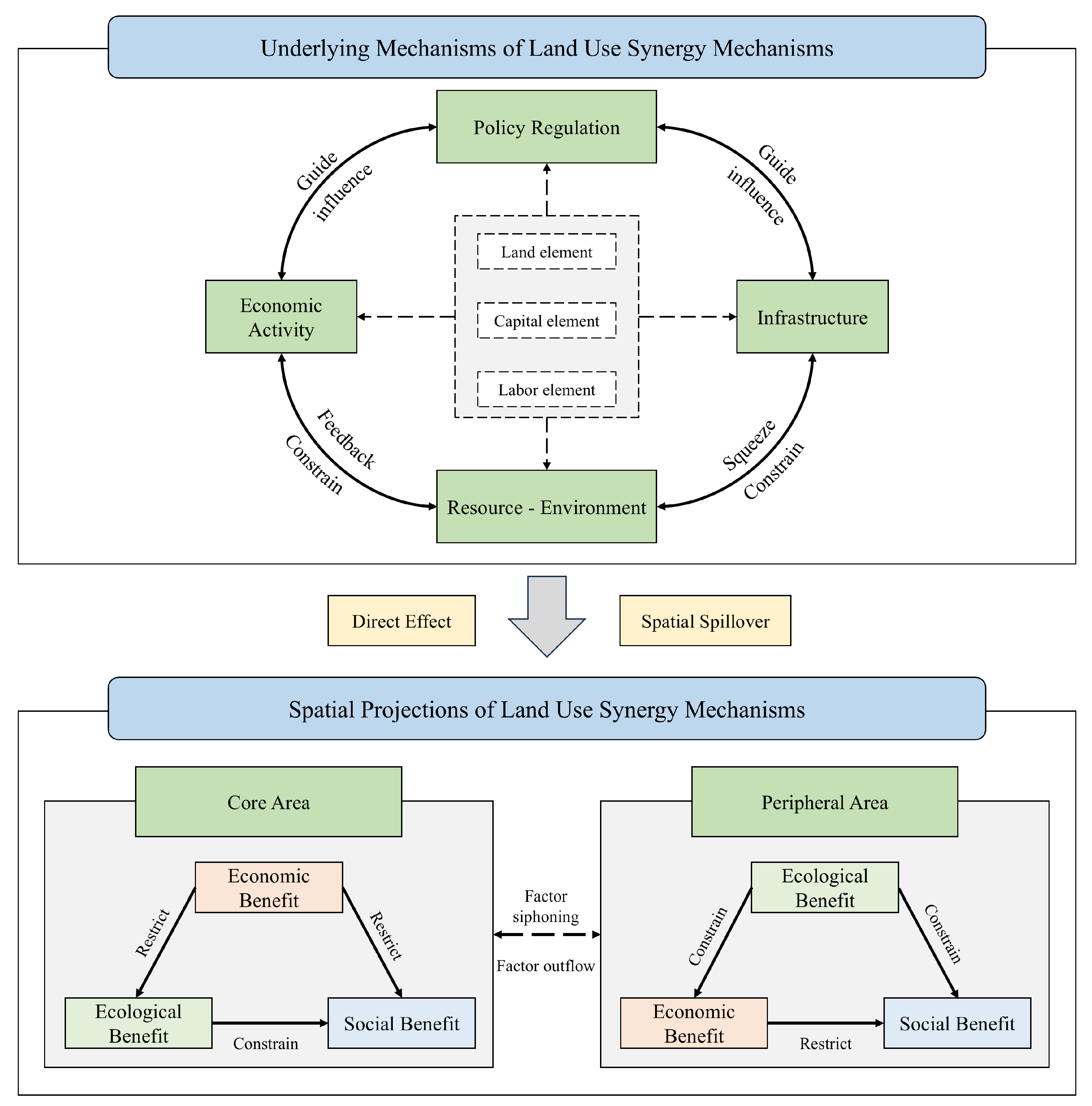
4.1. Synergistic Mechanism of Spatio-Temporal Differentiation and Coupled Coordination Degree of Land Use Ecological–Economic–Social Benefits
4.2. Influence Mechanism of Multidimensional Driving Factors on the Degree of Coordination of Coupled Ecological–Economic–Social Benefits of Land Use
4.3. Institutional Innovation as a Prerequisite for Synergy
4.4. Research Limitations and Prospects
5. Conclusions
Author Contributions
Funding
Data Availability Statement
Conflicts of Interest
References
- Liang, H.M.; Liu, W.D.; Liu, H.P.; Ling, Y.; Liu, Y. Coupling Relationship between Socio-economy Benefits and Eco-environment Benefits of Land Use in Shenzhen City. Sci. Geogr. Sin. 2008, 28, 636–641. [Google Scholar]
- Wang, S.; Ma, H.; Zhao, Y. Exploring the relationship between urbanization and the eco-environment-A case study of Beijing-Tianjin-Hebei region. Ecol. Indic. 2014, 45, 171–183. [Google Scholar] [CrossRef]
- Tang, F.; Wang, L.; Guo, Y.; Fu, M.; Huang, N.; Duan, W.; Luo, M.; Zhang, J.; Li, W.; Song, W. Spatio-temporal variation and coupling coordination relationship between urbanization and habitat quality in the Grand Canal, China. Land Use Policy 2022, 117, 106119. [Google Scholar] [CrossRef]
- Liao, S.; Wu, Y.; Wong, S.W.; Shen, L. Provincial perspective analysis on the coordination between urbanization growth and resource environment carrying capacity (RECC) in China. Sci. Total Environ. 2020, 730, 138964. [Google Scholar] [CrossRef]
- Lei, K.; Zhang, H.; Qiu, H.; Liu, Y.; Wang, J.; Hu, X.; Cui, Z.; Zheng, D. A two-dimensional four-quadrant assessment method to explore the spatiotemporal coupling and coordination relationship of human activities and ecological environment. J. Environ. Manag. 2024, 370, 122362. [Google Scholar] [CrossRef] [PubMed]
- Zhang, X.; Jie, X.; Ning, S.; Wang, K.; Li, X. Coupling and coordinated development of urban land use economic efficiency and green manufacturing systems in the Chengdu–Chongqing urban agglomeration. Sustain. Cities Soc. 2022, 85, 104012. [Google Scholar] [CrossRef]
- Lei, X.; Liu, H.; Li, S.; Luo, Q.; Cheng, S.; Hu, G.; Wang, X.; Bai, W. Coupling coordination analysis of urbanization and ecological environment in Chengdu-Chongqing urban agglomeration. Ecol. Indic. 2024, 161, 111969. [Google Scholar] [CrossRef]
- Lei, Y.; Xiao, Y.; Wang, F.; Wang, R.; Huang, H. Investigation on the complex relationship between urbanization and eco-efficiency in urban agglomeration of China: The case study of Chengdu- Chongqing urban agglomeration. Ecol. Indic. 2024, 159, 111704. [Google Scholar] [CrossRef]
- Li, W.; Kang, J.; Wang, Y. Spatiotemporal changes and driving forces of ecological security in the Chengdu–Chongqing urban agglomeration, China: Quantification using health- services-risk framework. J. Clean. Prod. 2023, 389, 136135. [Google Scholar] [CrossRef]
- Xu, W.; Jin, J.; Zhang, J.; Yuan, S.; Liu, Y.; Guan, T.; He, R.; Zhu, L. Coupling coordination degree, interaction relationship and driving mechanism of water resources carrying capacity of Beijing-Tianjin-Hebei urban agglomeration in China. J. Clean. Prod. 2025, 504, 145433. [Google Scholar] [CrossRef]
- Zhao, J.; Zhao, Y. Synergy/trade-offs and differential optimization of production, living, and ecological functions in the Yangtze River economic Belt, China. Ecol. Indic. 2023, 147, 109925. [Google Scholar] [CrossRef]
- Yin, Z.; Liu, Y.; Tang, L.; Zhou, W.; Pan, Y. Spatial-temporal evolution of agricultural land utilization benefits and tradeoffs/synergies in the Beijing-Tianjin-Hebei region. Ecol. Indic. 2023, 156, 111110. [Google Scholar] [CrossRef]
- Wang, Z.; Hasi, E. Research on the development of deserticulture and desertification land use benefits evaluation in ordos city. Land 2023, 12, 1254. [Google Scholar] [CrossRef]
- Zhang, W.; Shi, P.; Tong, H. Research on construction land use benefit and the coupling coordination relationship based on a three-dimensional frame model-A case study in the Lanzhou-Xining urban agglomeration. Land 2022, 11, 460. [Google Scholar] [CrossRef]
- Ji, X.; Wang, K.; Ji, T.; Zhang, Y.; Wang, K. Coupling analysis of urban land use benefits: A case study of Xiamen city. Land 2020, 9, 155. [Google Scholar] [CrossRef]
- Li, D.; Fan, K.; Lu, J.; Wu, S.; Xie, X. Research on spatio-temporal pattern evolution and the coupling coordination relationship of land-use benefit from a low-carbon perspective: A case study of Fujian province. Land 2022, 11, 1498. [Google Scholar] [CrossRef]
- Wu, Q.; Cao, Y.; Fang, X.; Wang, J.; Li, G. A systematic coupling analysis framework and multi-stage interaction mechanism between urban land use efficiency and ecological carrying capacity. Sci. Total Environ. 2022, 853, 158444. [Google Scholar] [CrossRef]
- Su, X.; Fan, Y.; Wen, C. Systematic coupling and multistage interactive response of the urban land use efficiency and ecological environment quality. Environ. Manag. 2024, 365, 121584. [Google Scholar] [CrossRef] [PubMed]
- Zhang, K.; Jin, Y.; Li, D.; Wang, S.; Liu, W. Spatiotemporal variation and evolutionary analysis of the coupling coordination between urban social-economic development and ecological environments in the Yangtze River Delta cities. Sustain. Cities Soc. 2024, 111, 105561. [Google Scholar] [CrossRef]
- Liu, J.; Tian, Y.; Huang, K.; Yi, T. Spatial-temporal differentiation of the coupling coordinated development of regional energy-economy-ecology system: A case study of the Yangtze River Economic Belt. Ecol. Indic. 2021, 124, 107394. [Google Scholar] [CrossRef]
- Luo, L.; Wang, Y.; Liu, Y.; Zhang, X.; Fang, X. Where is the pathway to sustainable urban development? Coupling coordination evaluation and configuration analysis between low-carbon development and eco-environment: A case study of the Yellow River Basin, China. Ecol. Indic. 2022, 144, 109473. [Google Scholar] [CrossRef]
- Yao, Z.; Tu, J.; Niu, H.; Ha, L.; Li, J. The research on urban agglomeration spatial structure of Cheng-Yu economic zone. Econ. Geogr. 2017, 37, 82–89. [Google Scholar] [CrossRef]
- He, L.; Du, X.; Zhao, J.; Chen, H. Exploring the coupling coordination relationship of water resources, socio-economy and eco-environment in China. Sci. Total Environ. 2024, 918, 170705. [Google Scholar] [CrossRef] [PubMed]
- Cheng, G.; Li, G.; Pu, X.; Chen, C.; He, Y. Advancing coupling coordination simulation in the social-human-ecological system of the Three Gorges Reservoir Area: A multi-scenario system dynamics approach. Ecol. Indic. 2024, 158, 111504. [Google Scholar] [CrossRef]
- Brundtland, G.H. Our Common Future World Commission on Environment and Development; Harambee University: Adama, Ethiopia, 1987. [Google Scholar]
- Xie, X.J. Coupling coordination relationship and spatio-temporal evolution characteristics of land use benefits in Sichuan Province based on entropy weight TOPSIS and coupling coordination model. J. Soil Water Conserv. 2023, 38, 267–277. [Google Scholar] [CrossRef]
- Berkes, F.; Kislalioglu, M.; Folke, C.; Gadgil, M. Minireviews: Exploring the basic ecological unit: Ecosystem-like concepts in traditional societies. Ecosystems 1998, 1, 409–415. [Google Scholar] [CrossRef]
- Liao, Z.B. Quantitative evaluation and classification system for the coordinated development of environment and economy: A case study of the urban agglomeration in the Pearl River Delta. Trop. Geogr. 1999, 19, 171–177. [Google Scholar]
- Liu, N.; Liu, C.; Xia, Y.; Da, B. Examining the coordination between urbanization and eco-environment using coupling and spatial analyses: A case study in China. Ecol. Indic. 2018, 93, 1163–1175. [Google Scholar] [CrossRef]
- Zhang, Q.; Ye, B.; Shen, X.; Zhu, Y.; Su, B.; Yin, Q.; Zhou, S. Coupling coordination evaluation of ecology and economy and development optimization at town-scale. J. Clean. Prod. 2024, 447, 141581. [Google Scholar] [CrossRef]
- Pan, H.; Du, Z.; Wu, Z.; Zhang, H.; Ma, K. Assessing the coupling coordination dynamics between land use intensity and ecosystem services in Shanxi’s coalfields, China. Ecol. Indic. 2024, 158, 111321. [Google Scholar] [CrossRef]
- Wu, T.; Qiao, Z. Synergistic governance of urban heat islands, energy consumption, carbon emissions, and air pollution in China: Evidence from a Spatial Durbin Model. Environ. Pollut. 2025, 372, 126025. [Google Scholar] [CrossRef]
- Wu, R.; Liu, Q.; Wang, H. Spatial spillover effects of ecosystem service values in northeast China tiger and leopard national park based on spatial Durbin model. Ecol. Indic. 2024, 166, 112509. [Google Scholar] [CrossRef]
- Anselin, L. Spatial Econometrics: Methods and Models; Springer Science & Business Media: Berlin/Heidelberg, Germany, 1988; Volume 4. [Google Scholar]
- Luge, W.; Tianjiao, Z.; Tiyan, S. Spatial-temporal evolution and influencing factors of urban land use structure efficiency: Evidence from 282 cities in China. J. Clean. Prod. 2025, 500, 145275. [Google Scholar] [CrossRef]
- Friedmann, J. Regional Development Policy: A Case Study of Venezuela; MIT Press: Cambridge, MA, USA, 1966. [Google Scholar]
- Ding, T.; Chen, J.; Fang, Z.; Chen, J. Assessment of coordinative relationship between comprehensive ecosystem service and urbanization: A case study of Yangtze River Delta urban Agglomerations, China. Ecol. Indic. 2021, 133, 108454. [Google Scholar] [CrossRef]
- Dong, L.; Liang, L.; Wang, Z.; Chen, L.; Zhang, F. Exploration of coupling effects in the Economy-Society-Environment system in urban areas: Case study of the Yangtze River Delta Urban Agglomeration. Ecol. Indic. 2021, 128, 107858. [Google Scholar] [CrossRef]
- Chen, H.; Liu, L.; Wang, L.; Zhang, X.; Du, Y.; Liu, J. Key indicators of high-quality urbanization affecting eco-environmental quality in emerging urban agglomerations: Accounting for the importance of variation and spatiotemporal heterogeneity. J. Clean. Prod. 2022, 376, 134087. [Google Scholar] [CrossRef]
- Yin, H.; Xiao, R.; Fei, X.; Zhang, Z.; Gao, Z.; Wan, Y.; Tan, W.; Jiang, X.; Cao, W.; Guo, Y. Analyzing “economy-society-environment” sustainability from the perspective of urban spatial structure: A case study of the Yangtze River delta urban agglomeration. Sustain. Cities Soc. 2023, 96, 104691. [Google Scholar] [CrossRef]
- Krugman, P. Increasing returns and economic geography. J. Political Econ. 1991, 99, 483–499. [Google Scholar] [CrossRef]
- Liu, Y.; Yang, R.; Sun, M.; Zhang, L.; Li, X.; Meng, L.; Wang, Y.; Liu, Q. Regional sustainable development strategy based on the coordination between ecology and economy: A case study of Sichuan Province, China. Ecol. Indic. 2022, 134, 108445. [Google Scholar] [CrossRef]
- Li, X.; Lu, Z.; Hou, Y.; Zhao, G.; Zhang, L. The coupling coordination degree between urbanization and air environment in the Beijing (Jing)-Tianjin (Jin)-Hebei (Ji) urban agglomeration. Ecol. Indic. 2022, 137, 108787. [Google Scholar] [CrossRef]
- Cao, H.; Li, M.; Qin, F.; Xu, Y.; Zhang, L.; Zhang, Z. Economic development, fiscal ecological compensation, and ecological environment quality. Int. J. Environ. Res. Public Health 2022, 19, 4725. [Google Scholar] [CrossRef] [PubMed]
- Tu, D.; Cai, Y.; Liu, M. Coupling coordination analysis and spatiotemporal heterogeneity between ecosystem services and new-type urbanization: A case study of the Yangtze River Economic Belt in China. Ecol. Indic. 2023, 154, 110535. [Google Scholar] [CrossRef]




| Data Name | Data Sources | Year | Resolution |
|---|---|---|---|
| GDP per capita, Output Value of the Secondary Industry, Total Agricultural Output Value, Output Value of the Tertiary Industry, Total Food Production, Urbanization Rate, Disposable Income per Capita of All Residents, Fertilizer Consumption, Expenditure on Energy Conservation and Environmental Protection as a Proportion of General Public Budget Expenditure | Statistical Yearbooks for Chongqing Municipality and Sichuan Province for 2016, 2021, and 2024, as well as statistical yearbooks for Chongqing districts and counties and statistical bulletins, and budget reports at the district and county levels of Chongqing Municipality | 2015, 2020, 2023 | / |
| Water Area, Cropland Area, Woodland Area, Grassland Area | China Land Cover Dataset (CLCD) | 2015, 2020, 2023 | 30 m |
| Road Density | OpenStreetMap (OSM) official website (http://www.openstreetmap.org) | 2015, 2020, 2023 | / |
| NDVI | NASA (https://search.earthdata.nasa.gov/) | 2015, 2020, 2023 | 1 km |
| Average Nighttime Light Intensity | Resources and Environmental Science Data Platform (https://geodata.nnu.edu.cn/) | 2015, 2020, 2023 | 500 m |
| DEM data | Geoscience data cloud (https://www.gscloud.cn/) | 2023 | 30 m |
| Administrative Division Data | Center for Resource and Environmental Sciences and Data, Chinese Academy of Sciences (https://www.resdc.cn/) | 2023 | / |
| Objective Level | System Level | Indicator Layer | Meaning of the Indicator | Combined Weights | Characteristic |
|---|---|---|---|---|---|
| Land-Use Benefits | Economic Benefit | Land value of secondary industry per capita (million CNY/hm2) | Secondary GDP/land area | 0.1879 | + |
| Gross land value of agricultural production (10,000 CNY/hm2) | Gross agricultural product/land area | 0.0525 | + | ||
| GDP per capita (CNY/person) | GDP/Total population | 0.0578 | + | ||
| Tertiary sector output per capita (million CNY/hm2) | Total tertiary sector/land area | 0.2982 | + | ||
| Grain yield (t/hm2) | Total grain production/area sown to grain | 0.0336 | + | ||
| Social Benefit | Urbanization rate (%) | Non-farm population/total population | 0.0383 | − | |
| Disposable income per capita of all residents (CNY per person) | Disposable income of the entire population/number of permanent residents | 0.0501 | + | ||
| Cultivated land area per capita (hm2/person) | Cultivated land area/total population | 0.0428 | + | ||
| Population density (persons/hm2) | Total population/total land area | 0.0156 | − | ||
| Ecological Benefit | Biological abundance index | Abio × (0.5 × forest area + 0.3 × water area + 0.15 × grass area + 0.05 × other area)/land area | 0.0646 | + | |
| Forest cover (%) | Forest area/land area | 0.0241 | + | ||
| Fertilizer use per unit of cultivated area (t/hm2) | Total fertilizer use/cropland area | 0.0167 | − | ||
| Proportion of water area (%) | Water area/land area | 0.1178 | + |
| Degree of Coupling Coordination | Type of Coupled Coordination | Degree of Coupling Coordination | Type of Coupled Coordination |
|---|---|---|---|
| (0.00, 0.30] | Severe disorder | (0.50, 0.55] | Primary coordination |
| (0.30, 0.40] | Moderate disorder | (0.55, 0.60] | Intermediate coordination |
| (0.40, 0.45] | Mild disorder | (0.60, 0.70] | Good coordination |
| (0.45, 0.50] | On the verge of dysfunctional | (0.70, 1.00] | Quality coordination |
| Type | Driving Factors | Code | Meaning of the Indicator |
|---|---|---|---|
| Resource and Environment | Normalized difference vegetation index | NDVI | Arithmetic mean of the extent of vegetation cover in the region |
| Economic activity | Nighttime light intensity | NLI | Average nighttime light intensity |
| Policy Regulation | Fiscal intensity of environmental protection | FEPR | Intensity of fiscal investment in environmental protection/general public budget expenditure × 100% |
| Infrastructure | Hospital bed count | HBC | Total number of beds in medical institutions in the region |
| Road network density | RND | Total road length (km)/land area (km2) |
| Year | Moran I’s Index | Z Value |
|---|---|---|
| 2015 | 0.475 *** | 14.83 |
| 2020 | 0.471 *** | 14.88 |
| 2023 | 0.459 *** | 14.55 |
| Test | Statistic | df | p-Value |
|---|---|---|---|
| Spatial error | |||
| Moran’s I | 8.409 *** | 1 | 0.000 |
| Lagrange multiplier | 29.246 *** | 1 | 0.000 |
| Robust Lagrange | 5.214 ** | 1 | 0.022 |
| Spatial lag | |||
| Lagrange multiplier | 40.689 *** | 1 | 0.000 |
| Robust Lagrange | 16.657 *** | 1 | 0.000 |
| Test Methods | Statistical Value | p-Value |
|---|---|---|
| LR Lag | 21.34 *** | 0.000 |
| LR Err | 16.57 *** | 0.005 |
| Wald Lag | 16.43 *** | 0.006 |
| Wald Err | 14.02 ** | 0.016 |
| Hausman | 33.67 *** | 0.000 |
| Variant | SLM | SEM | SDM |
|---|---|---|---|
| lnNDVI | −0.042 | 0.051 | 0.219 |
| (0.125) | (0.133) | (0.138) | |
| lnNLI | 0.009 | 0.014 | −0.016 |
| (0.012) | (0.012) | (0.0125) | |
| lnHBC | 0.031 ** | 0.026 | 0.029 * |
| (0.015) | (0.016) | (0.016) | |
| lnFEPR | 0.012 ** | 0.007 | 0.009 |
| (7.48) | (0.006) | (0.006) | |
| lnRND | 0.013 * | −0.044 *** | −0.047 *** |
| (0.008) | (0.011) | (0.010) | |
| Number of Observations | 132 | 132 | 132 |
| R2 | 0.247 | 0.755 | 0.939 |
| ρ | 0.918 *** | 0.956 *** | 0.547 *** |
| (0.043) | (0.015) | (0.207) | |
| σ2 | 0.000 *** | 0.000 *** | 0.000 *** |
| (0.000) | (0.000) | (0.000) |
| Variant | Main | Wx | Direct Effect | Indirect Effect | Aggregate Effect |
|---|---|---|---|---|---|
| lnNDVI | 0.219 | −2.369 *** | 0.113 | −6.176 | −6.063 |
| (0.138) | (0.723) | (0.156) | (4.624) | (4.698) | |
| lnNLI | −0.016 | −0.043 | −0.021 | −0.225 | −0.246 |
| (0.0125) | (0.120) | (0.015) | (0.508) | (0.519) | |
| lnHBC | 0.029 * | 0.025 | 0.031 * | 0.090 | 0.122 |
| (0.016) | (0.089) | (0.019) | (0.274) | (0.282) | |
| lnFEPR | 0.009 | 0.054 | 0.011 * | 0.115 | 0.126 |
| (0.006) | (0.044) | (0.007) | (0.139) | (0.142) | |
| lnRND | −0.047 *** | −0.103 * | −0.045 *** | 0.236 | 0.191 |
| (0.010) | (0.060) | (0.013) | (0.270) | (0.275) |
Disclaimer/Publisher’s Note: The statements, opinions and data contained in all publications are solely those of the individual author(s) and contributor(s) and not of MDPI and/or the editor(s). MDPI and/or the editor(s) disclaim responsibility for any injury to people or property resulting from any ideas, methods, instructions or products referred to in the content. |
© 2025 by the authors. Licensee MDPI, Basel, Switzerland. This article is an open access article distributed under the terms and conditions of the Creative Commons Attribution (CC BY) license (https://creativecommons.org/licenses/by/4.0/).
Share and Cite
Chen, S.; Zeng, Y. The Core–Periphery Patterns in Land-Use Benefits: Spatiotemporal Patterns and Driving Mechanisms in the Chengdu–Chongqing Urban Agglomeration. Land 2025, 14, 2417. https://doi.org/10.3390/land14122417
Chen S, Zeng Y. The Core–Periphery Patterns in Land-Use Benefits: Spatiotemporal Patterns and Driving Mechanisms in the Chengdu–Chongqing Urban Agglomeration. Land. 2025; 14(12):2417. https://doi.org/10.3390/land14122417
Chicago/Turabian StyleChen, Shaojun, and Yi Zeng. 2025. "The Core–Periphery Patterns in Land-Use Benefits: Spatiotemporal Patterns and Driving Mechanisms in the Chengdu–Chongqing Urban Agglomeration" Land 14, no. 12: 2417. https://doi.org/10.3390/land14122417
APA StyleChen, S., & Zeng, Y. (2025). The Core–Periphery Patterns in Land-Use Benefits: Spatiotemporal Patterns and Driving Mechanisms in the Chengdu–Chongqing Urban Agglomeration. Land, 14(12), 2417. https://doi.org/10.3390/land14122417