1. Introduction
As urban development in China transitions from rapid expansion to a paradigm of intensive, quality-oriented growth, the creation of high-quality public spaces that meet the genuine needs of citizens has become a paramount objective. This aligns with the new era’s guiding philosophy of a “People’s City for the People.” National bodies, including the Ministry of Natural Resources and the Ministry of Housing and Urban–Rural Development, now mandate the use of “urban health check assessments” as a critical tool for evaluating planning implementation and guiding urban renewal. The goal is to precisely identify developmental challenges and shortcomings, formulate targeted countermeasures, and establish a dynamic feedback loop for monitoring and implementation, thereby effectively responding to the populace’s demand for a better quality of life [
1].
However, a significant methodological gap persists in local practice. Policy documents have not specified a clear mechanism for integrating public satisfaction surveys into these assessments. Consequently, planning evaluations rely predominantly on official statistical data from government departments. While such objective data can assess the scale and coverage of public service facilities, they fail to capture the subjective perceptions and experiences of residents—the primary users. This limitation prevents the evaluation from moving beyond a mere inventory of facilities (i.e., whether they exist) to a qualitative assessment of their performance (i.e., whether they are good). As a result, planning decisions, especially in the context of urban regeneration, lack the demand-side insights required for precise and effective resource allocation.
This paper addresses this critical disconnect between objective metrics and subjective realities. Grounded in Expectancy Theory, we investigate the disparities between objective provisions and subjective satisfaction with public service facilities in the East Lake High-tech Development Zone of Wuhan. Through a scientifically designed sampling strategy, this study analyzes the heterogeneous characteristics of subjective–objective perception gaps and identifies their key influencing factors. Our objective is to provide a robust analytical framework that enhances the role of demand-side feedback in urban governance. By doing so, we aim to support the establishment of a demand-responsive planning mechanism, facilitating a crucial paradigm shift from supply-driven to demand-oriented urban management.
2. Literature Review
Public satisfaction, a concept originating from customer satisfaction in marketing, is rooted in Expectancy Theory [
2], Expectancy Theory, proposed by American Psychologist Victor H. Vroom in 1964, is a motivational theory that views satisfaction as the gap between consumer expectations and reality [
3]. According to this theory, an excessive gap between expectations and reality can lead to dissatisfaction, and expectations may have an even greater impact on satisfaction than the actual situation. Both expectations and actual conditions are related to the socioeconomic attributes of individuals and households, such as income, education level, age, gender, etc. [
4].
Therefore, public satisfaction is not determined solely by the objective performance of public service facilities (such as coverage levels), but rather stems from the gap between their “perceived performance” and prior “expectations”. In this study, the “objective coverage rate” can be approximated as the objective performance of the facilities, while “subjective satisfaction” directly reflects residents’ overall “perceived performance.” Thus, the difference between objective and subjective data is theoretically moderated and explained by the key psychological variable of residents’ “expectations”. For example, in areas with “high objective coverage but low subjective satisfaction,” the cause may not be the absence of facilities but rather that residents’ actual experiences (perceived performance) fall far short of their high expectations. Conversely, “low coverage but high satisfaction” may reflect lower expectations among residents in that area, making them more easily satisfied. In short, public satisfaction is a psychological experience based on people’s perception of the degree to which society meets their needs. “Personal needs,” “environmental needs,” and “expected levels” are all key factors influencing public satisfaction [
5].
In the public sphere, satisfaction is a psychological experience derived from the perceived degree to which society meets an individual’s needs [
6], critically influenced by “personal needs,” “environmental conditions,” and “prior expectations” [
7]. The application of public satisfaction surveys in spatial planning to capture subjective resident perceptions dates back to the 1960s. Kevin Lynch’s seminal work in evaluating Boston’s public spaces pioneered this approach, providing a foundational basis for improving the legibility of urban form [
8]. As research evolved, the community and housing sectors became primary domains for such studies. For instance, Parkes et al., using UK housing survey data, developed a systematic methodology for measuring residents’ cognition and evaluation of community characteristics—including facility accessibility, safety, and neighborhood environment—to explore the key determinants of satisfaction with the physical environment [
9].
In China, guided by the “People’s City” philosophy, the scope of public satisfaction research has expanded to assess the quality of the living environment and the outcomes of planning projects, with a focus on public facilities like municipal infrastructure and green spaces [
10]. These studies are often conducted at the community scale, analyzing the relationship between living conditions and residential attachment, using satisfaction surveys to identify service gaps [
11] and measure residents’ sense of gain [
12], thereby informing the allocation of public resources.
Oliver fist constructed a satisfaction decision cognitive model [
13,
14], and then empirical research on the discrepancy between subjective perception and objective reality has further deepened theoretical understanding [
15,
16,
17,
18,
19,
20,
21,
22,
23,
24]. Galster demonstrated that the “expectancy-reality gap” is a decisive factor in determining satisfaction, at times exerting a stronger influence than objective conditions themselves [
25]. Building on this, scholars in China have explored the factors influencing public satisfaction. Using methods such as correlation analysis and comparative case studies, they have confirmed that subjective elements like cognitive biases and community sentiment significantly mediate satisfaction with the objective environment.
Despite the widespread use of public satisfaction surveys, the existing literature has yet to establish a complete technical framework for integrating subjective and objective data. This shortcoming is particularly pronounced in the field of urban planning evaluation. Although scholars like Zhang Wenzhong et al. have advocated for resident-led evaluation systems incorporating comprehensive indicators of comfort, convenience, and safety [
25], current applications of public satisfaction surveys suffer from several critical limitations:
Prevailing practices often rely on simple random sampling, which fails to account for the spatial distribution and socioeconomic heterogeneity of the population. This oversight compromises the scientific validity and objectivity of the findings, preventing a comprehensive reflection of diverse community needs [
26,
27]. Subjective satisfaction studies and objective planning assessments are typically conducted independently, with their results presented in separate reports for different contexts. A mechanism for deep, integrated analysis is absent. Even innovative attempts, such as Gan Lin et al.’s social satisfaction in urban health examination in 2020 from Ministry of Housing and Urban–Rural Development [
12],face high-cost barriers and do not resolve the core issue of how to synthesize the findings for actionable insights. While studies have noted that survey results are heavily influenced by subjective factors and have proposed methods for analyzing imbalances [
12], they have not delved deeply into identifying the root causes of these influencing factors. Crucially, they have failed to propose a clear pathway for how an integrated subjective–objective analysis can optimize future planning decisions.
To address these deficiencies, this paper proposes an innovative analytical framework. First, we employ a multi-level stratified sampling methodology to ensure a representative and scientifically robust sample. Second, we develop a subjective–objective cross-analytical framework to systematically identify the key factors driving perception gaps among different demographic groups. Third, based on these findings, we establish a feedback mechanism for optimizing planning indicators. This integrated approach not only remedies the methodological shortcomings of current public satisfaction surveys but also provides a dynamic basis for shifting planning from a focus on “facility provision” to one of “demand responsiveness.” Ultimately, this research strengthens the role of public participation in urban governance, enabling the precise identification of “urban ills” that affect residents’ well-being and happiness, and paving the way for a higher-quality living environment.
3. Methodology
This study establishes a three-stage framework—Discrepancy Identification, Causal Attribution, and Decision Transformation—to forge a demand-responsive planning mechanism by systematically integrating subjective public data with objective performance indicators. Recognizing that socioeconomic attributes such as education level and age significantly influence individual expectations [
28], we have designed a multi-level, stratified, and categorized sampling methodology for the public satisfaction survey. This approach, combined with an analysis of subjective influencing factors, allows for the identification of differentiated demands across various population strata. It forms the methodological foundation for a feedback loop that couples subjective perceptions with objective data to inform planning decisions.
3.1. Data Sampling and Methodology Design
The provision and spatial configuration of public service facilities are intrinsically linked to the daily lives of residents and are therefore a primary focus of their needs and perceptions. In contrast to traditional top-down planning evaluations that rely on departmental statistics, this study’s data are sourced directly from resident surveys.
First, considering the factor of a large population size and ensuring statistical robustness, the minimum sample size was determined 1%, by referencing the Regulations on National Population Census promulgated by the State Council in 2010. Second, the sampling scope and hierarchy were refined to align with the research objectives. Considering residents are the most stable and primary users of public service facilities, and their perceptions and evaluations are of paramount importance in assessing the effectiveness of facility planning and implementation, so the survey is focused on resident population. In accordance with Expectancy Theory, the sampling structure for residents was carefully balanced across socioeconomic attributes, including age and education level. This stratified approach ensures that the satisfaction levels of diverse population segments are captured, providing a reliable foundation for subsequent analysis of the factors influencing subjective perceptions.
3.2. Analysis and Identification of Subjective–Objective Perception Discrepancies
(1) Quantitative Representation of Subjective and Objective Data
The objective supply of public service facilities is typically quantified using a coverage ratio. In this study, subjective perception is quantified based on responses to the public satisfaction survey, which categorizes resident sentiment for each facility as “Satisfied,” “Neutral,” “Dissatisfied,” “Unfamiliar,” or “Facility Not Available.” The quantitative measure is the proportion of respondents selecting each category relative to the total number of valid responses (excluding “Facility Not Available”). Four types of facilities were selected for analysis, including Health Services, Elderly Care Services, Food Markets & Retail, and cultural facilities, within a 15 min walking distance (approximately 800–1000 m) of each respondent’s residential street. Health Services contain Community-level health centers, pharmacies, and general hospitals. Elderly Care Facilities involve Nursing homes, community elderly service centers, day care centers, and senior care facilities. Food Markets & Retail consist of Fresh markets, fruit/vegetable stores, supermarkets, restaurants, barbershops, home services, laundries, and convenience stores. Cultural Service Facilities is composed by Cinemas, theaters, and cultural activity centers. This classification ensures clarity and precision in our analysis. Public Service Facility Survey Questionnaire is shown in
Table 1.
(2) Subjective–Objective Cross-Comparison and Discrepancy Quantification
To enable a direct comparison between subjective and objective metrics, we normalized both datasets to a uniform scale using Min-Max Normalization. This linear transformation method scales the original data to a range of [0, 1], where the minimum value is mapped to 0 and the maximum to 1. This technique is particularly suitable when the original data approximates a normal distribution. The formula is as follows:
Following normalization, both the objective supply coverage coefficient and the subjective satisfaction coefficient are represented as relative values within the [0, 1] interval. This allows for a direct calculation of the subjective–objective discrepancy. The resulting discrepancy value falls within a [−1, 1] interval. A positive value indicates a positive discrepancy (subjective satisfaction exceeds objective coverage), while a negative value signifies a negative discrepancy (subjective satisfaction is lower than objective coverage). The absolute value of this metric indicates the magnitude of the perception gap; values approaching zero suggest alignment, whereas values approaching −1 or 1 indicate a significant perceptual deviation. The calculation is as follows:
,
: Subjective satisfaction
: Objective coverage
3.3. Causal Attribution of Group Perception Differences
To identify the primary factors driving these perception gaps, we employed the Pearson Product-Moment Correlation Coefficient (PCC). This statistical method measures the linear correlation between two variables, making it ideal for determining the relationship between the socioeconomic composition of a spatial unit and its measured subjective–objective discrepancy. The PCC, denoted as
r, produces a value between −1 and 1. A positive value indicates a positive linear correlation, a negative value indicates a negative correlation, and the absolute value indicates the strength of the association. The formula is:
3.4. Optimization Pathway for Planning Decision Feedback
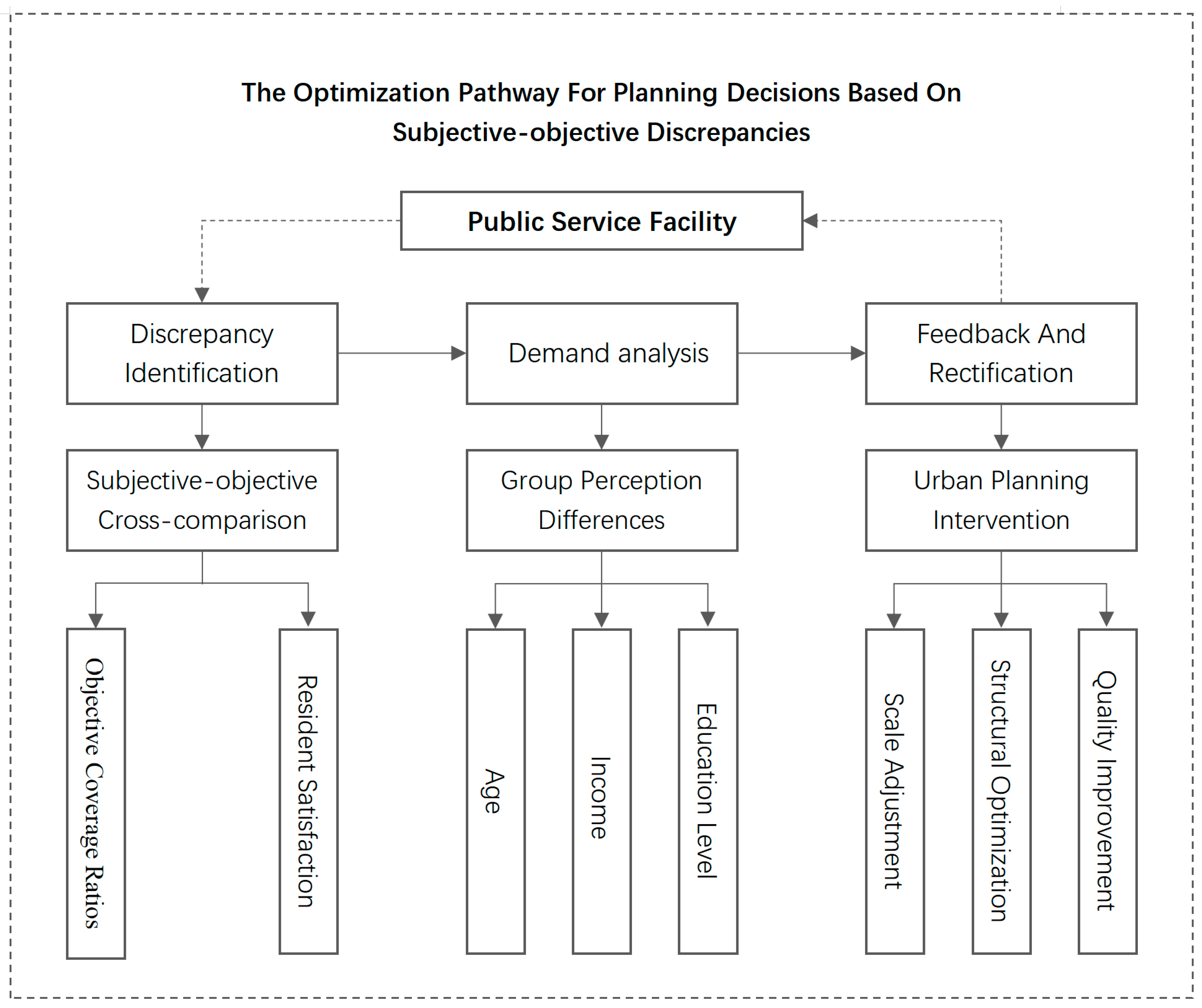
Finally, based on the analysis of perception discrepancies and their influencing factors, we establish a demand-responsive planning mechanism, as shown in
Figure 1. This mechanism follows a three-stage optimization pathway: “Discrepancy Identification → Demands Analysis → Feedback and Rectification.” By systematically fusing subjective data with objective indicators, this framework enables a significant leap in the precision of resource allocation. It achieves this by integrating decision-making logic and datasets, expanding the range of participating stakeholders, and enhancing the responsiveness of the planning process, thereby ensuring a more accurate alignment between the supply of public resources and the actual demands of the community, as shown in
Table 2.
4. Empirical Study
The empirical focus of this study is the East Lake High-tech Development Zone (EHDZ) in Wuhan. Established in 1988, EHDZ has evolved over three decades into one of China’s ten designated “world-class high-tech parks.” To accommodate rapid population growth, the zone has undergone four major expansions. However, this swift spatial development has created a mismatch between the quality of public service facilities and the high expectations of the skilled professionals the park attracts. As EHDZ transitions from an “industrial park” to a “model zone for industry–city integration,” its development focus is shifting from industrial space provision to meeting the residential needs of its population. In this context, integrating public participation and feedback into urban planning, construction, and management is crucial for enhancing public service capacity and refining the precision of government administration.
4.1. Data Preparation
The public satisfaction survey for this study encompassed seven subdistricts within EHDZ: Guandong, Jiufeng, Fozuling, Baoxie, Huashan, Zuoling, and Longquan. To ensure a balanced representation across occupation, age, and spatial distribution, the sample size for each subdistrict was allocated proportionally to its resident population. The data analyzed in this paper are derived from a total of 10,496 valid questionnaires collected from these seven subdistricts, representing approximately 1.12% of the total population. It is important to note that the survey collected the exact age of respondents. In
Table 3, we aggregated the raw age data into standard 10-year cohorts solely to provide a concise, general demographic profile that is easy for readers to scan. In contrast, for the subsequent analysis, we regrouped respondents into functional life-stage categories (e.g., 0–14 for children requiring pediatric care/schooling; 25–39 for the young workforce/parents). We adopted this approach because using standard 10-year blocks (e.g., 10–20) would have obscured critical life-stage distinctions, such as mixing adolescents with working adults.
4.2. Experimental Results
4.2.1. Quantification of Subjective Demand
By statistically analyzing the survey responses regarding health services, elderly care facilities, fresh food markets (including fruit/vegetable retail and supermarkets), and cultural facilities, we quantified the subjective perception of these services in each subdistrict. The results in
Table 4 reveal significant variations in satisfaction levels both across different subdistricts and among different facility types.
4.2.2. Quantification of Objective Supply
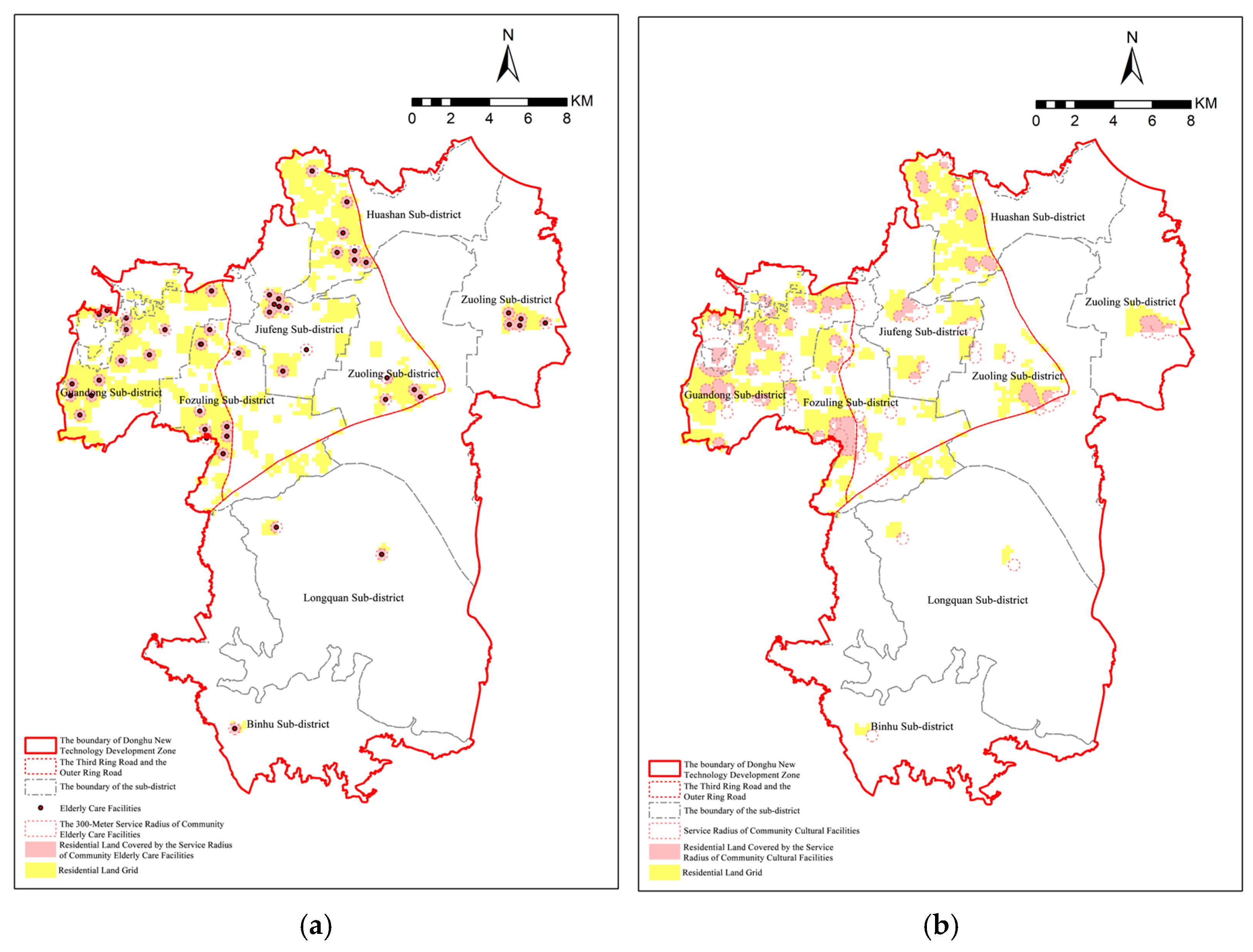
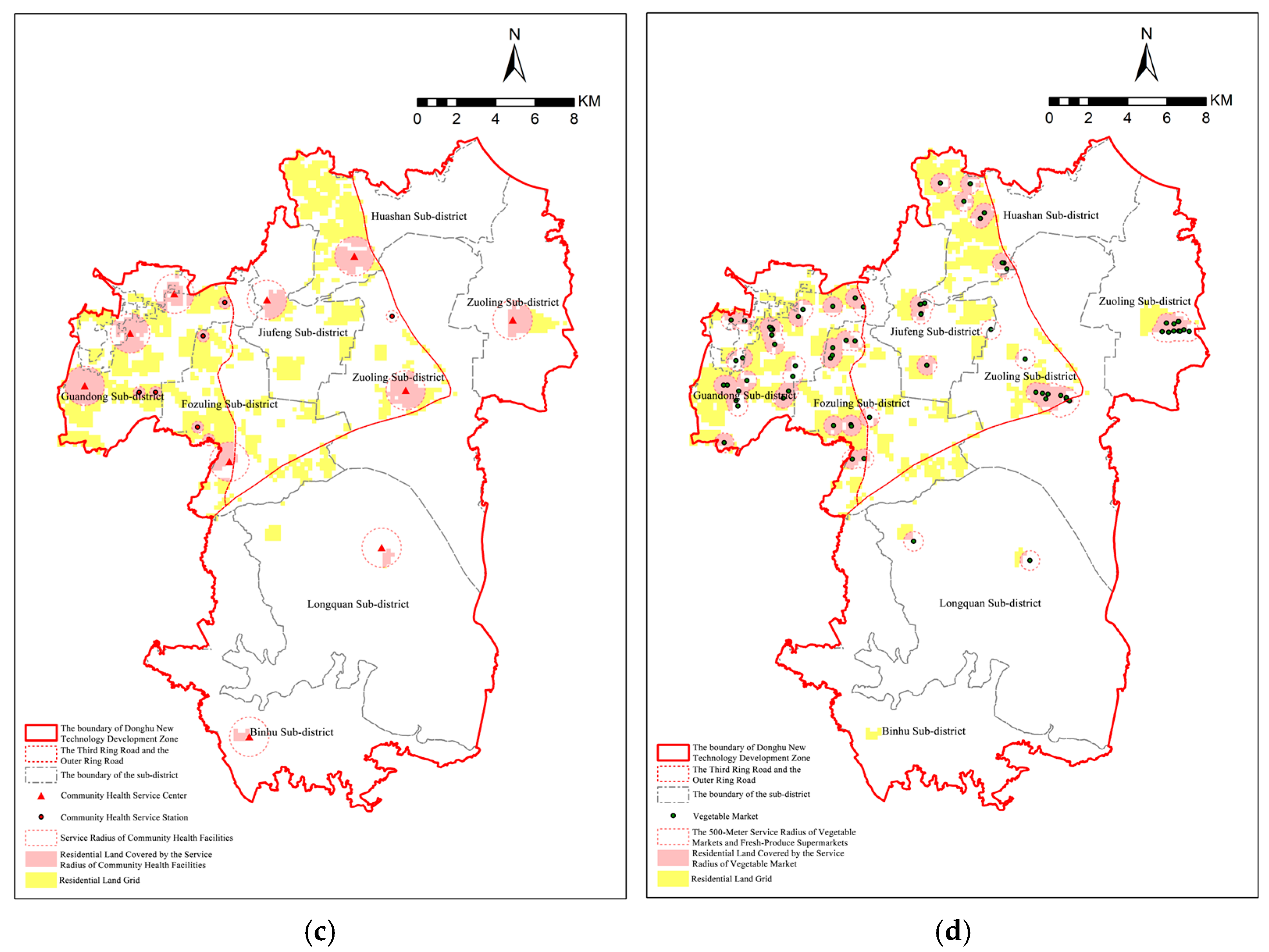
Using official point-of-interest (POI) data provided by relevant municipal departments, we calculated the objective supply for each facility category. This was measured as the service coverage within a 10–15 min walking radius (800 m) for the residential population. The resulting objective supply data are presented in
Table 5. and the spatial distribution of these facilities is illustrated in
Figure 2.
4.2.3. Analysis of Subjective–Objective Perception Discrepancy
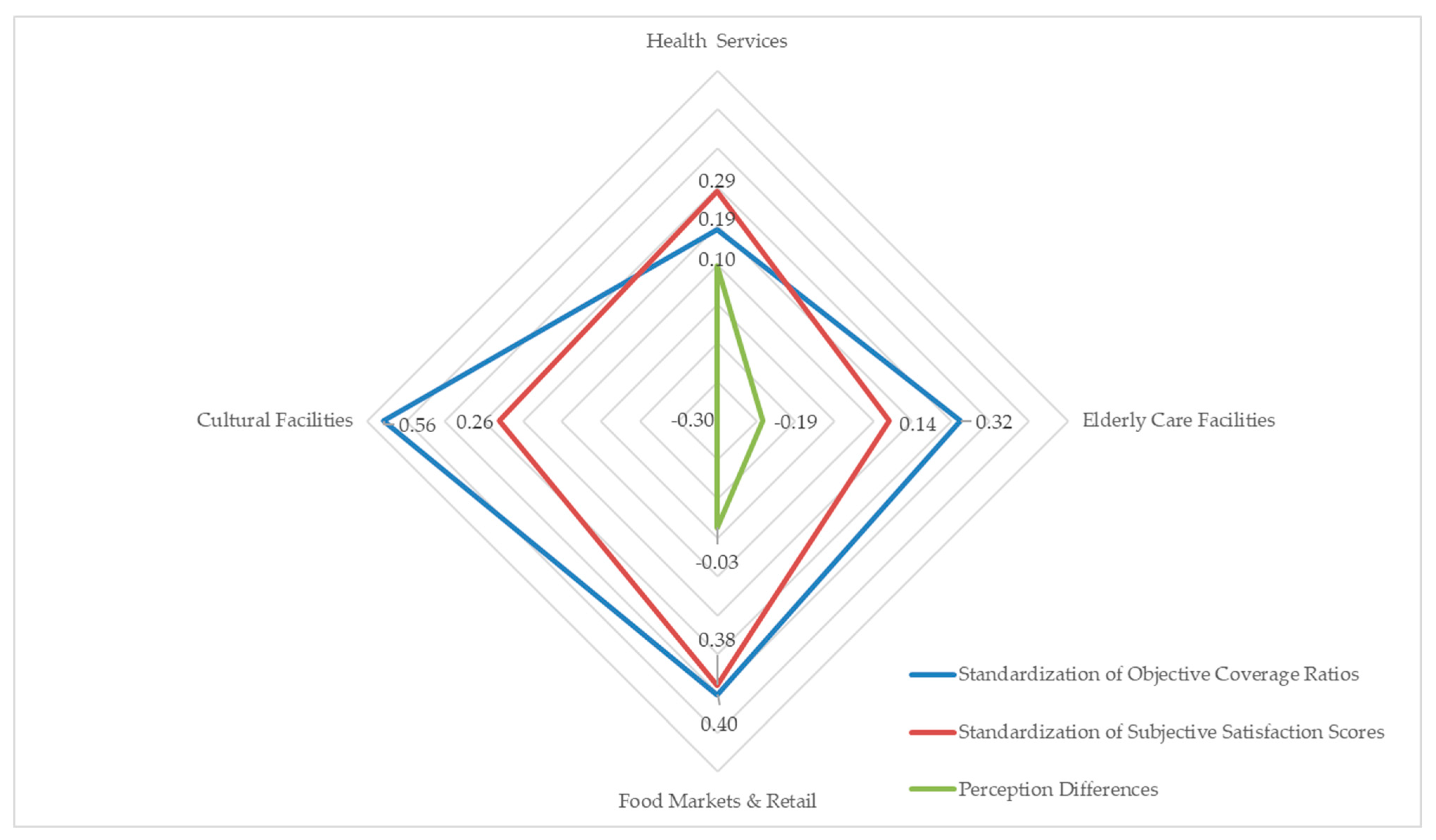
After normalizing both the subjective satisfaction scores and the objective coverage ratios, we calculated the discrepancy between them. Overall, significant disparities exist between subjective perceptions and objective supply in facility–service relationships, as shown in
Figure 3. For widely used facilities (e.g., Food Markets & Retail), perception bias is minimal, with alignment between subjective and objective metrics. In contrast, low-frequency facilities (e.g., health services) may exhibit subjective superiority—where satisfaction exceeds actual coverage. However, specialized facilities (e.g., elderly care, cultural facilities) show systematic perception gaps, with subjective satisfaction consistently below objective supply levels. This reflects residents’ varying expectations and “acceptable radius” thresholds across facility types.
Analysis at the subdistrict level (
Table 6) reveals distinct spatial variations in these perception gaps. Guandong and Baoxie subdistricts show particularly large negative discrepancies, where resident satisfaction with elderly care and health facilities is significantly lower than what objective metrics would suggest. Similarly, Guandong, Baoxie, Fozuling, and Zuoling all report low satisfaction with cultural facilities despite relatively high objective coverage. This spatial heterogeneity suggests that subjective factors, such as differing public expectations, play a critical role in shaping these perception gaps.
4.2.4. Causal Attribution of Discrepancies
To investigate the relationship between demographic characteristics and perception discrepancies, we conducted a Pearson correlation analysis. We correlated the perception discrepancy for each facility with demographic variables at the subdistrict level, including education (proportions of college, undergraduate, and postgraduate degree holders) and age cohorts (e.g., 0–14, 25–39 years), as
Table 7 listed,
Areas with high concentrations of children (0–14 years) and young adults (25–39 years) exhibit a significant negative perception discrepancy for health and elderly care facilities. This suggests that young families, often requiring pediatric services and elder support for childcare, have higher expectations that are not being met by the current supply. Conversely, areas with a higher proportion of middle-aged (40–59) and elderly (>60) residents show a positive discrepancy, where satisfaction often exceeds objective coverage levels, particularly for health and elderly care facilities, respectively.
A higher concentration of residents with advanced degrees (Bachelor, Master/PhD) is strongly correlated with a negative perception discrepancy for food markets and cultural facilities. This indicates that highly educated populations have higher standards for the quality and variety of these lifestyle amenities. They also demonstrate a negative perception of health and elderly care, though to a lesser extent.
Notably, the negative perception of elderly care facilities is not driven by areas with a high proportion of seniors, but rather by areas with a high proportion of young and working-age families. This aligns with the common reality in China where grandparents are heavily involved in childcare. Therefore, areas with a high dependency ratio (high proportions of both children and elders being cared for by the working-age population) exhibit greater demand and higher expectations for social welfare facilities.
4.3. Application to Planning and Decision-Making
The analysis of subjective–objective discrepancies provides actionable insights for optimizing public facility provision and enhancing public satisfaction. Key applications fall into two categories:
Refining Facility-Type Planning: The analysis confirms that specialized facilities (serving specific demographics like the elderly or culturally inclined) are more susceptible to negative perception gaps due to heterogeneous needs and information asymmetry. This highlights the failure of a one-size-fits-all planning standard. Future planning for such facilities must move towards a more nuanced, demand-responsive approach that is tailored to the specific needs of the target population within a service area [
29,
30].
Developing Targeted Intervention Strategies: The correlation analysis provides a “feedback and rectification” mechanism for precise planning interventions:
Responding to Age-Related Needs: In areas with a high dependency ratio (e.g., high proportions of young children and middle-aged adults), planners should prioritize upgrading health services (e.g., community clinics with pediatric specialties, extended hours for pediatric care) and elderly care facilities. This directly addresses the tension where subjective satisfaction is much lower than objective coverage.
Responding to Education-Related Needs: In areas with highly educated populations, planners must recognize that demand extends beyond specialized services to the quality of basic life amenities. The strong negative perception of cultural facilities and food markets indicates a need to enhance the quality, diversity, and experiential value of these services to match the expectations of skilled professionals.
5. Discussion
The provision and spatial configuration of public service facilities are intrinsically linked to the daily lives of residents and are therefore a primary focus of their needs and perceptions. While objective data can assess the scale and coverage of public service facilities, they fail to capture the subjective perceptions and experiences of residents—the primary users. This empirical study reveals that the universality of a facility’s target audience and use frequency is a critical determinant of subjective–objective perception discrepancies. For universal facilities that serve a broad public, subjective evaluations and objective metrics tend to align. In contrast, specialized facilities targeting specific demographic groups consistently exhibit a significant perception deficit, wherein public satisfaction is markedly lower than the objective level of provision.
In addition, the relationship between demographic characteristics and perception discrepancies has been found. A higher concentration of residents with advanced degrees (Bachelor, Master/PhD) is strongly correlated with a negative perception discrepancy for food markets and cultural facilities. This indicates that highly educated populations have higher standards for the quality and variety of these lifestyle amenities. Instead, residents with low educational attainment demonstrate a negative perception of health and elderly care. Areas with a high proportion of young and working-age families, have higher requirements and expectations for social welfare facilities. This is consistent with the common reality that many families rely on elderly family members taking care of children due to work pressure.
This finding exposes the limitations of traditional supply-driven planning paradigms. The planning decisions about urban public service facilities was based on official government statistics and departmental statistics and the public just played the role of passive recipient. At present, the public’s satisfaction and sense of gain regarding urban construction has become an important issue in current planning decisions. Therefore, future planning optimization must be rooted in the construction of a demand-responsive decision-making mechanism, and the residents should join in the planning as a participant and co-decision maker.
On one hand, this involves strengthening public participation to authentically capture the subjective environmental perceptions of diverse resident groups, thereby providing a more comprehensive and pluralistic evidence base for planning. On the other hand, it requires the formulation of differentiated provision strategies based on a granular analysis of facility types (universal vs. specialized) and population characteristics (e.g., age, education, family structure). From a facility-type perspective, the negative perception gap associated with specialized facilities—driven by heterogeneous demands and inadequate service matching—necessitates a fundamental shift in planning logic. The singular goal of achieving “coverage ratio targets” is no longer sufficient. Instead, planning must pivot towards a supply logic centered on the “precision of demand-responsiveness.” This requires establishing a service standards system driven by detailed user profiles to prevent the structural mismatch between standardized supply and differentiated public needs. This approach enables planners to address service gaps by targeting the specific needs of demographic groups within their areas of concentration, integrating resident feedback directly into a dynamic process of plan revision and operational adjustment.
Ultimately, this research advocates for an evolution in public service facility planning—a progression from ensuring “spatial coverage equity” to enhancing the “perceived sense of gain.” By achieving a human-centered balance between supply and demand, urban planning can genuinely improve the well-being and satisfaction that citizens derive from urban development.
6. Conclusions
As China’s urban development model has shifted from incremental expansion to inventory quality improvement, spatial planning and governance have increasingly prioritized human-centered needs. The report to the 20th National Congress of the Communist Party of China emphasized the principle of “people’s cities built by the people and for the people,” calling for improvements in urban planning, construction, and governance levels. Under this development philosophy, the allocation of spatial resources requires scientific planning and clear objectives to better align with residents’ demands. Social satisfaction surveys serve as a systematic tool for refining urban governance from a human-centered perspective. They effectively reveal existing shortcomings in urban spatial governance and authentically reflect the diverse demands of heterogeneous groups, thereby making planning decisions more scientific, objective, and reasonable.
To address the disconnect between objective metrics and subjective realities in spatial planning governance, this study established a three-stage framework—”Discrepancy Identification, Causal Attribution, and Decision Transformation”—to forge a demand-responsive planning mechanism. Empirical research was then conducted using social satisfaction survey data from the East Lake High-tech Development Zone in Wuhan. The study indicates that the universality and usage frequency of a facility significantly influence subjective–objective perception discrepancies. Universal facilities with high utilization rates and broad coverage are less prone to supply discrepancies. In contrast, specialized service facilities with limited utilization and narrower audience scopes are more likely to exhibit significant discrepancies, typically manifesting as a negative bias where subjective satisfaction falls below objective coverage rates.
Therefore, in service facility planning, it is essential to identify the heterogeneous characteristics of subjective and objective perceptions. Planners must focus on the refined supply of demand responses derived from the service area population and enhance public access through a balanced allocation of supply and demand. This approach effectively avoids the mismatch issues caused by traditional, supply-oriented public service facility planning.
Although this study focuses on the heterogeneous characteristics of subjective–objective perception gaps of public facilities and identifies their key influencing factors, there are still some limitations and unresolved issues that deserve attention in future research. (1) Although this research uses Pearson correlation to examine the relationship between the gap and demographic characteristics, it only shows pairwise associations without controlling for other variables, such as service quality, prices and so on. Future studies should incorporate more advanced models to address this issue. (2) Public facilities satisfaction is inherently complex. Two factors including Age and education level were mainly chosen in this paper. Furthermore, more granular satisfaction dimensions (e.g., satisfaction with price, quality) will be introduced in future research to further enhance the reliability and depth of the conclusions. (3) As the case study focused on the East Lake High-tech Development Zone—a region characterized by high income levels, high educational attainment, and a predominantly youthful demographic—the findings may face constraints in broader applicability. To enhance generalizability, future research will expand to diverse regions to systematically clarify subjective perception disparities among different population groups. (4) Through the analysis of long-term tracking survey data and existing research findings, we have observed that residents’ demand for public service facilities will change along with the high-quality development of Chinese cities. Future research should aim to acquire data with finer temporal resolutions to enable temporal comparisons and time-series analyses, which will expand the research scope and depth.
Author Contributions
Conceptualization, G.W. and H.Z.; methodology, H.Z. and Y.L.; software, H.Z. and Y.L.; validation H.Z., D.C. and Y.L., and; formal analysis, H.Z., D.C. and Y.L.; investigation, X.L. and H.R.; resources, D.C. and G.W.; data curation, H.Z. and D.C.; writing—original draft, H.Z., D.C. and Y.L.; writing—review and editing, G.W., H.Z., D.C. and H.R.; visualization, X.L. and H.R.; supervision, G.W.; project administration, G.W.; funding acquisition, H.Z. All authors have read and agreed to the published version of the manuscript.
Funding
This research was partly funded by Ministry of Education of China with grant number 21YJCZH121(name: “Study on the Socioeconomic Resilience and Its Formation Mechanism of Commercial Streets in the Internet Era: A Case Study of Wuhan and Melbourne”).
Data Availability Statement
Data available on request due to restrictions (e.g., privacy, legal or ethical reasons) The data presented in this study are available on request from the corresponding author due to protecting participant privacy.
Conflicts of Interest
Author Haijuan Zhao was employed by the company Wuhan Design Consulting Group Co., Ltd. The remaining authors declare that the research was conducted in the absence of any commercial or financial relationships that could be construed as a potential conflict of interest.
References
- Shi, X.; Yang, M.; Jin, Z.; Huang, H.; Luo, J.; Luo, X.; Zhang, W.; Deng, H.; Yang, J.; Sun, A. More effective city examination assessment. City Plan. Rev. 2020, 44, 65–73. (In Chinese) [Google Scholar]
- Osborne, D.; Gaebler, T. Reinventing Government: How the Entrepreneurial Spirit Is Transforming the Public Sector; Addison-Wesley Publishing Company: Reading, MA, USA, 1993; ISBN 9780452269422. [Google Scholar]
- Galster, G. Identifying the correlates of dwelling satisfaction: An empirical critique. Environ. Behav. 1987, 19, 539–568. [Google Scholar] [CrossRef]
- Diener, E. Subjective well-being: The science of happiness and a proposal for a national index. Am. Psychol. 2000, 55, 34–43. [Google Scholar] [CrossRef] [PubMed]
- Hansen, J.R.; Jacobsen, C.B. Changing strategy processes and strategy content in public sector organizations? A longitudinal case study of NPM reforms’ influence on strategic management. Br. J. Manag. 2016, 27, 373–389. [Google Scholar] [CrossRef]
- Cardozo, R.N. An experimental study of customer effort, expectation, and satisfaction. J. Mark. Res. 1965, 2, 244–249. [Google Scholar] [CrossRef]
- Verhagen, I.; Steunenberg, B.; de Wit, N.J.; Ros, W.J. Community health worker interventions to improve access to health care services for older adults from ethnic minorities: A systematic review. BMC Health Serv. Res. 2014, 14, 497. [Google Scholar] [CrossRef]
- Lynch, K. The Image of the City; MIT Press: Cambridge, MA, USA, 1960; ISBN 9780262620017. [Google Scholar]
- Parkes, A.; Kearns, A.; Atkinson, R. What Makes People Dissatisfied Their Neighborhoods? Urban Stud. 2002, 39, 2413–2438. [Google Scholar] [CrossRef]
- Wang, Z.; Wu, K. Evolution and comparative study on public service facilities at home and abroad based on bibliometric methods. Urban Dev. Stud. 2020, 27, 1–7. (In Chinese) [Google Scholar]
- Chen, H.; Li, Z.; Cai, Y.; Cai, Y.; Zhang, L. Optimal allocation of urban public service facilities based on an all-age-friendly perspective: A case study of Shenzhen. Mod. Urban Res. 2025, 40, 119–124. (In Chinese) [Google Scholar]
- Chen, L.; Jiang, Y. Application of social satisfaction survey in city health examination evaluation. Sci. Geogr. Sin. 2021, 41, 1729–1741. (In Chinese) [Google Scholar] [CrossRef]
- Oliver, R.L. A cognitive model of the antecedents and consequences of satisfaction decisions. J. Mark. Res. 1980, 17, 460–469. [Google Scholar] [CrossRef]
- Oliver, R.L.; DeSarbo, W.S. Response determinants in satisfaction judgments. J. Consum. Res. 1988, 14, 495–507. [Google Scholar] [CrossRef]
- Luo, W.; Wang, F. Measures of spatial accessibility to health care in a GIS environment: Synthesis and a case study in the Chicago region. Environ. Plan. B: Plan. Des. 2003, 30, 865–884. [Google Scholar] [CrossRef] [PubMed]
- Terblanche, N.S. An application of the American Customer Satisfaction Index (ACSI) in the South African motor vehicle industry. South Afr. J. Bus. Manag. 2006, 37, a611. [Google Scholar] [CrossRef]
- Van Ryzin, G.G. Testing the expectancy disconfirmation model of citizen satisfaction with local government. J. Public Adm. Res. Theory 2006, 16, 599–611. [Google Scholar] [CrossRef]
- Akinboade, O.A.; Kinfack, E.C.; Mokwena, M.P. An analysis of citizen satisfaction with public service delivery in the Sedibeng district municipality of South Africa. Int. J. Soc. Econ. 2012, 39, 182–199. [Google Scholar] [CrossRef]
- Nigro, H.O.; González Císaro, S.E. The citizen satisfaction index: Adapting the model in Argentine cities. Cities 2016, 56, 85–90. [Google Scholar] [CrossRef]
- Petrovsky, N.; Mok, J.Y.; León-Cázares, F. Citizen expectations and satisfaction in a young democracy: A test of the expectancy-disconfirmation model. Public Adm. Rev. 2017, 77, 395–407. [Google Scholar] [CrossRef]
- Kuo, Y.-C.; Huh, Y.; Hwang, B.-G. A comparative analysis of residents’ satisfaction with apartment building management and maintenance services in South Korea and Taiwan. Qual. Quant. 2022, 56, 395–412. [Google Scholar] [CrossRef]
- Lee, S.-W.; Seow, C.-W.; Xue, K. Residents’ sustainable city evaluation, satisfaction and loyalty: Integrating importance–performance analysis and structural equation modelling. Sustainability 2021, 13, 6766. [Google Scholar] [CrossRef]
- Dell ’Ovo, M.; Capolongo, S.; Oppio, A. Combining spatial analysis with MCDA for the siting of healthcare facilities. Land Use Policy 2018, 76, 634–644. [Google Scholar] [CrossRef]
- Fang, G.; Yang, Y.; Sun, W. Research on optimal allocation of medical resources in Beijing based on multi-cycle Acc-Cost model. Geogr. Res. 2025, 44, 603–618. (In Chinese) [Google Scholar] [CrossRef]
- Zhang, W.; He, J.; Chen, L. Method system of urban physical examination for high quality development in China. Geogr. Sci. 2021, 41, 1–12. (In Chinese) [Google Scholar]
- Neutens, T.; Delafontaine, M.; Scott, D.M.; De Maeyer, P. An analysis of day-to-day variations in individual space–time accessibility. J. Transp. Geogr. 2012, 23, 81–91. [Google Scholar] [CrossRef]
- Joassart-Marcelli, P. Leveling the playing field? Urban disparities in funding for local parks and recreation in the Los Angeles region. Environ. Plan. A 2010, 42, 1174–1192. [Google Scholar] [CrossRef]
- Belanche, D.; Casaló, L.V.; Orús, C. City attachment and use of urban services: Benefits for smart cities. Cities 2016, 50, 75–81. [Google Scholar] [CrossRef]
- Petter, S.; DeLone, W.; McLean, E.R. Information systems success: The quest for the independent variables. J. Manag. Inf. Syst. 2013, 29, 7–62. [Google Scholar] [CrossRef]
- Angelova, B.; Zekiri, J. Measuring customer satisfaction with service quality using American Customer Satisfaction Model (ACSI model). Int. J. Acad. Res. Bus. Soc. Sci. 2011, 1, 232–258. [Google Scholar] [CrossRef]
| Disclaimer/Publisher’s Note: The statements, opinions and data contained in all publications are solely those of the individual author(s) and contributor(s) and not of MDPI and/or the editor(s). MDPI and/or the editor(s) disclaim responsibility for any injury to people or property resulting from any ideas, methods, instructions or products referred to in the content. |
© 2025 by the authors. Licensee MDPI, Basel, Switzerland. This article is an open access article distributed under the terms and conditions of the Creative Commons Attribution (CC BY) license (https://creativecommons.org/licenses/by/4.0/).