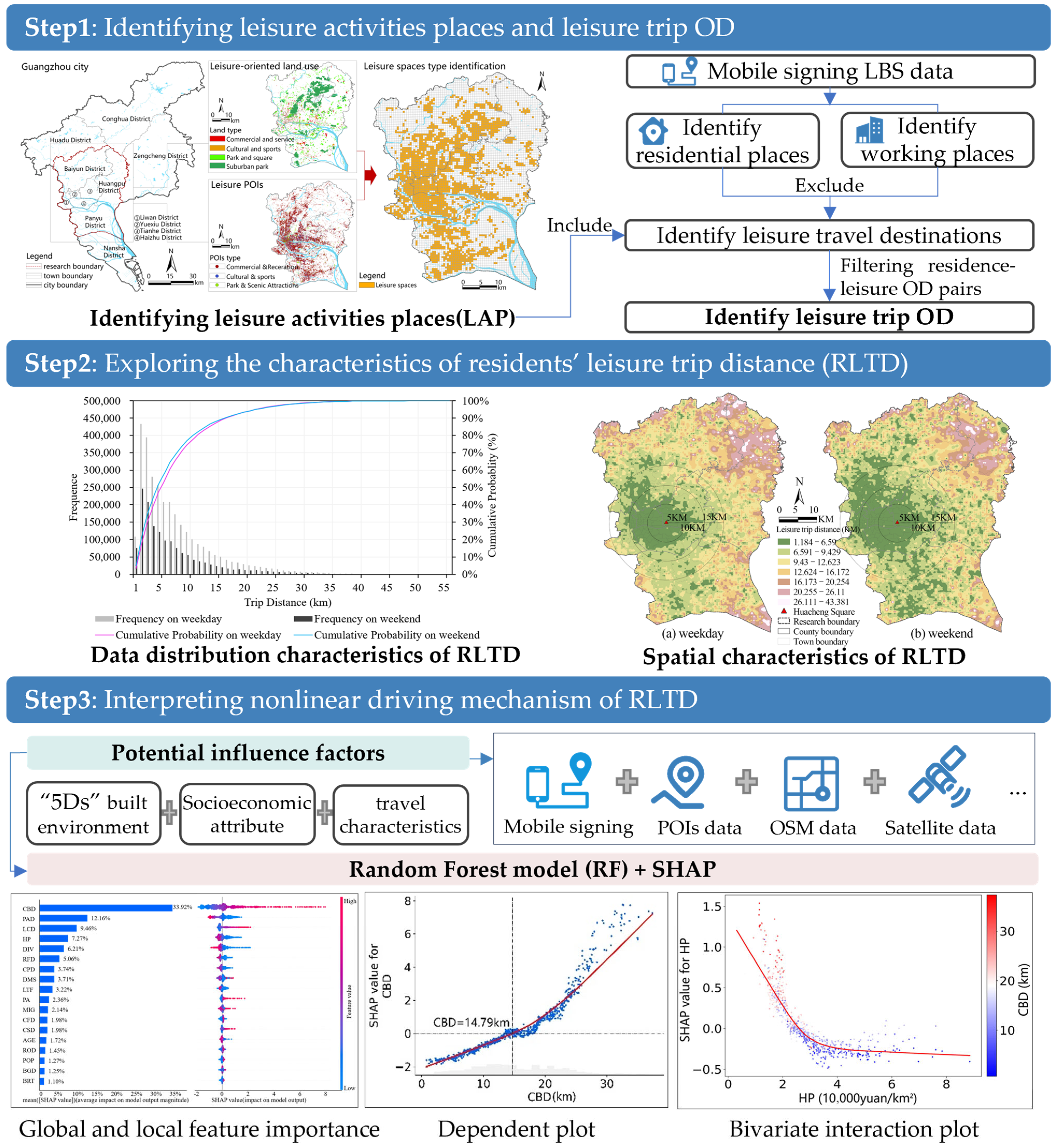

Examining the Nonlinear Relationship Between Built Environment and Residents’ Leisure Travel Distance: A Case Study of Guangzhou, China


Abstract
1. Introduction
2. Data and Methodology
2.1. Study Areas and Data
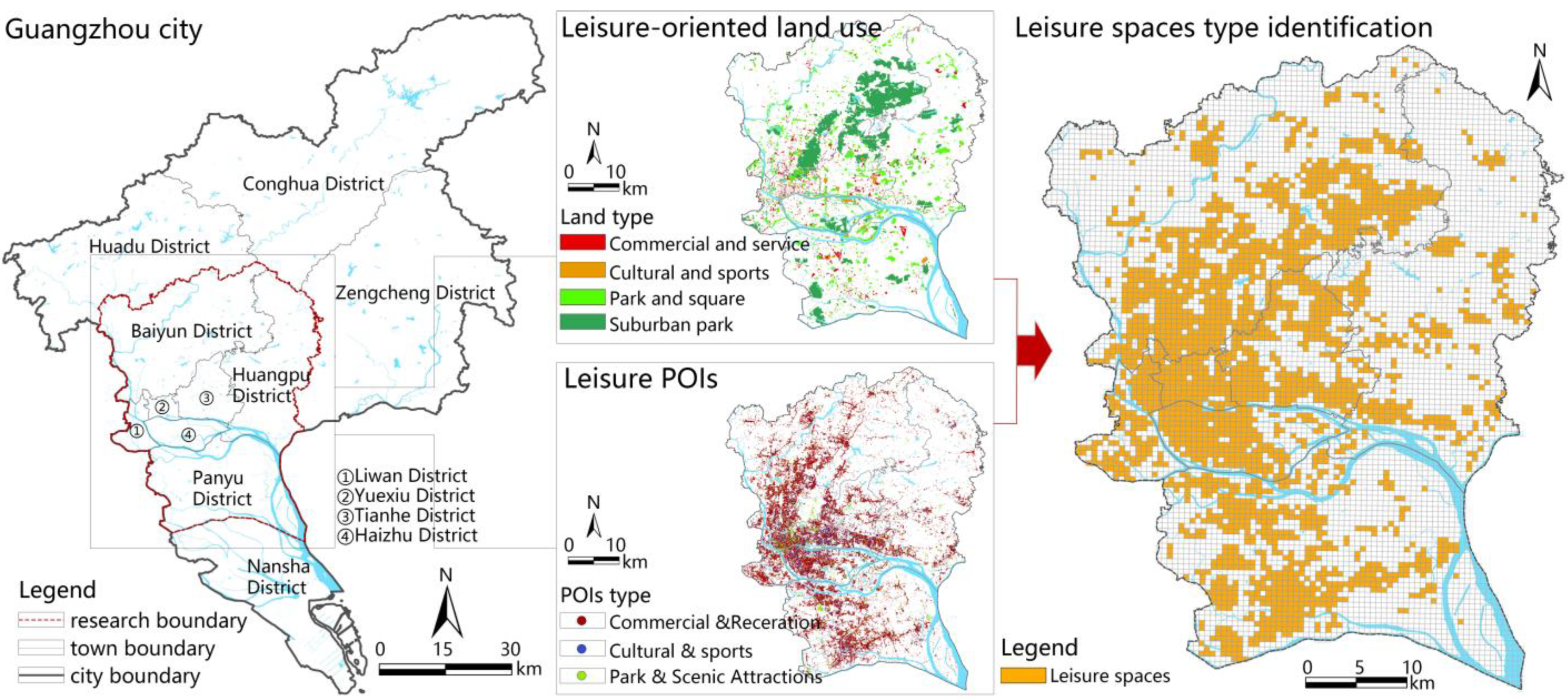
2.1.1. Study Areas
2.1.2. Data Sources
2.2. Identifying Leisure-Based Trips
2.3. Variable and Nonlinear Model
2.3.1. Variable Description
2.3.2. Random Forest Model
2.3.3. SHAP Model
3. Results
3.1. The Spatiotemporal Characteristics of Residents’ Leisure Travel Distance in Guangzhou
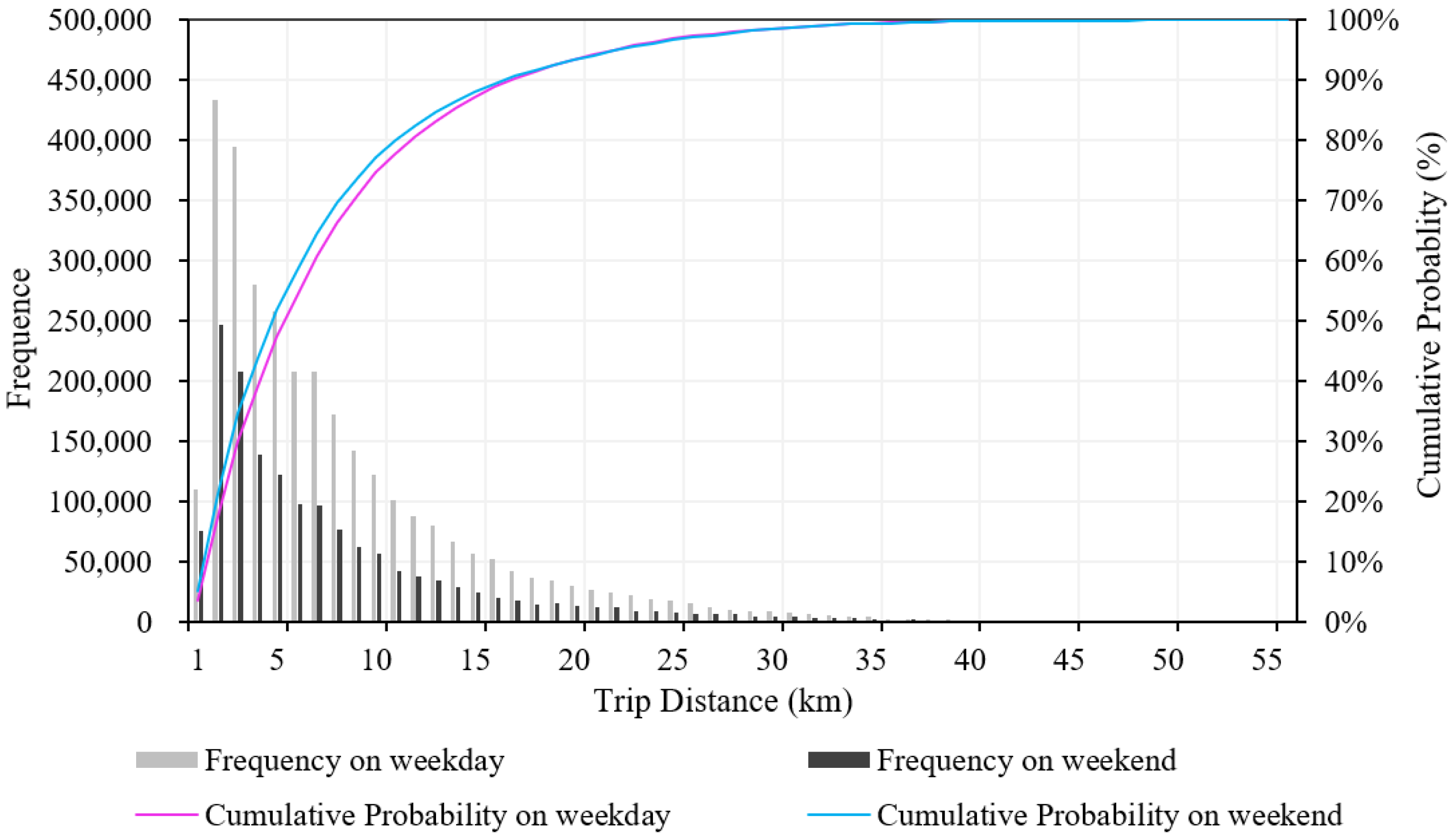
3.1.1. The Data Distribution Characteristics of Residents’ Leisure Travel Distance
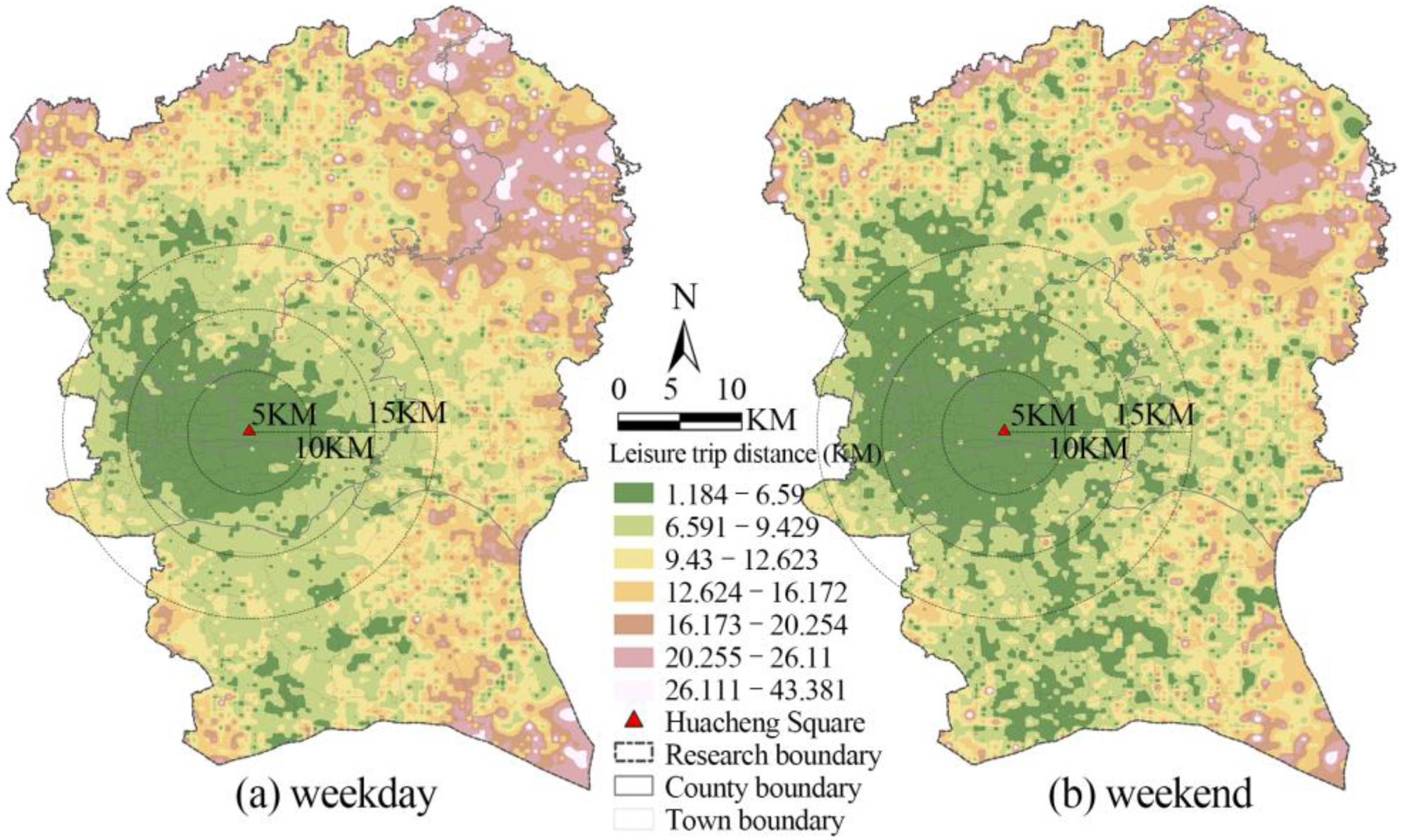
3.1.2. The Spatial Distribution Characteristics of Residents’ Leisure Travel Distance
3.2. Influencing Factors of the Average Leisure Travel Distance
3.2.1. Model Performance Comparison
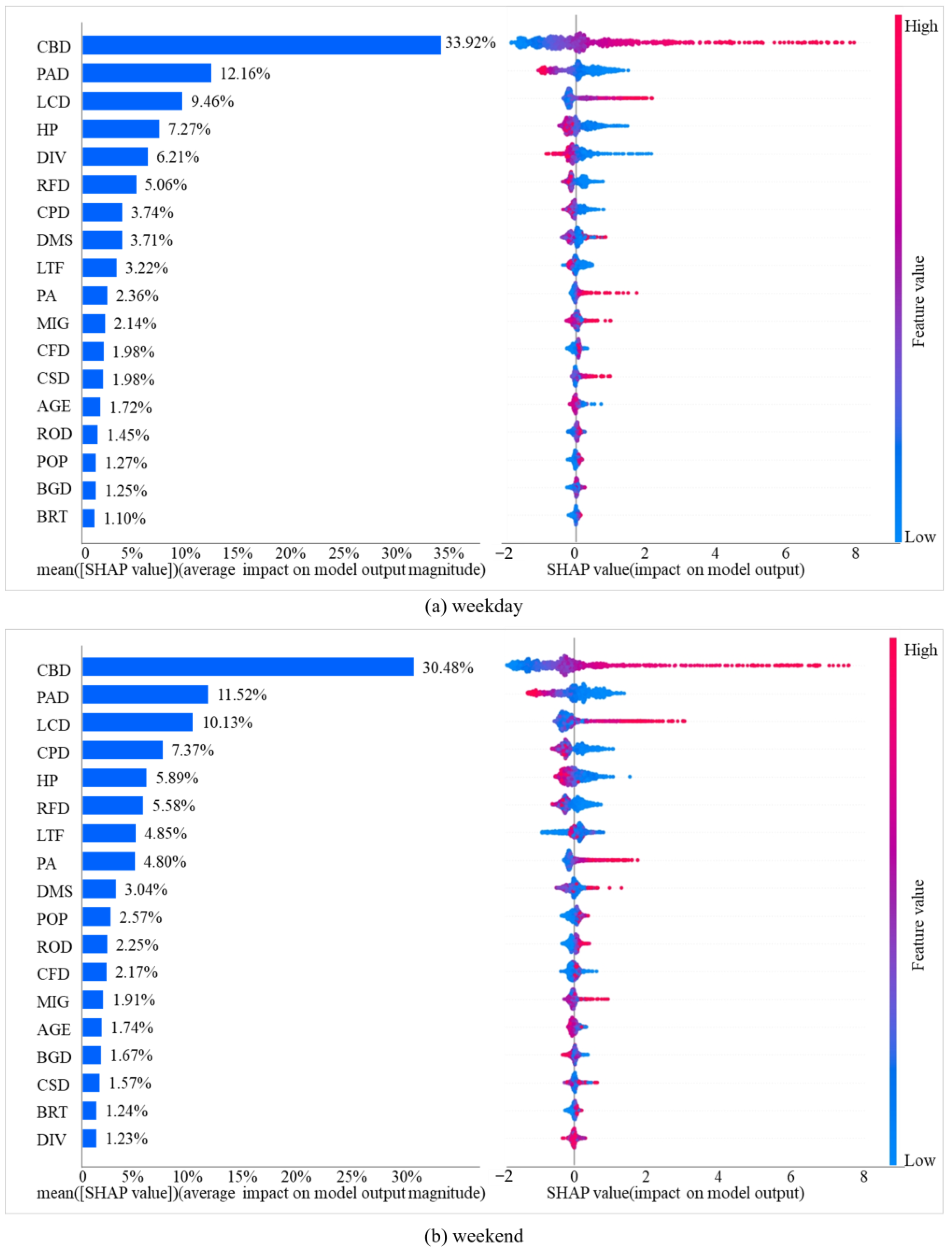
3.2.2. Feature Importance Analysis Based on SHAP
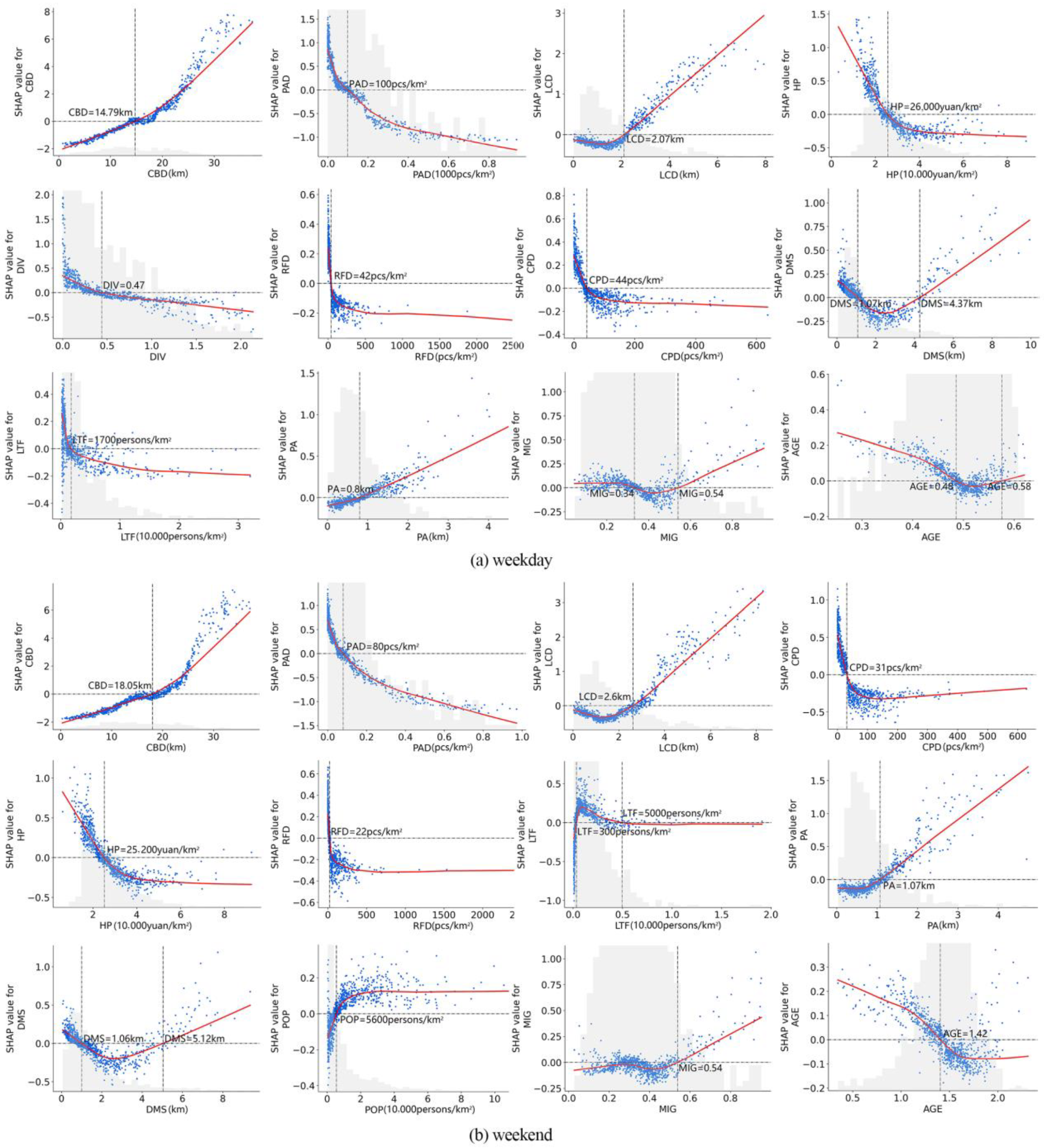
3.2.3. Nonlinear Effects Based on SHAP
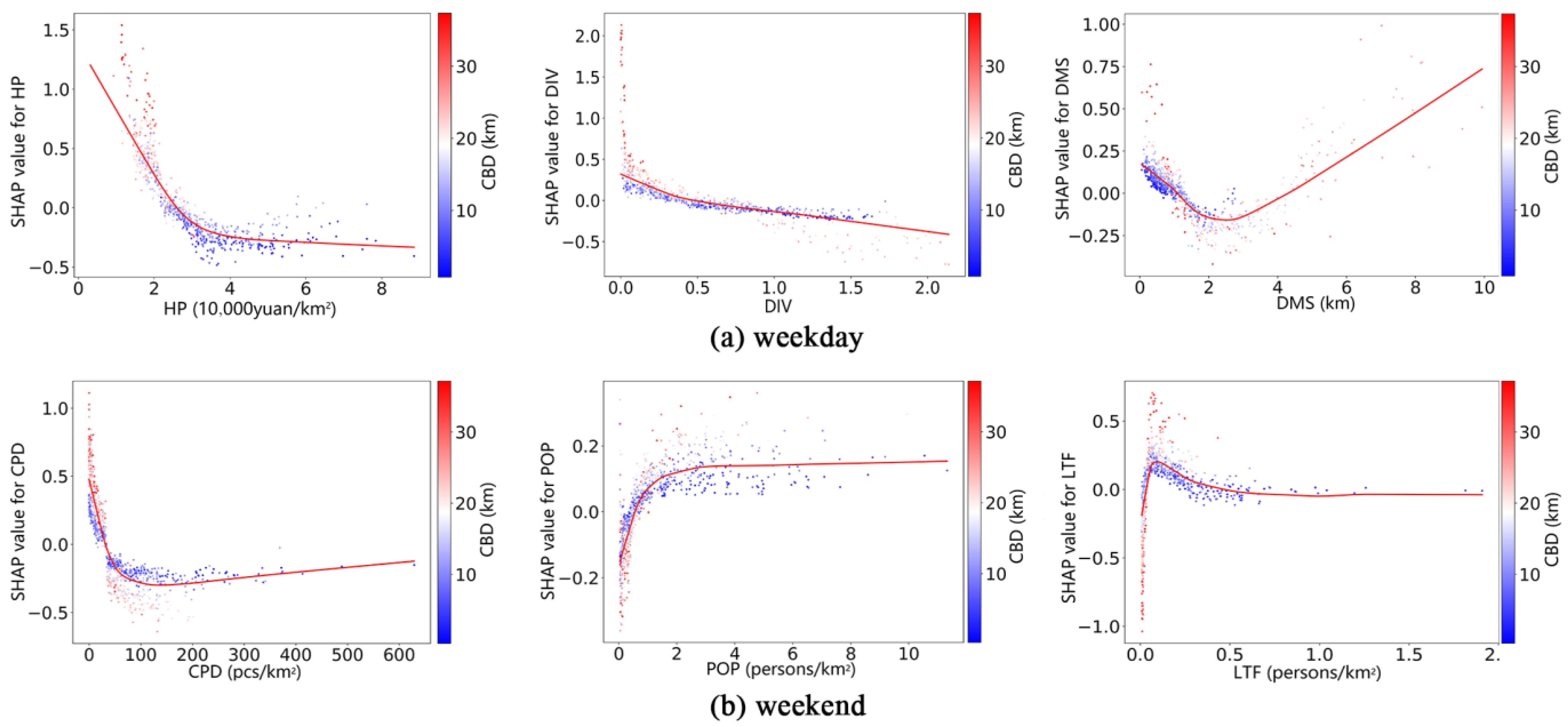
3.2.4. Interaction Effects Based on SHAP
4. Discussion
5. Conclusions
Author Contributions
Funding
Data Availability Statement
Conflicts of Interest
References
- Iso-Ahola, S.E. Basic dimensions of definitions of leisure. J. Leis. Res. 1979, 11, 28–39. [Google Scholar] [CrossRef]
- Newman, D.B.; Tay, L.; Diener, E. Leisure and Subjective Well-Being: A Model of Psychological Mechanisms as Mediating Factors. J. Happiness Stud. 2013, 15, 555–578. [Google Scholar] [CrossRef]
- Sallis, J.F.; Cerin, E.; Conway, T.L.; Adams, M.A.; Frank, L.D.; Pratt, M.; Salvo, D.; Schipperijn, J.; Smith, G.; Cain, K.L.; et al. Physical activity in relation to urban environments in 14 cities worldwide: A cross-sectional study. Lancet 2016, 387, 2207–2217. [Google Scholar] [CrossRef] [PubMed]
- Lloyd, K.; Auld, C. Leisure, public space and quality of life in the urban environment. Urban Policy Res. 2003, 21, 339–356. [Google Scholar] [CrossRef]
- Peter, H.; Michael, A. Positive moods derived from leisure and their relationship to happiness and personality. Personal. Individ. Differ. 1998, 25, 523–535. [Google Scholar]
- Chen, Y.; Wang, B.; Huang, J.; Gao, H.; Shu, X. Urban Physical Environments Promoting Active Leisure Travel: An Empirical Study Using Crowdsourced GPS Tracks and Geographic Big Data from Multiple Sources. Land 2024, 13, 589. [Google Scholar] [CrossRef]
- Chica-Olmo, J.; Lizárraga, C. Effect of Interaction between Distance and Travel Times on Travel Mode Choice when Escorting Children to and from School. J. Urban Plan. Dev. 2022, 148, 05021055. [Google Scholar] [CrossRef]
- Li, X.; Xu, J.; Du, M.; Liu, D.; Kwan, M.-P. Understanding the spatiotemporal variation of ride-hailing orders under different travel distances. Travel Behav. Soc. 2023, 32, 100581. [Google Scholar] [CrossRef]
- Hartieni, P.; Joewono, T.B.; Dharmowijoyo, D. The effects of planned behaviour, spatiotemporal variables and lifestyle on public transport use: An exploratory study. Transp. Res. Part A Policy Pract. 2024, 190, 104255. [Google Scholar] [CrossRef]
- Jiang, Y.; Qin, J.; Wu, T. Understanding the spatiotemporal response of dockless bike-sharing travel behavior to the small outbreaks of COVID-19. Appl. Geogr. 2025, 175, 103488. [Google Scholar] [CrossRef]
- Lin, J.J.; Yu, T.P. Built environment effects on leisure travel for children: Trip generation and travel mode. Transp. Policy 2011, 18, 246–258. [Google Scholar] [CrossRef]
- Lin, L. Leisure-time physical activity, objective urban neighborhood built environment, and overweight and obesity of Chinese school-age children. J. Transp. Health 2018, 10, 322–333. [Google Scholar] [CrossRef]
- Gul, Y.; Sultan, Z.; Moeinaddini, M.; Jokhio, G.A. The effects of physical activity facilities on vigorous physical activity in gated and non-gated neighborhoods. Land Use Policy 2018, 77, 155–162. [Google Scholar] [CrossRef]
- Long, Y.; Ao, Y.B.; Li, H.M.; Bahmani, H.; Li, M.Y. Non-linear effects of children’s daily travel distance on their travel mode choice considering different destinations. J. Transp. Geogr. 2024, 118, 103921. [Google Scholar] [CrossRef]
- Zhao, X.K.; Huang, H.; Lin, G.S.; Lu, Y.X. Exploring temporal and spatial patterns and nonlinear driving mechanism of park perceptions: A multi-source big data study. Sustain. Cities Soc. 2025, 119, 106083. [Google Scholar] [CrossRef]
- Xi, Y.F.; Hou, Q.H.; Duan, Y.Q.; Lei, K.X.; Wu, Y.; Cheng, Q.Y. Exploring the Spatiotemporal Effects of the Built Environment on the Nonlinear Impacts of Metro Ridership: Evidence from Xi’an, China. ISPRS Int. J. Geo-Inf. 2024, 13, 105. [Google Scholar] [CrossRef]
- Toger, M.; Türk, U.; Östh, J.; Kourtit, K.; Nijkamp, P. Inequality in leisure mobility: An analysis of activity space segregation spectra in the Stockholm conurbation. J. Transp. Geogr. 2023, 111, 103638. [Google Scholar] [CrossRef]
- He, S.; Yu, S.; Wei, P.; Fang, C. A spatial design network analysis of street networks and the locations of leisure entertainment activities: A case study of Wuhan, China. Sustain. Cities Soc. 2019, 44, 880–887. [Google Scholar] [CrossRef]
- Liu, J.; Meng, B.; Shi, C.S. A multi-activity view of intra-urban travel networks: A case study of Beijing. Cities 2023, 143, 104634. [Google Scholar] [CrossRef]
- Xue, D.; Xinmeng, C.; Xin, Y.; Yongyong, S. Residents’ Leisure and entertainment Travel Preference and Urban Residential-Leisure Function Pattern: A Case Study of Xi’an. Geogr. Geo-Inf. Sci. 2024, 40, 71–79+121. [Google Scholar] [CrossRef]
- Liu, Y.; Zhang, Y.; Jin, S.T.; Liu, Y. Spatial pattern of leisure activities among residents in Beijing, China: Exploring the impacts of urban environment. Sustain. Cities Soc. 2020, 52, 101806. [Google Scholar] [CrossRef]
- Shan, Z.R.; Jin, L.L.; Yuan, M.; Zhang, X.Y.; Huang, Y.P. Research on Influencing Factors and Optimization Strategies of Travel Distance for Workplace-originated Shopping Trips: Taking Wuhan City as an Example. Areal Res. Dev. 2024, 43, 71–77. [Google Scholar] [CrossRef]
- Qi, L.L.; Zhou, S.H. The Influence of Neighborhood Built Environments on the Spatial-temporal Characteristics of Residents’ Daily Leisure Activities: A Case Study of Guangzhou. Sci. Geogr. Sin. 2018, 38, 31–40. [Google Scholar] [CrossRef]
- Cao, Y.; Wang, L.X.; Wu, H.; Yan, S.Q.; Shen, S.W. Identification and Mechanism of Residents’ Regional Non-Commuting Flow Patterns Based on the Gradient Boosting Decision Tree Model: A Case Study of the Shanghai Metropolitan Area. Land 2023, 12, 1652. [Google Scholar] [CrossRef]
- Chen, L.K.; Chen, M.X.; Fan, C. Age disparities and socioeconomic factors for commuting distance in Beijing by explainable machine learning. Cities 2024, 155, 105493. [Google Scholar] [CrossRef]
- Zheng, Y.; Deng, A.X.; Yin, Z.J.; Li, W.Q. Assessing travelers’ preferences for online bus-hailing service across various travel distances: Insights from Chinese metropolitan areas. Transp. Res. Part A Policy Pract. 2024, 187, 104159. [Google Scholar] [CrossRef]
- Aghaabbasi, M.; Chalermpong, S. Machine learning techniques for evaluating the nonlinear link between built-environment characteristics and travel behaviors: A systematic review. Travel Behav. Soc. 2023, 33, 100640. [Google Scholar] [CrossRef]
- Duan, Z.Y.; Zhao, H.R.; Li, Z.M. Non-linear effects of built environment and socio-demographics on activity space. J. Transp. Geogr. 2023, 111, 103671. [Google Scholar] [CrossRef]
- Liu, J.X.; Wang, B.; Xiao, L.Z. Non-linear associations between built environment and active travel for working and shopping: An extreme gradient boosting approach. J. Transp. Geogr. 2021, 92, 103034. [Google Scholar] [CrossRef]
- Tao, T.; Wang, J.Y.; Cao, X.Y. Exploring the non-linear associations between spatial attributes and walking distance to transit. J. Transp. Geogr. 2020, 82, 102560. [Google Scholar] [CrossRef]
- Liu, Y.; Li, Y.P.; Yang, W.; Hu, J. Exploring nonlinear effects of built environment on jogging behavior using random forest. Appl. Geogr. 2023, 156, 102990. [Google Scholar] [CrossRef]
- Peng, Y.A.; Yang, L.C. Effect of the Community-level Built Environment on Cycling Behavior from the Perspective of Differences in Trip Purposes. South Archit. 2025, 4, 100–107. [Google Scholar] [CrossRef]
- Xiong, Q.Q.; Xing, L.J.; Wang, L.Y.; Liu, Y.F.; Liu, Y.L. Comparing the impacts of built environment across different objective life neighborhoods on the out-of-home leisure activities of employed people using massive mobile phone data. Appl. Geogr. 2024, 171, 103382. [Google Scholar] [CrossRef]
- Bai, X.H.; Zhou, M.; Li, W.M. Analysis of the influencing factors of vitality and built environment of shopping centers based on mobile-phone signaling data. PLoS ONE 2024, 19, e0296261. [Google Scholar] [CrossRef]
- Ding, C.; Cao, X.Y.; Næss, P. Applying gradient boosting decision trees to examine non-linear effects of the built environment on driving distance in Oslo. Transp. Res. Part A Policy Pract. 2018, 110, 107–117. [Google Scholar] [CrossRef]
- Cheng, L.; Chen, X.W.; De Vos, J.; Lai, X.J.; Witlox, F. Applying a random forest method approach to model travel mode choice behavior. Travel Behav. Soc. 2019, 14, 1–10. [Google Scholar] [CrossRef]
- Guo, C.; Jiang, Y.Q.; Qiao, R.L.; Zhao, J.B.; Weng, J.C.; Chen, Y. The nonlinear relationship between the active travel behavior of older adults and built environments: A comparison between an inner-city area and a suburban area. Sustain. Cities Soc. 2023, 99, 104961. [Google Scholar] [CrossRef]
- Yin, C.; Liu, J.H.; Sun, B.D. Effects of built and natural environments on leisure physical activity in residential and workplace neighborhoods. Health Place 2023, 81, 103018. [Google Scholar] [CrossRef]
- Liu, Y.; He, D.L.; Lei, J.Y.; He, M.W.; Shi, Z.B. Investigating the non-linear influence of the built environment on passengers’ travel distance within metro and bus networks using smart card data. Multimodal Transp. 2025, 4, 100188. [Google Scholar] [CrossRef]
- Li, J.; Zhao, P.J.; Zhang, M.Z.; Deng, Y.L.; Liu, Q.Y.; Cui, Y.Z.; Gong, Z.Y.; Liu, J.; Tan, W.C. Exploring collective activity space and its spatial heterogeneity using mobile phone signaling Data: A case of Shenzhen, China. Travel Behav. Soc. 2025, 38, 100920. [Google Scholar] [CrossRef]
- Guan, C.H.; Zhou, Y.C. Exploring environmental equity and visitation disparities in peri-urban parks: A mobile phone data-driven analysis in Tokyo. Landsc. Urban Plan. 2024, 248, 105104. [Google Scholar] [CrossRef]
- Gao, X.; Wang, H.; Liu, L. Profiling Residents’ Mobility with Grid-Aggregated Mobile Phone Trace Data Using Chengdu as the Case. Sustainability 2021, 13, 13713. [Google Scholar] [CrossRef]
- Liu, S.; Long, Y.; Zhang, L.; Liu, H. Quantifying and Characterizing Urban Leisure Activities by Merging Multiple Sensing Big Data: A Case Study of Nanjing, China. Land 2021, 10, 1214. [Google Scholar] [CrossRef]
- Zhang, X.; Rui, J.; Xia, G.; Yang, J.; Cai, C.; Zhao, W. Revealing disparities and driving factors in leisure activity segregation of residents and tourists: A data-driven analysis of smart phone data. Appl. Geogr. 2025, 176, 103513. [Google Scholar] [CrossRef]
- Wang, Y. Research on Spatio-Temporal Characteristic and Influencing Factors of Residents’ Leisure Activities Based on Multisource Big Data—Take Nanjing as an Example. Master’s Thesis, Southeast University, Nanjing, China, 2021. [Google Scholar]
- Rodriguez Galiano, V.; Sanchez Castillo, M.; Chica Olmo, M.; Chica Rivas, M. Machine learning predictive models for mineral prospectivity: An evaluation of neural networks, random forest, regression trees and support vector machines. Ore Geol. Rev. 2015, 71, 804–818. [Google Scholar] [CrossRef]
- Zhou, W.; Liang, Z.; Fan, Z.; Li, Z. Spatio–temporal effects of built environment on running activity based on a random forest approach in Nanjing, China. Health Place 2024, 85, 103176. [Google Scholar] [CrossRef]
- Yang, X.P.; Li, J.Y.; Fang, Z.X.; Chen, H.F.; Li, J.Y.; Zhao, Z.Y. Influence of residential built environment on human mobility in Xining: A mobile phone data perspective. Travel Behav. Soc. 2024, 34, 100665. [Google Scholar] [CrossRef]
- Lin, Y.X.; Liu, Y. Let the city heal you: Environment and activity’s distinct roles in leisure restoration and satisfaction. Cities 2024, 154, 105336. [Google Scholar] [CrossRef]
- Lee, S.; Ko, E.; Jang, K.; Kim, S. Understanding individual-level travel behavior changes due to COVID-19: Trip frequency, trip regularity, and trip distance. Cities 2023, 135, 104223. [Google Scholar] [CrossRef]
- Shao, Q.; Zhang, W.; Cao, X.; Yang, J.; Yin, J. Threshold and moderating effects of land use on metro ridership in Shenzhen: Implications for TOD planning. J. Transp. Geogr. 2020, 89, 102878. [Google Scholar] [CrossRef]
- Tao, T.; Cao, J. Exploring nonlinear and collective influences of regional and local built environment characteristics on travel distances by mode. J. Transp. Geogr. 2023, 109, 103599. [Google Scholar] [CrossRef]
- Ding, C.; Mishra, S.; Lu, G.Q.; Yang, J.W.; Liu, C. Influences of built environment characteristics and individual factors on commuting distance: A multilevel mixture hazard modeling approach. Transp. Res. Part D Transp. Environ. 2017, 51, 314–325. [Google Scholar] [CrossRef]



| Date | Origin_id | Destination_id | Origin_type | Destination_type | Trip_cnt |
|---|---|---|---|---|---|
| 27 June 2021 | 10000 | 10782 | Residential place | Leisure space | 7 |
| 30 June 2021 | 10002 | 13912 | Leisure space | Residence | 14 |
| 30 June 2021 | 10010 | 10186 | Residence | Leisure space | 9 |
| Category | Name (Units) | Abbr. | Computational Method and Interpretation | Mean | Standard Deviation |
|---|---|---|---|---|---|
| Dependent variable | |||||
| Average leisure travel distance on weekday (km) | RLTD | Sum of weighted leisure travel distances divided by sum of weighted leisure travel frequencies at place of residence on weekday | 9.476 | 4.756 | |
| Independent variable | |||||
| Density | Residential population density (10,000 persons/km2) | POP | Population density per unit area within spatial units | 1.482 | 1.923 |
| Diversity | Mixed-use index of facilities * | DIV | Mixed-use status of 14 POI categories within spatial units, Mixed-use index = , where k denotes the number of POI classes within each spatial unit and denotes the proportion of class i POI counts | 0.543 | 0.478 |
| Retail facilities density (1000 pcs/km2) | RFD | Number of retail facilities per unit area | 0.085 | 0.144 | |
| Catering service facilities density (1000 pcs /km2) | CFD | Number of catering service facilities per unit area | 0.077 | 0.107 | |
| Sports and recreation facilities density (1000 pcs/km2) | SRD | Number of sports and recreation facilities per unit area | 0.004 | 0.009 | |
| Educational and cultural facilities density (1000 pcs/km2) | ECD | Number of educational and cultural facilities per unit area | 0.067 | 0.074 | |
| Corporate facilities density (1000 pcs/km2) | CPD | Number of corporate facilities per unit area | 2.139 | 1.594 | |
| Design | Road density (km/km2) | ROD | Total road length divided by the area of the spatial unit | 0.186 | 0.124 |
| Building density (%) | BGD | Total building base area divided by total area | 0.126 | 0.173 | |
| Parking lot density (1000 pcs/km2) | PAD | Number of Parking lot facilities per unit area | 1.618 | 1.501 | |
| Distance | Distance to the metro station (km) | DMS | Euclidean distance to the nearest Metro Station | 3.685 | 3.324 |
| Bus Route Density (pcs/km2) | BRT | Number of bus route per unit area | 17.323 | 23.433 | |
| Destination | CBD accessibility (km) | CBD | Euclidean distance to CBD (Huacheng Square) | 14.995 | 7.213 |
| Large commercial complexes accessibility (km) | LCD | Euclidean distance to the nearest large commercial complexes | 1.733 | 1.373 | |
| Cultural and sports facilities accessibility (km) | CSD | Euclidean distance to the nearest cultural and sports facilities | 0.940 | 0.775 | |
| Park accessibility (km) | PA | Euclidean distance to the nearest park and square | 0.848 | 0.601 | |
| Socioeconomic attributes | Housing price (10,000 yuan/m2) | HP | Average housing price within spatial units, derived using Kriging spatial interpolation | 2.860 | 1.216 |
| Proportion of migrants (%) | MIG | Proportion of migrants within spatial units | 0.353 | 0.139 | |
| Age (%) | Age | Set values of 1, 2, 3, 4 and 5 for different age groups from youth to old age and calculate the weighted sum for the dummy variable of Age [25] | 0.489 | 0.056 | |
| Travel characteristic | Leisure travel frequency (10,000 persons/km2) | LTF | Leisure travel frequency within spatial units | 0.289 | 0.426 |
| Period | Mean | Median | Standard Deviation | Proportion of Short Distance Trip (0–5 km) | Proportion of Longer Distance Trip (5–10 km) | Proportion of Long Distance Trip (10–15 km) |
|---|---|---|---|---|---|---|
| weekday | 7.505 | 5.384 | 6.812 | 47% | 28% | 25% |
| weekend | 7.085 | 4.716 | 6.909 | 52% | 25% | 23% |
| RF | XGBoost | GBRT | SVM | MLR | |
|---|---|---|---|---|---|
| RMSE (weekday) | 2.977 | 3.072 | 3.076 | 3.775 | 3.17 |
| MAE (weekday) | 2.052 | 2.117 | 2.120 | 2.602 | 2.185 |
| R2 (weekday) | 0.601 | 0.575 | 0.574 | 0.358 | 0.547 |
| RMSE (weekend) | 3.869 | 3.983 | 4.024 | 4.739 | 3.982 |
| MAE (weekend) | 2.683 | 2.762 | 2.790 | 3.286 | 2.761 |
| R2 (weekend) | 0.477 | 0.447 | 0.435 | 0.217 | 0.447 |
| n_estimators | max_depth | min_sample_split | criterion | |
|---|---|---|---|---|
| weekday | 400 | 30 | 5 | 2 |
| weekend | 300 | 30 | 2 | 2 |
Disclaimer/Publisher’s Note: The statements, opinions and data contained in all publications are solely those of the individual author(s) and contributor(s) and not of MDPI and/or the editor(s). MDPI and/or the editor(s) disclaim responsibility for any injury to people or property resulting from any ideas, methods, instructions or products referred to in the content. |
© 2025 by the authors. Licensee MDPI, Basel, Switzerland. This article is an open access article distributed under the terms and conditions of the Creative Commons Attribution (CC BY) license (https://creativecommons.org/licenses/by/4.0/).
Share and Cite
Xu, Y.; Wang, Y.; Liu, H.; Huang, J.; Huang, Y.; Luo, M. Examining the Nonlinear Relationship Between Built Environment and Residents’ Leisure Travel Distance: A Case Study of Guangzhou, China. Land 2025, 14, 2392. https://doi.org/10.3390/land14122392
Xu Y, Wang Y, Liu H, Huang J, Huang Y, Luo M. Examining the Nonlinear Relationship Between Built Environment and Residents’ Leisure Travel Distance: A Case Study of Guangzhou, China. Land. 2025; 14(12):2392. https://doi.org/10.3390/land14122392
Chicago/Turabian StyleXu, Ying, Yankai Wang, Helin Liu, Jialei Huang, Yulin Huang, and Mei Luo. 2025. "Examining the Nonlinear Relationship Between Built Environment and Residents’ Leisure Travel Distance: A Case Study of Guangzhou, China" Land 14, no. 12: 2392. https://doi.org/10.3390/land14122392
APA StyleXu, Y., Wang, Y., Liu, H., Huang, J., Huang, Y., & Luo, M. (2025). Examining the Nonlinear Relationship Between Built Environment and Residents’ Leisure Travel Distance: A Case Study of Guangzhou, China. Land, 14(12), 2392. https://doi.org/10.3390/land14122392