Article

Topological Structure Characteristics of Ecological Spatial Networks and Their Correlation with Sand Fixation Function


1
School of Earth Science and Engineering, Hebei University of Engineering, Handan 056038, China
2
School of Landscape and Ecological Engineering, Hebei University of Engineering, Handan 056038, China
3
The College of Forestry, Beijing Forestry University, Beijing 100083, China
*
Author to whom correspondence should be addressed.
Land 2025, 14(12), 2388; https://doi.org/10.3390/land14122388
Submission received: 22 October 2025 / Revised: 4 December 2025 / Accepted: 5 December 2025 / Published: 7 December 2025

Abstract

The current research indicates that the Ecological Spatial Network (ESN) supports critical regulating services, yet the quantitative coupling between its topological structure and the sand fixation function has received limited attention. This study investigates this relationship in the Zhangbei region, China, from 2002 to 2022. By integrating the Minimum Cumulative Resistance (MCR) model, complex network theory, and the Revised Wind Erosion Equation (RWEQ), we systematically evaluated the network’s structural evolution and its correlation with the sand fixation capacity. The results reveal a significant enhancement in ecosystem service: the actual wind erosion amount decreased from 20.18 t/ha in 2002 to 2.83 t/ha in 2022, while the network structure matured, characterized by stable high modularity (Q ≈ 0.67) and a marked “core densification” trend. Correlation and regression analyses confirm that topological metrics—specifically PageRank, Betweenness Centrality, and Degree—are effective indicators, jointly explaining 48–65% of the spatial variation in the sand fixation capacity. Notably, PageRank emerged as the most robust predictor, highlighting the functional importance of high-quality patch clusters. Furthermore, optimization simulations suggest that a low-eigenvector centrality edge-adding strategy is most effective for enhancing network connectivity. These findings provide a theoretical basis and spatial guidance for ecological restoration in arid and semi-arid regions.

Graphical Abstract

1. Introduction

The Ecological Spatial Network (ESN), composed of ecological sources, ecological corridors, and their spatial connectivity, is a critical spatial structure for maintaining landscape connectivity, supporting species migration pathways, and facilitating ecological flows [1,2]. The core concept of ESN is to view natural ecosystems as a holistic network of nodes and edges. By identifying ecological sources and characterizing the structure of ecological corridors, the goal is to maintain the continuity and integrity of ecological processes [3]. Against the backdrop of increasing global change and human disturbance, landscape fragmentation is intensifying, ecological patches are becoming dispersed, and pathways for ecological process transmission are being obstructed [4]. Therefore, how to optimize the ecological spatial structure to enhance regional landscape connectivity, strengthen ecosystem stability, and improve ecological service functions has become a core issue in ecological conservation, territorial spatial planning, and regional sustainable development. Within this broader context, regulating ecosystem services that directly mitigate land degradation and dust hazards, such as the sand fixation function, are particularly critical in wind-eroded regions [5].
Sand fixation is a key regulating ecosystem service in arid and semi-arid landscapes, reflecting the capacity of vegetation and surface roughness to reduce wind-driven soil loss. It is usually defined as the difference between potential wind erosion under bare soil conditions and actual wind erosion under existing vegetation conditions, and can therefore be quantified using wind erosion models that explicitly account for climatic, soil, topographic, and vegetation factors [6]. At field and regional scales, models such as the Wind Erosion Equation (WEQ) [7], the Revised Wind Erosion Equation (RWEQ) [8], and the Wind Erosion Prediction System (WEPS) [9] have been widely applied to estimate wind erosion intensity and to evaluate the contribution of vegetation, roughness, and soil properties to sand fixation. These studies have demonstrated that improving vegetation cover, optimizing land-use patterns, and enhancing surface roughness are effective means to increase the sand fixation capacity and reduce dust storm risk [10]. However, most existing assessments treat sand fixation as a pixel-based or patch-based attribute, focusing on local biophysical conditions while paying less attention to how the spatial configuration of ecological patches and corridors at the network level constrains or enhances the delivery of sand fixation services.
With the rapid development of spatial information technology and ecological models, constructing ESNs has increasingly become an important technical pathway for identifying key ecological spaces, restoring corridor links, and improving the ecological security pattern [2]. Currently used methods include the Minimum Cumulative Resistance (MCR) model based on the patch–corridor–matrix theory [11], Morphological Spatial Pattern Analysis (MSPA) based on graph theory and mathematical morphology [12], and Circuit Theory based on electrical current flow simulation [13]. These methods can identify ecological sources, simulate ecological flow paths from different perspectives, and construct potential or actual regional ecological networks, providing solid technical support for tasks such as river and lake ecological corridor construction and the integration and optimization of nature reserves. In recent years, the combination of multi-source remote sensing data, machine learning, and landscape pattern analysis has further refined the precision and spatiotemporal resolution of ESN construction [14,15].
A notable trend within ESN research is the shift in focus from “structural connectivity” to “functional connectivity” [16]. Structural connectivity emphasizes whether ecological sources are spatially connected, but it may not truly reflect the efficiency of ecological process flow. Functional connectivity, on the other hand, highlights the actual performance of ecological flows (such as energy, water, species dispersal, and gene exchange) within the network [17]. For sand fixation, functional connectivity is particularly important because the reduction in wind erosion usually depends on continuous or semi-continuous belts of protective vegetation and rough surfaces along dominant wind directions rather than on isolated patches alone. In parallel, recent work on ecosystem assessments in land-use and territorial planning has demonstrated how information on ecosystem services, ecological capacity, and vulnerability can be systematically integrated into planning tools to support decisions towards ecosystem protection [18], underscoring the need to move beyond purely structural land-cover descriptions and explicitly account for ecosystem functions and services when designing spatial planning and conservation strategies.
Despite the widespread application of ESNs in connectivity analysis, ecological security pattern construction, and ecological conservation planning, existing research on the ecological function coupling of ESNs primarily focuses on the overall functional level, such as the enhancement of landscape connectivity, optimization of ecological security patterns, identification of ecological risks, simulation of species migration paths, and improvement of regional ecological stability [19,20,21]. Quantitative research on how ESNs support specific ecosystem services remain relatively scarce. For example, while considerable research has focused on the relationship between ESNs and services like carbon sequestration [22,23], there is a lack of systematic exploration into the quantitative coupling mechanism between ESNs and wind erosion-related ecological services, particularly the sand fixation service.
This research gap is particularly pronounced in arid and semi-arid regions. In these areas, ecosystems are fragile, vegetation coverage is low, and wind erosion is severe, making sand fixation a fundamental ecological function supporting regional ecological security. However, these regions often suffer from fragmented ecological patches, loose landscape structures, and discontinuous ecological corridors, leading to significant spatial heterogeneity in regional sand fixation capacity [5]. Existing studies have shown that the sand fixation capacity is jointly controlled by vegetation cover, surface roughness, soil texture, and wind regime, and that long-term ecological engineering projects can substantially reshape the spatial pattern of wind erosion and sand fixation [24]. Nevertheless, they rarely place the sand fixation function within the overall structural framework of an ESN to systematically discuss whether the structural characteristics of the ESN can explain the spatial heterogeneity of regional sand fixation. Therefore, exploring the potential relationship between ESNs and the sand fixation service from the perspective of ESN theory will not only help fill the theoretical void in the coupling of complex networks and ecosystem services but also provide new quantitative methods and scientific support for ecological restoration and wind–sand control in arid and semi-arid regions.
To further reveal the potential structure–function relationship between ESNs and the sand fixation function, it is necessary to start from the network structure itself and adopt quantitative indicators that can characterize node importance, spatial organization methods, and overall connectivity patterns for a more refined description and analysis of the ESN’s internal structure. Complex network theory provides such a methodological system, enabling ESNs to be not only spatially identified and constructed but also quantified in depth from a structural attribute perspective, thereby laying the foundation for understanding its potential impact on ecosystem services [22,23].
Complex network theory offers an effective set of quantitative tools for characterizing the internal structural features of ESNs [25,26]. By abstracting the ESN as a network composed of nodes (ecological sources) and edges (ecological corridors), a series of topological indicators can be used to quantify its ecological structural characteristics and ecological action pathways [27]. These indicators not only characterize the structural position of a node within the network but also reveal how the network structure influences regional ecological processes. For instance, Degree reflects the number of connections a node has with other nodes [28]; a higher Degree value usually indicates a larger patch size or a more connected location, suggesting a stronger potential role in maintaining vegetation continuity and weakening wind erosion. Betweenness Centrality characterizes a node’s “control” over ecological flow paths [29]; nodes with high Betweenness Centrality are often situated on important ecological channels, undertaking the function of blocking or regulating wind–sand transport paths, and are key “control points” for maintaining regional ecological connectivity. In addition, other indices such as Closeness Centrality, PageRank, Clustering Coefficient, and Coreness provide complementary perspectives for describing the ESN’s structural organization at both local and global scales and for exploring how network structure may relate to ecological processes such as sand fixation [30]. While these indicators have been widely used in landscape connectivity analysis, corridor importance identification, habitat pattern optimization, and network robustness evaluation, their application in the quantitative study of ecosystem services, particularly sand fixation, remains insufficient.
After clarifying the theoretical foundation of ESN topological analysis and its limitations in ecosystem service research, it becomes necessary to apply this framework to a region where ecological processes are highly sensitive to wind erosion and where long-term ecological interventions have produced substantial landscape changes. Such a setting allows the temporal evolution of the ESN structure and its potential ecological implications to be examined systematically.
The Zhangbei region, located in the transition zone between the North China Plain and the Inner Mongolia Plateau, represents such a context [31]. As a typical agro-pastoral ecotone and a core area of the Beijing–Tianjin Sandstorm Source Control Project, Zhangbei has long faced severe wind erosion and desertification pressures [32]. Decades of ecological engineering have profoundly reshaped its landscape configuration [5], making it an appropriate and representative case study for investigating the “ESN evolution–topological structure–ecological service” relationship, with sand fixation as a focal regulating service.
To reflect the typical changes across different stages of ecological engineering, this study selects four time points: 2002, representing the initial phase of regional ecological restoration at the beginning of the first phase of the Beijing–Tianjin Sandstorm Source Control Project; 2008, corresponding to the critical period of the first phase, where vegetation restoration and wind erosion control entered a rapid development phase; 2014, reflecting the stage where the regional ecological pattern gradually stabilized following the launch of the second phase of the project (2013–2022), with long-term projects like the Three-North Shelterbelt continuing; and 2022, representing the latest ecological pattern formed after over two decades of sustained ecological governance and consolidation [33]. These time points are highly representative and can comprehensively demonstrate the evolutionary process of the ESN structure and ecological function following long-term governance.
Based on the research background and theoretical gap mentioned above, this study aims to systematically reveal the structural evolution characteristics of the Ecological Spatial Network in the Zhangbei region from 2002 to 2022 and explore the potential relationship between its topological properties and the regional sand fixation function. To this end, the following research objectives are set: (1) construct the ESN for the Zhangbei region from 2002 to 2022; (2) systematically characterize the topological features of the ESN using complex network indicators; (3) quantitatively assess the sand fixation capacity for different years based on the Revised Wind Erosion Equation (RWEQ) model; (4) systematically analyze the correlation between ESN topological features and the sand fixation capacity, and identify possible structure–function coupling modes.
Drawing upon the theoretical understanding of centrality indicators and nodal functional importance in complex network theory, this study proposes the following hypothesis: ecological nodes with higher centrality values (e.g., Degree, Betweenness Centrality, and PageRank) bear more significant structural roles in the network, possess a stronger sand fixation capacity, and may therefore serve as critical nodes supporting regional ecological functions.
In summary, by integrating ESN construction, complex network topological analysis, and RWEQ-based wind erosion simulation, this study examines the relationships between ESN structural properties and the sand fixation capacity in arid and semi-arid regions, and provides preliminary insights into their potential structure–function linkages. The findings offer useful reference for ecological restoration, wind–sand control, and the optimization of ecological security patterns in wind-eroded areas.

2. Materials and Methods

2.1. Research Area Overview

The study area is situated at the junction of northwestern Hebei Province and the southern rim of the Inner Mongolia Autonomous Region, China, lying within the typical agro-pastoral ecotone that transitions between the North China Plain and the Inner Mongolia Plateau (Figure 1). The specific geographic location, topographic, and climatic characteristic parameters of this region are presented in Table 1.
As a vital ecological barrier for the Beijing–Tianjin–Hebei region, this area plays a critical role in windbreak and sand fixation services [34,35]. Notably, the study area was delineated based on unified geomorphological and ecological units—rather than being constrained by administrative boundaries—to fully capture the processes of wind erosion and sand fixation.
The topography is characterized by undulating plateaus and low hills, generally higher in the south and north and lower in the middle [35]. The region experiences a cold temperate continental monsoon climate, characterized by drought, low rainfall, and frequent strong winds [36]. Dominated by the Mongolian High Pressure system, strong northwesterly winds prevail particularly in winter and spring, providing the primary dynamic conditions for soil wind erosion [37].
The soil type is primarily chestnut soil (calcic kastanozems) and dark chestnut soil, which are characterized by a loose structure and weak resistance to wind erosion [35,37]. The land cover presents a mosaic pattern of farmland, grassland, and shelterbelts. As a key implementation area for the “Three-North Shelterbelt Project” and the “Beijing–Tianjin Sand Source Control Project,” the construction of artificial protective forests (mainly Populus) has significantly reduced wind speed and soil loss [5]. However, the region still faces ecological challenges such as soil desertification and the degradation of mature shelterbelts due to water limitations.
Table 1. Location, topographic, and climatic characteristics of the Zhangbei region.
CategoryIndicatorTypical Value/Range
LocationGeographic extent113.81° E–116.08° E, 40.73° N–42.18° N
Total area17,226.83 km2
TopographyElevation range857–2176 m
Dominant landformsUndulating plateau and low hills
ClimateClimate typeTemperate continental steppe climate [38]
Mean annual precipitation387.35–400 mm [36]
Mean annual evaporation1637 mm [36]
Average temperature of the four seasonsSpring, 4.8 °C; summer, 17.8 °C; autumn, 4.0 °C; winter, −11.7 °C [39]
Prevailing windNorthwest (winter/spring) [35]
VegetationMajor vegetation typesStipa steppe, artificial shelterbelts (Populus and Ulmus), crops [37]

2.2. Data Sources and Pre-Processing

This study involved data including land cover data, normalized difference vegetation index (NDVI) data, Digital Elevation Model (DEM) data, slope data, nighttime light data, snow cover data, wind speed data, and soil data. Details for all data are provided in Table 2.
Since the formats, coordinate systems, spatial resolutions, temporal resolutions, and geographical extents of the original datasets were inconsistent, standardized data pre-processing was required. First, all original datasets were converted to GeoTIFF format using tools in ArcGIS (10.4) to facilitate subsequent calculations. Second, all data were projected to a common coordinate system (WGS_1984_UTM_Zone_50N) and clipped to the boundary of the Zhangbei region. Finally, a unified working grid of 1 km × 1 km was adopted for all raster analyses, and all raster datasets were resampled and aligned to this target grid. During this resampling and reprojection process, continuous variables (e.g., NDVI, NPP-VIIRS-like nighttime light data, and DEM and its derived products) were processed using bilinear interpolation, which approximates a local spatial average, whereas categorical variables (e.g., land-use/land cover and soil type) were resampled using the nearest-neighbor method to preserve their original class values.
Regarding temporal resolution, soil properties and topographic information were assumed to be constant in time. In contrast, NDVI, land cover data, and NPP-VIIRS-like nighttime light data intensity were used as annual products for each of the four target years (2002, 2008, 2014, and 2022).
Some datasets, including snow cover and wind speed, required further detailed processing due to their distinct temporal resolutions. The specific processing procedures are as follows.
The snow cover data were originally in ASCII format. First, the data were converted to tif format, followed by projection and clipping to the study area. The raster calculator was then used to convert the snow cover values to centimeters. After generating the images, the “Mosaic to New Raster” tool in ArcGIS was applied to merge the daily raster data. Subsequently, the raster calculator was used again to binarize the snow cover data, retaining only areas with snow cover less than 2.54 cm. Finally, the “Mosaic to New Raster” tool was utilized to superimpose the images by summing their values on a monthly basis. Through these steps, the number of days per month with a snow depth of less than 2.54 cm was obtained.
The wind speed data were downloaded as average wind speed products (NC format) from the NASA GES DISC website. The NC files were interpreted using IDL code and converted into raster images readable in ArcGIS. Wind speed at a height of 2 m was calculated from the original raster data [47]. Due to the 3 h temporal resolution of the data, the “Mosaic to New Raster” tool was used to merge the corresponding 8 sets of data into one day to obtain the daily wind speed data. The raster calculator was then used for binarization: areas with wind speed greater than 5 m/s were assigned a value of 1, and those with wind speed less than 5 m/s were assigned 0. After screening out the wind speed data above 5 m/s, the “Mosaic to New Raster” tool was used again to sum the daily values. This process yielded the number of days per month with wind speeds exceeding 5 m/s.

2.3. Methodological Framework

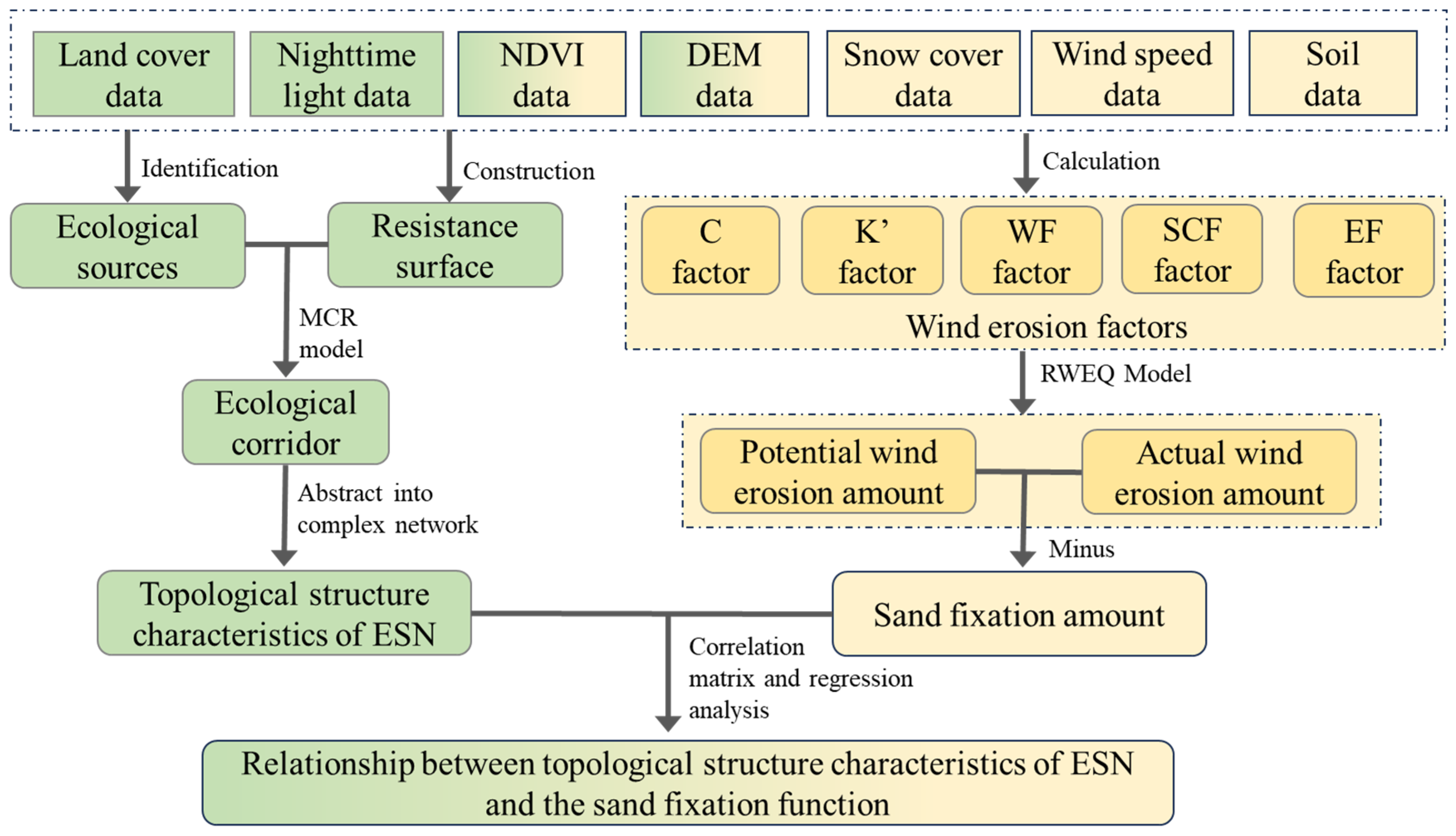
This study integrated the MCR model, complex network theory, and the RWEQ model to quantify the relationship between ESN topology and sand fixation capacity. The ESN was first constructed by identifying ecological sources and corridors and then abstracted into a complex network to evaluate structural features using six topological indices. Concurrently, the RWEQ model assessed the sand fixation capacity by calculating the difference between potential wind erosion (SR) and actual wind erosion (SL) based on climatic, soil, and vegetation drivers. Finally, correlation and regression analyses were performed to reveal the quantitative links between these topological indices and ecological functions, thereby providing a scientific basis for optimizing regional ecological spatial planning, as illustrated in Figure 2.

2.4. Construction of the ESN

In this study, the ESN was constructed by identifying ecological sources based on land-use type and patch area, and subsequently extracting ecological corridors using the MCR model. The underlying ecological resistance surface was synthesized from five key variables: vegetation cover, land-use, nighttime light, elevation, and slope.

2.4.1. Identification of Ecological Sources

Ecological sources refer to areas within an ecosystem that provide important ecosystem services, support biodiversity, and possess unique ecological functions [48]. In this study, landscape patches larger than 25 hectares and forest, shrub, and water land-use types were identified as ecological sources [49].
A minimum patch size of 25 hectares was adopted because patches below this threshold often fail to maintain stable vegetation–soil structures and are highly sensitive to disturbance. Similar thresholds have been used in ecological source identification and habitat viability studies: Regan et al. excluded suitable habitat patches smaller than 25 ha because they were considered too small to support viable populations [50]. Similarly, conservation guidelines and empirical assessments for rare vertebrates such as the Oregon spotted frog and the Western Silvery Minnow indicate that populations in habitats smaller than 25 ha face elevated extinction risk or fall below minimum viable population thresholds [51,52]. In addition, extensive evidence shows that small, fragmented patches are dominated by edge effects, reducing community stability [53,54].

2.4.2. Construction of Ecological Resistance Surface

The ecological resistance surface is a key link in the construction of the ESN, as it reflects the degree of obstruction that ecological flows encounter when moving through the landscape. Ecological flows disperse outward from ecological sources, and the resistance they must overcome during this diffusion process is calculated through pixel-wise accumulation. The resistance coefficient R i of any pixel in the propagation and diffusion process is determined by a total of 5 factors: elevation, slope, NDVI, nighttime light, and land-use type. To eliminate the influence of dimensional heterogeneity across the five resistance factors, a normalization process was applied prior to integration. Factors that positively correlate with ecological resistance, including elevation, slope, and nighttime light, were standardized using the positive normalization method (Equation (1)). In contrast, as higher vegetation coverage facilitates species migration and reduces ecological resistance, the NDVI data were processed using the reverse standardization method (Equation (2)).
F 1 = ( X M i n ) / ( M a x M i n )
where F 1   is the factor data after positive standardization; X is the original factor data; Min is the minimum value of the original factor data; Max is the maximum value of the original factor data.
F 2 = ( M a x X ) / ( M a x M i n )
where F 2   is the factor data after reverse standardization.
The land-use data are discrete, and the assignment method is shown in Table 3.
This assignment is based on the relative permeability of different land-use types to ecological flows and wind–sand movement. Forest, shrubland, and water bodies were assigned the lowest resistance (1) because their high vegetation cover, rough surface structure, and stable microclimate significantly slow wind speed and facilitate ecological processes. Grassland shows weaker surface roughness and lower biomass than forest, and thus, receives a slightly higher resistance value (2). Farmland and wetland (3) are frequently disturbed by human activities or seasonal hydrological changes, reducing their suitability for ecological flow continuity. Bare land (4) and impervious surfaces (5) represent the least permeable surfaces, functioning as barriers to species migration. This resistance ranking is widely adopted in ESN studies, reflecting a gradient of increasing ecological impedance from natural ecosystems to varying degrees of anthropogenic disturbance [55,56,57]. After assignment of the resistance values, positive standardization processing was also carried out.
On the basis of the dimensionless factor layers (0–1) obtained through the positive and reverse standardization described above, Principal Component Analysis (PCA) was applied to derive objective weights for the five resistance factors. A correlation matrix of the five factors was constructed using the pixel values across the study area, and PCA was performed on this matrix. Principal components with eigenvalues greater than 1 were retained, and the absolute loadings of each factor on these components were multiplied by the proportion of variance explained by each component and then summed to obtain an overall contribution score for each factor. Finally, these contribution scores were normalized so that their sum equaled 1, and the resulting values were used as the factor weights shown in Table 4. The factors were then superimposed according to their weights to generate a comprehensive resistance surface.

2.4.3. Construction of Ecological Corridors

Ecological corridors are strip-shaped areas with the least resistance to energy flow and material cycling when connecting two or more ecological sources [58]. They can promote gene exchange and species migration and are important for maintaining ecosystem integrity and biodiversity. Each ecological source has one or more ecological corridors linking to other sources [1].
In this study, the MCR model was used to construct ecological corridors based on the resistance system described in Section 2.4.2. The MCR model was proposed by Kanppen and is widely used in species protection, landscape pattern analysis, and related applications [11]. The model identifies the path with the minimum cumulative resistance between ecological sources by integrating “source”, “resistance”, and “cumulative cost”, and has become one of the most commonly used methods for constructing ESNs [59]. The general form of the MCR model can be expressed as
R m c = f m i n j = n i = m D i j × R i ( i = 1 ,   2 ,   3 , m ;   j = 1 ,   2 , , n )
where   R m c is the minimum cumulative resistance value, f m i n is an unknown negative function, D i j is the spatial distance from the source to the landscape unit, and R i is the resistance coefficient of the landscape unit to the propagation and diffusion process.
In this study, ecological corridors were extracted using the Cost Distance and Cost Path tools in ArcGIS based on the resistance surface. For each ecological source, cost–distance surfaces were calculated, and least-cost paths were generated to all other sources. To avoid generating unrealistically long corridors with limited ecological significance, a maximum cumulative resistance threshold equal to the 75th percentile of the cost–distance distribution was applied, and only source pairs with cumulative resistance values below this threshold were retained as effective corridors. This approach ensured that the extracted corridors represented ecologically meaningful connections rather than mathematically possible but biologically unrealistic long-distance links.

2.5. Complex Network Topological Structure Indices

To study the topological structure characteristics of the ESN, we transformed the centroids of ecological sources into ecological nodes and the corridors between ecological sources into connections between nodes. The ESN was then abstracted into the form of a complex network. We selected 6 indices, namely, Degree and Degree Distribution, Closeness Centrality, Betweenness Centrality, PageRank, Clustering Coefficient, and Coreness, to evaluate the topological structure of the ESN in the research area.

2.5.1. Degree and Degree Distribution

Degree measures the importance of a node by the number of other nodes it connects to. The higher the Degree, the more important the node. From a landscape ecology perspective, Degree represents the local connectivity capacity of a patch. A node with a high Degree serves as a local convergence center for species and energy, facilitating frequent material exchange with its immediate neighbors. For the network as a whole, the average Degree and Degree Distribution can reflect the network structure characteristics, connectivity, and attack resistance. The average value of the Degrees of all nodes is called the network average Degree [60]. The calculation formula is as follows:
k ¯ = 1 N i = 1 N k i
where k ¯ is the network average Degree, N is the number of nodes in the network, and k i is the Degree of the i -th node.
The network Degree Distribution is the ratio of the number of nodes with Degree k in the network to the total number of nodes:
k = N k N
where k is the network average Degree; N k is the number of nodes with Degree k in the network.

2.5.2. Closeness Centrality

Closeness Centrality measures the importance of a node by the average distance from that node to all other nodes in the network. The higher the Closeness Centrality, the shorter the average path from the node to other nodes, and the more important it is in the network. In the context of ecological processes, this index reflects the global efficiency of species migration or seed dispersal. A high Closeness Centrality value implies that a patch can physically reach (or be reached by) all other patches in the landscape with the fewest transfer steps, thereby minimizing the energy cost of migration.
The overall Closeness Centrality of the network can reflect characteristics such as network efficiency, connectivity, and robustness. Generally, the higher the overall Closeness Centrality of the network, the stronger these characteristics are [61]. The reciprocal of the average shortest path from a node to all other nodes is defined as the Closeness Centrality of the node. The calculation formula is as follows:
C i = N 1 j 1 d i j
where C i is the Closeness Centrality of node i , N is the total number of nodes in the network, and d i j is the shortest path distance from node i to node j .
In practical applications, the Closeness Centrality can be standardized so that its value range is between 0 and 1, facilitating the comparison of networks of different scales:
C i = C i N 1 = 1 j 1 d i j
where C i is the standardized Closeness Centrality of node i .

2.5.3. Betweenness Centrality

Betweenness Centrality measures the importance of a node as an intermediary for information transmission and for connecting other nodes. The higher the Betweenness Centrality of a node, the more important it is in the network, and the more likely it is to function as a hub node. Ecologically, nodes with high Betweenness Centrality act as critical “stepping stones” or “bridges” in the landscape. They control the bottlenecks of ecological flows, ensuring that matter and energy can traverse between otherwise disconnected habitat clusters.
The overall Betweenness Centrality distribution of the network can reflect characteristics such as network structural uniformity and robustness. The Betweenness Centrality of a node is defined as the ratio of the number of shortest paths passing through that node to the total number of shortest paths in the network [62]. The calculation formula is as follows:
B i = s t i σ s t ( i ) σ s t
where B i is the Betweenness Centrality of node i , σ s t ( i ) is the number of shortest paths passing through node, and σ s t is the total number of shortest paths in the network.

2.5.4. PageRank

PageRank determines the probability of a node being visited through a random walk model. The higher this probability, the greater the node’s PageRank value and the more important it is in the network. Unlike Degree, which only counts connection quantity, PageRank reflects the “quality” of the habitat neighborhood. A high PageRank indicates that a patch is surrounded by other high-quality, well-connected patches, representing a zone of high habitat suitability aggregation and ecological influence.
The PageRank distribution can reflect the structural heterogeneity of the network and its robustness against different types of attacks [63]. For unweighted, undirected graphs, the PageRank value of a node is calculated iteratively using the following formula:
R i = 1 d N + d j M i R j k j
where R i is the PageRank value of node i ; d is a model parameter, typically set to 0.85; k j is the Degree of node j ; M i is the set of all nodes linking to node i ; and R j is the PageRank value of node j .

2.5.5. Clustering Coefficient

The Clustering Coefficient is used to measure the tightness of connections between the neighbor nodes of a particular node. A higher Clustering Coefficient indicates more mutual connections between the neighboring nodes of that node. In landscape ecology, this metric reflects the local redundancy and resilience of the network. A high Clustering Coefficient implies that, if a specific path is blocked, alternative pathways exist within the local neighborhood to maintain the flow of ecological processes.
The overall Clustering Coefficient of a network can reflect the overall aggregation Degree of the network, while the distribution of the Clustering Coefficient can reflect structural characteristics such as network hierarchy [64]. The Clustering Coefficient of a node denotes the probability of mutual connections within its neighborhood, and the calculation formula is as follows:
L i = 2 E i k i ( k i 1 )
where L i is the Clustering Coefficient of node i , E i is the number of actual edges between the neighbors of node i , and k i is the Degree of node i .

2.5.6. Coreness

After removing all nodes of Degree k from a network, the remaining subset is called the k-core of the network. If a node belongs to the k-core but not the (k + 1)-core, its Coreness is k [65]. The maximum Coreness among all nodes in the network is defined as the network Coreness. This index reveals the “depth” of the ecological network’s hierarchy. High-Coreness nodes constitute the stable “backbone” of the ecosystem and are essential for maintaining the overall structural integrity of the landscape against external disturbances.
The overall Coreness of a network reflects its connectivity, robustness, and other structural characteristics [66].

2.6. Calculation of Sand Fixation Capacity

The sand fixation function quantifies the ecosystem’s capacity to mitigate soil loss, defined as the difference between potential wind erosion under bare soil conditions and actual erosion under vegetation cover [67]. To estimate these values, this study employed the RWEQ model, a model widely recognized for its effectiveness in predicting regional erosion dynamics over long time series using high spatiotemporal resolution data [68,69]. Consequently, the sand fixation capacity was calculated by subtracting the actual wind erosion from the potential wind erosion, as expressed in the following formula:
G = S R S L
where G is the sand fixation capacity (t/ha), S R is the potential wind erosion amount (t/ha), and S L is the actual wind erosion amount (t/ha).
The specific calculation formulae for S R and S L are as follows:
S R = 2 z s r 2 Q r m a x × e ( z / s ) 2
S L = 2 z s 2 Q m a x × e ( z / s ) 2
where z is the downwind distance (m) calculated, taken as 50 m in this calculation [70]; s r is the potential critical plot length (m); s is the critical plot length (m); Q r m a x is the maximum sediment transport capacity of potential wind (t/ha); and Q m a x is the maximum sediment transport capacity of wind (t/ha).
The s r , s , Q r m a x , and Q m a x used to calculate SR and SL can be obtained from the climate factor, soil erodibility factor, soil crust factor, soil roughness factor, and vegetation factor. Their specific calculation formulae are as follows:
s r = 150.71 ( W F × E F × S C F × K ) 0.3711
s = 150.71 ( W F × E F × S C F × K × C ) 0.3711
Q r m a x = 109.8 ( W F × E F × S C F × K )
Q m a x = 109.8 ( W F × E F × S C F × K × C )
where W F is the climatic factor (kg/m), E F is the soil erodibility factor (dimensionless), S C F is the soil crust factor (dimensionless), K is the soil roughness factor (dimensionless), and C is the vegetation factor (dimensionless).
It is important to clarify the biophysical distinction between SR and SL. SR represents the theoretical potential wind erosion under a ‘worst-case’ scenario of completely bare soil (where the vegetation factor C is effectively treated as 1). In contrast, SL represents the realized erosion under the actual vegetation coverage. Therefore, the difference (G) is not merely a mathematical derivative but physically quantifies the “avoided erosion”, representing the explicit ecosystem service provided by vegetation in preventing soil loss.
The calculation of W F , E F , S C F , K , and C factors is described in Section 2.6.1, Section 2.6.2, Section 2.6.3, Section 2.6.4 and Section 2.6.5, respectively.

2.6.1. The Climatic Factor ( W F )

The W F factor comprehensively incorporates temperature, precipitation, air temperature, snow cover, and sunshine conditions to analyze the ability of wind to erode and transport surface materials. The calculation formula is as follows:
W F = w f ρ g S W S D
where w f is the wind force coefficient (m·s−3); ρ is the air density (kg·s−3), taken as 1.29 in this paper; g is the gravitational acceleration (m·s−2); S W is the soil moisture content (dimensionless); and S D is a dimensionless ratio defined as the proportion of days within the study period characterized by a snow depth of less than 25.44 mm.
The calculation formula for w f is as follows:
w f = U 2 U 2 U 1 2 N d
where U 1 is the threshold wind speed for sand movement (m·s−1), taken as 5 in this paper; U 2 is the wind speed at a 2 m height (m·s−1); and N d is the number of days per month when the wind speed exceeds the threshold wind speed (day).

2.6.2. The Soil Erodibility Factor ( E F )

The EF factor measures soil erodibility, that is, the sensitivity of soil to wind erosion under wind action. It is influenced by soil sand, soil silt, soil clay, soil organic matter, and soil calcium carbonate contents. The value of the erodibility factor is usually between 0 and 1, with higher values indicating greater susceptibility to wind erosion [71].
E F = 29.09 + 0.31 S a + 0.17 S i + 0.33 S a C l 2.59 O M 0.95 C a C O 3 100
where E F is the soil erodibility factor (dimensionless), S a is the soil sand content (%), S i is the soil silt content (%), C l is the soil clay content (%), O M is the soil organic matter content (%), and C a C O 3 is the soil calcium carbonate content (%).

2.6.3. The Soil Crust Factor ( S C F )

Soil crust refers to a thin, hardened, or compacted layer formed on the soil surface that can resist wind erosion. The SCF measures the resistance of the soil crust layer to wind erosion. Crust formation is related to the soil clay content and soil organic matter content. The value of the S C F is usually between 0 and 1, with higher values indicating stronger resistance of the soil crust layer to wind erosion. The calculation formula is as follows:
S C F = 1 1 + 0.0066 C l 2 + 0.021 O M 2
where S C F is the soil crust factor (dimensionless).

2.6.4. The Soil Roughness Factor ( K )

K measures the degree of surface unevenness and spatial undulation. Higher K indicates large and irregular surface undulations, which help inhibit the flow of wind-blown sand and the occurrence of wind erosion. Lower K reflects a relatively flat surface, allowing wind sweep the soil surface more easily and increasing the possibility of erosion. The calculation formula is as follows:
K = cos α
where α   is the slope, which can be extracted from the DEM.
Given the negligible interannual variation in terrain, we consider this factor to be constant over the study period.

2.6.5. The Vegetation Factor ( C )

C quantifies the capacity of vegetation cover to suppress wind erosion by reducing the kinetic energy of wind flow and protecting the soil surface. A higher vegetation coverage significantly lowers the soil’s susceptibility to erosion. In this study, C is calculated based on the vegetation coverage rate (FVC) using the following exponential function:
C = e 0.0483 F V C
where C is the vegetation factor (dimensionless), and F V C is the vegetation coverage rate, expressed as a percentage (0–100).
The F V C is derived from the NDVI using the dimidiate pixel model, which assumes that a pixel consists of a mosaic of vegetation and bare soil. The calculation formula is
F V C = N D V I N D V I s o i l N D V I v e g N D V I s o i l × 100 %
where N D V I s o i l is the NDVI value of bare soil areas and N D V I v e g is the NDVI value of areas with complete vegetation coverage.
To minimize noise from the remote sensing images, N D V I s o i l and N D V I v e g were determined based on the cumulative frequency distribution of the NDVI values in the Zhangbei region. Specifically, the NDVI values corresponding to the 5% and 95% confidence intervals were selected to represent N D V I s o i l and N D V I v e g , respectively.

2.7. Correlation and Regression Analysis Between Network Topology and Sand Fixation Function

To quantify the relationships between ESN structural properties and the sand fixation function, we first constructed correlation matrices between node-level topological indices and the sand fixation capacity. For each of the four years considered in this study, Pearson’s product–moment correlation coefficients were calculated using the values of all ecological nodes in that year. Two-tailed tests with a significance level of p < 0.05 were applied to assess statistical significance, and the correlation coefficients are summarized in a correlation matrix.
On this basis, we further examined the predictive relationships between the network topology and sand fixation function using regression analysis. Specifically, for each year we selected those topological indices that exhibited relatively high absolute Pearson correlations with the sand fixation capacity in the correlation matrix, and used them as independent variables in multiple linear regression models, with the sand fixation capacity as the dependent variable.
The models were fitted using ordinary least squares. For each yearly model, overall model fit and statistical significance were evaluated using the multiple correlation coefficient, the coefficient of determination, and the F-test, while the significance of individual predictors was assessed using t-tests at the p < 0.05 level. In the regression output, we calculated standardized regression coefficients ( β ) to compare the relative contribution of each topological indicator. To check the independence of residuals, Durbin–Watson statistics were also computed for the regression residuals of each year.

3. Results Analysis

3.1. Construction of the ESN

3.1.1. Construction of the Ecological Resistance Surface

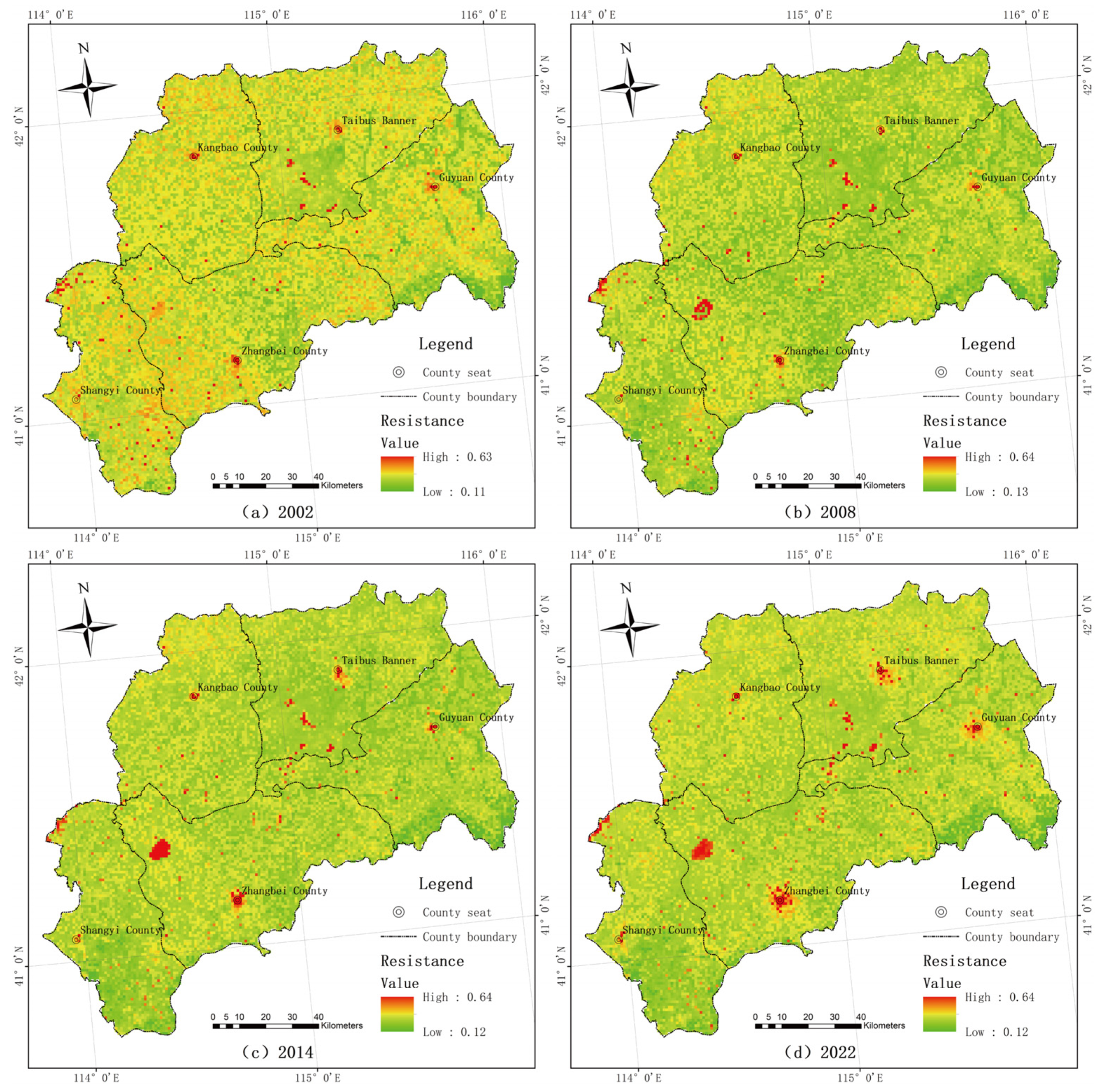
According to the method described in Section 2.4.2, the ecological resistance of the study area in 2002, 2008, 2014, and 2022 was evaluated. The results are shown in Figure 3. As illustrated in Figure 3, the ecological resistance of the study area exhibited a similar spatial pattern over the 22 years—the overall resistance value in the Zhangbei region was relatively uniform, with the highest resistance values occurring around the county administrative centers. Statistical analysis of the annual average ecological resistance values revealed no obvious trend of change over the study period, fluctuating around a mean of 0.38. The maximum average resistance of 0.39 occurred in 2008, while the minimum average resistance of 0.37 was observed in 2002. This trend in resistance indicates that the spatial distribution and temporal evolution of ecological resistance in the study area have remained basically stable in recent years.

3.1.2. Screening of Ecological Source Areas and Extraction of Ecological Corridors

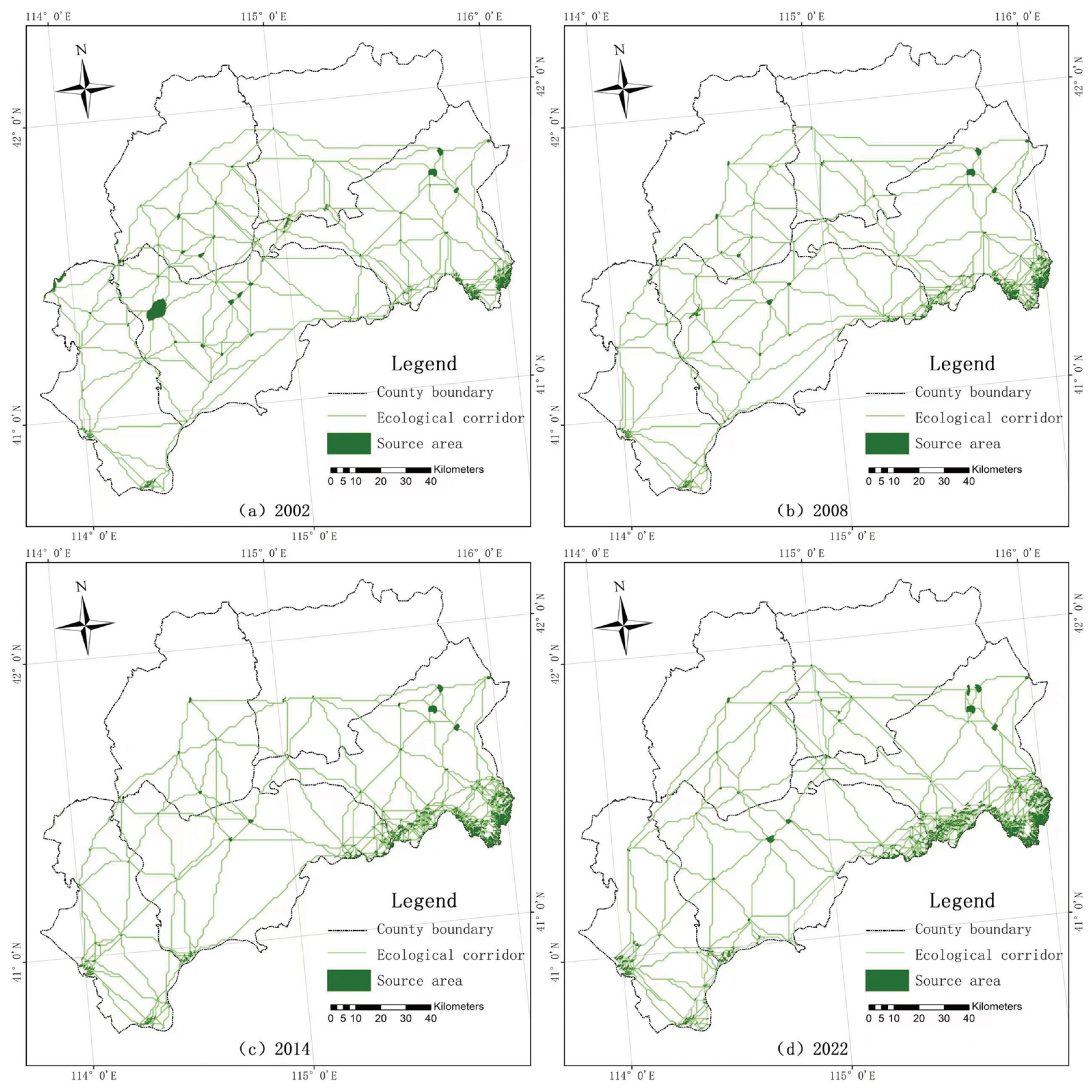
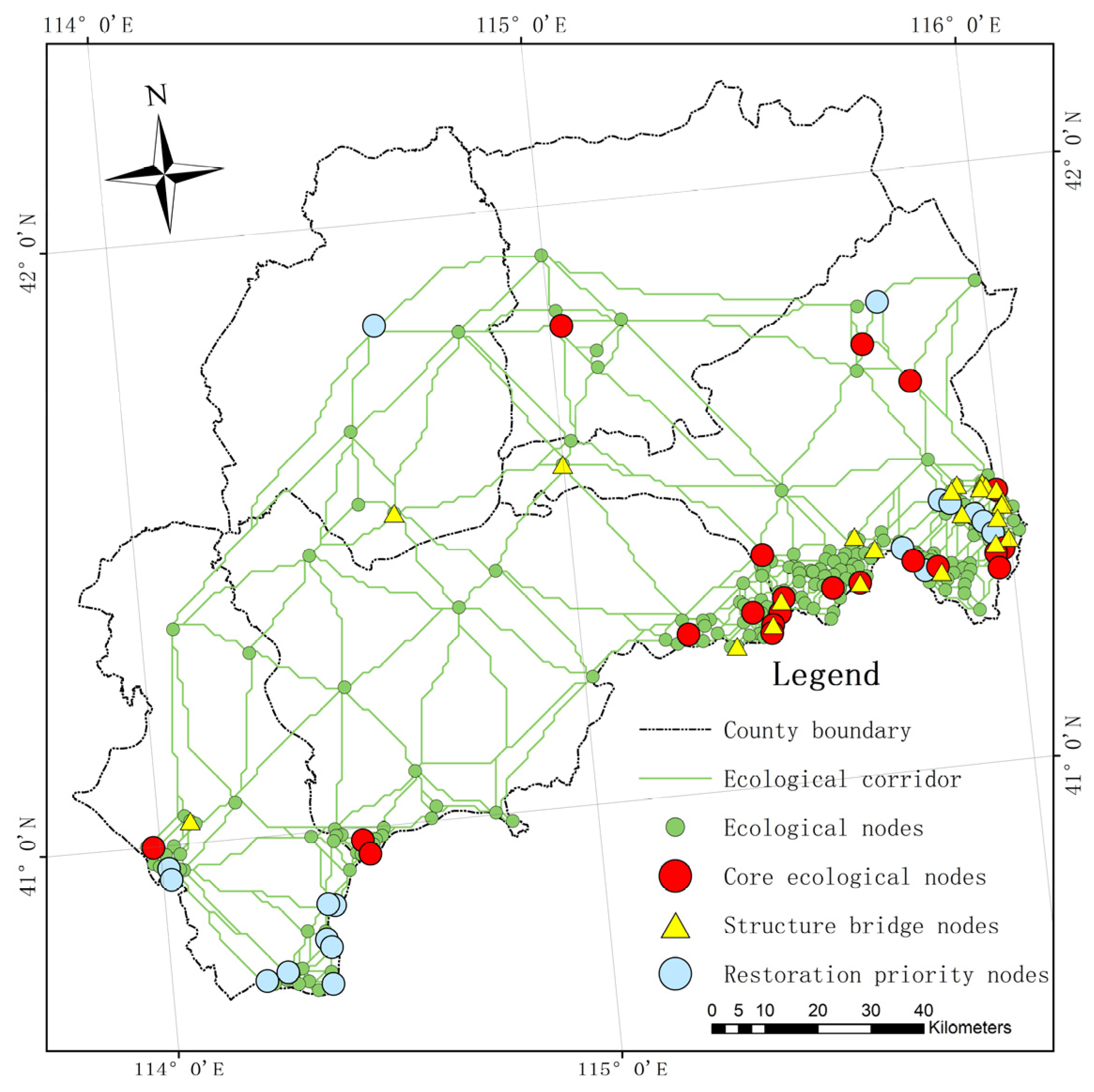
According to the method in Section 2.4.1, ecological source areas were screened and ecological corridors were extracted based on ecological resistance to form the ESN of the study area, as shown in Figure 4. As illustrated in Figure 4, ecological source areas in the study area are relatively dense in the southeast, with large patch areas and continuous spatial distribution. Some sources in the north and west also show continuous distribution, while those in the central part are sparse and appear as discrete patches. The numbers of source patches in 2002, 2008, 2014, and 2022 were 110, 147, 195, and 230, with areas of 17,239.59, 14,654.97, 21,456.79, and 30,311.94 ha, respectively. The total area of source patches showed a fluctuating upward trend over the years, with the largest area in 2022 and the smallest in 2008. The main ecological corridors in the study area are relatively evenly distributed. In the southeast, where ecological sources are dense, the corridors are shorter and more numerous. The number of ecological corridors in 2002, 2008, 2014, and 2022 was 296, 415, 575, and 734, respectively, showing a clear increasing trend, possibly due to the significant increase in the number and area of ecological patches as the ecological environment improved.

3.2. Topological Structure Characteristics of the ESN

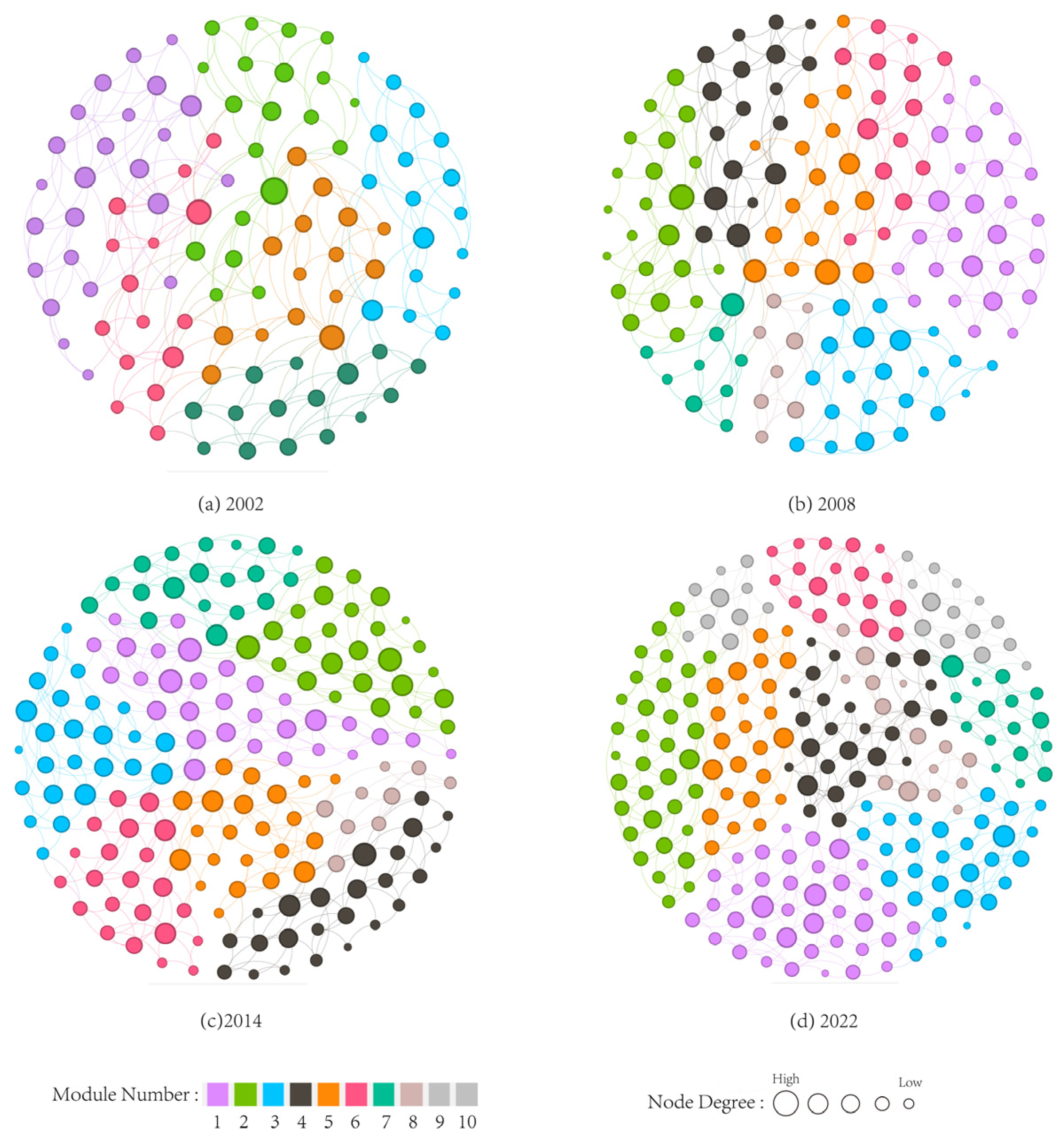
Based on complex network theory, the ecological source areas in each year were abstracted as nodes, and the ecological corridors between them were abstracted as connecting edges to construct the topological structure of the ESN in the Zhangbei region (Figure 5). As illustrated in Figure 5, the topological structures of the ESN were relatively similar during the study period, with obvious modular structures. The average number of modules was eight, and the average modularity was 0.67, which was higher than the ESN modularity threshold, with small fluctuations in each year. This indicates that ecological nodes in the network have more connections within modules, while connections between modules are relatively fewer, and the ESN has highly modular structural characteristics.

3.2.1. Degree and Degree Distribution

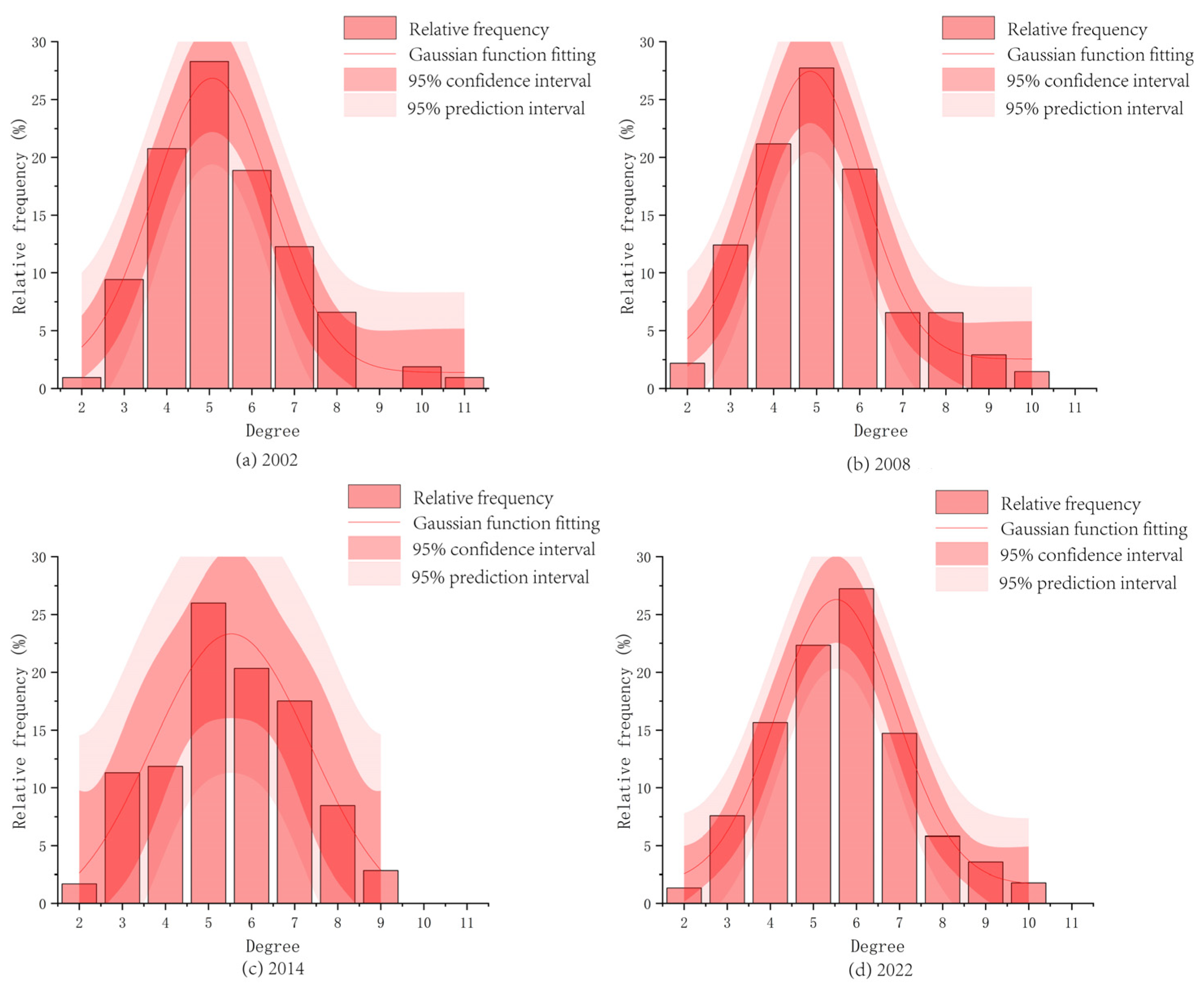
The average Degrees of the ESN in 2002, 2008, 2014, and 2022 were 5.36, 5.18, 5.53, and 5.63, respectively, showing a slight increase with small fluctuations (the standard deviation is 0.187). This means that, on average, each ecological source area is connected to about five neighboring source areas and that the overall network connectivity has remained relatively stable over the past two decades (Figure 6). Ecologically, this relatively constant and moderate Degree suggests that pathways for ecological flows related to wind erosion control and sand fixation have been largely maintained through time, with only a modest improvement in redundancy.
The Degree Distributions in each year were fitted with a Gaussian function (Figure 6). The results exhibit characteristics typical of random networks (approximating a Poisson distribution), particularly in 2002 and 2008. This implies that the number of links per node is relatively random and that there is no pronounced “rich-get-richer” effect. Ecologically, the absence of extreme hub nodes means that sand fixation and other ecological functions are not overly concentrated in a few patches, which enhances the network’s robustness to random disturbances.
From 2014 to 2022, the Degree Distribution gradually tended towards a more symmetric, quasi-normal shape, indicating the emergence of locally prominent nodes, while extreme hubs remained absent. These locally prominent nodes can act as local centers for ecological flows and may improve the efficiency of transmitting sand fixation effects within their neighborhoods. At the same time, their increasing relative importance may slightly raise the network’s sensitivity to targeted disturbances (e.g., degradation or conversion of these nodes). Overall, most nodes still have a medium number of connections (around five), suggesting that ecological functions remain relatively evenly distributed in space, and the slight increase in average Degree reflects a slow but steady enhancement of ecological connectivity associated with ongoing restoration efforts.

3.2.2. Closeness Centrality

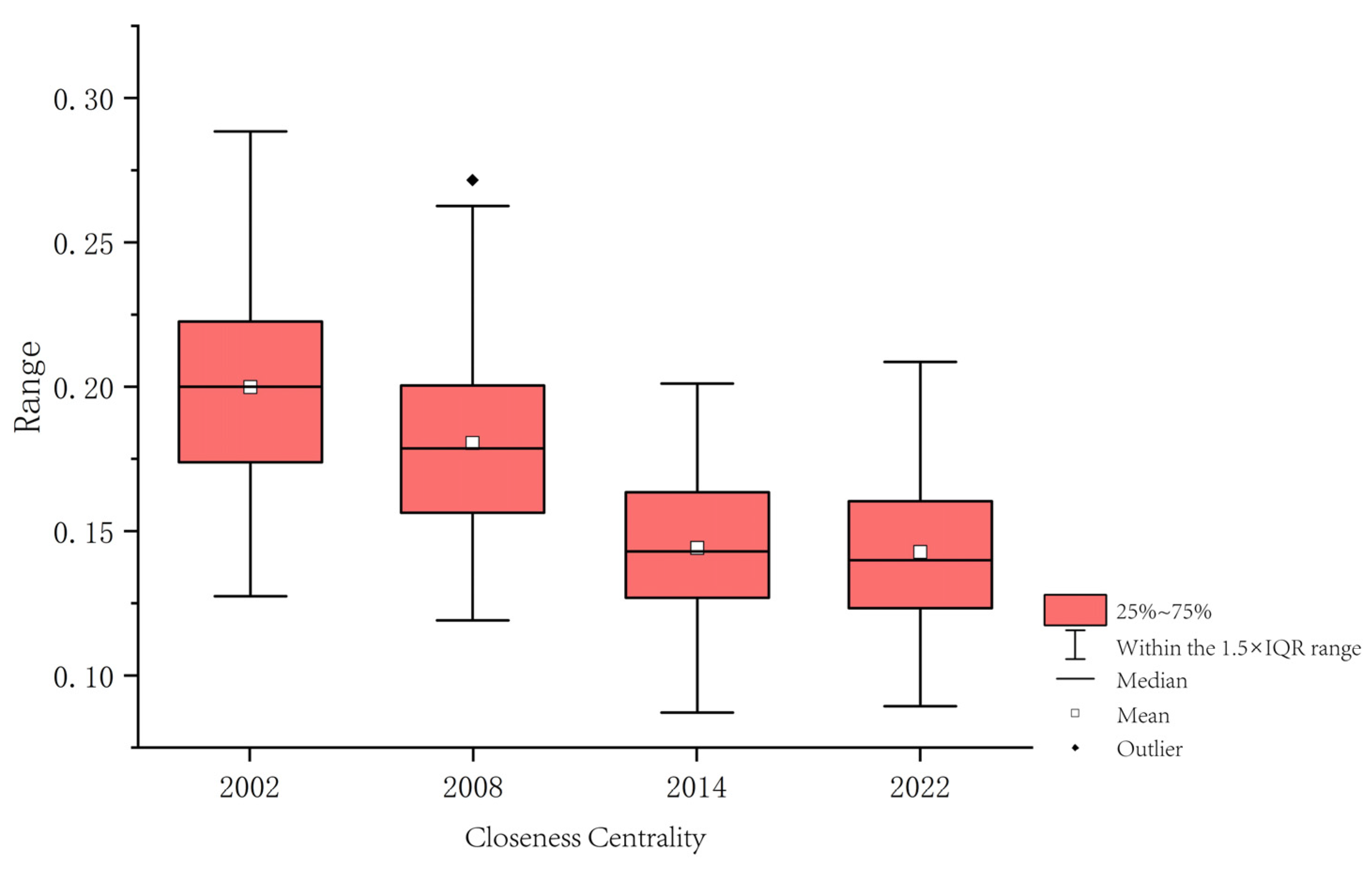
Based on complex network theory, this study calculated the Closeness Centrality of ecological nodes in the Zhangbei region. To characterize the temporal evolution of global network efficiency, the distribution of Closeness Centrality values for each year was visualized using boxplots (Figure 7).
As illustrated in Figure 7, the Closeness Centrality of the ESN exhibits a clear downward trajectory throughout the study period. The average value (indicated by the hollow square) decreased continuously from 0.205 in 2002 to 0.182 (2008), 0.149 (2014), and 0.145 (2022). The median values showed a similar decline, shifting from the upper quartile of the subsequent years.
This statistical trend indicates an increase in the average topological distance between ecological nodes as the network expands. Ecologically, the decline reflects reduced global transmission efficiency, meaning that ecological flows—such as seed dispersal, fauna migration, or the synergistic interactions of windbreaks—require longer paths or more intermediate steps to traverse the landscape compared with the more compact structure observed in 2002. While the network coverage may have increased, the reduced Closeness Centrality suggests that the overall cohesiveness of the sand fixation barrier has slightly weakened, potentially slowing down the system’s collective response to regional ecological stressors.

3.2.3. Betweenness Centrality

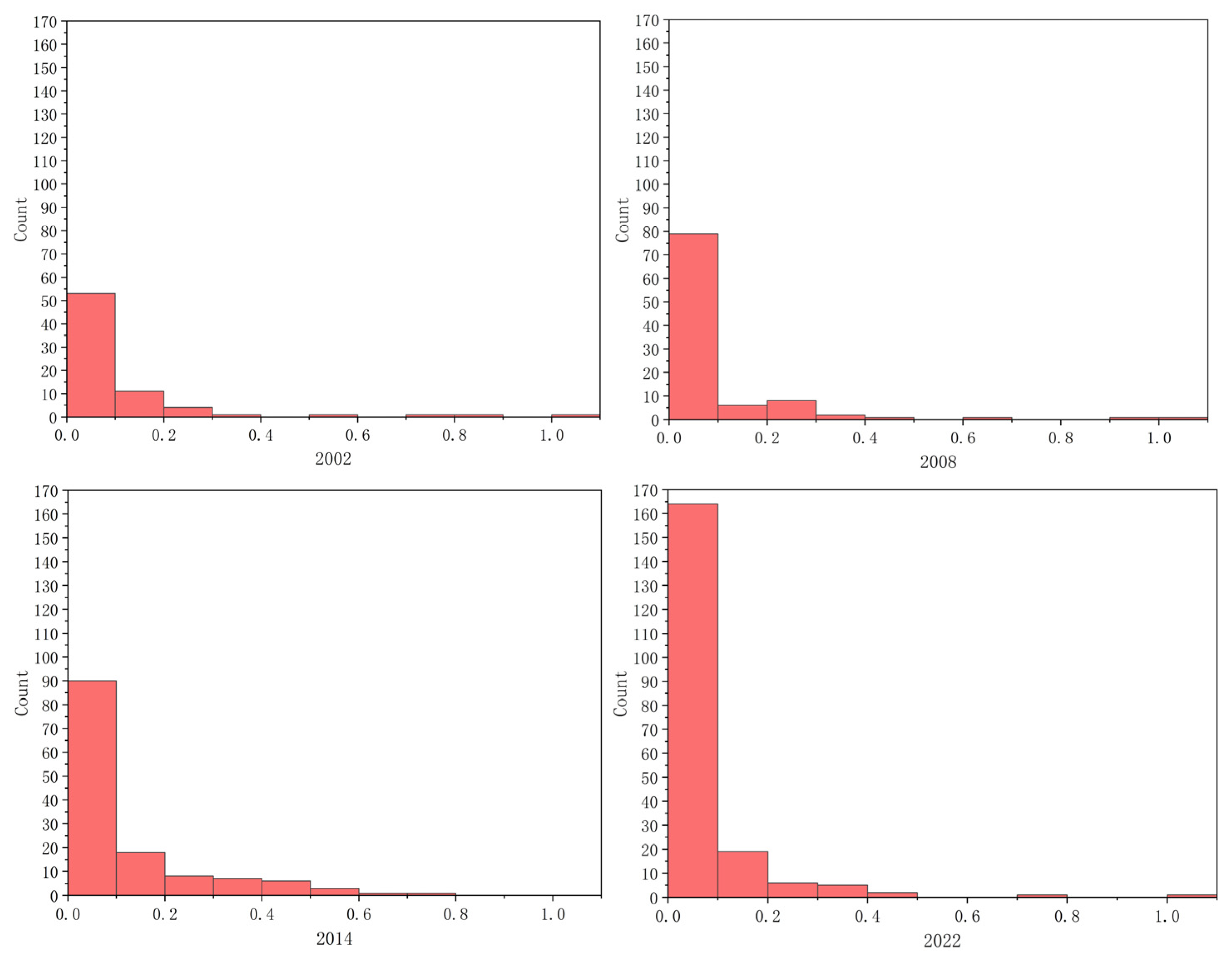
The Betweenness Centrality of each ecological node in the study area was calculated, and the frequency distribution for each year was plotted as histograms (Figure 8). The histograms show highly right-skewed distributions: in all four years, the Betweenness Centrality of the vast majority of nodes is close to 0, whereas only a very small proportion of nodes reach Betweenness Centrality values above 0.3, and a few extreme nodes approach 1.0. This uneven distribution reveals a pronounced hub-like structure, where the shortest paths between nodes pass through a limited number of bridge nodes. Ecologically, these high Betweenness Centrality nodes function as key connector patches or corridors that concentrate ecological flows such as wind–sand blocking and material/organism exchange, while the many low Betweenness Centrality nodes mainly play local roles. As a result, random disturbances to ordinary nodes may have limited influence on overall connectivity, whereas damage to these bridge nodes can strongly disrupt regional sand fixation pathways.
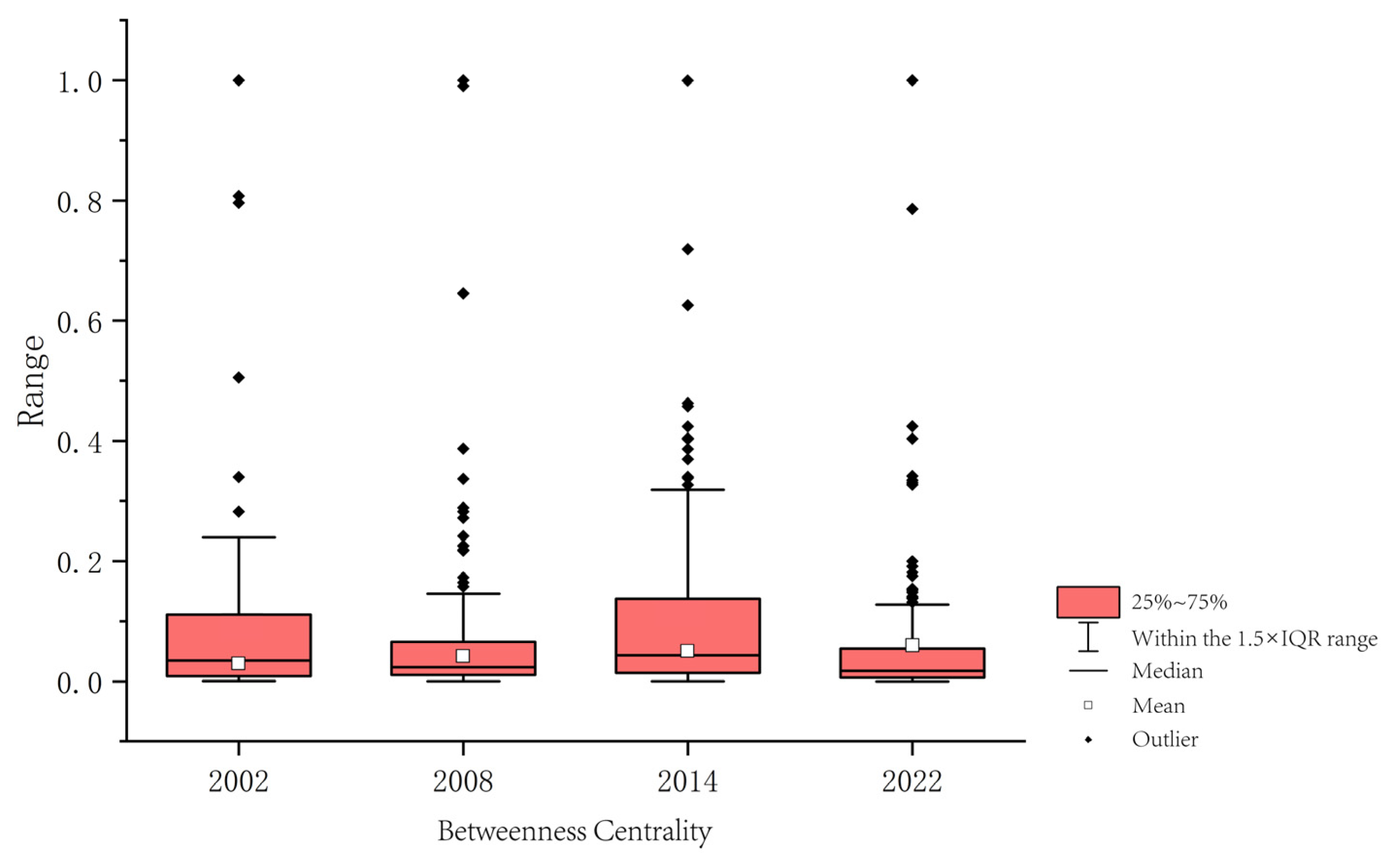
In addition, boxplots of Betweenness Centrality were used to summarize interannual changes in the central tendency and dispersion of node Betweenness Centrality (Figure 9). The average Betweenness Centrality values in 2002, 2008, 2014, and 2022 were 2.12 × 10⁻², 3.20 × 10⁻², 5.33 × 10⁻², and 6.79 × 10⁻², respectively, indicating an overall increasing trend. However, the boxplots reveal a more complex pattern in distribution. While the mean values consistently rose, the median and interquartile range (IQR) fluctuated across the study period. Specifically, the IQR was relatively narrow in 2008 and 2022 compared with 2014, suggesting that while the average centrality increased, the majority of nodes remained within a concentrated range in those years. Notably, the number of upper outliers increased significantly, particularly in 2014 and 2022. This indicates that the increase in the average Betweenness Centrality was largely driven by a subset of nodes acquiring extremely high values rather than by a uniform shift across all nodes. This confirms that the ESN gradually evolves towards a more hierarchical structure dominated by several important bridge patches. Ecologically, this may improve the efficiency with which sand fixation effects and other ecological functions are transmitted over long distances, but it also increases the dependence of the network on a limited set of critical nodes, thereby reducing robustness to targeted disturbances and highlighting the need to prioritize the protection of these key patches.

3.2.4. PageRank

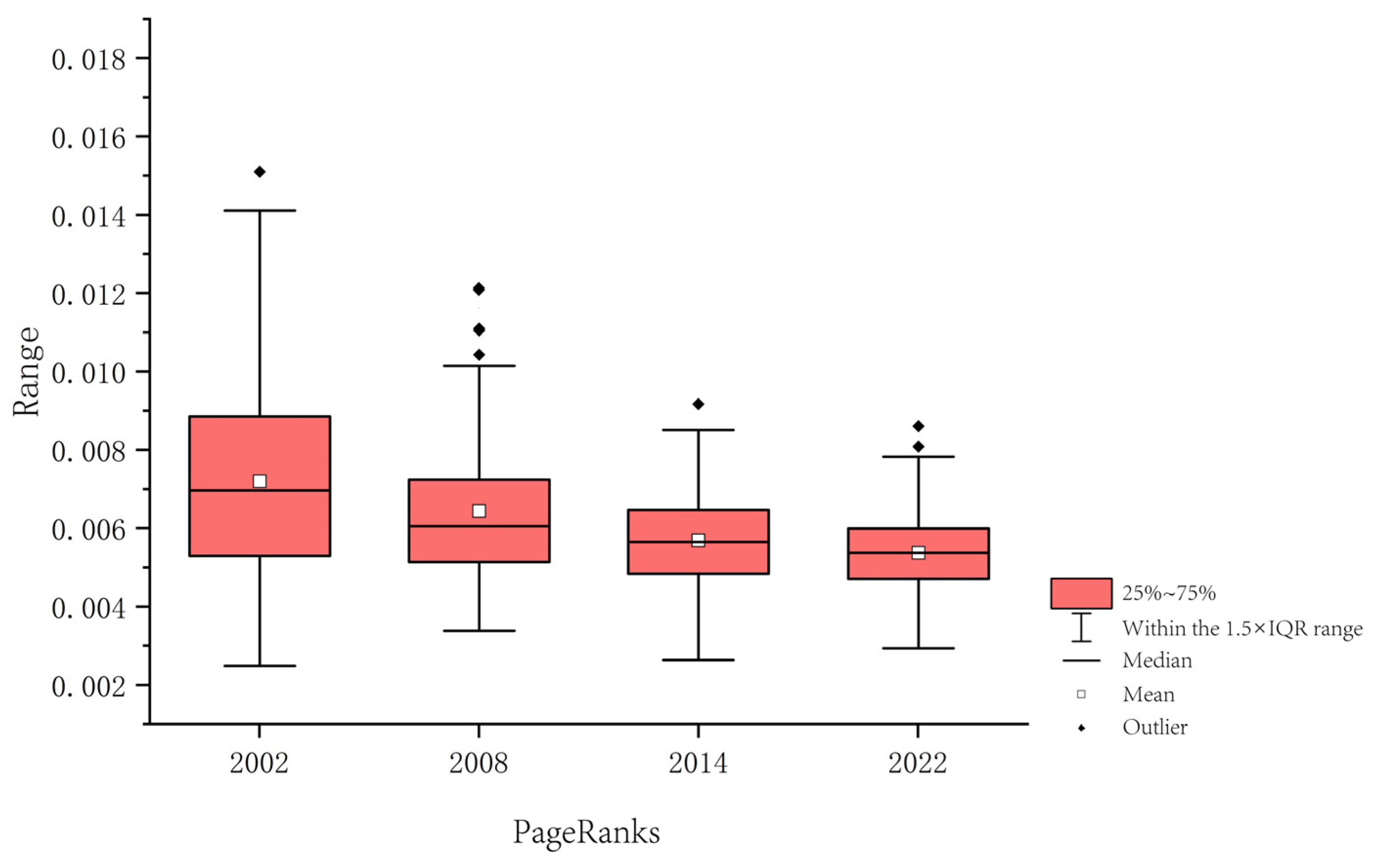
Based on the PageRank algorithm, this study quantitatively analyzed the importance of nodes in the ESN of the Zhangbei region. To characterize the temporal changes in node influence, the distribution of PageRank values for each year was visualized using boxplots (Figure 10).
As shown in Figure 10, the PageRank values exhibit a distinct downward and converging trend. The average PageRank value (indicated by the hollow square) decreased from 0.72 × 10⁻² in 2002 to 0.53 × 10⁻² in 2022. The median and the interquartile range (the height of the red box) showed a similar shrinking pattern. This statistical narrowing indicates that the influence of nodes has become more evenly distributed, and the disparity between high- and low-importance nodes has gradually diminished over the past two decades.
Ecologically, this declining and tightening pattern reflects a “dilution effect” of the relative influence of core nodes as the ecological network expands. It signifies an evolution from a more centralized structure towards a more decentralized one. In this configuration, sand fixation and other ecological functions are shared by a larger number of patches rather than being dominated by a few super-nodes. This increased functional redundancy potentially enhances the system’s resilience to random or local disturbances, as the failure of a single patch is less likely to disrupt the entire network.

3.2.5. Clustering Coefficient

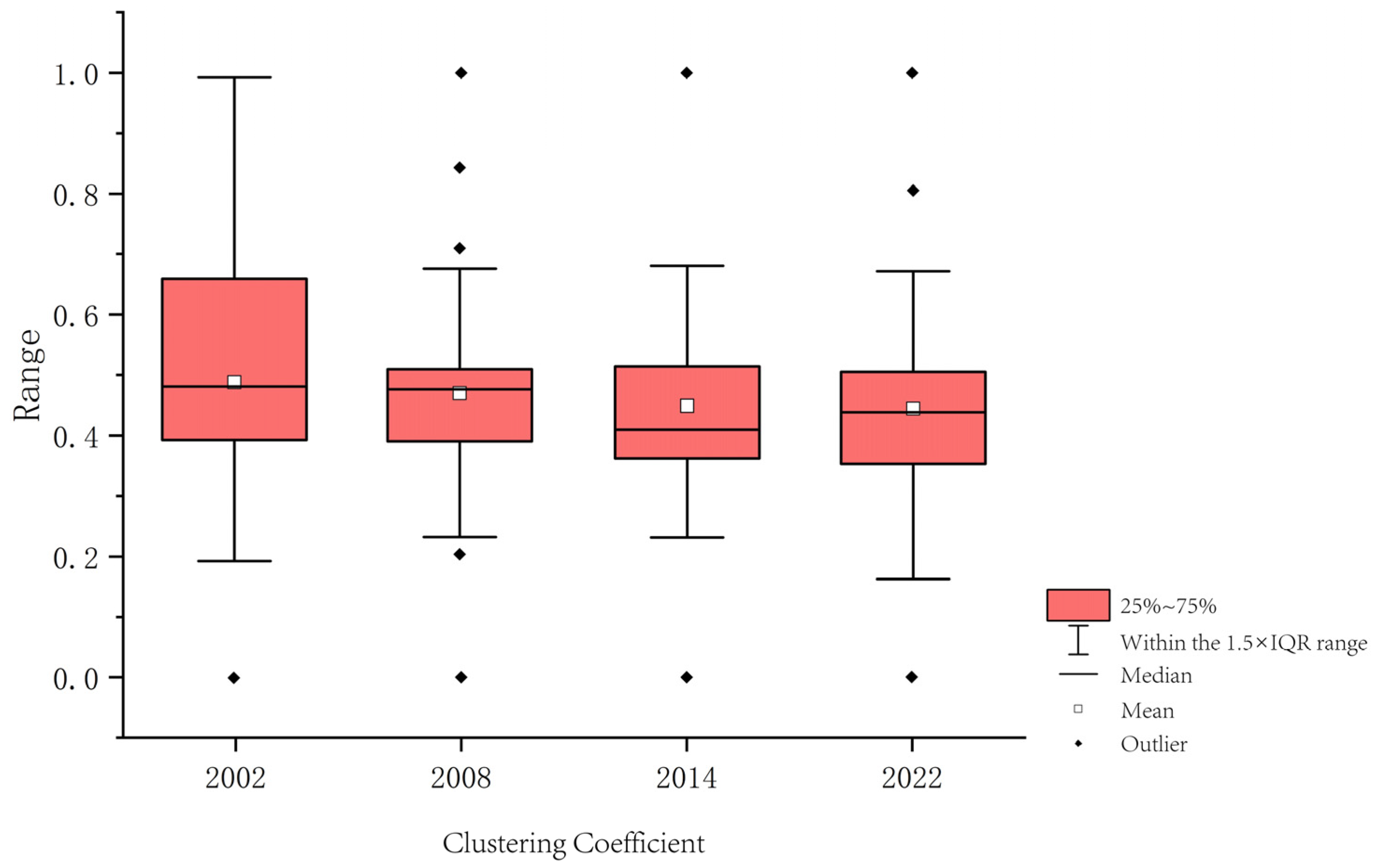
Based on the undirected network model, this study calculated the Clustering Coefficient of ESN nodes to evaluate the local cohesive structure of the network. The distribution and temporal changes in these coefficients are visualized using boxplots in Figure 11.
As shown in Figure 11, the Clustering Coefficient predominantly ranges from 0.3 to 0.7, with the interquartile range centered around 0.4–0.5. This relatively high value indicates that the network possesses strong “small-world” properties, where nodes tend to form tight local clusters. Ecologically, such a high Clustering Coefficient implies strong local functional redundancy: if one patch is disturbed, adjacent connected patches can quickly compensate for its ecological functions, thereby maintaining local stability.
Temporally, however, the average Clustering Coefficient showed a slight but continuous downward trend, decreasing from 0.49 in 2002 to 0.48 (2008), 0.47 (2014), and 0.46 (2022). Although the median value fluctuated, reaching its lowest point in 2014, the general decline in the mean suggests that, as the network expands, the connection density within local clusters has gradually become looser. This phenomenon is likely due to the addition of new ecological source areas or corridors that are initially connected to the network backbone but lack intricate lateral connections with their immediate neighbors. From an ecological perspective, this thinning of local clusters means that the synergistic effects between neighboring patches are slightly weakening.

3.2.6. Coreness

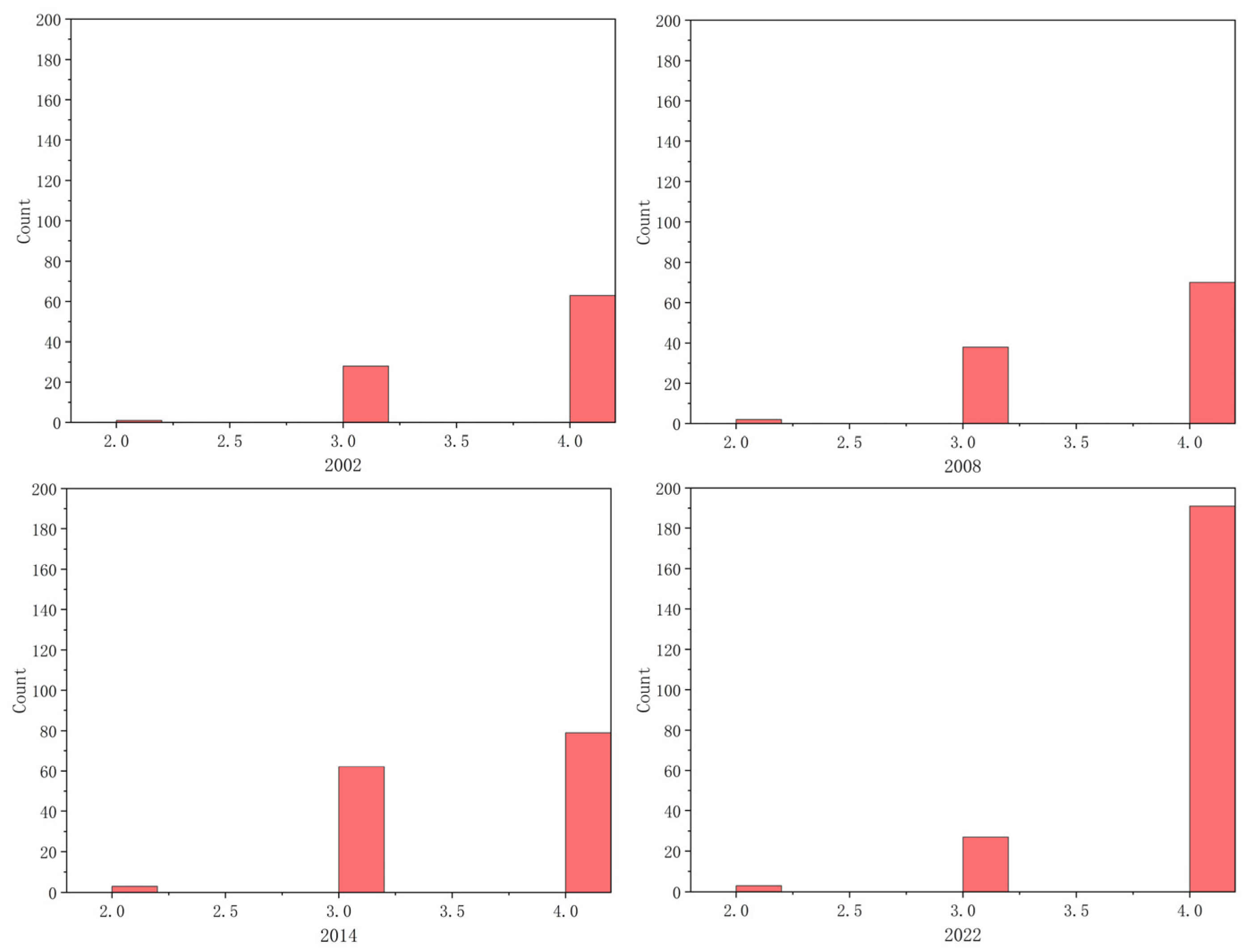
The Coreness of the nodes was analyzed to evaluate the hierarchical depth and stability of the ESN. Since Coreness values are discrete integers, the frequency distribution for each year is presented using histograms (Figure 12).
As is clearly shown in Figure 12, the network exhibits a trend of “core densification”. In the earlier periods (2002–2014), the nodes were distributed across k-shells 2, 3, and 4, with a relatively balanced proportion between shells 3 and 4. However, by 2022, a significant structural shift occurred: the number of nodes in the maximum k-shell (k = 4) surged dramatically, dominating the network, while the proportion of peripheral nodes (k = 2 or 3) decreased.
Ecologically, this increase in Coreness indicates that the “backbone” of the ecological security network has become significantly more robust. A higher Coreness value implies that these nodes are located in the deep core of the network and are mutually connected to other highly connected nodes. This structure is notoriously resistant to unraveling; even if peripheral patches are removed, this dense core can sustain the network’s fundamental structure. Therefore, despite the observed decrease in global transmission efficiency (Closeness Centrality) and local clustering (Clustering Coefficient) mentioned earlier, the structural stability of the network’s core has actually improved, securing the long-term persistence of sand fixation functions against cascading failures.

3.3. Sand Fixation Function

Based on the RWEQ model framework described in Section 2.6, this section quantifies the spatiotemporal patterns of S R , S L , and G in the Zhangbei region.

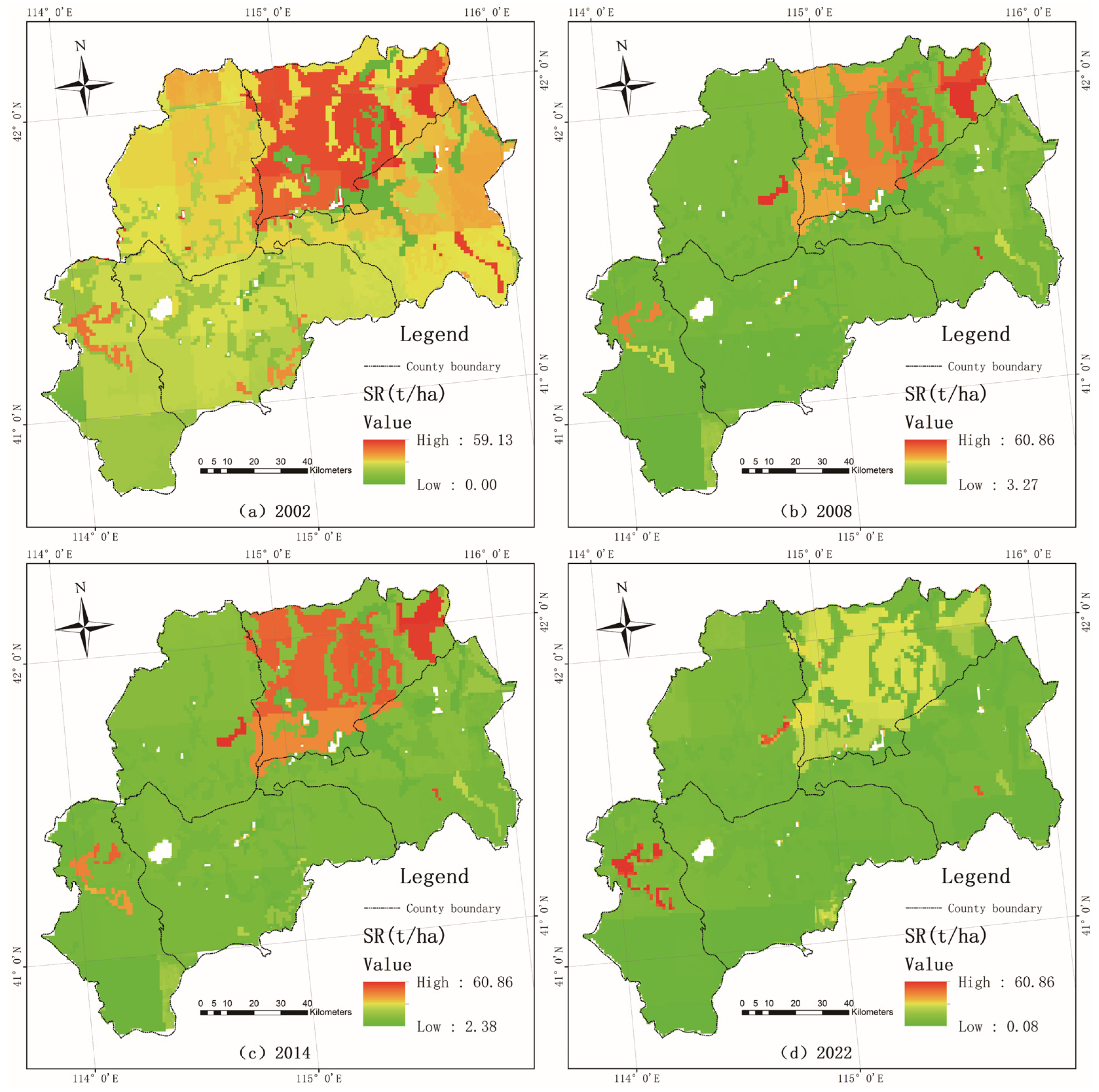
3.3.1. S R in Zhangbei Region

The S R function is shown in Figure 13. Spatially, high-potential zones are concentrated in the northern agro-pastoral transition belt and southwestern hotspots, driven by intrinsic soil and topographic factors. Temporally, S R exhibited a fluctuating trend dictated by climatic variability. The average potential erosion rose from 30.55 t/ha in 2002 to a peak of 46.86 t/ha in 2008, before declining to 31.68 t/ha (2014) and 28.03 t/ha (2022). As S R excludes vegetation effects, these fluctuations reflect changes in regional climatic erosivity rather than human intervention, suggesting that the lower erosion potential in 2022 provided a naturally favorable environmental baseline for restoration.

3.3.2. S L in Zhangbei Region

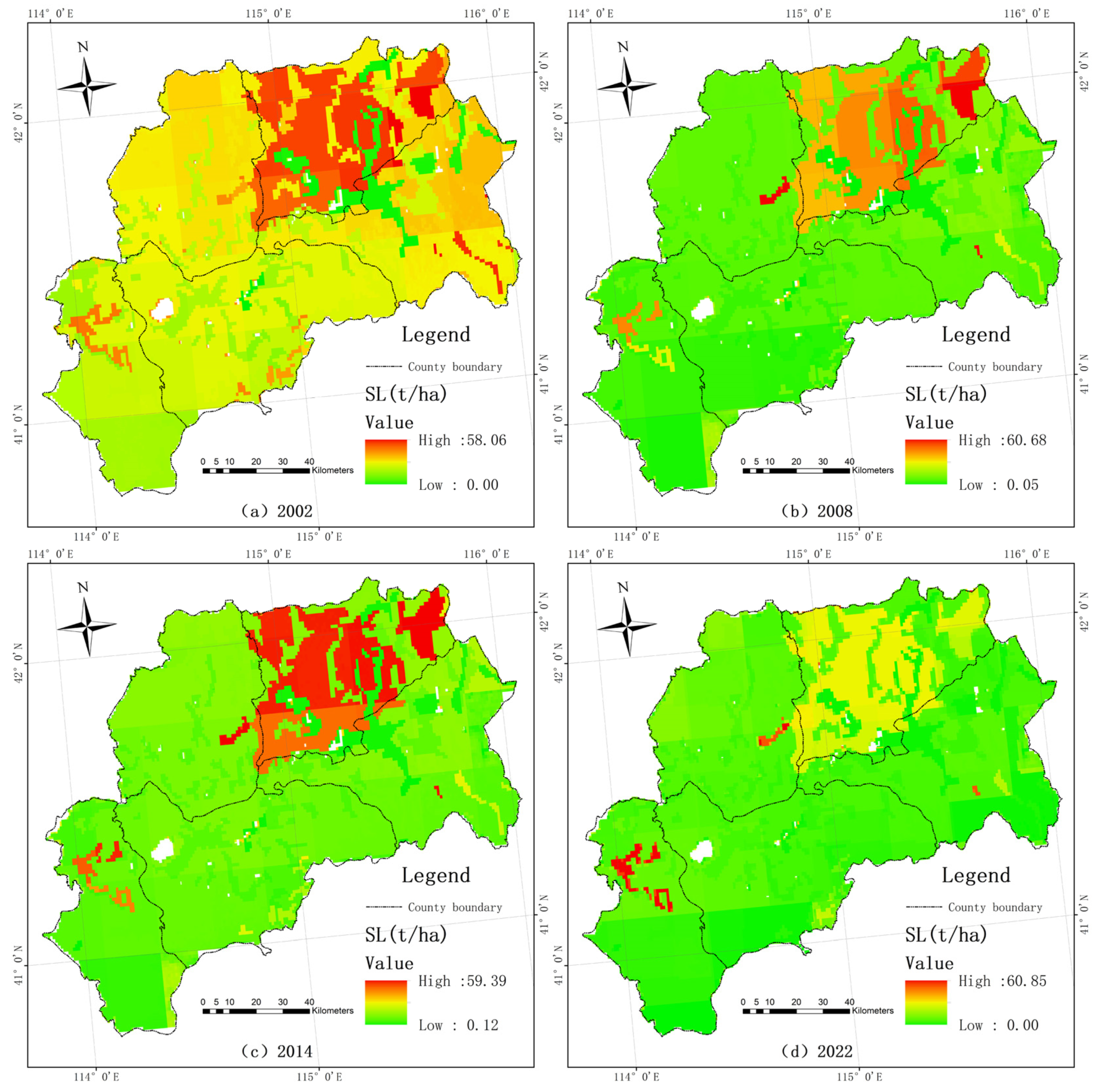
The results of S L are shown in Figure 14. Spatially, S L exhibits significant regional heterogeneity, with higher values concentrated in the northern agro-pastoral ecotone and localized hotspots in the southwest. Temporally, unlike S R , S L demonstrated a fluctuating downward trend. The average erosion modulus decreased from 20.18 t/ha in 2002 to 8.22 t/ha in 2008. Despite a slight rebound to 11.08 t/ha in 2014 due to climatic variability, it dropped significantly to 2.83 t/ha in 2022. This overall decline, evidenced by the shrinking of high-erosion zones, highlights the long-term effectiveness of ecological protection measures, which have successfully enhanced surface resistance to wind erosion.

3.3.3. G in Zhangbei Region

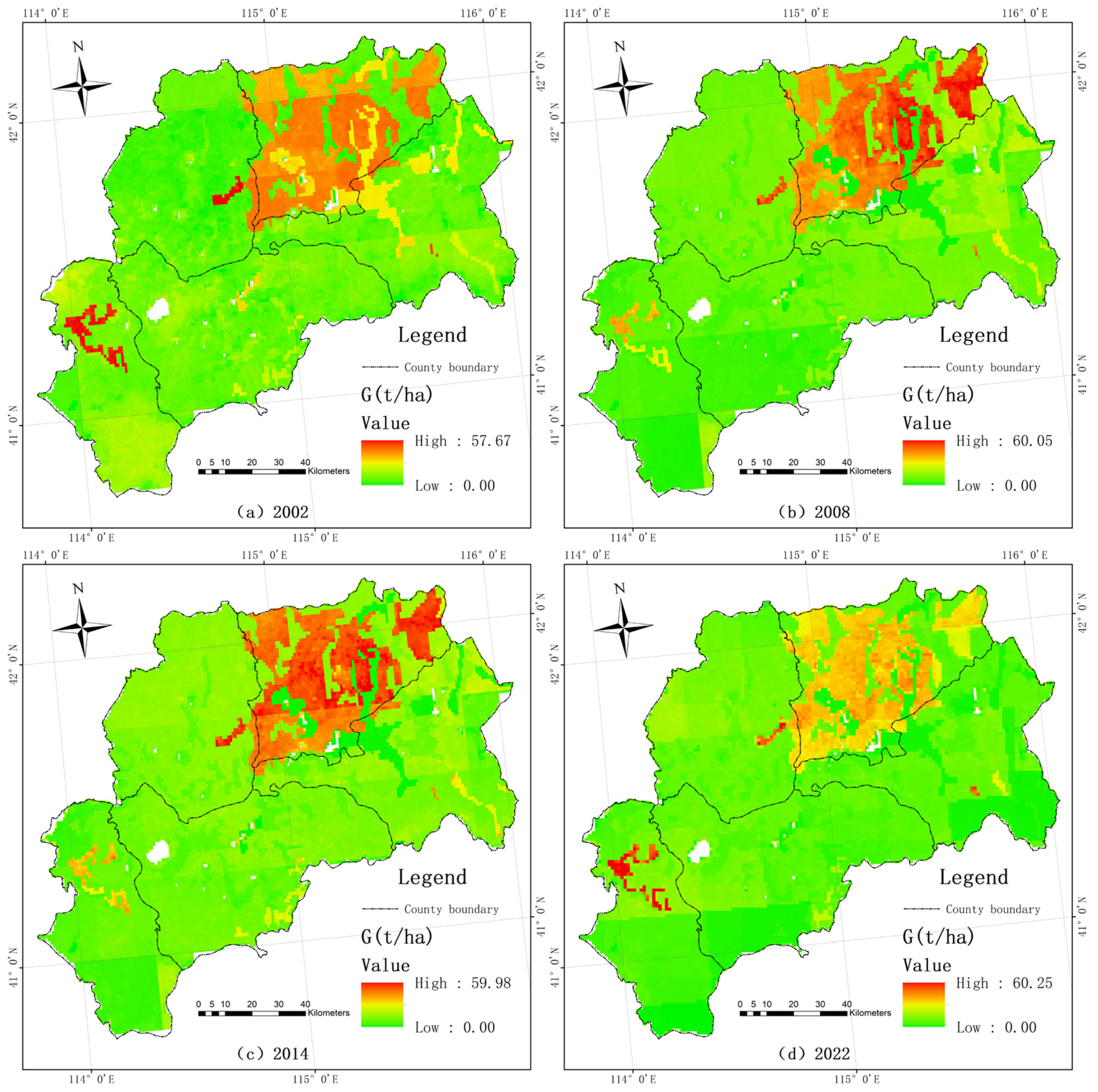
The spatiotemporal distribution of G is presented in Figure 15. Spatially, G exhibits a pattern highly consistent with SR. High-value areas are predominantly distributed in the northern agro-pastoral ecotone and the southwestern hilly regions. These areas serve as the critical “frontlines” of ecological defense, where the vegetation barrier effectively intercepts the high intensity of wind-blown sand inherent to the local environment.
Temporally, G demonstrated significant fluctuation driven by the interaction between climatic erosivity and vegetation recovery. The spatially averaged G values were 10.37 t/ha in 2002, surging to a peak of 38.64 t/ha in 2008, followed by 20.60 t/ha in 2014 and 25.20 t/ha in 2022.
The low value in 2002 indicates a weak ecosystem service supply during the early stages of restoration, where vegetation failed to effectively retain the soil. In contrast, the peak in 2008 highlights the resilience of the restored ecosystem: despite the year’s high climatic erosivity ( S R was 46.86 t/ha), the vegetation successfully intercepted the majority of the sediment. Notably, in 2022, although the S R was naturally low (28.03 t/ha), the G remained high (25.20 t/ha), implying an extremely high sand fixation rate. This suggests that the current vegetation cover has reached a stable state capable of providing near-complete protection against wind erosion under typical climatic conditions.

3.3.4. G of Ecological Source Areas

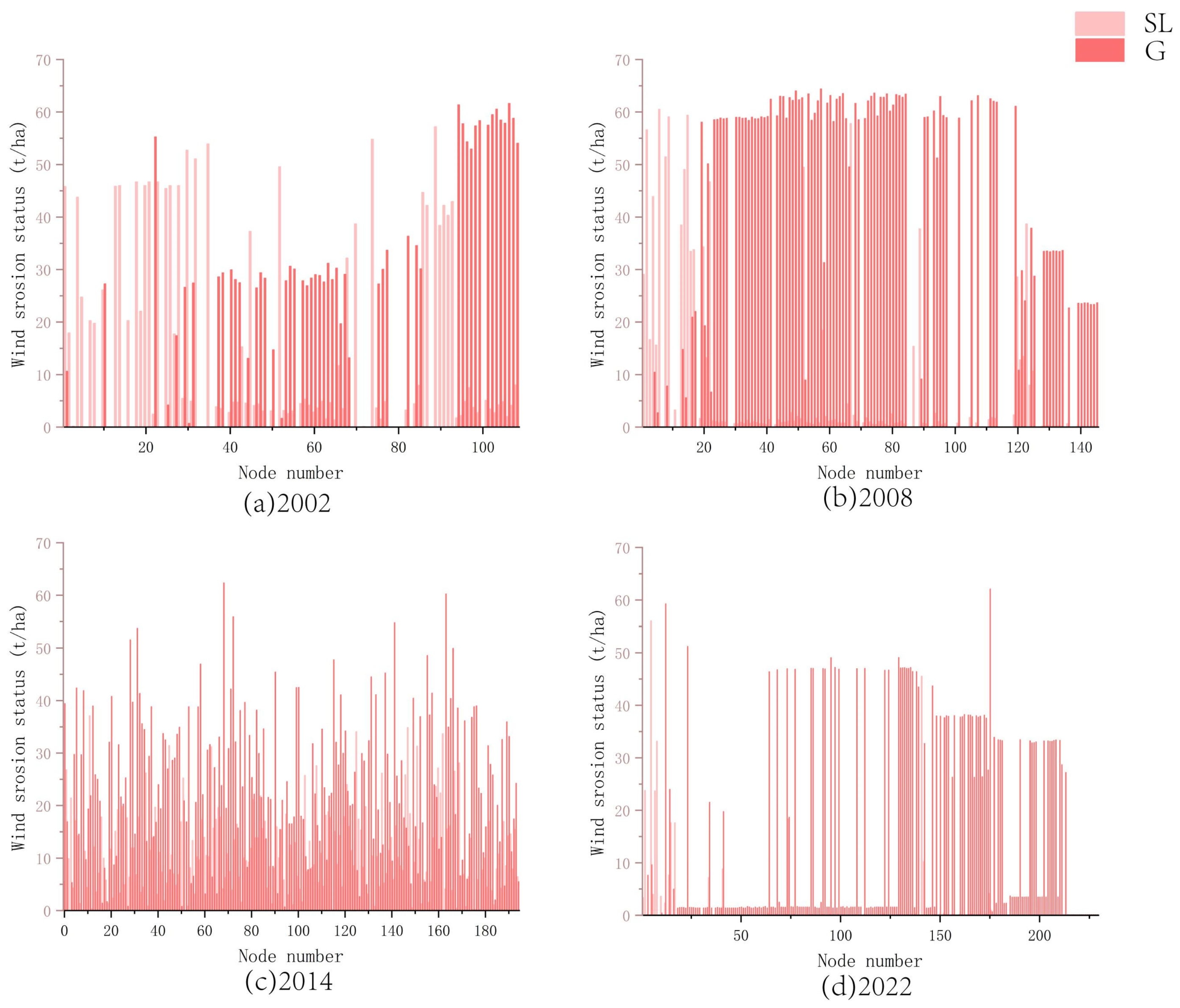
The S L and G values were extracted for each ecological source patch across the four study periods. As shown in Figure 16, for the vast majority of patches across all years, G significantly exceeds S L . This indicates that the vegetation within these source patches effectively intercepts the S R flux, confirming that these nodes serve as the functional “backbone” of the regional ecological security pattern.
The temporal evolution of these nodes reveals the resilience and maturation of the network. While 2002 and 2014 display a mixed pattern where some patches still experienced observable soil loss, reflecting ecosystem vulnerability during intermediate restoration stages, the patterns in 2008 and 2022 are particularly telling. In 2008, despite the highest regional climatic erosivity, the source nodes exhibited exceptionally high G (many greater than 60 t/ha), demonstrating strong resilience under extreme climatic stress. By 2022, although the absolute G values were lower due to naturally lower wind potential, the service efficiency reached its peak. S L for almost all nodes became negligible, suggesting that the vegetation cover matured to provide near-total protection.

3.4. Relationships Between Topological Characteristics of Ecological Nodes and Wind Erosion

This section quantitatively examines the relationship between the ESN topological structure and sand fixation function using correlation and regression analyses, with the specific results presented below.

3.4.1. Correlation Between Topological Characteristics and Wind Erosion

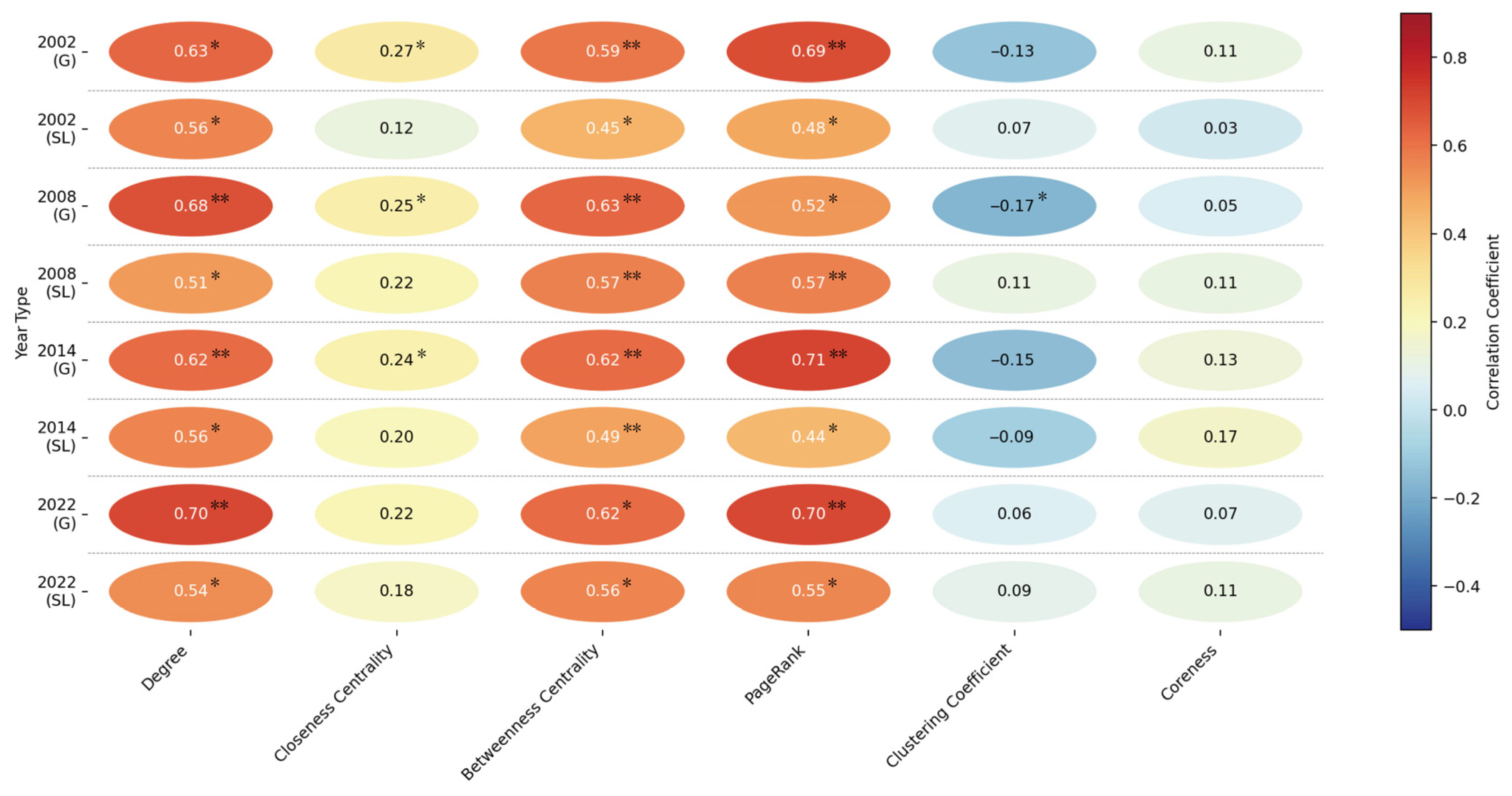
As shown in Figure 17, the correlation matrix results between the node topological indices of the ESN in the Zhangbei region and their corresponding ecological source areas indicate that there is a significant correlation between the topological characteristics of nodes and their G , but a relatively weaker correlation with S L .
The Degree, PageRank, and Betweenness Centrality of nodes exhibit obvious and statistically significant positive correlations with G in each year, meaning that the importance of these nodes is consistent with their contributions to the ecosystem’s sand fixation function. Among them, PageRank and Degree have the most obvious correlation with G , maintaining high correlation coefficients across all years. In contrast, Closeness Centrality, Clustering Coefficient, and Coreness show weak correlations with G, with most of these relationships failing to reach statistical significance.
Correlations between ESN topological indices in the Zhangbei region and S L are generally weaker than those observed for G . Similarly, the node Degree, PageRank, and Betweenness Centrality have obvious positive correlations with S L , with most reaching statistical significance. Among them, the node Degree and PageRank show the most significant correlations with S L , with Degree reaching a maximum correlation coefficient of 0.56 in 2002 and 2014.

3.4.2. Regression Analysis of the Effects of ESN Topology on Sand Fixation Capacity

Based on the correlation analysis results, only Degree, PageRank, and Betweenness Centrality—which exhibited the most significant correlations with G —were selected as independent variables for the multiple linear regression analysis.
The multiple linear regression results for the four years are summarized in Table 5. The models show consistently good overall performance. The multiple correlation coefficients (R) increase from 0.71 in 2002 to 0.81 in 2022, and the corresponding coefficients of determination (R2) rise from 0.50 to 0.65. The adjusted values (0.48–0.65) indicate that after accounting for the number of predictors, approximately 48–65% of the spatial variation in sand fixation capacity can be explained by variation in ESN topology. The F-statistics range from 23.06 to 123.75 and are all highly significant, confirming that Degree, Betweenness Centrality, and PageRank provide a statistically meaningful prediction of the sand fixation capacity in all four years. The steady increase over time suggests that as the ecological network matures through restoration projects, the spatial coupling between the network structure and ecological function becomes tighter, meaning the spatial configuration of vegetation plays an increasingly dominant role in controlling wind erosion.
The standardized regression coefficients (β) reveal the relative contributions of the three topological indices (Table 5). PageRank consistently stands out as the most robust predictor, showing a statistically significant positive effect in all four years (0.29–0.57). Ecologically, PageRank measures not just the number of connections but the “quality” of neighboring nodes. A high PageRank coefficient implies that the sand fixation capacity of a patch is significantly boosted when it is connected to other high-quality, influential patches. This reflects a “synergistic protection effect”: clusters of high-quality vegetation patches provide mutual shielding, reducing wind velocity more effectively than isolated patches.
Betweenness Centrality also shows a strong positive effect, though this relationship only becomes statistically significant from 2008 onwards; its 2002 coefficient (0.149) was not significant. This temporal shift highlights the evolving role of ecological corridors. In the early stages (2002), the network was likely fragmented; however, as restoration progressed, nodes with high Betweenness Centrality began to function as critical “bridge” corridors. These nodes act as key barriers interception wind–sand flow along dominant pathways, thereby exerting a stronger control on regional sand fixation than peripheral nodes.
Degree has the weakest and least consistent effect overall. It was statistically insignificant in 2002 and 2014, but showed significance in 2008 and 2022, generally having less predictive power than the other indices. This counter-intuitive result conveys an important ecological message: simply having many neighbors does not guarantee a high sand fixation function if those neighbors are small or fragmented. Instead, the “strategic position” (Betweenness Centrality) and “neighbor quality” (PageRank) are far more critical determinants of ecological function than simple patch adjacency.
Together, these patterns suggest that, beyond the sheer number of connections, the strategic topological configuration of nodes within the ESN—specifically their role as bridges and their aggregation into high-quality clusters—is critical for improving the sand fixation capacity.

4. Discussion

4.1. Structural Evolution of the ESN and Sand Fixation in Zhangbei

4.1.1. Overall Structural Pattern and Temporal Changes

The evolution of the ESN in the Zhangbei region from 2002 to 2022 reveals a clear transition from a relatively sparse and fragmented state to a denser and structurally more robust configuration. This maturation is reflected in three key topological features.
First, the ESN exhibited a consistently high Degree of modularity throughout the study period, with a mean Q of approximately 0.67. This stable organization into distinct functional communities creates a compartmentalized structure that effectively confines local ecological disturbances within individual modules, thereby preventing their propagation across the entire system.
Concurrently, the network’s internal hierarchy has strengthened significantly. While the average Degree saw only a marginal increase, the abundance of nodes within the maximum k-shell (k = 4) surged by 2022. This shift signals the emergence of a consolidated backbone, enhancing the structural robustness of the ESN against potential cascading failures.
Furthermore, the network evolution reflects a trend towards decentralization and improved redundancy. The decline in typical PageRank values, combined with a persistently right-skewed Betweenness Centrality, suggests that functional importance is being distributed among a larger set of nodes. Although this spatial expansion led to a modest reduction in global compactness (lower Closeness Centrality), the resulting denser mesh of local connections enhances the system’s capacity to buffer against local disturbances.
From the perspective of complex adaptive systems, these topological shifts signify a fundamental enhancement in ecological resilience. As Folke et al. argue, resilience is an emergent property reflecting a system’s capacity to absorb disturbance and sustain function within a desired stability domain [72]. Crucially, this topological resilience translates directly into functional landscape stability: the consolidated ‘core backbone’ ensures that the sand-fixation service remains operative even if peripheral patches are disturbed, while the modular structure acts as a containment mechanism, preventing localized erosion events from triggering a system-wide reversal to desertification. In our study, the combination of high modularity and a strengthened core suggests that the landscape has transformed into a resilient configuration capable of persisting against chronic environmental pressures, embodying the dynamic interplay between structural persistence and adaptability.
These structural changes co-evolved with a marked enhancement of the sand fixation function. As network density and Coreness increased, S L in the Zhangbei region decreased from 20.18 t/ha in 2002 to 2.83 t/ha in 2022. The inverse trajectories of S L and network robustness confirm that the densification of the ESN has effectively translated into a higher regional capacity to intercept wind and fix soil.
The timing of this structural evolution broadly coincides with major national ecological restoration initiatives. The early stage (around 2002) overlaps with the launch of the Beijing–Tianjin Sandstorm Source Control Project, while later periods (2008–2014) reflect accelerated afforestation and the consolidation of the Three-North Shelterbelt Program. By 2022, sustained anthropogenic ecological engineering appears to have successfully reshaped the regional topological structure, transforming a previously fragmented landscape into a coherent, high-Coreness network optimized for wind erosion control.

4.1.2. Regional and Temporal Comparisons with Other Arid–Semi-Arid Regions

Placing the Zhangbei ESN results in a broader regional context shows that both the topological evolution and the structure–function coupling observed here align with patterns reported in other arid and semi-arid restoration regions.
From a structural perspective, the Zhangbei ESN is characterized by high modularity (Q ≈ 0.67) and a pronounced core–periphery hierarchy. Similar structural properties have been identified in the ecological networks of the Yellow River Basin and the Thal Desert. For instance, a hierarchical ESN in the Yellow River Basin was identified, where high-centrality nodes form a backbone supporting regional connectivity [73]. Similarly, it was observed that in the Thal Desert, the ecological network evolved from a dispersed state to a complex, hierarchical structure with increased modularity over a 20-year restoration period [23].These studies consistently emphasize that the emergence of structurally central patches (hubs) and functional modules is a common response of dryland ecological networks to long-term restoration, enhancing the system’s robustness against local disturbances.
Crucially, recent studies provide convergent evidence linking ESN topology to ecosystem service performance, though the specific dominant metrics may vary by region. Men and Pan explicitly demonstrated that, in the Yellow River Basin, the wind-breaking and sand-fixing service is significantly and positively correlated with both Degree and Betweenness Centrality, which strongly supports our finding in Zhangbei that “bridge” nodes (high Betweenness Centrality) are critical for erosion control. Expanding beyond sand fixation, Zeng et al. and Nawaz et al. reported that connectivity metrics (e.g., closeness and eigenvector centrality) are strong predictors of carbon use efficiency and net primary productivity (NPP), respectively [23,74]. Since vegetation productivity is the biophysical basis for roughness and sediment interception, these positive correlations collectively validate our core conclusion: nodes that are topologically central—whether through local connections (Degree) or strategic positions (Betweenness Centrality)—make disproportionate contributions to the regional regulating services.
The magnitude and trend of wind erosion and sand fixation in Zhangbei observed in this study are generally consistent with previous regional assessments and field observations. Our estimated S R in Zhangbei falls well within the range of potential wind erosion (12.58–58.72 t/ha) simulated for the broader agro-pastoral ecotone of northern China by Liu et al. using four different models [75]. Furthermore, the historical erosion intensity in our study aligns closely with field-based estimates reported by Wang et al., who measured wind erosion rates of 11.99–28.52 t/ha on cultivated slopes in the neighboring Bashang region using the IPSDC method [76]. Notably, our results show that SL dropped to 2.83 t/ha by 2022, a value significantly lower than the historical baseline, validating the successful transition of Zhangbei from a moderate erosion zone to a stable, low-erosion state.
Regarding service enhancement, our results indicate a substantial improvement in G, which increased from 10.37 t/ha in 2002 to 25.20 t/ha in 2022, with a notable peak in 2008 (38.64 t/ha). This trajectory of “fluctuating growth” mirrors trends observed in the broader Beijing–Tianjin Sandstorm Source Control Project Area. Wang et al. (2020) reported that vegetation cover and sand-fixing services have improved synergistically over time [77]. Additionally, Xu et al. highlighted that the benefits of such service enhancements in National Key Ecological Function Areas diffuse to downwind regions, further underscoring the strategic value of the high-functioning network hubs identified in our study [78].
Overall, the Zhangbei case fits well into the broader picture emerging from dryland ecological network studies: (i) restoration promotes the emergence of modular and high-Coreness topologies; (ii) structurally central nodes are key providers of regulating services, particularly wind erosion control; and (iii) network densification co-occurs with measurable declines in wind erosion modulus. This consistency suggests that the ESN-based diagnostic framework is robust and transferable to other wind erosion-prone ecotones.

4.2. Relationship Between Topological Structure Characteristics and Sand Fixation Function

Our analysis reveals a robust and consistent pattern across all four study years: Degree, Betweenness Centrality, and PageRank exhibit strong positive correlations with G. This relationship is further substantiated by the multiple regression analysis, where these three topological metrics jointly explained 48–65% of the spatial variation in sand fixation (R2 = 0.48–0.65). This statistical stability suggests that node-level sand fixation is collectively shaped by three complementary structural dimensions. Specifically, high PageRank values reflect “comprehensive influence,” characterizing nodes as high-quality core patches that radiate protective functions to their surroundings. In parallel, Betweenness Centrality captures “positional criticality,” identifying nodes that function as stepping stones along key corridors to physically intercept wind–sand flow. Furthermore, Degree signifies “self-strength,” where highly connected nodes typically correspond to large, well-vegetated patches that offer inherent structural stability against erosion. Theoretically, we interpret this strong structure-function coupling as a reflection of underlying physical mechanisms. The clustering of high-Degree and high-PageRank nodes likely enhances the ‘aerodynamic obstacle effect,’ where dense vegetation patches increase surface roughness and lift the airflow, thereby reducing shear stress on the soil [10]. Similarly, the strong influence of Betweenness Centrality aligns with the ‘fetch fragmentation effect,’ suggesting that bridge nodes interrupt long wind corridors and prevent the acceleration required for sand particle saltation. Collectively, these metrics confirm that nodes occupying strategic, central, and influential topological positions are the primary providers of regional sand fixation services.
In contrast to the strong predictors, topological metrics such as Closeness Centrality, Clustering Coefficient, and Coreness exhibited weak correlations and were therefore excluded from the regression models. We interpret this discrepancy as a reflection of potential scale and mechanistic mismatches between these specific topological attributes and the biophysical process of wind erosion.
The limited explanatory power of these metrics can likely be attributed to distinct theoretical reasons. For Closeness Centrality and Coreness, the limitation appears to be scale-based: these metrics characterize global transmission efficiency or deep network embedding—qualities relevant for broad-scale information diffusion. However, sand fixation is a localized biophysical process, suggesting a potential logical gap between global topology and local function.
Conversely, for the Clustering Coefficient, the mismatch may be mechanistic. This metric measures local “clique” closure and redundancy, which benefits internal system stability. However, given that wind erosion is a directional flow process, “channel-based” metrics (like Betweenness) conceptually align more directly with the dynamics of wind–sand interception than “cluster-based” metrics.

4.3. Implications for Restoration Planning and Ecological Corridor Design

4.3.1. Prioritizations of Strategic Nodes and Modules

To translate the topological analysis into actionable spatial planning strategies, we categorized the ecological nodes whose Degree, PageRank, and Betweenness Centrality rank among the top 10% into three strategic types based on the coupling relationship between their structural centrality and sand fixation function (Figure 18). These three types of nodes are Core Ecological Nodes, Structure Bridge Nodes, and Restoration Priority Nodes, respectively. This classification provides a spatially explicit implementation pathway for regional ecological restoration.
Different management strategies should be adopted based on the distinct topological and functional roles of network nodes. Core Ecological Nodes, characterized by high centrality and sand fixation capacity, serve as the functional backbone of the Zhangbei ESN. These large, well-vegetated anchors warrant strict preservation within “Ecological Conservation Red Lines” to prevent land-use conversion and ensure regional stability. Conversely, Restoration Priority Nodes represent critical structural hubs that currently underperform due to degradation. These areas act as system “leaks” and should be the primary targets for remediation; improving their vegetation coverage yields the highest marginal returns by radiating positive effects to connected neighbors. Finally, Structure Bridge Nodes function as essential bridges between functional modules. Management of these areas must focus on maintaining permeability through ecological corridors to prevent fragmentation while monitoring them to control potential risk diffusion.

4.3.2. Edge-Adding Strategies and Practical Constraints

The results of this study show that node Betweenness Centrality, PageRank, and Degree in the ESN of the study area have strong positive correlations with the sand fixation function. Therefore, ESN optimization can be guided by comparing how different edge-adding strategies enhance the effects of Betweenness Centrality, PageRank, and Degree, and selecting the strategy that produces the most significant improvement to the regional sand fixation function.
In this study, we designed three alternative management scenarios to simulate network optimization: a low-Degree edge addition scenario, a Betweenness Centrality-based scenario, and an eigenvector centrality-based scenario. Specifically, a 10% edge-adding optimization was applied to the ESN under each scenario. By comparing the structural outcomes of these alternative scenarios, we aimed to identify the most cost-effective intervention strategy. Our optimization simulation (Table 6) identifies the “Low-Eigenvector Centrality Addition” as the superior strategy. Although PageRank showed the strongest correlation with function, this choice is theoretically consistent because PageRank is a variant of eigenvector centrality. This strategy specifically targets nodes with high latent structural influence but low Degree, yielding the highest increases in both average Degree (from 5.63 to 6.18) and Betweenness Centrality. In practical ecological engineering, this translates to a “gap-filling” strategy: restoration resources should prioritize connecting isolated, peripheral patches that possess high latent structural influence to the main network rather than merely thickening existing dense forests. By linking these marginal nodes to the core backbone, the network’s overall connectivity and sand-interception efficiency can be maximized with minimal construction costs.
However, theoretical optimization must be balanced with practical constraints. The implementation of new corridors (e.g., shelterbelts) is strictly limited by land-use policies, particularly the “red line” for cultivated land protection and the water resource carrying capacity in arid zones. Therefore, the optimized topological links should be viewed as a “candidate list” for spatial planning. Final decision making requires integrating these topological priorities with ground-level realities, such as soil suitability, land ownership, and construction feasibility, to ensure that the proposed “edges” are both ecologically effective and socio-economically viable. To systematically address these trade-offs, future work should integrate these topological optimization strategies with Multi-Criteria Decision Analysis (MCDA) frameworks that explicitly incorporate economic construction costs, land tenure constraints, and social feasibility.

4.3.3. Integration with Existing Programs and International Assessment Frameworks

Current domestic and international ecological assessment frameworks often focus primarily on land-use cover or static ecosystem service valuation. While effective for quantifying the total service supply, these approaches often overlook the dynamic structural connectivity that sustains these functions over time. This study advances such frameworks by integrating network topology as a critical spatial constraint.
By spatially coupling topological centrality with the sand fixation capacity, our approach provides a “dual-filter” mechanism that can be directly integrated into the current ‘Territorial Spatial Planning’ system. Specifically, the identified Core Ecological Nodes serve as scientific evidence for delineating ‘Ecological Conservation Red Lines’, ensuring that high-value network hubs receive statutory protection. This allows decision-makers to move beyond simple “green quantity” targets to identify areas that are both functionally productive and structurally critical. This perspective is particularly valuable for the adaptive management of major national initiatives, such as the Beijing–Tianjin Sandstorm Source Control Project and the Three-North Shelterbelt Program. Instead of uniform afforestation, the ESN-RWEQ framework enables the identification of strategic “hub nodes” where restoration yields the highest marginal gain for regional connectivity.
Furthermore, this methodology aligns with international assessment standards (e.g., IPBES and IUCN) that increasingly emphasize landscape connectivity and resilience as key indicators of ecosystem health. By providing a quantitative tool to screen for “high-structure–high-function” priority areas, this study bridges the gap between local restoration engineering and global sustainability goals, offering a replicable model for dryland ecosystem management worldwide.

4.4. Uncertainties, Spatial Autocorrelation, and Limitations

4.4.1. Model and Parameter Uncertainties

While this study establishes a robust framework for linking ESN topology to sand fixation, uncertainties regarding model parameterization remain. To mitigate subjective bias, we employed PCA to objectively determine weights for the MCR surface and conducted preliminary sensitivity tests on key RWEQ parameters (Vegetation Factor and Roughness Factor). These checks confirmed that the interannual trends and spatial patterns of our results are robust to minor parameter perturbations. However, residual uncertainties exist. First, the RWEQ model parameters were derived from the literature and regional datasets rather than site-specific calibration using local wind tunnel or field plot experiments, which may affect the absolute accuracy of erosion modulus estimates. Second, while PCA reduces subjectivity, the resulting resistance surface still depends on the selection and standardization of input variables. Therefore, our quantitative results should be interpreted as identifying relative spatial patterns and temporal trends rather than providing precise, absolute measurements of soil loss.

4.4.2. Data Resolution and Remote-Sensing-Based Indicators

Inherent limitations in data resolution may introduce biases into the assessment. First, the wind speed data used in this study are 3 h averages. This temporal smoothing likely masks short-duration, high-intensity wind gusts (extreme wind events), potentially leading to a conservative estimation of the actual wind erosion amount and sand fixation capacity. Second, optical remote sensing products have inherent constraints; for instance, NDVI may saturate in high-density shelterbelts, underestimating the protective function of dense forests, while the “blooming effect” of NPP-VIIRS nighttime light data could overestimate ecological resistance in suburban areas. Third, the resampling of all spatial layers to a unified 1 km grid, while necessary for regional-scale analysis, inevitably homogenizes fine-scale landscape features. Narrow shelterbelts or small patches of farmland–grassland mosaics may be underrepresented in the network model. Nevertheless, given that these biases are systematic across the study period (2002–2022), they do not compromise the validity of the identified interannual trends and macro-scale structural patterns.

4.4.3. Spatial Autocorrelation and Unmodeled Drivers

A critical reflection on the statistical analysis reveals the potential influence of spatial autocorrelation. The ecological variables (e.g., sand fixation and wind erosion) and topological metrics (e.g., PageRank and Degree) are spatially dependent rather than random. It is important to note that our analysis was conducted at the scale of discrete ecological source nodes rather than at the pixel level. While this patch-based aggregation mitigates the intense spatial redundancy typical of pixel-by-pixel analyses, some residual spatial dependence likely persists between neighboring nodes due to shared environmental gradients. In this study, we used standard Pearson correlation and Ordinary Least Squares (OLS) regression, which assume independence of observations. Consequently, the statistical significance (p-values) of the reported structure–function relationships might be slightly overestimated (inflated) due to the non-independence of samples.
Furthermore, the unexplained variance in our regression models suggests the presence of unmodeled drivers. Local factors such as specific land management practices, micro-topography, and soil micro-variability likely co-vary with network structure and influence sand fixation but were not explicitly included in the macroscopic RWEQ or MCR models. Future research should address these issues by employing spatial autoregressive models or Geographically Weighted Regression (GWR) to explicitly account for spatial dependency and heterogeneity, and by integrating higher-resolution data on human management and microclimates.

4.4.4. Limitations in Network Metrics and Temporal Resolution

Finally, the characterization of the network structure and its temporal dynamics has room for improvement. This study focused on a selected set of node-based centrality metrics. Future work could expand the indicator system to include path-based metrics (e.g., average path length) and functional connectivity indices to capture more complex flow dynamics. Additionally, our analysis was conducted on an annual time scale, which smooths out intra-annual variability. Since wind erosion in northern China is highly seasonal, the structure–function coupling might exhibit significant seasonal variations that are obscured in annual aggregates. Future studies should aim to construct seasonal ESNs to explore how the network’s protective function responds to the dynamics of vegetation phenology during critical wind erosion months.

5. Conclusions

This study integrates the ESN framework with the RWEQ model to quantify the coupling mechanism between the landscape topology and sand fixation function in the Zhangbei region from 2002 to 2022. The results indicate a significant structural maturation of the ESN, characterized by consistently high modularity (Q ≈ 0.67) and a trend of “core densification,” in which the network backbone has strengthened over time. Over the same period, the region shifted from a high-erosion state to a stable state: S L decreased markedly from 20.18 t/ha in 2002 to 2.83 t/ha in 2022, while G showed a fluctuating upward trend, peaking at 38.64 t/ha in 2008, demonstrating enhanced ecosystem resilience.
Building on these spatiotemporal patterns, we confirmed that complex network topological indices are effective indicators of regional sand fixation capacity. The regression analysis revealed that node-level Degree, Betweenness Centrality, and PageRank jointly explain 48–65% of the spatial variation in the sand fixation capacity. Notably, PageRank emerged as the most consistent predictor across all years, validating the hypothesis that “structural centrality breeds functional capacity” and providing a theoretical basis for using topological metrics as efficient proxies for ecosystem service monitoring in data-scarce drylands.
To translate these insights into practice, this study formulated a differentiated management framework. We identified three categories of strategic nodes: (i) Core Ecological Nodes, serving as the stable backbone for strict protection; (ii) Restoration Priority Nodes, identified as targets where remediation yields the highest marginal gain; and (iii) Structure Bridge Nodes, critical for maintaining landscape permeability. Furthermore, our optimization simulation demonstrated that the Low-Eigenvector Centrality edge-adding strategy outperforms random or Degree-based approaches. This implies that future ecological engineering should prioritize connecting isolated, peripheral patches to the network core to maximize connectivity efficiency with limited resources.
In a broader context, the framework developed in this study demonstrates high transferability to other wind-erosion-prone ecotones globally. The observed transition of the Zhangbei ESN from a fragmented state to a high-Coreness structure—coinciding with a substantial reduction in wind erosion—provides empirical evidence that long-term ecological restoration successfully reshapes landscape topology. For policy-making, this underscores the necessity of shifting from “green quantity” to “structural quality” in territorial spatial planning, ensuring that ecological corridors are designed to explicitly optimize the flow of regulating ecosystem services.

Author Contributions

Writing—original draft preparation: Z.G. and Y.H.; Data curation: Z.G., Y.H. and Q.L.; Funding acquisition: Q.Z. and Q.Y.; Resources: Q.Z. and Q.Y.; Software: Y.H. and Z.G.; Validation: Y.H. and Z.G.; Supervision: Q.Z.; Visualization: Z.G. and Y.H.; Formal analysis: Q.L. All authors have read and agreed to the published version of the manuscript.

Funding

This research was funded by the Natural Science Foundation for Young Scientists of Hebei Province (No. 2024402020) and the National Natural Science Foundation of China International (Regional) Cooperation and Exchange Project (No. 42261144747).

Data Availability Statement

The original contributions presented in this study are included in the article. Further inquiries can be directed to the corresponding author.

Acknowledgments

Special thanks are extended to the editors and anonymous reviewers for their professional guidance in refining the manuscript.

Conflicts of Interest

The authors declare no conflict of interest.

References

  1. Opdam, P.; Steingröver, E.; van Rooij, S. Ecological networks: A spatial concept for multi-actor planning of sustainable landscapes. Landsc. Urban Plan. 2006, 75, 322–332. [Google Scholar] [CrossRef]
  2. Peng, J.; Yang, Y.; Liu, Y.; Hu, Y.; Du, Y.; Meersmans, J.; Qiu, S. Linking ecosystem services and circuit theory to identify ecological security patterns. Sci. Total Environ. 2018, 644, 781–790. [Google Scholar] [CrossRef]
  3. Qiu, S.; Yu, Q.; Niu, T.; Fang, M.Z.; Guo, H.Q.; Liu, H.J.; Li, S.; Zhang, J.Y. Restoration and Renewal of Ecological Spatial Network in Mining Cities for the Purpose of Enhancing Carbon Sinks: The Case of Xuzhou, China. Ecol. Indic. 2022, 143, 109313. [Google Scholar] [CrossRef]
  4. Haddad, N.M.; Brudvig, L.A.; Clobert, J.; Davies, K.F.; Gonzalez, A.; Holt, R.D.; Lovejoy, T.E.; Sexton, J.O.; Austin, M.P.; Collins, C.D.; et al. Habitat fragmentation and its lasting impact on Earth’s ecosystems. Sci. Adv. 2015, 1, e1500052. [Google Scholar] [CrossRef]
  5. Ouyang, Z.; Zheng, H.; Xiao, Y.; Polasky, S.; Liu, J.; Xu, W.; Wang, Q.; Zhang, L.; Xiao, Y.; Rao, E.; et al. Improvements in ecosystem services from investments in ecological conservation. Science 2016, 352, 1455–1459. [Google Scholar] [CrossRef] [PubMed]
  6. Jiang, W.; Lü, Y.; Liu, Y.; Gao, W. Ecosystem service assessment for the Gobi Desert region of China based on Landsat images. J. Arid Environ. 2016, 130, 49–61. [Google Scholar]
  7. Woodruff, N.P.; Siddoway, F.H. A wind erosion equation. Soil Sci. Soc. Am. J. 1965, 29, 602–608. [Google Scholar] [CrossRef]
  8. Fryrear, D.W.; Bilbro, J.D.; Saleh, A.; Schomberg, H.; Stout, J.E.; Zobeck, T.M. RWEQ: Improved wind erosion technology. J. Soil Water Conserv. 2000, 55, 183–189. [Google Scholar] [CrossRef]
  9. Hagen, L.J. A wind erosion prediction system to replace the wind erosion equation. J. Soil Water Conserv. 1991, 46, 106–111. [Google Scholar] [CrossRef]
  10. Pi, H.; Sharratt, B.; Feng, G.; Lei, J.; Li, X.; Zheng, Z. Validation of WEQ and RWEQ for estimating soil wind erosion in the transition zone between desert and steppe. Aeolian Res. 2017, 29, 67–74. [Google Scholar]
  11. Knaapen, J.P.; Scheffer, M.; Harms, B. Estimating habitat isolation in landscape planning. Landsc. Urban Plan. 1992, 23, 1–16. [Google Scholar] [CrossRef]
  12. Soille, P.; Vogt, P. Morphological segmentation of binary patterns. Pattern Recognit. Lett. 2009, 30, 456–459. [Google Scholar] [CrossRef]
  13. McRae, B.H.; Dickson, B.G.; Keitt, T.H.; Shah, V.B. Using circuit theory to model connectivity in ecology, evolution, and conservation. Ecology 2008, 89, 2712–2724. [Google Scholar] [CrossRef]
  14. Wang, F.; Yuan, X.; Zhou, L.; Zhang, M. Integrating ecosystem services and jagged terrain to identify ecological security patterns in the Loess Plateau. J. Clean. Prod. 2020, 269, 122365. [Google Scholar]
  15. Li, S.; Wu, J.; Gong, J.; Li, S. Human footprint in Tibet: Assessing the spatial barriers to antelope migration routes. Sci. Total Environ. 2020, 748, 141432. [Google Scholar] [CrossRef] [PubMed]
  16. Correa Ayram, C.A.; Mendoza, M.E.; Etter, A.; Pérez-Salicrup, D.R. Habitat connectivity in biodiversity conservation: A review of recent studies and applications. Prog. Phys. Geogr. 2016, 40, 7–37. [Google Scholar] [CrossRef]
  17. Tischendorf, L.; Fahrig, L. On the usage and measurement of landscape connectivity. Oikos 2000, 90, 7–19. [Google Scholar] [CrossRef]
  18. Córdoba Hernández, R.; Camerin, F. The application of ecosystem assessments in land use planning: A case study for supporting decisions toward ecosystem protection. Futures 2024, 161, 103399. [Google Scholar] [CrossRef]
  19. Saura, S.; Rubio, L. A common currency for the conservation planning of nature reserve networks: The probability of connectivity. Ecol. Indic. 2010, 10, 539–549. [Google Scholar]
  20. Kang, P.; Chen, W.; Hou, Y.; Li, Y. Linking ecosystem services and ecosystem health to identify ecological risk control zones in the Tianshan North Slope Economic Belt. Sci. Rep. 2018, 8, 13745. [Google Scholar]
  21. Zeller, K.A.; McGarigal, K.; Whiteley, A.R. Estimating landscape resistance to movement: A review. Landsc. Ecol. 2012, 27, 777–797. [Google Scholar] [CrossRef]
  22. Fang, M.; Si, G.; Yu, Q.; Huang, H.; Huang, Y.; Liu, W.; Guo, H. Study on the Relationship between Topological Characteristics of Vegetation Ecospatial Network and Carbon Sequestration Capacity in the Yellow River Basin, China. Remote Sens. 2021, 13, 4926. [Google Scholar] [CrossRef]
  23. Nawaz, T.; Ansari, M.G.I.; Avirmed, B.; Zhao, T.; Liu, W.; Lian, J.; Wang, Y.; Liu, Y.; Zhao, J.; Yang, X.; et al. Ecological network optimization and its correlation with net primary productivity in the Thal Desert: A 20-year analysis. Geospat. Inf. Sci. 2025, in press. [Google Scholar] [CrossRef]
  24. Cao, S.; Chen, L.; Gong, H. Soil and water conservation and sand-fixing engineering and vegetation restoration in China. Ecol. Eng. 2007, 30, 133–140. [Google Scholar]
  25. Urban, D.; Keitt, T. Landscape connectivity: A graph-theoretic perspective. Ecology 2001, 82, 1205–1218. [Google Scholar] [CrossRef]
  26. Bodin, Ö.; Norberg, J. A network approach for analyzing spatially structured populations in fragmented landscapes. Landsc. Ecol. 2007, 22, 31–44. [Google Scholar] [CrossRef]
  27. Galpern, P.; Manseau, M.; Fall, A. Patch-based graphs of landscape connectivity: A guide to construction, analysis and application for conservation. Biol. Conserv. 2011, 144, 44–55. [Google Scholar] [CrossRef]
  28. Freeman, L.C. Centrality in social networks conceptual clarification. Soc. Netw. 1978, 1, 215–239. [Google Scholar] [CrossRef]
  29. Bodin, Ö.; Saura, S. Ranking individual habitat patches as connectivity providers: Integrating network analysis and patch removal experiments. Ecol. Model. 2010, 221, 2393–2405. [Google Scholar] [CrossRef]
  30. Estrada, E.; Bodin, Ö. Using network centrality measures to identify landscape connectivity complex. Ecol. Complex. 2008, 5, 103–114. [Google Scholar]
  31. Liu, J.; Tian, H.; Liu, M.; Zhuang, D.; Melillo, J.M.; Zhang, Z. China’s changing landscape during the 1990s: Large-scale land transformations estimated with satellite data. Remote Sens. Environ. 2011, in press. [CrossRef]
  32. Zhao, R.; Kan, H.; Xu, H.; Zhang, G.; Pang, Z.; Zhang, W. The Effects of Multi-Scenario Land Use Change on the Water Conservation in the Agro-Pastoral Ecotone of Northern China: A Case Study of Bashang Region, Zhangjiakou City. Agriculture 2025, 15, 1008. [Google Scholar] [CrossRef]
  33. National Forestry and Grassland Administration (NFGA). The Beijing-Tianjin Sandstorm Source Control Project has Achieved Remarkable Results: A “Green Great Wall” Safeguarding Beijing and Tianjin. 2021. Available online: https://www.forestry.gov.cn/c/www/zxdt/42365.jhtml (accessed on 30 September 2025).
  34. Zhan, X.K.; Yan, B.Z.; Yu, Y.B.; Tuo, Y.P.; Xie, X.D. Ecological Environment Vulnerability Assessment of Typical Agro-Pastoral Ecotone: A Case Study of Zhangbei County, Bashang, Zhangjiakou. J. Jilin Univ. (Earth Sci. Ed.) 2025, 55, 1–11. [Google Scholar] [CrossRef]
  35. Liu, Z.H.; Zhang, X. Ecological sensitivity analysis of tourist highway based on GIS: Taking the east line of Zhangbei grassland road as an example. J. Hebei Inst. Archit. Civ. Eng. 2024, 42, 80–85. [Google Scholar]
  36. Wu, A.B.; Chen, F.G.; Zhao, Y.X.; Qin, Y.J.; Shen, H.T.; Liu, X. Dynamic evaluation of ecological environment quality and analysis of influencing factors in the northern agro-pastoral ecotone: A case study of Bashang Area in Hebei Province. J. Shanxi Agric. Univ. (Nat. Sci. Ed.) 2024, 44, 12–24. [Google Scholar]
  37. Wang, X.Y. Spatial and Temporal Variation of Soil Erosion in Typical Water-Wind Erosion Ecotone in North China—Take Zhangjiakou City as an Example. Master’s Thesis, Sichuan Agricultural University, Yaan, China, 2021. [Google Scholar]
  38. Zhang, J.; Hu, X.J.; Wang, W.; Chen, D.; Huang, X.; Yang, J. Comprehensive Assessment and Analysis of Natural Resources and Ecological Conditions in the Zhangbei Area. Remote Sens. Nat. Resour. 2025, 37, 164–172. [Google Scholar]
  39. Tianqi24. Zhangbei Historical Weather [EB/OL]. Available online: https://www.tianqi24.com/zhangbei/history.html (accessed on 25 November 2025).
  40. Yang, J.; Huang, X. The 30 m annual land cover dataset and its dynamics in China from 1990 to 2019. Earth Syst. Sci. Data 2021, 13, 3907–3925. [Google Scholar] [CrossRef]
  41. Gao, J.; Shi, Y.; Zhang, H.; Chen, X.; Zhang, W.; Shen, W.; Xiao, T.; Zhang, Y. China Regional 250m Normalized Difference Vegetation Index Data Set (2000–2023) [DB/OL]; National Tibetan Plateau/Third Pole Environment Data Center: Beijing, China, 2023. [Google Scholar]
  42. Jarvis, A.; Reuter, H.I.; Nelson, A.; Guevara, E. Hole-Filled Seamless SRTM Data V4 [EB/OL]; CGIAR-CSI SRTM; International Centre for Tropical Agriculture: Cali-Palmira, Colombia, 2008. [Google Scholar]
  43. Chen, Z.Q.; Yu, B.L.; Yang, C.S.; Zhou, Y.Y.; Yao, S.J.; Qian, X.J.; Wang, C.X.; Wu, B.; Wu, J.P. An Extended Time-Series (2000–2023) of Global NPP-VIIRS-Like Nighttime Light Data [DB/OL]. Harvard Dataverse, 2020, V5. Available online: https://essd.copernicus.org/articles/13/889/2021/ (accessed on 2 October 2025).
  44. National Ice Center and National Snow and Ice Data Center. IMS Daily Northern Hemisphere Snow and Ice Analysis at 1 km Resolution, Version 1 [DB/OL]; Updated Daily; NSIDC: Boulder, CO, USA, 2008. [Google Scholar]
  45. Beaudoing, H.; Rodell, M. GLDAS Noah Land Surface Model L4 3 Hours 0.25 x 0.25 Degree V2.1 [DB/OL]; NASA Goddard Earth Sciences Data and Information Services Center (GES DISC): Greenbelt, MD, USA, 2016. [Google Scholar] [CrossRef]
  46. Wieder, W.R.; Boehnert, J.; Bonan, G.B.; Langseth, M. Regridded Harmonized World Soil Database v1.2; ORNL Distributed Active Archive Center: Oak Ridge, TN, USA, 2014. [Google Scholar] [CrossRef]
  47. Zhang, G.P. Study on Soil Wind Erosion in China Based on Remote Sensing and GIS; Graduate School of the Chinese Academy of Sciences (Institute of Remote Sensing Applications): Beijing, China, 2002. [Google Scholar]
  48. Su, K.; Yu, Q.; Yue, D.; Zhang, Q.; Yang, L.; Liu, Z.; Niu, T.; Sun, X. Simulation of a forest-grass ecological network in a typical desert oasis based on multiple scenes. Ecol. Model. 2019, 413, 108834. [Google Scholar] [CrossRef]
  49. Chen, R.; Li, M.; Liu, S. A multi-criteria approach for ecological source identification in fragmented landscapes: Integrating MSPA, InVEST, and circuit theory. Ecol. Model. 2023, 475, 110203. [Google Scholar]
  50. Regan, H.M.; Syphard, A.D.; Franklin, J.; Swab, R.M.; Markovchick, L.; Flint, A.L.; Flint, L.E.; Zedler, P.H. Evaluation of assisted colonization strategies under global change for a rare, fire-dependent plant. Global Change Biol. 2011, 17, 936–947. [Google Scholar] [CrossRef]
  51. Wolfe, R.J.; Walty, J.R. Recovery Potential Assessment of Western Silvery Minnow (Hybognathus argyritis) in Canada; Canadian Science Advisory Secretariat Research Document 2014/038; Fisheries and Oceans Canada: Ottawa, ON, Canada, 2014; pp. 1–44. [Google Scholar]
  52. US Fish and Wildlife Service. Oregon Spotted Frog (Rana pretiosa) Recovery Plan; USFWS: Portland, OR, USA, 2014; pp. 1–46.
  53. Murcia, C. Edge effects in fragmented forests: Implications for conservation. Trends Ecol. Evol. 1995, 10, 58–62. [Google Scholar] [CrossRef]
  54. Harper, K.A.; Macdonald, S.E.; Burton, P.J.; Chen, J.; Brosofske, K.D.; Saunders, S.C.; Euskirchen, E.S.; Roberts, D.; Jaiteh, M.S.; Esseen, P.-A. Edge influence on forest structure and composition in fragmented landscapes. Conserv. Biol. 2005, 19, 768–782. [Google Scholar] [CrossRef]
  55. Gong, H.J.; Chang, J.S.; Du, Y.Y. The construction of county ecological network based on MCR and gravity model. Bull. Surv. Mapp. 2023, 52, 23–29. [Google Scholar]
  56. Liu, W.; Yu, Q.; Pei, Y.R.; Wu, Y.; Niu, T.; Wang, Y. Characteristics of spatial ecological network in the Yellow River Basin of Northern China. J. Beijing For. Univ. 2022, 44, 142–152. [Google Scholar]
  57. Shi, J.; Shi, P.J.; Wang, Z.Y.; Wan, Y.; Cheng, F.Y.; Wang, L. Ecological network optimization of Jiuquan City, Gansu, China based on complex network theory and circuit model. Chin. J. Appl. Ecol. 2024, 35, 237–246. [Google Scholar]
  58. Shi, F.; Liu, S.; Sun, Y.; An, Y.; Zhao, S.; Liu, Y.; Li, M. Ecological network construction of the heterogeneous agro-pastoral areas in the upper Yellow River basin. Agric. Ecosyst. Environ. 2020, 302, 107069. [Google Scholar] [CrossRef]
  59. Xu, R.; Ma, J.Z.; Wang, N.L. Quantitative Assessment of Wind Erosion Control by Vegetation in the Tengger Desert Using RWEQ Model. J. Arid Environ. 2019, 169, 1–11. [Google Scholar] [CrossRef]
  60. Bin, C.; Weixing, Z.; Ying, L. Algorithm for complex network diameter based on distance matrix. J. Syst. Eng. Electron. 2018, 29, 336–342. [Google Scholar] [CrossRef]
  61. An, S.H.; Yu, R.H. Review on Complex Network Theory Research. Comput. Syst. Appl. 2020, 29, 26–31. [Google Scholar]
  62. Bian, Y.; Lin, X.Q.; Zhou, X.; Cui, W.J. Temporal and Spatial Evolution Characteristics and Influencing Factors of Industrial Carbon Emissions in the Beijing-Tianjin-Hebei Region. Environ. Sci. Technol. 2021, 44, 37–47. [Google Scholar]
  63. Qi, K.; Zhang, H.; Zhou, Y.; Liu, Y.; Li, Q. A community partitioning algorithm for cyberspace. Sci. Rep. 2023, 13, 19021. [Google Scholar] [CrossRef]
  64. Meng, H.; Zhao, X.R.; Wang, Y.; Lv, X.; Chen, Y.; Jiao, X.; Sui, Y. Pedogenesis of typical zonal soil drives belowground bacterial communities of arable land in the Northeast China Plain. Sci. Rep. 2023, 13, 14555. [Google Scholar] [CrossRef]
  65. Hou, H.B.; Guo, H.Q.; Yu, Q.; Mao, X.; Long, Q.; Yue, D. Ecospatial Network Optimization in Ordos Based on LMBA Strategy. Trans. Chin. Soc. Agric. Mach. 2021, 52, 219–227. [Google Scholar]
  66. Jiang, S.; Zhu, Y.N.; Zhao, Y.; Wang, Q.M.; He, G.H.; Wang, L.Z.; Chang, H.Y. Analysis of Urban Water and Energy Network Structure Based on Ecological Network Analysis Method. Water Resour. Power 2022, 40, 66–70. [Google Scholar]
  67. Fryrear, D.W.; Saleh, A.; Bilbro, J.D.; Schomberg, H.M.; Stout, J.E.; Zobeck, T.M. Revised Wind Erosion Equation (RWEQ); Technical Bulletin 1; Wind Erosion and Water Conservation Research Unit, USDA-ARS, Southern Plains Area Cropping Systems Research Laboratory: Lubbock, TX, USA, 1998. [Google Scholar]
  68. Li, H.H.; Ma, T.H.; Wang, K.; Tan, M.; Qu, J.F. Construction of Ecological Security Pattern in Northern Peixian Based on MCR and SPCA. J. Ecol. Rural Environ. 2020, 36, 1036–1045. [Google Scholar]
  69. Liu, Y.S.; Yang, Y.; Zhang, X.P. Dynamic Evaluation of Windbreak and Sand Fixation Function in the Mu Us Sandy Land Based on RWEQ and Remote Sensing Data. Land Degrad. Dev. 2020, 31, 2465–2478. [Google Scholar]
  70. Bachar, A.; Al-Ashhab, A.; Soares, M.I.M.; Sklarz, M.Y.; Angel, R.; Ungar, E.D.; Gillor, O. Soil microbial abundance and diversity along a low precipitation gradient. Microb. Ecol. 2010, 60, 453–461. [Google Scholar] [CrossRef] [PubMed]
  71. Wu, X.G.; Fan, J.Q.; Sun, L.; Zhang, H.; Xu, Y.; Yao, Y.; Yan, X.; Zhou, J.; Jia, Y.; Chi, W. Wind Erosion and Its Ecological Effects on Soil in the Northeastern Piedmont of the Yinshan Mountains. Ecol. Indic. 2021, 128, 107825. [Google Scholar] [CrossRef]
  72. Folke, C.; Carpenter, S.R.; Walker, B.; Scheffer, M.; Chapin, T.; Rockström, J. Resilience thinking: Integrating resilience, adaptability and transformability. Ecol. Soc. 2010, 15, 20. [Google Scholar] [CrossRef]
  73. Men, D.; Pan, J. Incorporating Network Topology and Ecosystem Services into the Optimization of Ecological Network: A Case Study of the Yellow River Basin. Sci. Total Environ. 2024, 912, 169004. [Google Scholar] [CrossRef]
  74. Zeng, Y.; Chen, X.; Yang, Z.; Yu, Q. Study on the relationship between ecological spatial network structure and regional carbon use efficiency: A case study of the Wuding River Basin. Ecol. Indic. 2023, 155, 110909. [Google Scholar] [CrossRef]
  75. Liu, J.; Wang, X.; Zhang, L.; Guo, Z.; Chang, C.; Du, H.; Wang, H.; Wang, R.; Li, J.; Li, Q. Regional Potential Wind Erosion Simulation Using Different Models in the Agro-Pastoral Ecotone of Northern China. Int. J. Environ. Res. Public Health 2022, 19, 9538. [Google Scholar] [CrossRef]
  76. Wang, R.; Guo, Z.; Chang, C.; Xiao, D.; Jiang, H. Quantitative estimation of farmland soil loss by wind-erosion using improved particle-size distribution comparison method (IPSDC). Aeolian Res. 2015, 19, 163–170. [Google Scholar]
  77. Wang, S.; Zhang, B.; Xie, G.; Zhai, X.; Sun, H. Vegetation cover changes and sand-fixing service responses in the Beijing–Tianjin sandstorm source control project area. Environ. Dev. 2020, 34, 100455. [Google Scholar] [CrossRef]
  78. Xu, J.; Xiao, Y.; Xie, G.; Wang, Y.; Lei, G. Assessment of the benefit diffusion of windbreak and sand-fixation service in National Key Ecological Function Areas in China. Aeolian Res. 2021, 51, 100681. [Google Scholar] [CrossRef]
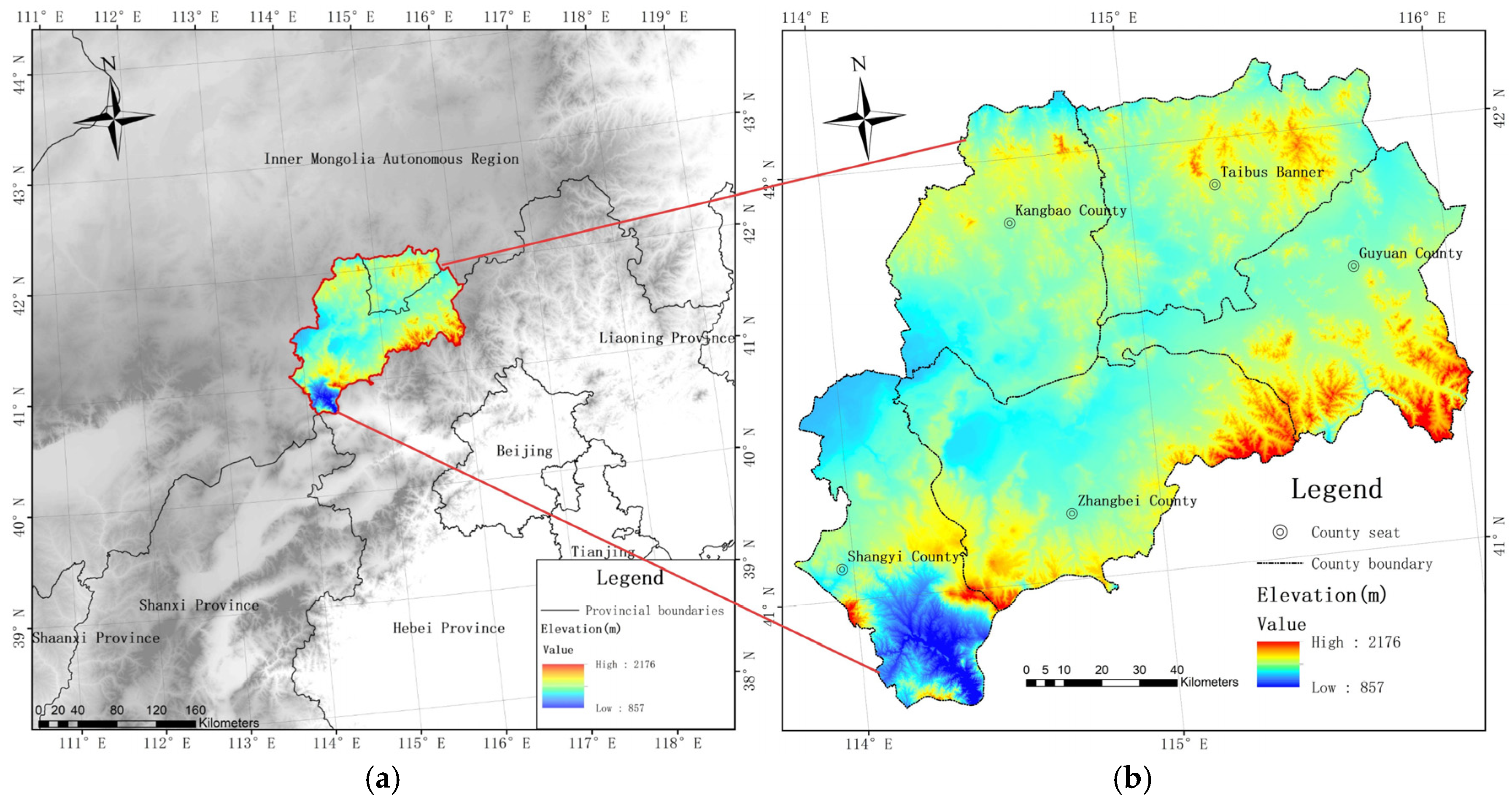
Figure 1. Spatial location and elevation of the Zhangbei region. (a) Location of the study area within northern China, showing its position on the transition zone between the Mongolian Plateau and the northern edge of the North China Plain. (b) Elevation distribution and county boundaries (Shangyi County, Zhangbei County, Kangbao County, Guyuan County, and Taibus Banner) within the Zhangbei region. Elevation ranges from 857 m (blue) to 2176 m (red).
Land 14 02388 g001
Figure 2. The methodological framework of this study. The framework consists of three main parts: (1) construction of the Ecological Security Network (ESN) using the Minimum Cumulative Resistance (MCR) model based on multi-source data; (2) quantification of sand fixation capacity using the Revised Wind Erosion Equation (RWEQ) model; and (3) analysis of the relationship between ESN topological characteristics and sand fixation capacity using correlation matrices and regression analysis.
Land 14 02388 g002
Figure 3. Spatiotemporal distribution of ecological resistance surfaces in the study area from 2002 to 2022. The subplots represent the resistance surfaces for (a) 2002, (b) 2008, (c) 2014, and (d) 2022. The color gradient from green to red indicates the transition from low resistance values (favorable for ecological flow) to high resistance values (hindering ecological flow).
Land 14 02388 g003
Figure 4. Spatial distribution and temporal evolution of the ESN from 2002 to 2022. The subplots show the network structure for (a) 2002, (b) 2008, (c) 2014, and (d) 2022. Dark green patches represent the identified ecological source areas (nodes), while light green lines represent the ecological corridors (edges) extracted based on the MCR model.
Land 14 02388 g004
Figure 5. Visualization of the modular structure and node centrality of the ESN from 2002 to 2022. The subplots display the network topologies for (a) 2002, (b) 2008, (c) 2014, and (d) 2022. The size of the nodes corresponds to the node Degree, with larger nodes indicating higher connectivity and importance. The color of the nodes represents different modular communities (modules 1–10), reflecting the clustering characteristics of the network.
Land 14 02388 g005
Figure 6. Temporal evolution of the Degree Distribution of the ESN from 2002 to 2022. The subplots represent the Degree statistics for (a) 2002, (b) 2008, (c) 2014, and (d) 2022. Red bars indicate the relative frequency of node Degrees. The continuous red curve represents the Gaussian function fitting, suggesting that the network topology approximates a random graph structure. The dark and light pink shaded regions denote the 95% confidence interval and 95% prediction interval, respectively. The uni-modal distribution indicates a homogeneous network connectivity with no extreme hubs.
Land 14 02388 g006
Figure 7. Temporal variation in Closeness Centrality values in the ESN (2002–2022). The boxplots quantify the statistical distribution for each year. The red boxes represent the interquartile range (25–75%), the internal solid lines mark the median, and the hollow squares denote the mean values. The overall downward trend indicates a decrease in the global compactness of the network.
Land 14 02388 g007
Figure 8. Frequency distribution of Betweenness Centrality across four study periods (2002, 2008, 2014, and 2022). The histograms reveal a long-tailed distribution pattern where the vast majority of ecological nodes function as peripheral points (low Betweenness Centrality), while a small fraction acts as critical bridges (high Betweenness Centrality).
Land 14 02388 g008
Figure 9. Temporal evolution of Betweenness Centrality values in the ESN. The boxplots quantify the dispersion and central tendency of the metric for each year. The red boxes indicate the interquartile range (25–75%), solid horizontal lines mark the medians, and hollow squares represent the means. The increasing values indicate that ecological flows are becoming more channeled through specific high Betweenness Centrality nodes.
Land 14 02388 g009
Figure 10. Temporal evolution of node importance (PageRank) in the ESN from 2002 to 2022. The boxplots illustrate the decreasing average influence and the narrowing disparity between nodes over time. The red boxes represent the interquartile range (25–75%), the solid horizontal lines mark the medians, and the hollow squares indicate the mean values. The converging trend reflects the “dilution effect” of core nodes and a shift towards a more decentralized network structure.
Land 14 02388 g010
Figure 11. Temporal evolution of the Clustering Coefficient in the ESN from 2002 to 2022. The boxplots illustrate the distribution of local network connectivity. The relatively high values (mostly >0.4) indicate a strong clustering tendency, while the slight downward trend in mean values (hollow squares) suggests a gradual loosening of local ecological clusters as the network expands.
Land 14 02388 g011
Figure 12. Frequency distributions of Coreness in the ESN from 2002 to 2022. The histograms reveal a discrete shift in network hierarchy. The dramatic increase in the number of nodes with the maximum Coreness (k = 4) in 2022 indicates a strengthening of the network’s core backbone and enhanced structural stability.
Land 14 02388 g012
Figure 13. Spatiotemporal distribution of SR in the study area from 2002 to 2022. The subplots display the SRs for (a) 2002, (b) 2008, (c) 2014, and (d) 2022, which were calculated assuming no vegetation cover. The color gradient represents the severity of potential erosion, where red indicates high SR values and green indicates low SR values.
Land 14 02388 g013
Figure 14. Spatiotemporal distribution of SL in the study area from 2002 to 2022. The subplots illustrate the spatial patterns of S L for (a) 2002, (b) 2008, (c) 2014, and (d) 2022. The color gradient from green to red indicates the transition from low to high erosion intensity.
Land 14 02388 g014
Figure 15. Spatiotemporal distribution of the G in the study area from 2002 to 2022. The subplots display the spatial patterns of G for (a) 2002, (b) 2008, (c) 2014, and (d) 2022. The color gradient represents the intensity of G , where red indicates high sand fixation values and green indicates low values.
Land 14 02388 g015
Figure 16. Statistical characteristics of S L and G for ecological source patches in the Zhangbei region. The bar charts illustrate the wind erosion status of each identified ecological source node in (a) 2002, (b) 2008, (c) 2014, and (d) 2022. The dark red bars represent G , while the light pink bars represent S L .
Land 14 02388 g016
Figure 17. Correlation coefficient matrix between the topological indices of ESN nodes and the S L and G of their corresponding ecological source areas. The color scale represents the Pearson correlation coefficient, ranging from dark blue (negative correlation) to dark red (positive correlation). Asterisks indicate statistical significance levels: * p < 0.05 and ** p < 0.001.
Land 14 02388 g017
Figure 18. Spatial identification and classification of strategic nodes for differentiated management in the Zhangbei ESN (2022).
Land 14 02388 g018
Table 2. Basic information of data sources.
Data TypeData SourceFormatSpatial ResolutionTemporal Resolution
The 30 m annual land cover dataset and its dynamics in China [40]ZENODO database
(https://zenodo.org/record/5816591#ZAWM3BVBy5c (accessed on 1 September 2025))
tif1 km × 1 kmAnnual
China regional 250 m normalized difference vegetation index dataset (2000–2023) [41]National Tibetan Plateau/Third Pole Environment Data Center
(https://doi.org/10.11888/Terre.tpdc.300328 (accessed on 1 September 2025))
hdf1 km × 1 kmMonth
The SRTMDEMUTM 90 m digital elevation data V4.1 [42]Geospatial Data Cloud
(https://www.gscloud.cn/ (accessed on 1 September 2025))
tif90 m × 90 m/
An extended time-series (2000–2023) of global NPP-VIIRS-like nighttime light data [43]Harvard Dataverse
(https://doi.org/10.7910/DVN/YGIVCD (accessed on 1 September 2025))
tif500 m × 500 mAnnual
Snow cover data [44]IMS Daily Northern Hemisphere Snow and Ice Analysis
(https://doi.org/10.7265/N52R3PMC (accessed on 1 September 2025))
ASCII1 km × 1 km16 days
Wind speed data [45]GLDAS-2.1, NASA LDAS (https://ldas.gsfc.nasa.gov/ (accessed on 1 September 2025))nc0.25° × 0.25°3 h per scene
Soil data [46]World Soil Database (HWSD)
(https://www.fao.org/soils-portal/data-hub/soil-maps-and-databases/harmonized-world-soil-database-v12/en/ (accessed on 1 September 2025))
tif1 km × 1 km/
Table 3. Ecological resistance of land-use.
Land-Use TypeResistance
Forest, shrub, water area1
Grassland2
Farmland, wetland3
Bare land4
Ice and snow, impervious surface5
Table 4. Weights of each factor.
FactorWeight
land-use0.25
Elevation0.14
Slope0.13
Nighttime light0.11
Normalized difference vegetation index0.37
Table 5. Summary of multiple linear regression results.
YearNRR2Adj.R2FDWβ (Degree)β (Betweenness Centrality)β (PageRank)
20021100.710.500.4823.06 ***1.900.010.150.57 *
20081470.730.540.5236.93 ***1.300.28 *0.20 *0.31 *
20141950.740.550.5453.61 ***1.780.240.29 ***0.29 *
20222300.810.650.65123.75 ***1.700.21 ***0.31 ***0.43 ***
Note: N is the number of samples (ecological nodes); R is the multiple correlation coefficient; R2 is the coefficient of determination; Adj.R2 is the adjusted coefficient of determination; F is the F-statistic; DW is the Durbin–Watson statistic; β represents the standardized regression coefficient; asterisks indicate statistical significance levels: * p < 0.05, and *** p < 0.001.
Table 6. Indicators of the optimized network topology structure.
Edge-Adding Strategy TypeEdge-Adding Strategy MethodEdge-Adding Proportion (%)Average DegreeAverage Betweenness Centrality (×10−4)Average PageRank (×10−3)
Original Network (2022)5.63679.005.30
Degree CentralityLow-Degree Edge Addition106.05747.005.30
Degree CentralityShortcut Edge Addition106.02719.005.30
Betweenness CentralityLow-Betweenness Centrality Addition106.01753.005.30
Betweenness CentralityShortcut Edge Addition105.59749.005.30
Eigenvector CentralityLow-Eigenvector Centrality Addition106.18864.005.30
Eigenvector CentralityShortcut Edge Addition106.15759.005.30
Disclaimer/Publisher’s Note: The statements, opinions and data contained in all publications are solely those of the individual author(s) and contributor(s) and not of MDPI and/or the editor(s). MDPI and/or the editor(s) disclaim responsibility for any injury to people or property resulting from any ideas, methods, instructions or products referred to in the content.