Article

Temporal and Spatial Distribution of Sanxingdui (3.7–3.1 ka BP) and Shi’erqiao (3.1–2.6 ka BP) Sites on the Chengdu Plain, Southwest China


1
School of Atmospheric Sciences, Chengdu University of Information Technology, Chengdu 610225, China
2
Key Laboratory of Deep-Time Geography and Environment Reconstruction and Applications of Ministry of Natural Resources, Chengdu University of Technology, Chengdu 610059, China
3
Institute of Sedimentary Geology, Chengdu University of Technology, Chengdu 610059, China
4
Center for Scientific and Technological Archaeology, Chengdu University of Technology, Chengdu 610059, China
5
Sichuan Metallurgical Geological Exploration Institute, Chengdu 610000, China
*
Author to whom correspondence should be addressed.
Land 2025, 14(12), 2379; https://doi.org/10.3390/land14122379
Submission received: 2 November 2025 / Revised: 29 November 2025 / Accepted: 1 December 2025 / Published: 5 December 2025
(This article belongs to the Special Issue Archaeological Landscape and Settlement II)

Abstract

Understanding the spatial distribution of ancient settlements is essential for reconstructing human–environment dynamics. The Chengdu Plain, a core region of the ancient Shu civilization, provides a key setting for examining early cultural development in Southwest China. This study applies GIS-based spatial analysis to 116 prehistoric sites, 27 Sanxingdui (3.7–3.1 ka BP) and 89 Shi’erqiao (3.1–2.6 ka BP), to evaluate their relationships with elevation, relief, slope, aspect, and distance from rivers. Sanxingdui settlements show a tightly constrained pattern, clustering at 450–500 m a.s.l. elevation, on gentle slopes (0–5°), within moderate relief (30–150 m), and almost entirely inside the 0–0.01 river buffer, reflecting strong dependence on stable alluvial landscapes. In contrast, Shi’erqiao sites occupy a broader environmental spectrum, spanning 400–650 m a.s.l. in elevation, concentrating in 30–60 m relief zones, and extending beyond the 0.02 hydrological buffer, indicating enhanced adaptability supported by improved water management and sociopolitical reorganization. The transition from Sanxingdui to Shi’erqiao thus represents a shift from selective environmental reliance to more flexible landscape engagement under mid–late Holocene climatic variability. These results underscore the dynamic nature of prehistoric human–landscape interaction on the Chengdu Plain and provide new insights into cultural resilience in the upper Yangtze River basin.

1. Introduction

During the Holocene, the intensification of human activities produced increasingly complex interactions between societies and their surrounding environments [1]. Understanding the relationship between environmental change, regional cultural evolution, and human–land dynamics has therefore become a central focus of environmental archaeology, attracting sustained scholarly attention both within China and internationally [2,3]. The Yangtze River Basin, one of the major population centers and cultural heartlands, offers an important context for examining these long-term interactions [4]. Within this region, the Chengdu Plain, located in the upper reaches of the basin, stands out as a principal core area of early Chinese civilization. Archaeological investigations have documented a long and continuous cultural sequence extending from early agrarian settlements to increasingly complex Bronze Age societies [5]. High-quality archaeological datasets now enable more refined reconstructions. These include models of human habitation patterns, cultural transmission pathways, migration trajectories, and broader processes of social development [6]. The Shu cultural sequence developed from the Baodun culture, flourished at Sanxingdui, and transitioned into Shi’erqiao, forming a continuous trajectory of cultural evolution in the upper Yangtze River [7,8]. Among these cultural stages, the Sanxingdui and Shi’erqiao periods are particularly significant for understanding the interplay between cultural transformation and environmental setting [9,10,11,12]. A growing body of research demonstrates that the evolution of ancient settlements and cultural systems was closely tied to both natural and social environmental conditions [1,2,3]. Moreover, key environmental variables, such as topography, hydrology, and geomorphology, have been recognized as decisive factors shaping cultural development, land-use strategies, and spatial organization over millennia [1,13]. Consequently, analyzing the spatial logic of prehistoric settlement systems provides essential insights into how ancient communities adapted to and modified their local environments [14].
The Sanxingdui culture represents a highly centralized and materially distinctive Bronze Age society on the Chengdu Plain, characterized by monumental ritual architecture, urban-scale fortified settlements, and an advanced bronze industry that relied on the region’s rich agricultural and metallurgical resource base [5,7,9]. Archaeological studies suggest that the remarkable spatial concentration of Sanxingdui sites around the Guanghan area may reflect both the presence of a strong political ritual center and potential research biases arising from the preferential discovery and excavation of large, architecturally prominent sites [11,12]. Following the decline of this urban-focused system, the succeeding Shierqiao culture exhibits a markedly different spatial pattern, typified by smaller, more dispersed settlements distributed across the Chengdu Plain, as well as diversified subsistence and land-use strategies [1]. Although the two cultures differ significantly in settlement scale, spatial organization, and modes of environmental engagement, they form a continuous cultural sequence from Baodun through Sanxingdui to Shierqiao, reflecting a long-term sociopolitical transformation within the ancient Shu region [7,15]. The contrast between their centralized and dispersed spatial patterns provides a crucial framework for examining how environmental factors, resource availability, and cultural dynamics jointly shaped the evolution of prehistoric settlement systems on the Chengdu Plain.
Over the past decades, archaeological discoveries related to the Sanxingdui–Shi’erqiao cultural sequence have attracted wide scholarly attention, providing new insights into early state formation, sociopolitical organization, and human–environment interactions in prehistoric China [1,5,8]. Nevertheless, several key challenges remain. First, most previous research has concentrated on dwelling features and artifact typology, whereas systematic, quantitative assessments of settlement distribution and environmental preferences remain limited [16,17]. Second, the nature of the cultural transition from Sanxingdui to Shi’erqiao, whether abrupt collapse, gradual transformation, or adaptive relocation, continues to be debated [5,7]. Third, the specific role of climatic fluctuations, particularly extreme climate events, in shaping settlement strategies and sociopolitical reorganization has yet to be fully clarified [18,19,20]. Recent advances in Geographic Information Systems (GIS) offer powerful tools for modeling settlement spatial logic and quantifying environmental determinants of site selection [21,22]. GIS-based analyses of elevation, slope, relief, aspect, and hydrological proximity have proved effective for identifying the geo-environmental drivers behind prehistoric land-use choices [23,24,25,26]. By integrating these analytic approaches with archaeological datasets, researchers can reconstruct diachronic trajectories of environmental adaptation and cultural evolution [27].
This study applies GIS spatial analysis to 116 prehistoric sites on the Chengdu Plain, including 27 Sanxingdui and 89 Shi’erqiao sites, to examine their distribution in relation to five key environmental variables. Although a modern Digital Elevation Model (DEM) was used, numerous geomorphological studies and borehole records indicate that the Chengdu Plain has experienced minimal vertical displacement (<10 m) since the mid-Holocene [2,5], allowing modern elevation and slope data to serve as reasonable proxies for paleo-topographic conditions. The research aims to characterize the environmental preferences of Sanxingdui and Shi’erqiao settlements, identify diachronic changes in settlement–environment relationships, and interpret how these spatial patterns reflect broader processes of cultural transformation and environmental adaptation. The findings contribute to ongoing discussions of prehistoric human–landscape dynamics in southwestern China and offer a replicable methodological framework for spatial analysis in heritage science.

2. Study Area

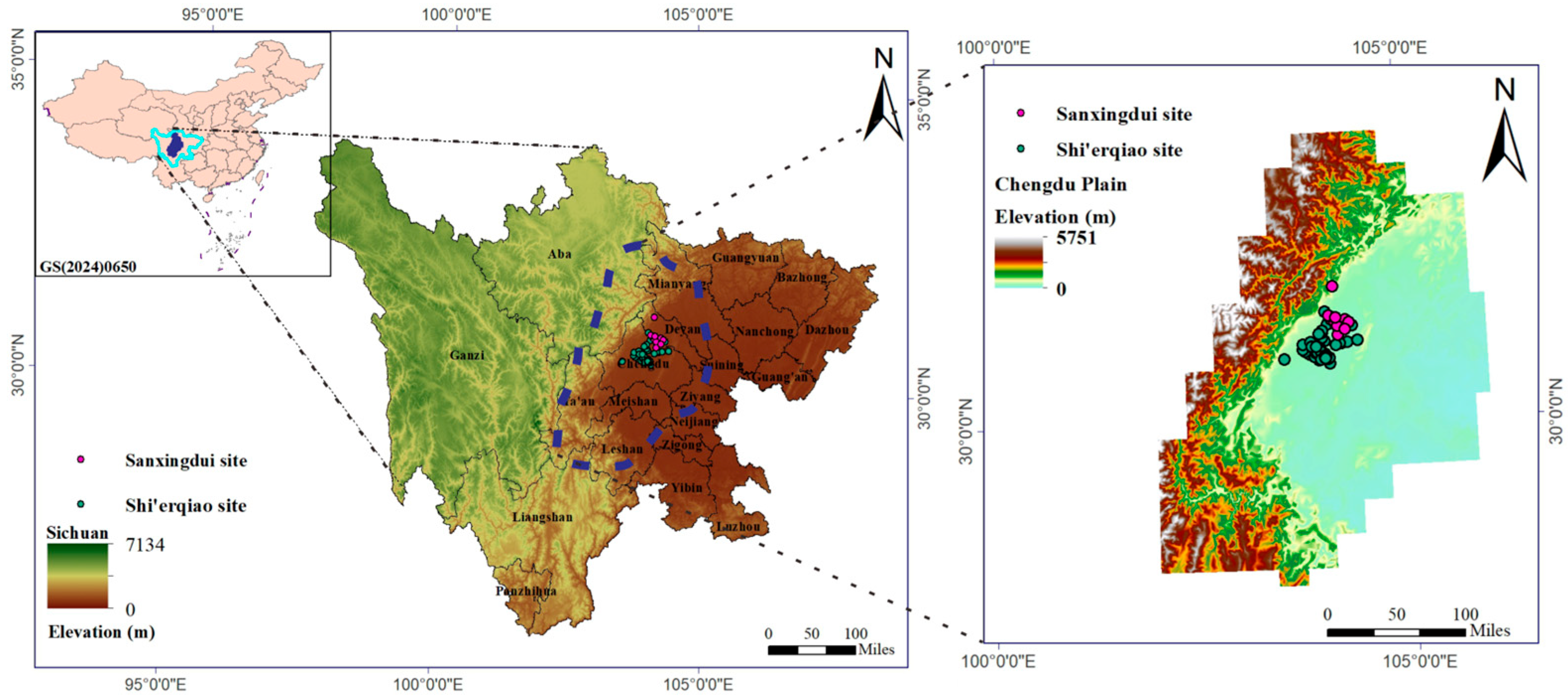
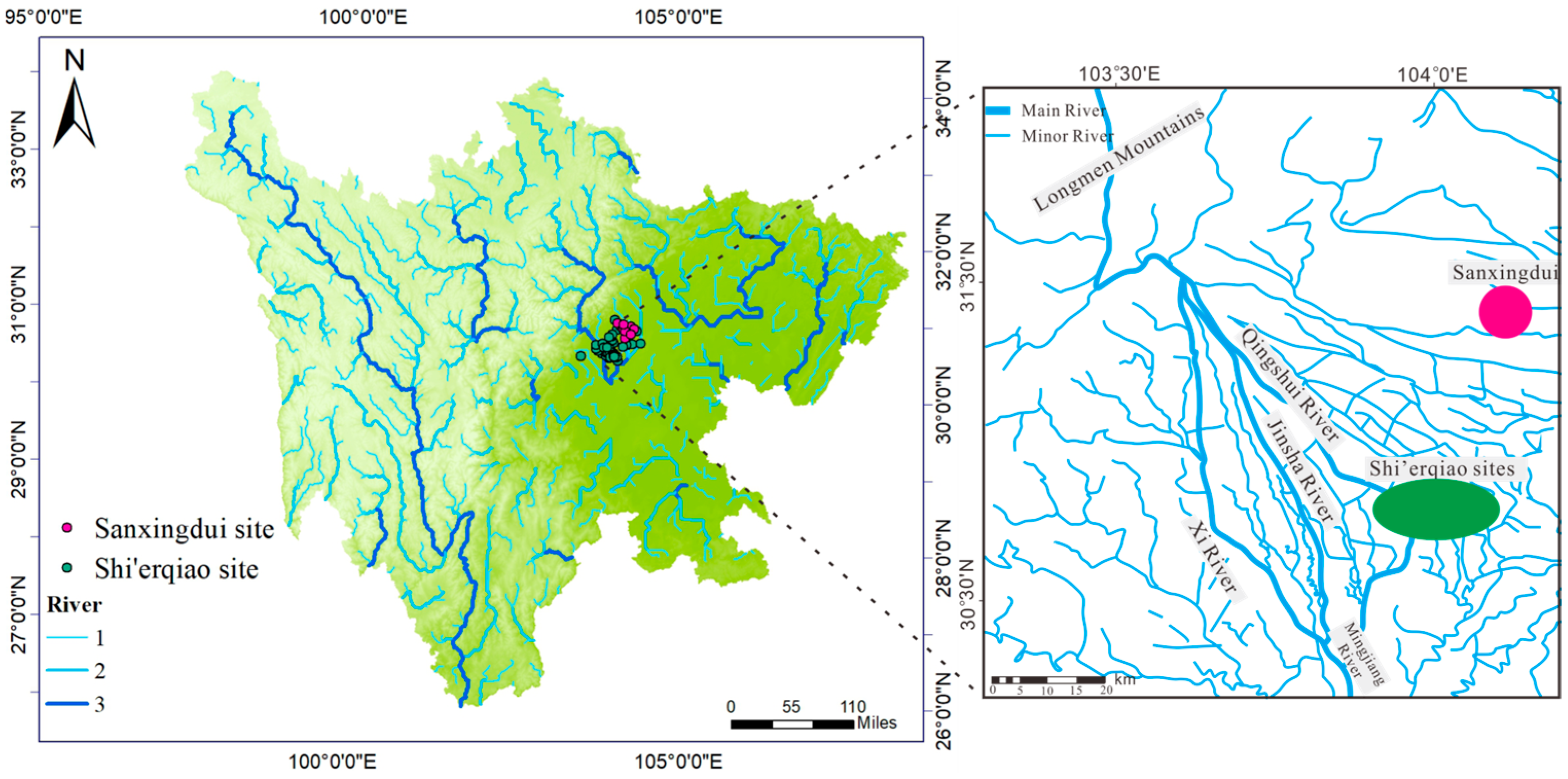
The Chengdu Plain, situated in the western Sichuan Basin of Southwest China, provides an exemplary setting for examining long-term human–environment interactions [28,29]. Flanked by the Longmen Mountains to the northwest and the Longquan Mountains to the east, the plain extends approximately 166 km from north to south and 192 km from east to west, covering ~12,400 km2, about 2.6% of Sichuan Province [5]. Formed largely by overlapping alluvial fans of the Min and Tuo rivers, which descend from the mountainous sectors of the northwestern Sichuan Plateau [13], the region comprises one of the largest and most continuous alluvial lowlands in Southwest China. Its flat terrain, well-developed dendritic river network, and humid subtropical monsoon climate (mean annual precipitation 1000–1200 mm, concentrated in summer) have supported continuous human occupation since the Neolithic [20,28]. These environmental conditions facilitated early agricultural intensification, dense settlement development, and sustained cultural evolution. Historically, the Chengdu Plain served as the political core of the ancient Shu state and hosted several major prehistoric urban centers, including the Sanxingdui complex in the Guanghan area (Deyang City) and the Shi’erqiao cultural center in modern Chengdu [30] (Figure 1).
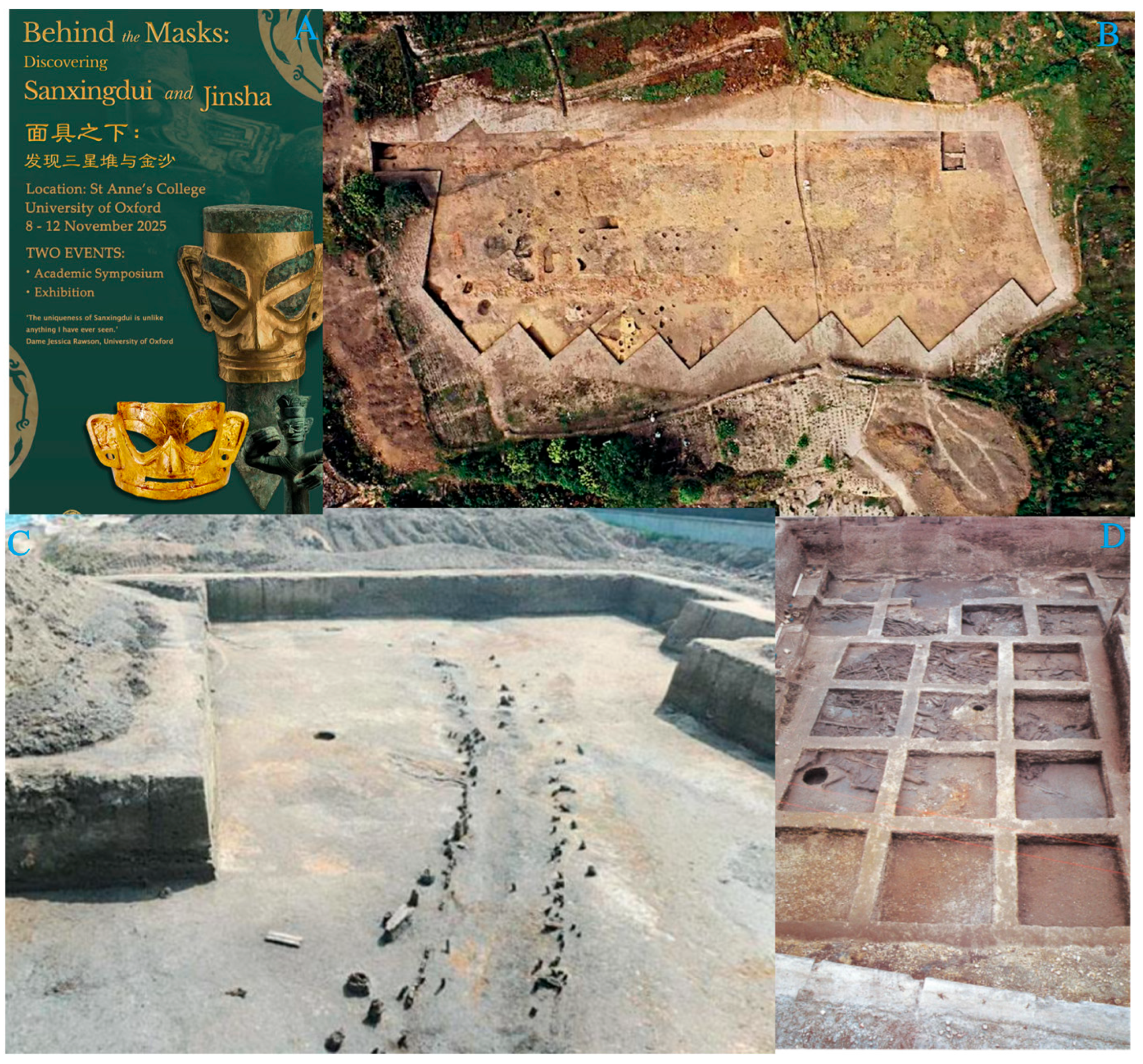
Sanxingdui and Shi’erqiao cultures represent two sequential yet distinct modes of settlement organization on the Chengdu Plain [31]. The Sanxingdui culture is characterized by its large urban center, advanced bronze technology, and monumental ritual architecture, and broadly contemporaneous with Erlitou Phase IV and Yinxu Phase II in North China [32] (Figure 2A,B). Current archaeological research widely agrees that the Shi’erqiao culture constitutes a direct cultural continuation of the Sanxingdui. After the decline of the Sanxingdui urban core, the political and ceremonial center of the ancient Shu state shifted from the Guanghan area (Deyang City) to the Chengdu area, where the Shi’erqiao culture developed as its immediate successor [9,10]. Shi’erqiao culture is a continuation of the Sanxingdui culture. It is represented by the Shi’erqiao site in Jinniu District and the Jinsha site in Qingyang District (Figure 2C,D). It was a period of regional transition, contemporaneous with the early Western Zhou to the early Spring and Autumn Period in the Central Plains, characterized by a shift toward more dispersed and diverse settlement forms [33].
The chronological framework adopted in this study is grounded in published radiocarbon evidence (Table 1) and follows the established cultural sequence of the ancient Shu region, encompassing the Sanxingdui (3.7 ka BP) and Shi’erqiao (3.1–2.6 ka BP) periods [29]. This framework provides the temporal foundation for examining long-term changes in settlement patterns and human–environment interactions across the two cultural phases.

3. Materials and Methods

The archaeological site data used in this study are derived from published sources, including the journals Archaeology, Sichuan Cultural Relics, and the report Archaeological Discoveries in Chengdu. A total of 116 prehistoric sites were compiled from published survey reports, excavation bulletins, and official heritage databases. These records were generated by government-authorized archaeological institutions through systematic surveys, scientific and rescue excavations, and standardized registration, representing the most authoritative dataset for the Chengdu Plain. Site detection follows a dual-track system: rescue excavations preferentially target large or highly visible sites, while survey techniques have evolved from early pedestrian methods to recent remote sensing and geophysical prospection. Despite these biases, cross-checking among multiple sources ensures that the dataset provides the most reliable baseline for regional prehistoric settlement analysis. All archaeological points used in this study represent confirmed habitation or multi-functional settlement sites, each characterized by well-defined cultural layers documented in published excavation or survey reports. These cultural deposits provide clear evidence of sustained or recurrent human occupation, allowing their unequivocal identification as settlements.
This study compiled data from 116 archaeological sites on the Chengdu Plain, including 27 from the Sanxingdui period and 89 from the Shierqiao period. For each site, recorded attributes include its name, cultural type, precise location, and elevation. These data were organized in a spreadsheet for GIS analysis. All sites were georeferenced using WGS84 UTM Zone 48N coordinates and cross-validated against topographic base maps. Data normalization and error correction were applied using ArcGIS 10.2 to ensure spatial accuracy. Five environmental variables were selected to evaluate the geomorphological and hydrological constraints influencing the spatial distribution of the Sanxingdui and Shi’erqiao settlements: elevation, relief degree, slope, aspect, and Euclidean distance to rivers. These indicators are widely recognized in archaeological landscape studies as key determinants of settlement suitability because they jointly reflect terrain stability, flood risk, resource accessibility, and environmental habitability [36]. Elevation provides the general altitudinal setting and helps assess flood avoidance or strategic visibility. Relief degree, calculated as the elevation range within a 3 × 3 pixel neighborhood (approximately 90 m × 90 m for a 30 m DEM), represents local terrain variability, which affects construction feasibility and agricultural potential [36]. Because even 30–50 m of relief in this low-gradient alluvial setting delineates discrete Holocene geomorphic surfaces with different hydrological behaviours, our elevation, local-relief, and slope metrics are designed to capture microtopographic suitability rather than absolute terrain variation, ensuring robust differentiation of settlement distributions across cultural phases.
Slope was derived from the DEM using the Spatial Analyst “Slope” tool and reflects terrain steepness, a critical factor in evaluating accessibility, defense, and suitability for habitation [37]. In the low-gradient alluvial context of the Chengdu Plain, even slight slope differences (<1–2°) measurably influence surface drainage behaviour and the propensity for seasonal waterlogging. Consequently, the slope metric here is intended to characterise microtopographic hydrological performance rather than broader regional contrasts in terrain. This approach enables a more reliable assessment of fine-scale settlement suitability across the Sanxingdui and Shi’erqiao cultural phases. Aspect, generated using the “Aspect” tool and categorized into eight directional classes, captures insolation and microclimate differences that influence agricultural productivity [38]. Using a 30 m resolution river network dataset, we computed the Euclidean distance to rivers to evaluate water accessibility, essential for daily consumption, agriculture, and transportation. Although river size varies, previous studies confirm that this proximity measure is a robust proxy for hydrological suitability in prehistoric contexts [36].
All variables were derived from a 30 m resolution DEM provided by the Geospatial Data Cloud Platform, reprojected to a unified coordinate system. The 3 × 3 pixel moving window is sufficiently large to capture meaningful microtopographic variation around each site while remaining small enough to avoid overgeneralizing the terrain; although it does not cover the entire extent of large settlements, it reliably represents the immediate environmental conditions relevant to prehistoric habitation. Terrain anomalies such as cliffs or incised valleys are inherently captured through elevation gradients, relief degree, and slope values, while areas of nearly imperceptible slope variation are appropriately reflected in low-gradient outputs. Together, these variables provide an integrated representation of the topographic and hydrological factors that most likely shaped prehistoric settlement choices on the Chengdu Plain.

4. Results

4.1. Elevation

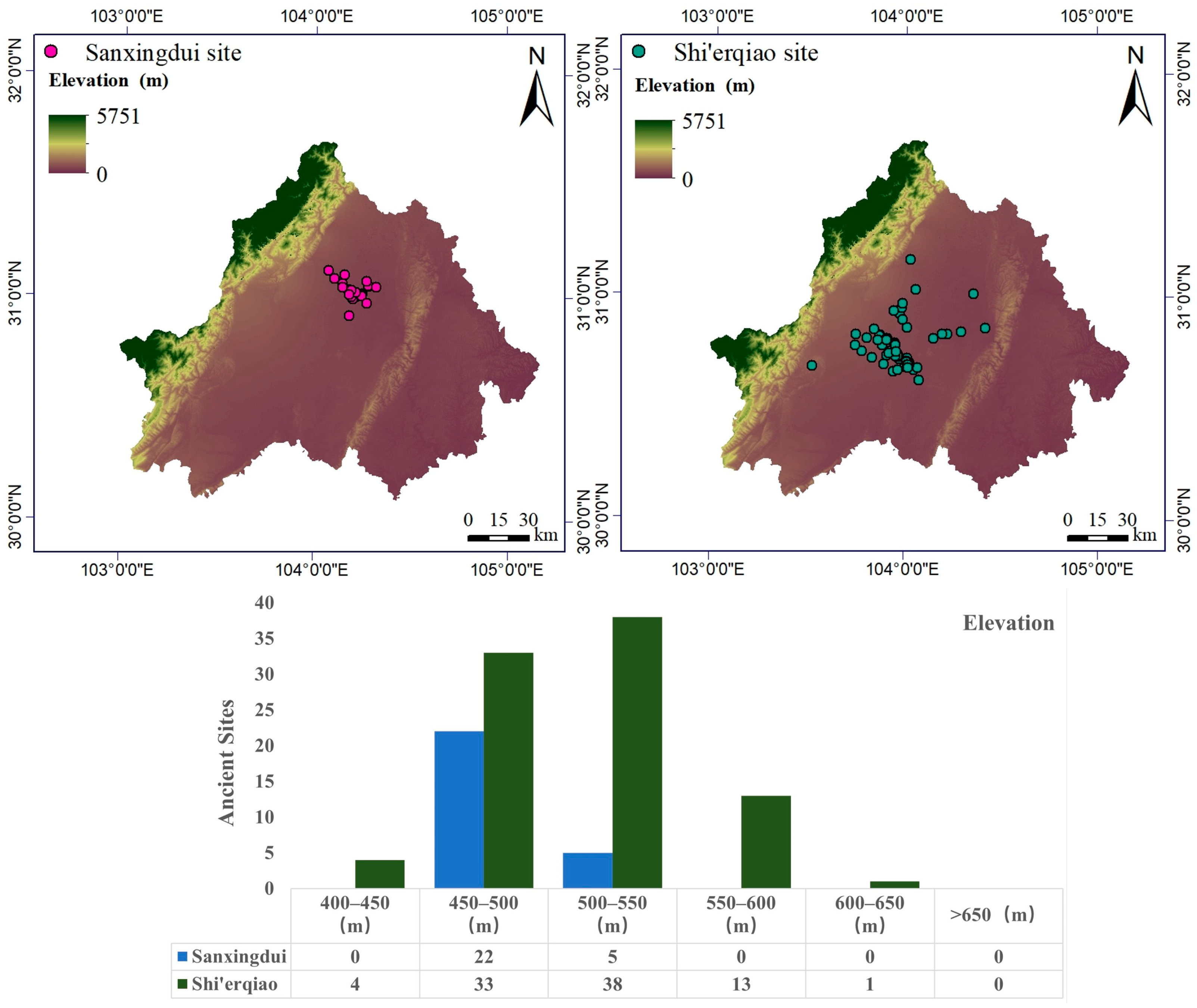
In the ArcGIS software, the DEM of Sichuan province was projected and symbolized. Subsequently, the spatial data of ancient sites spanning from the Sanxingdui period to the Shi’erqiao period were overlaid onto the DEM. Ultimately, the distribution patterns of these ancient sites across varying elevations were visualized through mapping. Furthermore, we determined the elevation of each ancient site and calculated the frequency of sites at different elevation intervals (Figure 3).
The altitudinal distribution of all sites from both phases in the study area falls within the range of 400–650 m a.s.l. Sanxingdui-period sites are predominantly clustered within a narrow band of 450–500 m a.s.l.; specifically, 22 of the 27 total sites fall within the 400–500 m a.s.l. range, with the remaining 5 located between 500 and 550 m a.s.l. These sites are situated near the junction of the piedmont and mid-fan zones, a region characterized by gently undulating relief and abundant water resources.
In comparison, Shi’erqiao period sites exhibit a significantly broader spatial distribution, spanning the full spectrum from 400 to 650 m a.s.l., with a notable concentration between 450 and 550 m a.s.l. The 500–550 m a.s.l. interval hosts the highest density of remains (38 sites), followed by 37 sites at 400–500 m a.s.l., 13 sites at 550–600 m a.s.l., and 1 site extending to 600–650 m a.s.l. This pattern indicates a more advanced capacity for exploiting diverse micro-topographic settings in site selection and land use.
Although the overall elevational range is relatively constrained, it corresponds to distinct geomorphic zonation on the Chengdu Plain. Even modest altitudinal differences here reflect transitions from floodplains to low terraces and gentle foothills. Consequently, the tight clustering of Sanxingdui sites at 450–500 m a.s.l. aligns with stable floodplain-terrace surfaces, while the wider elevational span of Shi’erqiao sites demonstrates an adaptation to more varied terrain.

4.2. Relief Degree

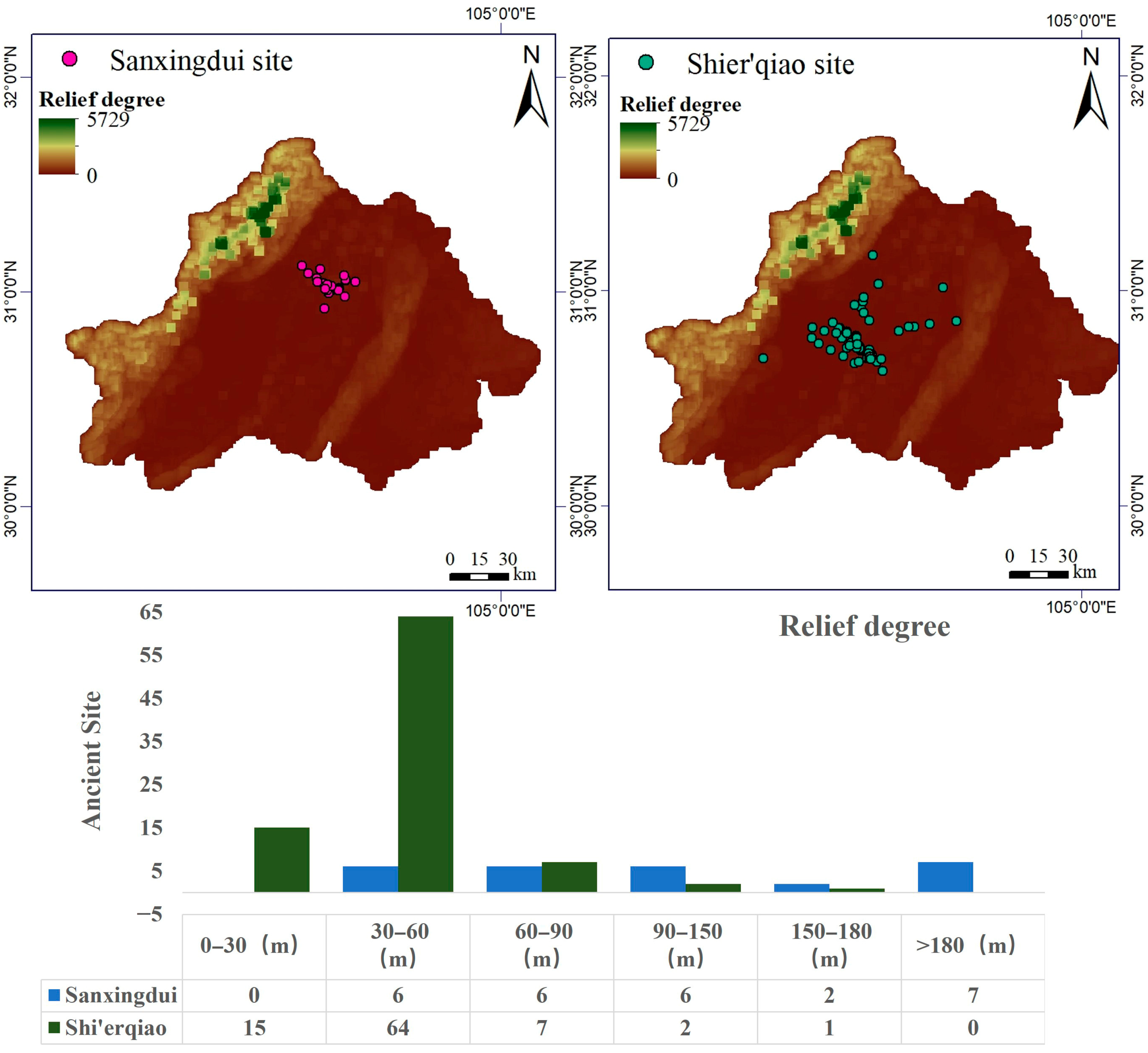
Relief degree is a fundamental geomorphological metric that captures elevation variability within a defined area and serves as a key proxy for surface heterogeneity, exerting strong control over prehistoric settlement placement [36]. In this study, we derived relief values from a 30 m-resolution DEM using a standard classification scheme and mapped their spatial distribution across the Chengdu Plain. The locations of Sanxingdui and Shi’erqiao sites were then superimposed onto the relief map to assess topographic preferences (Figure 4). Elevation in the study area increases from the low-lying alluvial plain toward the piedmont zone and decreases again toward the Min River terraces; accordingly, relief was categorized into six classes: 0–30 m, 30–60 m, 60–90 m, 90–150 m, 150–180 m, and >180 m. The number of sites falling within each relief class was quantified to evaluate differences between the two cultural phases, enabling a comparative analysis of how variability in microtopography influenced settlement distribution.
The results show that overall relief variability across the study area is relatively low, yet clear differences emerge between the two cultural phases. Sanxingdui sites are distributed across a broader relief spectrum, with no sites found in the lowest (0–30 m) category. Their distribution is as follows: 18 sites within the 30–150 m classes, 2 sites in the 150–180 m range, and 7 sites in areas exceeding 180 m.
In contrast, Shi’erqiao sites display a pronounced concentration in low-relief settings. More than 60% (64 sites) occur within the 30–60 m class. The remaining locations are distributed as follows: 15 sites in the 0–30 m class, 9 sites within 60–150 m, and only one site in the 150–180 m category. No Shi’erqiao sites are located in high-relief areas (>180 m). As illustrated in Figure 3, Sanxingdui sites reflect a broader tolerance for topographic variability and a more dispersed spatial configuration, suggesting flexible settlement strategies. Conversely, the Shi’erqiao sites are tightly clustered within low-relief alluvial plains characterized by minimal surface undulation. This shift indicates a morphological evolution in settlement organization, from the more outward-expanding and topographically diverse pattern of the Sanxingdui phase to the more inward-focused and spatially intensive configuration characteristic of the Shi’erqiao period.

4.3. Slope

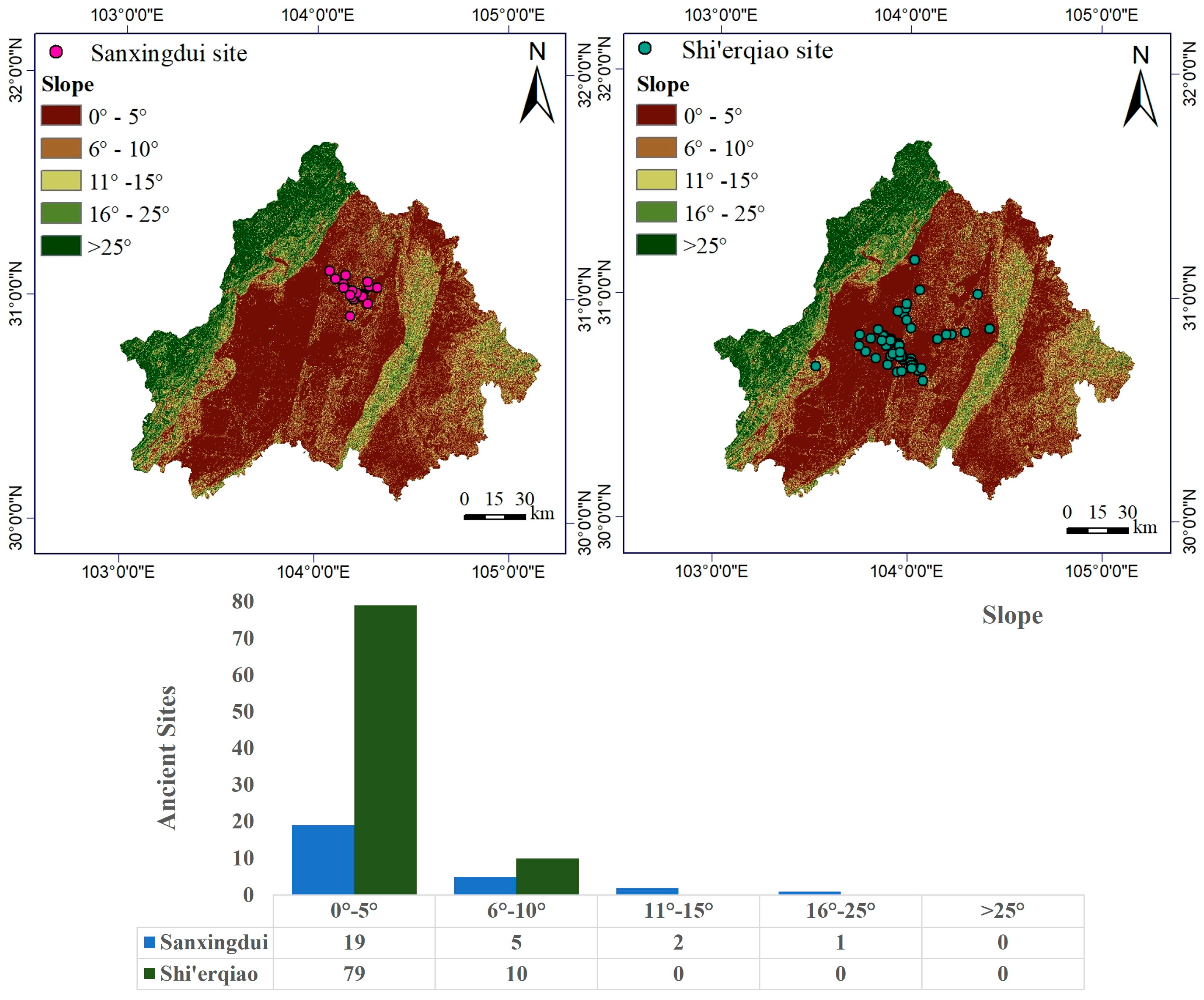
Slope is a key geomorphological parameter that strongly shapes settlement suitability, influencing construction feasibility, land-use intensity, water retention, erosion risk, and transportation efficiency [37]. Although elevation data portray the Chengdu Plain as broadly level, fine-scale slope variations reveal subtle terrain differences that may have conditioned early habitation choices. Slope analysis, integrated with the spatial distribution of archaeological sites, demonstrates that both Sanxingdui and Shi’erqiao settlements are overwhelmingly concentrated within gentle-slope zones (0–5°), reflecting the inherently low-gradient landscape of the region (Figure 5).
Slope extraction analysis shows that both the Sanxingdui and Shi’erqiao settlements overwhelmingly occupy gentle-slope zones (0–5°), though with distinct patterns of variability. Sanxingdui sites are primarily concentrated within the 0–5° range (19 sites), but a smaller number extend into higher slope categories, including 5 sites in the 6–10° range, 2 sites in the 11–15° range and 1 site in the 16–25° range. No Sanxingdui sites occur on slopes exceeding 15°. In contrast, Shi’erqiao settlements display an even stronger preference for flat terrain: 79 sites fall within the 0–5° zone, accounting for more than 80% of all occurrences, and only 10 sites lie within the 6–10° category. No Shi’erqiao sites are identified on slopes above 10°. Overall, Sanxingdui exhibits a slightly broader slope tolerance, whereas the Shi’erqiao settlements are tightly clustered within the flattest parts of the plain, reflecting an increasing reliance on low-relief environments during the later cultural phase.

4.4. Aspect

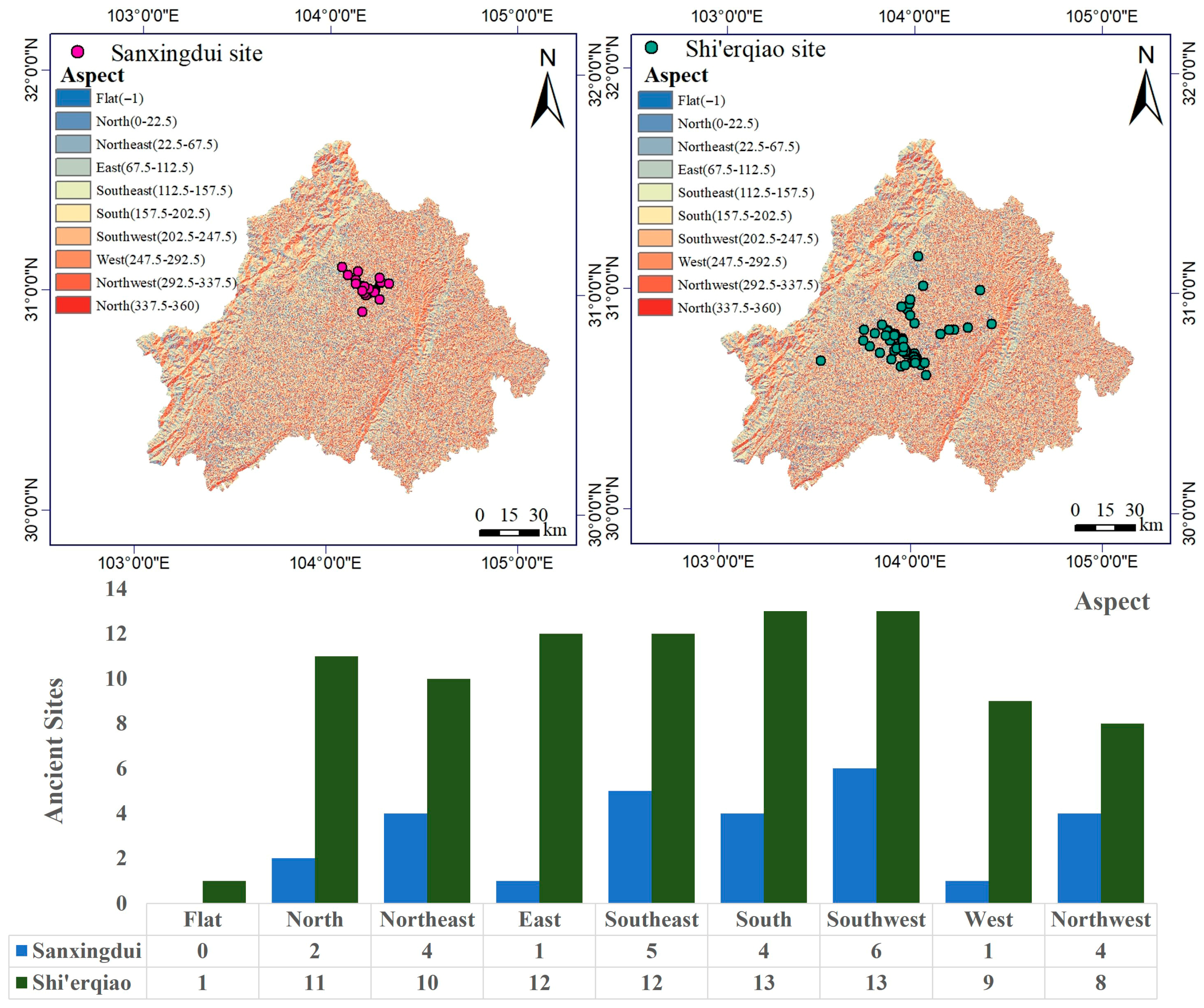
Aspect, defined as the compass direction of slope orientation, is a key geomorphic parameter influencing micro-environmental conditions such as solar radiation, evapotranspiration, wind exposure, and vegetation growth [38]. These factors can shape local habitability and thus affect ancient settlement choices. In this study, the aspect of the Chengdu Plain was categorized into nine classes (Figure 5): Flat terrain (−1), North (0–22.5°), Northeast (22.5–67.5°), East (67.5–112.5°), Southeast (112.5–157.5°), South (157.5–202.5°), Southwest (202.5–247.5°), West (247.5–292.5°), and Northwest (292.5–337.5°), with the final interval returning to North (337.5–360°). Sanxingdui sites are primarily concentrated within the central portion of the study area, whereas the Shi’erqiao sites exhibit a broader spatial distribution across multiple aspect categories, reflecting more extensive use of diverse micro-environments.
The aspect analysis reveals a relatively even distribution of Sanxingdui sites across multiple orientation categories. Specifically, 2 sites occur on flat terrain, while north-, east-, southeast-, south-, and west-facing slopes each host between 4 and 6 sites, with smaller occurrences in the northeast, southwest, and northwest categories. In contrast, the Shi’erqiao sites exhibit a more concentrated pattern. A total of 11 sites are situated on flat terrain, and the majority are distributed across east-, southeast-, south-, northeast-, and west-facing slopes (9–13 sites each), with no sites recorded on northwest-facing slopes. This indicates a marked preference for flat surfaces and east-facing orientations during the Shi’erqiao period. The histogram in Figure 6 further highlights these contrasts, showing the broad, nearly uniform aspect distribution of Sanxingdui sites versus the strong clustering of Shi’erqiao settlements in low-relief, east-facing environments.

4.5. Euclidean Distance to Rivers

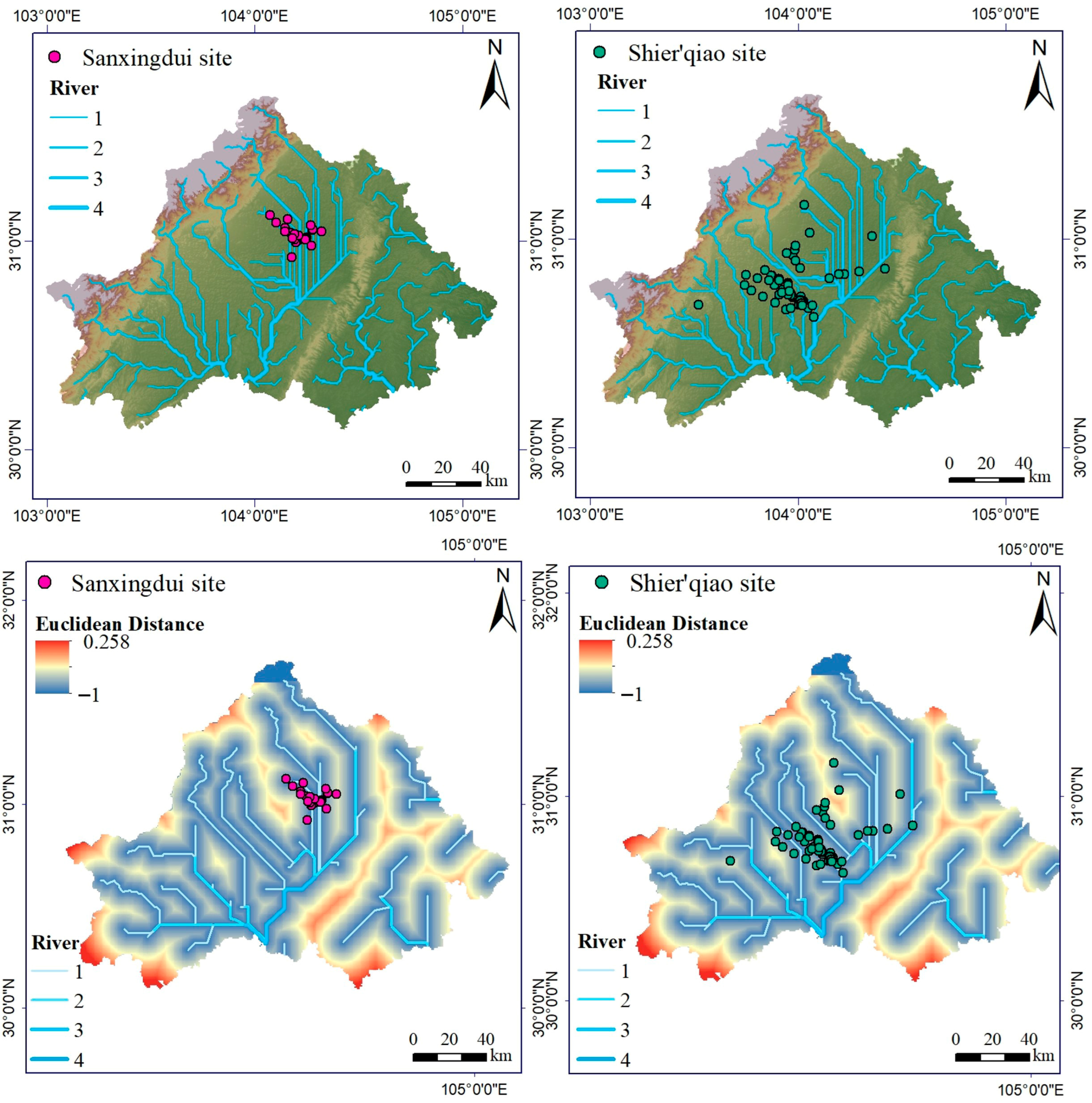
Hydrological systems are a fundamental component shaping the formation and sustainability of human settlements, influencing access to drinking water, irrigation, transportation, daily activities, and defensive planning [21]. To assess the spatial relationship between settlements and water availability, this study generated proximity buffers around the regional river network, and overlaid the Sanxingdui and Shi’erqiao sites’ distributions onto a Euclidean distance-to-river surface (Figure 6). This approach allows for a comparative assessment of hydrological dependency and settlement location preferences between the two cultural phases [39].
Figure 7 shows that Sanxingdui sites are predominantly concentrated within the 0–0.01 distance interval, indicating strong spatial clustering in areas immediately adjacent to river channels. Most sites occur along higher-order rivers (Classes 3–4), which represent larger, more stable waterways. This pattern underscores the marked hydrological dependence of Sanxingdui settlements and highlights the central role of major river systems in sustaining their habitation and socio-economic development.
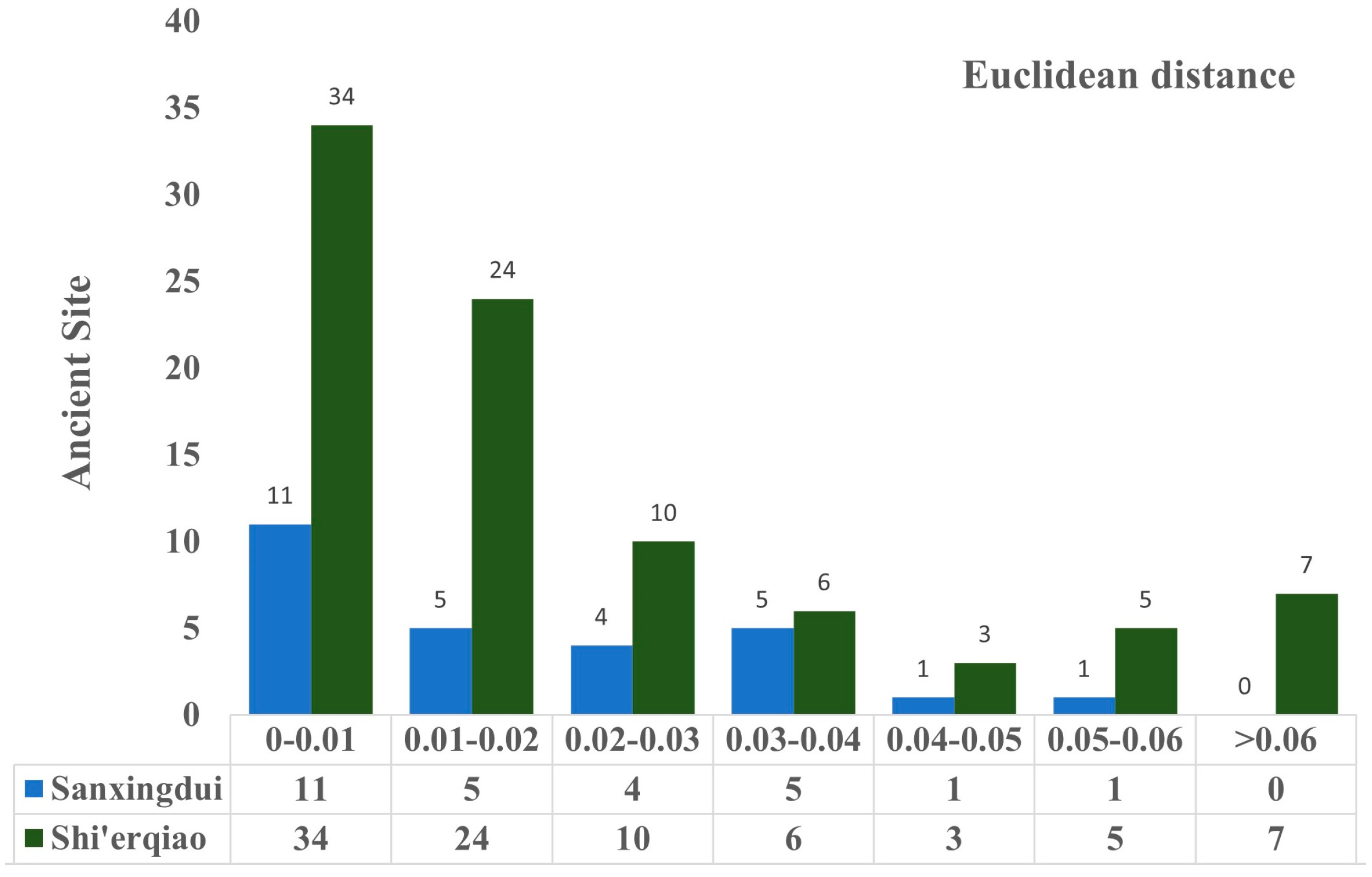
In contrast, the Shi’erqiao sites exhibit a more dispersed pattern of hydrological proximity. Although many sites remain within 0.05 units of the nearest river, a notable proportion extends to greater distances (up to 0.2578 units), indicating reduced spatial dependence on major waterways. As shown in Figure 8, Sanxingdui settlements are strongly clustered in the nearest interval (0–0.01) with 11 sites, followed by progressively fewer sites in the subsequent distance classes (5 in 0.01–0.02, 4 in 0.02–0.03, 5 in 0.03–0.04, 1 in 0.04–0.05, and 1 in 0.05–0.06), with none beyond 0.06.
Shi’erqiao sites display a markedly different pattern: the highest frequency occurs in the 0.01–0.02 interval (34 sites), followed by 24 sites in the 0–0.01 interval. Site numbers decline gradually with increasing distance (10 in 0.02–0.03, 6 in 0.03–0.04, 3 in 0.04–0.05, and 5 in 0.05–0.06), yet 7 sites occur beyond 0.06. This distribution suggests a broader range of hydrological adaptability during the Shi’erqiao period. These contrasting patterns indicate a clear diachronic shift from the Sanxingdui culture’s strong dependence on major river channels to the more diversified hydrological strategies of the Shi’erqiao period.

5. Discussion

5.1. Geomorphic Evolution and Settlement Adaptation

Rivers, particularly unstable channels in alluvial proluvial plains, are highly sensitive to environmental change, and the development of a river system records variations linked to tectonic activity, paleoclimatic conditions, and other factors [40]. The Chengdu Plain is a tectonically conditioned depression undergoing sustained uplift along the eastern flank of the Longmen Mountains, where active orogenesis and consequent fluvial incision have long shaped regional landscape evolution [2,5,41]. Increased relief contrasts enhanced sediment flux from the mountain front, particularly along the Minjiang and its distributary channels emerging from the Longmen Shan foothills [42]. This promoted frequent avulsion of proximal channels such as the paleo-Minjiang and early Jinsha–Qingshui tributaries, facilitating the progradation of fantoe lobes along the northwestern Chengdu Plain [42,43]. Sustained river incision driven by tectonic uplift caused the abandonment of older alluvial-fan surfaces adjacent to the Minjiang and Qingshui River corridors, leading to the dissection of mid- to late Holocene fan deposits and the formation of inset fluvial terraces [41,42,43]. Differential uplift along the mountain front induced subtle tilting of the foreland surface toward the southeast. This tectonically forced reorientation produced an asymmetric pattern of fan development, with more deeply entrenched channels in the northwest and broader, low-gradient fan surfaces to the southeast [41]. Collectively, the Minjiang River and its tributary systems have progressively lowered regional base levels, expanded drained areas, and promoted the formation of stepped river terraces since the mid-Holocene [42,43]. As a result, the plain developed a dense dendritic drainage system incorporating the Minjiang, Jinsha, Qingshui, and the Xi River, creating a heterogeneous mosaic of floodplains, paleo-channels, and low-relief foothills [13] (Figure 9).
During the mid–late Holocene, the Chengdu Plain was shaped by an actively adjusting fluvial regime dominated by lateral accretion, channel avulsion, and episodic overbank deposition [42]. These processes produced a tiered geomorphic surface composed of low-relief floodplains (30–90 m), aggradational terrace margins (60–150 m), and abandoned channel depressions. Consistent with this framework, Sanxingdui settlements are concentrated in the northeastern plain, where moderate relief, natural levees, and high hydraulic connectivity offered favorable conditions for irrigation, drainage, and soil productivity [44]. Portions of the Minjiang floodplain have since undergone extensive alluvial burial and modern land modification, suggesting that some prehistoric sites may remain undiscovered; the present dataset therefore reflects only the identifiable archaeological record [43].
Sanxingdui sites show strong clustering within the 0–0.01 river-distance buffer and a marked preference for relief values > 90 m, indicating avoidance of flood-prone basin floors while maintaining direct access to perennial water. To reduce the impact of later hydraulic engineering, the hydrological analysis focuses on geomorphically persistent river corridors and tributary sectors supported by mid-Holocene sedimentary evidence. Their tight proximity to rivers underscores a high dependence on stable surface water typical of early agrarian systems [44], while the tendency toward elevated microtopography suggests intentional selection for improved drainage and reduced flood risk [45]. By contrast, Shi’erqiao settlements occupy a broader geomorphic spectrum, extending southward toward the Jinsha drainage and into higher microbasins (up to 550–600 m a.s.l.) (Figure 3 and Figure 4). Their greater representation in the 0.01–0.03 buffer zones (Figure 7) reflect decreased reliance on major channels and expanded use of secondary water sources. This diversification is consistent with archaeological evidence for small-scale hydraulic installations, canals, ponds, and weirs, that enabled irrigation and facilitated settlement expansion into more dispersed terrain [46,47]. These features contrast sharply with the Sanxingdui period, where only simple earthen ditches have been documented, and demonstrate a clear technological transition toward engineered water redistribution systems [48]. Such installations would have reduced dependence on proximity to major channels and enabled reliable irrigation in more distant or geomorphically varied settings, consistent with the observed increase in site frequency within the 0.01–0.03 hydrological buffer zones [49]. Both cultural phases exhibit a preference for low slopes (0–5°) and low-to-moderate relief (<90 m), but the broader topographic tolerance of Shi’erqiao communities indicates gradually diminished geomorphic constraints and improved adaptability to varied fluvial landscapes [50]. Although the absolute differences in elevation and slope across the Chengdu Plain are small, these parameters retain functional significance in a low-gradient alluvial environment. Even modest elevation steps (30–50 m) and microslope variations (<1–2°) can substantially influence surface drainage efficiency, seasonal waterlogging, and the stability of cultivated landforms. These microtopographic controls operate at scales far below regional geomorphic contrasts; thus, the observed differences in settlement preferences cannot be attributed simply to the Sanxingdui and Shi’erqiao sites occupying different subregions of the plain. After controlling for regional distribution patterns, both cultural phases display internally consistent elevation and slope tendencies, Sanxingdui sites clustering on slightly elevated, better-drained levee–ridge margins, and Shi’erqiao sites extending into lower, gentler, more hydrologically varied surfaces. This persistence of microtopographic preference across spatially distinct areas indicates that elevation and slope reflect genuine environmental selection behaviours rather than artefacts of uneven site locations. Accordingly, the shift from Sanxingdui concentration on modestly higher, well-drained micro-relief to the broader topographic tolerance of the Shi’erqiao period is best understood as a cultural adaptation facilitated by advances in water-management capacity rather than a by-product of regional terrain differences.
Agricultural development played a significant role in this transition. During the Sanxingdui–Shi’erqiao sequence, settlements increasingly occupied flatter terrain (0–60 m), particularly within the 30–60 m band, aligning with areas offering stable irrigation potential and arable land [29,50]. Sanxingdui communities favored mid-elevation (400–550 m a.s.l.) zones with a stable water supply, well-suited for diversified early agriculture [51]. By the Shi’erqiao period, agricultural practices expanded further, with rice cultivation supplemented by foxtail millet, broomcorn millet, barley, and wheat [29,52]. These developments strengthened water-management capacity and increased tolerance for more distant hydrological settings. Spatially, 41% of Sanxingdui settlements fall within the 0–0.01 hydrological buffer, whereas this proportion decreases to 38% for the Shi’erqiao period (Figure 8). In contrast, the proportion in the 0.01–0.03 interval increases to 38%, reflecting reduced dependence on primary river channels and increasingly flexible land-use strategies enabled by hydraulic innovation [53,54]. Overall, the agricultural intensification and technological advances of the Shi’erqiao period supported settlement dispersal into a wider range of geomorphic contexts, marking a shift from river-dominated settlement logic to a more diversified and resilient land-use system.
Shi’erqiao culture, therefore, displays a broader environmental tolerance, encompassing higher elevations, lower-relief plains, and more distant positions from major rivers. This dispersed pattern suggests increased landscape flexibility likely driven by technological innovation, demographic expansion, or emerging sociopolitical organization [55]. The transition from tightly clustered riverine settlements in the Sanxingdui period to more topographically dispersed sites in the Shi’erqiao period reflects an evolving strategy of environmental adaptation supported by improved water management and expanding agricultural capacity [56,57]. Furthermore, the emergence of formalized burial zones, standardized ceramic forms, and organized production areas at Late Shi’erqiao sites supports interpretations of increased political coordination and community-level planning [11,58]. Together, these lines of evidence substantiate the argument that both hydraulic innovation and rising sociopolitical complexity contributed to broader settlement tolerance and more flexible land-use strategies in the Shi’erqiao period.

5.2. Impacts of Climatic Conditions on the Distribution of Archaeological Sites

The formation, development, and exchange of human cultures are often influenced by geographic environments, as evidenced by the effects of climate change and extreme weather events on human migration and cultural turnover [59,60]. The settlement behaviors of the Sanxingdui and Shi’erqiao cultures occurred during a transitional period of the Holocene climate. Globally, the Middle to Late Holocene as characterized by a gradually weakening Asian summer monsoon (ASM), declining temperatures, and regional aridification in parts of inland Asia and northern China [13,61].
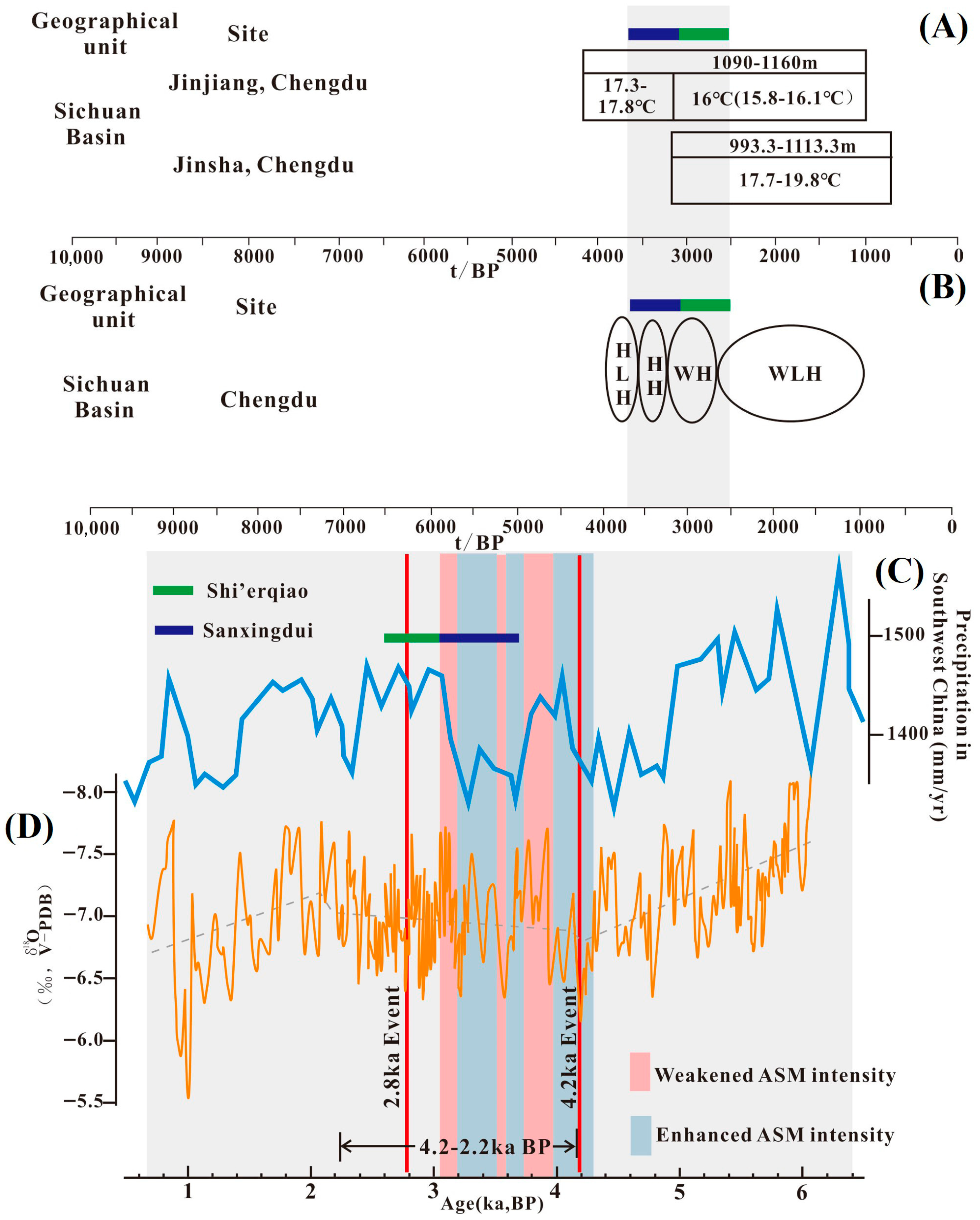
Throughout the Holocene, the Sichuan Basin experienced a long-term shift from warm–humid conditions to a hotter phase and then to cooler regimes, with climate variability intensifying after the mid-Holocene [62,63]. During the Sanxingdui period, this transition manifested as a decline in mean annual temperature from ~+1 °C above modern values to ~0.5–0.8 °C below present, accompanied by a ~15% decrease in precipitation and a weakening ASM around 3.2 ka BP. In contrast, the subsequent Shi’erqiao occupation unfolded under persistently cooler and drier conditions, with climatic archives revealing centennial-scale oscillations of ±0.7 °C, >100 mm yr−1 precipitation variability, and two notable ASM “weak–strong–weak” cycles at ~2.7 and ~2.4 ka BP [62] (Figure 10A,B). Based on extensive research on the ASM, stalagmite δ18O is widely used as a proxy for the influence of solar radiation fluctuations on the ASM over orbital timescales. Lighter (more negative) δ18O values indicate a stronger summer monsoon, while heavier (less negative) values indicate a weaker one (Figure 10C) [18,63]. As shown in Figure 10C, from 4.2 to 2.2 ka BP, δ18O values exhibited a long-term trend toward lighter values (decreasing from −6.13‰ to −7.57‰), suggesting a strengthening ASM forcing at the orbital scale [64]. However, this trend was superimposed on substantial variability, and regional precipitation proxies for the Chengdu Plain tell a more complex story. Some records indicate an overall trend towards drier conditions [64]. While others show periods of increased rainfall, potentially linked to factors such as the transition from El Niño to La Niña conditions during the 4.2 ka BP event, which can lead to anomalous precipitation increases in the Yangtze River Basin [62,63,65] (Figure 10D). These hydroclimatic stresses coincided with the terminal stage of the Sanxingdui culture, marked by settlement contraction and large-scale ritual bronze deposition [63,65,66]. While the Sanxingdui period (3.7–3.1 ka BP) initially developed under a relatively warm and humid regime [67,68]. The ensuing amplified late-Holocene instability meant that Shi’erqiao communities faced more frequent and severe environmental fluctuations, likely prom [69].
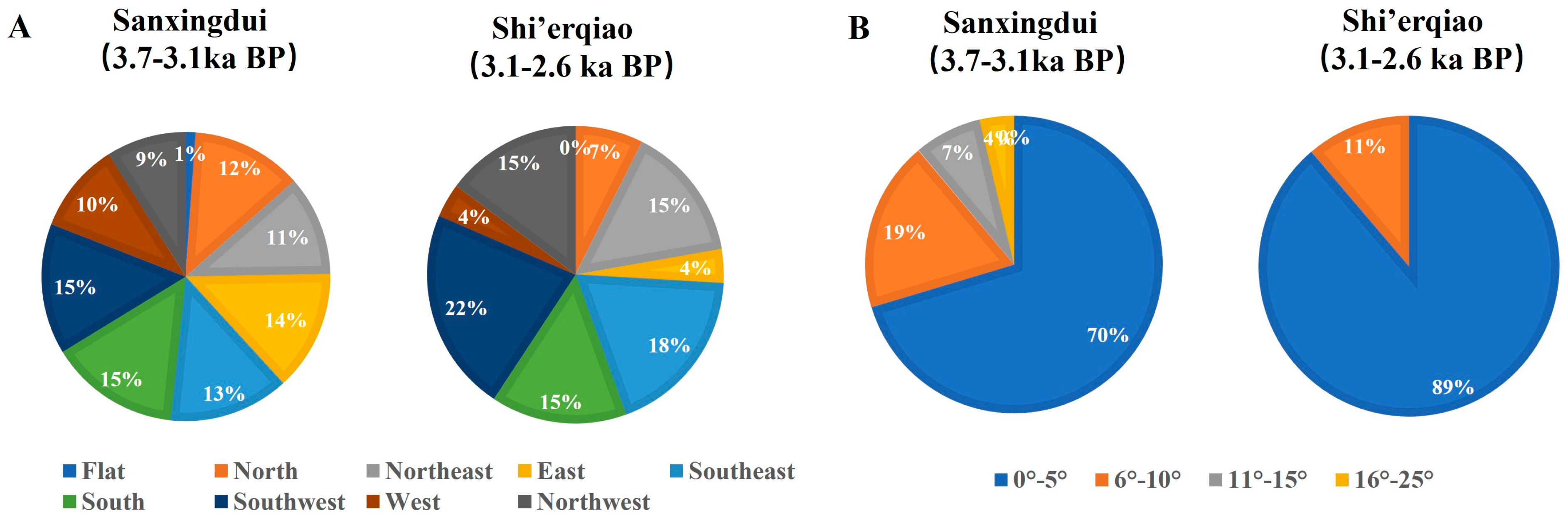
Against this backdrop of progressively intensified late-Holocene climate variability, the settlement preferences of the Sanxingdui and Shi’erqiao cultures exhibit clear geomorphic signatures that closely track these hydroclimatic transitions. During the warm–humid and hydrologically stable Sanxingdui phase (3.7–3.1 ka BP), communities preferentially occupied extremely east-southeast-facing aspects (Figure 11A), low slopes (0–5°) (Figure 11B), and floodplain-proximal locations. These settings maximized biomass productivity, reliable hydrology, and radiative advantages favorable for intensive rice agriculture [70,71,72]. This pattern aligns with relatively high temperatures and abundant moisture before the weakening of the ASM at ~3.2 ka BP, as reflected in declining precipitation, weakening monsoon intensity, and changes in δ18O values (Figure 10) [65]. Hydroclimatic instability intensified around 3.3–3.0 ka BP, marked by cold–wet anomalies, floods, and tectonically induced disturbances [13,65]. A 20–50 cm layer of coarse sand and fine gravel (0.5–2 cm, well-rounded) in the upper cultural deposits at Sanxingdui provides clear evidence of a high-energy flood event. This interpretation is reinforced by a 1.2 m grayish-white sandy gravel lens at the base of the cultural layer at the Shi’erqiao site (Lanyuan locality), dated to 3080 ± 30 BP, which aligns closely with the same flood phase [73,74,75]. The terminal Sanxingdui stage thus experienced environmental stress, settlement contraction, and large-scale ritual bronze deposition [65,69].
In contrast, the Shi’erqiao period (2.8–2.3 ka BP), coinciding with cooler, drier, and more variable climatic conditions linked to the 2.8 ka event and a weakened ASM, shows increasingly concentrated settlement distributions: 89% of sites lie on 0–5° slopes, yet slope-aspect preferences broaden to include north- and northwest-facing orientations (Figure 11) [65,76]. This shift indicates enhanced adaptive capacity and refined land–energy strategies under heightened climate variability [77]. Significantly, hydraulic installations, including wood-pile wharves, reservoirs, covered culverts, composite stone–timber floodwalls, and paddy-ditch systems, first appear or reach their greatest density during this period, whereas Sanxingdui features only simple irrigation ditches [78,79]. These facilities cluster on north-to northwest-facing slopes and gently rolling terrain of 5–10°, matching the expanded aspect range characteristic of Shi’erqiao settlements. This spatial correspondence provides material confirmation of the causal chain in which improved water-management technology enabled greater locational flexibility and resilience under increasingly unstable late-Holocene climatic conditions [80,81]. Together with the broader influence of the 4.2 ka and 2.8 ka events on regional hydroclimatic stability, these patterns underscore a marked contrast: warm–humid stability during the Sanxingdui period fostered centralized settlements and intensive agriculture, whereas the more variable climate of the Shi’erqiao period promoted settlement decentralization, diversified land use, and heightened topographic adaptability [68,82].

5.3. Responses of Environment Evolution to Culture

The close relationship between environmental change and cultural transformation in the Chengdu Plain provides an essential context for interpreting the evolution from the Sanxingdui to the Shi’erqiao stage of ancient Shu civilization [83]. Archaeological and chronological evidence demonstrates that these two cultural phases form a continuous developmental sequence rather than separate cultural entities [82,84]. Stratified excavations at Sanxingdui and Shi’erqiao show uninterrupted ceramic traditions, shared jade-working methods, and stable bronze typologies, particularly in mask-making, anthropomorphic imagery, and high-tin ritual vessels, indicating a deep lineage continuity across the transition [84,85]. During the Sanxingdui phase, settlement patterns and material assemblages reveal a highly centralized polity whose power was expressed through monumental ritual complexes, large-scale sacrificial pits, and specialized bronze workshops concentrated near the core site [4,5]. Their spatial clustering on low-relief, hydrologically accessible terrain reflects a landscape strategy dependent on predictable water supply and state-directed labor mobilization [86].
Around 3.1 ka BP, weakening of the Asian summer monsoon produced drier climatic conditions, while tectonically driven reorganization of the Minjiang and its distributaries reshaped the hydrological framework of the Chengdu Plain [34]. This environmental inflection point coincides with marked cultural adjustments recorded at Sanxingdui: abrupt burning remains, large-scale backfilling, and the termination of centralized bronzeworking within the ritual core [16]. Meanwhile, new occupational surfaces and cultural layers at Jinsha and Shierqiao reveal the emergence of continuously inherited ceramic forms, duplicated ritual motifs, and relocated craft-production loci, showing that cultural authority did not disappear but shifted spatially within the same cultural tradition [5,85,87]. The succeeding Shi’erqiao period, corresponding broadly to the early Western Zhou, exhibits greater settlement dispersal, diversified craft zones, and increased functional mixing of domestic, ritual, and production activities [58]. The rise of secondary centers and small-scale villages, together with the expansion of bead-making, gold-crafting, and sandstone-implement workshops, reflects a maturing sociopolitical and economic system that had moved beyond the earlier highly centralized model [85]. These changes indicate not cultural rupture but adaptive decentralization, a process that allowed communities to buffer hydrological uncertainty and broaden their ecological footprint [88].
In this broader context, the Sanxingdui–Shi’erqiao transformation mirrors synchronous patterns observed across Bronze Age Eurasia, where climatic instability and shifting river regimes frequently corresponded with political decentralization, innovation in land management, and restructured ritual practices [89,90,91]. Thus, the evolution from Sanxingdui to Shi’erqiao reflects both a deep cultural inheritance, evidenced by continuous ceramic lineages, bronze traditions, and ritual symbolism, and a strategic reorientation in human–landscape interaction driven by intertwined environmental pressures and sociopolitical recalibration.

6. Conclusions

This study demonstrates that the spatial and temporal patterning of Sanxingdui and Shi’erqiao cultural sites on the Chengdu Plain was jointly shaped by geomorphology, hydrology, and changing cultural–technological practices. Analysis of 116 confirmed settlement sites, 27 Sanxingdui and 89 Shi’erqiao reveals clear contrasts in land-use strategies between the two periods.
Sanxingdui settlements show strong environmental coherence, clustering at 450–500 m a.s.l. elevation, on gentle slopes, within moderate relief zones, and almost entirely inside the 0–0.01 river buffer. Their consistent orientation toward east- and southeast-facing slopes reflects dependence on fertile floodplains, stable river corridors, and microclimatic conditions that supported intensive rice agriculture and centralized sociopolitical organization. Shi’erqiao sites, in contrast, occupy a wider elevational and hydrological spectrum, with over one-third located beyond major river buffers and a marked preference for flat terrain and warm-aspect slopes. This broader distribution indicates reduced dependence on trunk rivers and greater reliance on small-scale irrigation, flexible water management, and diversified subsistence strategies.
The transition from Sanxingdui to Shi’erqiao therefore signals a shift from selective environmental preference to active environmental engagement, driven by both hydrogeomorphic adjustment and technological innovation. These findings highlight the dynamic interaction between human groups and the Chengdu Plain landscape and provide a framework for understanding cultural adaptation during the late Bronze Age. Future research integrating paleoenvironmental records and subsurface survey data will further clarify the mechanisms guiding settlement organization and cultural transformation in this region.

Author Contributions

Conceptualization, H.C. and X.C.; methodology, H.C., X.C. and C.X.; formal analysis, H.C. and C.X.; investigation, H.C. and C.X.; writing—original draft preparation, H.C., X.C. and C.X.; writing—review and editing, H.C. and X.C. All authors have read and agreed to the published version of the manuscript.

Funding

This research was funded by the Open Fund (DGERA20221101) of Key Laboratory of Deep-time Geography and Environment Reconstruction and Applications of Ministry of Natural Resources, Chengdu University of Technology, Talent Introduction Program of Chengdu University of In-formation Technology, (KYTZ202201).

Data Availability Statement

The original contributions presented in the study are included in the article, further inquiries can be directed to the corresponding author.

Conflicts of Interest

The authors declare no conflicts of interest.

References

  1. Zhao, C.; Mo, D. Holocene hydro-environmental evolution and its impacts on human occupation in Jianghan-Dongting Basin, middle reaches of the Yangtze River, China. J. Geogr. Sci. 2020, 30, 423–438. [Google Scholar] [CrossRef]
  2. Zeng, M.X.; Zhu, C.; Song, Y.G.; Wu, Y.Q.; Wang, H.J.; Zhang, Y.W.; He, K.Y.; Chen, J.; Wu, Z.R.; Zeng, Q. Significance of fluvial landform evolution and river reorganization in settlement development over the past 50 ka: A case study of Baodun site on Chengdu Plain, SW China. Geomorphology 2022, 409, 108267. [Google Scholar] [CrossRef]
  3. Wen, X.; Chen, M.; Feng, W.; Huang, C. Mid-late Holocene climatic changes recorded by loess deposits in the eastern margin of the Tibetan Plateau: Implication for human migrations. Quat. Int. 2017, 441 Pt A, 77–88. [Google Scholar] [CrossRef]
  4. Chen, C.J.; Wu, Y.; Li, J.Y.; Zhang, H.W.; Cheng, H.; Shen, C.C.; Li, T.Y. Hydrological changes in the east asian monsoon region around 4.2 ka precisely reconstructed from multi-proxy stalagmites. Quat. Sci. Rev. 2025, 357, 109321. [Google Scholar] [CrossRef]
  5. Huang, M. Investigation and research on environmental archaeology in Chengdu Plain. China Cult. Herit. 2017, 6, 87–93. (In Chinese) [Google Scholar]
  6. Dong, G.; Li, T.; Zhang, S.; Ren, L.; Li, R.; Xiao, Y.; Wang, Z.; Chen, F. Precipitation in surrounding mountains instead of lowlands facilitated the prosperity of ancient civilizations in the eastern Qaidam Basin of the Tibetan Plateau. Catena 2021, 203, 105318. [Google Scholar] [CrossRef]
  7. Yang, Q. A study on the correlation between the migration of major city sites of the ancient Shu civilization and climate change. Sichuan Archit. 2015, 3, 7–10. [Google Scholar]
  8. Jiang, L.; Wu, Z.R. Human Activities Flexibility under Volatile Environment Conditions around 4000 a BP: Insights from the Jinsha Site in the Chengdu Plain, SW China. Quat. Sci. Rev. 2024, 326, 108612. [Google Scholar] [CrossRef]
  9. Chen, D.A.; Chen, X.D. The Excavation of the No.1 Sacrificial Pit at Sanxingdui Site, Guanghan. Cult. Relics 1987, 10, 1–15+97–101. (In Chinese) [Google Scholar]
  10. Chen, D.A.; Chen, X.D. The Excavation of the No.2 Sacrificial Pit at Sanxingdui Site, Guanghan. Cult. Relics 1989, 5, 1–20+97–103. (In Chinese) [Google Scholar]
  11. Jiang, J.H.; Wang, Y.; Zhang, Q. A Preliminary Research on the Predynastic Qin Culture in the Chengdu Plain. Acta Archaeol. Sin. 2002, 1, 1–22. (In Chinese) [Google Scholar]
  12. Fan, J. Research on Prehistoric Agriculture in the Chengdu Plain. Forum Chin. Cult. 2017, 12, 80–83. (In Chinese) [Google Scholar]
  13. Wu, J.H.; Zeng, M.X.; Zhu, C.; Song, Y.G.; Wu, Y.Q.; Mao, X.Y.; Wang, N.J.; Wang, X.L. Drivers of prehistoric cultural evolution in the Chengdu Plain: Fire events and environmental changes during the middle and late Holocene. Ecol. Indic. 2024, 169, 112833. [Google Scholar] [CrossRef]
  14. Zhu, L.; Li, Z.; Su, H.; Wang, X. Temporal and spatial distribution of ancient sites in Shaanxi Province using geographic information systems (GIS). Herit. Sci. 2021, 9, 1–10. [Google Scholar] [CrossRef]
  15. Sun, H. Constitution and Origin of Wave Patterns on Bronze Ware: Issues of Sanxingdui/Shierqiao Culture and Wave Patterns of the Zhou Dynasty. Sichuan Archit. 2021, 1, 107–118. (In Chinese) [Google Scholar]
  16. Zhao, D.Z. Basic Structure of the Sacrificial Activities at Sanxingdui Site: Altars, Temple and Sacrificial Pits. Sichuan Cult. Relics 2022, 201, 80–94. (In Chinese) [Google Scholar]
  17. Wang, T.Y. The Identification of the Symbols Related to Bashu Sacred Tree—Taking the Yucong Sacred Tree Pattern Unearthed from Sanxingdui No.3 Pit as the Main Clue. J. Chin. Cult. 2024, 4, 113–123. (In Chinese) [Google Scholar]
  18. Tan, M. Circulation Effect: Response of Precipitation δ18O to the ENSO Cycle in Monsoon Regions of China. Clim. Dyn. 2014, 42, 1067–1077. [Google Scholar] [CrossRef]
  19. Sun, Q.L.; Liu, Y.; Wünnemann, B.; Peng, Y.J.; Jiang, X.Z.; Deng, L.J.; Chen, J.; Li, M.T.; Chen, Z.Y. Climate as a factor for Neolithic cultural collapses approximately 4000 years BP in China. Earth Sci. Rev. 2019, 197, 102915. [Google Scholar] [CrossRef]
  20. Huang, M.; Deng, Y.; Peng, H.; Wen, Z.; Shang, G.; Guan, H.; Ma, C. Hydroclimatic changes since the Last Glacial Maximum recorded in mountain peat deposit on the southwestern margin of the Sichuan Basin, China. Front. Ecol. Evol. 2022, 10, 1050429. [Google Scholar] [CrossRef]
  21. Zhu, C.; Xu, J.J.; Huang, M.; Yang, Z.F.; Jiang, Z.H.; Bai, T.Y.; Lu, F.Z. Archaeological discoveries and research on the remains of an ancient flood event at the Majie Site in the Chengdu Plain. Front. Earth Sci. 2021, 28, 181–201. (In Chinese) [Google Scholar]
  22. Hu, H.N. Study on the Distribution of Archaeological Sites from Yangshao to Shang periods in the Zhuozhang River Basin and Its Relationship with Physical Environment. Master’s Thesis, Henan University, Henan, China, 2023. (In Chinese). [Google Scholar]
  23. Feng, Y.; Wei, H.; Huang, Y.; Li, J.; Mu, Z.; Kong, D. Spatiotemporal evolution characteristics and influencing factors of traditional villages: The Yellow River Basin in Henan Province, China. Herit. Sci. 2023, 11, 97. [Google Scholar] [CrossRef]
  24. Fang, Y.L.; Lu, H.Y.; Huang, Z.F.; Zhu, Z.G. Spatial and temporal distribution characteristics and influencing factors of traditional villages in China. Econ. Geogr. 2023, 43, 187–196. [Google Scholar]
  25. Chen, W.; Yang, L.; Wu, J.; Wu, J.; Wang, G.; Bian, J.; Liu, Z. Spatio-temporal characteristics and influencing factors of traditional villages in the Yangtze River Basin: A Geodetector model. Herit. Sci. 2023, 11, 111. [Google Scholar] [CrossRef]
  26. Zhang, H.P.; Liu, W.M.; Zhao, H.M.; Ye, Z.L.; Pan, M.H. The Paleolithic–Bronze age sites in Sichuan Province: Distribution and influencing factor. Mar. Geol. Quat. Geol. 2025, 45, 188–198. (In Chinese) [Google Scholar]
  27. Cheng, J.N.; Zhao, G.X.; Zhang, Z.X.; Wang, S. Characterization of spatial pattern and geographic differentiation of traditional villages in Shandong Province. J. Guilin Univ. Technol. 2022, 42, 845–852. (In Chinese) [Google Scholar]
  28. Zeng, M.X.; Ma, C.M.; Zhu, C.; Song, Y.G.; Zhu, T.X.; He, K.Y.; Chen, J.; Huang, M.; Jia, T.J.; Guo, T.H. Influence of climate change on the evolution of ancient culture from 4500 to 3700 cal. yr BP in the Chengdu Plain, upper reaches of the Yangtze River, China. Catena 2016, 147, 742–754. [Google Scholar] [CrossRef]
  29. Yang, Y.; Li, H.; Lu, Y.; Xia, R.; James, N.; Chen, H.; Zhao, Y. The agricultural economy of the Sanxingdui culture (3700–3100 BP): Archaeological and historical evidence from the Chengdu Plain. Land 2024, 13, 787. [Google Scholar] [CrossRef]
  30. Zhao, Z.Z.; Qiao, Y.S.; Wang, Y.; Fu, J.L.; Wang, S.B.; Li, C.Z.; Yao, H.T.; Jiang, F.C. Magnetostratigraphic and paleoclimatic studies on the red earth formation from the Chengdu Plain in Sichuan Province. Sci. China Ser. Earth Sci. 2007, 50, 927–935. [Google Scholar] [CrossRef]
  31. Jiang, S.B. Preliminary study on pre-Qin agriculture in Chengdu Plain. Agric. Archaeol. 2002, 3, 26–34. (In Chinese) [Google Scholar]
  32. Chen, X.D. The culture and chronology at Sanxingdui Site. South. Ethnol. Archaeol. 1990, 213–231+312+318. (In Chinese) [Google Scholar]
  33. Shi, J.S. Shi’erqiao sites and Shi’erqiao culture. Archaeology 2015, 2, 79–91+2. (In Chinese) [Google Scholar]
  34. Xie, Z.B.; Xu, D.Y.; Han, Y.; Chen, M.; Wang, T.; Zhan, T.Y.; He, K.; Qiu, Y.W.; Li, G.H.; Wang, Q. Carbon-14 Dating Study of the No. 4 Sacrificial Pit at the Sanxingdui Site in Guanghan, Sichuan. Sichuan Cult. Relics 2021, 2, 117–120. (In Chinese) [Google Scholar]
  35. Laboratory of the Institute of Archaeology, Chinese Academy of Social Sciences. Radiocarbon Dating Report (14). Archaeology 1987, 7, 658–662. (In Chinese) [Google Scholar]
  36. Callow, J.N.; Van Niel, K.P.; Boggs, G.S. How does modifying a DEM to reflect known hydrology affect subsequent terrain analysis? J. Hydrol. 2007, 332, 30–39. [Google Scholar] [CrossRef]
  37. Deng, C.; Liu, L.; Li, H.; Peng, D.; Wu, Y.; Xia, H.; Zhu, Q. A data-driven framework for spatiotemporal characteristics, complexity dynamics, and environmental risk evaluation of river water quality. Sci. Total Environ. 2021, 785, 147134. [Google Scholar] [CrossRef]
  38. Liu, Y.; Cui, J.; Kong, X.; Zeng, C. Assessing suitability of rural settlements using an improved technique for order preference by similarity to ideal solution. Chin. Geogr. Sci. 2016, 26, 638–655. [Google Scholar] [CrossRef]
  39. Askman, J.; Nilsson, O.; Becker, P. Why people live in flood-prone areas in Akuressa, Sri Lanka. Int. J. Disaster Risk Sci. 2018, 9, 143–156. [Google Scholar] [CrossRef]
  40. Dewan, A.; Corner, R.; Saleem, A.; Rahman, M.; Haider, M.; Rahman, M.; Sarker, M. Assessing channel changes of the Ganges–Padma River system in Bangladesh using Landsat and hydrological data. Geomorphology 2017, 276, 257–279. [Google Scholar] [CrossRef]
  41. He, Y. The preliminary discussion of the formation of Chengdu Basin. Geol. Bull. China 1987, 2, 75–82. (In Chinese) [Google Scholar]
  42. Yan, L.; Li, Y.; Zhao, G.H.; Liang, M.J.; Yan, Z.K.; Shao, C.J.; Li, F.S.; Yun, K.; Ma, C.; Zhang, W. The uplift process and the geomorphological features of the rivers system in the Longmen Shan since Late Quaternary. Quat. Sci. 2018, 38, 232–246. [Google Scholar]
  43. Lu, H.; Wang, C.; Cai, F.; Wu, C.; Bao, J.; Zheng, Y.; Cao, C. Morphological change and its response to human activities in the estuary of Minjiang River, China, since the last early century. Earth Surf. Process. Landf. 2023, 48, 1940–1955. [Google Scholar] [CrossRef]
  44. Xu, J.; Jia, Y.; Ma, C.; Zhu, C.; Wu, L.; Li, Y.; Wang, X. Geographic distribution of archaeological sites and their response to climate and environmental change between 10.0–2.8 ka BP in the Poyang Lake Basin, China. J. Geogr. Sci. 2016, 26, 603–618. [Google Scholar] [CrossRef]
  45. Gao, Y.; Li, J.; Di, B. Early human settlements and mobility patterns in the Sichuan–Chongqing region from the late Neolithic to the Bronze Age. Quat. Int. 2025, 724, 109726. [Google Scholar] [CrossRef]
  46. Yu, M.Z.; Wu, C.M. Preliminary Discussion on the Early Remains of the Shierqiao Culture. Acta Archaeol. Sin. 2019, 2, 163–192. (In Chinese) [Google Scholar]
  47. Wu, C.M. Preliminary Study of the Majiashan Type of the Shi’erqiao Culture. Jianghan Archaeol. 2023, 5, 82–92+121. (In Chinese) [Google Scholar]
  48. Li, H.; Zuo, Z.; Cui, J.; Tian, J.; Yang, Y.; Yi, L.; Zhou, Z.; Fan, J. Bronze Production in the Ancient Chengdu Plains: A Diachronic Metallurgical Perspective on a Separate Cultural Region. J. Cult. Herit. 2020, 43, 26–36. [Google Scholar] [CrossRef]
  49. Hosner, D.; Wagner, M.; Tarasov, P.E.; Chen, X.; Leipe, C. Spatiotemporal distribution patterns of archaeological sites in China during the Neolithic and Bronze Age: An overview. Holocene 2016, 26, 1576–1593. [Google Scholar] [CrossRef]
  50. Li, Y.P.; Zhou, X.Y.; Li, J.Y.; Sun, N.; Zhao, K.L.; Chen, G.H.; Zhang, Y.P.; Li, X.Q. Evolution of agricultural structure and its adaptation to the environment in North China during the middle Holocene warm period. Quat. Sci. 2024, 44, 1433–1449. (In Chinese) [Google Scholar]
  51. Ren, X.; Lemoine, X.; Mo, D.; Kidder, T.R.; Guo, Y.; Qin, Z.; Liu, X. Foothills and intermountain basins: Does China’s fertile arc have “hilly flanks”? Quat. Int. 2016, 426, 86–96. [Google Scholar] [CrossRef]
  52. Lü, Y.; Zhang, J.P.; Tang, M.; Yang, Z.F.; Huang, M.; Jiang, M.; Yan, X.; Shao, K.; Wen, C.H.; Ye, M.L.; et al. Phytolith Analysis Reveals the Agricultural Development and Environmental Background of the Pre-Qin Period in Chengdu Plain—A Case Study of Baodun and Sanxingcun Sites. Quat. Sci. 2021, 41, 1475–1488. (In Chinese) [Google Scholar]
  53. Gregory, K.J. The Human Role in Changing River Channels. Geomorphol. 2006, 79, 172–191. [Google Scholar] [CrossRef]
  54. Chen, T.; Ryves, D.; Wang, Z.; Lewis, J.; Yu, X. Mid- to Late Holocene Geomorphological and Hydrological Changes in the South Taihu Area of the Yangtze Delta Plain, China. Palaeogeogr. Palaeoclimatol. Palaeoecol. 2018, 498, 127–142. [Google Scholar] [CrossRef]
  55. Zhang, S.; Zhang, D.D. Centralization or Decentralization? A Spatial Analysis of Archaeological Sites in Northern China during the 4.2 ka BP Event. Front. Earth Sci. 2023, 11, 1135395. [Google Scholar] [CrossRef]
  56. Montgomery, D.R. Dirt: The Erosion of Civilizations, with a New Preface; Univsity of California Press: Oakland, CA, USA, 2012. [Google Scholar]
  57. Zheng, Z.; Ma, T.; Tang, Y.J.; Rolett, B.V.; Zong, Y.Q.; Huang, K.Y.; Zhang, S.X. Holocene Environmental Changes and Prehistoric Agricultural Development along the Coastal Areas of South China to Southeast Asia. Chin. Sci. Bull. 2024, 69, 2553–2567. (In Chinese) [Google Scholar] [CrossRef]
  58. Huo, W. Shi’erqiao Sites in Chengdu. J. Tianfu 2023, 6, 2+161. (In Chinese) [Google Scholar]
  59. Staubwasser, M.; Weiss, H. Holocene Climate and Cultural Evolution in Late Prehistoric–Early Historic West Asia. Quat. Res. 2006, 66, 372–387. [Google Scholar] [CrossRef]
  60. Shi, Z.; Zhou, P.; Li, X.; Cheng, H.; Sha, Y.; Xie, X.; Liu, X. Distinct Holocene Precipitation Trends over Arid Central Asia and Linkages to Westerlies and Asian Monsoon. Quat. Sci. Rev. 2021, 266, 107055. [Google Scholar] [CrossRef]
  61. Zhao, K.; Wang, Y.; Edwards, R.L.; Cheng, H.; Kong, X.; Liu, D.; Shao, Q.; Cui, Y.; Huang, C.; Ning, Y.; et al. Late Holocene Monsoon Precipitation Changes in Southern China and Their Linkage to Northern Hemisphere Temperature. Quat. Sci. Rev. 2020, 232, 106191. [Google Scholar] [CrossRef]
  62. Shen, J.; Xiao, X. Evolution of the South Asian Monsoon during the Last 20 ka Recorded in Lacustrine Sediments from Southwestern China. Quat. Sci. 2018, 38, 799–820. [Google Scholar]
  63. Liu, B.; Sheng, E.; Yu, K.; Zhou, K.E.; Lan, J. Variations in Monsoon Precipitation over Southwest China during the Last 1500 Years and Possible Driving Forces. Sci. China Earth Sci. 2022, 65, 949–965. [Google Scholar] [CrossRef]
  64. Wang, N.; Zhong, J.; Li, Y.; Bao, L.; Lu, T. Research Progress on Pollen-Inferred Holocene Climate Histories in Southwestern China. Chin. J. Appl. Environ. Biol. 2018, 24, 1. (In Chinese) [Google Scholar]
  65. Chen, C.J. The Evolution of Asian Summer Monsoon and Its Impact on Human Activities During 2.9–8.2 ka BP. Ph.D. Thesis, Southwest University, El Paso, TX, USA, 2022. (In Chinese). [Google Scholar]
  66. Zhang, X.; Zhang, H.; Wang, M.; Cheng, H. The 2.8 ka Abrupt Climate Event in East Asian Monsoon Region: High-Resolution Stalagmite Records from Southern China. In Proceedings of the EGU General Assembly 2025, Vienna, Austria, 27 April–2 May 2025; p. EGU25-8706. [Google Scholar]
  67. Wu, L.; Lu, S.; Zhu, C.; Ma, C.; Sun, X.; Li, X.; Guo, Q. Holocene Environmental Archaeology of the Yangtze River Valley in China: A Review. Land 2021, 10, 302. [Google Scholar] [CrossRef]
  68. Huang, M.; Ma, C.M.; He, K.Y.; Tang, M.; Xu, J.J.; Zhu, C. Environmental Changes and Human Activities Recorded by Pollen in the Middle–Late Holocene at Baodun Site, Chengdu Plain. Quat. Sci. 2022, 4, 1078–1093. (In Chinese) [Google Scholar]
  69. Wang, F.; Fang, Q. The Locality and Adaptability of Early Settlement Construction in Shijiahe Settlement. Jianghan Archaeol. 2022, 6, 49–56+145. (In Chinese) [Google Scholar]
  70. Zeng, M.X. The Variation of Vegetation and Climate and Its Impact on Human Activities from Late Deglacial Period in Western Sichuan. Ph.D. Thesis, Nanjing University, Nanjing, China, 2017. (In Chinese). [Google Scholar]
  71. Barry, R.G.; Blanken, P.D. Top of Climatic Effects on Microclimate. In Microclimate and Local Climate; Cambridge University Press: Cambridge, UK, 2016; pp. 261–274. [Google Scholar]
  72. Cheng, P.; Liu, H.; Zhang, L. Research on the Spatial–Temporal Distribution and Morphological Characteristics of Ancient Settlements in the Sichuan Basin. Land 2024, 13, 1622. [Google Scholar] [CrossRef]
  73. Lin, A.; Wang, M. Great Earthquakes and the Fall of the Sanxingdui and Jinsha Civilizations in Central China. Geoarchaeology 2017, 32, 479–493. [Google Scholar] [CrossRef]
  74. Zhu, Y.; Chen, G.; Wang, H.; Li, X. Holocene Fluvial Processes in the Chengdu Plain: Responses to Climate Change and Tectonic Activity. Geomorphology 2021, 385, 107742. (In Chinese) [Google Scholar]
  75. Sichuan Provincial Institute of Cultural Relics and Archaeology. Environmental Archaeology Research Report of the Sanxingdui Site; Science Press: Beijing, China, 2019. [Google Scholar]
  76. Luo, L.P.; Zhu, L.D.; Xiang, F.; Yang, W.G.; Han, A.K.; Luo, H.; Zhang, Q.; Zhu, Z.Y. Spore–Pollen Assemblage Age and Environmental Changes of the Chengdu Plain during the Late Holocene. Acta Palaeontol. Sin. 2008, 47, 195–202. [Google Scholar]
  77. Jia, M.; Li, C.; Mao, X.; Zhang, D.; Wei, C.; Liu, H. Climate–Human–Environment Interactions in the Middle Yangtze Basin (Central China) during the Middle Holocene, Based on Pollen and Geochemical Records from the Sanfangwan Site. Catena 2021, 204, 105357. [Google Scholar] [CrossRef]
  78. Huang, G.L.; Ma, C.M.; Zhu, C. Progress of the Mid–Late Holocene Environmental Archaeology in Chengdu Plain. J. Paleogeography (Chin. Ed.) 2017, 19, 1087–1098. (In Chinese) [Google Scholar]
  79. Zhang, W.Y.; Wu, C.N.; Zhang, L.Y. A Review of Early Shi’erqiao Culture Remains. Sichuan Cult. Relics 2018, 5, 88–96. (In Chinese) [Google Scholar]
  80. Huang, M. Prehistoric Floods and Water Control Documented at the Archaeological Sites in the Chengdu Plain. J. Earth Environ. 2024, 15, 193–206. (In Chinese) [Google Scholar]
  81. Li, H.Y.; Wu, Y.; Li, T.Y.; Duan, R.; Wang, H.B.; Cui, J.H.; Li, J.Y. Variation in Climate and Hydrological Conditions in Southwest China during the Mid- to Late Holocene, Inferred from Stalagmite Multiple Proxies. Palaeogeogr. Palaeoclimatol. Palaeoecol. 2025, 666, 112831. [Google Scholar] [CrossRef]
  82. Shi, J.S. Burial, Culture and Society in the Pre-Qin Period of Chengdu Plain. Archaeol. 2019, 4, 74–87. (In Chinese) [Google Scholar]
  83. Wang, T. Research on Cultural Development and Man-Environment Interactions in Chengdu Plain during the Pre-Imperial Period. Ph.D. Thesis, Jilin University, Jilin, China, 2015. (In Chinese). [Google Scholar]
  84. Huo, W. The Resource System and Exchange Network of the Sanxingdui Civilization. J. Tsinghua Univ. (Philos. Soc. Sci.) 2024, 39, 1–11+237. (In Chinese) [Google Scholar]
  85. Lin, K.C. On Craft Production and the Settlement Pattern of the Jinsha Site Cluster on the Chengdu Plain. Asian Perspect. 2019, 58, 366–400. [Google Scholar] [CrossRef]
  86. Xu, J.J. Mid- to Late Holocene Environmental Archaeology in Chengdu Plain. Ph.D. Thesis, Nanjing University, Nanjing, China, 2017. (In Chinese). [Google Scholar]
  87. Wen, X.; Song, B.; Na, Z. Interruptions of the Ancient Shu Civilization: Triggered by Climate Change or Natural Disaster. Int. J. Earth Sci. 2013, 102, 933–947. [Google Scholar] [CrossRef]
  88. Shi, J.S. On the Sanxingdui-Jinsha Culture. Archaeol. Cult. Relics 2020, 5, 65–72. (In Chinese) [Google Scholar]
  89. Yan, Z.; Du, L.; Alipujiang, N.; Alimu, A.; Zhang, Z.; Qiu, M.; Dong, G. Spatio–Temporal Changes of Prehistoric Human Activities and Subsistence in Relation to Trans-Eurasian Exchange in the Inner Asian Mountain Corridor. J. Geogr. Sci. 2025, 35, 1667–1682. [Google Scholar] [CrossRef]
  90. Giosan, L.; Clift, P.D.; Macklin, M.G.; Fuller, D.Q.; Constantinescu, S.; Durcan, J.A.; Tabrez, A.R. Fluvial Landscapes of the Harappan Civilization. Proc. Natl. Acad. Sci. USA 2012, 109, E1688–E1694. [Google Scholar] [CrossRef]
  91. Molloy, B. Was There a 3.2 ka Crisis in Europe? A Critical Comparison of Climatic, Environmental, and Archaeological Evidence for Radical Change during the Bronze Age–Iron Age Transition. J. Archaeol. Res. 2023, 31, 331–394. [Google Scholar] [CrossRef]
Figure 1. Location of Sanxingdui and Shi’erqiao site in Chengdu Plain, SW China.
Land 14 02379 g001
Figure 2. (A) “Behind the Masks: Discovering Sanxingdui and Jinsha”, University of Oxford; (B) Plan of the Qinguanshan No. 1 Large Building Foundation at the Sanxingdui Site in Guanghan, Sichuan (Sichuan Provincial Institute of Archaeological Research); (C,D) The Excavation Site at the Shi’erqiao Site (Sichuan Provincial Institute of Archaeological Research), Chengdu.
Land 14 02379 g002
Figure 3. Distribution of Sanxingdui and Shi’erqiao sites at different elevations in the Chengdu Plain.
Land 14 02379 g003
Figure 4. Distribution of Sanxingdui and Shi’erqiao sites at different relief degrees in the Chengdu Plain.
Land 14 02379 g004
Figure 5. Distribution of Sanxingdui and Shi’erqiao sites at different slopes in the Chengdu Plain.
Land 14 02379 g005
Figure 6. Distribution of Sanxingdui and Shi’erqiao sites at different aspects.
Land 14 02379 g006
Figure 7. The Euclidean distance from the rivers of the Sanxingdui and Shi’erqiao sites in the Chengdu Plain.
Land 14 02379 g007
Figure 8. Distribution of Sanxingdui and Shi’erqiao sites at different Euclidean distances from rivers.
Land 14 02379 g008
Figure 9. Location of the Sanxingdui and Shi’erqiao sites on river system map: (left) River system background of the study area in Sichuan Province; (right) Cultural sites on a small-scale modern river system map.
Land 14 02379 g009
Figure 10. (A) Quantitative and (B) Qualitative reconstruction of climate change since Holocene in the Sichuan Basin, SW China [64]. HLH: Hot and little humid; HH: Hot and humid; WH: Warm and humid; WLH: Warm and little humid; (C) Reconstructed past precipitation in Southwest China [62]; (D) The Stalagmite oxygen isotope (δ18O) record from 6.2 to 0.69 ka BP in Southwest China. The gray dashed lines indicate the variation trends of the δ18O. The red lines indicate the extreme climatic events, including the 2.8 and 4.2 ka event [65].
Land 14 02379 g010
Figure 11. The statistics of Sanxingdui and Shi’erqiao sites at (A) aspect and (B) slope.
Land 14 02379 g011
Table 1. 14C radiocarbon dating data of the Sanxingdui and Shi’erqiao period.
PeriodAge
(Minimum)
LabAge
(Maximum)
Lab
Sanxingdui3.15–2.97 ka BP
[34]
BA210001,
Peking University
3.615 ± 0.080 ka BP
[35]
Laboratory of the Institute of Archaeology, Chinese Academy of Sciences
Shi’erqiao2.567 ± 0.078 ka BP
[13]
Peking University3.15–2.97 ka BP
[34]
BA210001,
Peking University
Disclaimer/Publisher’s Note: The statements, opinions and data contained in all publications are solely those of the individual author(s) and contributor(s) and not of MDPI and/or the editor(s). MDPI and/or the editor(s) disclaim responsibility for any injury to people or property resulting from any ideas, methods, instructions or products referred to in the content.