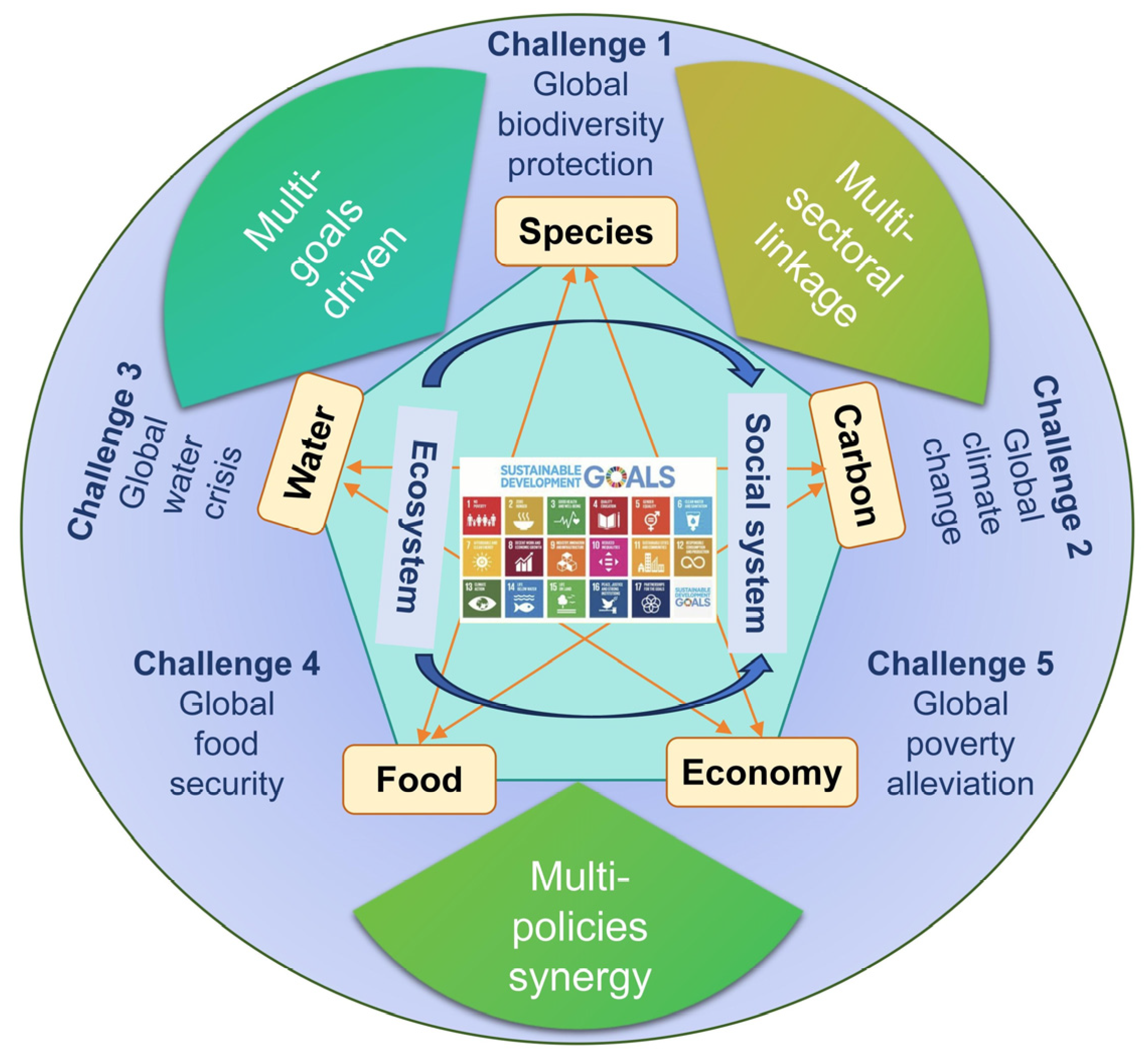
Trade-Offs and Synergies in the Species–Carbon–Water–Food–Economy Functional Nexus in China’s Provinces from a Socio-Ecological System Perspective
Abstract
1. Introduction
2. Materials and Methods
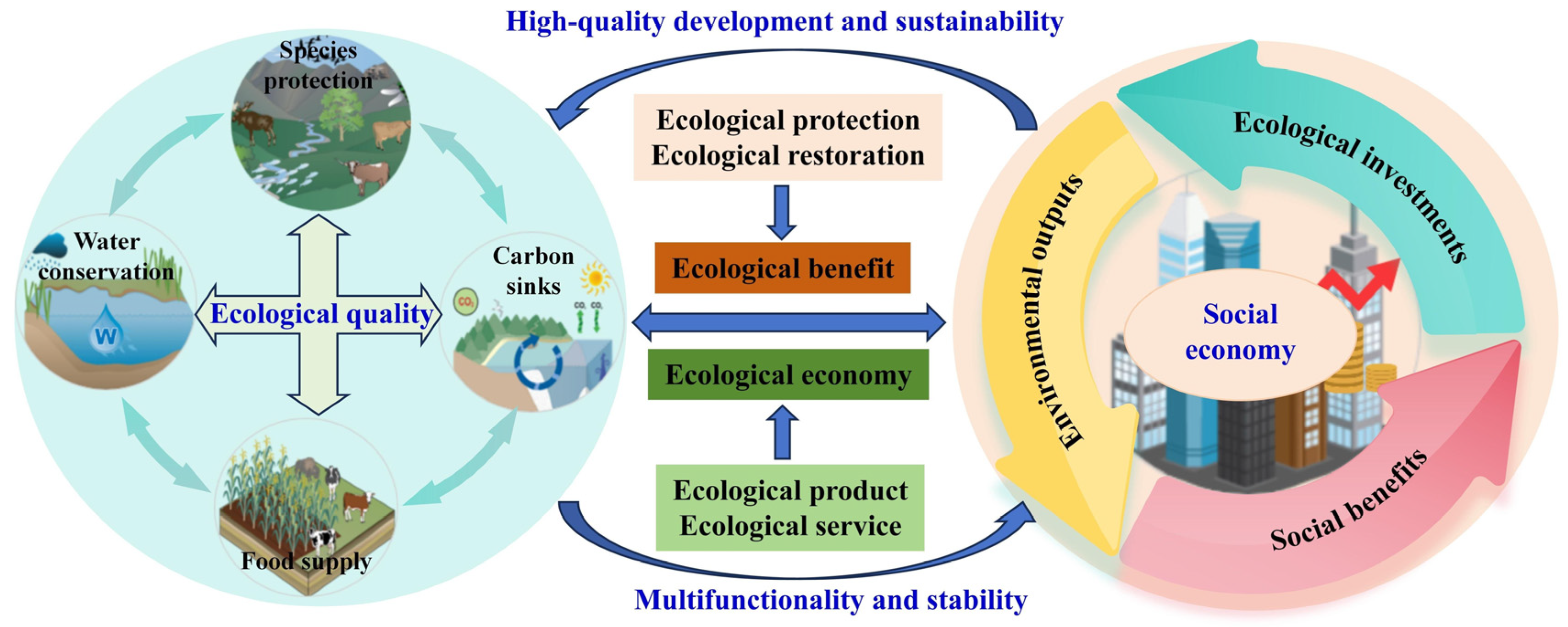
2.1. Functional Nexus Linkage Mechanisms
2.2. Ecosystem Functions Evaluation
2.3. Economic Development Functions Evaluation
2.3.1. Evaluation Indicator System
2.3.2. Measurement of Economic Development Functions
2.4. Functional Nexus Trade-Offs and Synergies
2.5. Redundancy Analysis
2.6. Functional Policy Goals
2.7. Data Sources
3. Results
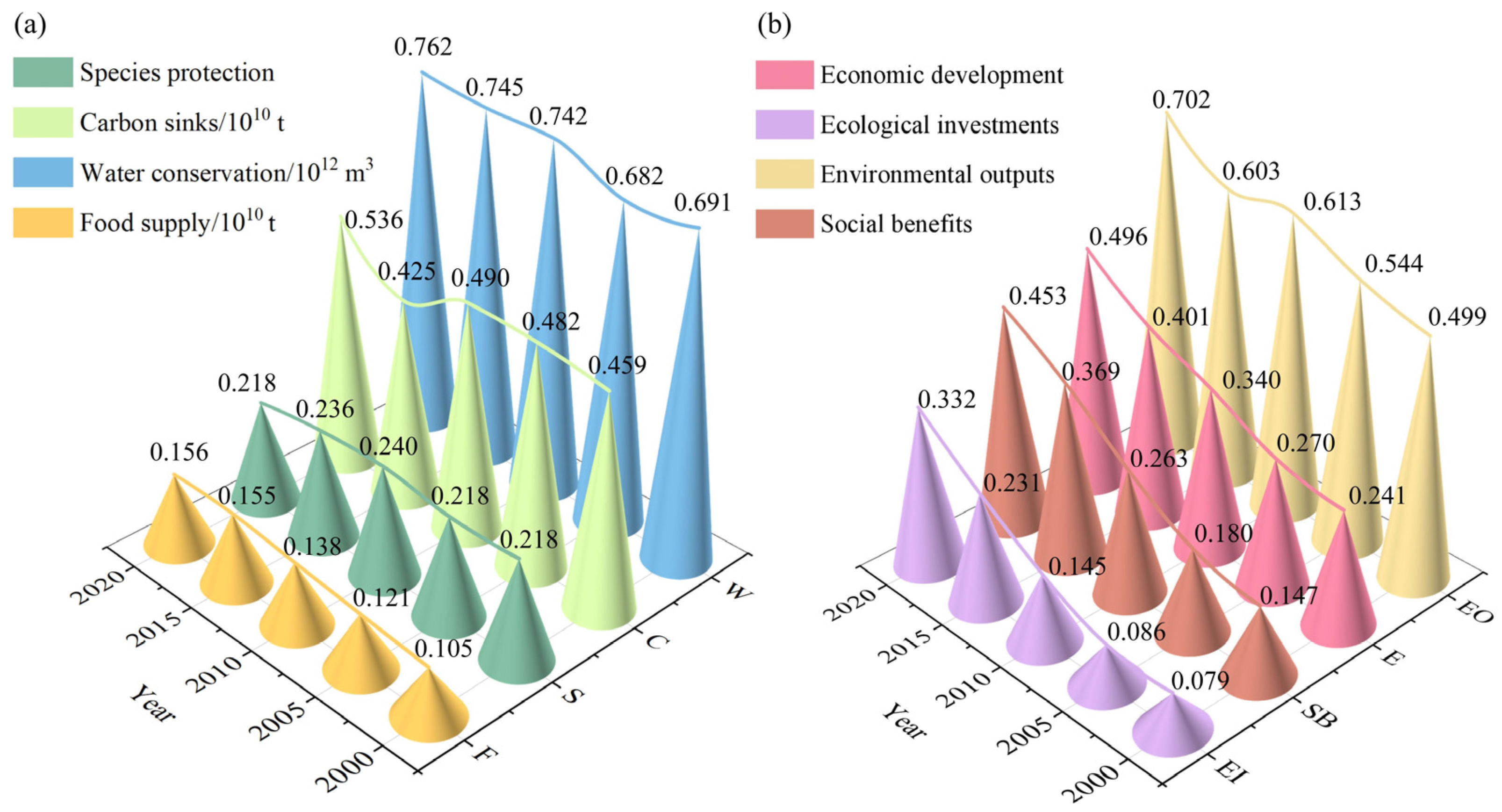
3.1. Temporal Variation
3.2. Spatio-Temporal Patterns
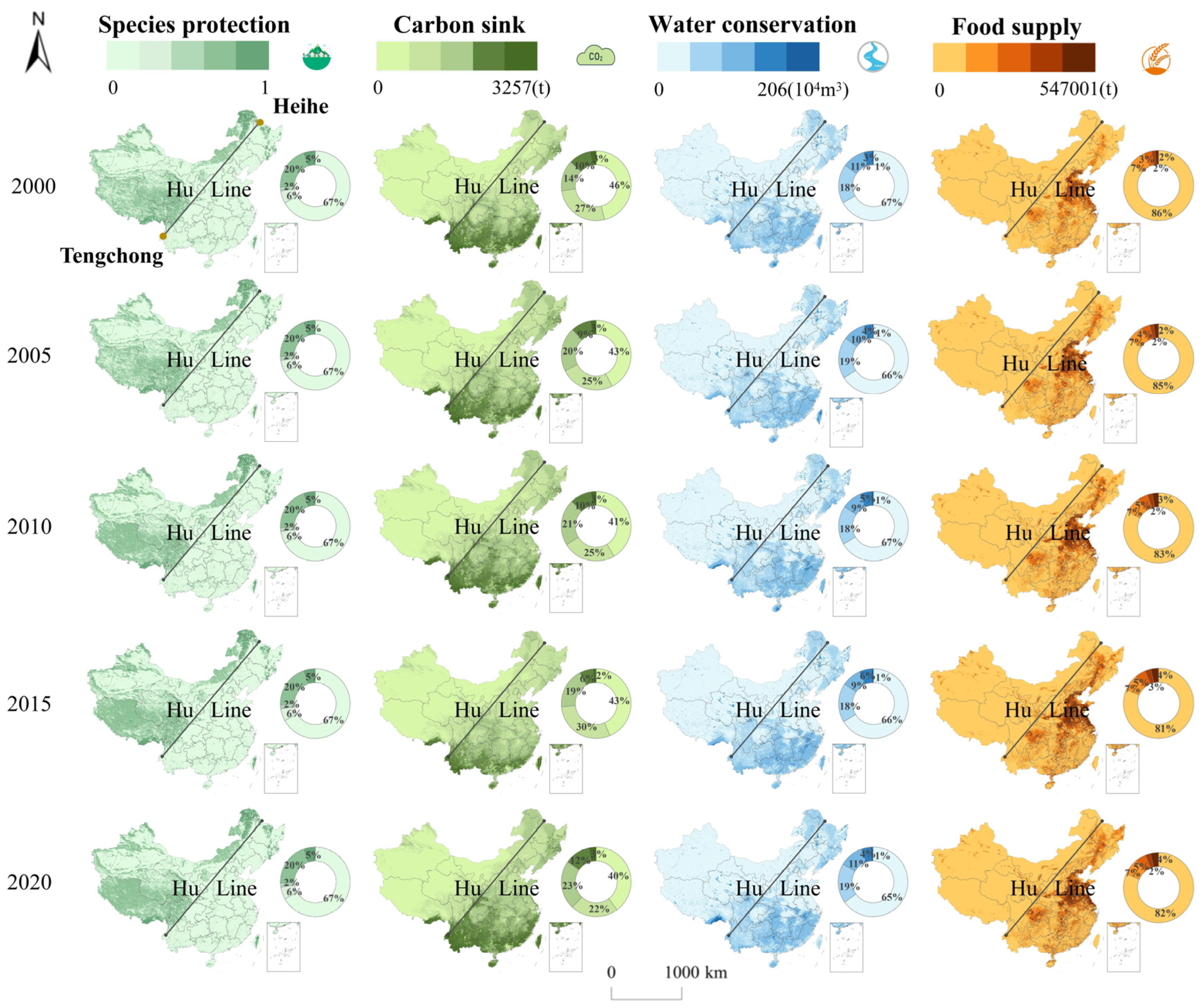
3.2.1. Spatio-Temporal Patterns of Ecosystem Functions
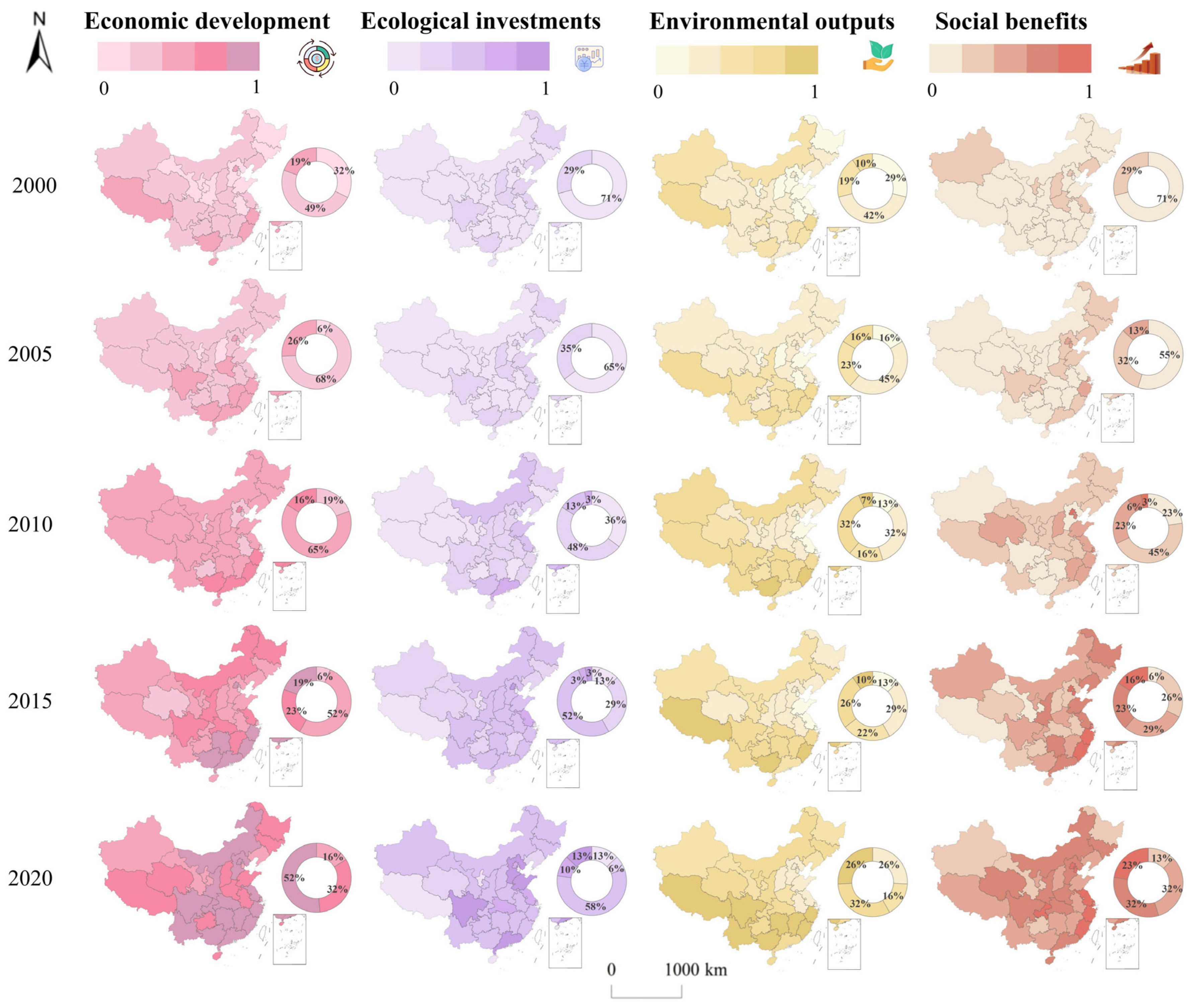
3.2.2. Spatio-Temporal Patterns of Economic Development Functions
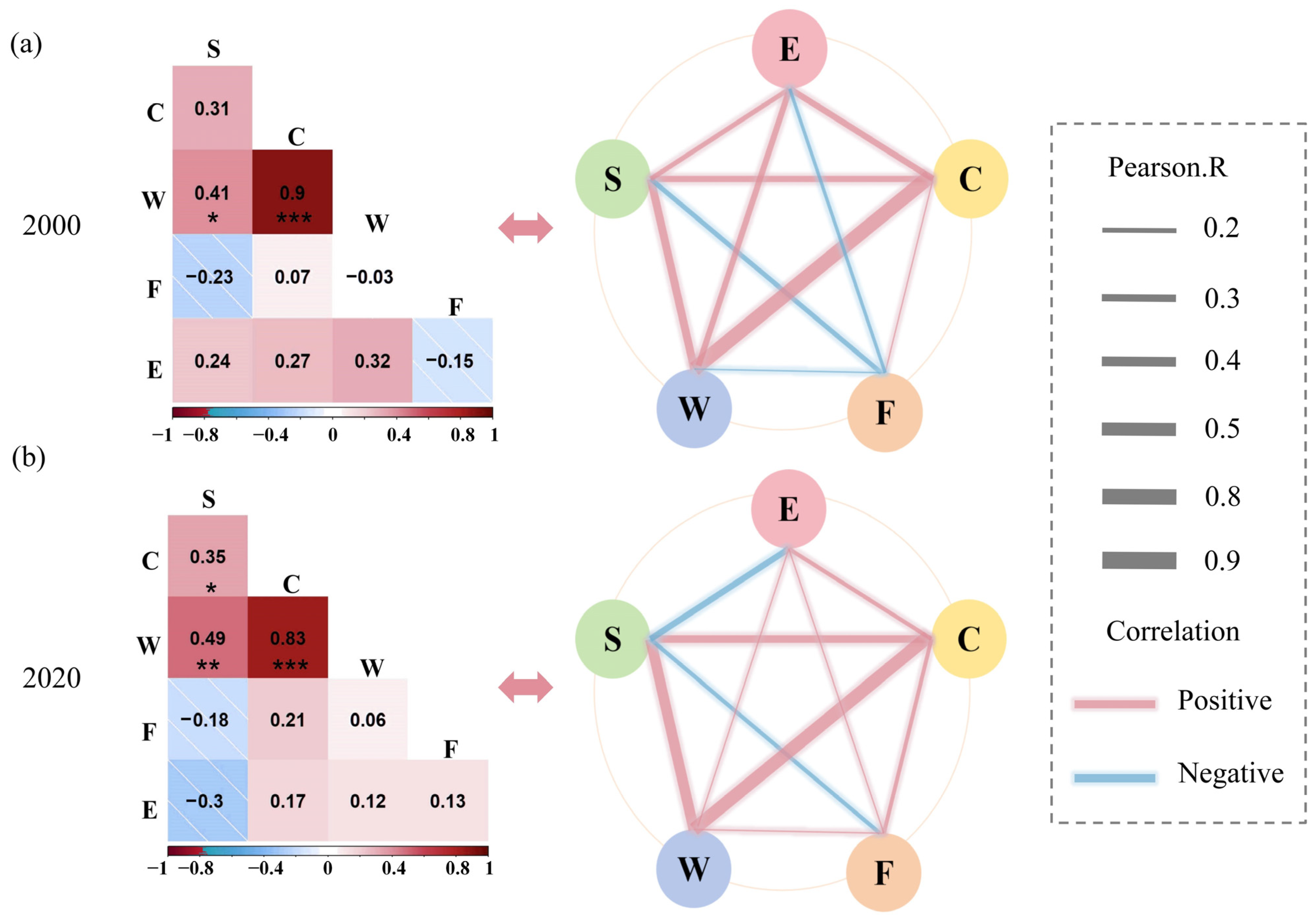
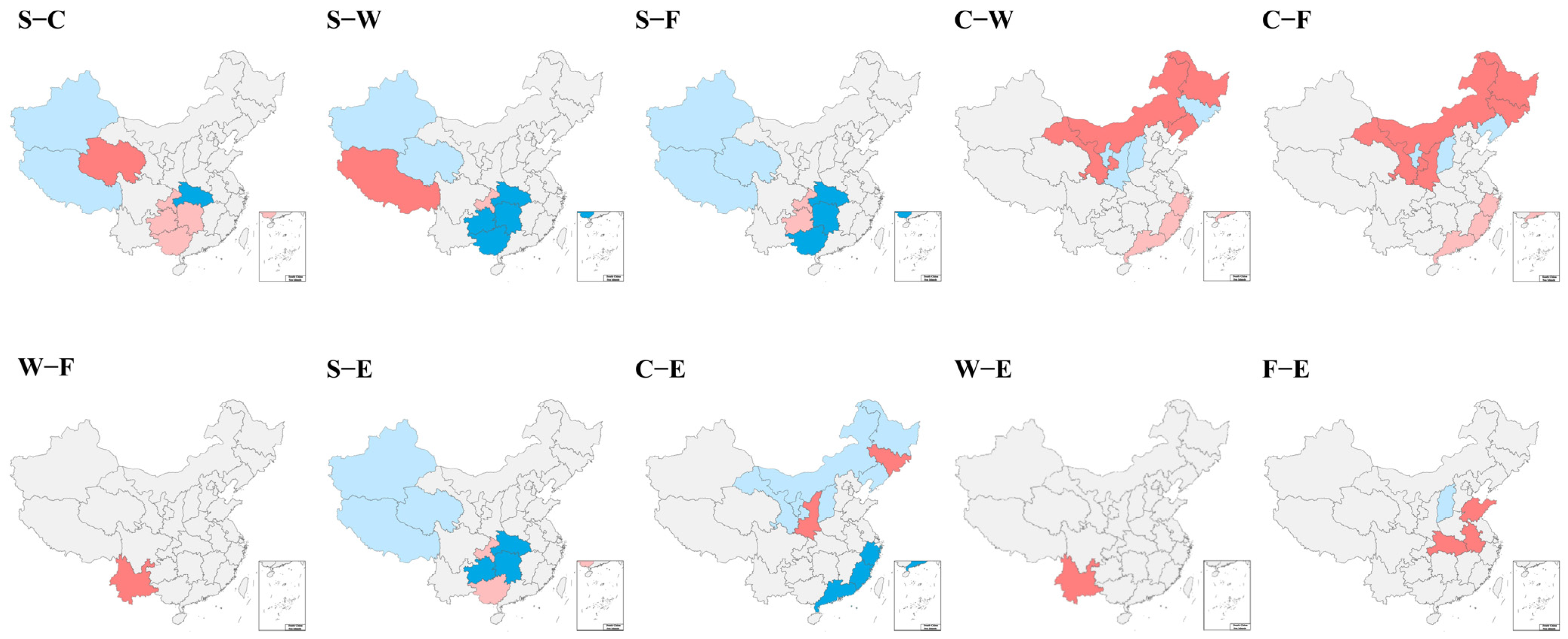
3.3. Trade-Offs and Synergies Among Different Functions
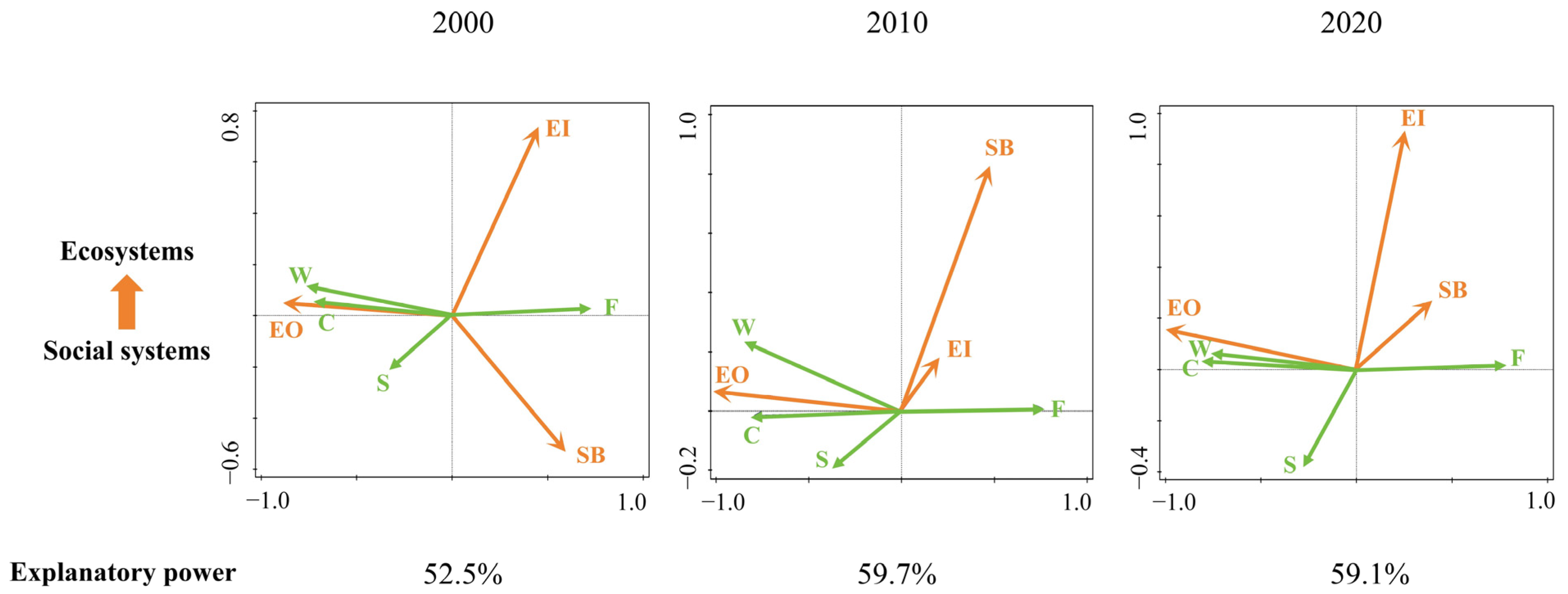
3.4. Redundancy Analysis of SES
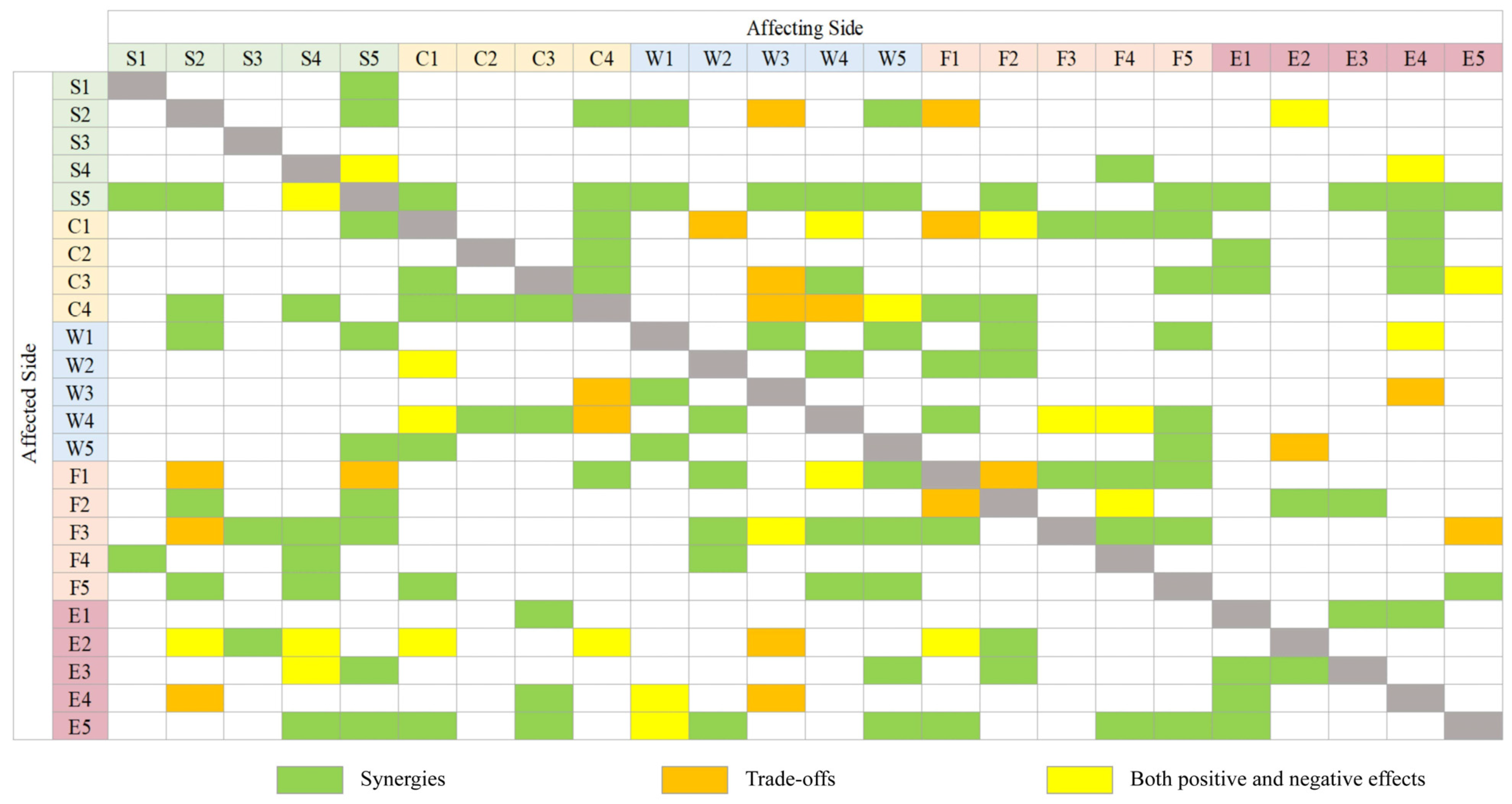
3.5. Trade-Offs and Synergies Among Policy Goals
4. Discussion
4.1. Functional Evolution Characteristics
4.2. Functional Trade-Offs and Synergies
4.3. Coordinate the Five-Pool Functional Nexus of SES
5. Conclusions
Author Contributions
Funding
Data Availability Statement
Conflicts of Interest
Appendix A

| Functions | Dimensions | Policy Goals |
|---|---|---|
| Species protection | S1 | Improve biodiversity monitoring and establish the regulatory system |
| S2 | Protect wild, rare, and endangered species | |
| S3 | Enhance the management and control of invasive alien species | |
| S4 | Improve the biotechnological level of germplasm resource variety improvement | |
| S5 | Protect natural resources, reduce environmental pollution, and enhance ecosystem quality and stability | |
| Carbon sink | C1 | Promote clean production and the transformation of traditional energy industries |
| C2 | Significant improvement in utilization efficiency | |
| C3 | Promote green and low-carbon consumption patterns | |
| C4 | Enhance the carbon sequestration capacity of ecosystems | |
| Water conservation | W1 | Ensure the safety of centralized drinking water sources |
| W2 | Optimize the water resource allocation pattern and improve allocation efficiency | |
| W3 | Control the total water resource utilization and development intensity | |
| W4 | Improve the utilization efficiency | |
| W5 | Strengthen water pollution prevention and control | |
| Food supply | F1 | Strictly adhere to the farmland red line and build high-standard farmland |
| F2 | Convert farmland back to forests and grasslands | |
| F3 | Ensure stable food supply and prices | |
| F4 | Implement the “Technology-Driven Grain” initiative | |
| F5 | Enhance the capacity for agricultural waste recycling | |
| Economic development | E1 | Increase fiscal and tax support and develop green finance |
| E2 | Develop smart tourism | |
| E3 | Strengthen the management of natural resource assets and improve the mechanism for realizing the value of ecological products | |
| E4 | Vigorously develop the new energy industry | |
| E5 | Increase the added value of agricultural products |
References
- Huynh, L.T.M.; Gasparatos, A.; Su, J.; Lam, R.D.; Grant, E.I.; Fukushi, K. Linking the nonmaterial dimensions of human-nature relations and human well-being through cultural ecosystem services. Sci. Adv. 2022, 8, eabn8042. [Google Scholar] [CrossRef]
- Hautier, Y.; Tilman, D.; Isbell, F.; Seabloom, E.W.; Borer, E.T.; Reich, P.B. Anthropogenic environmental changes affect ecosystem stability via biodiversity. Science 2015, 348, 336–340. [Google Scholar] [CrossRef]
- Richardson, K.; Steffen, W.; Lucht, W.; Bendtsen, J.; Cornell, S.E.; Donges, J.F.; Drüke, M.; Fetzer, I.; Bala, G.; von Bloh, W.; et al. Earth beyond six of nine planetary boundaries. Sci. Adv. 2023, 9, eadh2458. [Google Scholar] [CrossRef]
- Zhang, W.X.; Zhou, T.J.; Wu, P.L. Anthropogenic amplification of precipitation variability over the past century. Science 2024, 385, 427–432. [Google Scholar] [CrossRef]
- Weiskopf, S.R.; Isbell, F.; Arce-Plata, M.I.; Di Marco, M.; Harfoot, M.; Johnson, J.; Lerman, S.B.; Miller, B.W.; Morelli, T.L.; Mori, A.S.; et al. Biodiversity loss reduces global terrestrial carbon storage. Nat. Commun. 2024, 15, 4354. [Google Scholar] [CrossRef]
- Zhou, G.Y.; Eisenhauer, N.; Terrer, C.; Eldridge, D.J.; Duan, H.M.; Guirado, E.; Berdugo, M.; Zhou, L.Y.; Liu, S.G.; Zhou, X.H.; et al. Resistance of ecosystem services to global change weakened by increasing number of environmental stressors. Nat. Geosci. 2024, 17, 882–888. [Google Scholar] [CrossRef]
- Pereira, H.M.; Martins, I.S.; Rosa, I.M.D.; Kim, H.J.; Leadley, P.; Popp, A.; van Vuuren, D.P.; Hurtt, G.; Quoss, L.; Arneth, A.; et al. Global trends and scenarios for terrestrial biodiversity and ecosystem services from 1900 to 2050. Science 2024, 384, 458–465. [Google Scholar] [CrossRef] [PubMed]
- Liu, J.; Li, D.L.; Chen, H.; Wang, H.; Wada, Y.; Kummu, M.; Gosling, S.N.; Yang, H.; Pokhrel, Y.; Ciais, P. Timing the first emergence and disappearance of global water scarcity. Nat. Commun. 2024, 15, 7129. [Google Scholar] [CrossRef]
- Li, K.K.; Yang, J.Y.; Wang, J.Y.; Wang, Z.; Zeng, Y.; Borrelli, P.; Hubacek, K.; Hu, Y.C.; Xu, B.D.; Fang, N.F.; et al. Human-altered soil loss dominates nearly half of water erosion in China but surges in agriculture-intensive areas. One Earth 2024, 7, 2008–2018. [Google Scholar] [CrossRef]
- Feng, B.B.; Zhuo, L.; Mekonnen, M.M.; Marston, L.T.; Yang, X.; Xu, Z.H.; Liu, Y.L.; Wang, W.; Li, Z.B.; Li, M.; et al. Inputs for staple crop production in China drive burden shifting of water and carbon footprints transgressing part of provincial planetary boundaries. Water Res. 2022, 221, 118803. [Google Scholar] [CrossRef] [PubMed]
- Shi, S.H.; Zhou, S.W.; Lei, Y.D.; Harrison, M.T.; Liu, K.; Chen, F.; Yin, X.G. Burgeoning food demand outpaces sustainable water supply in China. Agric. Water Manag. 2024, 301, 108936. [Google Scholar] [CrossRef]
- Zhang, H.; Deng, W.; Zhang, S.Y.; Wang, Z.Y. Multiscale geospatial transitions and sustainable strategies for mountainous urban agglomerations: From the perspective of social–ecological systems. Cities 2025, 169, 106560. [Google Scholar] [CrossRef]
- Hooper, D.U.; Adair, E.C.; Cardinale, B.J.; Byrnes, J.E.K.; Hungate, B.A.; Matulich, K.L.; Gonzalez, A.; Duffy, J.E.; Gamfeldt, L.; O’Connor, M.I. A global synthesis reveals biodiversity loss as a major driver of ecosystem change. Nature 2012, 486, 105–108. [Google Scholar] [CrossRef] [PubMed]
- de Graaf, I.E.M.; Gleeson, T.; van Beek, L.P.H.; Sutanudjaja, E.H.; Bierkens, M.F.P. Environmental flow limits to global groundwater pumping. Nature 2019, 574, 90–94. [Google Scholar] [CrossRef] [PubMed]
- Yue, Q.; Wu, H.; Wang, Y.Z.; Guo, P. Achieving sustainable development goals in agricultural energy-water-food nexus system: An integrated inexact multi-objective optimization approach. Resour. Conserv. Recycl. 2021, 174, 105833. [Google Scholar] [CrossRef]
- Li, R.S.; Zhao, R.Q.; Xie, Z.X.; Xiao, L.G.; Chuai, X.W.; Feng, M.Y.; Zhang, H.F.; Luo, H.L. Water-energy-carbon nexus at campus scale: Case of North China University of Water Resources and Electric Power. Energy Policy 2022, 166, 113001. [Google Scholar] [CrossRef]
- Yu, Y.; Bo, Y.; Castelletti, A.; Dumas, P.; Gao, J.Y.; Cai, X.M.; Liu, J.G.; Kahil, T.; Wada, Y.; Hu, S.R.; et al. Transboundary cooperation in infrastructure operation generates economic and environmental co-benefits in the Lancang-Mekong River Basin. Nat. Water 2024, 2, 589–601. [Google Scholar] [CrossRef]
- Zhang, S.; Chen, W.Y.; Zhang, Q.; Krey, V.; Byers, E.; Rafaj, P.; Nguyen, B.; Awais, M.; Riahi, K. Targeting net-zero emissions while advancing other sustainable development goals in China. Nat. Sustain. 2024, 7, 1107–1119. [Google Scholar] [CrossRef]
- Wu, X.T.; Wei, Y.P.; Fu, B.J.; Wang, S.A.; Zhao, Y.; Moran, E.F. Evolution and effects of the social-ecological system over a millennium in China’s Loess Plateau. Sci. Adv. 2020, 6, eabd0276. [Google Scholar] [CrossRef]
- Ji, Q.L.; Feng, X.M.; Sun, S.Q.; Zhang, J.Z.; Li, S.Y.; Fu, B.J. Cross-scale Coupling of Ecosystem Service Flows and Socio-Ecological Interactions in the Yellow River Basin. J. Environ. Manag. 2024, 367, 122071. [Google Scholar] [CrossRef]
- Chen, L.; Yao, Y.; Xiang, K.M.; Dai, X.A.; Li, W.Y.; Dai, H.; Lu, K.; Li, W.L.; Lu, H.; Zhang, Y.; et al. Spatial-temporal pattern of ecosystem services and sustainable development in representative mountainous cities: A case study of Chengdu-Chongqing Urban Agglomeration. J. Environ. Manag. 2024, 368, 122261. [Google Scholar] [CrossRef] [PubMed]
- Li, F.; Yin, X.; Shao, M. Natural and anthropogenic factors on China’s ecosystem services: Comparison and spillover effect perspective. J. Environ. Manag. 2022, 324, 116064. [Google Scholar] [CrossRef] [PubMed]
- Li, G.D.; Fang, C.L.; Watson, J.E.M.; Sun, S.; Qi, W.; Wang, Z.B.; Liu, J.G. Mixed effectiveness of global protected areas in resisting habitat loss. Nat. Commun. 2024, 15, 8389. [Google Scholar] [CrossRef] [PubMed]
- de Vos, A.; Biggs, R.; Preiser, R. Methods for understanding social-ecological systems: A review of place-based studies. Ecol. Soc. 2019, 24, 16. [Google Scholar] [CrossRef]
- Li, S.; Yu, D.; Li, X. Exploring the impacts of ecosystem services on human well-being in Qinghai Province under the framework of the sustainable development goals. J. Environ. Manag. 2023, 345, 118880. [Google Scholar] [CrossRef]
- Zhang, Y.J.; Wang, Q.S.; Tian, S.; Xu, Y.; Yuan, X.L.; Ma, Q.; Xu, Y.; Yang, S.; Zhang, H.B.; Liu, C.Q. Evaluation and optimization of five straw energy utilization modes based on the improved emergy-based life cycle assessment (EmLCA-II) method. Energy Convers. Manag. 2023, 298, 117764. [Google Scholar] [CrossRef]
- Wang, X.Z.; Zhang, W.L.; Li, Y.; Tong, J.X.; Yu, F.; Ye, Q.L. Impacts of water constraints on economic outputs and trade: A multi-regional input-output analysis in China. J. Clean. Prod. 2024, 434, 140345. [Google Scholar] [CrossRef]
- Qiu, J.Q.; Yu, D.Y.; Huang, T. Influential paths of ecosystem services on human well-being in the context of the sustainable development goals. Sci. Total Environ. 2022, 852, 158443. [Google Scholar] [CrossRef]
- Xiao, H.J.; Bao, S.; Ren, J.Z.; Xu, Z.C.; Xue, S.; Liu, J.G. Global transboundary synergies and trade-offs among Sustainable Development Goals from an integrated sustainability perspective. Nat. Commun. 2024, 15, 500. [Google Scholar] [CrossRef]
- Huang, L.; Swain, R.B.; Jeppesen, E.; Cheng, H.; Zhai, P.M.; Gu, B.J.; Barceló, D.; Lu, J.H.; Wei, K.; Luo, L.; et al. Harnessing science, technology, and innovation to drive synergy between climate goals and the SDGs. Innovation 2024, 5, 100693. [Google Scholar] [CrossRef]
- Wu, X.T.; Fu, B.J.; Wang, S.; Song, S.; Li, Y.J.; Xu, Z.C.; Wei, Y.P.; Liu, J.G. Decoupling of SDGs followed by re-coupling as sustainable development progresses. Nat. Sustain. 2022, 5, 452–459. [Google Scholar] [CrossRef]
- Fu, B.J.; Zhang, J.Z. Progress and challenges of Sustainable Development Goals (SDGs) in the World and in China. Bull. Chin. Acad. Sci. 2024, 39, 804–808. [Google Scholar] [CrossRef]
- Zhang, J.S. A survey on income inequality in China. J. Econ. Lit. 2021, 59, 1191–1239. [Google Scholar] [CrossRef]
- Wang, Y.S.; Yu, G.R. Ecosystem quality-based management and the development of a new eco-friendly economy. Innovation 2023, 4, 100491. [Google Scholar] [CrossRef]
- Zhang, Y.K.; Wang, Y.S. How does urbanization evolve heterogeneously in urbanized, urbanizing, and rural areas of China? Insights from ecosystem service value. Geogr. Sustain. 2024, 6, 100254. [Google Scholar] [CrossRef]
- Yu, G.R.; Wang, Y.S.; Yang, M. Discussion on the ecological theory and technological approaches of ecosystem quality improvement and stability enhancement. Chin. J. Appl. Ecol. 2023, 34, 1–10. [Google Scholar] [CrossRef]
- Yu, G.R.; Yang, M.; Hao, T.X. Coordinate the five-pool functions of ecosystem and build strong national ecological infrastructures-Ecological construction ideology, tasks and goals in the new developing era of China. Bull. Chin. Acad. Sci. 2022, 37, 1534–1538. [Google Scholar] [CrossRef]
- Ma, Y.; Yang, J. A review of methods for quantifying urban ecosystem services. Landscape Urban Plan. 2025, 253, 105215. [Google Scholar] [CrossRef]
- Terrado, M.; Sabater, S.; Chaplin-Kramer, B.; Mandle, L.; Ziv, G.; Acuña, V. Model development for the assessment of terrestrial and aquatic habitat quality in conservation planning. Sci. Total Environ. 2016, 540, 63–70. [Google Scholar] [CrossRef] [PubMed]
- Wang, J.L.; Zhou, W.Q.; Pickett, S.T.A.; Yu, W.J.; Li, W.F. A multiscale analysis of urbanization effects on ecosystem services supply in an urban megaregion. Sci. Total Environ. 2019, 662, 824–833. [Google Scholar] [CrossRef]
- Ouyang, Z.Y.; Song, C.S.; Zheng, H.; Polasky, S.; Xiao, Y.; Bateman, I.J.; Liu, J.G.; Ruckelshaus, M.; Shi, F.Q.; Xiao, Y.; et al. Using gross ecosystem product (GEP) to value nature in decision making. Proc. Natl. Acad. Sci. USA 2020, 117, 14593–14601. [Google Scholar] [CrossRef] [PubMed]
- Zhang, X.R.; Wang, Y.S.; Yuan, X.F.; Shao, Y.J.; Bai, Y. Identifying ecosystem service supply-demand imbalance for sustainable land management in China’s Loess Plateau. Land Use Policy 2022, 123, 106423. [Google Scholar] [CrossRef]
- Zhang, W.; Xu, D. Benefits evaluation of ecological restoration projects based on value realization of ecological products. J. Environ. Manag. 2024, 352, 120139. [Google Scholar] [CrossRef]
- Xia, H.; Yuan, S.F.; Prishchepov, A.V. Spatial-temporal heterogeneity of ecosystem service interactions and their social-ecological drivers: Implications for spatial planning and management. Resour. Conserv. Recycl. 2023, 189, 106767. [Google Scholar] [CrossRef]
- Ouyang, X.; Tang, L.S.; Wei, X.; Li, Y.H. Spatial interaction between urbanization and ecosystem services in Chinese urban agglomerations. Land Use Policy 2021, 109, 105587. [Google Scholar] [CrossRef]
- Li, G.Y.; Jiang, C.H.; Gao, Y.; Du, J. Natural driving mechanism and trade-off and synergy analysis of the spatiotemporal dynamics of multiple typical ecosystem services in Northeast Qinghai-Tibet Plateau. J. Clean. Prod. 2022, 374, 134075. [Google Scholar] [CrossRef]
- Xiao, S.Y.; Hou, Y.L.; Lovely, M. Top-Down Central Inspection and Subnational Discretion in Policymaking. Governance 2025, 38, e70013. [Google Scholar] [CrossRef]
- Zhou, Y.; Gu, B.J. The impacts of human activities on Earth Critical Zone. Earth Crit. Zone 2024, 1, 100004. [Google Scholar] [CrossRef]
- Ouyang, Z.Y.; Zheng, H.; Xiao, Y.; Polasky, S.; Liu, J.G.; Xu, W.H.; Wang, Q.; Zhang, L.; Xiao, Y.; Rao, E.M.; et al. Improvements in ecosystem services from investments in natural capital. Science 2016, 352, 1455–1459. [Google Scholar] [CrossRef]
- Fang, Z.; Ding, T.H.; Chen, J.Y.; Xue, S.; Zhou, Q.; Wang, Y.D.; Wang, Y.X.; Huang, Z.D.; Yang, S.L. Impacts of land use/land cover changes on ecosystem services in ecologically fragile regions. Sci. Total Environ. 2022, 831, 154967. [Google Scholar] [CrossRef] [PubMed]
- Zhou, L.Y.; Cui, W.L.; Yang, F. Spatiotemporal variations and driving forces analysis of ecosystem water conservation in coastal areas of China. Ecol. Indic. 2024, 162, 112019. [Google Scholar] [CrossRef]
- Sadiq, M.; Chau, K.Y.; Ha, N.T.T.; Phan, T.T.H.; Ngo, T.Q.; Huy, P.Q. The impact of green finance, eco-innovation, renewable energy and carbon taxes on CO2 emissions in BRICS countries: Evidence from CS ARDL estimation. Geosci. Front. 2024, 15, 101689. [Google Scholar] [CrossRef]
- Seidl, A.; Mulungu, K.; Arlaud, M.; van den Heuvel, O.; Riva, M. The effectiveness of national biodiversity investments to protect the wealth of nature. Nat. Ecol. Evol. 2021, 5, 530–539. [Google Scholar] [CrossRef] [PubMed]
- Wang, J.; Liu, C.N.; Liu, B.Y.; Lee, T.M. Integrated outcomes of large-scale ecological restoration projects on biodiversity–eco-environment–society in China. Geogr. Sustain. 2025, 6, 100243. [Google Scholar] [CrossRef]
- Xiong, C.S.; Ren, H.Y.; Xu, D.; Gao, Y.M. Spatial scale effects on the value of ecosystem services in China’s terrestrial area. J. Environ. Manag. 2024, 366, 121745. [Google Scholar] [CrossRef] [PubMed]
- Jia, M.J.; Xu, T.Y.; Li, H.J. Ecosystem Services Value of the Grain for Green Program in China—A Case Study of Five Representative Provinces. Forests 2025, 16, 1671. [Google Scholar] [CrossRef]
- Xin, J.X.; Yang, J.; Yu, H.S.; Ren, J.Y.; Yu, W.B.; Cong, N.; Xiao, X.M.; Xia, J.H.; Li, X.M.; Qiao, Z. Towards ecological civilization: Spatiotemporal heterogeneity and drivers of ecological quality transitions in China (2001–2020). Appl. Geogr. 2024, 173, 103439. [Google Scholar] [CrossRef]
- Su, R.; Duan, C.C.; Chen, B. The shift in the spatiotemporal relationship between supply and demand of ecosystem services and its drivers in China. J. Environ. Manag. 2024, 365, 121698. [Google Scholar] [CrossRef]
- Fang, C.L.; Fan, Y.P.; Bao, C.; Li, G.D.; Wang, Z.B.; Sun, S.; Ma, H.T. China’s improving total environmental quality and environment-economy coordination since 2000: Progress towards sustainable development goals. J. Clean. Prod. 2023, 387, 135915. [Google Scholar] [CrossRef]
- Ge, Y.; Hu, S.; Song, Y.Z.; Zheng, H.; Liu, Y.S.; Ye, X.Y.; Ma, T.; Liu, M.X.; Zhou, C.H. Sustainable poverty reduction models for the coordinated development of the social economy and environment in China. Sci. Bull. 2023, 68, 2236–2246. [Google Scholar] [CrossRef]
- Zhang, H.; Wang, Y.W.; Wang, C.; Yang, J.M.; Yang, S.W. Coupling analysis of environment and economy based on the changes of ecosystem service value. Ecol. Indic. 2022, 144, 109524. [Google Scholar] [CrossRef]
- Sun, T.; Feng, X.M.; Lal, R.; Cao, T.H.; Guo, J.R.; Deng, A.X.; Zheng, C.Y.; Zhang, J.; Song, Z.W.; Zhang, W.J. Crop diversification practice faces a tradeoff between increasing productivity and reducing carbon footprints. Agric. Ecosyst. Environ. 2021, 321, 107614. [Google Scholar] [CrossRef]
- Fan, S.X.; Newbold, T.; Tscharntke, T.; Tang, W.H.; Yu, Z.R.; Liu, Y.H. Impact of crop type on biodiversity globally. Global Change Biol. 2024, 30, e70005. [Google Scholar] [CrossRef]
- Gao, Y.; Wang, Z.; Li, C. Assessing spatio-temporal heterogeneity and drivers of ecosystem services to support zonal management in mountainous cities. Sci. Total Environ. 2024, 954, 176328. [Google Scholar] [CrossRef] [PubMed]
- Han, Y.L.; Chang, C.; Wu, S.; Edwin, I.E.; Wang, Y.H.; Yan, W.; Liu, J.; Ma, X.F. Cross-scale spillover of ecosystem services reveals pathways for equitable ecological compensation in inland river basins. J. Environ. Manag. 2025, 394, 127448. [Google Scholar] [CrossRef]
- Hong, W.Y.; Li, Y.L.; Guo, R.Z.; Chen, B.; Zhang, W.J.; Li, F.X.; Yang, S.W.; Liu, Y.K.; Zhao, Y.M.; Li, Y.R.; et al. Empowering China’s sustainable development through social-ecological networks. npj Urban Sustain. 2025, 5, 45. [Google Scholar] [CrossRef]
- Liu, H.M.; Xiong, J.Y.; Hong, S.F.; Zhou, B.B. Social, economic, and environmental development in China through the lens of synergies and trade-offs. J. Clean. Prod. 2025, 509, 145634. [Google Scholar] [CrossRef]
- Jay, M.; Plieninger, T. Addressing landscape multifunctionality in conservation and restoration. Nat. Rev. Biodivers. 2025, 1, 717–732. [Google Scholar] [CrossRef]
- Li, C.G.; Chen, Z.L.; Jiang, Q.T.; Yue, M.; Wu, L.; Bao, Y.H.; Huang, B.; Wang, A.B.; Tan, Y.Y.; Xu, Z.C. Impacts of government attention on achieving Sustainable Development Goals: Evidence from China. Geogr. Sustain. 2025, 6, 100233. [Google Scholar] [CrossRef]
- Zhu, S.Y.; Wang, H.S.; Zhang, P. Beyond tradeoffs: How do local governments synergize multiple complementary goals? Public Perform. Manag. 2025, 5, 1–26. [Google Scholar] [CrossRef]
- Wang, M.; Wan, D.; Xie, X.; Bai, Z.H.; Wang, R.; Zhang, X.M.; Gao, Y.Z.; Tan, Z.L.; Yin, Y.L. Crop-livestock integration: Implications for food security, resource efficiency and greenhouse gas mitigation. Innov. Life 2024, 2, 100103. [Google Scholar] [CrossRef]
- Yang, Z.J.; Ding, H.; Zhu, W.B. Environmental regulation and land resource allocation in China: Empirical evidence from micro-level land transaction data. Land Use Policy 2024, 140, 107126. [Google Scholar] [CrossRef]
- Biswas, A.; Maddocks, I.; Dhar, T.; Dube, L.; Dutta, A.; Talukder, B.; Ponnambalam, K. Guiding sustainable transformations in food systems. Nat. Rev. Earth Environ. 2024, 5, 607–608. [Google Scholar] [CrossRef]
- Wang, Y.H.; Chen, X.N. River chief system as a collaborative water governance approach in China. Int. J. Water Resour. Dev. 2020, 36, 610–630. [Google Scholar] [CrossRef]
- Sun, Z.N.C.; Chen, N.K.; Dong, J.W.; Jia, M.M.; Xu, Z.C. Enabling new sustainability opportunities from integrated blue sustainable development. Innov. Geosci. 2025, 3, 100171. [Google Scholar] [CrossRef]
- Chen, M.K.; Xu, X.B.; Tan, Y.; Lin, Y.Y. Integrating ecosystem service spillovers and environmental justice in ecological compensation: A pathway to effective ecological protection in China. Ecol. Indic. 2025, 174, 113455. [Google Scholar] [CrossRef]
- Perschke, M.J.; Harris, L.R.; Sink, K.J.; Lombard, A.T. Systematic conservation planning for people and nature: Biodiversity, ecosystem services, and equitable benefit sharing. Ecosyst. Serv. 2024, 68, 101637. [Google Scholar] [CrossRef]
- Tang, F.; Zhou, Z.F.; Li, Y.B.; Jing, Y.T. Policy for poverty alleviation and relocation promotes synergistic development of the cross-regional social-ecological system: A case study of Guizhou, China. Habitat Int. 2025, 167, 103666. [Google Scholar] [CrossRef]
- Kimengsi, J.N.; Buchenrieder, G.; Pretzsch, J.; Balgah, R.A.; Mallick, B.; Haller, T.; Gebara, M.F. Institutional jelling in socio-ecological systems: Towards a novel theoretical construct? Land Use Policy 2025, 157, 107681. [Google Scholar] [CrossRef]


| Ecosystem Functions | Assessment Method | Computational Formula | Variable |
|---|---|---|---|
| Species protection | Invest model habitat quality module | Where represents the habitat maintenance dimension of land use type j raster x, represents the degree of habitat degradation for land use type j raster x, and represents the degree of habitat suitability of land use type j. | |
| Carbon sink | Estimated as a function of Net Primary Production (NPP) | Where represents the amount of oxygen sequestered by image , and represents the value of NPP of image . | |
| Water conservation | Water balance equation | Where represents water yield, represents flow-producing rainfall, represents surface runoff, represents evapotranspiration, represents ecosystem area, represents ecosystem type, and represents total number of ecosystem types. | |
| Food supply | NDVI estimation method | Where and represent the output of material products of image , the total output of material products (grain, meat, vegetables) of each county, and represent the NDVI of farmland (or grassland) of image , and the total value of farmland (or grassland) of the whole county. |
| Economic Development Functions | Indicator | Unit | Causality | Weights |
|---|---|---|---|---|
| Ecological investments | Investment in ecological construction and protection | 104 yuan | + | 0.2554 |
| Expenditure on energy conservation and environmental protection | 108 yuan | + | 0.3471 | |
| Investment in drainage and pollution control | 104 yuan | + | 0.3875 | |
| Growth rate of investment in agriculture, forestry, animal husbandry and fishery | % | + | 0.0099 | |
| Environmental outputs | Forest and grass cover | % | + | 0.3769 |
| Carbon emission intensity | t/104 yuan | − | 0.0876 | |
| Proportion of Classes I-III water quality sections | % | − | 0.3615 | |
| Growth rate of primary industry output | % | + | 0.1740 | |
| Social benefits | per capita GDP | yuan | + | 0.3538 |
| per capita disposable income | yuan | + | 0.4008 | |
| Gini coefficient | - | − | 0.2077 | |
| Urban-rural consumption ratio | - | − | 0.0377 |
| Data | Description | Source |
|---|---|---|
| Land use data | Land use types | Resource and Environmental Science Data Platform (http://www.resdc.cn/ (accessed on 8 July 2024)) (2000–2020) |
| Vegetation data | NDVI data and NPP data | National Ecosystem Science Data Center (http://www.nesdc.org.cn/ (accessed on 8 July 2024)) (2000–2020) Earth Resources Data Cloud Platform (http://www.gis5g.com/ (accessed on 9 July 2024)) (2000) MODIS_MOD17A3 on Google Earth Engine (GEE) (https://lpdaac.usgs.gov/products/mod17a3hgfv061/ (accessed on 9 July 2024)) (2001–2020) |
| Meteorological data | Rainfall data and evapotranspiration data | National Earth System Science Data Center (https://www.geodata.cn/ (accessed on 10 July 2024)) (2000–2020) National Tibetan Plateau Data Center (https://data.tpdc.ac.cn/ (accessed on 10 July 2024)) (2000–2020) |
| Soil data | World soil dataset | International Institute for Applied Systems Analysis (IIASA) and the Food and Agriculture Organization (FAO) of the United Nations (https://iiasa.ac.at/models-tools-data/hwsd (accessed on 10 July 2024)) |
| Statistical data | Food production, ecological investments, environmental outputs, and social benefits | China County Statistical Yearbook, China Environmental Statistical Yearbook, China Ecological and Environmental Status Bulletin, and so on (2000–2020) |
Disclaimer/Publisher’s Note: The statements, opinions and data contained in all publications are solely those of the individual author(s) and contributor(s) and not of MDPI and/or the editor(s). MDPI and/or the editor(s) disclaim responsibility for any injury to people or property resulting from any ideas, methods, instructions or products referred to in the content. |
© 2025 by the authors. Licensee MDPI, Basel, Switzerland. This article is an open access article distributed under the terms and conditions of the Creative Commons Attribution (CC BY) license (https://creativecommons.org/licenses/by/4.0/).
Share and Cite
Liu, Y.; Wang, Y.; Long, P. Trade-Offs and Synergies in the Species–Carbon–Water–Food–Economy Functional Nexus in China’s Provinces from a Socio-Ecological System Perspective. Land 2025, 14, 2336. https://doi.org/10.3390/land14122336
Liu Y, Wang Y, Long P. Trade-Offs and Synergies in the Species–Carbon–Water–Food–Economy Functional Nexus in China’s Provinces from a Socio-Ecological System Perspective. Land. 2025; 14(12):2336. https://doi.org/10.3390/land14122336
Chicago/Turabian StyleLiu, Yuhan, Yongsheng Wang, and Pei Long. 2025. "Trade-Offs and Synergies in the Species–Carbon–Water–Food–Economy Functional Nexus in China’s Provinces from a Socio-Ecological System Perspective" Land 14, no. 12: 2336. https://doi.org/10.3390/land14122336
APA StyleLiu, Y., Wang, Y., & Long, P. (2025). Trade-Offs and Synergies in the Species–Carbon–Water–Food–Economy Functional Nexus in China’s Provinces from a Socio-Ecological System Perspective. Land, 14(12), 2336. https://doi.org/10.3390/land14122336