Article

Incorporating Future Ecosystem Services to Assess the Progress of Sustainable Development Goals in Southern Jiangsu, China

1
School of Public Administration, Nanjing University of Finance and Economics, Nanjing 210023, China
2
Observation Research Station of Land Ecology and Land Use in the Yangtze River Delta, Ministry of Natural Resources, Nanjing 210017, China
3
Faculty of Geographical Science, Beijing Normal University, Beijing 100875, China
4
School of Geography and Ocean Science, Nanjing University, Nanjing 210023, China
5
Jiangsu Land Development and Consolidation Center, Nanjing 210017, China
*
Author to whom correspondence should be addressed.
Land 2025, 14(11), 2295; https://doi.org/10.3390/land14112295
Submission received: 16 October 2025 / Revised: 16 November 2025 / Accepted: 18 November 2025 / Published: 20 November 2025

Abstract

Urban expansion in southern Jiangsu is intensifying the conflict between ecological protection and economic growth, hindering the implementation of the Sustainable Development Goals (SDGs). However, we have not yet seen the development of a framework combining land use/land cover (LULC) simulation, ecosystem service (ES) quantification, and SDG assessment; there is an especially limited understanding of future ES dynamics and their potential to support the SDGs. In this study, we used the PLUS and InVEST models to simulate and quantify carbon storage (CS), water yield (WY), soil conservation (SC), and habitat quality (HQ) in southern Jiangsu, China, under four 2030 scenarios: business as usual scenario (BAUS), ecological protection redline scenario (EPRS), cropland protection scenario (CPS), and economic development scenario (EDS). Additionally, we assessed the contributions of these ESs in advancing SDGs, guided by the ES-SDG target-SDG linkages. The results revealed a pronounced trade-off between WY and HQ, where the EDS, promoting the highest WY increase (+4.54%), caused the most severe degradation in CS (−5.86%) and HQ (−4.39%). In contrast, the EPRS optimally balanced multiple ESs, enhancing CS (+1.62%) and WY (+2.26%) over the BAUS. Spatially, ESs and the derived SDG index were superior in forested and agricultural clusters compared to urban cores. Overall, the SDG index declined most under the EDS and improved most under the EPRS, highlighting the EPRS as the most sustainable pathway. The sustainability performance regarding SDG 7 (Affordable and Clean Energy) and SDG 12 (Responsible Consumption and Production) was higher than that regarding SDG 6 (Clean Water and Sanitation), with Changzhou and Zhenjiang exceeding Suzhou. This study examined the contribution of ESs to the SDGs through four 2030 scenarios, offering insights to guide regional sustainable development.

1. Introduction

Ecosystem services (ESs) refer to the various products and services that humans obtain directly or indirectly from the structures, processes, and functions of ecosystems, which are fundamental in sustaining life [1,2]. Over the past 40 years, China’s development model, centered around rapid industrialization and urbanization, has triggered a cascade of issues such as deteriorating ESs, diminished biodiversity, and land degradation [3,4]. This not only weakens the supply capacity of ESs but also directly threatens human well-being [5]. Against this backdrop, the United Nations released the 2030 Agenda for Sustainable Development, which introduced 17 Sustainable Development Goals (SDGs) and 169 specific indicators, with ESs serving as a core link in achieving these objectives. For instance, carbon storage (CS) supports SDG 13 (Climate Action) through carbon sequestration and emission reduction [6], while habitat quality (HQ) and soil conservation (SC) support SDG 15 (Life on Land) by preserving terrestrial ecosystems’ integrity [7,8]. Water yield (WY) underpins SDG 6 (Clean Water and Sanitation) by ensuring a stable supply of water resources [9]. However, the ecological degradation induced by rapid urbanization in China continues to undermine the efficacy of ESs in supporting the SDGs. How to quantify the relationship between the two and identify key constraints has emerged as a key concern in studies on sustainable development [10]. Solutions to this issue rely primarily on scientific assessment methods and continuous spatiotemporal data support.
Current common methods for quantifying ESs include field surveys and model simulations (e.g., InVEST, ARIES and SolVES models). While field surveys can yield high-precision parameters such as soil organic matter content and vegetation coverage, they are limited by observational costs and timescales, making it impossible to trace historical ES dynamics or predict changes in service under future scenarios [11]. In contrast, the InVEST model has been widely applied globally in the assessment of services such as CS, HQ, and WY due to its ability to incorporate multi-source data and dynamically simulate the spatiotemporal patterns of ESs [12,13], making it a mainstream tool for quantitative research on ESs. At the same time, scholars have constructed multi-scale land use/land cover (LULC) classification datasets [14,15,16], providing foundational input data for the InVEST model. However, the existing research has two main shortcomings: firstly, a lack of data continuity, with most assessments focusing solely on historical static data, thus failing to cover a complete “past-present-future” spatiotemporal sequence, which hinders the exploration of long-term trends in ESs [17]; secondly, a lack of scenario simulations that consider the potential impacts of future policy adjustments and environmental changes on LULC, such as delineating ecological protection redlines in territorial spatial planning, which leads to ES evaluation results that are insufficient to support forward-looking sustainable development decision-making [18]. Although the utility of this “spatiotemporal integration” research approach has been confirmed [10,19], further studies are needed on multi-scenario land use simulation and the long-term assessment of ESs in complex regions [20,21,22]. Therefore, developing a LULC dataset that covers extended timescales and includes multiple future scenarios, along with conducting dynamic evaluations of ESs using the InVEST model, is not only key in expanding research perspectives but also essential in subsequently relating them to the SDGs and quantifying the supporting efficacy of ESs.
In recent years, academia has gradually developed a focus on the relationship between ESs and SDGs [23,24,25], but the research has largely remained at a preliminary stage, lacking a quantitative framework that links future ES projections derived from spatially explicit land use simulations with the progress in specific SDG targets on a regional scale. This has made it difficult to promote coordinated development strategies in highly developed regions. Existing studies have qualitatively identified the differentiated impacts of various ESs on different SDGs. For example, related research suggests that integrating previously neglected inland fishery services could aid in the achievement of the SDGs [26]; however, this study has yet to establish a quantitative mapping relationship between ESs and SDG indicators. On the issue of nutrient pollution in China’s water bodies, some studies have quantitatively analyzed the interactions among SDGs using large-scale water quality models [27], but have not further elaborated on the mechanisms connecting ESs and SDGs. Additionally, a study analyzed the contributions of 16 ESs toward achieving SDGs related to environmental and human welfare through expert questionnaire surveys. Food and water resource supply, habitat and biodiversity maintenance, carbon storage and sequestration were identified as key services; however, this research did not quantify the specific contribution values of these services [23]. Through regional assessments, existing studies have evaluated the progress in SDG achievement in the Yangtze River Economic Belt, Gansu Province, and the Luanhe River Basin [9,28,29], but all are based on historical data and do not consider the potential impact of future economic development and ecological protection scenarios on the relationship between ESs and the SDGs [11,30]. More critically, current research often employs a global or national SDG framework [31,32,33,34], with limited localization for urban-scale assessments, particularly in economically advanced regions with prominent ecological conflicts. Resource scarcity and poverty alleviation in dry northwestern China are fundamentally different from conflicts between ecological preservation and commercial growth in the southern Jiangsu region [35]. A macro framework alone would fail to identify the unique bottlenecks encountered in the ES-SDG relationship in these regions. These limitations indicate that, to date, current research has not addressed the core issue of “how to quantify the contributions of ESs to SDGs in future scenarios”, which is a critical prerequisite in formulating regional strategies in the sprint phase toward achieving the SDGs.
The southern Jiangsu region, as a core area of the Yangtze River Delta urban agglomeration and a key node in the ecological corridor of the Yangtze River Economic Belt, presents a typical and urgent case for research on the association between ESs and the SDGs, as it faces a constant trade-off between high economic growth and high ecological pressure. With its rapid development, ecological degradation issues are becoming increasingly pronounced [36]. Problems such as a continuous reduction in cultivated land resources, accelerated urban expansion, recurrent eutrophication in the Taihu Lake Basin, and increasing habitat fragmentation are leading to a decline in ESs such as HQ and CS, which is threatening the achievement of SDG 2 (Zero Hunger), SDG 6, and SDG 15. This unique contradiction of being economically developed but ecologically fragile makes southern Jiangsu an ideal region in which to examine the effectiveness of ESs in supporting the SDGs. Firstly, its economic foundation provides material support toward the achievement of the SDGs; secondly, the weakening of ESs due to ecological degradation is becoming the main bottleneck in the sprint phase toward meeting the SDGs. Therefore, by focusing on southern Jiangsu, we aim to quantify the contribution of ESs to the SDGs under future scenarios, which will not only address the region’s own sustainability conflicts but also provide a replicable research framework and practical insights for use in other similar areas.
Given the current research gaps, this investigation takes the LULC-ES-SDG relationship as its core logic, with the aim of expanding research possibilities regarding quantifying the contribution of ESs to the SDGs in future scenarios through multi-model coupling and multi-scenario simulation. The specific research objectives include: (1) using the PLUS model to simulate land use patterns in southern Jiangsu under four different future scenarios; (2) utilizing the InVEST model to assess the spatiotemporal differentiation of four key ESs from 2010 to 2030, revealing the complex interactions among ESs; (3) constructing a quantitative relationship between ESs and the SDGs based on their mapping relationship, and assessing the spatiotemporal dynamics of the contribution of ESs to the SDGs in southern Jiangsu. Subsequently, this study will explore how policymakers can plan and implement more effective ESs and promote higher levels of sustainable development, providing information and knowledge for managing the rapid development of southern Jiangsu.

2. Materials and Methods

2.1. Study Area

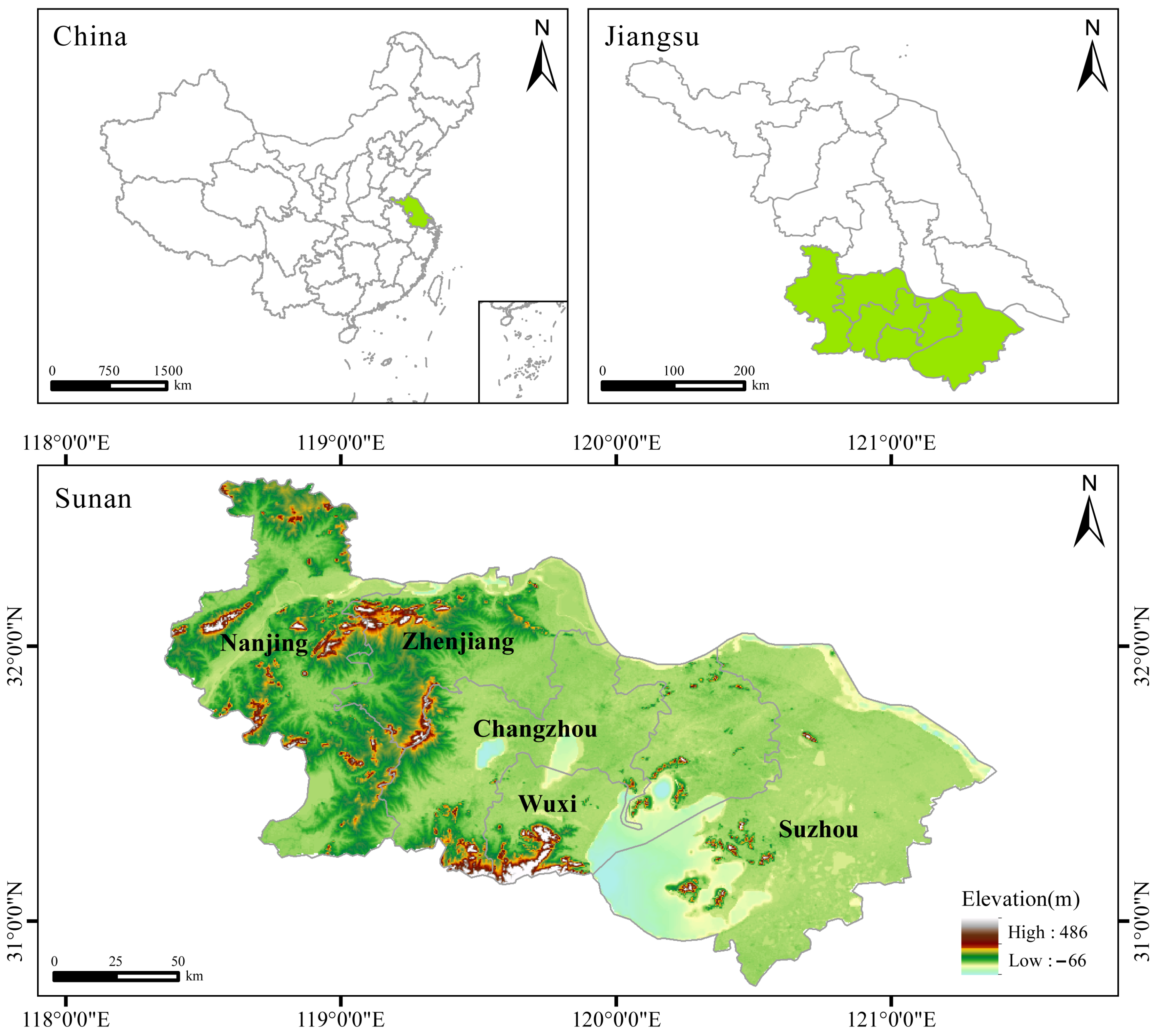
Southern Jiangsu lies south of the Yangtze River and centers within the Yangtze River Delta. With the Yangtze River to the north, Zhejiang to the south, Shanghai to the east, and Anhui to the west, it covers the geographic coordinates of 30°47′ to 32°37′ N and 118°22′ to 121°20′ E. This area includes five municipalities: Nanjing, Wuxi, Changzhou, Suzhou, and Zhenjiang (Figure 1). The eastern part of southern Jiangsu is predominantly a plain with flat terrain and a dense water network, while the western part is mountainous, featuring terrains such as the Ningzhen Mountain, with significant undulations. These mountainous areas serve as critical water conservation zones, floodwater storage areas, areas providing agricultural and aquatic products, and ecological safety buffers for human habitation. The region has a subtropical monsoon climate, with four distinct seasons and abundant rainfall, averaging over 1000 mm annually. The total land area of southern Jiangsu is 27,872 km2, with forested areas covering 1926.33 km2, grasslands covering 203.48 km2, and water bodies covering 5802.23 km2. However, the region faces a relative scarcity of ecological space and uneven distribution. According to the Ecological Protection Redline Plan of Jiangsu Province [37] the ecological protection redline in southern Jiangsu encompasses 3571.07 km2, representing 12.81% of the entire land area of the region. This protected area is primarily located within the Yangtze River Basin, Taihu Lake Basin, and Ningzhen Hills. By the end of 2023, the resident population of southern Jiangsu is expected to reach approximately 39 million, with a GDP of CNY 7.3 trillion and a per capita GDP of CNY 189,000. The region’s urbanization rate exceeds 80%, making it one of the most economically developed and modernized regions in China. Given the increasing demands for ecological protection and continued economic development, southern Jiangsu faces the significant challenge of balancing these dual priorities. This study is crucial in addressing the regional conflicts between ecological security and sustainable economic and social development. We aim to optimize the spatial development and protection framework and provides scientific support to advance sustainable development in the Yangtze River Delta region.

2.2. Data Sources

The data utilized in this research include information for simulating future LULC, assessing ESs, and quantifying SDGs. This primarily consists of data related to land use, the natural environment, socioeconomic factors, and other pertinent information. Table 1 shows the data resources. Land use data at a 30 m resolution were obtained from a publicly available dataset [15]. Land use types were reclassified into six categories using ArcGIS 10.6 software: cropland, forestland, grassland, water area, unused land, and built-up land. According to the characteristics of the southern Jiangsu region, 17 driving factors were selected for land use simulation. Due to the large number of driving factor data types, a series of data preprocessing steps such as projection transformation, extraction by mask, and resampling were carried out in ArcGIS software to ensure the consistency of the spatial location of the data. At a precision of 30 m, the uniformly transformed spatial coordinate system is WGS_1984_UTM_zone_48N. Utilizing the DEM data, the slope was calculated using the slope tool, and the aspect tool was used to calculate the slope direction in ArcGIS software. The Euclidean distance tool was utilized to calculate the distance from the study region to streams, residential regions, and roads at all levels. The InVEST model was used to assess the ESs, which required some specific data as inputs, including various spatial datasets and biophysical data. Based on the predicted values of ESs, the achievement scores of specific SDGs are quantified through standardized scoring and weighted calculation and integrated into a composite index to assess progress.

2.3. Methods

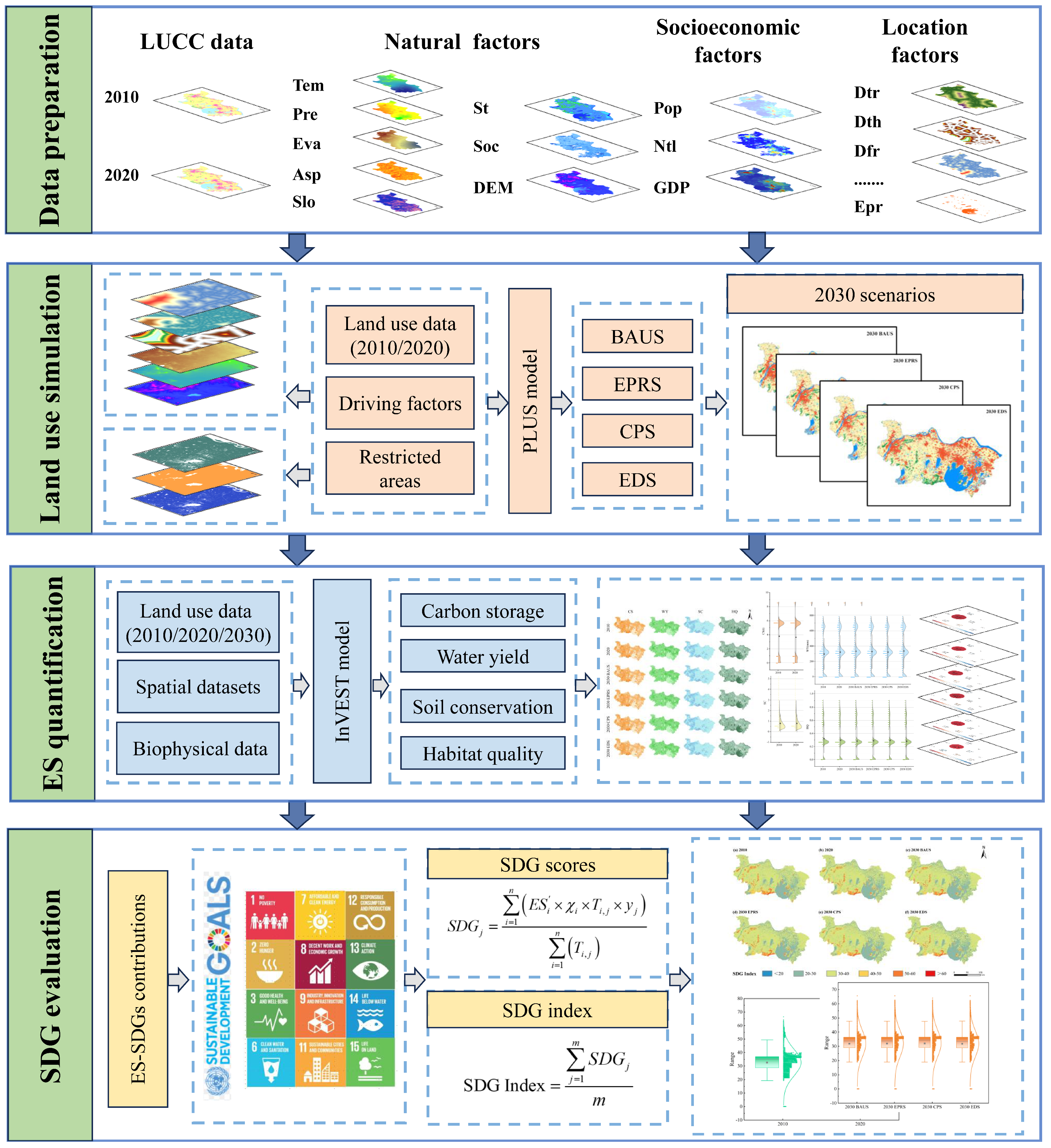
This study examines the spatiotemporal change traits of ESs in the southern Jiangsu region under various future scenarios and links them to the SDGs, thereby evaluating the progress of SDG implementation (Figure 2). The research framework consists of three steps. Firstly, land use data and driving factors are preprocessed as input datasets for land use simulation using the PLUS model in 2030 under different scenarios. Then, using the InVEST model, four ESs are quantified: CS, WY, SC, and HQ. Finally, quantitative equations are constructed based on the ES-SDG target-SDG linkages, to calculate the SDG scores and SDG index for the southern Jiangsu region. Based on the analysis of the spatiotemporal changes in ESs and SDGs, suggestions are made for planning and land management in order to support environmental sustainability and achieve the SDGs.

2.3.1. Land Use Simulation

The PLUS model is a patch-based model for simulating land use change, building on existing approaches. It examines the contributions of many driving elements to each land surface type and enables more realistic modeling of varied land use patch types than other models [17]. In this study, the spatial pattern of land use in southern Jiangsu in 2020 was simulated using the PLUS model and historical land use data. The simulation results were compared with actual 2020 data, and the accuracy of the simulations was validated using kappa and FoM coefficients [38]. The findings showed an overall accuracy of 0.89 and a kappa coefficient of 0.82. These measures of accuracy indicate that the PLUS model’s simulation of the spatial distribution data is quite accurate and can more accurately depict changes in land use over time in the research area. Thus, future land use data in this study can be simulated by using the PLUS model, utilizing the land use expansion module to analyze past land use expansion, and employing Markov chains to predict the demand for different land types in 2030.
The Territorial Spatial Planning of Jiangsu Province (2021–2035) specifies clear guidelines for protecting ecological and agricultural areas [39] The overall area of ecological protection redlines should remain at least 18,200 km2, and the extent of arable land should not be less than 39,847 km2 by 2035. By altering the land use conversion matrix, four scenarios were created based on pertinent policy documents and expert contacts [35,40,41,42]: (1) Business as usual scenario (BAUS): Based on the land use change patterns from 2010 to 2020, the probability of conversion between land use types remains unchanged. The PLUS model forecasts land use demand in 2030 utilizing the Markov chain module, which serves as a basis for simulating other development scenarios. (2) Ecological protection redline scenario (EPRS): The preservation of natural areas such as woods and meadows is given top priority in this scenario, limiting economic development. The probability of conversion between arable land, forests, and grassland and other land uses is set at 40%. This is consistent with the plan’s requirements for the strict protection of key ecological spaces. (3) Cropland protection scenario (CPS): With the primary goal of protecting arable land, the probability of conversion from forest and grassland to arable land is increased by 30%, while the probability of conversion from arable land to other land types is reduced by 30%. These directly respond to the province’s strict cultivated land protection policy and the requirement for “cultivated land balance”. (4) Economic development scenario (EDS): This scenario prioritizes urban expansion to ensure regional economic development. The probability of conversion from arable land, forests, and grassland to construction land is increased by 20%, while the probability of conversion from construction land to non-arable land types is reduced by 20%. This reflects the policy orientation of promoting urban compact development and industrial park expansion in southern Jiangsu. Considering the non-developable nature of water bodies, they are used as restricted areas in all scenarios. Additionally, in the EPRS, ecological protection redline areas are also designated as restricted areas [43], with special protection for protected areas and land types that hold significant ecological functions in southern Jiangsu.

2.3.2. Ecosystem Service Assessment

Based on our knowledge of the ESs in the southern Jiangsu area, its characteristics as a core area of the Yangtze River Delta with rapid urbanization, tight human-land relationships, significant water resource supply-demand conflicts, and prominent ecological space protection needs [36], aligning with the “2030 Agenda for Sustainable Development”, CS, WY, SC, and HQ are selected as the evaluation indicators. Specifically, CS corresponds to SDG 13, reflecting the “dual carbon” strategy; WY corresponds to SDG 6, ensuring regional water security; and SC and HQ align with SDG 15, addressing soil degradation and encroachment on ecological space. The evaluation makes use of the InVEST model 3.14.0, which analyzes and forecasts ES supply utilizing biophysical data and land use maps [44]. This model is very useful in predicting the effects of future events on ESs [45].
Carbon Storage
In CS assessment investigations, the InVEST model’s carbon storage and sequestration tool is increasingly utilized. Dead organic matter, the soil carbon pool, subsurface biomass, and aboveground biomass are the four basic carbon pools that comprise this idea. Cabove denotes carbon stores found in root systems, trunks, foliage, and other biological vegetation in the earth; Cbelow stands for the CS in the living root systems of vegetation; Csoil denotes the CS found in organic and mineral soil; and Cdead represents the CS found in dead plants or litter [46]. The following formula was used:
C =   C a b o v e +   C b e l o w +   C s o i l +   C d e a d
where C is the sum of the carbon reserves (t/hm2·a). Numerous parameters were gathered from sources in the literature [28,47].
Water Yield
The WY module of the InVEST model, a hydrological model that calculates the contribution of water from various landscape elements based on the Budyko curve and the annual average precipitation, was used to evaluate the water yield supply. This model provides a useful way of examining how changes in land use affect yearly surface WY [48]. The equation used is displayed below:
S W Y x =   1   A E T ( x ) P ( x )   × P ( x )
where SWY(x) is the water yield supply for landscape pixel x (mm), AET(x) is the actual evapotranspiration for the year (mm), and P(x) is the precipitation for the year (mm).
Soil Conservation
Forests, grasslands, and other ecological systems have regulatory functions in reducing water-driven soil erosion through their natural structure and function, which can be referred to as the SC [47]. The InVEST model’s sediment delivery ratio module was used to determine the SC [43,49,50]. The equation used is displayed below:
A c =   A p   A r =   R   ×   K   × L   × S   × ( 1   C   × P )
where Ac is quantity of soil stored (t/hm2·a); Ap is potential amount of soil loss that may occur; and Ar is quantity of soil collapse that physically occurs. R is rainfall erosion index (MJ·mm/hm2·h·a); K is soil erodibility index (t·hm2·h/hm2·MJ·mm); L is length of the slope index; and S is the slope index. C is cover of vegetation and farming practices factor, and P is water and soil retention strategy factor.
Habitat Quality
Land use data and biodiversity factors such as stress, which can represent the impact of constantly shifting changes in land use on ESs, can be utilized to estimate HQ based on the InVEST model. The grid serves as the fundamental examination unit in the model. A land use category was allocated to each grid. Each land use type’s habitat suitability data, the weight and distance of influence of different threat indices, and the land use type’s susceptibility to these hazard indices are used to compute HQ [51]. The main equation is shown below:
Q x j =     H j 1 ( D x j z / ( D x j z +   k z ) )
where Qxj is the HQ of the surface cover type j grid x; Hj is the habitat appropriateness of type j; Dxj is the level of decline in a habitat of grid x in type j; z denotes the model’s default parameter; and k is the semi-saturation constant, which is equivalent to half of the highest amount of Dxj.

2.3.3. Trade-Off and Synergy Analysis of ESs

We employed Spearman’s nonparametric correlation analysis, a widely used quantitative technique for figuring out the intensity and direction of interactions, to identify trade-offs and synergies amongst ES pairs [52,53]. Synergies are implied by positive correlations between ES pairs, and trade-offs are implied by negative correlations. The degree of trade-offs and synergies can be ascertained using correlation coefficient values. The strength of the trade-off or synergy increases with the correlation coefficient’s absolute value. Spearman’s correlation analysis was carried out on three spatial and temporal scales, 2010, 2020 and 2030, applying the R4.0 tool’s “corrplot” module.

2.3.4. Scoring SDG and SDG Index

The attributes and quantification units of various ES indicators are different, making weighted summation and direct comparison impossible. We first standardize the data to a range of 0 to 100 using the following formula in order to remove the variations among the ES indicators [28].
E S i = ( E S i M i n ( E S i ) ) M a x E S i M i n ( E S i )   × 100
where E S i and ESi stand for the normalizing scores and biophysics values of ESi respectively. Max (ESi) and Min (ESi) denote the maximum and minimum values.
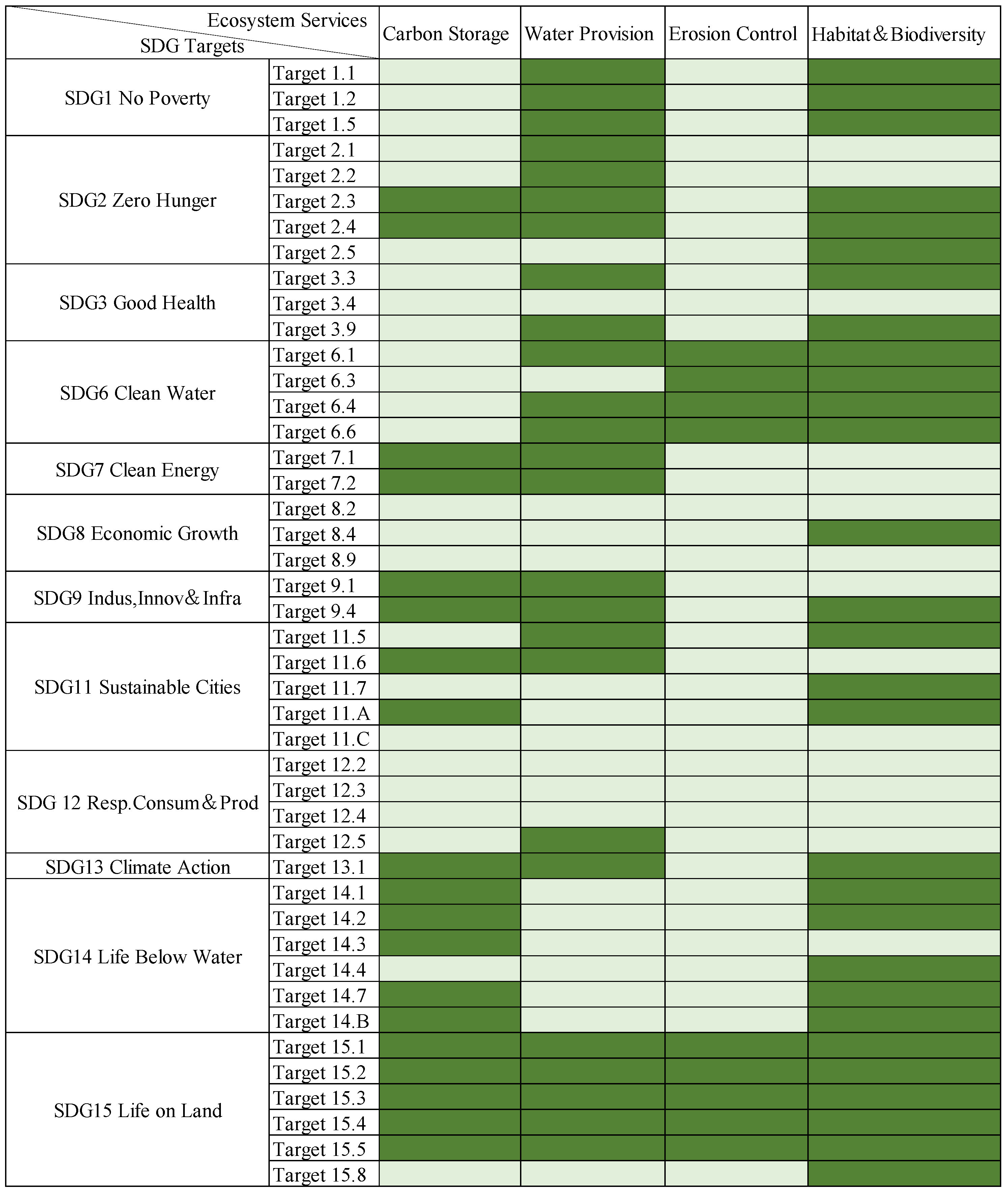
Existing study established links between 16 ESs and 44 SDGs through expert consensus [23]. Detailed mapping between the four ES indicators and their corresponding SDG targets, based on the established framework by Wood et al., is provided in Appendix A Figure A1. Based on these foundational data, we relate changes in ESs to specific SDGs. We chose several relationships that are thought to offer substantial assistance in achieving a sustainable future in the southern Jiangsu region [28]. According to the relationship between ESs and SDGs, the relative spatiotemporal performance toward achieving the SDGs is evaluated using the normalized scores of ESs according to the formula that follows:
S D G j =   i = 1 n   ( E S i   ×   x i   ×   T i , j   ×   y j ) i = 1 n ( T i , j )
where SDGj is evaluation value of SDGj; xi and yj are weights of ESi and the goals within SDGj, respectively; and Ti,j is the number of ES-target linkages under SDGj. X and y have been assigned a value of 1 in this research, demonstrating that every indicator within each SDG has the same importance. We adopt that the use of equal weights due to the current lack of a universally accepted, region-specific weighting system for prioritizing ESs or SDGs in the context of our study area. The number of connected SDG targets is a coefficient in this weighted average solution equation, which is based on the normalized ES. The SDG Index is a composite indicator that can be calculated using the following formula to measure overall success in achieving all assessed SDGs.
S D G   I n d e x = j = 1 m S D G j m
where m is the total number of SDGs that have been analyzed.

3. Results

3.1. Temporal and Spatial Evolution of ESs

3.1.1. Carbon Storage

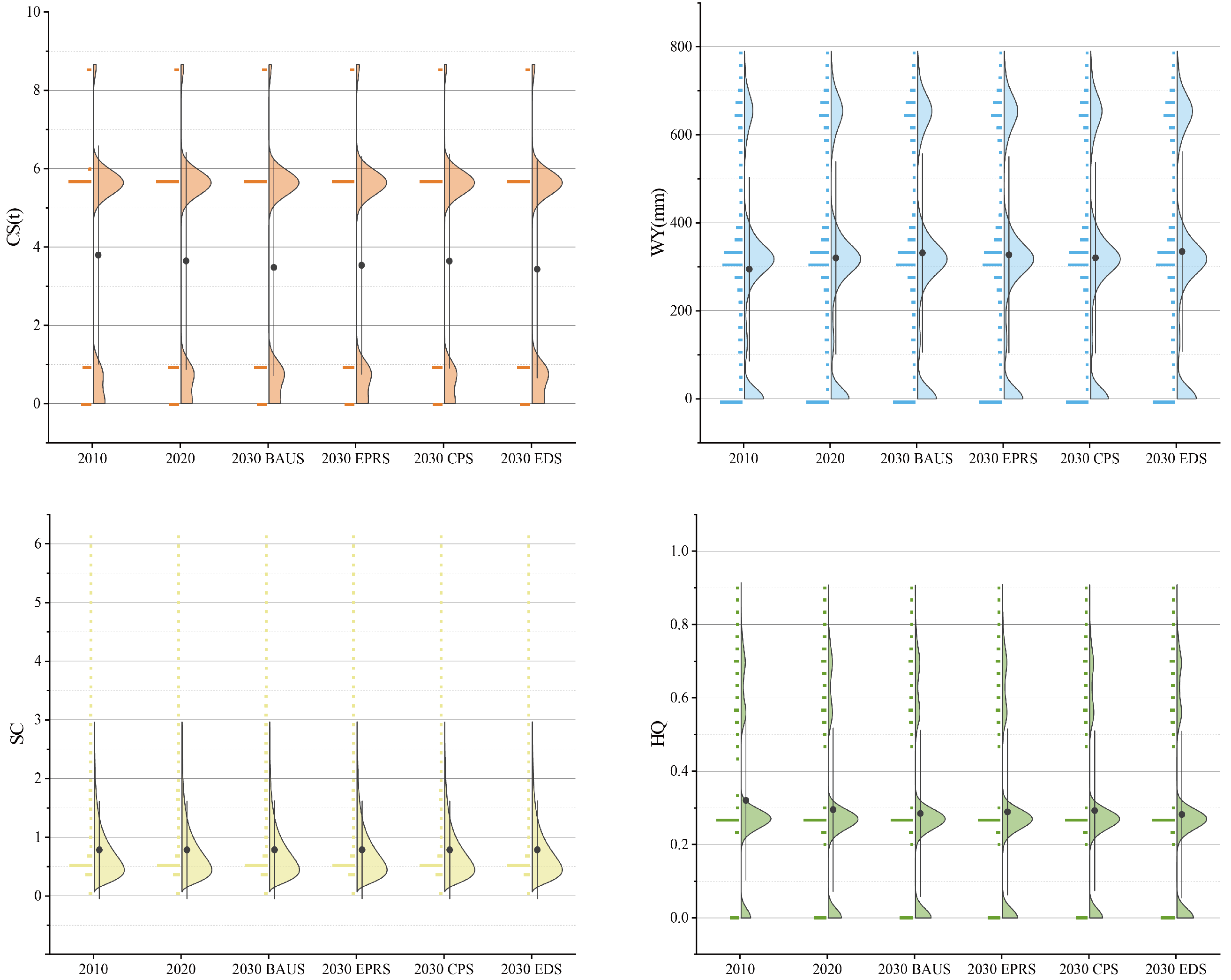
The CS capacity of built-up land and places with minimal vegetative cover is lower than that of croplands, forests, and grasslands. Consequently, LULC was a carbon emission or sequestration process. From 2010 to 2020, CS decreased from 1.144 × 10⁵ t to 1.099 × 10⁵ t, a reduction of 3.94% over ten years (Table 2 and Table 3; Figure 3). From 2020 to 2030, CS declined under all four scenarios, with the largest reduction in the EDS, followed by the BAUS, decreasing by 5.86% (6400 t) and 4.56% (5000 t), respectively. The smallest reduction was observed in the CPS, at only 0.16% (200 t). Compared with the BAUS, CS increased in the CPS and EPRS, with increases of 4.62% (4800 t) and 1.62% (1700 t), respectively. This was mainly due to the protection of ecosystems and farmlands, whereas the CS in the EDS decreased by 1.36% (1400 t), mainly due to the expansion of built-up land.
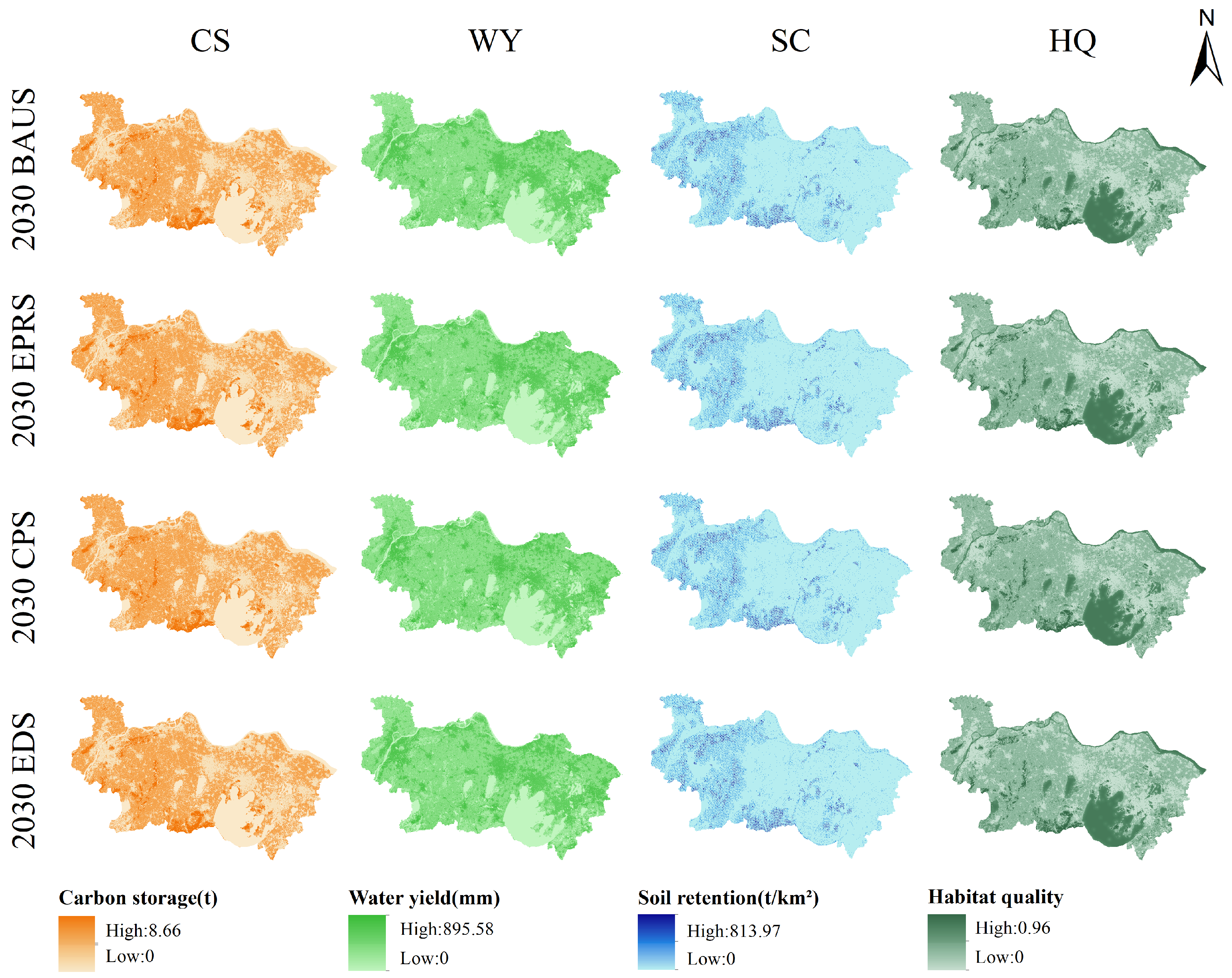
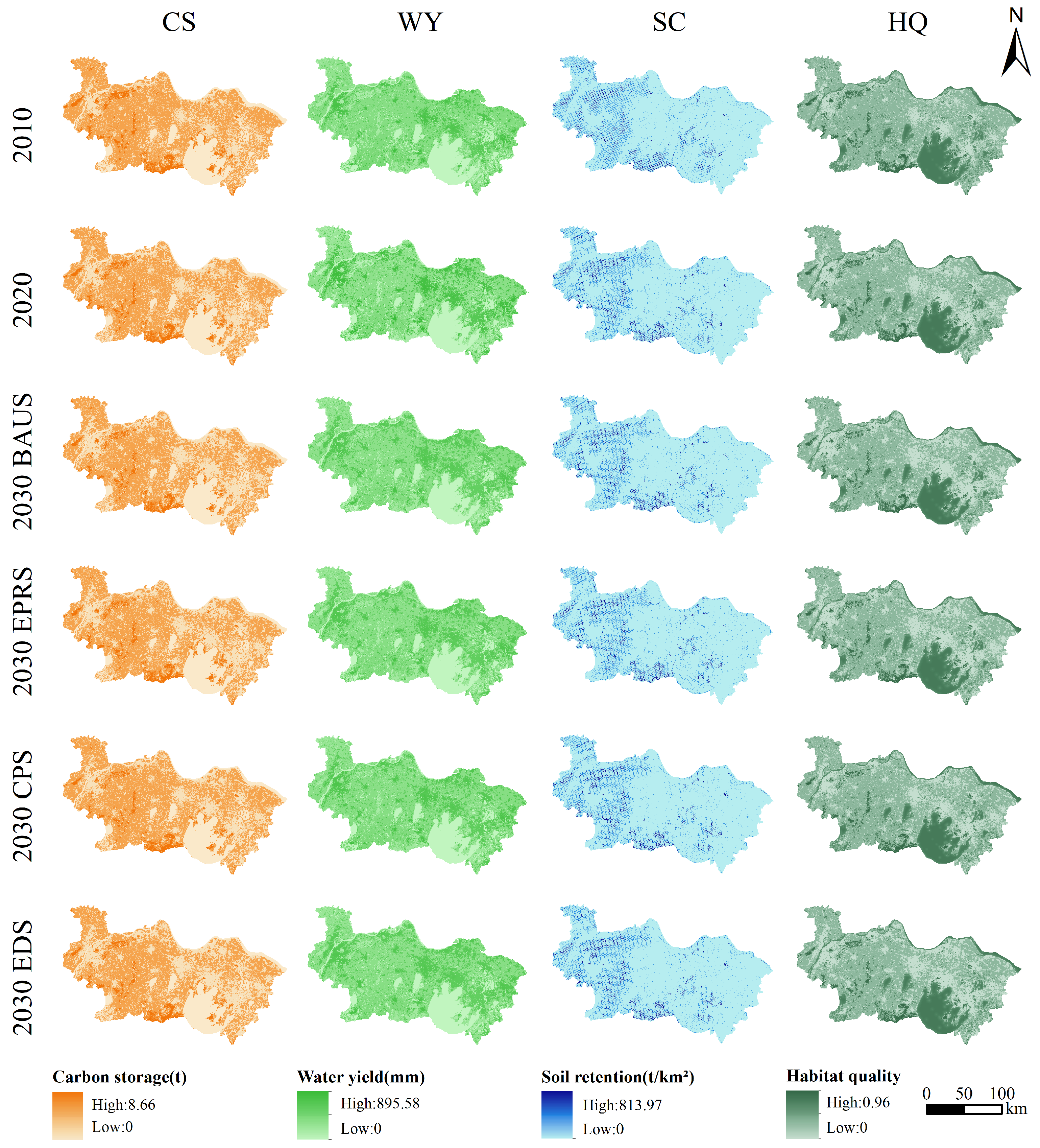
In terms of spatial distribution, CS is higher in the southwestern part of southern Jiangsu Province, while it is lower in the eastern part (Figure 4). The majority of southern Jiangsu’s forests are found near Taihu Lake’s coastline, in Liyang City in Changzhou, in Jurong City in Zhenjiang, and in Jiangning District and Pukou District in Nanjing. These areas have the highest CS, followed by areas with cropland. From 2020 to 2030, except for the CPS, the decrease in CS under the BAUS, ESPS, and EDS is mainly concentrated in the Nanjing, Wuxi, and Suzhou areas. Compared with 2020, CS in the southern forest-dense areas of Suzhou slightly declined under the CPS.

3.1.2. Water Yield

According to Table 2 and Table 3, Figure 3, from 2010 to 2020, WY showed an increasing trend, rising from 8.88 × 10⁹ m3 to 9.65 × 10⁹ m3, an 8.61% increase over ten years. From 2020 to 2030, all four scenarios show an increasing trend in WY, with predicted values ranging from 9.66 × 10⁹ m3 to 1.01 × 10¹⁰ m3, but the growth rates vary. The EDS shows the biggest growth, while the CPS shows the smallest. In the BAUS, WY increases by 3.53% compared with 2020. Despite a reduction in cropland and forestland, which decreases WY by 2.53 × 10⁸ m3 and 1.73 × 10⁷ m3, respectively, the WY increases by 6.10 × 10⁸ m3 as a result of the growth of built-up land. Under the EPRS and EDS, WY increases by 2.26% and 4.54%, respectively, compared with 2020. In the CPS, WY increases by 0.10%. Due to a reduction in built-up land, WY decreases by 8.67 × 10⁷ m3, but this is offset by the increase in cropland, resulting in an increase of 1.28 × 10⁸ m3 in WY. The impact of land use on WY is reflected in the quantitative variations between various land use scenarios. The EDS and BAUS differ from one another the least, while the difference between the CPS and BAUS is the largest, with increases and decreases of 9.80 × 10⁷ m3 and 3.31 × 10⁸ m3, respectively.
In Figure 4, the geographic distribution of WY is shown. The water balance principle is founded on the watershed scale, which makes the watershed the smallest unit. Overall, Nanjing, Wuxi, and Suzhou have higher WY, while Zhenjiang and Changzhou in the central region have lower WY. From 2020 to 2030, except for the CPS, the increase in WY under the BAUS, ESPS, and EDS mainly occurs in Nanjing, Wuxi, and Suzhou, while the decrease mainly occurs in Changzhou. Compared with 2020, the CPS sees a slight increase in WY in the southern forest-dense areas of Suzhou. The EDS includes more urban areas in the east and west than the BAUS, and WY is primarily concentrated in these regions.

3.1.3. Soil Conservation

SC increases from 4994.34 t/km2 in 2010 to 4997.51 t/km2 in 2020, showing a growth of 0.06% over the ten years (Table 2 and Table 3; Figure 3). Except for the CPS, SC is projected to increase from 2020 to 2030. In the BAUS, EPRS, and EDS, SC is expected to grow by 0.14%, 0.01%, and 0.13%, respectively. However, in the CPS, SC shows a decreasing trend, with a reduction of 0.35%.
The SC is higher in Nanjing and Zhenjiang and lower in Changzhou, Wuxi, and Suzhou, according to the geographical distribution of SC displayed in Figure 4. High values are concentrated in regions with a high spread of forests, mainly along the Taihu Lake, as well as around the mountains near Liyang City in Changzhou, Jurong City in Zhenjiang, and Nanjing.

3.1.4. Habitat Quality

HQ dropped by 7.91% over the course of ten years, from 0.32 in 2010 to 0.29 in 2020 (Table 2 and Table 3; Figure 3). From 2020 to 2030, every scenario predicts HQ to shrink, with the EDS and BAUS seeing the biggest drops at 4.39% and 3.48%, respectively. Notably, HQ in aquatic areas improves in all four scenarios by 2030, with the most significant improvement in the EPRS, likely due to the impact of the ecological protection redline policy. Compared with the BAUS, the EPRS and CPS improve by 1.49% and 2.71%, respectively. This improvement is primarily due to the control of human disturbance and farmland protection under the ecological protection redline policy, as well as restrictions on sources of threat and threat distances, which enhance HQ. In the BAUS, human disturbance continues as in the previous development model. Under the EDS, HQ declines by 0.95% compared with the BAUS, due to economic development.
High HQ is mainly found in forested areas and water bodies, while HQ in built-up land is the lowest (Figure 4). HQ is generally very low around urban areas in the southern Jiangsu region, especially in Changzhou, Wuxi, and Suzhou. In contrast, Nanjing and Zhenjiang, with higher vegetation coverage, have relatively higher HQ. HQ in aquatic areas is significantly higher, such as in Taihu Lake, Yangcheng Lake, and the Yangtze River, which flows through the southern Jiangsu region.

3.1.5. Trade-Off and Synergy

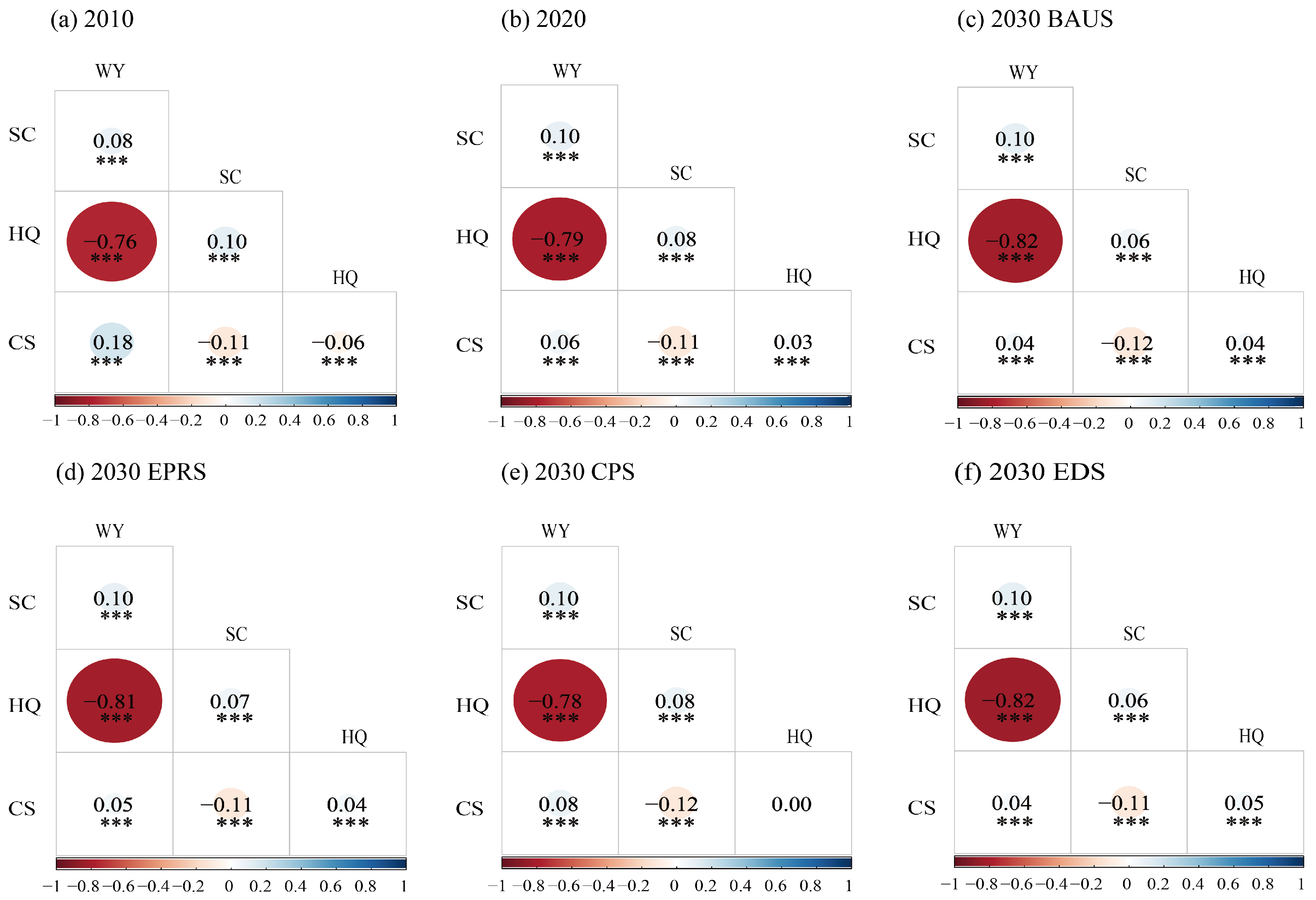
The trade-offs and synergies among the four ESs are shown in Figure 5, with statistically significant correlations observed between service pairs. Over time, these services exhibit similar relationships. Synergies are observed between SC and WY, HQ and SC, and CS and WY, while trade-offs are seen between HQ and WY, and SC and CS. CS and HQ were found to have a poor trade-off association in 2010, which eventually changed to a weak synergy. As time progresses, the trade-off between HQ and WY increases, while the synergy between CS and WY weakens. The synergy between SC and WY initially strengthened and then stabilized, whereas the synergy between SC and HQ decreased and the trade-off between SC and CS stayed essentially the same. The trade-offs and synergies in 2030 vary depending on the scenario. In the CPS, the trade-off between WY and HQ is the lowest of the four situations, the synergy between WY and CS is the strongest, and there is no significant correlation between CS and HQ.

3.2. Contribution of ESs to SDGs Progress

3.2.1. Contribution of ESs to Individual SDG Scores

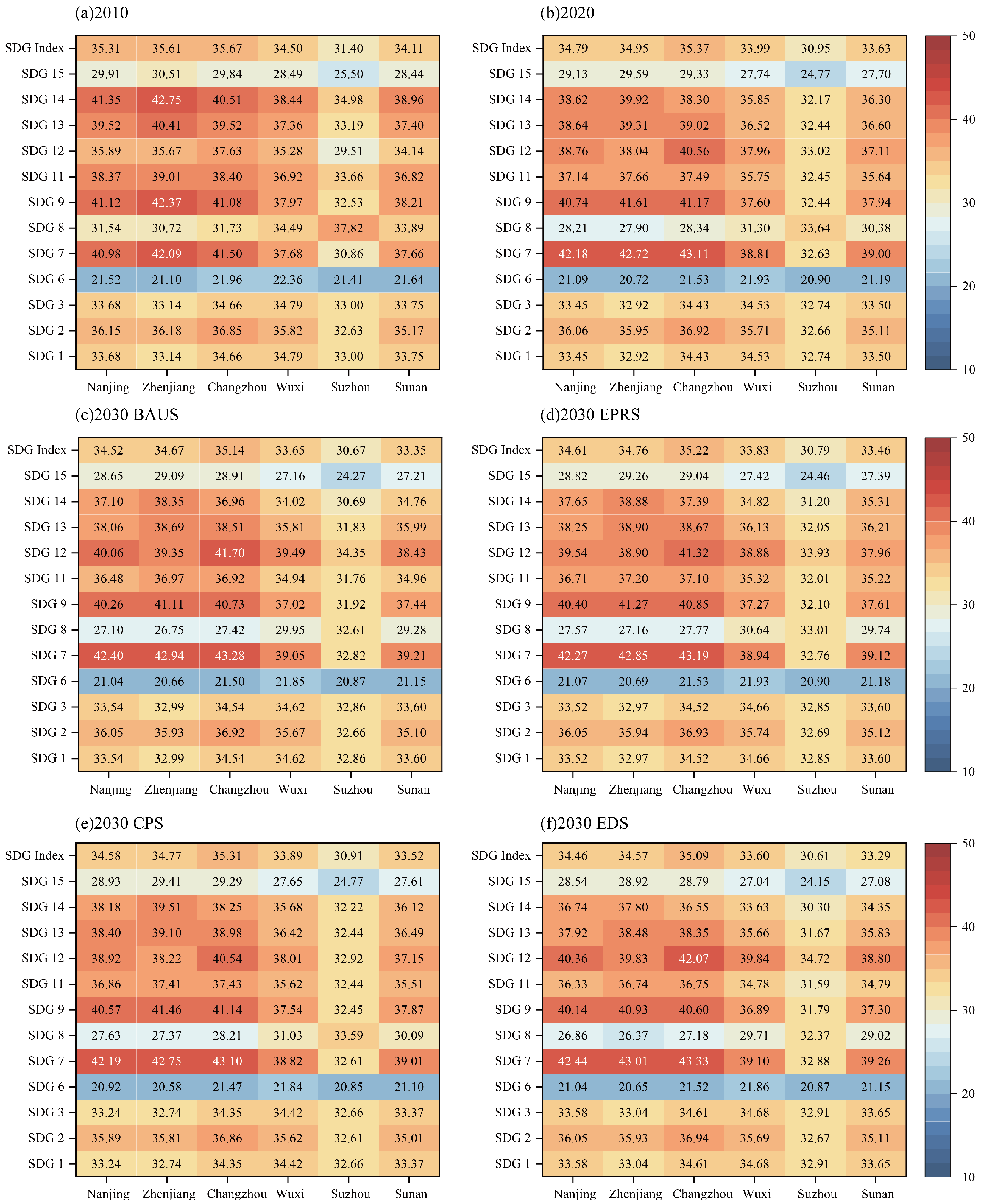
Using the normalized ES values as a basis, the SDG scores for the southern Jiangsu region and five cities were calculated using a quantitative equation (Figure 6). The highest sustainable development performance is represented by a score of 100, while the lowest is represented by a score of 0. Overall, from 2010 to 2030, SDG 6 consistently had the lowest score, followed by SDG 15 and SDG 8 (Decent Work and Economic Growth). SDG 7 (Affordable and Clean Energy) had relatively high scores for most of the time, followed by SDG 9 (Industry, Innovation and Infrastructure) and SDG 12 (Responsible Consumption and Production). SDG 8 and SDG 12 exhibited significant fluctuations, with SDG 8 showing a downward trend and SDG 12 showing an upward trend. Specifically, from 2010 to 2020, scores for all SDGs declined, except for SDG 7 and SDG 12, which increased. From 2020 to 2030, scores for SDG 1 (No Poverty), SDG 3 (Good Health and Well-being), SDG 7, and SDG 12 increased, while most other SDGs showed a decline. Clearly, SDG 7 and SDG 12 performed well in terms of sustainable development. Among the 12 SDGs, the EPRS performed well in SDG scores compared with the BAUS, especially SDG 8 and SDG 14 (Life Below Water), which increased by 0.45 and 0.56, respectively.
On the city scale, Changzhou and Zhenjiang had higher SDG scores, with Suzhou having the lowest. The spatial differences in SDG scores mainly reflect regional disparities. Specifically, the SDG score ranges for each city were as follows: Changzhou (21.47 to 43.33), Zhenjiang (20.58 to 43.01), Nanjing (20.92 to 42.44), Wuxi (21.84 to 39.84), and Suzhou (20.85 to 37.82). This aligns with the expert view that different ESs contribute differently to various SDGs [54]. For each SDG, the score variations between cities were different. The largest variations occurred in SDG 7, SDG 8, SDG 9, SDG 11 (Sustainable Cities and Communities), SDG 12, SDG 13, and SDG 14, while smaller variations were observed in SDG 1, SDG 2, SDG 3, and SDG 6. Among the four scenarios in 2030, the EPRS and CPS performed better.

3.2.2. Spatiotemporal Patterns and Changes in SDG Index

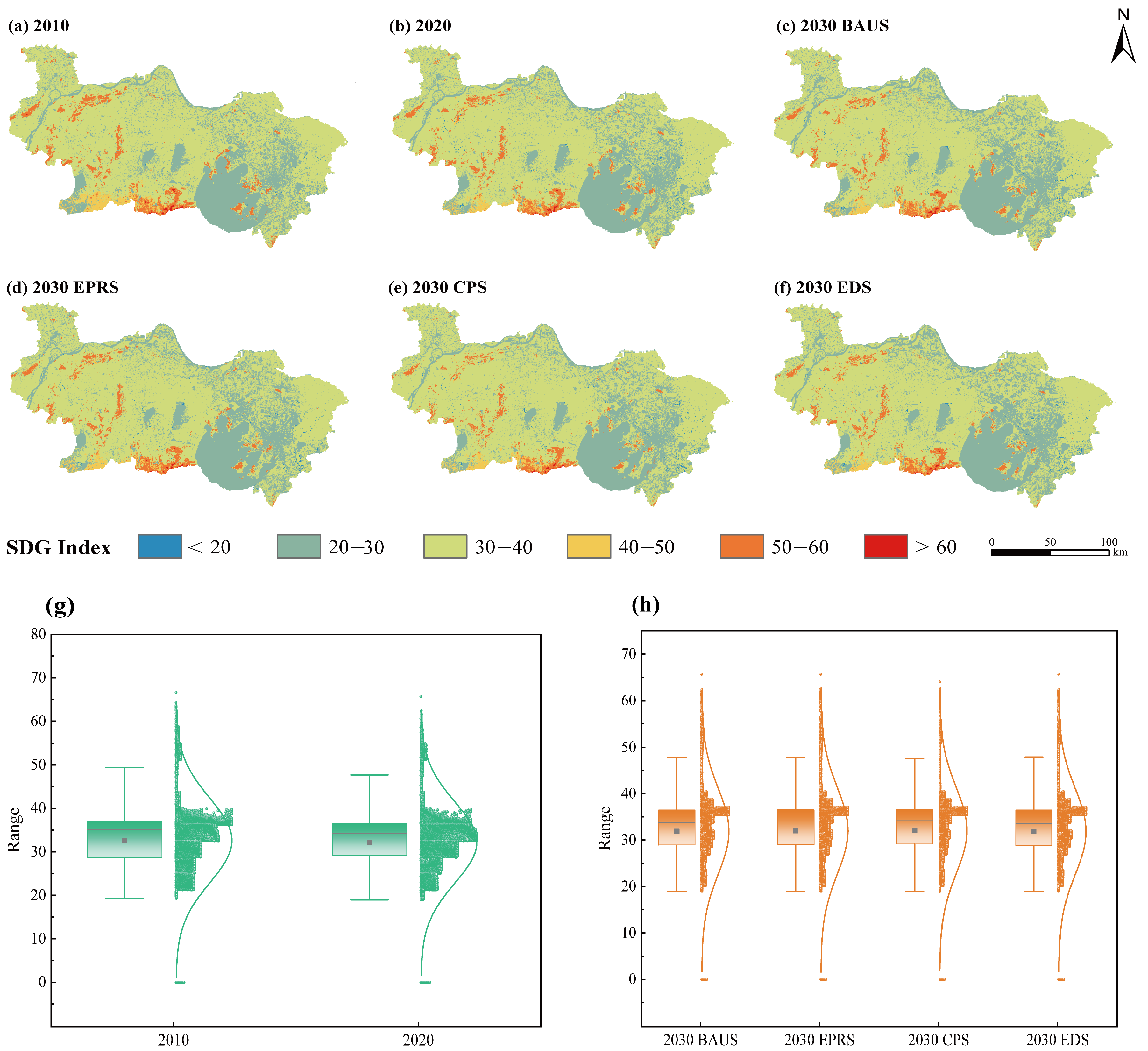
The SDG index for the southern Jiangsu region was calculated based on the scores for the 12 SDGs (Figure 7a–h). Overall, the SDG index for southern Jiangsu decreased from 34.11 in 2010 to 33.63 in 2020, a decline of 1.42%. Under four scenarios, the SDG index in 2030 will marginally reduce from 2020, with the EDS experiencing the biggest decline and the CPS experiencing the smallest. Compared with the BAUS, the EPRS and CPS show a growth in SDG index, while the EDS shows a decline. The SDG index’s spatial distribution from 2010 to 2030 is shown (Figure 7a–f), with similar trends in distribution. Regarding land use types in southern Jiangsu, densely distributed forest areas generally have a higher SDG index, while water bodies have a lower SDG index. Other land types show a medium level of SDG performance. Notably, the SDG index for cropland in the southern parts of Nanjing and Changzhou ranges between 40 and 50, which is relatively high.

4. Discussion

4.1. Changes of ESs and Various Scenarios

From 2010 to 2030, the four types of ESs in the southern Jiangsu region exhibit significant spatiotemporal heterogeneity and show different change trajectories under the four scenarios. Each ES responds to changes in land use conversion through different ecological processes [55], and their interactions reflect the complexity of urban ecosystems. The most serious degradation of ESs results from the EDS’s prioritization of urban expansion through increased conversion of agriculture, forestland, and grassland to built-up land. Because built-up land replaces high-carbon ecosystems, CS decreases the most by 5.86%, whereas HQ decreases by 4.39% as a result of habitat fragmentation brought on by urban growth. This aligns with earlier studies [4,56], which indicate that uncontrolled urbanization in China leads to systemic ES losses; however, our study further quantifies this loss under explicit policy scenarios, highlighting the possibility of a 1.3% drop in CS for every 20% rise in urban land expansion in comparison to the BAUS. From 2010 to 2030, SC under the BAUS shows a growing trend, indicating the effectiveness of recent governmental ecological projects [57]. In contrast, the EPRS and CPS mitigate ES degradation by restricting destructive land use conversions. The EPRS designates ecological redline areas as non-developable zones, protecting forestland and grassland, which not only increases CS by 1.62% compared with the BAUS but also improves HQ to some extent, as redline areas include crucial water bodies that provide a buffer against urban threats, such as Taihu Lake and the Yangtze River. This aligns with previous research [58], which found that ecological redline policies enhance ESs by limiting human interference. However, SC was relatively low in the EPRS. Ecological protection areas may face intensified soil drought due to increased vegetation evapotranspiration, subsequently reducing their resistance to erosion [59]. Simultaneously, the implementation of the ecological redline policy may prioritize carbon sinks or biodiversity over SC, which is in line with prior discoveries [43,60]. Meanwhile, the CPS maximized the reduction in CS decline through reducing cropland outflow and moderately increasing inflow. Although the CS capacity of cropland is lower than that of forestland, its higher soil organic carbon content prevents the sharp declines in CS observed in the EDS and BAUS. Notably, HQ improves under the CPS compared with the BAUS, as protected farmland acts as a buffer zone between built-up land and natural habitats, thereby reducing the distance-weighted impacts of urban threats on HQ. Unlike in arid regions where cropland expansion degrades HQ [42], the intensively managed cropland in this region maintains moderate habitat suitability, underscoring the importance of regional context in the ES-policy relationship, which is a unique finding for southern Jiangsu. Nevertheless, SC was found to be comparatively low in the CPS, potentially due to the negative ecological impacts of intensive agriculture, as some production practices that overly rely on irrigation and fertilizers to maintain food production can lead to soil salinization or acidification, thereby indirectly exacerbating erosion, which is consistent with other research findings [28,57].
The WY shows an increase in all scenarios, and the differences in vegetation cover across scenarios provide one explanation for the changes in WY. The EDS exhibits the highest growth rate in WY because of the growth in built-up land, which increases impervious surfaces, hindering the infiltration of precipitation and redirecting rainfall to surface runoff [61]. In contrast, the CPS has the lowest growth rate of WY, as agricultural land with high permeability can mitigate runoff, even when small areas of forestland are converted to cropland. The vegetation cover in the EDS is the smallest, while the vegetation cover in the CPS is the largest. In other words, greater vegetation cover correlates with lower WY [43]. By concentrating on the connection between WY and built-up land, we can determine that the EDS, which has the most built-up land, also exhibits the highest WY. This highlights a critical ES trade-off in the southern Jiangsu region: urbanization promotes WY but reduces CS and HQ, while cropland protection limits the growth of WY but preserves CS and HQ. The interactions between ESs across scenarios reveal a consistent but context-dependent pattern, with the HQ-WY trade-off being the most significant pattern affecting regional sustainability. The strong trade-off between HQ and WY emerges as the key limiting factor for achieving SDG 6 and SDG 15 simultaneously in the region. By 2030, this trade-off is weakest in the CPS and stronger in the EDS and BAUS, reflecting how land use policies mediate ecological trade-offs [28]. The potential mechanism is clear: urban expansion increases impervious surfaces, enhancing WY but degrading habitats and reducing HQ, while cropland protection balances permeability and habitat buffering, softening the trade-off. This is consistent with observations in the Taihu River Basin [47] but extends this previous work by demonstrating specific policy levers in particular scenarios, such as cropland conversion restrictions, which quantify the extent of trade-off mitigation. Although the synergy between ESs is less apparent, it is equally important. The synergy between CS and WY has weakened over time. Firstly, this synergy may stem from forest ecosystems, which offer strong CS capabilities while also performing water resource protection functions. Secondly, the weakening trend is driven by urbanization: as the coverage of built-up land expands, WY increases while CS declines, leading to a decoupling of the hydrological and carbon cycles. This decoupling warns that unregulated development will erode the synergistic benefits of ES, underscoring the need for policy interventions to maintain these synergies.

4.2. Impacts of ESs in Advancing the SDGs

ESs act as a “bridge” between land use changes and the achievement of SDGs, with their supply patterns directly determining the performance of SDGs related to climate, water, and biodiversity [62]. In the southern Jiangsu region, the contribution of ESs to the SDGs exhibits specific service efficiency, scenario dependency, and regional heterogeneity. CS is a key driver of SDG 13. The 3.94% decline in CS from 2010 to 2020 is associated with a 0.80 drop in the SDG 13 score, as the reduction in carbon sequestration undermined the region’s ability to meet the “dual carbon” targets [63,64]. The EPRS and CPS prioritize CS, reversing this trend. The increase in CS under the EPRS compared with the BAUS subsequently improved the SDG 13 score, while the CPS maintained stability in SDG 13. This confirms that improvements in ES directly advance the SDGs, consistent with existing research [65,66], and our study quantifies this relationship in highly urbanized areas. HQ significantly contributes to SDG 15 (Life on Land). The 7.91% decline in HQ from 2010 to 2020 led to a 0.74 decrease in the SDG 15 score, as habitat degradation reduced biodiversity and ecosystem resilience. Improvements in HQ under the EPRS enhanced the SDG 15 score, benefiting from the protection of high-suitability habitat areas designated by redlines [67]. Notably, by 2030, HQ is expected to improve in all scenarios, which also elevates the score for SDG 14. Compared with the BAUS, the EPRS shows the greatest benefits, highlighting the co-benefits of protecting terrestrial-aquatic connectivity. It is important to note that WY negatively impacts SDG 6. Although WY is on the rise, SDG 6 has consistently recorded the lowest scores among the SDGs. This discrepancy may arise because in highly urbanized humid areas such as southern Jiangsu, the growth in WY primarily stems from the expansion of impervious surfaces, leading to rapid surface runoff rather than infiltration. This increases total runoff, but comes with non-point source pollution, reduced groundwater recharge, and heightened risks of urban flooding, ultimately degrading water quality. This aligns with existing studies [27], pointing out that if pollution issues are not addressed, increases in water volume do not guarantee progress toward SDG 6. This suggests that in southern Jiangsu, high water yield has not translated into good water security and water quality, but rather reflects a severe water system issue.
The EPRS is the most effective scenario for advancing the SDGs. Its SDG index is higher than that of the BAUS, with most SDG scores showing improvement. This is because the EPRS optimizes ESs to support multiple SDGs, avoiding the trade-offs associated with single-target policies [68]. For example, the protection of redline areas not only safeguards ESs but also creates green job opportunities in ecological monitoring and reforestation [56], thereby enhancing SDG 8 compared with the BAUS. In contrast, the EDS leads to the most significant decline in SDGs, with all goals related to the ecological environment experiencing reductions. This underscores the unsustainability of high-intensity urbanization; while EDS may temporarily improve economic indicators, it undermines the ES foundation necessary for the long-term achievement of SDGs. Spatially, the SDG index reflects the supply patterns of ESs. Areas with dense forests have the highest SDG index because they provide high CS and HQ [69], strongly supporting SDG 13 and SDG 15. These regions also maintain moderate SC, indirectly promoting SDG 2 by preventing soil degradation in neighboring cropland. Changzhou and Zhenjiang outperform Suzhou and Wuxi in SDG scores due to their better performance in cropland protection and forest retention, supporting SDG 2, SDG 13, and SDG 15. In contrast, Suzhou and Wuxi show lower SDG indices, as extensive built-up land lowers CS and HQ, limiting progress on SDG 13 and SDG 15 [70], while water quality issues prevent improvements in WY from enhancing SDG 6. This indicates that economic growth alone cannot guarantee progress toward achieving the SDGs, emphasizing the necessity of integrating ES protection into “quality growth”.

4.3. Management and Recommendations

Land use change can significantly affect ESs through changes in human-environment interactions, thereby impacting the sustainability of socio-economic systems [18]. To ensure the health and stability of ecosystems, continuously provide a wide range of ESs, and government decision-makers should concentrate on planning and management that center on ecological, agricultural production, and urban growth in order to support sustainable regional development. Regarding ecology and agricultural production, firstly, important natural regions should be better protected and managed through a focused approach. Efforts should be made to integrate these essential ecological spaces and intact natural reserves into ecologically protected redlines for strict control [71], and severe penalties should be imposed for illegal conversions. We now explicitly pinpoint the western and southern hilly areas of Nanjing and Zhenjiang as critical sub-regions for intervention. These areas, identified as having high CS and HQ values but facing potential conversion pressure under economic development scenarios, should be prioritized for the strict enforcement of the ecological protection redline. Conversely, for the eastern plains of Suzhou and Wuxi, characterized by extensive built-up land and an acute HQ-WY trade-off, we recommend the targeted implementation of green infrastructure and compact urban infilling to mitigate runoff and habitat fragmentation. Otherwise, as seen in the scenarios, some forests might be covered by built-up land or deteriorate into grasslands and shrublands. Secondly, in order to sustain crop production on the land, high-productivity farms should be rigorously shielded from urban expansion. To improve SC and stop soil erosion, this can be used in conjunction with ecological agriculture techniques such as cover crops and no-till farming. In areas with intensive cropland, this approach has been shown to increase soil CS while maintaining food production [57], balancing SDG 2 and SDG 15. For the CS-SC synergy in croplands, we also recommend implementing “conservation agriculture subsidies” that promote no-till farming and cover crops, specifically within the fertile cropland clusters of Changzhou.
Regarding urban development, promoting compact urban growth is vital in reducing trade-offs in ESs. In southern Jiangsu, where the urbanization rate exceeds 80%, sporadic suburban expansion has led to significant losses in ESs. The scientific optimization of the layout and functional structure of built-up land, as well as the delineation of urban development boundaries, can prevent disordered expansion and sprawl, ensuring that urban growth only occurs in areas with low ES values rather than regions with high carbon or high HQ, thus advancing SDG 6 and SDG 15. Simultaneously, establishing a cross-city ES coordination mechanism is essential in addressing spatial spillover issues. ESs in southern Jiangsu exhibit strong inter-city connections, and regional ecological compensation will incentivize ecological protection [72]. Additionally, coordinating land use planning across cities can avoid fragmented governance and encourage sustainable development in the region [73]. In terms of the various SDG indicators, SDG 6 scores the lowest, and regional managers should strengthen lake protection while continuously enhancing water quality purification, creating regular water quality monitoring reports [74]. In conclusion, it is hoped that the national spatial planning and institutional reforms can comprehensively consider ecology, agriculture, and urban development [75]. The region’s unique demands and goals should guide the creation of suitable policies.

4.4. Modeling Limitations and Future Perspectives

Similarly to existing research, this study has several limitations, indicating areas for further improvement: Firstly, the uncertainty of ESs that could result from changes in the climate is not taken into account in this analysis [76]. According to a study, land use change is the primary factor influencing ESs, with climate change coming in second [77]. Future work could incorporate climate scenario studies to investigate how LULC and climate change interact to affect ESs and SDGs, providing more robust policy guidance. Secondly, there are many different types of ESs, but for this study, we only chose four, which restricted the thoroughness and accuracy of the evaluation of ESs and SDGs. Moreover, the uncertainty of various ESs under different scenarios has not been comprehensively considered [78]. More pertinent metrics that represent economic growth and social equality should be included in future studies, such as provisioning services and cultural services. Lastly, the InVEST model, is a widely validated and applied tool, but the simulation outputs are subject to uncertainties [79,80]. We acknowledge that the InVEST model outputs are contingent upon the accuracy of input data (e.g., LULC classification, precipitation) and biophysical parameters, many of which are derived from the existing literature and based on the characteristics of the study area. While these are standard practices, they introduce a degree of uncertainty in the absolute values of the quantified ESs. In future, we plan to perform localized calculations of these model parameters for more in-depth research.

5. Conclusions

We studied four key ESs under four scenarios in the southern Jiangsu region from 2010 to 2030 and used ES-SDG target-SDG linkages to assess regional progress toward ecosystem-related SDGs. This formed the LULC-ES-SDG analytical framework. The framework quantifies future land use impacts on ES-SDG links, providing a replicable tool for urbanized regions. The results showed that: (1) There was a decline in CS (−3.94%) and HQ (−7.91%) from 2010 to 2020. SC showed slight growth, while WY exhibited an upward trend (+8.61%). In the future scenarios for 2030, for ESs excluding WY, the EPRS and CPS perform relatively well, while the EDS performs the worst. The increase in built-up land has a positive connection with WY. (2) From 2010 to 2020, the SDG index in the southern Jiangsu region decreased by 1.42%; during 2020–2030, the EDS experienced the greatest decline, with the EPRS and CPS indices remaining higher than the BAUS. Spatially, areas with dense forests have higher indices, while water bodies have lower indices. Regarding individual SDG scores, SDG 6 consistently scores the lowest, while SDG 7 and SDG 12 score relatively high. These findings underscore that achieving the SDGs requires integrated land use planning that explicitly manages ES trade-offs. The integrated assessment framework developed here provides a replicable and scalable approach for evaluating landscape sustainability pathways, which can be adapted to inform spatial planning and policy-making in other rapidly urbanizing regions facing similar tensions regarding ecological development.

Author Contributions

H.P.: Conceptualization, Methodology, Formal Analysis, Validation, Writing—Original Draft. X.H.: Data Curation, Visualization, Writing—Review & Editing. J.Z.: Visualization, Writing—Review & Editing. L.L.: Conceptualization, Project Administration, Funding acquisition, Writing—Original Draft. X.W.: Conceptualization. All authors have read and agreed to the published version of the manuscript.

Funding

This work was supported by the National Natural Science Foundation of China (Grant No. 42271271, 42301131, 42201282), the Open Fund of Observation Research Station of Land Ecology and Land Use in the Yangtze River Delta, Ministry of Natural Resources of China (Grant No. 2023YRDLELU02).

Data Availability Statement

Data supporting the findings of this study are not publicly available due to privacy concerns. However, they can be requested from the corresponding author upon reasonable request.

Conflicts of Interest

The authors declare no conflicts of interest.

Abbreviations

The following abbreviations are used in this manuscript:
LULCLand Use/Land Cover
ESsEcosystem Services
SDGsSustainable Development Goals
InVESTIntegrated Valuation of Ecosystem Services and Tradeoffs
PLUSPatch-Generated Land Use Simulation
CARSCellular Automata model of the multi-type Random patch Seeds
ARIESArtificial Intelligence for Ecosystem Services
SolVESSocial Values for Ecosystem Services
FoMFigure of Merit
CSCarbon Storage
WYWater Yield
SCSoil Conservation
HQHabitat Quality
BAUSBusiness As Usual Scenario
EPRSEcological Protection Redline Scenario
CPSCropland Protection Scenario
EDSEconomic Development Scenario
TemTemperature
PrePrecipitation
EvaEvapotranspiration
AspAspect
SloSlope
StSoil type
SocSoil organic
DEMDigital Elevation Model
PopPopulation
NtlNighttime light
GDPGross Domestic Product
DtrDistance to railway
DthDistance to highway
DfrDistance to first-level roads
EprEcological protection redline

Appendix A

Figure A1. An ES-SDG linkage map based on the data extracted from Wood et al. [23]. Note: Dark green indicates that the SDG is strongly supported by a specific ES. Light green represents weak, uncertain, or unassessed support which are not the focus of the current research, referring to other studies [23,28].
Land 14 02295 g0a1
Figure A2. Spatial distribution of ESs from 2010 to 2030.
Land 14 02295 g0a2

References

  1. Mandle, L.; Shields-Estrada, A.; Chaplin-Kramer, R.; Mitchell, M.G.E.; Bremer, L.L.; Gourevitch, J.D.; Hawthorne, P.; Johnson, J.A.; Robinson, B.E.; Smith, J.R.; et al. Increasing decision relevance of ecosystem service science. Nat. Sustain. 2021, 4, 161–169. [Google Scholar] [CrossRef]
  2. Yang, S.; Zhao, W.; Liu, Y.; Cherubini, F.; Fu, B.; Pereira, P. Prioritizing sustainable development goals and linking them to ecosystem services: A global expert’s knowledge evaluation. Geogr. Sustain. 2020, 1, 321–330. [Google Scholar] [CrossRef]
  3. Bai, Y.; Jiang, B.; Wang, M.; Li, H.; Alatalo, J.M.; Huang, S. New ecological redline policy (ERP) to secure ecosystem services in China. Land Use Policy 2016, 55, 348–351. [Google Scholar] [CrossRef]
  4. Bryan, B.A.; Gao, L.; Ye, Y.; Sun, X.; Connor, J.D.; Crossman, N.D.; Stafford-Smith, M.; Wu, J.; He, C.; Yu, D.; et al. China’s response to a national land-system sustainability emergency. Nature 2018, 559, 193–204. [Google Scholar] [CrossRef]
  5. Costanza, R.; de Groot, R.; Braat, L.; Kubiszewski, I.; Fioramonti, L.; Sutton, P.; Farber, S.; Grasso, M. Twenty years of ecosystem services: How far have we come and how far do we still need to go? Ecosyst. Serv. 2017, 28, 1–16. [Google Scholar] [CrossRef]
  6. Yin, C.; Zhao, W.; Ye, J.; Muroki, M.; Pereira, P. Ecosystem carbon sequestration service supports the Sustainable Development Goals progress. J. Environ. Manag. 2023, 330, 117155. [Google Scholar] [CrossRef]
  7. Guo, Z.F.; Boeing, W.J.; Borgomeo, E.; Xu, Y.Y.; Weng, Y. Linking reservoir ecosystems research to the sustainable development goals. Sci. Total Environ. 2021, 781, 146769. [Google Scholar] [CrossRef]
  8. Yin, H.Y.; Xiao, R.; Fei, X.F.; Zhang, Z.H.; Gao, Z.; Wan, Y.; Tan, W.F.; Jiang, X.C.; Cao, W.; Guo, Y.X. Analyzing “economy-society-environment” sustainability from the perspective of urban spatial structure: A case study of the Yangtze River delta urban agglomeration. Sustain. Cities Soc. 2023, 96, 104691. [Google Scholar] [CrossRef]
  9. Liu, L.J.; Liang, Y.J.; Hashimoto, S. Integrated assessment of land-use/coverage changes and their impacts on ecosystem services in Gansu Province, northwest China: Implications for sustainable development goals. Sustain. Sci. 2020, 15, 297–314. [Google Scholar] [CrossRef]
  10. Jiang, W.; Zhang, Z.; Ling, Z.; Deng, Y. Experience and future research trends of wetland protection and restoration in China. J. Geogr. Sci. 2024, 34, 229–251. [Google Scholar] [CrossRef]
  11. Zhang, F.; Xu, N.; Wang, C.; Guo, M.; Kumar, P. Multi-scale coupling analysis of urbanization and ecosystem services supply-demand budget in the Beijing-Tianjin-Hebei region, China. J. Geogr. Sci. 2023, 33, 340–356. [Google Scholar] [CrossRef]
  12. Babbar, D.; Areendran, G.; Sahana, M.; Sarma, K.; Raj, K.; Sivadas, A. Assessment and prediction of carbon sequestration using Markov chain and InVEST model in Sariska Tiger Reserve, India. J. Clean. Prod. 2021, 278, 123333. [Google Scholar] [CrossRef]
  13. Wang, P.; Xu, M. Dynamics and interactions of water-related ecosystem services in the Yellow River Basin, China. J. Geogr. Sci. 2023, 33, 1681–1701. [Google Scholar] [CrossRef]
  14. Sagar, S.; Roberts, D.; Bala, B.; Lymburner, L. Extracting the intertidal extent and topography of the Australian coastline from a 28 year time series of Landsat observations. Remote Sens. Environ. 2017, 195, 153–169. [Google Scholar] [CrossRef]
  15. Yang, J.; Huang, X. The 30 m annual land cover dataset and its dynamics in China from 1990 to 2019. Earth Syst. Sci. Data 2021, 13, 3907–3925. [Google Scholar] [CrossRef]
  16. Zhao, C.; Qin, C.-Z. 10-m-resolution mangrove maps of China derived from multi-source and multi-temporal satellite observations. ISPRS J. Photogramm. Remote Sens. 2020, 169, 389–405. [Google Scholar] [CrossRef]
  17. Liang, X.; Guan, Q.; Clarke, K.C.; Liu, S.; Wang, B.; Yao, Y. Understanding the drivers of sustainable land expansion using a patch-generating land use simulation (PLUS) model: A case study in Wuhan, China. Comput. Environ. Urban Syst. 2021, 85, 101569. [Google Scholar] [CrossRef]
  18. Bai, Y.; Wong, C.P.; Jiang, B.; Hughes, A.C.; Wang, M.; Wang, Q. Developing China’s Ecological Redline Policy using ecosystem services assessments for land use planning. Nat. Commun. 2018, 9, 3034. [Google Scholar] [CrossRef]
  19. Baskent, E.Z. Characterizing and assessing key ecosystem services in a representative forest ecosystem in Turkey. Ecol. Inform. 2023, 74, 101993. [Google Scholar] [CrossRef]
  20. Fedele, G.; Locatelli, B.; Djoudi, H. Mechanisms mediating the contribution of ecosystem services to human well-being and resilience. Ecosyst. Serv. 2017, 28, 43–54. [Google Scholar] [CrossRef]
  21. Potschin-Young, M.; Haines-Young, R.; Goerg, C.; Heink, U.; Jax, K.; Schleyer, C. Understanding the role of conceptual frameworks: Reading the ecosystem service cascade. Ecosyst. Serv. 2018, 29, 428–440. [Google Scholar] [CrossRef]
  22. Rugani, B.; de Souza, D.M.; Weidema, B.P.; Bare, J.; Bakshi, B.; Grann, B.; Johnston, J.M.; Raymundo Pavan, A.L.; Liu, X.; Laurent, A.; et al. Towards integrating the ecosystem services cascade framework within the Life Cycle Assessment (LCA) cause-effect methodology. Sci. Total Environ. 2019, 690, 1284–1298. [Google Scholar] [CrossRef] [PubMed]
  23. Wood, S.L.R.; Jones, S.K.; Johnson, J.A.; Brauman, K.A.; Chaplin-Kramer, R.; Fremier, A.; Girvetz, E.; Gordon, L.J.; Kappel, C.V.; Mandle, L.; et al. Distilling the role of ecosystem services in the Sustainable Development Goals. Ecosyst. Serv. 2018, 29, 70–82. [Google Scholar] [CrossRef]
  24. Yin, C.C.; Zhao, W.W.; Cherubini, F.; Pereira, P. Integrate ecosystem services into socio-economic development to enhance achievement of sustainable development goals in the post-pandemic era. Geogr. Sustain. 2021, 2, 68–73. [Google Scholar] [CrossRef]
  25. Zhao, Y.; Zhou, R.J.M.; Yu, Q.; Zhao, L. Revealing the contribution of mountain ecosystem services research to sustainable development goals: A systematic and grounded theory driven review. J. Environ. Manag. 2025, 373, 123452. [Google Scholar] [CrossRef]
  26. Lynch, A.J.; Elliott, V.; Phang, S.C.; Claussen, J.E.; Harrison, I.; Murchie, K.J.; Steel, E.A.; Stokes, G.L. Inland fish and fisheries integral to achieving the Sustainable Development Goals. Nat. Sustain. 2020, 3, 579–587. [Google Scholar] [CrossRef]
  27. Wang, M.; Janssen, A.B.G.; Bazin, J.; Strokal, M.; Ma, L.; Kroeze, C. Accounting for interactions between Sustainable Development Goals is essential for water pollution control in China. Nat. Commun. 2022, 13, 730. [Google Scholar] [CrossRef]
  28. Chen, D.; Zhao, Q.; Jiang, P.; Li, M. Incorporating ecosystem services to assess progress towards sustainable development goals: A case study of the Yangtze River Economic Belt, China. Sci. Total Environ. 2022, 806, 151277. [Google Scholar] [CrossRef]
  29. Xu, J.; Renaud, F.G.; Barrett, B. Modelling land system evolution and dynamics of terrestrial carbon stocks in the Luanhe River Basin, China: A scenario analysis of trade-offs and synergies between sustainable development goals. Sustain. Sci. 2022, 17, 1323–1345. [Google Scholar] [CrossRef]
  30. Wood, S.L.R.; DeClerck, F. Ecosystems and human well-being in the Sustainable Development Goals. Front. Ecol. Environ. 2015, 13, 123. [Google Scholar] [CrossRef]
  31. Du, J.; Liu, Y.; Xu, Z.; Duan, H.; Zhuang, M.; Hu, Y.; Wang, Q.; Dong, J.; Wang, Y.; Fu, B. Global effects of progress towards Sustainable Development Goals on subjective well-being. Nat. Sustain. 2024, 7, 360–367. [Google Scholar] [CrossRef]
  32. Liu, Y.; Du, J.; Wang, Y.; Cui, X.; Dong, J.; Gu, P.; Hao, Y.; Xue, K.; Duan, H.; Xia, A.; et al. Overlooked uneven progress across sustainable development goals at the global scale: Challenges and opportunities. Innovation 2024, 5, 100573. [Google Scholar] [CrossRef] [PubMed]
  33. Ma, F.; Wang, H.; Tzachor, A.; Hidalgo, C.A.; Schandl, H.; Zhang, Y.; Zhang, J.; Chen, W.-Q.; Zhao, Y.; Zhu, Y.-G.; et al. The disparities and development trajectories of nations in achieving the sustainable development goals. Nat. Commun. 2025, 16, 1107. [Google Scholar] [CrossRef] [PubMed]
  34. Mahato, S.; Pal, S.; Joshi, P.K.; Matzarakis, A.; Tarolli, P.; Anand, V. Early summer warming amplification threats towards sustainable development goals (SDGs) in India. Ecol. Inform. 2025, 88, 103156. [Google Scholar] [CrossRef]
  35. Gao, Y.; Shen, Z.; Zhang, T.; Liu, Y. Integrating ecosystem service bundles and scenario predicting for win-win sustainable urban management: A case study of typical arid cities in China. Cities 2025, 166, 106248. [Google Scholar] [CrossRef]
  36. Ding, T.; Chen, J.; Fang, Z.; Chen, J. Assessment of coordinative relationship between comprehensive ecosystem service and urbanization: A case study of Yangtze River Delta urban Agglomerations, China. Ecol. Indic. 2021, 133, 108454. [Google Scholar] [CrossRef]
  37. Jiangsu Provincial People’s Government. Notice of the Provincial Government on Printing and Distributing the National Ecological Redline Plan of Jiangsu Province; Jiangsu Provincial People’s Government: Nanjing, China, 2021.
  38. Jian, L.; Xia, X.; Liu, X.; Zhang, Y.; Wang, Y. Spatiotemporal variations and multi-scenario simulation of urban thermal environments based on complex networks and the PLUS model: A case study in Chengdu central districts. Sustain. Cities Soc. 2024, 115, 105833. [Google Scholar] [CrossRef]
  39. Jiangsu Provincial People’s Government. Notice of the Provincial Government on Printing and Distributing the Territorial Spatial Planning of Jiangsu Province (2021–2035); Jiangsu Provincial People’s Government: Nanjing, China, 2021.
  40. Nie, W.; Xu, B.; Yang, F.; Shi, Y.; Liu, B.; Wu, R.; Lin, W.; Pei, H.; Bao, Z. Simulating future land use by coupling ecological security patterns and multiple scenarios. Sci. Total Environ. 2023, 859, 160262. [Google Scholar] [CrossRef]
  41. Lei, X.; Hai, X. Assessing economic value of carbon storage and land use changes based on the coupled PLUS-InVEST model in Lanzhou City. Sci. Geogr. Sin. 2024, 45, 339–348. (In Chinese) [Google Scholar]
  42. Shilong, W.; Lufeng, Y.; Ting, Z.; Rongfang, L.; Yuliang, W.; Zilong, Z. The effects of landscape patterns on ecosystem services of urban agglomeration in semi-arid area under scenario modeling. Ecol. Indic. 2024, 167, 112610. [Google Scholar] [CrossRef]
  43. Guo, X.; Zhang, Y.; Guo, D.; Lu, W.; Xu, H. How does ecological protection redline policy affect regional land use and ecosystem services? Environ. Impact Assess. Rev. 2023, 100, 107062. [Google Scholar] [CrossRef]
  44. Nelson, E.; Mendoza, G.; Regetz, J.; Polasky, S.; Tallis, H.; Cameron, D.; Chan, K.M.A.; Daily, G.C.; Goldstein, J.; Kareiva, P.M.; et al. Modeling multiple ecosystem services, biodiversity conservation, commodity production, and tradeoffs at landscape scales. Front. Ecol. Environ. 2009, 7, 4–11. [Google Scholar] [CrossRef]
  45. Zheng, H.; Li, Y.; Robinson, B.E.; Liu, G.; Ma, D.; Wang, F.; Lu, F.; Ouyang, Z.; Daily, G.C. Using ecosystem service trade-offs to inform water conservation policies and management practices. Front. Ecol. Environ. 2016, 14, 527–532. [Google Scholar] [CrossRef]
  46. Sun, X.; Yang, P.; Tao, Y.; Bian, H. Improving ecosystem services supply provides insights for sustainable landscape planning: A case study in Beijing, China. Sci. Total Environ. 2022, 802, 149849. [Google Scholar] [CrossRef] [PubMed]
  47. Qiao, X.; Gu, Y.; Zou, C.; Xu, D.; Wang, L.; Ye, X.; Yang, Y.; Huang, X. Temporal variation and spatial scale dependency of the trade-offs and synergies among multiple ecosystem services in the Taihu Lake Basin of China. Sci. Total Environ. 2019, 651, 218–229. [Google Scholar] [CrossRef]
  48. Yin, D.; Yu, H.; Shi, Y.; Zhao, M.; Zhang, J.; Li, X. Matching supply and demand for ecosystem services in the Yellow River Basin, China: A perspective of the water-energy-food nexus. J. Clean. Prod. 2023, 384, 135469. [Google Scholar] [CrossRef]
  49. Bi, Y.; Zheng, L.; Wang, Y.; Li, J.; Yang, H.; Zhang, B. Coupling relationship between urbanization and water-related ecosystem services in China’s Yangtze River economic Belt and its socio-ecological driving forces: A county-level perspective. Ecol. Indic. 2023, 146, 109871. [Google Scholar] [CrossRef]
  50. Sun, X.; Lu, Z.; Li, F.; Crittenden, J.C. Analyzing spatio-temporal changes and trade-offs to support the supply of multiple ecosystem services in Beijing, China. Ecol. Indic. 2018, 94, 117–129. [Google Scholar] [CrossRef]
  51. Xiang, H.; Wang, Z.; Mao, D.; Zhang, J.; Xi, Y.; Du, B.; Zhang, B. What did China’s National Wetland Conservation Program Achieve? Observations of changes in land cover and ecosystem services in the Sanjiang Plain. J. Environ. Manag. 2020, 267, 110623. [Google Scholar] [CrossRef]
  52. Xia, H.; Yuan, S.; Prishchepov, A.V. Spatial-temporal heterogeneity of ecosystem service interactions and their social-ecological drivers: Implications for spatial planning and management. Resour. Conserv. Recycl. 2023, 189, 106767. [Google Scholar] [CrossRef]
  53. Dou, H.; Li, X.; Li, S.; Dang, D.; Li, X.; Lyu, X.; Li, M.; Liu, S. Mapping ecosystem services bundles for analyzing spatial trade-offs in inner Mongolia, China. J. Clean. Prod. 2020, 256, 120444. [Google Scholar] [CrossRef]
  54. Dai, E.; Zhao, Z.; Jia, L.; Jiang, X. Contribution of ecosystem services improvement on achieving Sustainable development Goals under ecological engineering projects on the Qinghai-Tibet Plateau. Ecol. Eng. 2024, 199, 107146. [Google Scholar] [CrossRef]
  55. Ju, X.; Li, W.; He, L.; Li, J.; Han, L.; Mao, J. Ecological redline policy may significantly alter urban expansion and affect surface runoff in the Beijing-Tianjin-Hebei megaregion of China. Environ. Res. Lett. 2020, 15, 1040b1. [Google Scholar] [CrossRef]
  56. Wang, L.; Zheng, H.; Chen, Y.; Huang, B. Ecological redline policy strengthens sustainable development goals through the strict protection of multiple ecosystem services. Glob. Ecol. Conserv. 2024, 56, e03306. [Google Scholar] [CrossRef]
  57. Huang, C.; Zhao, D.; Liao, Q.; Xiao, M. Linking landscape dynamics to the relationship between water purification and soil retention. Ecosyst. Serv. 2023, 59, 101498. [Google Scholar] [CrossRef]
  58. Yang, Y.; Song, G.; Lu, S. Study on the ecological protection redline (EPR) demarcation process and the ecosystem service value (ESV) of the EPR zone: A case study on the city of Qiqihaer in China. Ecol. Indic. 2020, 109, 105754. [Google Scholar] [CrossRef]
  59. Ju, H.; Liu, Y.; Zhang, S. Interprovincial agricultural water footprint in China: Spatial pattern, driving forces and implications for water resource management. Sustain. Prod. Consum. 2023, 43, 264–277. [Google Scholar] [CrossRef]
  60. Ju, H.; Zeng, G.; Zhang, S. Inter-provincial flow and influencing factors of agricultural carbon footprint in China and its policy implication. Environ. Impact Assess. Rev. 2024, 105, 107419. [Google Scholar] [CrossRef]
  61. Zhang, H.; Wang, B.; Liu, D.L.; Zhang, M.; Leslie, L.M.; Yu, Q. Using an improved SWAT model to simulate hydrological responses to land use change: A case study of a catchment in tropical Australia. J. Hydrol. 2020, 585, 124822. [Google Scholar] [CrossRef]
  62. Li, C.J.; Lu, T.; Fu, B.J.; Wang, S.; Holden, J. Sustainable city development challenged by extreme weather in a warming world. Geogr. Sustain. 2022, 3, 114–118. [Google Scholar] [CrossRef]
  63. Li, X.Y.; Huang, G.H.; Wang, S.G.; Zhang, X.Y.; Luo, B. Synergistic Management of Water, energy, and carbon: A case Study from Shandong Province, China. Appl. Energy 2025, 381, 125192. [Google Scholar] [CrossRef]
  64. Yang, Y.; Su, X.Y. Spatial correlation network structure of carbon emission reduction capacity on urban agglomerations and its driving factors: A perspective of Sustainable Development Goals. Sustain. Cities Soc. 2024, 113, 105646. [Google Scholar] [CrossRef]
  65. Wang, R.; Zhao, J.; Lin, Y.; Qin, B.; Chen, G.; Bao, L.; Long, X. Study on the response and prediction of SDGs based on different climate change scenarios: The case of the urban agglomeration in central Yunnan. Ecol. Indic. 2023, 156, 111076. [Google Scholar] [CrossRef]
  66. Zhu, L.; Wu, Z.; Huang, X. Exploring the relationship between ecosystem services and sustainable development goals in Guangdong province, China. Ecol. Indic. 2024, 169, 112907. [Google Scholar] [CrossRef]
  67. Zhang, J.; Fu, B.; Stafford-Smith, M.; Wang, S.; Zhao, W. Improve forest restoration initiatives to meet Sustainable Development Goal 15. Nat. Ecol. Evol. 2021, 5, 10–13. [Google Scholar] [CrossRef]
  68. Zuo, L.; Liu, G.; Zhao, J.; Li, J.; Zheng, S.; Su, X. Spatiotemporal heterogeneity management: Optimizing the critical role of ecosystem services in achieving Sustainable Development Goals. Geogr. Sustain. 2025, 6, 100211. [Google Scholar] [CrossRef]
  69. Cheng, K.; Yang, H.; Tao, S.; Su, Y.; Guan, H.; Ren, Y.; Hu, T.; Li, W.; Xu, G.; Chen, M.; et al. Carbon storage through China’s planted forest expansion. Nat. Commun. 2024, 15, 4106. [Google Scholar] [CrossRef]
  70. Shao, Z.; Sumari, N.S.; Portnov, A.; Ujoh, F.; Musakwa, W.; Mandela, P.J. Urban sprawl and its impact on sustainable urban development: A combination of remote sensing and social media data. Geo-Spat. Inf. Sci. 2021, 24, 241–255. [Google Scholar] [CrossRef]
  71. Liang, X.; Jin, X.; He, J.; Wang, X.; Xu, C.; Qiao, G.; Zhang, X.; Zhou, Y. Impacts of land management practice strategy on regional ecosystems: Enlightenment from ecological redline adjustment in Jiangsu, China. Land Use Policy 2022, 119, 106137. [Google Scholar] [CrossRef]
  72. Sangha, K.K.; Ahammad, R.; Russell-Smith, J.; Costanza, R. Payments for Ecosystem Services opportunities for emerging Nature-based Solutions: Integrating Indigenous perspectives from Australia. Ecosyst. Serv. 2024, 66, 101600. [Google Scholar] [CrossRef]
  73. Wu, X.; Fu, B.; Wang, S.; Song, S.; Li, Y.; Xu, Z.; Wei, Y.; Liu, J. Decoupling of SDGs followed by re-coupling as sustainable development progresses. Nat. Sustain. 2022, 5, 452–459. [Google Scholar] [CrossRef]
  74. Fang, J.; Xu, L.Y.; Lu, Q. Ecological security patterns of Chinese lakes based on ecosystem service values assessment and human threat factors evaluation. Ecol. Inform. 2024, 82, 102754. [Google Scholar] [CrossRef]
  75. Liu, Y.; Zhou, Y. Territory spatial planning and national governance system in China. Land Use Policy 2021, 102, 105288. [Google Scholar] [CrossRef]
  76. Underwood, E.C.; Hollander, A.D.; Safford, H.D.; Kim, J.B.; Srivastava, L.; Drapek, R.J. The impacts of climate change on ecosystem services in southern California. Ecosyst. Serv. 2019, 39, 101008. [Google Scholar] [CrossRef]
  77. Schröter, D.; Cramer, W.; Leemans, R.; Prentice, I.C.; Araújo, M.B.; Arnell, N.W.; Bondeau, A.; Bugmann, H.; Carter, T.R.; Gracia, C.A.; et al. Ecosystem service supply and vulnerability to global change in Europe. Science 2005, 310, 1333–1337. [Google Scholar] [CrossRef] [PubMed]
  78. Yang, Y.; Lu, Z.; Yang, M.; Yan, Y.; Wei, Y. Impact of land use changes on uncertainty in ecosystem services under different future scenarios: A case study of Zhang-Cheng area, China. J. Clean. Prod. 2024, 434, 139881. [Google Scholar] [CrossRef]
  79. Gu, Y.; Lin, N.; Ye, X.; Xu, M.; Qiu, J.; Zhang, K.; Zou, C.; Qiao, X.; Xu, D. Assessing the impacts of human disturbance on ecosystem services under multiple scenarios in karst areas of China: Insight from ecological conservation red lines effectiveness. Ecol. Indic. 2022, 142, 109202. [Google Scholar] [CrossRef]
  80. Wu, Y.; Tao, Y.; Yang, G.; Ou, W.; Pueppke, S.; Sun, X.; Chen, G.; Tao, Q. Impact of land use change on multiple ecosystem services in the rapidly urbanizing Kunshan City of China: Past trajectories and future projections. Land Use Policy 2019, 85, 419–427. [Google Scholar] [CrossRef]
Figure 1. Location of the study area.
Land 14 02295 g001
Figure 2. Overall study framework.
Land 14 02295 g002
Figure 3. Temporal change trend of ESs from 2010 to 2030. Note: To enhance visualization, SC was log-transformed as log(x + 1), converting from t/km2 to a dimensionless scale.
Land 14 02295 g003
Figure 4. Spatial distribution of ESs under different scenarios in 2030. Note: To enhance clarity, we have moved the detailed spatial distribution of ESs from 2010 to 2030 to Appendix A Figure A2.
Land 14 02295 g004
Figure 5. Correlations among ES pairs (*** p < 0.001) from 2010 to 2030.
Land 14 02295 g005
Figure 6. Scores of the influence of ESs on SDGs from 2010 to 2030.
Land 14 02295 g006
Figure 7. Spatial and temporal patterns of SDG index. Notes: (af) represent the spatial distribution. (g,h) denote the historical and future time trends.
Land 14 02295 g007
Table 1. Data and sources used in this study.
CategoriesNameResolutionYearSource
Land useLand use/
land cover
30 m2010
2020
The team of Professors Yang Jie and Huang Xin at Wuhan University (http://doi.org/10.5281/zenodo.4417809)
Natural factorsDEM30 m2020Geospatial Data Cloud (http://www.gscloud.cn/ (accessed on 10 June 2025))
Calculation based on DEM
Aspect
Slope
Soil type1 km2020Resource and Environmental Science Data Center (https://www.resdc.cn (accessed on 10 June 2025))
Soil organic carbon250 m
Precipitation1 km2020Resource and Environmental Science Data Center (https://www.resdc.cn (accessed on 10 June 2025))
Temperature
Evapotranspiration
Socioeconomic factorsPopulation1 km2020Resource and Environmental Science Data Center (https://www.resdc.cn (accessed on 10 June 2025))
GDP
Nighttime light500 m
Location factorsDistance to railwayVector data2020OpenStreetMap (https://www.openstreetmap.org/ (accessed on 10 June 2025))
Distance to river
Distance to residential area
Distance to highway
Distance to first-level road
Distance to second-level road
Distance to third-level road
Ecological protection rangeEcological protection redlineVector data2018Distribution figures in official document
Table 2. The average value of different ESs from 2010 to 2030.
IndicatorsCarbon Storage (104 t)Water Yield (108 m3)Soil Conservation
(t/km2)
Habitat Quality
(Unitless)
201011.4488.824994.340.3204
202010.9996.474997.520.2951
2030 BAUS10.4999.875004.470.2848
2030 EPRS10.6698.654998.000.2890
2030 CPS10.9796.564980.250.2925
2030 EDS10.34100.855004.090.2821
Note: To enhance data readability, HQ values are maintained at four decimal places.
Table 3. The percentage change in ESs from 2020 to 2030 under different scenarios.
IndicatorsCarbon Storage (%)Water Yield (%)Soil Conservation (%)Habitat Quality (%)
2030 BAUS−4.563.530.14−3.48
2030 EPRS−3.002.260.01−2.07
2030 CPS−0.160.10−0.35−0.88
2030 EDS−5.864.540.13−4.39
Disclaimer/Publisher’s Note: The statements, opinions and data contained in all publications are solely those of the individual author(s) and contributor(s) and not of MDPI and/or the editor(s). MDPI and/or the editor(s) disclaim responsibility for any injury to people or property resulting from any ideas, methods, instructions or products referred to in the content.