Article

How Do Street Landscapes Influence Cycling Preferences? Revealing Nonlinear and Interaction Effects Using Interpretable Machine Learning: A Case Study of Xiamen Island

1
School of Urban Design, Wuhan University, Wuhan 430072, China
2
Hunan Architectural Design Institute Group Co., Ltd., Changsha 410000, China
3
Hunan Provincial Architectural and Municipal Digital Twin Engineering Technology Research Center, Changsha 410000, China
4
School of Visual Arts Design, Hubei Institute of Fine Arts, Wuhan 430060, China
*
Author to whom correspondence should be addressed.
Land 2025, 14(11), 2253; https://doi.org/10.3390/land14112253
Submission received: 15 October 2025 / Revised: 9 November 2025 / Accepted: 12 November 2025 / Published: 13 November 2025

Abstract

Building cycling-friendly street environments is crucial for promoting sustainable urban mobility. However, existing studies exploring the influence of the built environment on cycling have paid limited attention to the three-dimensional characteristics of street landscapes and have mostly relied on linear assumptions. To address these gaps, this study employs street view imagery and interpretable machine learning methods to investigate the nonlinear and interaction effects of street landscape elements on residents’ cycling preferences in Xiamen Island, China. The results reveal that the visual indices of buildings, sky, vegetation, and roads are the most influential variables affecting cycling preferences. These factors exhibit pronounced nonlinear relationships with cycling preference. For instance, buildings exhibit a threshold effect, with positive influences on cycling preference when the building index is below 0.12 and negative effects when it exceeds 0.12. A low sky index significantly suppresses cycling preference, whereas higher values offer only limited additional benefits, with an optimal range of 0.1–0.25. Vegetation contributes positively only at relatively high levels, suggesting that its index should ideally exceed 0.3. The road index shows a V-shaped relationship: values between 0.15 and 0.25 reduce cycling preference, whereas values below 0.15 or above 0.25 enhance it. Moreover, clear interaction effects among these variables are observed, suggesting that the combined visual composition of the streetscape plays an important role in shaping cycling preferences. These findings deepen the understanding of how street landscape characteristics influence cycling behavior and provide nuanced, practical insights for designing cycling-friendly streets and promoting sustainable travel in urban environments.

1. Introduction

The bicycle, as an important means of transportation for urban residents, once played an irreplaceable role in daily urban travel. However, with the accelerating trend of urban motorization, the share of cycling in residents’ travel has gradually declined, accompanied by a rapid increase in the number of private cars [1]. The sharp growth of automobiles has brought multiple challenges to cities [2,3,4]. Car-dominated mobility has become one of the main sources of urban carbon emissions [5] and a leading cause of traffic congestion [6]. To alleviate these problems, increasing the share of public transport and non-motorized travel has been recognized as a key strategy for achieving sustainable urban transportation [7,8]. Around the world, many cities have begun to re-examine the role of cycling in urban transport systems. The Netherlands, for example, has developed metropolitan bicycle system plans [9]; Germany and France have actively implemented the concept of “bicycle-friendly cities” [10,11]. In Denmark, an increasing number of people use bicycles as their primary means of daily transportation, and dedicated bicycle lanes or even “cycling highways” have been established for commuting purposes [12].
Promoting cycling plays an important role in advancing the sustainability of urban transportation. On the one hand, cycling can directly reduce the use of private cars, thereby lowering carbon emissions and alleviating traffic congestion. On the other hand, cycling can enhance the use of public transportation by serving as a feeder mode that connects passengers to transit systems [13,14]. Moreover, cycling improves residents’ health by increasing moderate physical activity, effectively reducing the risks associated with chronic diseases such as cardiovascular disorders and hypertension [15,16,17,18]. In addition, during unexpected public health emergencies such as the COVID-19 pandemic, when public transportation systems were suspended, cycling served as an essential emergency alternative mode of transport, playing a significant role in maintaining urban mobility [19,20]. Therefore, to promote cycling in cities, it is essential to explore the mechanisms through which the built environment influences cycling behavior.
A wide range of built environment factors affect cycling behavior, and numerous studies have examined the relationships between them. Most of these studies adopt the “5D” framework—diversity, density, distance to transit, design, and destination accessibility [21]—to measure built environment characteristics. This framework comprehensively captures various aspects of urban form and function, and its ease of quantitative measurement has led to its widespread application. However, this framework primarily captures two-dimensional (2D) urban attributes such as land-use patterns, street layout, and network connectivity, while providing limited representation of three-dimensional (3D) spatial characteristics that shape human perception and behavioral responses in everyday travel. Environmental perception theory posits that human actions and decisions are influenced by the field of vision formed in a three-dimensional environment, such as street views and vegetation visibility. These three-dimensional perception features cannot be captured by traditional “5D” metrics. Numerous studies have demonstrated that these 3D spatial features exert a significant influence on travel behavior [22,23]. Streets comprise approximately 80% of a city’s public space [24] and are vital to residents’ daily lives—not only as transport corridors but also as important social spaces [25]. Yet, traditional measurement frameworks treat the built environment essentially as a two-dimensional plane divided into spatial units (such as grids or traffic analysis zones, TAZs) [26,27], neglecting fine-scale street-level analysis.
According to environmental perception theory, individuals’ subjective cognition and emotional responses to the external physical environment exert a significant influence on their behavioral choices [28]. In urban contexts, various activity subjects extract information from the built environment primarily through visual perception, forming subjective impressions that subsequently guide behavior. In other words, between spatial characteristics and human behavior lies a crucial intermediary—subjective perception [29]. Assessing subjective perception is particularly important for citizen-centered urban planning initiatives, such as improving the quality of public spaces [30,31]. Compared with motorists, cyclists are fully exposed to the street environment, making their subjective perception more sensitive to the three-dimensional features of urban streets [32,33]. Consequently, cycling behavior is more directly influenced by individual perceptual preferences [34]. The focus of this study—cycling preference—refers to an individual’s subjective inclination to choose cycling as a mode of travel after perceiving the environment. It represents a “summarized” decision preference derived from multiple types of subjective perceptions. However, previous studies have paid insufficient attention to the concept of cycling preference [35]. Moreover, when examining the relationship between the built environment and cycling behavior, most research has assumed a (generalized) linear relationship between variables [36]. Such linear assumptions can only capture positive or negative correlations between independent and dependent variables, failing to identify potential threshold or nonlinear effects. This makes it difficult to provide more nuanced guidance for street design and environmental improvement [37].
To address these limitations, this study employs street view imagery and machine learning methods to investigate, at the street scale, how landscape characteristics influence cycling preferences. Compared with the macro-level optimization of environmental factors, street-scale analysis offers a more feasible and cost-effective approach for urban design [38]. Specifically, the study applies the PSPNet deep neural network based on the CityScapes dataset to perform semantic segmentation on street view images of Xiamen Island [39], extracting the area ratio of each semantic object to quantify streetscape characteristics. A human–machine adversarial scoring framework combining deep learning, iterative feedback, and subjective ratings is then constructed to generate cycling preference scores for each image [40]. Finally, the XGBoost model, coupled with SHAP interpretation [41], is used to explore the nonlinear and interaction effects of street landscape features on residents’ cycling preferences. This study identifies the key street landscape elements that influence cycling preference and reveals their nonlinear and interaction effects. The findings contribute to a deeper understanding of how streetscape characteristics shape cycling behavior, offering both theoretical and practical guidance for designing cycling-friendly streets and promoting sustainable mobility.
The remainder of this paper is organized as follows. Section 2 reviews the relevant literature. Section 3 describes the study area, data, and methodology. Section 4 presents the empirical results. Section 5 concludes the study and provides practical implications.

2. Related Work

2.1. Advances in Measuring Subjective Perception

Early studies on subjective perception primarily relied on traditional approaches such as interviews and questionnaires to collect data. These methods were often costly, time-consuming, and limited in both sample size and spatial coverage, making it difficult to conduct large-scale assessments of human visual perception of urban environments [42,43]. Therefore, there is a pressing need for an efficient framework to optimize the process of evaluating urban perception. Street-view imagery has emerged as a valuable data source for studying urban environments, now covering nearly half of the global population [44]. With the advancement of computer vision techniques, it has become possible to extract and quantify street-level landscape features from massive amounts of street-view data. This progress enables large-scale investigations of urban streetscapes from a human visual perspective [45].
Existing studies using street-view imagery to explore the relationship between streetscape characteristics and human perception typically follow two methodological approaches. The first approach extracts visual features—such as green view index or sky openness—from street-view images using computer vision and then constructs evaluation frameworks based on existing knowledge to assess environmental perception. This approach indirectly evaluates human perception through the identification of physical features in the built environment [46,47,48]. The second approach recruits volunteers to subjectively rate street-view images, thereby generating datasets that link images with perception scores. Deep learning models are then trained to learn and replicate the human scoring logic, enabling large-scale perception evaluation [49,50,51]. This method is based on the idea that the human brain can quickly and accurately recognize complex scenes and make subjective judgments. By modeling this cognitive process, deep learning frameworks allow for broad, quantitative assessments of urban perception. For example, Yao et al. (2019) proposed a human–machine adversarial learning framework, which utilized a random forest model to explore the relationship between street-view elements and users’ perceptual scores [40].

2.2. Environmental Perception and Cognition

Most existing studies on emotional perception remain at a generalized level and lack specificity for particular situational contexts. For example, one of the most widely used frameworks—MIT’s Place Pulse project—classifies urban perception into six emotional dimensions: beautiful, boring, depressing, lively, safe, and wealthy [52,53]. However, the relative importance of these perceptual dimensions varies across different activity scenarios, and some may even conflict with each other. For instance, for cyclists, the perceptions of safety and beauty are key to enhancing cycling preference, whereas liveliness and wealth may be less relevant [54]. Moreover, safety does not necessarily coincide with beauty—a place perceived as beautiful may not feel safe, and vice versa [55].
According to Gestalt psychology [56], human cognition operates as an integrated whole. Landscapes are perceived on multiple psychological levels—such as safety or beauty—each representing emotional responses triggered as individuals move through a spatial environment [57]. However, human sensory information is not processed as isolated stimuli; rather, it is organized into a meaningful whole for decision-making—a central tenet of Gestalt theory that “the whole is greater than the sum of its parts” [56].
This study therefore uses cycling preference as an integrative measure to capture cyclists’ synthesized cognition—how they process various perceptual cues and combine them with personal experience within the specific context of cycling. Compared with discrete emotional perceptions, this aggregate preference measure provides a more holistic and practical basis for guiding urban planning and design practice.

2.3. Nonlinear Mechanisms in Perceptual Response

In the field of user satisfaction research, there exists an influential framework known as the Three-Factor Theory. This theory posits that the relationship between satisfaction and service attributes is nonlinear. Specifically, it categorizes factors into three types: Basic factors, which significantly reduce satisfaction when they perform poorly, but whose improvement beyond an acceptable level contributes little to satisfaction; Exciting factors, which increase satisfaction only when they perform exceptionally well; and Performance factors, which exert a linear influence on satisfaction—improvements lead directly to proportional increases in satisfaction [58].
This nonlinear relationship carries substantial implications for urban planning and design management. In this context, basic factors represent the “must-have” attributes that must first be satisfied to prevent dissatisfaction, whereas exciting factors are “added-value” attributes that enhance pleasure and enjoyment but have lower priority. Understanding this distinction is especially critical for streetscape optimization and management, where planners must first ensure essential qualities such as safety and comfort before enhancing esthetic or experiential elements.
Empirical applications of this theory in urban planning have demonstrated that nonlinear relationships are widespread [59,60]. However, many existing studies examining the effects of visual street features on cyclists’ subjective perceptions still rely on linear assumptions, often focusing only on individual features while neglecting potential interaction effects among multiple elements. For example, Li et al. found that features such as sky, grass, and walls tend to evoke lower perceptions of safety among cyclists; meanwhile, wider streets and abundant vegetation help create a more esthetically pleasing cycling environment. Conversely, features like sky, water, and fences may diminish cyclists’ perceived beauty of the surrounding environment [34]. While such findings are valuable for understanding basic perceptual tendencies, their utility for built-environment optimization remains limited. Therefore, it is necessary to further explore the nonlinear and interactive mechanisms through which streetscape elements influence cycling preference.
In summary, the application of street view imagery and advancements in deep learning technologies have provided new tools for large-scale measurement of subjective environmental perception. However, existing studies that use street-view imagery to examine perceptual responses have paid limited attention to cycling-specific contexts, and research on how streetscapes shape cycling preferences—particularly in Chinese cities—remains relatively scarce. Moreover, most studies tend to disaggregate perception into multiple independent dimensions, such as safety, beauty, or liveliness, while neglecting the role of “aggregate cognition”—the holistic evaluation that ultimately drives human behavior. This fragmented approach overlooks how individuals integrate multiple perceptual cues into an overall judgment when making behavioral decisions such as whether or not to cycle in a given environment. In addition, current studies exploring the influence of the built environment on subjective perception predominantly rely on linear assumptions. In reality, the influence of street environment on cycling preferences is complex and diverse, and not a simple linear relationship. To address these research gaps, this study adopts cycling preference as a comprehensive cognitive indicator that reflects cyclists’ integrated evaluation after processing multiple perceptual stimuli. By applying interpretable machine learning methods, the study investigates the nonlinear and interaction effects of streetscape elements on cycling preference. The goal is to provide more nuanced and actionable insights for optimizing cycling-friendly street environments.

3. Method

3.1. Study Area

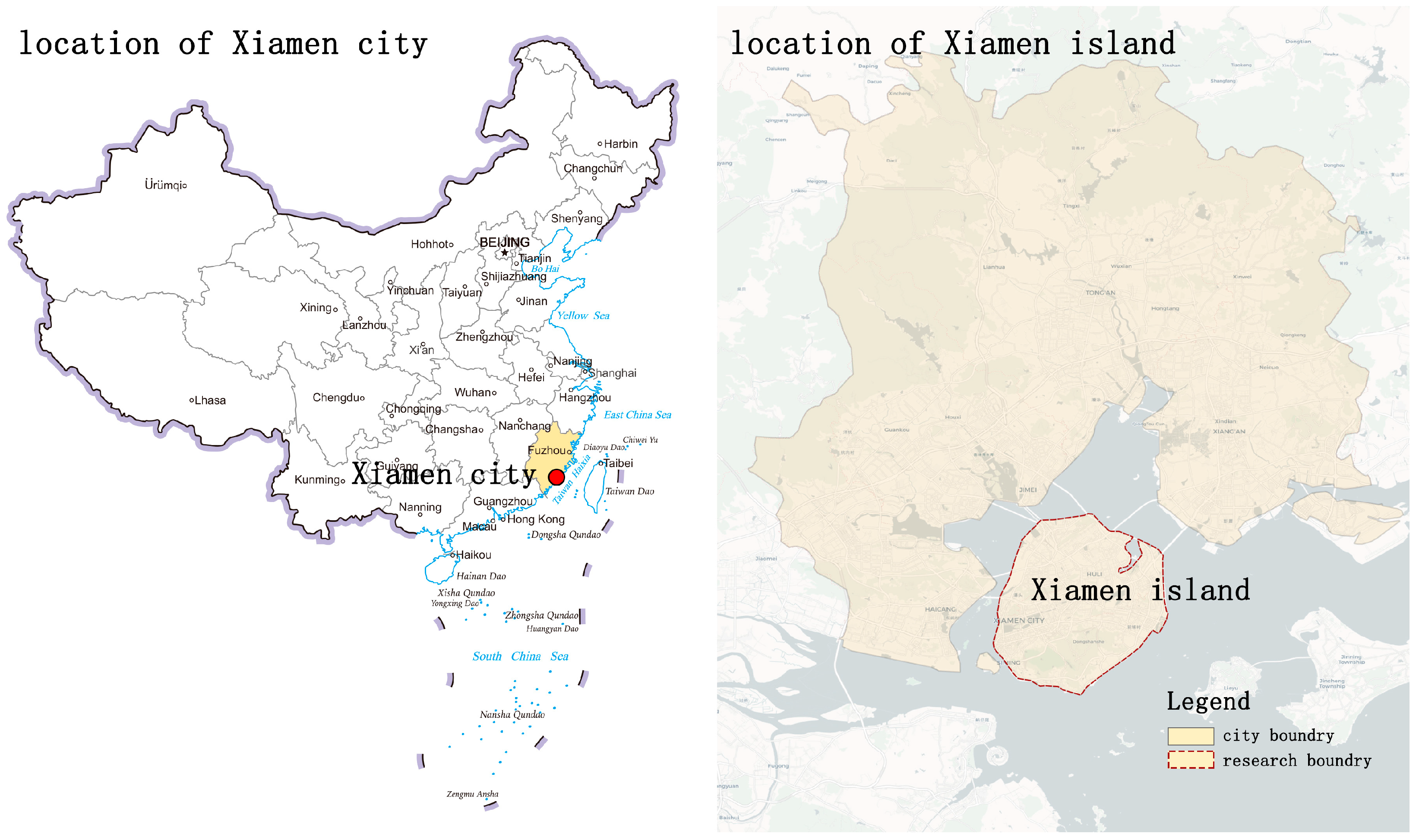
This study focuses on Xiamen Island, located in Xiamen City, southeastern China. Xiamen is one of the country’s earliest Special Economic Zones and has been at the forefront of promoting sustainable urban transport. Over the past decade, the municipal government has actively pursued the development of a cycling-friendly city, integrating non-motorized transport into the broader strategy of green mobility and carbon reduction.
The city launched its public bicycle system in 2014, marking a significant step toward expanding the slow-traffic network. In 2017, Xiamen became the first city in China to construct and operate an elevated cycling path, symbolizing a major innovation in the design of dedicated bicycle infrastructure. By 2021, approximately 150,000 dockless shared bicycles were in operation, with consistently high daily usage, indicating both the city’s strong cycling demand and its leadership in promoting active travel.
Xiamen Island (Figure 1) represents the historical urban core of the city. It encompasses mature commercial, residential, and tourist districts, serving as both the administrative and economic center of Xiamen and a major national tourist destination. The island enjoys a pleasant coastal environment and mild subtropical climate, providing favorable conditions for year-round cycling. Moreover, the built environment on Xiamen Island is highly developed, and its nearly complete street-view imagery coverage offers a robust foundation for data collection and analysis in this study.

3.2. Research Data

The data used in this study include street-view imagery, road network data, and cycling preference ratings collected from volunteers.
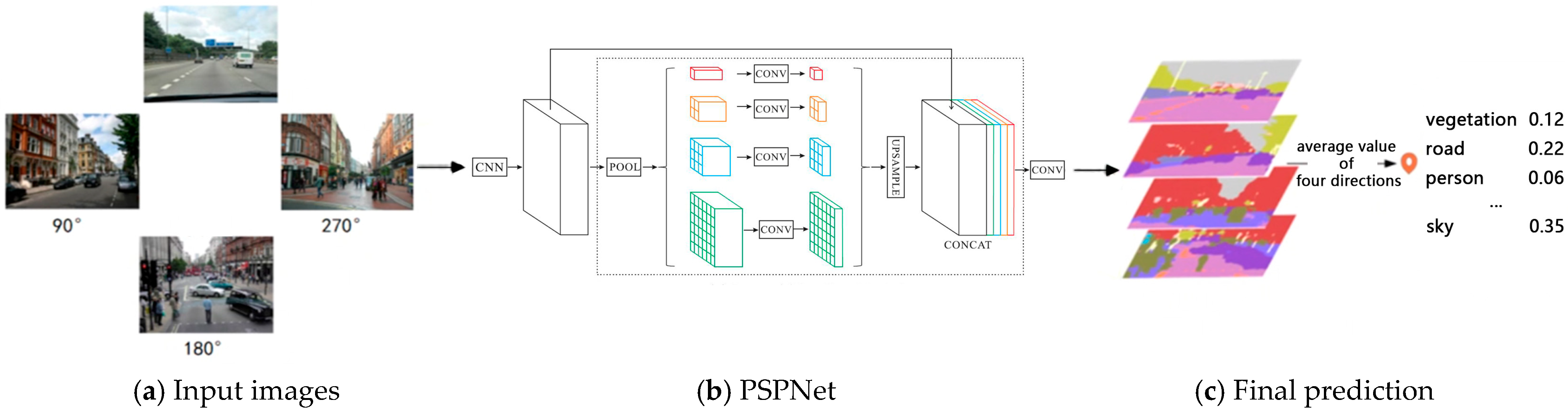
The street-view image data were obtained from Baidu Maps between 2019 and 2020. Baidu Maps is a widely used Chinese mapping platform similar to Google Maps, which allows researchers to perceive the street environment from a human-eye perspective through Street View Images (SVI). Sampling points were established at 100 m intervals along all roads on Xiamen Island. At each sampling point, four directional street-view images were captured—facing 0°, 90°, 180°, and 270°—to represent a complete panoramic perception of the streetscape. In total, 33,760 street-view images were collected from 8440 sampling points. The road network data were derived from OpenStreetMap (OSM) as of February 2020, with a total road length of approximately 1600 km. Since Xiamen Island is located in a subtropical region where evergreen vegetation dominates, the street-view imagery is minimally affected by seasonal variation, ensuring consistency in visual features across the dataset.
To collect subjective evaluations of cycling preference, we developed a street-view rating platform. Volunteers viewed pairs of street-view images from the same sampling point to simulate the field of vision during cycling. They were asked to answer the question: “Would you like to cycle on this street?” Based on their intuitive perception of the image, volunteers rated their willingness to cycle on a scale from 0 to 100, where a higher score indicated a stronger preference for cycling in that scene. A total of 30 volunteers, including university students and faculty members, participated in the rating process, with a balanced gender ratio. The age distribution of the participants was as follows: 12 individuals aged 20–30, 10 individuals aged 31–40, and 8 individuals aged 41–50.
The cycling preference scores collected through the rating platform were used as the dependent variable, while the indices of streetscape elements derived from semantic segmentation served as the independent variables. The descriptive statistics of all variables are presented in Table 1.

3.3. Research Methods

To efficiently and accurately obtain the proportions of various streetscape elements and the corresponding cycling preference scores for each image on Xiamen Island, this study employed a two-step methodology. First, a PSPNet deep neural network model, pre-trained on the CityScapes dataset (Figure 2b), was adopted for transfer learning to conduct semantic segmentation on both front- and rear-view street view images captured at each sampling point [39]. The average values of the two images were calculated to derive the proportion of 19 classes of urban features (e.g., roads, pedestrians, sky, vegetation, etc.) for each sampling location (Figure 2c). The core component of PSPNet is the Pyramid Pooling Module, which integrates multi-scale contextual information through pooling operations at different scales. This structure enhances the model’s ability to capture global contextual features, thereby improving the representation power and segmentation accuracy.
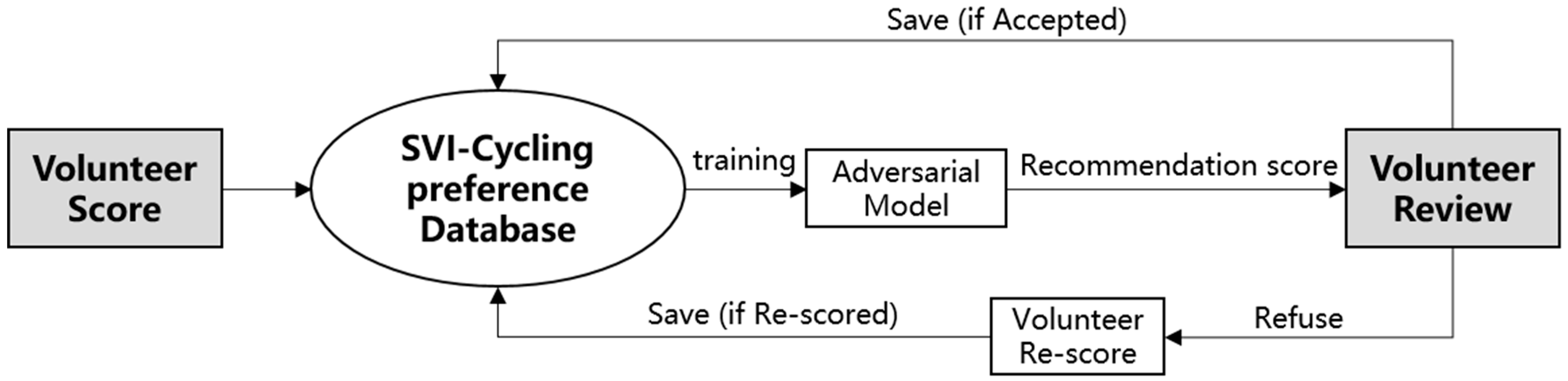
Next, a scoring platform was developed based on a human–machine adversarial learning framework, following the algorithm proposed by Yao et al. [40]. The “human–machine adversarial” design creates a conditioned reflex environment in which machine learning assists human annotators in categorizing global perceptual attributes—an approach similar to Google’s “Fluid Annotation.”
The detailed scoring procedure is illustrated in Figure 3. Volunteers first evaluated the cycling preference of the initial 50 images, and the scoring software subsequently constructed a random forest ensemble to model and approximate the volunteer’s scoring behavior. As the volunteer continued to rate additional images, the system generated recommended scores based on the patterns learned from previous human ratings. Each volunteer then reviewed these recommended scores. If the deviation between the recommended score and the volunteer’s expected score was within 10 points, the volunteer accepted the system’s recommendation. If the deviation exceeded 10 points, the volunteer rejected the recommendation and manually re-rated the image. When more than five consecutive images exhibited discrepancies between the recommended and expected scores, the embedded random forest module was retrained and self-adjusted to refine the fitted model [40]. We defined a human–machine compromise as a case in which the difference between the machine-predicted score and the human-assigned score was within ±5 points. This framework effectively collected accurate human-labeled scores for each image while significantly accelerating the overall rating process.
With the support of the human–machine adversarial scoring system, each volunteer was able to complete the annotation of 1000 to 2000 images within one hour, including approximately 2000 manually rated images.
To explore the nonlinear effects of street landscape features on residents’ cycling preferences, this study constructed an XGBoost model. XGBoost is an enhanced version of the Gradient Boosting Decision Tree (GBDT) model, which improves both the loss function and its optimization process, thereby achieving higher predictive accuracy [41]. Following previous research, the computational process can be described as follows.
Given a dataset D = x i , y i , which contains n samples and m features D = n , x i R m , the objective is to determine a function that best estimates the response variable y ^ i from the input variables x i :
  y ^ i = x i = k = 1 K α k f k x i
where y ^ i   denotes the cycling preference score, is the final strong learner, f k ·   represents the weak learners generated by the Decision Tree (DT) algorithm, K is the number of weak learners, and α k   is the learning rate used to avoid overfitting. According to the XGBoost framework, the objective loss function L · can be expressed as:
L = i L y i , y ^ i + k Ω f k
where L · measures the training loss between the true and predicted values, while Ω · denotes the model complexity term, often referred to as the regularization component. L · evaluates the model’s fitting performance, and Ω · constrains its complexity. Generally, a squared loss function is used for L · , and the L 2 norm of leaf weights and the number of leaves represent Ω · :
L y i , y ^ i = y i y ^ i 2 Ω f k = γ T + 1 2 λ ω k
where T is the number of leaf nodes, ω k is the leaf weight, and γ and λ are regularization coefficients. are regularization coefficients f t at each iteration t K that minimizes the loss function:
  f t = a r g min f t F L t = a r g min f k F i = 1 n L y i , t x i + k = 1 t Ω f k
At iteration t, this can be rewritten as:
L t = i = 1 n L y i , t x i + k = 1 t Ω f k = i = 1 n L y i , y ^ i t 1 + f t x i + Ω f k + c o n s t .
Using a second-order Taylor expansion and ignoring constant terms, the loss function can be approximated as:
L t i = 1 n L y i , y ^ i t 1 + g i f t x i + 1 2 h i f t 2 x i + Ω f t
where g i = y ^ i t 1 L y i , y ^ i t 1 , h i = y ^ i t 1 2 L y i , y ^ i t 1 , represent the first- and second-order gradients of the loss function, respectively. By aggregating samples into leaf nodes I j , the objective can be simplified as:
L t = i = 1 n g i f t x i + 1 2 h i f t 2 x i + Ω f t = j = 1 T i I j g i w i + 1 2 i I j h i + λ w j 2 + γ T = j = 1 T G j w i + 1 2 H j + λ w j 2
where G j = i I j g i , and H j = i I j h i . From this formulation, the optimal leaf weight and split gain can be derived as:
  w j * = G j H j + λ , L s p l i t = 1 2 G L 2 H L + λ + G R 2 H R + λ G L + G R 2 H L + H R + λ λ
where G L , G R , H L , H R are the first- and second-order gradients of the left and right child nodes, respectively.
Furthermore, this study employed SHAP (SHapley Additive exPlanations) [41] interaction values to explore the interactions between street landscape features. SHAP is an additive feature attribution method that decomposes the model output into the sum of each feature’s contribution, known as SHAP values. The SHAP interaction value captures the combined effects of two features on the prediction outcome, revealing hidden dependencies and allowing interpretation of local interaction effects while maintaining model consistency. The SHAP interaction value is defined as:
  ϕ i , j = S i , j S ! M S 2 ! 2 M 1 ! δ i j S
w h e n   i j , a n d   δ i j S = f x S i , j f x S i f x S j + f x S
where ϕ i , j measures the interaction effect between feature i and feature j on a single prediction. M denotes the number of input features, and x represents the input variable for prediction.

4. Results

4.1. Spatial Distribution of Cycling Preference Scores

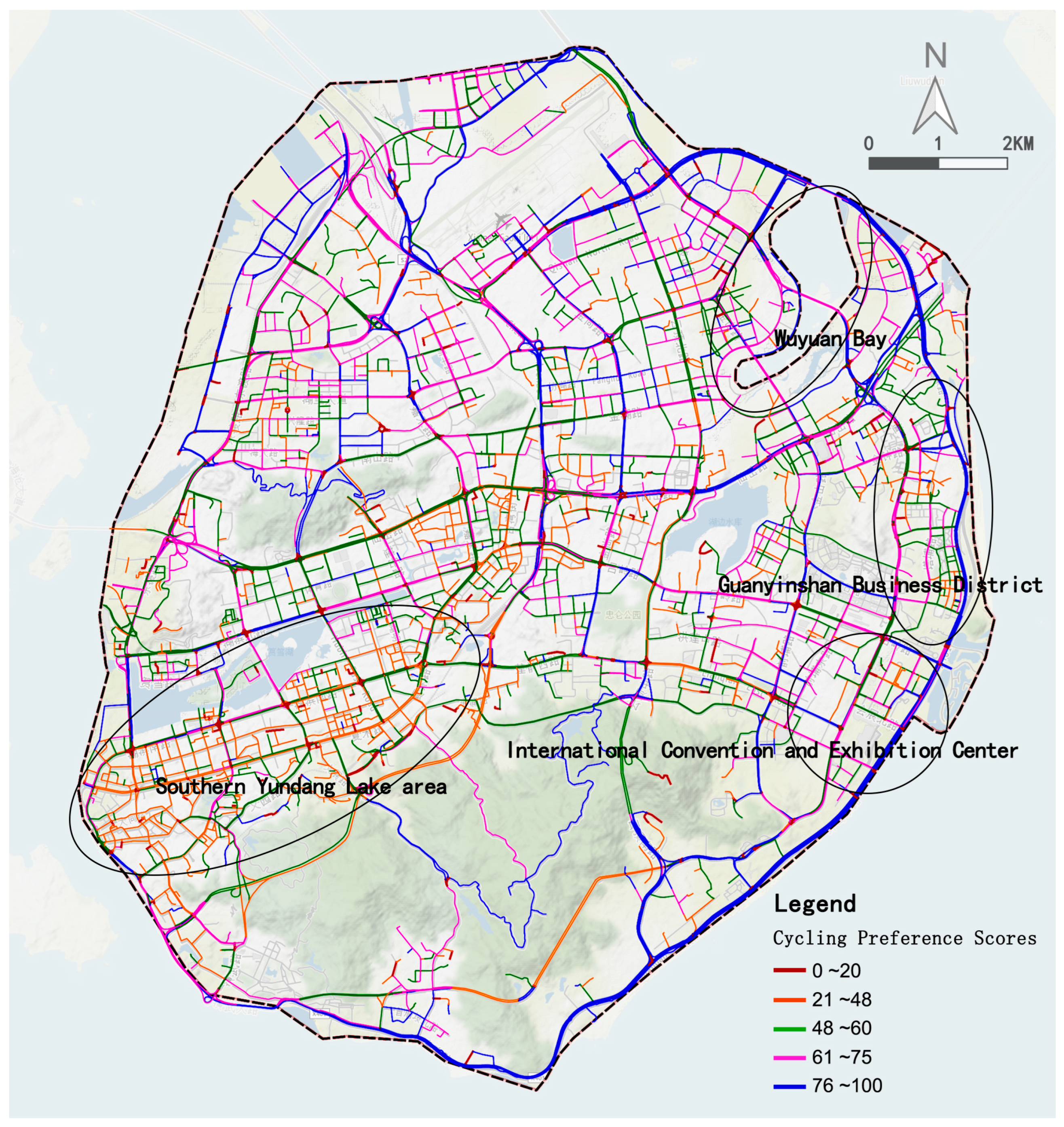
As shown in Figure 4, the overall spatial pattern of cycling preference scores on Xiamen Island reveals that the outer ring roads exhibit higher scores, which gradually decrease toward the urban center. The eastern part of the island generally scores higher than the western part. This spatial distribution can be attributed to Xiamen’s geographic and urban characteristics—being surrounded by the sea, the outer ring enjoys better coastal scenery, while the eastern areas (e.g., International Convention and Exhibition Center, Guanyinshan Business District, and Wuyuan Bay) represent newly developed urban zones with superior urban landscapes compared to the older western areas such as traditional port zones and historical neighborhoods. Among all, the eastern Ring Road records the highest scores due to its pleasant coastal scenery and strong visual openness. In contrast, the southern Yundang Lake area shows consistently low scores, largely because it has the highest population density and is one of the earliest developed urban zones, containing extensive urban villages.
When comparing arterial and local roads, the mean score of arterial roads is slightly lower, which aligns with previous findings [61]. This may be explained by higher traffic volumes on arterial roads, which increase safety risks and reduce visual diversity. Notably, cycling preference scores are particularly low around intersections of major roads, likely due to high vehicle flow and traffic conflicts between motorized and non-motorized modes, which compromise cycling continuity and safety [62,63].

4.2. Relative Importance of Landscape Elements

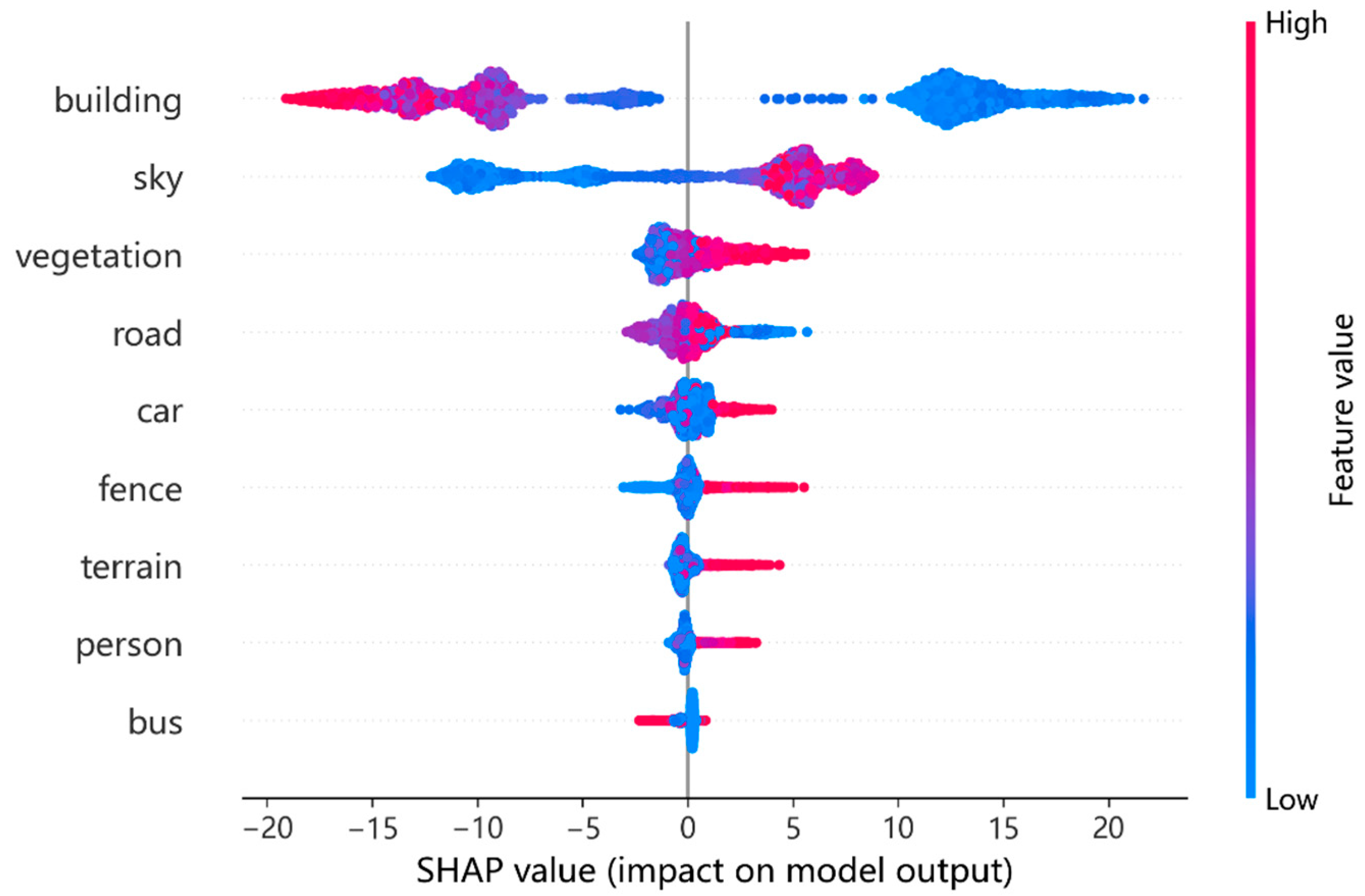
To ensure model robustness, a five-fold cross-validation was applied. The XGBoost model was trained on 70% of the dataset and tested on the remaining 30%, achieving an R2 value ranging between 0.68 and 0.85. To examine the influence of different landscape features on cycling preference, we employed XGBoost and SHAP to evaluate the relative importance of each environmental variable. The total importance of all features equals 100%, with higher values indicating greater contributions to the predicted outcome. The ranking of feature importance is illustrated in Figure 5.
The results show that the building index exerts the strongest influence on cycling preference, followed by sky, vegetation, and road—the four key structural components of the streetscape. On the SHAP summary plot, the X-axis represents SHAP values (direction of influence), where features on the right side have positive effects on cycling preference, and those on the left have negative effects. The color of each point indicates the proportion of that feature in the visual field (blue for low values, red for high). A clear pattern emerges: higher building ratios correspond to lower cycling preference scores (negative influence), while a greater sky ratio has a generally positive impact. However, the sky index shows a longer left tail—indicating that low sky ratios have strong negative impacts, whereas high ratios provide only limited improvement. Vegetation and terrain indices display consistent positive effects, with stronger enhancement at higher proportions.

4.3. Nonlinear Effects of Landscape Elements

To further explore the nonlinear effects of streetscape characteristics on residents’ cycling preferences, this study employed SHAP dependence plots derived from each feature to examine their nonlinear associations.
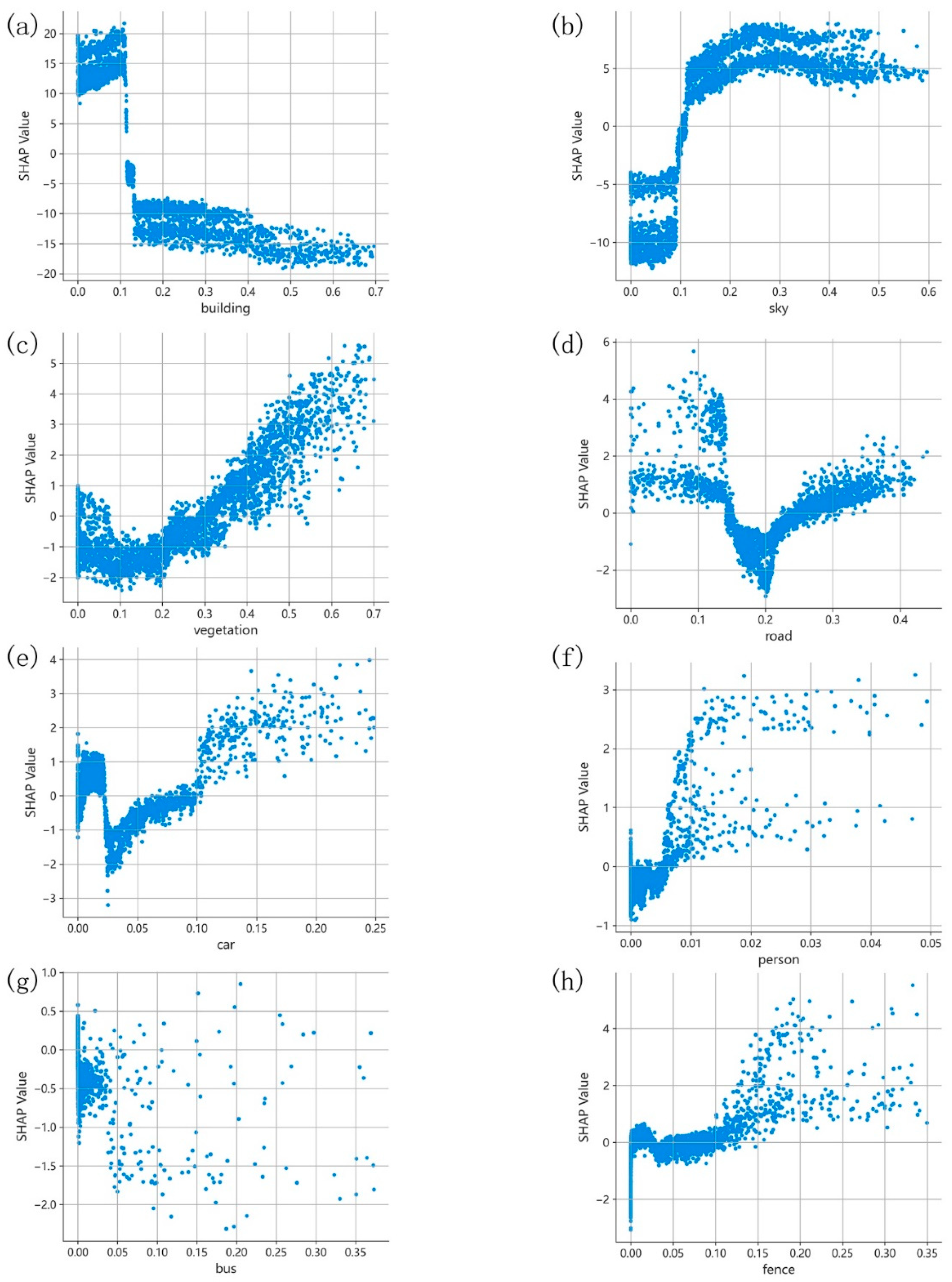
As shown in Figure 6a, the building index exhibits a distinct segmented pattern in its effect on cycling preference. When the building index ranges from 0 to 0.1, its influence on cycling preference is positive. However, when the index lies between 0.1 and 0.12, this positive effect sharply diminishes and gradually turns negative. When the building index exceeds 0.12, its impact on cycling preference becomes negative. Most existing studies have classified the building index as a negative or unfavorable factor for cycling preference. Nevertheless, this study finds that when the building index is below 0.12, its impact is actually positive. This may be attributed to the functional role of built structures: a high building index in the visual field often conveys a sense of congestion, whereas a very low value may evoke a sense of desolation due to insufficient spatial enclosure or functionality.
Figure 6b presents a more intuitive pattern, showing that when the sky index is low, it exerts a strong negative impact on cycling preference, while excessively high values yield only limited positive effects. Specifically, when the sky index is below 0.1, the influence is negative; when it exceeds 0.1, the effect becomes positive. The positive influence increases rapidly as the sky index rises from 0.1 to 0.25, but beyond 0.25, the incremental benefit becomes negligible.
As shown in Figure 6c, the vegetation index also exhibits a nonlinear relationship with cycling preference. When the vegetation index is below 0.3, its influence is primarily negative, reaching its greatest negative effect at a value of approximately 0.1. When the vegetation index exceeds 0.3, the impact becomes positive, and this positive effect continues to strengthen as the index increases.
Figure 6d illustrates that the road index has a pronounced nonlinear influence on cycling preference, displaying a “V-shaped” relationship. When the road index lies between 0.15 and 0.25, the effect is negative, reaching its minimum (strongest negative effect) around 0.2. When the road index is below 0.15 or above 0.25, the impact turns positive, with the positive effect being stronger at lower values. This pattern helps explain why side streets generally receive higher cycling preference scores than main roads.
Figure 6e–g show the effects of the car index, person index, and bus index, respectively. Both the car and person indices exhibit an overall positive correlation with cycling preference, which appears counterintuitive because cyclists often compete with cars and pedestrians for road space. A possible explanation is that areas with higher cycling preference also tend to attract greater pedestrian and vehicular activity, reflecting higher street vitality. The distribution of points in the bus index plot is more scattered, indicating greater variability in its contribution to cycling preference. Nevertheless, the effect is predominantly negative, likely because large buses are visually dominant in the streetscape and may induce a psychological sense of pressure among residents. This study was unable to fully capture the complex dynamics of right-of-way competition among the three indices.
As shown in Figure 6h, the fence index exerts a positive influence on cycling preference when its value exceeds 0.1, while its effect is negligible when the index is below this threshold. This finding is consistent with previous studies, as fences are typically used to separate motorized and non-motorized lanes, enhancing perceived safety and thereby improving residents’ willingness to cycle.

4.4. Interaction Effects of Landscape Elements

An interaction effect refers to the mutual influence or cooperation between multiple factors, where their combined impact is either greater or smaller than the sum of their individual effects. When the SHAP interaction value (an extension of the standard SHAP value) between two variables is greater than zero, it indicates a synergistic effect [64,65]; conversely, a value less than zero suggests an inhibitory effect. Exploring the interactions among different streetscape elements allows for a deeper understanding of how these features collectively influence cycling preferences. The SHAP dependence plots and interaction values provide valuable insights into these inter-element dynamics. After evaluating the interaction effects of all variables on cycling preference, we identified the four most significant pairs of interactions for detailed analysis.
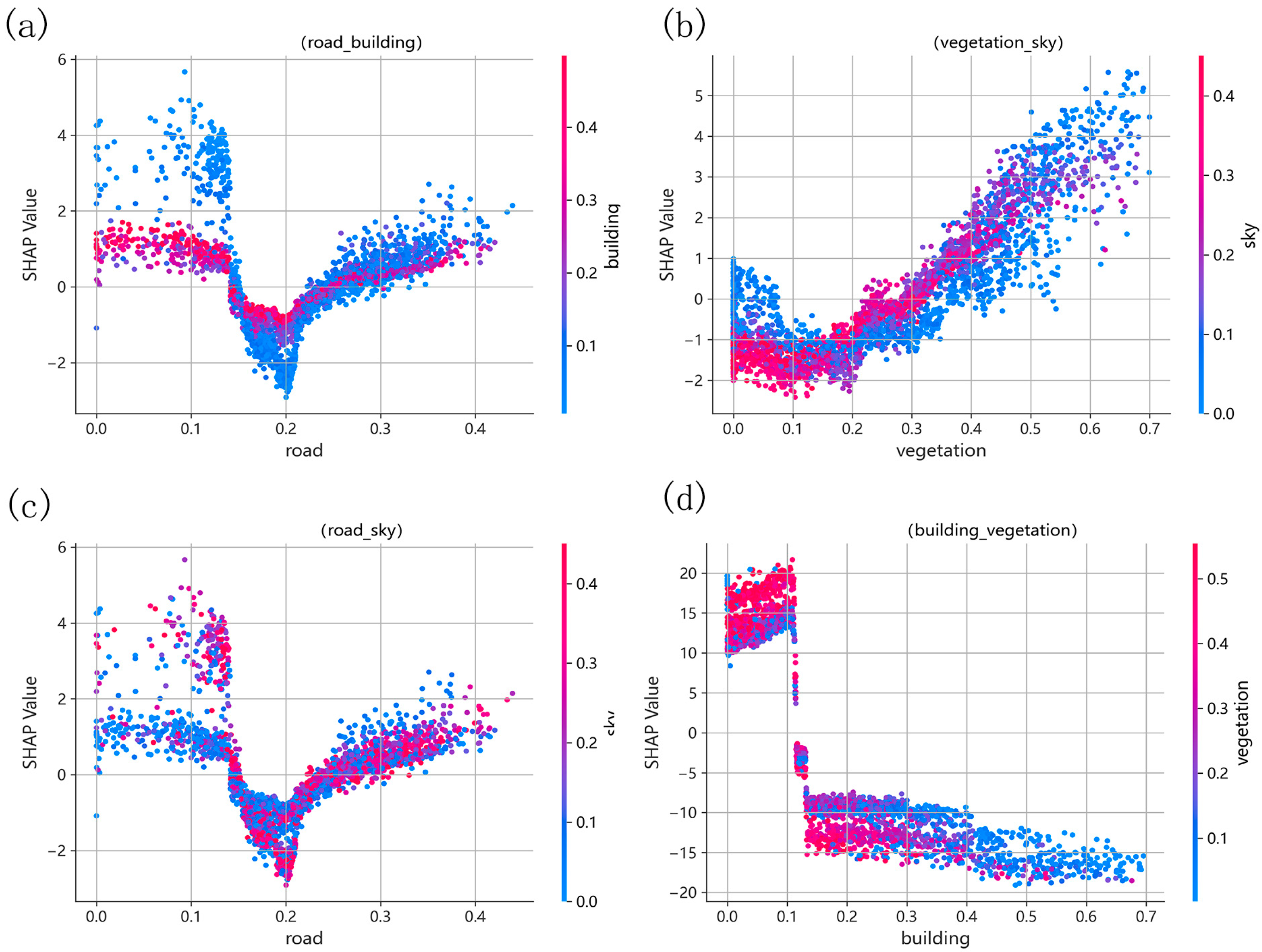
The road–building interaction exhibited the strongest effect, which aligns with previous research findings, as roads and buildings jointly form the structural framework of the streetscape and exert the most significant influence on residents’ perception. As shown in Figure 7a, the overall “V-shaped” relationship between the road index and cycling preference is retained, while the building index demonstrates a clear moderating effect on the SHAP value of the road index. In general, when the road index is below 0.15 or above 0.25, the road index and building index exhibit a synergistic effect on cycling preference. However, the synergistic impact is stronger for high building index values (red dots) compared with low values (blue dots). When the road index lies between 0.15 and 0.25, high building index values (red dots) can mitigate the negative influence of the road index on cycling preference.
As shown in Figure 7b, a vegetation index of 0.3 serves as a critical threshold. When the vegetation index exceeds 0.3, the vegetation and sky indices demonstrate a synergistic effect on cycling preference, with the high sky index showing a more pronounced synergy. When the vegetation index is below 0.2, low sky index values can help alleviate the negative impact of vegetation on cycling preference. Notably, when the vegetation index is below 0.08, even low sky index values can interact with vegetation to produce a positive synergistic effect (SHAP value > 0). This finding suggests that in areas with very low vegetation coverage, reducing sky openness can still enhance cycling preference by improving spatial comfort and reducing exposure.
Figure 7c indicates that when the road index is below 0.15 or above 0.25, the sky and road indices exhibit a synergistic interaction in influencing cycling preference. Specifically, when the road index is below 0.15, high sky index values (red dots) have a stronger positive impact on cycling preference; when the road index is above 0.25, low sky index values (blue dots) show a greater positive impact. This suggests that in urban side streets (low road index), a broader sky view (high sky index) helps improve cycling preference, as a limited sky view may create a sense of claustrophobia, thereby reducing comfort and willingness to cycle. In contrast, in urban arterial roads (high road index), a smaller sky view contributes to higher cycling preference scores, as a highly open sky (high sky index) can make the space feel too exposed or barren, lacking shade and spatial enclosure.
As shown in Figure 7d, when the building index is below 0.12, the vegetation and sky indices exhibit a synergistic effect on cycling preference, with the synergy being stronger at higher vegetation values (red dots). This suggests that on streets with low building density, increasing vegetation can more effectively enhance cycling preference. In this case, vegetation acts as a substitute for architectural enclosure, forming the spatial framework of the streetscape together with the road, and fostering a sense of spatial cohesion. When the building index exceeds 0.12, low vegetation values (blue dots) help offset the negative effect of dense buildings on cycling preference. This indicates that on streets with a high building index, introducing vegetation can not only directly enhance cycling comfort and preference but also visually screen buildings, thereby mitigating their negative visual and psychological impact [61].

5. Conclusions and Discussion

Enhancing residents’ cycling preference plays an essential role in reducing carbon emissions, promoting sustainable urban transportation, and improving public health. Understanding how streetscape characteristics influence residents’ cycling preferences is therefore of great importance. In this study, we investigated how streetscape characteristics influence residents’ cycling preferences from a visual perspective. This line of inquiry has been relatively uncommon in research on Chinese cities, thus offering a meaningful contribution to the field. The findings align closely with those of studies from other regions, indicating that cyclists’ preferences for streetscape features exhibit a certain degree of universality at the street scale. We also identified several important threshold effects and interaction effects in how streetscape elements shape cycling preferences, which can provide more refined guidance for designing cycling-friendly street environments. These points are further discussed in the following sections.
(1)
Spatial Distribution of Cycling Preference
From the overall spatial distribution of cycling preferences, new urban areas exhibit higher cycling preferences than older districts, while arterial roads have slightly lower cycling preference scores than local streets. This finding aligns with previous research [18] and may be attributed to the heavier traffic flow and less appealing landscapes along major roads. Notably, cycling preference is consistently low at intersections on arterial roads, possibly due to the high traffic volumes and conflicts between motor vehicles and non-motorized traffic, which reduce both the continuity and safety of cycling routes.
(2)
Relative Importance of Streetscape Elements
In terms of the relative importance of different streetscape elements, building, sky, vegetation, and road indices were identified as the most influential factors affecting residents’ cycling preferences. These elements form the core framework of the streetscape and represent the dominant visual components of urban street environments.
In this study, the sky index exhibited a stronger influence on cycling preference than the vegetation index, a finding that diverges from certain previous studies. For instance, Yang et al. found that the green view index had a greater influence on cycling behavior than the sky view index. This discrepancy may stem from differences in the dependent variable: while Yang et al. used actual cycling behavior, our study focuses on cycling preference. Cycling preference is likely shaped more by subjective perception and emotional responses, whereas actual cycling behavior is also constrained by urban functional requirements. Indeed, in many urban settings, cyclists may prefer not to ride in areas of poor spatial quality, yet are compelled to do so out of necessity.
(3)
Nonlinear Effects of Streetscape Elements
From the perspective of nonlinear relationships, the building index generally exerts a negative effect on cycling preference. This is consistent with existing research, as overly dense buildings can increase traffic pressure, obstruct sunlight, and create a “concrete city forest” [66] effect that negatively impacts both mental and physical well-being [67]. However, our study further reveals that when the building index is below 0.12, its influence becomes positive. In sparsely built environments or suburban areas, the absence of buildings can generate a sense of desolation, while the presence of a moderate number of buildings can enhance perceived comfort and functionality.
A low sky view index has a significant negative impact on cycling preference, while the positive effect of a high sky index is limited, with the optimal range between 0.1 and 0.25. The vegetation view index exhibits a strong positive influence, and when spatial conditions permit, it should be increased to above 0.3. The road index demonstrates a distinct V-shaped relationship: when the index is between 0.15 and 0.25, its effect on cycling preference is negative; when it is below 0.15 or above 0.25, the effect turns positive, with a stronger positive impact at lower values. This pattern helps explain why local streets tend to yield higher cycling preference scores than arterial roads.
(4)
Interaction Effects of Streetscape Elements
From the perspective of interaction effects, the four key elements—road, building, sky, and vegetation—exhibit significant synergistic relationships in influencing cycling preferences. When the road index is low (below 0.15), lower building indices and higher sky indices show stronger synergistic effects with the road index in promoting cycling preference. Conversely, when the road index is high (above 0.25), lower building indices and lower sky indices demonstrate stronger synergistic effects with the road index.
These findings have important implications for spatial planning and design practices. Trees, as a low-cost yet highly effective intervention, play a crucial role in regulating the streetscape environment [68]. For example, on local streets, where the sky index tends to be lower, it is advisable to limit building height and reduce the building index, while minimizing excessive tree canopy coverage that may obscure the sky, thereby maintaining a sense of openness in the streetscape. In contrast, on arterial roads, cultivating tall street trees can increase the vegetation view index. Tree canopies can both moderate the sky index by providing shade and partially obscure building façades, thereby reducing the building index and enhancing cycling preference. Furthermore, on streets with a low building index, increasing vegetation coverage can improve the cycling environment by enriching the visual structure. On streets with a high building index, adding greenery can partially shield building masses, lower the perceived building index, and elevate the overall cycling preference.
(5)
Planning Implications and Limitations
Understanding the nonlinear and synergistic effects of streetscape elements on cycling preference can help refine urban design guidelines and support the optimization of cycling environments. Enhancing the streetscape quality of older districts is particularly important, as these areas tend to experience higher congestion and lower cycling preference.
In the design of street interfaces, appropriate control over street width, building height, and vegetation coverage can balance the proportions of building, sky, vegetation, and road indices within the visual field. From the cyclist’s perspective, the road index should be kept below 0.15 on local streets while maintaining the sky index above 0.1 and, where buildings are sparse, vegetation above 0.3. In denser environments, increasing vegetation coverage can help partially screen buildings. For arterial roads, the road index may be maintained above 0.25, while tall roadside trees should be cultivated to reduce the sky index to below 0.25. In suburban or park areas with few buildings (building index < 0.1), adding functional structures such as rest stations can enhance convenience and mitigate desolation.
Overall, this study emphasizes that cycling preferences are shaped not by single streetscape elements but by their nonlinear thresholds and interaction effects. Policymakers should move beyond conventional 2D planning metrics and incorporate 3D perceptual indicators—sky view, building view, and vegetation view—into street design guidelines. By quantitatively identifying optimal ranges for these indicators, the findings provide a scientifically grounded basis for crafting fine-grained, human-centered streetscape improvement strategies.
Despite these contributions, this study also has limitations that merit future investigation. First, the analysis was conducted at a micro-street level, focusing on the effects of streetscape elements on cycling preference. Other potentially influential factors—such as land-use types, commercial activity patterns, and user-generated content [69]—were not included. Future studies could integrate these non-landscape variables to provide a more comprehensive understanding. Second, due to methodological constraints, this study analyzed pairwise interactions among elements but did not account for multi-way interactions involving more than two variables. Finally, urban cycling behavior varies by trip purpose and spatial context, meaning that different types of cycling (e.g., commuting, leisure, or transit connection) may reflect distinct preferences. These differences were not explicitly considered in this study and warrant further exploration.

Author Contributions

Conceptualization, P.H., L.F. and G.W.; methodology, J.H. and E.Z.; software, L.F.; validation, P.H. and E.Z.; formal analysis, P.H.; data curation, L.F.; writing—original draft preparation, P.H.; writing—review and editing, J.H., G.W. and C.L.; visualization, P.H., E.Z. and L.F.; funding acquisition, C.L. All authors have read and agreed to the published version of the manuscript.

Funding

This study was supported by the National Social Science Fund of China (Youth Program in Art Studies) under the project titled “Urban Image Mediation Mechanisms and Evidence-Based Planning and Design in the Co-shaping of Spatial Behavior” (Grant No. 22CG182).

Data Availability Statement

Our data is obtained from other institutions, therefore it cannot be publicly uploaded without permission. We can provide it if other researchers request it.

Conflicts of Interest

Author Libo Fang was employed by Hunan Architectural Design Institute Group Co., Ltd. The remaining authors declare that the research was conducted in the absence of any commercial or financial relationships that could be construed as a potential conflict of interest.

References

  1. Crozet, Y. Cars and space consumption: Rethinking the regulation of urban mobility. In International Transport Forum Discussion Paper; OECD Publishing: Paris, France, 2020. [Google Scholar]
  2. Prieto Curiel, R.; González Ramírez, H.; Quiñones Domínguez, M.; Orjuela Mendoza, J.P. A paradox of traffic and extra cars in a city as a collective behaviour. R. Soc. Open Sci. 2021, 8, 201808. [Google Scholar] [CrossRef]
  3. Mohamad, J.; Kiggundu, A.T. The rise of the private car in Kuala Lumpur, Malaysia: Assessing the policy options. IATSS Res. 2007, 31, 69–77. [Google Scholar] [CrossRef]
  4. Jiang, Y.; Sun, Z.; Wei, D.; Zhao, P.; Yang, L.; Lu, Y. Revealing the spatiotemporal pattern of urban vibrancy at the urban agglomeration scale: Evidence from the Pearl River Delta, China. Appl. Geogr. 2025, 181, 103694. [Google Scholar] [CrossRef]
  5. Zhang, R.; Hanaoka, T. Cross-cutting scenarios and strategies for designing decarbonization pathways in the transport sector toward carbon neutrality. Nat. Commun. 2022, 13, 3629. [Google Scholar] [CrossRef] [PubMed]
  6. Abdulrazzaq, L.R.; Abdulkareem, M.N.; Yazid, M.R.M.; Borhan, M.N.; Mahdi, M.S. Traffic congestion: Shift from private car to public transportation. Civ. Eng. J. 2020, 6, 1547–1554. [Google Scholar] [CrossRef]
  7. Cervero, R.; Sullivan, C. Green TODs: Marrying transit-oriented development and green urbanism. Int. J. Sustain. Dev. World Ecol. 2011, 18, 210–218. [Google Scholar] [CrossRef]
  8. Miller, P.; de Barros, A.G.; Kattan, L.; Wirasinghe, S.C. Public transportation and sustainability: A review. KSCE J. Civ. Eng. 2016, 20, 1076–1083. [Google Scholar] [CrossRef]
  9. Nello-Deakin, S.; Nikolaeva, A. The human infrastructure of a cycling city: Amsterdam through the eyes of international newcomers. Urban Geogr. 2021, 42, 289–311. [Google Scholar] [CrossRef]
  10. Xiao, C.S.; Sharp, S.J.; van Sluijs, E.M.; Ogilvie, D.; Panter, J. Impacts of new cycle infrastructure on cycling levels in two French cities: An interrupted time series analysis. Int. J. Behav. Nutr. Phys. Act. 2022, 19, 77. [Google Scholar] [CrossRef]
  11. Werschmöller, S.; Blitz, A.; Lanzendorf, M.; Arranz-López, A. The cycling boom in German cities. The role of grassroots movements in institutionalizing cycling. Int. J. Sustain. Transp. 2024, 18, 534–545. [Google Scholar] [CrossRef]
  12. Emanuel, M. Making a bicycle city: Infrastructure and cycling in Copenhagen since 1880. Urban Hist. 2019, 46, 493–517. [Google Scholar] [CrossRef]
  13. Guo, Y.; He, S.Y. Built environment effects on the integration of dockless bike-sharing and the metro. Transp. Res. Part D Transp. Environ. 2020, 83, 102335. [Google Scholar] [CrossRef]
  14. Martens, K. Promoting bike-and-ride: The Dutch experience. Transp. Res. Part A Policy Pract. 2007, 41, 326–338. [Google Scholar] [CrossRef]
  15. Rissel, C.; Watkins, G. Impact on cycling behavior and weight loss of a national cycling skills program (AustCycle) in Australia 2010–2013. J. Transp. Health 2014, 1, 134–140. [Google Scholar] [CrossRef]
  16. Hu, G.; Jousilahti, P.; Borodulin, K.; Barengo, N.C.; Lakka, T.A.; Nissinen, A.; Tuomilehto, J. Occupational, commuting and leisure-time physical activity in relation to coronary heart disease among middle-aged Finnish men and women. Atherosclerosis 2007, 194, 490–497. [Google Scholar] [CrossRef]
  17. Hu, F.B.; Stampfer, M.J.; Solomon, C.; Liu, S.; Colditz, G.A.; Speizer, F.E.; Willett, W.C.; Manson, J.E. Physical activity and risk for cardiovascular events in diabetic women. Ann. Intern. Med. 2001, 134, 96–105. [Google Scholar] [CrossRef]
  18. Cavill, N.; Kahlmeier, S.; Rutter, H.; Racioppi, F.; Oja, P. Economic Assessment of Transport Infrastructure and Policies. Methodological Guidance on the Economic Appraisal of Health Effects Related to Walking and Cycling; World Health Organization: Geneva, Switzerland, 2007. [Google Scholar]
  19. Francke, A. Chapter Twelve-Cycling during and after the COVID-19 pandemic. In Advances in Transport Policy and Planning; Heinen, E., Götschi, T., Eds.; Academic Press: Cambridge, MA, USA, 2022; pp. 265–290. [Google Scholar]
  20. Wu, Y.; Wei, Y.D.; Liu, M.; García, I. Green infrastructure inequality in the context of COVID-19: Taking parks and trails as examples. Urban For. Urban Green. 2023, 86, 128027. [Google Scholar] [CrossRef] [PubMed]
  21. Ewing, R.; Cervero, R. Travel and the built environment: A meta-analysis. J. Am. Plan. Assoc. 2010, 76, 265–294. [Google Scholar] [CrossRef]
  22. Zhou, H.; Gu, J.; Liu, Y.; Wang, X. The impact of the “skeleton” and “skin” for the streetscape on the walking behavior in 3D vertical cities. Landsc. Urban Plan. 2022, 227, 104543. [Google Scholar] [CrossRef]
  23. Lu, X.; Li, Q.; Ji, X.; Sun, D.; Meng, Y.; Yu, Y.; Lyu, M. Impact of streetscape built environment characteristics on human perceptions using street view imagery and deep learning: A case study of Changbai Island, Shenyang. Buildings 2025, 15, 1524. [Google Scholar] [CrossRef]
  24. Sun, H.; Xu, H.; He, H.; Wei, Q.; Yan, Y.; Chen, Z.; Li, X.; Zheng, J.; Li, T. A Spatial Analysis of Urban Streets under Deep Learning Based on Street View Imagery: Quantifying Perceptual and Elemental Perceptual Relationships. Sustainability 2023, 15, 14798. [Google Scholar] [CrossRef]
  25. Carmona, M. Public Places Urban Spaces: The Dimensions of Urban Design; Routledge: Oxfordshire, UK, 2021. [Google Scholar]
  26. Chen, E.; Ye, Z. Identifying the nonlinear relationship between free-floating bike sharing usage and built environment. J. Clean. Prod. 2021, 280, 124281. [Google Scholar] [CrossRef]
  27. Ma, X.; Ji, Y.; Yuan, Y.; Van Oort, N.; Jin, Y.; Hoogendoorn, S. A comparison in travel patterns and determinants of user demand between docked and dockless bike-sharing systems using multi-sourced data. Transp. Res. Part A Policy Pract. 2020, 139, 148–173. [Google Scholar] [CrossRef]
  28. Gärling, T.; Golledge, R.G. Environmental perception and cognition. In Advance in Environment, Behavior and Design; Springer: Berlin/Heidelberg, Germany, 1989; Volume 2, pp. 203–236. [Google Scholar]
  29. Wang, R.; Jiang, Y.; Liu, D.; Peng, H.; Cao, M.; Yao, Y. Is perceived safety a prerequisite for the relationship between green space availability, and the use and perceived comfort of green space? Wellbeing Space Soc. 2025, 8, 100247. [Google Scholar] [CrossRef]
  30. Ogawa, Y.; Oki, T.; Zhao, C.; Sekimoto, Y.; Shimizu, C. Evaluating the subjective perceptions of streetscapes using street-view images. Landsc. Urban Plan. 2024, 247, 105073. [Google Scholar] [CrossRef]
  31. Mela, A.; Tousi, E.; Varelidis, G. Assessing Urban Public Space Quality: A Short Questionnaire Approach. Urban Sci. 2025, 9, 56. [Google Scholar] [CrossRef]
  32. Lu, Y. Using Google Street View to investigate the association between street greenery and physical activity. Landsc. Urban Plan. 2019, 191, 103435. [Google Scholar] [CrossRef]
  33. Willberg, E.; Poom, A.; Helle, J.; Toivonen, T. Cyclists’ exposure to air pollution, noise, and greenery: A population-level spatial analysis approach. Int. J. Health Geogr. 2023, 22, 5. [Google Scholar] [CrossRef] [PubMed]
  34. Zeng, Q.; Gong, Z.; Wu, S.; Zhuang, C.; Li, S. Measuring cyclists’ subjective perceptions of the street riding environment using K-means SMOTE-RF model and street view imagery. Int. J. Appl. Earth Obs. Geoinf. 2024, 128, 103739. [Google Scholar] [CrossRef]
  35. Liu, G.; Krishnamurthy, S.; Van Wesemael, P. Conceptualizing cycling experience in urban design research: A systematic literature review. Appl. Mobilities 2021, 6, 92–108. [Google Scholar] [CrossRef]
  36. Hou, Y. Polycentric urban form and non-work travel in Singapore: A focus on seniors. Transp. Res. Part D Transp. Environ. 2019, 73, 245–275. [Google Scholar] [CrossRef]
  37. Tang, Q.; Cao, J.; Yin, C.; Cheng, J. Examining the nonlinear relationships between park attributes and satisfaction with pocket parks in Chengdu. Urban For. Urban Green. 2024, 101, 128548. [Google Scholar] [CrossRef]
  38. Millstein, R.A.; Cain, K.L.; Sallis, J.F.; Conway, T.L.; Geremia, C.; Frank, L.D.; Chapman, J.; Van Dyck, D.; Dipzinski, L.R.; Kerr, J. Development, scoring, and reliability of the Microscale Audit of Pedestrian Streetscapes (MAPS). BMC Public Health 2013, 13, 403. [Google Scholar] [CrossRef]
  39. Zhao, H.; Shi, J.; Qi, X.; Wang, X.; Jia, J. Pyramid scene parsing network. In Proceedings of the IEEE Conference on Computer Vision and Pattern Recognition, Honolulu, HI, USA, 21–26 July 2017. [Google Scholar]
  40. Yao, Y.; Liang, Z.; Yuan, Z.; Liu, P.; Bie, Y.; Zhang, J.; Wang, R.; Wang, J.; Guan, Q. A human-machine adversarial scoring framework for urban perception assessment using street-view images. Int. J. Geogr. Inf. Sci. 2019, 33, 2363–2384. [Google Scholar] [CrossRef]
  41. Ji, S.; Wang, X.; Lyu, T.; Liu, X.; Wang, Y.; Heinen, E.; Sun, Z. Understanding cycling distance according to the prediction of the XGBoost and the interpretation of SHAP: A non-linear and interaction effect analysis. J. Transp. Geogr. 2022, 103, 103414. [Google Scholar] [CrossRef]
  42. Goldberg, D.; Huxley, P. Mental illness in the community: The pathway to psychiatric care. Int. J. Rehabil. Res. 1983, 6, 127. [Google Scholar] [CrossRef]
  43. Kabisch, N.; Qureshi, S.; Haase, D. Human–environment interactions in urban green spaces—A systematic review of contemporary issues and prospects for future research. Environ. Impact Assess. Rev. 2015, 50, 25–34. [Google Scholar] [CrossRef]
  44. Goel, R.; Garcia, L.M.; Goodman, A.; Johnson, R.; Aldred, R.; Murugesan, M.; Brage, S.; Bhalla, K.; Woodcock, J. Estimating city-level travel patterns using street imagery: A case study of using Google Street View in Britain. PLoS ONE 2018, 13, e0196521. [Google Scholar] [CrossRef]
  45. Li, Z.; Lee, J.H.; Yao, L.; Ostwald, M.J. Impact of built environments on human perception: A systematic review of physiological measures and machine learning. J. Build. Eng. 2025, 104, 112319. [Google Scholar] [CrossRef]
  46. Chen, J.; Chen, L.; Li, Y.; Zhang, W.; Long, Y. Measuring physical disorder in urban street spaces: A large-scale analysis using street view images and deep learning. Ann. Am. Assoc. Geogr. 2023, 113, 469–487. [Google Scholar] [CrossRef]
  47. Jiang, Y.; Chen, L.; Grekousis, G.; Xiao, Y.; Ye, Y.; Lu, Y. Spatial disparity of individual and collective walking behaviors: A new theoretical framework. Transp. Res. Part D Transp. Environ. 2021, 101, 103096. [Google Scholar] [CrossRef]
  48. Gu, P.; Han, Z.; Cao, Z.; Chen, Y.; Jiang, Y. Using open source data to measure street walkability and bikeability in China: A case of four cities. Transp. Res. Rec. 2018, 2672, 63–75. [Google Scholar] [CrossRef]
  49. Zhang, F.; Zhou, B.; Liu, L.; Liu, Y.; Fung, H.H.; Lin, H.; Ratti, C. Measuring human perceptions of a large-scale urban region using machine learning. Landsc. Urban Plan. 2018, 180, 148–160. [Google Scholar] [CrossRef]
  50. Han, X.; Wang, L.; Seo, S.H.; He, J.; Jung, T. Measuring perceived psychological stress in urban built environments using google street view and deep learning. Front. Public Health 2022, 10, 891736. [Google Scholar] [CrossRef] [PubMed]
  51. Huang, J.; Liang, J.; Yang, M.; Li, Y. Visual preference analysis and planning responses based on street view images: A case study of Gulangyu Island, China. Land 2022, 12, 129. [Google Scholar] [CrossRef]
  52. Zhang, F.; Zhang, D.; Liu, Y.; Lin, H. Representing place locales using scene elements. Comput. Environ. Urban Syst. 2018, 71, 153–164. [Google Scholar] [CrossRef]
  53. Porzi, L.; Rota Bulò, S.; Lepri, B.; Ricci, E. Predicting and understanding urban perception with convolutional neural networks. In Proceedings of the 23rd ACM International Conference on Multimedia, Brisbane, Australia, 26–30 October 2015. [Google Scholar]
  54. Gössling, S.; McRae, S. Subjectively safe cycling infrastructure: New insights for urban designs. J. Transp. Geogr. 2022, 101, 103340. [Google Scholar] [CrossRef]
  55. Nasar, J.L.; Fisher, B.; Grannis, M. Proximate physical cues to fear of crime. Landsc. Urban Plan. 1993, 26, 161–178. [Google Scholar] [CrossRef]
  56. Freeman, F.S. The beginnings of Gestalt psychology in the United States. J. Hist. Behav. Sci. 1977, 13, 352–353. [Google Scholar] [CrossRef]
  57. Zube, E.H.; Sell, J.L.; Taylor, J.G. Landscape perception: Research, application and theory. Landsc. Plan. 1982, 9, 1–33. [Google Scholar] [CrossRef]
  58. Wu, X.; Cao, J.; Huting, J. Using three-factor theory to identify improvement priorities for express and local bus services: An application of regression with dummy variables in the Twin Cities. Transp. Res. Part A Policy Pract. 2018, 113, 184–196. [Google Scholar] [CrossRef]
  59. Dong, W.; Cao, X.; Wu, X.; Dong, Y. Examining pedestrian satisfaction in gated and open communities: An integration of gradient boosting decision trees and impact-asymmetry analysis. Landsc. Urban Plan. 2019, 185, 246–257. [Google Scholar] [CrossRef]
  60. Cao, J.; Hao, Z.; Yang, J.; Yin, J.; Huang, X. Prioritizing neighborhood attributes to enhance neighborhood satisfaction: An impact asymmetry analysis. Cities 2020, 105, 102854. [Google Scholar] [CrossRef]
  61. Wang, L.; Han, X.; He, J.; Jung, T. Measuring residents’ perceptions of city streets to inform better street planning through deep learning and space syntax. ISPRS J. Photogramm. Remote Sens. 2022, 190, 215–230. [Google Scholar] [CrossRef]
  62. Guo, Y.; Wu, L.; Zeng, P. Spatial heterogeneity of the built environment effect on the use of a bikeshare-metro commute in a metropolitan area: A case study of shenzhen. Trop. Geogr. 2023, 43, 872–884. [Google Scholar]
  63. Yu, B.; Liang, Y.; Yang, L. Exploring the relationship between bike-sharing ridership and built environment characteristics: A case study based on GAMM in Boston. World Reg. Stud. 2023, 32, 48. [Google Scholar]
  64. Xiao, L.; Lo, S.; Liu, J.; Zhou, J.; Li, Q. Nonlinear and synergistic effects of TOD on urban vibrancy: Applying local explanations for gradient boosting decision tree. Sustain. Cities Soc. 2021, 72, 103063. [Google Scholar] [CrossRef]
  65. Peng, J.; Hu, Y.; Liang, C.; Wan, Q.; Dai, Q.; Yang, H. Understanding nonlinear and synergistic effects of the built environment on urban vibrancy in metro station areas. J. Eng. Appl. Sci. 2023, 70, 18. [Google Scholar] [CrossRef]
  66. Wong, M.S.; Nichol, J.; Ng, E. A study of the “wall effect” caused by proliferation of high-rise buildings using GIS techniques. Landsc. Urban Plan. 2011, 102, 245–253. [Google Scholar] [CrossRef]
  67. Zhong, W.; Schröder, T.; Bekkering, J. Biophilic design in architecture and its contributions to health, well-being, and sustainability: A critical review. Front. Archit. Res. 2022, 11, 114–141. [Google Scholar] [CrossRef]
  68. White, M.; Langenheim, N.; Yang, T.; Dia, H.; Woodcock, I.; Paay, J. Do Trees Really Make a Difference to Our Perceptions of Streets? An Immersive Virtual Environment E-Participation Streetscape Study. Land 2025, 14, 1866. [Google Scholar] [CrossRef]
  69. Wei, D.; Wang, Y.; Jiang, Y.; Guan, X.; Lu, Y. Deciphering the effect of user-generated content on park visitation: A comparative study of nine Chinese cities in the Pearl River Delta. Land Use Policy 2024, 144, 107259. [Google Scholar] [CrossRef]
Figure 1. Study area.
Land 14 02253 g001
Figure 2. Semantic segmentation results of street-view imagery.
Land 14 02253 g002
Figure 3. Human–machine adversarial framework for cycling preference scoring.
Land 14 02253 g003
Figure 4. Spatial Distribution of Cycling Preference Scores.
Land 14 02253 g004
Figure 5. Relative Importance of Landscape Elements.
Land 14 02253 g005
Figure 6. Nonlinear Effects of Streetscape Elements on Cycling Preference. (a) Nonlinear Effects of building index on Cycling Preference. (b) Nonlinear Effects of sky index on Cycling Preference. (c) Nonlinear Effects of vegetation index on Cycling Preference. (d) Nonlinear Effects of road index on Cycling Preference. (e) Nonlinear Effects of car index on Cycling Preference. (f) Nonlinear Effects of person index on Cycling Preference. (g) Nonlinear Effects of bus index on Cycling Preference. (h) Nonlinear Effects of fence index on Cycling Preference.
Land 14 02253 g006
Figure 7. Interaction Effects among Streetscape Elements on Cycling Preference. (a) Interaction Effects between road and building on Cycling Preference. (b) Interaction Effects between vegetation and sky on Cycling Preference. (c) Interaction Effects between road and sky on Cycling Preference. (d) Interaction Effects between building and vegetation on Cycling Preference.
Land 14 02253 g007
Table 1. Descriptive statistics of the variables.
VariablesMeanS.D.MinMax
Dependent Variables
   Cycling preference score48.2318.3416.5393.85
Independent Variables
   Road view index0.210.0900.41
   Building view index0.180.1700.57
   Fence view index0.050.0800.15
   Vegetation view index0.270.1900.85
   Terrain view index0.020.0400.05
   Sky view index0.170.1400.60
   Person view index0.010.0100.01
   Car view index0.030.0100.10
   Bus view index0.020.0800.03
Disclaimer/Publisher’s Note: The statements, opinions and data contained in all publications are solely those of the individual author(s) and contributor(s) and not of MDPI and/or the editor(s). MDPI and/or the editor(s) disclaim responsibility for any injury to people or property resulting from any ideas, methods, instructions or products referred to in the content.