Article

Developing Management Practices in: “Living Labs” That Result in Healthy Soils for the Future, Contributing to Sustainable Development

1
Department of Soil Science, Wageningen University & Research, 6708 PB Wageningen, The Netherlands
2
Department of Agricultural Economics and Agribusiness, Tilburg University, 5037 AB Tilburg, The Netherlands
*
Author to whom correspondence should be addressed.
Both authors are retired.
Land 2022, 11(12), 2178; https://doi.org/10.3390/land11122178
Submission received: 5 November 2022 / Revised: 22 November 2022 / Accepted: 29 November 2022 / Published: 1 December 2022
(This article belongs to the Special Issue Soils for the Future)

Abstract

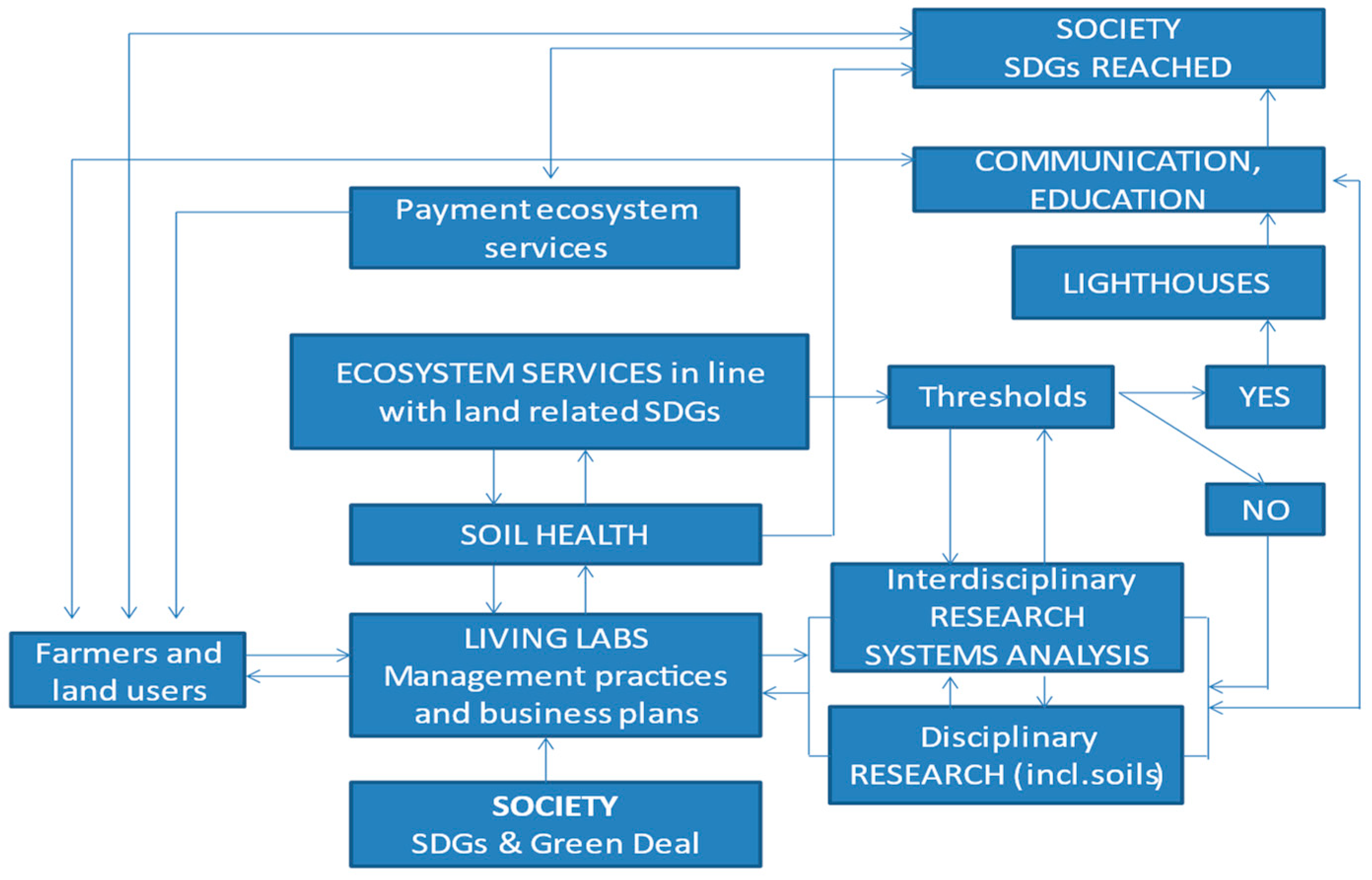
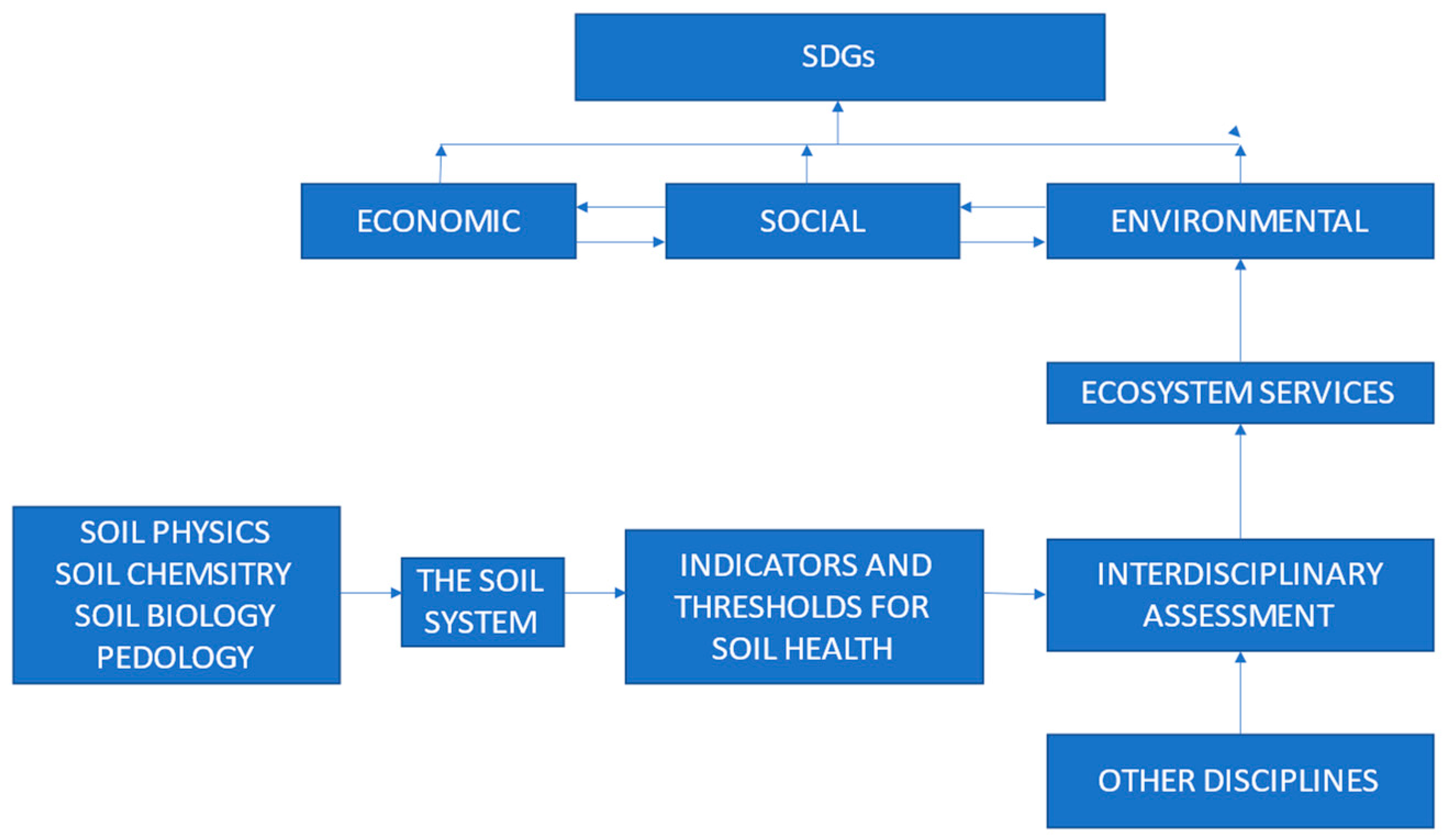
There is general agreement on the need for sustainable development, but the concept has remained rather vague until seventeen specific goals (SDGs) were approved by the UN Assembly in 2015, including targets and indicators. The EU followed this example by introducing their Green Deal in 2019. Soils play a very important role in realizing these goals by the intended year of 2030 in terms of (amongst other less directly related goals) contributing to food production (SDG2: “zero hunger”), good health and wellbeing (SDG3), water quality (SDG6: “clean water and sanitation”), sustainable production (SDG12: ”sustainable consumption and production”), carbon capture and greenhouse gas emission (SDG13: “climate action”) and soil health and biodiversity preservation (SDG15: “life on land”). Of course, not only soils but many other scientific disciplines contribute to achieving the SDGs, and the EU Mission Board for Soil Health and Food has, therefore, defined soil health in terms of specific soil contributions to interdisciplinary ecosystem services: “soils supporting ecosystem services in line with the SDGs and the Green Deal”. Restricting attention in this paper to soils, the Board has defined six indicators for soil health that allow an integrated assessment of the role of soils, reported in this paper in a slightly modified version: presence of soil pollutants, organic matter content, structure, biodiversity, nutrient content and water regimes. Currently, different indicator systems are being used while soil research is rather fragmented, as future environmental policies are still being discussed. The research and policy arenas face major challenges at this point in time to rise to the occasion by defining clear operational assessment procedures for soil health that will, above all, be accepted and internalized by land users, of which farmers manage the largest land area. Only then can implementation be realized in practice. An effort is needed to test the vast body of existing techniques and expertise and focus new research on gaps that appear. This is discussed in detail for the six indicators distinguished, and particular attention is paid to defining threshold values, separating the “good” from the “not yet good enough”. New ways have to be explored to achieve real and productive interactions between scientists and stakeholders, including farmers. The establishment of Living Labs aimed at realizing successful Lighthouses is, therefore, seen as an effective way for scientists to work with farmers in developing innovative management schemes, including the role of soils, expressed in terms of indicators and thresholds for soil health. Such procedures should be the basis for future rules and regulations, where a “one-out, all-out” principle can be used for the various indicators to avoid the current complex discussions about deriving a single, overall soil health indicator.
Keywords: UN SDGs; EU Green Deal; interdisciplinarity; transdisciplinarity; Lighthouses UN SDGs; EU Green Deal; interdisciplinarity; transdisciplinarity; Lighthouses