Coupling Characteristics of Ecological Cost, Ecological Value, and Network Ecological Efficiency Across Production–Living–Ecological Space Land-Use Transition Pathways in a Peri-Urban Transition Zone: A Case Study of Wenjiang District, Chengdu, China

Abstract
1. Introduction
2. Materials and Methods
2.1. Study Area and Data
2.1.1. Study Area
2.1.2. Data Sources and Processing
2.2. Methods
2.2.1. Classification of PLES Functional Land-Use Classes and Eco-Environmental Quality Weights
2.2.2. Analysis of Transitions Among PLES Functional Land-Use Classes
2.2.3. Quantitative Assessment of Eco-Environmental Effects
2.2.4. Coupling Coordination Analysis of Ecological Cost, Value, and Efficiency
2.2.5. Multi-Scenario Simulation of PLES Functional Land-Use Change
3. Results
3.1. Spatiotemporal Evolution and Network Structure of PLES Functional Land Use
3.1.1. Structure and Spatial Changes in PLES Functional Land Use
3.1.2. Dynamic Degree of PLES Functional Land-Use Change
3.1.3. Network Structure of PLES Functional Land-Use Transitions
3.2. Eco-Environmental Effects and Coupling Characteristics of PLES Functional Land-Use Change
3.2.1. Spatiotemporal Evolution of Eco-Environmental Quality
3.2.2. Ecological Contribution Rates and Major Degradation Pathways
3.2.3. Ecological Cost, Ecological Value, and Network Ecological Efficiency of PLES Functional Land-Use Transitions
3.2.4. Coupling Coordination of Ecological Cost, Value, and Efficiency in PLES Functional Land-Use Transitions
3.3. Multi-Scenario Simulation and Identification of Critical PLES Functional Land-Use Transition Pathways
3.3.1. Projected PLES Functional Land-Use Structure Under Three Scenarios


3.3.2. Scenario-Specific Eco-Environmental Effects of PLES Functional Land-Use Change
3.3.3. Identification of Critical PLES Functional Land-Use Regulation Pathways
4. Discussion
4.1. Main Findings and Interpretation
4.2. Methodological Contribution and the Boundaries of Originality in the Pathway Coupling Framework
4.3. The Representativeness of the Findings for Peri-Urban Transition Zones
4.4. The Reliability and Uncertainty of the Findings
4.5. Policy Implications
4.6. Limitations and Future Research
5. Conclusions
Supplementary Materials
Author Contributions
Funding
Data Availability Statement
Acknowledgments
Conflicts of Interest
References
- Lambin, E.F.; Meyfroidt, P. Global land use change, economic globalization, and the looming land scarcity. Proc. Natl. Acad. Sci. USA 2011, 108, 3465–3472. [Google Scholar] [CrossRef] [Scilit]
- Turner, B.L., II; Lambin, E.F.; Reenberg, A. The emergence of land change science for global environmental change and sustainability. Proc. Natl. Acad. Sci. USA 2007, 104, 20666–20671. [Google Scholar] [CrossRef] [Scilit]
- Newbold, T.; Hudson, L.N.; Hill, S.L.L.; Contu, S.; Lysenko, I.; Senior, R.A.; Börger, L.; Bennett, D.J.; Choimes, A.; Collen, B.; et al. Global effects of land use on local terrestrial biodiversity. Nature 2015, 520, 45–50. [Google Scholar] [CrossRef] [Scilit]
- Qin, C.Y.; Pang, Z.H.; Li, K.; Liu, Z.Y.; Yan, D.M.; Xiang, K.N.; He, J.P.; Zhou, J.; Ye, Y.Y.; Zeng, K.; et al. Coupled effects of land-use/cover change and climate change on ecosystem services from a cross-scale perspective: Research progress and future directions. Ecol. Front. 2026; in press. [CrossRef] [Scilit]
- Foley, J.A.; DeFries, R.; Asner, G.P.; Barford, C.; Bonan, G.; Carpenter, S.R.; Chapin, F.S.; Coe, M.T.; Daily, G.C.; Gibbs, H.K.; et al. Global consequences of land use. Science 2005, 309, 570–574. [Google Scholar] [CrossRef] [Scilit]
- Cui, X.; Xu, N.; Chen, W.; Wang, G.; Liang, J.; Pan, S.; Duan, B. Spatio-temporal variation and influencing factors of the coupling coordination degree of production-living-ecological space in China. Int. J. Environ. Res. Public Health 2022, 19, 10370. [Google Scholar] [CrossRef] [Scilit]
- Zhou, D.; Xu, J.; Lin, Z. Conflict or coordination? Assessing land use multi-functionalization using production-living-ecology analysis. Sci. Total Environ. 2017, 577, 136–147. [Google Scholar] [CrossRef] [Scilit]
- Bu, Z.; Fu, J.; Jiang, D.; Lin, G. Production-living-ecological spatial function identification and pattern analysis based on multi-source geographic data and machine learning. Land 2023, 12, 2029. [Google Scholar] [CrossRef] [Scilit]
- Spyra, M.; La Rosa, D.; Zasada, I.; Sylla, M.; Shkaruba, A. Governance of ecosystem services trade-offs in peri-urban landscapes. Land Use Policy 2020, 95, 104617. [Google Scholar] [CrossRef] [Scilit]
- Salem, M.; Ravetz, J.; Sareen, S.; Dong, T.; Haque, M.; Bayoumi, W.; Tsurusaki, N.; Xu, G. Managing the urban-rural transition: A review of approaches and policies for peri-urban land use. J. Urban Manag. 2025, 14, 1115–1129. [Google Scholar] [CrossRef] [Scilit]
- Ma, W.; Yang, H.; Jiang, G.; Zhou, T.; Zhao, Q. Exploring trade-offs between residential and industrial functions in rural areas and their ecological impacts across transitioning agricultural systems: Evidence from the metropolitan suburbs of China. J. Environ. Manag. 2024, 358, 120907. [Google Scholar] [CrossRef] [Scilit]
- Li, Y.; Tang, Y.; Ives, C.D. Policy-driven scenarios for sustainable peri-urban land use: Production-living-ecological space in Yubei District, Chongqing. Land 2025, 14, 1074. [Google Scholar] [CrossRef] [Scilit]
- Ren, L.; Wang, X.; Jiang, W.; Ren, M.; Yin, L.; Zhang, X.; Zhang, B. Exploring impact and driving forces of land use transformation on ecological environment in urban agglomeration from the perspective of production-living-ecological spatial synergy. Sustainability 2025, 17, 8235. [Google Scholar] [CrossRef] [Scilit]
- Yi, M.; Yan, Q.; Li, K.; Ma, X.; Li, G.; Wu, Z.; Pan, Q.; Chen, X. The ecological environmental effects and topographic gradient analysis of transformation in the production-living-ecological spaces in the northern slope of the Tianshan Mountains. Land 2024, 13, 1170. [Google Scholar] [CrossRef] [Scilit]
- Yang, Y.Y.; Bao, W.K.; Li, Y.H.; Wang, Y.S.; Chen, Z.F. Land use transition and its eco-environmental effects in the Beijing-Tianjin-Hebei urban agglomeration: A production-living-ecological perspective. Land 2020, 9, 285. [Google Scholar] [CrossRef] [Scilit]
- Liu, Q.; Zhao, S.L.; Li, Y.F. The hidden costs of land use transformation: Ecological degradation in arid and semi-arid areas. J. Arid Environ. 2025, 230, 105433. [Google Scholar] [CrossRef] [Scilit]
- Zhang, M.; Wang, J.; Feng, Y. Temporal and spatial change of land use in a large-scale opencast coal mine area: A complex network approach. Land Use Policy 2019, 86, 375–386. [Google Scholar] [CrossRef] [Scilit]
- Wang, Y.; Li, X.; Li, J.; Huang, Z.; Xiao, R. Impact of rapid urbanization on vulnerability of land system from complex networks view: A methodological approach. Complexity 2018, 2018, 8561675. [Google Scholar] [CrossRef] [Scilit]
- Wang, Z.; Li, T.; Yang, S.; Zhong, D. Spatio-temporal dynamic and structural characteristics of land use/cover change based on a complex network: A case study of the middle reaches of Yangtze River urban agglomeration. Sustainability 2022, 14, 6941. [Google Scholar] [CrossRef] [Scilit]
- Zhang, Q.; Yan, M.; Zhang, L.; Shao, W.; Chen, Y.; Dong, Y. Three decades of oasis transition and its driving factors in Turpan-Hami Basin in Xinjiang, China: A complex network approach. Remote Sens. 2024, 16, 465. [Google Scholar] [CrossRef] [Scilit]
- Li, F.; Ye, Y.; Song, B.; Wang, R. Evaluation of urban suitable ecological land based on the minimum cumulative resistance model: A case study from Changzhou, China. Ecol. Model. 2015, 318, 194–203. [Google Scholar] [CrossRef] [Scilit]
- Costanza, R.; de Groot, R.; Sutton, P.; van der Ploeg, S.; Anderson, S.J.; Kubiszewski, I.; Farber, S.; Turner, R.K. Changes in the global value of ecosystem services. Glob. Environ. Change 2014, 26, 152–158. [Google Scholar] [CrossRef] [Scilit]
- Xie, G.D.; Zhang, C.X.; Zhang, L.M.; Chen, W.H.; Li, S.M. Improvement of the evaluation method for ecosystem service value based on per unit area. J. Nat. Resour. 2015, 30, 1243–1254. [Google Scholar] [CrossRef]
- Lindeman, R.L. The trophic-dynamic aspect of ecology. Ecology 1942, 23, 399–417. [Google Scholar] [CrossRef] [Scilit]
- Huppes, G.; Ishikawa, M. A framework for quantified eco-efficiency analysis. J. Ind. Ecol. 2005, 9, 25–41. [Google Scholar] [CrossRef] [Scilit]
- Latora, V.; Marchiori, M. Efficient behavior of small-world networks. Phys. Rev. Lett. 2001, 87, 198701. [Google Scholar] [CrossRef] [Scilit]
- Xu, S.; Liu, G.; Mou, B. Vulnerability analysis of land ecosystem considering ecological cost and value: A complex network approach. Ecol. Indic. 2023, 147, 109941. [Google Scholar] [CrossRef] [Scilit]
- Wang, S.J.; Kong, W.; Ren, L.; Zhi, D.D.; Dai, B.T. Research on misuses and modification of coupling coordination degree model in China. J. Nat. Resour. 2021, 36, 793–810. [Google Scholar] [CrossRef] [Scilit]
- Zhang, F.; Xie, A.; Jiang, C.; Chen, J.; An, Y.; Yang, P.; Ma, D. Coupling coordination analysis and spatio-temporal heterogeneity between urban land green use efficiency and ecosystem services in Yangtze River Economic Belt, China. Humanit. Soc. Sci. Commun. 2024, 11, 1328. [Google Scholar] [CrossRef] [Scilit]
- Luan, C.; Liu, R.; Li, Y.; Zhang, Q. Comparison of various models for multi-scenario simulation of land use/land cover to predict ecosystem service value: A case study of Harbin-Changchun Urban Agglomeration, China. J. Clean. Prod. 2024, 478, 144012. [Google Scholar] [CrossRef] [Scilit]
- Burnham, B.O. Markov intertemporal land use simulation model. J. Agric. Appl. Econ. 1973, 5, 253–258. [Google Scholar] [CrossRef] [Scilit]
- Subedi, P.; Subedi, K.; Thapa, B. Application of a hybrid cellular automaton-Markov model in land-use change prediction: A case study of Saddle Creek drainage basin, Florida. Appl. Ecol. Environ. Sci. 2013, 1, 126–132. [Google Scholar] [CrossRef] [Scilit]
- Kumar, S.; Radhakrishnan, N.; Mathew, S. Land use change modelling using a Markov model and remote sensing. Geomat. Nat. Hazards Risk 2014, 5, 145–156. [Google Scholar] [CrossRef] [Scilit]
- Xiong, S.; Yang, F.; Zhang, J.; Tang, Y. An integrated model chain for diagnosing and predicting conflicts between production-living-ecological space in lake network regions: A case of the Dongting Lake region, China. Ecol. Indic. 2024, 166, 112237. [Google Scholar] [CrossRef] [Scilit]
- Xiong, B.; Deng, L.; Luo, G.; Pan, W.; Lao, X.; Zhu, Z.; Yin, H. Spatiotemporal evolution and driving mechanisms of the transformation of production-living-ecological land in peri-urban areas under the construction of the Guangdong-Hong Kong-Macao greater bay area: A case study of Huiyang district, China. Front. Environ. Sci. 2026, 13, 1697838. [Google Scholar] [CrossRef] [Scilit]
- Zuo, M.; Liu, G.; Jing, C.; Zhang, R.; Wang, X.; Mao, W.; Shen, L.; Dai, K.; Wu, X. Spatiotemporal patterns and driving factors of cropland abandonment in metropolitan suburbs: A case study of Chengdu directly administered zone, Tianfu New Area, Sichuan Province, China. Land 2025, 14, 1311. [Google Scholar] [CrossRef] [Scilit]
- Lu, Y.; He, T.; Yue, W.; Li, M.; Shan, Z.; Zhang, M. Does cropland threaten urban land use efficiency in the peri-urban area? Evidence from metropolitan areas in China. Appl. Geogr. 2023, 161, 103124. [Google Scholar] [CrossRef] [Scilit]
- Li, W.J.; Kang, J.W.; Wang, Y. Identifying the contribution and spatial effects of land use conversion on ecosystem health in Chongqing: A multi-scenario simulation perspective. Ecol. Indic. 2024, 165, 112232. [Google Scholar] [CrossRef] [Scilit]
- Wang, S.T.; Ge, Y.C. Ecological quality response to multi-scenario land-use changes in the Heihe River Basin. Sustainability 2022, 14, 2716. [Google Scholar] [CrossRef] [Scilit]
- Pereira, P.; Inácio, M.; Pinto, L.; Kalinauskas, M.; Bogdzevic, K.; Zhao, W. Mapping ecosystem services in urban and peri-urban areas: A systematic review. Geogr. Sustain. 2024, 5, 491–509. [Google Scholar] [CrossRef] [Scilit]
- Yang, Y.; Lu, Z.; Yang, M.; Yan, Y.; Wei, Y. Impact of land use changes on uncertainty in ecosystem services under different future scenarios: A case study of Zhang-Cheng area, China. J. Clean. Prod. 2024, 434, 139881. [Google Scholar] [CrossRef] [Scilit]
- Meng, B.; Wang, X.; Zhang, Z.; Huang, P. Spatio-temporal pattern and driving force evolution of cultivated land occupied by urban expansion in the Chengdu Metropolitan Area. Land 2022, 11, 1458. [Google Scholar] [CrossRef] [Scilit]
- Dai, X.; Li, Y.; Qi, Y.; Chen, Y.; Yan, D.; Xia, K.; He, S.; He, Y. Coupling agricultural green development and Park City development: An empirical analysis from Chengdu, China. Agriculture 2025, 15, 248. [Google Scholar] [CrossRef] [Scilit]
- Saaty, T.L. Decision making with the analytic hierarchy process. Int. J. Serv. Sci. 2008, 1, 83–98. [Google Scholar] [CrossRef] [Scilit]
- Li, P.; Gao, J.; Chen, J. Quantitative assessment of ecological stress of construction lands by quantity and location: Case study in Southern Jiangsu, Eastern China. Environ. Dev. Sustain. 2020, 22, 1559–1578. [Google Scholar] [CrossRef] [Scilit]
- Adriaensen, F.; Chardon, J.P.; De Blust, G.; Swinnen, E.; Villalba, S.; Gulinck, H.; Matthysen, E. The application of least-cost modelling as a functional landscape model. Landsc. Urban Plan. 2003, 64, 233–247. [Google Scholar] [CrossRef] [Scilit]
- Rina, S.; Bole, Y.; Tong, Z.; Zhi, F.; Xu, J.; Ma, B.; Liu, X.; Zhang, J. Ecological zoning study on the coupling of land use intensity and landscape ecological risk in Western Jilin: A production-living-ecological space perspective. Sustainability 2024, 16, 10992. [Google Scholar] [CrossRef] [Scilit]
- Varga, O.G.; Pontius, R.G., Jr.; Singh, S.K.; Szabó, S. Intensity analysis and the Figure of Merit’s components for assessment of a Cellular Automata-Markov simulation model. Ecol. Indic. 2019, 101, 933–942. [Google Scholar] [CrossRef] [Scilit]
- Pontius, R.G., Jr.; Millones, M. Death to Kappa: Birth of quantity disagreement and allocation disagreement for accuracy assessment. Int. J. Remote Sens. 2011, 32, 4407–4429. [Google Scholar] [CrossRef] [Scilit]
- Ben, X.C.; Yu, C. Ecological effects of land use transformation and its driving force based on production-living-ecological space: A case study of Suzhou City. J. Environ. Eng. Technol. 2022, 12, 1428–1436. [Google Scholar] [CrossRef]
- Chen, H.J.; Yang, Q.Y.; Peng, L.X.; Su, K.C.; Zhang, H.Z.; Liu, X.Y. Spatiotemporal evolution characteristics and scenario simulation of production-living-ecological space at county level in Three Gorges reservoir are-as. Trans. Chin. Soc. Agric. Eng. 2022, 38, 285–294. [Google Scholar] [CrossRef]
- Cheng, X.D.; Qu, L.P.; Wang, X. Characteristics of land use transition of production-living-ecological spaces in ecologically fragile areas: A case study of Datong County, Qinghai Province. South-Cent. Agric. Sci. Technol. 2025, 46, 114–122. [Google Scholar]
- Huang, A.; Wang, Y.; Xiang, Y.; Xu, Y.; Tian, L.; Zhou, G.; Zhuang, Y.; Zhu, L. A comprehensive framework for assessing spatial conflicts risk: A case study of production-living-ecological spaces based on social-ecological system framework. Habitat Int. 2024, 154, 103218. [Google Scholar] [CrossRef] [Scilit]
- Liang, Y.; Chai, D.; Zhou, X.; Ning, Y. Potential conflict diagnosis, simulation optimization and coordination of production-living-ecological space in gully areas of the Loess Plateau, China. Environ. Dev. 2024, 52, 101099. [Google Scholar] [CrossRef] [Scilit]
- Li, Y.; Wu, H.; Blaschke, T.; Pradhan, B.; Mohamed Shariff, A.R.B.; Avtar, R.; Lin, A.; Shao, W. Integrating future land use uncertainty and spatial scales into ecosystem service degradation risk assessment for urban ecological management. Appl. Geogr. 2026, 186, 103860. [Google Scholar] [CrossRef] [Scilit]



| Classification by Dominant Land-Use Function | Corresponding CNLUCC Land-Use Type | Eco-Environmental Quality Weight | |
|---|---|---|---|
| First-Level PLES Category | Functional Land-Use Class | ||
| Production space | Agricultural production land | Paddy fields and dry cropland | 0.25 |
| Construction production land | Other construction land | 0.05 | |
| Ecological space | Forest ecological land | Forestland, shrubland, sparse woodland, and other woodland | 0.85 |
| Grassland ecological land | High-, medium-, and low-coverage grassland | 0.65 | |
| Water ecological land | Rivers and canals, lakes, reservoirs and ponds, glaciers and permanent snow, tidal flats, and floodplains | 0.35 | |
| Other ecological land | Sandy land, marshland, bare land, bare rock, and other unused land | 0.15 | |
| Living space | Urban living land | Urban land | 0.08 |
| Rural living land | Rural settlements | 0.12 | |
| Functional Land-Use Class | Ecological Cost Coefficient | Ecosystem Service Value-Equivalent Coefficient |
|---|---|---|
| Agricultural production land | 100 | 7.9 |
| Construction production land | 1000 | 0 |
| Forest ecological land | 5 | 28.12 |
| Grassland ecological land | 22 | 11.67 |
| Water ecological land | 5 | 45.35 |
| Urban living land | 1000 | 0 |
| Rural living land | 600 | 0 |
| Period | Individual Dynamic Degree, K (%) | Comprehensive Dynamic Degree, LC (%) | |||||||
|---|---|---|---|---|---|---|---|---|---|
| APL | CPL | FEL | GEL | WEL | OEL | ULL | RLL | ||
| 2000–2005 | −1.706 | 6.262 | 0.586 | 325.806 | 0.003 | – | 11.684 | 1.452 | 0.631 |
| 2005–2010 | −0.702 | 9.563 | 0.000 | 0.000 | 0.000 | – | 2.544 | 0.236 | 0.238 |
| 2010–2015 | −0.986 | 24.641 | −0.056 | 0.000 | 1.157 | – | 0.574 | 1.024 | 0.907 |
| 2015–2020 | −0.905 | 3.682 | 0.000 | 0.000 | −0.093 | – | 1.372 | 1.646 | 0.283 |
| 2020–2025 | −0.640 | 1.422 | 0.348 | 0.336 | −2.332 | – | 2.175 | 0.321 | 0.473 |
| Study Period | Transition Pathway | Converted Area (km2) | ECR | Effect |
|---|---|---|---|---|
| 2000–2005 | APL→FEL | 0.0738 | 0.00016 | Improvement |
| Subtotal | 0.0738 | 0.00016 | Improvement | |
| APL→CPL | 0.6876 | −0.00050 | Degradation | |
| APL→GEL | 0.4545 | −0.00066 | Degradation | |
| APL→ULL | 13.8654 | −0.00852 | Degradation | |
| APL→RLL | 2.3805 | −0.00112 | Degradation | |
| Subtotal | 17.3880 | −0.01079 | Degradation | |
| Total | 17.4618 | −0.0106 | Degradation | |
| 2005–2010 | APL→CPL | 1.3788 | −0.00100 | Degradation |
| APL→ULL | 4.7817 | −0.00294 | Degradation | |
| APL→RLL | 0.4149 | −0.00019 | Degradation | |
| Total | 6.5754 | −0.00413 | Degradation | |
| 2010–2015 | APL→FEL | 0.4707 | 0.00102 | Improvement |
| APL→WEL | 0.4428 | 0.00016 | Improvement | |
| CPL→APL | 0.3474 | 0.00025 | Improvement | |
| CPL→ULL | 0.1071 | 0.00001 | Improvement | |
| CPL→RLL | 0.1998 | 0.00005 | Improvement | |
| ULL→APL | 0.5031 | 0.00031 | Improvement | |
| ULL→FEL | 0.0639 | 0.00018 | Improvement | |
| ULL→GEL | 0.0513 | 0.00011 | Improvement | |
| ULL→WEL | 0.1251 | 0.00012 | Improvement | |
| ULL→RLL | 0.5013 | 0.00007 | Improvement | |
| RLL→APL | 5.2839 | 0.00248 | Improvement | |
| RLL→FEL | 0.0189 | 0.00005 | Improvement | |
| RLL→GEL | 0.0072 | 0.00001 | Improvement | |
| RLL→WEL | 0.4023 | 0.00033 | Improvement | |
| Subtotal | 8.5248 | 0.00516 | Improvement | |
| APL→CPL | 5.6421 | −0.00408 | Degradation | |
| APL→ULL | 1.8099 | −0.00111 | Degradation | |
| APL→RLL | 7.3908 | −0.00347 | Degradation | |
| FEL→APL | 0.4410 | −0.00096 | Degradation | |
| FEL→WEL | 0.0144 | −0.00003 | Degradation | |
| FEL→ULL | 0.0639 | −0.00018 | Degradation | |
| FEL→RLL | 0.0414 | −0.00011 | Degradation | |
| GEL→ULL | 0.0495 | −0.00010 | Degradation | |
| GEL→RLL | 0.0090 | −0.00002 | Degradation | |
| WEL→APL | 0.2736 | −0.00005 | Degradation | |
| WEL→ULL | 0.0261 | −0.00003 | Degradation | |
| WEL→RLL | 0.0621 | −0.00005 | Degradation | |
| ULL→CPL | 0.0990 | −0.00002 | Degradation | |
| RLL→CPL | 0.1656 | −0.00006 | Degradation | |
| RLL→ULL | 0.5040 | −0.00007 | Degradation | |
| Subtotal | 16.5924 | −0.0103 | Degradation | |
| Total | 25.1172 | −0.00520 | Degradation | |
| 2015–2020 | APL→CPL | 1.7514 | −0.00127 | Degradation |
| APL→ULL | 2.9898 | −0.00184 | Degradation | |
| APL→RLL | 3.0258 | −0.00142 | Degradation | |
| WEL→RLL | 0.0531 | −0.00004 | Degradation | |
| Total | 7.8201 | −0.00457 | Degradation | |
| 2020–2025 | APL→FEL | 0.045 | 0.00010 | Improvement |
| APL→GEL | 0.0081 | 0.00001 | Improvement | |
| Subtotal | 0.0531 | 0.00011 | Improvement | |
| APL→CPL | 0.124 | −0.00009 | Degradation | |
| APL→ULL | 4.8121 | −0.00296 | Degradation | |
| APL→RLL | 0.257 | −0.00012 | Degradation | |
| WEL→CPL | 0.677 | −0.00073 | Degradation | |
| WEL→ULL | 0.254 | −0.00025 | Degradation | |
| WEL→RLL | 0.393 | −0.00033 | Degradation | |
| Subtotal | 6.5171 | −0.00447 | Degradation | |
| Total | 6.5702 | −0.00436 | Degradation |
| Pathway Category | Representative Pathways | Value | Change in EC | Change in EV | NEE | Scenario Response | Management Strategy |
|---|---|---|---|---|---|---|---|
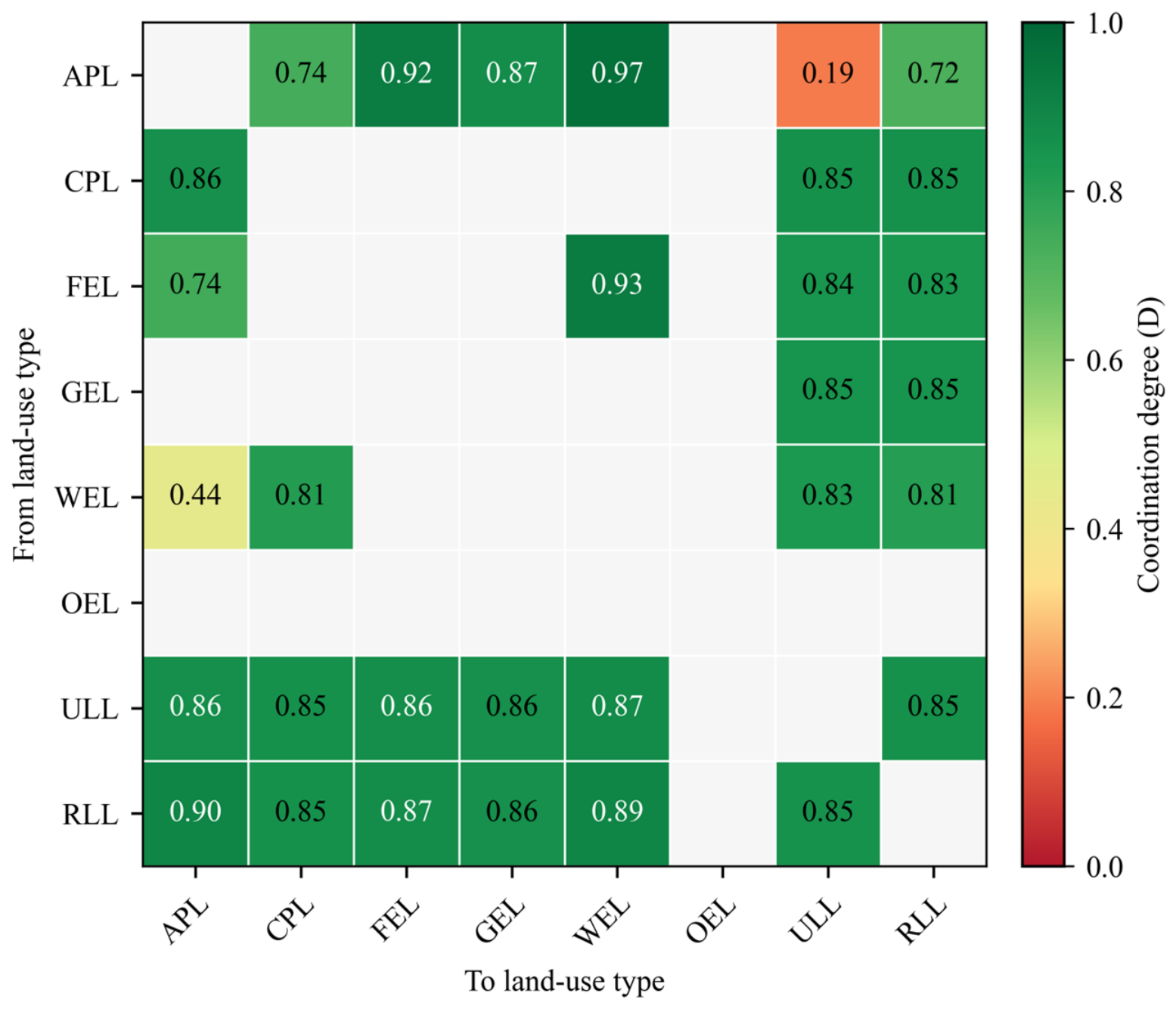
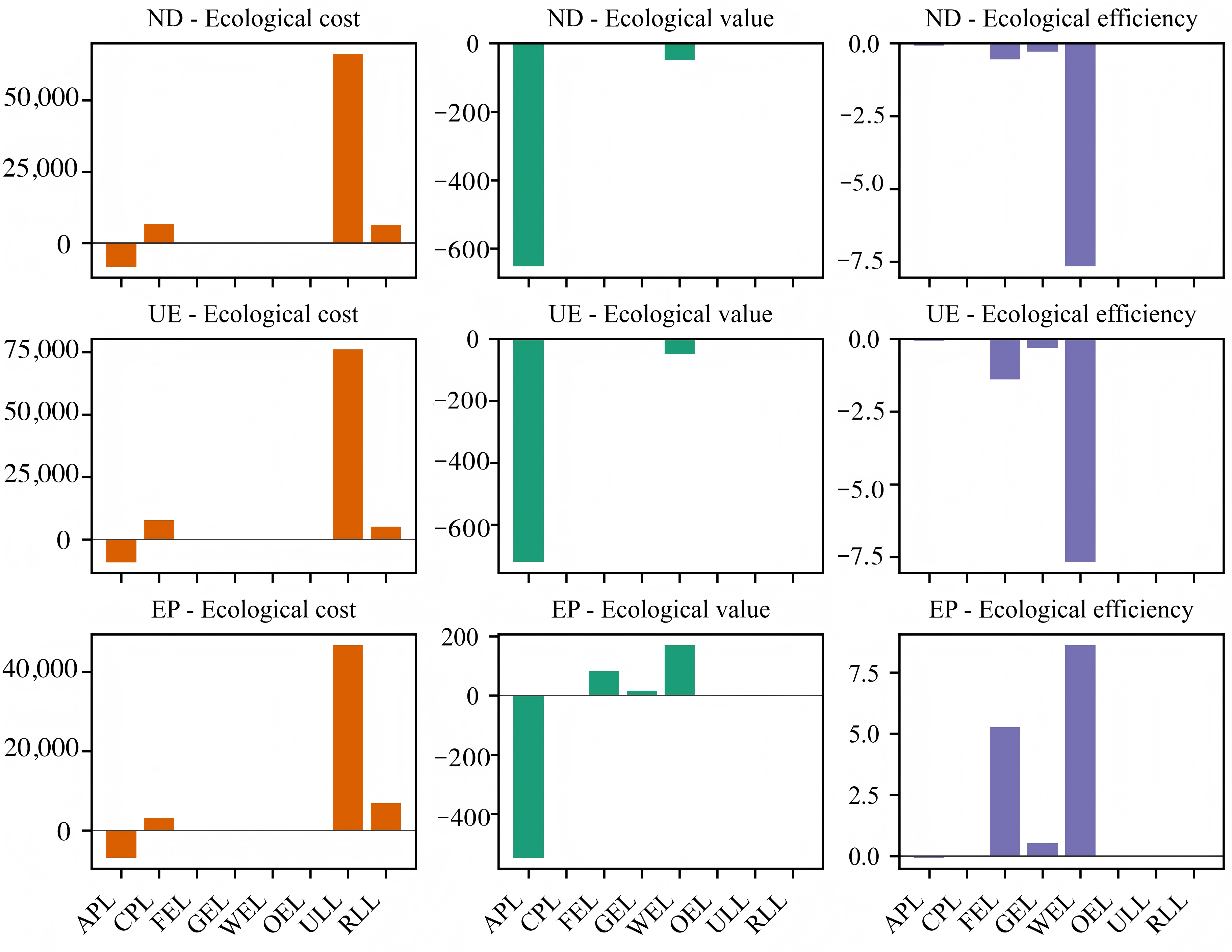
| Priority control | APL→ULL | 0.191 (severe imbalance) | 25433.01 (highest) | −223.25 (greatest loss) | −0.00878 (low) | Amplified under urban expansion | Restrict expansion |
| Priority incentive | APL→FEL, APL→GEL, APL→WEL, RLL→APL | 0.870–0.968 (good coordination) | −2642 to −36 (negative; cost relief) | 1.74–41.74 (gain) | 0.047–0.385 (high) | Enhanced under ecological protection | Promote transitions |
| Conditional management | APL→CPL, APL→RLL | 0.724 to 0.741 (moderate relative coordination) | 6734.50 to 8625.51 (increase) | −106.41 to −75.71 (loss) | −0.01580 to −0.00878 (negative) | Relatively limited differences among scenarios | Conditional approval, intensity control, and post-implementation assessment |
| Region | Regional Context | Study Period | Verified PLES Transition Pattern | Ecological Response Reported in the Original Study | Joint Pathway-Level Analysis of EC, EV, and NEE |
|---|---|---|---|---|---|
| Wenjiang District | Peri-urban plain district adjacent to a megacity | 2000 to 2025 | APL→ULL was dominant. APL→CPL and RLL→APL were also major pathways. | EQI decreased from 0.228 to 0.200. APL→ULL had the highest EC and the greatest EV loss. | Quantified in this study |
| Suzhou City [50] | Rapidly urbanizing city | 1980 to 2018 | Production land decreased, ecological land increased slightly, and living land increased rapidly. | EQI decreased from 0.4312 to 0.4139. | Not reported in the cited study |
| Shizhu County, Chongqing [51] | Mountainous county in the Three Gorges Reservoir Area | 1990 to 2020, with a scenario for 2035 | Production space decreased slightly, ecological space increased slightly, and living space increased markedly. | Ecological space accounted for more than 65%. The ecological protection scenario maintained the ecological space pattern and increased its area. | Not reported in the cited study |
| Datong County, Qinghai Province [52] | Ecologically fragile plateau county | 2010 to 2018 | Living-production land became more concentrated and occupied parts of ecological-production land and production-ecological land. | The cited study did not report a directly comparable EQI. | Not reported in the cited study |
| Pathway Type | Representative Pathways | Range | Spatial Regulation | Economic Incentives | Performance Evaluation | Technical Guidance |
|---|---|---|---|---|---|---|
| Priority-control type | APL→ULL | 0.191 (severe imbalance) | Strict constraints | Strict ecological compensation requirements | Pre-project assessment | Prioritize redevelopment of existing land |
| Priority-incentive type | APL→FEL, APL→GEL, APL→WEL, RLL→APL | 0.870–0.968 (good coordination) | Maintain spatial continuity | Ecological compensation and land consolidation incentives | Benefit tracking | Ecological restoration oriented |
| Conditional management type | APL→CPL, APL→RLL | 0.724 to 0.741 (moderate relative coordination) | Conditional approval and intensity control | Differentiated compensation | Post-implementation assessment | Low-impact development |
Disclaimer/Publisher’s Note: The statements, opinions and data contained in all publications are solely those of the individual author(s) and contributor(s) and not of MDPI and/or the editor(s). MDPI and/or the editor(s) disclaim responsibility for any injury to people or property resulting from any ideas, methods, instructions or products referred to in the content. |
© 2026 by the authors. Licensee MDPI, Basel, Switzerland. This article is an open access article distributed under the terms and conditions of the Creative Commons Attribution (CC BY) license.
Share and Cite
Yang, B.; Deng, Y.; Li, J.; Ding, Y.; Li, X.; Xia, J.; Li, Y.; Liu, Z. Coupling Characteristics of Ecological Cost, Ecological Value, and Network Ecological Efficiency Across Production–Living–Ecological Space Land-Use Transition Pathways in a Peri-Urban Transition Zone: A Case Study of Wenjiang District, Chengdu, China. Land 2026, 15, 1744. https://doi.org/10.3390/land15091744
Yang B, Deng Y, Li J, Ding Y, Li X, Xia J, Li Y, Liu Z. Coupling Characteristics of Ecological Cost, Ecological Value, and Network Ecological Efficiency Across Production–Living–Ecological Space Land-Use Transition Pathways in a Peri-Urban Transition Zone: A Case Study of Wenjiang District, Chengdu, China. Land. 2026; 15(9):1744. https://doi.org/10.3390/land15091744
Chicago/Turabian StyleYang, Bo, Yunsi Deng, Jun Li, Yi Ding, Xinzhu Li, Jianguo Xia, Yang Li, and Zhibin Liu. 2026. "Coupling Characteristics of Ecological Cost, Ecological Value, and Network Ecological Efficiency Across Production–Living–Ecological Space Land-Use Transition Pathways in a Peri-Urban Transition Zone: A Case Study of Wenjiang District, Chengdu, China" Land 15, no. 9: 1744. https://doi.org/10.3390/land15091744
APA StyleYang, B., Deng, Y., Li, J., Ding, Y., Li, X., Xia, J., Li, Y., & Liu, Z. (2026). Coupling Characteristics of Ecological Cost, Ecological Value, and Network Ecological Efficiency Across Production–Living–Ecological Space Land-Use Transition Pathways in a Peri-Urban Transition Zone: A Case Study of Wenjiang District, Chengdu, China. Land, 15(9), 1744. https://doi.org/10.3390/land15091744