Review

Environmental, Climatic, and Production Perspectives in Agroforestry Research: Reassessing the Position of Rural Livelihoods Through Bibliometric Analysis

by
Juan Urdánigo-Zambrano
1,2,
Bolier Torres
3,
Carmen De-Pablos-Heredero
4,*,
Robinson J. Herrera-Feijoo
1,
Federico Sinche Chele
5,6 and
Antón García
7,*
1
Facultad de Ciencias Pecuarias y Biológicas, Universidad Técnica Estatal de Quevedo (UTEQ), Quevedo Av. Quito km, 1 ½ Vía a Santo Domingo de los Tsáchilas, Quevedo 120550, Ecuador
2
Natural Resources and Sustainable Management Program at the University of Cordoba, Department of Animal Production, Faculty of Veterinary Sciences, University of Cordoba, 14071 Cordoba, Spain
3
Departamento de Silvicultura y Producción Agrícola, Universidad Estatal Amazónica (UEA), Puyo 160101, Ecuador
4
Department of Business Economics (Administration, Management and Organization), Applied Economics II and Fundamentals of Economic Analysis, Rey Juan Carlos University, Paseo de los Artilleros s/n, 28032 Madrid, Spain
5
New Technology Evaluation Group, Monitoring and Research Department, Metropolitan Water Reclamation District of Greater Chicago, Chicago, IL 60611, USA
6
Center for Fisheries, Aquaculture and Aquatic Sciences, Department of Zoology, Southern Illinois University, Carbondale, IL 62901, USA
7
Department of Animal Production, Faculty of Veterinary Sciences, University of Cordoba, 14071 Cordoba, Spain
*
Authors to whom correspondence should be addressed.
Land 2026, 15(9), 1571; https://doi.org/10.3390/land15091571
Submission received: 24 July 2026 / Revised: 17 August 2026 / Accepted: 24 August 2026 / Published: 27 August 2026

Abstract

Agroforestry integrates environmental, climatic, productive, and socioeconomic dimensions. The position of rural livelihoods within its scientific structure remains still characterized. This study evaluated the temporal evolution, conceptual organization, domain representation, and geographical and economic distribution of global agroforestry research using 5711 Scopus-indexed journal articles published between 1979 and 2025. Scientific production increased markedly, with 4133 articles published during 2013 to 2025, accounting for 72.37% of the corpus. Thematic evolution showed a shift from early agronomic topics toward biodiversity, ecosystem services, carbon sequestration, and climate change. Multiple Correspondence Analysis of harmonized Author Keywords identified five clusters, with the first two dimensions explaining 39.76% of total inertia. Livelihood-related terms were embedded within the central agroforestry and sustainability cluster under the analytical configuration applied, and this pattern was maintained after excluding corpus-defining search-anchor terms. Production, silvopastoral, and agronomic management had the highest proportional contribution (57.92%), whereas environmental and biodiversity (43.88%), livelihoods and socioeconomic (43.81%), and climate, carbon and soil dimensions (42.50%) occurred at comparable proportions. Fractional affiliation analysis indicated that all domains occurred across regions and income groups, with livelihoods and socioeconomic research showing larger fractional contributions from Africa and lower-middle-income countries.

1. Introduction

Agroforestry is recognized as an integrated land-use strategy that deliberately combines woody vegetation with crops and/or livestock to generate ecological and economic interactions within the same production system [1]. Its importance extends beyond agricultural production, as tree-based production systems can contribute to carbon sequestration, biodiversity conservation, soil enrichment, water regulation, and other ecosystem services associated with multifunctional landscapes [2,3]. At broader spatial scales, tree cover on agricultural land also represents an important component of biomass carbon stocks, which strengthens the role of agroforestry in climate change mitigation and in the transition of agricultural landscapes toward more sustainable land uses [4]. These environmental functions are linked to rural development concerns, since agroforestry can also support food security, livelihood diversification, and landscape-scale synergies between agricultural and forestry agendas [5]. In this sense, agroforestry can be understood as a socio-ecological strategy that integrates production practices within a broader framework of sustainable production, biodiversity conservation, climate resilience, and rural livelihoods.
The expansion of agroforestry research has been accompanied by a continuous diversification of its thematic structure. Bibliometric results indicate that, since 1990, agroforestry research has shifted from early emphases on intercropping, alley cropping, and multipurpose trees toward topics such as carbon sequestration, ecosystem services, and climate change, suggesting a broader and more heterogeneous scientific agenda [6]). Similarly, a systematic review focused on the Asia-Pacific region shows that agroforestry studies have expanded toward ecosystem services, plantation crop combinations, species habitats, biological control, genetic diversity, and climate- and biodiversity-related concerns, reflecting a growing diversity of research themes across services and geographical contexts [7]. This diversification has also been accompanied by a differentiated distribution of research attention across thematic areas. Evidence from high-income countries shows that agroforestry research has concentrated mainly on regulating ecosystem services, agricultural productivity, soil and water quality, carbon storage, and biodiversity outcomes, whereas evidence related to human well-being and policy interventions remains comparatively limited [8]. At the governance level, agroforestry implementation also appears to involve diverse actors and institutional networks, in which conservation initiatives, agricultural actors, and local tree-management systems often operate through partially disconnected organizational structures [9]. Therefore, although agroforestry research has expanded toward environmental, productive, and socioeconomic concerns, its knowledge base appears to be organized through partially connected thematic streams.
From a conceptual perspective, this diversification can be organized around four analytical domains that are not mutually exclusive but reflect different research orientations within agroforestry studies. The biodiversity/conservation domain focuses on the role of agroforestry systems as managed habitats that can contribute to species conservation, ecological functions, and the provision of ecosystem services within agricultural landscapes [10,11]. The climate-carbon-soil domain centers on the capacity of tree-based systems to store carbon in biomass and soil, increase soil organic carbon stocks, and support climate change mitigation through changes in land-use management [12]. The production/silvopastoral/agronomic domain examines the biophysical interactions among trees, crops, pastures, and livestock, including competition, resource capture, forage dynamics, animal production, and productivity within mixed production systems [13,14]. Finally, the livelihoods/socioeconomic domain considers how agroforestry influences agricultural productivity, ecosystem services, household welfare, human well-being, and rural development, particularly in low- and middle-income contexts where smallholder systems remain central to land-use transitions [15].
Although rural livelihoods are frequently mentioned as part of the rationale for agroforestry, their conceptual position within the field remains less clear. Existing studies show that agroforestry can facilitate livelihoods through production diversification, food and income security, ecosystem-service incentives, and social-ecological resilience in smallholder systems, silvopastoral systems, coffee-based agroforestry systems, and home gardens [16,17,18,19]. However, the socioeconomic effects of agroforestry are not automatic, because adoption and livelihood outcomes depend on farmers’ perceptions, land tenure, market access, income sources, cooperative membership, technical assistance, policy recognition, and broader institutional conditions [20,21,22,23]. This indicates that rural livelihoods are not absent from agroforestry research, but they are often addressed through applied themes such as adoption, incentives, food security, income diversification, household welfare, and social-ecological resilience.
Existing bibliometric studies on agroforestry have mainly mapped publication trends, leading authors, institutions, countries, journals, collaboration networks, and broad thematic structures. However, less attention has been given to the relative position of rural livelihoods within the conceptual organization of agroforestry research. The specific gap is that it remains insufficiently understood whether livelihood-related terminology forms an independent conceptual structure or is integrated within broader thematic configurations of the field. This limitation restricts the capacity to distinguish between the quantitative representation of socioeconomic dimensions in the literature and their degree of differentiation within the keyword co-occurrence structure.
Based on this gap, the study addressed the following research questions: How has global agroforestry research evolved over time, and how have its thematic priorities changed? How is the conceptual structure of agroforestry research organized, and what is the position of rural livelihoods within the keyword co-occurrence structure? Do livelihood-related terms form an independent conceptual cluster, or are they integrated within broader thematic structures? How are environmental and biodiversity, climate, carbon and soil, production, silvopastoral and agronomic management, and livelihoods and socioeconomic dimensions represented across the global research corpus? Finally, how are these analytical domains distributed across geographical regions and World Bank income groups? To answer these questions, this study evaluated the temporal evolution, conceptual organization, proportional representation of analytical domains, and geographical and economic distribution of global agroforestry research, with particular attention to the position of rural livelihoods. We hypothesized that agroforestry research would display differentiated environmental, carbon-related, and production-oriented conceptual structures, whereas livelihood-related terms would be substantially represented in the literature but would be less likely to form an independent keyword cluster, instead showing associations with broader sustainability-oriented themes.

2. Materials and Methods

Bibliometric analysis was used to examine the temporal evolution, conceptual structure, and thematic organization of global agroforestry research [24,25]. For transparency in reporting, the PRISMA 2020 framework was used to structure the identification, screening, and inclusion of documents [26]. No preregistered protocol was developed for this review. However, the methodological workflow was internally predefined through a structured procedure established prior to evidence selection.

2.1. Eligibility Criteria

This review included journal articles written in English and published as final documents between 1979 and 2025. Eligible records were required to address agroforestry in relation to at least one of the analytical domains considered in this study: biodiversity/conservation, climate-carbon-soil, production/silvopastoral-agronomic systems, or livelihoods/socioeconomic dimensions. Only peer-reviewed journal articles were retained. Conference papers, discussion papers, book chapters, editorials, notes, and other non-article document types were excluded.

2.2. Information Source and Search Strategy

Records were obtained from the Scopus database, which provides curated bibliographic metadata suitable for longitudinal analyses in bibliometric research [27,28]. The search was executed in January 2026 and was restricted to records published between 1979 and 2025, and the most recent search was executed on 9 June 2026. No additional databases, websites, registers, gray literature sources, or direct contact with authors were used to identify supplementary records.
A Boolean search string was designed to retrieve journal articles centered on agroforestry and related to at least one of the four analytical domains considered in this study: biodiversity and conservation; climate, carbon, and soil; production, silvopastoral, and agronomic systems; or livelihoods and socioeconomic dimensions. The agroforestry concept block was restricted to the TITLE field as an operational criterion to prioritize publications in which agroforestry or a named agroforestry system was a central topic rather than an incidental mention. The complementary domain block was applied to TITLE-ABS-KEY to retain broader terminology associated with the environmental, productive, and socioeconomic dimensions examined in the study. This asymmetric field structure combined topical specificity for the focal agroforestry concept with broader retrieval of domain-related terminology. Search design involves a trade-off between recall and precision because expanding field coverage can retrieve additional records while reducing the proportion that fits the intended analytical scope [29]. Consistent with bibliometric guidance, the search terms were selected to produce a corpus sufficiently large for quantitative analysis while remaining focused on the research field and objectives defined for the study [30].
The complete search strategy applied in Scopus was as follows: (TITLE ((agroforest* OR silvopast* OR agrosilvopast* OR “alley cropping” OR “forest farming” OR “home garden*” OR “tree-crop system*” OR “tree crop system*” OR “multistrata system*” OR “shade-grown” OR “shade coffee” OR “cocoa agroforest*” OR “cacao agroforest*”)) AND TITLE-ABS-KEY ((biodivers* OR conservation OR “species richness” OR “species diversity” OR “ecosystem service*” OR habitat* OR restoration OR “climate change” OR climate OR carbon OR “carbon sequestration” OR “carbon stock*” OR biomass OR mitigation OR adaptation OR livestock OR cattle OR pasture* OR grazing OR silvopast* OR “animal production” OR “livestock production” OR productivity OR “crop yield” OR “soil fertility” OR livelihood* OR income OR poverty OR household* OR wellbeing OR “well-being” OR welfare OR “food security” OR “rural development” OR adoption OR smallholder* OR socioeconomic OR “socio-economic”))) AND (EXCLUDE (PUBYEAR, “2026”)) AND (LIMIT-TO (DOCTYPE, “ar”)) AND (LIMIT-TO (LANGUAGE, “English”)) AND (LIMIT-TO (SRCTYPE, “j”)) AND (LIMIT-TO (PUBSTAGE, “final”)).
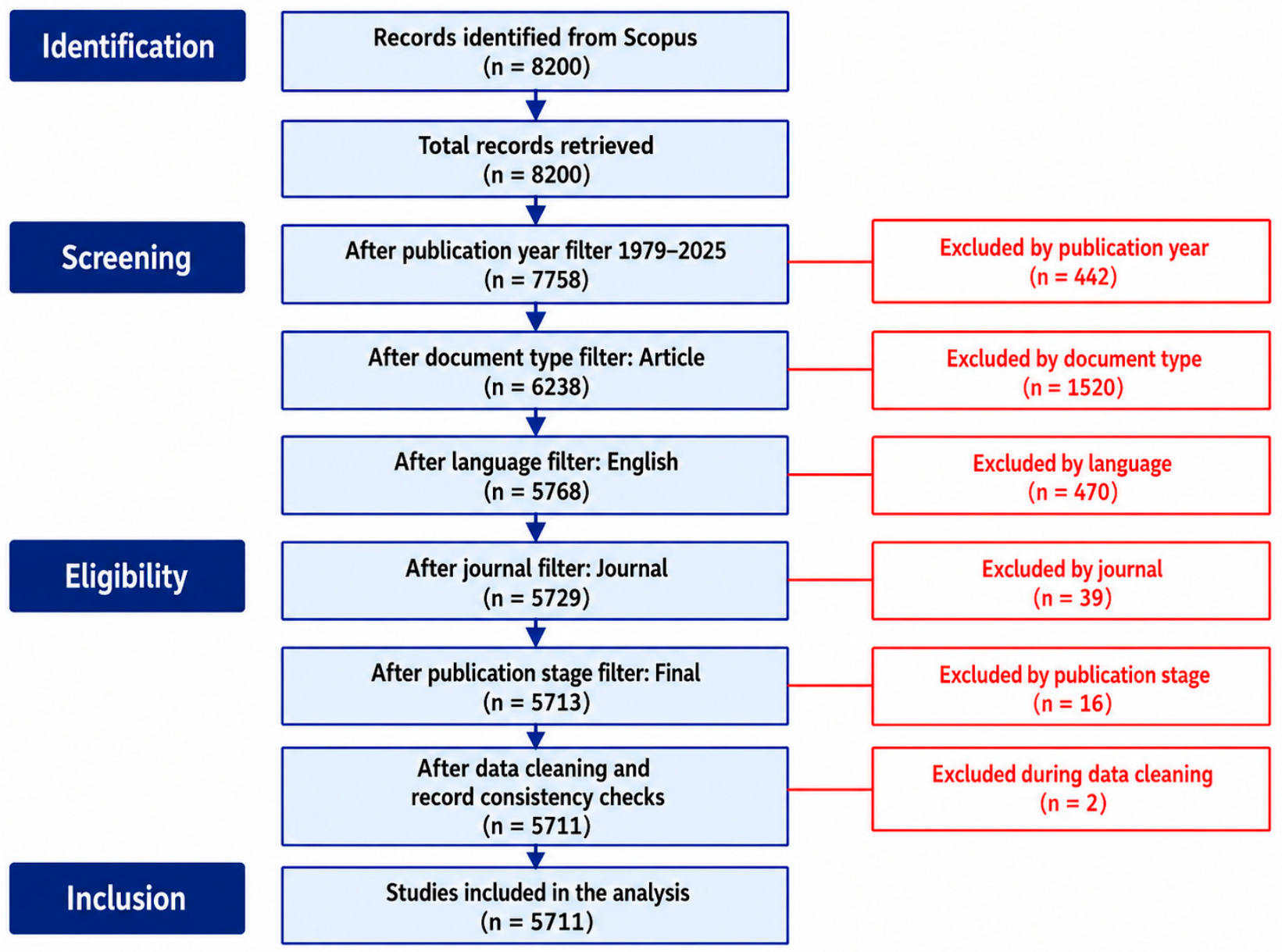
The initial Scopus search retrieved 8200 records. Restricting the publication period to 1979 to 2025 excluded 442 records, leaving 7758. Sequential application of the eligibility filters excluded 1520 records by document type, 470 by language, 39 by source type, and 16 by publication stage, leaving 5713 records. Data-cleaning and record-consistency checks excluded two additional records, yielding a final analytical corpus of 5711 journal articles (Figure 1).

2.3. Data Charting and Data Items

Bibliographic metadata were exported from Scopus and reviewed to verify the availability of the fields required for analysis, including titles, abstracts, Author Keywords, authors, institutional affiliations, publication year, document type, citation counts, and document identifiers. Derived analytical variables included harmonized Author Keywords, article-level assignments to the four non-exclusive analytical domains, standardized country identifiers, analytical regions, and country classifications according to World Bank income groups. Keyword cluster assignments were derived from Multiple Correspondence Analysis and were used to characterize the conceptual structure of the corpus. The study relied exclusively on bibliographic metadata and derived analytical variables; no additional information was requested from the authors.

2.4. Critical Appraisal of Individual Sources of Evidence

A critical appraisal of individual sources of evidence was not conducted because the study was designed as a bibliometric analysis focused on the structure, temporal evolution, and thematic organization of scientific production rather than on evaluating the methodological quality or risk of bias of primary empirical studies.

2.5. Data Analysis

-
Bibliometric indicators
Bibliometric and statistical analyses were conducted in R version 4.6 using the Bibliometrix package, complemented with custom scripts for data cleaning, classification, statistical testing, and visualization [31]. Descriptive indicators included annual scientific production and citation trends. Annual values were grouped into historical periods to examine temporal changes. Differences among periods were evaluated using Kruskal–Wallis tests followed by Dunn’s post hoc tests with adjusted p-values.
-
Keyword harmonization and semantic normalization
Before the conceptual analyses, author keywords were standardized through a controlled and reproducible harmonization procedure. First, automated normalization was applied to correct capitalization, whitespace, hyphenation, typographic and encoding inconsistencies, unequivocal spelling variants, and singular and plural forms. Scientific symbols, taxonomic hybrid notation, and multilingual expressions were preserved or restored when necessary. After normalization, repeated occurrences of the same canonical keyword within an individual bibliographic record were counted only once to avoid duplication within the same document.
Semantic harmonization was subsequently performed using a controlled dictionary derived from the study corpus. Keywords with a minimum frequency of 10 occurrences were prioritized, together with variants of lower frequency associated with these terms. This frequency threshold was not used as an inclusion threshold for the conceptual analyses. Terms were merged only when they represented unequivocal orthographic variants, singular or plural forms, unambiguous acronyms, exact multilingual equivalents, or semantically interchangeable expressions. For example, cacao, cocoa, and Theobroma cacao were harmonized under the canonical term Cocoa. In contrast, conceptually related but not equivalent expressions were kept separate to preserve conceptual resolution.
A conservative list of stop words was applied only to noninformative methodological terms (analysis, methods, and review). Substantive terms related to sustainability, management, conservation, production, land use, rural development, or other thematic dimensions were not removed because of their generality or frequency. Geographic and taxonomic terms were also not excluded. The terms agroforestry and agroforestry systems, which defined the corpus, were retained in the primary conceptual analysis. They were treated separately as corpus-defining anchor terms and excluded from the sensitivity MCA, rather than as conventional stop words. The complete list of methodological stop words and the controlled dictionary of synonyms are presented in Tables S1 and S2, respectively.
-
Domain classification
Records were classified into four analytical domains that were not mutually exclusive: environmental and biodiversity dimensions; climate, carbon and soil dimensions; production, silvopastoral and agronomic management; and livelihoods and socioeconomic dimensions. Classification was performed using a controlled dictionary applied exclusively to titles, abstracts, and author keywords after text normalization. Index keywords were not used. The controlled dictionary integrated direct matching rules for terms with sufficient semantic specificity and predefined contextual rules for potentially ambiguous expressions. For these latter expressions, assignment to a domain occurred only when the required semantic context was present and, where applicable, no predefined exclusion criterion was met. The complete domain classification dictionary and matching rules are provided in Supplementary Table S3.
The non-exclusive classification framework allowed the same article to be assigned to more than one domain when the bibliographic record contained distinct domain-specific evidence satisfying the rules defined for each domain. Generic terms alone were not used to activate multiple domains simultaneously. Articles that did not meet any validated classification rule were retained in the complete analytical corpus but remained without domain assignment for this analysis. The controlled dictionary and classification rules were finalized before conducting statistical comparisons across domains.
For the comparative analysis, a binary indicator was generated for each domain and article, coded as 1 when the article met the assignment criteria and 0 when it did not. Frequencies and proportions for each domain were calculated using the complete analytical corpus as the denominator. Because classification was non-exclusive, the same article could contribute to more than one domain; therefore, domain percentages were not constrained to sum to 100%. Proportions were accompanied by 95% Wilson confidence intervals. Overall differences in marginal proportions across the four related binary domain indicators were assessed using Cochran’s Q test. When Cochran’s Q test was significant, pairwise comparisons were performed using McNemar’s test [32]. Pairwise p values were adjusted using the Holm procedure to control the family-wise error rate. Statistical significance was set at α = 0.05.
-
Conceptual structure and thematic evolution analysis
The conceptual structure of the analyzed agroforestry literature was examined using Multiple Correspondence Analysis (MCA) based on harmonized author keywords [33]. The MCA included the 50 most frequent keywords after application of the controlled normalization, synonym harmonization, and exclusion procedures described above. The analysis was used to examine associations among recurrent keywords and to represent their relative positions within the factorial space of the bibliographic corpus.
To examine alternative cluster structures, solutions ranging from k = 2 to k = 6 were evaluated using the same set of 50 keywords and identical analytical settings. Cluster selection was based on interpretability and conceptual coherence rather than on a formal statistical optimization criterion. The five-cluster solution was retained because solutions with fewer clusters combined conceptually differentiated groups, whereas the six-cluster solution fragmented an otherwise coherent group associated with livestock production into smaller peripheral clusters. Cluster interpretation considered keyword membership, relative proximity within the factorial space, centroid coordinates, and the conceptual coherence of the terms assigned to each cluster.
Because agroforestry and agroforestry systems were also terms used to define the bibliographic corpus, their potential influence on the resulting conceptual structure was examined through a sensitivity analysis. The MCA was repeated after excluding these two search-anchor terms while retaining the same harmonization procedures and k = 5 configuration. Fixing the number of clusters allowed the sensitivity analysis to isolate changes associated with removal of the anchor terms rather than changes resulting from a different cluster solution. The sensitivity analysis therefore included the 48 non-anchor keywords from the primary MCA and was used to assess whether the broader conceptual organization remained stable after removal of the corpus-defining terms. The results of this sensitivity analysis are provided in Supplementary Figure S1.
Thematic evolution across four predefined historical periods (1979 to 1989, 1990 to 1999, 2000 to 2012, and 2013 to 2025) was analyzed using harmonized author keywords in Bibliometrix [34]. The controlled synonym dictionary and stop-word list used in the conceptual analysis were also applied to maintain consistent vocabulary across analytical procedures. Keyword harmonization included correction of orthographic variants, singular and plural forms, hyphenation differences, unambiguous acronyms, and semantically equivalent expressions, whereas conceptually distinct terms were retained separately.
To reduce the influence of corpus-defining terms on the temporal structure, agroforestry and agroforestry systems were excluded from the primary thematic evolution analysis. The analysis was conducted using 250 words, a minimum cluster frequency of 3 per 1000 documents, an α parameter of 0.5, a minimum weight index of 0.1, three labels per thematic cluster, and Louvain community detection. The Sankey diagram represented the thematic communities identified within each period using their leading keyword labels, whereas inter-period flows represented connections between thematic communities in consecutive periods that met the specified minimum weight threshold.
-
Geographical and economic distribution analysis
Geographic research participation across the analytical domains was quantified from country affiliation data using fractional counting to account for internationally coauthored publications [35,36]. Country names were identified from institutional affiliation metadata, standardized using a controlled country-level reference database, and linked through ISO3 codes. Multiple affiliations corresponding to the same country within an article were collapsed to a single country. For each article i with ki, unique affiliated countries, each country received a fractional weight of 1/ki, so that country-level contributions summed to one for every article with available geographic information. Articles for which geographic information could not be recovered from the available affiliation metadata were retained in the complete bibliographic corpus but excluded from the geographical and economic distribution analyses.
Country-level fractional weights were aggregated into six analytical regions: Africa, Asia, Europe, Latin America and the Caribbean, North America, and Oceania. The same country-level weights were independently aggregated according to World Bank income groups: high income, upper middle income, lower middle income, and low income [37]. Countries without an assigned income category were excluded from the income-group aggregation, and their fractional weights were not redistributed among the remaining income groups. Consequently, the total classified income weight for an article could be lower than one when part of its geographic contribution corresponded to a country with unclassified income status.
Fractional contributions were summarized independently for the four non-exclusive analytical domains: environmental and biodiversity dimensions (ENV), climate, carbon and soil dimensions (CCS), production, silvopastoral and agronomic management (PROD), and livelihoods and socioeconomic dimensions (LSE). When an article was assigned to more than one domain, its original country-level fractional weights were applied independently to each applicable domain and were not divided among domains. Domain-by-region and domain-by-income matrices were visualized using chord diagrams, in which ribbon width represented the accumulated fractional contribution between each analytical domain and each geographical or income category. Articles without recoverable geographic information and countries with unclassified income status were retained in the corresponding audit records but were not displayed as categories in the chord diagrams. The geographical and economic analyses were descriptive, and no inferential comparisons among regions or income groups were performed.

2.6. Synthesis of Results

Results were synthesized according to the research questions and specific objectives of the study. First, temporal trends in scientific production and citation patterns were summarized across the predefined historical periods. Second, thematic evolution was examined using harmonized Author Keywords to characterize changes in thematic composition and continuity across periods. Third, the conceptual structure of agroforestry research was assessed using Multiple Correspondence Analysis, with particular attention to the position of rural livelihood-related terms within the keyword structure and to the stability of the resulting configuration after removal of the corpus-defining search-anchor terms. Fourth, the representation of the four non-exclusive analytical domains was summarized using frequencies, proportions, and 95% Wilson confidence intervals. Differences among domain marginal proportions were assessed using Cochran’s Q test, followed by pairwise McNemar tests with Holm adjustment when the global test was significant. Fifth, the geographical and economic distributions of the analytical domains were examined using country-level fractional contributions aggregated into analytical regions and World Bank income groups. Domain-by-region and domain-by-income matrices were represented using chord diagrams, in which ribbon width indicated the accumulated fractional contribution between each analytical domain and each geographical or economic category.

3. Results

3.1. Temporal Evolution of Agroforestry Research

-
Annual scientific production and citation trends
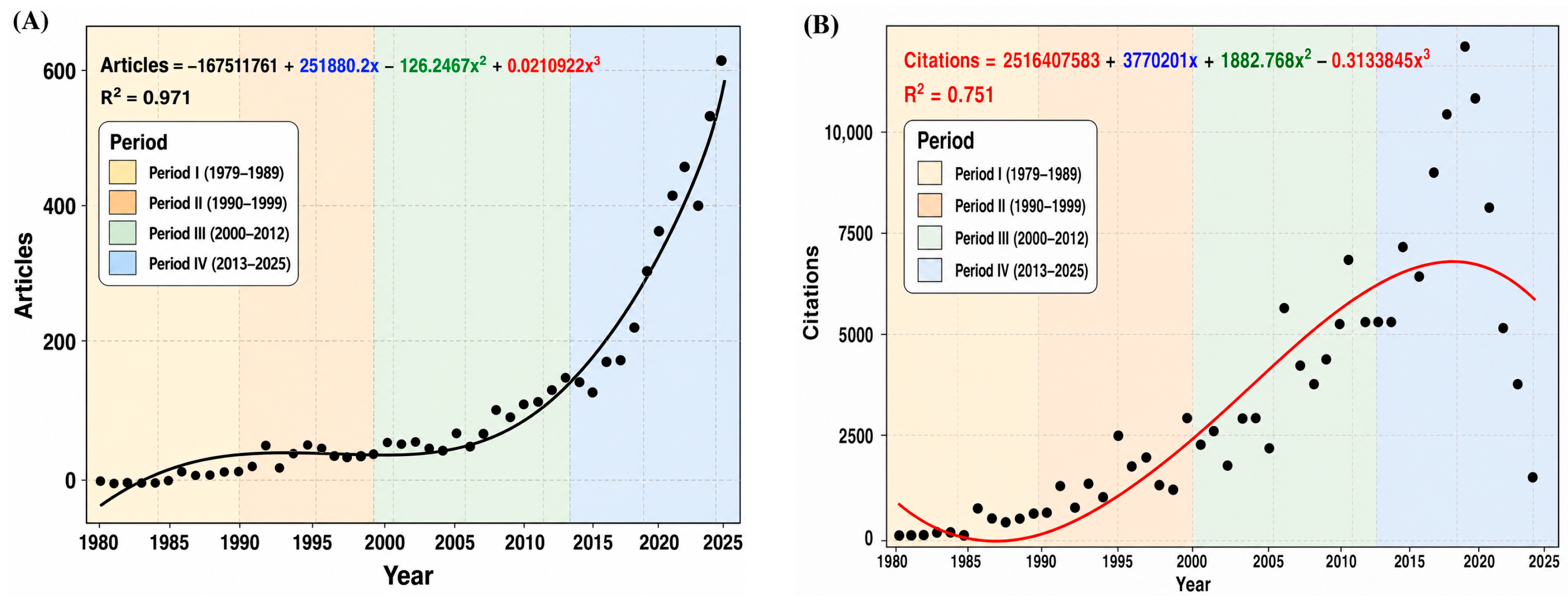
Global agroforestry research showed a temporal increase between 1979 and 2025 (Figure 2). Research output was distributed across four periods: Period I (1979–1989), with 100 articles; Period II (1990–1999), with 428 articles; Period III (2000–2012), with 1050 articles; and Period IV (2013–2025), with 4133 articles. Annual scientific production increased from an average of 9.09 articles per year in Period I to 42.8 in Period II, 80.8 in Period III, and 318 articles per year in Period IV. The annual publication trajectory followed an increasing polynomial trend, particularly after 2013. The fitted model for annual articles indicated a sustained expansion of agroforestry research output during the most recent period (Figure 2A). Citation counts also increased over time. Annual citations were lowest during Period I and increased in subsequent periods, reaching their maximum value during Period IV (Figure 2B). Differences among historical periods were statistically significant for both annual articles and annual citations.
The Kruskal–Wallis test indicated significant period-level differences in annual scientific production (H = 42.3, df = 3, p = 3.53 × 10⁻⁹) and annual citations (H = 38.3, df = 3, p = 2.39 × 10⁻⁸). Dunn’s post hoc comparisons showed that annual scientific production differed significantly between Period I and Period III, and that Period IV differed significantly from all previous periods. For annual citations, significant differences were only observed between Period I and Period III, Period I and Period IV, and Period II and Period IV.
-
Thematic evolution across periods
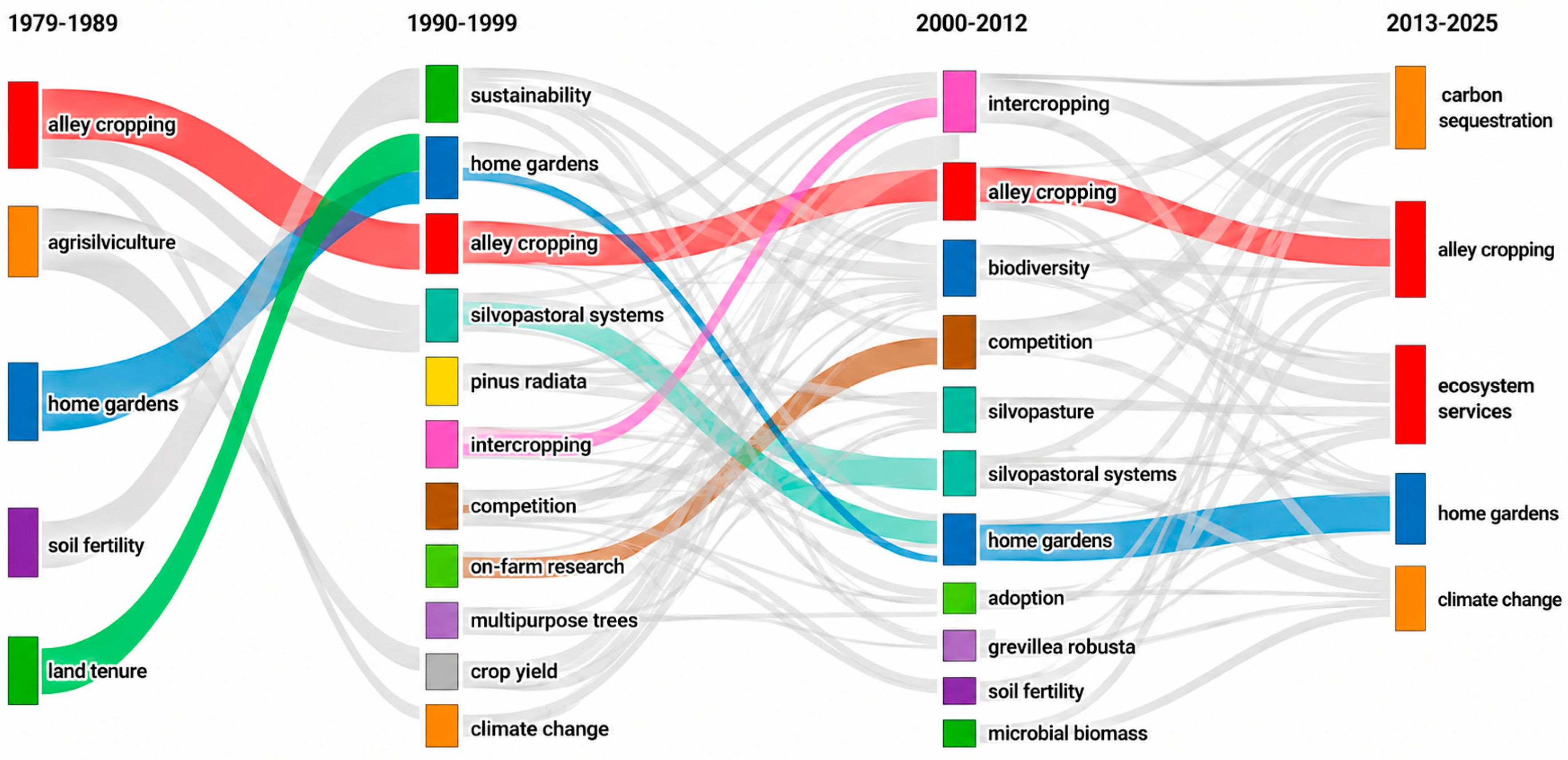
The thematic evolution map showed changes in the composition and continuity of themes derived from author keywords across the four historical periods (Figure 3). After excluding the corpus-defining search terms agroforestry and agroforestry systems, the analysis identified the thematic communities represented within each period and their connections across consecutive periods.
During Period I (1979 to 1989), the thematic structure comprised a limited set of topics represented primarily by *alley cropping*, *agrisilviculture*, *home gardens*, *soil fertility*, and *land tenure*. Agronomic management, system configuration, soil processes, and land use were the principal thematic components represented during this period.
In Period II (1990 to 1999), the number and diversity of thematic labels increased. Themes associated with *home gardens*, *alley cropping*, and *soil fertility* maintained connections with the preceding period, while additional topics included *sustainability*, *silvopastoral systems*, *competition*, *intercropping*, *multipurpose trees*, *crop yield*, *on-farm research*, *climate change*, and *Pinus radiata*. The thematic structure during this period incorporated a broader range of production, management, and sustainability-related topics.
During Period III (2000 to 2012), the thematic map included terms related to production, ecological processes, and adoption. Representative keywords included *intercropping*, *alley cropping*, *competition*, *biodiversity*, *silvopasture*, *silvopastoral systems*, *home gardens*, *adoption*, *Grevillea robusta*, *soil fertility*, and *microbial biomass*. *Alley cropping*, *intercropping*, and *competition* maintained visible connections with themes identified in earlier periods, whereas *biodiversity* and *adoption* became more clearly represented within the thematic structure.
In Period IV (2013 to 2025), the most visible thematic labels included *carbon sequestration*, *alley cropping*, *ecosystem services*, *home gardens*, and *climate change*. *Alley cropping* and *home gardens* maintained connections with themes identified in previous periods, while *carbon sequestration*, *climate change*, and *ecosystem services* became more prominent representation in the most recent thematic structure.

3.2. Conceptual Structure of Agroforestry Research

-
MCA based on harmonized Author Keywords
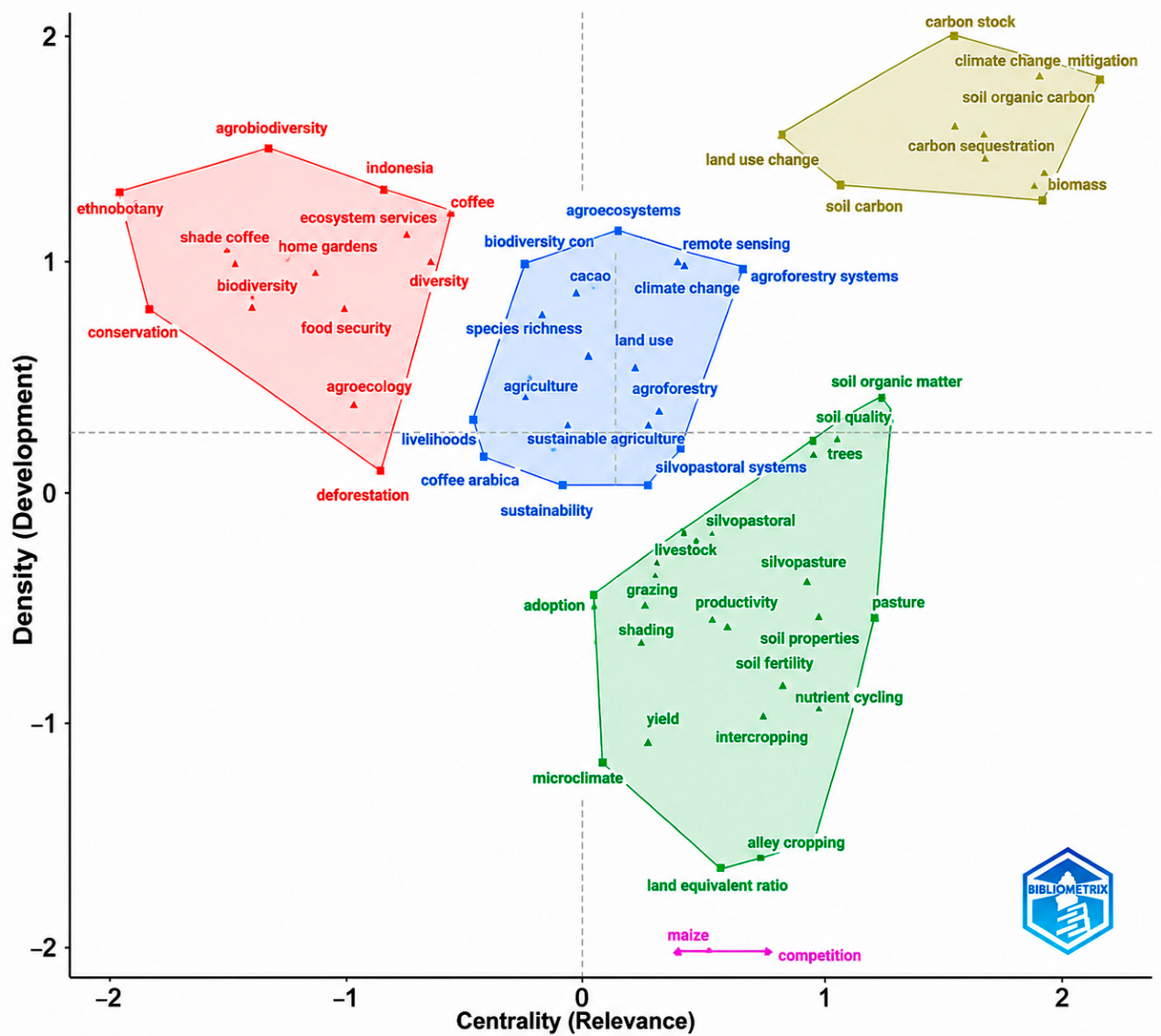
Multiple Correspondence Analysis (MCA) based on harmonized author keywords showed a differentiated conceptual structure within the analyzed agroforestry literature (Figure 4). The first two dimensions accounted for 23.01% and 16.75% of the total inertia, respectively. The retained five-cluster solution comprised groups associated with agroforestry and sustainability, biodiversity and diversified agroecosystems, carbon and climate mitigation, silvopastoral production and agronomic management, and a small peripheral group defined by maize and competition.
The central cluster grouped terms associated with agroforestry, sustainability, and land use, including agroforestry, agroforestry systems, agroecosystems, sustainable agriculture, climate change, land use, species richness, biodiversity conservation, cacao, and livelihoods. Livelihood-related terms were positioned within this cluster and did not form an independent cluster under the retained analytical configuration.
A second cluster, located on the left side of the factorial space, grouped terms related to biodiversity and diversified agroecosystems, including biodiversity, conservation, agrobiodiversity, ecosystem services, food security, home gardens, shade coffee, ethnobotany, agroecology, and deforestation.
A third cluster, positioned in the upper right portion of the factorial space, comprised carbon stock, carbon sequestration, soil organic carbon, soil carbon, biomass, land use change, and climate change mitigation. These terms formed a compact group associated with carbon-related and climate mitigation topics.
The fourth cluster occupied the lower right portion of the factorial space and grouped terms related to silvopastoral production and agronomic management, including silvopastoral, silvopasture, livestock, grazing, pasture, productivity, soil fertility, soil properties, soil quality, soil organic matter, nutrient cycling, intercropping, yield, alley cropping, land equivalent ratio, and microclimate. The fifth cluster was small and peripheral and consisted of only maize and competition.
With the number of clusters fixed at k = 5, the sensitivity analysis excluding the corpus-defining terms agroforestry and agroforestry systems included 48 keywords. The first two dimensions accounted for 25.90% and 18.08% of the total inertia, respectively. The broader environmental, carbon-related, and production-oriented organization of the conceptual space was preserved, although the fine-scale partitioning of individual keywords changed. Livelihood-related terms did not form an independent cluster. Detailed results are presented in Supplementary Figure S1.
-
Position of Rural Livelihoods in the Conceptual Structure
To summarize the conceptual organization identified by the MCA, the five retained clusters were characterized according to their centroid positions, representative keywords, and conceptual interpretation (Table 1). Cluster 1 occupied the central portion of the factorial space and grouped agroforestry, agroforestry systems, sustainability, sustainable agriculture, livelihoods, land use, agroecosystems, cacao, species richness, biodiversity conservation, and climate change. Livelihood-related terms were located within this central agroforestry and sustainability cluster and did not form an independent grouping. Cluster 2 comprised biodiversity, conservation, agrobiodiversity, ecosystem services, food security, home gardens, shade coffee, ethnobotany, agroecology, and deforestation, representing biodiversity conservation and diversified agroecosystems. Cluster 3 formed a compact carbon and climate-related grouping characterized by carbon sequestration, carbon stock, soil organic carbon, soil carbon, biomass, land use change, and climate change mitigation. Cluster 4 grouped production and management-related terms, including silvopastoral, silvopasture, livestock, grazing, pasture, productivity, soil fertility, soil properties, soil organic matter, nutrient cycling, intercropping, yield, alley cropping, land equivalent ratio, microclimate, and adoption. Cluster 5 was a small peripheral grouping represented by maize and competition. The MCA indicated that livelihood-related terms were embedded within the broader agroforestry and sustainability cluster rather than forming a distinct cluster under the analytical configuration applied.
-
Relative contribution of analytical domains
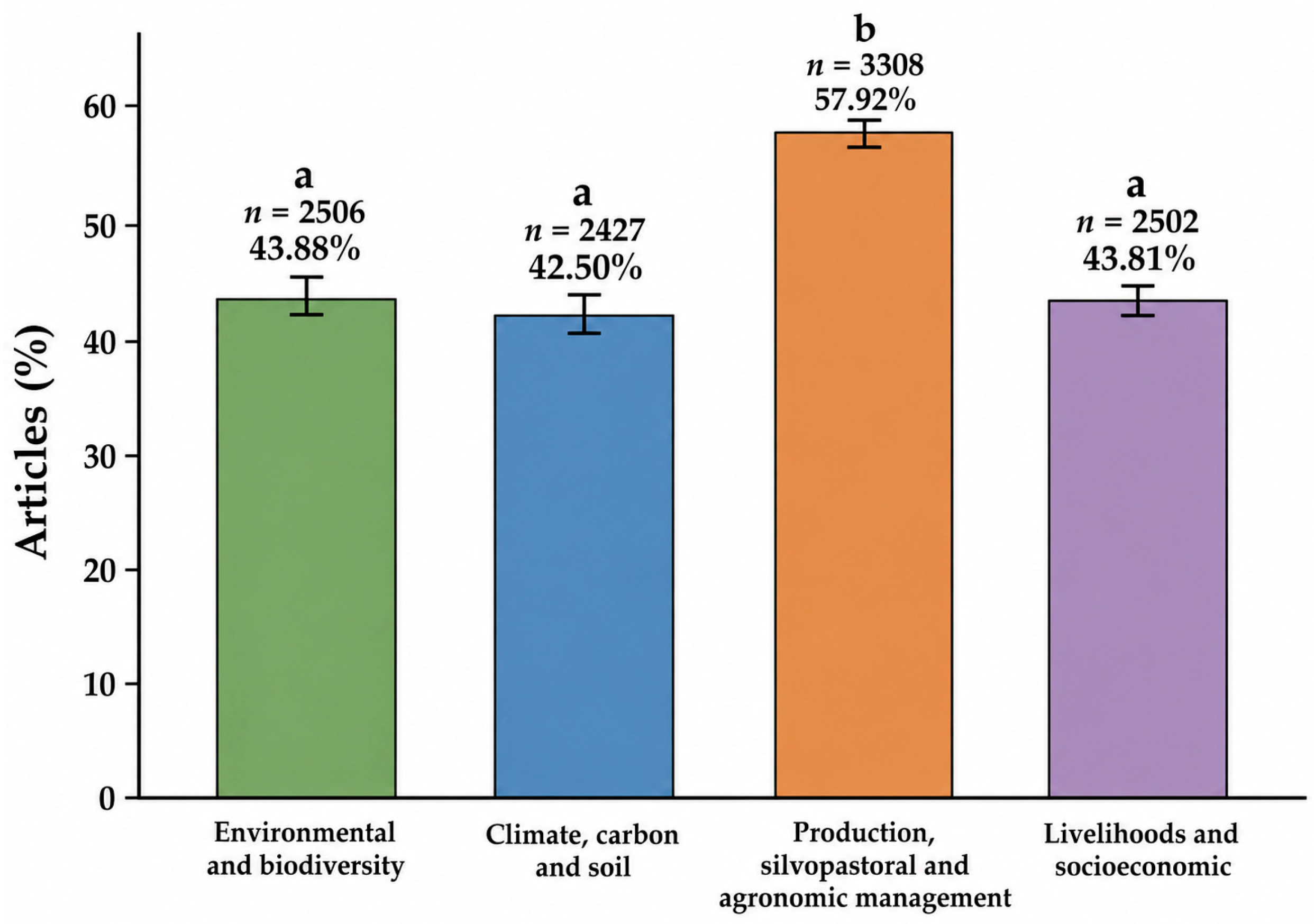
The proportion of articles assigned to the four analytical domains differed within the analyzed agroforestry corpus (Figure 5). Production, silvopastoral and agronomic management had the highest representation, comprising 57.92% of the corpus (n = 3308). Environmental and biodiversity dimensions accounted for 43.88% (n = 2506), followed by livelihoods and socioeconomic dimensions at 43.81% (n = 2502) and climate, carbon and soil dimensions at 42.50% (n = 2427).
Cochran’s Q test indicated a significant overall difference among the four related domain proportions (Q = 349.90, df = 3, p < 0.001; n = 5711). Pairwise McNemar tests with Holm adjustment showed that production, silvopastoral and agronomic management had a significantly higher proportion of assigned articles than environmental and biodiversity dimensions, climate, carbon and soil dimensions, and livelihoods and socioeconomic dimensions. No significant pairwise differences were detected among the latter three domains, which shared the same significance group in Figure 5. Thus, the overall difference was attributable to the higher representation of the production, silvopastoral and agronomic management domain, whereas the other three domains occurred at comparable proportions within the corpus.

3.3. Geographical and Economic Distribution of Research Domains

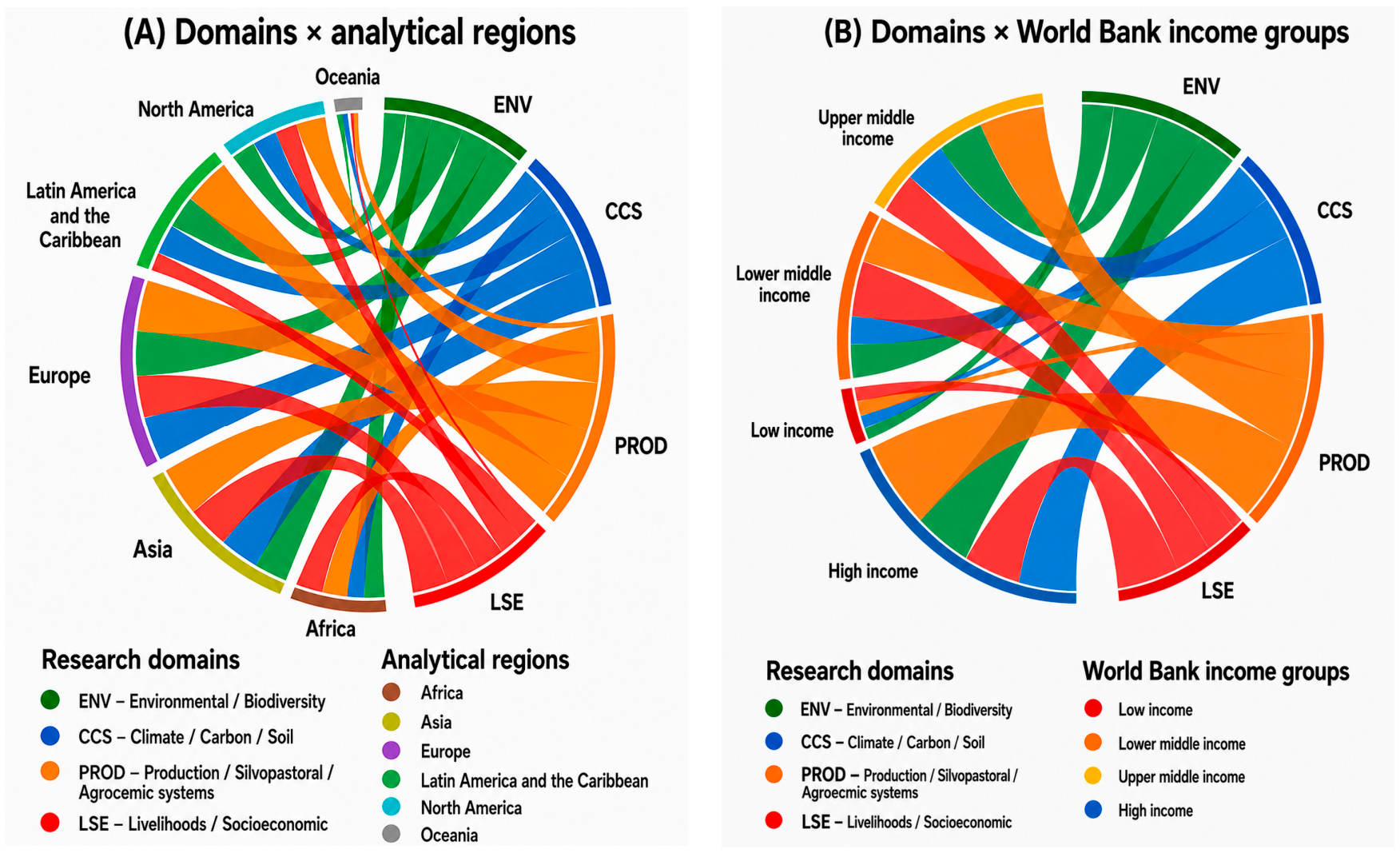
The chord diagrams showed that the four analytical domains were represented across all analytical regions, although the magnitude of their fractional contributions varied (Figure 6). In the regional structure (Figure 6A), the environmental and biodiversity domain showed its largest contributions in Europe, Asia, and Latin America and the Caribbean. The climate, carbon, and soil domain showed its largest contributions in Asia and Europe, followed by Latin America and the Caribbean. The production, silvopastoral, and agronomic management domain had the largest accumulated regional contribution, particularly in Latin America and the Caribbean, Europe, and Asia. The livelihoods and socioeconomic domain showed its largest contributions in Asia, Europe, and Africa. Oceania had the smallest fractional contribution in all four domains.
The distribution by World Bank income group also varied among domains (Figure 6B). High-income countries accounted for the largest fractional contribution within each of the four domains. The highest contribution from high-income countries occurred in the production, silvopastoral, and agronomic management domain, followed by environmental and biodiversity, livelihoods and socioeconomic, and climate, carbon, and soil dimensions. Upper-middle-income countries provided the second-largest contribution in the environmental and biodiversity, climate, carbon and soil, and production domains. In contrast, within the livelihoods and socioeconomic domain, lower-middle-income countries provided the second-largest contribution, slightly exceeding that of upper-middle-income countries. Low-income countries accounted for the smallest fractional contribution in all four domains. Production-related research accumulated the largest fractional contribution across regions and income groups, while the livelihoods and socioeconomic domain showed relatively larger fractional contributions from Africa and lower-middle-income countries.

4. Discussion

4.1. Expansion and Thematic Reorientation of Agroforestry Research

The publication record expanded across all four periods, with the strongest increase between 2013 and 2025. The thematic map also indicates a broader research agenda. Early work centered on intercropping, alley cropping, home gardens, soil fertility, and farm management, whereas recent work gave greater visibility to carbon sequestration, ecosystem services, climate change, biodiversity, adoption, and silvopastoral systems. This sequence is consistent with the growth of ecosystem-service and resilience perspectives reported in earlier syntheses [7,38]. It indicates diversification in the questions addressed by agroforestry research, rather than a simple increase in publication volume.
The temporal change should not be read as the replacement of agronomic research. Alley cropping and home gardens persisted across periods, and silvopastoral systems remained part of the recent thematic structure. Productive practices therefore continued while carbon, climate, and ecosystem-service topics gained visibility. Recent analyses likewise treat agroforestry as a set of systems in which production, environmental regulation, and social objectives are examined together [39,40]. The field has widened by adding analytical dimensions to long-standing management questions, although the balance among those dimensions varies by system, location, and research design.
This diversification also helps explain why the conceptual map contains several differentiated components rather than one uniform research agenda. A review map of agroforestry outcomes found extensive variation in practices, indicators, and geographical coverage, with environmental outcomes studied more often than social out-comes [41]. The present temporal analysis adds a historical view: newer environmental and climate themes coexist with continuing attention to farm management and production. Such coexistence supports an interdisciplinary reading of the field, but it also requires separating the frequency of articles assigned to a domain from the way keywords organize conceptually.

4.2. Production Predominance and Conceptual Differentiation of Carbon-Related and Production-Oriented Research

Domain classification showed a clear quantitative result. Production, silvopastoral, and agronomic management was assigned to 57.92% of the corpus and was the only domain with a significantly higher proportional representation. Environmental and biodiversity dimensions accounted for 43.88%, livelihoods and socioeconomic dimensions for 43.81%, and climate, carbon, and soil dimensions for 42.50%; these three proportions did not differ significantly. Accordingly, the corpus was quantitatively dominated by PROD, not by CCS. This distinction corrects any interpretation that equates a well-defined carbon component with a larger share of articles.
The MCA provides a different type of evidence. Carbon stock, carbon sequestration, soil organic carbon, soil carbon, biomass, land-use change, and climate-change mitigation formed a compact cluster. Production and agronomic management formed another component around silvopasture, livestock, grazing, pasture, productivity, soil fertility, soil properties, nutrient cycling, intercropping, yield, alley cropping, and microclimate. These groupings indicate differentiated patterns of keyword co-occurrence and related research questions. The compact carbon-related cluster therefore describes conceptual organization under the MCA configuration; it does not indicate that CCS occurred more frequently than ENV or LSE in the corpus.
Recent quantitative syntheses help interpret both components without merging them. Soil-carbon meta-analyses provide comparable measures of carbon stocks and sequestration across systems [12,42], while production studies evaluate yield, animal performance, soil fertility, and management outcomes [43,44,45,46]. A global meta-analysis of maize found that yield responses depended on environmental and management conditions, despite a positive median response [47]. In coffee agroforestry, joint provision of production, carbon, waterquality, and biodiversity services depended on tree selection and density [48]. Measurable outcomes can therefore support differentiated studies while remaining connected in field-level decisions.

4.3. Biodiversity, Conservation and Diversified Agroecosystems as a Distinct Conceptual Component

Cluster 2 was a differentiated conceptual grouping centered on biodiversity and diversified agroecosystems. Its representative terms were biodiversity, conservation, agrobiodiversity, ecosystem services, food security, home gardens, shade coffee, ethnobotany, agroecology, and deforestation. This composition links conservation questions with managed, speciesrich production systems and with the services derived from them. The cluster was distinct from the central agroforestry and sustainability cluster in which the keyword livelihoods was located. The MCA therefore places the keyword livelihoods within Cluster 1 rather than Cluster 2, while smallholder- and local-knowledge-related terms are represented within the biodiversity and diversified agroecosystem cluster.
The cluster is consistent with research that evaluates biodiversity within working agricultural landscapes rather than only in protected ecosystems. Conceptual and empirical studies connect species diversity with ecosystem functioning, restoration, habitat provision, and management [49,50]. Across 2517 plots in six Central American countries, shade-plant composition varied among coffee, cocoa, dispersed-tree pasture, and live-fence systems, and no single system was consistently the most diverse across countries [51]. This context dependence supports treating diversified agroecosystems as a distinct research component while avoiding uniform claims about their conservation value.
Food security, home gardens, shade coffee, and ethnobotany in the same cluster also indicate that biodiversity research often examines useful species, culturally managed assemblages, and production landscapes. Their co-occurrence does not demonstrate a causal pathway from biodiversity to socioeconomic benefits, nor does it place livelihood terminology inside the cluster. Instead, it identifies a shared semantic space in which conservation and diversification are discussed through particular agroforestry systems. This interpretation preserves the ecological and management content of Cluster 2 while leaving livelihood outcomes to be evaluated through the separate domain classification and the central MCA cluster.

4.4. Rural Livelihoods: Substantial Representation Without an Independent Keyword Cluster

Livelihoods and socioeconomic dimensions were assigned to 43.81% of the articles. This proportion was nearly identical to ENV at 43.88% and close to CCS at 42.50%, with no significant pairwise differences among the three domains. LSE therefore had substantial quantitative representation and was not the least represented domain in an analytically meaningful sense. The only distinct proportional result was the higher representation of PROD. This finding is important because it separates the amount of livelihood-related content detected by the controlled dictionary from the conceptual grouping of author keywords in the MCA.
In the retained MCA solution, livelihoods occurred within the central cluster organized around agroforestry and sustainability. Other terms in this cluster included agroforestry systems, sustainable agriculture, land use, agroecosystems, cocoa, species richness, biodiversity conservation, and climate change. Under the analytical configuration applied, livelihoods were nested within the central agroforestry and sustainability cluster. Substantial quantitative representation therefore did not correspond to an independent livelihood-centered keyword structure. The result indicates conceptual embedding within a broad sustainability vocabulary rather than numerical absence from literature.
The sensitivity analysis supports this interpretation. After removal of the corpus-defining terms agroforestry and agroforestry systems, the analysis retained k = 5 and included 48 keywords. The broader environmental, carbon-related, and production-oriented organization remained visible, although individual keyword assignments changed, and livelihood-related terms again did not form an independent cluster. Because the search anchors were excluded while the number of clusters was held constant, the repeated absence of a livelihood-centered group cannot be attributed only to those two dominant terms. It remains conditional, however, on keyword selection, harmonization, frequency thresholds, and the fixed five-cluster solution.
A plausible interpretation is that socioeconomic research uses a heterogeneous vocabulary across income, food security, wellbeing, adoption, tenure, perceptions, markets, household strategies, local knowledge, and resilience. Reviews report uneven coverage and limited comparability for many social outcomes [15,52], and a recent evidence map found far fewer syntheses centered on social outcomes than on environmental or yield outcomes [41]. Adoption decisions can also change across successive stages and depend on farm size, household decision making, income, and livestock assets [53]. Such diversity can disperse livelihood concepts across keywords even when many articles address them.
The absence of an independent livelihood-centered cluster should not be interpreted as evidence that livelihoods lack substantive or theoretical importance. MCA captures keyword co-occurrence under the applied analytical configuration, not the full arguments, measures, or causal models within each article. Domain assignment and MCA answer related but different questions: the former estimates the share of articles containing controlled domain terms, whereas the latter summarizes associations among frequent author keywords. Epistemic caution is therefore necessary. The combined evidence supports substantial livelihood-related attention with limited semantic autonomy, while leaving open whether alternative vocabularies, classifications, or text sources would produce a different conceptual partition.

4.5. Geographical and Economic Distribution of Analytical Domains

The geographical results in Figure 6 describe fractional contributions from author affiliations. They indicate institutional participation in the literature and should not be interpreted as the locations of study sites, because author affiliation and geographical topic focus are distinct dimensions in bibliometric analyses [54]. For ENV, the largest contributions came from Europe, Asia and Latin America and the Caribbean. CCS received its largest contributions from Asia and Europe, followed by Latin America and the Caribbean. PROD was concentrated mainly in Latin America and the Caribbean, Europe, and Asia. LSE received its largest absolute contributions from Asia, Europe, and Africa. Oceania supplied the smallest fractional contribution to every domain.
Africa had comparatively greater relative participation in LSE than in its contributions to the other domains, but Asia and Europe still provided larger absolute LSE contributions. At the broader field level, a recent global bibliometric review found that international collaboration was concentrated among European, North American, and Asian researchers, whereas African contributions remained comparatively limited [55]. This broader pattern provides context for the distinction between Africa’s relative participation in LSE and the larger absolute contributions from Asia and Europe in the present corpus. These statements describe the ribbon magnitudes in the fractional-counting analysis and do not establish regional effects or relationships between location and topic. They cannot determine where fieldwork occurred, which populations were studied, or whether regional research priorities differ after accounting for publication volume and collaboration structure.
The income-group distribution follows the same descriptive logic. High-income countries provided the largest fractional contribution in ENV, CCS, PROD, and LSE. Upper-middle-income countries ranked second in ENV, CCS, and PROD. In LSE, lower-midle-income countries ranked second and slightly exceeded the upper-middle-income contribution. Low-income countries provided the smallest contribution to all four domains. Since Figure 6 reports fractional affiliation weights and no inferential test was applied to region or income group, these magnitudes should not be described through association, probability, or explanatory language. They provide a map of participation rather than a test of geographical or economic determinants.

4.6. Knowledge Integration and Rural Development Implications

The differentiated environmental, carbon-related, and production-oriented keyword structures are consistent with the hypothesis, while livelihood-related terms did not form an independent cluster. Figure 5 immediately qualifies that result: the absence of an independent cluster was not accompanied by low quantitative representation, because LSE accounted for 43.81% of the corpus and did not differ significantly from ENV or CCS. The hypothesis is therefore supported for conceptual differentiation of the biophysical and productive components, but only partly supported for livelihoods. Livelihood research was substantial in frequency and embedded within the central agroforestry and sustainability structure.
For rural development, the main implication is the need to analyze biophysical, productive, and socioeconomic outcomes within the same evaluative framework. Carbon storage, biodiversity, soil condition, yield, and livestock performance can interact through synergies or trade-offs [40,56]. Coffee-system research likewise shows that joint service provision depends on management choices [48], while carbon interventions can produce different carbon and biodiversity outcomes across agroforestry complexity gradients [57]. Integration therefore requires explicit outcome definitions, comparable baselines, and attention to who receives benefits or bears costs under alternative system designs.
Governance and adoption determine whether potential system benefits become durable household outcomes. Landscape approaches can connect conservation and agricultural actors [9], but adoption also depends on tenure, market access, technical support, household resources, and institutional stability [58]. Studies should assess income, food security, wellbeing, equity, and household resilience alongside carbon, biodiversity, soil, and production indicators. They should also report time horizons, because establishment costs and delayed tree benefits can alter household choices. This approach treats livelihoods as an analytical dimension with its own measures rather than as an assumed consequence of environmental improvement or higher production.
Two extensions should remain future research rather than findings of this study. First, bibliographic records and full texts could be used to classify public, private, and mixed funding, then examine whether funding structures are related to thematic orientation. The present analysis did not test funding sources and cannot support claims about private-industry bias. Second, future work could compare thematic distributions with the United Nations Sustainable Development Goals and with national development, climate, biodiversity, and agroforestry policy priorities. No SDG or policy mapping was performed here, so current alignment or mismatch should not be inferred.
The interpretation is limited to Scopus-indexed, English-language journal articles. Restricting the focal agroforestry block to the TITLE field prioritized an agroforestry-centered corpus but may have excluded relevant studies that addressed agroforestry only in their abstracts or keywords. Because no TITLE-ABS-KEY sensitivity analysis was conducted, the findings apply to the corpus retrieved through the reported search strategy and should not be interpreted as an exhaustive census of all agroforestry-related literature. Interpretation is also limited by the semantic scope of the harmonized author keywords and controlled domain dictionary. MCA results depend on keyword cleaning, frequency thresholds, retained dimensions, and the fixed clustering configuration. Domain classification indicates textual assignment rather than direct empirical measurement of environmental, productive, or livelihood outcomes. Author-affiliation geography measures institutional participation rather than study sites. Finally, Figure 6 is descriptive because no inferential tests were applied to regions or income groups. These limitations define the scope of the conclusions, including the observed contrast between quantitative domain representation and keyword co-occurrence organization.

5. Conclusions

This bibliometric analysis of 5711 Scopus-indexed journal articles showed that global agroforestry research expanded substantially between 1979 and 2025 and became progressively diversified in its thematic organization. Livelihood-related terms were located within the central agroforestry and sustainability cluster under the analytical configuration applied in this research. This pattern persisted after excluding the corpus-defining search-anchor terms, indicating that it was not solely dependent on the presence of agroforestry and agroforestry systems in the primary MCA. Domain analysis indicated that production, silvopastoral and agronomic management had the highest proportional representation in the corpus, whereas environmental and biodiversity, climate, carbon and soil, and livelihoods and socioeconomic dimensions occurred at comparable proportions. Geographical and economic analyses based on fractional affiliation contributions indicated that all four domains were represented across the analytical regions and World Bank income groups, although their distributions varied. Production-related research accumulated the largest fractional contribution across regions and income groups, whereas livelihoods and socioeconomic research showed relatively larger fractional contributions from Africa and lower-middle-income countries. Rural livelihoods were therefore substantially represented in agroforestry research, with their terminology embedded within a broader sustainability-oriented conceptual space. This pattern should be interpreted as a property of the observed keyword co-occurrence structure and not as evidence that livelihoods lack substantive or theoretical importance within agroforestry research.

Supplementary Materials

The following supporting information can be downloaded at https://www.mdpi.com/article/10.3390/land15091571/s1. Table S1: Stop-word list used in preprocessing of author keywords; Table S2: Controlled dictionary and synonym mappings used to standardize author keywords; Table S3: Controlled dictionary used for non-exclusive analytical domain classification; Figure S1: Sensitivity analysis of the conceptual structure after exclusion of the corpus-defining terms agroforestry and agroforestry systems.

Author Contributions

Conceptualization, B.T. and A.G.; methodology, B.T. and J.U.-Z.; software, B.T. and J.U.-Z.; validation, A.G., C.D.-P.-H. and R.J.H.-F. formal analysis, J.U.-Z. and F.S.C.; writing—original draft preparation, B.T., J.U.-Z., R.J.H.-F., C.D.-P.-H., F.S.C. and A.G.; writing—review and editing, J.U.-Z., F.S.C. and A.G.; supervision, B.T., C.D.-P.-H. and A.G. All authors were involved in developing, writing, commenting, editing, and reviewing the manuscript. All authors have read and agreed to the published version of the manuscript.

Funding

This research was funded by the Fondo Competitivo de Investigación, Ciencia y Tecnología (Competitive Fund for Research, Science, and Technology), Décima Convocatoria, Universidad Técnica Estatal de Quevedo, grant number FOCICYT 2024-2025. The funder had no influence on the study.

Data Availability Statement

The data are not available in any publicly accessible data repositories; however, if an editorial committee needs access, we will happily provide them with the data (please use this email: jurdanigo@uteq.edu.ec).

Acknowledgments

This work is part of the results of a joint research agreement between Amazon State University (UEA) and Universidad Técnica Estatal de Quevedo (UTEQ). We would also like to acknowledge the ECONGEST AGR267 Group at Cordoba University for their support. During the preparation of this manuscript the authors used GPT-5 Pro. to enhance R scripts for data analysis. The authors have reviewed and edited the output and take full responsibility for the content of this publication.

Conflicts of Interest

The authors declare no conflicts of interest.

References

  1. Pantera, A.; Mosquera-Losada, M.R.; Herzog, F.; den Herder, M. Agroforestry and the Environment. Agrofor. Syst. 2021, 95, 767–774. [Google Scholar] [CrossRef] [Scilit]
  2. Jose, S. Agroforestry for Ecosystem Services and Environmental Benefits: An Overview. Agrofor. Syst. 2009, 76, 1–10. [Google Scholar] [CrossRef] [Scilit]
  3. Torralba, M.; Fagerholm, N.; Burgess, P.J.; Moreno, G.; Plieninger, T. Do European Agroforestry Systems Enhance Biodiversity and Ecosystem Services? A Meta-Analysis. Agric. Ecosyst. Environ. 2016, 230, 150–161. [Google Scholar] [CrossRef] [Scilit]
  4. Zomer, R.J.; Neufeldt, H.; Xu, J.; Ahrends, A.; Bossio, D.; Trabucco, A.; van Noordwijk, M.; Wang, M. Global Tree Cover and Biomass Carbon on Agricultural Land: The Contribution of Agroforestry to Global and National Carbon Budgets. Sci. Rep. 2016, 6, 29987. [Google Scholar] [CrossRef] [Scilit]
  5. Mbow, C.; Van Noordwijk, M.; Luedeling, E.; Neufeldt, H.; Minang, P.A.; Kowero, G. Agroforestry Solutions to Address Food Security and Climate Change Challenges in Africa. Curr. Opin. Environ. Sustain. 2014, 6, 61–67. [Google Scholar] [CrossRef] [Scilit]
  6. Liu, W.; Yao, S.; Wang, J.; Liu, M. Trends and Features of Agroforestry Research Based on Bibliometric Analysis. Sustainability 2019, 11, 3473. [Google Scholar] [CrossRef] [Scilit]
  7. Shin, S.; Soe, K.T.; Lee, H.; Kim, T.H.; Lee, S.; Park, M.S. A Systematic Map of Agroforestry Research Focusing on Ecosystem Services in the Asia-Pacific Region. Forests 2020, 11, 368. [Google Scholar] [CrossRef] [Scilit]
  8. Brown, S.E.; Miller, D.C.; Ordonez, P.J.; Baylis, K. Evidence for the Impacts of Agroforestry on Agricultural Productivity, Ecosystem Services, and Human Well-Being in High-Income Countries: A Systematic Map Protocol. Environ. Evid. 2018, 7, 24. [Google Scholar] [CrossRef] [Scilit]
  9. Zinngrebe, Y.; Borasino, E.; Chiputwa, B.; Dobie, P.; Garcia, E.; Gassner, A.; Kihumuro, P.; Komarudin, H.; Liswanti, N.; Makui, P.; et al. Agroforestry Governance for Operationalising the Landscape Approach: Connecting Conservation and Farming Actors. Sustain. Sci. 2020, 15, 1417–1434. [Google Scholar] [CrossRef] [Scilit]
  10. Bhagwat, S.A.; Willis, K.J.; Birks, H.J.B.; Whittaker, R.J. Agroforestry: A Refuge for Tropical Biodiversity? Trends Ecol. Evol. 2008, 23, 261–267. [Google Scholar] [CrossRef] [Scilit]
  11. Barrios, E.; Valencia, V.; Jonsson, M.; Brauman, A.; Hairiah, K.; Mortimer, P.E.; Okubo, S. Contribution of Trees to the Conservation of Biodiversity and Ecosystem Services in Agricultural Landscapes. Int. J. Biodivers. Sci. Ecosyst. Serv. Manag. 2018, 14, 1–16. [Google Scholar] [CrossRef] [Scilit]
  12. Mayer, S.; Wiesmeier, M.; Sakamoto, E.; Hübner, R.; Cardinael, R.; Kühnel, A.; Kögel-Knabner, I. Soil Organic Carbon Sequestration in Temperate Agroforestry Systems–A Meta-Analysis. Agric. Ecosyst. Environ. 2022, 323, 107689. [Google Scholar] [CrossRef] [Scilit]
  13. Rao, M.R.; Nair, P.K.R.; Ong, C.K. Biophysical Interactions in Tropical Agroforestry Systems. Agrofor. Syst. 1997, 38, 3–50. [Google Scholar] [CrossRef] [Scilit]
  14. Peri, P.L.; Chará, J.; Viñoles, C.; Bussoni, A.; Cubbage, F. Current Trends in Silvopastoral Systems. Agrofor. Syst. 2024, 98, 1945–1953. [Google Scholar] [CrossRef] [Scilit]
  15. Miller, D.C.; Ordoñez, P.J.; Brown, S.E.; Forrest, S.; Nava, N.J.; Hughes, K.; Baylis, K. The Impacts of Agroforestry on Agricultural Productivity, Ecosystem Services, and Human Well-being in Low-and Middle-income Countries: An Evidence and Gap Map. Campbell Syst. Rev. 2020, 16, cl2.1066. [Google Scholar] [CrossRef] [Scilit]
  16. Pagiola, S.; Ramírez, E.; Gobbi, J.; de Haan, C.; Ibrahim, M.; Murgueitio, E.; Ruíz, J.P. Paying for the Environmental Services of Silvopastoral Practices in Nicaragua. Ecol. Econ. 2007, 64, 374–385. [Google Scholar] [CrossRef] [Scilit]
  17. Buchmann, C. Cuban Home Gardens and Their Role in Social–Ecological Resilience. Hum. Ecol. 2009, 37, 705–721. [Google Scholar] [CrossRef] [Scilit]
  18. Siles, P.; Cerdán, C.R.; Staver, C. Smallholder Coffee in the Global Economy—A Framework to Explore Transformation Alternatives of Traditional Agroforestry for Greater Economic, Ecological, and Livelihood Viability. Front. Sustain. Food Syst. 2022, 6, 808207. [Google Scholar] [CrossRef] [Scilit]
  19. Sudomo, A.; Leksono, B.; Tata, H.L.; Rahayu, A.A.D.; Umroni, A.; Rianawati, H.; Asmaliyah; Krisnawati; Setyayudi, A.; Utomo, M.M.B.; et al. Can Agroforestry Contribute to Food and Livelihood Security for Indonesia’s Smallholders in the Climate Change Era? Agriculture 2023, 13, 1896. [Google Scholar] [CrossRef] [Scilit]
  20. Ahmad, S.; Xu, H.; Ekanayake, E.M.B.P. Socioeconomic Determinants and Perceptions of Smallholder Farmers towards Agroforestry Adoption in Northern Irrigated Plain, Pakistan. Land 2023, 12, 813. [Google Scholar] [CrossRef] [Scilit]
  21. Mukhlis, I.; Syamsu Rizaludin, M.; Hidayah, I. Understanding Socio-Economic and Environmental Impacts of Agroforestry on Rural Communities. Forests 2022, 13, 556. [Google Scholar] [CrossRef] [Scilit]
  22. Schaffer, C.; Elbakidze, M.; Björklund, J. Motivation and Perception of Farmers on the Benefits and Challenges of Agroforestry in Sweden (Northern Europe). Agrofor. Syst. 2024, 98, 939–958. [Google Scholar] [CrossRef] [Scilit]
  23. Fané, S.; Agbotui, D.K.; Graefe, S.; Sanou, L.; Sanogo, S.; Buerkert, A. Adoption of Agroforestry Systems by Smallholders’ Farmers in the Sudano-Sahelian Zones of Mali and Burkina Faso, West Africa. Agrofor. Syst. 2024, 98, 2385–2396. [Google Scholar] [CrossRef] [Scilit]
  24. Ninkov, A.; Frank, J.R.; Maggio, L.A. Bibliometrics: Methods for Studying Academic Publishing. Perspect. Med. Educ. 2022, 11, 173–176. [Google Scholar] [CrossRef] [Scilit]
  25. Urdánigo-Zambrano, J.; Torres, B.; De-Pablos-Heredero, C.; Herrera-Feijoo, R.; García, A. Open Data Reuse in Agricultural, Livestock, and Environmental Systems: A Global Scoping Review with a Case Analysis of Ecuador. Land 2026, 15, 13. [Google Scholar] [CrossRef] [Scilit]
  26. Page, M.J.; McKenzie, J.E.; Bossuyt, P.M.; Boutron, I.; Hoffmann, T.C.; Mulrow, C.D.; Shamseer, L.; Tetzlaff, J.M.; Moher, D. Updating Guidance for Reporting Systematic Reviews: Development of the PRISMA 2020 Statement. J. Clin. Epidemiol. 2021, 134, 103–112. [Google Scholar] [CrossRef] [Scilit]
  27. Zhu, J.; Liu, W. A Tale of Two Databases: The Use of Web of Science and Scopus in Academic Papers. Scientometrics 2020, 123, 321–335. [Google Scholar] [CrossRef] [Scilit]
  28. Burnham, J.F. Scopus Database: A Review. Biomed. Digit. Libr. 2006, 3, 1. [Google Scholar] [CrossRef] [Scilit]
  29. Gusenbauer, M.; Haddaway, N.R. Which Academic Search Systems Are Suitable for Systematic Reviews or Meta-Analyses? Evaluating Retrieval Qualities of Google Scholar, PubMed, and 26 Other Resources. Res. Synth. Methods 2020, 11, 181–217. [Google Scholar] [CrossRef] [Scilit] [PubMed]
  30. Donthu, N.; Kumar, S.; Mukherjee, D.; Pandey, N.; Lim, W.M. How to Conduct a Bibliometric Analysis: An Overview and Guidelines. J. Bus. Res. 2021, 133, 285–296. [Google Scholar] [CrossRef] [Scilit]
  31. Aria, M.; Cuccurullo, C. Bibliometrix: An R-Tool for Comprehensive Science Mapping Analysis. J. Informetr. 2017, 11, 959–975. [Google Scholar] [CrossRef] [Scilit]
  32. Nitu, M.; Dascalu, M. Authorship Attribution in Less-Resourced Languages: A Hybrid Transformer Approach for Romanian. Appl. Sci. 2024, 14, 2700. [Google Scholar] [CrossRef] [Scilit]
  33. Niknejad, N.; Ismail, W.; Bahari, M.; Hendradi, R.; Salleh, A.Z. Mapping the Research Trends on Blockchain Technology in Food and Agriculture Industry: A Bibliometric Analysis. Environ. Technol. Innov. 2021, 21, 101272. [Google Scholar] [CrossRef] [Scilit]
  34. Taha, M.M.E.; Abdelwahab, S.I.; Sahli, K.A.; Assiri, A.; Qadri, M.; Alarifi, A.; Farasani, A.; Moshi, J.M. Global Trends and Thematic Evolution in Robotic Urogynecologic Surgery: A Mapping and Visualization Study (Inception–2025). J. Robot. Surg. 2026, 20, 435. [Google Scholar] [CrossRef] [Scilit]
  35. Gauffriau, M. A Categorization of Arguments for Counting Methods for Publication and Citation Indicators. J. Informetr. 2017, 11, 672–684. [Google Scholar] [CrossRef] [Scilit]
  36. Perianes-Rodriguez, A.; Waltman, L.; van Eck, N.J. Constructing Bibliometric Networks: A Comparison between Full and Fractional Counting. J. Informetr. 2016, 10, 1178–1195. [Google Scholar] [CrossRef] [Scilit]
  37. World Bank The World by Income and Region. Available online: https://datatopics.worldbank.org/world-development-indicators/the-world-by-income-and-region.html (accessed on 31 August 2025).
  38. Gallo, A.d.S.; Gervazio, W.; Christofoletti, J.H.; de Magalhães, L.P.; de Oliveira, R.E. Agroforestry Systems, Adaptation and Resilience in Agricultural Landscapes: A Bibliometric Analysis. Agrofor. Syst. 2024, 98, 2649–2666. [Google Scholar] [CrossRef] [Scilit]
  39. Ntawuruhunga, D.; Ngowi, E.E.; Mangi, H.O.; Salanga, R.J.; Leonard, K.L. Impacts of Climate-Smart Agroforestry Practices on Income and Food Security in Two Rwandan Agroecosystems. Sci. Afr. 2025, 29, e02785. [Google Scholar] [CrossRef] [Scilit]
  40. Mathieu, A.; Martin-Guay, M.-O.; Rivest, D. Enhancement of Agroecosystem Multifunctionality by Agroforestry: A Global Quantitative Summary. Glob. Change Biol. 2025, 31, e70234. [Google Scholar] [CrossRef] [Scilit]
  41. Köthke, M.; Ahimbisibwe, V.; Lippe, M. The Evidence Base on the Environmental, Economic and Social Outcomes of Agroforestry Is Patchy—An Evidence Review Map. Front. Environ. Sci. 2022, 10, 925477. [Google Scholar] [CrossRef] [Scilit]
  42. Hübner, R.; Kühnel, A.; Lu, J.; Dettmann, H.; Wang, W.; Wiesmeier, M. Soil Carbon Sequestration by Agroforestry Systems in China: A Meta-Analysis. Agric. Ecosyst. Environ. 2021, 315, 107437. [Google Scholar] [CrossRef] [Scilit]
  43. Lemes, A.P.; Garcia, A.R.; Pezzopane, J.R.M.; Brandão, F.Z.; Watanabe, Y.F.; Cooke, R.F.; Sponchiado, M.; de Paz, C.C.P.; Camplesi, A.C.; Binelli, M.; et al. Silvopastoral System Is an Alternative to Improve Animal Welfare and Productive Performance in Meat Production Systems. Sci. Rep. 2021, 11, 14092. [Google Scholar] [CrossRef] [Scilit]
  44. Smith, M.M.; Bentrup, G.; Kellerman, T.; MacFarland, K.; Straight, R.; Ameyaw, L.; Stein, S. Silvopasture in the USA: A Systematic Review of Natural Resource Professional and Producer-Reported Benefits, Challenges, and Management Activities. Agric. Ecosyst. Environ. 2022, 326, 107818. [Google Scholar] [CrossRef] [Scilit]
  45. Niether, W.; Jacobi, J.; Blaser, W.J.; Andres, C.; Armengot, L. Cocoa Agroforestry Systems versus Monocultures: A Multi-Dimensional Meta-Analysis. Environ. Res. Lett. 2020, 15, 104085. [Google Scholar] [CrossRef] [Scilit]
  46. Suárez, L.R.; Suárez Salazar, J.C.; Casanoves, F.; Ngo Bieng, M.A. Cacao Agroforestry Systems Improve Soil Fertility: Comparison of Soil Properties between Forest, Cacao Agroforestry Systems, and Pasture in the Colombian Amazon. Agric. Ecosyst. Environ. 2021, 314, 107349. [Google Scholar] [CrossRef] [Scilit]
  47. Baier, C.; Gross, A.; Thevs, N.; Glaser, B. Effects of Agroforestry on Grain Yield of Maize (Zea Mays L.)—A Global Meta-Analysis. Front. Sustain. Food Syst. 2023, 7, 1167686. [Google Scholar] [CrossRef] [Scilit]
  48. Notaro, M.; Gary, C.; Le Coq, J.F.; Metay, A.; Rapidel, B. How to Increase the Joint Provision of Ecosystem Services by Agricultural Systems. Evidence from Coffee-Based Agroforestry Systems. Agric. Syst. 2022, 196, 103332. [Google Scholar] [CrossRef] [Scilit]
  49. Schwarz, J.; Schnabel, F.; Bauhus, J. A Conceptual Framework and Experimental Design for Analysing the Relationship between Biodiversity and Ecosystem Functioning (BEF) in Agroforestry Systems. Basic Appl. Ecol. 2021, 55, 133–151. [Google Scholar] [CrossRef] [Scilit]
  50. van Noordwijk, M. Agroforestry-Based Ecosystem Services: Reconciling Values of Humans and Nature in Sustainable Development. Land 2021, 10, 699. [Google Scholar] [CrossRef] [Scilit]
  51. Esquivel, M.J.; Vilchez-Mendoza, S.; Harvey, C.A.; Ospina, M.A.; Somarriba, E.; Deheuvels, O.; Filho, E.d.M.V.; Haggar, J.; Detlefsen, G.; Cerdan, C.; et al. Patterns of Shade Plant Diversity in Four Agroforestry Systems across Central America: A Meta-Analysis. Sci. Rep. 2023, 13, 8538. [Google Scholar] [CrossRef] [Scilit]
  52. Castle, S.E.; Miller, D.C.; Ordonez, P.J.; Baylis, K.; Hughes, K. Karl The Impacts of Agroforestry Interventions on Agricultural Productivity, Ecosystem Services, and Human Well-Being in Low- and Middle-Income Countries: A Systematic Review. Campbell Syst. Rev. 2021, 17, e1167. [Google Scholar] [CrossRef] [Scilit]
  53. Amare, D.; Darr, D. Can a Sequential Analysis Provide a More Robust Understanding of Farmers’ Adoption Decisions? An Example from an Agroforestry Adoption Study in Ethiopia. For. Policy Econ. 2023, 153, 102997. [Google Scholar] [CrossRef] [Scilit]
  54. Purnell, P.J. Geodiversity of Research: Geographical Topic Focus, Author Location, and Collaboration. A Case Study of SDG 2: Zero Hunger. Scientometrics 2024, 129, 2701–2727. [Google Scholar] [CrossRef] [Scilit]
  55. Sharma, U.; Sharma, S.; Sankhyan, N.; Sharma, S.; Sharma, S. A Global Review of Agroforestry Research and Policy Directions: Addressing Ecological and Socioeconomic Challenges through Systematic Review and Bibliometric Analysis. For. Policy Econ. 2025, 181, 103639. [Google Scholar] [CrossRef] [Scilit]
  56. McDonald, R.I.; Chaplin-Kramer, R.; Mulligan, M.; Kropf, C.M.; Hülsen, S.; Welker, P.; Poor, E.; Erbaugh, J.T.; Masuda, Y.J. Win-Wins or Trade-Offs? Site and Strategy Determine Carbon and Local Ecosystem Service Benefits for Protection, Restoration, and Agroforestry. Front. Environ. Sci. 2024, 12, 1432654. [Google Scholar] [CrossRef] [Scilit]
  57. Pappo, E.; Cook-Patton, S.; Beillouin, D.; Cardinael, R.; Cesario, F.; Culbertson, K.; Griffey, V.; Hall, J.; Hyppolite, S.S.; Lovdal, A.; et al. Carbon Payment Strategies in Coffee Agroforests Shape Climate and Biodiversity Outcomes. Commun. Earth Environ. 2025, 6, 661. [Google Scholar] [CrossRef] [Scilit]
  58. Tranchina, M.; Reubens, B.; Frey, M.; Mele, M.; Mantino, A. What Challenges Impede the Adoption of Agroforestry Practices? A Global Perspective through a Systematic Literature Review. Agrofor. Syst. 2024, 98, 1817–1837. [Google Scholar] [CrossRef] [Scilit]
Figure 1. Document identification, screening, and inclusion workflow structured using the PRISMA 2020 framework.
Land 15 01571 g001
Figure 2. Temporal evolution of agroforestry research output and citation counts, 1979–2025. (A) Annual number of published articles and fitted polynomial trend. (B) Annual citation counts and fitted polynomial trend. Shaded backgrounds in panels (A,B) indicate the four analytical periods: Period I (1979–1989), Period II (1990–1999), Period III (2000–2012), and Period IV (2013–2025).
Land 15 01571 g002
Figure 3. Thematic evolution of global agroforestry research across four periods (1979–1989, 1990–1999, 2000–2012, and 2013–2025).
Land 15 01571 g003
Figure 4. Conceptual structure of global agroforestry research based on Multiple Correspondence Analysis of harmonized Author Keywords.
Land 15 01571 g004
Figure 5. Relative contribution of analytical domains to global agroforestry research. Different lowercase letters indicate statistically significant differences between analytical domains based on pairwise McNemar tests with Holm adjustment (p < 0.05); domains sharing the same letter are not significantly different.
Land 15 01571 g005
Figure 6. Geographical and economic distribution of research domains in global agroforestry research based on fractional counting of author affiliations. (A) Chord diagram linking the four research domains with analytical regions. (B) Chord diagram linking the four research domains with World Bank income groups.
Land 15 01571 g006
Table 1. Conceptual interpretation of the five clusters derived from Multiple Correspondence Analysis of harmonized Author Keywords in global agroforestry research.
ClusterCentroid Dim 1, 2Representative KeywordsCluster InterpretationRole of Rural LivelihoodsInterpretation for Agroforestry Research
1−0.181, 0.253Agroforestry; sustainability; livelihoods; land use; cacao; agroecosystems; biodiversity; climate changeAgroforestry, Sustainability clusterLocated within this clusterCentral agroforestry cluster linking sustainability, land use, agroecosystems, climate, and livelihoods, with livelihoods embedded rather than forming a distinct cluster.
2−1.387, 0.566Biodiversity; conservation; ecosystem services; food security; ethnobotany; agroecology; shade coffee; deforestationBiodiversity, Conservation and Diversified Agroecosystems clusterThe keyword livelihoods was not assigned to this clusterConservation-oriented cluster linking biodiversity, ecosystem services, diversified agroecosystems, food security, and local/traditional knowledge, with livelihoods not assigned to this cluster.
31.564, 1.363Carbon sequestration; carbon stock; soil carbon; biomass; climate change mitigation; land use changeCarbon, Biomass and Climate Mitigation clusterThe keyword livelihoods was not assigned to this clusterBiophysical cluster centered on carbon sequestration, soil carbon, biomass, land-use change, and climate mitigation.
40.438, −0.990Productivity; silvopasture; livestock; grazing; pasture; soil fertility; soil properties; nutrient cycling; intercropping; alley cropping; yieldProduction, Silvopastoral and Agronomic Management clusterThe keyword livelihoods was not assigned to this clusterProduction-oriented cluster linking livestock, silvopastoral management, productivity, pasture, soil processes, and crop performance.
50.385, −3.120Maize; competitionMaize and Competition nicheThe keyword livelihoods was not assigned to this clusterSmall agronomic cluster focused on maize and competition, representing a specialized crop-interaction niche.
Disclaimer/Publisher’s Note: The statements, opinions and data contained in all publications are solely those of the individual author(s) and contributor(s) and not of MDPI and/or the editor(s). MDPI and/or the editor(s) disclaim responsibility for any injury to people or property resulting from any ideas, methods, instructions or products referred to in the content.