1. Introduction
The relationship between overtourism and the erosion of local cultural heritage has become a central concern of the academic community [
1]. Following the Brundtland Report’s foundational definition of sustainability [
2], tourism cannot be considered sustainable unless it accounts for its present and future economic, social, and environmental consequences, balancing the often competing interests of visitors, the service sector, the host ecosystem, and resident populations [
3]. However, despite this consensus, tourism is frequently far from sustainable, generating what critical scholarship terms “overtourism”.
Much of the existing literature on overtourism has concentrated on already saturated, hyper-visitable metropolitan destinations and coastal enclaves, where infrastructural strain and real estate financialization are well documented [
4,
5]. Far less attention has been paid to what happens when the same phenomenon takes hold in emerging destinations located in structurally fragile, economically marginal rural areas [
6]. Crucially, this gap is not merely empirical but deeply theoretical. Dominant overtourism frameworks predominantly conceptualize tourist saturation as an exogenous shock (i.e., a top-down expansion driven by transnational corporate capital, platform real estate, or external developers who impose tourism on passive host communities [
7]). What existing literature does not completely explain is how overtourism can emerge endogenously from within a marginalized community’s own accumulated structural vulnerabilities.
This paper addresses this conceptual blind spot by identifying a specific mechanism: the shift from latent rural marginality to unmanaged overtourism driven by local promoter-led territorial self-commodification under conditions of structural anxiety. This transition must be situated within broader debates on evolutionary path dependency in peripheral rural economies [
8]. Rural restructuring and prolonged socio-economic marginalization often lock peripheral places into trajectories of structural decline [
9]. When traditional agrarian production contracts, communities frequently experience path-creation pressures, seeking rapid economic diversification. However, in peripheral destinations lacking capital and institutional capacity, these evolutionary pathways often rely on high-volatility, low-cost interventions that generate unexpected path-lock-ins, transforming latent marginality into unmanaged, localized overtourism [
10]. As explained by Mitchell [
11], these transformations, which may have occurred in furthering the fragility of the rural areas, cannot be understood just as forms of self-inflicted “creative destruction” but rather as forms of “creative enhancement” that are open to varied evolutionary trajectories, although the outcomes of the changes may not be profitable in the medium and long term for the local communities. Besides their outcomes, the grassroots process of change can be read as a response to the human condition of communities living in rural areas. When peripheral areas endure decades of public divestment, depopulation, and agrarian decline, local actors come to experience what de Martino [
12] termed “angoscia territorial” (“territorial anxiety”), which is the fear of the total erasure of their socio-economic viability. This study demonstrates that under existential survival pressure, local promoters endogenously re-evaluate their landscape, stripping productive land of its labor-centered meanings and refashioning it as a speculative asset to capture volatile urban leisure flows [
13]. By demonstrating how overtourism can be self-initiated as a survival tactic rather than externally imposed, this study offers an alternative perspective on the origins of overtourism in rural peripheries.
In this respect, Italy offers a particularly interesting setting for examining this transition from structurally neglected areas to areas of overtourism [
14]. Alongside its globally recognized art cities and its heavily capitalized coastline, the country is marked by a deep divide tied to the condition of its rural areas [
15]. The scale of this divide is captured starkly in demographic data: just 1% of Italy’s municipalities hold over 30% of the national population, while roughly 21% of the population is spread across the remaining 70% of municipalities (all with fewer than 5000 residents and together covering more than 60% of the national territory) [
16]. This imbalance is the legacy of twentieth-century economic restructuring, during which Southern Europe largely abandoned polycultural agrarian systems in favor of industrial cores, triggering a massive rural exodus toward manufacturing hubs [
17]. The settlements left behind have since been caught in a self-reinforcing spiral of demographic contraction, commercial desertification, and population aging, dissolving the communal arrangements that once governed the landscape as a productive commons [
18].
It is precisely because of this history that Italian marginal rural areas provide a critical laboratory for examining how peripheral communities turn to viral, low-infrastructure attractions to capture global tourist flows, generating a localized form of overtourism [
19]. Within this framework, rural overtourism must be conceptualized beyond its classic urban manifestations. While urban overtourism manifests as housing displacement, in agrarian contexts it operates as acute, high-velocity spatial compression [
20]. Visitor flows in marginal spaces are volatile, unregulated, and localized around specific visual markers. When high-density leisure mobility collides with fragile rural infrastructure, such as narrow single-lane farm tracks and private courtyards, it generates immediate socio-spatial friction, disrupting seasonal agricultural labor and triggering direct conflicts over land access, spatial privacy, and right-of-way [
21]. This is not about the number of visitors, though, but actually about the perception of a transformation from the perspective of the local inhabitants and the sustainability of the sector as it is developed for the local areas [
22].
Furthermore, when local promoters adopt standardized solutions, they engage in a staged commodification of space (i.e., the process where physical or social environments are aesthetically arranged and controlled to serve commercial or tourist interests, often masking the underlying labor and inequalities involved [
23,
24]). This dynamic aligns with critical perspectives on the landscape–tourism nexus and landscape heritagization [
25]. In effect, landscapes are not merely passive physical backdrops; they are socially constructed, highly contested arenas where spatial identities [
26] and heritage values are continuously negotiated [
27]. When peripheral areas undergo landscape commodification, productive agrarian space is transformed into an aesthetic commodity designed for visual consumption [
28]. This process of heritage-making often privileges external, image-driven values over local agricultural labor, creating spatial conflicts between the aestheticized ‘tourismscape’ and the everyday practices of host communities [
29]. Yet, unlike classic models of staged authenticity where communities construct a “front stage” to protect their private “backstage” [
24], viral rural attractions often erase this boundary entirely. Placed directly in functional agrarian landscapes with no backstage, these installations expose working fields and private homes to the unmediated tourist gaze [
30]. In economic terms, this promoter-led adaptation establishes an asymmetric core–periphery dependency within post-industrial leisure economies [
31]. While rural communities invest in tourism in search of social and cultural recognition from the urban centers [
32], such development establishes an asymmetric exchange where urban visitors extract pleasure and value in exchange for the momentary fulfillment of the locals’ expectations of modernity [
33]. Ultimately, this endogenous pathway risks turning latent rural marginality into unmanaged overtouristic destinations, fostering local resentment and internal community division.
It is against this backdrop that the article turns to the hillside community of San Giovanni in Piedmont, in northwestern Italy, and to a single, emblematic intervention: the installation of a “Big Bench” under the Big Bench Community Project (BBCP). To connect the empirical case directly to these ongoing theoretical debates, the article pursues three core scientific questions concerning the reality and meaning of overtourism in a rural area:
RQ1. What cultural dynamics underpin the refunctionalization of the rural landscape for tourism purposes in response to marginalization?
RQ2. What are the specific sociocultural dynamics and spatial manifestations of overtourism in a rural community setting?
RQ3. What is the actual sociocultural impact of tourism in re-balancing the structural marginality of the community?
The questions will be address in the next parts of the article, which is structured as follows: the next section outlines the characteristics of the field and the methodological framework of the research;
Section 3 provides an ethnographic account of the research and its findings;
Section 4 analyzes the conceptual findings in relation to economic anthropology and critical tourism scholarship; finally, in the
Section 5, the article provides structured policy implications for destination management alongside research limitations.
2. Materials and Methods
The empirical findings presented in this article derive from a longitudinal, multi-sited ethnographic research design deployed across the rural and semi-peripheral landscapes of Northwestern Italy [
34]. The primary field site, San Giovanni, is a small hillside municipality situated within the Monferrato area of the Piedmont region [
35].
Geographically, San Giovanni occupies approximately 30 square kilometers, bisected by a central ridge that reaches a maximum altitude of around 300 m above sea level [
32,
36]. This ridge dominates two flat valleys: a northern valley defined by a torrent that flows directly into the Po River basin, and a southern valley characterized by an intricate network of minor streams feeding into the Tanaro River system. This topography historically positioned San Giovanni as a highly strategic regional hub and provided the village with an aesthetically pleasing setting. Demographically, San Giovanni has been defined by a continuous, century-long structural contraction. At the dawn of the Twentieth century, the municipality boasted a stable resident population of approximately 5000 individuals, the majority of whom were employed directly in labor-intensive polycultural farming systems, with a particular specialization in viticulture, wheat cultivation, and silk production [
37]. However, the post-World War II industrialization of the surrounding plains triggered a massive rural exodus, drawing active generations toward the manufacturing hubs of Genoa, Milan, and Turin. By the commencement of the ethnographic field study in 2020, the resident population had stabilized at approximately 1000 inhabitants. The community’s demographic pyramid reflects a pronounced pattern of aging: the median age of the citizenry exceeds 55 years, and over 35% of the population are retirees living alone. Furthermore, agriculture’s structural role has been completely marginalized. Fewer than 100 individuals continue to farm professionally, concentrated in approximately 20 highly mechanized, family-run entrepreneurial entities, each spanning 50–100 hectares. For the remaining 90% of the active population, the village functions purely as a dormitory periphery, a satellite dependent entirely on the labor systems and service infrastructure of the adjacent cities.
San Giovanni represents a long-term ethnographic field site investigated by the author over more than a decade of continuous field engagement, starting in the early 2010s [
32,
36]. Within this broader longitudinal trajectory, the empirical dataset presented here focuses on a field window from May 2020 to October 2021, involving intensive participant observation, extended stays, and around 180 h of direct observation in key public spaces, parking areas, and local commercial hubs. This specific window captured the immediate socio-spatial dynamics surrounding the installation of the Big Bench and the subsequent surge in low-infrastructure day tourism during the peak and easing phases of COVID-19 regional mobility restrictions.
To accurately capture the dynamics characterizing the friction between this underlying structural decline and the sudden influx of tourist flows, this study employed a multi-method qualitative toolkit comprising participant observation and ethnographic conversations. Participant observation was conducted across the principal spaces of local sociability, including the local shops, municipal volunteer meetings, agricultural fields during harvest periods, and the immediate open-access terrain surrounding the Big Bench installation.
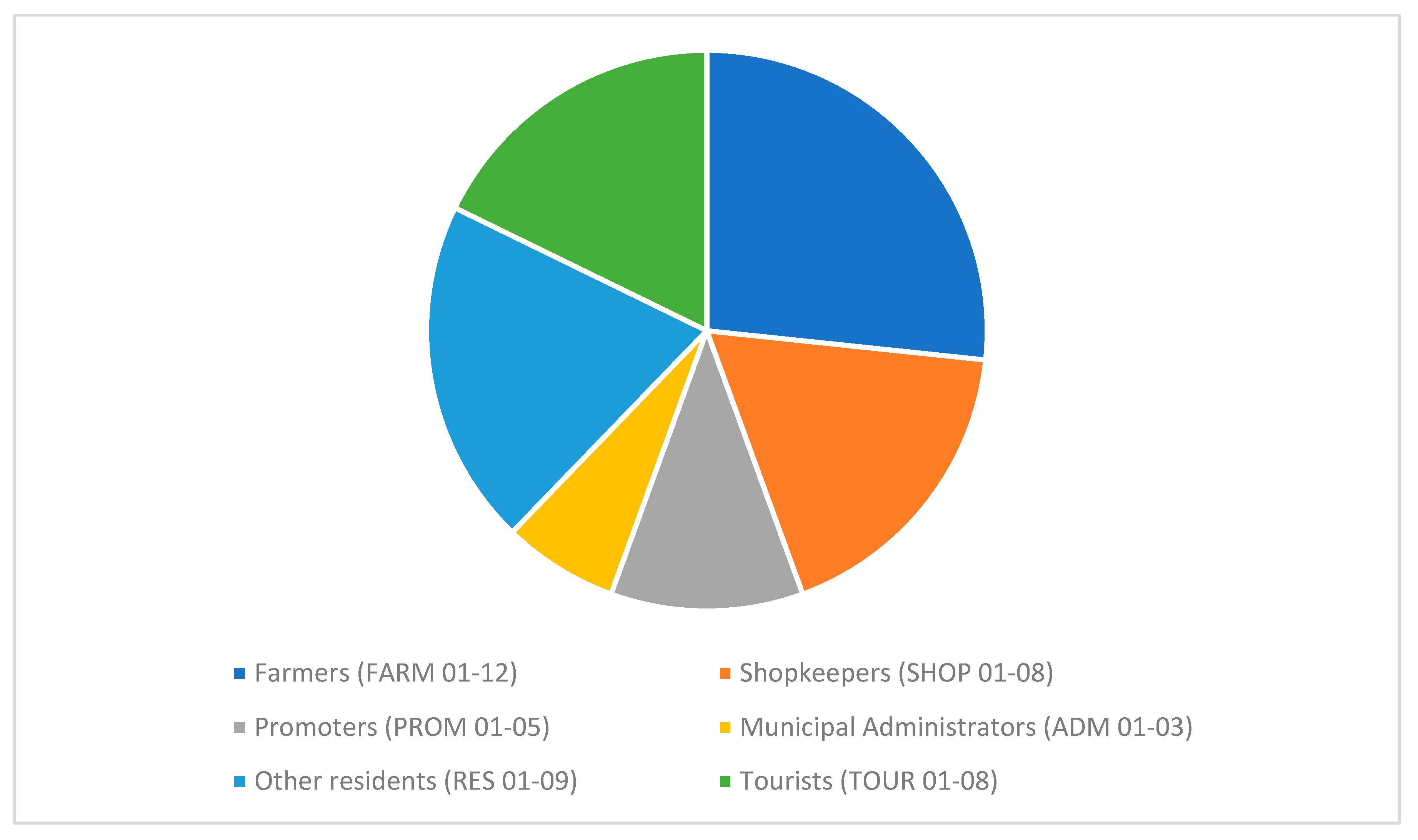
A total of 45 in-depth interviews were conducted across five key stakeholder categories (
Figure 1). Twenty were conducted in Summer 2020, and 25 the following summer. Participants were selected using a combination of purposive sampling (to ensure representation across the six identified stakeholder groups: promoters, administrators, farmers, long-term residents, shopkeepers, and visitors) and snowball sampling. Inclusion criteria required local residency or active business/administrative operation in San Giovanni for at least 5 years (except for visitors). Interviews lasted between 20 and 40 min. Detailed field notes were taken for each interview. Field notes were coded using an inductive thematic analysis framework [
38]. Initial open coding identified primary concepts, which were subsequently refined into broader thematic categories. Quotes selected in the text were chosen based on their representativeness of recurrent themes or their capacity to illustrate key conceptual divergences.
All ethnographic materials were collected, processed, and stored in strict compliance with the European General Data Protection Regulation (GDPR) and the ethical guidelines of the Association of Social Anthropologists of the UK and the Commonwealth [
39]. Given the sensitive socio-political tensions in small rural communities, prior to each recording or note-taking session, oral informed consent was obtained from all 45 interviewees. Formal written consent forms were deliberately bypassed as pre-test trials indicated that signing formal legal documents induced anxiety and inhibited spontaneous narrative expression among elderly rural informants [
40]. Informants were verbally briefed using a, standardized information protocol outlining the research objectives, voluntary participation, and data protection. To prevent deductive disclosure (a critical risk in a small municipality of about 1,000 residents, where granular demographic matrices could lead to local re-identification), all personal and spatial data were anonymized at the source using functional coding, with sample metrics presented exclusively in aggregated stakeholder categories. Moreover, operational details were aggregated into analytical categories to prevent commercial exploitation or local stigmatization. All oral testimonies in Piedmontese dialect or standard Italian were translated directly into English by the author to preserve semantic fidelity. AI tools (i.e. Google Gemini, Pro account) were used to assist the process.
The research timeframe captured the immediate socio-spatial dynamics surrounding the installation of the Big Bench and the subsequent surge in low-infrastructure day tourism following the easing of COVID-19 mobility restrictions, which occurred in summer 2020 and Spring–Summer 2021 [
41]. The pandemic context significantly shaped spatial behavior during this window, as urban day-trippers increasingly sought low-risk, open-air rural destinations [
42]. Crucially, long-term observations conducted through the author’s ongoing longitudinal engagement confirm that the structural patterns of unmanaged visitor flows, host–guest friction, and logistical congestion observed during the 2020–2021 window remained fully valid after the acute pandemic phase [
32].
It has to be highlighted that a fundamental methodological challenge in analyzing rural and peripheral destinations lies in their systemic data deficit. Unlike urban or ticketed tourism contexts, small rural spaces lack disaggregated quantitative datasets on both physical visitor presence (due to open spatial configurations without formal entry monitoring) and micro-level socio-economic indicators. Official statistical frameworks and municipal financial reporting rarely disaggregate local business balance sheets, revenue flows, or tourism-related municipal expenditure at the micro-scale of small hamlets. In the absence of fine-grained statistics, direct field observations and indicators of spatial compression, such as localized traffic saturation, physical bottlenecks, and parking capacity breakdowns, serve as the primary empirical proxies for assessing temporary overtourism pressure in data-scarce rural environments.
3. Results
The installation of the Big Bench in San Giovanni is best understood as a deliberate spatial and economic intervention, undertaken within a community conscious of its own marginal position. In late 2019, a small committee of local activists and entrepreneurs decided to join the BBCP and proceed with the construction of a new oversized bench, having closely followed the project’s rapid diffusion in neighboring areas of Piedmont, most notably the Langhe.
The BBCP was originally developed in 2010 by designer Chris Bangle and his wife Catherine in Clavesana (CN), about 100 km southwest of San Giovanni, and has since evolved into a pervasive regional marketing phenomenon across Italy and Europe, with over 500 sites as of 2026. The project involved installing an oversized bench painted in a highly vibrant, contrasting color scheme in locations recognized by local communities as particularly relevant and beautiful. Once installed, the project operates on a highly structured gamification system: tourists purchase a standardized “passport” and travel from site to site to collect custom stamps from local businesses, such as bars, wineries, and convenience stores.
According to the promoters, in San Giovanni, what made the format attractive was less its novelty than its fit with what the promoters already had at their disposal: San Giovanni’s agricultural economic base had eroded, but its ridgelines, panoramic viewpoints, and hillside vistas remained intact and, crucially, free. This asset stood in stark contrast to the signs of decline that surrounded the promoters on all sides, such as vineyards and cultivated fields steadily overtaken by unmanaged growth, and a historic center whose shuttered shops and vacant social spaces gave the village an atmosphere of slow, unrelenting erosion [
43]. Against this backdrop, the committee concluded that, rather than focusing on heritage preservation, it was better to explore new directions. As one organizer put it: “There is no past worth preserving if a place has no future in which to preserve it.” The argument, in effect, treated socioeconomic survival as the precondition for any subsequent claim to cultural continuity.
Consistent with BBCP’s own funding rules, the bench was built entirely through private donations and volunteer craftsmanship, without recourse to public funds, and sited on an isolated hilltop less than two kilometers from the village center, overlooking the agricultural valley. At the inception of the project, support was unanimously shared among municipal administrators and project promoters, who viewed the installation as a low-cost, high-visibility shortcut into a proven regional tourism circuit. The anticipated mechanism was straightforward: passport-stamp collectors, drawn from across the Big Bench network, would arrive steadily and, in doing so, generate indirect but reliable income for what remained of the village’s commercial life. One of the promoters, a man in his late thirties (PROM 02, July 2020), framed the initiative in terms that fieldwork returned to repeatedly:
“Look at what happened in the Langhe. Tourism saved those villages from disappearing completely. We tried to open factories here in the seventies and eighties, but they all closed, leaving nothing but rusty sheds in the valley. Agriculture alone can no longer sustain us; prices are set by corporate boards far from here. This bench costs us nothing but our labor, yet it links our name to a network of thousands of people. It is a light at the end of the tunnel for a town that is slowly dying.”
The optimism captured in this statement would not survive the years that followed intact. The Bench was inaugurated at the beginning of Summer 2020, and between Summer 2020 and Fall 2021, the gap between these expectations and the situation on the ground widened sharply.
As the first pandemic lockdowns eased, tourists from nearby cities began arriving in search of open-air destinations perceived as low-risk during the COVID-19 pandemic. San Giovanni found itself absorbing hundreds of visitors every weekend, a volume the settlement had never been built to accommodate. The road serving the bench, barely five meters wide and laid out for tractors and local traffic rather than for cars queuing to reach a viewpoint, buckled almost immediately under pressure. With no formal parking provision, visitors left their vehicles along the unpaved verges, and on a busy weekend, the resulting line could run to twenty cars or more, enough to close the road to any other kind of traffic entirely.
The qualitative data collected across stakeholder groups reveal a sharply fractured community perception regarding the impact of these visitor flows. While visiting tourists expressed enthusiastic, unanimous satisfaction with the attraction, and municipal administrators, alongside core promoters, maintained their firm support for the initiative, local sentiment among residents and workers became deeply polarized.
The severe infrastructural gridlock hit the agricultural community hardest. Among professional farmers, opposition and resentment were virtually unanimous, as unmanaged weekend traffic directly disrupted seasonal labor routines and harvest deadlines.
Field notes from July 2020 record one such encounter directly. A large tractor pulling a trailer full of cereals was completely immobilized at the base of the ridge. The road is entirely blocked by a row of cars bearing license plates from Lombardy. The driver of the tractor, a professional farmer in his fifties, was engaged in a heated argument with a young tourist couple who had just returned from the bench holding their passports. The farmer shouted in dialect, pointing to his trailer:
“This is my work! This isn’t a playground for you! I have to deliver this to the cooperative before the evening, and I am losing hundreds of euros because you cannot walk more than fifty meters!”
The tourists appeared defensive, replying in standard Italian that there were no signs prohibiting parking and that the municipality should provide adequate parking spaces if it wanted people to visit the bench.
The exchange clarifies the underlying conflict: two parties occupying the same narrow stretch of road were, in effect, operating on entirely different regimes of value, one rooted in productive labor and seasonal urgency, the other in leisure, image, and the assumption that access is simply owed.
What began as a logistical bottleneck soon revealed itself as something deeper: a rearrangement of the affective and cognitive relationship between the community and its own territory. Land that residents had long understood through the lens of labor, memory, and generational continuity was, for the great majority of visitors, legible only as a backdrop, a site defined by the stamp it yielded and the photograph it made possible. Visiting day-trippers consistently expressed enthusiastic endorsement of the gamified attraction, enjoying its open-air accessibility while remaining largely unengaged with the village’s broader historical reality. A woman in her early thirties visiting from Milan (Tour 04, August 2020), queuing at the village bar, described her itinerary without any apparent sense that it might read as dismissive:
“We came here specifically for the bench. It is a beautiful spot for a photo, and the view over the hills is spectacular. We bought the passport last month, and this is our third bench today. We visited one in [a nearby village] this morning, then another near [another village in Monferrato], and now this one. To be honest, we don’t know much about San Giovanni itself. It seems like a very small, quiet place. Is there anything else to see here? Probably not much, right? We are just going to have a quick sandwich here at the bar, get our stamp, and then drive to the next bench before the sun sets. We want to finish our passports before the end of the summer.”
The itinerary she describes, three benches consumed in a single day (and maybe more by the end of the day), San Giovanni reduced to an unremarked stop among other locations, illustrates a mode of tourism that is high in volume but shallow in engagement, and correspondingly thin in the economic return it leaves behind: a coffee, a sandwich, a stamp, rarely a meal at a restaurant or a bottle from a local cellar. The value extracted from the village, in other words, bore little relation to the disruption the village absorbed in exchange.
In this context, commercial shopkeepers and hospitality operators exhibited a predominant, though nuanced, inclination toward support, favoring the attraction of the immediate cash flow and foot traffic generated by passport collectors, in particular considering the serious economic impact of the COVID-19 lockdown, even while acknowledging local logistical strains. From an economic perspective, participant accounts indicate that the influx of visitors generated localized financial returns primarily for food and beverage establishments, most notably bars, restaurants, and a few local wine producers, where day-trippers purchased drinks, light meals, and some gastronomic souvenirs. Conversely, non-food shop owners reported no substantial benefits from the presence of tourists. Furthermore, hospitality and accommodation providers emphasized that while the Big Bench served as a convenient secondary activity for visitors already staying at their establishments, it did not drive overnight stays or new bookings. Given the absence of public statistical indicators (such as localized post-installation average income data) and the inability to access private business balance sheets, these economic dynamics cannot be quantitatively measured. However, the ethnographic conversations clearly show that the economic benefits were perceived as concentrated among a small subset of local actors, failing to translate into widespread or generalized economic improvement for the broader village community.
In stark contrast to some of the shop owners, general residents and third-sector volunteers expressed a marked tendency toward resentment and opposition, perceiving the attraction as an intimate intrusion into their daily lives. Residents along the footpaths leading to the bench reported a steady erosion of privacy that had defined the village’s small-scale social fabric, describing tourists who peered through gates and windows in pursuit of a suitably rustic image. A woman in her late sixties (Res 04, September 2020), whose family farmhouse sits along one such path, put the experience starkly:
“I feel like an animal in a zoo. On Sundays, I cannot even sit in my courtyard to have lunch with my family without dozens of strangers staring at us, taking pictures of our old well, or asking to use our private bathroom. They look at our houses as if they were museum pieces, completely disregarding the fact that people actually live here, work here, and have their lives here. They have no respect for our privacy. They are invaders who consume our land and leave nothing behind but their plastic trash and their arrogance.”
Her language signals how far the experience had moved from the promoters’ original framing of the bench as costless and benign. By the autumn of 2021, the initial enthusiasm around the project had given way to a clear qualitative divide across the municipality. While public administrators, promoters, commercial shopkeepers, and visiting tourists continued to sustain the installation, the broader citizenry, dominated by working farmers and affected residents, increasingly viewed the Big Bench as a source of ongoing disruption, unregulated congestion, and spatial degradation, offering no sustainable path for the community’s future.
5. Conclusions
By the end of the fieldwork, the initial local consensus around the Big Bench installation had given way to clear qualitative divergence among study participants. While administrative and commercial stakeholders emphasized foot traffic and promotional benefits, interviewed agricultural producers and long-term residents reported ongoing disruptions to daily labor routines, spatial gridlock, and loss of privacy.
The events in San Giovanni tell about the possible price with which tourism developed locally and from a grassroots perspective; a trajectory in which the search for visibility and relevance, territorial integrity, privacy, and inherited meaning are sacrificed as the ordinary and perhaps unavoidable cost of an implicit transaction with the outside world. Thus, rather than illustrating tourism imposed solely by external entities, the empirical findings document a process of promoter-led self-commodification emerging as a constrained response to long-term demographic and agricultural contraction. In this process, driven by territorial anxiety and structural marginalization, local promoters ultimately. Thus, while the initiative remains strictly ‘local’ in origin, its underlying rationale is shaped by the expectations of urban consumers, and its impact reverberates throughout the entire community.
The empirical findings directly address the research questions posed in this study. Under conditions of structural vulnerability and territorial anxiety, local promoters had re-evaluated the surrounding landscape, reframing productive agricultural space as a visual asset to capture short-term leisure flows. However, the arrival of unmanaged visitor flows into an open-access environment lacking formal traffic infrastructure generated physical bottlenecks and host–visitor friction during peak harvest periods. Thus, this process develops a form of self-commodification and self-extractivism that, rather than yielding generalized economic revitalization, produces internal social polarization between promoters seeking external visibility and residents experiencing spatial intrusion.
All these aspects define the localized experience of rural overtourism and demonstrate how rural overtourism can develop endogenously through self-commodification. Driven by structural precarity, local actors internalize external urban market demand, becoming vectors for visitor-led spatial pressure that impacts the broader local environment and transfers the socio-environmental costs of visibility and new centrality onto the broader community.
Because these findings are derived from a single qualitative case study, they cannot be generalized as universal regularities across all rural territories. While the micro-mechanics of logistical saturation and host–visitor tension observed in San Giovanni offer conceptual transferability to similar contexts, they reflect the unique geographic lineaments of the Monferrato hillside ridge and its direct spatial proximity to the dense metropolitan centers of Northwestern Italy. These findings represent localized ethnographic dynamics rather than universal theoretical regularities. In this respect, future research should employ comparative designs across diverse rural areas, integrate quantitative metrics to assess carrying capacity and local capital retention, and/or consider longitudinal demographic tracking to evaluate the cross-temporal capacity of grassroots initiatives to stimulate permanent repopulation and generational handovers.
To translate these empirical findings into actionable practice, a three-tiered governance framework is proposed:
Public funding and regional development schemes should transition away from open-access, unmanaged “viral” installations disconnected from a destination’s actual logistical capacity. Regional policies must mandate rigorous carrying-capacity assessments and integrate rural tourism incentives directly with regional agricultural support, ensuring that tourism development complements rather than disrupts primary food production systems.
Municipalities and regional tourism boards must establish co-management arrangements and spatial buffering measures. This includes constructing designated peripheral parking facilities, implementing seasonal traffic regulation during peak harvest windows, and deploying clear directional signage to prevent visitor traffic from encroaching upon working farm tracks and private residential areas. Furthermore, resources spent on spectacularizing the landscape should be redirected toward strengthening short, high-margin agrifood chains—such as local cooperative wineries, mills, or dairies—to maximize local capital retention from day tourism.
Local civic organizations (e.g. Pro Loco associations), businesses, and municipal councils should foster participatory governance structures that protect community agency and spatial privacy. Transmitting traditional ecological knowledge and historical land-use practices to younger residents is a vital way to counter internal epistemic colonization. By enabling communities to re-evaluate their landscape as a shared socio-ecological commons worth governing on their own terms, local governance can build genuine territorial resilience rather than relying on external validation
Ultimately, the case of San Giovanni demonstrates that genuine rural revitalization cannot be measured by the viral visibility of transient attractions, but rather by the capacity to restore tangible value and agency to local communities. To prevent peripheral margins from becoming mere playgrounds for urban centers, territorial policies must prioritize protecting the socio-ecological commons and strengthening local agrifood value chains. Only by reclaiming the centrality of agrarian labor and participatory governance can rural communities transform the anxiety of disappearance into the foundation for a sustainable, self-aware future.