Article

Toward Sustainable Agriculture in the Mekong Delta: A Multi-Criteria Analysis of Organic and Conventional Rice Farming Systems


1
Institute for Environment and Human Security (UNU-EHS), United Nations University, 53113 Bonn, Germany
2
Agrosphere Institute IBG-3, Forschungszentrum Jülich GmbH, 52428 Jülich, Germany
3
Institute of Crop Science and Resource Conservation (INRES), Soil Science and Soil Ecology, University of Bonn, Nussallee 13, 53115 Bonn, Germany
4
Plant Sciences Institute IBG-2, Forschungszentrum Jülich GmbH, 52428 Jülich, Germany
5
Department of Genetics and Plant Breeding, College of Agriculture, Can Tho University, 3/2 Street, Can Tho 900000, Vietnam
6
College of Agriculture, Can Tho University, 3/2 Street, Can Tho 900000, Vietnam
7
L.U.P.O GmbH, 67705 Trippstadt, Germany
8
Institute of Food and Biotechnology, Can Tho University, 3/2 Street, Can Tho 900000, Vietnam
*
Author to whom correspondence should be addressed.
Land 2026, 15(9), 1542; https://doi.org/10.3390/land15091542
Submission received: 30 June 2026 / Revised: 11 August 2026 / Accepted: 16 August 2026 / Published: 24 August 2026

Abstract

Sustainable agriculture is critical to sustainable development and climate resilience, yet evidence of its multidimensional environmental, social and economic benefits and trade-offs remains limited, especially in regions most vulnerable to climate change. This study addresses this gap in Vietnam’s Mekong Delta (MKD), where decades of intensive rice farming has bolstered rice yields at the expense of environmental quality and farmers’ health. This study presents a multi-criteria analysis (MCA) comparing organic rice (OR) and conventional rice (CR) farming systems in the MKD. We applied a weighted sum model to evaluate the environmental, social and economic performance of the two production systems. The assessment drew on quantitative and qualitative primary data collected through stakeholder engagements and field measurements from Vinh Long province between 2023 and 2025, as part of the OrganoRice project. Overall, OR farming performed cumulatively better (0.663 and 0.695) than CR farming (0.496 and 0.484). OR scores were higher across most sub-criteria, particularly “farmers’ income” and “biodiversity”. However, CR outperformed OR for “rice yield” and “farmers’ workload”. Comparable water and soil quality scores, due to the presence of pesticide residues in both systems, suggest that the environmental performance of OR farming was likely dampened due to cross-contamination from surrounding or upstream non-organic farms. The expansion of OR farming in the MKD has the potential to enhance environmental, social and economic performance of rice production in the region. However, in order to achieve the full scope of these benefits, short-term measures should aim to reduce the financial risks of conversion for farmers, ensure access to affordable organic inputs, increase farmer training, ensure reliable premium contracts for rice producers and support them in accessing organic markets. Longer-term measures must improve irrigation water management and infrastructure to minimise cross-contamination risks. Coordinated marketing campaigns are needed to develop a trusted regional brand for organic rice from the MKD to create new opportunities in international and domestic markets. Moreover, long-term monitoring of post-transition outcomes is important to capture the full impacts of conversion. As OR cultivation continues to expand across the MKD, evidence on its benefits and trade-offs is essential to guide this transition effectively. This study provides that evidence, offering a context-specific, multidimensional evaluation to inform OR policy and practice in the region.

1. Introduction

Sustainable agricultural approaches have been identified as key to achieving global goals related to sustainable development, climate change adaptation, and land degradation neutrality [1]. Despite recognition of the multiple benefits of transitioning from less sustainable approaches, however, challenges remain in assessing the multidimensional benefits for the environment, society and economy, and potential trade-offs which arise, which can hinder uptake by local farmers and communities [2,3]. Of particular interest are the benefits and trade-offs experienced during the critical transition phase, which can determine whether sustainable approaches persist or are abandoned. Assessments which capture specific environmental, political and social contexts are needed for a holistic understanding of transition performance, however, such transdisciplinary studies, particularly in areas most vulnerable to climate change impacts, are rare [4,5].
The Mekong Delta (MKD), Vietnam’s southernmost region, is dominated by agricultural production, the majority of which is rice cultivation (40–46%), which includes triple, double and single rice cropping, followed by aquaculture production (10–22%) [6,7]. This production accounts for over half of the nation’s rice production and 90% of its exports, making it a critically important region for both national food security and economic stability [8,9]. Since 2020, rice systems in the MKD have undergone rapid intensification to achieve the country’s rice production targets [6,9]. Boosts in rice yields, growing from 4.24 t ha−1 in 2000, to 5.76 t ha−1 in 2015, to 6.10 t ha−1 in 2024 [10], were largely driven by intensive production with high agrochemical inputs, technological innovation, and use of high-yielding varieties [8,9,11].
However, this intensification has resulted in environmental and social costs, such as water and soil contamination, and detrimental impacts of pesticide exposure on farmers’ health [9,11,12,13]. At the same time, rice productivity in the MKD has stagnated in recent years [8]. While the construction of dikes in the late 2000s supported the expansion of intensive double and triple rice cropping, it also disrupted annual flood regimes and decreased the deposition of essential sediments in the MKD floodplains [6]. Moreover, Vu et al. (2022) [6] observed an inverse relationship between the expansion of triple rice cropping systems and rice productivity. The authors argue that such shifts in rice production are linked to the implementation of national policies, such as Resolution 09/ND-CP issued in 2000 and Resolution 120/NQ-CP in 2017. Yields grew steadily between 2000 and 2011 but declined in subsequent years until 2017—a period marked by the expansion of triple rice cropping systems, thus pointing to the overuse of natural soil resources. Conversely, an increase in yields between 2017 and 2020 coincided with a reduction in triple cropping areas and a simultaneous increase in double cropping systems [6].
In response to these challenges, the Vietnamese government has been promoting more sustainable rice production through various initiatives and programmes, such as the “Three Reductions, Three Gains” (3R3G) program in 2003, the Good Agriculture Practice (GlobalGAP and VietGAP) programme in 2008, the Sustainable Rice Platform (SRP) standards in 2017 [9], and organic farming. Certification schemes like VietGAP and GlobalGAP promote food safety, traceability, sustainable environmental management and responsible agricultural practices and may facilitate access to premium domestic and export markets. However, unlike organic certification, both standards permit the use of synthetic chemical inputs within regulated limits. Therefore, they can be considered intermediate production standards between conventional and certified organic farming, which help farmers adapt to reduced chemical and pesticide use [14,15].
Organic agriculture is “based on specific and precise production standards that aim to achieve optimal agroecosystems that are socially, ecologically and economically sustainable” [16] (p. 2). While specific standards vary across certifying agencies, organic requirements generally promote soil health, crop rotation, biological diversity and processes, and animal welfare. On the other hand, they generally prohibit the use of chemical inputs (pesticides, growth regulators and mineral fertilisers), irradiation, application of sewage sludge, genetic engineering, or prophylactic use of antibiotics in livestock farming [17].
In recent years, efforts to expand the organic sector in Vietnam have intensified following the issuance of Decree No. 109/2018/ND-CP on organic agriculture in 2018 and, in 2020, the approval of the Project on Organic Agriculture Development for 2020–2030 (Decision No. 885/QD-TTg) [18]. Moreover, Resolution No. 19-NQ/TW, which was issued in 2022, explicitly emphasised the development of “green, organic, and circular agriculture” [18] (p.14). Ultimately, strategies for developing rice production vary by province, and are tailored to the unique geographical characteristics and localised development priorities [6].
Rising incomes and an increase in consumer health awareness have driven a burgeoning interest in safer and environmentally friendly products in Vietnam, particularly in major urban centres like Hanoi and Ho Chi Minh City. This has led to the rapid development of organic agricultural market in the country [18]. In fact, organically managed farmland increased from 76,600 ha in 2017 to 450,000 ha in 2023 [18]. The organic sector currently operates under two primary models: private enterprises that adhere to international organic standards for export and domestic distribution, and farmer groups that apply the Participatory Guarantee System (PGS) standards to serve Vietnamese consumers [18].
As the expansion of organic rice (OR) production in Vietnam accelerates, it is crucial to evaluate the impacts of conversion and to identify the associated benefits and trade-offs [13]. Organic farming can contribute to multiple Sustainable Development Goals (e.g., SDGs 1, 3, 12, 13 and 15) by offering distinct environmental, social and economic advantages over conventional systems. Widely cited environmental benefits include increased farmland biodiversity, improved soil quality, and enhanced provision of key ecosystem services, while a notable social benefit is reduced human exposure to synthetic pesticides [3,17]. Economically, premium market prices afforded to organic producers generate greater profits and higher benefit–cost ratios, albeit at higher costs to consumers [3,17]. A recent review by the authors of this study [13] corroborated these findings, demonstrating that transitioning to organic rice farming delivers multidimensional benefits, including improved water and soil quality, increased biodiversity, and better health and livelihood outcomes. Furthermore, when integrated with other strategies, organic farming can enhance agricultural resilience against natural hazards such as salinity intrusion, storms and droughts by improving the overall soil and ecosystem health.
On the other hand, a common disadvantage of organic production is the lower crop yields compared to conventional production [3,17]. As a result of lower productivity, Muller et al., 2017 [19] argue that a total conversion to organic agriculture would require 16–33% more land to maintain comparable yields to conventional farming. Ultimately, despite its diverse benefits, organic farming is not a silver bullet capable of addressing all SDGs without inherent trade-offs.
Given that its impacts are highly context-dependent, further research is required to evaluate its performance across varying geographical and socio-economic contexts [13]. Generalising conclusions across empirical studies remains challenging due to the lack of standardised reporting protocols, varied soil and climate conditions across case studies, differing local input availability, and the frequent omission of specific farming practices [13]. The present study aims to provide a comprehensive evaluation of organic versus conventional rice (CR) production in the MKD, by using a multi-criteria analysis (MCA) approach. An MCA is an assessment tool that allows for the systematic comparison of multiple options, against several, often conflicting, criteria, with the ultimate goal of identifying an optimal option [20]. It can help support transparency and consistency in decision-making by clarifying priorities and highlighting trade-offs between alternatives [20,21]. Additionally, MCAs facilitate the inclusion and integration of diverse types of knowledge, including quantitative and qualitative data [21]. Thus, it is an appropriate tool for assessing sustainability, which often involves evaluating multiple dimensions with diverse, incommensurable data types.
While the use of multi-criteria methods to assess agricultural sustainability has grown over the last decade, their overall application remains relatively limited [22]. Most studies employing multi-criteria methods incorporate the triple bottom line, which covers people, planet and profit dimensions [22]. However, very few studies have adopted MCAs to specifically compare organic versus conventional rice farming systems in a multidimensional manner, e.g., [23]. This multidimensionality is essential for identifying key synergies and trade-offs between various criteria and production systems [3]. Instead, the literature is dominated by other approaches such as Life Cycle Assessments, e.g., [24,25,26], economic analyses [27], and carbon footprint assessments [28]. Moreover, the indicators used to compare organic and conventional rice systems across environmental, economic or social dimensions vary widely across studies.
Long-term evaluations of organic transitions are predominantly confined to developed countries, resulting in a substantial knowledge gap concerning organic systems in the Global South [3,29,30]. Moreover, comprehensive evaluations of organic rice (OR) farming across multiple sustainability pillars are scarce. Notably, the OR literature lacks research on the social dimensions, such as occupational safety and health, farm workload, and community benefits, especially within the context of agricultural systems in the Global South [9,17,31].
To date, research on Vietnamese rice production has primarily examined conventional systems [32] and empirical studies of OR in Vietnam remain fragmented. Most studies address OR through a narrow lens, typically focusing on only one or two of the core dimensions: environmental, economic, or social [9,32,33,34,35]. However, few studies examine all three dimensions simultaneously [36]. To address these critical knowledge gaps and effectively guide the future development of OR farming in Vietnam, there is an urgent need for holistic analyses that integrate both empirical quantitative data and qualitative insights to comprehensively evaluate the performance of OR farming in various regional contexts [13,36]. Building on the preceding discussion, the objectives of this study are to conduct an MCA of organic and conventional rice production systems in Vinh Long province, in order to assess and compare their performance across three key dimensions: economic, environmental and social. This holistic evaluation will shed light on the strengths and trade-offs associated with both production systems to inform the development and future expansion of organic rice production in the MKD region and beyond. This study is guided by the following research question: How do organic and conventional rice production systems in Vinh Long province compare in terms of their economic, environmental and social performances? It draws on data generated by the OrganoRice project (https://organorice.org/), a transdisciplinary research collaboration between German and Vietnamese institutions.

2. Materials and Methods

2.1. Study Area

The study area is the Vietnamese MKD, located in southern Vietnam. It covers a total area of 40,921.8 km2, with a population of 17,547,900 people [10]. The region is flat with an elevation of 0–4 m above mean sea level [37].
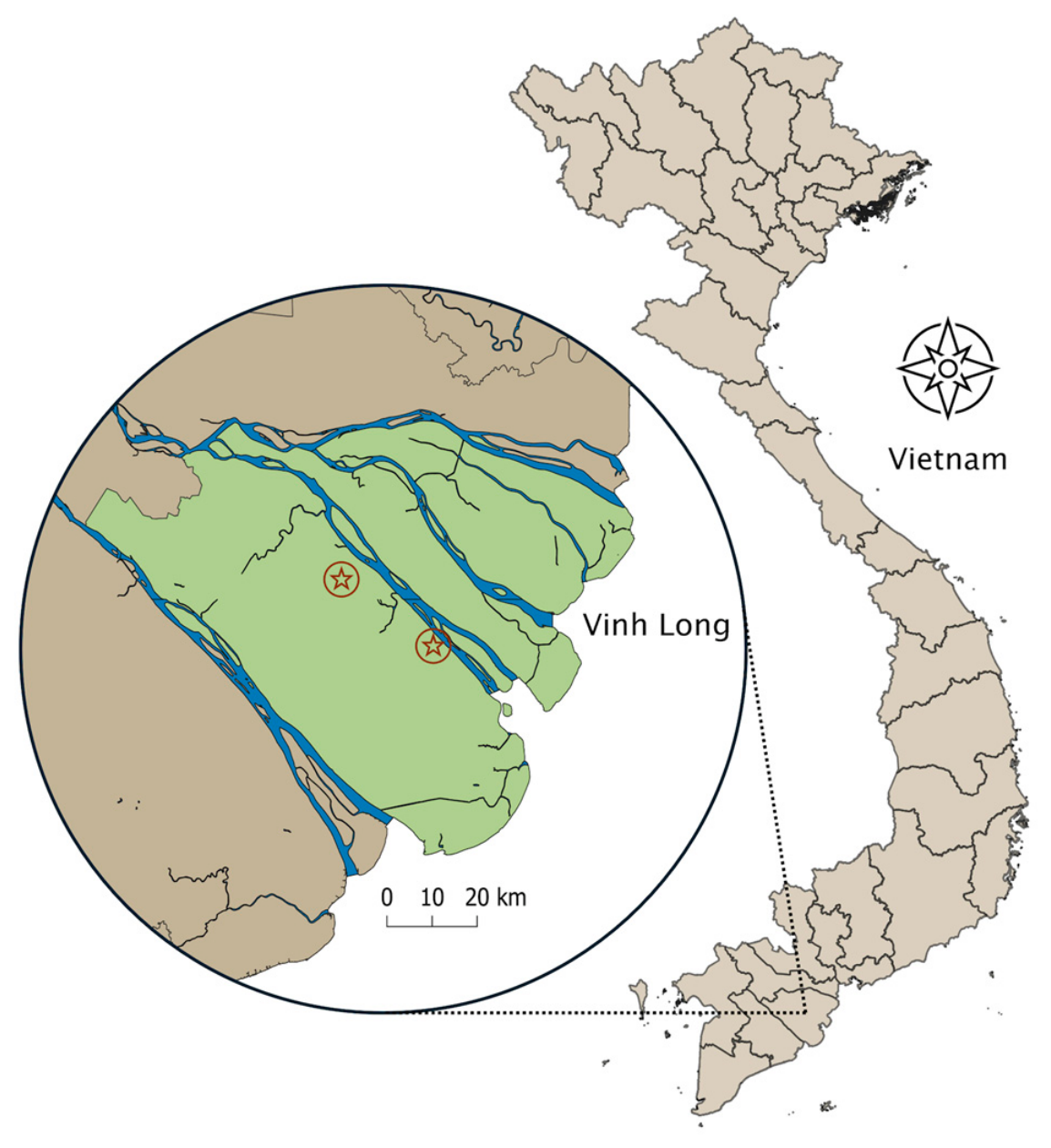
Fieldwork took place between 2023 and 2025 in two Vinh Long communes (Figure 1), hereafter referred to as Commune A (formerly and currently Vinh Long province) and Commune B (formerly Tra Vinh province) (Communes have not been named to protect the anonymity and privacy of interviewed stakeholders). Following the administrative restructuring and merger of provinces (finalised in June of 2025), former Ben Tre, Tra Vinh, and Vinh Long provinces were merged into a single province now called Vinh Long, with a total aggregate area of 6296.20 km2 and a population of 3,367,500 [10]. The total area of paddy rice cultivation in this new province of Vinh Long is 327,200 ha, with an average total yield of approximately 5.44 t ha−1 in 2024 [10]. In the MKD, rice production occurs across three cropping seasons: winter–spring (November–March), summer–autumn (April–July), autumn–winter (August–November).
Quantitative data on rice yields, soil quality, biodiversity, pesticide, and heavy metal contamination of the soil and water was collected from three rice systems in Commune A: (1) certified organic rice (OR) farm, (2) transitioning to organic farm set up by the OrganoRice project and partly used as an experimental platform for testing different rice varieties, fertilisation practices, and biological pest control, and (3) conventional rice (CR) farm. Additional details are available in the Supplementary Materials. Across communes A and B, a total of six group discussions were conducted with a total of 12 rice farmers transitioning to OR farming and 17 certified OR and rice–shrimp farmers. Individual interviews were also conducted with two cooperative managers (one from each commune). Access to organic rice farmers was constrained by the limited widespread adoption of organic practices in the MKD, by the challenge of identifying participants across provinces willing to participate in the study, and by the complex administrative procedures required to conduct research in Vietnam, resulting in a small interview sample size. Nevertheless, qualitative data saturation was observed to some extent during the data collection process, lending a degree of robustness to the preliminary findings.
All the interviewed farmers were members of cooperatives. The officially preferred institutional form of agriculture in Vietnam is cooperatives. They differ in size, internal structure and openness to sustainability issues. The key benefit they offer to their members is access to shared equipment like harvesters or drones for seeding and spraying, and the cost of achieving and maintaining the organic certification, all of which are hardly affordable for individual farmers. The larger cooperatives, being bigger market actors, also have a stronger role in price negotiations for input and output.
In Commune A, the participants practiced triple rice cropping, whereas in Commune B, farmers practiced either double rice cropping, or integrated rice–shrimp production (one season for rice, one season for shrimp). Group discussions with stakeholders were conducted in An Giang and Dong Thap provinces, exclusively for the weighting aspect of the MCA. An Giang groups consisted of three government officials, three Safe Rice (SR) farmers, and four CR farmers. Dong Thap groups comprised six government officials, four SR farmers and five CR farmers. Similarly, seven government officials, ten OR farmers and eight CR farmers from Commune B were engaged in group discussions for the weighting exercises.
SR was described by some interviewees as an intermediary step between CR and OR farming. SR encourages the use of sustainable farming practices and the reduction in synthetic inputs (including fertilisers and pesticides) to promote consumer safety [38]. SR was included in the weighting exercises alongside OR and CR systems to broaden the sample size and ensure a geographically representative sample of stakeholder priorities. However, SR was omitted from the subsequent performance evaluation, as the available data for this system was incomplete and strictly qualitative, precluding a comprehensive analysis.
The quality standards for CR are primarily defined by government health regulations, with some additional environmental requirements governing production. In contrast, OR is regulated through strict input-based standards, requiring the use of certified organic inputs, comprehensive documentation, and regular inspections to ensure compliance with internationally recognised certification schemes. SR, by comparison, adopts an output-based approach, focusing on the final product rather than production inputs. SR certification generally requires that residues of specified hazardous chemicals remain below detectable limits using standard analytical methods.
There are some public support programs for the transition to organic production. Some provinces provide financial subsidies or may offer free inputs such as organic fertilisers. While seeds are typically not provided, government regulations often mandate a substantial reduction in seeding rates (by up to 50% or more) without compromising harvest yields. However, there is an absence of support for the administrative and financial burdens of bookkeeping and certification. Conditionalities and duration of support varies; in some cases government assistance only lasts two years, although the transition period required for formal certification is generally three years.

2.2. Multi-Criteria Analysis Approach

We applied a weighted sum model (WSM), an MCA method that is widely used due to its simple implementation and interpretation [39,40]. Key steps in the WSM include: (1) identifying alternatives to assess, (2) selecting and defining appropriate criteria, (3) assigning weights to individual criteria according to their relative importance, (4) scoring criteria, (5) normalising scores to convert all values into a compatible scale, and (6) ranking alternatives based on overall performance [39,40]. The WSM generally performs well due to its ability to balance stability and sensitivity. The method exhibits good stability to minor variations in input data (thus maintaining a consistent ranking of attributes), while retaining sensitivity to substantial data variations, allowing it to reflect significant changes in input data [39].
The alternatives considered in this MCA are CR production and OR production in Vinh Long province. CR agriculture is defined as the dominant production system in Vietnam, primarily characterised by large quantities of agrochemical inputs. Conversely, OR agriculture is defined as a farming system that adheres to organic certification standards, including the strict prohibition of synthetic chemical inputs.

2.2.1. Criteria Selection, Definition and Data Sources

Three main criteria (environmental, social, and economic) along with 13 sub-criteria, were selected to holistically assess the conversion to OR production in Vinh Long province (Table 1). These criteria were identified through a triangulated approach, combining a literature review [13], preliminary stakeholder interviews, and an assessment of available data from the OrganoRice project. The assessment criteria was intentionally categorised into environmental, economic and social dimensions to provide a holistic and multidimensional evaluation of the rice production systems and to avoid a reductionist approach. The environmental dimension evaluated changes in the ecological conditions of the farms, including the physical and chemical properties of paddy field water and soil. The social dimension examined well-being impacts for farmers and local community members, as well as overall health impacts for consumers. Finally, the economic dimension assessed the performance of indicators related to economic costs and benefits, including yields, income, expenditures, grain quality, and crop resilience. All three primary criteria were evaluated based on a mix of quantitative and qualitative data. Table 1 details the list of indicators used for each sub-criterion.
Qualitative data was collected through farmer group discussions conducted in November 2023, March and November 2024, and March 2025. Water and soil samples were collected from CR and certified OR fields in April–May 2023 and in March 2024 [41]. Yield measurements were collected during three cropping seasons in 2024 (March, July and November) from conventional and organic fields. For the biodiversity assessment, sweep netting was carried out in February 2024 in both conventional and certified organic farms. Pesticide residue and rice quality were assessed through the analysis of seven unpolished rice varieties (white rice: Jasmine 85, TNN 91, ST24, Vin 16; red rice: ST 5; black rice: Lua Tim VL, Lua Tim CT), with samples collected from both conventional and transitioning organic fields in November 2024. Rice quality cannot be captured in a single definition but rather it is a number of physical (milling quality, appearance quality) and chemical (nutritional quality, eating and cooking quality) quality characteristics used for the comprehensive evaluation of rice quality during rice processing and cooking [42].
In Table 1, metrics such as income, expenditures and rice yields derived from group discussions with farmers are classified as “qualitative”. The reason for this is that rather than systematically recording exact individual values, participants were asked to discuss broadly the trends observed (increase, decrease, or no change). While some farmers mentioned specific figures, the inconsistency of these numerical responses required qualitative analysis. Conversely, data designated as “quantitative” in Table 1 refers strictly to systematically collected numerical values subjected to quantitative assessment.
Table 1. List of criteria, sub-criteria and indicators for MCA assessment, and number of samples collected from conventional rice (CR) and organic rice (OR) farming systems.
CriteriaSub-CriteriaData TypeIndicator (Units)CR
n
OR
n
EnvironmentWater qualityQualitativeWater quality (stakeholder engagements)-8
QuantitativeHeavy metals in water (µg L−1)122
QuantitativePesticide residues in water (µg L−1)81
Soil qualityQualitativeSoil quality (stakeholder engagements)-8
QuantitativeHeavy metals in soil (mg kg−1)5717
QuantitativePesticide residues in soil (µg kg−1)2918
QuantitativeTotal soil organic carbon (%)5817
QuantitativeSoil carbon/nitrogen ratio (C:N ratio)5817
BiodiversityQualitativeBiological diversity of farm/surrounding farm (stakeholder engagements)-8
QuantitativeDiversity/abundance of dragonflies and damselflies66
SocialFarmers’ healthQualitativeFarmers’ health (stakeholder engagements)-8
Availability of additional foodQualitativeAvailability of wild foods (non-target species of nutritional/economic benefit, including plants, animals, fungi, that are harvested from wild or managed landscapes without deliberate cultivation) [43] (stakeholder engagements)-8
Consumer health and safetyQualitativeConsumer health/safety (stakeholder engagements)-8
QuantitativePesticide residues in rice (mg kg−1)1010
QuantitativeNutritional quality of rice:
(1)
Indicators for antioxidant content:
-
Antioxidative capacity (µM Trolox 100 g−1)
-
Total Phenolic Content (mg GAE 100 g−1)
-
Flavonoid content (mg RE 100 g−1)
-
Anthocyanin content (mg Cy3glc 100 g−1)
(2)
Other indicators:
-
y-Aminobutyric acid (GABA) (µg GABA 100 g−1)
-
Resistant Starch (mg g−1)
-
Glycaemic Index
1010
Community benefitsQualitativeCommunity benefits (stakeholder engagements)-8
Farmers’ workloadQualitativeFarmers’ workload (the physical/time demands of rice farming) (stakeholder engagements)-8
Economic and rice production performanceFarmers’ incomeQualitativeFarmers’ income (VND ha−1 per crop cycle) (stakeholder engagements)-8
Farm expendituresQualitativeFarm expenditures (VND ha−1 per crop cycle) (stakeholder engagements)-8
Rice qualityQualitativeRice quality (stakeholder engagements)-8
QuantitativeRice eating and cooking quality (amylose mass fraction, %)1010
Rice yieldsQualitativeRice yields (tons ha−1) (stakeholder engagements)-8
QuantitativeRice yields (tons ha−1)99
Rice plant’s resilienceQualitativeRice plant’s resistance to pests/diseases (stakeholder engagements)-8
QualitativeRice plant’s resilience to natural hazards (stakeholder engagements)-8

2.2.2. Weighting of Criteria

The weighting process is a critical step in the MCA that involves assigning a value to each criterion based on its relative importance to the others [21]. As previously noted, weighting exercises were carried out with two stakeholder groups in Vinh Long, An Giang, and Dong Thap provinces: (1) government officials from the Department of Agriculture and Rural Development (DARD), (2) rice farmers. The stakeholders were asked to attribute a level of importance to all MCA criteria and sub-criteria to determine how the different groups valued the environmental, social, and economic dimensions of rice production. First, participants were asked to distribute 100 points across the three primary criteria, then allocate another 100 points across the sub-criteria of each primary criteria group. Final weights for the MCA were determined based on the average of all farmer groups, and the average of all government official groups.

2.2.3. Measuring the Performance of Each Production System

Throughout the OrganoRice project, scientists collected relevant quantitative and qualitative data in Vinh Long. These data were used to calculate the scores for all the environmental, social, and economic sub-criteria of the OR and CR systems.

2.2.4. Normalisation Approaches

After the initial scoring, a normalisation process was performed to ensure comparability across the different indicators. This involved converting all raw data into a common scale, thereby eliminating different units of measurement [44,45]. Different normalisation approaches were selected based on their suitability for each individual data type [40,45]. The data were normalised to values ranging from 0 to 1 to aggregate diverse data types and facilitate comparison between the two production systems. The following approaches were selected:
Min-max normalisation: 
Min-max normalisation is a widely applied method [46,47] also employed in sustainability assessments [47]. A key strength of this method is its ability to maintain stability and responsiveness while being robust to small changes in the input data and simultaneously accurately reflecting substantial shifts in the data [39]. This method considers the minimum and maximum values within a dataset, rescaling all data to a 0–1 range, where 1 equates to the best performance and 0 to the worst, and all other values in the dataset fall between 0 and 1 [40,44,48]. The normalised value xnorm for each benefit criterion, where a higher value is considered better [44,46] was calculated as follows:
x n o r m = x r a w x m i n x m a x x m i n
where xraw is the actual measured value of the indicator, and xmax and xmin are the highest and lowest values recorded for that indicator in the dataset, respectively.
To calculate a cost criterion, where a lower value is considered better, xnorm was calculated as follows:
x n o r m = x m a x x r a w x m a x x m i n
min-max normalisation was applied to the following sub-criteria: soil quality (total organic carbon, and carbon/nitrogen ratio), biodiversity (dragonfly and damselfly diversity and abundance), consumer and health safety (nutritional quality of rice), rice quality (eating and cooking quality), and rice yields.
Threshold-based normalisation: 
Threshold-based normalisation also scales data to a 0–1 range; however, unlike min-max normalisation, it utilises externally defined standards, benchmarks, or thresholds to set cutoff values for “best” or “worst” performance and establish the scale [49]. As such, it can be grounded in biophysical limits or policy targets.
This normalisation approach was applied to the environment criteria, specifically sub-criteria assessing heavy metals and pesticide residues in water and soil, and to the social criteria, specifically in the assessment of pesticide residues in rice as part of the “consumer health and safety” sub-criteria. Values below threshold levels were attributed a score of 1, while values equal to or above the threshold levels were attributed a value of 0.
In the absence of Vietnamese water and soil standards tailored specifically to organic production and given the lack of harmonised international guidelines specifying toxicological thresholds for such systems, this study draws on several regulatory standards from the EU, Germany and China, to compile information that is as comprehensive as possible. By synthesising multiple standards, we attempt to address the current regulatory gaps and derive a scientifically conservative assessment for our MCA. This integrated approach establishes a more robust, cross-verified baseline that is both globally relevant and ecologically applicable to the specific requirements of OR agriculture. Threshold levels were established using the following standards:
(1)
For pesticide residues in irrigation water: EU Directive 2006/118/EC on the protection of groundwater against pollution and deterioration (amended by Directive 2014/80/EU) [50].
(2)
For pesticide residues in soil: Since EU Regulation 2018/848 does not provide specific maximum residue limits for pesticide residues in soil, the Limit of Quantification (LOQ) of the analytical method of an accredited laboratory (TLR International Laboratories) [51] was used.
(3)
For pesticide residues in rice: the LOQ was defined by the routine LOQ of the calibration standard and samples were analysed in the analytical laboratory of the Research Center Forschungszentrum Jülich (IBG-3).
(4)
For heavy metal concentrations in paddy field waters: the Chinese Standard for Irrigation Water Quality (GB 5084-2021) [52].
(5)
For heavy metal concentrations in paddy field soils: the Chinese Soil Environmental Quality Risk Control Standard for Soil Contamination of agricultural land (GB 15618-2018) [53], and the German Federal Soil Protection Act (BbodSchV) [54].
Fuzzy transformation using trapezoidal membership function: 
The trapezoidal membership function is appropriate for “Goldilocks” indicators, which have an ideal value within an optimal range. This was used to transform the data of one indicator (C/N ration) for soil quality to values between 0 and 1. The threshold parameters (lower limit (L), ideal start (IS), ideal end (IE), upper limit (U)) for C/N were established based on the available literature indicating the optimal C/N range for paddy soils [55,56,57]. Values falling within the optimal range (between IS and IE), were assigned the maximum score of 1, while values falling below L or exceeding U were deemed unsuitable and assigned a score of 0. To reflect the gradual decrease in suitability outside the optimal range, linear interpolation was applied to the transition zones (between L and IS, and between IE and U).
The trapezoidal membership function is expressed as follows (adjusted from Hendiani et al., 2020) [58]:
x n o r m = 0 x r a w   L I S   L 1 U   x r a w U   I E 0         x r a w   L   L <   x r a w   < I S I S   x r a w   I E I E <   x r a w   < U x r a w     U
where xnorm is the final normalised score (ranging from 0 to 1) and xraw is the actual measured value of the indicator.
Normalisation of qualitative data: 
Following established mixed-methods frameworks, the qualitative responses from the interviews were analysed through a thematic and sentiment analysis, then converted into a 5-point Likert scale ranging from “substantially improved/increased” to “substantially worsened/decreased” [59,60]. To allow aggregation with other indicators, these categories were subsequently transformed into an equal interval 0–1 scale. The attribution of these scores was based on the phrasing used by respondents which were benchmarked to scores as follows: substantially improved/increased (1), slightly improved/increased (0.75), no change (0.5), slightly worsened/decreased (0.25), and substantially worsened/decreased (0). Scores of 1 or 0 were assigned only when respondents used strong qualifiers such as “significant”, “a lot” or “very”. In cases where respondents simply stated that a sub-criterion had “increased” or “decreased” without such emphasis, a conservative approach was adopted, and moderate scores of 0.75 or 0.25 were attributed. A score of 0.5 was assigned when no change was reported.

2.2.5. Sensitivity Analysis

A sensitivity analysis was conducted to evaluate the robustness and reliability of the results by adjusting the weights of the criteria and observing the impacts on the ranking of alternatives [61]. Three alternative scenarios were created based on the following weighting structures: (1) equal weight across all three criteria, (2) greater weight on environmental criteria, and (3) greater weight on social criteria.

3. Results

3.1. Weighting Exercise and Final Scores

3.1.1. Results of the Weighting Exercise

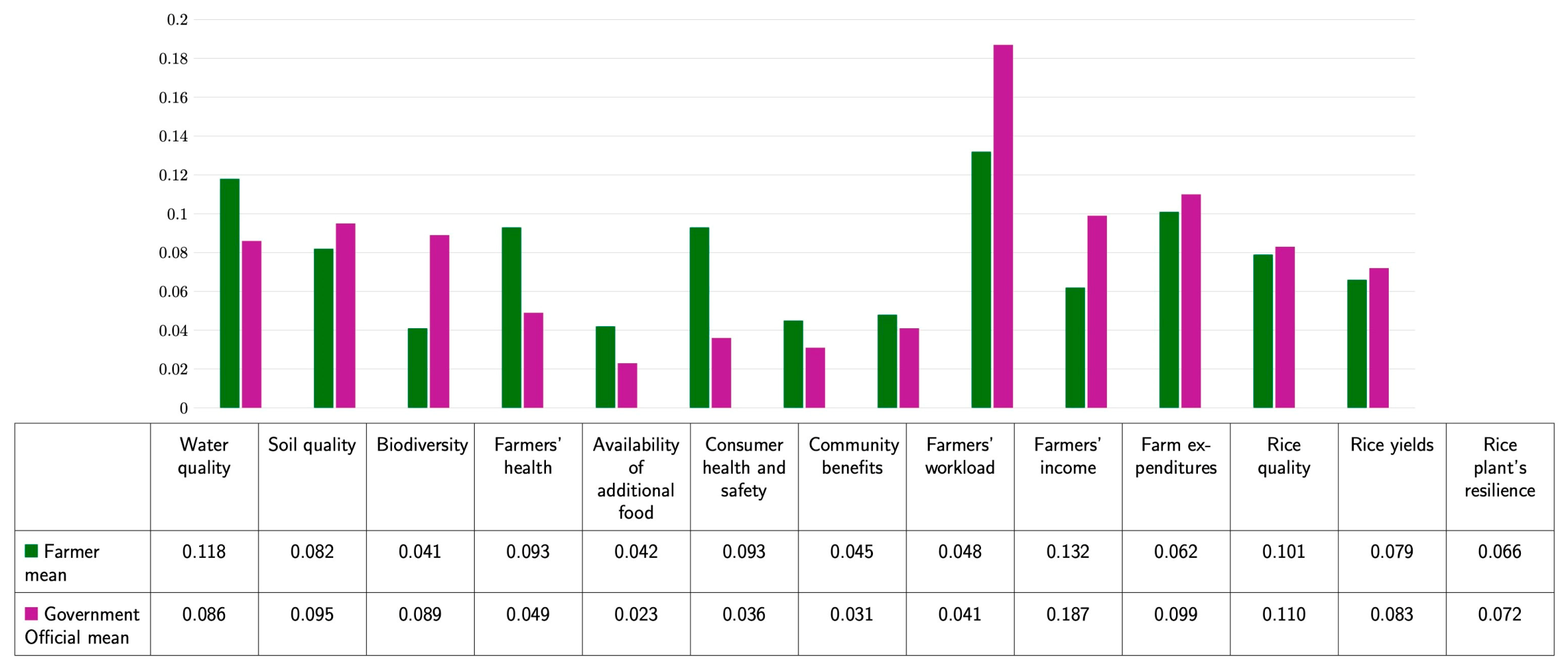
To attribute a level of importance for each sub-criterion, we conducted weighting exercises with two stakeholder groups (farmers and government officials) from Vinh Long, An Giang and Dong Thap. The results are presented in Figure 2.
Overall, both stakeholder groups considered economic benefits to be their top priority, particularly the sub-criterion of “farmers’ income”. The stakeholders viewed farmers’ economic security as foundational to supporting all dimensions of rice production. For example, CR farmers in Vinh Long stated that profits from rice production were important for investing in their farm, improving their quality of life, and enhancing the environmental conditions. Similarly, CR farmers in Dong Thap stated that their income was essential for ensuring their well-being and a good living environment.
In contrast, a few OR farmers in Vinh Long and some CR farmers in An Giang did not consider the economic dimension to be their top priority. Although the Vinh Long group rated economics to be the least important factor in rice production, it is necessary to contextualize their response. The rice–shrimp farmers reported that their income from rice farming accounted for only about 20% of their total income, while shrimp production accounted for the remaining 80%. Moreover, their organic rice production management served as the basis for their aquaculture production, as shrimps benefit from reduced chemical inputs. This may explain why they ranked the social and environmental dimensions as more important. When asked to weigh the criteria again, considering both rice and aquaculture production, this group of farmers changed their priorities, attributing 50 points to the economic criteria and a reduced weight for environmental and social (25 points each). CR farmers in An Giang rated social as their top priority and economic as second. They viewed farmers’ well-being as a prerequisite for rice production success and believed that good farmer health resulted in better economic outcomes.
Farmers generally ranked social and environmental benefits second or third, whereas government officials across the three provinces ranked them in the same order: economic first, environment second, and social third. Under the environmental criteria, stakeholders mostly prioritised “soil quality” and “water quality”. Farmers described soil and water as the “living environment” of the rice plants. They recognised these as essential for supporting the health, quality and productivity of rice crops, and ultimately, for supporting their livelihoods. Under the social criteria, stakeholders mostly prioritised “farmers’ health” and “consumer health and safety”. As previously noted, farmers considered their own health as essential to carrying out farm work and enhancing rice production efficiency. Regarding additional food sources, Vinh Long organic rice–shrimp farmers reported that the additional availability of wild foods provided additional sources of nutritious foods while also decreasing household food expenses. Although Vinh Long CR farmers acknowledged that chemical inputs reduced overall biodiversity, they were willing to accept this trade-off in order to prioritise rice productivity.

3.1.2. Results of Final Scores

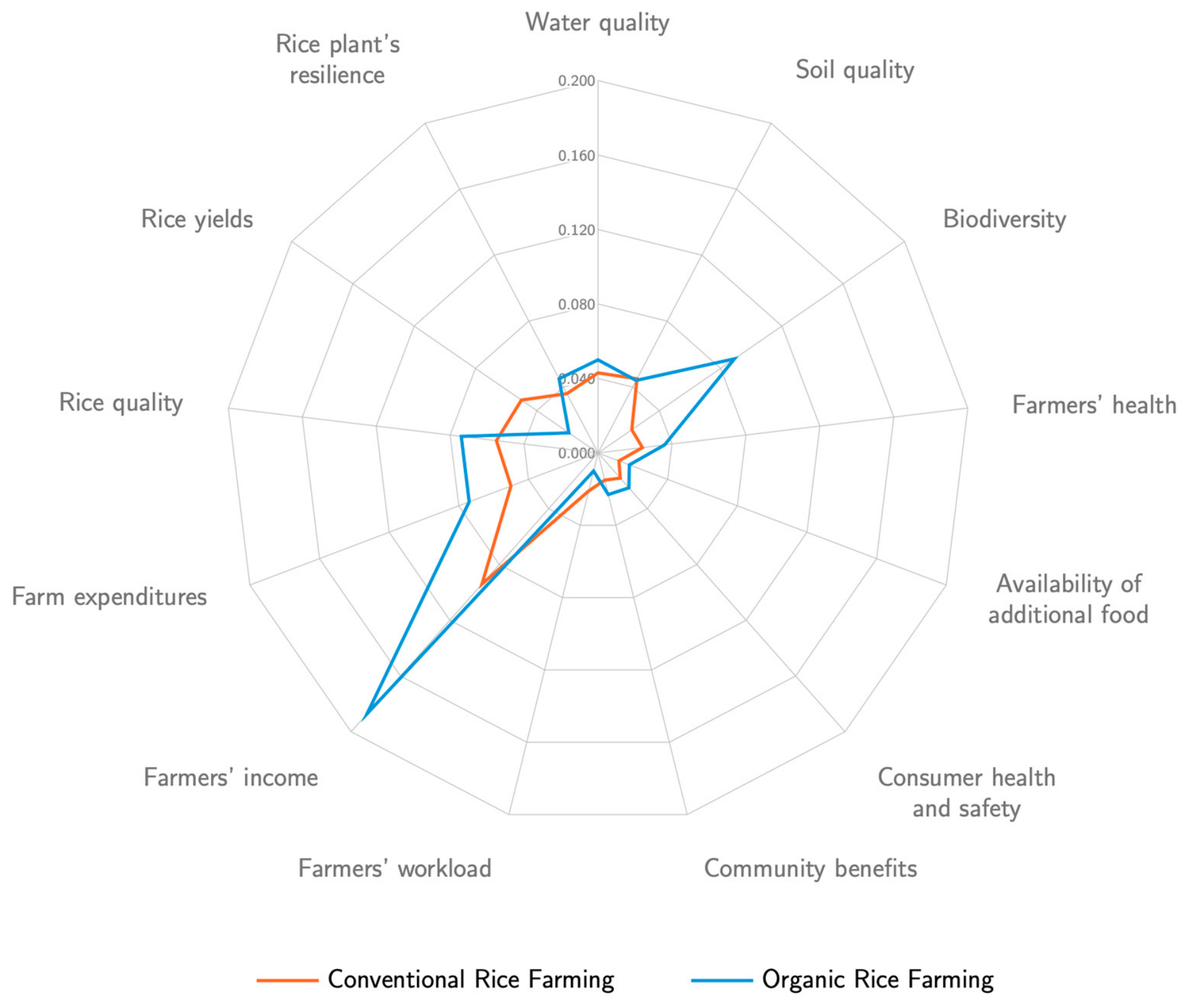
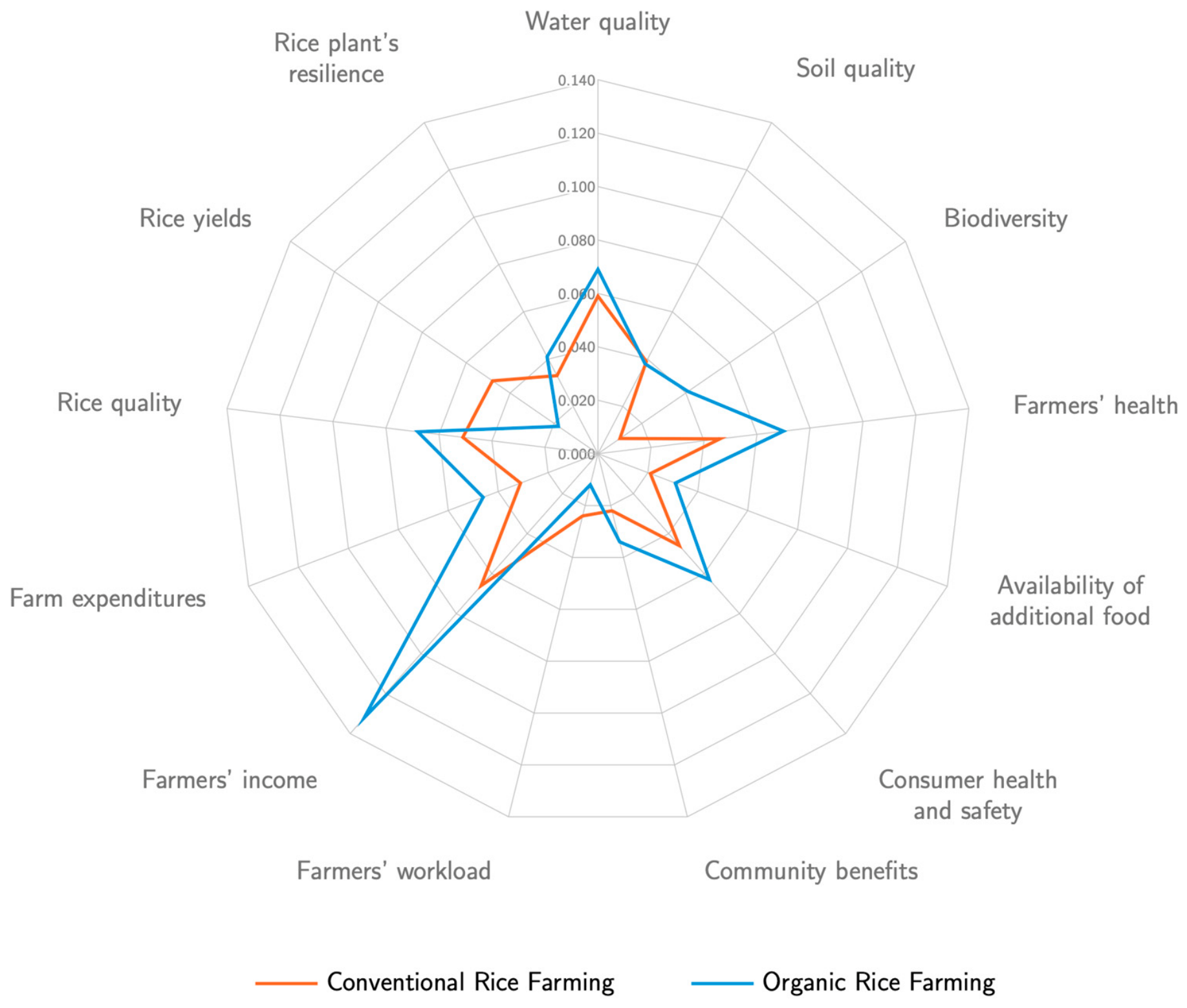
We calculated the final normalised weighted scores (Tables S1 and S2, Figure 3 and Figure 4), by integrating the stakeholder weights (Figure 2) with the assessment scores for each sub-criterion. This produced two assessments reflecting the opinions of each stakeholder group. The MCA scores present composite performance measures across multiple criteria, revealing the ordinal ranking of alternatives.
Our assessment revealed that, overall, OR farming performed cumulatively better (0.663 and 0.695) than CR farming (0.496 and 0.484). OR scores were higher across most sub-criteria, particularly “farmers’ income” and “biodiversity”. However, better “rice yields” and “farmers’ workload” scores were observed under conventional management. This was consistent across both assessments. However, the final scores for each sub-criterion were additionally influenced by the weights applied by the different stakeholder groups.

3.2. Results: Environment Criteria

3.2.1. Water Quality

Overall, water quality was slightly better in the OR (0.069 and 0.050) than in the CR (0.059 and 0.043) system. Farmers transitioning to OR observed improvements in water quality, including reduced skin irritation from contact with farm water and an increased presence of various aquatic species. The concentration of heavy metals in water, specifically arsenic and cadmium, were found to be well below the regulatory standards set by the Chinese government (GB 5084-2021) in both organic and conventional fields. The mean concentrations (±standard error of the mean, (SE)) of arsenic were 1.62 ± 0.24 and 1.14 ± 0.07 µg L−1, while mean cadmium concentrations were 0.62 ± 0.02 and 0.56 ± 0.03 µg L−1 in organic and conventional fields, respectively. Pesticide residues, however, were detected in both production systems, suggesting widespread cross-contamination due to shared irrigation systems and a lack of adequate physical barriers between organic and conventional fields [41]. Particularly high concentrations of fungicides, such as Tricyclazole (mean concentrations of 0.28 ± 0.06 µg L−1 in conventional and 0.30 µg L−1 in organic fields; mean ± SE), were detected in paddy rice waters [41]. The average sum of pesticide residues in the organic fields (1.2 µg L−1), the conventional fields (2.4 µg L−1), and in irrigation canals connecting the different production systems (2.7 µg L−1), all exceeded the aggregate sum of 0.5 µg L−1 threshold level set by EU Directive 2006/118/EC (amended by Directive 2014/80/EU) [41]. The lack of adequate separation between production systems likely results in pesticide residues continuously being introduced into the organic system via the irrigation water. A potential variability in observed residue levels may be attributed to the timing of sample collection relative to the most recent pesticide application, though this could not be verified as application dates were not recorded [41].

3.2.2. Soil Quality

Overall, soil quality scores were comparable between conventional (0.039 and 0.045) and certified organic (0.038 and 0.044) fields. Although transitioning farmers observed improvements in paddy soil quality since beginning the organic transition, quantitative assessments of pesticide residues and soil parameters revealed minimal differences between the two production systems. Similar to the analysis of water heavy metals, mean soil arsenic and cadmium concentrations were generally comparable between the two production systems, averaging (±SE) 3.74 ± 0.13 and 0.14 ± 0.01 mg kg−1 in certified organic fields and 4.05 ± 0.1 and 0.16 ± 0.01 mg kg−1 in conventional fields, respectively. These values are considered acceptable as they are below the regulatory thresholds set by China (GB 15618-2018) and Germany (Federal Soil Protection Act—BbodSchV). Pesticide residues in soil samples were detected in both production systems, again highlighting the issue of cross-contamination in the study area, as pointed out by Klamann et al. (2026) [41]. As already discussed in the assessment of water quality, elevated levels of the fungicide Tricyclazole were found, with average (±SE) values of 227.3 ± 13.7 and 136.8 ± 12.1 µg kg−1 recorded in organic and conventional soils, respectively [41]. Regarding soil quality and fertility indicators, the average TOC values in certified organic and conventional fields were comparable at 3.85 ± 0.11% and 4.06 ± 0.14%, respectively, while C/N ratio values were 10.2 ± 0.1, 10.4 ± 0.1, respectively.

3.2.3. Biodiversity

Farm-level biodiversity was higher under organic management (0.041 and 0.089) than under conventional management (0.010 and 0.022). Farmers in Vinh Long reported an increased presence of various species, including dragonflies, spiders, butterflies, fish, and frogs. These observations were corroborated by a biodiversity assessment of dragonflies and damselflies carried out on conventional and organic fields. Dragonflies and damselflies are valuable bioindicators, as their abundance and species diversity are strongly influenced by the structural diversity of the landscape (variety of wetland types) and local pesticide loads. Greater diversity and abundance of dragonflies and damselflies were registered in the organic farms. For example, an average of 23 individual damselflies of the species variable wisp (Agriocnemis femina) were collected through sweep netting in organic fields, as well as two more damselfly species and five dragonfly species. In the same fields, other species were also observed, including spiders, fish, crabs and frogs. Five damselfly species and 15 dragonfly species were identified in ponds and ditches neighbouring the organic fields. These areas serve as important source biotopes, supporting the recolonisation of the paddies when rice fields are dry following harvest. Contrastingly, only two A. femina were found per sweep netting event in the CR fields. No species belonging to sensitive damselfly and dragonfly genera typically found in clean running water (e.g., Calopterygidae, Gomphidae) were identified in either production system or nearby biotopes.

3.3. Results: Social Criteria

3.3.1. Farmers’ Health

Scores for this sub-criterion were greater in the organic system (0.070 and 0.036) than in the conventional system (0.046 and 0.024). Farmers reported health improvements under organic management, which they attributed to the elimination of chemical pesticides. Under conventional production systems, farmers may experience a host of health issues due to exposure to agrochemicals, including fatigue, increased susceptibility to illness, respiratory issues and skin rashes. Moreover, pesticides applied in paddy fields can reach nearby households through wind drift, which can cause adverse health impacts for community members. According to the director of a Vinh Long cooperative, such health issues can result in a reduced number of farmer working days and lost productivity. As a result of organic conversion, farmers reported health improvements such as reduced fatigue, and absence of skin irritation following contact with contaminated waters. Another Vinh Long cooperative manager also reported that breathing and digestive issues among farm workers decreased by approximately 30–40% following conversion, resulting in improvements in their overall sense of well-being and work satisfaction.

3.3.2. Availability of Additional Foods

Availability of additional foods for farmers’ household consumption refers to the presence of harvested or naturally occurring edible plants, fish, or small game available in or around the paddy fields. These foods are important as they can contribute to household nutrition and dietary diversity, thereby contributing to overall food security [62,63]. Scores for this sub-criterion were higher in the OR system (0.031 and 0.018) than the CR system (0.021 and 0.012). Farmers in Vinh Long reported an increased availability of various wild foods, including crabs, fish, and prawns. These foods mainly served as supplementary food sources for household consumption, but were also sold depending on needs and availability.

3.3.3. Consumer Health and Safety

Scores for consumer health and safety were higher under organic (0.063 and 0.025) than conventional management (0.046 and 0.018). Farmers considered OR a “clean”, “high quality” and healthier option to consume than CR due to the lack of chemical contamination. However, fungicides were detected in the rice samples collected from both production systems, although fewer and lower levels of fungicides were observed in the rice from the OR system compared to the one from the CR system. In the OR samples, all pesticides tested were below the limit of quantification, except for Isoprothiolane with an average (±SE) residue level of 0.09 ± 0.02 mg kg−1. Conversely, three fungicides in the CR samples were detected with residue levels above the European maximum residue limits (MRLs). Both Propiconazole and Tricyclazole have an MRL of 0.01 mg kg−1 according to the Commission Regulation (EU) 2021/155 of 9 February 2021 [64] and Commission Regulation (EU) 2017/983 of 9 June 2017 [65]. Propiconazole exceeded this threshold in all samples and Tricyclazole did so in five out of seven samples. Although Isoprothiolane residues did not exceed MRLs in CR samples, the concentrations were approximately 15-fold higher than in the OR samples. Despite the fact that polishing the rice reduced pesticide residues, they did not decrease below threshold levels in the affected samples.
The nutritional quality of rice was assessed by determining the levels of γ-aminobutyric acid (GABA), resistant starch, estimated glycaemic index, and antioxidant content. Organic production mostly resulted in better outcomes for GABA and antioxidant content of rice, whereas conventional production generally supported better outcomes in terms of resistant starch and glycemic index. However, values varied by rice variety, and in some cases, between growing seasons. For example, the highest mean GABA concentrations of all rice varieties were detected in the two black rice varieties and one white variety (TNN91). However, while the black varieties had higher mean GABA values under organic management (e.g., 690.88 µg GABA 100 g−1 for organic Lua Tim VL and 283.25 µg GABA 100 g−1 for conventional Lua Tim VL), the opposite was true for TNN 91 (267.35 µg GABA 100 g−1 in organic and 724.71 µg GABA 100 g−1 in conventional production). While the antioxidant contents of white (Jasmine 85, TNN 91, ST24, Vin 16) and red (ST 5) rice varieties were not significantly affected by the different production systems, the two organically grown black rice varieties (Lua Tim VL and Lua Tim CT) showed significantly higher values than their conventionally grown counterparts. Except for Lua Tim VL and Vin16, rice grown using organic practices had lower resistant starch content than rice grown using conventional methods. This indicates better resistant starch outcomes under conventional production in terms of health. Most rice varieties had high glycaemic index levels. Conventional production resulted in slightly lower (therefore better) glycaemic index values across all rice varieties, except for Vin16. Our results revealed that the nutritional quality of rice is influenced not only by the production system, but also by the variety of rice. Overall, the two black rice varieties performed particularly well under organic production across most indicators of nutritional quality, except for resistant starch and glycaemic index. However, it is important to note that these benefits were only evident when the rice was unpolished. This is explained by the fact that most antioxidants are located in the outer layers of the rice (the bran and germ), which are removed during the polishing process.

3.3.4. Community Benefits

Overall scores for “community benefits” were higher in the organic (0.034 and 0.023) than in the conventional (0.022 and 0.015) system. At the time of the interviews, transitioning farmers had completed only three crop cycles under organic production, and therefore believed that it was too soon to assess any community-level benefit. However, they anticipated that expanding organic production would result in benefits for the wider community, specifically due to the elimination of chemical inputs resulting in an overall healthier living environment and consequently, better health outcomes for community members. The cooperative manager reported that, prior to the organic transition, chicken and ducks from neighbouring households would occasionally die after accidentally consuming conventionally grown rice. This phenomenon was no longer observed following the shift to organic production. Conversion to organic farming may also enhance the aesthetic qualities of the farmland, which could be enjoyed by the wider community. Certified organic rice–shrimp producers felt that the landscape was more beautiful due to greater biodiversity on the farm and in the surrounding areas, which contributed to their sense of well-being.

3.3.5. Farmers’ Workload

Scores for “farmers’ workload” in the organic system were lower (0.012 and 0.010) compared to those in the conventional system (0.024 and 0.021). Changes in workload under organic farming varied according to farm size and specific management practices (e.g., fully manual or mechanised). While some farmers reported an increase in overall workload, others reported workload reductions. Although workload tended to increase slightly under organic management, the patterns of work intensity changed substantially between the different stages of each season. Workload tended to increase specifically for fertilisation, and, in some cases, for weed management. For example, a few farmers reported three additional working days for fertiliser application, and others reported increased workload due to manure application in the fields. The outcomes for weed management were mixed, with some farmers indicating less weeding time due to reduced weed presence, while others noted increased workload due to hand weeding. Farmers mostly reported time savings on pest and disease management as the vulnerability to such pressure tended to be lower in the organic farms. This was partly due to a decreased occurrence of some pests, as well as enhanced rice plant health due to the application of organic amendments. For land preparation, seeding and harvesting, organic farmers reported similar or less work compared to conventional management.
Farmers either received support from family members and neighbours, or hired additional labour to carry out farm work during periods of increased need. While a few farmers from Vinh Long noted that finding and paying workers was not a problem, others claimed that it was. One farmer specifically noted that it was difficult to recruit younger workers because many tended to leave the village, and that negotiating wages was sometimes challenging, as most of the farming activities had to be performed manually due to the area’s topography. Mechanisation and opportunities to rent farm machinery from the cooperative (such as harvesters or land-levelling equipment) can, however, substantially reduce workload and labour time.

3.4. Results: Economic Criteria

3.4.1. Farmers’ Income

Farmers’ income from certified OR was found to be considerably higher compared to CR, resulting in higher overall scores for organic (0.132 and 0.187) than conventional (0.066 and 0.094). For OR farmers, the transition period tended to come with an income loss, due to lower yields (up to 1/3 reductions for both), but not yet premium prices. Some farmers reported pre-transition incomes of about 20,000,000 VND ha−1 (759 USD ha−1), which reduced to 13,000,000 VND ha−1 (493 USD ha−1) during the transition period. Based on our discussion with a Vietnamese premium rice wholesaler, farm gate premium prices for OR typically range between 40 and 50% greater than conventional, depending on rice variety. As such, incomes generally tend to improve among post-transition certified organic producers. According to certified organic rice–shrimp farmers, farm gate price for CR was approximately 40,000,000 VND t−1 (1517 USD t−1) and currently about 55,000,000 VND t−1 (2086 USD t−1) for OR. They reported that their profits had increased by 20–30% and the overall economic status of households was more sustainable. In addition, they highlighted how OR farming also supported their aquaculture production by providing cleaner water for the shrimps, thus supporting overall household profitability. Consequently, the initial income losses associated with yield reductions during the transition phase were eventually offset following the acquisition of organic certification.

3.4.2. Farm Expenditures

Scores for this sub-criterion were higher in the OR farms (0.046 and 0.074) than in the CR farms (0.031 and 0.050). Overall farm expenditures can either increase or decrease under organic management, depending on, among other things, prior baselines, and local subsidies available for organic inputs. We found that savings on agricultural inputs, such as pesticides, fertilisers and seeds, generally constituted an economic benefit for organic farmers. However, the total volume of savings was dependent on the amounts of agricultural inputs used before transition and therefore varied between farms. Where farmers previously used large amounts of chemical inputs, sizeable savings can be experienced under organic management, but where the use of such inputs is already low, savings may be less substantial. For example, one rice–shrimp producer, who did not apply any fertilisers prior to conversion, reported an additional input cost of 3,200,000 VND ha−1 (121 USD ha−1) for organic fertilisers. However, despite this additional cost, their overall profits were still higher compared to pre-transition due to market price premiums. Other rice–shrimp producers recalled the cost for chemical inputs was 5–6,000,000 VND ha−1 (190–228 USD ha−1), which was twice as much as for organic inputs. In general, imported certified organic fertilisers are expensive, and, while domestically produced organic fertilisers are much cheaper, they are generally not certified.
Additional savings can occur due to decreased harvest losses caused by pests and diseases or natural hazards, as organic plants tend to be more robust and resilient to such occurrences. However, we did not quantify these yields and the associated savings. On the other hand, an additional cost to consider is the annual fee required for certification. In OR farming, weed control costs from purchasing synthetic herbicides is transferred to farm labour or machinery. One farmer mentioned that the cost to hire farm workers (for activities such as weed removal) is sometimes higher in OR farming because the work must be done manually, leading workers to demand higher wages.
CR farming in the MKD is generally considered inefficient, as farmers tend to use large quantities of seeds, fertilisers and synthetic pesticides. Interviews with DARD representatives revealed that existing subsidies for agricultural inputs aim to encourage farmers to transition to less intensive production systems and to reduce overall input use, thereby further lowering farm input costs. Support for organic inputs varies by province and can cover up to 50% of the costs.

3.4.3. Rice Quality

Rice quality scores were higher in the organic system (0.068 and 0.074) than the conventional one (0.051 and 0.055). Farmers experienced improvements in the quality of their ST24 and ST25 rice varieties, highlighting its improved flavour. These improvements are valued by farmers, as a portion of the harvest is consumed by the farming household. However, it is important to note that the eating quality of rice is greatly influenced by rice variety. Moreover, optimal level of amylose content for good eating and cooking quality of rice is determined by cultural context and consumer preferences. In Vietnam, rice with lower amylose content, characterised by greater softness and stickiness, is generally considered superior in terms of eating quality. Analyses of the same seven rice varieties assessed for consumer health and safety were grown in experimental fields under both organic and conventional management. All organically grown rice varieties, with the exception of Lua Tim CT, contained slightly lower amylose than their conventionally grown counterparts.

3.4.4. Rice Yields

Rice yield scores were 0.018 and 0.019 in the OR farm, compared to 0.048 and 0.050 in the CR farm, reflecting the finding that rice from the certified organic fields yielded much lower harvests. Field research was conducted in Vinh Long during three consecutive crop seasons (winter–spring season (November 2023–March 2024), summer–autumn season (April–July 2024), and autumn–winter season (August–November 2024)) to collect rice yield data from conventional and certified production systems. CR fields consistently had the highest yields across all three crop seasons with approximately 10 t ha−1 (winter–spring season) and 7 t ha−1 (both summer–autumn and autumn–winter seasons). Comparatively, certified OR fields maintained around 4–5 t ha−1 across all three seasons. These results are largely comparable to what certified producers in Vinh Long reported during interviews. As noted earlier, certified rice–shrimp farmers observed a drop in yields during the transition period of up to 30%. In the course of the transition, however, yields tended to gradually rise again, although they did not surpass pre-transition levels when measured in t ha−1 per season. According to one director of a cooperative in Vinh Long, OR yields increased from 4.6 in 2020 to 5.5 t ha−1 in 2025, which he attributed to increased soil fertility as a result of applying organic amendments.

3.4.5. Rice Plants’ Resilience

OR farming generally supported better rice plant resilience to both natural hazards and pests and diseases (0.041 and 0.045) than its conventional counterpart (0.033 and 0.036). The majority of farmers reported decreased occurrence of specific pests following their conversion to organic production. For example, transitioning farmers noted reductions in pests such as Asiatic rice borer (Chilo suppressalis) and rice ear-cutting caterpillar (Mythimna separata) and certified rice–shrimp farmers reported reductions in rice leaf roller (Cnaphalocrocis medinalis), to name a few examples. At the same time, the presence of natural enemies (such as dragonflies, spiders, butterflies) also increased.
Transitioning farmers described their rice plants as “healthier”. One farmer observed that the leaves of his rice plants were “thicker” and “stronger”, resulting in reduced pest damage. Producers attributed these improvements to the use of organic inputs (including organic fertilisers), but certified rice–shrimp respondents also highlighted the role of high-quality rice varieties (ST24 and ST25) which are considered to have good pest and disease resistance. Moreover, resilience may also be influenced by the type of organic production system. For example, Vinh Long’s alternating rice–shrimp model and saline environment may be less conducive to pest development, thus providing additional benefits for rice resilience.
Certified rice–shrimp farmers reported improved rice plant resilience to natural hazards. OR plants were described as being more resilient to different climatic conditions, including elevated temperatures and droughts. Farmers stated that the use of organic fertilisers strengthened the rice plants, ultimately reducing damage caused by strong winds and rains. In addition, high-quality rice varieties used (ST24 and ST25) had greater salt tolerance. On the other hand, transitioning rice farmers had not observed any change in rice plant resilience to natural hazards compared to pre-transition.

3.5. Sensitivity Analysis

Considering that stakeholders prioritised economic criteria in the original assessment, we created three alternative weighting scenarios for the sensitivity analysis:
  • Equal weights across all three criteria. Points distributed as follows: environment (33), social (33), economic (34).
  • More weight on environment criteria. Points distributed as follows: environment (60), social (20), economic (20).
  • More weight on well-being criteria. Points distributed as follows: environment (20), social (60), economic (20).
As reflected in Table 2, the final weighted scores for OR and CR remained stable across alternatives, reflecting that the ranking is robust within the applied weighted variations.

4. Discussion

Overall, OR farming had better outcomes than CR across environmental, social and economic dimensions, although lower rice yields and greater workload remained important trade-offs. This synthesised picture of performance across criteria comes with important caveats which must be considered when assessing the transition’s overall success.

4.1. Biodiversity, Pest Regulation and Crop Resilience

Through increased habitat variability, implementation of wildlife-friendly management practices, and the prohibition of agrochemical use [66], organic systems can foster greater diversity of different local flora and fauna [17] and can increase organism abundance of different taxa by up to 50% [3]. Biodiversity recovery via organic agricultural approaches can be particularly pronounced in simplified landscapes characterised by high agricultural land cover and poorer habitat quality, as well as in regions dominated by intensive agriculture [3]. This suggests that farmers converting from intensive conventional farming systems in the MKD may observe even greater biodiversity enhancements following a conversion to organic production.
Farmers’ responses generally indicated improvements in biodiversity and environmental condition, a promising outcome in an environment as heavily impacted by human activities over time as the MKD. This was supported by quantitative data, which indicated that the elimination of agrochemical use in organically managed fields was associated with greater abundance of beneficial species in OR farms (even during early conversion). These beneficial species, which included natural enemies (e.g., dragonflies), support pest control [67,68,69], but tend to be adversely impacted by intensive use of synthetic pesticides [70]. Other studies similarly found increased presence of natural enemies, such as spiders and fish, in organically managed rice fields [62,71,72], although effects tend to vary depending on specific taxa and local conditions [66,73].
Farmers also reported reductions in occurrence of specific pests and overall healthier and more robust plants. The efficacy of natural predators in suppressing pests in OR systems is highly context-dependent and varies according to the ecological characteristics of each organism [72]. A shift to organic does not automatically reduce all pest species. For example, Sorgog et al. (2023) [72] found reduced abundance of brown planthopper (Laodelphax striatellus) but greater abundances of the leafhopper (Nephotettix cincticeps) and white-backed planthopper (Sogatella furcifera) in organic paddies. Furthermore, Pérez-Méndez et al. (2023) [74] observed elevated pest infestation levels in OR farms compared to conventional ones in Spain, suggesting that biological pest control mechanisms were insufficient to match the efficacy of synthetic chemical treatments, ultimately resulting in reduced productivity within the organic system.
Overall, our results suggest that organic management supports stronger and more resilient plants, though variables such as years under organic management, specific rice varieties used and type of production systems (e.g., rice–shrimp), may also play an important role. For example, rice variety and crop diversification strategies can also play an important role in disease control. For example, Zhu et al. (2000) [75] demonstrated that interplanting disease-susceptible rice varieties alongside resistant ones reduced rice blast disease by 94% and increased yields by 89% compared to the monoculture system.
While certified organic producers reported increased rice plant resilience to various natural hazards (including drought conditions and strong winds and rains), some transitioning farmers had not yet observed improvements. This suggests that such benefits may require an extended timeframe to fully manifest. Various studies support our findings related to enhanced climate resilience under organic management [17,76,77]. Evidence from a long-term field trial in the USA suggests that organically grown crops perform better than conventional systems during periods of drought or excessive rainfall [78]. While the authors noted that both systems experienced substantial yield reductions during a particularly severe drought year, the organically managed fields generally maintained higher yields than their conventionally managed counterparts. This is explained, in part, by the fact that organic practices, including the application of organic amendments, increase soil organic matter, which subsequently enhances the water-holding capacity and infiltration rates of soils [78]. Consequently, organic systems can demonstrate higher yields and superior water-use efficiency during periods of extreme weather, such as droughts and heavy rainfall [3,17,76]. Furthermore, Mendoza (2004) [76] observed that deeper mud layers and looser soils in organic paddies facilitated deeper root penetration, thereby increasing nutrient uptake by rice plants.

4.2. Cross-Contamination and Product Safety

Interestingly, our qualitative and quantitative findings revealed slightly different facets of environmental performance. Farmers who had just completed their third crop cycle transitioning to organic management noted some observable improvements in soil and water quality, specifically noting, for example, reductions in skin irritation from contact with paddy water. However, analyses of soil and water samples from nearby certified and conventional fields revealed pesticide residues in both production systems, suggesting widespread cross-contamination, likely facilitated via connected irrigation networks and inadequate physical barriers between farms or through spray drift [41]. Cross-contamination via waterways is further evidenced by the presence of exogenous substances, such as the insect repellent N,N-diethyl-m-toluamide (DEET), which is not approved for agricultural purposes, but which was found in both production systems [41].
In relation to consumer health and safety, farmers in this study perceived organically grown rice as a healthier and safer alternative to consume. This sentiment was, to some degree, substantiated by the results of our pesticide residues analysis. Hereby, two of the three pesticides detected in CR samples (Propiconazole and Tricyclazole) were not detected in OR samples and Isoprothiolane concentration was 15-fold lower in organic than CR samples. The reduction in Isoprothiolane concentration between organic and conventional samples suggests that farming practices have a substantial impact on residue levels. However, Nguyen et al. (2022) [79], who collected rice samples across ten districts in six provinces in the MKD, noted widespread pesticide contamination in organic farms. They identified 18 active chemical ingredients in organically grown rice, with high detection frequencies for Tricyclazole (62.5%), followed by Difenoconazole (32.5%), Chlorpyrifos-ethyl (30%) and Isoprothiolane (25%). This contamination was attributed to two factors: intentional farmer non-compliance to organic protocols, and legacy soil contamination caused by the extended half-lives of pesticides used in previous conventional crop cycles. Furthermore, the study highlighted that contamination was lower in a coastal district characterised by alternating rice–shrimp systems. Because these systems produce only one rice crop annually, they are inherently lower-input and therefore present a lower contamination risk compared to intensive rice farming areas [79].
Our findings ultimately raise significant concerns regarding product safety and acquisition of future organic certification, underscoring the urgent need to address cross-contamination challenges in the region.

4.3. Nutritional Quality of Rice

Our findings on the nutritional quality of rice grown under organic and conventional management are somewhat complicated by the fact that nutritional quality was also influenced by rice variety. Organic production mostly supported better outcomes for GABA and antioxidant content in rice, whereas conventional production generally supported better outcomes for resistant starch and glycaemic index. Moreover, nutritional quality parameters of black rice varieties were generally better under organic management than conventional. The existing literature also reveals mixed and nuanced results regarding the nutritional quality of organic versus conventionally grown crops, highlighting how the consumer health benefits are rarely straightforward or binary [3,80,81]. Other studies have similarly found mixed outcomes based on rice variety [80,81]. A synthesis of various quantitative reviews and meta-analyses indicated that organically cultivated plant foods exhibit elevated profiles of secondary metabolites, vitamins, and mineral nutrients; however, these aggregate findings must be interpreted with caution due to high uncertainty and discrepancies between studies [3]. Nevertheless, some studies highlight the potential nutritional advantages of consuming organic foods. Research conducted in India found that organically grown rice contained significantly elevated levels of key phytochemicals relevant to antioxidative capacity (including phenolics, flavonoids and γ-oryzanol) [82]. Additionally, organic management enhanced various physicochemical characteristics, such as amylose content and gel consistency. Field experiments with organic and conventionally grown rice in India found moderate improvements in nutritional quality, specifically for protein, phosphorus and potassium content of OR, especially for brown rice varieties [81]. However, these quality improvements were diminished through polishing—which we also found to be the case with the black rice varieties in our study.

4.4. Timeframes of Environmental, Health and Community Benefits

A challenge in assessing the performance of transition is having clear timeframes for the criteria to be affected in different contexts. For example, we found that soil TOC and C/N ratio values were generally comparable between the conventional and the organic fields, despite the organic farm having been certified for six years, indicating that a longer timeframe is required to achieve significant improvements of certain soil quality parameters. In studies from Japan for example, organic farms achieved significantly higher carbon stocks (15.5% higher) and nitrogen stocks (17.2% higher) compared to their conventional counterparts—but this was only the case for farms that had been managed organically for 12 years [83]. On the other hand, there was no significant difference in carbon and nitrogen stocks for those that had been managed organically for 4–5 and 8–9 years, suggesting the initial 4–5-year timeframe may still represent a transition phase, during which the soil microbial communities are still adapting to the organic amendments, increased nutrient cycling rate, and the nitrogen deficiencies that commonly characterise early organic conversion.
A similar dynamic applies to social and health benefits. Our results revealed that the absence of agrochemical use in organic farms supported the health of farmers and nearby community members by limiting exposure to harmful chemicals in line with wider studies [84,85]. This is not uniform across previous studies, however, for example in China, while organic farmers provided higher self-ratings for their health than their conventional counterparts, transitioning farmers did not perceive significant improvements in their health [84]. This suggests that, in some contexts, health improvements may take a longer timeframe to fully manifest.
Our analysis also revealed some potential preliminary improvements for the community level. Farm-level benefits—such as reduced health risks from direct exposure to pesticides, enhanced biodiversity and improved landscape aesthetics—could be amplified through large-scale organic conversion, thereby extending these positive outcomes to the broader community. In addition, shifting to organic production can fortify local social networks, as these systems rely heavily on cooperative structures and community-based knowledge exchange [17]. Moreover, it can also facilitate more direct and frequent social interactions between farmers and consumers [17].

4.5. Labour and Economic Viability

The labour demands and economic viability of OR varied across farms and stages of transition, reflecting interactions among workload, yields, production costs and market access. Our findings indicate that the transition may involve lower yields and reduced profitability in the short term, along with greater labour requirements, whereas input savings, certification and premium prices can improve longer-term outcomes. These patterns were also shaped by factors such as farm size, specific management practices, pre-conversion baselines and access to affordable organic inputs.
We found a general increase in farm workload under organic management, particularly for fertilisation and weed control, although some operations become less demanding as farm conditions improved. Workload requirements also varied with farm size, management practices and pre-conversion conditions. Previous studies similarly reported context-dependent effects. Organic farming may require more time for weeding because of increased weed infestation [86,87], whereas effective water management can suppress weeds and reduce manual labour requirements [76]. Tran et al. (2026) [32] found that, on average, five fewer man days per crop cycle were needed for OR farming (16 man days) compared to CR farming (21 man days) in Vietnam. In order to encourage higher rates of organic transition, ways to address higher workloads should be investigated to alleviate farmer concerns and reduce a potential barrier to uptake.
Several interviewed farmers reported an initial yield decline after conversion, followed by gradual recovery over subsequent growing seasons, although productivity did not surpass pre-transition baselines. Studies in coastal MKD provinces have similarly reported lower yields under organic systems (4.29–5.8 t ha−1) than under conventional production (5.4–7.2 t ha−1) [33,34]. However, yield effects vary by context. Ngo et al. (2025) [35] recorded slightly higher rice yields under OR farming (6.62 t ha−1) than CR farming (6.35 t ha−1) in Vietnam’s Red River Delta region. Organic farmers in Cambodia also reported improved yields and food security following conversion [85]. These improvements were attributed to compost application, System of Rice Intensification techniques, and access to better seeds, among other things [85]. Longer-term monitoring is therefore needed to determine how yields develop beyond the initial transition period.
Changes in overall farm expenditure can vary according to pre-conversion baselines, labour requirements and access to affordable organic inputs. We found that savings on synthetic pesticides, fertilisers and seeds generally constituted an economic benefit for organic farmers. Overall, organic producers may experience substantial reductions in farm expenditures and overall cost savings when the transition is supported by subsidies or access to low-cost organic inputs. However, in the absence of such support, economic gains are more moderate, as additional tasks and requirements (such as increased workload or the need to hire extra labour) may reduce overall profitability. Previous studies illustrate this variation. A study in Vietnam’s Hue province reported cost savings due to significant lower fertiliser and pesticide expenses in OR compared to CR systems [32]. In contrast, OR farms in Ca Mau province had higher total costs (26,891,200 VND ha−1 or 1020 USD ha−1) compared to CR farms (18,942,200 VND ha−1 or 718 USD ha−1) because of greater fertiliser and labour expenses [34]. Cost differences between organic and chemical inputs, such as fertilisers, can vary significantly depending on context and application volumes necessitated by different production regimes [34,88]. Access to locally sustainable and cost-effective organic inputs is important for reducing transition costs and barriers.
In this study, reduced yields and the absence of premium prices during the transition phase initially lowered farmers’ profitability. However, once formal certification and access to premium markets was secured, incomes generally stabilised and improved. Fixed purchasing prices, established through contractual agreements between agricultural cooperatives and traders, ensure price stability for OR, minimising exposure to market fluctuations frequently observed for CR [32]. In rice–shrimp systems in the former Tra Vinh province, OR received a higher price than CR, 8700 VND kg−1 compared with 6480 VND kg−1 (0.33 and 0.25 USD kg−1), generating slightly higher incomes for farmers [33]. In Ca Mau, OR prices were nearly double those of CR, and gross profits were also substantially higher [34].
Taken together, these findings suggest that the economic viability of OR depends on whether input savings and premium prices can compensate for lower yields and greater labour requirements.

4.6. Recommendations for Policy and Management

The successful expansion of organic rice production in the Mekong Delta requires coordinated action across multiple stakeholders, including national and provincial governments, farmers, cooperatives, private sector actors, agricultural extension services, and research institutions. While organic rice production has the potential to provide substantial benefits, several structural barriers continue to constrain wider adoption. Addressing these barriers requires a combination of immediate interventions that reduce the risks associated with conversion, alongside longer-term investments that strengthen the enabling environment for organic agriculture.
In the short term, policies should focus on reducing the financial risks associated with conversion. This could be done by introducing government-backed insurance mechanisms to compensate farmers for the yield losses during the transition period. In addition, organic material inputs (such as organic fertilisers and biopesticides) should be subsidised during the entire transition period. Strengthening farmer training on organic production and pest management is also important, which could be facilitated by the technical staff from agricultural extension centres or cooperatives. Given the importance of price premiums and market access for the economic viability of organic rice production, cooperatives or traders must ensure reliable premium contracts for organic farmers, and efforts must be made to strengthen linkages with exporters capable of accessing high-value organic markets.
Together with immediate investments to improve the monitoring of irrigation water, longer-term efforts should focus on identifying suitable water quality zones and implementing strategic improvements in irrigation infrastructure across the MKD region to better manage water quality and minimise cross-contamination risks. Strategic landscape-scale conversion could further reduce contamination risks by clustering organic farms.
Long-term market development should focus on strengthening consumer confidence in Vietnamese organic rice. Developing a trusted regional brand for organically produced rice from the MKD could help differentiate Vietnamese products in international markets while creating new opportunities for domestic market expansion. Moreover, branding initiatives targeting the domestic market should be bolstered by coordinated marketing campaigns that clearly communicate the environmental, health, and social benefits of organic production.
Finally, universities and research institutions should establish long-term monitoring programmes to evaluate post-transition outcomes, as many of the agronomic, environmental, and economic benefits of organic farming (such as improvements in soil health, biodiversity, and yield stability) may only become evident over extended time horizons.
Collectively, these measures highlight that scaling up organic rice production requires a systems-based approach that integrates supportive public policies, market development, capacity building, and continued research.

4.7. Limitations

Key limitations of this study are that it focuses on only one province and that we had a relatively small sample size of certified organic farmers to draw conclusions from. These constraints, stemming primarily from the limited availability and access to organic producers in the MKD, may restrict the generalisability of our findings to the broader farming community and to other provinces with differing geographical, climatic or socio-economic contexts. Despite this, we observed a degree of qualitative data saturation, reflecting a degree of robustness and thematic depth in the socio-economic findings. Furthermore, our data also points to the long timeframe required for organic farming benefits to be fully realised. Given the timeframe of our study was limited to three years, this may have restricted the ability to fully understand the long-term effects of transition. Longitudinal research is therefore necessary to fully evaluate the long-term ecological and socio-economic trajectories of transitioning to OR farming in the MKD.

5. Conclusions

Our study shows that OR farming generally outperforms CR farming across environmental, social, and economic dimensions in the context of a large deltaic Vietnamese province. In particular, there was clear evidence of improvement in social and economic criteria via qualitative and quantitative measures. In the social dimension, OR farming performed better for “farmers’ health”, “availability of additional foods”, and “community benefits”. Conversely, “farmers’ workload” was generally better under CR farming, although this varied by farm. Regarding the economic criteria, OR achieved notably higher scores for “farmers’ income”. Moreover, the sub-criteria “farm expenditures”, “rice quality” and “rice plant’s resilience” were also better under OR management. On the other hand, “rice yields” were notably better in the CR system. Considering the yield reductions following conversion, the economic viability of OR production remains fundamentally contingent on securing premium contracts and access to premium markets, as well to affordable organic inputs.
Although the organic system performed particularly better for “biodiversity” compared to its conventional counterpart, scores for “water quality” and “soil quality” were lower than expected. This is primarily because some pesticides were detected at concentrations above the maximum permitted level in both production systems. Similarly, OR scores for “consumer health and safety” were dampened by the fact that one of the three pesticides detected above the level of quantification in the CR samples was also present in the OR samples, albeit at much lower levels.
Expanding OR farming in the MKD has the potential to improve rice production’s environmental, social and economic performance, but fully realising these benefits will require coordinated action. Persistent cross-contamination across the MKD highlights the urgent need to identify suitable water quality zones and implement strategic improvements in irrigation infrastructure across the region to manage water quality, prevent contamination of organic paddies, and ensure strict adherence to organic certification requirements. Priorities should also include reducing farmers’ financial risks during conversion, ensuring access to affordable organic inputs, increasing farmer training, and securing reliable premium contracts and market access. Long-term monitoring is important to capture information of transition impacts over longer timeframes. Efforts should also be made to develop the MKD’s organic brand to create new opportunities in domestic and international markets.
This research highlights the necessity of multidimensional assessments that integrate stakeholder priorities and diverse data types to capture a holistic overview of agricultural transitions. More comprehensive, transdisciplinary assessments of OR conversion are needed. Realising the benefits of OR is not solely a function of changing the production regime, but is also shaped by other contextual factors, such as geography, policies, pre-transition management and baselines, and cultivar selection. How these elements amplify or obstruct OR benefits in the MKD requires further investigation. Moreover, considering different sustainability dimensions evolve over varying temporal scales, assessing the full impact of OR conversion necessitates extended study timeframes. Future research must look beyond commodity yields to evaluate impacts on dietarily or culturally significant species, ecosystem services, and broader social and well-being outcomes. While large-scale OR conversion in the MKD could amplify benefits beyond the individual farm, more empirical data and long-term monitoring of key sustainability metrics are critical.

Supplementary Materials

The following supporting information can be downloaded at: https://www.mdpi.com/article/10.3390/land15091542/s1, Further information regarding the methodology for the quantitative data is included. Table S1: Final performance score for conventional rice (CR) and organic rice (OR) farming systems, with farmers’ weights; Table S2: Final performance score for conventional rice (CR) and organic rice (OR) farming systems, with government officials’ weights. References [41,89,90,91,92,93,94,95,96,97,98,99,100,101] are cited in the Supplementary Materials.

Author Contributions

Conceptualization, G.E. and J.J.O.; methodology, G.E. and J.J.O.; formal analysis, G.E., J.H.S., A.K., B.W., L.K., D.M.D., N.N.T.T., B.T. and K.H.; investigation, G.E., J.H.S., A.K., B.W., L.K., A.G.C.D., D.M.D., N.N.T.T., B.T., K.H., N.M.P.N. and J.O.; writing—original draft preparation, G.E.; writing—review and editing, G.E., J.J.O., L.W., A.K., B.W., L.K., K.C.M., D.M.D., B.T. and J.O.; visualization, G.E.; supervision, L.W.; project administration, L.W. and K.C.M.; funding acquisition, L.W., K.C.M., A.K., J.O. and J.H.S. All authors have read and agreed to the published version of the manuscript.

Funding

The bilateral OrganoRice project, from which this paper emerged, is funded by the German Federal Ministry of Research, Technology and Space (BMFTR) within the “CLIENT II—International Partnerships for Sustainable Innovations” funding initiative, funding code 01LZ1806A, 01LZ1806B, 01LZ1806C, and 01LZ1806D and by the Vietnamese Ministry of Science and Technology (MOST), funding code NĐT/DE/22/29.

Institutional Review Board Statement

The study was conducted in accordance with the Declaration of Helsinki, and approved by the Ethics Committee of the Jülich Research Centre (16 October 2025).

Informed Consent Statement

Informed consent was obtained from all subjects involved in the study.

Data Availability Statement

Dataset available on request from the authors.

Acknowledgments

We would like to thank Nick Kupfer for developing the map of the study area, Figure 1 of this paper.

Conflicts of Interest

Authors Linda Klamann, Bei Wu, Björn Thiele, Joachim H. Spangenberg, Lutz Weihermüller were employed by the company Forschungszentrum Jülich GmbH. Author Jürgen Ott was employed by the company L.U.P.O GmbH. The remaining authors declare that the research was conducted in the absence of any commercial or financial relationships that could be construed as a potential conflict of interest.

Abbreviations

The following abbreviations are used in this manuscript:
MKDMekong Delta
OROrganic rice
CRConventional rice
SRSafe rice
MCAMulti-criteria analysis
GABAγ-aminobutyric acid
SEstandard error of the mean
DARDDepartment of Agriculture and Rural Development

References

  1. Streimikis, J.; Baležentis, T. Agricultural sustainability assessment framework integrating sustainable development goals and interlinked priorities of environmental, climate and agriculture policies. Sustain. Dev. 2020, 28, 1702–1712. [Google Scholar] [CrossRef] [Scilit]
  2. Gennari, P.; Navarro, D.K. The challenge of measuring agricultural sustainability in all its dimensions. J. Sustain. Res. 2019, 1, e190013. [Google Scholar] [CrossRef] [Scilit]
  3. Seufert, V.; Ramankutty, N. Many shades of gray—The context-dependent performance of organic agriculture. Sci. Adv. 2017, 3, e1602638. [Google Scholar] [CrossRef] [Scilit] [PubMed]
  4. Darmaun, M.; Chevallier, T.; Hossard, L.; Lairez, J.; Scopel, E.; Chotte, J.-L.; Lambert-Derkimba, A.; de Tourdonnet, S. Multidimensional and multiscale assessment of agroecological transitions. A review. Int. J. Agric. Sustain. 2023, 21, 2193028. [Google Scholar] [CrossRef] [Scilit]
  5. Möhring, N.; Muller, A.; Schaub, S. Farmers’ adoption of organic agriculture—A systematic global literature review. Eur. Rev. Agric. Econ. 2024, 51, 1012–1044. [Google Scholar] [CrossRef] [Scilit]
  6. Vu, H.T.D.; Tran, D.D.; Schenk, A.; Nguyen, C.P.; Vu, H.L.; Oberle, P.; Trinh, V.C.; Nestmann, F. Land use change in the Vietnamese Mekong Delta: New evidence from remote sensing. Sci. Total Environ. 2022, 813, 151918. [Google Scholar] [CrossRef] [Scilit] [PubMed]
  7. Kupfer, N.; Vo, T.Q.; Bachofer, F.; Huth, J.; Vereecken, H.; Weihermüller, L.; Montzka, C. Enhanced Monitoring of Sub-Seasonal Land Use Dynamics in Vietnam’s Mekong Delta through Quantile Mapping and Harmonic Regression. Remote Sens. 2024, 16, 3569. [Google Scholar] [CrossRef] [Scilit]
  8. Shrivastava, A.; Tchale, H.; Cao, B.T.; Elabed, G.; Kar, A.; Kieu, H.T.P.; Nguyen, H.T.T. Vietnam-Spearheading Vietnam’s Green Agricultural Transformation: Moving to Low-Carbon Rice; World Bank Group: Washington, DC, USA, 2022. [Google Scholar] [CrossRef] [Scilit]
  9. Hien, N.T.T.; Tam, H.T.; Shimada, K.; Anh, H.H.; Van Cuong, N.; Tru, L.C. Impact of Sustainable Agricultural Practices on Labor Use Among Rice Farmers in the Mekong Delta of Vietnam. Agribusiness 2026, 42, 845–861. [Google Scholar] [CrossRef] [Scilit]
  10. General Statistics Office of Vietnam. 2026. Available online: https://www.nso.gov.vn/en/homepage/ (accessed on 8 April 2026).
  11. Connor, M.; Tuan, L.A.; DeGuia, A.H.; Wehmeyer, H. Sustainable Rice Production in the Mekong River Delta: Factors Influencing Farmers’ Adoption of the Integrated Technology Package ‘One Must Do, Five Reductions’ (1M5R). Outlook Agric. 2021, 50, 90–104. [Google Scholar] [CrossRef] [Scilit]
  12. Toan, P.V.; Sebesvari, Z.; Bläsing, M.; Rosendahl, I.; Renaud, F.G. Pesticide Management and Their Residues in Sediments and Surface and Drinking Water in the Mekong Delta, Vietnam. Sci. Total Environ. 2013, 452–453, 28–39. [Google Scholar] [CrossRef] [Scilit] [PubMed]
  13. O’Connor, J.; Spangenberg, J.H.; Nguyen, N.H.; Emidi, G.; Kappenberg, A.; Klamann, L.; Kupfer, N.; Ky, H.; Nga, N.T.T.; Khoi, C.M.; et al. Organic Rice Transition in a Changing Environment: Linking Farmers’ Benefits to Adaptation and Mitigation. Land 2025, 14, 2074. [Google Scholar] [CrossRef] [Scilit]
  14. Nguyen, T.K.Q.; Tran, T.B.Y.; Riple, A.K.L. Adoption of Vietnamese Good Agricultural Practices (VietGAP) in Aquaculture: Evidence From Small-Scale Shrimp Farming. Asian Fish. Sci. 2022, 34, 393–403. [Google Scholar] [CrossRef] [Scilit]
  15. GlobalGAP. Integrated Farm Assurance: Guideline for Fruit and Vegetables; GlobalGAP: Cologne, Germany, 2023; Available online: https://documents.globalgap.org/documents/230414_IFA_guideline_FV_v6_0_Apr23_en.pdf (accessed on 30 July 2026).
  16. Food and Agriculture Organization of the United Nations; World Health Organization. Codex Alimentarius—Organically Produced Foods; FAO and WHO: Rome, Italy, 2001. [Google Scholar]
  17. Reganold, J.; Wachter, J. Organic agriculture in the twenty-first century. Nat. Plants 2016, 2, 15221. [Google Scholar] [CrossRef] [Scilit] [PubMed]
  18. Nguyen, S.H.; Ngo, M.D. Organic agriculture development in Vietnam in the new era: Current situation, opportunities, and challenges. J. State Manag. 2025, 32, 12–22. [Google Scholar] [CrossRef] [Scilit]
  19. Muller, A.; Schader, C.; Scialabba, N.E.-H.; Brüggemann, J.; Isensee, A.; Erb, K.-H.; Smith, P.; Klocke, P.; Leiber, F.; Stolze, M.; et al. Strategies for feeding the world more sustainably with organic agriculture. Nat. Commun. 2017, 8, 1290. [Google Scholar] [CrossRef] [Scilit] [PubMed]
  20. Ness, B.; Urbel-Piirsalu, E.; Anderberg, S.; Olsson, L. Categorising tools for sustainability assessment. Ecol. Econ. 2007, 60, 498–508. [Google Scholar] [CrossRef] [Scilit]
  21. Lindfors, A. Assessing sustainability with multi-criteria methods: A methodologically focused literature review. Environ. Sustain. Indic. 2021, 12, 100149. [Google Scholar] [CrossRef] [Scilit]
  22. Cicciù, B.; Schramm, F.; Schramm, V.B. Multi-criteria decision making/aid methods for assessing agricultural sustainability: A literature review. Environ. Sci. Policy 2022, 138, 85–96. [Google Scholar] [CrossRef] [Scilit]
  23. Rozaki, Z.; Yudanto, R.S.B.; Triyono; Rahmawati, N.; Alifah, S.; Ardila, R.A.; Pamungkas, H.W.; Fathurrohman, Y.E.; Man, N. Assessing the Sustainability of Organic Rice Farming in Central Java and Yogyakarta: An Economic, Ecological, and Social Evaluation. Org. Farming 2024, 10, 142–158. [Google Scholar] [CrossRef] [Scilit]
  24. Hokazono, S.; Hayashi, K. Variability in environmental impacts during conversion from conventional to organic farming: A comparison among three rice production systems in Japan. J. Clean. Prod. 2012, 28, 101–112. [Google Scholar] [CrossRef] [Scilit]
  25. He, X.; Qiao, Y.; Liang, L.; Knudsen, M.T.; Martin, F. Environmental life cycle assessment of long-term organic rice production in subtropical China. J. Clean. Prod. 2018, 176, 880–888. [Google Scholar] [CrossRef] [Scilit]
  26. Amirahmadi, E.; Moudrý, J.; Konvalina, P.; Hörtenhuber, S.J.; Ghorbani, M.; Neugschwandtner, R.W.; Jiang, Z.; Krexner, T.; Kopecký, M. Environmental Life Cycle Assessment in Organic and Conventional Rice Farming Systems: Using a Cradle to Farm Gate Approach. Sustainability 2022, 14, 15870. [Google Scholar] [CrossRef] [Scilit]
  27. Gao, P.; Wang, H.; Sun, G.; Xu, Q.; Dou, Z.; Dong, E.; Wu, W.; Dai, Q. Integrated emergy and economic evaluation of the dominant organic rice production systems in Jiangsu province, China. Front. Plant Sci. 2023, 14, 1107880. [Google Scholar] [CrossRef] [Scilit] [PubMed]
  28. Arunrat, N.; Sereenonchai, S.; Chaowiwat, W.; Wang, C.; Hatano, R. Carbon, Nitrogen and Water Footprints of Organic Rice and Conventional Rice Production over 4 Years of Cultivation: A Case Study in the Lower North of Thailand. Agronomy 2022, 12, 380. [Google Scholar] [CrossRef] [Scilit]
  29. Panday, D.; Bhusal, N.; Das, S.; Ghalehgolabbehbahani, A. Rooted in Nature: The Rise, Challenges, and Potential of Organic Farming and Fertilizers in Agroecosystems. Sustainability 2024, 16, 1530. [Google Scholar] [CrossRef] [Scilit]
  30. Pandey, S.; Pant, P. Organic Agriculture as a Climate Mitigation Strategy: Evidence and Prospects. Adv. Agric. 2026, 2026, 3551723. [Google Scholar] [CrossRef] [Scilit]
  31. Sannou, R.O.; Kirschke, S.; Günther, E. Integrating the social perspective into the sustainability assessment of agri-food systems: A review of indicators. Sustain. Prod. Consum. 2023, 39, 175–190. [Google Scholar] [CrossRef] [Scilit]
  32. Tran, H.H.; Datai, H.; Ton Nu Hai, A. Technical efficiency of organic and conventional rice farming in Central Vietnam: A meta-frontier DEA analysis. J. Glob. Innov. Agric. Sci. 2026, 14, 719. [Google Scholar] [CrossRef] [Scilit]
  33. Nguyen, C.T.; Nguyen, V.M.; Nguyen, V.A.; Phan, T.P.T.; Doan, T.H.C.; Nguyen, T.H.; Nguyen, T.H. Some Initial Results on Research and Modeling of Organic Rice Production in the Mekong Delta, Vietnam. Int. J. Energy Environ. Sci. 2016, 1, 29–36. [Google Scholar] [CrossRef]
  34. Dat, T.T.; Truong, D.D.; Huan, L.H.; Hang, N.D. Cost-Benefit Analysis of Organic and Traditional Rice Production in Mekong River Delta: The Case of Ca Mau Province, Vietnam. Appl. Ecol. Environ. Res. 2023, 21, 503–518. [Google Scholar] [CrossRef] [Scilit]
  35. Ngo, M.H.; Kim, M.K.; Takagi, C. Assessing technical efficiency and farmer adoption of organic rice in the Red River Delta of Vietnam: An application of metafrontier DEA and Probit Models. Org. Agric. 2025, 15, 107–123. [Google Scholar] [CrossRef] [Scilit]
  36. Tran, D.D.; Park, E.; Thu Van, C.; Nguyen, T.D.; Nguyen, A.H.; Linh, T.C.; Quyen, P.H.; Tran, D.A.; Nguyen, H.Q. Advancing sustainable rice production in the Vietnamese Mekong Delta insights from ecological farming systems in an Giang Province. Heliyon 2024, 10, e37142. [Google Scholar] [CrossRef] [Scilit] [PubMed]
  37. Berg, H.; Ekman Söderholm, A.; Söderström, A.S.; Nguyen, T.T. Recognizing wetland ecosystem services for sustainable rice farming in the Mekong Delta, Vietnam. Sustain. Sci. 2017, 12, 137–154. [Google Scholar] [CrossRef] [Scilit] [PubMed]
  38. Huynh, V.K.; Vo, T.D.; Nguyen, N.T. Research on the demand for safe rice of people in Can Tho city. Can Tho Univ. J. Sci. 2021, 57, 8–15. (In Vietnamese) [Google Scholar] [CrossRef] [Scilit]
  39. Malefaki, S.; Markatos, D.; Filippatos, A.; Pantelakis, S. A Comparative Analysis of Multi-Criteria Decision-Making Methods and Normalization Techniques in Holistic Sustainability Assessment for Engineering Applications. Aerospace 2025, 12, 100. [Google Scholar] [CrossRef] [Scilit]
  40. Mokotoff, E.; García, E.; Pérez, J. Normalization Procedures on Multicriteria Decision Making-An Example on Environmental Problems. In Proceedings of the 12th International Conference on Enterprise Information Systems (ICEIS 2010), Funchal, Portugal, 8–12 June 2010. [Google Scholar] [CrossRef] [Scilit]
  41. Klamann, L.; Thiele, B.; Giang, C.D.A.; Kupfer, N.; Kappenberg, A.; Nguyen, T.T.N.; Vo, T.Q.; Khoi, C.M.; Weihermüller, L. Pesticide residues in organic vs. conventional rice systems: Management recommendations for Vietnam’s Mekong Delta. Agric. Syst. 2026, 236, 104773. [Google Scholar] [CrossRef] [Scilit]
  42. Li, P.; Chen, Y.H.; Lu, J.; Zhang, C.Q.; Liu, Q.Q.; Li, Q.F. Genes and Their Molecular Functions Determining Seed Structure, Components, and Quality of Rice. Rice 2022, 15, 18. [Google Scholar] [CrossRef] [Scilit] [PubMed]
  43. Bharucha, Z.; Pretty, J. The roles and values of wild foods in agricultural systems. Philos. Trans. R. Soc. B 2010, 365, 2913–2926. [Google Scholar] [CrossRef] [Scilit] [PubMed]
  44. Stanujkic, D.; Magdalinovic, N.; Jovanovic, R. A Multi-Attribute Decision Making Model Based on Distance from Decision Maker’s Preferences. Informatica 2013, 24, 103–118. [Google Scholar] [CrossRef] [Scilit]
  45. Mhlanga, S.T.; Lall, M. Influence of Normalization Techniques on Multi-criteria Decision-making Methods. J. Phys. Conf. Ser. 2022, 2224, 012076. [Google Scholar] [CrossRef] [Scilit]
  46. Krishnan, A.R. Past efforts in determining suitable normalization methods for multi-criteria decision-making: A short survey. Front. Big Data 2022, 5, 990699. [Google Scholar] [CrossRef] [Scilit] [PubMed]
  47. Daugavietis, J.E.; Soloha, R.; Dace, E.; Ziemele, J. A Comparison of Multi-Criteria Decision Analysis Methods for Sustainability Assessment of District Heating Systems. Energies 2022, 15, 2411. [Google Scholar] [CrossRef] [Scilit]
  48. Talukder, B.; Hipel, K.W.; vanLoon, G.W. Developing Composite Indicators for Agricultural Sustainability Assessment: Effect of Normalization and Aggregation Techniques. Resources 2017, 6, 66. [Google Scholar] [CrossRef] [Scilit]
  49. Pollesch, N.L.; Dale, V.H. Normalization in sustainability assessment: Methods and implications. Ecol. Econ. 2016, 130, 195–208. [Google Scholar] [CrossRef] [Scilit]
  50. European Union. Directive 2006/118/EC of the European Parliament and of the Council on the protection of groundwater against pollution and deterioration. Off. J. Eur. Union 2006, L 372, 19–31. [Google Scholar]
  51. European Union. Regulation (EU) 2018/848 of the European Parliament and of the Council on organic production and labelling of organic products and repealing Council Regulation (EC) No 834/2007. Off. J. Eur. Union 2018, L 150, 1–92. [Google Scholar]
  52. GB 5084-2021; Standard for Irrigation Water Quality. Ministry of Ecology and Environment: Beijing, China, 2021.
  53. GB 15618-2018; Soil Environmental Quality-Risk Control Standard for Soil Contamination of Agricultural Land. Ministry of Ecology and Environment: Beijing, China, 2018.
  54. Federal Republic of Germany. Bundes-Bodenschutz- und Altlastenverordnung (BBodSchV); Bundesgesetzblatt I; Federal Office of Justice: Berlin, Germany, 2021; pp. 2598–2716.
  55. Wanga, M.A.; Watanabe, Y.; Kamati, N.N.; Hukununa, R.K.; Alweendo, B.N.; Hangula, M.N.; Nanhapo, P.I.; Awala, S.K.; Fujisawa, M. Impact of Paddy Fields on Soil Salinity and Sodicity at Kalimbeza Rice Project, Namibia. Open J. Soil Sci. 2025, 15, 477–495. [Google Scholar] [CrossRef]
  56. Zhang, L.; Wang, Y.; Lou, Z.; Hsu, L.; Chen, D.; Piao, R.; Zhao, H.; Cui, Z. Meta-Analysis of Factors Affecting C-N Fractions and Yield of Paddy Soils by Total Straw Return and N Fertilizer Application. Agronomy 2022, 12, 3168. [Google Scholar] [CrossRef] [Scilit]
  57. Kusumawardani, P.N.; Bimantara, P.O.; Guigue, J.; Haga, C.; Sasaki, Y.; Kautsar, V.; Kimani, S.M.; Nguyen-Sy, T.; Tang, S.; Purwanto, B.H.; et al. Carbon and Nitrogen Dynamics as Affected by Land-Use and Management Change from Original Rice Paddies to Orchard, Wetland, Parking Area and Uplands in a Mountain Village Located in Shonai Region, Northeast Japan. Soil Sci. Plant Nutr. 2022, 68, 114–123. [Google Scholar] [CrossRef] [Scilit]
  58. Hendiani, S.; Liao, H.; Bagherpour, M.; Tvaronavičienė, M.; Banaitis, A.; Antucheviciene, J. Analyzing the Status of Sustainable Development in the Manufacturing Sector Using Multi-Expert Multi-Criteria Fuzzy Decision-Making and Integrated Triple Bottom Lines. Int. J. Environ. Res. Public Health 2020, 17, 3800. [Google Scholar] [CrossRef] [Scilit] [PubMed]
  59. Sandelowski, M.; Voils, C.I.; Knafl, G. On Quantitizing. J. Mix. Methods Res. 2009, 3, 208–222. [Google Scholar] [CrossRef] [Scilit] [PubMed]
  60. Pinar, M.; Cruciani, C.; Giove, S.; Sostero, M. Constructing the FEEM sustainability index: A Choquet integral application. Ecol. Indic. 2014, 39, 189–202. [Google Scholar] [CrossRef] [Scilit]
  61. Więckowski, J.; Sałabun, W. Sensitivity analysis approaches in multi-criteria decision analysis: A systematic review. Appl. Soft Comput. 2023, 148, 110915. [Google Scholar] [CrossRef] [Scilit]
  62. Halwart, M. Biodiversity, nutrition and livelihoods in aquatic rice-based ecosystems. Biodiversity 2008, 9, 36–40. [Google Scholar] [CrossRef] [Scilit]
  63. Garaway, C.J.; Photitay, C.; Roger, K.; Khamsivilay, L.; Halwart, M. Biodiversity and nutrition in rice-based ecosystems; the case of Lao pdr. Hum. Ecol. 2013, 41, 547–562. [Google Scholar] [CrossRef] [Scilit]
  64. European Union. Commission Regulation (EU) 2021/155 of 9 February 2021 amending Annexes II, III and V to Regulation (EC) No 396/2005 of the European Parliament and of the Council as regards maximum residue levels for carbon tetrachloride, chlorothalonil, chlorpropham, dimethoate, ethoprophos, fenamidone, methiocarb, omethoate, propiconazole and pymetrozine in or on certain products. Off. J. Eur. Union 2021, L 46, 5–32. [Google Scholar]
  65. European Union. Commission Regulation (EU) 2017/983 amending Annexes III and V to Regulation (EC) No 396/2005 of the European Parliament and of the Council as regards maximum residue levels for tricyclazole in or on certain products. Off. J. Eur. Union 2017, L 148, 27–37. [Google Scholar]
  66. Gomiero, T.; Pimentel, D.; Paoletti, M.G. Environmental Impact of Different Agricultural Management Practices: Conventional vs. Organic Agriculture. Crit. Rev. Plant Sci. 2011, 30, 95–124. [Google Scholar] [CrossRef] [Scilit]
  67. Baba, Y.G.; Kusumoto, Y.; Tanaka, K. Effects of agricultural practices and fine-scale landscape factors on spiders and a pest insect in Japanese rice paddy ecosystems. BioControl 2018, 63, 265–275. [Google Scholar] [CrossRef] [Scilit]
  68. Settele, J.; Heong, K.L.; Kühn, I.; Klotz, S.; Spangenberg, J.H.; Arida, G.; Beaurepaire, A.; Beck, S.; Bergmeier, E.; Burkhard, B.; et al. Rice ecosystem services in South-East Asia. Paddy Water Environ. 2018, 16, 211–224. [Google Scholar] [CrossRef] [Scilit]
  69. Hsu, G.-C.; Ou, J.-A.; Ni, M.-H.; Lin, Z.-H.; Ho, C.-K. Generalist predators function as pest specialists: Examining diet composition of spiders and ladybeetles across rice crop stages. J. Appl. Ecol. 2025, 65, 1889–1901. [Google Scholar] [CrossRef] [Scilit]
  70. Geiger, F.; Bengtsson, J.; Berendse, F.; Weisser, W.W.; Emmerson, M.; Morales, M.B.; Ceryngier, P.; Liira, J.; Tscharntke, T.; Winqvist, C.; et al. Persistent negative effects of pesticides on biodiversity and biological control potential on European farmland. Basic Appl. Ecol. 2010, 11, 97–105. [Google Scholar] [CrossRef] [Scilit]
  71. Katayama, N.; Baba, Y.G.; Okubo, S.; Matsumoto, H. Taxon-specific responses to landscape-scale and long-term implementation of environmentally friendly rice farming. J. Appl. Ecol. 2023, 60, 1399–1408. [Google Scholar] [CrossRef] [Scilit]
  72. Sorgog, K.; Tanaka, K.; Baba, Y.G. Macro-scale perspectives in conservation biological control: Latitudinal differences in the effects of organic farming on insect pests and natural enemies in rice paddy ecosystems. Agric. Ecosyst. Environ. 2023, 357, 108689. [Google Scholar] [CrossRef] [Scilit]
  73. Gong, S.; Zhou, X.; Zhu, X.; Huo, J.; Faghihinia, M.; Li, B.; Zou, Y. Organic rice cultivation enhances the diversity of above-ground arthropods but not below-ground soil eukaryotes. Agric. Ecosyst. Environ. 2023, 347, 108390. [Google Scholar] [CrossRef] [Scilit]
  74. Pérez-Méndez, N.; Martínez-Eixarch, M.; Llevat, R.; Mateu, D.; Marrero, H.J.; Cid, N.; Catala-Forner, M. Enhanced diversity of aquatic macroinvertebrate predators and biological pest control but reduced crop establishment in organic rice farming. Agric. Ecosyst. Environ. 2023, 357, 108691. [Google Scholar] [CrossRef] [Scilit]
  75. Zhu, Y.; Chen, H.; Fan, J.; Wang, Y.; Li, Y.; Chen, J.; Fan, J.X.; Yang, S.; Hu, L.; Leung, H. Genetic diversity and disease control in rice. Nature 2000, 406, 718–722. [Google Scholar] [CrossRef] [Scilit] [PubMed]
  76. Mendoza, T.C. Evaluating the Benefits of Organic Farming in Rice Agroecosystems in the Philippines. J. Sustain. Agric. 2004, 24, 93–115. [Google Scholar] [CrossRef] [Scilit]
  77. Heckelman, A.; Smukler, S.; Wittman, H. Cultivating climate resilience: A participatory assessment of organic and conventional rice systems in the Philippines. Renew. Agric. Food Syst. 2018, 33, 225–237. [Google Scholar] [CrossRef] [Scilit]
  78. Lotter, D.W.; Seidel, R.; Liebhardt, W. The performance of organic and conventional cropping systems in an extreme climate year. Am. J. Altern. Agric. 2003, 18, 146–154. [Google Scholar] [CrossRef] [Scilit]
  79. Nguyen, C.T.; Vo, T.T.; Nguyen, T.X.; Nguyen, H.P.; Bui, D.D.; Nguyen, V.M.; Duong, V.H. Assessment of Pesticide Residues in Organic Rice Production in The Mekong Delta, Vietnam. Eur. J. Dev. Stud. 2022, 2, 1–11. [Google Scholar] [CrossRef] [Scilit]
  80. Alves, G.H.; Paraginski, R.T.; Lamas, N.D.; Hoffmann, J.F.; Vanier, N.L.; de Oliveira, M. Effects of Organic and Conventional Cropping Systems on Technological Properties and Phenolic Compounds of Freshly Harvested and Stored Rice. J. Food Sci. 2017, 82, 2276–2285. [Google Scholar] [CrossRef] [Scilit] [PubMed]
  81. Surekha, K.; Jhansilakshmi, V.; Somasekhar, N.; Latha, P.C.; Kumar, R.M.; Shobha Rani, N.; Rao, K.V.; Viraktamath, B.C. Status of Organic Farming and Research Experiences in Rice. J. Rice Res. 2010, 3, 31–43. [Google Scholar]
  82. Bagchi, T.B.; Ghosh, A.; Kumar, U.; Chattopadhyay, K.; Sanghamitra, P.; Ray, S.; Adak, T.; Sharma, S. Comparison of Nutritional and Physicochemical Quality of Rice Under Organic and Standard Production Systems. Cereal Chem. 2016, 93, 435–443. [Google Scholar] [CrossRef] [Scilit]
  83. Kautsar, V.; Cheng, W.; Tawaraya, K.; Yamada, S.; Toriyama, K.; Kobayashi, K. Carbon and nitrogen stocks and their mineralization potentials are higher under organic than conventional farming practices in Japanese Andosols. Soil Sci. Plant Nutr. 2020, 66, 144–151. [Google Scholar] [CrossRef] [Scilit]
  84. Xiang, P.; Wen, C.; Lin, Z.; Xia, M. Effects of organic farming adoption on farmer’s subjective well-being: Evidence from Xiangxi Prefecture, China. Int. J. Agric. Sustain. 2025, 23, 2455801. [Google Scholar] [CrossRef] [Scilit]
  85. Beban, A. Organic Agriculture and Farmer Wellbeing: A Case Study of Cambodian Small-Scale Farmers; Institute of Development Studies, Massey University: Palmerston North, New Zealand, 2009; Available online: http://hdl.handle.net/10179/952 (accessed on 29 April 2026).
  86. Muneret, L.; Mitchell, M.; Seufert, V.; Aviron, S.; Djoudi, E.A.; Pétillon, J.; Plantegenest, M.; Thiéry, D.; Rusch, A. Evidence that organic farming promotes pest control. Nat. Sustain. 2018, 1, 361–368. [Google Scholar] [CrossRef] [Scilit]
  87. Hakimi, F.; Sehli, S.; Hashem, A.; Avila-Quezada, G.D.; Abd_Allah, E.F. Comparative analysis of organic and conventional farm sustainability in peri-urban zones of Rabat, Morocco: Insights and perspectives. Cogent Food Agric. 2025, 11, 2463562. [Google Scholar] [CrossRef] [Scilit]
  88. Kennvidy, S.A. Organic Rice Farming Systems in Cambodia: Socio-economic Impact of Smallholder Systems in Takeo Province. Int. J. Environ. Rural Dev. 2011, 2, 115–119. [Google Scholar] [CrossRef] [PubMed]
  89. Lehotay, S.J. Determination of Pesticide Residues in Foods by Acetonitrile Extraction and Partitioning with Magnesium Sulfate: Collaborative Study. J. AOAC Int. 2007, 90, 485–520. [Google Scholar] [CrossRef] [Scilit]
  90. EN 15662:2018; Foods of Plant Origin-Multimethod for the Determination of Pesticide Residues Using GC- and LC-Based Analysis Following Acetonitrile Extraction/Partitioning and Clean-Up by Dispersive SPE-Modular QuEChERS-Method. CEN (European Committee for Standardization): Brussels, Belgium, 2018.
  91. ISO 6647-1:2020; Rice—Determination of Amylose Content, Part 1: Spectrophotometric Method with a Defatting Procedure by Methanol and with Calibration Solutions of Potato Amylose and Waxy Rice Amylopectin. ISO (International Organization for Standardization): Geneva, Switzerland, 2020.
  92. Wu, N.N.; Li, R.; Li, Z.J.; Tan, B. Effect of germination in the form of paddy rice and brown rice on their phytic acid, GABA, γ-oryzanol, phenolics, flavonoids and antioxidant capacity. Food Res. Int. 2022, 159, 111603. [Google Scholar] [CrossRef] [Scilit] [PubMed]
  93. Re, R.; Pellegrini, N.; Proteggente, A.; Pannala, A.; Yang, M.; Rice-Evans, C. Antioxidant activity applying an improved ABTS radical cation decolorization assay. Free Radic. Biol. Med. 1999, 26, 1231–1237. [Google Scholar] [CrossRef] [Scilit] [PubMed]
  94. Singleton, V.L.; Orthofer, R.; Lamuela-Raventós, R.M. Analysis of total phenols and other oxidation substrates and antioxidants by means of Folin-Ciocalteu reagent. In Methods in Enzymology; Packer, L., Ed.; Academic Press: New York, NY, USA, 1999; Volume 299, pp. 152–178. [Google Scholar] [CrossRef] [Scilit]
  95. Ghasemzadeh, A.; Karbalaii, M.T.; Jaafar, H.Z.; Rahmat, A. Phytochemical constituents, antioxidant activity, and antiproliferative properties of black, red, and brown rice bran. Chem. Cent. J. 2018, 12, 17. [Google Scholar] [CrossRef] [Scilit] [PubMed]
  96. Stanoeva, J.P.; Balshikevska, E.; Stefova, M.; Tusevski, O.; Simic, S.G. Comparison of the Effect of Acids in Solvent Mixtures for Extraction of Phenolic Compounds from Aronia melanocarpa. Nat. Prod. Commun. 2020, 15, 1–10. [Google Scholar] [CrossRef] [Scilit]
  97. Englyst, H.N.; Kingman, S.M.; Cummings, J.H. Classification and measurement of nutritionally important starch fractions. Eur. J. Clin. Nutr. 1992, 46, S33–S50. [Google Scholar] [PubMed]
  98. Chung, H.J.; Liu, Q.; Hoover, R. Impact of annealing and heat-moisture treatment on rapidly digestible, slowly digestible and resistant starch levels in native and gelatinized corn, pea and lentil starches. Carbohydr. Polym. 2009, 75, 436–447. [Google Scholar] [CrossRef] [Scilit]
  99. Brodkorb, A.; Egger, L.; Alminger, M.; Alvito, P.; Assunção, R.; Ballance, S.; Bohn, T.; Bourlieu-Lacanal, C.; Boutrou, R.; Carrière, F.; et al. INFOGEST static in vitro simulation of gastrointestinal food digestion. Nat. Protoc. 2019, 14, 991–1014. [Google Scholar] [CrossRef] [Scilit] [PubMed]
  100. Pautong, P.A.; Anonuevo, J.J.; De Guzman, M.K.; Sumayao, R., Jr.; Henry, C.J.; Sreenivasulu, N. Evaluation of in vitro digestion methods and starch structure components as determinants for predicting the glycemic index of rice. LWT 2022, 168, 113929. [Google Scholar] [CrossRef] [Scilit]
  101. Goñi, I.; Garcia-Alonso, A.; Saura-Calixto, F. A starch hydrolysis procedure to estimate glycemic index. Nutr. Res. 1997, 17, 427–437. [Google Scholar] [CrossRef] [Scilit]
Figure 1. Location of the two study sites in Vinh Long province in the Mekong Delta.
Land 15 01542 g001
Figure 2. Relative importance of all sub-criteria according to the mean opinion of two stakeholder groups (farmers and government officials). The higher the number of points, the greater the importance placed on a sub-criterion.
Land 15 01542 g002
Figure 3. Final performance score for conventional rice and organic rice systems, with farmers’ weights.
Land 15 01542 g003
Figure 4. Final performance score for conventional rice and organic rice farming systems, with government officials’ weights.
Land 15 01542 g004
Table 2. Final scores with alternative weighting scenarios for conventional rice (CR) and organic rice (OR).
Criteria/Sub-CriteriaAlternative 1Alternative 2Alternative 3
Equal Weights Across Three CriteriaMore Weight on Environment CriteriaMore Weight on Social Criteria
CRORCRORCROR
Environmental
Water quality0.0560.0650.1020.1190.0340.040
Soil quality0.0520.0510.0950.0930.0320.031
Biodiversity0.0270.1090.0500.1980.0170.066
Social
Farmers’ health0.0330.0500.0200.0300.0600.090
Availability of additional food0.0330.0500.0200.0300.0600.090
Consumer health and safety0.0330.0450.0200.0270.0600.082
Community benefits0.0330.0500.0200.0300.0600.090
Farmers’ workload0.0330.0170.0200.0100.0600.030
Economic and rice production performance
Farmers’ income0.0340.0680.0200.0400.0200.040
Farm expenditures0.0340.0510.0200.0300.0200.030
Rice quality0.0340.0460.0200.0270.0200.027
Rice yields0.0410.0150.0240.0090.0240.009
Rice plant’s resilience0.0340.0430.0200.0250.0200.025
Total score0.4770.6580.4510.6680.4860.650
Disclaimer/Publisher’s Note: The statements, opinions and data contained in all publications are solely those of the individual author(s) and contributor(s) and not of MDPI and/or the editor(s). MDPI and/or the editor(s) disclaim responsibility for any injury to people or property resulting from any ideas, methods, instructions or products referred to in the content.