Article

Identity Reframing and Transformation Trajectories in Post-Socialist Mono-Functional Urban Formations: Reference Cases for Piatykhatky (Kharkiv, Ukraine)


Faculty of Architecture, Vilnius Gediminas Technical University, LT-10223 Vilnius, Lithuania
Land 2026, 15(8), 1388; https://doi.org/10.3390/land15081388
Submission received: 10 June 2026 / Revised: 26 July 2026 / Accepted: 30 July 2026 / Published: 2 August 2026

Abstract

Post-socialist monotowns and mono-functional urban districts face interrelated economic, spatial, institutional, and identity crises, yet their transformation trajectories vary. Building on the previously developed methodological framework, the study implements its second stage by selecting reference cases and reconstructing transformation trajectories in Central and Eastern Europe. Seven weighted criteria—identity reframing, multi-level governance and actors, cultural vitality, economic diversification, heritage and architectural significance, positive physical transformation, and regional connectivity—were applied to nine purposively selected cases in Estonia, Lithuania, Poland, Germany, the Czech Republic, and Slovakia. Scores ranged from 1.40 to 4.05; five cases were retained, comprising a stable four-case core and a weight-sensitive fifth case selected for typological and target-context complementarity. Cross-case analysis identified four overlapping contours: crisis-adaptive, institutional-spatial, heritage-symbolic, and cultural-everyday. Transformation was asynchronous and non-linear: symbolic, institutional, cultural, spatial, and economic changes unfolded in different sequences, while economic diversification remained limited or moderate in most cases. Given theory-informed, author-assigned weights and a regionally bounded, typologically heterogeneous sample, the ranking is a case-selection tool rather than a measure of transformation success. The reconstructed trajectories provide the analytical basis for the subsequent assessment of their transferability to Piatykhatky (Kharkiv, Ukraine).

1. Introduction

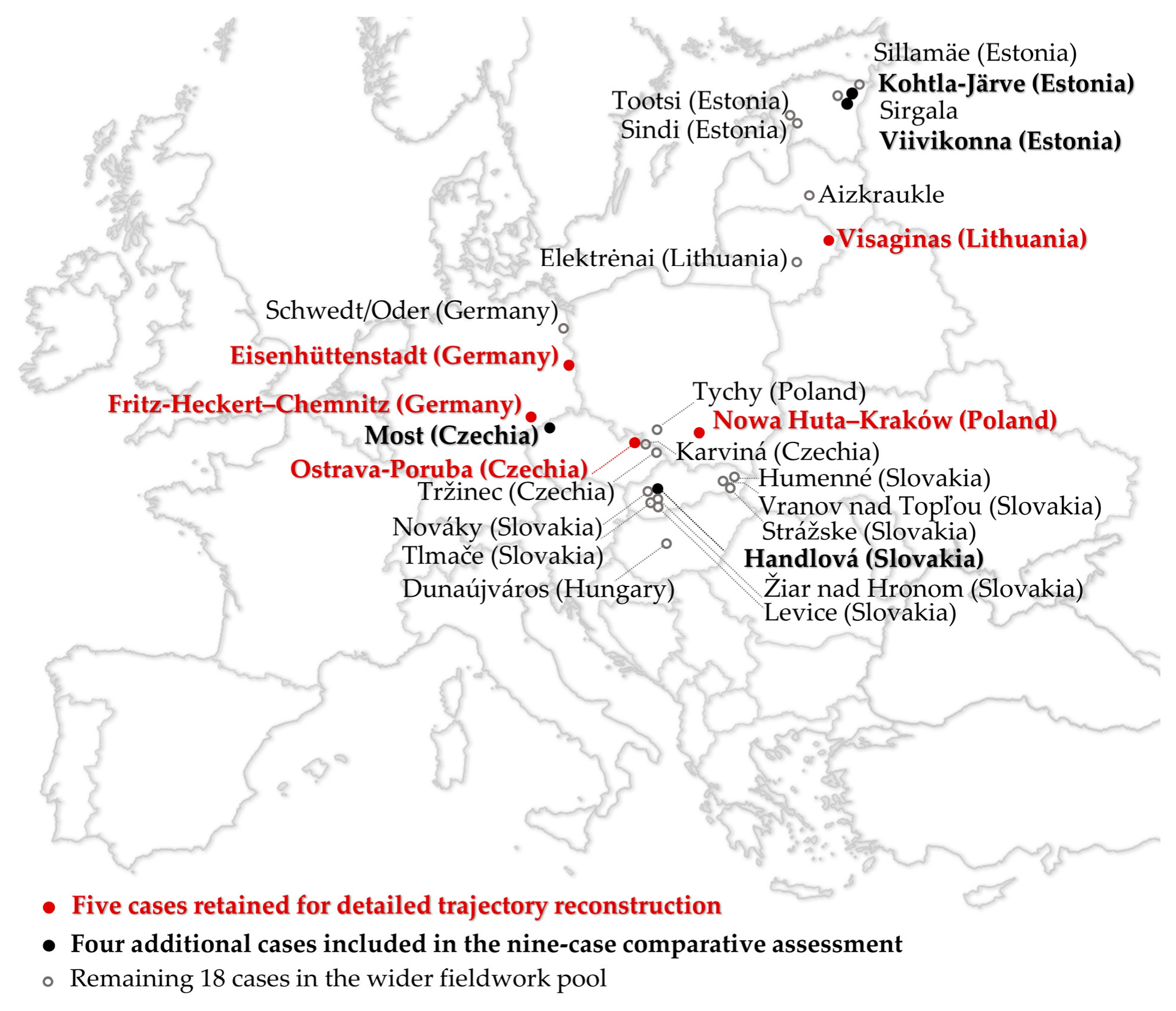
In Central and Eastern Europe, post-socialist restructuring has exposed urban formations shaped by functional specialisation to intertwined economic, spatial, institutional, and identity challenges. Monotowns and mono-functional urban districts are particularly vulnerable because dependence on a single enterprise, sector, or institution means that structural crisis can simultaneously disrupt the economy, social fabric, spatial organisation, and symbolic order. Some have reframed their identities, mobilised new coalitions, and activated inherited urban fabric as a resource for regeneration, whereas others continue to experience shrinkage, fragmented adaptation, or prolonged structural decline. These divergent trajectories make mono-functional urban formations a particularly revealing field for examining how identity, governance, culture, economic restructuring, and the material environment interact under post-socialist conditions. Field visits undertaken within the broader research project covered 27 such formations across eight countries in the region, illustrating the phenomenon’s geographical breadth without constituting an exhaustive regional count, given the lack of harmonised national definitions and statistical classifications (Figure 1).
The relevant literature can be organised into three complementary strands. The first conceptualises post-socialist urban change as the interaction of institutional, social, and urban transformations [1]. The second traces how functional specialisation was embedded in the planning and urban form of Soviet Baltic mono-industrial towns [2] and how inherited cultural landscapes [3] and socialist–modernist urban icons [4] have subsequently been reinterpreted under post-socialist conditions. The third, a process-oriented strand foregrounds heterogeneous actor configurations [5], while studies of street renaming [6], culture-led regeneration [7], and the urban common good [8] demonstrate how symbolic interventions, cultural practices, and citizen agency reshape urban space and collective meanings. Research on old industrial places further shows that local and industrial cultures may enable or constrain change agency and development paths [9,10]. Such agency is conditioned by local institutional contexts [11], while place leadership may expand local opportunity spaces after industrial crises [12]. Taken together, these strands frame post-socialist mono-functional transformation as an interaction among inherited urban form, changing meanings, actor configurations, and institutional conditions. This synthesis provides the conceptual basis for examining how symbolic, institutional, cultural, spatial, and economic changes unfold in relation to one another over time.
The need for this integrated perspective is particularly evident in Ukraine. The 2004 National Programme for the Development of Small Towns identified 111 small towns—approximately one quarter of the national total—as having relatively developed economic bases and predominantly industrial functions, providing a historical proxy, rather than a direct count of mono-functional towns, for the scale of functionally specialised small-town development [13]. The Ukrainian literature includes conceptual analyses of post-socialist urban change [14], case-based socio-geographical studies of integrated development, diversification, and regeneration in individual mono-functional towns [15,16,17], and studies of satellite towns formed around nuclear power plants as a specific type of mono-functional urban formation [18]. Complementary studies address rehabilitation models [19], industrial heritage and its adaptive potential [20,21], and selected architectural and public-space issues [22]. Piatykhatky itself has been examined as a Soviet science-city formation with a distinctive planning and functional structure [23]. Collectively, however, these studies do not provide an integrated comparative approach linking identity, governance, cultural and heritage processes, spatial change, and economic adaptation across post-socialist transformation trajectories. To address this gap, the broader research project developed and tested a conceptual and methodological framework in its first stage [24]; the present article advances the project’s second stage by analysing and conceptualising Central and Eastern European reference cases.
The nine-case analytical set used in the present study intentionally combines autonomous monotowns with mono-functional urban districts embedded within larger cities. From the wider fieldwork corpus, these cases were selected through a two-stage eligibility and maximum-variation procedure to capture contrasts in urban form, original town-forming function, national and institutional context, and the degree and mode of post-socialist transformation, including boundary cases of partial adaptation and prolonged decline. The cases are not treated as administratively equivalent; rather, they are compared as urban formations historically dependent on a dominant enterprise, sector, or institution, with differences in administrative autonomy and embeddedness within larger urban systems retained as contextual variables. This comparative design is particularly relevant because Piatykhatky is an urban formation embedded within Kharkiv rather than an administratively autonomous town.
The aim of this article is to identify, compare, and reconstruct the post-socialist transformation trajectories of selected mono-functional urban formations in Central and Eastern Europe, thereby establishing a reference basis for the subsequent assessment of their transferability to Piatykhatky. The study first derives and weights a theoretically grounded set of selection criteria, applies them to nine cases in Estonia, Lithuania, Poland, Germany, the Czech Republic, and Slovakia, and then selects the most analytically relevant cases for detailed trajectory reconstruction. The trajectories are interpreted as phase-based configurations of actors, instruments, and changes across the tangible and intangible dimensions of urban identity.
Analytical relevance is distinguished from comprehensive transformation success: cases with limited economic diversification may still reveal institutional, cultural, symbolic, or spatial adaptation and are therefore treated as analytically informative cases of partial or uneven transformation rather than as fully successful outcomes. The ranking of nine cases thus supports case selection, not an absolute hierarchy of urban success, while boundary cases help distinguish partial adaptation from prolonged decline.
Accordingly, the study addresses three interrelated research questions concerning criterion development, comparative case selection, and trajectory reconstruction:
RQ1. How can the previously developed multilayered identity–governance framework be operationalised through theoretically grounded criteria for selecting reference cases, and what justifies the inclusion and proposed relative weighting of these criteria?
RQ2. How do the nine cases differ when assessed using this criterion system, and which are most analytically relevant for detailed trajectory reconstruction when weighted scores and typological diversity are considered together?
RQ3. What recurrent and case-specific configurations of crises, turning points, actors, instruments, and changes across the dimensions of urban identity emerge from the selected cases, and how do symbolic, institutional, cultural, spatial, and economic processes interact over time?

2. Materials and Methods

The research design is underpinned by three complementary philosophical lenses: Henri Lefebvre’s theory of the social production of space, Paul Ricoeur’s hermeneutics of memory and narrative identity, and Bruno Latour’s actor–network perspective. Lefebvre conceptualises space as a material, social, and semantic system [25,26]; Ricoeur clarifies the role of memory, narrative, and self-understanding in identity formation [27,28,29]; and Latour provides a basis for interpreting urban transformation as the outcome of heterogeneous actor networks and mediators [30,31].
The study adopts the interdisciplinary comparative case-study framework developed during the first stage of the broader research project [24]. It combines a structured literature review of the relationship between the material environment and identity with document analysis, field observation, confidential semi-structured interviews, and expert consultations across institutional, professional, and grassroots levels.
The broader research programme included exploratory field visits to 27 mono-functional urban formations in eight Central and Eastern European countries between 2024 and 2026. The analytical corpus of the present article comprised nine purposively selected cases assessed using the seven case-selection criteria; five were subsequently retained for detailed trajectory reconstruction. The evidence base included peer-reviewed publications; official municipal, strategic, planning, heritage-protection, and project documents; field observations recorded through field notes and photography, supplemented by selective mapping; 17 confidential semi-structured interviews; and eight expert consultations involving residents, local activists, cultural practitioners, architects, and urban researchers. The interviews supported contextual interpretation and source triangulation, whereas the expert consultations were used only to verify case chronologies, clarify institutional contexts, and cross-check documentary information. All materials were de-identified; no participant names, identifying details, or verbatim quotations are reported; and all participants provided verbal informed consent for the non-attributable use of the information.
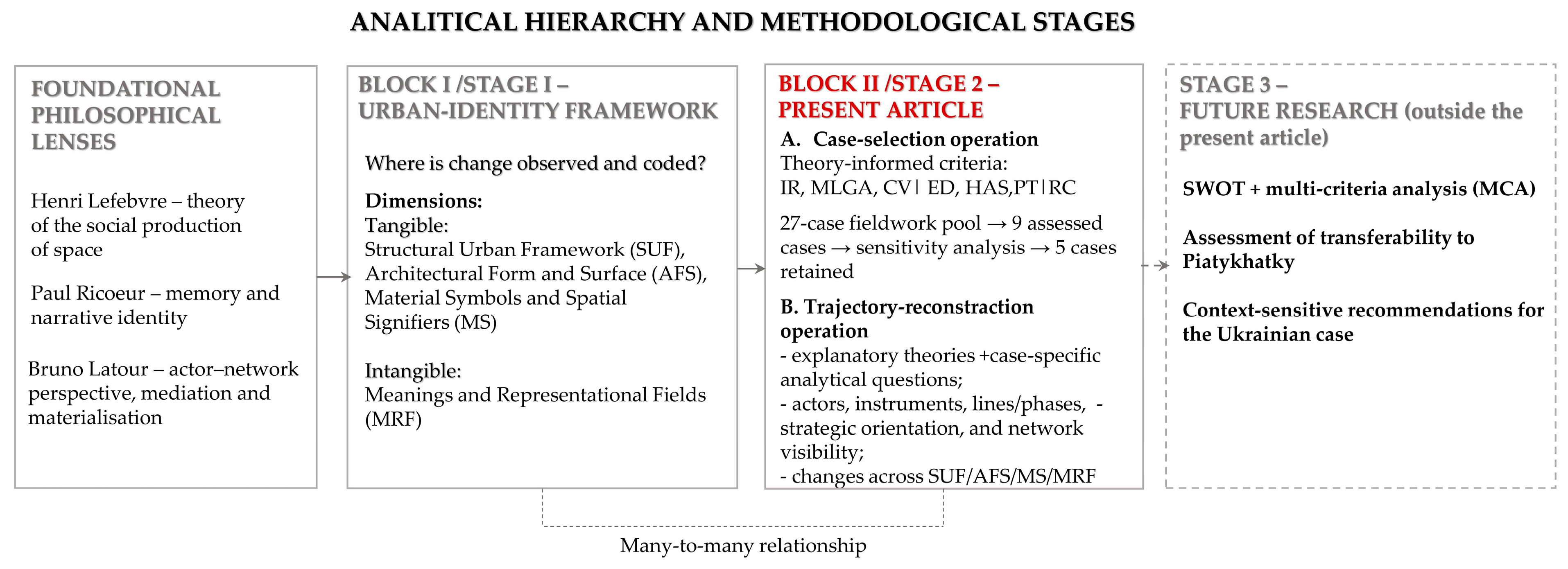
The methodology comprises two conceptual blocks and three analytical stages. Block I, Constructing a Methodological Framework (I): Urban Environment Components—Tangible and Intangible, underpins Stage 1 by defining three tangible dimensions—Structural Urban Framework (SUF), Architectural Form and Surface (AFS), and Material Symbols and Spatial Signifiers (MS)—and one intangible dimension, Meanings and Representational Fields (MRF), through which identity-related change is analysed. Block II, Identification of Transformation Trajectories and the Transferability of Experience, comprises Stage 2—case selection and trajectory reconstruction, addressed in this article—and Stage 3—the future assessment of transferability to Piatykhatky through SWOT and multi-criteria analysis (MCA) [24]. The present article implements Stage 2 only.
To avoid conflating analytical levels, Figure 2 summarises the analytical hierarchy, methodological sequence, and scope of the study. The foundational lenses of Lefebvre, Ricoeur, and Latour provide the conceptual basis for the framework, while Stage 1 defines four urban-identity dimensions: SUF, AFS, and MS as tangible dimensions, and MRF as the intangible dimension. Stage 2, implemented in the present article, comprises two linked operations: case selection and trajectory reconstruction. The seven case-selection criteria are grouped into transformation mechanisms (IR, MLGA, and CV), resources and outcomes (ED, HAS, and PT), and a contextual condition (RC); their relationship to the four dimensions is many-to-many rather than one-to-one. The theoretical traditions discussed in Section 3.1 and Section 3.2 support criterion derivation and trajectory reconstruction, respectively. The figure also shows the nested progression from the 27-case fieldwork pool to nine assessed cases and five cases retained for detailed reconstruction, while Stage 3—SWOT and multi-criteria assessment of transferability to Piatykhatky—lies outside the scope of the present article.
From the wider fieldwork pool, nine cases were selected through criterion-based purposive maximum-variation sampling. Eligibility required an identifiable town-forming enterprise, sector, or institution; documented post-socialist restructuring or loss of the original function; and sufficient evidence to distinguish low criterion values from missing data. Among eligible cases, the nine-case set maximised variation in urban form, original town-forming function, national and institutional context, and the degree and mode of post-socialist transformation, including boundary cases of partial adaptation and prolonged decline. Cases were not retained when they did not meet the evidence threshold or duplicated an analytical configuration already represented in the comparative set (Table A1).
Trustworthiness is reported according to Lincoln and Guba’s four criteria [32]. Credibility was supported through triangulation of the peer-reviewed literature, official and planning documents, field observations, interviews, and expert consultations, together with the inclusion of contrasting and boundary cases. Transferability, in the qualitative-trustworthiness sense, was supported through contextualised case descriptions; dependability through a common case-extraction and trajectory-reconstruction template; and confirmability through traceable source citation and explicit disclosure that case scoring and weighting were author-led. This qualitative use of “transferability” should not be conflated with the subsequent substantive assessment of whether practices can be transferred to Piatykhatky. Member checking, independent coding, and expert validation of the weights were not undertaken and are therefore acknowledged as limitations.

3. Analytical Framework: Case Selection and Trajectory Reconstruction

3.1. Case-Selection Criteria: Theoretical Derivation, Weighting, and Scoring

The selection of the seven case-selection criteria is grounded in complementary theoretical traditions: discursive institutionalism [33], relational planning theory [34], place identity theory [35,36], culture-led urban regeneration [37,38], urban political economy [39,40], and the broader literature on urban regeneration and post-socialist urban transformation [41,42,43]. The relative weights are author-assigned modelling assumptions and are explained below. The conceptual basis is further supported by Lefebvre’s understanding of urban space as socially produced [25], Hidalgo and Hernández’s account of place attachment as shaped by the social and physical aspects of the person–place relationship [44], and Arnstein’s ladder of citizen participation [45].
The analytical framework retains all four urban-identity dimensions—SUF, AFS, MS, and MRF—for trajectory coding. The seven criteria form a separate, parsimonious, theory-informed case-selection instrument rather than an exhaustive index of urban performance. Candidate variables were retained as separate criteria when they were central to the identity–governance focus, conceptually non-redundant, applicable to both autonomous towns and embedded districts, and sufficiently assessable across the heterogeneous cases. Demographic, social, environmental, and fiscal variables were retained as contextual evidence rather than standalone criteria because their inclusion would duplicate selected assessment domains and/or they could not be assessed consistently across the full sample (Table 1).
The proposed system conceptualises post-socialist urban transformation as an interaction among changes in meanings, actor coalitions, cultural practices, economic adaptation, and the material environment. It does not assume a universal temporal sequence; rather, it enables examination of whether semantic and institutional shifts precede, accompany, or follow spatial and economic change. This analytical position is consistent with Harvey’s account of the shift from managerialism to entrepreneurialism in urban governance [39], Healey’s relational-institutionalist approach to strategic spatial planning [34], and Schmidt’s explanation of how ideas and discourse shape institutional change [33]. The focus on smaller urban centres also responds to Bell and Jayne’s argument that their complexity is often obscured by models derived from large cities and urban hierarchies [52].
The first criterion—identity reframing (IR)—captures whether a new system of meanings has emerged that connects the city’s past, present, and desired future [33]. Urban identity is understood as a dynamic relationship between people and their urban environment, integrating material, social, cultural, historical, and spatial aspects of place [46,47]. Empirical studies further show that urban identity is formed and expressed through residents’ perceptions and public representations; it should therefore be assessed not only through official narratives but also through social perception and everyday experience [44,48]. Accordingly, IR captures both the presence of a new narrative and the extent to which it is socially perceived, embedded in person–place relations, and institutionally articulated [33,44,48].
The second criterion—multi-level governance and actors (MLGA)—assesses whether actors and coalitions can interpret, legitimise, coordinate, and implement change. Meaning frameworks can support coalition formation, while relational planning emphasises the capacity of actors to operate through networks, partnerships, and institutional relations [33,34]. Socio-psychological research further associates the durability of urban regeneration with group identification, collective unity, and residents’ willingness to engage in collective action [49]. Resident participation is assessed under MLGA when it concerns decision-making and coalition-building, and under cultural vitality (CV) when it is expressed through recurring cultural or community practices [45].
The third criterion—cultural vitality (CV)—treats culture as a mediator between meanings and urban space [37,38]. Cultural practices can make new urban meanings visible, communicable, and embedded in everyday perceptions [37,47]. Research on culture-led regeneration shows that culture may restore local pride, renew the urban image, and activate neglected areas [37,38]. In post-socialist cities, cultural initiatives may also provide public arenas in which contested historical legacies are reinterpreted and connected to new urban meanings [48].
The fourth criterion—economic diversification (ED)—captures the extent to which a case has reduced dependence on its original town-forming sector and expanded its functional and employment base [39,43]. In shrinking and post-socialist urban contexts, diversification is a key condition for mitigating structural dependence, demographic decline, and economic vulnerability [42,43]. Its implementation is nevertheless shaped by the social and institutional environment in which strategic planning and regeneration policies operate [43].
The fifth and sixth criteria—heritage and architectural significance (HAS) and positive physical transformation (PT)—capture, respectively, the role of inherited urban fabric as a resource and the extent to which change has acquired material–spatial expression. Heritage may enable a city to reinterpret its history, strengthen local identity, and activate attachment to the existing urban fabric [41,50]. PT is evidenced by interventions such as brownfield revitalisation, public-space renewal, housing adaptation, and infrastructure modernisation. This interpretation is consistent with Tsenkova’s work on strategic planning in post-socialist cities [43] and Gražulevičiūtė-Vileniškė and Urbonas’s analysis of regeneration in post-Soviet Lithuania [51].
The seventh criterion—regional connectivity (RC)—is treated as a contextual condition shaping the external framework within which local trajectories unfold. Integration with metropolitan and regional networks may expand access to markets, institutions, resources, and mobility [34,39]. At the same time, small-city research cautions against explaining development solely through agglomeration-based models; RC must therefore be interpreted together with local agency and the case-specific trajectory [52]. RC receives the lowest weight because it is an external enabling or constraining condition rather than a case-internal transformation mechanism, resource, or outcome, particularly when autonomous towns are compared with districts embedded in larger cities.
The weights are theory-informed, author-assigned modelling assumptions rather than expert-consensus estimates; no Delphi or other expert-elicitation procedure was conducted. They reflect the specific purpose of selecting cases for identity–governance trajectory reconstruction: IR and MLGA are assigned 25% each, CV 15%, ED, HAS, and PT 10% each, and RC 5% (Table 1). The 10% weight assigned to ED does not imply that economic change is unimportant; rather, economic performance is one domain within a case-selection instrument that does not measure comprehensive urban success, which would require a separate assessment of sustained economic, social, institutional, and spatial outcomes. Weighted scores therefore indicate suitability for trajectory reconstruction rather than transformation success; cases with limited economic improvement may be retained as partial, uneven, or boundary cases but are not classified as fully successful transformations. The author-assigned nature of the weights is acknowledged as a limitation and tested through sensitivity analysis.
All seven criteria were scored by the author using a five-level, criterion-specific anchored scoring scale, with higher scores indicating a stronger manifestation of the respective criterion. Scores increased monotonically from 1 (absent or negligible) to 5 (very strong, sustained, and fully developed), with criterion-specific descriptors provided for each level in Table A2. For weighted aggregation, the levels were treated as equally spaced numerical values, an explicit author-assigned modelling assumption [53]. Ranking robustness was tested through sensitivity analysis [54].
Following the general sensitivity-analysis approach for deterministic multi-criteria decision-making and weighted-sum models [54], ranking robustness was tested using three author-defined global weighting specifications and 14 one-at-a-time perturbation tests. The global specifications comprised the baseline weights; equal weights of one-seventh per criterion; and an economic-priority scenario with IR 20%, MLGA 20%, CV 10%, ED 20%, HAS 10%, PT 10%, and RC 10%. For the perturbation tests, each baseline weight was varied by −50% and +50%, with the remaining weights rescaled proportionally to sum to 1.00. The original criterion scores remained fixed in all scenarios. Stability was assessed through changes in the full rank order and membership of the five-case set. Exact scenario weights and complete recalculated scores and ranks are reported in Table A3 and Table A4.
Final case-set membership was determined through a two-step procedure. First, sensitivity analysis tested whether membership of the five-case set remained stable across alternative weighting scenarios. Where the fifth position was weight-sensitive, the ranking was treated as a decision-support tool rather than a deterministic cut-off, and the final case was selected using target-context relevance and typological complementarity. The results of this procedure are reported in Section 4.1.

3.2. Transformation-Trajectory Reconstruction: Theoretical Basis and Analytical Procedure

The selected case set was then subjected to trajectory reconstruction. This operation draws on place identity theory [35,36,55], which explains the interaction between material settings and social meanings; actor–network theory [30,31,56], which supports analysis of the materialisation of meanings through inscriptions and mediators; critical toponymy [57,58], which treats naming as a political-symbolic instrument; evolutionary economic geography and path dependence [59,60], which explain inertia, lock-in, and selective change; historical institutionalism [61], which describes gradual institutional change; strategic spatial planning [62], which provides a lens for goal-setting and strategic orientation; and collaborative governance [63,64], which emphasises coalition capacity and coordination across levels. The framework of multiple transformations and post-socialist urban transition [1,65] provides the macro-conceptual basis for periodisation and differentiated tempos of change (Table 2). These theories support trajectory interpretation, while the four urban-identity dimensions—SUF, AFS, MS, and MRF—operationalise where change is observed. Path dependence is used to explain inherited constraints and selective continuity within each case; phase-based reconstruction is a temporal organising device for observed turning points and does not imply a predetermined linear sequence.
In this study, a transformation trajectory denotes the overall case-specific configuration of change over time. A transformation line denotes a thematic stream of change that may overlap with other streams, whereas a phase is a temporally bounded segment defined by a crisis, turning point, or institutional shift.
The analysis is guided by the following case-specific analytical questions for each reference case:
Who? At which level or levels are the relevant actors situated, and what actor configuration shapes the transformation process?
What/Where? What changes, and in which of the four urban-identity dimensions do these changes occur?
How? Which instruments, interventions, and mechanisms affect these dimensions?
When? How can the process be periodised, and which crises, turning points, and phases of reorientation can be identified?
Where to? What strategic orientation guides actor activity, and what image of the city’s future does it construct?
Within which networks? What is the case’s network visibility and embeddedness, and through which platforms do changes acquire durability and external legitimisation?
Accordingly, each reference-case trajectory is described in the following standardised format:
Transformation line or phase (period/trigger)—actor configuration (who?)—instruments and mechanisms (how?)—illustrative practices—affected identity dimensions (what/where?)—strategic orientation (where to?)—networked visibility (within which networks?).
To compare economic transformation across heterogeneous territorial cases without conflating autonomous municipalities, urban districts, and non-administrative housing formations, four descriptors were applied consistently: (1) the status of the original town-forming function—retained, restructured, substantially reduced, or discontinued; (2) the degree of emergence of alternative employment sectors and urban functions—limited, partial, or substantial; (3) the territorial scale at which economic adaptation occurs—case-specific, district, municipal or city-wide, metropolitan, or regional; and (4) the persistence of structural dependence and economic vulnerability—high, moderate, or limited. Population, employment, unemployment, and business data were used only where territorial units and observation periods were directly comparable; otherwise, the assessment relied on traceable qualitative evidence. This descriptive standard supports cross-case interpretation but does not constitute a separate composite index of economic performance.
This template is applied consistently to the selected cases to reconstruct and compare their post-socialist transformation trajectories. The resulting trajectories constitute the principal analytical output of the present article and the input for the subsequent, separately reported assessment of transferability to Piatykhatky.

4. Results

4.1. Identifying Reference Cases Through Weighted Comparative Assessment

This section applies the weighted comparative assessment solely as a case-selection procedure; it does not rank the overall success, effectiveness, or societal outcomes of the nine post-socialist transformations. Seven criteria were applied to nine candidate cases: Visaginas (Lithuania), Kohtla-Järve (Estonia), Viivikonna (Estonia), Nowa Huta–Kraków (Poland), Fritz-Heckert–Chemnitz (Germany), Eisenhüttenstadt (Germany), Ostrava-Poruba–Ostrava (Czechia), Most (Czechia), and Handlová (Slovakia). The purposively selected set includes post-socialist mono-functional urban formations that differ in scale, spatial structure, and urban genealogy, ranging from autonomous industrial and post-industrial towns to socialist districts embedded in larger urban agglomerations. This configuration supports comparison of how deindustrialisation, demographic decline, identity disruption, and functional restructuring manifest across different types of mono-functional formation, and how their transformation mechanisms recur or differ.
The nine-case set was derived from the broader fieldwork programme through criterion-based maximum-variation sampling. All nine cases met the eligibility requirements defined in Section 2 and collectively maximised variation in urban type, original town-forming function, national and institutional context, and the mode and degree of post-socialist transformation. Other visited formations were not retained when the available evidence was insufficient to assess all seven criteria or when they did not add a distinct analytical configuration to the comparative set.
The following profiles provide a qualitative interpretation of the seven assessment domains; the criterion scores are reported in the weighted comparative assessment table. Lower-scoring cases remain in the comparative assessment as boundary cases because they help distinguish consolidated transformation, partial adaptation, and prolonged structural contraction. This comparison supports the selection of cases that are analytically suitable for detailed trajectory reconstruction, while transferability to Piatykhatky will be assessed at the subsequent research stage.
Eisenhüttenstadt represents a post-socialist trajectory of a monotown in which deindustrialisation, managed shrinkage, and the reinterpretation of socialist heritage unfold in parallel. Identity reframing is among the most pronounced assessment domains in this case, as new urban narratives are formed not through a radical break with the past, but through cultural revalorisation, the institutionalisation of memory, and the reinterpretation of socialist heritage as a resource for the future. Multi-level governance is particularly pronounced here. The transformation involved the Treuhandanstalt—the federal agency responsible for the privatisation and restructuring of former East German state-owned enterprises—as well as the municipality, housing companies, municipal services, heritage authorities, local coalitions, and external experts. The city’s cultural vitality also remains strong due to the role of the Documentation Centre of Everyday Culture of the GDR, museum and educational practices, and cultural mediators who reshape the city’s image. At the same time, economic restructuring remains partial, while regional connectivity functions primarily as a limiting contextual condition: the city’s peripheral position, dependence on regional rail links, and need for upgraded digital infrastructure constrain its integration into wider economic, institutional, and mobility networks. Heritage, architectural significance, and physical transformation form a strong material dimension of change, making Eisenhüttenstadt one of the highest-scoring and most analytically relevant reference cases of institutionally managed post-socialist transformation with a heritage-cultural core [66].
Nowa Huta (Kraków) is among the highest-scoring cases in the sample, as its post-socialist transformation has unfolded primarily through the redefinition of heritage rather than through a radical restructuring of the urban fabric. After 1989, the key changes took place in the symbolic and cultural dimension: through new narratives, the reinterpretation of the socialist past, local memory initiatives, and the grassroots reprogramming of space. The strong profile of this case is also shaped by institutional capacity and cultural vitality: the transformation brings together the actions of state and municipal bodies, heritage-protection institutions, cultural organisations, and residents’ initiatives. The urban structure and architectural ensembles of Nowa Huta have been progressively institutionalised as protected heritage, turning the inherited fabric into an active resource for development. By contrast, economic restructuring and physical transformation remain moderate in character, as the process involves the strengthening of cultural, tourism, and recreational functions rather than deep economic restructuring or large-scale spatial reconstruction. The case is also characterised by its full integration into the metropolitan context of Kraków, as well as its inclusion in the international network New Towns | New Narratives [67].
Visaginas emerges as one of the most distinctive examples of post-socialist transformation, in which intangible and cultural-symbolic mechanisms of change play a leading role. Following the phased shutdown of the INPP’s two reactors in 2004 and 2009, the city’s identity has shifted from a mono-functional “nuclear” image towards a multilayered framework that combines nuclear memory, local narratives, cultural initiatives, and international visibility within the New Towns | New Narratives network. The strong profile of this case is also shaped by local actors, cultural practices, guided-tour formats, and museum and artistic initiatives that translate the city’s memory into contemporary forms of public representation. At the same time, the governance-related transformation mechanism, although still relatively strong, relies primarily on localised initiatives, while broader multi-level coalitions are less consistently articulated. Economic diversification, physical transformation, and regional connectivity remain moderate in character: the city demonstrates certain signs of adaptation, but continues to retain features of post-nuclear vulnerability. Heritage and architectural significance also play an important, though not dominant, role, since the main transformative resource of Visaginas lies less in the institutionalised protection of objects than in the active reinterpretation of their meanings [68].
Fritz-Heckert (Chemnitz) represents the post-socialist transformation of a large-scale housing estate that has unfolded not through comprehensive redevelopment, but through a combination of managed adaptation, local practices, and the gradual reprogramming of the urban environment. The strongest aspects of this case are identity reframing, multi-level governance, cultural activation, physical transformation, and urban integration. The district generates alternative narratives of resilience grounded in the everyday use of space, local self-organisation, and the strengthening of a sense of place. Its international visibility is also supported by activists through the New Towns | New Narratives network. Transformation is enabled through the interaction of state programmes, the municipality, housing cooperatives, cultural mediators, and civic initiatives, while the cultural aspect is sustained by educational practices, public historical representation, and projects such as Fritz51. Economic adaptation remains moderate and unfolds primarily within the broader transformation of Chemnitz. The district’s heritage potential is evident, although less strongly institutionalised than in the leading heritage-oriented cases. By contrast, spatial change is pronounced: the demolition of part of the housing stock, the modernisation of buildings, the creation of new open spaces, and the replacement of some demolished structures with more contemporary low-rise housing are combined with the district’s strong integration into the urban structure of Chemnitz [69].
Ostrava-Poruba (Ostrava) is an analytically relevant example of the post-socialist transformation of a planned socialist district, where new economic, governance, and symbolic regimes are layered onto a relatively stable morphological framework. The most pronounced aspects of this case are institutional capacity, the heritage framework, and integration into the wider urban structure, while the reframing of local identity accompanies these processes without serving as their sole or primary driver. Spatial transformation is associated with changes in the use of public, semi-public, and residential spaces, as well as with educational-symbolic interventions, including the SORELA (socialist–realist architecture) route, a structured thematic walk interpreting the district’s socialist–realist architectural heritage. An important role is played by the combination of the state heritage-protection regime, municipal strategies for regeneration, mobility, and the development of Pustkovec, together with residents’ local practices and research-educational formats. The cultural dimension remains visible, although it is primarily subordinated to a heritage-educational logic rather than to autonomous cultural expansion. Economic adaptation is moderate and manifests itself through the commercialisation of ground floors, the emergence of the first private shops, and the development of local commerce. Physical transformation is also selective: the most visible changes concern urban voids, courtyards, façades, and the ground-floor street front, while the planning structure and volumetric-spatial composition remain largely stable. The case is also characterised by its embeddedness in the polycentric structure of Ostrava, which reinforces the district’s functional links with other parts of the city [70].
Most represents a case of post-socialist transformation of a monotown in which material change is combined with the redefinition of the city’s image after the destruction of its historic core and long-term dependence on an extractive economy. The most pronounced dimensions of this case are identity shift, institutional coordination, and physical transformation of the urban environment. The city has gradually moved from the image of an industrially depressed territory towards a narrative of reclamation, recreation, and a new visual identity. An important role in this transformation is played by the interaction between the state and the municipality in the implementation of reclamation, housing, and cultural projects, although the implementation of strategies remains uneven. The cultural dimension is visible, but it primarily performs a supporting function in relation to the city’s new image rather than forming an autonomous cultural system. Economic adaptation is also moderate and is associated mainly with the strengthening of commercial, tourist, and recreational functions. Most’s heritage resources remain significant but fragmented, while physical transformation is evident in selected interventions, including land reclamation, housing restructuring, and improvements to the urban environment [71,72,73].
Kohtla-Järve represents an example of post-socialist adaptation in which institutional and governance mechanisms of transformation play a leading role. The city has shifted from the model of a resource-dependent industrial centre towards a scenario of selective stabilisation and environmental reprogramming; however, identity reframing remains only partially consolidated. The strongest dimensions of this case are multi-level governance, heritage and architectural significance, and regional embeddedness. Transformation relies on the interaction of state institutions, the municipality, and programme-based financial instruments, particularly in the fields of managed shrinkage, vacant housing management, and energy-efficient modernisation. The cultural dimension remains visible, though not dominant: the network of cultural institutions, event venues, and international visibility within New Towns | New Narratives support new forms of urban representation, but have not yet formed a coherent cultural model for the city. Economic adaptation and physical transformation remain moderate and unfold primarily through selective reduction in the vacant building stock and targeted renewal rather than growth. At the same time, the preserved Stalinist central ensemble and the city’s position within the Ida-Viru oil-shale industrial region define Kohtla-Järve’s specific spatial and heritage profile [74].
Handlová represents a case of post-socialist transformation of a mining monotown in which the post-coal transition, moderate infrastructure modernisation, selective conversion of industrial territories, and the symbolic re-signification of mining identity are the most clearly visible processes. The profile of this case is generally moderate and reflects selective adaptation rather than a coherent transformation model. Identity reframing is associated with the narrative of a “city after coal”, the activation of mining memory, local symbols, and event-based forms of representation. The governance dimension is also moderately articulated: transformations rely on a combination of municipal decisions, the regional and state framework of the post-coal transition, interaction with Hornonitrianske bane Prievidza (Upper Nitra Mines Prievidza), and external support mechanisms for the transformation of Horná Nitra (Upper Nitra). The cultural dimension is supported by events related to mining memory, particularly Banícky jarmok (Miners’ Fair), as well as by the municipal framework Handlovské ikony (Icons of Handlová), which brings together mining, sacred, technical, and post-war architectural markers of the city. However, the cultural field remains limited in scale and does not constitute a fully autonomous model of revitalisation. Economic restructuring remains the least consolidated dimension of the case and is concentrated primarily on individual conversion projects, adaptation programmes related to the end of the coal economy, and the search for new functional scenarios. Heritage, physical transformation, and connectivity demonstrate a moderate level of change. The city has recognisable fragments of SORELA (socialist–realist architecture); however, the heritage-protection regime, economic resilience, and broader regional integration remain only partially consolidated [75,76,77].
Viivikonna represents a pronounced case of post-socialist shrinkage, in which the historically formed planning framework was not converted into a resource for recovery. Founded as a mining settlement within the Ida-Viru oil-shale region, it had a regular structure, while the post-war master plan envisaged a centre with a square, compositional axes, a Palace of Culture, and public facilities. This model, however, was implemented only partially, and subsequent development became increasingly subordinated to the logic of contraction. In the post-socialist period, Viivikonna did not move towards adaptive reprogramming; instead, it lost functional and institutional support, which is reflected in the degradation of the housing stock, the decline of public infrastructure, the accumulation of unsafe and non-residential buildings, and the almost complete absence of new cultural or governance initiatives. The historical planning fabric survives only fragmentarily and does not function as an activated resource for regeneration. As a result, Viivikonna is best understood as a boundary case that illustrates prolonged structural contraction and the gradual decline of the urban environment within the post-socialist context [74].
Viivikonna is not treated as a transferable model but as a negative reference case identifying conditions to be avoided. Its trajectory suggests that delayed responses to functional loss may allow demographic contraction, housing deterioration, infrastructure decline, and institutional withdrawal to become mutually reinforcing. The case highlights the importance of early and coordinated shrinkage management, continuity of basic services and governance, and the connection of heritage recognition with maintenance and adaptive reuse; inherited planning or architectural value alone is insufficient to support recovery.
Across the nine cases, the dominant town-forming function historically linked employment, housing, social infrastructure, and urban identity. Its post-socialist weakening exposed recurrent internal conditions—functional dependence, demographic contraction, built-fabric decline or surplus, and identity disruption—while transformation modes differed according to geographical embeddedness, institutional support, and local adaptive capacity (Table 3).
Four overlapping modes can be distinguished: heritage-symbolic reframing; managed shrinkage and spatial or housing reprogramming; institutionally supported functional and environmental adaptation; and prolonged contraction with limited adaptive reprogramming. Their relative prominence is conditioned by metropolitan and regional embeddedness, continuity of multi-level institutional support, access to programme funding, local actor capacity, and the ability to activate inherited urban fabric as a development resource. These factors are interpreted as contextual drivers rather than deterministic causes.
Across the 17 weighting specifications, Eisenhüttenstadt, Nowa Huta, Visaginas, and Fritz-Heckert remained within the five-case set in every scenario. Ostrava-Poruba remained in the set in 15 scenarios, while Most entered under two perturbations: a 50% reduction in the HAS weight and a 50% increase in the PT weight. The exact rank order therefore varied, but the four-case core was invariant and only the fifth position was weight-sensitive (Table A3 and Table A4). Ostrava-Poruba was retained as the purpose-dependent fifth case because its embedded-district morphology, target-context relevance, and typological complementarity were more directly aligned with the subsequent application to Piatykhatky.
The four cases not retained for detailed trajectory reconstruction remained part of the comparative analysis but performed different analytical functions: (1) Most (3.60) remained the weight-sensitive alternative to Ostrava-Poruba. (2) Kohtla-Järve (3.40) combined substantial institutional and regional support with less consolidated identity reframing and cultural transformation. (3) Handlová (2.90) represented an ongoing and only partly consolidated post-coal transition, with weaker evidence of coherent economic diversification and multi-level transformation. (4) Viivikonna (1.40) remained in the nine-case assessment as a negative boundary case of prolonged contraction; the limited presence of active actor–instrument configurations made it unsuitable for detailed reconstruction on the same basis as the five reference cases.
Thus, non-retention for detailed reconstruction should not be interpreted as exclusion from the study or as a judgement of overall urban failure, but as a distinction between different analytical roles within the comparative design.
Accordingly, five reference cases were retained for detailed trajectory reconstruction: Eisenhüttenstadt, Nowa Huta—Kraków, Visaginas, Fritz-Heckert—Chemnitz, and Ostrava-Poruba—Ostrava (Table 4). The set combines high aggregate scores with typological and processual diversity, including identity reframing, heritage-cultural re-signification, institutionally managed restructuring, everyday adaptation, and managed transformation of a large-scale housing district. Consistent with multiple-case research and theoretical sampling [78,79,80], the cases were selected for analytical rather than statistical representativeness and for a manageable balance between comparative breadth and reconstruction depth. Three of the five are embedded urban formations, and most are shaped primarily by socialist or modernist urban layers; these features strengthen their relevance to Piatykhatky, while transferability remains the subject of the subsequent research stage.

4.2. Transformation Trajectories: Line–Actor–Instrument Configurations

Following the selection of five reference cases, the analysis moves from the weighted ranking to the reconstruction of their case-specific transformation trajectories and constituent transformation lines. In this subsection, the line–actor–instrument scheme defined in the methodology is applied as an analytical tool for interpreting each case. Each case is examined as a process of unfolding change, in which crises, turning points, or institutional shifts activate specific configurations of actors, instruments, and practices and direct transformations across particular urban-identity dimensions.
Here, trajectory denotes the overall case-specific configuration of post-socialist change, transformation line denotes a thematic stream within that trajectory, and phase is reserved for a temporally bounded segment. In Table 5, Table 6, Table 7, Table 8 and Table 9, the bracketed numerals in the first column link each transformation line to the corresponding note beneath the matrix, where strategic orientation and networked visibility are reported.
The main focus is placed on how each case reshapes the relationship between the inertial and transformed components of the urban environment: the Structural Urban Framework (SUF), Architectural Form and Surface (AFS), Material Symbols and Spatial Signifiers (MS), and Meanings and Representational Fields (MRF). This makes it possible to trace both the content of change and the sequence through which it unfolds—from symbolic re-signification and institutional coordination to cultural activation, spatial adaptation, or the regeneration of the everyday urban environment.
Accordingly, this subsection has an applied analytical function: it translates the five selected cases into a common format of reconstruction and establishes an analytical basis for the subsequent assessment of the transferability of the identified trajectories to Piatykhatky.
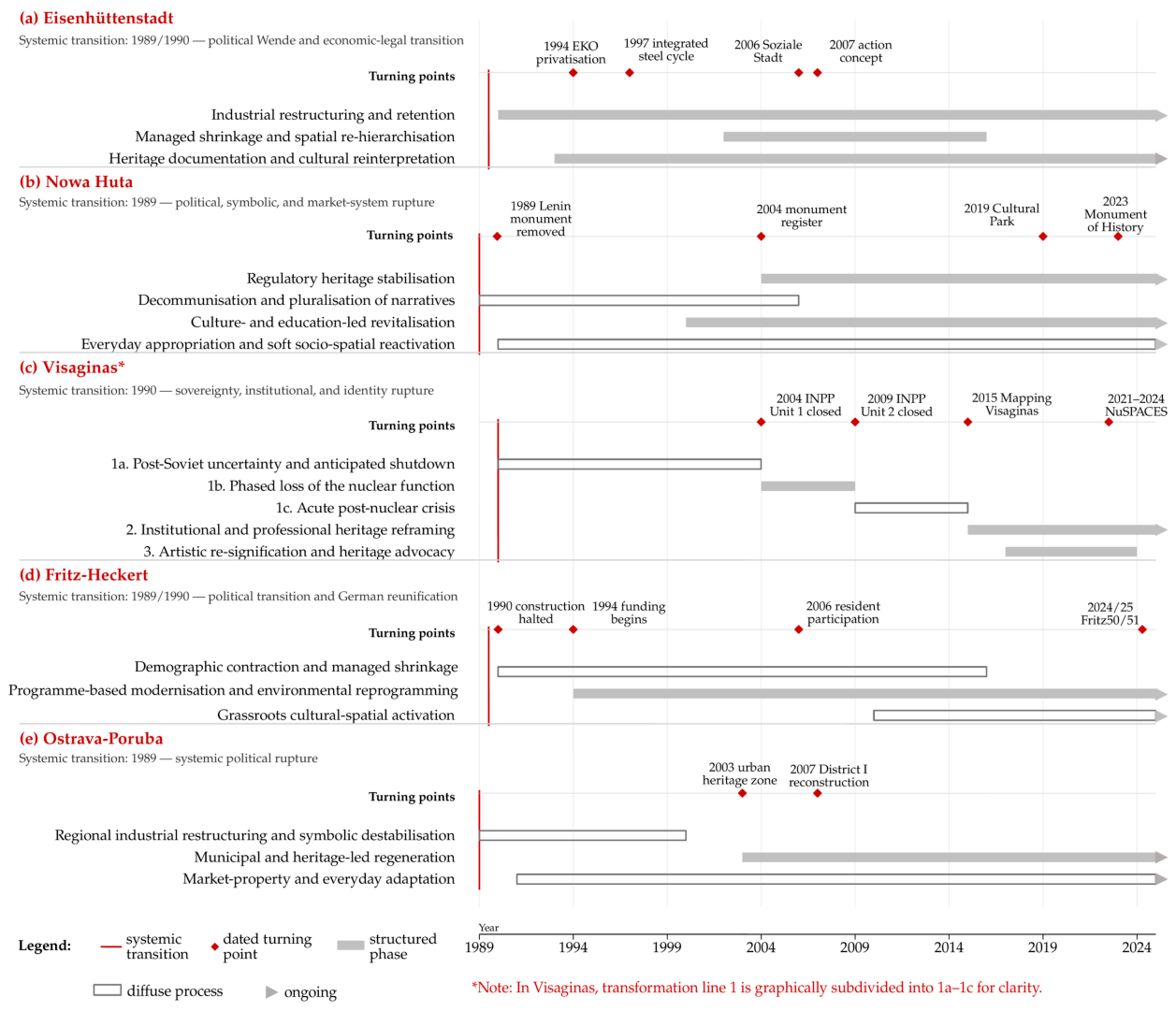
To make the temporal structure of the reconstructed trajectories explicit, Figure 3 aligns the principal transformation lines and documented turning points of the five reference cases. Each case is presented as a separate chronology. The aligned timelines facilitate comparison of the timing, duration, overlap, and sequencing of functional rupture, institutional intervention, spatial adaptation, heritage recognition, and cultural re-signification. The figure does not imply a universal linear sequence: the transformation lines frequently overlap and proceed at different speeds within the same case.

4.2.1. Eisenhüttenstadt

Eisenhüttenstadt is a planned monotown formed around the Eisenhüttenkombinat Ost (EKO; Steelworks Combine East) as an integrated system of “production–housing–everyday life”. Founded in 1950 as “the first socialist city on German soil”, from the outset it combined steelworks, residential complexes, cultural facilities, and sports infrastructure within a unified socialist model of urban life [81]. The spatial structure of the city was organised through the Magistrale/Lindenallee, the main urban axis, Zentraler Platz (Central Square), and the housing complexes WK I–IV (Wohnkomplex I–IV), followed later by WK V–VII. The most inertial layers proved to be the planning framework and the early ensembles, part of which were placed under heritage protection as early as 1977 and 1984. Although the city had already undergone changes during the socialist period, the systemic rupture unfolded across 1989/1990; the 1990 economic–legal transition replaced the growth model with deindustrialisation, depopulation, and housing surplus.
The post-socialist trajectory of Eisenhüttenstadt comprises three interrelated transformation lines that overlap, interact, and develop at different temporal rhythms. One of the key lines was the adaptation of, and struggle for, EKO in the 1990s, when the future of the steelworks became the central object of conflict. The external institutional and economic framework involved the Treuhandanstalt, the agency responsible for privatising formerly state-owned GDR enterprises, and later its successor, the BvS/Bundesanstalt für vereinigungsbedingte Sonderaufgaben (Federal Agency for Special Tasks Related to Unification), while the Belgian steel company Cockerill-Sambre became the privatisation partner. At the same time, a local coalition of workers, the Betriebsrat (works council), IG Metall (Germany’s industrial union for metalworkers), the local management of the plant, and the urban public resisted dismantling and phased privatisation [82]. The outcome was the rehabilitation and privatisation of EKO as an integrated complex, although employment losses and out-migration intensified demographic decline and weakened the original “work–housing–urban life” model.
The second transformation line was managed shrinkage—Stadtumbau Ost from 2002—with the most intensive restructuring during the 2000s to the mid-2010s, associated with the demolition of peripheral housing complexes, especially WK VII, the modernisation of part of the housing stock, and the consolidation of the model of “periphery for demolition—centre for protection”. The key actors in this line included the municipality, federal and land urban-development programmes, the housing companies GeWi (Eisenhüttenstädter Gebäudewirtschaft GmbH) and EWG (Eisenhüttenstädter Wohnungsbaugenossenschaft eG), municipal services, heritage authorities, and external experts. The official website of the city confirms the inclusion of WK I–IV and parts of WK V–VI in the Soziale Stadt (“Social City”) programme in October 2006 and the approval of the Integrated Action Concept (Integriertes Handlungskonzept, IHK) in November 2007 [83]. Within this line, the city’s spatial framework was not only reduced but also re-hierarchised: the peripheral complexes lost functional density, while the early socialist core acquired the status of a priority zone for stabilisation.
The third transformation line was heritage reinterpretation and local cultural reactivation, within which memory, the protected status of WK I–IV, the adaptive reuse of individual buildings, and the activity of local cultural agents transformed the socialist urban project into a resource for symbolic stabilisation. Its institutional and public supports include the Documentation Centre of Everyday Culture of the GDR in a former kindergarten, the reuse of the former Großgaststätte “Aktivist” (large restaurant), publications, guided-tour formats, and event-based initiatives. Since 2010, this line has acquired distinct public forms: Stadtführungen mit Martin Maleschka (“City Tours with Martin Maleschka”), the “Beleuchtet die Innenstadt” initiative (“Light Up the City Centre”, 2020), “70 Jahre Ausbildung in Eisenhüttenstadt” (“70 Years of Vocational Training in Eisenhüttenstadt”, 2023), as well as museum events related to Hotel Lunik in 2024. Among local cultural agents, Martin Maleschka is particularly prominent: an architect, native of Eisenhüttenstadt, editor of Architekturführer Eisenhüttenstadt (“Architectural Guide to Eisenhüttenstadt”, 2021), and author of the text “Heimatlose Heimat” (literally, “Homeless Homeland”); the official tourism portal of the city also confirms his individual Stadtführungen, or city tours [84,85]. Within this line, Eisenhüttenstadt is increasingly represented not only as a shrinking city, but as a city of architecture, art, and reinterpreted socialist heritage (Table 5).

4.2.2. Nowa Huta

Nowa Huta emerges as a model socialist new town established in 1949 around the Lenin Steelworks as a spatial and social embodiment of a modern working-class society. Its initial regime combined a monumental radial-ring composition, a central square, arcaded façades, the organisation of residential ensembles and everyday infrastructure, and a close relationship between work, housing, and social facilities. At the same time, already during the socialist period, the planned model was not entirely closed: residents adapted space through informal practices, while religious mobilisation around the cross and the construction of Arka Pana (the Church of the Lord’s Ark, formally the Church of Our Lady the Queen of Poland in Kraków—Bieńczyce) created an alternative spatial-symbolic anchor, produced through collective resistance rather than state planning. In the post-socialist period, this framework was further consolidated through regulatory and heritage-protection mechanisms: in 2004, the urban layout of the district was entered into the register of monuments; in 2019, Park Kulturowy Nowa Huta (Nowa Huta Cultural Park) was established by a municipal resolution; and in 2023, “Kraków—the architectural and urban ensemble of the Nowa Huta district” was recognised as a Pomnik Historii (Monument of History).
After 1989, the transformation of Nowa Huta was driven predominantly by the semantic, cultural, and social re-signification of a relatively inert physical structure, with large-scale replanning playing only a marginal role. The planning framework, open spaces, main architectural volumes, and façade ensembles remained largely stable, while the principal changes unfolded in the fields of symbolic re-signification, decommunisation, culture- and education-led heritage revitalisation, and grassroots everyday appropriation of space. Despite local ageing and depopulation, Nowa Huta did not experience demographic decline on the scale of many autonomous monotowns. Following its incorporation into Kraków in 1951, its identity developed vis-à-vis other city districts through a locally rooted sense of self-sufficiency and comparable urban significance. Symbolic re-signification involved the removal of the Lenin monument, changes in toponymy, the reinterpretation of central spaces, and competition between external tourist narratives and local forms of counter-representation, particularly after the opening of the 1949 Club in 2006 [2,86,87].
Culture- and education-led heritage revitalisation intensified from the 2000s onwards and relied on the activity of Centrum Kultury im. C. K. Norwida (the Norwid Culture Centre), museums, civic organisations, cultural managers, and researchers. One of the key figures is Jarosław Klaś, a cultural manager and mediator of new ways of reading the district, associated with the Norwid Culture Centre and a series of projects that reinterpret Nowa Huta through architecture, culture, nature, and everyday memory, including the Alternative Guide to Nowa Huta (2017), Nowa Huta—Architectural Portrait of the City (2018), and Nowohucki szlak neonów (Nowa Huta Neon Trail, 2022) [67]. Grassroots everyday appropriation and soft socio-spatial reactivation are expressed through courtyard gardens, informal playgrounds, new routes of everyday movement, and the re-signification of shared green areas, that is, through practices that reactivate inter-building spaces without altering the basic planning framework.
Thus, four interrelated transformation lines can be identified within Nowa Huta’s case-specific post-socialist trajectory: regulatory and heritage-protection stabilisation of the physical fabric; symbolic re-signification and decommunisation; culture- and education-led heritage revitalisation; and grassroots everyday appropriation and soft socio-spatial reactivation. These lines do not describe a rigid phase sequence, but rather different directions of transformation interacting within a shared post-socialist field. The district’s external networked framework is also clearly identifiable: Nowa Huta is one of the new towns in the New Towns | New Narratives programme, and the representative institution of the district within this network is the Norwid Culture Centre in Kraków (Table 6).

4.2.3. Visaginas

Visaginas is a planned Soviet monotown, established in the Lithuanian SSR in the 1970s as a settlement for workers of the Ignalina Nuclear Power Plant (INPP). Unlike historically evolved cities, it was a planned urban formation fully tied to a single town-forming function. Its initial regime was defined by mono-functional dependence on the INPP, the centralised recruitment of specialists from across the USSR, the multi-ethnic composition of the population, and the formation of a shared “atomic identity”, in which professional belonging prevailed over local historical continuity. Spatially, the city was built according to the principles of late Soviet modernism: microdistrict zoning, the separation of residential and production zones, extensive greenery, pedestrian orientation, bicycle infrastructure, connection to the landscape, Sedulinos alėja as the main pedestrian artery, standardised prefabricated housing with individualised details, and several architect-designed public buildings [2,86].
After 1990, the city entered a period of institutional and identity uncertainty; the phased shutdown of the INPP’s two reactors in 2004 and 2009 then discontinued its original power-generation function and deepened the city’s socio-economic crisis, marked by unemployment, demographic decline, youth out-migration, and institutional-identity disruption. The trajectory of urban identity may be divided into several phases of local crisis: denial (until 2004), hope (2004), crisis (2009–2015), and reframing (from 2015 onward) [68]. From 2015, Visaginas shifted from reacting to the loss of function toward the deliberate re-signification of the city through participation, cultural memory, professional cooperation, and international connections.
Within the post-Soviet trajectory, three transformation lines can be identified: (1) post-Soviet uncertainty and phased loss of function; (2) institutional and professional heritage reframing, incorporating grassroots memory work and local reactivation; and (3) artistic re-signification and heritage advocacy. For graphic clarity, Figure 3 subdivides line 1 into three sequential sub-phases (1a–1c): post-Soviet uncertainty and anticipated shutdown, phased loss of the nuclear function, and acute post-nuclear crisis. These lines are articulated through institutional and professional formats such as Mapping Visaginas [88], NuSPACES, educational expeditions, inter-professional exchanges, strategic recommendations, and Visaginas. People. Part 1; grassroots formats such as Urban Stories, History at First Sight, residents’ audio tours, participatory workshops, Visaginas.guide, and local digital micro-narratives; and artistic responses including the campaign around the first kindergarten, photographic exhibitions, murals, site-specific actions, and visual interventions [68].
These transformation lines affect the four urban-identity dimensions in different ways: from new scenarios of urban use and proposals for the reactivation of urban voids (SUF), and the increased status of modernist buildings (AFS), to the re-signification of atomic heritage (MS) and the institutional reframing of the city as a laboratory of modernism and post-nuclear futures (MRF). At the grassroots level, this is reflected in the formation of new points of attachment, local micro-toponyms, soft and digital memory markers, new collective narratives, and a renewed mental map of the city. Thus, Visaginas should be read not as a single linear transformation, but as a set of interconnected trajectory lines that unfold from a shared crisis condition while differing in actors, instruments, and layers of impact (Table 7).

4.2.4. Fritz-Heckert

The Fritz-Heckert housing estate in Chemnitz was formed in the 1970s and 1980s as a large-scale socialist housing estate for workers in the industrial economy of Karl-Marx-Stadt, the official name of Chemnitz from 1953 to 1990. In 1972, a decision was made to expand the city southwards along Stollberger Straße (Stollberger Street), and in October 1974 construction began on the district as a “city within the city” between the former villages of Helbersdorf and Markersdorf [69,89]. The original model combined more than 32,000 apartments, social infrastructure, a road network, pedestrian zones, green spaces, a central civic centre in Baufeld 6 (Building Area 6), and an artistic-colour programme that included monumental and applied art. In this way, the district formed not only a residential environment but also an integrated late-socialist urban identity, in which the planning framework, housing typology, public spaces, and symbolic visual elements were interconnected layers of the urban image [69,90,91].
Following the 1989/1990 systemic transition and German reunification, the district entered a trajectory of crisis and managed shrinkage associated with deindustrialisation, demographic decline, and housing surplus. Construction remained unfinished, part of the housing stock and several public facilities were demolished, and open spaces increasingly became the product of after-the-fact adaptation rather than completed planning. The housing stock decreased from more than 31,000 prefabricated-panel apartments to approximately 21,800 by 2017, while the population declined from 84,000 in 1992 to approximately 37,100 in 2017. Spatially, this meant the emergence of numerous gaps and undeveloped areas; symbolically, it marked a shift from the original ideological coherence toward a more fragmented representation of the district [69].
On this crisis basis, a second transformation line emerged: municipal-institutional modernisation and environmental reprogramming. Since 1994, the district has been included in Städtebauförderung (Urban Development Assistance Programmes); by 2023, more than EUR 80 million had been invested in it, while almost 11,000 apartments had been demolished under Stadtumbau (Urban Restructuring). From 2006 onward, residents began to be involved in the development of planning concepts, while a new stage of transformation from 2024 is associated with the energy modernisation of the housing stock and the landscape reinterpretation of open spaces [69]. Within this transformation line, post-demolition voids and open spaces are reorganised into a new network of green and pedestrian areas, façades and apartment typologies are modernised, and the district is officially recoded through information steles, anniversary formats, and municipal historical representation. Thus, the changes primarily affect SUF and AFS, while gradually reshaping MS and MRF through new representational instruments.
The third transformation line is formed by grassroots cultural-spatial activation and local narratives of everyday resilience, especially visible from the 2010s to 2025. Among the visible local actors of the district, Norbert Engst (civil engineer and landscape architect) should be noted in particular: he is closely associated with Chemnitzer Süden (Chemnitz South)/Heckertgebiet (Heckert area) and is the author of several publications on the district [90,91]. He appears as one of the district’s public mediators: according to the available materials, his archival materials are used by the City of Chemnitz, he participates in the public presentation of the history of the Fritz-Heckert-Gebiet (Fritz-Heckert residential area), and, in the Chemnitz Travel format, he appears as one of the “district enthusiasts” introducing the area to a wider audience. Alongside this, Fritz50, Fritz51, Museum Night, local publications, gardening and neighbourhood formats unfold in the district, transforming post-demolition areas into routes, gardens, playgrounds, and cultural sites, while generating new collective narratives of the district as a space of local knowledge, green everyday life, and co-creation [92]. Beyond local and municipal channels of representation, Fritz-Heckert-Gebiet (Fritz-Heckert residential area)/Chemnitz is part of the European network New Towns | New Narratives, which strengthens the district’s networked visibility beyond the local context.
Thus, three interrelated transformation lines can be identified within the district’s case-specific post-socialist trajectory: crisis and managed shrinkage; municipal-institutional modernisation and environmental reprogramming; grassroots cultural-spatial activation and local narratives of everyday resilience (Table 8).

4.2.5. Ostrava-Poruba

Ostrava-Poruba appears as a planned socialist urban district, created on the site of a former village as “Nová Ostrava” (New Ostrava) to accommodate workers of the wider industrial city of Ostrava. Its initial socio-spatial model was defined by state-directed planning, accelerated housing construction for employees of major enterprises, a clear spatial framework, comprehensive greenery, and the symbolic image of a “clean” city separated from “dirty” industrial labour. The project of Nová Ostrava (New Ostrava) was institutionally approved by party and municipal authorities in 1951, and construction began in 1952. Poruba was initially conceived as a new centre of Ostrava, while its social space was formed through directed resettlement from different parts of the city and the incorporation of surrounding villages. In this way, the district combined residential, social, and symbolic functions, forming a working-class environment with a distinct genius loci. Its coherent architectural composition and greenery operated as carriers of identity.
After 1989, Poruba entered a prolonged post-socialist transformation driven by deindustrialisation, mine closures, the loss of regional economic resources, and the negative image of the old industrial city. At the same time, the spatial framework and overall volumetric structure remained relatively inert, while intra-block voids, facade surfaces, ground-floor frontages, and symbolic-code elements became the most dynamic layers. Strategic documents of the Poruba municipal district indicate a municipally and institutionally framed shift toward managed regeneration, prioritising the quality of public spaces, clean transport, regeneration of the oldest part of the district, the development of Pustkovec, and the revitalisation of intra-block spaces. Already in 1990, negotiations began on the construction of a new church, the first private shops appeared, and a privatisation project was being prepared; the ground-floor zone thus became the area of the fastest market transformation, whereas the upper parts of the built fabric preserved socialist compositional coherence for longer.
Since 2003, part of Poruba-ves (Poruba Village) and I–II obvod (Districts I–II) have held the status of městská památková zóna (urban heritage zone) [93], which institutionally anchors Poruba’s earliest socialist–realist architecture core (SORELA) as a protected layer of urban identity. This formal recognition is extended into public interpretation through Procházka sorelou (SORELA Walk), presented by the municipal website as a thematic route devoted to socialist–realist architecture in Poruba [94]. Daniel Topinka’s analysis adds the residents’ perspective to this institutional and representational framing: mental mapping shows that the founding spatial structure, especially the oldest districts, Hlavní třída and other key elements of the original plan, remains central to Poruba’s collective image [95]. Together, these instruments indicate that Poruba’s post-socialist transformation has not erased the socialist–realist spatial code but has reframed it as a protected, interpreted, and socially recognisable identity layer.
Within this logic, three main transformation lines can be identified within the case-specific trajectory. The first is regional industrial restructuring and symbolic destabilisation, associated with deindustrialisation, the loss of the economic base, and the intensification of the negative symbolic image of the “old industrial city”. The second transformation line is municipal and heritage-led regeneration and spatial reprogramming, within which the strategic structures of the municipal district define priorities related to mobility, public spaces, intra-block areas, Pustkovec, Hlavní třída (Main Avenue), and DK Poklad (Poklad House of Culture), combining institutional mechanisms, spatial transformations, design practices, and educational interventions. The third transformation line is market-property and everyday adaptation, in which housing privatisation, the commercialisation of ground-floor frontages, changing regimes of building management, thermal insulation, and the infill of intra-block “voids” with new construction collectively layer new regimes of ownership, consumption, and everyday use onto a relatively stable socialist framework (Table 9).

4.2.6. Cross-Case Comparison of Transformation Paths

The five reference cases share a common post-socialist rupture but differ substantially in the sequence, scale, and institutionalisation of subsequent change. In Eisenhüttenstadt and Fritz-Heckert, demographic contraction and housing surplus initially generated programme-led spatial restructuring; heritage reinterpretation and cultural re-signification acquired greater public visibility at later stages. In Visaginas, the progressive loss of its town-forming nuclear function, culminating in the phased shutdown of the INPP’s two reactors, produced a prolonged crisis, after which professional, grassroots, and cultural actors began to reframe the city’s nuclear and modernist heritage. Nowa Huta and Ostrava-Poruba followed trajectories more strongly shaped by their embeddedness within larger urban systems: their principal planning frameworks remained relatively stable, while symbolic codes, property regimes, ground-floor uses, heritage status, and everyday practices changed incrementally.
Across the five cases, the Structural Urban Framework (SUF) is generally the most inert dimension, whereas Meanings and Representational Fields (MRF) and Material Symbols and Spatial Signifiers (MS) respond more rapidly to institutional and social change. Architectural Form and Surface (AFS) occupies an intermediate position. It is substantially altered through demolition and modernisation in Eisenhüttenstadt and Fritz-Heckert, stabilised through formal heritage protection in Nowa Huta and Ostrava-Poruba, and selectively re-evaluated through professional and grassroots advocacy in Visaginas.
The principal difference between the cases concerns not simply the presence or absence of actors, but the density, continuity, and institutionalisation of relations among municipal authorities, heritage bodies, housing organisations, cultural mediators, professional networks, and residents. Programme-based multi-level governance supports long-term spatial restructuring in Eisenhüttenstadt and Fritz-Heckert. Embeddedness within larger urban structures provides Nowa Huta and Ostrava-Poruba with access to broader labour markets, institutions, services, and mobility networks. In Visaginas, professional and grassroots networks partly compensate for weaker formal heritage protection and more limited regional connectivity.
The economic dimension was compared using four common descriptors: original-function status, functional and employment diversification, territorial scale of adaptation, and remaining structural vulnerability. Because the cases include autonomous cities and embedded districts, quantitative indicators were used only where territorial units and periods were comparable; otherwise, the assessment relied on traceable qualitative evidence. Table 10 summarises the five trajectories using a common structure.
The comparison shows partial rather than comprehensive economic transformation across all five cases, through different modes: restructuring and retention of the original industrial base, metropolitan integration, limited post-functional diversification, or adaptation through the economy of the larger city. Economic change is therefore interpreted as one component of each trajectory, not as a measure of overall transformation success.

5. Discussion

5.1. Cross-Case Synthesis of Transformation Trajectories

Across the nine cases, the common structural condition is an inherited coupling between the dominant town-forming function, employment, housing, social infrastructure, and urban identity. Post-socialist restructuring destabilised this coupling through functional contraction, demographic decline, surplus or deteriorating built fabric, and weakened institutional narratives. Outcomes diverged according to geographical embeddedness, the continuity and scale of institutional support, and local adaptive capacity: districts embedded within larger cities could draw on wider labour markets and institutions; programme-supported cases combined public intervention with spatial reprogramming; cases with weaker formal support depended more strongly on professional, cultural, and grassroots networks; and Viivikonna illustrates the cumulative effects of institutional withdrawal and limited local capacity.
These differences indicate that post-socialist transformation is not a linear shift from mono-functionality to diversification but a selective reconfiguration of inherited dependencies. Four overlapping contours can be distinguished: crisis-adaptive (functional loss, shrinkage, and spatial adjustment); institutional-spatial (governance, planning, housing, and programme-based intervention); heritage-symbolic (protection, re-signification, and public narratives); and cultural-everyday (cultural mediation, education, grassroots appropriation, and networked visibility). Their combination and sequencing shape whether inherited urban structures are reduced, stabilised, adaptively reused, or re-signified across SUF, AFS, MS, and MRF. Boundary cases show that architectural coherence or heritage value alone does not generate transformation without sustained actor coalitions and institutional capacity.

5.2. Theoretical Interpretation and Contribution

The findings illustrate the analytical utility of the three philosophical lenses. Lefebvre’s conception of socially produced space clarifies how demolition, ensemble protection, façade renewal, routes, museums, narratives, and cultural events jointly produce new spatial meanings across SUF, AFS, MS, and MRF [25,26]. Ricoeur frames these processes as work on memory and narrative identity, through which the socialist past is retained and retold through heritage, local stories, cultural mediation, public formats, and everyday practices [27,28,29]. Latour’s actor–network perspective explains how municipal programmes, housing organisations, museums, archives, cultural agents, residents, digital platforms, and material objects mediate transformation [30,31].
The post-socialist context provides the macro-historical frame for the uneven and asynchronous character of change. Deindustrialisation, shifts in property regimes, demographic decline, institutional restructuring, heritage revaluation, and the emergence of new actors proceed at different tempos. In Visaginas and Nowa Huta, changes in meanings and representations became prominent before major material restructuring; in Eisenhüttenstadt and Fritz-Heckert, managed shrinkage and spatial reprogramming were more pronounced; and in Nowa Huta and Ostrava-Poruba, heritage protection and public interpretation stabilised inherited socialist urban layers as legible identity resources. This pattern is consistent with the multiple-transformation and post-socialist-transition literature [1,65].
The findings also complement research on shrinking cities and programme-led restructuring [42,43] by showing that housing reduction, demolition, and environmental reprogramming interact with heritage recognition, identity work, and cultural mediation. They extend culture-led regeneration [37,38] and place-based agency and leadership research [9,10,11,12] by identifying how shifts in meanings, actor configurations, and public recognition can precede or legitimise material interventions. The contribution is integrative rather than a new universal model: the article connects path-dependent town-forming structures [60], actor–instrument configurations, and the four urban-identity dimensions within a temporally structured trajectory framework. This explains not only which urban layers change, but also how actors and instruments connect these changes over time and why similar structural ruptures produce differentiated outcomes.

5.3. Methodological Contribution: Trajectory Reconstruction as a Bridge

Methodologically, the study bridges comparative case selection and trajectory reconstruction. It operationalises the previously developed identity–governance framework [24] by combining theory-informed weighted assessment and sensitivity analysis with a standardised transformation line–actor–instrument matrix. The first operation identifies analytically suitable cases without equating scores with transformation success; the second locates each transformation line within SUF, AFS, MS, and MRF and relates it to actors, instruments, strategic orientation, and networked visibility. This sequence preserves comparability across heterogeneous cases while retaining their temporal and contextual specificity.

5.4. Limitations

The study has four main limitations. First, the sample deliberately combines autonomous towns, urban districts, and a non-administrative housing formation with different scales, institutional arrangements, and levels of support. This heterogeneity enables analytical contrast but limits direct comparison of outcomes. The weighted ranking is therefore a case-selection device, not a hierarchy of success, and the transferability of the identified trajectories to the Ukrainian context has not yet been tested.
Second, the study does not provide harmonised longitudinal demographic analysis or a separate economic-resilience index. Population data contextualise the trajectories, but territorial boundaries and statistical series differ. Economic resilience is assessed descriptively through the status of the original town-forming function, functional and employment diversification, the scale of adaptation, and remaining structural vulnerability; no separate longitudinal index based on comparable employment, firm, income, fiscal, or productivity data was constructed. As part of the same limitation, the 10% weight assigned to economic diversification reduces the framework’s sensitivity to economic restructuring. This is especially relevant because most cases show only limited or moderate progress in this dimension, while economic stagnation and rigid industrial structures remain key constraints on post-socialist transformation. Since the framework primarily foregrounds identity reframing, governance, spatial change, and cultural-heritage processes, this limitation should be considered in the subsequent transferability assessment of Piatykhatky.
Third, the geographical scope is limited to Central and Eastern Europe and does not test whether the identified contours apply to Western European industrial towns or mono-functional districts. This focus strengthens contextual coherence but limits broader geographical generalisation.
Fourth, the evidence base combines peer-reviewed and documentary sources, official and planning documents, field observations, 17 confidential semi-structured interviews, and eight expert consultations. Direct input from residents and other stakeholders was used for contextual interpretation and source triangulation rather than population-level inference. Its coverage varied across cases; where interview or consultation material was more limited, trajectory reconstruction relied more heavily on official documents, planning materials, published research, and field observations. Case scores were assigned by a single researcher; criterion-specific anchors, source triangulation, and sensitivity analysis increased transparency, but no independent second rating or inter-rater reliability assessment was performed. The scores should thus be interpreted as traceable author-led analytical judgements rather than observer-independent measurements.

5.5. Policy Relevance

The cross-case findings support four provisional policy principles for post-socialist mono-functional towns and districts in Central and Eastern Europe: respond to functional decline before demographic contraction, housing deterioration, and institutional withdrawal become mutually reinforcing; coordinate spatial restructuring with heritage recognition and identity work; combine multi-level institutional coalitions with local cultural and professional mediators; and distinguish between autonomous towns and districts embedded within larger urban economies.
For Ukraine, these principles are analytical hypotheses rather than transferable prescriptions. Wartime disruption, demographic displacement, institutional conditions, and reconstruction priorities alter the context of application; their relevance to Piatykhatky must therefore be tested before context-specific recommendations are formulated.

5.6. Future Research Directions

The next stage will assess transferability to Piatykhatky through four linked tasks: (1) reconstructing its identity–governance profile using SUF, AFS, MS, and MRF and actor–instrument mapping; (2) comparing this profile with the five reference trajectories; (3) applying SWOT analysis and multi-criteria assessment to evaluate the compatibility and relative transferability of selected mechanisms; and (4) formulating context-specific recommendations that distinguish transferable principles from non-transferable institutional, demographic, economic, and spatial conditions. The assessment will be cross-checked against local documentary, spatial, and stakeholder evidence.

6. Conclusions

This study operationalised a multilayered identity–governance framework for selecting and reconstructing post-socialist transformation trajectories in mono-functional urban formations in Central and Eastern Europe. Seven weighted criteria were applied to nine candidate cases; sensitivity analysis identified a stable four-case core and a weight-sensitive fifth position, and five cases were retained on the basis of analytical suitability and typological complementarity. The ranking is therefore a case-selection tool, not a hierarchy of transformation success.
The cross-case comparison shows that post-socialist transformation is asynchronous and non-linear. The cases share an inherited coupling between the town-forming function, employment, housing, social infrastructure, and urban identity, but diverge according to geographical embeddedness, institutional continuity, actor coalitions, and local adaptive capacity. Four overlapping contours were identified: crisis-adaptive, institutional-spatial, heritage-symbolic, and cultural-everyday. Changes in meanings, representations, and actor configurations often precede or accompany, and can legitimise larger spatial interventions, while SUF generally remains the most inert dimension.
The principal contribution is an integrative methodological bridge from transparent case selection to temporally structured trajectory reconstruction. By combining weighted assessment, sensitivity analysis, transformation line–actor–instrument configurations, and the four urban-identity dimensions, the framework compares heterogeneous cases without treating them as equivalent measures of success. The next stage will use SWOT and multi-criteria assessment to test the compatibility and transferability of these configurations to Piatykhatky before context-specific recommendations are formulated.

Funding

This research was funded by Lietuvos Mokslo Taryba (Research Council of Lithuania), project No. S-PD-24-119.

Informed Consent Statement

Verbal informed consent was obtained from all participants for the non-attributable use of the information.

Data Availability Statement

Data supporting the reported results are contained within the article. Confidential interview and consultation materials are not publicly available and can be reported only in de-identified, non-attributable form.

Conflicts of Interest

The author declares no conflicts of interest.

Appendix A

Table A1. Two-Stage screening and selection of the nine-case assessment set from the 27-case fieldwork pool. (A) Cases selected for seven-criterion comparative assessment. (B) Field-visited cases not retained for seven-criterion comparative assessment.
Case/CountryConceptual Profile Evidence Profile and Principal Gaps Selection Decision and Concise Rationale
(A)
Visaginas,
Lithuania
Autonomous nuclear-energy town; Ignalina NPP; 1990 sovereignty and identity rupture; phased reactor shutdowns in 2004 and 2009Adequate—triangulated project and public-source evidence; all seven criteria assessableS—Selected: unique post-nuclear case with identity-led reframing and phased functional loss
Kohtla-Järve,
Estonia
Fragmented autonomous city; oil-shale industry; post-1991 industrial, demographic, housing, and environmental restructuringAdequate—sufficient evidence across all seven criteriaS—Selected: fragmented morphology, programme-led stabilisation, and networked actor visibility
Viivikonna,
Estonia
Peripheral oil-shale mining settlement; functional loss, severe shrinkage, and infrastructure declineAdequate to distinguish genuinely low criterion performance from missing evidenceS—Selected: negative boundary case of prolonged contraction
Nowa Huta, Kraków, PolandMetropolitan urban district; Lenin Steelworks; 1989 systemic and symbolic rupture followed by industrial restructuringAdequate—strong field, documentary, heritage, actor, and cultural evidenceS—Selected: embedded-district type with heritage-symbolic and culture-led transformation
Fritz-Heckert, Chemnitz, GermanyLarge embedded housing formation for an industrial workforce; 1989/1990 transition followed by demographic contraction and housing surplusAdequate—sufficient evidence across the seven criteriaS—Selected: managed shrinkage, environmental–spatial reprogramming, and grassroots activation
Eisenhüttenstadt, GermanyAutonomous planned steel town; EKO steelworks; 1989/1990 transition and post-1990 industrial restructuringAdequate—strong actor, programme, spatial, heritage, and documentary evidenceS—Selected: industrial retention, managed shrinkage, and heritage-cultural reframing
Ostrava-Poruba, CzechiaEmbedded planned district serving Ostrava’s industrial economy; 1989 transition followed by property, use, and governance changesAdequate—sufficient evidence across all seven criteriaS—Selected: stable inherited morphology with market-property and heritage-led adaptation
Most, CzechiaAutonomous lignite city; extractive dependence and relocated urban core; post-1989 restructuring and reclamationAdequate—sufficient evidence for comparative scoringS—Selected: reclamation-led spatial transformation and a radically reconfigured heritage context
Handlová,
Slovakia
Small autonomous coal-mining town; gradual post-socialist coal contraction and post-coal transitionAdequate—sufficient evidence for scoring, although several domains remain only moderately developedS—Selected: small post-coal case of partial and uneven adaptation
(B)
Elektrėnai,
Lithuania
Municipal centre; thermal-power complex; functional downgrading after 1990 and renewed strategic energy role after 2009 [96]FN, PH; public-source coverage substantial, but project-specific evidence for IR, actor configurations, CV, and HAS was insufficiently triangulatedN1—Not retained: insufficient project-specific evidence for consistent seven-criterion assessment
Aizkraukle,
Latvia
Municipal centre and hydropower town; 1990 sovereignty, renaming, and identity rupture with continued energy function [2,97,98]FN, PH; public-source coverage substantial, but the project corpus was insufficiently triangulated for IR, MLGA, and CVN1—Not retained: insufficient project-specific evidence across the identity–governance domains
Sillamäe, EstoniaAutonomous former secret uranium and heavy-industry town; post-1991 opening and port-logistics reorientation [2,99]FN, PH, INT; public-source coverage adequate across all seven domainsN2—Not retained: regional and analytical overlap with Kohtla-Järve; the latter added fragmented morphology, programme-led stabilisation, and clearer networked actor visibility
Sirgala, EstoniaPeripheral oil-shale mining settlement; extraction closure, abandonment, and subsequent military-landscape reuse [5,100]FN, PH, CON; sparse public evidence, especially for IR, CV, and HASN2—Not retained: boundary-case overlap with Viivikonna; Viivikonna had a more extensive and coherent evidence base
Sindi, EstoniaFactory settlement within Tori Municipality; textile-industry decline and local heritage continuity [101]FN, PH, CON; ED and PT not adequately documented; IR and MLGA only partialN1—Not retained: insufficient cross-domain evidence for comparable assessment
Tootsi, EstoniaLocal centre; peat-briquette works; contraction of the mono-function and partial industrial-heritage/site repositioning [102]FN, PH, CON; public coverage partial across most domains; IR not foundN1—Not retained: evidence insufficient for consistent assessment, particularly IR
Tychy, PolandPlanned socialist city; automotive-industry anchoring; post-1992 ownership restructuring with functional continuity [4,86,103]FN, PH; no interviews or consultations; public-source coverage strong, but project-specific IR, actor, and cultural evidence was less fully triangulatedN2—Not retained: national and thematic overlap with Nowa Huta; Nowa Huta provided stronger target-context relevance, networked actors, and identity/heritage evidence
Schwedt/Oder, GermanyAutonomous refinery town; PCK refinery and petrochemical complex (formerly Petrolchemisches Kombinat Schwedt); post-1991 privatisation and restructuring, followed by the post-2022 oil-supply shock [104]FN, PH, DR; no interviews or consultations; public-source coverage strong, but project-specific IR, actor, and cultural evidence was less fully triangulatedN1—Not retained: strong policy-level evidence, but insufficient project-specific evidence on locally embedded actors, identity reframing, and cultural mediation
Karviná, CzechiaStatutory coal city; prolonged coal-sector drawdown and selective governance and spatial adaptation [105]FN, PH, MP, CTX; IR, local actor configurations, and CV were insufficiently triangulatedN1—Not retained: insufficient project-specific evidence for identity reframing, local actors, and cultural transformation
Třinec, CzechiaStatutory steel city; active Třinecké železárny; post-socialist restructuring and green modernisation with functional continuity [106]FN, PH, MP; no formal interviews; public-source coverage strongN2—Not retained: analytical overlap with Eisenhüttenstadt and a less pronounced loss of the original steel function
Strážske,
Slovakia
Chemical-industry town; fragmentation of the Chemko complex and continuing environmental burden [107]FN, PH, DR; CV, ED, HAS, and RC only partially documentedN1—Not retained: insufficient project and public evidence for identity and cultural transformation
Humenné,
Slovakia
City shaped by Kapron/Chemlon synthetic-fibre and chemical industry; loss of enterprise centrality and municipal reuse [108]FN, PH, DR; IR not found; ED, HAS, and RC only partialN1—Not retained: insufficient evidence for a coherent post-industrial identity and transformation trajectory
Nováky,
Slovakia
Autonomous mining-energy town; Nováky brown-coal mine and associated energy production; gradual phase-out culminating in the end of coal extraction on 20 December 2023 [109]FN, PH; public evidence available, but diversification and long-term outcomes remain immatureN4—Not retained: functional rupture too recent for mature trajectory reconstruction; long-term diversification and actor/spatial outcomes were not yet observable
Levice,
Slovakia
Regional centre with a historical textile-industry layer; no securely established single-enterprise dominance or clear rupture [110]FN, PH; public planning evidence available, but conceptual mono-functional fit remains weakN3—Not retained: insufficiently secure conceptual fit with the mono-functional case definition
Tlmače,
Slovakia
Power-engineering town; SES Tlmače boiler and energy-equipment works; 1992 conversion from a state enterprise to a joint-stock company, followed by ownership restructuring while the original industrial function continued [111,112]FN, PH; IR and HAS not found; remaining domains only partially documentedN3—Not retained: insufficiently distinct functional rupture, combined with evidence gaps
Vranov nad Topľou, SlovakiaRegional centre with major employment links to the Bukóza pulp, paper, wood-processing, and chemical complex in nearby Hencovce; post-socialist weakening and later financial distress of the complex within an otherwise mixed urban economy [113]FN, PH, DR; IR and HAS not found; mono-functional fit only partialN3—Not retained: insufficiently distinct functional rupture, combined with evidence gaps
Žiar nad Hronom, SlovakiaAluminium-industry town; primary aluminium production halted in 2022 while recycling/remelting continued [114,115]FN, PH, DR; public-source coverage substantialN4—Not retained: insufficient temporal depth after the 2022 shock; long-term diversification, actor, and spatial outcomes remain unsettled
Dunaújváros, HungaryAutonomous planned socialist steel industrial city; long post-1989 restructuring and a recent acute steel crisis [4,116]FN, PH; no interviews or consultations; strong public-source coverage, but project-specific actor and cultural evidence was less fully triangulatedN2—Not retained: substantial overlap with Eisenhüttenstadt; the latter provided a more fully triangulated actor–instrument, shrinkage, and heritage-reframing trajectory
Note: Column 2 summarises conceptual fit and the principal post-socialist rupture; column 3 distinguishes public-source readiness from the project-specific fieldwork corpus; and column 4 records the maximum-variation selection decision. “Not retained” indicates an evidence, conceptual-fit, temporal-depth, or set-composition decision and should not be interpreted as the absence of transformation or as a judgement of urban failure. S = Selected; N1 = insufficient project-specific evidence; N2 = analytical redundancy or lower marginal contribution; N3 = limited conceptual fit or insufficiently distinct functional rupture; N4 = rupture too recent for mature trajectory reconstruction. FN = field notes; PH = photographs; MP = selective mapping; DR = field drawings; INT = confidential interview(s); CON = expert consultation(s); CTX = contextual conversation(s).
Table A2. Criterion-specific anchors for the five-point case-assessment scale.
CriterionScore 1Score 3Score 5
IRNo identifiable reframing; narratives absent, fragmented, or socially unrecognisedEmerging or partial reframing with limited social or institutional embeddingCoherent narrative linking past, present, and future; socially recognised and institutionally articulated
MLGAActors are isolated or absent; no meaningful coordination across levelsPartial or project-based coordination among a limited set of actors or levelsSustained multi-level coalition with institutional, professional, and community participation
CVCultural initiatives are absent or sporadic and have little public reachRecurring initiatives exist but remain limited in diversity, reach, or continuitySustained, diverse, and socially embedded cultural ecosystem with institutional and community support
EDContinued strong dependence on the original sector; no meaningful alternativesPartial diversification and new functions, but continued structural vulnerabilityBroad and sustained diversification with substantially reduced dependence on the original sector
HASLimited recognised or non-recognised significance, protection, interpretation, or adaptive reuseSelective recognition, protection, interpretation, or reuse of inherited urban fabricHigh significance supported by formal protection, active reuse, and sustained public interpretation
PTContinuing physical decline or absence of positive interventionSelective or localised renewal affecting limited components of the urban environmentSubstantial and sustained physical improvement across multiple urban components
RCWeak external connections and pronounced peripheral isolationModerate access to regional mobility, institutions, services, or networksStrong integration into regional mobility, institutional, and economic networks
Note: A score of 1 indicated documented absence or very weak presence, 3 indicated partial or moderate presence, and 5 indicated strong, sustained, and cross-source-confirmed presence; scores of 2 and 4 represented intermediate conditions.

Appendix B

Table A3. Weighting specifications used in the sensitivity analysis.
SpecificationIRMLGACVEDHASPTRC
Baseline0.25000.25000.15000.10000.10000.10000.0500
Equal weights0.14290.14290.14290.14290.14290.14290.1429
Economic priority0.20000.20000.10000.20000.10000.10000.1000
IR −50%0.12500.29170.17500.11670.11670.11670.0583
IR +50%0.37500.20830.12500.08330.08330.08330.0417
MLGA −50%0.29170.12500.17500.11670.11670.11670.0583
MLGA +50%0.20830.37500.12500.08330.08330.08330.0417
CV −50%0.27210.27210.07500.10880.10880.10880.0544
CV +50%0.22790.22790.22500.09120.09120.09120.0456
ED −50%0.26390.26390.15830.05000.10560.10560.0528
ED +50%0.23610.23610.14170.15000.09440.09440.0472
HAS −50%0.26390.26390.15830.10560.05000.10560.0528
HAS +50%0.23610.23610.14170.09440.15000.09440.0472
PT −50%0.26390.26390.15830.10560.10560.05000.0528
PT +50%0.23610.23610.14170.09440.09440.15000.0472
RC −50%0.25660.25660.15390.10260.10260.10260.0250
RC +50%0.24340.24340.14610.09740.09740.09740.0750
Note: Weights sum to 1.00 before rounding. In each one-at-a-time test, the focal weight was changed by 50%, and the remaining weights were rescaled proportionally. Criterion scores remained fixed. IR = Identity reframing; MLGA = multi-level governance and actors; CV = cultural vitality; ED = economic diversification; HAS = heritage and architectural significance; PT = positive physical transformation; RC = regional connectivity.
Table A4. Ranking and five-case-set stability across weighting specifications.
SpecificationRank OrderSelection Boundary (Inside/Outside; Margin)Five-Case Membership
BaselineEIS > NH > VIS > FH > OP > MOST > KJ > HAN > VVKOP 3.6500/MOST 3.6000; margin 0.0500Baseline set retained
Equal weightsNH > EIS = FH > VIS = OP > MOST = KJ > HAN > VVKVIS = OP 3.5714/MOST = KJ 3.4286; margin 0.1429Baseline set retained
Economic priorityNH > EIS > VIS = FH > OP > MOST > KJ > HAN > VVKOP 3.6000/MOST 3.5000; margin 0.1000Baseline set retained
IR −50%EIS > NH > FH > VIS > OP > MOST > KJ > HAN > VVKOP 3.5917/MOST 3.5333; margin 0.0583Baseline set retained
IR +50%VIS > EIS > NH > FH > OP > MOST > KJ > HAN > VVKOP 3.7083/MOST 3.6667; margin 0.0417Baseline set retained
MLGA −50%NH > EIS > VIS > FH > OP > MOST > KJ > HAN > VVKOP 3.5917/MOST 3.5333; margin 0.0583Baseline set retained
MLGA +50%EIS > NH > VIS > FH > OP > MOST > KJ > HAN > VVKOP 3.7083/MOST 3.6667; margin 0.0417Baseline set retained
CV −50%EIS > NH > VIS > FH > OP > MOST > KJ > HAN > VVKOP 3.7074/MOST 3.6529; margin 0.0544Baseline set retained
CV +50%EIS > NH > VIS > FH > OP > MOST > KJ > HAN > VVKOP 3.5926/MOST 3.5471; margin 0.0456Baseline set retained
ED −50%EIS > NH > VIS > FH > OP > MOST > KJ > HAN > VVKOP 3.6861/MOST 3.6333; margin 0.0528Baseline set retained
ED +50%EIS > NH > VIS > FH > OP > MOST > KJ > HAN > VVKOP 3.6139/MOST 3.5667; margin 0.0472Baseline set retained
HAS −50%EIS > VIS > NH > FH > MOST > OP > KJ > HAN > VVKMOST 3.6333/OP 3.6306; margin 0.0028MOST replaces OP
HAS +50%EIS > NH > VIS > FH > OP > MOST > KJ > HAN > VVKOP 3.6694/MOST 3.5667; margin 0.1028Baseline set retained
PT −50%EIS > NH > VIS > FH > OP > MOST > KJ > HAN > VVKOP 3.6861/MOST 3.5778; margin 0.1083Baseline set retained
PT +50%EIS > NH > VIS > FH > MOST > OP > KJ > HAN > VVKMOST 3.6222/OP 3.6139; margin 0.0083MOST replaces OP
RC −50%EIS > VIS > NH > FH > OP > MOST > KJ > HAN > VVKOP 3.6408/MOST 3.6158; margin 0.0250Baseline set retained
RC +50%EIS > NH > VIS > FH > OP > MOST > KJ > HAN > VVKOP 3.6592/MOST 3.5842; margin 0.0750Baseline set retained
Note: Ranks were calculated from unrounded aggregate scores; = indicates a tie. The invariant four-case core comprised EIS, NH, VIS, and FH (17/17 specifications); OP was retained in 15/17 and MOST in 2/17. EIS = Eisenhüttenstadt; NH = Nowa Huta; VIS = Visaginas; FH = Fritz-Heckert; OP = Ostrava-Poruba; MOST = Most; KJ = Kohtla-Järve; HAN = Handlová; VVK = Viivikonna. The sensitivity analysis varied criterion weights only; it did not test alternative case scores.

References

  1. Sýkora, L.; Bouzarovski, S. Multiple transformations: Conceptualising the post-communist urban transition. Urban Stud. 2012, 49, 43–60. [Google Scholar] [CrossRef]
  2. Cinis, A.; Drėmaitė, M.; Kalm, M. Perfect representations of Soviet planned space: Mono-industrial towns in the Soviet Baltic Republics in the 1950s–1980s. Scand. J. Hist. 2008, 33, 226–246. [Google Scholar] [CrossRef]
  3. Czepczyński, M. Cultural Landscapes of Post-Socialist Cities: Representation of Powers and Needs; Ashgate Publishing: Aldershot, UK, 2008. [Google Scholar]
  4. Mihaylov, V.; Ilchenko, M. (Eds.) Post-Utopian Spaces: Transforming and Re-Evaluating Urban Icons of Socialist Modernism; Routledge: Abingdon, UK; New York, NY, USA, 2023. [Google Scholar] [CrossRef]
  5. Cvetinović, M.; Nedović-Budić, Z.; Bolay, J.-C. Decoding urban development dynamics through actor-network methodological approach. Geoforum 2017, 82, 141–157. [Google Scholar] [CrossRef]
  6. Light, D. Street names in Bucharest, 1990–1997: Exploring the modern historical geographies of post-socialist change. J. Hist. Geogr. 2004, 30, 154–172. [Google Scholar] [CrossRef]
  7. Nedučin, D.; Krklješ, M.; Gajić, Z. Post-socialist context of culture-led urban regeneration—Case study of a street in Novi Sad, Serbia. Cities 2019, 85, 72–82. [Google Scholar] [CrossRef]
  8. Grabkowska, M. Post-Socialist Cities and the Urban Common Good: Transformations in Central and Eastern Europe; Routledge: New York, NY, USA, 2023. [Google Scholar]
  9. Stihl, L. Local culture and change agency in old industrial places: Spinning forward and digging deeper. Eur. Plan. Stud. 2024, 32, 586–606. [Google Scholar] [CrossRef]
  10. Bole, D.; Goluža, M.; Kozina, J. Linking industrial culture and human agency in three (post)industrial towns: Collective and individual agency shaping development paths. Geoforum 2024, 150, 103993. [Google Scholar] [CrossRef]
  11. Rekers, J.V.; Stihl, L. One crisis, one region, two municipalities: The geography of institutions and change agency in regional development paths. Geoforum 2021, 124, 89–98. [Google Scholar] [CrossRef]
  12. Sotarauta, M.; Kurikka, H.; Kolehmainen, J.; Sopanen, S.; Moisio, S. Place leadership in the geography of opportunities: Survival of small industrial localities when industrial giants fall. Reg. Stud. 2025, 59, 2479108. [Google Scholar] [CrossRef]
  13. Verkhovna Rada of Ukraine. On Approval of the State Small Town Development Program: Law of Ukraine No. 1580-IV, 4 March 2004. Available online: https://zakon.rada.gov.ua/laws/show/1580-15 (accessed on 31 May 2026).
  14. Mezentsev, K.V.; Denysenko, O.O. Cities in post-socialist space: Approaches to conceptualization and placing in urban discourse. Ukr. Geogr. J. 2018, 4, 16–24. (In Ukrainian) [Google Scholar] [CrossRef]
  15. Klymenko, A.V.; Gnatiuk, O.M. Integrated development of the monofunctional city of Horishni Plavni. Sci. Bull. Kherson State Univ. Ser. Geogr. Sci. 2023, 19, 18–34. [Google Scholar] [CrossRef]
  16. Khrebtishcheva, O.; Gnatiuk, O. Regeneration of a small monofunctional city (a case of Zhovti Vody). Bull. Taras Shevchenko Natl. Univ. Kyiv Geogr. 2023, 1–2, 17–25. (In Ukrainian) [Google Scholar] [CrossRef]
  17. Provotar, N.; Volkova, A. Diversification of the socio-economic and spatial development of a small mono-functional city: The case of the city of Yuzhne, Ukraine. Ekon. Sots. Geogr. 2022, 87, 32–43. (In Ukrainian) [Google Scholar] [CrossRef]
  18. Kravchenko, I.L.; Akopnyk, S.V. Satellite cities of nuclear power plants: Between dependence and development. Urban Dev. Spat. Plan. 2026, 91, 196–214. (In Ukrainian) [Google Scholar] [CrossRef]
  19. Mykytenko, V.V.; Sheludko, N.M. Monofunctional territory rehabilitation based on a model of cognitive-spatial recovery. Ukr. Soc. 2025, 2, 158–173. (In Ukrainian) [Google Scholar] [CrossRef]
  20. Patsiuk, V.S. Industrial heritage: Conceptual approaches to the selection and classification of objects. Slobozh. Sci. Bull. Ser. Nat. Sci. 2024, 2, 84–91. (In Ukrainian) [Google Scholar] [CrossRef]
  21. Patsiuk, V.; Kazakov, V. Industrial heritage as a resource for sustainable development of industrial regions: The case of Kryvyi Rih. Bull. Taras Shevchenko Natl. Univ. Kyiv Geogr. 2025, 1–2, 22–28. [Google Scholar] [CrossRef]
  22. Petryshyn, H.; Sosnova, N.; Tupis, S.; Bolila, A. Development of the public space of a mono-functional town (on the example of the town of Novoyavorivsk, Ukraine). IOP Conf. Ser. Earth Environ. Sci. 2024, 1376, 012003. [Google Scholar] [CrossRef]
  23. Kachemtseva, L.; Khoroian, N.; Didenko, K.; Antonenko, N. Urban planning features of Naukogrady (science cities): Centers of innovative activity: The case of Pyatihatky. Archit. Civ. Eng. Environ. 2022, 15, 19–28. [Google Scholar] [CrossRef]
  24. Didenko, K. Towards a framework for sustainable monotowns: Identity, transformation, and heritage in post-socialist cities. Archit. Urban Plan. 2026, 22, 38–50. [Google Scholar] [CrossRef]
  25. Lefebvre, H. The Production of Space; Nicholson-Smith, D., Translator; Blackwell: Oxford, UK, 1991. [Google Scholar]
  26. Lefebvre, H. The Urban Revolution; University of Minnesota Press: Minneapolis, MN, USA; London, UK, 2003. [Google Scholar]
  27. Ricoeur, P. Time and Narrative; McLaughlin, K.; Pellauer, D.; Blamey, K., Translators; University of Chicago Press: Chicago, IL, USA; London, UK, 1984–1988; Volumes 1–3. [Google Scholar]
  28. Ricoeur, P. Oneself as Another; Blamey, K., Translator; University of Chicago Press: Chicago, IL, USA; London, UK, 1992. [Google Scholar]
  29. Ricoeur, P. Memory, History, Forgetting; Blamey, K.; Pellauer, D., Translators; University of Chicago Press: Chicago, IL, USA; London, UK, 2004. [Google Scholar]
  30. Latour, B. Science in Action: How to Follow Scientists and Engineers Through Society; Harvard University Press: Cambridge, MA, USA, 1987. [Google Scholar]
  31. Latour, B. Reassembling the Social: An Introduction to Actor-Network-Theory; Oxford University Press: Oxford, UK; New York, NY, USA, 2005. [Google Scholar]
  32. Lincoln, Y.S.; Guba, E.G. Naturalistic Inquiry; SAGE Publications: Beverly Hills, CA, USA, 1985; 416p. [Google Scholar]
  33. Schmidt, V.A. Discursive institutionalism: The explanatory power of ideas and discourse. Annu. Rev. Polit. Sci. 2008, 11, 303–326. [Google Scholar] [CrossRef]
  34. Healey, P. Urban Complexity and Spatial Strategies: Towards a Relational Planning for Our Times; Routledge: London, UK; New York, NY, USA, 2007. [Google Scholar]
  35. Proshansky, H.M.; Fabian, A.K.; Kaminoff, R. Place-identity: Physical world socialization of the self. J. Environ. Psychol. 1983, 3, 57–83. [Google Scholar] [CrossRef]
  36. Twigger-Ross, C.L.; Uzzell, D.L. Place and identity processes. J. Environ. Psychol. 1996, 16, 205–220. [Google Scholar] [CrossRef]
  37. Hwang, K.H. Finding urban identity through culture-led urban regeneration. J. Urban Manag. 2014, 3, 67–85. [Google Scholar] [CrossRef]
  38. García, B. Cultural policy and urban regeneration in Western European cities: Lessons from experience, prospects for the future. Local Econ. 2004, 19, 312–326. [Google Scholar] [CrossRef]
  39. Harvey, D. From managerialism to entrepreneurialism: The transformation in urban governance in late capitalism. Geogr. Ann. Ser. B Hum. Geogr. 1989, 71, 3–17. [Google Scholar] [CrossRef]
  40. Molotch, H. The city as a growth machine: Toward a political economy of place. Am. J. Sociol. 1976, 82, 309–332. [Google Scholar] [CrossRef] [PubMed]
  41. Giambruno, M.; Pistidda, S. Cultural heritage for urban regeneration: Developing methodology through a knowledge exchange program. In Sustainable Urban Development and Globalization: New Strategies for New Challenges—With a Focus on the Global South; Petrillo, A., Bellaviti, P., Eds.; Springer: Cham, Switzerland, 2018; pp. 251–262. [Google Scholar] [CrossRef]
  42. Bontje, M. Facing the challenge of shrinking cities in East Germany: The case of Leipzig. GeoJournal 2004, 61, 13–21. [Google Scholar] [CrossRef]
  43. Tsenkova, S. Urban futures: Strategic planning in post-socialist Europe. In The Post-Socialist City: Urban Form and Space Transformations in Central and Eastern Europe after Socialism; Stanilov, K., Ed.; Springer: Dordrecht, The Netherlands, 2007; pp. 447–471. [Google Scholar] [CrossRef]
  44. Hidalgo, M.C.; Hernández, B. Place attachment: Conceptual and empirical questions. J. Environ. Psychol. 2001, 21, 273–281. [Google Scholar] [CrossRef]
  45. Arnstein, S.R. A ladder of citizen participation. J. Am. Inst. Plan. 1969, 35, 216–224. [Google Scholar] [CrossRef]
  46. Ziyaee, M. Assessment of urban identity through a matrix of cultural landscapes. Cities 2018, 74, 21–31. [Google Scholar] [CrossRef]
  47. Mansour, H.M.; Alves, F.B.; da Costa, A.R. A Comprehensive Methodological Approach for the Assessment of Urban Identity. Sustainability 2023, 15, 13350. [Google Scholar] [CrossRef]
  48. Melnychuk, A.; Gnatiuk, O. Public perception of urban identity in post-Soviet city: The case of Vinnytsia, Ukraine. Hung. Geogr. Bull. 2019, 68, 37–50. [Google Scholar] [CrossRef]
  49. Heath, S.C.; Rabinovich, A.; Barreto, M. Exploring the social dynamics of urban regeneration: A qualitative analysis of community members’ experiences. Br. J. Soc. Psychol. 2023, 62, 521–539. [Google Scholar] [CrossRef] [PubMed]
  50. Maghsoodi Tilaki, M.J.; Farhad, S. Revitalising historic fabrics: The influence of identity and community belonging. Geogr. Res. 2025, 63, 573–593. [Google Scholar] [CrossRef]
  51. Gražulevičiūtė-Vileniškė, I.; Urbonas, V. Urban regeneration in the context of post-Soviet transformation: Lithuanian experience. J. Cult. Herit. 2014, 15, 637–643. [Google Scholar] [CrossRef]
  52. Bell, D.; Jayne, M. Small cities? Towards a research agenda. Int. J. Urban Reg. Res. 2009, 33, 683–699. [Google Scholar] [CrossRef]
  53. Belton, V.; Stewart, T.J. Multiple Criteria Decision Analysis: An Integrated Approach; Kluwer Academic Publishers: Boston, MA, USA, 2002; 372p. [Google Scholar] [CrossRef]
  54. Triantaphyllou, E.; Sánchez, A. A Sensitivity Analysis Approach for Some Deterministic Multi-Criteria Decision-Making Methods. Decis. Sci. 1997, 28, 151–194. [Google Scholar] [CrossRef]
  55. Peng, J.; Strijker, D.; Wu, Q. Place identity: How far have we come in exploring its meanings? Front. Psychol. 2020, 11, 294. [Google Scholar] [CrossRef] [PubMed]
  56. Akrich, M. The De-Scription of Technical Objects. In Shaping Technology/Building Society: Studies in Sociotechnical Change; Bijker, W.E., Law, J., Eds.; MIT Press: Cambridge, MA, USA, 1992; pp. 205–224. [Google Scholar]
  57. Light, D.; Young, C. Toponymy as commodity: Exploring the economic dimensions of urban place names. Int. J. Urban Reg. Res. 2015, 39, 435–450. [Google Scholar] [CrossRef]
  58. Bigon, L. Towards creating a global urban toponymy: A comment. Urban Sci. 2020, 4, 75. [Google Scholar] [CrossRef]
  59. Martin, R.; Sunley, P. Path dependence and regional economic evolution. J. Econ. Geogr. 2006, 6, 395–437. [Google Scholar] [CrossRef]
  60. Boschma, R. Towards an evolutionary perspective on regional resilience. Reg. Stud. 2015, 49, 733–751. [Google Scholar] [CrossRef]
  61. Mahoney, J.; Thelen, K. A theory of gradual institutional change. In Explaining Institutional Change: Ambiguity, Agency, and Power; Mahoney, J., Thelen, K., Eds.; Cambridge University Press: Cambridge, UK, 2010; pp. 1–37. [Google Scholar] [CrossRef]
  62. Albrechts, L. Strategic spatial planning reexamined. Environ. Plan. B Plan. Des. 2004, 31, 743–758. [Google Scholar] [CrossRef]
  63. Ansell, C.; Gash, A. Collaborative governance in theory and practice. J. Public Adm. Res. Theory 2008, 18, 543–571. [Google Scholar] [CrossRef]
  64. Emerson, K.; Nabatchi, T.; Balogh, S. An integrative framework for collaborative governance. J. Public Adm. Res. Theory 2012, 22, 1–29. [Google Scholar] [CrossRef]
  65. Malý, J.; Dvořák, P.; Šuška, P. Multiple transformations of post-socialist cities: Multiple outcomes? Cities 2020, 107, 102901. [Google Scholar] [CrossRef]
  66. Didenko, K.; Gella, O. Post-socialist challenges of a monotown: Eisenhüttenstadt between deindustrialization and rethinking heritage. Sci. Probl. Archit. Urban Plan. 2026, 4, 5–16. [Google Scholar] [CrossRef]
  67. Didenko, K.; Nikitina, O.; Derfufi, I.; El Hazzat, A. Post-socialist transformation and socio-cultural revitalization of urban space: The case of Nowa Huta. Urban Dev. Spat. Plan. 2026, 91, 102–117. [Google Scholar] [CrossRef]
  68. Didenko, K. Building sustainability from below: Grassroots responses to global challenges in monotowns. E3S Web Conf. 2025, 669, 10002. [Google Scholar] [CrossRef]
  69. Didenko, K. From a socialist housing estate to fragmented resilience: The transformation of the Fritz Heckert district in Chemnitz. Theory Pract. Des. 2026, 1, 28–40. [Google Scholar] [CrossRef]
  70. Didenko, K.; Gella, O. Post-socialist transformations of Ostrava-Poruba: Configurations of agency and instruments of influence in the urban environment. Bull. Natl. Acad. Fine Arts Archit. 2026, 5, 47–60. [Google Scholar] [CrossRef]
  71. Glassheim, E. Most, the town that moved: Coal, communists and the “Gypsy question” in post-war Czechoslovakia. Environ. Hist. 2007, 13, 447–476. [Google Scholar] [CrossRef]
  72. Statutory City of Most. Strategic Development Plan of the City of Most for 2021–2027; Statutory City of Most: Most, Czech Republic, 2021; Available online: https://www.mesto-most.cz/assets/File.ashx?id_dokumenty=44786&id_org=9959 (accessed on 31 May 2026).
  73. Didenko, K.; Gella, O. Post-socialist transformation of the city of Most: Spatial and socio-cultural aspects. Sci. Bull. Constr. 2026, 114, 53–61. [Google Scholar] [CrossRef]
  74. Didenko, K.; Gella, O. Monotowns of North-Eastern Estonia: De-utopianisation and post-socialist transformation trajectories. Munic. Econ. Cities Ser. Inf. Technol. Eng. 2026, 1, 82–97. [Google Scholar] [CrossRef]
  75. Štilla, M. (Ed.) Handlová; Stredoslovenské Vydavateľstvo: Banská Bystrica, Czechoslovakia, 1966. [Google Scholar]
  76. Reiff, I.; Turčan, T. (Eds.) 100 Rokov Priemyselnej Ťažby Uhlia Baňa Handlová: Súhrnné Dejiny Priemyselného Využívania Hnedouhoľného Ložiska v Handlovej; Banská Agentúra: Košice, Slovakia, 2009; 159p. [Google Scholar]
  77. Mesto Handlová. Predkladacia Správa k Rozpočtu Mesta Handlová, Škôl a Školských Zariadení v Zriaďovateľskej Pôsobnosti mesta Handlová na Roky 2026–2028. 2025. Available online: https://www.handlova.sk/data/news_files/handlova.sk/122405/predkladacia_sprava_k_rozpoctu_mesta_handlova_na_roky_2026_az_2028-docx2.pdf (accessed on 31 May 2026).
  78. Eisenhardt, K.M. Building theories from case study research. Acad. Manag. Rev. 1989, 14, 532–550. [Google Scholar] [CrossRef]
  79. Eisenhardt, K.M.; Graebner, M.E. Theory building from cases: Opportunities and challenges. Acad. Manag. J. 2007, 50, 25–32. [Google Scholar] [CrossRef]
  80. Seawright, J.; Gerring, J. Case selection techniques in case study research: A menu of qualitative and quantitative options. Political Res. Q. 2008, 61, 294–308. [Google Scholar] [CrossRef]
  81. May, R. Planned city Stalinstadt: A manifesto of the early German Democratic Republic. Plan. Perspect. 2003, 18, 47–78. [Google Scholar] [CrossRef]
  82. IG Metall. ArcelorMittal Eisenhüttenstadt GmbH: Lehrstück Eines Erfolgreichen Kampfes ums Überleben. Available online: https://www.igmetall.de/im-betrieb/mitbestimmung/im-betrieb/lehrstueck-eines-erfolgreichen-kampfes-ums-ueberleben (accessed on 31 May 2026).
  83. Stadt Eisenhüttenstadt. Soziale Stadt. Available online: https://www.eisenhuettenstadt.de/Leben-Wohnen/Wohnen-und-Bauen/Stadtentwicklung/Soziale-Stadt/ (accessed on 31 May 2026).
  84. Stadt Eisenhüttenstadt. Freizeit & Tourismus. Available online: https://www.eisenhuettenstadt.de/Freizeit-Tourismus/ (accessed on 31 May 2026).
  85. Maleschka, M. (Ed.) Eisenhüttenstadt: Architekturführer, 3rd ed.; DOM Publishers: Berlin, Germany, 2023; 224p. [Google Scholar]
  86. Balockaite, R. Coping with the unwanted past in planned socialist towns: Visaginas, Tychy, and Nowa Huta. Slovo 2012, 24, 41–60. [Google Scholar]
  87. Poźniak, K. Nowa Huta: Generations of Change in a Model Socialist Town; University of Pittsburgh Press: Pittsburgh, PA, USA, 2014. [Google Scholar]
  88. Liubimau, S.; Cope, B. (Eds.) Re-Tooling Knowledge Infrastructures in a Nuclear Town; Vilnius Academy of Arts Press: Vilnius, Lithuania, 2021; Available online: https://criticalurbanism.org/wp-content/uploads/2021/11/download_book_re-tooling.pdf (accessed on 29 July 2026).
  89. Büro des Stadtarchitekten beim Rat der Stadt Karl-Marx-Stadt. Karl-Marx-Stadt: Wohngebiet Fritz Heckert. Heckert Residential Area; Büro des Stadtarchitekten beim Rat der Stadt Karl-Marx-Stadt: Karl-Marx-Stadt, German Democratic Republic, 1977; Sächsisches Staatsarchiv, Staatsarchiv Chemnitz, Bibliothek, shelfmark AA 300/08. [Google Scholar]
  90. Engst, N. Der Chemnitzer Süden: Luftbilder aus acht Jahrzehnten; Sax-Verlag: Markkleeberg, Germany, 2020. [Google Scholar]
  91. Engst, N.; Richter, J. (Eds.) Heckert: Die Transformation; Verlag Heimatland Sachsen: Chemnitz, Germany, 2025. [Google Scholar]
  92. Chemnitz 2025. Fritz51: Festival and Cultural Projects. 2025. Available online: https://chemnitz2025.de/en/fritz51/ (accessed on 29 July 2026).
  93. Ministerstvo Kultury České Republiky. Vyhláška č. 108/2003 Sb., o Prohlášení Území s Historickým Prostředím ve Vybraných Městech a Obcích za Památkové Zóny a Určování Podmínek pro Jejich Ochranu. Available online: https://www.zakonyprolidi.cz/cs/2003-108 (accessed on 29 July 2026). (In Czech)
  94. Městský Obvod Ostrava-Poruba. Procházka Sorelou. Available online: https://poruba.ostrava.cz/cs/o-porube/media-a-zpravodajstvi/tiskove-zpravy/prochazka-sorelou (accessed on 29 July 2026).
  95. Topinka, D. Ostrava-Poruba: A “pure” socialist city in change and permanence. In Post-Utopian Spaces: Transforming and Re-Evaluating Urban Icons of Socialist Modernism; Mihaylov, V., Ilchenko, M., Eds.; Routledge: London, UK; New York, NY, USA, 2023; pp. 121–139. [Google Scholar] [CrossRef]
  96. Ignitis Gamyba. Elektrėnai Complex. Available online: https://www.ignitisgamyba.lt/en/our-activities/electricity-generation/elektrenai-complex/4189 (accessed on 29 July 2026).
  97. Aizkraukle Municipality. Dāvana Aizkraukles Dzimšanas Dienā [A Gift for Aizkraukle’s Birthday]. Available online: https://www.aizkraukle.lv/lv/jaunums/davana-aizkraukles-dzimsanas-diena (accessed on 29 July 2026).
  98. Aizkraukle Central Library. Pļaviņu HES [Pļaviņas Hydroelectric Power Station]. Available online: https://novadpetnieciba.aizkraukle.lv/aizkraukles-novads/plavinu-hes/ (accessed on 29 July 2026).
  99. Sillamäe City Government. History. Available online: https://www.sillamae.ee/en/tourism/history (accessed on 29 July 2026).
  100. Estonian Defence Forces. Sirgala. Available online: https://mil.ee/kaitsevagi/harjutusvaljad/sirgala/ (accessed on 29 July 2026).
  101. Tori Municipality. Muuseumid [Museums]. Available online: https://www.torivald.ee/kultuur-sport-ja-kogukonnad/kultuur/muuseumid (accessed on 29 July 2026).
  102. Põhja-Pärnumaa Municipality. Arengukava [Development Plan]. Available online: https://www.pparnumaa.ee/vald-uudised-ja-kontakt/vallavalitsus/arengukava (accessed on 29 July 2026).
  103. City of Tychy. Szlakiem Produkcyjnym FSM [Along the FSM Production Route]. Available online: https://umtychy.pl/133962-tychy-szlakiem-produkcyjnym-fsm (accessed on 29 July 2026).
  104. City of Schwedt/Oder. Schwerpunktbranchen [Key Industries]. Available online: https://schwedt.eu/de/24446 (accessed on 29 July 2026).
  105. City of Karviná. Available online: https://www.karvina.cz/mesto-karvina/info-1-eng (accessed on 29 July 2026).
  106. Třinecké Železárny. About Us. Available online: https://www.trz.cz/en/about-us/ (accessed on 29 July 2026).
  107. City of Strážske. Základné Informácie o Meste STRÁŽSKE [Basic Information about the City of Strážske]. Available online: https://strazske.sk/zakladne-informacie-o-meste/ (accessed on 29 July 2026).
  108. City of Humenné. Návrh PHRSR Mesta Humenné na Roky 2023–2030s Výhľadom do roku 2040 [Draft Development Programme of Humenné for 2023–2030 with an Outlook to 2040]. Available online: https://www.humenne.sk/Samosprava-mesta/PHSR-mesta-Humenne/Navrh-PHRSR-mesta-Humenne-na-roky-2023-2030-s-vyhladom-do-roku-2040/ (accessed on 29 July 2026).
  109. City of Nováky. Mesto [The City]. Available online: https://novaky.sk/27915/mesto (accessed on 29 July 2026).
  110. City of Levice. Základné Údaje [Basic Data]. Available online: https://www.levice.sk/zakladne-udaje.html (accessed on 29 July 2026).
  111. City of Tlmače. Mesto Tlmače [Town of Tlmače]. Available online: https://www.mestotlmace.sk/en/ (accessed on 19 July 2026).
  112. SES Tlmače. History. Available online: https://www.ses.sk/en/index.php?navID=22 (accessed on 29 July 2026).
  113. City of Vranov nad Topľou. Program Rozvoja Mesta Vranov nad Topľou na Roky 2021–2030 [Development Programme of Vranov nad Topľou for 2021–2030]. Available online: https://www.vranov.sk/Samosprava/Dokumenty/Koncepcie-a-plany-rozvoja/Program-rozvoja-mesta-Vranov-nad-Toplou/ (accessed on 29 July 2026).
  114. City of Žiar nad Hronom. Pamätihodnosti [Places of Interest]. Available online: https://www.ziar.sk/pamatihodnosti/ (accessed on 29 July 2026).
  115. Hydro. Slovalco Will Stop Primary Aluminium Production. 2022. Available online: https://www.hydro.com/en/global/media/news/2022/slovalco-will-stop-primary-aluminium-production/ (accessed on 29 July 2026).
  116. Municipality of Dunaújváros. Integrált Városfejlesztési Stratégia [Integrated Urban Development Strategy]. Available online: https://dunaujvaros.hu/integralt_varosfejlesztesi_strategia (accessed on 29 July 2026).
Figure 1. Geographical distribution and nested selection of the 27-case fieldwork pool of mono-functional urban formations in Central and Eastern Europe. Red markers indicate the five cases retained for detailed trajectory reconstruction; black markers identify the four additional cases included in the nine-case comparative assessment; open grey markers denote the remaining 18 field-visited cases. The map visualises the progression from the wider fieldwork pool to the assessment and reconstruction sets and does not represent an exhaustive regional inventory of mono-functional urban formations. Source: Author.
Land 15 01388 g001
Figure 2. Analytical hierarchy, methodological stages, and scope of the present study. IR = Identity reframing; MLGA = multi-level governance and actors; CV = cultural vitality; ED = economic diversification; HAS = heritage and architectural significance; PT = positive physical transformation; RC = regional connectivity. Source: Author’s elaboration, adapted from [24].
Land 15 01388 g002
Figure 3. Comparative timelines of the five reference-case transformation trajectories, 1989–2025: (a) Eisenhüttenstadt; (b) Nowa Huta; (c) Visaginas; (d) Fritz-Heckert; and (e) Ostrava-Poruba. Red lines indicate systemic transitions; red diamonds indicate dated turning points; solid bars denote structured trajectory phases; outlined bars denote diffuse or weakly bounded processes; arrows indicate ongoing processes. In Visaginas, transformation line 1 is graphically subdivided into 1a–1c for clarity.
Land 15 01388 g003
Table 1. Analytical role, weighting, theoretical basis, and relation of the case-selection criteria to the urban-identity dimensions.
Criterion (Weight)Theoretical Traditions/FrameworksAnalytical Role and Primary Relation to Identity DimensionsKey Sources
Identity Reframing (IR)—25%Discursive institutionalism; place identity theoryProcess-oriented assessment domain; primarily MRF,
with materialisation through MS
Schmidt; Proshansky et al.; Twigger-Ross and Uzzell; Hidalgo and Hernández; Ziyaee; Mansour et al.; Melnychuk and Gnatiuk [33,35,36,44,46,47,48]
Multi-Level Governance and Actors (MLGA)—25%Discursive institutionalism;
relational planning theory
Cross-cutting process-oriented domain; may affect SUF, AFS, MS, and MRFSchmidt; Healey; Arnstein; Heath et al. [33,34,45,49]
Cultural Vitality (CV)—15%Culture-led urban regeneration;
place identity theory
Process-oriented cultural domain; primarily MRF and MS, with possible activation of AFS and SUFHwang; García; Mansour et al.; Melnychuk and Gnatiuk [37,38,47,48]
Economic Diversification (ED)—10%Urban political economy; urban regeneration; post-socialist urban transformationFunctional outcome; not a separate identity dimension, but potentially influential across SUF, AFS, and MRFHarvey; Molotch; Bontje; Tsenkova [39,40,42,43]
Heritage and Architectural Significance (HAS)—10%Culture-led urban regeneration; place identity theory; post-socialist urban transformationInherited and reinterpreted resource; relates to SUF, AFS, MS, and associated meanings in MRFGiambruno and Pistidda; Maghsoodi Tilaki and Farhad; Gražulevičiūtė-Vileniškė and Urbonas [41,50,51]
Positive Physical Transformation (PT)—10%Urban regeneration;
Post-socialist urban transformation
Material–spatial outcome; primarily SUF, AFS, and MSBontje; Tsenkova; Gražulevičiūtė-Vileniškė and Urbonas [42,43,51]
Regional Connectivity (RC)—5%Relational planning theory; urban political economyExternal contextual condition; indirectly affects all four dimensionsHealey; Harvey; Bell and Jayne [34,39,52]
Table 2. Theoretical foundations of trajectory reconstruction.
Theoretical Tradition/FrameworkRelevance for Reconstructing TrajectoriesAuthors
Place identity theoryLinks material settings to self-identity, place meanings, and social representations; supports analysis of MRF and its relation to tangible settings.Proshansky, Fabian and Kaminoff; Twigger-Ross and Uzzell; Peng, Strijker and Wu [35,36,55]
Actor–network theory (ANT)Explains how meanings, scripts, and representations are materialised through inscriptions, artefacts, technologies, and mediators within actor–instrument trajectories.Latour; Akrich [30,31,56]
Critical toponymyTreats naming and renaming as transformable symbolic-spatial codes within MS and links them to memory, power, commodification, and changing urban meanings.Light and Young; Bigon [57,58]
Evolutionary economic geography/path dependenceExplains inherited constraints, lock-in, selective continuity, change, and regional resilience.Martin and Sunley; Boschma [59,60]
Historical institutionalism/gradual institutional changeProvides concepts such as layering, drift, and conversion for analysing how actors modify inherited institutional frameworks over time.Mahoney and Thelen [61]
Strategic spatial planningLinks trajectories to strategic orientation, long-term vision, spatial priorities, and the translation of planning ideas into programmes and effects.Albrechts [62]
Collaborative governanceSupports analysis of coalition capacity, cross-level coordination, shared decision-making, and interaction among public, professional, institutional, and community actors.Ansell and Gash (2008); Emerson, Nabatchi and Balogh [63,64]
Multiple transformations/post-socialist urban transitionProvides the basis for periodisation, turning points, and differentiated tempos across institutional, social, economic, and spatial processes.Sýkora and Bouzarovski; Malý, Dvořák and Šuška [1,65]
Table 3. Cross-case summary of structural conditions, transformation modes, and differentiating drivers.
CaseInternal Structural ConditionsDominant Transformation CodeDifferentiating Drivers
Eisenhüttenstadt, GermanySteel dependence; employment loss; housing surplusIndustrial restructuring, managed shrinkage, and heritage reframingGeography: autonomous town; institutions: strong multi-level programmes; local: industrial coalition, protected core, cultural mediators
Nowa Huta,
Kraków, Poland
Historical steelworks dependence; contested socialist legacyHeritage-symbolic and culture-led adaptationGeography: metropolitan district; institutions: strong heritage protection; local: strong place identity and civic-cultural actors
Visaginas,
Lithuania
Nuclear-sector dependence; phased reactor shutdown; out-migration and identity crisisPost-nuclear identity reframing and cultural activationGeography: autonomous town; institutions: shutdown framework but uneven coalitions; local: active grassroots and professional networks
Fritz-Heckert, Chemnitz,
Germany
Industrial dependence; demographic contraction; housing surplusManaged shrinkage and environmental–spatial reprogrammingGeography: district embedded in Chemnitz; institutions: strong programme and housing support; local: resident participation and cultural mediation
Ostrava-Poruba, CzechiaDependence on Ostrava’s industrial economy; housing privatisation and changing use regimesIncremental municipal and heritage-led regenerationGeography: district embedded within Ostrava; institutions: municipal and heritage support; local: coherent fabric and resident adaptation
Most,
Czechia
Lignite dependence; relocated urban core; fragmented heritageReclamation-led spatial adaptation and image repositioningGeography: autonomous city; institutions: state–municipal programmes with uneven implementation; local: reclaimed landscapes and fragmented heritage
Kohtla-Järve,
Estonia
Oil-shale dependence; spatial fragmentation; demographic and housing declineProgramme-led stabilisation and environmental reprogrammingGeography: fragmented city in the Ida-Viru industrial region; institutions: strong programme support; local: preserved centre but weak identity consolidation
Handlová,
Slovakia
Coal dependence; incomplete diversification; partial resilienceSelective post-coal adaptation and mining-identity reframingGeography: small town; institutions: multi-level transition support; local: strong mining memory but limited cultural capacity
Viivikonna,
Estonia
Mining dependence and functional loss; severe demographic and infrastructural contractionProlonged contraction with minimal adaptationGeography: peripheral mining settlement; institutions: lost or weak support; local: fragmented fabric and almost no new initiatives
Note: The table presents dominant patterns; the listed drivers are qualitative enabling or constraining conditions rather than statistically established causal effects.
Table 4. Weighted comparative assessment of the nine candidate cases.
MonotownIR, 0.25MLGA, 0.25CV, 0.15ED, 0.10HAS, 0.10PT, 0.10RC, 0.05Score
Eisenhüttenstadt4 × 0.25 = 15 × 0.25 = 1.254 × 0.15 = 0.63 × 0.10 = 0.34 × 0.10 = 0.44 × 0.10 = 0.42 × 0.05 = 0.14.05
Nowa Huta4 × 0.25 = 14 × 0.25 = 14 × 0.15 = 0.63 × 0.10 = 0.35 × 0.10 = 0.53 × 0.10 = 0.35 × 0.05 = 0.253.95
Visaginas5 × 0.25 = 1.254 × 0.25 = 14 × 0.15 = 0.63 × 0.10 = 0.33 × 0.10 = 0.33 × 0.10 = 0.33 × 0.05 = 0.153.9
Fritz-Heckert4 × 0.25 = 14 × 0.25 = 14 × 0.15 = 0.63 × 0.10 = 0.33 × 0.10 = 0.34 × 0.10 = 0.44 × 0.05 = 0.23.8
Ostrava-Poruba4 × 0.25 = 14 × 0.25 = 13 × 0.15 = 0.453 × 0.10 = 0.34 × 0.10 = 0.43 × 0.10 = 0.34 × 0.05 = 0.23.65
Most4 × 0.25 = 14 × 0.25 = 13 × 0.15 = 0.453 × 0.10 = 0.33 × 0.10 = 0.34 × 0.10 = 0.43 × 0.05 = 0.153.6
Kohtla-Järve3 × 0.25 = 0.754 × 0.25 = 13 × 0.15 = 0.453 × 0.10 = 0.34 × 0.10 = 0.43 × 0.10 = 0.34 × 0.05 = 0.23.4
Handlová3 × 0.25 = 0.753 × 0.25 = 0.753 × 0.15 = 0.452 × 0.10 = 0.23 × 0.10 = 0.33 × 0.10 = 0.33 × 0.05 = 0.152.9
Viivikonna1 × 0.25 = 0.252 × 0.25 = 0.51 × 0.15 = 0.151 × 0.10 = 0.12 × 0.10 = 0.21 × 0.10 = 0.12 × 0.05 = 0.11.4
Note: All criterion scores were assigned by the author using the criterion-specific 1–5 descriptors presented in Table A2. The overall score is the weighted sum of the seven criterion scores, with total weights equal to 100%. Higher scores indicate greater analytical suitability for detailed trajectory reconstruction, not greater transformation success or stronger transformation effects. The table presents the baseline weighting scenario; sensitivity-analysis results are reported below and in Table A3 and Table A4.
Table 5. Eisenhüttenstadt: Transformation line–actor–instrument configuration.
Transformation LineActor
Configuration
Instruments and Key PracticesAffected
Identity Dimensions
Industrial restructuring and retention 1 (1990–present)Municipality/state: Treuhandanstalt, later BvS
Professional/institutional: EKO management, Betriebsrat, IG Metall, Cockerill-Sambre Grassroots: Belegschaft, local public
Inter-level coalition: plant management–workers–union–urban public
Institutional mechanisms/policies: privatisation and restructuring framework
Economic incentives and development: rehabilitation and modernisation of EKO;
Community practices and local activation: worker and public mobilisation
Narratives and communication strategies: EKO framed as the city’s survival core
MRF: EKO retained as identity core
SUF/AFS: housing surplus after workforce decline
Managed shrinkage and spatial re-hierarchisation 2 (from 2002; intensive restructuring during the 2000s–mid-2010s) Municipality/state: municipality, federal and land programmes, municipal services, heritage authorities
Professional/institutional: GeWi, EWG, planners, external experts
Grassroots: residents as relocated/affected social actors
Institutional mechanisms/policies: Stadtumbau Ost, Soziale Stadt, Integrated Action Concept
Spatial and urban-planning transformations: centre–periphery re-hierarchisation
Urban-planning/design practices: integrated action planning; selective housing modernisation; relocation planning
Economic incentives and development: funding for housing modernisation
SUF: reduction and re-hierarchisation of the spatial framework
AFS: selective modernisation
MRF: periphery-for-demolition/centre-for-protection model
Heritage documentation and cultural reinterpretation 3
(since 1993; public formats after 2010)
Municipality/state: municipal administration; statutory heritage-protection framework
Professional/institutional: Städtisches Museum Eisenhüttenstadt; Museum Utopie & Alltag/Documentation Centre for Everyday Culture of the GDR; etc.
Grassroots: residents, local cultural agents; Martin Maleschka as mediator
Cultural and symbolic programmes: heritage reinterpretation, exhibitions, guided tours, public cultural formats Educational/public-outreach practices: Documentation Centre, publications, Architectural Guide to Eisenhüttenstadt
Adaptive reuse: former Großgaststätte “Aktivist”
Narratives and communication strategies: reframing Eisenhüttenstadt from a shrinking city to a city of architecture, art, and reinterpreted socialist heritage
Media platforms and digital tools: tourism and museum platforms, public dissemination of heritage narratives
Small-scale events/media mediation: “Light Up the City Centre”, etc.
SUF/AFS: WK I–IV and Magistrale as heritage core,
AFS adaptive reuse of socialist-era buildings
MS/MRF: recognition of the loss of art, home, and orientation markers
MRF: city of architecture, art and reinterpreted socialist heritage
1 Strategic orientation: Stabilising the industrial core under market restructuring; networked visibility: inter-level coalition-building around the survival and restructuring of the town-forming enterprise. 2 Strategic orientation: Stabilising the city through managed shrinkage and protection of the early socialist core; networked visibility: institutional embeddedness within Germany’s federal–state framework for managed urban restructuring. 3 Strategic orientation: Transforming socialist urban heritage into a resource for symbolic stabilisation and future development; networked visibility: municipal, museum, tourism, housing-cooperative, and local mediation platforms.
Table 6. Nowa Huta: Transformation line–actor–instrument configuration.
Transformation LineActor
Configuration
Instruments and Key PracticesAffected
Identity Dimensions
Regulatory heritage stabilisation 1 (2004–present)Municipality/state: Kraków municipal authorities; state and municipal heritage-protection bodies
Professional/institutional: heritage departments; cultural institutions
Grassroots: residents as indirect users and co-carriers of the protected urban fabric
Institutional mechanisms/policies: monument-register entry; Nowa Huta Cultural Park; Monument of History status
Spatial and urban-planning transformations: stabilisation of the existing layout and open-space system
Urban-planning/design practices: regulatory protection of the planning framework, architectural volumes and façade ensembles
MS/MRF: socialist–realist environment legitimised as a cultural resource
AFS: architectural volumes and façades stabilised
SUF: planning framework and open-space system stabilised
Decommunisation and pluralisation of narratives 2 (1990s–2000s)Municipality/state: municipal cultural institutions
Professional/institutional: tourism operators; cultural mediators
Grassroots: local community and local counter-representational platforms
Narratives and communication strategies: reinterpretation of the communist past; local counter-representation
Cultural and symbolic programmes: removal of the Lenin monument; toponymic changes; reinterpretation of central spaces
Media platforms/cross-sector networks: external tourist narratives and the opening of the 1949 Club as a local response
MS: official communist markers weakened or replaced
MRF: competing interpretations of the past emerge
SUF/MS: central spaces re-signified without altering the basic plan
Culture- and education-led heritage revitalisation 3 (2000s–present)Municipality/state: municipal cultural institutions
Professional/institutional: Norwid Culture Centre in Kraków; museums; civic organisations; cultural managers; researchers
Grassroots: local community as co-producer of the district’s image
Educational, research and public-outreach practices: Alternative Guide to Nowa Huta; Nowa Huta—Architectural Portrait of the City; Nowa Huta Neon Trail
Cultural and symbolic programmes: lectures, guided walks, photo walks and exhibition practices
Media platforms/cross-sector networks: projects linking culture, architecture, nature and everyday memory
AFS/MRF: post-war housing blocks represented as architectural and historical heritage
MS/MRF: symbolic legibility strengthened through narratives and personal histories
MS/MRF: personal histories and local narratives strengthen symbolic legibility
Everyday appropriation and soft socio-spatial reactivation 4 (1990s–present)Municipality/state: local administration (as a supporting context)
Professional/institutional: cultural and educational platforms partly supporting local practices
Grassroots: residents; courtyard, everyday spatial practices
Community practices and local activation: courtyard gardens, informal playgrounds, everyday routes and shared green areas
Small-scale cultural events/temporary interventions: micro-level activation of inter-building spaces
Narratives and communication strategies: everyday re-signification of the preserved planning framework
MRF: new local meanings and practices of cohabitation
SUF/MRF: everyday reactivation of inter-building spaces without altering the basic planning framework
SUF: inter-building and shared green spaces reactivated
1 Strategic orientation: Preserving the district’s planning and architectural integrity as a basis for further reinterpretation; networked visibility: municipal heritage frameworks and Kraków heritage platforms. 2 Strategic orientation: Shifting the district from an imposed communist code towards plural interpretations of the past; networked visibility: interaction between external tourist narratives and local counter-representational platforms. 3 Strategic orientation: Transforming the district’s heritage into a cultural resource and strengthening local pride; networked visibility: New Towns | New Narratives and the Norwid Culture Centre in Kraków. 4 Strategic orientation: Sustaining district vitality through everyday use and micro-scale re-signification of space; networked visibility: Local and informal, based on residents’ everyday spatial practices.
Table 7. Visaginas: Transformation line–actor–instrument configuration.
Transformation LineActor
Configuration
Instruments and Key PracticesAffected
Identity Dimensions
Post-Soviet uncertainty and phased loss of function 1 (1990–2015; functional turning points in 2004 and 2009)Municipality/state: state and supranational decision-making around the INPP
Professional/institutional: municipal administration, cultural centre, weak institutional structures
Grassroots: residents as crisis-bearing actors; young people leaving the city
Institutional mechanisms/policies: shutdown-related framework and attempts to sustain local institutions
Narratives and communication strategies: crisis phases from denial and hope to crisis and reframing
MRF: erosion of the former atomic self-identification
MS/MRF: competing narratives of the atomic past
SUF/AFS: decline of modernist objects and public spaces; interrupted development scenarios
Institutional and professional heritage reframing, including grassroots memory work and local reactivation 2 (2015–present)Municipality/state: municipal administration as a partial participant and supporter
Professional/institutional: Critical Urban Studies Lab, NuSPACES, DOCOMOMO International, Urban Stories, researchers, artists, architects, photographers, and cultural mediators
Grassroots/local mediation: residents, activists, local participants, and intergenerational participants as co-partners
Educational, research, and outreach practices: Mapping Visaginas, educational expeditions, training courses, inter-professional exchanges, History at First Sight, residents’ audio tours, and participatory workshops
Urban-planning/design practices: strategic recommendations, proposals for urban reactivation, and micro-activation of courtyards and informal public spaces
Cross-sector networks and media platforms: NuSPACES, DOCOMOMO involvement, New Towns | New Narratives, Visaginas.guide, and local digital micro-narratives
Narratives and communication strategies: Visaginas. People. Part 1 and other interview- and memory-based formats; heritage reframed as a cultural resource
MRF: Visaginas positioned as a laboratory of modernism and post-nuclear futures; new collective narratives, renewed mental map, and intergenerational dialogue
MRF/MS: atomic heritage re-signified from technical legacy into cultural resource
AFS: increased status and cataloguing of modernist buildings
AFS/MS: strengthened local value of modernist fabric; grassroots micro-toponyms and local markers
SUF: new scenarios of urban use and proposals for reactivating urban voids; new points of attachment, routes, and everyday urban use
Artistic re-signification and heritage advocacy 3 (2017–2024)Professional/institutional: professionals, artists, illustrators, photographers
Grassroots: Urban Stories, local activists, residents
Cultural and symbolic programmes: campaign around the first kindergarten, artistic works by Jevgenia Cholodova, murals by Marija Tiurina
Small-scale cultural events/temporary interventions: (Un)typical Architecture as Event, Norbert Tukaj workshop, site-specific artistic actions
Media platforms and digital tools: visual interventions and digital dissemination
MRF: tension between unofficial recognition of modernism and limited legal protection
AFS/MS: new artistic markers of contemporary Visaginas
AFS/MRF: emotional re-signification of the architectural environment
AFS/SUF: loss of modernist objects, sharpening the heritage question
1 Strategic orientation: Sustaining the city after the loss of its town-forming function and moving from shock towards a new frame of self-understanding; networked visibility: limited and not yet consolidated before reframing. 2 Strategic orientation: Forming a post-nuclear identity, legitimising modernist-nuclear heritage as a resource for the future, and strengthening local attachment through professional and grassroots memory work; networked visibility: professional mapping, research collaboration, Urban Stories, Visaginas.guide, residents’ audio tours, local cultural platforms, and transnational new-town discourse. 3 Strategic orientation: Protecting modernist heritage and transforming it into an element of identity; networked visibility: heritage-advocacy networks, local cultural mediation, digital dissemination, and international expert framing.
Table 8. Fritz-Heckert: Transformation line–actor–instrument configuration.
Transformation LineActor
Configuration
Instruments and Key PracticesAffected
Identity Dimensions
Demographic contraction and managed shrinkage 1 (1990–2016)Municipality/state: multi-level public governance within urban development and restructuring frameworks
Professional/institutional: housing cooperatives and municipal housing owners
Grassroots: residents primarily as affected or relocated social actors
Institutional mechanisms/policies: post-reunification urban-development and restructuring programmes
Economic incentives and development: programme-based public funding for managed shrinkage, spatial adaptation
Spatial and urban-planning transformations: unfinished construction, selective demolition, and adaptive reuse of open areas;
Cross-sector networks and coalitions: coordination between public authorities and housing actors
MRF/MS: shift from late-socialist ideological coherence toward fragmented district representation
AFS: reduction and remodelling of prefabricated volumes; loss of some public facilities
SUF: gaps within the former large-scale planning framework
Programme-based modernisation and environmental reprogramming 2 (1994–present)Municipality/state: City of Chemnitz, federal and Saxon state frameworks, EU-related funding contexts
Professional/institutional: housing cooperatives, municipal owners, planning, landscape, and energy specialists
Grassroots: residents as participants in concept formation
Institutional mechanisms/policies: Städtebauförderung, Stadtumbau
Economic incentives and development: housing-stock and energy modernisation
Spatial and urban-planning transformations: demolition of apartments; reorganisation of post-demolition voids
Urban-planning/design practices: participatory spatial reprogramming and housing modernisation
Narratives and communication strategies: official recoding through information steles, anniversary formats, and municipal historical representation
MRF: gradual shift from a deficit image toward a stabilised and liveable district narrative
MS: information steles and signs
AFS: modernised façades, apartment typologies, and housing-envelope performance
SUF: voids and open spaces reorganised into connected green and pedestrian areas
Grassroots cultural-spatial activation 3 (2010s–present)Municipality/state: municipal cultural-policy and urban-representation frameworks
Professional/institutional: cultural, archival and district-management institutions and professionals acting as mediators
Grassroots: residents, neighbourhood initiatives and local knowledge mediators
Narratives and communication strategies: reframing the district through local memory, everyday resilience, and shared knowledge of place
Cultural, symbolic, and outreach practices: anniversary, museum, publication, archival, and public-history formats supporting symbolic recoding
Community practices and local activation: neighbourhood, gardening, route-making, small-scale reuse of spaces
Media platforms and cross-sector networks: local, municipal, tourism, and European channels linking cultural, housing, and grassroots actors
MRF: new collective narratives of co-creation and local resilience
AFS/MS: targeted visual and symbolic updating through signs, steles, publications, and public history
SUF: post-demolition territories converted into routes, gardens, play spaces, and cultural sites
1 Strategic orientation: Stabilising the district under housing surplus and demographic decline through selective demolition, reconstruction, and adaptive spatial management; networked visibility: mainly administrative and programmatic, embedded in urban-development and restructuring frameworks. 2 Strategic orientation: Upgrading housing standards, improving energy performance, and making the district liveable through coordinated spatial, housing, and landscape reprogramming; networked visibility: primarily administrative and municipal, mediated through urban-development frameworks and official district representation. 3 Strategic orientation: Re-signifying the district through local memory, everyday resilience, green everyday practices, and co-creation; networked visibility: municipal, cultural, tourism, grassroots, and European new-town networks.
Table 9. Ostrava-Poruba: Transformation line–actor–instrument configuration.
Transformation LineActor
Configuration
Instruments and Key PracticesAffected
Identity Dimensions
Regional industrial restructuring and symbolic destabilisation 1 (1989–1990s)Municipality/state: post-socialist transition and regional industrial restructuring frameworks
Professional/institutional: industrial enterprises and the mining sector as background structures
Grassroots: local community as bearer of social and symbolic effects of decline
Institutional mechanisms/policies: post-1989 transition and emerging privatisation framework
Narratives and communication strategies: negative framing of the old industrial city
Spatial and urban-planning transformations: exposure of intra-block voids, ground-floor fronts, façade envelopes and symbolic-code layers as dynamic zones of change
MRF: destabilised industrial image and negative representation
AFS/MS: façade, ground-floor and symbolic-code layers opened to change
SUF: stable spatial framework with exposed intra-block voids
Municipal and heritage-led regeneration 2 (2003–present)Municipality/state: Poruba municipal district and Ostrava strategic structures
Professional/institutional: planning, design, heritage, educational and research actors
Grassroots: residents as sources of local spatial knowledge
Institutional mechanisms/policies: municipal strategic planning and heritage-zone protection
Spatial and urban-planning transformations: mobility, public-space, intra-block and oldest-district regeneration
Urban-planning/design practices: spatial reprogramming of key axes, nodes and open spaces
Educational, research, and public-outreach practices: SORELA heritage interpretation and residents’ mental mapping
MRF/MS: recoding toward a green, comfortable, well-managed and heritage-readable district
AFS: selective renewal of façade, architectural and heritage layers
SUF: improved legibility and quality of public and intra-block framework
Market-property and everyday adaptation 3 (early 1990s–present)Municipality/state: Ostrava
Professional/institutional: housing associations and building-management structures
Grassroots: owners, residents, private entrepreneurs and everyday users
Economic incentives and development: housing privatisation and ground-floor commercialisation
Spatial and urban-planning transformations: infill and reuse of intra-block voids
Community practices and local activation: everyday maintenance, thermal upgrading and adaptation of buildings and courtyards
MRF/MS: market signs, ownership regimes and consumption practices layered onto the socialist framework
AFS: transformed façades, envelopes and ground-floor fronts
SUF: infill and new uses of voids and courtyards
1 Strategic orientation: Coping with the loss of regional industrial-economic support; networked visibility: limited, framed mainly through the broader image of the old industrial city. 2 Strategic orientation: Improving liveability and local attractiveness through managed regeneration of public-space, mobility, heritage, and intra-block layers; networked visibility: local-institutional, mediated by strategic documents and municipal heritage and walking-route platforms. 3 Strategic orientation: Adapting the residential environment to new regimes of ownership, consumption, and everyday use; networked visibility: mainly local and everyday.
Table 10. Structured summary of the five reference-case transformation paths.
CasePrincipal Rupture and Temporal PatternDominant Actor–Instrument ConfigurationMain Identity and Spatial EffectsEconomic TransformationMain Contextual Condition
Eisenhüttenstadt1989/1990 systemic transition followed by industrial restructuring, managed shrinkage, and later heritage-cultural re-significationFederal and land programmes, municipality, steelworks management, unions, housing companies, heritage and cultural institutions Strong SUF/AFS restructuring; protection of the early socialist core; MRF re-signification Function: retained and restructured; Diversification: partial; Scale: municipal and regional; Vulnerability: continuing industrial dependenceAutonomous peripheral city with relatively weak metropolitan integration
Nowa Huta 1989 systemic transition followed by overlapping symbolic, heritage, cultural, and everyday transformationKraków municipality, heritage authorities, cultural institutions, museums, civic organisations, residents Strong MS/MRF transformation; SUF/AFS largely stabilised through protection Function: retained and restructured; Diversification: partial; Scale: metropolitan; Vulnerability: not separable at district scale Embedded in a diversified metropolitan economy
Visaginas1990 sovereignty and identity rupture; phased shutdown of the INPP reactors in 2004 and 2009; acute crisis after 2009; re-signification from 2015State and supranational shutdown framework, municipal institutions, professionals, local initiatives, international networks Strongest changes in MRF/MS; selective re-evaluation of AFS and SUFFunction: power-generation function discontinued; Diversification: partial and fragmented; Scale: municipal and regional; Vulnerability: continuing post-nuclear dependence and limited diversificationPeripheral autonomous city with limited regional connectivity
Fritz-Heckert 1989/1990 systemic transition followed by demographic contraction, programme-led demolition and modernisation, and later grassroots activationCity and state programmes, housing cooperatives, planning and energy specialists, residents and cultural mediators Major SUF/AFS adaptation; later MRF re-signification through local narrativesFunction: industrial-residential role reconfigured; Diversification: partial; Scale: city; Vulnerability: not separable at district scale Embedded district within Chemnitz
Ostrava-Poruba 1989 systemic transition followed by regional industrial restructuring, property-use adaptation, and gradual municipal and heritage-led regenerationMunicipal district, City of Ostrava, planning and heritage bodies, housing organisations, owners and residentsStable SUF with selective infill; selective AFS renewal; MS re-signified through heritage and market signs; MRF reframed as a green, well-managed, heritage-readable districtFunction: industrial-residential role reconfigured; Diversification: partial; Scale: district-level adaptation within the wider Ostrava economy; Vulnerability: not independently separable at the district scaleEmbedded district within Ostrava’s polycentric urban structure
Note: All five cases received ED = 3 in the case-selection matrix. The four descriptors distinguish modes and scales of adaptation; where district-level effects cannot be separated from city or metropolitan dynamics, this is stated explicitly. They do not form a separate economic index or rank overall transformation success.
Disclaimer/Publisher’s Note: The statements, opinions and data contained in all publications are solely those of the individual author(s) and contributor(s) and not of MDPI and/or the editor(s). MDPI and/or the editor(s) disclaim responsibility for any injury to people or property resulting from any ideas, methods, instructions or products referred to in the content.