1. Introduction
The United Nations (UN) 2030 Agenda and its corresponding Sustainable Development Goals (SDGs) constitute the most ambitious global normative framework for mitigating the contemporary, interconnected socio-environmental crisis. However, the localized implementation of these global architectures often meets a fundamental operational and epistemological barrier: the systemic imposition of standardized, quantitative indicators that overlook or make invisible situated territorial ontologies, localized hydrological realities, and vernacular land-use practices [
1]. Consequently, these universal metrics fail to recognize diverse, localized approaches to sustainability, thereby enforcing a rigid, non-inclusive worldview that actively disregards the specificities of different socio-ecological realities.
A critical challenge in contemporary land governance is the semantic and structural constraint of global developmental indicators themselves. Universal targets are often constructed on a standardized, Westernized framework that prioritizes market-driven efficiency, routinely ignoring the specific cultural requirements, historical ecosystem boundaries, and internal life logic of local landscapes [
2]. This divergence creates an operational mismatch in which top-down, macro-level indices fail to capture nuanced, localized territorial realities, necessitating an epistemological shift toward analytical approaches capable of assessing socio-ecological and intercultural sustainability simultaneously [
3,
4,
5]. Consequently, grounded in the transdisciplinary matrices of human-scale development [
6] and pluriverse design philosophies [
7,
8], diverse cultural imaginaries should not be viewed merely as passive alternatives to dominant metrics. Instead, they actively generate distinct cognitive and practical pathways that solve complex socio-environmental problems through localized, non-linear strategies tailored to the situated ecological vulnerabilities of specific communities [
4,
9]. This structural vitality highlights the contemporary efficacy of situated environmental knowledge over top-down technical interventions in rural land-use planning. Recognizing this ongoing tension between global universal metrics and situated territorial realities is particularly crucial across the Andean regions of Latin America. In these contexts, alternative configurations of socio-environmental sustainability depend entirely on recognizing localized cognitive systems and community-led resource governance [
8,
9]. Consequently, effective landscape resilience emerges from internal self-determination processes in which cultural identity is intrinsically linked to active material stewardship, thereby transforming territorial defense into an exercise of fundamental cultural rights [
10,
11].
In the high-altitude municipality of Ráquira, Boyacá (Colombia)—located near the capital, Bogotá—the Reverdece Association’s experience provides a clear empirical manifestation of these localized problem-solving pathways. Rather than viewing sustainability merely as an external programmatic target to be achieved through technology transfers, this organized community of peasant-mestizo families proactively faces contemporary socio-environmental challenges by deliberately reclaiming, adapting, and operationalizing the Muisca ancestral legacy as a functional tool for daily life. Productive activities within the association—encompassing sheep’s wool husbandry, fique fiber harvesting, native seed stewardship, agroecology, permaculture soil preservation, and food processing—constitute conscious life choices and deliberate processes of socio-ecological self-determination aimed at securing autonomous landscape permanence in direct communion with their natural surroundings [
12,
13]. Historically, pre-Colombian Muisca societies demonstrated highly sophisticated ecosystem management strategies that ensured nutritional sufficiency and a balanced landscape [
14]. Also, Muisca archaeological evidence and oral descriptions highlight agricultural efficiency, techniques, and knowledge [
12,
15,
16,
17]. These historical traits have not disappeared through centuries of colonial disruption; instead, they have been transferred and re-signified by contemporary peasant populations as an active, living mechanism for cultural continuity and autonomous territorial permanence [
18,
19].
The operational validity of these community-based agrarian initiatives has recently gained significant international recognition. A prominent manifestation of this shift is the formal recognition of the Reverdece Association by the Forest and Farm Facility (FFF)—jointly administered by the Food and Agriculture Organization of the United Nations (FAO) and the governments of Sweden, Germany, and the United Kingdom. The fieldwork for this study in December 2025 serves as external, objective validation of the strategic relevance, technical consistency, and immediate socio-ecological impact of the community’s production loops [
20]. However, despite this rising institutional visibility, a profound gap persists in the peer-reviewed environmental literature for analyzing the endogenous epistemologies that sustain such operational success [
5,
21]. This article addresses that analytical gap, examining how the practical activation of the elective Muisca legacy and the paradigm of
sentipensar (sensing–thinking) function as the primary structural drivers of the association’s landscape resilience [
7,
22].
To systematically address these research lacunae, the central inquiry guiding this investigation is: How do Muisca-inspired production principles contribute to resilient economic models and redefine the global sustainability agenda? To answer this question, the study aims to: (i) analyze ancestral agricultural and textile techniques as dynamic knowledge systems; (ii) identify the foundational epistemological elements, such as
pquyquy, that foster organic sustainability from within; and (iii) determine how these situated practices offer alternative interpretations of SDGs 2 (Zero Hunger), 12 (Responsible Consumption and Production), and 15 (Life on Land), aligning with international mandates for localized community rights highlighted in Agenda 21 [
23]. Specifically, this study contributes to international land-use debates in three ways: it provides an empirical analysis of how peasant-mestizo communities operationalize sustainability through rooted practices; it proposes a qualitative framework linking cultural identity, production, and territorial belonging; and it demonstrates how localized community actions provide alternative interpretations of global indices, grounded in established paradigms of socio-ecological and intercultural sustainability.
2. Materials and Methods
2.1. Research Design and Epistemological Framework
This study employs a qualitative, transdisciplinary research design grounded in the Ethnography of Practice and Community-Based Participatory Action Research (CPAR). The research is framed within the epistemological principle of
sentipensar (sensing-thinking) [
22]. This framework facilitates a horizontal, non-hierarchical dialogue between institutionalized global sustainability metrics and the situated, Muisca-inspired worldview of the peasant-mestizo collective. By prioritizing analytical depth and ontological safety over statistical generalization, this approach shifts the community’s role from passive subjects to active epistemic partners and co-producers of knowledge.
2.2. Study Context and Participants
The empirical core of this study focuses on the Reverdece Association, a community collective located in the rural highlands of Ráquira, Boyacá (Colombia), approximately 100 km from the national capital, Bogotá. The collective comprises 25 peasant-mestizo families, totaling 25 formal members. The community exhibits a robust intergenerational structure. At the same time, each family consists of at least 4 individuals—creating a support network in which non-member relatives also engage in community activities—but the primary analytical focus remains on the 25 formal members. Demographic distribution among formal members includes 17 women and 8 men, with an age range spanning youth (including one young male aged 18–30), adults (aged 34–60), and seniors (aged 93). Participants were selected via purposive sampling based on their active self-identification as a peasant-mestizo collective, their operational status as an empirical locus of long-term territorial resilience, and their proven performance as a high-impact model of artisanal circular economy and regenerative food sovereignty.
2.3. Fieldwork Architecture and Data Collection Mechanics
The fieldwork was structured as an intensive, seven-month ethnographic immersion running from March to September 2025, organized into three sequential phases:
Territorial Diagnostic: Mapping of the nucleus families, complemented by an extensive content analysis of local documentary records, oral testimonies, and historical literature.
Intensive Participant Observation: Daily logging of community production cycles (raw fiber harvesting, botanical dyeing, and handloom weaving) to capture the operational expressions of territorial resilience.
Systematization and Qualitative Interviews: This phase utilized a multi-layered interview matrix over the six months of active engagement.
Longitudinal Narrative Interviews: Four deep-systematization sessions (120 min each) were conducted with the association’s female legal leader, providing a comprehensive historical and strategic narrative record.
Community Member Interviews: A series of monthly, focused interviews was conducted with eight selected community members over 6 months to document their individual roles in the daily operational loops.
Expert/Witness Triangulation: Four distinct 120-min interview sessions were conducted with local experts and community witnesses to corroborate the findings and ensure the data’s collective representativeness.
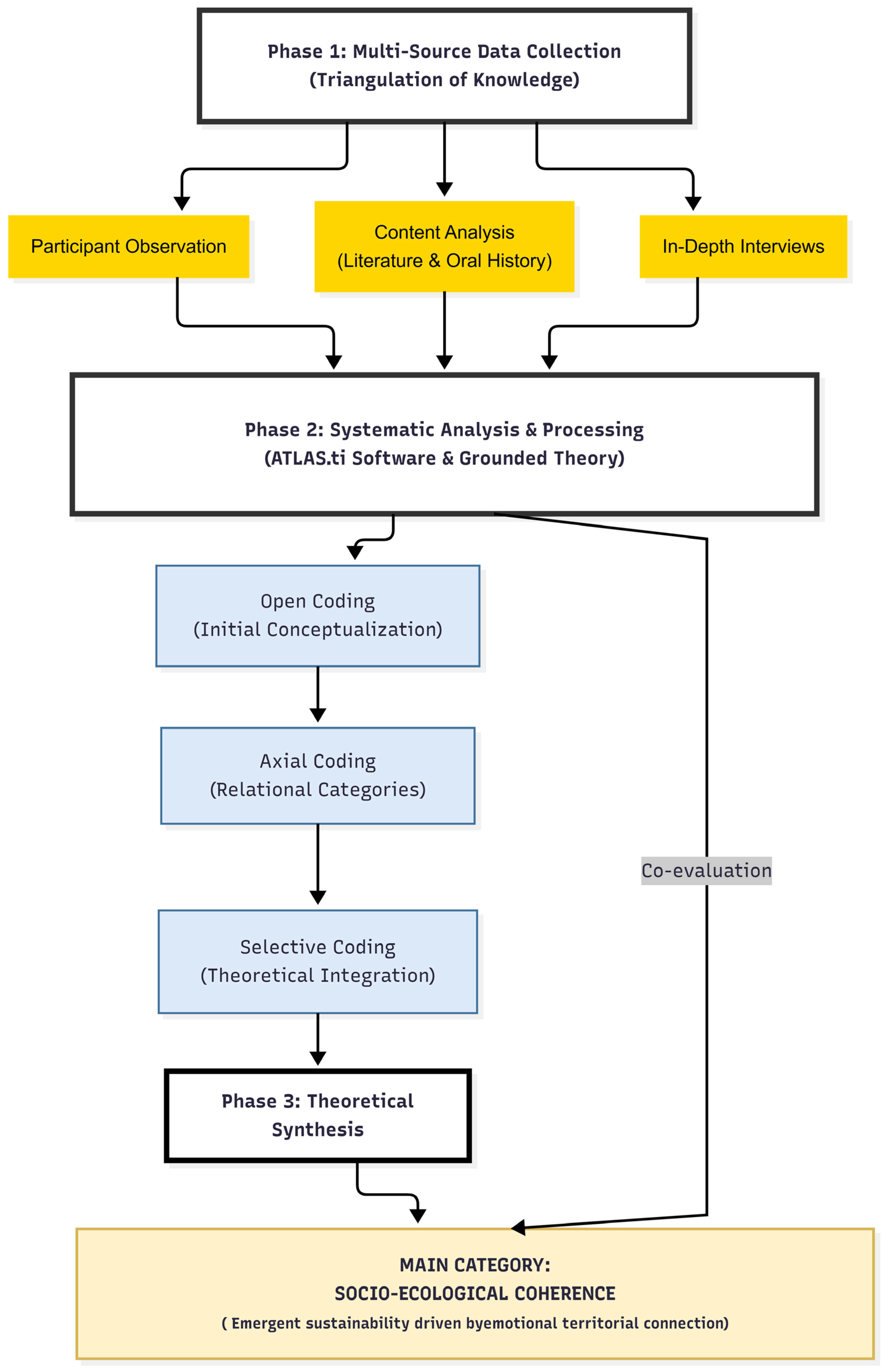
Coverification process: The results, interpretation, and conclusions were socialized with the Reverse Organization to obtain approval and consent that effectively reflect reality. This crucial step was used to co-construct the research (
Figure 1).
All sessions were recorded using high-fidelity digital audio, cataloged chronologically, and transcribed verbatim in accordance with informed consent protocols.
2.4. Qualitative Analytical Modeling and Coding Architecture
The qualitative text corpora, field journals, and descriptive records were systematically processed using a progressive multi-version software pipeline in ATLAS.ti 26. The analysis employed a Grounded Theory-inspired approach to prioritize semantic density over mere word frequencies. The coding architecture followed a strict three-tiered process:
Open Coding: Raw transcriptions and field notes were examined line by line to extract initial, emergent conceptual codes grounded in the community’s vernacular and ontological categories.
Axial Coding: Open codes were clustered into cross-cutting analytical categories to map structural relationships between the overarching dimensions of Identity (Being), Social Agency (Doing), and Livelihood (Having).
Selective Coding: All social, emotional, and economic categories were integrated around a core explanatory node: Socio-Ecological Coherence. This central integration explains the community’s operational model as a direct expression of alignment between identity and practice.
The coding process continued until theoretical saturation was reached, as confirmed by subsequent iterations that yielded no new conceptual dimensions. Finally, the study included a co-verification (member checking) stage, during which synthesized results were presented to community leaders and workshop participants. This process served to validate the emerging categories, correct potential observer effects, and obtain the community’s formal approval of the analytical results, ensuring the study faithfully represents their lived reality and intellectual property.
2.5. Validity and Ethical Considerations
The integrity of this study was ensured through the triangulation of multiple data sources, including in-depth interviews, participant observation, and software-generated semantic networks. In strict alignment with the principles of Community-Based Participatory Action Research (CPAR), the study incorporated a formal co-verification (member checking) process as a final methodological stage.
This process involved workshops with community leaders and participants, designed specifically to validate the emerging analytical categories and minimize the “observer effect” associated with the researcher’s presence during the field immersion, and researcher bias. Furthermore, a double-check protocol was implemented regarding the paper’s language and narrative framing; all synthesized findings were presented back to the Reverdece Association to ensure the academic interpretation faithfully represented their lived reality and community-defined knowledge. Consequently, formal approval of the results was obtained from the association, ensuring that the dissemination of these outcomes respects the community’s collective intellectual property over their ancestral techniques and socio-ecological practices.
Financially and institutionally independent of external extractive agendas, the research maintained all investigative protocols grounded in the principles of symmetry, horizontal reciprocity, and deep ethical commitment throughout the research process.
3. Results
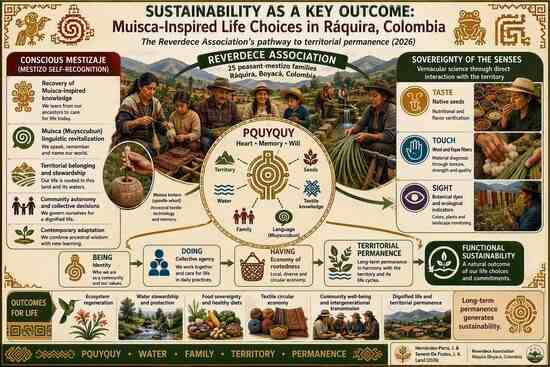
The systematic processing of qualitative data within ATLAS.ti 26 reveals that the Reverdece Association does not approach sustainability as an external programmatic aim or a set of top-down metrics. Instead, empirical evidence shows that sustainable outcomes emerge directly from an internally coherent life strategy aimed at long-term territorial permanence. The association’s operational model functions as a dynamic system in which adaptive practices and an elective ancestral knowledge base are reclaimed to address modern economic, social, and environmental pressures. Rather than adhering to conventional linear production models or market-driven efficiency metrics, the community organizes its landscape through a closed-loop philosophy of abundance under constraint. The following sections detail the empirical findings from the systematic coding of narrative and observational data, which underwent a formal co-verification process with the community to ensure alignment with their operational reality.
3.1. Socio-Ecological Coherence: The Being, Doing, Having Matrix
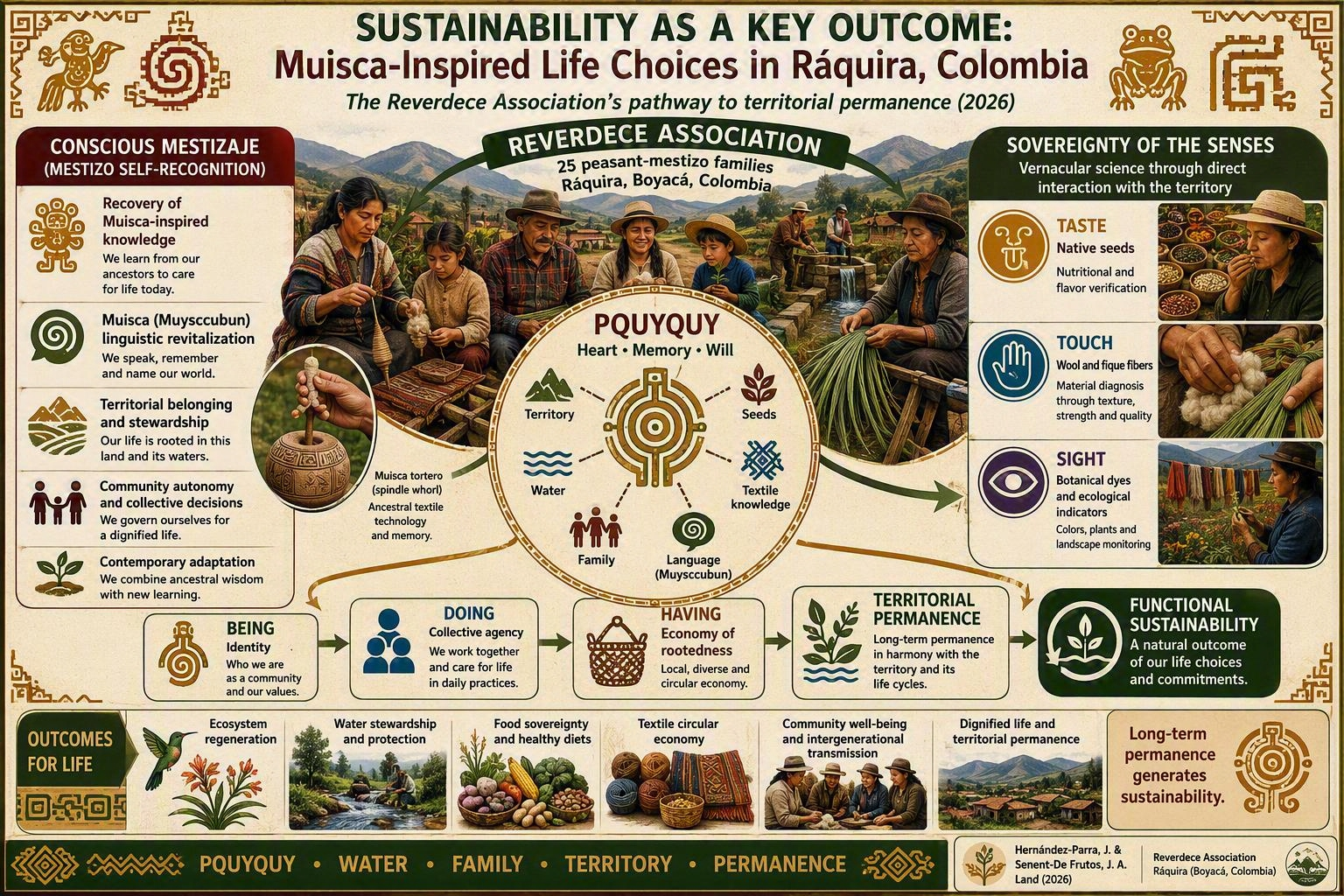
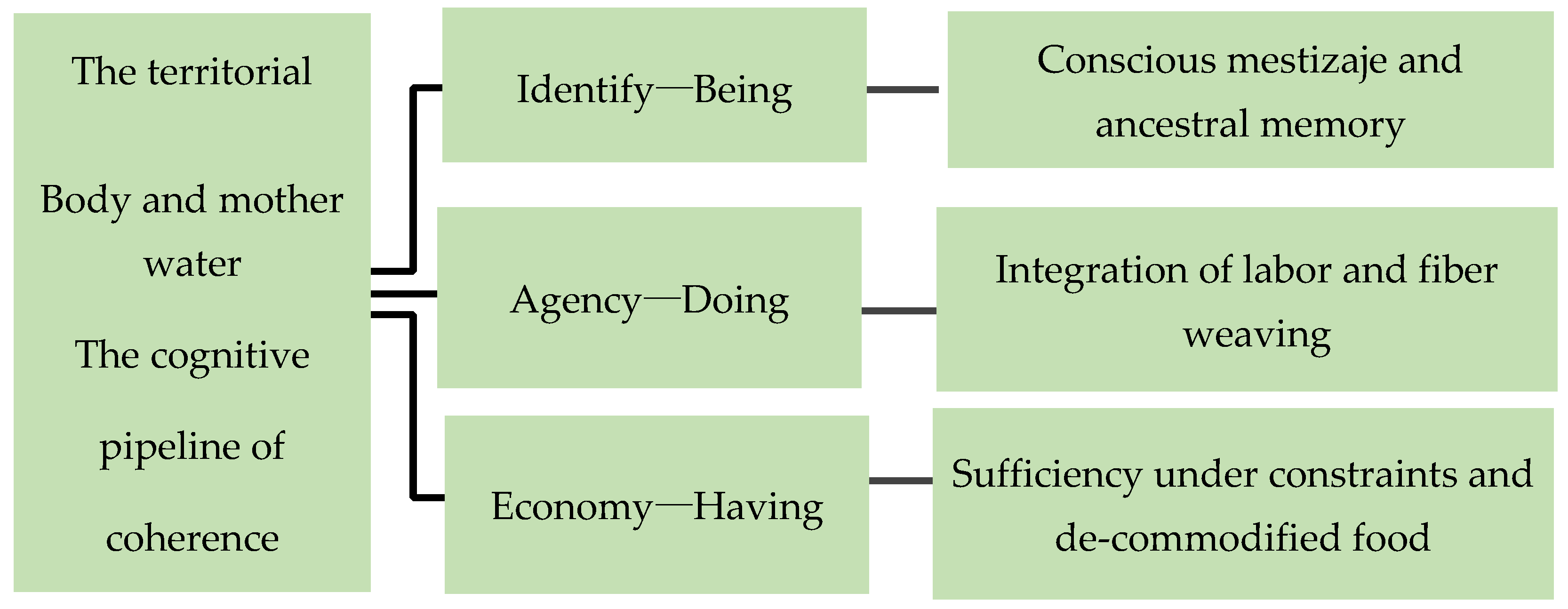
The systematic coding process identifies “Socio-Ecological Coherence” as the core category organizing the association’s activities. This coherence serves as a practical framework for addressing contemporary economic pressures while upholding the community’s choice to remain in their ancestral territory. The association operationalizes this relational view through an integrated matrix that aligns three core dimensions: Identity (Being), Collective Agency (Doing), and a Sovereign Economy (Having).
“La sostenibilidad consiste en realizar las labores cotidianas del campo y en optimizar los mal llamados recursos, como el agua, en nuestras fincas y predios.” [“Sustainability is carrying out the daily tasks of the countryside and the optimization of the wrongly called resources, such as water, within our farms and our properties”].
Identity (Being): The data indicate that participants prioritize cultural resonance and territorial honor over market-driven optimization. This dimension serves as the ethical foundation of the association, transforming territorial stewardship into a form of active community empowerment.
Collective Agency (Doing): The association deploys collective adaptability by translating raw environmental elements into sovereign technological choices. This involves intergenerational labor, closed-loop sheep husbandry, botanical dye extraction, and manual weaving as primary acts of territorial defense.
Sovereign Economy (Having): The association maintains a materially secure, decommodified economy that prioritizes stable nutrition and resource sufficiency over the external growth mandates of conventional markets.
The thematic mapping generated during qualitative modeling illustrates how the community’s commitment and high adaptability turn inherited practices into modern solutions. Furthermore, empirical evidence confirms that the Reverdece Association does not operate in geographic or social isolation. Instead, the association actively navigates contemporary economic challenges—such as income instability and market volatility—by deliberately adopting a self-determined lifestyle rooted in these three dimensions (
Table 1).
The coding analysis further reveals that “Territory” stands as the category with the highest semantic density and anchoring frequency. In the analyzed narratives, the territory is understood as a living, relational subject intrinsically bound to the Chibcha concept of
pquyquy (heart/memory/will). The data demonstrate that for the families involved, protecting the ecosystem is a manifestation of filial honor toward “Mother Water,” positioning the landscape as an active, living body [
24]. This relational model is reflected in their definition of sustainability: “Sustainability is carrying out the daily tasks of the countryside and the optimization of the wrongly called resources, such as water, within our farms and our properties”.
Pquyquy The thematic mapping generated during qualitative modeling illustrates how the association’s community commitment and high adaptability turn inherited practices into modern solutions. The data shows that Reverdece does not work in geographic, political, or social isolation. Instead, the association actively navigates contemporary economic challenges—such as income instability, unequal access to resources, and market volatility—by explicitly choosing a self-determined lifestyle. The detailed account of their daily operations provides unambiguous empirical evidence of this adaptive process, proving a complete, circular production system that relies entirely on internal capacities and local ecosystems:
“La agricultura orgánica es una pieza importante dentro de este rompecabezas, pero sigues dependiendo de insumos externos… intentar, en la medida de lo posible, no depender tanto de factores externos para sacar adelante las cosechas; la autonomía es precisamente tener un bajo impacto en las labores que realizamos.” [“Organic agriculture is an important piece within this puzzle, but you still depend on external inputs… to try as much as possible not to depend so much on external issues to be able to get the harvests forward; autonomy is to try precisely to have a low impact among the tasks that we carry out”].
Pasture & Flock Management: The association supports a cooperative system of sheep husbandry, where the community directly manages high-altitude lands and harvests local timber to maintain tools and processing infrastructure.
Material Processing: The raw wool and plant fibers are harvested, cleaned, spun into threads, and dyed with botanical dyes extracted from local species such as fique, chilco, and sauco.
Intergenerational Production: The production loop is intentionally organized to involve the entire community fabric, integrating everyone from young children to elders over 90 in weaving and preparation.
This total involvement ensures that technical and cultural knowledge is transmitted naturally through shared daily labor, reinforcing social bonds and family learning networks. Rather than seeking expansion or capital accumulation, the narrative analysis confirms that Reverdece builds its economic stability on the principle of sufficiency. The association operates on the collective understanding that they have everything they need within their territory, using their electoral tradition as a tool for autonomy and resistance to external market dependencies.
3.2. The Sovereignty of the Senses: Sensory Validation and Relational Diagnosis
The association employs a sensory-based diagnostic framework to manage local agroecological systems, utilizing senses as a localized validation mechanism to monitor biological health. Far from rejecting scientific properties or nutritional facts, the association integrates the senses as a localized validation mechanism; this sensory sovereignty works as a form of vernacular science that respects natural laws, material capacities, and biological cycles. This framework includes advanced techniques for environmental restoration that the community implements to minimize external dependence: “La agricultura orgánica es una pieza importante dentro de este rompecabezas, pero aún dependes de insumos externos (como cal, melaza o minerales)… la agricultura sintrópica habla de una alta densidad de plantas y especies y de poda permanente para poder generar sustratos y así no depender de problemas externos.” [“Organic agriculture is an important piece within this puzzle, but you still depend on external inputs (such as lime, molasses, or minerals)… syntropic agriculture speaks of a wide density of plants and species and permanent pruning to be able to generate substrates so you do not depend on external issues”].
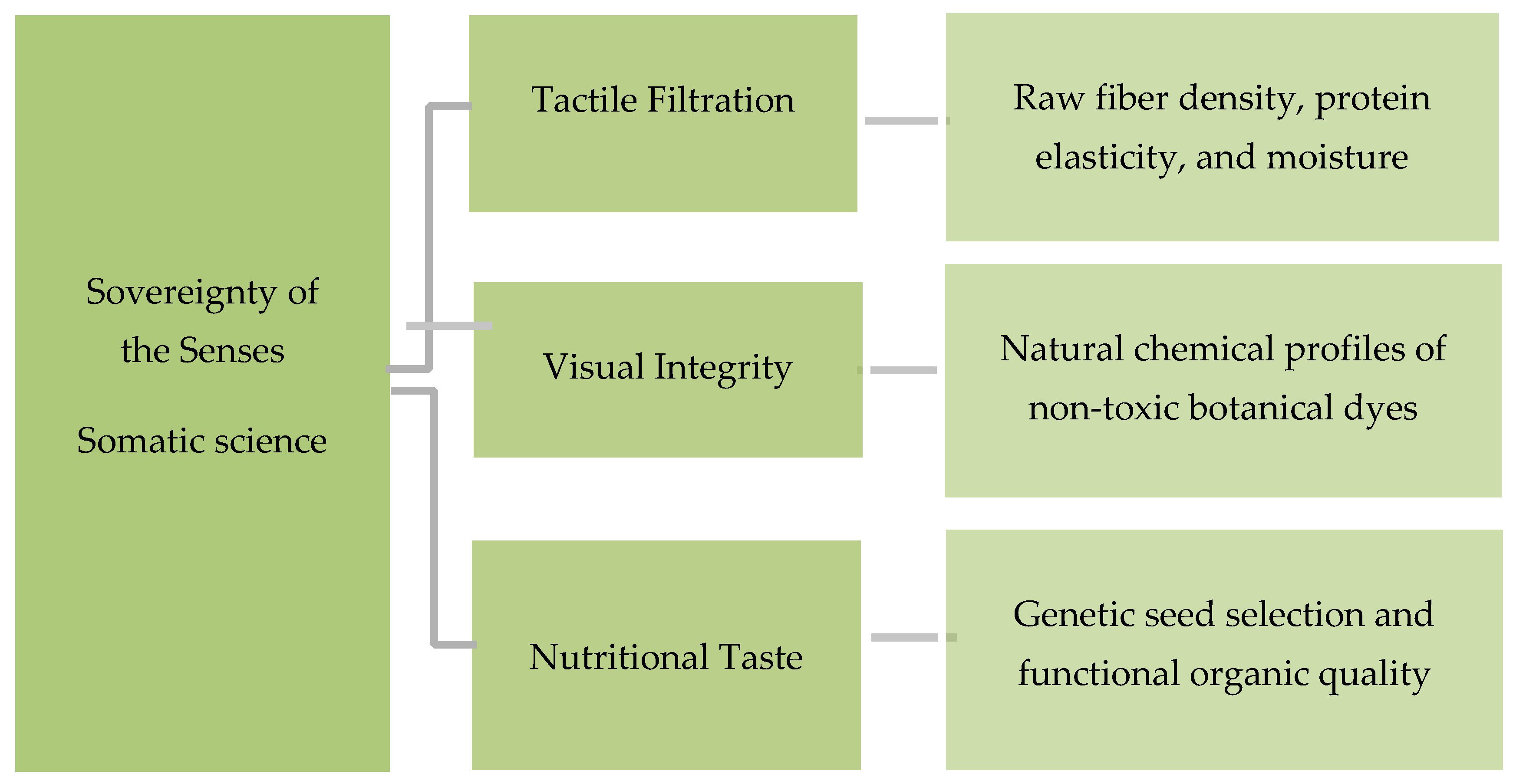
The qualitative data indicate that the Reverdece Association employs a sensory-based diagnostic framework to manage local agroecological systems. Rather than treating senses as subjective or aesthetic features, the community utilizes them as a localized validation mechanism to monitor biological and material health. This “sovereignty of the senses” functions as a precise diagnostic tool, allowing participants to evaluate the intrinsic material qualities of their living environment without relying solely on external technocratic indicators.
The empirical application of this framework is evident across three primary diagnostic indicators:
Taste as Nutritional Verification: Participants utilize the flavor profiles of native seed varieties as empirical indicators of soil health and structural adaptation. The community interprets specific taste characteristics as signals of genetic purity and nutritional richness, which serve as non-linear indicators of agricultural success.
Touch as Material Diagnostic: Artisans apply tactile interaction with raw wool and fique fibers to assess protein elasticity, moisture retention, and material density. This somatic engagement guides technical weaving decisions, enabling the production of high-quality textiles while bypassing the need for industrial chemical treatments.
Visual and Chromatic Correspondence: The community tracks natural chemical changes during fermentation and botanical dyeing processes using visual markers. This careful observation ensures optimal fiber binding while explicitly protecting local water networks from industrial chemical pollution.
“Para las personas nativas, tú sigues siendo una persona que no es de acá [colono], pero sí siento que mucho de eso tenía que tener un polo a tierra, que es precisamente esa conexión con el territorio en el que tú habitas.” [“For native people, you are still a person who is not from here [colonizer], but I do feel that a lot of that had to have a grounding point, which is precisely that connection with the territory in which you inhabit”].
These sensory-guided practices confirm that the association’s management of the territory relies on a deep, ethical connection between human labor and ecological health. By framing the senses as diagnostic tools for recognition and validation, the association demonstrates an integrated understanding of sustainability where human well-being and ecological health are part of the same operational fabric. As noted by community leadership, these practices reflect a deep commitment to territorial stewardship: “Sustainability is carrying out the daily tasks of the countryside and the optimization of the wrongly called resources, such as water, within our farms and our properties”.
3.3. Empirical Drivers of Material Sovereignty: Agroecological Care and Textile Cycles
The practical, empirical expression of the association’s socio-ecological coherence is visible in two primary, closed-loop production pillars. These systems provide physical proof of how the Reverdece Association transforms traditional memory into active socio-ecological solutions without relying on external, top-down development models.
3.3.1. Native Seed Stewardship, Permaculture, and Land Reconstruction
The communal seed bank stands as the second most conceptually dense category in the discourse analysis, serving as the foundation of the association’s material sovereignty. Participants regard these native seeds as “carriers of history,” in which success is measured by the “pleasure of eating well” rather than by commercial volume. The community’s agricultural strategy relies on syntropic agriculture and the creation of “forests for the future,” which prioritize long-term ecosystemic health over immediate extraction. This management style employs rotational cropping and active weed control through botanical synergy, allowing livestock to enter the fields only after the primary production phase to avoid crop damage. [“In any case, some aspects of medicine, natural medicine, water conservation, and seed preservation are still preserved”].
Native Seeds and Alimentary Sovereignty: The data shows that the communal seed bank is the second most frequent sub-category after “Territory.” Rather than viewing seeds as simple commercial inputs or passive agricultural factors, the association manages them as living repositories of genetic and cultural memory. The collective cultivates its agricultural systems through permaculture and organic management, drawing on historical records of regional Muisca production and using the full articulation of their sensory parameters to guide crop management. Participants regard native seeds as “carriers of history,” in which flavor and the “pleasure of eating well” serve as non-linear indicators of success (
Figure 2). In this sense, the community does not seek “productivity” in neoliberal terms, but the reproduction of life through the recovery of ancestral genetic memory.
By prioritizing high-altitude biodiversity and avoiding synthetic inputs such as lime, molasses, or industrial minerals, the community maintains soil balance and enhances microbial diversity. The concept of organic or permaculture transcends reconstruction biology and the succession process of syntropic agriculture. This diversification fosters vital ecological relationships with pollinators and local fauna, driving the active restoration of degraded areas. The Reverdece leader emphasizes the core motivation of these practices: “Buscamos el bienestar de la comunidad y del medio ambiente” [“We are looking for well-being for the community and for the environment”].
The association’s cultural approach to cultivation is deeply rooted in the relational management of local resources, including wild fruits and native fibers. This production cycle rejects industrial shortcuts, maintaining a localized pipeline for resources such as wild agraz, which is processed into refined products like jams and preserved to bypass exploitative intermediation.
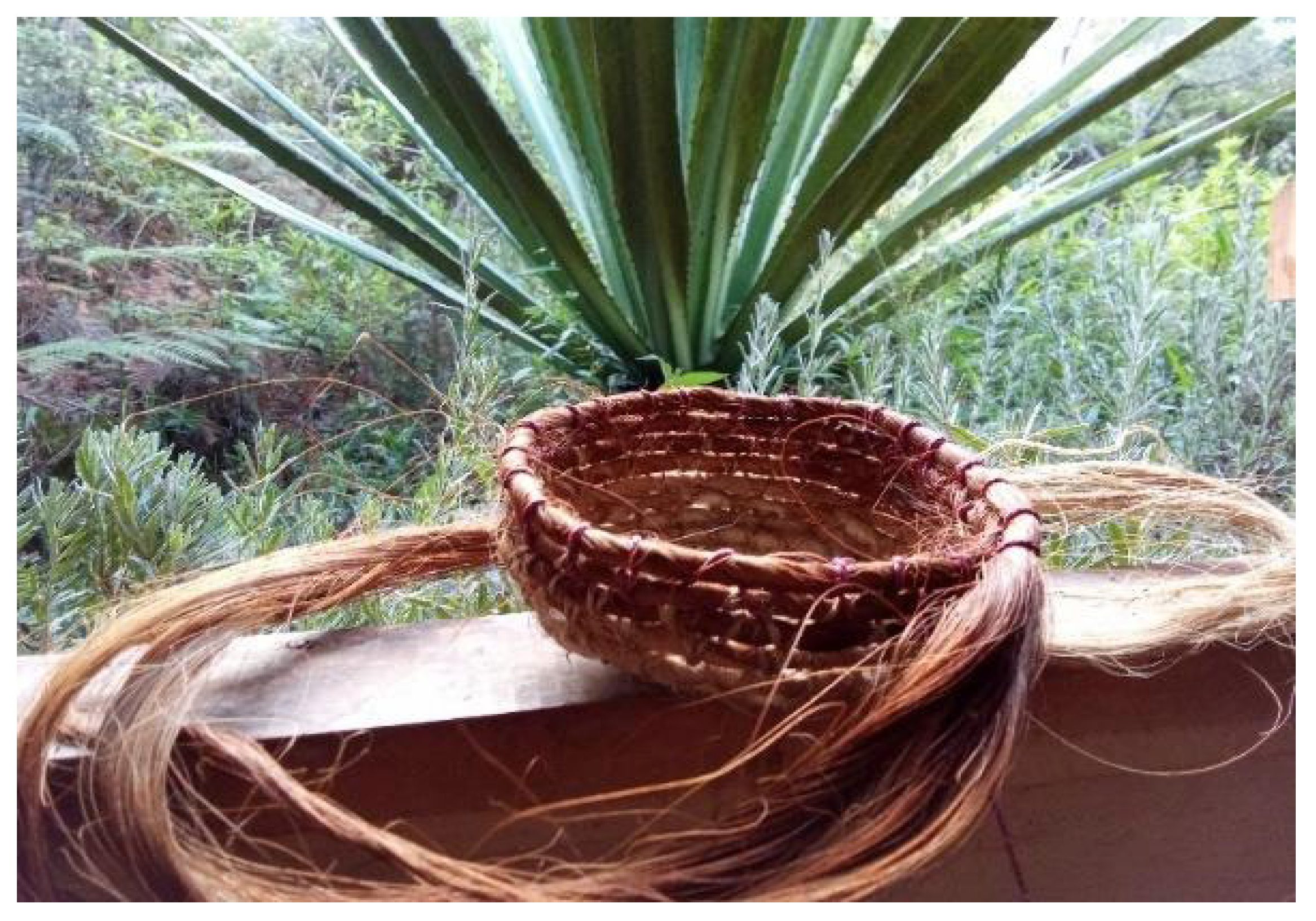
The textile process reflects this cultural depth: “The raw wool and plant fibers are harvested, cleaned, spun into threads, and processed using botanical dyes extracted directly from local species like fique, chilco, and sauco”. This meticulous cycle has allowed the community to evolve their traditional expressions—historically centered on mochilas—into modern natural-fiber products like pet mats. Such diversification is a strategic response to market instability, proving that the association relies on its internal capacities rather than external fluctuations: ultimately, this material sovereignty is rooted in an ethical foundation, as defined by a Reverdece member: “La sostenibilidad consiste en llevar a cabo las tareas cotidianas del campo y optimizar el uso de recursos que, erróneamente, se denominan así, como el agua, dentro de nuestras explotaciones agrícolas y nuestras propiedades” [“Sustainability is carrying out the daily tasks of the countryside and the optimization of the wrongly called resources, such as water, within our farms and our properties”].
3.3.2. Textile Resilience: Closed-Loop Fiber Systems and Botanical Indicators
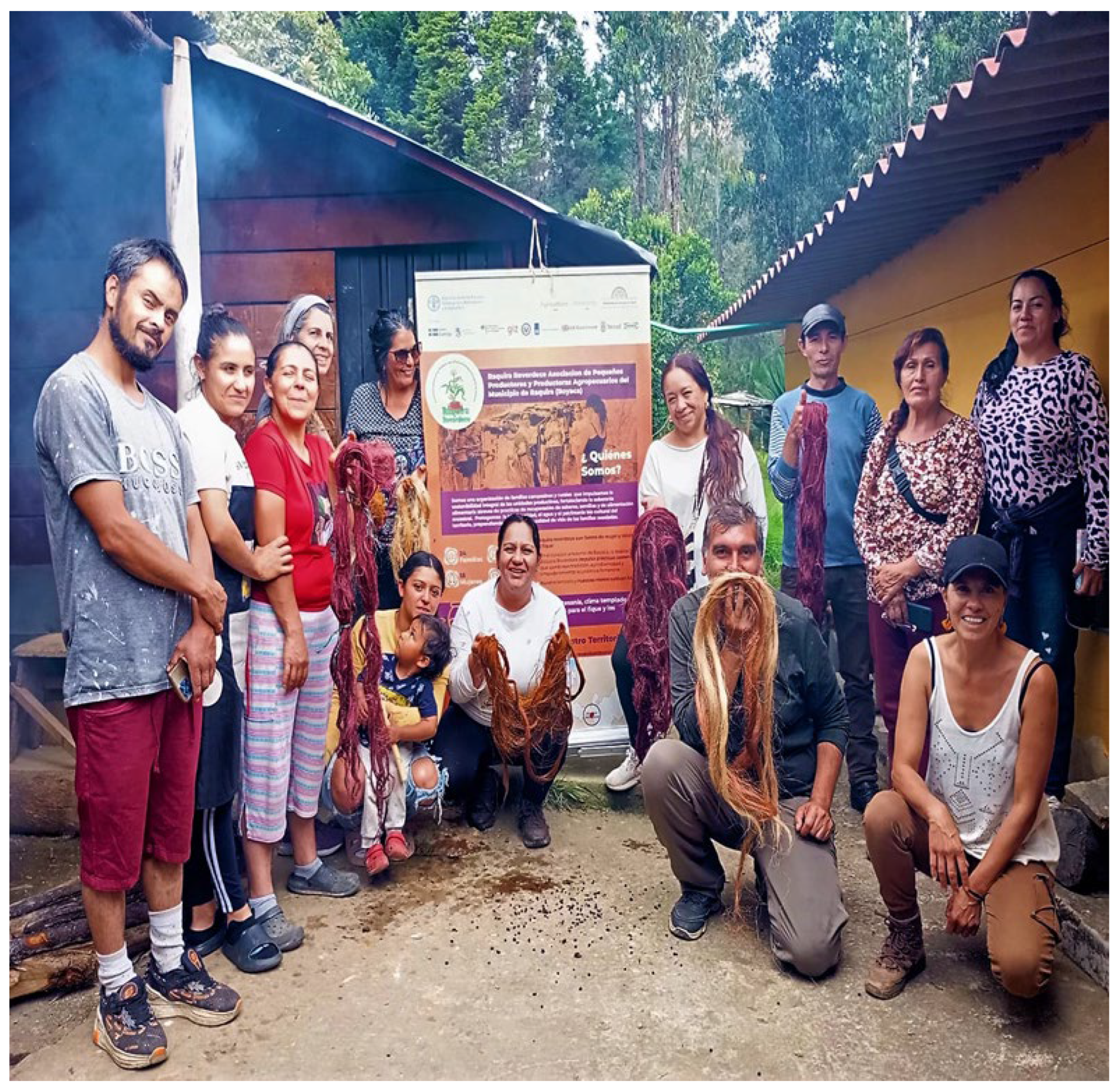
The traditional textile cycle provides further empirical evidence of the association’s closed-loop philosophy, which explicitly rejects industrial shortcuts in favor of localized raw-material pipelines. The collective manages high-altitude pastures, cultivating specific grasses that support healthy sheep flocks, and integrates livestock into the land management cycle only after primary crop harvests, ensuring a holistic use of the territory. The raw wool and plant fibers are harvested, cleaned, and spun into high-quality threads within family spaces, removing the need for external intermediaries or industrial chemicals (
Figure 3). As documented in the research data: “La lana cruda y las fibras vegetales se cosechan, se limpian, se hilan y se procesan utilizando tintes botánicos extraídos directamente de especies locales como el fique, el
chilco y el
sauco” [“The raw wool and plant fibers are harvested, cleaned, spun into threads, and processed using botanical dyes extracted directly from local species like fique, chilco, and sauco”].
This material autonomy is bolstered by the association’s successful diversification of its traditional textile expressions, adapting historical practices such as mochilas to meet contemporary needs through high-quality, natural-fiber products—including innovative designs like pet mats. This diversification serves as a strategic response to market challenges and instability, as the association moves to dignify their craft by adding value: “Estamos intentando dignificar ese oficio, el oficio de recolector y recolectora de agraz y también dándole valor agregado a través de la transformación” [“We are trying to dignify that craft, the craft of the agraz gatherer, and also adding value through transformation”]. By maintaining these cycles entirely within the community, the association bypasses volatile external market dependencies, reinforcing their commitment to a sufficiency-based economy where the goal is not capital accumulation, but the preservation of a dignified, sovereign way of life.
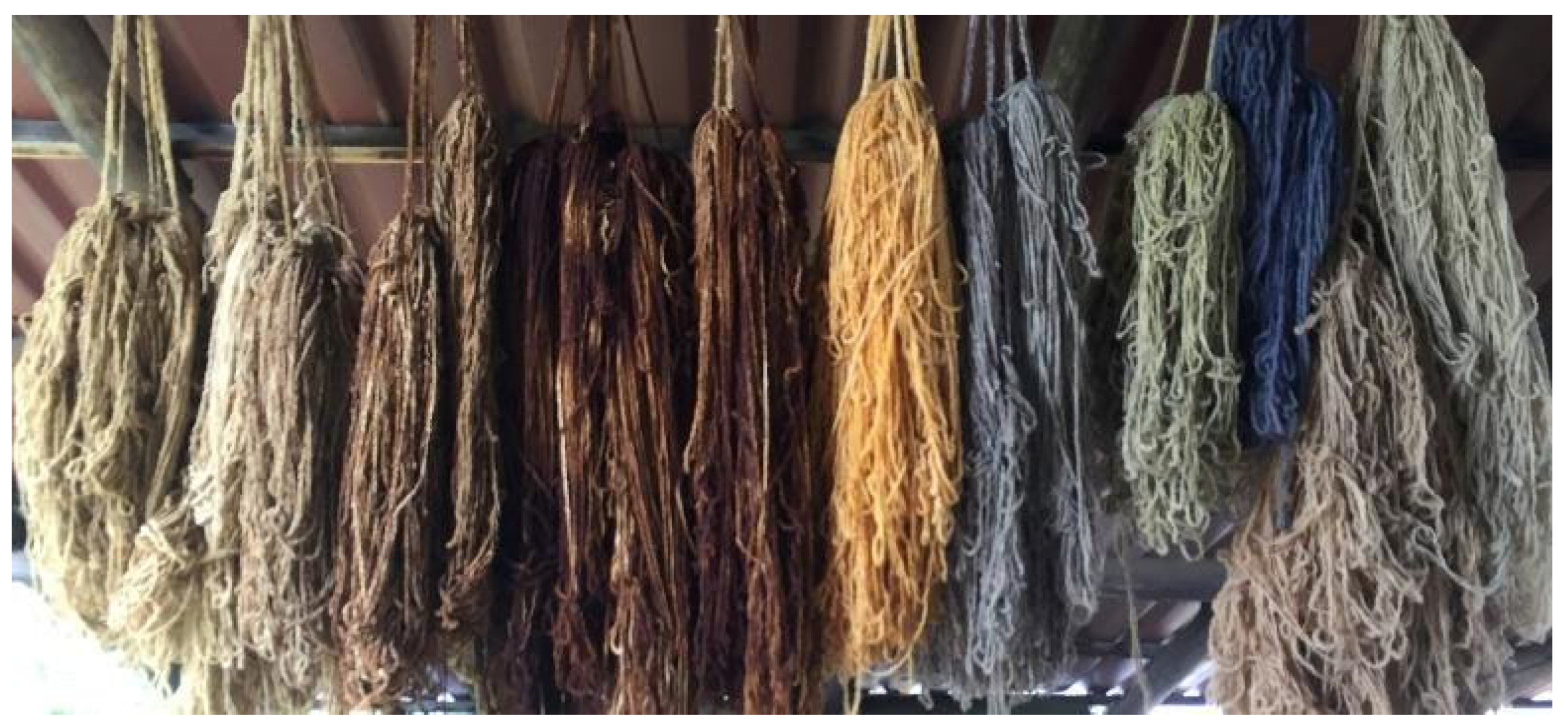
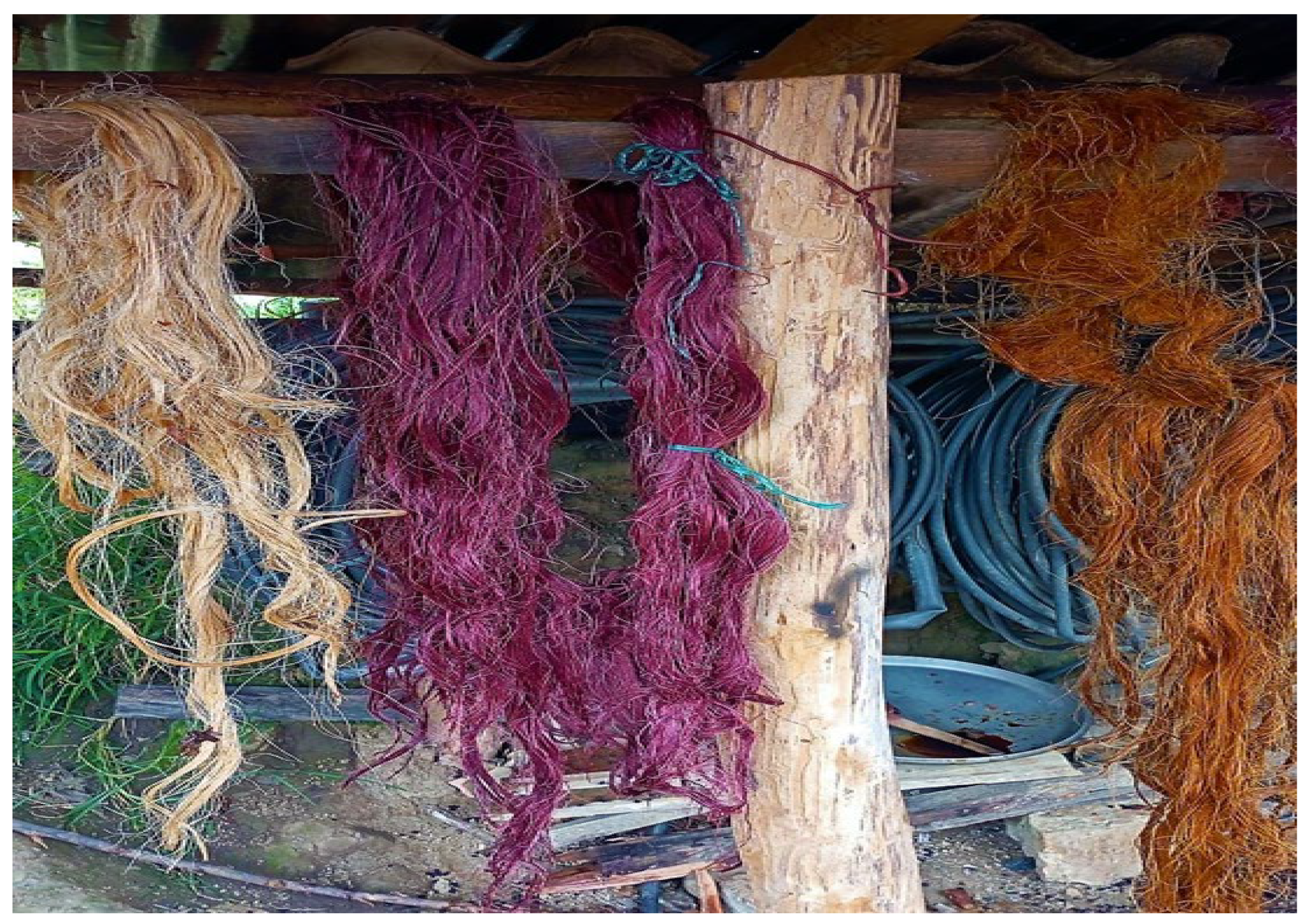
Botanical Dyeing: The threads are processed using natural pigments extracted from native local plants, specifically
chilco and
sauco (
Figure 4). This complete rejection of synthetic, industrial dyes protects local waterways from chemical pollution.
3.4. Intergenerational Pedagogy and the Logic of Territorial Permanence
The discourse analysis was conducted via ATLAS. ti, identifying “Territory” and “Communal Seed Bank” as the semantic anchors with the highest conceptual density in the Reverdece Association’s narratives. These anchors are not isolated concepts; they are the pedagogical pillars that facilitate a natural, intergenerational transmission of knowledge.
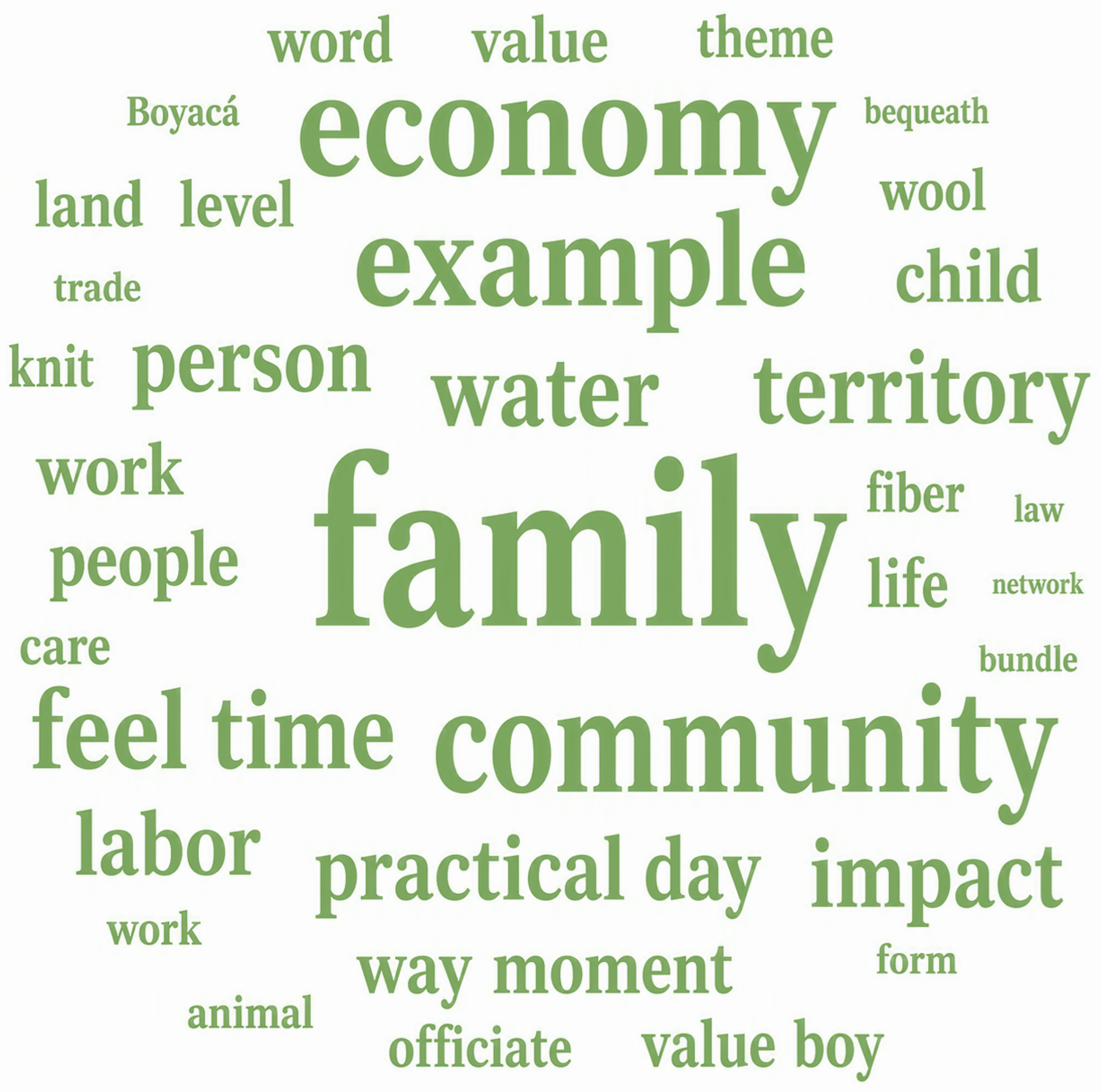
To visualize the conceptual density derived from the discourse analysis, the data were mapped into a semantic frequency cloud (see
Figure 5). This mapping reveals a clear hierarchy of terms that serve as the “semantic anchors” for the Reverdece Association’s identity. At the core, the frequency of terms such as Territory, Water, and Seed demonstrates that these are not merely topics of conversation, but the pillars of a living socio-ecological system. Surrounding these core anchors are the operational descriptors—Sovereignty, Care, Weaving, and Sufficiency—which provide the context for how the community translates these concepts into daily action.
This linguistic mapping is more than a quantitative exercise; it provides a visual representation of the Analytical Alignment discussed throughout this chapter. By quantifying the weight of these concepts, the word cloud confirms that the community’s discourse is not fragmented, but organized around a central, circular logic of permanence.
Within this community, the production loop is intentionally organized to involve the entire family fabric, integrating everyone from young children to elders over 90 in weaving and preparation tasks. This total involvement ensures that technical and cultural knowledge is passed on through shared daily labor rather than formal instruction, reinforcing social bonds and family learning networks. As Reverdece explains: “El tejido que se ha logrado a través de lo que hago con la comunidad en general hace que haya un acercamiento… no es llegar a hacer tu historia y que los demás te valgan nada, sino que realmente las cosas que haces las haces con el compromiso de hacer un cuidado integral del territorio.” [“The fabric that has been achieved through what I do with the community in general creates an approach… it is not about arriving to make your own story and that the others do not matter, but rather that the things you do, you do them with the commitment of being able to perform comprehensive care for the territory truly”].
This pedagogy of “shared doing” supports the cultural continuity of ancestral practices, even in a modern context where traditional ways of life are often under pressure. The community manages to bypass the imposition of external models by validating their own daily, lived experience. Rather than treating ancestral knowledge as a static artifact, the association treats it as a living dynamic that adapts to the present needs of the ecosystem. This approach is mirrored in the way they handle their cultural and medicinal practices: “Las prácticas que nosotros realizamos también a nivel ancestral con plantas y demás han sido un buen acercamiento con las personas y las familias… no es algo impositivo, sino más bien algo de compartir saberes, compartir experiencias, también desde la mirada académica o como se quiera llamar, y desde el hacer cotidiano.” [“The practices that we carry out also at an ancestral level with plants and others have been a good approach with people and families… it is not something imposed, but rather something of sharing knowledge, sharing experiences, also from the academic perspective or whatever one wants to call it, and from the daily doing of the families”].
Ultimately, this pedagogical model serves as an act of resistance against external market dependencies. By focusing on the continuity of the pquyquy—the Chibcha concept of heart and memory—the association transforms the territory into a space of collective sovereignty. They do not seek expansion or capital accumulation; instead, they build economic stability on the principle of sufficiency, confirming through their daily lives that they have everything they need within their territory. Their elective tradition functions as a tool for autonomy, ensuring that the legacy of “Mother Water” and the health of their soil remain central to the identity of future generations. “El agua hace parte integral de ese camino de vida que elegí, pero pues esa agua realmente está en todo lo que hacemos, todo el tiempo…” [“Water is an integral part of the life path I’ve chosen, but that water is really in everything we do, all the time…”].
3.5. Territorial Permanence: The Water Nexus and Intergenerational Continuity
The permanence of the Reverdece Association in their territory is stabilized by a final, critical linguistic conceptual anchor: “Water.” In the community’s discourse, water serves as the semantic pivot that bridges administrative labor and ethical commitment, ensuring the survival of the community’s fabric across generations (
Figure 6). By successfully managing their own aqueduct and navigating complex bureaucratic challenges, the association has transformed water access from a mere utility into a cornerstone of their intergenerational project. Reverdecer members articulate this connection as the foundation of their presence in the landscape: “El agua hace parte integral de ese camino de vida que elegí pero pues esa agua realmente está en todo lo que hacemos todo el tiempo; por eso lo pongo tan reiterativo: el tema del cuidado del territorio a través del agua” [“Water is an integral part of this life path I chose, but that water is truly in everything we do all the time; that is why I make it so repetitive: the issue of caring for the territory through water”].
This commitment to water access is the primary mechanism that permits the physical and cultural permanence of the entire community, allowing families to remain in Ráquira despite contemporary economic pressures and the threat of resource extraction. Without this collective governance, the cultural practices and ancestral agricultural techniques described would be impossible to sustain. As the Reverdece community emphasizes regarding the community’s refusal to succumb to external extractive models, the management of the aqueduct is the prerequisite for all other forms of life and resistance: “Nosotros somos, según la constitución, somos comunidades organizadas, entonces desde ahí realmente es que nosotros hemos tenido la posibilidad de hacer esa interlocución; ellos se lucran del acceso de la gente al agua, nosotros simplemente lo que cobramos realmente es para la operación del servicio” [“According to the constitution, we are organized communities, so from there, we could make that dialogue; they profit from people’s access to water, we simply charge what is really for the operation of the service”]. This relational management of water serves as the ultimate safeguard for the association’s future, ensuring that the land’s legacy is preserved as a sovereign space for generations to come.
3.6. Linguistic Revitalization: The Cognitive Catalyst for Territorial Sovereignty
A foundational catalyst within this structural alignment is the revitalization of the Chibcha (Muisca) language. Rather than treating it as an extinct historical artifact, the community engages in active linguistic reconstruction workshops led by specialized knowledge holders, most notably Maestro Facundo Saravia. These activities are hosted in the leader’s home, which serves as the Reverdece Association’s home office and foundational center, grounding the recovery of ancestral knowledge in the community’s daily, domestic space. Accessing these reconstructed phonemes and semantic structures is not a nostalgic exercise; it functions as a critical cognitive tool that allows the association to reactivate ancestral ways of thinking, feeling, and diagnosing the territory. As the community integrates these concepts, the linguistic structure begins to redefine their social economy: “La lengua no es solo palabra, es la forma en que nombramos la vida, y al nombrar el territorio en nuestra lengua, estamos recuperando nuestra capacidad de cuidarlo” [“The language is not just words; it is the way we name life, and by naming the territory in our language, we are recovering our capacity to care for it”].
This linguistic process is deeply embedded in the association’s operational dynamics, specifically through the introduction of vocabulary that encodes complex ecological relationships. The integration of terms like pquyquy—representing the deep intersection of heart, memory, and territorial heartbeat—acts as a semantic anchor that reorients the association’s doing, being, and having. By using these terms, the members of the association shift their ontological orientation; they cease to be mere land managers and become active participants in an ancestral dialogue. As Katerin Castillo notes regarding this process: “Al traer estas palabras de nuevo a nuestro hacer cotidiano, el territorio nos habla de otra forma, y nuestras prácticas se vuelven una respuesta a esa memoria que habíamos olvidado” [“By bringing these words back into our daily doing, the territory speaks to us in a different way, and our practices become a response to that memory we had forgotten”]. This revitalization of language provides the cognitive scaffolding necessary for the association to sustain its Social Economy Coherence, thereby proving that territorial sovereignty is as much a linguistic act as a physical one.
3.7. Convergence with Sustainable Economy Frameworks: Speech Frequency and Empirical Validation
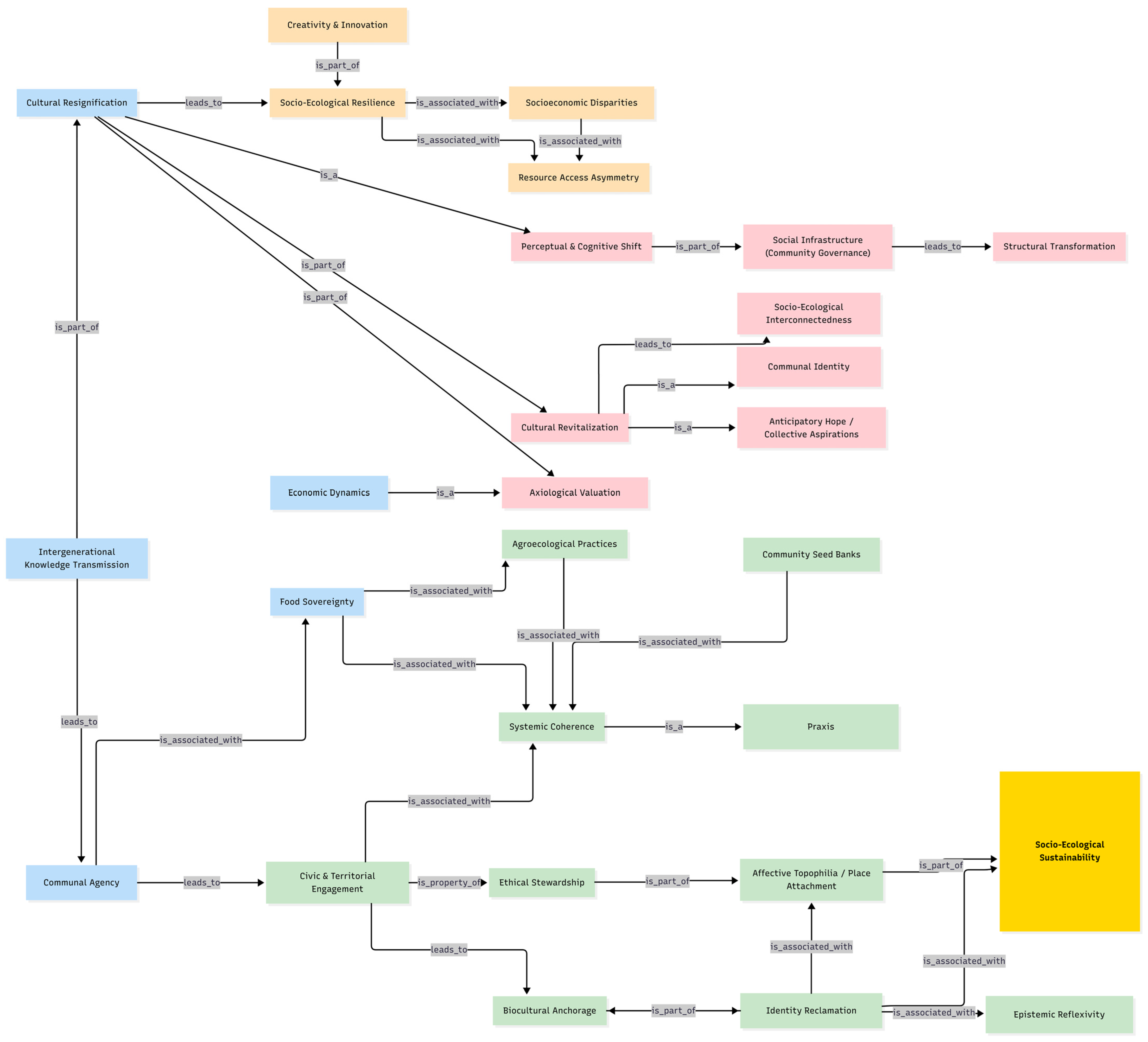
The qualitative trends seen throughout the thematic coding architecture are formally confirmed by the frequency analysis of the association’s discourse. The software-generated map (
Figure 7) illustrates the clear dominance of specific emic and relational terms over conventional technocratic vocabularies. Notably, the membership has expanded from foundational members at the start of this study to 25 active participants by 2026. This growth is not merely numerical; it reflects a deepening of the family-based operative model. Because the association functions as an inseparable unit, members engage in all activities alongside their kin, making the family the primary cell of their social economy. As Katerin Castillo observes regarding this collective immersion: “Cuando nos reunimos no somos solo los 25 que figuramos en el papel, somos todas las familias, porque aquí el trabajo es de todos, desde el más pequeño hasta el abuelo, y esa es la verdadera fuerza de nuestro proceso.” [“When we meet, it is not just the 25 of us on paper; it is all the families, because here the work belongs to everyone, from the smallest child to the grandfather, and that is the true strength of our process”].
Words such as “family,” “water,” “land,” and
pquyquy (heart/memory/will) show the highest frequency density within the text corpus. Crucially, the technical term “sustainability” is rarely mentioned; instead, the concept is expressed through the recurring linguistic pillar of “Permanence.” This frequency distribution provides empirical evidence that the community’s speech is rooted in a relational ontology where the triad of Doing, Being, and Having is inextricably linked (
Figure 8). The impact of this familial cohesion is evident at every stage of operations, as members consistently integrate their domestic lives into the productive cycle. As one member poignantly described the necessity of this unity: “Uno no llega al tejido solo, uno llega con su historia, con sus hijos, con su pareja; porque si el tejido no se hace en familia, no tiene el mismo sentido, no tiene el mismo corazón.” [“One does not come to the weaving alone; one comes with their history, their children, their partner; because if the weaving is not done as a family, it does not have the same meaning, it does not have the same heart”].
The prominence of the “family” node within this frequency mapping highlights the role of intergenerational transmission as the primary engine for both cultural continuity and economic resilience. By re-signifying their practices from within their own reality, the association demonstrates the following alignments:
Artisanal Circular Economy: The high frequency of terms related to labor, fiber [wool/fique], and processing confirms a complete closed-loop model. Resource efficiency, waste reduction, and absolute reliance on local biomaterials are prioritized to keep production loops within local territorial control.
Social and Solidarity Economy: The structural density of the community and labor codes reflects a cooperative production system. Economic interactions are governed by internal principles of horizontal organization, collective reciprocity, and generational equity rather than external market competition.
Bioeconomy and Local Biodiversity: The consistent reference to natural elements, native reforestation, and water sources aligns with the core parameters of a sustainable bioeconomy. The association uses local biological resources without disrupting regional ecological cycles.
Natural and Cultural Capital: Reclaiming ancestral knowledge functions as a valuable, transmissible common good. The community does not adapt its lifestyle to fit institutional economic models; instead, it integrates ancestral and contemporary elements to build a coherent way of life grounded in history, territory, and worldview.
3.8. Integrated Economic Impact and Strategies for Territorial Sovereignty
The results of this study—derived from both prolonged field observations of the community’s social dynamics and the discourse analysis of the Reverdece Association—reveal a living laboratory of Social Economy Coherence. The impact of this model is not measured by segmented metrics but by the convergence of outcomes across social, ecological, and economic dimensions, demonstrating how the community has successfully operationalized sovereignty. From a social perspective, the family fabric acts as the primary node of knowledge transmission. By integrating the daily labor of all generations, the association has secured its social permanence. As Reverdece members articulates: “La mayor ganancia no es el dinero que recibimos por el producto, sino saber que nuestros hijos están aprendiendo a valorar el territorio, que la lengua y el hacer de los abuelos no se están perdiendo, sino que se están viviendo” [“The greatest gain is not the money we receive for the product, but knowing that our children are learning to value the territory, that the language and the work of the grandparents are not being lost, but are being lived”]. This pedagogical continuity serves as the definitive shield protecting the group against external systemic pressures.
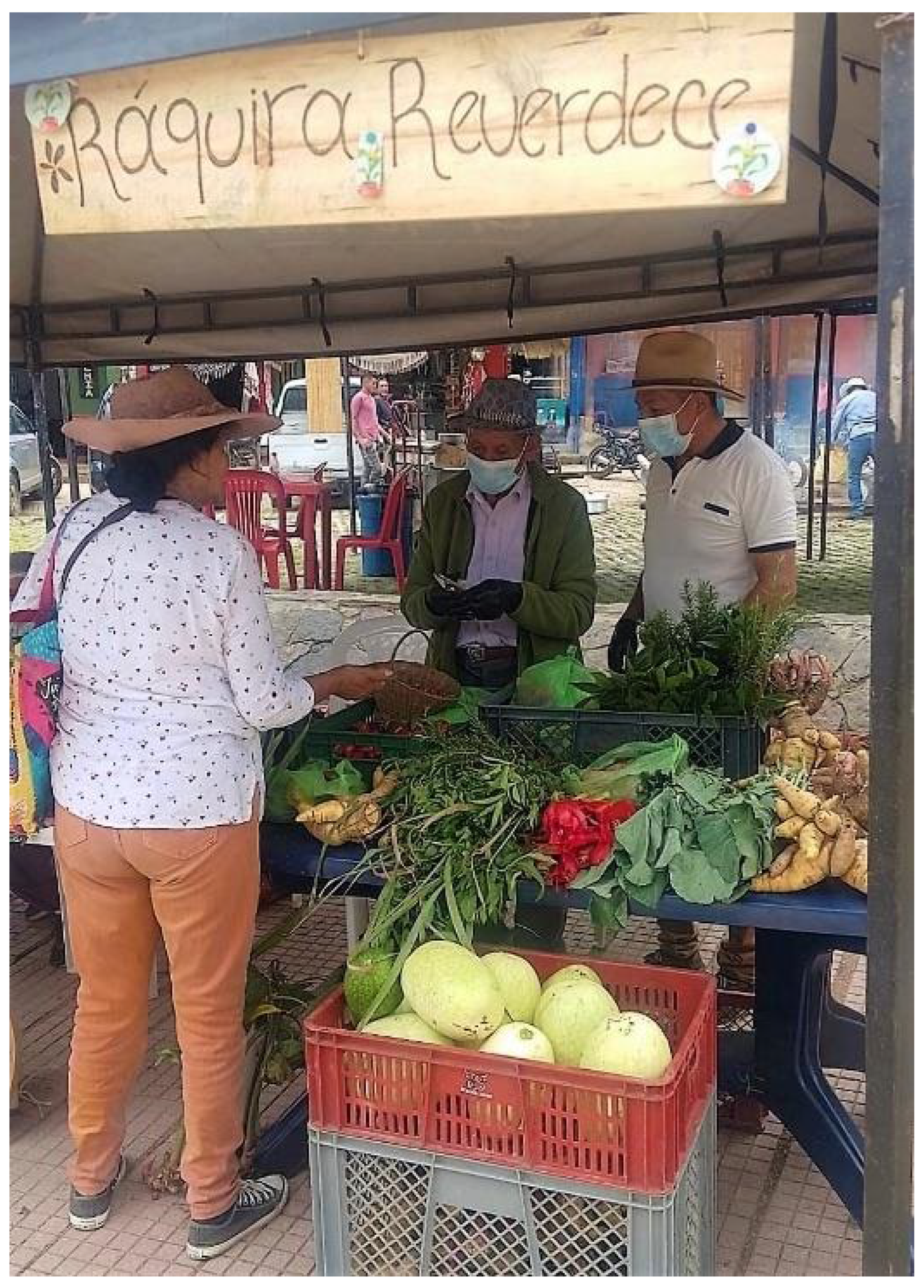
Ecologically and economically, the association has navigated structural constraints by engineering a circular model that prioritizes sufficiency and cooperation over extractive market participation. A key finding from the field is the community’s proactive approach to innovation; they are not merely replicating ancestral techniques but are constantly evolving to remain at the forefront of contemporary demand. This is evidenced by their ability to create new, modern textile designs and refine their artisanal processes to maintain market relevance (
Figure 9). The association strategically navigates both the craft and food sectors, utilizing localized fair networks and trust-based markets to sell organic produce, processed food products such as marmalade and concentrates, and high-quality textiles (
Figure 10). By converting seasonal organic surpluses into value-added products, the community captures higher economic margins while drastically reducing dependency on industrial intermediaries.
A zero-waste philosophy reinforces this operationality. In this material, waste is systematically minimized through organic reuse and reintegration of by-products into agricultural and textile cycles. Rather than prioritizing volume maximization, the association maintains a strict equilibrium between economic viability and cultural integrity. Income generation is understood strictly as a practical tool to secure dignified living conditions, never as an end in itself. As a Reverdece leader emphasizes: “Nuestro dinero no es para acumular, nuestro dinero es para que la vida aquí sea posible; es el medio que nos permite seguir habitando este lugar sin tener que irnos a la ciudad a mendigar lo que el territorio mismo nos puede dar” [“Our money is not for accumulation; our money is so that life here is possible; it is the means that allows us to continue inhabiting this place without having to go to the city to beg for what the territory itself can provide us”].
3.9. Potential Contributions to the SDGs: When Community Practice Precedes the Indicator
To evaluate how these localized life-logics interface with global development frameworks, the empirical findings of the Reverdece Association were analytically mapped against the United Nations 2030 Agenda. This alignment is strictly analytical rather than instrumental; the association does not structure its daily operations around external targets but instead embodies an internally coherent way of life from which global policy can derive alternative models of sustainability.
Although the Reverdece Association does not explicitly organize its activities around the UN framework, its everyday practices are naturally aligned with SDGs. The discourse analysis and field observations reveal a consistent convergence between the community’s autonomous life-logics and the sustainability parameters defined by the UN 2030 Agenda. This convergence is not the result of a programmatic design, but a structural characteristic of the Reverdece Association’s model. The following matrix (
Table 2) presents the findings from our empirical mapping, where specific community practices—documented throughout this research—are contrasted with the thematic goals of the SDGs. This data confirms that the community’s internal requirements for territorial permanence naturally produce outcomes that mirror, and often exceed, global sustainability indicators.
This mapping serves as validation that the community’s relational ontology—centered on pquyquy—generates systemic outcomes that global frameworks categorize as sustainable development, despite the complete absence of these institutional labels. When asked about these external frameworks, members often emphasize that their motivation is deeply local. As one community member noted: “Nosotros no trabajamos para cumplir metas de alguien más, ni sabemos mucho de esas siglas internacionales; nosotros trabajamos porque el campo nos necesita, porque nuestra vida aquí es lo que nos dicta el corazón y el territorio” [“We do not work to meet anyone else’s targets, nor do we know much about those international acronyms; we work because the land needs us, because our life here is what our heart and the territory dictate to us”].
The data presented in
Table 2 demonstrates that the community’s “Permanence” framework functions as a surrogate for global sustainability indicators. While the 2030 Agenda defines targets such as “Zero Hunger” (SDG 2) and “Clean Water” (SDG 6) as end goals to be achieved through programmatic interventions, the association’s discourse and field observations show that these outcomes are inherent in their daily organizational structure. The community prioritizes the logic of the territory over technical planning, as Katerin Castillo clarifies: “Si uno hace las cosas bien, con respeto por la semilla y por el agua, los resultados llegan solos; no necesitamos que nadie nos diga cómo ser sostenibles porque, para nosotros, eso siempre ha sido la forma normal de vivir” [“If one does things right, with respect for the seed and the water, the results come on their own; we do not need anyone to tell us how to be sustainable because, for us, that has always been the normal way to live”].
These results show that the community’s practices precede the global indicators; they are not reactions to external goals but foundational aspects of their territorial governance. This mapping exercise documents how a localized, non-instrumental logic yields measurable ecological and social outcomes that parallel global sustainability agendas while remaining entirely independent of the mechanisms for their implementation.
4. Discussion
The empirical findings presented reveal a critical tension. While global development frameworks seek to standardize “sustainability” as a measurable outcome, the Reverdece Association demonstrates that resilience is an ontological byproduct of territorial permanence. To ensure the rigor of this interpretation, the research employed co-verification. By engaging the community members in the analytical mapping of their own practices, this study reduces researcher bias and significantly increases the reliability of the findings. This methodological choice is rooted in an epistemological commitment to justice and the democratization of knowledge, opening a scaffolding-of-learning optic in which the researcher and the community co-construct the meaning of the data.
The importance of this horizontal dialogue is echoed in the very words of the community, who reflect on the necessity of being heard on their own terms: “Para nosotros, que alguien venga a investigar no significa que nos vengan a enseñar cómo vivir, sino que abrimos un espacio donde nuestras palabras y nuestro hacer cotidiano se encuentran con otros saberes, y eso nos ayuda a entender mejor nuestro propio camino” [“For us, someone coming to investigate does not mean they come to teach us how to live, but that we open a space where our words and our daily work meet other forms of knowledge, and that helps us understand our own path better”].
This quote encapsulates the “co-verification” process: it is a democratic scaffolding of knowledge where the community’s self-understanding is treated as the primary source of validity. The data confirm that the association’s “Social Economy Coherence” does not operate as an alternative within the market but as a totalizing logic that exists outside it. By positioning this research within the framework of Fornet-Betancourt’s intercultural dialogue, we move from “instrumental development” toward “relational sovereignty,” ensuring that our findings are not merely observational but are grounded in a co-verified commitment to the community’s own definitions of life and dignity. This approach aligns with the proposal for a profound intercultural transformation [
25]. As established in the literature, contextuality and historicity affect all human knowledge [
26,
27]. However, there remains a persistent lack of an interpretation capable of fostering a genuine culture of dialogue and social learning [
18,
28] By adopting this intercultural perspective, this study moves beyond extractive data collection; it treats the association’s life-logics not as objects of study, but as subjects of an active, decolonizing dialogue.
Contrary to traditional assumptions of rural isolation, the Reverdece Association thrives in a highly connected context only 100 km from Bogotá, proving that their model is not a retreat from modernity but an active, sovereign engagement with it. The data confirm that the community’s “Social Economy Coherence” does not operate as an alternative within the market but as a totalizing logic that exists outside it. This discussion addresses the implications of these findings and argues that the Reverdece model represents a shift from “instrumental development” to relational sovereignty [
29]. Rather than showing instrumental compliance with top-down normative architectures, the data gathered during the seven-month field immersion and analyzed in ATLAS.ti 26 reveal an operative model in which community praxis naturally precedes global sustainable indicators. This discussion presents a rigorous analytical position by evaluating how a grassroots peasant-mestizo organization can deliberately reconstruct and operationalize an elective ancestral logic of life that functions as a highly efficient, tangible, and economically practical response to contemporary environmental and material pressures.
4.1. The Failure of Metrics: Why Permanence Replaces Sustainability
The discourse analysis revealed that the absence of technocratic terminology within the community is not a lack of conceptual awareness; rather, it is a deliberate rejection of a language that treats life as a manageable resource. By substituting “sustainability” with “permanence,” the association repositions the human being from a manager of resources to a custodian of cycles. This shift forces a reconsideration of the limitations inherent in the Sustainable Development Goals (SDGs). While the SDGs provide a universal language, they rely on a top-down, programmatic structure that often fragments the very systems it seeks to protect [
1].
In contrast, the Reverdece model suggests that when sustainability is turned into an indicator, it loses its relational quality. The findings show that the association achieves the objectives of the 2030 Agenda—food security, water management, and social equity—precisely because these are not its primary targets. They aim instead for the integrity of their ancestral heritage (pquyquy) and the health of their territory. This discussion posits that the most effective path to achieving global ecological goals is not through the imposition of external metrics, but through the protection of the autonomous “life-logics” that allow communities to sustain themselves without them. Consequently, the “Permanence” framework serves as a more robust indicator of systemic health than standard sustainability metrics, because it is anchored in the collective’s daily, lived reality.
4.2. Permanence as an Alternative to Programmatic Sustainability
The structural patterns found through line-by-line coding suggest that within the studied community, sustainability does not function as a programmatic aim to be achieved through external technical training but appears as a direct sub-product of an active strategy for territorial permanence. While mainstream circular economy literature has predominantly emphasized resource efficiency and market-based optimization, the empirical experience of Ráquira suggests that locally situated environmental knowledge can provide more context-sensitive and adaptive solutions than standardized top-down technocratic interventions [
30,
31]. Within this context, the Muisca-inspired worldview is enacted not as an unanchored romantic philosophy or an ideological retreat, but as a practical logic of life that dynamically adjusts to the continuous demands of communal coexistence [
7]. It functions as a flexible, adaptive framework in which the community recognizes itself as an active, structural part of a living, evolving regional ecosystem.
Consequently, this elective ancestral framework manifests as a highly practical, functionally validated mechanism that adapts to contemporary economic and material constraints. Rather than using it as an isolated retreat from modern regional challenges, these practices represent successful, determined adjustments that enable the Reverdece’s families to navigate capital markets and income instability without succumbing to territorial displacement. This adaptive resilience is not engineered for individual accumulation or short-term financial profit; instead, it is deliberately structured to preserve an internal, collective dynamics of well-being. It recognizes and fulfills immediate, utilitarian material needs while explicitly rejecting consumerist growth paradigms [
13,
32]. By prioritizing the logic of sufficiency over volume maximization, the community transforms the protection of native seed banks, the handling of animal fibers, and the controlled extraction of botanical dyes into strategic choices aimed at securing long-term socio-ecological balance for the intergenerational collective.
4.3. The Weaving of Territory as an Affective and Relational Space
The empirical findings derived from the praxis of the Reverdece Association transcend the mechanical implementation of conventional circular economy models, representing a profound ontological and spatial shift in how a geographic territory is “woven.” The results suggest that the transition from a model of linear extraction to one of circular, sense-based sovereignty is neither a mere technical adjustment nor a passive adoption of green market metrics. Instead, it constitutes a deliberate operationalization of what Fals-Borda termed
sentipensar (feeling–thinking), utilized here as a functional decolonial tool [
22]. These systemic contributions are not the artificial byproduct of top-down institutional monitoring or external evaluation frameworks; they emerge organically from an internally coherent way of life. As one community participant articulated: “Nosotros no esperamos las acciones del Estado, porque al final nosotros también somos el Estado. Depende de nosotros; somos responsables” [“We do not wait for the actions of the State, because in the end, we are also the State. It depends on us; we are responsible.”]. This statement encapsulates a pragmatic pursuit of localized autonomy, in which the community positions itself as an active subject of rights rather than a passive object of global development policies [
8,
9,
33].
While conventional circular economy literature often restricts its analytical focus to material resource efficiency, supply chain optimization, and carbon accounting, the association’s experience introduces a distinct qualitative and somatic dimension: the Sovereignty of the Senses. This paradigm aligns with the Epistemologies of the South, particularly the framework of a “sociology of absences,” which recognizes situated ancestral knowledge as operational, legitimate science [
8]. Within the association’s territorial bounds, the linguistic and cognitive reactivation of
pquyquy serves as the primary engine driving resource management [
21]. This relational category systematically replaces the abstract, universalist construct of
homo economicus with a highly adaptive, sentipensante community capable of aligning immediate material survival with ecosystem health [
14,
18,
34]. The emotional depth of this labor is central to their success; as a Reverdece member observes: “El tejido no es solo lana y color, el tejido es una conversación que tenemos con la tierra; cuando mis manos tocan la fibra, sé si el agua fue suficiente y si el clima fue bueno, y ese conocimiento no está en ningún manual de economía” [“The weaving is not just wool and color; the weaving is a conversation we have with the land; when my hands touch the fiber, I know if the water was sufficient and if the climate was good, and that knowledge is not in any economics manual”].
The qualitative network analysis confirms that this relational fabric prevents disassociation from modern geographic and economic realities. Rather, it serves as a conscious recognition of highly efficient land-use strategies that are structurally coherent with a logic of long-term permanence. This relationship with the environment is total and non-linear, embedding daily physical interactions—such as spinning, loom weaving, and harvesting organic dyes—directly into the spatial governance of the landscape. Every physical trade is charged with a collective effect, stabilized through intergenerational labor. Within this framework, spatiality is not experienced as an external raw input or a commercial property-asset, but as an ongoing process of active, reciprocal coexistence. By transforming labor into a medium of territorial communication, the association demonstrates that community praxis—informed by both emotion and intellect—necessarily precedes and surpasses the quantitative indicators typically demanded by global development agendas [
3,
5,
6].
4.4. Spatial Coexistence and the Practical Efficiency of Ancestral Protocols
The empirical evidence generated through PAR confirms that the community’s relationship with the environment is total and deeply embedded in daily activities. Within the Reverdece Association, everyday tasks—such as weaving, cultivating polycultures, spinning wool, and processing organic dyes—are not mechanical economic actions separated from the collective reality [
22]. Instead, every physical trade is charged with a shared emotion that is captured and stabilized through daily labor, proving that spatial relation is a process of direct coexistence and shared habitat [
35]. These daily practices serve as a clear expression of the community’s profound commitment and active identification with their cultural identity, anchoring their ancestral beliefs in a deliberate labor system organized to serve their specific long-term purposes [
36]. This physical interaction does not mean a disassociation from modern geographic realities; rather, it is the recognition of alternative, highly efficient land-use strategies that are structurally coherent with their long-term goal of territorial permanence.
Consequently, the operational success of these Muisca-inspired technologies cannot be evaluated under standard capitalistic or neoliberal premises of optimization—a framework that treats the landscape as a resource to be unilaterally exploited [
32]. Instead, the durability of the association’s closed-loop production cycles is driven by a logic of communal work that follows established ancestral protocols to support equilibrium and ethical responsibility between the human community and its non-human environment [
37] This efficiency of care ensures that immediate material needs are fully met within a healthy dynamic of collective well-being that deliberately rejects consumerist growth models [
29]. By prioritizing a logic of sufficiency over volume maximization, the community demonstrates that its elective tradition serves as a tangible, functionally validated mechanism for adapting to contemporary constraints [
38].
4.5. Conscious Mestizaje and Regional Sovereignty as Tools for Adaptation
When contrasting the empirical results from Ráquira with documented socio-environmental research in other Andean spaces—such as the Guaraní, Tastil, and Diaguita communities in northern Argentina—a clear regional pattern emerges: cultural identity and heritage do not function as folkloric ornaments but rather as structural tools for material and political survival. In the context of the Reverdece Association, this dynamic is embodied through an original framework of “conscious mestizaje” [
39]. The community does not fall within the traditional, state-sanctioned categories of a legally recognized Indigenous reservation; instead, it operates as a self-determined peasant-artisan association that freely and deliberately chooses to reclaim, reconstruct, and apply Muisca-inspired technologies due to their proven long-term efficiency and contemporary viability [
40]. By approaching ancestral wisdom through active engagement with historical literature, oral testimonies, active listening, and a progressive reconstruction of the Chibcha language, the 25 families discover and implement exactly what functions best for their modern survival [
12,
14]. They dynamically adapt their traditional skills and integrate these historical insights with contemporary technical ability, creating a highly functional hybrid knowledge system that allows them to navigate regional challenges successfully.
Within this integrated model, water is used as the undisputed central axis and “Mother Water,” transforming environmental protection into an act of compassion, deep ethics, and systemic sustainability [
13]. The community’s agroecological diversity enables controlled, balanced extraction of natural resources that respect biological rhythms, ensuring the local ecosystem has sufficient time to recover [
41,
42,
43]. This continuous contribution to the environmental dynamics means that resources are harvested while simultaneously helping the landscape’s recovery, fostering an unbroken loop of renewal [
44]. Consequently, the intensive manual reconstruction of eroded topsoil is not undertaken to satisfy international land-degradation targets but is experienced as an act of profound self-respect and territorial honor [
45,
46]. This material restoration demonstrates that the regeneration of natural landscapes and the preservation of human identity are part of the same continuous thread, showing that an elective tradition can serve as a functional response to regional economic and ecological pressures [
47].
4.6. Language as an Axis of Identity and Epistemological Continuity
The empirical findings confirm that language, culture, and territory work as an inseparable metabolic system within the community’s land governance framework [
14]. Within the Reverdece Association, language is not treated as a static or extinct historical artifact; rather, it serves as a dynamic vehicle for expressing a distinct worldview and a collective determination [
46]. The integration of reconstructed Chibcha phonemes into daily agricultural and textile tasks serves to vocalize an environmental determination that shapes how families appreciate, label, and manage their physical surroundings [
47]. This linguistic reclamation is a practical strategy where the community actively reflects their shared cosmovision directly onto the landscape, ensuring that technical tasks are structurally bound to their identity parameters [
14].
Consequently, the reclamation of the vernacular vocabulary provides the precise conceptual parameters needed to access situated epistemologies without falling into Western technocratic separations [
8]. Learning these specific terms allows the association to rename, monitor, and care for soil networks, native seeds, and water lines from an internal perspective that confirms their own cognitive structures [
21]. This linguistic continuity acts as a pathway to reactivate alternative ways of thinking and feeling, showing that language is the tool through which their cultural self-determination has materialized in the territory [
48]. Ultimately, the structural presence of these reconstructed concepts in their everyday interactions proves that language, geography, and resource management are part of the same living fabric [
5].
The Muisca language, also known as Chibcha, although now considered extinct as a living language, played a leading role as a widespread, non-written (
agrapha) language that was elevated to the status of a “general language” during the colonial period [
49]. Its gradual historical disappearance from public spheres did not end its underlying cultural legacy [
14]. Like the people themselves, the language underwent deep processes of mestizo integration, permanently incorporating Indigenous lexical and phonetic elements into colonial Spanish and rural vocabularies [
49].
Through the work of linguists and knowledge holders, phonemes reconstructed by scholars such as María Stella González de Pérez and Facundo Saravia have regained relevance as sounds that resonate with the territory, identity, and collective memory [
21,
47]. Furthermore, the language’s permeability to Spanish phonetics illustrates its structural capacity for adaptation, reinterpretation, and cross-cultural survival within a changing sociocultural landscape [
49].
Consequently, the qualitative evidence shows that language directly expresses the territorial bond and the somatic sensing that underpins the relationship between the community, their physical environment, and themselves [
8]. This active linguistic reclamation functions not as a passive performance, but as a deliberate and functional form of relationship and spatial governance [
22]. Language and culture remain structurally inseparable because the vernacular vocabulary provides the cognitive frameworks needed to access situated epistemologies that guide daily land-use decisions [
21,
47]. Learning these semantic structures works as a practical pathway to reactivate ancestral ways of thinking and watching ecological balance, proving that linguistic architecture and ecosystem management are part of the same continuous fabric.
4.7. Global Frameworks and the Enrichment of the 2030 Agenda
The empirical evidence generated through the qualitative systematization of the Reverdece Association shows that, while global development architectures—such as the SDGs—are not determining or driving tools for localized grassroots communities, they should not be viewed as rigid, unalterable barriers [
1]. As documented in the specialized literature, the Muisca worldview is characterized by a profound interconnection among nature, spirituality, and social organization [
12,
14]. Within this elective ontology, land—often understood as Mother Earth—is conceived as a living entity endowed with rights, with whom relationships of reciprocity and respect are established [
39,
41]. This understanding contrasts sharply with the instrumentalist perspectives that dominate Western development models, which routinely reduce geographic landscapes to passive commercial resources or property assets [
32].
Consequently, the non-programmatic alignment found between the association’s closed-loop production pillars and the targets of the 2030 Agenda demonstrates that international frameworks can be actively adapted, reinterpreted, and made plausible when approached from the bottom up [
4]. Rather than forcing a community to change its lifestyle to fit technocratic parameters, the autonomous actions of the families show how localized community practices can enrich global indices by infusing them with material meaning and long-term socio-ecological validity [
33,
49]. This adaptive intersection shows that universal metrics are not absolute targets but flexible structures that can be enriched by alternative interpretations of sustainability, in which community praxis successfully precedes the quantitative indicator [
8].
Ultimately, the case of Ráquira illustrates that global goals such as SDG 2 (Zero Hunger), SDG 12 (Responsible Consumption and Production), and SDG 15 (Life on Land) were successfully realized through independent governance and an active economy rooted in place, rather than through external institutional pressures [
33,
38,
42,
50]. Integrating these situated life-logics into international land-use conversations expands the structural reach of global sustainability, demonstrating that universal agendas become functionally achievable when they respect and reinforce localized community rights [
51,
52,
53]. This cross-scale dialogue reconfigures our understanding of grassroots organizations’ technical and cultural consistency, demonstrating that they can work in tandem with global environmental frameworks [
20]. The most robust execution of international development goals does not rely on a top-down imposition of metrics but on acknowledging and supporting autonomous models in which the political and spiritual decision to remain and regenerate defines the core of sustainability [
12].
4.8. Linguistic Incommensurability, Cross-Scale Dialogue, and the Qualitative Mapping of Sentipensar
The epistemological gap between alternative territorial worldviews and Western development frameworks becomes evident during translation processes, creating distinct semantic barriers that require advanced cross-scale dialogue [
8]. A clear example of this tension is the Muisca term “
pquyquy,” which translates literally to “heart” in Western languages. However, this translation strips the term of its rich repository of memory, talent, imagination, and practical wisdom. When viewed through a lens that separates reason from emotion, such terms lose their meaning, illustrating that significance is always influenced by geographical, cultural, and historical contexts [
48]. In contrast, when a culture imbues animals with deep-rooted sacred, mythological, and cultural significance, it is inherently less likely to exploit them irresponsibly [
54]. Addressing this misunderstanding requires authentic intercultural learning, in which Western development discourses recognize ancestral knowledge systems as valid and inherently sustainable contributions to the global commons, rather than as marginal alternatives [
55,
56]. Through this dialogue, the lived experiences, agency, and resistance of peasant-mestizo collectives act as ecological sentinels, transforming environmental crises into collective creativity and functional food sovereignty [
57,
58,
59].
Within this framework, traditional agricultural practices and localized markets serve as living classrooms, where sustainability is not taught as abstract theory but is instead practiced as a lived, intergenerational endeavor [
60,
61].
To provide an analytical foundation for these models, this elective architecture shifts the community’s landscape framework away from technocratic resource allocation toward a reciprocal coexistence with a living territory, superimposing a relational matrix over market metrics [
32,
44,
62,
63]. Consequently, this conceptual shift requires non-conventional analytical tools to track human-nature dynamics without breaking their semantic density.
This cross-scale integration is structurally supported by the qualitative coding architecture implemented in ATLAS.ti 26, which has significant methodological implications for capturing these relational dynamics [
64,
65]. While conventional positive science has traditionally treated emotions, spiritual ties, and localized
sentipensares as unscientific “noise” that undermines objective analysis, this research design proves that using high-level qualitative modeling to map semantic networks achieves a surgical precision in describing complex communal processes [
66,
67]. By systematically tracking co-occurrence algorithms and density nodes for concepts like
pquyquy, the qualitative project builds a reliable empirical pipeline that bridges the gap between the material data of circular economies and the deep data of indigenous and peasant cosmologies [
68,
69].
This systemic bridge is functionally reinforced by historical baseline indicators that map how ancient environmental interactions resonate in modern community praxis [
70,
71]. Ultimately, this methodological calibration subverts the traditional hierarchy of environmental science. It demonstrates that the most rigorous form of landscape analysis is not one that treats human–nature interactions as mere variables, but one that documents how a community’s ethical, linguistic, and sensory relationship with the land constitutes the primary engine of regional resilience [
22,
72,
73,
74]. By validating
sentipensar through systematic qualitative mapping, this study provides a replicable framework for documenting similar autonomous models worldwide.
5. Conclusions and Ethical Considerations
The qualitative tracking of the Reverdece Association provides an empirical baseline for evaluating how elective ancestral lifeways intersect with global environmental metrics. Through a PAR framework and coding networks in ATLAS. ti 25/26, this study isolated the operational relationships between community identity and land management. The data reconfigure the idea that emic categories like pquyquy and the Sovereignty of the Senses function as practical mechanisms for resource management and territorial permanence rather than as static symbols. Consequently, these findings define how localized peasant-mestizo practices re-interpret the universal targets of the UN 2030 Agenda, proving that when community praxis precedes the quantitative indicator, sustainability manifests as an emergent property of a self-determined socio-ecological system.
5.1. Sustainability as an Emergent Consequence of Territorial Permanence
The empirical tracking of Muisca-inspired textile and agricultural practices confirms that sustainability within the Reverdece Association does not function as a programmatic horizon dictated by international metrics but rather emerges as an organic consequence of an ontology focused on long-term permanence. The structural durability of their closed-loop production cycles relies not on technical alignment with external targets, but on the capacity of these elective traditions to ensure the cross-generational reproduction of community life. This life choice serves as a practical solution, with ancestral wisdom providing a functional framework for rural resilience amid modern economic constraints. While the formal inclusion of the association within the FFF validates its strategic relevance, the data show that its operational consistency is driven by an underlying logic of sufficiency that conventional development indices routinely overlook [
75,
76]. Ultimately, this model shows that landscape preservation is achieved most effectively when it is lived as an act of territorial honor and filial piety toward the environmental systems that sustain the community.
One of the significant challenges the association faces is the impact of external factors, particularly consumerism and foreign publicity, which affect communities at large. In response to these challenges, the association emphasizes open communication and actively integrates technology and community-relevant information into its practices. This approach enables the members to continuously evaluate and determine the most suitable strategies for their context in every situation they face.
5.2. Conscious Mestizaje and the Sovereignty of the Senses
The study demonstrates that conscious mestizaje serves as a crucial resilience strategy in the modern Andean context. By utilizing Muisca knowledge, the families of Ráquira are not merely trying to meet global standards; they are restoring an ecological relationship that emphasizes rootedness, sufficiency, and permanence [
77]. A key finding is the concept of “Sovereignty of the Senses,” which expresses how the flavors of native seeds and the honor of traditional crafts create a harmony between sensing (
pquyquy), doing, and passing down knowledge. This coherence illustrates that sustainability is most effective when it is a lived practice motivated by internal values rather than imposed from external sources.
5.3. Epistemological Incommensurability: The Limits of the SDG Framework
The 2030 Agenda meets a fundamental challenge when engaging with alternative worldviews, as direct evaluation through conventional SDG indicators is structurally inadequate due to profound semantic, etymological, and epistemological differences. A clear example is the Muisca term pquyquy, whose literal translation into Spanish as corazón (heart) obscures its full analytical meaning. Within the Muisca epistemology, the heart functions as a complex repository of memory, imagination, skill, and moral life, constituting the foundation of thought and collective will. Detaching such concepts from their cultural and geographical contexts produces a semantic displacement that makes localized solutions invisible, proving that effective intercultural dialogue requires recognizing the right of peasant communities to cultural self-determination.
The activities undertaken by the Reverdece Association in crop cultivation and agriculture signify a commitment to upholding their ancestral traditions, which have demonstrated sustainability and are intricately connected to their territory and cultural identity. The success of their initiatives is assessed through the lens of permanency, emphasizing the need to ensure their practices endure.
5.4. Methodological Synthesis: Semantic Density and the Five Analytical Dimensions
The rigorous tracking of these phenomena was structurally validated through iterative analysis in ATLAS.ti focused on uncovering the semantic density of the community’s narratives. This systematic process helped the construction of five core analytical dimensions that structure the final outputs of this study:
Adopted sustainable practices, focusing specifically on the dimension of ‘Doing’.
Worldview and territorial relationships, centered on the strategic conceptualization of pquyquy.
Socio-ecological and economic impacts of ancestral technologies.
Analytical alignment and reinterpretation of the SDGs.
Systemic obstacles and epistemic tensions met in territorial permanence.
This multi-layered classification confirms that sustainability does not appear as an external programmatic goal but manifests as an emergent sub-product of socio-ecological coherence, in which agricultural practice is transformed into an act of emotional connection, identity reclamation, and cultural resistance.
5.5. Constraints and Future Research Directions
Despite the structural insights provided by this qualitative systematization, several methodological limitations must be explicitly acknowledged. First, the empirical research focuses on a single community case study, which limits the immediate statistical generalizability of the empirical findings. Second, the qualitative nature of the research design intentionally prioritizes depth of semantic interpretation and contextual truth over broad statistical representativeness. Consequently, future research lines should expand this analytical framework to other regional indigenous or peasant collectives to explore comparative patterns of territorially grounded sustainability and to confirm cross-scale policy recommendations [
78,
79,
80].
5.6. Ethical Considerations
Research was grounded in respect, reciprocity, and ethical commitment. Informed consent was obtained, ensuring the protection of intellectual property and traditional knowledge. The process was not an extraction of data but a mutually beneficial exchange based on cultural respect. This commitment aligns directly with decolonial methodological safeguards [
40,
81] and established international standards for cognitive justice [
82].