Article

Beyond Ornament: Ecosystem Services and Disservices of Cultivated Ornamental Flora on the Circum-Sicilian Islands


by
Gianniantonio Domina
1,
Fortunato Cirlincione
2,*,
Maria Letizia Gargano
2,*,
Giuseppe Venturella
1,
Raimondo Pardi
1 and
Emilio Di Gristina
1
1
Department of Agricultural, Food and Forest Sciences, University of Palermo, Viale delle Scienze Bldg. 4, 90128 Palermo, Italy
2
Department of Soil, Plant and Food Sciences, University of Bari Aldo Moro, Campus “E. Quagliarello” Via Orabona, 4, 70126 Bari, Italy
*
Authors to whom correspondence should be addressed.
Land 2026, 15(7), 1252; https://doi.org/10.3390/land15071252
Submission received: 8 June 2026 / Revised: 2 July 2026 / Accepted: 10 July 2026 / Published: 12 July 2026

Abstract

Ornamental flora is often appreciated for its aesthetic and recreational value, overlooking its ecological functions. This study provides the first comprehensive assessment of ecosystem services and disservices delivered by cultivated ornamental plants across all the islands of the circum-Sicilian archipelago. We surveyed the vascular flora characterizing each island, compiling a checklist of 402 taxa. For each taxon, we recorded biological traits, beneficial services (e.g., wildlife food, human food, habitat provision, beekeeping, erosion control, green fencing, and medicinal interest), and disservices (naturalization, toxicity to humans, pets, or livestock, and allergenicity). The island of Ustica hosts the highest number of taxa (217), followed by the island of Lipari (213), while the islands of Marettimo (95) and Alicudi (96) are the poorest. Remarkably, 329 taxa are potential sources of medicine, 326 provide wildlife habitats, 299 are of beekeeping interest, 218 are suitable for living fences, 212 contribute to erosion control, 192 supply fruits for wild birds, 130 human food, and 86 livestock forage. Spatial analysis of ornamental flora reveals that the island of Favignana has the highest proportional cover (11%) with moderate clustering, the islands of Ustica and Panarea display more dispersed, larger patches, and the islands of Lipari and Salina show strongly aggregated small patches. These results demonstrate that ornamental plants perform substantial regulatory and provisioning services, and their spatial arrangement further modulates ecological outcomes.

1. Introduction

Historical evidence indicates that sustained relationships between human populations and ornamental flora have persisted over extended temporal scales. Despite this, human perception stayed narrow across generations guided more by looks than function. Trees, shrubs, and flowers in gardens, along streets, or around homes have been prized mainly for making landscapes look better, giving shade, pleasing us with scents and colors, or showing off the owner’s social standing [1,2,3,4,5]. Ornamental plants also carry out ecological services that matter a great deal.
These past few decades reveal how urban greenery, mainly shaped by cultivated decorative species, performs a wide range of key ecological functions. Shading, releasing moisture, and stabilizing temperatures all contribute to moderating local climates. Dust particles, nitrogen compounds, and CO2 vanish more easily where such plants grow, improving air conditions. Noise levels drop noticeably near dense plantings. Root networks hold soil firmly, preventing washouts during rain. Rainfall slows down as leaves catch droplets, allowing gradual absorption into the earth below. Nectar, fruit, and seeds feed creatures ranging from bees to sparrows, and hidden corners among stems offer safety and breeding sites [6,7,8]. Even in tightly packed urban zones, gardens and tree-lined streets bring important cultural, psychological, and social benefits fostering community interaction [9,10,11]. Viewed closely, these ornamentals emerge not merely as decoration but as active contributors to nature’s balance within human-altered landscapes.
Despite their well-documented benefits, ornamental plants may also present certain challenges that require careful consideration. Although they enhance urban landscapes, support biodiversity, and provide cultural and psychological benefits, some species can have adverse effects, particularly due to allergenic pollen production. For example, taxa such as Pinus halepensis Mill., P. pinea L., Cupressus sempervirens L., Olea europaea L., Populus nigra L., and P. alba L. may release pollen that triggers allergic reactions, potentially contributing to respiratory issues among urban populations. Some carry toxins harmful to people, animals, or household pets, creating hazards near schools, parks, or communal green areas [12,13,14,15]. Beyond individual cases, worldwide movement of ornamental plants often introduces non-native species that later spread uncontrollably. With naturalization, such species often dominate native vegetation and alter ecosystems, reducing regional biological diversity [16,17,18]. Because of this shift, careful landscape design must balance benefits from cultivated plants while limiting their unintended consequences.
Though ornamental plants play roles in ecological, social, and economic systems, most data emerge from research centered on plant invasions or natural spread [19,20,21]. As a result, ornamentals have often been seen mainly as potentially troublesome alien species rather than as a subject worth studying on its own. This has led to scattered knowledge and a lack of systematic work documenting the taxa grown in urban and suburban settings. Progress in studying decorative plants across southern Italy boosted just recently. One investigation focused on Apulia [22], delivering a detailed overview of cultivated trees and herbs. Another covered Sicily, revising earlier records with new field data [23]. A third contribution examined Basilicata, mapping plantings in public spaces [24]. These surveys link together documented greenery found along roadsides, within urban parks, and in private areas. Trees, shrubs, and flowering perennials received equal attention. Findings emerged separately yet align closely in method and making patterns in planting choices clearer.
Small islands make up a particularly interesting case that has been little explored from this angle. Their limited size, rich uniqueness, and species absent beyond their shores, combined with sensitivity to ecological shifts, make them special spots for observation [25,26,27]. When alien decorative plants arrive in a territory, consequences grow fast—a species contained in continental yards might break free here, invade native growths, and disrupt ancient equilibriums built during long separation [28]. Meanwhile, on these lands marked by thin soils and deep human reshaping, cultivated greenery sometimes holds slopes at bay, shields fields from gusts, feeds fading insect partners, and delivers herbs or nourishment where little remains. Islands balance risk against need differently [29].
Scattered near Sicily, places like the islands of Ustica, Lipari, Salina, Vulcano, Alicudi, and Filicudi, along with Favignana, Levanzo, and Marettimo from the Egadi archipelago, plus Pantelleria and Lampedusa, form a cluster rarely studied in this context. During six decades, shifts in how people live and use land have reshaped them sharply [30]. Farming practices that long defined terrain through vines, olives, and cultivated fields slowly faded; instead, unchecked building followed rising tourist numbers [31]. Yet greener spaces emerged too: parks by shores, plants beside roads, resorts’ lawns, as well as personal spots, homes tucked into foliage, balconies heavy with blooms, and tiny garden patches just outside towns. Nowadays, ornamental species make up most of what people grow, replacing once common fruit trees, veggies, herbs, or feed crops meant for practical use [30]. Toughness matters more than looks when selecting these garden plants, though this is rarely stated outright [32]. Exposure to salt-laden gusts, scorching sunlight, dry months without rain, and neglect through off-season abandonment all shape which ones survive [33]. As a result, an unusual group of cultivated plants has emerged over time. Studying it means looking beyond floristic aspects toward how these plants behave, interact, and persist. Islands face harsh summers, thin ground, and constant travelers; here, thoughtfully picked greenery does more than please the eyes, it helps land meet needs using fewer outside inputs [34]. Deeply connected to cultural traditions while continuously adapting to contemporary preferences, ornamental flora represents a dynamic link between historical practices and present-day societal needs. Through this interaction, these plants reflect the ongoing evolution of human–plant relationships across time. Current conditions on small Mediterranean islands reveal a complex interplay between ornamental green spaces and their surrounding environment [25]. Although often planted for aesthetic reasons, these cultivated patches may provide measurable ecosystem services, such as habitats for birds, erosion control, and support for pollinators, but they can also generate disservices, including allergenic or toxic effects [6,35]. This study sets out to analyze, on thirteen Sicilian circum-insular islands, the spatial configuration of ornamental green areas and its relationship with both services and disservices. Specifically, we examine the proportion of ornamental green cover relative to total island area, the degree of clustering or dispersion of patches (nearest neighbor ratio), patch size variability, and the strength of spatial clustering patterns. Using these landscape metrics together with a semi-quantitative assessment of plant-related services and disservices, we provide a first comparative overview across the island group. The aim of this contribution is not only to produce a comprehensive species checklist of ornamental cultivated plants, but also to identify which islands achieve a more favorable balance between benefits and risks, and how different spatial arrangements (aggregated versus dispersed green patches) influence that balance. These findings are intended as a support for local planners, landscape managers, and conservation practitioners who need evidence-based guidance on maintaining ornamental green spaces without amplifying disservices. In an era of rising temperatures, habitat fragmentation, and increasing tourism pressure on coastal and insular systems, understanding the functional role of ornamental vegetation becomes essential for designing resilient and healthy green infrastructure [36,37].

2. Materials and Methods

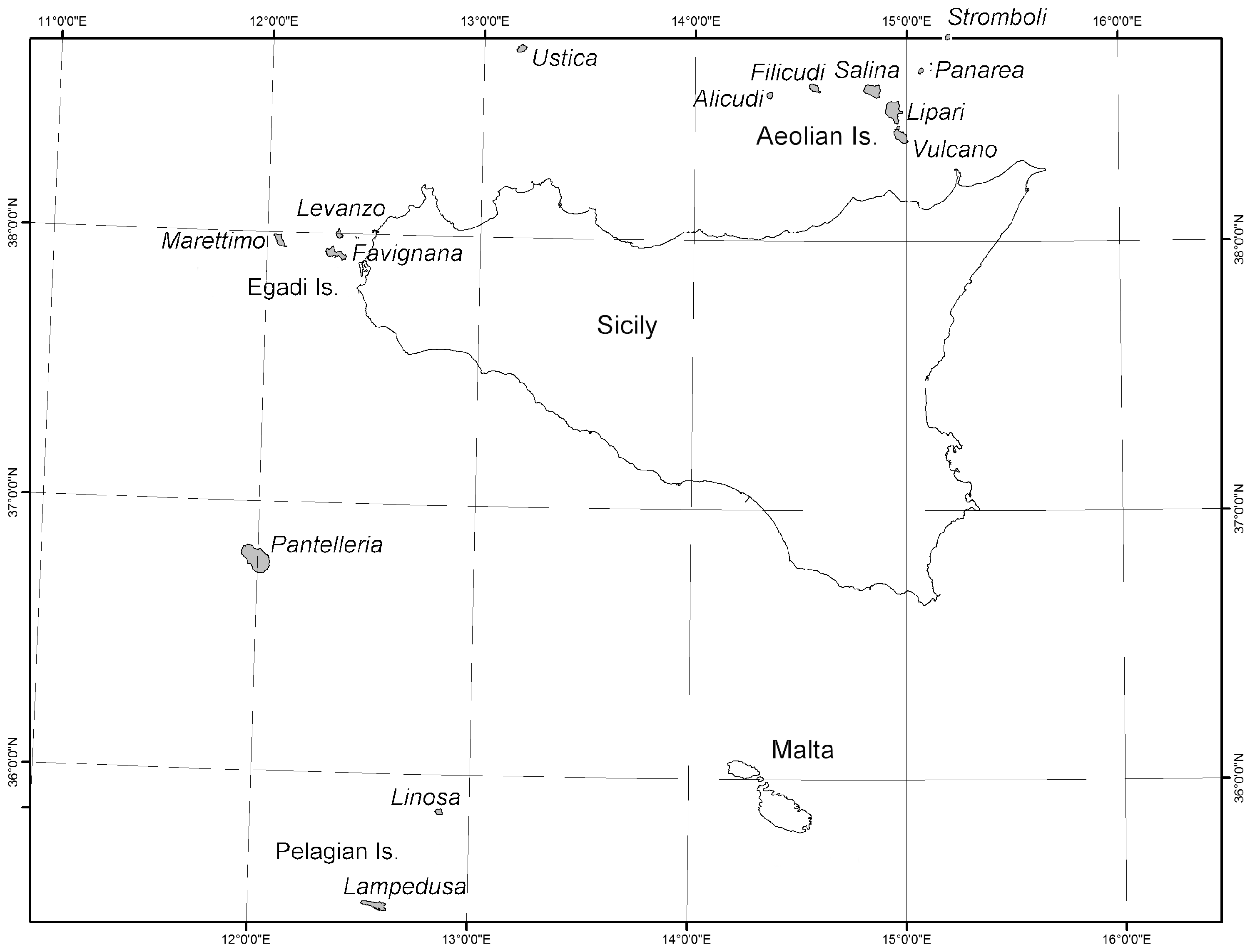
The study was carried out through field surveys followed by spatial and floristic analyses. The investigation targeted all major inhabited islands of the circum-Sicilian archipelagos (Figure 1 and Table 1). Uninhabited islets were excluded because of their small extent and poor plant assemblages. For each island, the area occupied by ornamental green spaces was obtained by photointerpretation of satellite images available on Google Earth (acquisition dates between 2019 and 2025), working at a scale of 1:2000 and mapping polygons with a minimum surface of 25 m2. This minimum mapping unit ensures data consistency and avoids the “noise” introduction. Spatial analyses were performed using ArcGIS 10.5 with the Patch Analyst extension [38], and the results are summarized reporting class area (CA; total area of polygons in m2), number of patches (NumP), mean patch size (MPS), patch size standard deviation (PSSD; measuring size variability), nearest neighbor ratio (NNR), standard deviations (Z score; how the spatial clustering deviates from a random pattern), and probability (p-value; likelihood that the observed pattern occurred by random chance).
Field surveys were conducted over the last twenty years. All cultivated ornamental plants, both exotic and native, grown in open ground or in outdoor pots were recorded to include common taxa, avoiding underestimating the overall biodiversity of the study area, while single individuals belonging to special public or private collections were excluded. Particular attention was paid to taxa traditionally associated with human activities as useful plants, and these include fruit trees, reforestation species, and plants providing fibers or other raw materials (e.g., Arundo donax L.), provided they also serve a significant ornamental purpose. Taxonomic identification followed the current standard floras for Italy [39] and for cultivated plants in Europe [40]. The nomenclature is based on POWO [41]. Critical cases were resolved by comparison with living collections at the Palermo Botanical Garden and with exsiccata preserved at the Herbarium Mediterraneum Panormitanum (PAL) in Palermo. For each island, the classes (cultivated only, casual, naturalized, or invasive) follow [21] but the classification is based on island-specific observations.
For each recorded taxon we include the following information: area of origin [41], biological form [39,42], family [41], any relevant synonyms from local literature [30], and the period of introduction to Sicily, as derived from historical sources [43,44,45,46,47]. Toxicity and allergenicity, key ecosystem disservices, were assessed following [15,48,49], while the potential use as a source of medicinal substances was recorded from [50,51,52]. In addition, the following ecosystem services were evaluated directly in the field: provision of wildlife habitat, supply of fruits for wildlife, contribution to soil erosion control, feed for livestock, food for human consumption, beekeeping interest, suitability for green fences, and water requirement.
A synoptic table presents for each taxon its family, biological form, area of origin, current synonyms, and documented period of introduction to Sicily. Based on this dataset, comparative analyses were carried out to highlight similarities and differences among the islands and their ornamental floras.
Statistical analyses were performed using PAST version 4.14 [53]. Prior to analysis, the dataset was organized with islands as rows and the following variables as columns: island area (km2), population size, ornamental green cover (km2), total ornamental taxa, and the numbers of native, invasive, toxic, allergenic, habitat-providing, and low-water-requirement ornamental taxa.
Spearman’s rank correlation coefficients (rs) were computed to evaluate the pairwise relationships between the three predictors (island area, population size, and ornamental green cover) and the eight ornamental flora metrics (total taxa, native, invasive, toxic, allergenic, habitat-providing, and low-water-requirement taxa).
Generalized linear models (GLMs) with normal distribution and identity link were fitted to test the relationships between three predictors (island area, population size, and ornamental green cover) and each of the eight response variables (ornamental green cover when not used as a predictor, total ornamental taxa, native, invasive, toxic, allergenic, habitat-providing, and low-water-requirement taxa). Model significance was assessed using the G-test, with a significance threshold of α = 0.05.
A principal component analysis (PCA) based on a correlation matrix was performed to explore the overall structure of the dataset and identify the main sources of variation among islands. The number of components to retain was evaluated based on eigenvalues and the proportion of explained variance.
All statistical tests were two-tailed, and results were considered statistically significant at p < 0.05.

3. Results

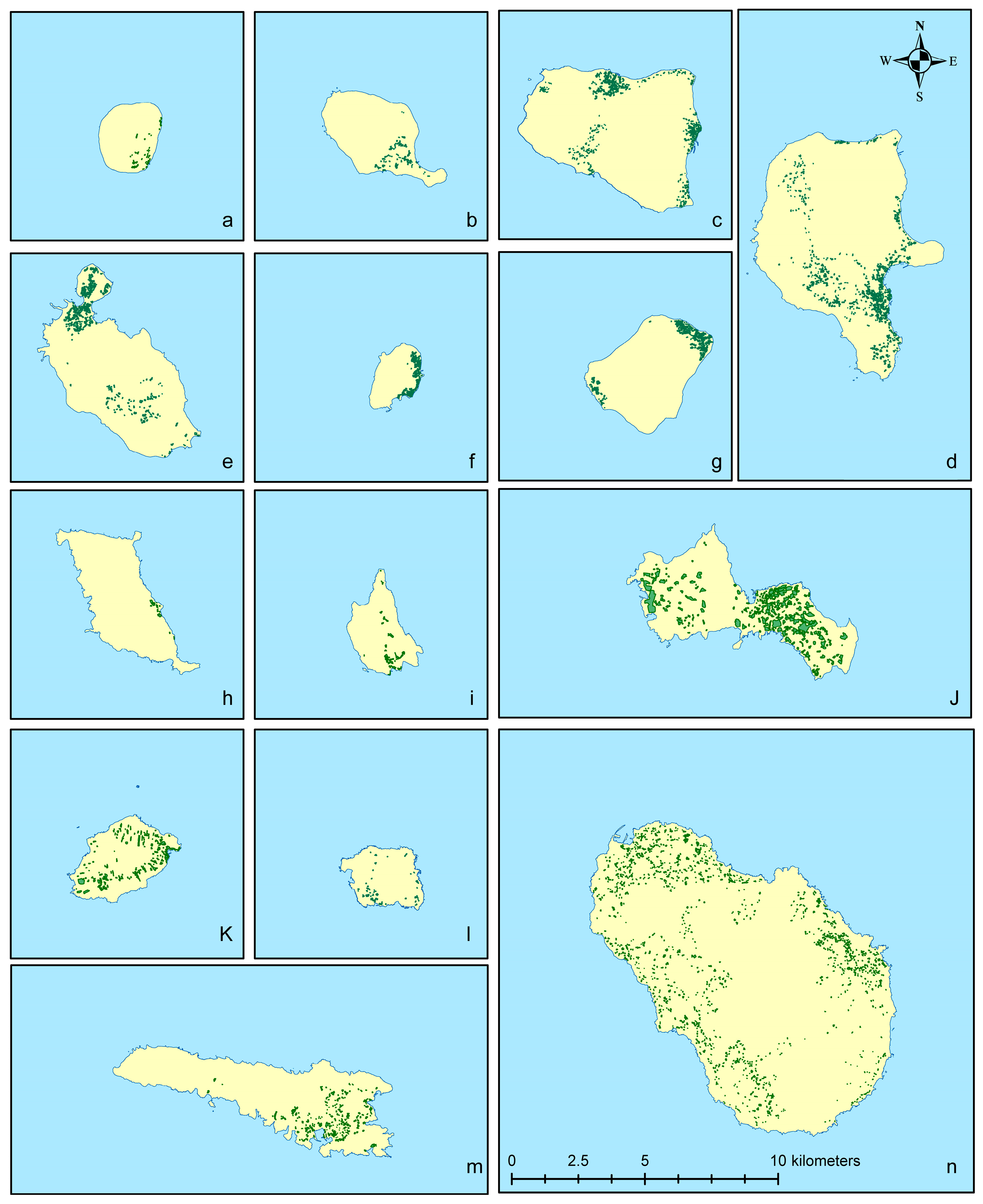
Based on the geographical dataset (Figure 2 and Table 2), several islands stand out for their ornamental green cover and spatial configuration. Favignana has the highest percentage of ornamental green relative to its total area, with approximately 11%, a value considerably larger than any other island in the survey. Despite this high coverage, its nearest neighbor ratio is close to 0.79, while the Z score is negative and significant, indicating a tendency toward clustering, although the clustering is only moderate in strength. In contrast, the island of Pantelleria shows a very strong clustering pattern with an extremely low nearest neighbor ratio, but the proportion of ornamental green area is just over 1%, suggesting that while the green spaces are highly concentrated, they occupy a very limited portion of the island.
Regarding fragmentation and patch characteristics, islands such as Lipari, Vulcano, and Stromboli display very strong clustering patterns with nearest neighbor ratios well below 0.5. These islands also have relatively small mean patch sizes and low standard deviations, implying that their ornamental green areas consist of numerous small, tightly grouped patches rather than large contiguous expanses. The island of Salina exhibits a similar trend, characterized by highly pronounced clustering and a mean patch size of approximately 0.06, indicating that green spaces are both aggregated and highly fragmented.
The islands of Ustica and Panarea show a different behavior: their nearest neighbor ratios are above 0.8, indicating a more dispersed or random distribution of green patches. Ustica has nearly 5% ornamental green cover, the second highest after Favignana, and its patches are larger on average compared to the strongly clustered islands, with a mean patch size of 0.22. The island of Panarea has a weak clustering pattern and a mean patch size of 0.12, suggesting a more even spread of green areas without strong aggregation.
Among the smaller islands, Marettimo has the lowest ornamental green percentage, just 0.26%, with a moderate clustering pattern and a relatively high standard deviation in patch size, implying a few larger patches accompanied by several very small ones.
The islands of Alicudi and Filicudi also have very low percentages of ornamental green, below one percent, yet both show moderate to very strong clustering. In these cases, the green areas are few and concentrated around the villages rather than distributed across the island. The islands of Linosa and Levanzo, with strong clustering and low mean patch sizes, follow the pattern of aggregated but tiny ornamental green patches. Overall, Favignana is unique in combining high proportional cover with moderate clustering, whereas islands like Ustica and Panarea offer more dispersed green areas that might be less fragmented despite lower total cover percentages.
Looking at the total number of cultivated ornamental species per island (see the Supplementary Material, Table S1), Ustica is the richest with 217 species, followed by Lipari (213) and Salina (205). The poorest islands in terms of ornamental flora are Marettimo with only 95 species, Alicudi with 96, and Stromboli with 108. So, the smallest totals are found on the smaller Aeolian and Egadi islands, while Ustica and the larger Aeolian islands support a much wider range of ornamentals.
Regarding the use of native plants as ornamentals (Table 3), Stromboli exhibits the highest percentage (18.52%), indicating that approximately one in five ornamental species is native. Marettimo follows with 17.89%, and Filicudi ranks third with 15.65%. At the other end, Ustica has the lowest share of native ornamentals (9.22%), followed by Lampedusa and Salina.
For naturalized and invasive species combined (Table 3), Stromboli again leads with 15.74% (12.04% naturalized plus 3.70% invasive). Linosa is next at 14.13%, then Pantelleria at 12.88%. The lowest combined percentages are on Lampedusa (7.24%), Salina (7.32%), and Lipari (7.98%). Stromboli and Linosa are the islands where the most common ornamental plants are those that are no longer cultivated and become established in the wild.
The total number of taxa strongly correlated with allergenic (ρ = 0.974), toxic (ρ = 0.960), and habitat provider richness (ρ = 0.982, all p < 0.001; Table S2). Native richness showed similar patterns, while invasive richness was weakly and non-significantly associated with all variables. Geo-demographic metrics (area, population, and ornamental surface) had negligible correlations. Low water requirement correlated strongly with toxic, allergenic, and habitat provider richness (ρ > 0.879, p < 0.001), but not with invasives.
The GLM analyses (Table S3) revealed no statistically significant relationships between any of the predictors and the ornamental flora metrics examined (all p > 0.05; Table S2).
The principal component analysis (Plot S1, Table S4) revealed that the first component (PC1) explained 99.96% of the total variance, overwhelmingly dominating the ordination structure. The PC1 scores were strongly correlated with population size (rs = 0.98, p < 0.001), indicating that demographic pressure is the primary source of variation in the dataset. The second component (PC2), explaining only 0.033% of the variance, separated islands with higher proportions of native species and habitat-providing taxa (positive scores: Ustica, Vulcano, Salina, and Linosa) from those with higher proportions of invasive and toxic species (negative scores: Marettimo, Alicudi, Stromboli, and Favignana).
The cultivated ornamental green across the islands provides a range of ecosystem services but also generates some disservices. Among the services, the highest values for habitat provision are recorded on Lipari and Ustica, followed closely by Salina and Vulcano (Table 4). These same islands also score highly for fruit availability for birds and small mammals, with Lipari reaching 107, Ustica 112, and Salina 97, indicating that ornamental green supports local fauna. Erosion control is another notable service, with Lipari, Vulcano, and Salina showing strong values above 119, while Ustica and Linosa also contribute significantly. Pollination support, here labeled as bee-related value, is particularly high on Ustica, Lipari, and Salina, all exceeding 140 taxa, suggesting that ornamental plantings provide floral resources for pollinators. Food production for human use, though secondary, is present on most islands, with Ustica and Lipari again leading. Fences or live hedges as a service are strongest on Ustica and Salina, indicating that ornamental green can still play an important role as a vegetative barrier today.
Regarding disservices, the dataset includes categories for toxic or allergenic effects (Table 4). Ustica shows the highest toxic value at 98 and allergenic at 94 taxa, meaning that its ornamental green, despite offering many benefits, also introduces potentially harmful taxa. Lipari follows closely with 100 for toxic and 99 for allergenic, while Salina and Vulcano also have elevated values. The possible source of medicines column, which might be interpreted as a service, includes plants that could be toxic if misused, and here again Ustica, Lipari, Salina, and Linosa have high numbers, reflecting a double-edged character. Smaller islands, such as Marettimo and Stromboli, show lower disservice values, with Marettimo having the lowest toxic and allergenic scores overall, but their service provision is also reduced. Favignana presents moderate values for both services and disservices, while Levanzo and Alicudi remain relatively low across most categories. In summary, islands with the most abundant ornamental green, such as Ustica and Lipari, deliver the highest levels of habitat, food for birds, erosion control, and pollination, but simultaneously pose greater risks from toxic and allergenic plants. Islands with a lower number of ornamental plants, like Marettimo and Stromboli, offer fewer services but also fewer disservices.
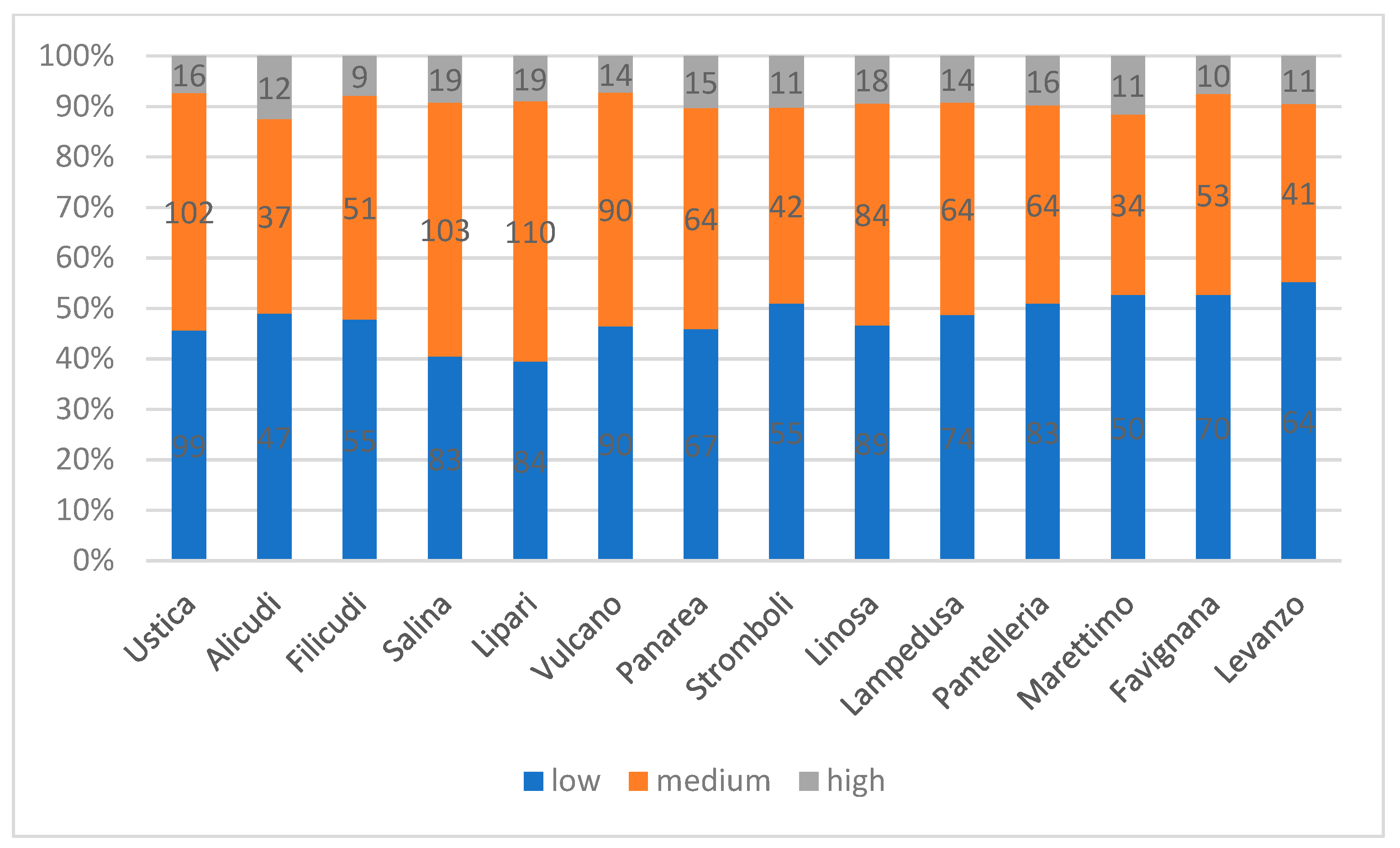
The analysis of water requirements for ornamental plants (Figure 3) reveals a consistent pattern across all islands. The proportion of species with low water needs ranges from 39% to 55%, those with medium requirements from 35% to 52%, and those with high requirements from 7% to 13%. Among the islands, the Egadi archipelago stands out, where over half of the ornamental plants fall into the low-water-demand category. In contrast, on Lipari and Salina, low-requirement species account for 39% and 40%, respectively, while medium-requirement species reach 52% on Lipari and 50% on Salina.

4. Discussion

On small islands like Marettimo and Alicudi where decorative green is limited, the selection of cultivated plants has turned to local native species instead of a diverse group of non-native plants. On the other hand, larger islands, such as Ustica or Lipari, which feature extensive gardens and public green spaces, resulted to support numerous introduced non-native plants.
The disturbance (bare ground and ash fall) in Stromboli creates open habitats where cultivated species can easily establish themselves. This island, despite having a low total species count, has the highest native percentage and the highest combined naturalized plus invasive share. Ornamental plants that manage to survive there may spread rapidly because competition from a closed vegetation cover is weak. Stromboli shows that even with a modest planting area, high invasive potential can occur, and disturbances outweigh the effects of the area. The ornamental green patches display a clear spatial dichotomy across the islands. Pantelleria, Lipari, Vulcano, Stromboli, and Salina show very strong clustering, indicating that green areas are tightly packed into restricted zones around settlements. Also, among the smaller islands (Marettimo, Alicudi, Filicudi, Linosa, and Levanzo), clustering tends to be moderate to strong, with ornamental vegetation largely confined to village cores. A different behavior emerges on Ustica and Panarea, where the distribution approaches a dispersed pattern with a more uniform spatial footprint. Favignana occupies an intermediate position, showing a weak but statistically detectable tendency toward clustering, without falling into either extreme. Overall, the islands divide into two main groups—strongly aggregated versus more dispersed—with only Favignana lying between them as a transitional case. This variation points to different local drivers, such as topography or settlement history, shaping ornamental green spaces.
It is important to emphasize that the natural and semi-natural vegetation present on most islands (particularly Marettimo, Alicudi, and Stromboli) already provides substantial habitat and connectivity functions. Ornamental patches should, therefore, be viewed as complementary elements within a broader landscape mosaic, rather than as primary habitat providers. On islands where natural vegetation is extensive, like Marettimo, increasing ornamental cover would not necessarily improve overall connectivity and could inadvertently facilitate invasions, especially where disturbance creates open niches. Thus, management recommendations should be tailored to each island’s existing vegetation cover, disturbance regime, and invasion history.
Favignana, on the other hand, has the largest area devoted to ornamental, more than twice that of Pantelleria, which ranks second. Although part of its water supply is obtained from groundwater wells, the island’s freshwater resources are intrinsically limited, and approximately 70% of its groundwater is highly saline because of seawater intrusion into the aquifer. Nevertheless, its total ornamental flora is intermediate among the studied islands, while its combined proportion of naturalized and invasive species (10.53%) remains relatively low compared with Stromboli (15.74%) or Linosa (14.13%). This suggests that, despite severe water constraints, appropriate species selection has limited both irrigation demand and the establishment of invasive ornamentals.
The absence of significant relationships between the tested predictors and ornamental flora metrics suggests that ornamental plant diversity on these islands is shaped by local cultural and historical factors rather than by simple biogeographic or demographic rules. The overwhelming dominance of PC1 (99.96% of variance) confirms that population size is the main driver of ornamental flora quantity across the circum-Sicilian islands, as it determines the overall number of species, including toxic, allergenic, and habitat-providing taxa. However, as shown by the non-significant GLM results, population size does not explain the functional composition of the ornamental flora. The association between the number of drought-tolerant taxa and allergenic/toxic traits reveals a trade-off between water-efficient landscaping and public health safety, calling for cautious plant selection in urban green spaces.
Maintaining ornamental plants on Mediterranean islands requires greater care than on the mainland, involving both the selection of species with moderate or low water requirements and appropriate long-term management. Climate change is expected to intensify water scarcity throughout the Mediterranean basin by increasing temperatures, prolonging drought periods, and reducing groundwater recharge. These effects are likely to be particularly severe on small islands, where freshwater resources are naturally scarce and often threatened by seawater intrusion. Under these conditions, ornamental planting should increasingly favor native species and long-established drought-tolerant taxa that are naturally adapted to local environmental conditions. Besides reducing irrigation requirements, these species generally require less maintenance, better withstand saline winds and prolonged summer drought, and often present a lower risk of naturalization and invasion than recently introduced exotic ornamentals. Examination of the introduction dates (Table S1) shows that a large proportion of the ornamental flora has been cultivated in Sicily or Italy for centuries. This finding highlights the islands’ reliance on plant species that are already well adapted to the Sicilian climate and capable of surviving with limited external inputs.
It is notable that on Favignana several abandoned calcarenite quarries have been successfully transformed into gardens [54]. Similarly, on Pantelleria, traditional circular dry-stone enclosures built from lava blocks create sheltered and humid microclimates that protect ornamental and cultivated plants from strong winds while reducing water loss [55]. These examples illustrate how traditional landscape practices can complement species selection in improving the resilience of ornamental green spaces under increasingly water-limited conditions.
The increasing interest in ornamental greening has drawn attention to the multiple functions of ornamental vegetation, but also to its potential trade-offs. This examination of thirteen Mediterranean islands provides a comprehensive overview of how cultivated green spaces contribute simultaneously to ecosystem services and ecosystem disservices, and how their spatial distribution influences their ecological performance. Furthermore, ornamental green spaces increasingly provide ecosystem functions that were formerly supplied by agricultural land, which has steadily declined on the circum-Sicilian islands since the end of the Second World War. A first key finding is the consistent association between total ornamental green cover and the provision of multiple services. Islands such as Ustica and Lipari, which rank highest in ornamental green percentage and in the number of plant taxa providing habitat, fruit for birds and small mammals, erosion control, bee forage, and live hedges, also exhibit the highest values of allergenic and toxic plants. In other words, greener, and especially a richer plant diversity, brings more benefits, but also increases the risk of negative effects. This pattern mirrors a general trade-off widely discussed in urban ecosystem literature: a larger and more diverse plant community tends to produce both more services and more disservices [14,56]. In small island settings, where spatial constraints are pronounced and isolation from mainland contexts is marked, these effects may be considerably exacerbated.
The spatial configuration of ornamental patches adds another layer of variability. Islands with very strong clustering patterns (Lipari, Vulcano, Stromboli, and Salina) have ornamental green areas composed of numerous small patches aggregated in few locations, often near residential centers. This configuration maximizes some local services, such as shading or aesthetic enjoyment, but likely reduces landscape connectivity and habitat for wide-ranging species. Conversely, Ustica and Panarea show a more dispersed distribution of patches, with larger mean patch sizes and a weaker clustering pattern. Dispersed ornamental green, even when covering a smaller total area, may better support pollinators and other animals by increasing habitat accessibility across the island. This observation is consistent with the island biogeography theory as applied to urban green spaces: larger and more interconnected patches support greater biodiversity and lower extinction rates [57]. In an island setting, this framework is particularly relevant because every patch of ornamental vegetation functions as a “habitat island” embedded in a matrix of other land uses.
The results also reveal that high cultivated ornamental plant diversity does not necessarily imply high fragmentation. Favignana has the highest proportional cover of ornamental green (about 11% of the island) and a moderate clustering pattern, which suggests that a high cover can be achieved without excessive fragmentation. This is an encouraging case: it demonstrates that a relatively large and moderately aggregated green area can deliver a balanced set of services without the high disservice levels observed on Ustica and Lipari.
When comparing these results with other Mediterranean studies, several convergences emerge. Domina et al. [14] surveyed 100 sites across Sicily and found that 137 poisonous and allergenic taxa are commonly planted in gardens and parks, 21 of which are deadly. Their recommendations include careful plant selection and environmental education, which are directly applicable to ornamental green management on islands. Similarly, assessments on the Ionian Islands [58] identified seven ecosystem service bundles and highlighted that the degree of mixing between natural vegetation and olive orchards determines different ecosystem service patterns across islands. That study also stressed the importance of compact ecosystem service zones where demand and supply are balanced. In the Aegean, research on Paros [59] emphasized xeriscaping and stormwater management as key strategies for sustainable ornamental landscaping in water-stressed insular environments. Our study highlighted the high incidence and ecological importance in circum-Sicilian islands of aridity-tolerant plant species, including many native taxa.
Regarding the care and maintenance of ornamental plants on Mediterranean islands, the current findings indicate several practical suggestions. First, plant selection should prioritize native or well-adapted non-invasive species that provide ecosystem services without high allergenic or toxic potential [60,61]. Where high diversity is desired, a careful mix of service-providing and low-risk species can be designed, avoiding the dominance of highly allergenic trees (e.g., many Cupressaceae or Oleaceae) or toxic ornamentals (e.g., Nerium oleander or Ricinus communis). Second, the spatial configuration matters: rather than concentrating all ornamental green space in a few dense clusters, a pattern of medium-sized patches connected by green corridors (even if narrow) would likely enhance connectivity for pollinators and birds without excessively increasing maintenance costs. This approach is in line with the island biogeography principle that connectivity reduces extinction rates and supports biodiversity [57]. Third, on islands with water scarcity, such as Ustica or Lampedusa, xeriscaping and use of drought-tolerant native species should be integrated with ornamental design to reduce irrigation demand and avoid the introduction of water-intensive exotic plants [59].
Conversely, certain practices should be avoided. The indiscriminate planting of highly allergenic or toxic species, especially in public gardens or near schools and health facilities, is clearly inadvisable. Domina et al. [14] explicitly warn against 21 deadly poisonous plants commonly found in Sicilian gardens. Also, extreme fragmentation (many tiny, isolated patches) should be avoided, as it limits the capacity to support viable populations of pollinators and birds [62,63], while still requiring maintenance. Moreover, a complete removal of ornamental green, as might be implied by the low service/low disservice islands like Marettimo, would not be a desirable solution, because it would deprive islands of essential services. Rather, an adaptive management that balances services and disservices through informed species selection and spatial design is the recommended path.
The study has some limitations worth noting. First, while the checklist recorded ornamental plants grown in outdoor pots, the spatial analysis of green areas was based on satellite mapping of polygons with a minimum size of 25 m2. This minimum mapping unit was adopted to ensure data consistency and mitigate the noise that would result from mapping numerous tiny, fragmented features. The species cultivated in small pots, balcony plantings, and isolated container specimens, despite occupying negligible surface area, often harbor a surprisingly rich and diverse flora. The assessment of ecosystem services and disservices relies entirely on a presence–absence checklist of taxa, without considering species abundance, frequency, or actual distribution across each island. Third, the study does not account for seasonal dynamics or management intensity, both of which strongly influence the actual provision of services, such as erosion control or wildlife habitat.
Despite these limitations, this paper delivers valuable data for understanding and managing ornamental heritage on circum-Sicilian islands. The comparative framework, linking spatial configuration (clustered versus dispersed patches) to service and disservice patterns, offers practical insights. For instance, the observation that Favignana achieves high cover with moderate clustering and relatively low naturalization risk, while Stromboli shows high invasion potential despite limited planted area, gives local managers concrete evidence to adjust planting strategies. The study also clearly demonstrates the trade-off whereby species-rich ornamental floras (Ustica and Lipari) deliver many services but also higher toxicity and allergenicity risks. Such findings can inform species selection and spatial planning, even without detailed abundance data. In essence, the work opens a necessary discussion on functional ornamental green in insular environments and provides a replicable methodological framework that future studies can refine by incorporating abundance, distribution, and temporal monitoring.

5. Conclusions

This study shows that ornamental green spaces on Mediterranean islands are not a uniform asset: their ecological role depends strongly on both species composition and spatial arrangement. The survey of 402 cultivated taxa across the circum-Sicilian islands revealed marked differences among islands in both floristic richness and ecosystem functions. Ustica and Lipari hosted the highest numbers of ornamental taxa and provided the greatest levels of ecosystem services, including habitat provision, pollinator support, erosion control, and food resources for wildlife, but they also showed the highest occurrence of toxic and allergenic species. In contrast, Favignana combined the largest proportional ornamental green cover (approximately 11% of the island area) with only moderate spatial clustering and relatively limited naturalization risk, suggesting that extensive ornamental green can be compatible with a balanced provision of ecosystem services when supported by appropriate species selection and landscape configuration.
These findings demonstrate that ornamental vegetation on Mediterranean islands should be planned not only according to aesthetic criteria but also considering ecosystem services, potential disservices, and spatial configuration. The results also indicate that the island biogeography framework provides a useful approach for understanding and designing functional ornamental green networks. Future research should extend this methodology to other island systems and urban environments, while incorporating species abundance, temporal dynamics, and management intensity to better quantify ecosystem service delivery.

Supplementary Materials

The following supporting information can be downloaded at: https://www.mdpi.com/article/10.3390/land15071252/s1. Table S1: Summary of taxonomic, ecological, and phytogeographic characteristics of the studied flora, with distribution across the major islands of the Sicilian archipelagos; Table S2: Spearman’s correlation coefficients for all variables (Area, Population, Ornamental surface, No. of taxa, Native no., Invasive no., Toxic no., Allergenic no, Habitat providers no., Low-water-requirement ornamental taxa no.; Table S3: Generalized Linear Model (GLM) results testing the effects of island area, population size, and ornamental green cover on eight ornamental flora metrics; Plot S4: Principal component analysis based on the 7 continuous variables (island area (km2), population size, ornamental green cover (km2), total ornamental taxa, and the numbers of native, invasive, toxic, allergenic, habitat-providing, and low-water-requirement ornamental taxa; Table S4: PCA scores of the circum-Sicilian islands along the first seven principal components.

Author Contributions

Conceptualization, G.D. and G.V.; methodology, G.D., M.L.G., and E.D.G.; software, F.C. and R.P.; validation, M.L.G., G.V., and F.C.; formal analysis, R.P. and E.D.G.; investigation, G.D., E.D.G., and M.L.G.; data curation, F.C., R.P., and E.D.G.; writing—original draft preparation, G.D., F.C., and M.L.G.; writing—review and editing, G.V., R.P., and E.D.G. All authors have read and agreed to the published version of the manuscript.

Funding

This research received no external funding.

Data Availability Statement

The original contributions presented in this study are included in the article/Supplementary Material. Further inquiries can be directed to the corresponding author(s).

Acknowledgments

The authors have reviewed and edited the output and take full responsibility for the content of this publication.

Conflicts of Interest

The authors declare no conflicts of interest.

References

  1. Li, X.X.; Zhou, Z.K. Endemic wild ornamental plants from northwestern Yunnan, China. HortScience 2005, 40, 1612–1619. [Google Scholar] [CrossRef] [Scilit]
  2. Oloyede, F.A. Survey of ornamental ferns, their morphology and uses for environmental protection, improvement and management. IJS 2012, 14, 245–252. [Google Scholar]
  3. Elmqvist, T.; Setälä, H.; Handel, S.N.; van der Ploeg, S.; Aronson, J.; Blignaut, J.N.; Gómez-Baggethun, E.; Nowak, D.J.; Kronenberg, J.; de Groot, R. Benefits of restoring ecosystem services in urban areas. Curr. Opin. Environ. Sustain. 2015, 14, 101–108. [Google Scholar] [CrossRef] [Scilit]
  4. Dauda, W.P.; Dantata, I.J.; Adetunji, C.O.; Abraham, P.; Ifeanyi, U.J.; Glen, E.; Morumda, D.; Abraham, S.E.; Wabba, G.P.; Ogwuche, I.O.; et al. The effect of evaporative coolant structure on ornamental plants. In Evaporative Coolers for the Postharvest Management of Fruits and Vegetables; Academic Press: Cambridge, UK, 2023; pp. 209–235. [Google Scholar]
  5. Monder, M.J.; Pacholczak, A.; Zajączkowska, M. Directions in ornamental herbaceous plant selection in the central European temperate zone in the time of climate change: Benefits and threats. Agriculture 2024, 14, 2328. [Google Scholar] [CrossRef] [Scilit]
  6. Bolund, P.; Hunhammar, S. Ecosystem services in urban areas. Ecol. Econ. 1999, 29, 293–301. [Google Scholar] [CrossRef] [Scilit]
  7. Tzoulas, K.; Korpela, K.; Venn, S.; Yli-Pelkonen, V.; Kaźmierczak, A.; Niemelä, J.; James, P. Promoting ecosystem and human health in urban areas using green infrastructure: A literature review. Landsc. Urban Plan. 2007, 81, 167–178. [Google Scholar] [CrossRef] [Scilit]
  8. Larcher, F.; Battisti, L.; Pomatto, E.; Devecchi, M. Woody species and supporting ecosystem services: The case study of the city of Turin (Italy). Acta Hortic. 2021, 1331, 181–186. [Google Scholar] [CrossRef] [Scilit]
  9. Chiesura, A. The role of urban parks for the sustainable city. Landsc. Urban Plan. 2004, 68, 129–138. [Google Scholar] [CrossRef] [Scilit]
  10. Kabisch, N.; Qureshi, S.; Haase, D. Human–environment interactions in urban green spaces—A systematic review of contemporary issues and prospects for future research. Environ. Impact Assess. Rev. 2015, 50, 25–34. [Google Scholar] [CrossRef] [Scilit]
  11. van den Bosch, M.; Sang, Å.O. Urban natural environments as nature-based solutions for improved public health—A systematic review of reviews. Environ. Res. 2017, 158, 373–384. [Google Scholar] [CrossRef] [Scilit] [PubMed]
  12. D’Amato, G.; Cecchi, L.; Bonini, S.; Nunes, C.; Annesi-Maesano, I.; Behrendt, H.; Liccardi, G.; Popov, T.; van Cauwenberge, P. Allergenic pollen and pollen allergy in Europe. Allergy 2007, 62, 976–990. [Google Scholar] [CrossRef] [Scilit] [PubMed]
  13. Bruneton, J. Toxic Plants Dangerous to Humans and Animals; Lavoisier Publishing: Paris, France, 1999. [Google Scholar]
  14. Domina, G.; Di Gristina, E.; Barone, G. Main poisonous and allergenic plant species in Sicilian gardens and parks: Applications and recommendations for use. Plants 2024, 13, 1031. [Google Scholar] [CrossRef] [Scilit] [PubMed]
  15. Colombo, M.L.; Assisi, F.; Della Puppa, T.; Moro, P.; Sesana, F.M.; Bissoli, M.; Borghini, R.; Perego, S.; Galasso, G.; Banfi, E.; et al. Most commonly plant exposures and intoxications from outdoor toxic plants. J. Pharm. Sci. 2010, 2, 417–425. [Google Scholar]
  16. Lambdon, P.W.; Pyšek, P.; Basnou, C.; Hejda, M.; Arianoutsou, M.; Essl, F.; Jarošík, V.; Pergl, J.; Winter, M.; Anastasiu, P.; et al. Alien flora of Europe: Species diversity, temporal trends, geographical patterns and research needs. Preslia 2008, 80, 101–149. [Google Scholar]
  17. Hulme, P.E.; Brundu, G.; Carboni, M.; Dehnen-Schmutz, K.; Dullinger, S.; Early, R.; Essl, F.; González-Moreno, P.; Groom, Q.J.; Kueffer, C.; et al. Integrating invasive species policies across ornamental horticulture supply chains to prevent plant invasions. J. Appl. Ecol. 2018, 55, 92–98. [Google Scholar] [CrossRef] [Scilit]
  18. van Kleunen, M.; Essl, F.; Pergl, J.; Brundu, G.; Carboni, M.; Dullinger, S.; Early, R.; González-Moreno, P.; Groom, Q.J.; Hulme, P.E.; et al. The changing role of ornamental horticulture in alien plant invasions. Biol. Rev. 2018, 93, 1421–1437. [Google Scholar] [CrossRef] [Scilit] [PubMed]
  19. Celesti-Grapow, L.; Alessandrini, A.; Arrigoni, P.V.; Assini, S.; Banfi, E.; Barni, E.; Bovio, M.; Brundu, G.; Cagiotti, M.R.; Camarda, I.; et al. Non-native flora of Italy: Species distribution and threats. Plant Biosyst. 2010, 144, 12–28. [Google Scholar] [CrossRef] [Scilit]
  20. Galasso, G.; Bartolucci, F.; Peruzzi, L.; Ardenghi, N.M.G.; Banfi, E.; Celesti-Grapow, L.; Conti, F. Checklist aggiornata della flora vascolare alloctona d’Italia. Not. Soc. Bot. Ital. 2016, 0, 49–50. [Google Scholar]
  21. Galasso, G.; Conti, F.; Peruzzi, L.; Alessandrini, A.; Ardenghi, N.M.G.; Bacchetta, G.; Banfi, E.; Barberis, L.; Bernardo, L.; Bouvet, D.; et al. A second update to the checklist of the vascular flora alien to Italy. Plant Biosyst. 2024, 158, 297–340. [Google Scholar] [CrossRef] [Scilit]
  22. Venturella, G.; Di Gristina, E.; Pardi, R.; Cirlincione, F.; Gargano, M.L. Checklist of ornamental trees, shrubs, and succulents of Apulia (Southern Italy). Plants 2024, 13, 2463. [Google Scholar] [CrossRef] [Scilit] [PubMed]
  23. Di Gristina, E.; Barone, G.; Domina, G.; Badalamenti, E.; Gargano, M.L.; Venturella, G.; Pardi, R. A checklist of the ornamental vascular flora of Sicily. Plants 2025, 14, 795. [Google Scholar] [CrossRef] [Scilit] [PubMed]
  24. Di Gristina, E.; Pardi, R.; Cirlincione, F.; Venturella, G.; Gargano, M.L. Ornamental vascular plant diversity in Basilicata (Southern Italy). Plants 2025, 14, 3306. [Google Scholar] [CrossRef] [Scilit] [PubMed]
  25. Whittaker, R.J.; Fernández-Palacios, J.M. Island Biogeography: Ecology, Evolution, and Conservation, 2nd ed.; Oxford University Press: Oxford, UK, 2007. [Google Scholar]
  26. Russell, J.C.; Kueffer, C. Island biodiversity in the Anthropocene. Annu. Rev. Environ. Resour. 2019, 44, 31–60. [Google Scholar] [CrossRef] [Scilit]
  27. Whittaker, R.J.; Fernández-Palacios, J.M.; Matthews, T.J.; Borregaard, M.K.; Triantis, K.A. Island biogeography: Taking the long view of nature’s laboratories. Science 2017, 357, eaam8326. [Google Scholar] [CrossRef] [Scilit] [PubMed]
  28. Sax, D.F.; Gaines, S.D. Species invasions and extinction: The future of native biodiversity on islands. Proc. Natl. Acad. Sci. USA 2008, 105, 11490–11497. [Google Scholar] [CrossRef] [Scilit] [PubMed]
  29. van Kleunen, M.; Dawson, W.; Essl, F.; Pergl, J.; Winter, M.; Weber, E.; Kreft, H.; Weigelt, P.; Kartesz, J.; Nishino, M.; et al. Global exchange and accumulation of non-native plants. Nature 2015, 525, 100–103. [Google Scholar] [CrossRef] [Scilit] [PubMed]
  30. Domina, G.; Mazzola, P. Flora ornamentale delle isole circumsiciliane. Quad. Bot. Amb. Appl. 2008, 19, 107–109. [Google Scholar]
  31. Bauzà, J.; Grimalt, M.; Oro, D. Unlocking landscape transient dynamics: Integrating traditional ecological knowledge for enhanced analysis of land-use changes and forest expansion in a Mediterranean ecosystem. People Nat. 2025, 8, 283–300. [Google Scholar] [CrossRef] [Scilit]
  32. Leotta, L.; Toscano, S.; Ferrante, A.; Romano, D.; Francini, A. New Strategies to Increase the Abiotic Stress Tolerance in Woody Ornamental Plants in Mediterranean Climate. Plants 2023, 12, 2022. [Google Scholar] [CrossRef] [Scilit] [PubMed]
  33. Blondel, J.; Aronson, J.; Bodiou, J.-Y.; Boeuf, G. The Mediterranean Region: Biological Diversity in Space and Time, 2nd ed.; Oxford University Press: Oxford, UK, 2010. [Google Scholar]
  34. Mircea, D.-M.; Boscaiu, M.; Sestras, R.E.; Sestras, A.F.; Vicente, O. Abiotic Stress Tolerance and Invasive Potential of Ornamental Plants in the Mediterranean Area: Implications for Sustainable Landscaping. Agronomy 2025, 15, 52. [Google Scholar] [CrossRef] [Scilit]
  35. von Döhren, P.; Haase, D. Ecosystem disservices research: A review of the state of the art with a focus on cities. Ecol. Indic. 2015, 52, 490–497. [Google Scholar] [CrossRef] [Scilit]
  36. European Commission. Towards an EU Research and Innovation Policy Agenda for Nature-Based Solutions and Re-Naturing Cities; Publications Office of the European Union: Luxembourg, 2015. [Google Scholar]
  37. Raymond, C.M.; Frantzeskaki, N.; Kabisch, N.; Berry, P.; Breil, M.; Razvan Nita, M.; Geneletti, D.; Calfapietra, C. A framework for assessing and implementing the co-benefits of nature-based solutions in urban areas. Environ. Sci. Policy 2017, 77, 15–24. [Google Scholar] [CrossRef] [Scilit]
  38. Kowe, P.; Pedzisai, E.; Gumindoga, W.; Rwasoka, D.T. An analysis of changes in the urban landscape composition and configuration in the Sancaktepe District of Istanbul Metropolitan City, Turkey using landscape metrics and satellite data. Geocarto Int. 2015, 30, 506–519. [Google Scholar] [CrossRef] [Scilit]
  39. Pignatti, S.; Guarino, R.; La Rosa, M. Flora d’Italia, 2nd ed.; New Business Media: Milano, Italy, 2019. [Google Scholar]
  40. Huxley, A.M. Dictionary of Gardening; The Macmillan Press: London, UK, 1992. [Google Scholar]
  41. Royal Botanic Gardens, Kew. Plants of the World Online. Available online: http://www.plantsoftheworldonline.org (accessed on 2 March 2026).
  42. Raunkiaer, C. The Life Form of Plants and Statistical Geography; Clarendon: Oxford, UK, 1934. [Google Scholar]
  43. Cupani, F. Hortus Catholicus seu Illustrissimi et Excellentissimi Principis Catholicae Ducis Misilmeris; Francesco Benzi: Napoli, Italy, 1696. [Google Scholar]
  44. Ucria, B. Hortus Regius Panormitanus Aere Vulgaris Anno 1779 Noviter Extructus; Royal Press: Italy, Palermo, 1789. [Google Scholar]
  45. Tineo, V. Catalogus Plantarum Horti Regii Panormitani Ad Annum 1827; Regale Tip: Palermo, Italy, 1827. [Google Scholar]
  46. Ostinelli, V. Villa Trabia; Tipografia Priulla: Palermo, Italy, 1910. [Google Scholar]
  47. Maniero, F. Cronologia Della Flora Esotica Italiana; L.S. Olschki: Firenze, Italy, 2015. [Google Scholar]
  48. Poppenga, R.H. Poisonous plants. In Molecular, Clinical and Environmental Toxicology; Birkhäuser: Basel, Switzerland, 2010; Volume 2, pp. 123–175. [Google Scholar]
  49. D’Amato, G.; Spieksma, F.T.M.; Bonini, S. Allergenic Pollen and Pollinosis in Europe; Blackwell Scientific Publications: Hoboken, NJ, USA, 1991. [Google Scholar]
  50. Benigni, R.; Capra, C.; Cattorini, P.E. Piante Medicinali: Chimica Farmacologica e Terapia; Inverni & Della Beffa: Milano, Italy, 1962. [Google Scholar]
  51. Gastaldo, P. Compendio della Flora Officinale Italiana; Piccin: Padova, Italy, 1987. [Google Scholar]
  52. Pedretti, M. Chimica e Farmacologia delle Piante Medicinali; Studio Edizioni: Milano, Italy, 1997. [Google Scholar]
  53. Hammer, Ø.; Harper, D.A.; Ryan, P.D. PAST: Paleontological Statistics Software Package for Education and Data Analysis. Palaeontol. Electron. 2001, 4, 9. [Google Scholar]
  54. Mamì, A.; Caleca, E.; Nicolini, E. Favignana bio-calcarenite: Technological culture, knowledge and recovery. In HERITAGE 2022—International Conference on Vernacular Heritage: Culture, People and Sustainability; Mileto, C., Vegas, F., Cristini, V., García-Soriano, L., Eds.; Editorial Universitat Politècnica de València: Valencia, Spain, 2022; pp. 401–408. [Google Scholar] [CrossRef] [Scilit]
  55. Georgiadis, T.; Barbera, G.; Carotenuto, F.; Lenzi, J.; Motisi, A.; Rossi, F. How a traditional agricultural protection structure acts in conditioning the internal microclimate: A statistical analytical approach to Giardino Pantesco (Pantelleria Island–Italy). J. Agric. Meteorol. 2014, 18, 41–58. [Google Scholar]
  56. Veibiakkim, R.; Shkaruba, A.; Sepp, K. A systematic review of urban ecosystem disservices and its evaluation: Key findings and implications. Environ. Sustain. Indic. 2025, 26, 100612. [Google Scholar] [CrossRef] [Scilit]
  57. Christy, H.J.; Pati, P.; Malathi, H.; Singh, A.; Kalele, G.; Piakaray, D. Application of island biogeography theory in designing urban biodiversity reserves. Nat. Eng. Sci. 2025, 10, 469–481. [Google Scholar] [CrossRef] [Scilit]
  58. Lorilla, R.; Poirazidis, K.; Kalogirou, S.; Detsis, V.; Martinis, A. Assessment of spatial dynamics and interactions among multiple ecosystem services to promote effective policy making across mediterranean island landscapes. Sustainability 2018, 10, 3285. [Google Scholar] [CrossRef] [Scilit]
  59. Metanai, S. Residential garden landscaping in the Aegean Sea island of Paros. Bachelor’s Thesis, Perrotis College, Cardiff Metropolitan University, Cardiff, UK, 2024. [Google Scholar]
  60. Norton, B.A.; Evans, K.L.; Warren, P.H. Urban biodiversity and landscape ecology: Patterns, processes and planning. Curr. Landsc. Ecol. Rep. 2016, 1, 178–192. [Google Scholar] [CrossRef] [Scilit]
  61. Avolio, M.L.; Pataki, D.E.; Trammell, T.L.; Endter-Wada, J. Biodiverse cities: The nursery industry, homeowners, and neighborhood differences drive urban tree composition. Ecol. Monogr. 2018, 88, 259–276. [Google Scholar] [CrossRef] [Scilit]
  62. Benedict, M.A.; McMahon, E.T. Green Infrastructure: Linking Landscapes and Communities; Island Press: Washington, DC, USA, 2006. [Google Scholar]
  63. Hansen, R.; Pauleit, S. From multifunctionality to multiple ecosystem services? A conceptual framework for multifunctionality in green infrastructure planning for urban areas. Ambio 2014, 43, 516–529. [Google Scholar] [CrossRef] [Scilit] [PubMed]
Figure 1. The circum-Sicilian archipelagos investigated.
Land 15 01252 g001
Figure 2. Ornamental green mapped via photointerpretation on each island: (a) Alicudi, (b) Filicudi, (c) Salina, (d) Lipari, (e) Vulcano, (f) Panarea, (g) Stromboli, (h) Marettimo, (i) Levanzo, (J) Favignana, (K) Ustica, (l) Linosa, (m) Lampedusa, and (n) Pantelleria.
Land 15 01252 g002
Figure 3. Water requirements of the ornamental flora across the islands of the Sicilian archipelago. Numbers in the middle of the bar represent the absolute counts of the detected taxa.
Land 15 01252 g003
Table 1. Key features of the study islands.
IslandArea (km2)No. of
Inhabitants
Inhabitants
per km2
Distance from
Mainland *
SubstrateMain Source of Water Supply
Ustica8.121323162.9336VolcanicDesalination plant, Cisterns
Alicudi5.0610520.7552VolcanicTankers, Cisterns
Filicudi9.2423525.4342VolcanicTankers, Cisterns
Salina26.06254997.8129VolcanicTankers, Cisterns
Lipari37.2311,118298.6322VolcanicDesalination plan, Cisterns, Tankers
Vulcano20.8945021.5419VolcanicDesalination plant, Tankers, Cisterns
Panarea3.3724171.5130VolcanicTankers, Cisterns
Stromboli12.6160047.5843VolcanicTankers, Cisterns
Linosa5.4043380.1890VolcanicDesalination plants, Cisterns
Lampedusa20.516052295.08115CarbonateDesalination plants, Wells, Cisterns
Pantelleria83.71715085.4175VolcanicDesalination plants
Marettimo12.1668055.9224CarbonateTankers
Favignana19.923652183.3312CarbonateTankers, Wells
Levanzo5.8120835.809CarbonateTankers
* Nautical miles from the main Sicilian port with which the island is connected.
Table 2. Main features of the islands under study.
IslandTotal AreaCAOrnamental Green %NumPMPSPSSDNNRZ Scorep-Value
Ustica8.120.404.931820.220.350.833−4.310.000
Alicudi5.060.040.78540.070.080.721−3.930.000
Filicudi9.240.070.781170.060.080.469−10.990.000
Salina26.060.341.305820.060.060.397−27.810.000
Lipari37.230.651.758460.080.110.471−29.420.000
Vulcano20.890.472.273550.130.180.475−18.940.000
Panarea3.370.164.711280.120.150.903−2.090.037
Stromboli12.610.251.993290.080.090.438−19.510.000
Linosa5.400.050.88600.080.110.662−5.010.000
Lampedusa20.510.261.252910.090.140.563−14.260.000
Pantelleria83.710.921.1015890.060.060.551−34.210.000
Marettimo12.160.030.26210.150.220.788−1.860.063
Favignana19.922.2011.053000.731.500.794−6.840.000
Levanzo5.810.091.53480.190.180.556−5.880.000
Total area (total area of the island in km2), class area (CA; ornamental green area in km2), number of patches (NumP), mean patch size (MPS), patch size standard deviation (PSSD; measuring size variability), nearest neighbor ratio (NNR), standard deviations (Z score), and probability (p-value).
Table 3. Number and percentage of native, cultivated only, casual, naturalized, and invasive ornamental taxa recorded across the islands of the Sicilian archipelago.
NativeCultivated OnlyCasualNaturalizedInvasiveTOTAL
IslandNo.%No.%No.%No.%No.%
Ustica209.2215872.81156.91219.6831.38217
Alicudi1414.586567.7188.3377.2922.0896
Filicudi1815.658573.9110.8786.9632.61115
Salina2411.7116178.5452.44115.3741.95205
Lipari2310.8016878.8752.35136.1041.88213
Vulcano2814.4313971.6573.61178.7631.55194
Panarea1913.0110974.6664.1185.4842.74146
Stromboli2018.526862.9632.781312.0443.70108
Linosa2412.5712364.40178.902312.0442.09191
Lampedusa1811.8411978.2942.6395.9221.32152
Pantelleria2213.5010966.87116.751710.4342.45163
Marettimo1717.896871.5811.0577.3722.1195
Favignana2015.049873.6810.75118.2732.26133
Levanzo1714.668371.5532.59108.6232.59116
Table 4. Number of taxa with ecosystem services or disservices recorded across the islands of the Sicilian archipelago. To., toxic; Al., allergenic; Me., with known medicinal use; Ha., habitat provision; Wi., wildlife feed; Er., erosion control; Li., livestock feed; Fo., food for humans; Be., beekeeping interest; Fe., green fences.
IslandTo.Al.Me.Ha.Wi.Er.Li.Fo.Be.Fe.
Ustica98941821811121174980158128
Alicudi53438275445624307355
Filicudi525598100576927448975
Salina9595178175971194974147125
Lipari100991781831071264977151125
Vulcano8586169170971245177144122
Panarea73611281237280366011385
Stromboli44449489536532448066
Linosa9076164155981034969140107
Lampedusa71621311227884395610785
Pantelleria67661341307894406212089
Marettimo40398479545425457156
Favignana6354115109647936519877
Levanzo57479495577229478465
Disclaimer/Publisher’s Note: The statements, opinions and data contained in all publications are solely those of the individual author(s) and contributor(s) and not of MDPI and/or the editor(s). MDPI and/or the editor(s) disclaim responsibility for any injury to people or property resulting from any ideas, methods, instructions or products referred to in the content.