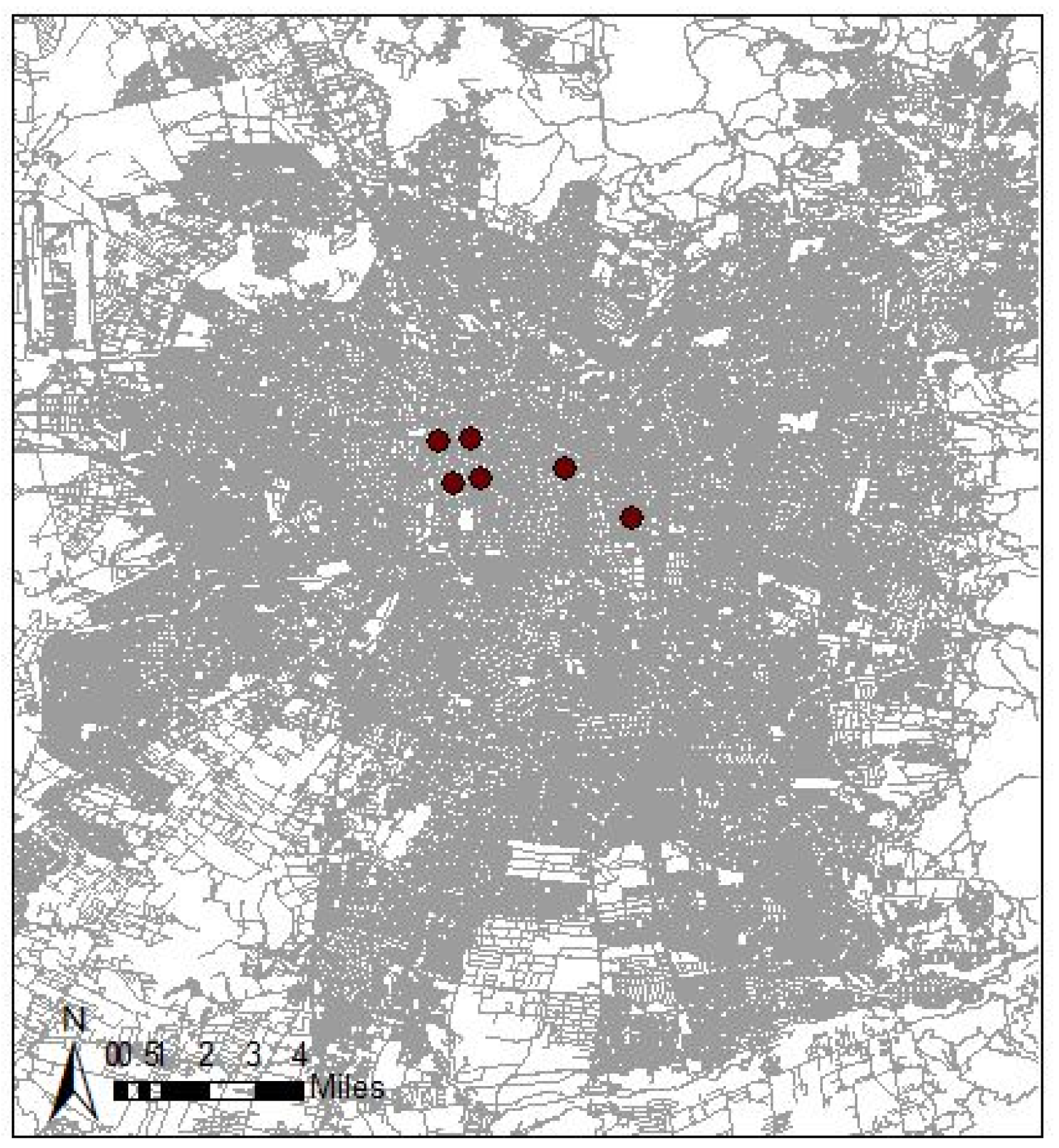
Determinants of Women’s Place Attachment in Middle-Income Neighborhoods of Santiago, Chile


Abstract
1. Introduction
2. Methodology
2.1. Study Area, Research Procedure and Participants
2.2. Measurements
2.2.1. Place Attachment as Dependent Variable
2.2.2. Lifestyles
2.2.3. Personal Values
2.2.4. Social Cohesion
2.2.5. Built Environment
2.3. Analysis
3. Results
4. Discussion
5. Conclusions
Author Contributions
Funding
Institutional Review Board Statement
Data Availability Statement
Conflicts of Interest
References
- Comstock, N.; Dickinson, L.M.; Marshall, J.A.; Soobader, M.-J.; Turbin, M.S.; Buchenau, M.; Litt, J.S. Neighborhood attachment and its correlates: Exploring neighborhood conditions, collective efficacy, and gardening. J. Environ. Psychol. 2010, 30, 435–442. [Google Scholar] [CrossRef]
- Anton, C.E.; Lawrence, C. Home Is Where the Heart Is: The Effect of Place of Residence on Place Attachment and Community Participation. J. Environ. Psychol. 2014, 40, 451–461. [Google Scholar] [CrossRef]
- Anton, C.E.; Lawrence, C. The relationship between place attachment, the theory of planned behaviour and residents’ response to place change. J. Environ. Psychol. 2016, 47, 145–154. [Google Scholar] [CrossRef]
- Kamani Fard, A.; Paydar, M. Place Attachment and Related Aspects in the Urban Setting. Urban Sci. 2024, 8, 135. [Google Scholar] [CrossRef]
- Bonaiuto, M.; Aiello, A.; Perugini, M.; Bonnes, M.; Ercolani, A.P. Multidimensional perception of residential environment quality and neighborhood attachment in the urban environment. J. Environ. Psychol. 1999, 19, 352. [Google Scholar] [CrossRef]
- Adewale, B.A.; Ibem, E.O.; Amole, S.A.; Adeboye, A.B. Place attachment in Nigerian urban slums: Evidence from inner-city Ibadan. Cities 2020, 107, 102902. [Google Scholar] [CrossRef]
- Brown, B.; Perkins, D.D.; Brown, G. Place attachment in a revitalizing neighborhood: Individual and block levels of analysis. J. Environ. Psychol. 2003, 23, 259–271. [Google Scholar] [CrossRef]
- Paydar, M.; Kamani Fard, A.; Sabri, S. Walking Behavior of Older Adults and Air Pollution: The Contribution of the Built Environment. Buildings 2023, 13, 3135. [Google Scholar] [CrossRef]
- Chang, J.; Lin, Z.; Vojnovic, I.; Qi, J.; Wu, R.; Xie, D. Social environments still matter: The role of physical and social environments in place attachment in a transitional city, Guangzhou, China. Landsc. Urban Plan. 2023, 232, 104680. [Google Scholar] [CrossRef]
- Sun, Y.; Fang, Y.; Yung, E.H.; Chao, T.-Y.S.; Chan, E.H. Investigating the links between environment and older people’s place attachment in densely populated urban areas. Landsc. Urban Plan. 2020, 203, 103897. [Google Scholar] [CrossRef]
- Azevedo, A.; Custódio, M.J.; Perna, F. “Are you happy here?”: The relationship between quality of life and place attachment. J. Place Manag. Dev. 2013, 6, 102–119. [Google Scholar] [CrossRef]
- Kamalipour, H.; Yeganeh, A.J.; Alalhesabi, M. Predictors of Place Attachment in Urban Residential Environments: A Residential Complex case study. Procedia-Soc. Behav. Sci. 2012, 35, 459–467. [Google Scholar] [CrossRef]
- Morais, L.M.O.; Borde, E.; Guevara, P.; Valdebenito, R.; Baldovino-Chiquillo, L.; Sarmiento, O.L.; Vergara, A.V.; Friche, A.A.L.; Caiaffa, W.T. Gender and urban health: A Latin American structured tool for research and policy. Cad. Saúde Pública 2025, 40, e00046124. [Google Scholar] [CrossRef] [PubMed]
- Scannell, L.; Gifford, R. Defining place attachment: A tripartite organizing framework. J. Environ. Psychol. 2010, 30, 1–10. [Google Scholar] [CrossRef]
- Lewicka, M. Place attachment: How far have we come in the last 40 years? J. Environ. Psychol. 2011, 31, 207–230. [Google Scholar] [CrossRef]
- Sun, C.; Li, F.; Chen, Y. Urban form, neighborhood environment, and place attachment: A structural equation model. Cities 2020, 100, 102649. [Google Scholar] [CrossRef]
- Valentine, G. The production of safe spaces. Geoforum 1997, 28, 283–294. [Google Scholar] [CrossRef]
- Hanson, S. Gender and mobility: New approaches for informing sustainability. Gend. Place Cult. 2010, 17, 5–23. [Google Scholar] [CrossRef]
- Lawson, V. Geographies of care and responsibility. Ann. Assoc. Am. Geogr. 2007, 97, 1–11. [Google Scholar] [CrossRef]
- Chan, E.T.; Li, T.E. The effects of neighbourhood attachment and built environment on walking and life satisfaction: A case study of Shenzhen. Cities 2022, 130, 103940. [Google Scholar] [CrossRef]
- Chang, C.C.; Hwang, R.L.; Lee, M.H. Built environment characteristics and place attachment: A systematic review of recent evidence. Cities 2023, 134, 104190. [Google Scholar]
- Koohsari, M.J.; Sugiyama, T.; Mavoa, S.; Villanueva, K.; Owen, N. Place attachment and neighborhood walkability: Emerging evidence from urban environmental research. Health Place 2023, 80, 102992. [Google Scholar]
- Morais, M.; Silva, C.; Lopes, M. Gendered experiences of neighborhood attachment: Safety, mobility, and care practices in contemporary cities. Cities 2025, 149, 105027. [Google Scholar]
- Li, J.; Koohsari, M.J.; Kaczynski, A.T.; Tanimoto, R.; Watanabe, R.; Nakaya, T.; Luo, Y.; Zhao, J.; Yasunaga, A.; Oka, K.; et al. The built environment and place attachment: Insights from Japanese cities. Prev. Med. Rep. 2025, 50, 102969. [Google Scholar] [CrossRef] [PubMed]
- Castellani, F.; Parent, G.; Zentero, J. The Latin American Middle Class: Fragile After All? IDB Publications (Working Papers) 6733; Inter-American Development Bank: Washington, DC, USA, 2014. [Google Scholar]
- Figueroa, C.; Hodgson, F.; Mullen, C.; Timms, P. Walking through deprived neighbourhoods: Meanings and constructions behind the attributes of the built environment. Travel Behav. Soc. 2019, 16, 171–181. [Google Scholar] [CrossRef]
- Herrmann-Lunecke, M.G.; Mora, R.; Vejares, P. Perception of the built environment and walking in pericentral neighbourhoods in Santiago, Chile. Travel Behav. Soc. 2021, 23, 192–206. [Google Scholar] [CrossRef]
- Paydar, M.; Fard, A. Travel mode choice of the commuters and neighborhood socioeconomic segregation. J. Transp. Health 2025, 44, 102085. [Google Scholar] [CrossRef]
- Paydar, M.; Kamani Fard, A. Subjective Well-Being, Active Travel, and Socioeconomic Segregation. Sustainability 2025, 17, 10571. [Google Scholar] [CrossRef]
- Koohsari, M.J.; Yasunaga, A.; Oka, K.; Nakaya, T.; Nagai, Y.; McCormack, G.R. Place attachment and walking behaviour: Mediation by perceived neighbourhood walkability. Landsc. Urban Plan. 2023, 235, 104767. [Google Scholar] [CrossRef]
- Kroesen, M.; Chorus, C. The role of general and specific attitudes in predicting travel behavior—A fatal dilemma? Travel Behav. Soc. 2017, 10, 33–41. [Google Scholar] [CrossRef]
- Etminani-Ghasrodashti, R.; Paydar, M.; Hamidi, S. University-related travel behavior: Young adults’ decision-making in Iran. Sustain. Cities Soc. 2018, 43, 495–508. [Google Scholar] [CrossRef]
- Paydar, M.; Kamani Fard, A. Active travel and subjective well-being in Temuco, Chile. J. Transp. Geogr. 2025, 123, 104070. [Google Scholar] [CrossRef]
- García, J.; Mars, L.; Arroyo, R.; Casquero, D.; di Ciommo, F.; Ruiz, T. Personal Values, Attitudes and Travel Intentions Towards Cycling and Walking, and Actual Behavior. Sustainability 2019, 11, 3574. [Google Scholar] [CrossRef]
- Paydar, M.; Kamani Fard, A. Satisfaction with travel and its associated factors among university students. J. Transp. Health 2026, 48, 102261. [Google Scholar] [CrossRef]
- Paulssen, M.; Temme, D.; Vij, A.; Walker, J.L. Values, attitudes and travel behavior: A hierarchical latent variable mixed logit model of travel mode choice. Transportation 2014, 41, 873–888. [Google Scholar] [CrossRef]
- Sampson, R.J.; Raudenbush, S.W.; Earls, F. Neighborhoods and violent crime: A multilevel study of collective efficacy. Science 1997, 277, 918–924. [Google Scholar] [CrossRef] [PubMed]
- Baldwin, C.; Vincent, P.; Anderson, J.; Rawstorne, P. Measuring Well-Being: Trial of the Neighbourhood Thriving Scale for Social Well-Being Among Pro-Social Individuals. Int. J. Community Well-Being 2020, 3, 361–390. [Google Scholar] [CrossRef] [PubMed]
- Miller, H.N.; Thornton, C.P.; Rodney, T.; Thorpe, R.J., Jr.; Allen, J. Social Cohesion in Health: A Concept Analysis. Adv. Nurs. Sci. 2020, 43, 375–390. [Google Scholar] [CrossRef] [PubMed]
- Kamani Fard, A.; Paydar, M. Women’s walking behaviour and subjective well-being in the middle-income neighbourhoods of Santiago, Chile. BMC Public Health 2026. [Google Scholar] [CrossRef] [PubMed]
- Cerin, E.; Conway, T.L.; Cain, K.L.; Kerr, J.; De Bourdeaudhuij, I.; Owen, N.; Reis, R.S.; Sarmiento, O.L.; Hinckson, E.A.; Salvo, D.; et al. Sharing good NEWS across the world: Developing comparable scores across 12 countries for the neighborhood environment walkability scale (NEWS). BMC Public Health 2013, 13, 309. [Google Scholar] [CrossRef] [PubMed]
- Paydar, M.; Kamani Fard, A. Walking and cycling as recreational activities and their associated factors. Int. J. Urban Sustain. Dev. 2025, 17, 268–283. [Google Scholar] [CrossRef]
- Berrigan, D.; Pickle, L.W.; Dill, J. Associations between street connectivity and active transportation. Int. J. Health Geogr. 2010, 9, 20. [Google Scholar] [CrossRef] [PubMed]
- Paydar, M.; Kamani Fard, A. Older Adults’ Walking Behavior and the Associated Built Environment in Medium-Income Central Neighborhoods of Santiago, Chile. Infrastructures 2025, 10, 137. [Google Scholar] [CrossRef]
- Mayer, H.; Nonn, C.; Osterbrink, J.; Evers, G. Qualitätskriterien von Assessmentinstrumenten—Cohen’s Kappa als Maß der Interrater-Reliabilität (Teil 1). Pflege 2004, 17, 36–46. [Google Scholar] [CrossRef] [PubMed]
- Liu, M.; Zhao, S.; Li, J. Associations among perceived built environment, attitudes, walking behavior, and physical and mental state of college students during COVID-19. Travel Behav. Soc. 2022, 28, 170–180. [Google Scholar] [CrossRef] [PubMed] [PubMed Central]
- Hu, L.-T.; Bentler, P.M. Fit indices in covariance structure modeling: Sensitivity to under parameterized model misspecification. Psychol. Methods 1998, 3, 424–453. [Google Scholar] [CrossRef]
- Hooper, D.; Coughlan, J.; Mullen, M. Structural Equation Modeling: Guidelines for Determining Model Fit. Electron. J. Bus. Res. Methods 2007, 6, 53–60. [Google Scholar]
- Kline, R.B. Principles and Practice of Structural Equation Modeling; Guilford Press: New York, NY, USA, 1998. [Google Scholar]
- Kline, R.B. Principles and Practice of Structural Equation Modeling, 2nd ed.; Guilford Press: New York, NY, USA, 2005. [Google Scholar]
- Kline, R.B. Principles and Practice of Structural Equation Modeling, 3rd ed.; Guilford: New York, NY, USA, 2011. [Google Scholar]
- Hu, L.-T.; Bentler, P.M. Cutoff Criteria for Fit Indexes in Covariance Structure Analysis: Conventional Criteria Versus New Alternatives. Struct. Equ. Model. 1999, 6, 1–55. [Google Scholar] [CrossRef]
- Koohsari, M.J.; Nakaya, T.; McCormack, G.R.; Shibata, A.; Ishii, K.; Yasunaga, A.; Hanibuchi, T.; Oka, K. Traditional and novel walkable built environment metrics and social capital. Landsc. Urban Plan. 2021, 214, 104184. [Google Scholar] [CrossRef]
- Leverentz, A.; Pittman, A.; Skinnon, J. Place and Perception: Constructions of Community and Safety Across Neighborhoods and Residents; SAGE Publications Sage: Los Angeles, CA, USA, 2018. [Google Scholar]
- Busco, C.; González, F.; Lillo, N. Safety, Gender, and the Public Transport System in Santiago, Chile. Sustainability 2022, 14, 16484. [Google Scholar] [CrossRef]
- Pfeiffer, D.; Ehlenz, M.M.; Andrade, R.; Cloutier, S.; Larson, K.L. Do neighborhood walkability, transit, and parks relate to residents’ life satisfaction? Insights from Phoenix. J. Am. Plan. Assoc. 2020, 86, 171–187. [Google Scholar] [CrossRef]
- Kim, B.; Park, J. Effects of Commercial Activities by Type on Social Bonding and Place Attachment in Neighborhoods. Sustainability 2018, 10, 1771. [Google Scholar] [CrossRef]
- Li, Y.; Zhang, X.; Wang, S. Neighborhood safety perceptions, environmental quality, and emotional attachment to place among urban residents. Landsc. Urban Plan. 2025, 256, 105112. [Google Scholar]
- Elshater, A.; Abusaada, H.; Alfiky, A.; El-Bardisy, N.; Elmarakby, E.; Grant, S. Workers’ satisfaction vis-à-vis environmental and socio-morphological aspects for sustainability and decent work. Sustainability 2022, 14, 1699. [Google Scholar] [CrossRef]
- Koluman, N.; Chalak, L.; Koutouzidou, G.; Göncü, S.; Celik Guney, M.; Eid, C.; Ragkos, A. Women’s cooperatives and silvopastoralism in the Mediterranean: A strategic approach to service provision in Lebanon and Turkey. Sustainability 2026, 18, 5995. [Google Scholar] [CrossRef]


| Research Stage | Methods | Outputs |
|---|---|---|
| Sampling | Power analysis and simple random sampling | N = 586 |
| Study Area Selection | Six middle-income neighborhoods in Santiago | Representative neighborhoods |
| Data Collection | Face-to-face surveys | 586 respondents |
| Built Environment Assessment | GIS and neighborhood audits | Objective indicators |
| Factor Extraction | EFA | Lifestyle and perceived BE factors |
| SEM | AMOS v21 | Determinants of place attachment |
| Variables | Variable Description | Frequency | Percentage | Mean | SD |
|---|---|---|---|---|---|
| Place attachment | 2.77 | 0.68 | |||
| Socio-demographic variables | |||||
| Job situation | 1 = With job outside of home | 286 | 48.8 | ||
| 0 = Without job outside of home | 300 | 51.1 | |||
| Education | 1 = Basic education or lower | 21 | 3.6 | ||
| 2 = Secondary education | 206 | 35.2 | |||
| 3 = Professional Technician | 162 | 27.6 | |||
| 4 = Higher education | 173 | 29.5 | |||
| 5 = Postgraduate | 24 | 4.1 | |||
| Duration of residency at the present house | Less than one year | 48 | 8.4 | ||
| Between 1 and 3 years | 101 | 16.1 | |||
| Between 3 and 5 years | 103 | 17.6 | |||
| More than 5 years | 334 | 57.9 | |||
| Having foreign origin | 0 = No | 481 | 82.1 | ||
| 1 = Yes | 105 | 17.9 | |||
| Personal values | |||||
| Self-direction | 4.11 | 0.90 | |||
| Hedonism | 4.32 | 0.76 | |||
| Power | 4.05 | 1.00 | |||
| Achievement | 4.15 | 0.88 | |||
| Universalism | 4.47 | 0.76 | |||
| Security | 4.58 | 0.64 | |||
| Conformity | 4.52 | 0.68 | |||
| Social/related variables | |||||
| Social cohesion | 2.57 | 0.81 | |||
| Built environmental factors | |||||
| Path comfort | 0.67 | 0.09 | |||
| Safety from Traffic | 0.65 | 0.16 | |||
| Aesthetic | 2.00 | 0.19 | |||
| Greenery | 1.76 | 0.13 | |||
| Building height | 1.36 | 1.13 | |||
| Mixed land use | 0.25 | 0.03 | |||
| Link node ratio (Links/Nodes per unit of area) | 0.84 | 0.14 |
| Component | How Often (in the Last Month) Have You Engaged in Various Activities During Your Free Time? | Loadings |
|---|---|---|
| Physical active people outside of home | Go to the gym or indoor sports | 0.876 |
| Going to outdoor sports, walking, jogging or cycling, | 0.813 | |
| Going to restaurants and malls with friends | Going to shopping centers | 0.886 |
| Going to the restaurant/cafeteria with friends | 0.807 |
| Component | Loadings | |
|---|---|---|
| Aesthetic and Infrastructure for comfort | Most of the sidewalks in my neighborhood are wide enough. | 0.572 |
| In general, the sidewalks in this neighborhood are well maintained. | 0.672 | |
| There are dedicated bike lanes in my neighborhood. | 0.660 | |
| There are many natural attractions in my neighborhood (such as vegetation and trees). | 0.737 | |
| My neighborhood is pleasant to look at while walking through it. | 0.727 | |
| There is sufficient signage to facilitate pedestrian movement in my neighborhood. | 0.717 | |
| The streets in my neighborhood are well lit at night | 0.736 | |
| Accessibility | The store I use is a short walk from my house | 0.828 |
| There are many places I usually go that are a short walk from my house | 0.840 | |
| The bus stop is a short walk from my home | 0.824 | |
| The streets in my neighborhood don’t have many dead ends. | 0.591 | |
| The parks and squares are within easy walking distance of my house | 0.642 | |
| There are many alternative routes to get from one place to another in my neighborhood (I don’t have to follow the same path every time). | 0.537 | |
| Insecurity related aspects | There is a high level of crime in my neighborhood. | 0.773 |
| The crime rate in my neighborhood makes it unsafe to go for a walk during the day. | 0.833 | |
| The crime rate in my neighborhood makes it unsafe to go for a walk at night. | 0.865 | |
| Safety from traffic | There are many obstructions along the sidewalks (parked cars, ongoing construction, etc.) | 0.739 |
| There is so much traffic on the nearby streets that walking or cycling becomes difficult and/or unpleasant. | 0.752 | |
| Vehicles do not respect the speed limits in my neighborhood. | 0.792 |
| Domain | Variable (Factor) | Variable Description | Mean (in Total Zones) [SD] |
|---|---|---|---|
| Infrastructure and functional aspects for comfort | 0.67 [0.09] | ||
| Quality of pavement | 1 = poor, 2 = fair, 3 = good | ||
| Sidewalk width | 1 < 4 feet, 2 = between 4 and 8 feet, 3 > 8 feet | ||
| Physical barriers/path obstructions | 1 = present, 0 = not present | ||
| The buffer between road and path | 1 = present, 0 = not present | ||
| Amenities (All types) | 1 = present, 0 = not present | ||
| Presence of benches | 1 = present, 0 = not present | ||
| Traffic safety | 0.65 [0.16] | ||
| Traffic control devices | 1 = present, 0 = not present | ||
| Crossing aids | 1 = present, 0 = not present | ||
| Crosswalks | 1= none, 2 = 1–2, 3 = 3–4, 4 > 4 | ||
| Quality and quantity of green spaces | 1.76 [0.13] | ||
| Number of trees | 1 = none or very few, 2 = some, 3 = many/dense | ||
| Presence of flowers | 1 = yes, 0 = no | ||
| Maintenance and cleanliness of green spaces | 1 = Poor (much litter/no grass cutting 2 = Fair (some litter/grass cutting in some places 3 = Good (no litter/grass cutting in many places | ||
| Aesthetic related aspects | 2.00 [0.19] | ||
| General cleanliness: (can you see trash, graffiti, broken windows, discarded objects, etc.?) | 1 = None or almost no trash/bad graffiti/broken facilities) 2 = Yes, a little (little trash/bad graffiti/broken facilities) 3 = Yes, a lot (a lot of trash/bad graffiti/broken facilities) | ||
| Building Maintenance | 1 = Poor (Much unrepaired and unmaintained façade is observed 2 = Fair (To some extent, unrepaired and unmaintained façade is observed) 3 = Good (unrepaired and unmaintained façade is not observed) | ||
| Articulation in building designs | 1 = little or no articulation, 2 = some articulation, 3 = highly articulated | ||
| Public art (Is there public art that is visible in this segment?) | 1 = yes, 0 = no | ||
| Building height | 1.36 [1.13] | ||
| Building height | 1 = short, 2 = medium, 3 = tall |
| Place Attachment | ||
|---|---|---|
| Variables | Estimate | C.R. |
| Sociodemographic factors | ||
| Having job outside of home | 0.109 ** | 1.950 |
| Secondary versus basic education | −0.016 | −0.168 |
| Technicians Versus Basic Education | 0.075 | 0.841 |
| Higher education versus basic education | 0.024 | 0.260 |
| Postgraduate versus basic education | 0.010 | 0.192 |
| Time of residency at home | 0.085 ** | 1.967 |
| Having foreign origin | 0.021 | 0.549 |
| Lifestyle | ||
| Physical active people outside of home | −0.002 | −0.040 |
| Going to restaurants and malls with friends | 0.068 | 1.115 |
| Personal values | ||
| Self-direction | 0.033 | 0.799 |
| Hedonism | −0.055 | −1.058 |
| Power | 0.087 ** | 2.346 |
| Achievement | −0.012 | −0.284 |
| Universalism | 0.150 ** | 2.585 |
| Security | −0.060 | −0.801 |
| Conformity | −0.076 | −1.203 |
| Social-related factors | ||
| Social cohesion | 0.246 *** | 4.580 |
| Perceived Built Environment | ||
| BA_1: Aesthetic and Infrastructure for comfort | 0.306 *** | 3.686 |
| BA_2: Accessibility | 0.230 *** | 2.775 |
| BA_3: Insecurity related aspects | −0.095 * | −1.813 |
| BA_4: Safety from traffic | −0.030 | −0.530 |
| Objective built environment | ||
| Path comfort | 0.086 * | 1.138 |
| Safety from Traffic | 0.079 | 1.561 |
| Aesthetic | −0.343 | −0.672 |
| Greenery | 0.000 | 0.283 |
| Building height | −0.383 | −1.417 |
| Mixed land use | −0.348 * | −1.805 |
| Link node ratio (Links Nodes per unit of area) | 0.014 | 0.229 |
| Model fit: | ||
| CMIN/DF | 2.541 | |
| CFI | 0.901 | |
| TLI | 0.899 | |
| RMSEA | 0.050 | |
| PCLOSE | 0.209 |
Disclaimer/Publisher’s Note: The statements, opinions and data contained in all publications are solely those of the individual author(s) and contributor(s) and not of MDPI and/or the editor(s). MDPI and/or the editor(s) disclaim responsibility for any injury to people or property resulting from any ideas, methods, instructions or products referred to in the content. |
© 2026 by the authors. Licensee MDPI, Basel, Switzerland. This article is an open access article distributed under the terms and conditions of the Creative Commons Attribution (CC BY) license.
Share and Cite
Kamani Fard, A.; Paydar, M.; Azócar Fernández, P. Determinants of Women’s Place Attachment in Middle-Income Neighborhoods of Santiago, Chile. Land 2026, 15, 1242. https://doi.org/10.3390/land15071242
Kamani Fard A, Paydar M, Azócar Fernández P. Determinants of Women’s Place Attachment in Middle-Income Neighborhoods of Santiago, Chile. Land. 2026; 15(7):1242. https://doi.org/10.3390/land15071242
Chicago/Turabian StyleKamani Fard, Asal, Mohammad Paydar, and Pablo Azócar Fernández. 2026. "Determinants of Women’s Place Attachment in Middle-Income Neighborhoods of Santiago, Chile" Land 15, no. 7: 1242. https://doi.org/10.3390/land15071242
APA StyleKamani Fard, A., Paydar, M., & Azócar Fernández, P. (2026). Determinants of Women’s Place Attachment in Middle-Income Neighborhoods of Santiago, Chile. Land, 15(7), 1242. https://doi.org/10.3390/land15071242