1. Introduction
Climate change is affecting the frequency and intensity of disasters such as extreme weather events across the globe [
1]. In the period 2000–2019 alone, they caused nearly USD 3 trillion in economic losses, affected around 4 billion people, and claimed 1.23 million lives [
2]. In response, policy actions to mitigate climate change and progress in low-emission technologies have accelerated [
1]. Yet, it is just as essential to further research and develop ways to adapt to the present and inevitable future risks to protect property, nature and people from adverse climate change impacts [
3].
Central to this challenge are urban environments, which are home to more than half of the world’s population today and up to 70% by 2050 [
4]. Regardless of whether through densification or sprawl, the land use change necessary for this urban development comes at a price. It leads to the fragmentation and degradation of habitats, reduces biodiversity, and disrupts hydrological systems [
5].
This further affects the intensity of climate-related hazards, among which heatwaves and pluvial flooding are particularly relevant for urban contexts [
6].
Heatwaves are periods during which local excess heat accumulates over multiple, unusually hot days and nights. They are exacerbated by the urban heat island effect, further increasing the temperature compared to non-urban surroundings [
7,
8]. Besides contributing to other hazards such as air pollution, droughts, and wildfires, they also directly threaten human thermoregulation, ultimately resulting in increased morbidity and mortality [
7,
8,
9]. This is intensified by factors such as age and pre-existing conditions but also socioeconomic status, rendering it a matter of social and climate justice [
10]. Examples of these factors are the lack of air conditioning due to financial constraints as well as the lack of awareness and knowledge of adequate behaviours due to limited language proficiency and low levels of or access to education [
11,
12]. Effective land use planning and management of green spaces can mitigate this through the provision of regulating ecosystem services (ESs) such as microclimate regulation through vegetation like trees and parks [
13]. The unequal distribution of protective green (and blue) infrastructure, however, may lead to cases of environmental injustice in which environmental benefits and burdens are unevenly distributed around the city.
Analogously, vulnerability to urban flooding depends both on access to regulating ES such as runoff retention associated with soil permeability [
6] and on socioeconomic factors that hinder the ability to prepare for and respond to floods such as age, pre-existing health conditions, limited financial means, and access to information [
14,
15,
16].
This shows that to adequately address these hazards and allow decision-makers to implement efficient and cost-effective measures, it is crucial that disaster risk is understood in the context of a complex social–ecological system [
17]. This means that disaster risk assessment must be approached from a holistic viewpoint taking into account interactions, synergies, and trade-offs between the different factors determining overall risk. It also includes the consideration of linkages with environmental justice and the possibility of co-occurring or cascading hazards.
In fact, many disaster risk assessment approaches such as the Sendai Framework do include a multi-hazard perspective and address both demographics and the capacity of ESs to reduce disaster risk. However, the latter is not formally integrated into the risk assessment process or one of the three risk components: Hazard (a phenomenon that may cause adverse impacts like loss of life, injury, or damage), Exposure (presence of people and assets in hazard-prone areas), or Vulnerability (characteristics that increase susceptibility of people or assets to the impacts of a hazard) [
18,
19]. Accordingly, most risk assessment methods have focused primarily on social dimensions while ecological considerations, including ESs, have been limited [
17,
20,
21].
Several approaches have aimed to address this, which differ in indicator selection and whether ESs should be integrated into the hazard [
22], exposure [
23], or vulnerability [
17,
24] component of risk. Nevertheless, there are approaches that are not directly linked to the terminology of the Sendai Framework but still offer valuable insights into the biophysical supply of ESs capable of reducing disaster risks. The Natural Capital Project has developed a suite of tools called InVEST
® aimed at informing decisions about natural resource management and assessing impacts of different land use scenarios [
25]. This variety of approaches to incorporating ESs into risk assessments showcases the lack of a unified framework. This hinders comparable and reproducible risk assessments that can adequately inform decision-making at local scales. It can indeed be argued that ESs should be included in each, or none, of the risk components depending on the focus and framing of the analysis. However, including them in the vulnerability component has the benefit of facilitating the recognition and assessment of the direct link between ESs and socioeconomic vulnerability.
This holds the potential to formally integrate an environmental justice perspective into risk assessments, which remains an underexplored topic. Environmental justice has typically been divided into several sub-categories to highlight the multiple dimensions of this issue. In the case of land use planning, this refers to how specific population groups, such as low-income and minority communities, are disadvantaged on multiple levels. They are typically excluded from the decision-making processes of urban planning (procedural injustice), receive fewer environmental benefits and more burdens (distributional injustice), and these differences are often not recognised or acknowledged, hindering efforts to overcome these issues (recognitional injustice) [
26].
There is robust evidence from varying contexts showing that ES provision and subsequently climate risk are unevenly distributed within various urban areas. This unequal distribution has been shown to be highly dependent on demographics, leading to disadvantaged groups being disproportionately affected by climate risk [
27,
28,
29,
30]. However, there is still a lack of accessible data and plans to evaluate environmental justice [
26]. Furthermore, these findings are not directly integrated into risk assessment or spatial planning procedures, meaning this effect may be overlooked unless specifically investigated. This highlights the need to develop a methodology that intrinsically links environmental justice and climate risk assessment to close knowledge gaps and facilitate spatial planning that minimises all dimensions of environmental injustice based on land use decisions.
This study addresses several gaps related to the integration of ESs, environmental justice, and the evaluation of land use change impacts within the risk assessment process. This is achieved by building on and combining previous approaches to develop and test a framework that incorporates ESs into the risk assessment process and includes an environmental justice evaluation. In this framework, ESs, assessed with InVEST models, and socioeconomic vulnerability are considered complementary parts of vulnerability in the overall risk equation. Their overlay allows for the direct assessment of environmental justice as an integral step within the risk assessment process.
To showcase the practical application of the developed framework, the city of Valencia was chosen as a case study area and scenarios of possible land use development were applied to assess risk variation.
By applying this framework to the case study of Valencia and considering the specific challenges the city faces, the predicted population increase and current political ambitions, this study seeks to evaluate whether Valencia’s existing urban green and blue infrastructure offers evenly distributed protection from both floods and heatwaves and whether there are trade-offs or synergies between the associated ESs. Furthermore, the analysis aims to evaluate environmental justice by identifying patterns of co-occurrence between sociodemographic determinants of vulnerability and a lack of access to ESs protecting against heatwaves and flooding. Lastly, by creating different land use scenarios, this study aims to reveal the impact of hypothetical urban development trends on disaster risk and particularly how they affect neighbourhoods with a high level of vulnerability.
2. Materials and Methods
2.1. Case Study Area: The City of Valencia
With 809,501 inhabitants in 2023, the municipality (municipio) of Valencia is the third largest city in Spain [
31]. In the past century, the city has expanded far beyond the ancient city centre to the outskirts, absorbing formerly separate towns and villages into the continuous urban fabric. Reflecting this development, there is considerable variation in population and building density, building height, and the percentage of green areas between neighbourhoods. The city centre (e.g., Ciutat Vella) contains few and small urban parks while there are still remnants of cropland to be found in the suburbs [
32,
33]. Overall, urban green areas cover 5.33 km
2 [
34]. The most prominent of these is the Turia Gardens (Jardín del Turia), an east–west-oriented strip with a total area of about 1.2 km
2 and an average width of 180 metres, which runs through the city centre. It was established after the rerouting of the Turia River following a flood in 1957 that inundated nearly three-quarters of the city. Together with the devastating floods in October 2024 that claimed more than 200 lives and recurring heatwaves, this highlights how Valencia is (and will increasingly be) affected by climate-related hazards [
35,
36,
37,
38].
To counter this and strengthen climate change adaptation and disaster risk reduction, the city of Valencia has been scaling up its efforts in sustainable tourism, climate neutrality, and a fair and inclusive green transition. For these efforts, Valencia was awarded the title of European Green Capital 2024 [
39].
Yet, the expected socio-demographic changes complicate the ambitious plans of the city of Valencia. Recent projections estimate an overall population increase to 813,000 inhabitants by 2030 and up to 820,000 by 2035. This increase of about 1.3% by 2035 is equivalent to more than 10,000 new inhabitants [
40]. Even with the planned reduction in building vacancies, an increase in renovations and intergenerational housing concepts, it is uncertain whether the city will be able to provide housing for the expected population increase without reverting to urban densification or sprawl at the cost of open spaces [
41]. Additionally, drastic demographic changes are projected. While the overall population increase is around 1.3%, the increase in the age group over 65 years is estimated to be more than 16%. This will add additional challenges associated with an ageing population with differing needs and greater vulnerability to environmental hazards [
40].
2.2. Risk Framework
2.2.1. Overview
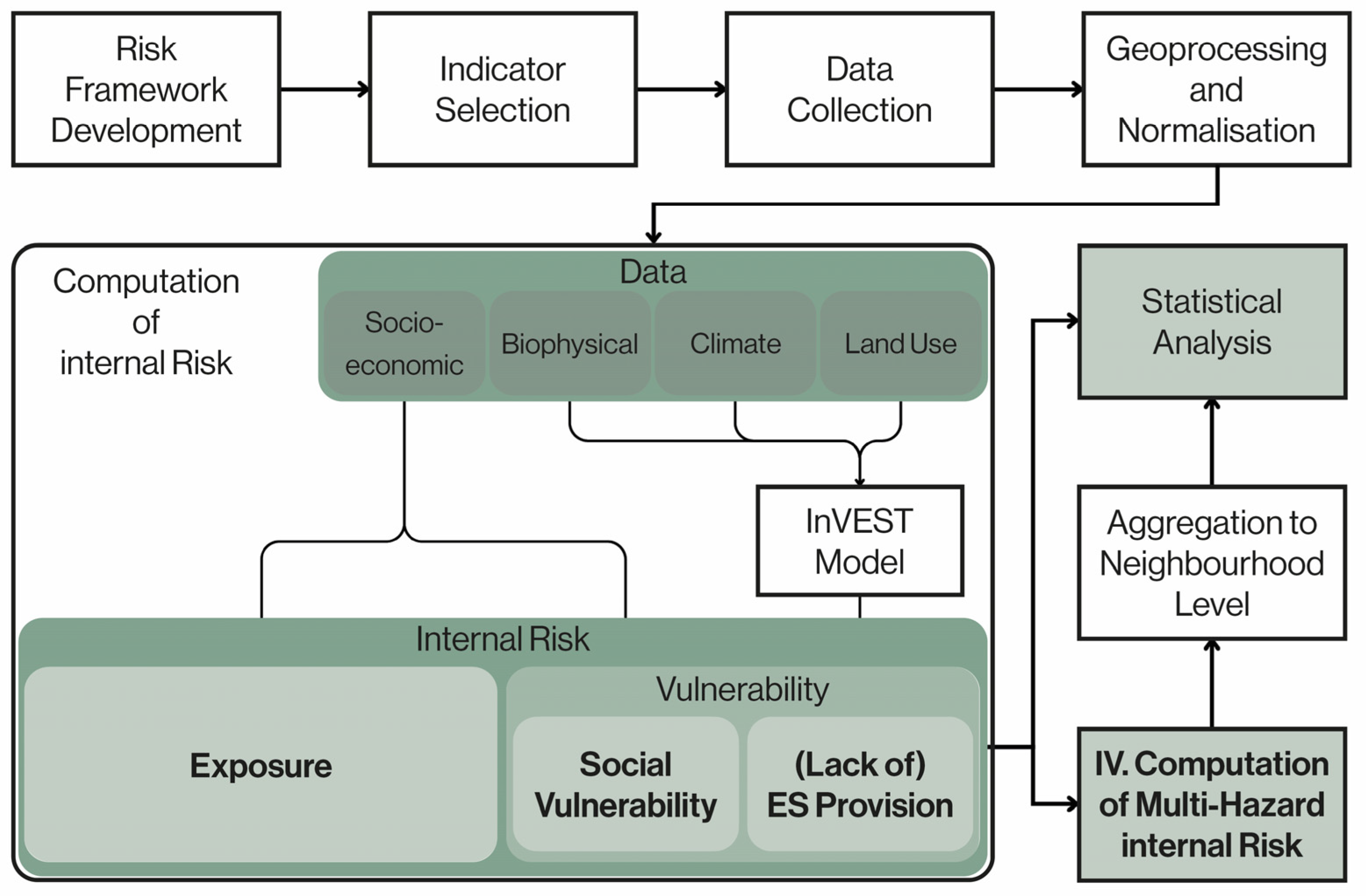
The overall methodological workflow is depicted in
Figure 1. After the development of the risk framework, relevant indicators for exposure, social vulnerability, and the provision of ESs were selected based on previous literature and the requirements of the InVEST software (Version 3.14.2). InVEST and the specific models were chosen to provide comprehensive spatial coverage and allow the integration of biophysical and socio-demographic variables, supporting large-scale assessments and policy applications [
25]. Data were collected and normalised using min–max normalisation, which rescales all values to fall between 0 and 1. This method allows indicators with different units to be compared, but it should be noted that this method is sensitive to outliers, and normalised values represent relative differences within the Valencia case study and are therefore not directly comparable to other locations. (Lack of) ES provision (
VES) was assessed utilising InVEST models. The output was normalised and (internal) risk indices were computed.
After the creation of land use scenarios using InVEST, the resulting maps were used as modified inputs for the InVEST models assessing ES provision. The subsequent steps were conducted analogously to the baseline scenario.
The results were aggregated to average values per neighbourhood and statistically analysed using RStudio 2023.03.0 Build 386 [
42].
In this work, an adapted framework for risk assessment was developed based on the work of Peng et al., which considers the capacity of ESs to reduce disaster risk as part of the vulnerability component [
17]. This highlights the role of ESs in reducing susceptibility and increasing adaptive capacity.
While risk is generally determined through the assessment of hazard, exposure, and vulnerability, following the approach of Maragno et al. [
24], this study excludes hazard. This was done to emphasise the socioeconomic and ecological dimensions of risk and its implications for environmental justice, highlighting the focus and novelty of the proposed framework. Accordingly, this means the results will be only one step of the overall risk assessment process. Hence, to distinguish the results from overall risk, the product of exposure
E and vulnerability
V is referred to here as internal risk. This frames hazard as an external force on the social–ecological system predominantly determined by large-scale climate patterns [
1]. However, this does not mean that hazard cannot be modulated on a local scale through factors such as topography and technical infrastructure like drainage systems.
This study focuses on the direct impact disasters have on people, warranting the use of normalised population density
D as an indicator of exposure. Population density data were retrieved from the most recent Padrón Municipal de Habitantes [
31].
Vulnerability is divided into two separate key components [
43]. Overall vulnerability
V was computed by calculating the unweighted average of the lack of ES provision
VES and social vulnerability
VS:
Equal weighting was applied due to the absence of robust information regarding the different contributions of the two individual components to overall vulnerability. However, since equal weighting influences composite index results, a sensitivity analysis was conducted to assess the robustness of the resulting vulnerability rankings.
After computing hazard-specific internal risk indices for the two considered hazards, heatwaves and floods, their sum was considered as overall multi-hazard internal risk. This is an adaptation of multi-hazard risk equations found in previous studies, highlighting the cumulative nature of risks through different hazards [
18,
43].
2.2.2. Social Vulnerability
Socioeconomic vulnerability was computed following the approach by Peng et al. [
43], calculating it as the average of the normalised indicators
x. With the number
n of indicators used, social vulnerability
VS is defined as:
Analogously to the overall vulnerability, social vulnerability was calculated as the unweighted average of the individual indicators since no locally validated weighting factors were available for the selected indicators, but a sensitivity analysis was performed to assess the impact of weight variation.
Based on previous literature, immigration status, education, age, and poverty were considered relevant determinants of social vulnerability in the context of both heatwaves [
8,
11,
12,
44] and floods [
14,
15,
16]. Based on data availability and their use in previous studies investigating heat risk, the following indicators were chosen:
Percentage of foreigners per district [
23,
45];
Percentage of adults without a high school degree per district [
45,
46];
Percentage of elderly residents (over 65 years old) per neighbourhood [
23,
43,
46];
Unemployment rate per neighbourhood [
23,
45].
Data on the percentage of foreigners, adults without a high school degree, and elderly residents were obtained from the most recent Padrón Municipal de Habitantes [
31]. Unemployment rate data were retrieved for January 2023 from the Servicio Valenciano de Empleo y Formación [
47].
2.2.3. ES Provision
To assess the contribution of ESs to heat mitigation, the InVEST Urban Cooling model was used. The main output of the model is the heat mitigation index (HMI), which provides a value between 0 and 1, with 0 indicating no heat mitigation by green and blue infrastructure and a value of 1 indicating complete mitigation of the urban heat island effect. This does not mean that there is no risk of heatwaves in this area, but merely that there is no alleviation of risk through the urban heat island effect. The HMI can thus be understood as a relative indicator, which by itself does not include information on actual hazard intensity, making it suitable for its inclusion into the vulnerability component based on the developed framework [
25,
48]. It considers multiple factors such as crop coefficient, shade, evapotranspiration, and albedo, which are associated with different land use classes. To incorporate the results into the risk equation, the heat-related
VES was determined by inverting the normalised HMI.
The model settings and input data were chosen as shown in
Table 1, in accordance with the InVEST recommendations and underlying empirical studies [
25,
49,
50]. The selected temperature data were chosen based on the highest observed value, while evapotranspiration data were selected for the corresponding month. This does not necessarily represent long-term climate patterns but provides an estimate of the potential maximum effect of extreme events on relative ES provision in Valencia.
The contribution of ESs to Flood Mitigation was assessed with the InVEST Urban Flood Risk Mitigation model. It calculates the runoff retention using a function based on the curve number, a predictor of runoff and infiltration depending on soil hydrologic group and land use class. This provides an indication of the risk reduction provided by ESs in the context of urban flooding [
25]. To use the results as indicators for flood-related
VES, the values of runoff retention were inverted and normalised.
Input data for the Urban Flood Risk Mitigation model are shown in
Table 2. Analogously to the Heat Mitigation model, the precipitation data were based on the maximum value recorded to give an estimate of extreme weather events in Valencia.
2.3. Assessing Potential Synergies/Trade-Offs Between ESs
After aggregating the results of the two different provision levels of ESs to average values per neighbourhood, they were statistically analysed to reveal whether there is a synergistic or trade-off relationship between them. This was carried out by determining the Spearman’s rank correlation coefficient. The results were considered significant when p values ≤ 0.05, while p values ≤ 0.1 were assumed to indicate trends.
2.4. Environmental Justice: Relationship Between Social Vulnerability and ES Provision
To assess the level of environmental justice, potential mismatches between social vulnerability and ES provision were investigated using the Spearman’s rank correlation coefficients between the neighbourhood-level values of ES provision on one side and aggregated social vulnerability on the other. To ensure the aggregation to overall social vulnerability does not mask underlying patterns, the relationships between ES provision and the individual indicators of social vulnerability were assessed accordingly. The results were considered significant when p values ≤ 0.05, while p values ≤ 0.1 were assumed to indicate trends.
2.5. Scenario Generation
The 2021 land use map by Zanaga et al. [
51] was chosen as the baseline for the creation of three hypothetical future land use scenarios to analyse the effect of ES provision on risk reduction based on similar approaches in the existing literature [
58,
59].
The scenarios were created using the InVEST Scenario Generator, which is a proximity-based, spatially explicit tool converting the land use type of a predefined area of land according to user-defined criteria [
25,
60].
Two of the generated scenarios assume a hypothetical worst-case scenario in which the projected population increase in Valencia leads to an increase in built-up surfaces at the cost of open spaces such as tree cover, cropland, and grassland.
The first scenario, Densification, simulates this urbanisation process as densification. Urban green spaces (tree cover and grassland) were converted to built-up areas within the city centre, which was defined using the 2018 Corine Land Cover classification of Continuous Urban Fabric and Green Urban Areas [
61]. Considering the projected additional 10,000 inhabitants [
40], the current population density within the city centre and the percentage of built-up areas required to sustain this population density, it was estimated that under these conditions, 100 hectares of additional land would be converted to built-up areas.
The second scenario, Sprawl, also assumes an increase in built-up areas but simulates this in the form of urban sprawl. For this, the land cover conversion was confined to the periphery of the city centre. This includes the area not classified as continuous urban fabric within neighbourhoods at the edge of the city centre [
61]. The centre’s periphery had a population density one-fifth of that in the city centre itself. Thus, the area of land (in this case grassland and cropland) to be converted to built-up land was set to be 500 hectares.
The third and final scenario, Greener Centre, instead assumes a development in which the amount of tree cover increases at the cost of built-up surfaces in the urban centre. For comparability to the first scenario, the converted area was set at 100 hectares as well.
It is important to note that all three scenarios calculate the land cover conversion solely based on proximity to selected land use types. They do not consider limitations such as protected areas or the presence of urban structures such as buildings and should therefore not be seen as realistic or even possible predictions [
25]. The purpose of these simple models is to represent general trends in urban development and their effects on ES supply. If needed and available, these can be substituted with scenarios representing real-world plans involving land use changes. After scenario creation, the InVEST Urban Cooling and Urban Flood Risk Mitigation models were used to compute modified values for HMI and runoff retention. They were subsequently used to calculate multi-hazard internal risk indices for each scenario.
Lastly, statistical testing using the Mann–Whitney U test was applied to add an environmental justice perspective to the scenarios. This revealed whether the land use change scenarios had a disproportionate effect on the multi-hazard internal risk of neighbourhoods with the highest values of overall social vulnerability. These were defined as the top decile of socially vulnerable neighbourhoods. The results were considered significant when p values ≤ 0.05, while p values ≤ 0.1 were assumed to be trends.
2.6. Sensitivity Analysis
A simple weight sensitivity analysis was conducted to assess the robustness of the use of equal weights for the social and overall vulnerability indices. For the social vulnerability index, the equal-weight baseline assigned each of the four indicators a weight of 0.25. Four alternative schemes were tested, each assigning one indicator a higher weight of 0.40 and the remaining indicators a weight of 0.20.
For the composite heat- and flood-related vulnerability indices, the equal-weight baseline was compared with alternative social/ecological weighting schemes of 60/40, 40/60, 70/30, and 30/70. Robustness was assessed using Spearman’s rank correlation to evaluate ranking stability and mean absolute change to assess the difference in index values.
3. Results
3.1. Risk Components
3.1.1. Exposure
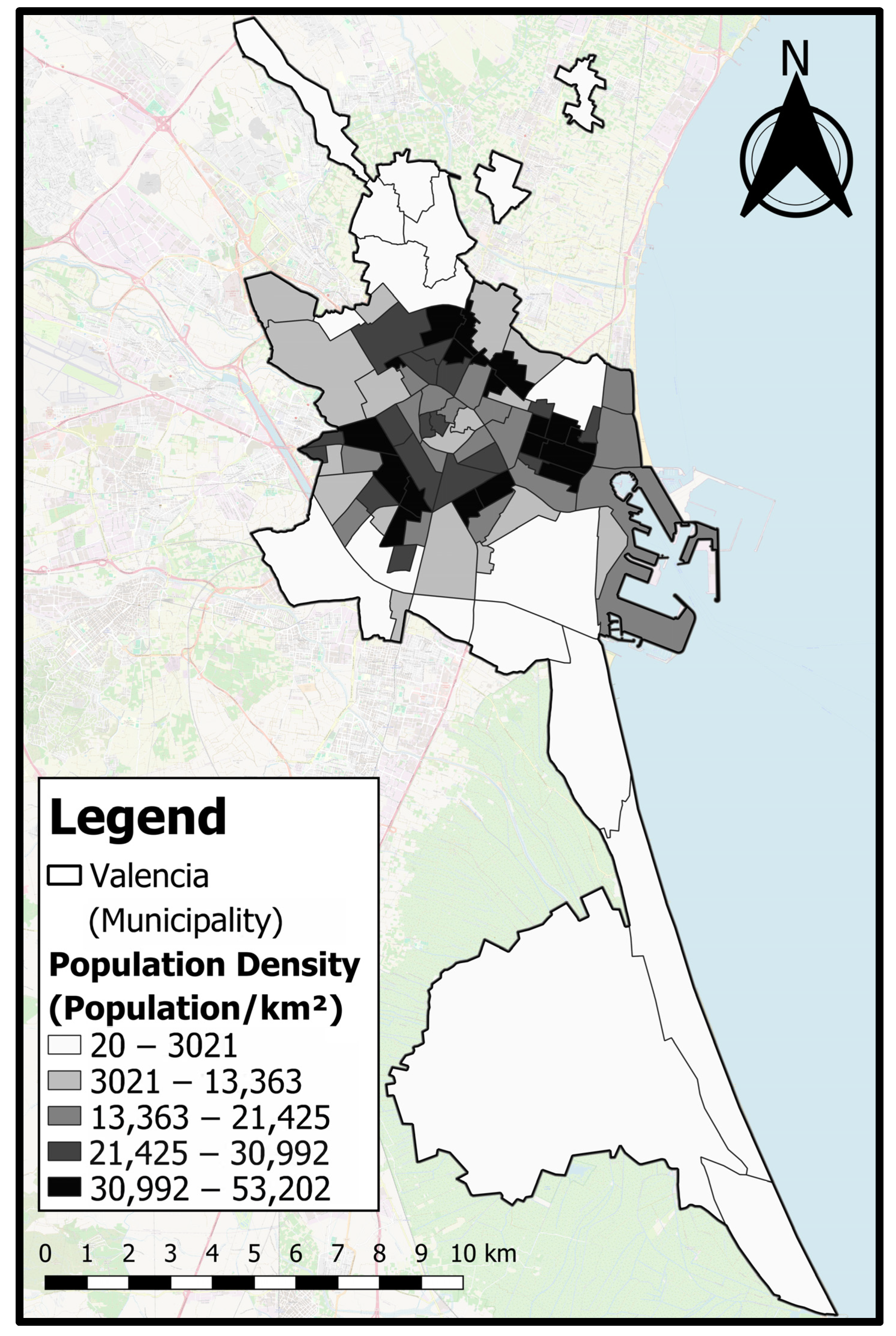
As shown in
Figure 2, the lowest population densities and therefore the lowest exposure values can be found in the north and the south of the municipality, while the neighbourhoods surrounding the city’s nucleus (Ciutat Vella) exhibit the highest values, with the most central neighbourhoods displaying medium values.
3.1.2. Social Vulnerability
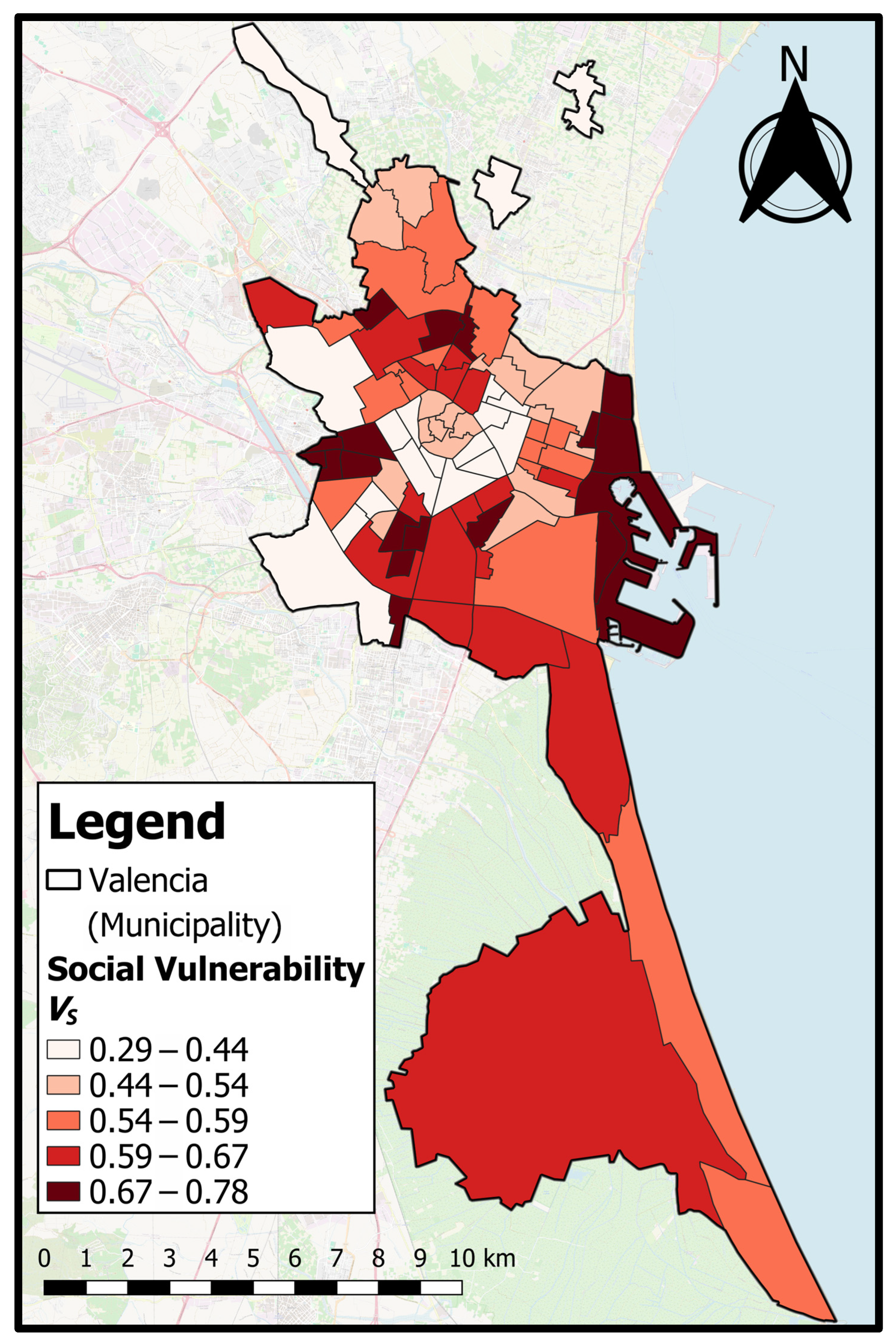
Based on the percentages of foreigners, adults without a high school degree, elderly residents, and the unemployment rate, values of the social vulnerability
VS per neighbourhood were computed. This is illustrated by
Figure 3.
While there seems to be a tendency of increased social vulnerability along the coastline and south and north of the city centre, neighbourhoods with very high and very low social vulnerability are distributed throughout the municipality. The most striking pattern, however, is the low social vulnerability surrounding the city’s nucleus on three sides (east, west, and south). In comparison, the nucleus itself has a slightly higher value of social vulnerability, albeit with values ranging from 0.448 to 0.509, still significantly lower than the neighbourhoods with the highest values (up to 0.775).
The sensitivity analysis showed that the social vulnerability index was robust to moderate changes in indicator weighting. Spearman’s rank correlations between the equal-weight baseline and the alternative weighting schemes ranged from 0.945 to 0.982, indicating a strong correlation and minor changes in the ranking of neighbourhoods from most to least vulnerable. Mean absolute changes ranged between 0.020 and 0.041. The largest change in index values occurred when education was assigned a higher weight, while unemployment weighting had the least influence on the index.
3.1.3. ES Provision
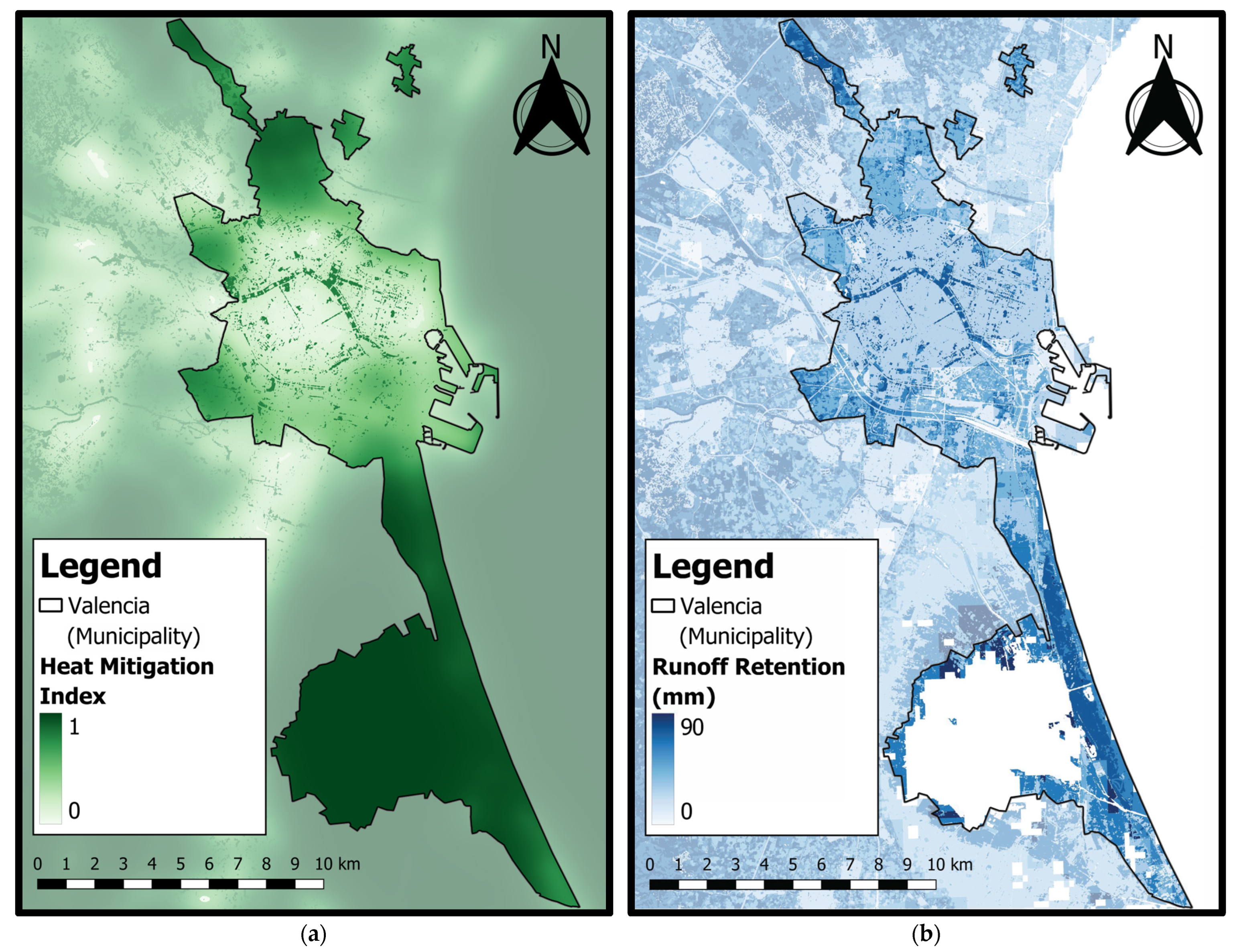
When comparing the outputs from the two InVEST models, Urban Cooling (see
Figure 4a) and Urban Flood Risk Mitigation (
Figure 4b), a common pattern emerges. The outskirts of the city have the highest supply of heat mitigation and runoff retention compared with the more urban areas. The most prominent outlier is the linear strip of the Turia Gardens cutting through the city centre in a semicircle.
3.1.4. Assessment of Internal Risk
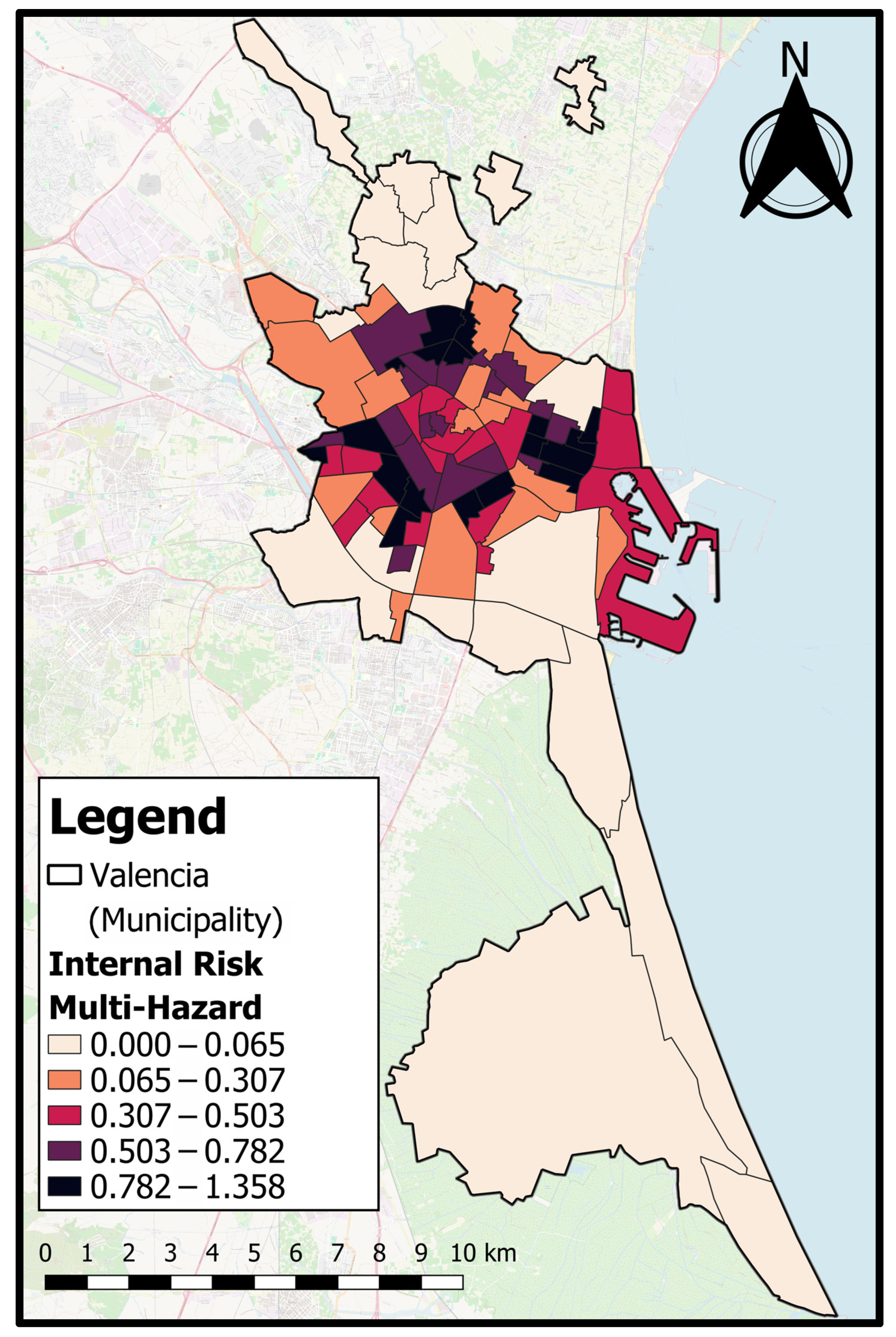
Considering the ecological and social dimensions of vulnerability and multiplying it by exposure, estimates of internal risk for heatwave and flood hazards were generated, as well as their sum, the multi-hazard internal risk. As shown in
Figure 5, the outskirts, especially the neighbourhoods in the north and south of the municipality, display the lowest values of internal risk. This can be attributed to a high supply of ES protection and low population density. Moving towards the centre, a fragmented ring of neighbourhoods with the highest internal risk levels can be observed, driven by high values of population density and social vulnerability, and decreasing values of ES supply. Finally, the city centre consists of neighbourhoods with medium internal risk. This corresponds with similarly medium values of population density and the combination of very low levels of ES provision but also low levels of social vulnerability.
The biggest difference between heatwave-related and flood-related internal risk is one of scale. Based on the calculation method, the maximum possible range for both is between 0 and 1. However, the highest values of heatwave internal risk reach up to 0.73, while the maximum of flood internal risk is 0.62.
The sensitivity analysis of the composite vulnerability indices also indicated overall stability. For heat-related vulnerability, Spearman’s rank correlations between the equal-weight baseline and alternative social/ecological weighting schemes ranged from 0.924 to 0.982, with mean absolute changes between 0.024 and 0.048. The strongest deviations occurred under the 70/30 weighting schemes. Flood-related vulnerability was slightly more stable, with Spearman’s rank correlations ranging from 0.942 to 0.989 and mean absolute changes between 0.011 and 0.023.
3.2. The Synergy of Heat Mitigation and Runoff Retention
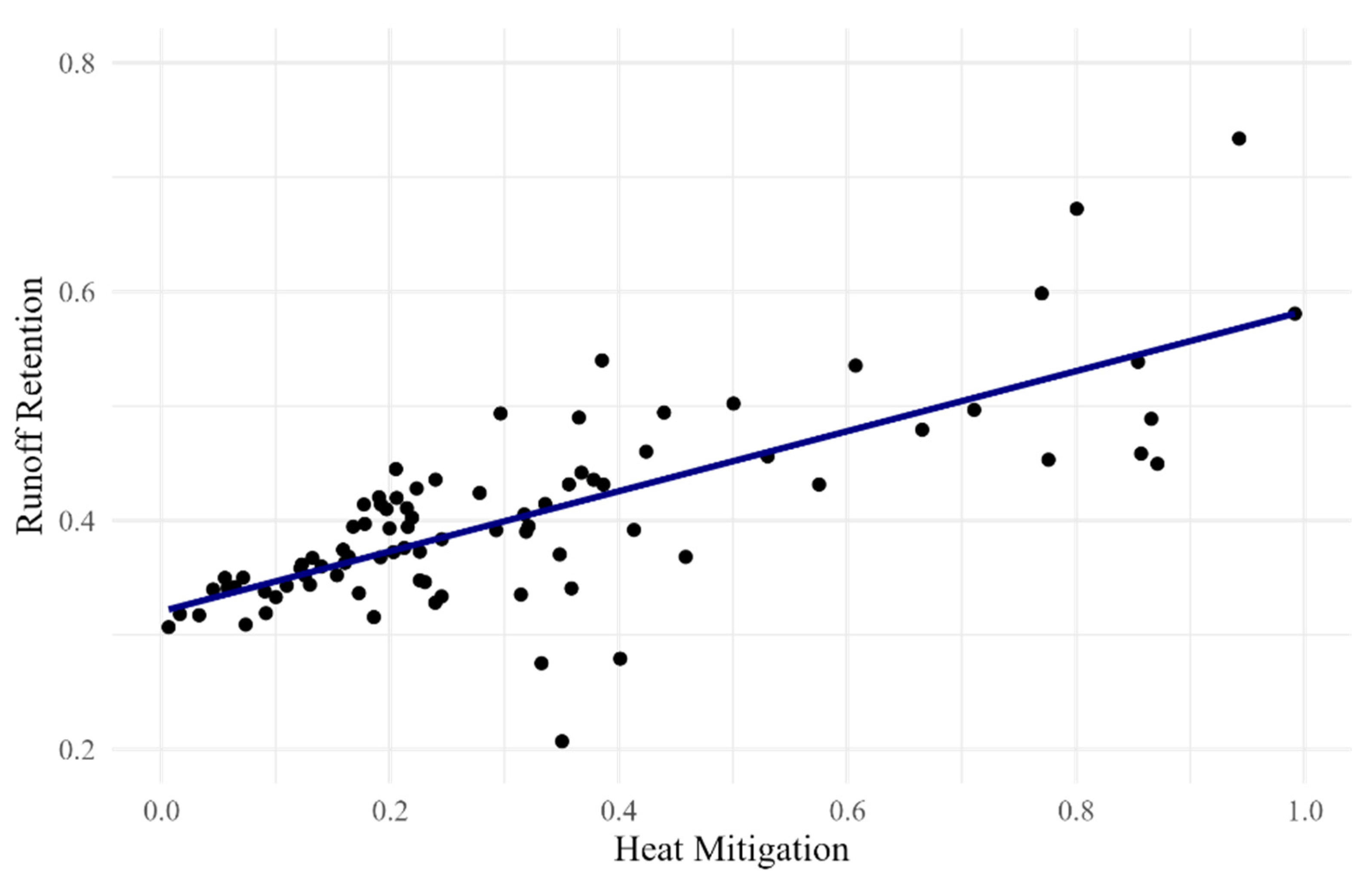
Comparing the two assessed ESs, as displayed in
Figure 4, an overall synergistic effect can be observed (Spearman’s rank correlation coefficient: ρ = 0.702,
S = 32,670,
n = 87,
p < 0.001). Besides the fact that open water bodies like the lagoon in the Albufera Natural Park contribute to heat mitigation but not to runoff retention, one noticeable difference between the two ES supply maps is the more gradual nature of the heat mitigation decrease towards dense urban areas, while runoff retention seems to be more evenly distributed. This is also apparent when comparing normalised ES provision values between neighbourhoods. Heat mitigation displays a range approximately 1.9 times wider than that of runoff retention. This difference in variation as well as the overall correlation can also be visualised in
Figure 6, showing the normalised neighbourhood-level provision values of the two ESs in a scatter plot.
3.3. Environmental Justice
No correlation was found between the lack of heat mitigation and overall social vulnerability VS. However, when lack of heat mitigation was compared with individual indicators of social vulnerability, two interesting patterns could be identified. Heat mitigation per neighbourhood shows a negative correlation with the percentage of foreigners (Spearman’s rank correlation coefficient: ρ = −0.407, S = 154,386, n = 87, p < 0.001) and a positive correlation with the percentage of adults without a high school degree (Spearman’s rank correlation coefficient: ρ = 0.573, S = 46,904, n = 87, p < 0.001).
For runoff retention per neighbourhood, a similar pattern emerged. There was no correlation with overall social vulnerability, but there was a significant negative correlation with the percentage of foreigners (Spearman’s rank correlation coefficient: ρ = −0.413, S = 155,099, n = 87, p < 0.001) and a positive correlation with the percentage of adults without a high school degree (Spearman’s rank correlation coefficient: ρ = 0.250, S = 82,331, n = 87, p = 0.020). Additionally, higher runoff retention per neighbourhood is significantly associated with lower unemployment rates (Spearman’s rank correlation coefficient: ρ = −0.302, S = 142,856, n = 87, p = 0.005).
3.4. Scenarios
ES provision, hazard-specific and multi-hazard internal risk for each of the land use scenarios were calculated analogously to the baseline. Statistical testing showed significant changes in the overall multi-hazard internal risk.
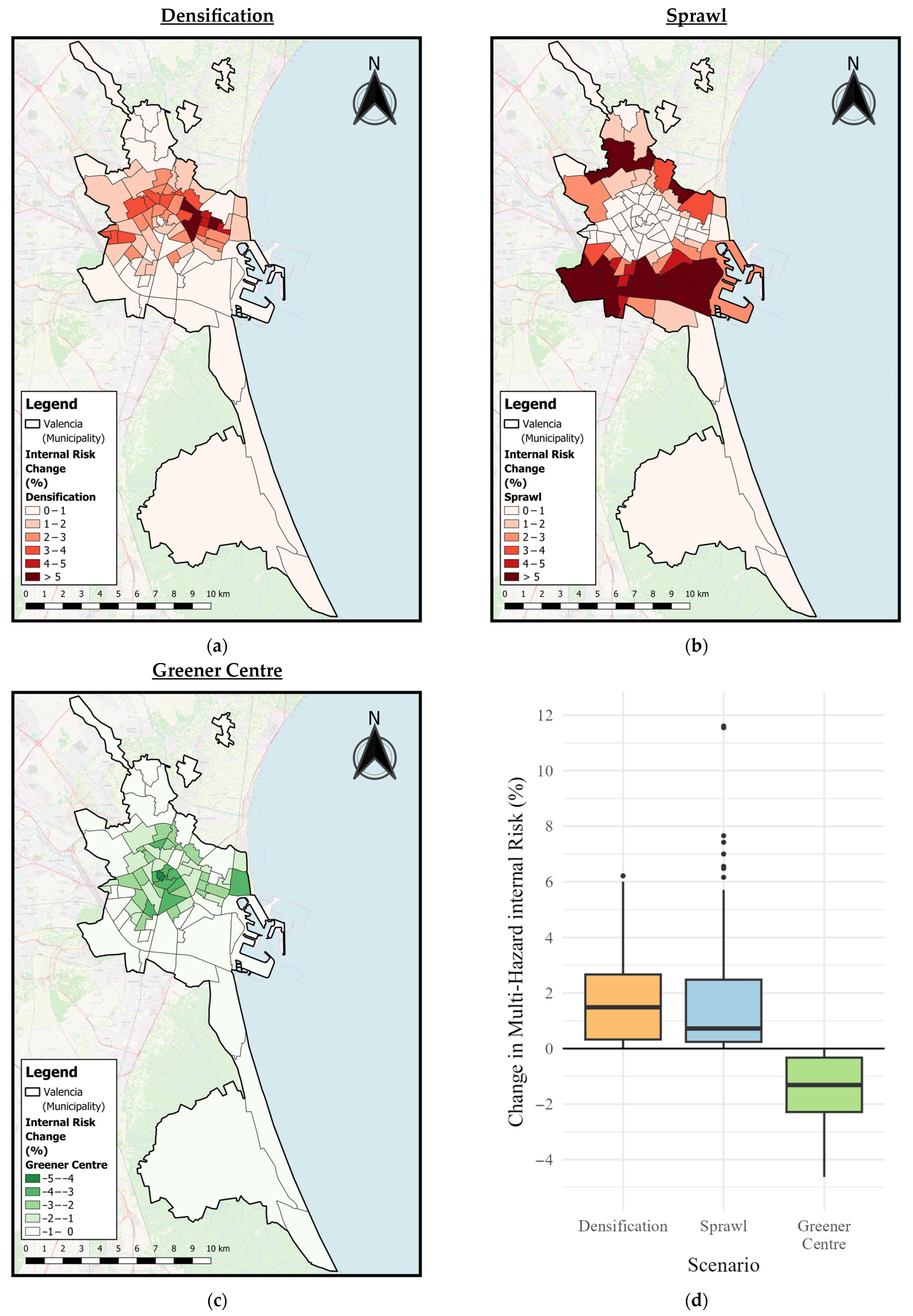
Over the entire study area, the Densification scenario caused a 1.82% increase in internal risk, Sprawl increased it slightly less by 1.63%, and the Greener Centre scenario led to a 1.66% decrease in internal risk. Considering individual neighbourhoods, the Densification scenario (see
Figure 7a) caused a significant increase (Wilcoxon signed-rank test with continuity correction:
V = 16,
n = 87,
p < 0.001) that reached up to 6.21%. The changes in the Sprawl scenario, shown in
Figure 7b, also led to significant increases (Wilcoxon signed-rank test with continuity correction:
V = 9,
n = 87,
p < 0.001), reaching as high as 11.61%. Compared to the baseline scenario, the Greener Centre scenario had a positive effect (Wilcoxon signed-rank test with continuity correction:
V = 3806,
n = 87,
p < 0.001), visualised in
Figure 7c. The maximum decrease was 4.62%. For each scenario, the change in internal risk per neighbourhood compared to the baseline is illustrated with a boxplot in
Figure 7d.
A closer inspection of the geographical distribution reveals that in the Sprawl scenario the increase is relatively evenly distributed throughout the areas that were affected by the land use change. For the Densification and Greener Centre scenarios, despite an equal amount of land use change taking place within the same geographical boundaries, the most affected neighbourhoods only partially overlap. The main area of change in the Densification scenario lies in the north of the city centre, especially the neighbourhoods containing the Turia Gardens. In contrast, the Greener Centre scenario appears to particularly benefit areas further towards the south of the city centre and the city’s nucleus.
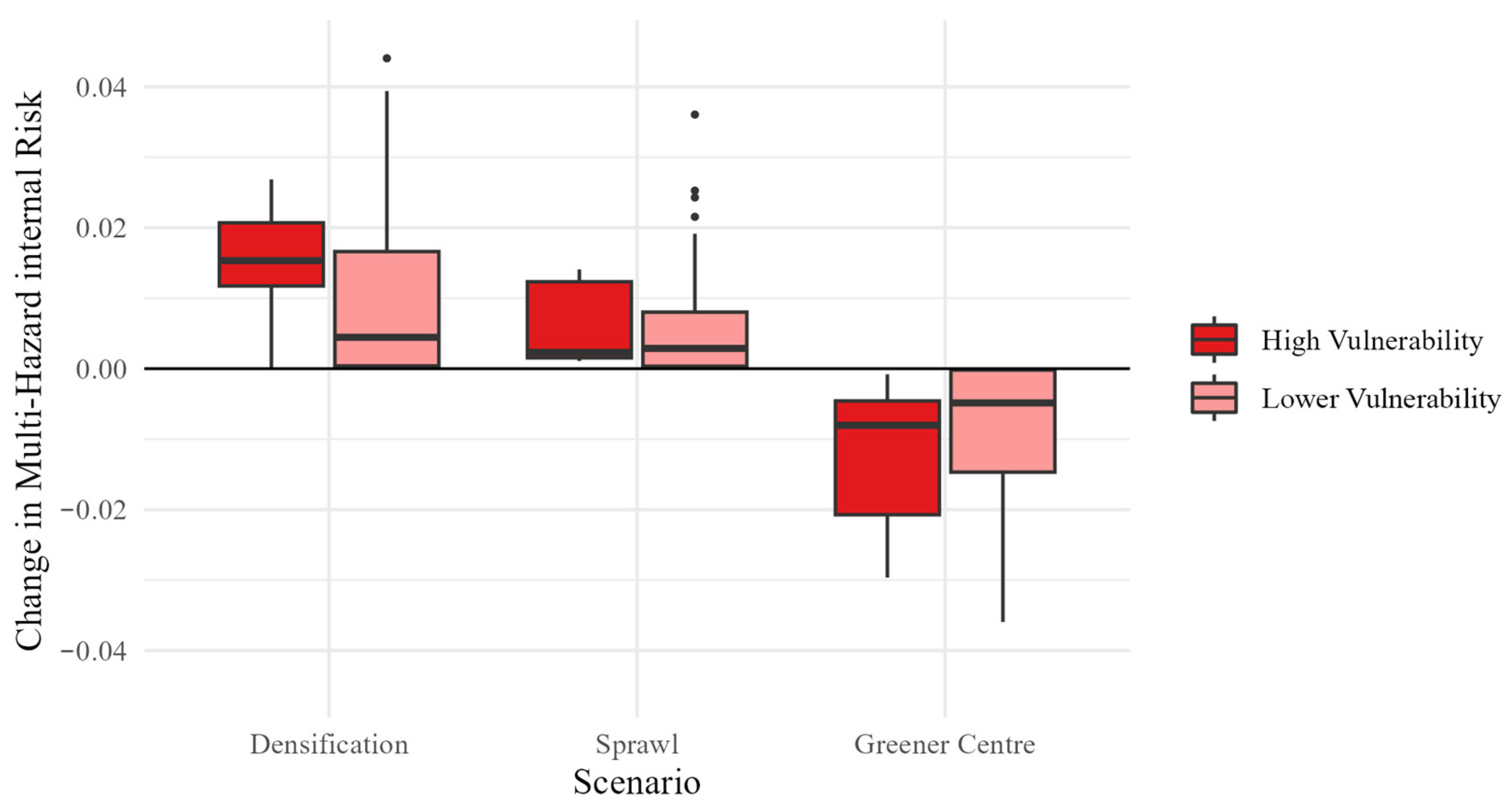
In all three scenarios, no significant differences were found between the most socially vulnerable neighbourhoods and the rest of the municipality, in either absolute or relative terms. However, as shown in
Figure 8, the Densification scenario is associated with a trend towards an increase in absolute multi-hazard internal risk for the socially vulnerable in particular (Mann–Whitney U test:
W = 492,
n1 = 9,
n2 = 78,
p = 0.051). Moreover, the Sprawl scenario seems to display a slight, yet far from significant, tendency in the same direction. The Greener Centre scenario shows the opposite tendency, benefiting neighbourhoods with high social vulnerability more.
4. Discussion
4.1. Assessment of Internal Risk
The overall assessment of internal risk, both hazard-specific and in a multi-hazard context, revealed an interesting pattern, reflecting the different overall trends of ES provision decreasing towards the centre and population density and social vulnerability being unevenly distributed but especially high within the periphery of the city’s nucleus. This can give an indication of which neighbourhoods might need most attention when it comes to internal risk associated with these two hazards.
4.2. The Synergy of Heat Mitigation and Runoff Retention
The results for heat mitigation and runoff retention reveal consistent and typical patterns. Urban and built-up areas generally lack ES provision, while suburban, rural, and forested areas display lower values of vulnerability due to higher ES provision [
63]. There is a strong correlation between ES supply relevant to heatwave and flood vulnerability. This highlights the synergistic relationship between heat mitigation and runoff retention, as found in previous literature. However, the results shown here as well as past studies also reveal differences in the distribution of this effect such as the more even distribution of runoff retention throughout Valencia [
64]. Further testing is required to evaluate the exact mechanisms of this disparity, but it may be partly caused by the urban heat island effect, which represents a feedback loop in which larger green (and blue) areas have an increasingly positive effect, thereby causing higher ES provision values in their surroundings. In the calculation of runoff retention, such a feedback loop was absent, meaning there was no effect on the surrounding areas and therefore a more even overall distribution. Understanding and considering these differences in spatial distribution is an important step towards strategically located greening measures that could maximise ES supply with minimal costs.
4.3. Environmental Justice
By integrating the ES supply assessment into vulnerability estimation and comparing it with social vulnerability, significant mismatches were uncovered.
While there was no correlation between aggregated social vulnerability and ES supply, this could be explained by the chosen indicators masking trends due to counteracting patterns along the urban–rural gradient. Indeed, investigating all dimensions of vulnerability individually reveals a diverse pattern in line with previous studies in other locations, which found clear disparities in access to urban green infrastructure, depending on social vulnerability [
28,
29,
30].
The negative correlation between the percentage of foreigners and ES supply may be partly explained by the fact that immigrants tend to settle in dense urban areas (with less ES provision), where there are more job opportunities [
65]. However, a more in-depth investigation of the specific context of Valencia would be required to validate this finding and its causes. A contrary trend was found for neighbourhoods with high percentages of adults without a high school degree, which correlated with higher ES provision. This may be at least partially attributed to the urban–rural gradient since urban areas tend to have higher average levels of education [
66]. However, more detailed socio-geographic data and further investigation are required to identify the mechanisms behind this pattern.
Additionally, runoff retention was lower in neighbourhoods with a high unemployment rate. A more in-depth analysis would be required to explore the causes of this correlation. Yet, this further showcases the possibility of an unjust distribution of green and blue infrastructure and the disaster risk protection they provide. The fact that this relationship is only significant for ESs relevant for flood protection highlights the importance of considering different ESs individually.
These results do not only showcase how the established framework can help identify cases of environmental injustice, which in turn may inform decision-makers about which areas should be prioritised. They also highlight the importance of addressing individual dimensions of vulnerability like the disproportionate threat that heatwaves pose to foreigners and that floods pose to foreigners and unemployed people.
Nonetheless, the simplifications of this approach for determining social vulnerability should be considered. While all four indicators have been used in previous literature [
23,
43,
45,
46], it is difficult to assess the degree to which they influence the level of social vulnerability, especially for the specific case of Valencia. The percentage of foreigners can be used as an example to illustrate this. There could be striking differences in vulnerability within this group. Generally, it can be assumed that foreigners are, on average, less likely to speak the local language and are less familiar with local emergency plans and behaviours [
15]. However, the socioeconomic makeup within this group substantially affects actual susceptibility and coping capacity. The current approach does not consider potential differences within this group between neighbourhoods regarding actual fluency in Spanish or Valencian, immigrant status, income, ethnicity, and country of origin, all of which might have relevant consequences for disaster risk vulnerability [
67,
68].
4.4. Scenarios
Assessing multi-hazard internal risk for different land use scenarios offers valuable insights into changes in ES provision. While the approach of this study was to show the effects of general urban development trends, this can be adapted easily to study the impact of specific infrastructure projects. Ideally, this should also consider related changes to the population structure. In the scenarios of this study, population density and structure (such as age) were held equal to the baseline scenario. This means the scenarios did not reflect the expected (and hypothetical) changes in exposure and social vulnerability due to shifts in population structure and an increasing percentage of elderly residents [
40]. On the other hand, this allowed for the direct assessment of impacts induced solely by changes in ES provision.
The results of the scenarios clearly show that land use planning decisions have a significant impact on overall disaster risk. While the absolute percentage point change was relatively small (between 1.63 and 1.82 percentage points), it should be taken into account that these changes are the average result across the entire municipality. Only 0.74% (in the Densification and Greener Centre scenarios) or 3.71% (in the Sprawl scenario) of the overall area’s land use class was changed.
Looking at the specific scenarios reveals that while the median and average change in the Sprawl scenario was lower than in the Densification scenario, the maximum change per neighbourhood was more than twice as high. This can be attributed to the fact that the changes in the Sprawl scenario took place predominantly in neighbourhoods that have low internal risk to begin with, which caused small increases in internal risk to have a stronger relative effect. This is put into perspective when comparing the overall effect of the changes on the entire study area. Even though in the Sprawl scenario the area that was converted to built-up land was five times larger than in the Densification scenario, the overall increase was lower in the Sprawl scenario (1.63% compared to 1.82%). This could prompt the misleading assumption that, from a disaster risk perspective, sprawl might be preferable to increased densification if urban expansion must occur. This is further supported by other studies that investigated the relationship between urban morphology and disaster risk. In these, high urban density or densification correlated with disproportionately higher heat-induced health impacts and flood risk compared with low density or sprawl [
69,
70]. Besides neglecting the negative effects of sprawl beyond disaster risk, this does not consider that densification in existing cities does not necessarily equal a reduction in green areas. Densification can also include renovating unused space or the conversion of office spaces into housing. Thus, the results of these scenarios should not be interpreted as arguments in favour of sprawl but rather highlight the relevance and impact of existing urban green infrastructure. A reduction in green areas and open spaces in the centre has a negative impact more than five times as severe as that of a similar reduction in the city’s periphery. This is in line with previous studies that showcase the higher relative importance of smaller green areas in dense urban environments in which green areas are sparse, and they (as well as their functions) cannot be as easily replaced due to spatial constraints [
71,
72]. The Greener Centre scenario showed the possible positive effect of additional green spaces, especially for areas further away from existing major parks such as the Turia Gardens. This even holds true when the introduction of additional green spaces is, as simulated here, not specifically designed to maximise either heat mitigation or runoff retention.
Similar to the overall scenario analysis, the additional angle of considering social vulnerability highlighted that the existing urban green spaces in the city centre are especially essential for socially vulnerable neighbourhoods. A decrease disproportionately affects neighbourhoods with high social vulnerability. The fact that this trend is only observable in absolute terms, while the percentage change for these neighbourhoods does not differ as much from that for the rest of the municipality, could be attributed to the already high internal risk in the baseline scenario.
4.5. Limitations
For optimal and cost-effective risk management, it should be noted that the inclusion of hazard assessment is essential for the identification of areas that should be prioritised. Low ES supply and subsequent high internal risk in a neighbourhood might, in theory, still correspond to low overall risk due to low hazard probability (for example, because of topographic conditions hindering the development of flood events). In contrast, high ES supply and low internal risk might still not prevent possible disasters if those neighbourhoods are disproportionately affected by high hazard intensities. Integrating hazard into the assessment would also allow for a different weighting of the two considered hazards. Therefore, the results of the internal risk assessment shown in this study, while providing valuable insights into the socio-ecological dimensions of risk, do not replace a complete risk analysis including hazard assessment but are merely a proposed integral step. This risk assessment should then be followed up by an intensive validation phase by including uncertainty analyses and comparing the outputs with other approaches and locally available models.
Additionally, the weighting between different social vulnerability indicators and between overall social vulnerability and ES provision represents a factor which should be considered for future studies. While the sensitivity analysis showed that the ranking of neighbourhoods in terms of social and overall vulnerability was relatively robust under the equal weight assumption, the weighting schemes still impact the results. If available, future applications should refine weights by integrating local empirical evidence, expert judgement, and/or stakeholder input.
Another factor worth expanding on is the inclusion of additional indicators such as those that reflect the negative impacts disasters can have on ecosystems themselves, since these can subsequently decrease ES provision [
19].
5. Conclusions
Generally, the developed risk framework and its application to the study area of Valencia were able to highlight the relevance of ESs as determinants of vulnerability to multiple hazards, emphasising disaster risk as a phenomenon within a complex social–ecological system. The framework shows how InVEST models can be incorporated into the risk assessment process to adequately identify areas that need particular attention in terms of vulnerability and environmental justice under present conditions. It can also illustrate possible impacts of future land use change and urban planning initiatives.
Due to the low data requirements and modularity of the overall framework and InVEST software, this approach can be adapted to other study areas and scenarios, integrating local conditions and, where available, more advanced modelling. There is also potential for an expanded focus on the multi-dimensionality of risk in subsequent applications of the framework. For example, future applications could include indicators representing the exposure and vulnerability of economic, cultural, and ecological assets.
Additionally, future research should advance this study’s outcomes by integrating the hazard component to conduct an overall risk assessment. Furthermore, by comparing the framework with other approaches, conducting uncertainty analyses, integrating expert judgement and involving stakeholders, the indicator selection and weighting should be validated and refined to enhance the accuracy of the model for local conditions. This will ensure its applicability for decision-making in urban planning and disaster risk management. Through the information provided by the results, this framework can then be used to implement efficient and cost-effective measures by prioritising key issues, disadvantaged population groups (foreigners and unemployed people in the case of Valencia), and leveraging synergies.