Article

A Source-Oriented Ecological and Health Risk Assessment of Soil Heavy Metals in a Small Watershed of Henan Province, China: A Coupled PMF-RI/PMF-HRA Approach

School of Public Administration and Law, Northeast Agricultural University, Harbin 150030, China
*
Author to whom correspondence should be addressed.
These authors contributed equally to this work.
Land 2026, 15(6), 982; https://doi.org/10.3390/land15060982 (registering DOI)
Submission received: 30 March 2026 / Revised: 27 May 2026 / Accepted: 2 June 2026 / Published: 3 June 2026

Abstract

The quantitative identification of heavy metal sources is essential to clarify their relationships with ecological and health risks. This study focused on the Manghe Watershed in Jiyuan City, Henan Province, China, integrating the Positive Matrix Factorization (PMF) model, ecological risk index (RI), and health risk assessment (HRA) to construct a coupled PMF-RI/PMF-HRA framework to quantify source-specific risk contributions and propose targeted mitigation strategies. Key findings included: (1) Among the 121 surface soil samples, Cr and Ni showed natural background levels, while Cd, Pb, Hg, Zn, As, and Cu exceeded regional backgrounds by 1.63–33.65 times with anthropogenic-driven spatial heterogeneity. (2) The PMF identified four sources: natural–agriculture mixed (42.65%), the main contributor to Cr, Ni, As, and Cu; industrial activity (24.99%), the primary source of Cd and Zn; traffic–agriculture mixed (20.99%), primarily emitting Pb and As; and coal combustion (11.36%), dominating Hg emissions. (3) Ecological and health risks were governed by heavy metal toxicity and exposure pathways rather than mere concentration levels. Specifically, industrial sources (Cd, Zn) should be prioritized for ecological risk control, whereas natural–agricultural mixed sources (As, Pb, Cr) should be prioritized for health risk control. Oral ingestion was the dominant exposure pathway for both non-carcinogenic risk and carcinogenic risk in children, with the natural–agricultural mixed source contributing the most to this pathway. (4) The total carcinogenic risk (TCR) for children was 1.17 × 10⁻⁴, which exceeds the commonly accepted unacceptable threshold of 1 × 10⁻⁴, indicating a potential carcinogenic concern. (5) The PMF-RI and PMF-HRA frameworks quantitatively proved that the main sources of ecological risks and health risks may be completely different, and this phenomenon was jointly regulated by the toxicity response coefficient and exposure pathways. A “source–risk-pathway” quantitative attribution was achieved and provides clear support for targeted interventions, emphasizing source control for industrial emissions (Cd-Zn), traffic–agriculture inputs (Pb-As), and coal-derived Hg, alongside optimized agricultural practices.

1. Introduction

As the industrial and agricultural sectors surge forward and cities keep sprawling, the problem of soil heavy metal contamination has transformed into a multifaceted safety concern that threatens both environmental health and public well-being [1,2]. Heavy metals enter soils through various pathways, including industrial wastewater discharge, surface runoff, and atmospheric dry–wet deposition [3,4,5]. Due to the interfacial, heterogeneous, and dynamic nature of soil, heavy metal contamination exhibits characteristics of concealment, latency, accumulation, and irreversibility [1,6]. The continuous accumulation of heavy metals in soil can result in the degradation of soil structure, subsequently causing nutrient loss and ecological function deterioration [7,8]. Moreover, heavy metals can enter the human body through bioaccumulation in food chains, respiratory inhalation, and dermal contact, leading to adverse effects on the neurological, digestive, hematopoietic, and immune systems [9,10], with long-term exposure potentially increasing cancer risks [11]. Therefore, the precise evaluation of heavy metal spatial distributions, the identification of potential pollution sources, and the quantification of ecological and human health risks are critical components of soil pollution prevention and control.
The identification of sources contributing to soil heavy metal contamination is a critical component of risk management. Sources of heavy metal contamination are categorized into natural and anthropogenic origins [12,13]. Natural sources are primarily governed by local soil parent materials and geological structures [14] while anthropogenic sources are closely linked to human activities, including agricultural practices, mining, and transportation, etc. [15,16,17]. Among source apportionment methods, receptor models have been widely adopted because of their efficiency and accuracy [18], like Positive Matrix Factorization (PMF) [19], Principal Component Analysis-Multiple Linear Regression (PCA-MLR) [20], Absolute Principal Component Scores-Multiple Linear Regression (APCS-MLR) [21], Unmix Model (UNMIX) [22], and Chemical Mass Balance (CMB) [23], etc. Notably, the PMF model demonstrates exceptional advantages: it eliminates the need for predefined source profiles through automated source identification, enhances result reliability by weighting each data point with uncertainty analysis, enforces non-negative constraints to ensure physically meaningful source contributions, and precisely allocates source contribution rates for individual heavy metals [19,24]. Combined with principal component analysis (PCA) and the Positive Matrix Factorization (PMF) model, the effects of TMs and contamination sources on ecological risks were revealed [25]. These attributes have established PMF as a mainstream approach for the source apportionment of heavy metals in diverse environmental media such as soil and atmosphere.
An accurate assessment of soil heavy metal pollution is critical for effective control and remediation. This encompasses evaluating the level of contamination and assessing the risk [26,27]. Current heavy metal risk assessment models primarily focus on quantifying pollution levels but fail to identify the specific pollutants and their sources that should be prioritized for control, particularly the key drivers of ecological and human health risks [28]. For instance, certain heavy metals may contribute significantly to overall soil pollution levels but minimally to ecological or health risks [29]. Due to the diversity of pollution sources and variations in land-use practices, the composition and risk levels of heavy metals can differ significantly among different sources [30,31]. Thus, pollution risk assessment should emphasize source-oriented risk evaluation to clarify the contributions of various sources to contamination and their differential risk profiles, thereby providing a scientific basis for prioritizing control targets [32,33,34]. This approach is essential for disentangling the relationships among heavy metal sources, ecological risks, and human health risks. To address the needs above, the Positive Matrix Factorization (PMF) model has been extensively employed in source apportionment and risk management studies of soil heavy metal pollution. This model does not necessitate a pre-specified source profile and can quantitatively determine the contribution rates of various pollution sources, thus establishing itself as a crucial tool for source apportionment [35,36]. Coupling the PMF model with ecological and human health risk assessment models enables the integration of pollution source identification, contribution quantification, and source-specific risk evaluation, thereby overcoming the drawbacks of traditional overall risk assessments that are unable to distinguish source-specific hazards [37]. When combined with spatial analysis, the bioavailability correction of heavy metals, and other methods, this coupled framework can precisely uncover differences in ecotoxicity and health risks associated with various anthropogenic and natural sources, offering a scientific foundation for precise soil pollution control at the regional scale [38]. Nevertheless, current research still has significant limitations: most coupling studies only combine the PMF model with a single risk model (e.g., either ecological risk or health risk), making it arduous to reveal the three-dimensional “source–risk-exposure pathway” relationship. Moreover, the impacts of heavy metal speciation and spatial heterogeneity on source–risk coupling results are frequently neglected [39].
This study selected the Mang River watershed in Jiyuan City as the research area to systematically investigate the pollution characteristics, sources, and associated risks of soil heavy metals under the context of intensive mining activities. The specific objectives are as follows: (1) To reveal the spatial distribution patterns and contamination levels of soil heavy metals through systematic soil sampling, elemental analysis, statistics and geostatistics analysis, and spatial interpolation methods; (2) To quantitatively identify the primary pollution sources and their respective contribution rates by applying correlation analysis and the Positive Matrix Factorization (PMF) model; (3) To assess potential risks to ecosystems and human health using the ecological risk index (RI) and the human health risk assessment (HRA) model; (4) To analyze the contribution of different pollution sources to ecological and health risks through integrated PMF-RI and PMF-HRA models. The findings of this study can provide scientific support for pollution prevention, remediation, and sustainable development in the Manghe River watershed, as well as a reference framework for heavy metal management in similar mining-affected regions.

2. Materials and Methods

2.1. Study Area

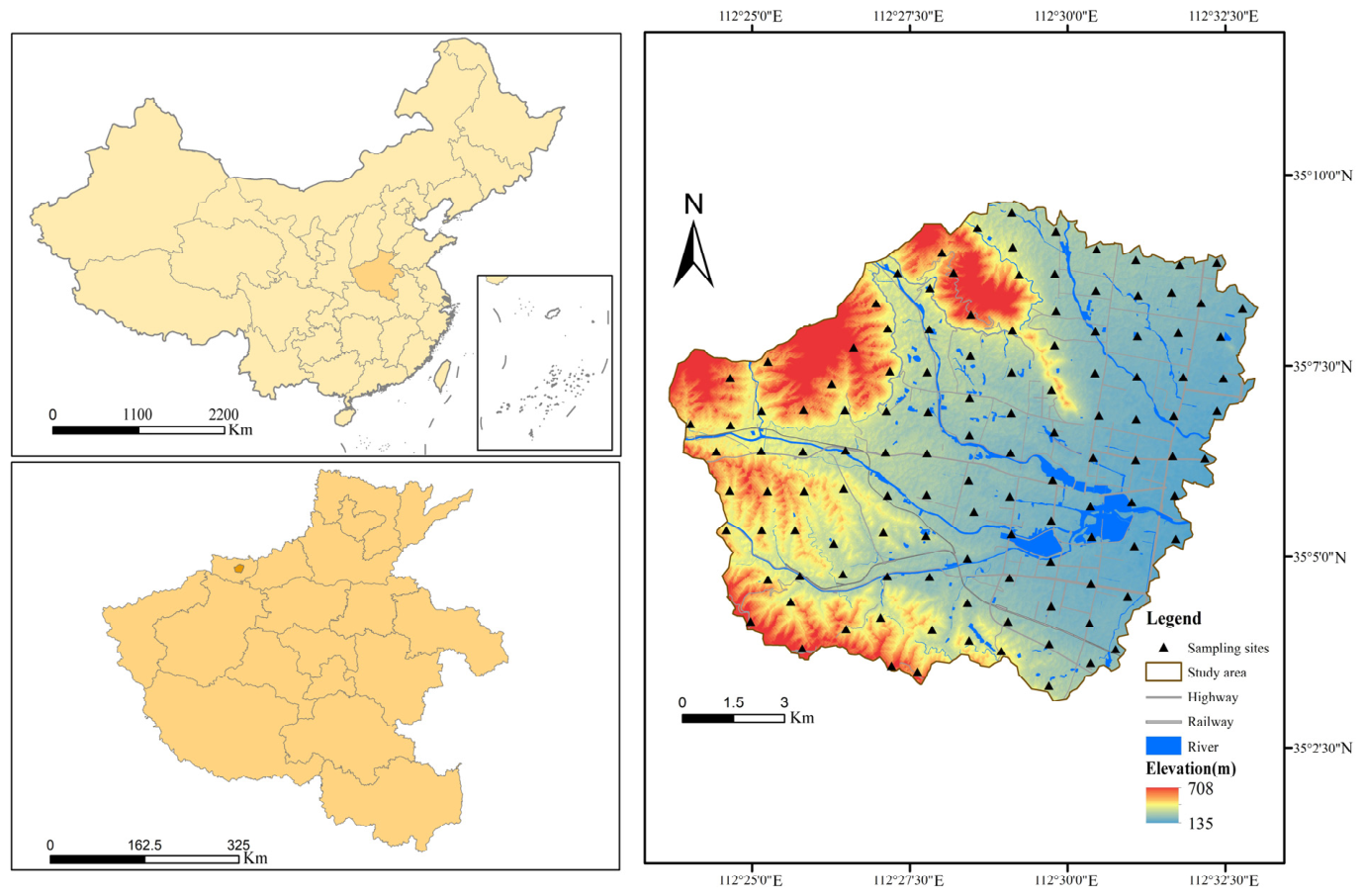
The Mang River basin spans an area of 112.82 km2 and administratively covers 73 villages in Jiyuan City. Geographically located between 112°23′37″–112°33′2″ E and 35°3′4″–35°9′40″ N (Figure 1), the region features western highlands transitioning to eastern lowland plains. The west is dominated by dense forests, while the east supports intensive agriculture and rural settlements. Classified as a temperate monsoonal zone, the area has an annual mean temperature of 14.5 °C and receives an average annual precipitation of 567.9 mm, which is distributed unevenly across the seasons. Pedologically, there are two main soil types—tidal soil and brown soil—both with neutral pH values. Historically, the Mang River basin has been influenced by the resource-based development of Jiyuan City. According to the Mineral Resources Master Plan of Jiyuan City (2021–2025) [40], the exploited mineral resources mainly include coal, bauxite, iron ore, limestone, dolomite, and other building-material minerals, and mining-related activities remain part of regional resource development. Driven by mineral exploitation, the regional economy has developed metallurgical and chemical manufacturing as its core industrial sectors. These industrial activities coexist with traditional agriculture and rural settlements in the basin, forming an agricultural watershed affected by mining-related and industrial activities.

2.2. Soil Sampling and Laboratory Processing

Soil sampling sites were systematically pre-designed on a 1 × 1 km grid system through the geospatial analysis of satellite imagery, followed by on-site verification and precise coordinate confirmation via portable GPS equipment (Garmin eTrex 30×, Garmin Ltd. (Olathe, KS, USA)). Composite soil samples (1 kg) were generated by mixing five subsamples (0–20 cm depth) collected through quincunx sampling and quadrant partitioning techniques. Post-collection procedures involved debris removal, ambient air desiccation, and mechanical pulverization to achieve particles < 150 μm (100-mesh). For elemental analysis, microwave-assisted digestion (MASTER-40, SINEO (Shanghai, China)) was performed using a four-acid regime (HNO3-HCl-HF-HClO4). Element quantification employed diversified spectroscopic approaches (ICP-OES, Avio 220 Max, PerkinElmer (Waltham, MA, USA)): Cr, Cu, Zn, and Ni were measured through a flame atomic absorption spectrometer; Pb and Cd via a graphite furnace atomic absorption spectrometer; Hg using a mercury vapor atomic absorption spectrometer; and As through a hydride generation atomic fluorescence spectrometer. Triplicate measurements ensured analytical consistency, with intra-assay variations constrained to <5% RSD. Method validation incorporated certified reference material GBW07403 (GSS-3) from the National Institute of Metrology, China, demonstrating satisfactory accuracy (recoveries 90–110%) and precision (RSD < 5%). Instrument detection thresholds were established as follows: Cr (2), Hg (0.0003), As (0.05), Pb (1), Ni (1), Cd (0.02), Cu (1), and Zn (2) mg/kg. Statistical screening via Grubbs’ test eliminated aberrant data points, resulting in 121 validated soil datasets for comprehensive geochemical evaluation.

2.3. Pollution Assessment Models

2.3.1. Geo-Accumulation Index (Igeo)

The geo-accumulation index (Igeo), which accounts for the effects of diagenesis and anthropogenic disturbances on heavy metal accumulation, serves as a quantitative tool for assessing heavy metal contamination in soils [41]. Its calculation formula is:
I g e o = l o g 2 C i k × C n i
where k denotes the correction coefficient (value = 1.5) to eliminate the influence of regional geochemical background heterogeneity on assessment results; Ci refers to the measured concentration of target heavy metals (mg/kg); C n i represents the soil background values of Henan province (mg/kg). The pollution classification criteria for Igeo are presented in Table 1.

2.3.2. Improved Nemerow Index (INI)

To address the limitations of the traditional Nemerow Index method, which underestimates the ecological risks of highly contaminated elements due to insufficient pollution weight allocation [42], this study introduces the Igeo for methodological optimization. The improved model achieves a comprehensive assessment of multi-metal composite pollution by coupling the extreme and mean values of contamination intensity [43]. The computational formula is expressed as:
I N I = I g e o M A X 2 + I g e o A V E 2 2
where INI denotes the composite pollution index, reflecting the integrated contamination load at sampling sites; IgeoAVE and IgeoMAX represent the average value and the maximum value of Igeo among detected heavy metals, respectively. The classification system is provided in Table 1.

2.4. Source Apportionment

The PMF (Positive Matrix Factorization) model is a receptor-based source apportionment method recommended by the USEPA (United States Environmental Protection Agency) [44]. It has gained widespread application in source identification and contribution estimation across a variety of environmental media, including atmospheric particulate matter, soil contaminants, and water sediments [45,46,47]. Mathematically, the PMF model decomposes the original data matrix X into three components: the factor score matrix (G), the factor loading matrix (F), and the residual error matrix (E) using the matrix decomposition method. The calculation formula is as follows:
X i j = k = 1 P G i k F k j + e i j
where Xij is the concentration of heavy metal j in the soil sample i; P denotes the number of pollution sources; Gik represents the contribution of factor K to the soil sample i; Fkj indicates the content of heavy metal j in factor k; and eij is the error term. PMF derives the factor contribution matrix G and the factor profile matrix F by minimizing the objective function Q, as expressed by the following equation:
Q = i = 1 n j = 1 m ( e i j u i j )
where m is the number of heavy metals measured; n denotes the number of soil samples; uij signifies the uncertainty associated with the concentration of the jth heavy metal in the ith soil sample, calculated through a categorical discussion based on the Method Detection Limit (MDL).
If the concentration of the jth heavy metal in the ith soil sample is below or equal to the MDL, Formula (5) should be used; otherwise, Formula (6) should be applied.
u i j = 5 / 6 × M D L
u i j = ( e r r o r f r a c t i o n × c ) 2 + ( 0.5 × M D L ) 2
In this study, the number of factors was set from 3 to 7, with 20 iterations performed for each run to reduce analytical bias. The results showed that with three factors, most residual values were stably distributed within the interval [−3, 3], and the relative error between Qrobust and Qtrue did not exceed 25%. Notably, when the number of factors increased from 3 to 4, the Qtrue/Qexp ratio exhibited a clear turning point. Based on the above mathematical analysis, selecting four factors for source apportionment was considered the most appropriate. In the four-factor PMF model, the goodness-of-fit (r) values for the majority of elements exceeded 0.6, which can be classified as “strong”; the signal-to-noise (S/N) ratios for all elements were greater than 8.0. These results indicate that using four factors in the PMF source apportionment adequately meets the requirements for the source apportionment of soil heavy metal health risks.

2.5. Risk Assessment Models

2.5.1. Potential Ecological Risk Model

Proposed by Swedish aquatic ecologist Hakanson, the potential ecological risk index (RI) integrates heavy metal toxicity with environmental ecological effects to assess potential ecological risks [48]. This assessment framework quantifies the ecological hazard potential of heavy metals through toxic response coefficients (Ti) and a hierarchical assessment system, which incorporates single-element risk indices (Ei) and a comprehensive risk index (RI). The computational formulas are expressed as:
E i = C i × ( T i C n )
R I = i = 1 n E i
where Ei represents the potential ecological risk index of heavy metal i; Ti denotes the toxicity response coefficient for heavy metal i; Ci and Cn refer to the measured concentration and background concentration of heavy metal i, respectively; and RI signifies the comprehensive ecological risks from multi-metal interactions. The level of ecological risk is defined in Table 2.

2.5.2. Health Risk Assessment

The human health risk assessment model links pollutant exposure to health risks by quantifying the dose–response relationship between environmental pollutant concentrations and toxicological effects [49]. This model incorporates behavioral and physiological differences between children and adults in exposure scenarios and therefore needs to be assessed separately [50]. Soil heavy metals impact human health primarily via three pathways: oral ingestion, respiratory inhalation, and dermal contact, and their non-carcinogenic health risks and carcinogenic health risks to adults and children are as follows:
A D D i n h = C i × I R × E F × E D P E F × B W × A T
A D D i n g = C i × I R × C F × E F × E D B W × A T
A D D d e r = C i × C F × S A s × A F × A B S d × E F × E D B W × A T
H Q i = A D D i R f D i
H I = i = 1 n H Q i
T H I = i = 1 n H I
C R i = A D D i × S F i
T C R = i = 1 n C R i
where ADDinh is the average daily exposure to pollutants inhaled through the respiratory tract (mg/(kg·d)), ADDimg is the average daily exposure to pollutants via oral intake (mg/(kg·d)), and ADDder is the average daily exposure to pollutants through dermal contact (mg/(kg·d)); Ci represents the measured concentration of heavy metal (mg/kg); CF is the mass conversion factor (1 × 10⁻⁶ kg/mg); EF denotes the exposure frequency, ED refers to the exposure duration, SAS is the exposed skin surface area, AF is the skin adhesion factor for soil, ABS is the dermal absorption factor, BW is the body weight of the individual, AT is the average exposure time, and PEF is the particle emission factor. HQi is the hazard factor of a single heavy metal via one exposure pathway in non-cancer risk assessment; RfD represents the reference dose of a heavy metal (mg/kg/day); SF denotes the slope factor (mg/kg/day); HI is the non-cancer risk score for a single substance; THI represents the cumulative non-carcinogenic risk index from multiple heavy metals across all exposure pathways; CRi is the carcinogenic risk index for a single substance; TCR is the total carcinogenic risk index for multiple heavy metals across all exposure pathways.
The values of the exposure factors and toxicity parameters used for the calculation are listed in Table 3 and Table 4, respectively.

2.6. Risk Assessment Model Based on PMF

To address the limitations in pollution source contribution analysis and risk quantification, this study introduces coupled PMF-RI model and PMF-HRA model, aiming to clarify the contributions of different pollution sources to heavy metal contamination and characterize the spatial heterogeneity of their associated risk levels [38].

2.6.1. PMF-RI Model

This methodology integrates PMF-derived source apportionment with RI toxicity-weighted algorithms to systematically unify source identification, toxicity correction, and risk allocation [55]. The contribution proportion of each pollution source to individual heavy metals was first determined based on the PMF output results. Subsequently, the source-divided metal concentrations were obtained by coupling the source contribution ratio with the actual measured contents. Finally, the above partitioned concentration data were substituted into risk assessment formulas to calculate source-specific risk index (RI) and human health risk assessment (HRA) results. Compared with traditional ecological risk assessments, key advancements of this coupled model include: (1) Spatial Coupling Analysis: which explicitly reveals the spatial correlations between specific pollution sources (e.g., industrial emissions, agricultural inputs) and ecological risk hotspots; (2) Priority Control Identification: determines hierarchical control priorities for high-risk pollution sources by integrating source contributions and risk magnitudes.
C i j k = P i j k × C j
R I j k = ( E r i ) j k = T r i × C i j k S i
where C i j k represents the content of the i-th heavy metal from the k-th source in the j-th sample, P i j k denotes the contribution of the i-th heavy metal from the k-th source to the j-th sample, Cj is the total heavy metal content (mg/kg) in the j-th sample, and ( E r i ) j k refers to the combined potential ecological risk posed by the k-th source in the j-th sample.

2.6.2. PMF-HRA Model

The PMF-HRA model is capable of quantifying human health risks associated with soil heavy metals originating from diverse pollution sources. The calculation formulas are:
A D D i j , i n h k = C i j k × I R × E F × E D P E F × B W × A T
A D D i j , i n g k = C i j k × I R × C F × E F × E D B W × A T
A D D i j , d e r k = C i j k × C F × S A s × A F × A B S d × E F × E D B W × A T
T C R i j k = C R i j k = A D D i j k × S F i
H I i j k = H Q i j k = A D D i j k R f D i
where A D D i j k , C R i j k , and H Q i j k respectively represent the average daily intake, carcinogenic risk, and non-carcinogenic risk of the ith heavy metal from the kth source in the jth sample.

3. Results and Discussion

3.1. Analysis of Heavy Metal Pollution

3.1.1. Descriptive Statistics

The statistical analysis of soil heavy metal contamination in the study area was summarized in Table 5. The average concentrations of eight soil heavy metals exhibited significant differences, ranked from lowest to highest as follows: Hg (0.12 mg/kg) < Cd (2.49 mg/kg) < As (19.21 mg/kg) < Ni (27.66 mg/kg) < Cu (32.15 mg/kg) < Cr (55.35 mg/kg) < Pb (100.31 mg/kg) < Zn (128.49 mg/kg). Cr did not exceed the background value of Henan Province, and Ni was nearly identical to it. However, Cd, Pb, Hg, Zn, As, and Cu were 33.65, 5.12, 3.53, 2.14, 1.69, and 1.63 times higher than the respective soil background values. Jiang et al. obtained similar conclusions [56]. The coefficient of variation (CV) was used to further evaluate the spatial heterogeneity of soil heavy metals. Cr (CV = 0.165) and Ni (CV = 0.187) showed moderate variability, suggesting that their spatial distributions may be mainly controlled by parent material, soil-forming processes, and other natural factors. This interpretation is consistent with previous studies indicating that elements with relatively low spatial variability are generally more strongly influenced by natural pedogenic processes [54]. Conversely, Zn (CV = 0.564), Cu (CV = 0.626), As (CV = 0.668), Cd (CV = 0.876), Pb (CV = 1.480), and Hg (CV = 2.341) exhibited high variability and strong spatial dispersion. Such pronounced heterogeneity usually reflects uneven anthropogenic inputs, including industrial emissions, mining or smelting activities, agricultural production, traffic-related deposition, and other localized pollution sources [50].

3.1.2. Spatial Distribution of Heavy Metals in Soil

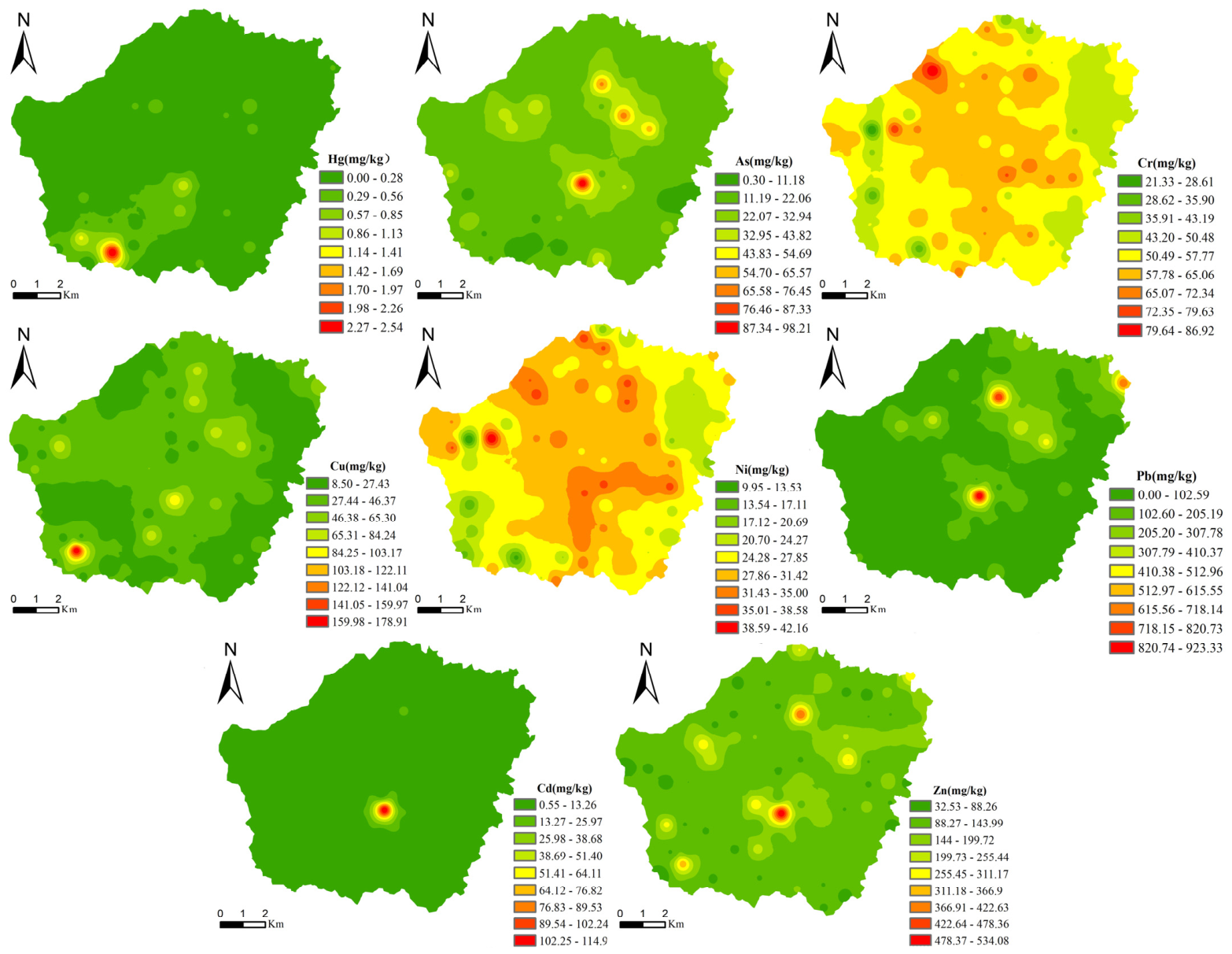
The spatial distribution patterns of eight heavy metals were obtained using Inverse Distance Weighting (IDW) interpolation (as shown in Figure 2). This method was principally simple, insensitive to data distribution, easy to operate, and highly stable for discrete sampling points under a uniform/dense layout. Cr and Ni exhibited similar spatial configurations, characterized by continuous block-like distributions and relatively gentle concentration gradients. As their mean concentrations were close to the regional soil background values, their spatial patterns likely reflect the influence of natural sources rather than intensive external inputs. This interpretation is consistent with previous findings that Cr and Ni in soils are often strongly associated with lithogenic sources and natural soil-forming processes [56]. In contrast, the remaining six heavy metals demonstrated typical spatial response patterns indicative of anthropogenic inputs, with close linkages to local land use types: (1) Hg, Cu, and Cd displayed isolated point-source diffusion features. Hg and Cu showed clustered high-value zones in the southwestern sector, accompanied by secondary dispersion patches. These high-value areas spatially coincided with industrial zones (e.g., smelting plants and coal-fired facilities), suggesting atmospheric deposition from industrial emissions followed by surface runoff. Cd presented an isolated anomalous high-value point in the central-southern region, which was located near a historical smelting waste residue stockpile. (2) As, Pb, and Zn formed composite pollution clusters, manifesting a high-value hotspot in the central study area that extends northeastward with three satellite pollution patches. The chain-like distribution is more likely related to anthropogenic inputs and dispersion attenuation along transport corridors. Traffic activities may promote heavy metal accumulation in surrounding soils through vehicle emissions, tire and brake wear, road dust deposition, and atmospheric settling [57]. Overlay analysis with land use maps revealed that the central hotspot and its northeastward extension closely followed the layout of major roads and highways, with agricultural fields on both sides showing elevated concentrations.

3.1.3. Evaluation of Heavy Metal Pollution

The Igeo evaluation results for the study area were summarized in Table 6. The mean Igeo values of the eight heavy metals, ranked in descending order, were as follows: Cd (4.16) > Pb (0.69) > Zn (0.36) > Cu (−0.03) > As (−0.08) > Hg (−0.32) > Ni (−0.56) > Cr (−0.81). Cr and Ni were predominantly unpolluted, while most sample points of As, Cu, and Zn fell within the unpolluted to light pollution range. Although the mean value of Hg was −0.32 (unpolluted), its samples spanned all seven pollution grades, reflecting substantial spatial heterogeneity in Hg emissions [58]. The mean value of Pb was classified as slightly polluted, yet 31.4% of the samples reached moderate pollution, with 19% showing medium intensity or higher. Cd exhibited severe contamination, with a mean value of 4.16 (strong pollution). Notably, 14.1% of sample points reached extremely strong pollution, 36.4% showed strong pollution, and 41.3% exhibited relatively strong pollution, indicating that the enrichment of this element in the study area has constituted a serious ecological risk [59].
As shown in Table 7, the INI values across the study area ranged from 1.70 to 4.76, with a mean of 2.98, indicating an overall moderate pollution level. The spatial distribution revealed: 4.96% of samples in slight pollution, 50.4% of samples in moderate pollution and 44.6% of samples in severe pollution. This pattern underscored significant regional contamination, necessitating prioritized remediation strategies for Cd and Pb hotspots and enhanced monitoring protocols targeting Hg-enriched areas.

3.2. Source Identification Methodology

Different traceability techniques were employed to systematically identify heavy metals pollution sources in the study area.

3.2.1. Pearson Correlation Analysis

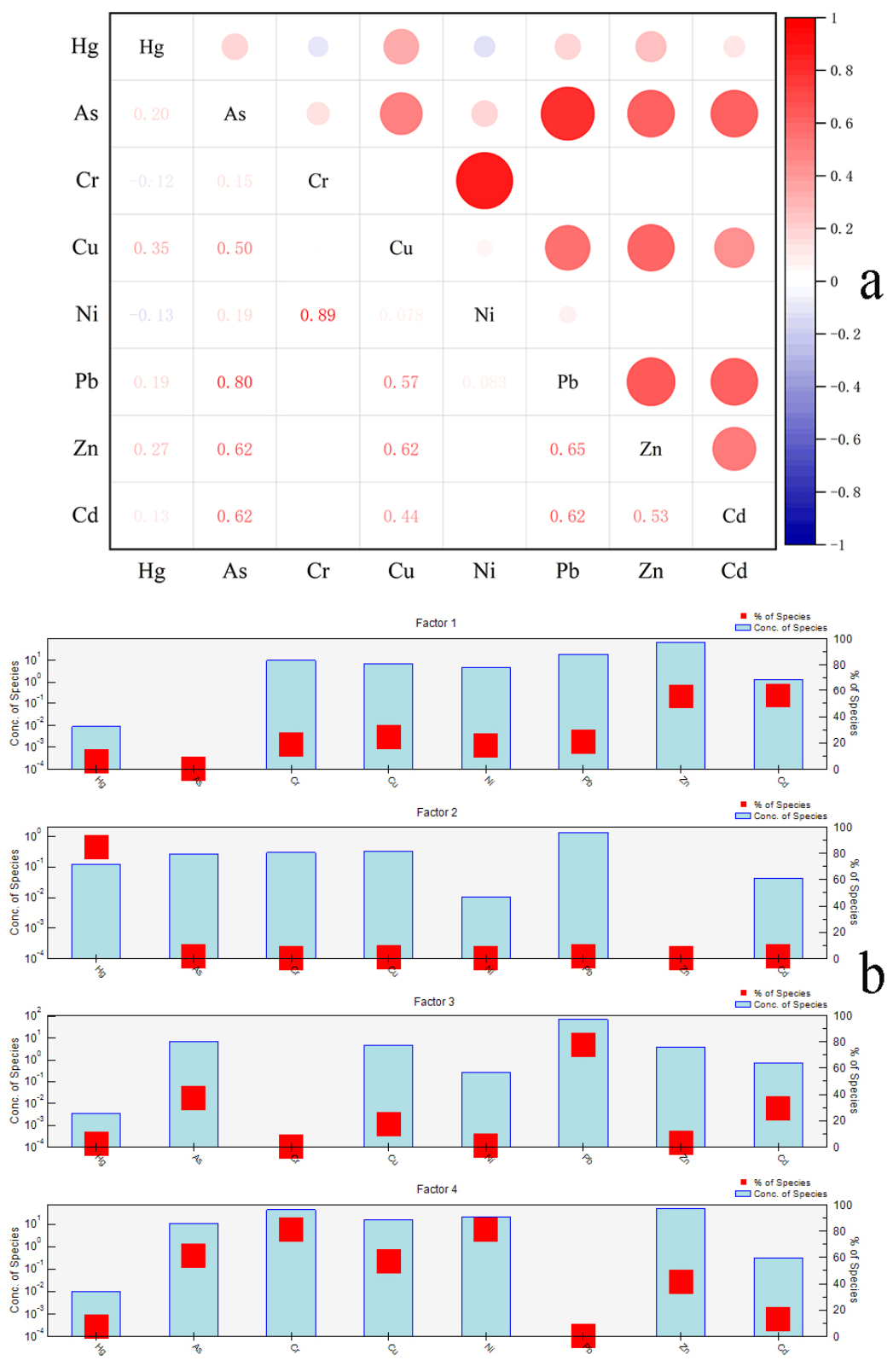
Two distinct clusters were revealed through Pearson Correlation Analysis (Figure 3. Pearson correlation analysis (a), PMF source contribution (b).). Cr-Ni cluster (r > 0.8): strong correlation coupled with background-level concentrations suggested lithogenic origins from the weathering of soil parent materials [60]. As-Cu-Zn-Cd-Pb cluster (r > 0.4): moderate inter-element correlations indicated synergistic contamination from industrial–agricultural composite sources [61,62]. Hg isolation (r < 0.3): weak correlations with other elements implied unique emission pathways.

3.2.2. Quantitative Source Apportionment Using PMF

Factor 1 had a contribution rate of 24.99%, with contribution rates to Cd and Zn of 56.39% and 55.55%, respectively. Previous studies had shown that Cd was an important indicator element of industrial activities [63]; processes such as ore mining, smelting, and electroplating could lead to Cd accumulation in the environment [64]. Furthermore, as the largest lead-zinc smelting base in Asia, Jiyuan City had abundant zinc resources and mining activities [65]. Based on the above evidence, Factor 1 was clearly identified as an industrial activity source. This source composition—where industrial activities dominate Cd and Zn—is typical for industrial–agricultural mixed areas in other Asian regions. For example, a comparable mixture of traffic and agricultural inputs was reported in mixed land-use watersheds in South Korea [20]. The consistency between our findings and these regional studies shows that the chemical characteristics of pollution sources remain stable across similar Asian environments.
Factor 2 had a contribution rate of 11.36%, with a contribution rate to Hg as high as 84.85%. The enrichment of Hg may be attributed to coal combustion-related emissions. Due to its high volatility, Hg can undergo atmospheric transport and subsequent deposition, contributing to regional soil contamination [66,67]. This also explains the high CV and significant spatial heterogeneity of Hg. Therefore, Factor 2 was determined to be a coal combustion source.
Factor 3 had a contribution rate of 20.99%, with contribution rates to Pb and As of 77.76% and 37.32%, respectively. Pb was an important indicator of traffic emissions, mainly originating from vehicle exhaust, engine wear, and tire friction [68]. The dense road network and proximity of sampling sites to traffic routes supported this attribution. The widespread use of pesticides and fertilizers can lead to significant As accumulation in agricultural soils [69]. Thus, Factor 3 was identified as a mixed traffic–agricultural mixed source.
Factor 4 had a contribution rate of 42.65%, with contribution rates to Ni, Cr, As, and Cu of 81.13%, 80.87%, 61.15%, and 56.91%, respectively. The concentrations of Cr and Ni were close to the soil background values of Henan Province, and their pollution assessment indicated a non-polluted level. Numerous studies have shown that Cr and Ni in soils were generally associated with geological activities such as parent material and soil formation processes [23,70]. Therefore, Cr and Ni originated from natural pedogenic processes. Cu was mostly present in the form of copper sulfate in pesticides and fertilizers, while phosphorus fertilizers and zinc sulfate fertilizers contain high levels of As, indicating a close relationship between As and Cu and agricultural production (e.g., the use of various pesticides, fertilizers, and herbicides) [71,72]. Based on the above analysis, Factor 4 was clearly identified as a natural–agriculture mixed source.

3.3. Risk Assessment of Heavy Metal Pollution

3.3.1. Ecological Risks and Their Sources

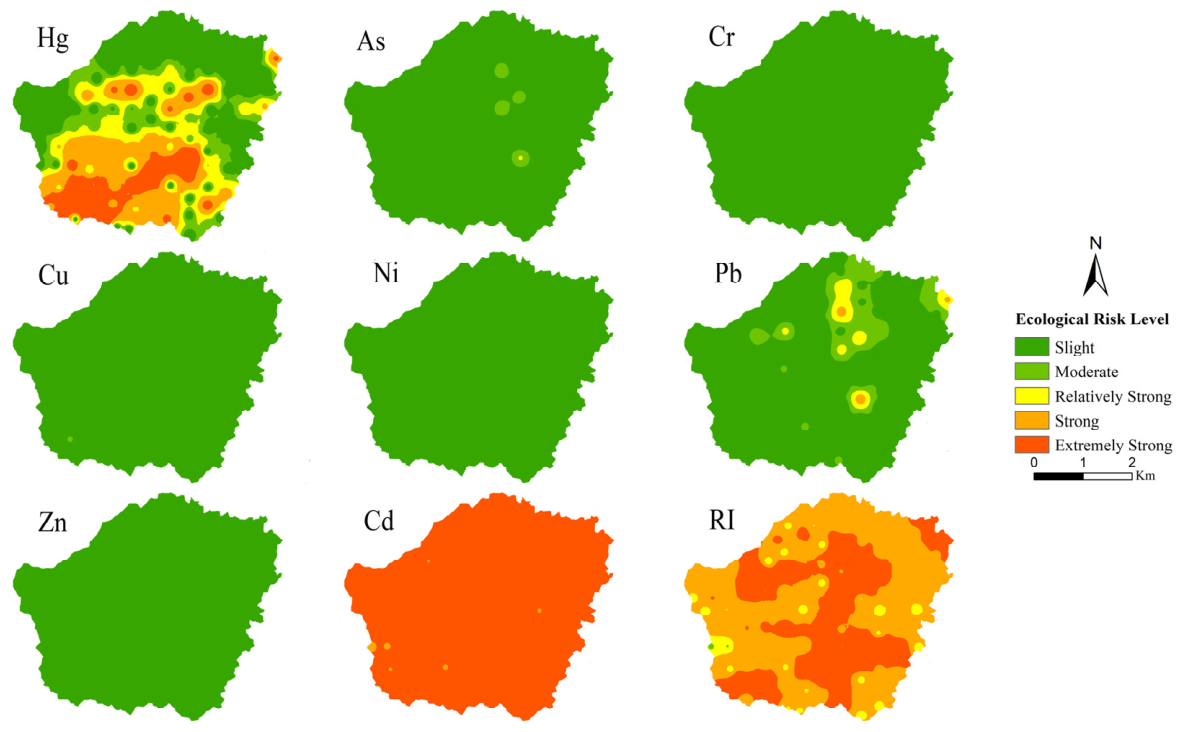
Based on Hakanson’s potential ecological risk index method (Figure 4), the comprehensive ecological risk index (RI) for the study area reached a mean value of 1213.5, indicating an extremely strong ecological risk level. Analysis of individual element risk indices (Ei) revealed the following descending order of mean risk values: Cd > Hg > Pb > As > Cu > Ni > Zn > Cr. Specifically, the mean value of ECd reached over 320 (extremely strong risk), with spatial distribution predominantly classified as very strong (160 < Ei ≤ 320) to extremely strong (Ei > 320) risk levels. The mean value of EHg was 145.06 (strong risk), with spatially heterogeneous distribution of 58.68% slight risk, 5.79% moderate risk, 6.61% strong risk, 14.88% very strong risk and 14.05% extremely strong risk. Its spatial distribution exhibited a gradient transition from extremely strong in the southwest to slight risk in northeast agricultural areas. The mean value of EPb was 25.59 (slight risk), with local anomalies of 85.95% slight risk, 8.26% moderate risk, 3.31% strong risk and 2.48% very strong risk. Both As and Cu were dominated by slight risk, with sporadic moderate/strong risk points linked to historical pesticide use (As) and agrochemical applications (Cu).
The characteristic that Cd and Hg dominated high ecological risks while Cr and Zn posed the lowest risks was consistent with the general pattern of soil heavy metal ecological risks in farmland and mining areas across China [25,58]. In terms of toxicity coefficients, Cd (30), Hg (40), and As (15) were much higher than those of Pb (7), Cu (6), Ni (7), Cr (10), and Zn (1), which determined the baseline risk weighting of each element [37,48]. The local variations in risk (e.g., Hg posing a higher risk than Cd, or As posing a higher risk than Pb) were mainly attributed to factors such as mining-related contamination, geological background, or medium type [59,73]. In other mining-affected watersheds (e.g., Gold Mining in Ghana, the Yangtze River basin) [16,58], the relative contributions of mining, smelting, traffic, and agriculture may differ substantially depending on local economic activities and regulatory histories. Specifically, while gold mining areas like Ghana [16] often exhibit severe ecological risks driven by As or Hg due to traditional gold extraction methods, the potential ecological risk in the Manghe basin is heavily dominated by Cd emissions from lead and zinc smelting [69]. This cross-regional divergence shows that while the risk pattern of our study area is exceptional compared to precious metal mining regions, it remains completely typical for base metal smelting zones, demonstrating that regional industrial types determine the specific metals requiring priority control.
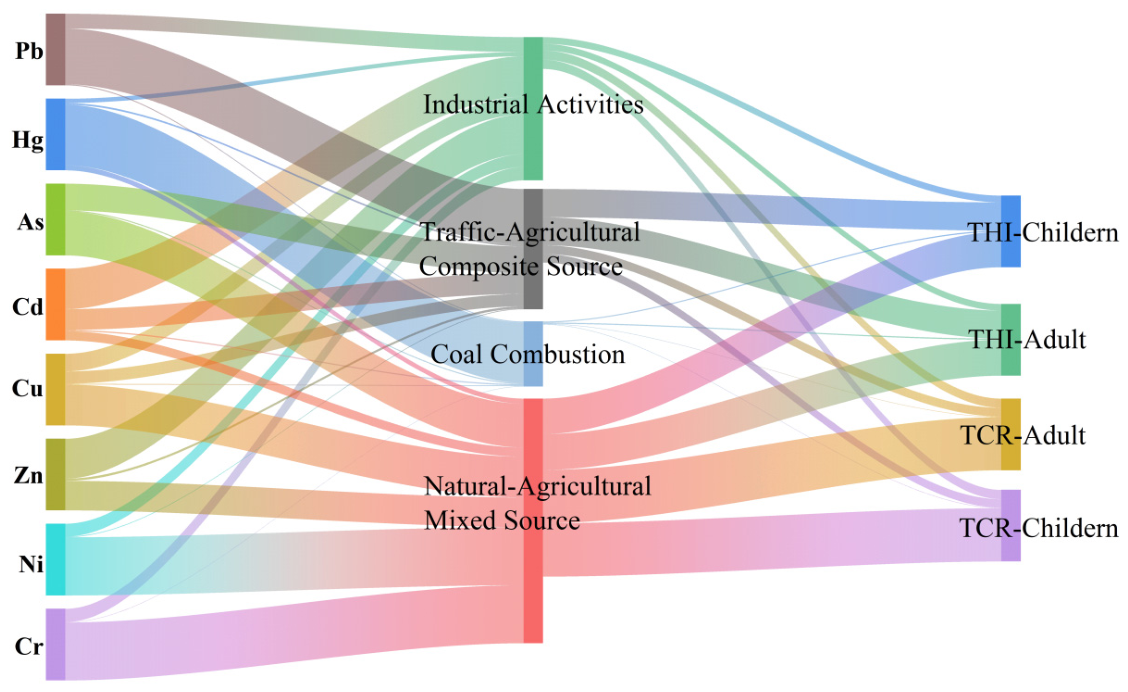
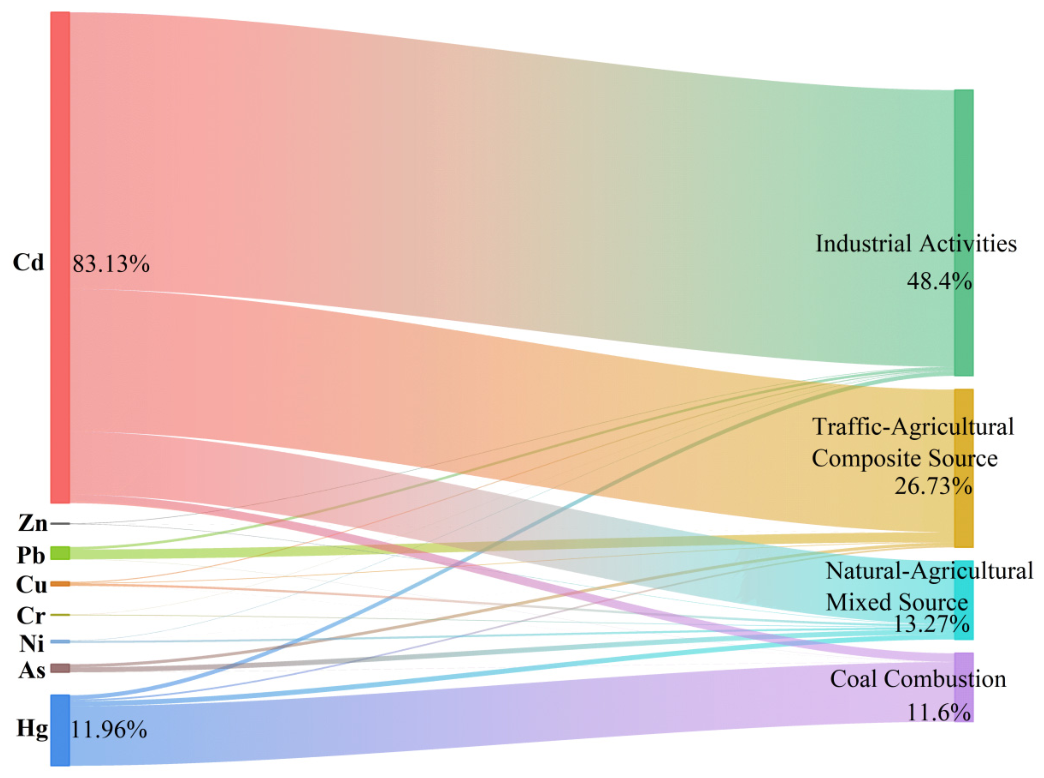
As illustrated in Figure 5, the integrated PMF and risk index (RI) model revealed significant disparities in ecological risk contributions among four pollution sources: Industrial activity dominated with a 48.4% contribution, traffic–agricultural composite source contributed 26.7%, natural–agricultural mixed source accounted for 13.3%, and coal combustion source represented 11.6%. This distribution characteristic was quite consistent with the research results of typical industrial and mining basins in China [62,64]. That was, the contribution of industrial sources to ecological risks was generally higher than that to concentration, reflecting the amplification effect of elements with relatively high toxicity coefficients, such as Cd and Zn, in risk aggregation [33,40,74]. Further investigation indicated that Cd alone contributed 83.13% of total RI, and Hg contributed 9.8% of RI. It had also been reported in some mining areas in Europe that Cd and Hg were the dominant elements contributing to high ecological risks [75]. Therefore, industrial activities should be the primary target for pollution control in the study area, with an emphasis on enhancing environmental regulation during industrial production processes to effectively block the transmission pathways of ecological risks into human health risks [55].

3.3.2. Health Risk Assessment Findings

Based on the USEPA health risk assessment model (Table 8), the non-carcinogenic effects of heavy metals in the study area exhibited significant population differentiation. (1) Child Exposure Risks: The cumulative non-carcinogenic risk for children, expressed as the total hazard index (THI = 1.59), exceeds the acceptable threshold of 1, indicating an elevated concern. However, this conclusion refers to the integrated risk across all metals and exposure pathways; individual pathways or single metals may not individually exceed the threshold. Such vulnerability may be attributed to children’s incomplete physiological development, immature immune systems, and heightened susceptibility to heavy metal toxicity [38,76]. (2) Adult Exposure Risks: All pathways remained below safety thresholds, with HQing = 0.197, HQinh = 0.0004, and HQder = 0.036. The mean total hazard index (THI) for adults was 0.234, confirming no significant non-carcinogenic risks. (3) Pathway Risk Hierarchy: for both children and adults, the mean non-carcinogenic health risks followed the order of oral ingestion (HQing) > dermal contact (HQder) > inhalation (HQinh). This finding aligned with existing related studies that oral ingestion was the predominant pathway contributing to non-carcinogenic health risks [77,78].
Based on the carcinogenicity criteria established by the International Agency for Research on Cancer (IARC) [79], this study systematically evaluated the carcinogenic risks of four heavy metals: Cd, As, Cr, and Ni. According to internationally recognized risk assessment frameworks [80], carcinogenic risk thresholds were defined as follows: risks exceeding 1 × 10⁻⁴ were deemed unacceptable and potentially harmful to human health; risks between 1 × 10⁻⁶ and 1 × 10⁻⁴ were generally considered acceptable; while risks below 1 × 10⁻⁶ indicated negligible carcinogenic hazards. As shown in Table 9, the soil heavy metal carcinogenicity assessment revealed distinct risk profiles. For both children and adults, the mean total carcinogenic risk indices for Cd from three exposure pathways—oral ingestion (CRing), dermal contact (CRder), and inhalation (CRinh)—were all below 1 × 10⁻⁶, demonstrating undetectable carcinogenic risks. In contrast, Cr, As, and Ni exhibited total risk indices ranging from 1 × 10⁻⁶ to 1 × 10⁻⁴, falling within the acceptable risk threshold. Further analysis of exposure pathway contributions demonstrated a consistent hierarchy across all four heavy metals: CRing > CRder > CRinh. This pattern highlighted oral ingestion as the predominant pathway for carcinogenic risk accumulation, accounting for the majority of total risk exposure [81]. It is noteworthy that the total carcinogenic risk (TCR) for children was 1.7 × 10⁻⁴, exceeding the unacceptable threshold of 1 × 10⁻⁴, which warrants particular attention in regional management. This elevated childhood TCR is a common issue widely documented in mining and smelting agglomerations in China [59,69]. Interestingly, the phenomenon in this watershed—where the natural–agricultural mixed source (via As, Cr, and Ni), rather than the heavily polluted industrial source (Cd), contributes the most to human health risks—is consistent with the multi-source risk assessment conclusions of Jiang et al. [38]. This confirms that the major sources driving ecological risk (Cd from industry) and health risk (As and Cr from agricultural and natural inputs) can be completely different, which is a common decoupling phenomenon in regional risk management.
By integrating health risk assessment outcomes with the PMF model, we quantified the contribution rates of different pollution sources to health risks (Figure 6). The analysis revealed distinct patterns in source-specific impacts. Specially, contributions to THI for adults and children followed an order of Natural–Agricultural Mixed Sources > Traffic–Agricultural Mixed Sources > Industrial Sources > Coal Combustion Sources; while contributions to TCR exhibited a law of Natural–Agricultural Mixed Sources > Industrial Sources > Traffic–Agricultural Mixed Sources > Coal Combustion Sources. This discrepancy arose from the exclusive evaluation of carcinogenic risks for Cd, As, Cr, and Ni. Notably, the Natural–Agricultural Mixed Sources emerged as the dominant contributor to both THI and TCR, primarily due to their substantial emissions of As, Cr, and Ni-elements recognized for their high carcinogenic potential under the IARC classification [82]. Intriguingly, coal combustion sources (contributing 84.85% of Hg) and industrial activities (accounting for 56.39% of Cd) showed limited health impacts. This paradox–where heavily contaminated elements (Cd) and moderately polluted ones (Hg) exhibited attenuated health effects–underscored a critical insight: health risk magnitude correlated more strongly with metal toxicity profiles than absolute contamination levels [83,84]. This risk-source coupling analysis provides a scientific foundation for developing targeted heavy metal management policies that address both contamination severity and toxicological significance. For instance, implementing stringent controls on high-toxicity [85] prioritizes the remediation of Natural–Agricultural Mixed Sources through precision fertilization techniques and soil amendment applications to disrupt the soil–human exposure pathway [86,87].

3.4. Limitations

The PMF-RI/PMF-HRA framework and spatial heterogeneity analysis (e.g., Hg point sources, As-Pb-Zn clusters) quantify a source-oriented risk assessment and propose a “source–risk-pathway” intervention strategy in small watersheds. However, there are still some limitations in this study.
Firstly, the PMF model assumed a linear additive contribution of each source to the total metal concentration, and the subsequent risk allocation linearly converted the concentration contributions into risk contributions using constant toxicity response factors or slope factors. This linear assumption may not fully capture the nonlinear or synergistic/antagonistic effects among multiple metals, nor reflect the influence of metal speciation, bioavailability, or aging effects on actual toxicity [73,87]. Nevertheless, the linear coupling framework remains widely accepted in regional-scale studies, because the decoupling between concentration contribution and risk contribution arises from the use of different metal, rather than from nonlinearity per se.
Secondly, this study focused on eight heavy metals (Hg, As, Cr, Cu, Ni, Pb, Zn, Cd), but potentially hazardous elements in mining-affected systems, such as Mn, Co, Sb, and Tl, were not included due to routine monitoring constraints and a lack of background data. Their exclusion may lead to an underestimation of total ecological and health risks; thus, our results should be viewed as conservative regarding the full contaminant spectrum. Furthermore, key soil properties controlling metal mobility and bioavailability—pH, organic matter, texture, and cation exchange capacity (CEC)—were not measured because the original project focused on total concentrations and source apportionment. The absence of these parameters limits mechanistic understanding of metal speciation and source-oriented bioavailability, and our total-concentration-based risk assessments may overestimate the actual risks in some contexts. Future studies should expand both the analyte suite and soil property measurements.
Thirdly, the IDW interpolation is widely used in soil heavy metal pollution assessment [75,88]. However, its accuracy is limited, and it may underestimate the precision of local pollution hotspots. In the future, it may be worthwhile to explore the integration of machine learning techniques to improve the precision of spatial pollution prediction and enhance the capability of dynamic source apportionment. Furthermore, the traditional additive risk model cannot fully reflect the complex synergistic or antagonistic interactions among coexisting heavy metals. Therefore, the calculated RI and health risk values in the present study represent conservative baseline risk estimates, and the actual in situ toxic risks may be higher due to the potential synergistic effects of combined metal exposure. So subsequent studies could incorporate metal interaction mechanisms and mixture toxicity models to achieve more accurate and realistic risk evaluation for soil heavy metal co-pollution.

4. Conclusions and Prospects

This study systematically investigated the pollution characteristics, sources, and ecological health risks of eight heavy metals (Pb, Cd, Hg, Cr, As, Cu, Zn, and Ni) in Manghe Small Watershed. A PMF-RI/PMF-HRA coupled framework was developed to quantify source-oriented contributions to ecological and health risks, providing scientific support for targeted pollution control. The main findings are summarized below:
(1) Concentrations followed Hg < Cd < As < Ni < Cu < Cr < Pb < Zn. Cr and Ni aligned with background levels, and Cd, Pb, Hg, Zn, As, and Cu exceeded Henan Province background values by 1.63–33.65 times with high variability, indicating strong anthropogenic impacts. In particular, Hg, Cu, and Cd exhibited isolated point-source patterns, while As, Pb, and Zn formed clustered pollution groups linked to human activities.
(2) The PMF model identified four sources: Industrial activities dominated Cd and Zn from smelting/mining; coal combustion contributed 84.85% of Hg via atmospheric deposition; traffic–agriculture mixed sources were responsible for Pb and As from vehicle emissions and agrochemicals; natural–agricultural mixed sources controlled Cr, Ni, As, and Cu from geological weathering and agricultural inputs.
(3) The geo-accumulation index ranked Cd > Pb > Zn > Cu > As > Hg > Ni > Cr. Cd reached strong pollution, Pb moderate-to-high, Hg full-spectrum. The modified Nemerow Index (mean = 2.98) indicated moderate pollution overall, with 44.6% of samples at severe levels. Ecological risk was extreme (RI = 1213.5), driven by Cd and Hg. Industrial activities contributed most to ecological risks, followed by traffic–agriculture sources.
(4) Children’s total risk (THI = 1.59) exceeded thresholds, primarily from the oral intake of As (57.39%), Pb (22.14%), and Cr (15.78%). Adult risks were acceptable (THI = 0.234). Carcinogenic risks of As, Cr, and Ni fell within acceptable ranges (1 × 10⁻⁶~1 × 10⁻⁴), but TCR children (1.17 × 10⁻⁴) exceeded the acceptable level and should be taken under control. Natural–agricultural sources contributed most to health risks (As, Cr, Ni), while industrial Cd posed negligible toxicity-driven impacts.
(5) The decoupling relationship between source contribution magnitude and actual health risk level is comprehensively determined by metal toxicological classification, bioavailability, and particle exposure characteristics. A “source–risk-pathway” strategy was proposed: control industrial Cd-Zn emissions, traffic–agriculture Pb-As inputs, and coal-derived Hg optimize agricultural practices and reduce child oral exposure to As-Cr.

Author Contributions

Writing—original draft preparation, Data curation, Software, Conceptualization, Visualization, Y.W. Writing—original draft preparation, Writing—review and editing, Y.S. Formal analysis, Investigation, X.C. Software, Supervision, X.Z. Writing–review & editing, Validation, Conceptualization, F.G. All authors have read and agreed to the published version of the manuscript.

Funding

This research received no external funding.

Data Availability Statement

The original contributions presented in this study are included in the article. Further inquiries can be directed to the corresponding author.

Conflicts of Interest

The authors declare no conflicts of interest.

References

  1. Huang, Y.; Chen, Q.; Deng, M.; Japenga, J.; Li, T.; Yang, X.; He, Z. Heavy metal pollution and health risk assessment of agricultural soils in a typical peri-urban area in southeast China. J. Environ. Manag. 2018, 207, 159–168. [Google Scholar] [CrossRef] [PubMed]
  2. Ali, M.M.; Hossain, D.; Khan, M.S.; Begum, M.; Osman, M.H. Environmental pollution with heavy metals: A public health concern. In Heavy Metals-Their Environmental Impacts and Mitigation; IntechOpen: London, UK, 2021. [Google Scholar]
  3. He, Z.; Zhang, M.; Calvert, D.; Stoffella, P.; Yang, X.; Yu, S. Transport of heavy metals in surface runoff from vegetable and citrus fields. Soil Sci. Soc. Am. J. 2004, 68, 1662–1669. [Google Scholar] [CrossRef]
  4. Dan’Azumi, S.; Bichi, M. Industrial pollution and heavy metals profile of Challawa River in Kano, Nigeria. J. Appl. Sci. Environ. Sanit. 2010, 5, 23–29. [Google Scholar]
  5. Connan, O.; Maro, D.; Hébert, D.; Roupsard, P.; Goujon, R.; Letellier, B.; Le Cavelier, S. Wet and dry deposition of particles associated metals (Cd, Pb, Zn, Ni, Hg) in a rural wetland site, Marais Vernier, France. Atmos. Environ. 2013, 67, 394–403. [Google Scholar] [CrossRef]
  6. Tiller, K. Heavy metals in soils and their environmental significance. In Advances in Soil Science; Springer: Berlin/Heidelberg, Germany, 1989; Volume 9, pp. 113–142. [Google Scholar]
  7. Kandeler, E.; Tscherko, D.; Bruce, K.; Stemmer, M.; Hobbs, P.; Bardgett, R.D.; Amelung, W. Structure and function of the soil microbial community in microhabitats of a heavy metal polluted soil. Biol. Fertil. Soils 2000, 32, 390–400. [Google Scholar] [CrossRef]
  8. Srivastava, V.; Sarkar, A.; Singh, S.; Singh, P.; De Araujo, A.S.; Singh, R.P. Agroecological responses of heavy metal pollution with special emphasis on soil health and plant performances. Front. Environ. Sci. 2017, 5, 64. [Google Scholar] [CrossRef]
  9. Mahurpawar, M. Effects of heavy metals on human health. Int. J. Res. Granthaalayah 2015, 530, 1–7. [Google Scholar] [CrossRef]
  10. Hembrom, S.; Singh, B.; Gupta, S.K.; Nema, A.K. A comprehensive evaluation of heavy metal contamination in foodstuff and associated human health risk: A global perspective. In Contemporary Environmental Issues and Challenges in Era of Climate Change; Springer: Berlin/Heidelberg, Germany, 2019; pp. 33–63. [Google Scholar]
  11. Antwi, S.O.; Eckert, E.C.; Sabaque, C.V.; Leof, E.R.; Hawthorne, K.M.; Bamlet, W.R.; Chaffee, K.G.; Oberg, A.L.; Petersen, G.M. Exposure to environmental chemicals and heavy metals, and risk of pancreatic cancer. Cancer Causes Control 2015, 26, 1583–1591. [Google Scholar] [CrossRef]
  12. Bradl, H. Sources and origins of heavy metals. In Interface Science and Technology; Elsevier: Amsterdam, The Netherlands, 2005; Volume 6, pp. 1–27. [Google Scholar]
  13. Mohammed, A.S.; Kapri, A.; Goel, R. Heavy metal pollution: Source, impact, and remedies. In Biomanagement of Metal-Contaminated Soils; Springer: Berlin/Heidelberg, Germany, 2011; pp. 1–28. [Google Scholar]
  14. Zinn, Y.L.; de Faria, J.A.; de Araujo, M.A.; Skorupa, A.L.A. Soil parent material is the main control on heavy metal concentrations in tropical highlands of Brazil. Catena 2020, 185, 104319. [Google Scholar] [CrossRef]
  15. Micó, C.; Recatalá, L.; Peris, M.; Sánchez, J. Assessing heavy metal sources in agricultural soils of an European Mediterranean area by multivariate analysis. Chemosphere 2006, 65, 863–872. [Google Scholar] [CrossRef]
  16. Armah, F.; Quansah, R.; Luginaah, I. A Systematic Review of Heavy Metals of Anthropogenic Origin in Environmental Media and Biota in the Context of Gold Mining in Ghana. Int. Sch. Res. Not. 2014, 2014, 252148. [Google Scholar] [CrossRef]
  17. Gunawardena, J.; Ziyath, A.M.; Egodawatta, P.; Ayoko, G.A.; Goonetilleke, A. Sources and transport pathways of common heavy metals to urban road surfaces. Ecol. Eng. 2015, 77, 98–102. [Google Scholar] [CrossRef]
  18. Wang, J.; Cai, Y.; Yang, J.; Zhao, X. Research trends and frontiers on source appointment of soil heavy metal: A scientometric review (2000–2020). Environ. Sci. Pollut. Res. 2021, 28, 52764–52779. [Google Scholar] [CrossRef] [PubMed]
  19. Cheng, W.; Lei, S.; Bian, Z.; Zhao, Y.; Li, Y.; Gan, Y. Geographic distribution of heavy metals and identification of their sources in soils near large, open-pit coal mines using positive matrix factorization. J. Hazard. Mater. 2020, 387, 121666. [Google Scholar] [CrossRef]
  20. Salim, I.; Sajjad, R.U.; Paule-Mercado, M.C.; Memon, S.A.; Lee, B.-Y.; Sukhbaatar, C.; Lee, C.-H. Comparison of two receptor models PCA-MLR and PMF for source identification and apportionment of pollution carried by runoff from catchment and sub-watershed areas with mixed land cover in South Korea. Sci. Total Environ. 2019, 663, 764–775. [Google Scholar] [CrossRef]
  21. Jin, G.; Fang, W.; Shafi, M.; Wu, D.; Li, Y.; Zhong, B.; Ma, J.; Liu, D. Source apportionment of heavy metals in farmland soil with application of APCS-MLR model: A pilot study for restoration of farmland in Shaoxing City Zhejiang, China. Ecotoxicol. Environ. Saf. 2019, 184, 109495. [Google Scholar] [CrossRef] [PubMed]
  22. Liao, S.; Jin, G.; Khan, M.A.; Zhu, Y.; Duan, L.; Luo, W.; Jia, J.; Zhong, B.; Ma, J.; Ye, Z. The quantitative source apportionment of heavy metals in peri-urban agricultural soils with UNMIX and input fluxes analysis. Environ. Technol. Innov. 2021, 21, 101232. [Google Scholar] [CrossRef]
  23. Wang, S.; Cai, L.-M.; Wen, H.-H.; Luo, J.; Wang, Q.-S.; Liu, X. Spatial distribution and source apportionment of heavy metals in soil from a typical county-level city of Guangdong Province, China. Sci. Total Environ. 2019, 655, 92–101. [Google Scholar] [CrossRef]
  24. González-Macías, C.; Sánchez-Reyna, G.; Salazar-Coria, L.; Schifter, I. Application of the positive matrix factorization approach to identify heavy metal sources in sediments. A case study on the Mexican Pacific Coast. Environ. Monit. Assess. 2014, 186, 307–324. [Google Scholar] [CrossRef] [PubMed]
  25. Zhao, Z.; Li, S.; Li, Y. Determining the priority control factor of toxic metals in cascade reservoir sediments viasource-oriented ecological risk assessment. J. Hydrol. 2024, 631, 130755. [Google Scholar] [CrossRef]
  26. Arao, T.; Ishikawa, S.; Murakami, M.; Abe, K.; Maejima, Y.; Makino, T. Heavy metal contamination of agricultural soil and countermeasures in Japan. Paddy Water Environ. 2010, 8, 247–257. [Google Scholar] [CrossRef]
  27. Mai, X.; Tang, J.; Tang, J.; Zhu, X.; Yang, Z.; Liu, X.; Zhuang, X.; Feng, G.; Tang, L. Research progress on the environmental risk assessment and remediation technologies of heavy metal pollution in agricultural soil. J. Environ. Sci. 2025, 149, 1–20. [Google Scholar] [CrossRef]
  28. Zhou, Y.; Ding, D.; Zhao, Y.; Li, Q.; Jiang, D.; Lv, Z.; Wei, J.; Zhang, S.; Deng, S. Determining priority control toxic metal for different protection targets based on source-oriented ecological and human health risk assessment around gold smelting area. J. Hazard. Mater. 2024, 468, 133782. [Google Scholar] [CrossRef] [PubMed]
  29. Fei, X.; Lou, Z.; Xiao, R.; Ren, Z.; Lv, X. Source analysis and source-oriented risk assessment of heavy metal pollution in agricultural soils of different cultivated land qualities. J. Clean. Prod. 2022, 341, 130942. [Google Scholar] [CrossRef]
  30. Zhao, X.; Sun, Y.; Huang, J.; Wang, H.; Tang, D. Effects of soil heavy metal pollution on microbial activities and community diversity in different land use types in mining areas. Environ. Sci. Pollut. Res. 2020, 27, 20215–20226. [Google Scholar] [CrossRef]
  31. Miranda, L.S.; Deilami, K.; Ayoko, G.A.; Egodawatta, P.; Goonetilleke, A. Influence of land use class and configuration on water-sediment partitioning of heavy metals. Sci. Total Environ. 2022, 804, 150116. [Google Scholar] [CrossRef]
  32. Li, Y.; Chen, H.; Teng, Y. Source apportionment and source-oriented risk assessment of heavy metals in the sediments of an urban river-lake system. Sci. Total Environ. 2020, 737, 140310. [Google Scholar] [CrossRef] [PubMed]
  33. Shen, C.; Huang, S.; Wang, M.; Wu, J.; Su, J.; Lin, K.; Chen, X.; He, T.; Li, Y.; Sha, C. Source-oriented health risk assessment and priority control factor analysis of heavy metals in urban soil of Shanghai. J. Hazard. Mater. 2024, 480, 135859. [Google Scholar] [CrossRef]
  34. Zhao, Z.; Hao, M.; Li, Y.; Li, S. Contamination, sources and health risks of toxic elements in soils of karstic urban parks based on Monte Carlo simulation combined with a receptor model. Sci. Total Environ. 2022, 839, 156223. [Google Scholar] [CrossRef]
  35. Liu, Z.; Wang, L.; Yan, M.; Ma, B.; Cao, R. Source apportionment of soil heavy metals based on multivariate statistical analysis and the PMF model: A case study of the Nanyang Basin, China. Environ. Technol. Innov. 2024, 33, 103537. [Google Scholar] [CrossRef]
  36. Fei, X.; Lou, Z.; Xiao, R.; Ren, Z.; Lv, X. Contamination assessment and source apportionment of heavy metals in agricultural soil through the synthesis of PMF and GeogDetector models. Sci. Total Environ. 2020, 747, 141293. [Google Scholar] [CrossRef]
  37. Huang, C.C.; Cai, L.M.; Xu, Y.H.; Wen, H.H.; Jie, L.; Hu, G.C.; Mei, J.X. Quantitative analysis of ecological risk and human health risk of potentially toxic elements in farmland soil using the PMF model. Land Degrad. Dev. 2022, 33, 1954–1967. [Google Scholar] [CrossRef]
  38. Jiang, H.H.; Cai, L.M.; Wen, H.H.; Hu, G.C.; Chen, L.G.; Luo, J. An integrated approach to quantifying ecological and human health risks from different sources of soil heavy metals. Sci. Total Environ. 2020, 701, 134466. [Google Scholar] [CrossRef] [PubMed]
  39. Goswami, A.P.; Kalamdhad, A.S. Mobility and risk assessment of heavy metals in benthic sediments using contamination factors, positive matrix factorisation (PMF) receptor model, and human health risk assessment. Environ. Sci. Pollut. Res. 2023, 30, 7056–7074. [Google Scholar] [CrossRef]
  40. Jiyuan Municipal People’s Government Office. Notice on Issuing the Mineral Resources Master Plan of Jiyuan City (2021–2025). 2023. Available online: https://www.jiyuan.gov.cn/shizf/zfgb/202305/szfbgswj_30370/t921986.html (accessed on 7 November 2023).
  41. García, E.; Cruz-Motta, J.; Farina, O.; Bastidas, C. Anthropogenic influences on heavy metals across marine habitats in the western coast of Venezuela. Cont. Shelf Res. 2008, 28, 2757–2766. [Google Scholar] [CrossRef]
  42. Niu, Y.; Zhou, Z.; Huang, D.; Yuan, X. Application of Different Composite Index Methods in the Evaluation of Soil Heavy Metal Pollution. In Proceedings of the International Conference on Geo-Informatics in Resource Management and Sustainable Ecosystems, Hong Kong, China, 18–20 November 2016; pp. 43–50. [Google Scholar]
  43. Nour, H.E.; Aljahdali, M.H. Ecological and health risk assessment of Sharm El-sheikh beach sediments, Red Sea coast. Mar. Pollut. Bull. 2025, 212, 117577. [Google Scholar] [CrossRef]
  44. Norris, G.; Duvall, R.; Brown, S.; Bai, S. Epa Positive Matrix Factorization (Pmf) 5.0 Fundamentals and User Guide; USA Environmental Protection Agency: Washington, DC, USA, 2014. [Google Scholar]
  45. Liu, B.; Yang, J.; Yuan, J.; Wang, J.; Dai, Q.; Li, T.; Bi, X.; Feng, Y.; Xiao, Z.; Zhang, Y. Source apportionment of atmospheric pollutants based on the online data by using PMF and ME2 models at a megacity, China. Atmos. Res. 2017, 185, 22–31. [Google Scholar] [CrossRef]
  46. Li, T.; Sun, G.; Yang, C.; Liang, K.; Ma, S.; Huang, L.; Luo, W. Source apportionment and source-to-sink transport of major and trace elements in coastal sediments: Combining positive matrix factorization and sediment trend analysis. Sci. Total Environ. 2019, 651, 344–356. [Google Scholar] [CrossRef] [PubMed]
  47. Yang, J.; Sun, Y.; Wang, Z.; Gong, J.; Gao, J.; Tang, S.; Ma, S.; Duan, Z. Heavy metal pollution in agricultural soils of a typical volcanic area: Risk assessment and source appointment. Chemosphere 2022, 304, 135340. [Google Scholar] [CrossRef]
  48. Hakanson, L. An ecological risk index for aquatic pollution control. A sedimentological approach. Water Res. 1980, 14, 975–1001. [Google Scholar] [CrossRef]
  49. Jiang, Y.; Chao, S.; Liu, J.; Yang, Y.; Chen, Y.; Zhang, A.; Cao, H. Source apportionment and health risk assessment of heavy metals in soil for a township in Jiangsu Province, China. Chemosphere 2017, 168, 1658–1668. [Google Scholar] [CrossRef]
  50. Sun, L.; Guo, D.; Liu, K.; Meng, H.; Zheng, Y.; Yuan, F.; Zhu, G. Levels, sources, and spatial distribution of heavy metals in soils from a typical coal industrial city of Tangshan, China. Catena 2019, 175, 101–109. [Google Scholar] [CrossRef]
  51. U.S. Environmental Protection Agency. Soil Screening Guidance: Technical Background Document; EPA/540/R-95/128; Office of Solid Waste and Emergency Response: Washington, DC, USA, 1996. [Google Scholar]
  52. U.S. Environmental Protection Agency. Exposure Factors Handbook, 2011th ed.; EPA/600/R-09/052F; National Center for Environmental Assessment, Office of Research and Development: Washington, DC, USA, 2011. [Google Scholar]
  53. Ministry of Environmental Protection of the People’s Republic of China. Technical Guidelines for Risk Assessment of Contaminated Sites; HJ 25.3-2014; China Environmental Science Press: Beijing, China, 2014. [Google Scholar]
  54. Chen, T.; Chang, Q.; Liu, J.; Clevers, J.; Kooistra, L. Identification of soil heavy metal sources and improvement in spatial mapping based on soil spectral information: A case study in northwest China. Sci. Total Environ. 2016, 565, 155–164. [Google Scholar] [CrossRef]
  55. Liu, J.; Liu, Y.J.; Liu, Y.; Liu, Z.; Zhang, A.N. Quantitative contributions of the major sources of heavy metals in soils to ecosystem and human health risks: A case study of Yulin, China. Ecotoxicol. Environ. Saf. 2018, 164, 261–269. [Google Scholar] [CrossRef]
  56. Jiang, Y.; Ma, J.; Wang, Y.; Yang, Y. Background values of soil heavy metals in the Huang-Huai-Hai Plain in Henan Province, China. Toxics 2025, 13, 93. [Google Scholar] [CrossRef] [PubMed]
  57. Zhou, L.; Liu, G.; Shen, M.; Liu, Y. Potential ecological and health risks of heavy metals for indoor and corresponding outdoor dust in Hefei, Central China. Chemosphere 2022, 302, 134864. [Google Scholar] [CrossRef]
  58. Zhao, B.; O’Connor, D.; Huang, Y.; Hou, R.; Cai, L.; Jin, Y.; Wang, P.; Zhang, H. An integrated framework for source apportionment and spatial distribution of mercury in agricultural soil near a primary ore mining site. Chemosphere 2024, 353, 141556. [Google Scholar] [CrossRef]
  59. Chen, Z.-Y.; Zhao, Y.-Y.; Chen, D.-L.; Huang, H.-T.; Zhao, Y.; Wu, Y.-J. Ecological risk assessment and early warning of heavy metal cumulation in the soils near the Luanchuan molybdenum polymetallic mine concentration area, Henan Province, central China. China Geol. 2023, 6, 15–26. [Google Scholar]
  60. Bini, C.; Sartori, G.; Wahsha, M.; Fontana, S. Background levels of trace elements and soil geochemistry at regional level in NE Italy. J. Geochem. Explor. 2011, 109, 125–133. [Google Scholar] [CrossRef]
  61. Xu, X.; Zhao, Y.; Zhao, X.; Wang, Y.; Deng, W. Sources of heavy metal pollution in agricultural soils of a rapidly industrializing area in the Yangtze Delta of China. Ecotoxicol. Environ. Saf. 2014, 108, 161–167. [Google Scholar] [CrossRef]
  62. Yang, Y.; Christakos, G.; Guo, M.; Xiao, L.; Huang, W. Space-time quantitative source apportionment of soil heavy metal concentration increments. Environ. Pollut. 2017, 223, 560–566. [Google Scholar] [CrossRef]
  63. Zhou, X.-Y.; Wang, X.-R. Impact of industrial activities on heavy metal contamination in soils in three major urban agglomerations of China. J. Clean. Prod. 2019, 230, 1–10. [Google Scholar] [CrossRef]
  64. Hu, B.; Zhou, Y.; Jiang, Y.; Ji, W.; Fu, Z.; Shao, S.; Li, S.; Huang, M.; Zhou, L.; Shi, Z. Spatio-temporal variation and source changes of potentially toxic elements in soil on a typical plain of the Yangtze River Delta, China (2002–2012). J. Environ. Manag. 2020, 271, 110943. [Google Scholar] [CrossRef] [PubMed]
  65. Kasemodel, M.C.; Sakamoto, I.K.; Varesche, M.B.A.; Rodrigues, V.G.S. Potentially toxic metal contamination and microbial community analysis in an abandoned Pb and Zn mining waste deposit. Sci. Total Environ. 2019, 675, 367–379. [Google Scholar] [CrossRef]
  66. Liu, X.; Zhang, L. Concentration, risk assessment, and source identification of heavy metals in surface sediments in Yinghai: A shellfish cultivation zone in Jiaozhou Bay, China. Mar. Pollut. Bull. 2017, 121, 216–221. [Google Scholar] [CrossRef] [PubMed]
  67. Feng, X.; Shi, J.; Li, P.; Yin, Y.; Jiang, G. Progress of mercury pollution research and implementation of minamata convention in China. Bull. Chin. Acad. Sci. (Chin. Version) 2020, 35, 1344–1350. [Google Scholar]
  68. Anaman, R.; Peng, C.; Jiang, Z.; Liu, X.; Zhou, Z.; Guo, Z.; Xiao, X. Identifying sources and transport routes of heavy metals in soil with different land uses around a smelting site by GIS based PCA and PMF. Sci. Total Environ. 2022, 823, 153759. [Google Scholar] [CrossRef]
  69. Zhou, Y.; Jiang, D.; Ding, D.; Wu, Y.; Wei, J.; Kong, L.; Long, T.; Fan, T.; Deng, S. Ecological-health risks assessment and source apportionment of heavy metals in agricultural soils around a super-sized lead-zinc smelter with a long production history, in China. Environ. Pollut. 2022, 307, 119487. [Google Scholar] [CrossRef]
  70. Liu, H.; Zhang, Y.; Yang, J.; Wang, H.; Li, Y.; Shi, Y.; Li, D.; Holm, P.E.; Ou, Q.; Hu, W. Quantitative source apportionment, risk assessment and distribution of heavy metals in agricultural soils from southern Shandong Peninsula of China. Sci. Total Environ. 2021, 767, 144879. [Google Scholar] [CrossRef] [PubMed]
  71. Liang, J.; Feng, C.; Zeng, G.; Gao, X.; Zhong, M.; Li, X.; Li, X.; He, X.; Fang, Y. Spatial distribution and source identification of heavy metals in surface soils in a typical coal mine city, Lianyuan, China. Environ. Pollut. 2017, 225, 681–690. [Google Scholar] [CrossRef]
  72. Cai, L.-M.; Jiang, H.-H.; Luo, J. Metals in soils from a typical rapidly developing county, Southern China: Levels, distribution, and source apportionment. Environ. Sci. Pollut. Res. 2019, 26, 19282–19293. [Google Scholar] [CrossRef] [PubMed]
  73. He, J.; Peng, Z.; Zeng, J.; Li, C.; Tang, L.; Jiang, J.; Luo, X.; Gao, W.; Guo, J.; Shao, B.; et al. Source apportionment and quantitative risk assessment of heavy metals at an abandoned zinc smelting site based on GIS and PMF models. J. Environ. Manag. 2023, 336, 117565. [Google Scholar] [CrossRef]
  74. Yang, Y.; Lu, X.; Yu, B.; Zuo, L.; Wang, L.; Lei, K.; Fan, P.; Liang, T.; Rennert, T.; Rinklebe, J. Source-specific risk judgement and environmental impact of potentially toxic elements in fine road dust from an integrated industrial city, North China. J. Hazard. Mater. 2023, 458, 131982. [Google Scholar] [CrossRef]
  75. Ding, Q.; Wang, Y.; Zhuang, D. Comparison of the common spatial interpolation methods used to analyze potentially toxic elements surrounding mining regions. J. Environ. Manag. 2018, 212, 23–31. [Google Scholar] [CrossRef] [PubMed]
  76. Durowoju, O.S.; Edokpayi, J.N.; Popoola, O.E.; Odiyo, J.O. Health risk assessment of heavy metals on primary school learners from dust and soil within school premises in Lagos State, Nigeria. In Heavy Metals; IntechOpen: London, UK, 2018. [Google Scholar]
  77. Nour, H.E.; Aljahdali, M.H. Risk assessment of potentially toxic elements in the coastal sediments of Quseir, Red Sea: Environmental and health perspectives. Reg. Stud. Mar. Sci. 2026, 94, 104796. [Google Scholar] [CrossRef]
  78. Du, C.; Li, Z. Contamination and health risks of heavy metals in the soil of a historical landfill in northern China. Chemosphere 2023, 313, 137349. [Google Scholar] [CrossRef]
  79. IARC Working Group on the Evaluation of Carcinogenic Risks to Humans, International Agency for Research on Cancer. IARC Monographs on the Evaluation of Carcinogenic Risks to Humans; IARC: Lyon, France, 1988. [Google Scholar]
  80. Men, C.; Liu, R.; Xu, F.; Wang, Q.; Guo, L.; Shen, Z. Pollution characteristics, risk assessment, and source apportionment of heavy metals in road dust in Beijing, China. Sci. Total Environ. 2018, 612, 138–147. [Google Scholar] [CrossRef]
  81. Shetty, B.R.; Pai, B.J.; Salmataj, S.; Naik, N. Assessment of Carcinogenic and non-carcinogenic risk indices of heavy metal exposure in different age groups using Monte Carlo Simulation Approach. Sci. Rep. 2024, 14, 30319. [Google Scholar] [CrossRef]
  82. Sah, D.; Verma, P.K.; Kumari, K.M.; Lakhani, A. Chemical partitioning of fine particle-bound As, Cd, Cr, Ni, Co, Pb and assessment of associated cancer risk due to inhalation, ingestion and dermal exposure. Inhal. Toxicol. 2017, 29, 483–493. [Google Scholar] [CrossRef] [PubMed]
  83. Jaishankar, M.; Tseten, T.; Anbalagan, N.; Mathew, B.; Beeregowda, K. Toxicity, mechanism and health effects of some heavy metals. Interdiscip. Toxicol. 2014, 7, 60–72. [Google Scholar] [CrossRef]
  84. Rehman, K.; Fatima, F.; Waheed, I.; Akash, M.S.H. Prevalence of exposure of heavy metals and their impact on health consequences. J. Cell. Biochem. 2018, 119, 157–184. [Google Scholar] [CrossRef]
  85. Li, X. Technical solutions for the safe utilization of heavy metal-contaminated farmland in China: A critical review. Land Degrad. Dev. 2019, 30, 1773–1784. [Google Scholar] [CrossRef]
  86. Huang, M.; Zhu, Y.; Li, Z.; Huang, B.; Luo, N.; Liu, C.; Zeng, G. Compost as a soil amendment to remediate heavy metal-contaminated agricultural soil: Mechanisms, efficacy, problems, and strategies. Water Air Soil Pollut. 2016, 227, 359. [Google Scholar] [CrossRef]
  87. Mikula, K.; Izydorczyk, G.; Skrzypczak, D.; Mironiuk, M.; Moustakas, K.; Witek-Krowiak, A.; Chojnacka, K. Controlled release micronutrient fertilizers for precision agriculture—A review. Sci. Total Environ. 2020, 712, 136365. [Google Scholar] [CrossRef] [PubMed]
  88. Wu, Z.; Xia, T.; Jia, X. Spatial variation and pollution risk assessment of heavy metals in industrial soil based on geochemical data and GIS-A case of an iron and steel plant in Beijing, China. Int. J. Environ. Anal. Chem. 2024, 104, 6826–6847. [Google Scholar] [CrossRef]
Figure 1. Location of the Study Area and Distribution of Sample Points.
Land 15 00982 g001
Figure 2. Spatial Distribution of Heavy Metals.
Land 15 00982 g002
Figure 3. Pearson correlation analysis (a), PMF source contribution (b).
Land 15 00982 g003
Figure 4. Spatial Distribution of Ecological Risks.
Land 15 00982 g004
Figure 5. Relationship between soil heavy metals and pollution sources and ecological risks.
Land 15 00982 g005
Figure 6. Relationship between soil heavy metals, pollution sources, and health risks.
Land 15 00982 g006
Table 1. Pollution Levels of Igeo and INI.
IgeoINI
Igeo ≤ 0No PollutionINI ≤ 0.7No Pollution
0 < Igeo ≤ 1Slight Pollution0.7 < INI ≤ 1Alert Pollution
1 < Igeo ≤ 2Moderate Pollution1 < INI ≤ 2Slight Pollution
2 < Igeo ≤ 3Medium Intensive Pollution2 < INI ≤ 3Moderate Pollution
3 < Igeo ≤ 4Relatively Strong PollutionINI > 3Strong Pollution
4 < Igeo ≤ 5Strong Pollution
Igeo > 5Extremely Strong Pollution
Table 2. Levels of Ei and RI.
E i RI Ecological Risk Level
E i     40 RI   150Slight
40 <   E i     80 150 <   RI   300Moderate
80 <   E i     160 300 <   RI   600Relatively Strong
160 <   E i   320600 <   RI   1200Strong
E i   >   320 RI   > 1200Extremely Strong
Table 3. Exposure parameters used in health risk assessment.
ParameterDescriptionValueUnit
RingchildrenIngestion rate200mg/day
adult100
RinhchildrenInhalation rate7.5m3/day
adult14.5
EF Exposure frequency350day/a
EDchildrenExposure duration6a
adult24
SAchildrenExposed skin area2448cm2
adult5075
AFchildrenSkin adherence factor0.2mg/cm2·day
adult0.07
ABS Dermal absorption factor0.001unitless
PEF Particle emission factor1.36 × 109m3/kg
ATcarcinogensAverage exposure time25,550days
non-carcinogensED × 365
BWchildrenAverage bodyweight15.9kg
adult56.8
Note: The exposure parameters were adopted from the USEPA Soil Screening Guidance, USEPA Exposure Factors Handbook, and the Technical Guidelines for the Risk Assessment of Contaminated Sites [51,52,53].
Table 4. Toxicity parameters used in health risk assessment.
Heavy MetalRfDingRfDinhRfDderSFingSFinhSFder
Hg3.00 × 10−48.60 × 10−52.10 × 10−5
As3.00 × 10−43.00 × 10−44.10 × 10−61.501.50 × 1011.10 × 102
Cr3.00 × 10−32.86 × 10−56.00 × 10−55.00 × 10−14.20 × 1012.00
Cu4.00 × 10−24.00 × 10−21.20 × 10−2
Ni2.00 × 10−22.00 × 10−25.40 × 10−31.709.00 × 10-14.20 × 101
Pb3.50 × 10−33.52 × 10−35.20 × 10−4
Zn3.00 × 10−13.00 × 10−16.00 × 10−2
Cd1.00 × 10−31.00 × 10−31.00 × 10−53.80 × 10−16.303.80 × 10−1
Note: RfD and SF represent the reference dose and slope factor, respectively. RfDing, RfDinh, and RfDder represent the reference doses for oral ingestion, inhalation, and dermal contact, respectively, with units of mg kg−1 day−1. SFing, SFinh, and SFder represent the corresponding carcinogenic slope factors, with units of (mg kg−1 day−1)−1. The toxicity parameters were adopted from USEPA and Chen et al. [52,54]. “—” indicates that carcinogenic risk was not calculated for the corresponding heavy metal.
Table 5. Descriptive Statistics of Heavy Metals in Soil (mg/kg).
HgAsCrCuNiPbZnCd
Maximum2.5498.2487.03179.4142.26923.7534.2616.16
Minimum00.321.188.439.87032.180.55
Mean0.1219.2155.3532.1527.66100.31128.492.49
Standard Deviation0.2912.849.1420.135.12148.4372.462.18
Coefficient of variation234.05%66.84%16.52%62.62%18.74%147.96%56.39%87.59%
Background value of Henan Province0.03411.463.819.726.719.660.10.074
Table 6. Assessment Results of Geo-Accumulation Index (Igeo).
ElementsMean of IgeoLevel of Igeo and Samples Proportion (%)
No PollutionSlight Moderate Medium Intensive Relatively Strong StrongExtremely Strong
Hg−0.3276
(62.8)
8
(6.6)
12
(9.9)
18
(14.9)
4
(3.3)
2
(1.7)
1
(0.8)
As−0.0874
(61.2)
36
(29.8)
9
(7.4)
2
(1.7)
000
Cr−0.81121
(100)
000000
Cu−0.0381
(66.9)
31
(25.6)
8
(6.6)
1
(0.8)
000
Ni−0.56120
(99.2)
1
(0.8)
00000
Pb0.6933
(27.3)
27
(22.3)
38
(31.4)
12
(9.9)
7
(5.8)
4
(3.3)
0
Zn0.3637
(30.6)
66
(54.6)
16
(13.2)
2
(1.7)
000
Cd4.1600010
(8.3)
50
(41.3)
44
(36.4)
17
(14.1)
Table 7. Assessment Results of Modified Nemerow Index (INI).
MinMaxMeanPercentage of Sample Points for INI Pollution Levels (%)
UnpollutedAlert PollutionSlightModerateStrong
1.704.762.98006 (4.96)61 (50.4)54 (44.6)
Table 8. Results of Non-Carcinogenic Risk Assessment.
ElementsHQingHQinhHQderHQ
ChildAdultChildAdultChildAdultChildAdult
Hg4.96 × 10−36.94 × 10−44.78 × 10−72.59 × 10−71.73 × 10−43.52 × 10−55.13 × 10−37.29 × 10⁻⁴
As7.72 × 10−11.08 × 10−12.13 × 10−51.15 × 10−51.38 × 10−12.81 × 10−29.11 × 10−11.36 × 10⁻¹
Cr2.23 × 10−13.12 × 10−26.44 × 10−43.48 × 10−42.72 × 10−25.53 × 10−32.50 × 10−13.70 × 10⁻²
Cu9.70 × 10−31.36 × 10−32.66 × 10−71.44 × 10−77.91 × 10−51.61 × 10−59.77 × 10−31.37 × 10⁻³
Ni1.67 × 10−22.33 × 10−34.47 × 10−72.42 × 10−71.51 × 10−43.07 × 10−51.68 × 10−22.37 × 10⁻³
Pb3.46 × 10−14.84 × 10−29.48 × 10−65.13 × 10−65.64 × 10−31.15 × 10−33.51 × 10−14.95 × 10⁻²
Zn5.17 × 10−37.23 × 10−41.42 × 10−77.71 × 10−86.32 × 10−51.28 × 10−55.23 × 10−37.36 × 10⁻⁴
Cd3.00 × 10−24.20 × 10−38.28 × 10−74.48 × 10−77.35 × 10−31.49 × 10−33.74 × 10−25.69 × 10⁻³
THI1.411.97 × 10−16.77 × 10−43.66 × 10−41.79 × 10−13.64 × 10−21.592.34 × 10−1
Table 9. Results of Carcinogenic Risk Assessment.
ElementsCRingCRinhCRderCR
ChildAdultChildAdultChildAdultChildAdult
As2.98 × 10−51.67 × 10−58.27 × 10−91.79 × 10−85.34 × 10−64.34 × 10−63.51 × 10−52.10 × 10⁻⁵
Cr2.87 × 10−51.61 × 10−56.63 × 10−81.43 × 10−72.80 × 10−72.28 × 10−72.90 × 10−51.64 × 10⁻⁵
Ni4.86 × 10−52.72 × 10−57.10 × 10−101.54 × 10−92.98 × 10−62.42 × 10−65.16 × 10−52.96 × 10⁻⁵
Cd9.78 × 10−75.47 × 10−74.47 × 10−109.67 × 10−102.39 × 10−91.94 × 10−99.80 × 10−75.50 × 10−7
TCR1.08 × 10−46.05 × 10−57.57 × 10−81.64 × 10−78.60 × 10−66.98 × 10−61.17 × 10−46.76 × 10⁻⁵
Disclaimer/Publisher’s Note: The statements, opinions and data contained in all publications are solely those of the individual author(s) and contributor(s) and not of MDPI and/or the editor(s). MDPI and/or the editor(s) disclaim responsibility for any injury to people or property resulting from any ideas, methods, instructions or products referred to in the content.