Article

Factor Mobility and Urban–Rural Integration in China: Unpacking Direct, Indirect, and Spatial Spillover Effects at the County Level

1
Chongqing Jiangjin District People’s Government, Chongqing 402000, China
2
School of Public Policy and Administration, Chongqing University, Chongqing 400044, China
3
School of Geographical Sciences, Northeast Normal University, Changchun 130024, China
4
School of Architecture and Urban Planning, Chongqing University, Chongqing 400044, China
*
Author to whom correspondence should be addressed.
Land 2026, 15(6), 975; https://doi.org/10.3390/land15060975 (registering DOI)
Submission received: 20 April 2026 / Revised: 29 May 2026 / Accepted: 31 May 2026 / Published: 3 June 2026

Abstract

Urban–rural integration (URI) is essential for achieving sustainable regional development and addressing the long-standing urban–rural dual-structure divide. This study investigates the impact of factor mobility—specifically labor, capital, and land—on URI across 1712 Chinese counties. By constructing a multidimensional evaluation system for URI and employing a Spatial Durbin Model (SDM), we unpack the direct and indirect effects, as well as the spatial spillover effects of these factors. The results indicate that URI levels in China exhibit significant positive spatial autocorrelation and distinct regional disparities. Labor and capital mobility significantly promote URI, manifesting robust positive direct effects and spatial spillovers that benefit neighboring counties. By contrast, land mobility reveals a “structural mismatch,” whereby inefficient land-use conversion can hinder integration, particularly in less-developed regions. Heterogeneity analysis further shows that the effects of factor mobility are strongest in Eastern China, while Western regions face structural constraints. These findings suggest that sustainable urban–rural transformation requires not only the free flow of production factors but also a coordinated spatial strategy to mitigate regional imbalances. This study provides policy-relevant insights for policymakers aiming to optimize factor allocation and enhance grassroots-level sustainability within the framework of rural revitalization and integrated regional development.

1. Introduction

As the Anthropocene era commenced, the disparity between the deterioration of rural regions and the expansion of urban centers has become increasingly evident, driven by worldwide trends in urbanization and industrialization, particularly in developing countries [1]. Establishing a positive relationship and fostering close connections between urban and rural areas are crucial foundations for achieving harmonious and sustainable regional growth and for enhancing regional competitiveness [1,2,3,4]. Consequently, achieving sustainable urban–rural integration (URI) has emerged as a common challenge facing nations worldwide [1,5,6]. URI represents a hallmark of advanced urban–rural relations, reflecting the organic alignment of factor allocation and equitable distribution of public resources between cities and the countryside. At its core, it enables the free flow of resources and factors across urban and rural boundaries, fostering multidimensional, bidirectional interactions and coordinated development in economic, social, spatial, and ecological domains while promoting equitable access to resources and shared prosperity [7,8]. The URI serves as a crucial pathway for promoting a cohesive and sustainable human society [9], thus becoming a prominent field of study for scholars across disciplines.
The discourse on urban–rural relationships has evolved through several theoretical lenses. Early perspectives, rooted in classical development economics such as the Lewis–Ranis–Fei model, often depicted a linear transition in which rural labor shifts to a modern urban-industrial sector, implicitly favoring urban-centric growth paradigms [7]. This prompted critiques of an inherent “urban bias” in policy and investment, which systematically disadvantaged rural areas [10]. In reaction, alternative arguments for “rural bias” or rural-first development strategies also emerged, though with less mainstream traction [11]. More recent scholarship, drawing on geographical and sociological insights, has moved beyond this simple dichotomy [12,13]. For instance, Woods (2005) highlights that rural areas are not merely passive recipients of urban influence but are actively shaped by diverse processes of “rural restructuring,” involving economic, social, and cultural transformations that intricately connect them to broader regional and global systems [14]. The Desakota model captured the reality of densely populated, intensely mixed urban–rural land-use configurations in Asia, challenging the notion of a clear urban–rural divide [15,16]. Similarly, regional network models emphasize the functional linkages and flows between cities and their hinterlands, viewing them as interconnected nodes in a wider system [17]. While these models provide powerful spatial and functional descriptions, the concept of urban–rural integration (URI) offers a more normative and multidimensional framework. Unlike the Desakota model, which focuses primarily on land use and spatial hybridity, URI can be defined as a multidimensional process encompassing four interconnected dimensions: economic integration (economic convergence, narrowing productivity and income gaps), social integration (social equalization, comparable access to public services), spatial integration (spatial connectivity, integrated infrastructure and flows), and ecological integration (ecological co-governance, shared environmental management).
Building on theoretical and conceptual frameworks, a group of scholars—predominantly from China—has quantitatively assessed the level and characteristics of URI at both national and regional scales using principal component analysis, TOPSIS, entropy weight methods, and spatial analytical techniques [1,7,9,18,19,20]. Based on these assessments, they have conducted preliminary investigations into the factors influencing, and mechanisms driving, URI [21,22,23]. Furthermore, many countries have undertaken extensive theoretical and practical explorations in pursuit of URI pathways suited to their national contexts, as exemplified by the “New Rural Movement” in South Korea, “Demonstration Project for Comprehensive Construction of Villages and Towns” in Japan, and research on rural economic development in Italy [7,24,25,26].
Research generally holds that development in urban and rural areas mutually influences each other through flows of people, materials, energy, goods, capital, and information. The essence of URI lies in the coordinated development of urban and rural areas, facilitated by mobility of key factors [4,7,9,19,22,27,28]. Factor mobility denotes the transfer and reallocation of production factors across regions. In this study, “factor mobility” refers specifically to the movement and redistribution of three fundamental production factors—labor, capital, and land—between urban and rural areas. The rationale for isolating these three dimensions is rooted in both classical political economy and China’s specific institutional context. Theoretically, labor, capital, and land constitute the most basic elements of production. Other elements, such as technology, information, or public services, are largely derivative or carrier-dependent; for instance, technology is embedded in human capital (labor mobility) and physical investment (capital mobility), while infrastructure is the spatial materialization of capital on land. Practically, China’s urban–rural dual structure is underpinned by institutional frictions in the household registration (Hukou) system, the financial allocation system, and the dual-track land-ownership system. Therefore, labor, capital, and land represent the deepest institutional bottlenecks. Focusing on these three core dimensions enables a more direct assessment of the foundational drivers of URI, rather than becoming entangled in their derivative manifestations. Several studies have begun to examine how factor mobility affects URI. Nevertheless, most existing work has focused on qualitative theorizing to explain the connection between factor mobility and URI [4,29]. Some empirical studies consider only specific factors, such as labor and capital, with respect to regional urban–rural development and URI [8,22,30]. These studies suggest that the two-way flow of population between urban and rural areas can promote URI by increasing employment opportunities, while the barriers and inequality of financial resources between urban and rural areas may inhibit URI [4,28,31]. Moreover, certain studies have identified potential spatial spillover effects, both in URI itself and in the influence of factor mobility on URI [4,31]. However, existing research lacks a quantitative, multidimensional analysis that integrates population, capital, and land factors to examine the impact of factor mobility on URI. Furthermore, there is insufficient quantitative investigation into the underlying mechanisms through which factor mobility facilitates URI. Consequently, systematic quantitative research on the relationship between factor mobility and URI is needed. Such work can deepen understanding of the dynamic mechanisms underpinning URI and support the development of effective strategies for its optimization and promotion.
The enduring limitations of China’s dual urban–rural system, along with policies that tend to prioritize urban areas, have led to unequal urban–rural development, resulting in lagging rural development [1]. In response, URI serves as the fundamental approach and rationale for implementing China’s rural revitalization strategy and as a prerequisite for achieving Chinese-style modernization [7,9]. Within this framework, the Chinese government has acknowledged the complex relationship between factor mobility and URI, identifying the facilitation of factor mobility as a crucial means of promoting URI. The Third Plenary Session of the 20th Central Committee underscored the importance of “promoting fair exchange and two-way movement of resources between urban and rural regions, reducing the gap between them, and encouraging shared prosperity and development across these areas.” In terms of scientific research, in addition to focusing on theoretical analysis, Chinese scholars have paid greater attention to policy design and implementation strategies for promoting URI through factor mobility [32,33,34]. Some studies have also conducted empirical tests on the relationship between factor mobility and URI in China using methods such as comprehensive index evaluation but mainly using provincial administrative regions and prefecture-level cities as the basic research units of analysis [22,35], or focusing on specific regions such as urban agglomerations [9,23]. However, several important theoretical and practical issues regarding factor mobility and the URI in China require further research and discussion. For instance, can promoting rural-to-urban factor mobility effectively contribute to achieving URI during China’s transitional period? If so, what mechanisms underlie this effect? Are there differences in the impacts of different factors on URI in China? Are there regional differences in the impacts of the same factor on URI? If so, what accounts for these differences?
To address these issues, it is essential to conduct in-depth and systematic research on the relationship between factor mobility and URI in China at a more granular level, such as the county level. This study argues that the county is the most appropriate and crucial spatial scale for examining URI in China, improving on previous macro-level studies in two significant ways. First, methodologically, previous studies predominantly rely on provincial- or prefecture-level data, which inevitably suffer from spatial aggregation bias (the Modifiable Areal Unit Problem, MAUP). Such macro-scale analyses often measure inter-regional or inter-city relationships rather than genuine grassroots urban–rural interactions, thereby masking substantial intra-regional disparities. Second, from the perspective of spatial governance and economic geography, the county is the fundamental, self-contained territorial unit where urban and rural subsystems directly interact. This aligns with the understanding of the “rural-urban fringe” as a critical zone of interaction, where local dynamics and diverse forms of interaction shape regional development [36]. Within China’s administrative and spatial hierarchy, a county integrates the urban core (county town) with its rural hinterlands (townships and villages). It is the primary scale at which daily commuting, local agricultural supply chains, and public service delivery naturally occur. Furthermore, the county acts as the direct policy-implementation frontline for China’s Rural Revitalization strategy and New-Type Urbanization. Therefore, a county-level analysis offers much higher resolution for accurately capturing the real-world dynamics of resource allocation and market integration. This study focuses on intra-county and inter-county dynamics of factor mobility and attempts to empirically assess the direct, indirect, and spatial spillover effects of factor mobility on county-level URI.
This study makes two contributions to the literature. First, we construct a comprehensive analytical framework that moves beyond the single-factor analyses prevalent in existing research. While previous studies have offered valuable insights by focusing on isolated factors such as labor mobility [8,22,30] or capital flows [4,28,31], they often overlook the synergistic and conflicting interactions among factors. Our study integrates three key factors—labor, capital, and land—and, by employing a Spatial Durbin Model (SDM) combined with a mediation-effect model, systematically disentangles and quantifies three distinct pathways through which factor mobility affects URI: direct effects within a county, indirect (mediated) effects transmitted through channels such as agricultural productivity, and spatial spillover effects on neighboring regions. This multi-pathway analysis reveals a composite mechanism of “factor empowerment—structural transformation—spatial reconstruction,” thereby offering a more holistic understanding than prior research that has predominantly provided qualitative discussions or single-dimensional assessments. Second, our analysis is conducted at the granular county level—the primary interface of URI—which addresses the limitations of existing large-scale studies. Previous research has predominantly focused on provincial or municipal scales [7,22], which, while valuable, often suffer from aggregation bias that masks significant intra-regional disparities. This fine-grained perspective not only provides a more accurate representation of grassroots urban–rural dynamics but also uncovers substantial regional heterogeneity in the impact patterns across Eastern, Central, Western, and Northeast China. As a result, our findings provide more precise empirical evidence and actionable policy insights for designing region-specific development strategies, improving on studies that rely on aggregated data.
The structure of this study is as follows: Section 2 outlines the theoretical framework and articulates the main hypotheses. Section 3 outlines the research methods and data. Section 4 reports the results, which include the spatiotemporal changes and evolutionary trends of URI at the county level in China, along with the empirical findings on the effects of factor mobility on URI. Section 5 provides a discussion focusing on the implications for research and policy. The study conclusions are presented in Section 6.

2. Theoretical Analysis and Research Hypothesis

The root cause of the urban–rural development imbalance stems from the misallocation of key production factors, including population, land, and capital. Consequently, facilitating the efficient flow of these factors is fundamental to dismantling the urban–rural dual structure and advancing URI [7,8,19,28]. The theory of urban–rural regional systems posits that although urban and rural areas differ significantly in terms of factor endowments and resource availability, they collectively constitute an organic whole characterized by interdependence and mutual interaction [29]. New Economic Geography (NEG) models, grounded in Krugman’s (1991) [37] core–periphery framework, on the one hand, suggest that reductions in transport costs and increased factor mobility can trigger cumulative causation effects, whereby initial advantages concentrate economic activity in core regions at the expense of the periphery. According to this logic, enhancing factor mobility might deepen, rather than narrow, urban–rural divides. On the other hand, subsequent developments in NEG recognize the possibility of dispersion forces: rising congestion costs, land-price differentials, and non-tradable local amenities can eventually induce a “spread” of economic activity to lagging regions [38].
Therefore, a critical question arises: under China’s current institutional context, which emphasizes coordinated development and rural revitalization, does factor mobility act as a catalyst for convergence or a driver of divergence? This study hypothesizes that, from a balanced perspective, promoting factor mobility is conducive to URI, while acknowledging the dual nature of this process. Our empirical analysis tests this hypothesis by examining the net effect of labor, capital, and land mobility on urban–rural integration at the county level.
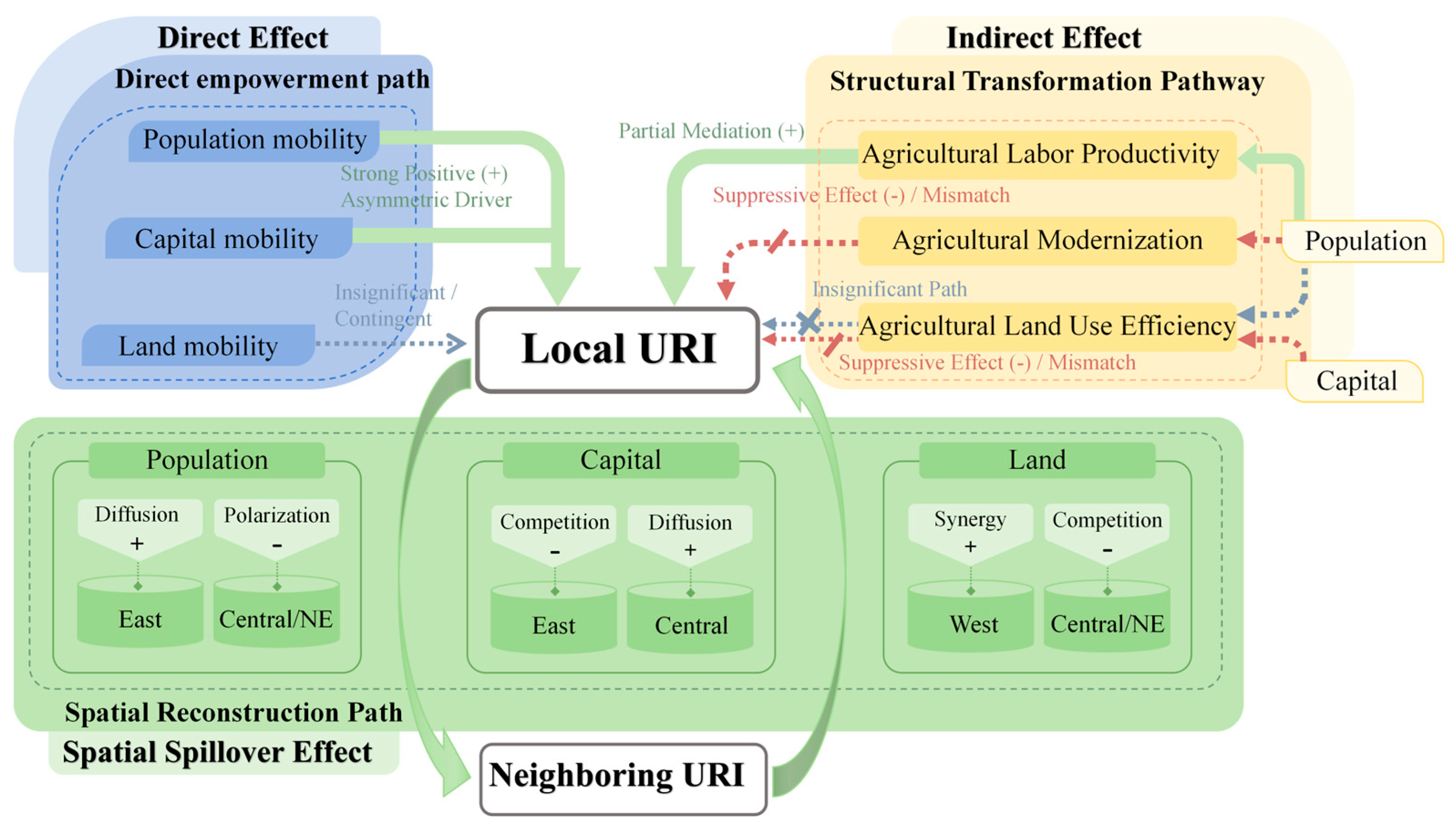
To systematically elucidate this process, this study draws on the theories of urban–rural regional systems and NEG and integrates the concept of flow space to construct a comprehensive analytical framework encompassing direct, indirect, and spatial spillover effects. The framework aims to reveal how factor mobility collectively advances URI through direct “factor empowerment,” indirect “structural transformation catalysis,” and cross-regional “spatial reconstruction”.
It is important to note that this study selects land mobility, population mobility, and capital mobility as the core independent variables to unpack the drivers of URI. This selection follows both classical economic theory and China’s institutional context. Land represents the spatial foundation of integration, population captures the social and labor dimension, and capital reflects the financial dynamics enabling transformation. Together, these elements embody the reform priorities that underpin China’s URI strategy. Other potential factors, such as technology or infrastructure, are viewed as derivative outcomes of capital investment and population mobility and are thus embedded within this tri-dimensional framework.

2.1. The Direct Effect: Factor Endowment Enhancement

The direct effect of factor mobility on URI involves the movement of various production factors between urban and rural areas, which directly increases factor endowment stocks and optimizes resource allocation, thereby facilitating URI. This pathway originates from the classical theory of production factors, which posits that the abundance of such factors directly influences a region’s output and level of development [1,35]. Specifically, in the context of population mobility—particularly the migration of rural labor to urban areas—this movement not only directly enhances the urban labor supply but also increases rural household income and human capital through remittances and skill transfer upon return, thereby effectively reducing the urban–rural development gap. However, we acknowledge that structural transformation is not synonymous with integration. Selective out-migration of young, educated workers can erode the human-capital base of rural communities, producing a “hollowing out” effect that reinforces, rather than mitigates, rural marginalization. The net outcome depends crucially on the nature of factor flows—whether migration is circular or permanent, whether remittances are invested productively in the origin community, and whether agricultural labor shedding is accompanied by farm consolidation and productivity growth. Our empirical expectation that rural labor transfer exhibits a positive coefficient on URI is therefore conditional on the presence of complementary mechanisms, which we examine through a mediation analysis of agricultural productivity growth.
The flow of land factors is primarily reflected in the conversion of rural land into urban construction land and the intensified utilization of rural land, thereby directly transforming land assets into property income for farmers. At the same time, this process creates space for the development of both agricultural and non-agricultural industries, promoting URI through the optimized allocation of land resources across urban and rural areas [35]. Capital mobility serves as the most direct driving force. Whether through the injection of industrial capital or government fiscal transfer payments, these funds are channeled into investments in rural infrastructure, public services, and industrial projects, significantly improving rural production and living conditions and promoting more equitable urban–rural development. In conclusion, the movement of population, land, and capital through their respective channels directly strengthens and optimizes the resource base for regional development, thereby positively promoting URI. Based on this analysis, the following hypotheses are proposed:
Hypothesis 1 (H1): 
Factor mobility exerts a significant positive direct effect on URI.
Hypothesis 1a (H1a): 
Population mobility exerts a significant positive direct effect on URI.
Hypothesis 1b (H1b): 
Land mobility exerts a significant positive direct effect on URI.
Hypothesis 1c (H1c): 
Capital mobility exerts a significant positive direct effect on URI.

2.2. The Indirect Effect: Mediating Pathways of Structural Transformation

The indirect effect of factor mobility on URI refers to its enduring influence on integration through the stimulation of structural changes within the urban–rural regional system. This effect is primarily realized by promoting economic structural transformation, improving resource-utilization efficiency, and enhancing labor productivity. According to Petty–Clark’s law and the theory of structural change, productive factors such as capital and labor tend to shift initially toward non-agricultural sectors offering higher returns, thereby accelerating the transition of regional economies from agriculture-dominated to industry- and service-oriented structures. This modernization of the industrial structure facilitates URI. However, an even more significant indirect effect operates within the internal dynamics of the urban–rural system, particularly through the structural transformation of the agricultural sector. The outflow of the rural labor force and increased mobility of land factors create favorable conditions for large-scale land operations, enhance agricultural land-use efficiency, and unlock the potential for economies of scale, thereby promoting rural development and contributing to narrowing the urban–rural gap [35]. The mobility of capital serves as the core driver of agricultural modernization, while the mobility of population between urban and rural areas generates a spillover of knowledge and technology from cities to rural regions [33,39]. This facilitates the transformation of agricultural development models, accelerates rural advancement, and ultimately narrows the urban–rural divide and promotes URI. By enhancing agricultural land-use efficiency and advancing agricultural modernization, population, land, and capital mobility can collectively contribute to increased agricultural labor productivity, strengthen rural development capacity, and thereby promote URI. Therefore, we propose the following hypotheses:
Hypothesis 2 (H2): 
Factor mobility can exert a significant positive indirect effect on URI by improving agricultural land-use efficiency, advancing agricultural modernization, and enhancing agricultural labor productivity.
Hypothesis 2a (H2a): 
Factor mobility can enhance the URI process by increasing agricultural labor productivity.
Hypothesis 2b (H2b): 
Facilitating factor mobility can improve the URI process by optimizing agricultural land-use efficiency.
Hypothesis 2c (H2c): 
Facilitation factor mobility can enhance the URI process by promoting agricultural modernization.

2.3. The Spatial Spillover Effect: Inter-County Dynamics in a Flow Space

Regions are not isolated geographical units but rather interconnected nodes in a network. According to flow-space theory, the movement of elements shapes interdependent relationships among regions, meaning that any internal change within a county may affect neighboring areas. Vigorous factor mobility within a region can not only promote local URI but also positively drive URI in neighboring regions through mechanisms such as demonstration, competition, and cooperation [40]. Specifically, population mobility—particularly the concentration of high-skilled labor—not only promotes industrial upgrading in neighboring counties through knowledge spillovers and technological diffusion but also expands market opportunities for agricultural products and services by stimulating consumer demand. This, in turn, supports rural development and fosters URI in adjacent counties. Capital mobility and industrial investment can generate spillover effects to neighboring counties through forward and backward linkages in the industrial chain, providing them with complementary opportunities and market access. Simultaneously, the joint development and shared use of infrastructure enhance regional efficiency, fostering URI. However, excessive agglomeration may trigger intensified competition for capital and resources, potentially draining surrounding areas and impeding URI in adjacent counties. Land-factor mobility enables successful models of agricultural modernization and characteristic industrial parks—developed through land transfer in one region—to serve as policy references and demonstration examples for neighboring counties. However, if such a land development model leads to cross-border environmental pollution or overuse of shared ecological resources, it may negatively affect agricultural productivity and residents’ livelihoods in adjacent areas, thereby impeding URI in those regions.
In conclusion, factor mobility within a county inevitably generates spatial spillover effects on URI in neighboring counties, operating through either positive diffusion or negative polarization mechanisms. Therefore, we propose the following hypothesis:
Hypothesis 3 (H3): 
Factor mobility exerts a significant spatial spillover effect on URI in neighboring regions.

2.4. The Regional Heterogeneity of Impact Mechanisms

In China, regional development disparities and uneven development are fundamental characteristics of the country’s socio-economic progress, primarily evident in the developmental gaps among its four major economic regions: Eastern, Central, Western, and Northeast China. Against this backdrop, the impact of factor mobility on URI varies significantly, shaped by these disparities. From the perspectives of regional development theory, factor mobility theory, and institutional economics, factor mobility may exhibit distinct patterns across different stages of development on URI. Eastern China boasts a developed economy and strong market absorption capacity, enabling it to more efficiently transform incoming production factors into sustainable development momentum. Moreover, the region’s mature market mechanisms significantly reduce market frictions and institutional barriers associated with factor mobility. As a result, factor mobility in Eastern China is likely to exert stronger direct and indirect effects on URI. Regarding spatial spillover effects, mature urban agglomerations and well-established industrial-chain networks in Eastern China are more likely to facilitate positive knowledge diffusion and market expansion; in contrast, core cities in Central, Western, and Northeast China may exert a “suction” effect on surrounding areas, resulting in negative polarization. Therefore, we propose the following comprehensive hypothesis:
Hypothesis 4 (H4): 
The impact of factor mobility on URI in China exhibits significant regional variation.
Hypothesis 4a (H4a): 
The positive impacts of factor mobility—both direct and indirect—on URI are most evident in Eastern China.
Hypothesis 4b (H4b): 
Spatial spillover effects are predominantly diffusive in the Eastern China but may be negligible or even negative—indicating polarization—in Central, Western, and Northeast China.

3. Materials and Methods

3.1. Development of the Index System and Selection of Variables

3.1.1. Development of the Evaluation Model for Urban–Rural Integration

Prior to empirical measurement, conceptualizing URI is essential. Drawing upon theoretical frameworks and a comprehensive synthesis of previous research [1,7,18,19,20], we conceptualize URI not merely as spatial proximity but as a multidimensional convergence encompassing economic, social, spatial, and ecological systems. The complete indicator system is presented in Table 1. Our indicator selection was guided by three principles: theoretical relevance, policy orientation, and data availability at the county level for our study period. While numerous indicators exist in the literature, such as those proposed by Liu et al. [20] and Yang et al. [1], our final set represents a pragmatic and robust choice for large-N panel data analysis, prioritizing indicators with high coverage and consistency.
In alignment with the concept of merging urban and rural economies, we selected the ratio of per capita disposable income between urban and rural populations, along with the urban–rural dual contrast coefficient, as essential indicators (see Table 1). The urban–rural dual contrast coefficient compares labor productivity in the agricultural sector with that in the broader non-agricultural economy. We include this as a core indicator of integration because a fundamental barrier to urban–rural equity in developing countries is the Lewis-type dual economic structure. A shrinking productivity gap between these sectors directly reflects the dismantling of this dual structure, signaling that agricultural modernization is catching up and that structural economic convergence—a critical prerequisite for comprehensive URI—is occurring.
To assess social integration between urban and rural areas, we employ the student–teacher ratio and the number of hospital beds per 10,000 people. The primary objective of integrating urban and rural societies is to eliminate disparities in social rights, welfare, and development opportunities among residents under the urban–rural dual structure, thereby advancing toward the equalization of basic public services [7]. Education and healthcare are two of the most fundamental social rights, and the equitable distribution of these resources serves as a critical indicator of urban and rural social integration. In terms of education, the student–teacher ratio serves as an indirect indicator of the balance in educational resource allocation between urban and rural areas within Chinese counties. A lower student–teacher ratio suggests that resources are more extensively and equitably distributed to rural schools, thereby helping to reduce disparities in educational access and quality between urban and rural regions. The number of beds in medical institutions per 10,000 people serves as a key indicator for assessing the accessibility of medical and health resources. The significant disparity in healthcare levels between urban and rural areas remains a critical challenge in Chinese society. A higher overall bed capacity per 10,000 residents at the county level reflects more comprehensive medical infrastructure, which facilitates the extension of medical resources from county centers to townships and villages, thereby enabling rural populations to access more convenient and higher-quality healthcare services. Therefore, in this study, we selected the student–teacher ratio and the number of medical institution beds per 10,000 people as two key indicators reflecting the level of social integration between urban and rural areas.
It is important to emphasize that although these indicators (the student–teacher ratio, the number of medical institution beds per 10,000 people) capture service capacity rather than integration directly, they serve as the fundamental spatial proxies for social integration within the specific context of Chinese counties. Unlike Western decentralized models, high-quality public resources (e.g., general hospitals and high schools) in rural China are structurally agglomerated in county towns rather than dispersed across villages. Rural residents primarily access these advanced services through spatial mobility and commuting. Under China’s recent national strategy of “urbanization with county towns as important carriers,” expanding the aggregate public service capacity at the county node is an essential physical prerequisite for absorbing the rural population and achieving spatial sharing of services. Without an increase in this aggregate carrying capacity, the influx of rural demand would overwhelm urban facilities, making social integration impossible. Thus, in a county-level evaluation, enhanced overall capacity directly dictates the territorial system’s ability to facilitate urban–rural public service equalization.
The essence of urban–rural spatial integration lies in dismantling the barriers inherent in traditional urban–rural spatial divisions and establishing an integrated spatial framework characterized by functional complementarity, interconnected infrastructure, and coordinated spatial planning [41]. To assess urban–rural spatial integration, this study employs per capita retail sales of consumer goods and land development intensity as key indicators. Among these, per capita retail sales of consumer goods reflect the level of market development and a region’s commercial outreach capacity. Strong performance in this metric indicates the establishment of an integrated and efficient urban–rural commodity distribution network, which is closely linked to the advancement of urban–rural transportation infrastructure [41]. Urban construction land serves as the primary conduit for the flow of resources and factors between urban and rural areas. Higher land development intensity signifies the spatial expansion of this functional carrier, facilitating greater integration between urban and rural systems. When managed in a moderate and orderly manner, the expansion of urban construction land is typically associated with the extension of road networks and public service infrastructure into rural regions. This reduces physical distances, enhances connectivity, and strengthens functional linkage between urban and rural spaces. However, unregulated and excessive expansion of urban construction land may lead to encroachment on arable land and the degradation of ecological spaces, ultimately impeding URI.
The integration of urban and rural ecology involves establishing a mutually beneficial and harmonious relationship between urban and rural areas in ecological conservation and resource utilization [1,7,42]. The primary objective is to develop an integrated urban–rural system characterized by efficient resource use and minimal environmental impact. Therefore, improvements in overall energy efficiency at the county level effectively reflect the integration of urban and rural ecological systems, and electricity consumption per 10,000 yuan of GDP serves as a key indicator of energy-use efficiency at the county level. Furthermore, in China, certain regions historically adopted a development model in which cities pursued “clean” GDP growth by relocating high-pollution and energy-intensive industrial activities to surrounding rural areas. This spatial transfer of environmental burdens has intensified ecological inequality between urban and rural areas. Electricity consumption per 10,000 yuan GDP, as a comprehensive indicator of energy efficiency, can partially reflect this inequality. Meanwhile, electricity consumption per 10,000 yuan GDP reflects the ecological efficiency of the economic activities that drive the integration of urban and rural areas, indicates the sustainability and quality of the urban and rural economic and social development model, and is highly representative as a composite measure. From a practical standpoint, this indicator is one of the few with consistent statistical caliber and high availability across all Chinese counties during our study period, ensuring the robustness of our national-scale analysis and avoiding biases from extensive data imputation that would be required for more granular ecological metrics. Therefore, it possesses both strong theoretical relevance and high empirical validity for our research question, and we select this indicator to measure ecological integration between urban and rural areas.

3.1.2. Characterization and Quantification of Factor Mobility

This research seeks to analyze and measure the movement of factors between urban and rural regions by employing a three-part examination of population, land, and capital. Land mobility captures the efficiency of spatial resource redistribution (e.g., changes in land-use structure and circulation intensity); population mobility reflects demographic shifts and labor reallocation between urban and rural areas; and capital mobility measures investment flows and fiscal/financial resource allocation. This triadic framework provides both theoretical integrity and empirical measurability, enabling an integrated assessment of how factor mobility shapes URI. However, at the granular county level, direct flow data (e.g., mobile-phone signaling for population and bank transaction matrices for capital) are largely unavailable. Therefore, following established practices in the literature [1,35,41], we employ a set of robust proxy variables to represent the intensity, outcomes, and spatial manifestations. It is crucial to clarify that these indicators capture the cumulative results of factor flows rather than the real-time flows, which aligns with our objective of assessing the long-term structural impacts of mobility.
In the process of regional development, human resources serve as the most fundamental production factor and play a critical role in promoting URI. Furthermore, human capital is intrinsically linked to demographic dynamics. In China, urbanization—the movement of population from rural to urban areas—represents the largest and most representative demographic transition process [35]. In contexts where county-level data on population migration are difficult to obtain, the urbanization rate serves as the most reliable and widely recognized proxy variable for measuring cross-regional and cross-sectoral mobility of population and labor; it proxies the net outcome of rural-to-urban migration. Therefore, this study adopts the urbanization rate (UR) as an indicator to capture urban–rural population mobility.
Land, as a critical production resource and carrier, serves as a foundational basis for URI. We use the changes in built-up area (BC) as a proxy for land mobility. In the Chinese context, “land mobility” in urban–rural integration primarily refers to the conversion of rural land (e.g., agricultural land) into urban construction land. The expansion of built-up areas is the most direct and quantifiable physical manifestation of this irreversible process. While built-up area changes represent a “stock” at any given point, their change over time powerfully reflects the “flow” of land resources into urban use.
Capital mobility facilitates the optimal allocation of resources, thereby playing a pivotal role in fostering urban and rural integration [22,35]. However, measuring capital mobility using direct indicators is challenging due to limitations in data acquisition. In the context of China’s development model, urban fixed asset investment serves as the primary engine of urbanization and industrialization, representing the principal destination and scale of capital allocation. It creates the “pull force” that draws other factors (labor and land) from rural areas. Therefore, it acts as a powerful proxy for the intensity of capital concentration in urban areas, which is the dominant form of capital mobility in the urban–rural dynamic. Consequently, based on relevant studies [22,39], this study selects the logarithm of urban fixed asset investment (lnUI) as the proxy for capital mobility. We recognize that this primarily captures intra-regional (rural-to-urban) capital shifts rather than inter-regional flows, which aligns perfectly with our county-level focus on internal URI dynamics. The three aforementioned variables serve as the fundamental explanatory factors in this study, and their descriptions are presented in Table 2.
It is essential to distinguish the conceptual boundaries between the explanatory variables (factor mobility) and the dependent variable (URI) in this study to prevent potential mechanical correlations. The URI index is designed to measure the state and outcome of urban–rural equivalence, such as the equalization of income, public services (healthcare and education), and ecological efficiency. In contrast, the explanatory variables (UR, lnUI, BC) capture the dynamic processes and flows of factors between urban and rural sectors. While these processes theoretically influence the final state of integration (as hypothesized), they do not measure the same dimensions mathematically. Therefore, the relationships explored in our models represent true causal mechanisms of “flow-to-state” transformation rather than tautological correlations.

3.1.3. Mediating Variables and Control Variables

Based on the theoretical framework, we posit that factor mobility exerts a positive impact on the URI process. Specifically, factor mobility influences URI by facilitating the modernization of agriculture and enhancing both land-use efficiency and agricultural labor productivity. The incorporation of machinery into the agricultural production process serves as a pivotal indicator of agricultural modernization. Consequently, this study selects agricultural machinery input per unit area (AMI) as a mediating variable to be included in the analytical model, aiming to test and quantify the mediating effect of agricultural modernization on the relationship between factor mobility and URI. The economic density of land use is a key indicator for assessing land-use efficiency [43]. In this study, we employ agricultural value added per unit area of cultivated land (ADV) to characterize rural land-use efficiency and incorporate it into the model as a mediating variable. Furthermore, this study uses the ratio of regional agricultural added value to the number of agricultural employees (AVA) to measure agricultural labor productivity. The characteristics of each variable are detailed in Table 2. It should be noted that while mediating variables like AVA and GDP per capita represent the absolute scale and productivity of regional economic activities, the URI index specifically measures the relative gaps (ratios) between urban and rural areas. Conceptually and mathematically, changes in absolute productivity (the mediators) act as causal drivers that subsequently influence the relative urban–rural equilibrium (the URI outcomes), ensuring that their relationship reflects true causal mechanisms rather than mechanical tautology.
To ensure the robustness of the empirical estimation and mitigate potential omitted variable bias, this study incorporates a comprehensive set of control variables capturing the economic, fiscal, financial, and industrial dimensions of county-level development. Specifically, the level of regional economic development (lnGDP) is included as it provides the fundamental material basis for urban–rural integration; a higher economic output typically facilitates the “trickle-down” effect and strengthens the capacity for urban areas to support rural development [1]. The industrial structure, represented by the industrial coordinated development index (ICDI), is also controlled for, as the transition from traditional agriculture to secondary and tertiary industries reshapes the labor market and serves as a key driver for bridging the urban–rural divide through value chain extension [32]. Furthermore, considering the pivotal role of government intervention in China’s regional development, fiscal self-sufficiency (FSR) is selected to reflect the local government’s capacity to provide equitable public services and infrastructure, which are essential for narrowing the living standard gap between urban and rural residents [9,33]. Finally, given that capital is a critical production factor, financial efficiency (FE) is incorporated to account for the efficiency of the credit market in mobilizing financial resources, which can significantly influence rural entrepreneurship and agricultural modernization [9,33]. By accounting for these multifaceted factors, the model can more accurately isolate the direct and spatial spillover effects of labor, capital, and technology mobility on urban–rural integration.

3.2. Research Methods

3.2.1. Calculation Method of the URI Index: Entropy Weight Method (EWM)

To objectively measure the comprehensive URI score for each county, this study employed the Entropy Weight Method (EWM), a widely used objective weighting approach for composite indicators in regional studies [44,45]. The specific calculation steps are as follows:
First, to eliminate the dimensional differences among indicators, the raw data were standardized using the Min-Max normalization method.
Second, the information entropy ( e j ) for each indicator was calculated to determine its dispersion degree.
Third, the weight ( W j ) of each indicator was estimated based on its information entropy. The specific estimated weights are presented in Table 1.
Finally, the composite URI score ( U i ) for each county was aggregated using the linear weighted sum formula:
U i = j = 1 n W j × X i j
where X i j represents the standardized value of the j-th indicator for county i. The Entropy Weight Method (EWM) was programmed and calculated using Microsoft Excel (version 2021; Microsoft Corporation, Redmond, WA, USA).

3.2.2. Exploratory Spatial Data Analysis (ESDA)

We used exploratory spatial data analysis (ESDA) to examine the spatial patterns and characteristics of URI in China, employing both global and local Moran’s I statistics. Tian et al. outline the specific formula for this model of exploratory spatial data analysis [46].
Although global Moran’s I reveals general spatial dependence and heterogeneity, local Moran’s I illustrates the specific spatial distribution characteristics of these factors in a more localized context. The expression for local Moran’s I is explained in detail by Lyu et al. [47].
Spatial correlation patterns can be classified into four types, based on the attribute values of the study region and its neighboring areas: (1) regions exhibiting both high values (high–high, HH), which denote a positive spatial correlation; (2) regions showing both low values (low–low, LL), also indicating a positive spatial correlation; (3) areas characterized by high values bordered by low-value regions (high–low, HL), reflecting a negative spatial correlation; and (4) areas with low values that are encircled by high-value regions (low–high, LH), illustrating a negative spatial correlation [44].

3.2.3. Spatial Durbin Model

In this research, we use a spatial econometric model to examine the influence of factor mobility on URI, thereby testing hypotheses H1, H3, and H4. Spatial econometric models are regarded as extensions of traditional regression models that explicitly account for spatial effects [48]. The primary types of spatial econometric models include the Spatial Lag Model (SLM), the spatial error model (SEM), and the Spatial Durbin Model (SDM). Among these models, the Spatial Durbin Model (SDM) integrates a spatially lagged dependent variable and spatially lagged explanatory variables. This unique feature has contributed to its rising prominence in empirical research in recent years [49]. SEM and SLM can be viewed as special cases of the SDM. The SDM is defined as follows:
y = ρ W y + α I n + X β + W X θ + ε , ε ~ N 0 , δ 2 I n
where y represents an N × 1 vector of the dependent variable; X signifies an N × K matrix of explanatory variables; β is a K × 1 vector of parameters; ρ indicates the autoregressive parameter; I n denotes an N × 1 unit vector for the intercept; ε refers to a vector of normally distributed errors; and W is the N × N matrix of spatial weights.
Within the spatial econometric framework, independent variables frequently exert indirect effects on the dependent variable in neighboring (non-local) areas. In general, the indirect effect in spatial econometric models is interpreted as the influence that a change in a given aspect of an exogenous variable has on the dependent variable in other units, and its economic meaning is the spatial spillover effect [50]. Both the Spatial Lag Model (SLM) and the Spatial Durbin Model (SDM) can exhibit spatial spillover effects; however, the SDM offers a more comprehensive explanation of spillover mechanisms and demonstrates greater generality and robustness than the SLM [51]. As a result, we employ the Spatial Durbin Model (SDM) to assess the impacts of explanatory variables at both regional and interregional levels.
This study obtained parameter estimates using the maximum likelihood (ML) method. A spatial weight matrix was constructed using the k-nearest neighbors algorithm. To evaluate these models, goodness-of-fit measures and the likelihood ratio (LR) test, which relies on log-likelihood function values from different models, were subsequently conducted. Stata 17(version 17.0; StataCorp LLC, College Station, TX, USA) was used to estimate the spatial econometric models and conduct the relevant tests.

3.2.4. Mediating Effect Model

In this study, we employed mediation analysis to further investigate the mechanism through which factor mobility facilitates URI. Mediation analysis can also help pinpoint key intervention targets. To test H2, along with H2a, H2b, and H2c, we developed a mediation model using the approach proposed by Baron and Kenny [52] to evaluate mediation effects:
Y = β 1 + c X + e 1
M = β 2 + a X + e 2
Y = β 3 + c X + b M + e 3
where M is the mediating variable, c is the total effect of factor mobility on URI, a is the influence of factor mobility on the mediating variable, c′ is the direct impact of factor mobility on URI, and b is the influence of the mediating variable on URI. β 1 , β 2 and β 3 are constant terms, and e 1 , e 2 and e 3 are error terms.
The influence of a third variable on the connection between two variables is usually recognized to manifest in three distinct forms: mediation effect, confounding effect, and suppression effect. The mediation effect refers to the indirect influence that an independent variable exerts on a dependent variable, in addition to its direct effects. Specifically, the independent variable triggers changes in the mediator, which subsequently affects the dependent variable [53]. When examining the mediating effect, accounting for a third variable statistically reduces the strength of the relationship seen between the independent and dependent variables [53]. Unlike mediation effects, the suppression effect amplifies the overall connection between the independent and dependent variables. To put it differently, the influence of the independent variable on the dependent variable becomes more pronounced once the suppression variable is accounted for [52]. This study will differentiate between the mediation effect and the suppression effect, examining each individually. The mediating effect model was estimated and tested using Stata (version 17.0; StataCorp LLC, College Station, TX, USA).

3.3. Research Area and Data Description

3.3.1. Research Area

This study focuses on China’s county-level units, which encompass counties, county-level cities, and corresponding ethnic autonomous areas. Notably, the study area deliberately excludes urban regions, specifically administrative units at the district level. This exclusion is based on the premise that county-level units, centered on counties and county-level cities, serve as the primary spatial interface where urban and rural regional systems closely interact [32]. Conceptually, “county-level urban–rural integration (URI)” in this study refers to the integrated development of urban and rural subsystems within a single administrative county boundary, capturing the extent to which population, capital, and land can flow freely across towns and villages under the same governance framework. This differs from cross-city or interprovincial integration, which focuses on interjurisdictional linkages. The county scale allows us to examine URI as an endogenous process occurring within a holistic socioeconomic unit.
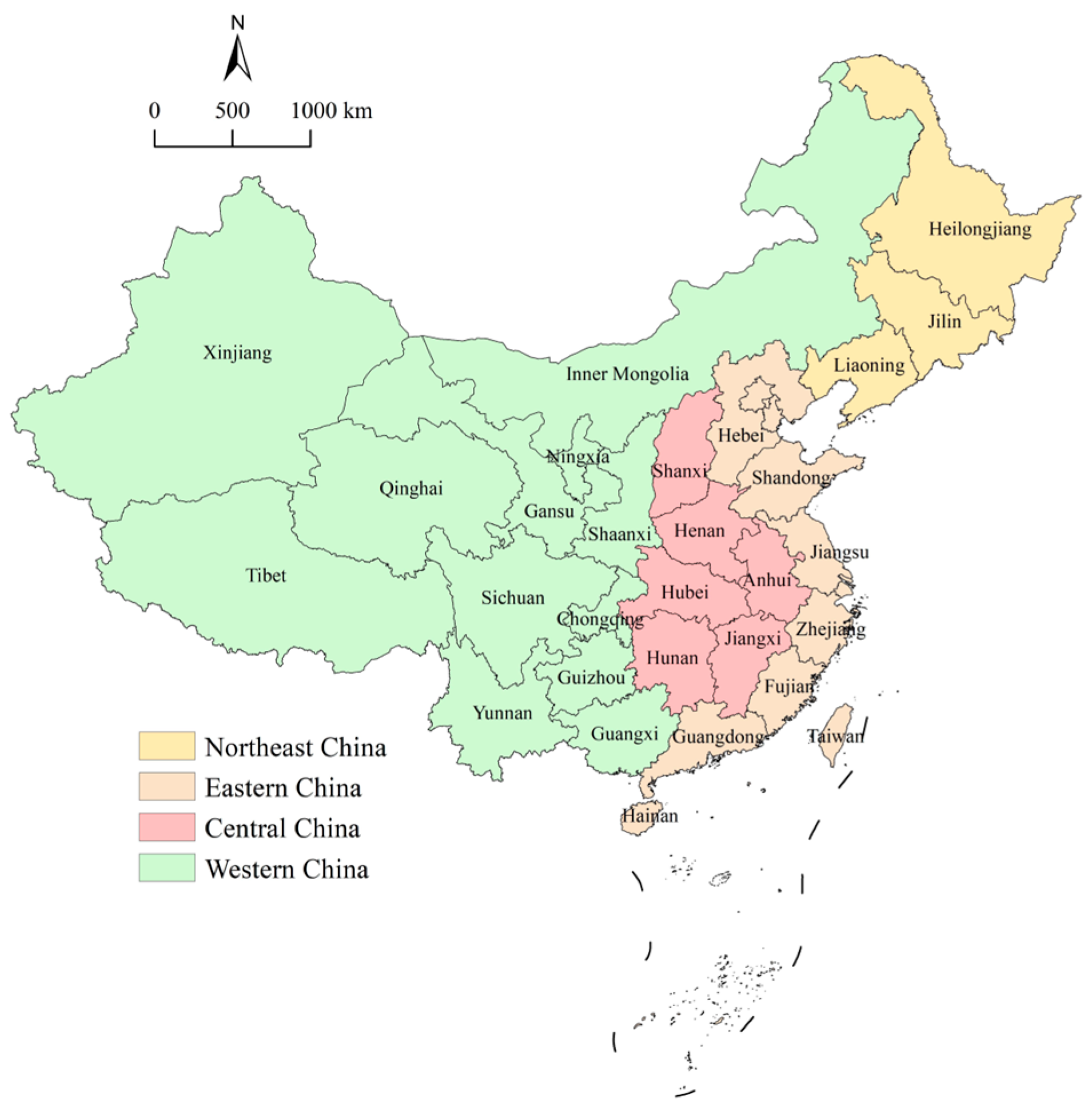
The research encompasses 1712 county-level administrative units, distributed among 29 provinces, autonomous regions, and municipalities directly under the central government, while excluding Hong Kong, Macao, and Taiwan, as well as Beijing, Tianjin, and Shanghai. Based on variations in geographical and economic factors, China can be categorized into four economic regions: Eastern China, Central China, Western China, and Northeast China (Figure 1). Eastern China comprises 13 provinces-level regions, namely Beijing, Tianjin, Hebei, Shandong, Jiangsu, Shanghai, Zhejiang, Fujian, Guangdong, Hainan, Hong Kong, Macao, and Taiwan; however this study includes 410 county units across 8 provinces. Central China includes six provinces— Shanxi, Henan, Anhui, Hubei, Jiangxi, and Hunan—encompassing 468 county units in this research. Northeast China consists of Heilongjiang, Jilin, and Liaoning, with 141 county units included in this study. Western China includes 12 province-level regions, with 693 county units serving as the research subjects.

3.3.2. Data Sources

Data from various sources, such as spatial, statistical, and land-use information, were employed to assess the URI and factor mobility, in addition to examining how factor mobility influences URI (Table 3). All spatial datasets were established in the Albers Equal-Area Conic projection and analyzed with ArcGIS (version 10.5; Esri, Redlands, CA, USA). Furthermore, based on existing research, the evolution of rural–urban relations in China since 1949 can be categorized into two distinct stages: the stage of rural–urban opposition (1949–2002) and the stage of urban–rural integration (after 2003). Notably, the period from 2003 to 2010 marked the initial phase of URI, with China fully entering the stage of URI in 2011 [28]. Consequently, the research period for this study is defined as 2011–2021.

4. Results and Analysis

4.1. The Characteristics and Space-Time Process of URI

4.1.1. Characteristics of URI

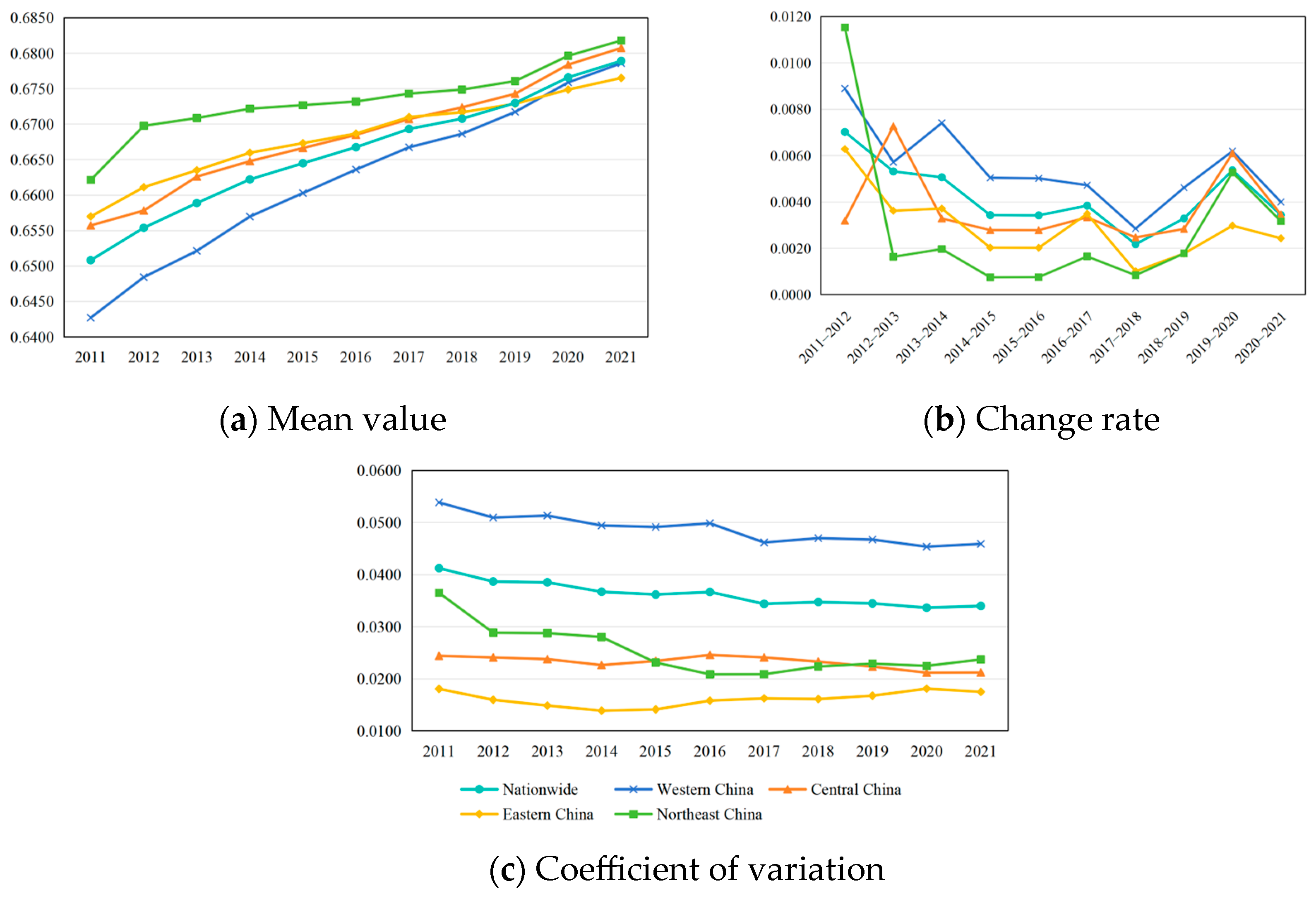
The calculation results indicate a continuous improvement process in the URI index at the county level in China throughout the study period; however, the rate of change for this index displays distinct characteristics across different intervals (Figure 2a,b). From 2011 to 2018, China’s URI showed a progressive trend, although the growth rate experienced a consistent decline. Subsequently, during the period from 2018 to 2020, there was an upward trajectory in the growth rate. Nevertheless, from 2020 to 2021, the growth rate of the URI reverted to a declining pattern (Figure 2b). Throughout the study period, the coefficient of variation for China’s county-level URI index demonstrated a declining trend, indicating a gradual reduction in regional disparities in China’s URI (Figure 2c).
The results reveal notable variations in URI among the four regions of China. Throughout the research timeframe, Northeast China exhibited the highest URI; nonetheless, the rate of increase was slow, especially from 2011 to 2018 (Figure 2a,b). In Eastern China, the URI levels are relatively high, yet the growth rate continues to be slow (Figure 2a,b). Additionally, a gradual emergence of a lagging characteristic in URI has been observed in Eastern China, with an expanding disparity between internal units since 2015 (Figure 2c). The URI in Central China reached a high level and demonstrated a process of enhancement throughout the study period (Figure 2a). In contrast to other regions, the URI among internal units in Central China exhibited a progressive trend from 2011 to 2015 (Figure 2c). At the beginning of the study period, the URI in Western China exhibited one of the highest growth rates nationwide (Figure 2a,b). Moreover, while a decreasing pattern in the coefficient of variation for the URI Index is observed in Western China, it still stands substantially above the national average and other areas. This indicates pronounced disparities in URI among different units within Western China, revealing distinctive characteristics of differentiation (Figure 2c).

4.1.2. Spatial Process of URI

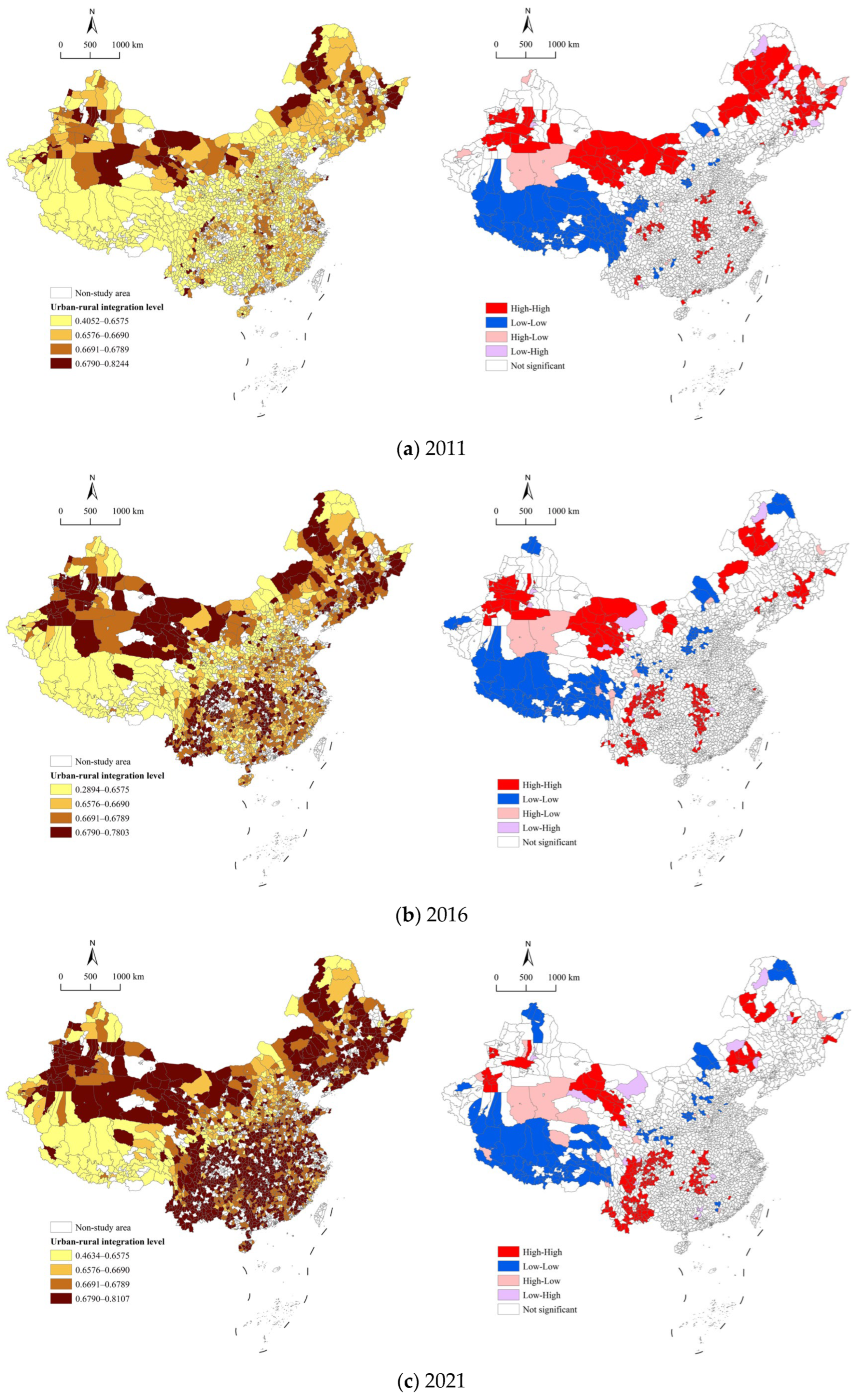
The spatial characteristics of URI in China were effectively illustrated using the model for exploratory spatial data analysis. The results indicated that, during the study period, the global Moran’s I values for URI were all greater than 0.000, suggesting that URI in China exhibited a spatial agglomeration feature. However, this trend has shown a weakening process after 2018 (Table 4).
The spatial evolution of URI in China has been prominently manifested at the county level. In 2011, the URI throughout the nation showed a generally low condition, marked by a spatial distribution that displayed higher concentrations in Eastern China and diminished levels in Western China. The high-level (HH) units were predominantly located in Heilongjiang and Jilin in Northeast China, Jiangsu in Eastern China, and Hubei in Central China (Figure 3a). In contrast, the HH units in Western China were primarily concentrated in western Inner Mongolia, Gansu, and central Xinjiang. The low-level (LL) units were primarily found in the Qinghai–Tibet Plateau and its surrounding areas. Between 2011 and 2016, a substantial enhancement in URI was observed in Central and Western China, which profoundly reshaped the spatial configuration of URI nationwide. By 2016, clusters of HH units had emerged in Hubei and Hunan in Central China, as well as in Sichuan and Chongqing in Western China (Figure 3b). Additionally, LL units formed contiguous clusters in Hebei and Shanxi, alongside the Qinghai–Tibet Plateau (Figure 3b). By 2021, the majority of China’s county units exhibited a moderate to high degree of URI, with lower-level units primarily concentrated in Tibet and border regions. This created a low-level zone extending from central Inner Mongolia through Hebei, Shanxi, and Gansu to Tibet (Figure 3c). In contrast to 2011 and 2016, the HH units of URI in China’s counties in 2021 displayed a predominant concentration in the western region, forming contiguous distribution areas primarily encompassing Sichuan, Chongqing, and Yunnan. Conversely, the presence of HH units in the northeastern and eastern regions has become almost negligible (Figure 3c).

4.2. Estimation Results of the Baseline Model

To address multicollinearity among the variables, this study conducted Pearson correlation analysis in conjunction with variance inflation factor (VIF) assessments. As demonstrated in Table 5, the explanatory variables and all control variables are significantly correlated with the dependent variable (URI).
The findings of the VIF test (refer to Table 6) indicate that all VIF values remain below 10, suggesting that significant multicollinearity does not pose a problem in this model.
According to the findings from the correlation and VIF tests, we estimated a pooled OLS regression model to examine the influence of factor mobility on URI. The results in Table 7 indicate that the adjusted R2 of the pooled regression model is 0.2553, and the F-statistic is significant, suggesting a good model fit. Regarding factor mobility, the UR, lnUI, and BC all have significant effects on the URI. Specifically, UR and lnUI positively affect URI, while BC has a negative impact. Among the control variables, lnGDP and ICDI have significant positive effects on URI, whereas the FSR has a significant negative effect. The FE variable, however, is not statistically significant (see Table 7).
Notably, the spatial autocorrelation in the OLS residuals is significant, indicated by a z-score of 7.329. This suggests that the OLS estimates may be unreliable. As a result, we infer that the geographic distribution of URI in China is not random, and thus, a spatial econometric framework should be used to examine the factors affecting URI. The LM and robust LM tests indicate spatial dependence in both the spatially lagged dependent variable and the error term (Table 8). Additionally, the LR and Wald tests suggest that the Spatial Durbin Model (SDM) into a Spatial Lag Model (SLM) or a Spatial Error Model (SEM) cannot be simplified. Furthermore, the Hausman test statistic (168.88) exceeds the 1% critical value at the 1% significance level, leading us to reject the null hypothesis in favor of the fixed-effects specification. Therefore, this study employs the SDM with fixed effects for the empirical analysis.

4.3. Findings from the Spatial Econometric Model

4.3.1. Conventional Results of the Spatial Econometric Model

The findings from the SDM (Table 9) show that both UR and lnUI have statistically significant positive effects on URI at the 1% significance level. This finding suggests that population mobility and capital mobility can facilitate URI. Conversely, BC does not have a significant effect on URI, implying that land mobility may not significantly influence local URI. This may be attributable to the expansion of urban built-up areas associated with land mobility, which leads to land-resource misallocation and a subsequent loss of allocative efficiency. The aforementioned results demonstrate that population mobility and capital mobility can directly facilitate URI. Therefore, H1 is partially supported; H1a and H1b are empirically validated, whereas H1c is not supported.
With respect to the control variables, the coefficient on lnGDP is both positive and statistically significant (Table 9). Similarly, the coefficient of FSR is positive and significant, indicating that improved fiscal conditions can promote regional URI (Table 9). Conversely, the coefficients for FE and ICDI are negative and significant at the 1% level (Table 9), indicating that improvements in financial efficiency and the optimization of regional industrial structure do not contribute to URI; rather, they hinder it.
Recognizing that changes in a region’s independent variables can influence both its dependent variable and the dependent variables of other regions, LeSage [49] referred to the former as direct effects and the latter as spatial spillover effects. This study reveals a statistically significant positive spatial spillover effect of UR on URI across China’s counties, indicating the positive spillovers of population mobility on URI (Table 10). The findings suggest that population mobility not only facilitates URI within the region but also contributes to the process of URI in neighboring regions. The transfer of knowledge and diffusion of technology during population mobility can enhance regional URI by increasing income, labor remuneration, and quality of life while also fostering URI in neighboring regions through the cross-regional dissemination of knowledge and technology, as well as the demonstration effect and peer pressure arising from inter-regional individual behavior. The direct impact of lnUI on URI is significant at the 1% level; in contrast, its spatial spillover effect is not significant. This indicates that capital mobility contributes to URI only within the local region, without any discernible spatial spillover effect (Table 10). A likely reason is the relatively localized nature of capital mobility compared to population mobility, which results in its limited impact on neighboring regions. Based on these results, it can be concluded that H3 is only partially supported.
Regarding the control variables, lnGDP exhibits a negative spatial spillover effect on URI. This finding indicates that economic development generates negative spillovers for neighboring regions. Furthermore, both the direct and indirect effects of FSR on URI demonstrate statistical significance, suggesting a positive influence of the fiscal conditions on spatial spillover in URI. The estimated coefficient indicating the spatial spillover effect of ICDI on URI is negative and statistically significant, implying that industrial upgrading has a detrimental spatial spillover effect on URI.

4.3.2. Mediation Effect Analysis

To examine the indirect effects of factor mobility on URI, this study employs a mediation model for empirical analysis. The mediation results indicate that population mobility and capital mobility—two key components of factor mobility—exert indirect effects on URI in China by enhancing agricultural labor productivity and improving agricultural land-use efficiency, thereby providing partial support for H2.
Furthermore, the results reveal that agricultural labor productivity partially mediates the relationship between population mobility and URI (Table 11), thus validating H2a. The migration of the rural population to urban areas in China has optimized the allocation of population and land resources in rural regions, fostering favorable conditions for large-scale agricultural operations, mechanized production, and technological modernization, thereby enhancing the productivity and income of the remaining rural labor force. This transformation has been supported by supportive policy initiatives, including reform of the household registration system, the separation of the three rights in rural land, and policies encouraging land transfer. Additionally, agricultural labor productivity also exhibits a suppressive effect in the relationship between capital mobility and URI (see Table 11). This suppressive effect may be attributable to the urbanization process, which has led to substantial losses of young and middle-aged rural populations, ultimately resulting in a decline in rural production capacity. The concentration of capital in urban areas further exacerbates this decline in rural production capacity. In the long term, this phenomenon will hinder URI progress in China.
By contrast, agricultural land-use efficiency exhibits a suppressing effect in the relationships between (i) population mobility and URI and (ii) capital mobility and URI. This suggests that although population and capital mobility, as well as agricultural land-use efficiency, can promote URI, population and capital mobility inhibit agricultural land-use efficiency (Table 11). Therefore, H2b is not supported. This result highlights the “mismatch” dilemma in factor mobility in China’s current context. Specifically, the potential gains from land consolidation driven by rural labor outflows are undermined by widespread land fragmentation and abandonment, as farmers maintain their land rights while migrating—commonly adopting the strategy of “leaving their hometowns without relinquishing their land.” Meanwhile, incoming social capital often prioritizes short-term profits, leading to the “non-agriculturalization” of farmland and failing to significantly enhance land productivity. Therefore, deepening land-system reforms and strengthening oversight of capital inflows into rural areas are essential to ensure the optimal allocation of labor and capital, aligning these factors with the core objectives of agricultural modernization and URI.
Furthermore, the results suggest that agricultural modernization does not mediate the relationship between factor mobility and URI, thus supporting the rejection of H2c. The rejection of this hypothesis reveals a structural challenge in China’s urban–rural transformation. Economically, it indicates that despite accelerated flows of labor and capital, they failed to translate systematically into a modern agricultural sector due to capital’s preference for non-farming sectors or cash crops, coupled with the low comparative returns and high risks inherent in agriculture. Therefore, future policies should adopt a more strategic approach by strengthening policy guidance in agricultural science and technology, advancing smart agriculture, supporting the entire agricultural value chain, and deepening reforms in the rural land property-rights system—thereby unlocking pathways for factor mobility to drive agricultural modernization.

4.3.3. Regional Heterogeneity Analysis

The analysis of the evolutionary process of URI reveals significant disparities in both level and growth rate across China’s four major economic zones. To gain a more in-depth understanding of how factor mobility affects URI, it is necessary to examine the influence of factor mobility on URI while accounting for regional differences.
The analysis results confirm significant regional variation in the impact of factor mobility on URI, thereby supporting H4. The promoting effect of population mobility (represented by lnUI) on URI is more pronounced in Western China and Northeast China, particularly in the latter, whereas it has no significant effect in Eastern China (Table 12). In terms of spatial spillover effects, population mobility has a significant negative effect on URI in Central China and Northeast China, a positive spillover effect in Eastern China, and an insignificant effect in Western China (Table 12). Notably, in Northeast China, the strong negative spillover even causes the total effect (−0.0319) to become negative, in sharp contrast to the positive total effects observed nationally and in Eastern China. In Eastern China, the positive spatial spillover effect reflects a “synergistic integration” model in which core cities serve as growth engines while surrounding counties actively engage in regional development. This pattern is consistent with “urban–rural continuum” theory, where well-established transportation and information networks support intense population mobility, enabling the effective diffusion of knowledge, technology, and consumption behaviors across urban and rural areas [54]. By contrast, the negative spatial spillovers in Central China and Northeast China suggest an early stage of “polarized integration” or “siphoning integration.” This phenomenon is particularly acute in the many agriculture-dominated, population-losing counties in these regions. Lacking robust local industries to retain labor, these counties experience a “brain drain” toward provincial capitals. According to core–periphery theory, under conditions of relatively scarce resources, the one-way concentration of high-quality population in core cities (e.g., provincial capitals) fails to drive development in surrounding rural areas. Instead, it drains the essential human capital from these areas, thereby hindering the overall regional process of URI [55]. This heterogeneity indicates that population policies aimed at promoting URI must be tailored to local conditions: Eastern China should focus on optimizing network structures, whereas Central China and Northeast China need to cultivate secondary growth centers to mitigate the siphoning effect.
The impact of capital mobility on URI also exhibits a clear pattern of regional differentiation. Although capital flows in all regions align with the national trend and significantly promote URI, the effect is particularly pronounced in Western China, where the estimated coefficient reaches 0.0068 (Table 12). The regional differences are mainly reflected in the spatial spillover effects. Eastern China shows a significant negative spatial spillover effect (−0.0045), indicating that in this capital-intensive and highly competitive area, capital investment in one location may create a “siphon effect” that attracts production factors, thereby inhibiting URI in neighboring regions (Table 12). In contrast, Central China exhibits a significantly positive spatial spillover effect (0.0034), indicating that capital mobility in this region generates a strong “diffusion effect” on URI and promotes URI in neighboring areas. Meanwhile, spatial spillover effects in Western China and Northeast China are insignificant, similar to the overall national pattern (Table 12), implying that the impact of capital mobility is largely confined within local administrative boundaries. In Eastern China, the negative spatial spillover effect of capital mobility stems from the market’s dominant role in the URI process. Guided by efficiency, capital tends to flow toward urban cores or suburban areas that offer higher expected returns. Although this “selective allocation” may be efficient at the micro level, it exacerbates the “Matthew effect” between urban and rural regions at the macro-regional scale, thereby impeding balanced URI development across the region. Conversely, the significantly positive spatial spillover effect observed in Central China underscores the effectiveness of national strategies such as the “Rise of Central China.” State-led deployment of major infrastructure and industrial projects facilitates coordinated capital investment across regions. For example, the development of cross-regional transportation corridors enables more even diffusion of capital into both urban and non-urban centers, fostering a graded distribution of industrial chains between cities and rural areas, thereby generating positive regional impacts through “capital-mediated integration.” This divide illustrates that a purely market-driven economy may intensify spatial disparities in URI, whereas well-designed regional strategic planning can direct investment toward a more balanced and synergistic spatial structure.
Compared with population and capital mobility, land mobility exhibits the most pronounced regional heterogeneity in its impact on URI, with the direction and statistical significance of its effects varying substantially across different regions. Western China is the only region showing significantly positive impacts, with both its direct effect (0.0000) and spatial spillover effect (0.0010) being positive. This suggests that land-based urbanization in Western China not only promotes URI locally but also generates positive spillovers in neighboring areas, reflecting a favorable trend of synergistic development. In stark contrast, the spatial spillover effects in Central China (−0.0011) and Northeast China (−0.0002) are significantly negative, indicating that land mobility in these regions adversely affects URI in neighboring areas. This spillover may stem from competition over limited land resources or incompatible regional development strategies. In Eastern China, the results are consistent with the national findings, with none of the effects being significant (Table 12). The positive spillover effect is observed only in Western China. This can be attributed to the specific characteristics of many western counties, which are often designated as national key ecological function zones or are recipients of strategic, state-led investment under the “Western Development Strategy.” In these counties, land expansion under the “Western Development Strategy” is primarily dedicated to constructing regional public goods such as transportation corridors, logistics hubs, and large-scale industrial parks. Such infrastructure mitigates geographical constraints and reduces transaction costs, thereby directly facilitating agricultural exports and industrial integration in neighboring regions [56], which in turn significantly promotes URI. However, the negative spatial spillover effects of land expansion in Central China and Northeast China reveal the inherent unsustainability of their current growth models. Central China and Northeast China, as major grain-producing regions, are subject to stringent farmland-protection policies under the national red-line system. Urban expansion in these areas largely constitutes a “zero-sum game,” wherein the growth of constructed land in one locality often comes at the expense of the developmental potential of surrounding regions, thereby reinforcing the entrenched pattern of “urban advance and rural retreat.” In Northeast China, land expansion sharply contradicts population loss. Blind urban expansion has resulted in severe land-resource misallocation [57], not only failing to promote URI but also weakening the development potential of surrounding rural areas through the inefficient use of limited fiscal resources, thereby intensifying regional spatial imbalance. This heterogeneity serves as a warning that the land-driven path to URI is highly stage- and region-specific and cannot be simply replicated.
The above analysis indicates that Hypotheses 4a and 4b are not supported. This underscores the complex regional disparities in the effects of county-level factor mobility on URI in China, posing significant challenges to the design and implementation of targeted URI policies.

4.4. Robustness Checks

To address potential endogeneity concerns, particularly reverse causality, and to examine the sensitivity of our findings to alternative model specifications, we conducted three robustness checks. All three checks are based on Spatial Durbin Model specifications with time-fixed effects, which are broadly consistent with, although not identical to, the baseline specification.
First, we used lagged explanatory variables. Specifically, we re-estimated the model using one-year lags of the three core explanatory variables, namely L.UR, L.lnUI, and L.BC, while retaining the original k-nearest-neighbor spatial weight matrix. The results are reported in Panel A of Table 13. Both L.UR and L.lnUI exhibit positive and statistically significant direct effects, with coefficients of 0.0140 and 0.0052, respectively, both significant at the 1% level. By contrast, L.BC is not statistically significant. In addition, L.UR shows a positive and statistically significant spatial spillover effect, with a coefficient of 0.0372, significant at the 5% level, as well as a positive and significant total effect, with a coefficient of 0.0513, significant at the 1% level. These results suggest that the positive effects of population mobility and capital mobility remain robust when potential reverse-causality bias is partially addressed through the use of lagged explanatory variables.
Second, we used an alternative spatial weight matrix. Specifically, we replaced the original spatial weight matrix with an inverse-distance-squared matrix while retaining the contemporaneous values of the explanatory variables. As reported in Panel B of Table 13, UR and lnUI continue to exhibit positive and statistically significant direct effects, with coefficients of 0.0136 and 0.0047, respectively, both significant at the 1% level. UR also shows statistically significant spatial spillover and total effects, with coefficients of 0.0214 and 0.0350, respectively, both significant at the 1% level. By contrast, the spatial spillover effect of capital mobility remains statistically insignificant, consistent with the baseline results. Land mobility is not statistically significant in this specification.
Third, we adopted a combined specification using both lagged explanatory variables and the alternative spatial weight matrix. As the most stringent robustness test, this specification simultaneously incorporates one-year lags of the explanatory variables and the inverse-distance-squared spatial weight matrix. The results, reported in Panel C of Table 13, show that L.UR and L.lnUI continue to have positive and statistically significant direct effects, with coefficients of 0.0135 and 0.0051, respectively, both significant at the 1% level. The spatial spillover and total effects of L.UR also remain statistically significant, with coefficients of 0.0190 and 0.0325, respectively, both significant at the 1% level. The spatial spillover effect of capital mobility is again statistically insignificant, and land mobility remains statistically insignificant.
In summary, the direct effect of capital mobility, proxied by lnUI, remains positive and statistically significant at the 1% level across all robustness checks. Population mobility, proxied by UR, also shows a generally positive and significant effect, with its direct effect remaining statistically significant in the lagged specifications. By contrast, land mobility, proxied by BC, does not exhibit statistically significant effects in any of the robustness checks. Taken together, these results indicate that our core findings are robust to alternative treatments of potential reverse causality and to the use of an alternative spatial weight matrix.

5. Discussion

5.1. The Mechanism of Factor Flow’s Impact on Urban–Rural Integration

Integrating the theoretical framework with the empirical findings, this study elucidates a comprehensive mechanism through which factor mobility collectively shapes urban–rural integration (URI) at China’s county level via three interconnected pathways: “Direct Factor Empowerment,” “Indirect Structural Transformation,” and “Spatial Restructuring” (Figure 4).
First, factor mobility provides the fundamental impetus for URI through a “Direct Empowerment” effect. The significant positive direct effects of population and capital mobility confirm the foundational role of labor and capital reallocation in optimizing resource allocation and narrowing the urban–rural divide, aligning with classical development theories. Specifically, the transfer of labor from rural to urban areas optimizes marginal labor productivity across sectors, while the resulting remittances and return entrepreneurship directly boost human and financial capital accumulation in rural areas. Concurrently, capital investment in county towns directly improves infrastructure and public services and benefits rural areas through industrial-chain extensions, laying the material foundation for stronger economic and social linkages. However, the statistically insignificant impact of land mobility at the national level presents a critical counterpoint. This suggests that China’s current model of land-centered urbanization, characterized by a one-way transfer from rural to urban uses under the dual land system, has encountered efficiency bottlenecks. As highlighted by Wang et al. [58], simple expansion does not equate to efficient use. In the context of URI, the inefficient conversion of rural land, often driven by local governments’ reliance on “land finance,” can lead to resource misallocation and impede the integration process, highlighting frictions in the land factor market that challenge conventional wisdom.
Second, factor mobility indirectly promotes URI by catalyzing efficiency gains within the urban–rural system through a “Structural Transformation” effect. The empirical results indicate that population mobility plays a significant mediating role by enhancing agricultural labor productivity (AVA). This confirms the classic logic of the Lewis model. The underlying mechanism is that rural labor outflows create conditions for moderate-scale land management. Coupled with the diffusion of technical knowledge from urban to rural areas, this directly increases the productivity and income of the remaining labor force, thereby narrowing the urban–rural income gap. However, our analysis reveals a crucial “inhibitory effect”: population and capital mobility exhibit an inhibitory relationship with URI through the mechanism of agricultural land-use efficiency. This “structural mismatch” paradoxically reveals that, although factor mobility is occurring, it is not effectively driving the intended modernization of the agricultural sector. This is a uniquely Chinese phenomenon in which rural labor outflows are not adequately accompanied by land consolidation due to institutional barriers, such as farmers’ tendency to “leave their hometowns without relinquishing their land” to retain their rights. Meanwhile, local administrative interventions strongly direct resource allocation toward high-yield urban sectors [58]. Therefore, capital inflows may be redirected toward non-agricultural activities or short-term speculative ventures rather than long-term agricultural productivity enhancement, failing to significantly improve land-use efficiency.
Finally, factor mobility reshapes the URI landscape across counties through a “Spatial Restructuring” effect. This provides robust support for the principles of new economic geography and flow-space theory, both of which highlight the significance of flows in shaping regional spatial structures. As a carrier of knowledge and information, cross-regional population movement can transmit the positive effects of URI to neighboring counties through mechanisms such as demonstration effects, technological diffusion, and the dissemination of consumption concepts. By comparison, the spillover effects of capital and land are more complex and geographically constrained. The impact of capital tends to be highly localized, with benefits predominantly confined within administrative boundaries. Moreover, the profound regional heterogeneity and spatial spillover effects observed in this study can also be interpreted through the lenses of regional development stages and spatial governance policies. In the mature market environment of Eastern China, well-established infrastructure and integrated industrial chains facilitate the positive diffusion of population and knowledge. Conversely, the negative spatial spillover of land mobility in Central and Northeast China is largely driven by China’s strict top-down construction-land quota system. Because land quotas are scarce developmental resources, urban expansion in one county often implies restrictions on development space in neighboring counties, creating a “zero-sum game” under pressure from local economic growth targets. In this context, core cities exert a “siphon effect,” draining rural hinterlands of essential elements. In contrast, the positive spillovers of land mobility in Western China are policy-driven. Supported by the national “Western Development Strategy,” land quotas are allocated to construct cross-regional public goods and ecological infrastructure, structurally transforming spatial relations from competition to cooperation. These findings underscore that the spatial restructuring mechanism is highly contingent upon underlying institutional constraints and specific regional development paradigms.
In conclusion, the impact of factor mobility on URI is a complex process involving the superposition of multiple pathways and scales. The direct effect is the immediate manifestation of resource reallocation, the indirect effect represents the long-term outcome of systemic structural optimization, and the spatial spillover effect reveals the interactive and interconnected nature of URI within regional networks. Elucidating this integrated mechanism provides a strong theoretical basis for formulating differentiated, regionally coordinated development policies.

5.2. The Theoretical and Practical Implications

5.2.1. Theoretical Implications

This research expands on previous studies in two primary ways. First, it provides a precise depiction of the characteristics and dynamics of the spatial and temporal evolution of URI at a national scale in China. The connection between urban and rural regions, as reflected in URI, has garnered considerable academic interest, as it is a crucial issue in China’s socio-economic advancement. However, existing research predominantly focuses on the processes and characteristics of URI at provincial and regional levels [7,9,59], resulting in an insufficient understanding of national-scale URI dynamics in China. While several studies attempt to analyze and discuss URI characteristics on a national scale [1,19,22], most adopt provincial and municipal areas as their primary research units, leading to a generalized characterization of these features. Most national-scale studies indicate that China’s URI is currently at a low level, although it shows signs of improvement and an ongoing upgrading process [22,60]. The findings of this study closely align with these observations. Building on this foundation, the present study further identifies significant disparities in the evolutionary trajectory of URI across China’s four major regions, with a specific focus on integration level and growth rate. Furthermore, regarding the spatial characteristics of URI in China, existing studies at provincial and city scales generally suggest that, similar to patterns observed in economic development, Eastern China emerges as a concentrated region exhibiting a higher level of URI than Western and Central China [22,35]. Using county-level observations, this study reveals that the URI of China’s county units exhibits a spatial pattern that transcends the simplistic characterization of being “high in the east and low in the west.” Notably, a significant number of high-level units are also identified in the western region, which aligns with the findings of Yang et al. [39]. Additionally, the findings of this research demonstrate a geographical shift in URI agglomeration in China, shifting from Eastern and Northeast China toward Central and Western China. Moreover, it identifies a low-level URI belt that stretches from central Inner Mongolia, across North China, to the Tibetan Plateau. The results deepen our understanding of the characteristics and trends of URI in China, thus offering a conceptual basis for developing region-specific strategies to optimize URI.
Second, this study provides empirical evidence and elucidates the underlying mechanism of factor mobility in URI through comprehensive quantitative analysis. The existing literature generally posits that the systematic exchange of factors between urban and rural areas is a prerequisite for achieving URI and rural revitalization [7,9,19,27]. However, regarding the mechanism of factor mobility in URI, most existing studies primarily adopt a qualitative perspective for theoretical discussion, with limited emphasis on empirical quantitative research and systematic analysis. Du and Liu [29] argue that factor mobility influences the dynamics of rural–urban relations through economic and political mechanisms in China. Furthermore, Ping et al. [34] found that factor mobility exerts an indirect influence on the URI process. By considering China’s counties as the fundamental unit of analysis, this study substantiates that factor mobility plays a pivotal role in fostering URI while also highlighting regional disparities in its promoting effect, consistent with previous findings [35,39]. However, this study also finds that land mobility does not promote URI in China’s counties and, in certain regions, even hinders it. This diverges from Ping et al. [35] but aligns with Yang et al. [39]. Furthermore, through rigorous quantitative analysis and empirical research, this study clarifies the direct, indirect, and spatial spillover effects of factor mobility on URI. It reveals that factor mobility can influence the URI process through three interrelated pathways: “direct empowerment,” “structural transformation,” and “spatial reconfiguration.” Moreover, the study identifies prominent challenges in this process, including the “asymmetry” of factor impacts and the “structural mismatch” between factor mobility and industrial structure transformation. These findings resonate with broader discussions in rural geography, particularly Woods’ [14] emphasis on the diverse and often contradictory outcomes of rural restructuring, where global and national forces interact with local specificities. Our observation of regional heterogeneity in factor mobility’s impact on URI, for instance, aligns with Bosworth and Atterton’s [36] argument for a nuanced understanding of local interactions within the rural–urban continuum, rather than a monolithic view of urban–rural relations. These insights provide both a theoretical and practical foundation for formulating an optimal strategy for URI in China.

5.2.2. Policy Implications and Recommendations

Through systematic theoretical construction and empirical analysis, this study demonstrates that factor mobility can effectively facilitate the process of urban–rural integration (URI) in China’s county units. Furthermore, the empirical results reveal the complex mechanisms through which factor mobility drives URI in China. Specifically, the influence of factor mobility on URI exerts not only significant direct effects but also intricate indirect effects and notable spatial spillover effects, and it exhibits substantial regional heterogeneity. These findings have significant practical implications for China, which is currently undergoing a critical phase of advancing rural revitalization and new urbanization strategies. Policymakers should move away from uniform, national-level macro-control and establish a more targeted policy framework that integrates “top-level design” with “region-specific measures,” thereby maximizing the positive impacts of factor mobility on URI while mitigating potential adverse effects.
(1) National level: Deepen institutional reforms and establish a top-level institutional framework to facilitate the two-way mobility of factors.
At the level of national macro-policy design, it is essential to enhance institutional innovation and reform to guide factor mobility between urban and rural areas toward a balanced two-way circulation, moving away from the traditional one-sided urban bias and thereby fully unlocking the positive impact of factor mobility on URI.
First, the market-driven allocation of land resources should be further strengthened to achieve a more effective balance between urban development and farmland protection. This study reveals that the current flow of land factors in China has not significantly promoted URI at the national level. Indeed, in Central China and Northeast China, it has generated a significant negative spatial spillover effect. This indicates that the prevailing one-way model of land transfer—from rural to urban areas—centered on land urbanization has led to efficiency losses. Therefore, policymaking should place greater emphasis on revitalizing existing urban construction land. It is imperative to accelerate nationwide implementation of a cross-regional trading mechanism for surplus indicators under the “increase-decrease linkage” policy. Policymakers should explore establishing a direct linkage between new construction-land indicators allocated to super-large and mega-cities and the outcomes of rural construction-land consolidation, reclamation, and high-standard farmland construction in major grain-producing areas or ecological function zones. Through institutional reforms, the urbanization demands of developed Eastern China can be transformed into direct drivers for rural development in Central, Western, and Northeast China, thereby enabling interregional “reverse compensation” of land-factor value and facilitating a “two-way flow” of resources between urban and rural areas. In addition, policies should also facilitate the market-oriented circulation of rural construction land and homesteads, allowing farmers to gain a fairer share of land value appreciation. This would address the “structural mismatch” where labor leaves but land remains idle and would transform land from a barrier into a catalyst for URI.
Second, it is essential to innovate incentive mechanisms for capital sinking and build a unified urban–rural factor market. While the direct effect of capital mobility is positive, its insignificant spatial spillover suggests localized agglomeration. Furthermore, the mediation effect analysis of the research indicates that capital mobility has not effectively promoted agricultural modernization or improvements in agricultural land-use efficiency. This reflects the tendency of capital mobility in rural areas to be “disconnected from the real economy and inclined toward the virtual economy” and to be short-term-oriented. Therefore, moving beyond traditional credit guidance, integrating the performance of “capital down to the countryside” into the Key Performance Indicators (KPIs) for financial institutions serving rural revitalization is crucial. Concurrently, piloting the issuance of special bonds backed by the future income of rural collectively owned profit-oriented construction land within the framework of the “Three Rural Lands” (rural collective-owned commercial construction land, rural homestead land, and rural contracted farmland) reform can inject large-scale, sustainable capital into rural industries. Furthermore, the government should enhance its regulatory guidance to direct capital toward rural areas more effectively. It is recommended that the China Development Bank and other policy banks take the lead in establishing, in collaboration with major state-owned enterprises and market-oriented investors, a national-level “Rural Revitalization Industry Investment Master Fund.” This fund would guide capital toward strategic sectors such as smart agriculture—areas characterized by long payback periods but high long-term value—rather than short-term, non-agricultural ventures, thereby catalyzing broader social investment in enhancing the core competitiveness of China’s agricultural sector.
Third, implement the reform linked to “household registration–public services” to smooth the two-way mobility of population between urban and rural areas. This study confirms that population mobility exerts significantly positive direct and spatial spillover effects on URI. To consolidate this positive impact, it is recommended to pilot the decoupling of the “residence permit + points” system from access to public services in selected regions. Individuals with stable employment or residence within a county should have equal access to basic public services such as education and healthcare, irrespective of their “Hukou” status. This would mitigate issues of “involuntary left-behind” groups and “semi-urbanization,” thereby fully activating the integrative power of population mobility.
(2) Regional level: Implement region-specific strategies and develop targeted policy instruments.
The regional heterogeneity analysis indicates that the impact of factor mobility on URI varies significantly across China’s four major economic regions. Therefore, differentiated policies and strategies should be formulated to fully harness the promoting effect of factor mobility on URI and achieve balanced regional development.
For Eastern China, the focus should be on “networked integration” to address the issue of capital siphoning. Population mobility in Eastern China shows a significant positive spatial spillover effect on URI, while capital mobility has shown a negative spillover effect. In response to this situation, in addition to market mechanisms, enhanced policy guidance and coordination are essential. It is recommended that mature urban agglomerations such as the Yangtze River Delta and the Guangdong–Hong Kong–Macao Greater Bay Area take the lead in formulating a “Metropolitan Circle Urban-Rural Integration Development Plan” to overcome administrative fragmentation. By integrating critical infrastructure—including intercity rail systems and digital networks—the functions and industries of core cities can be more effectively redirected to surrounding counties, promoting balanced regional development. Industrial enclaves with a tax-sharing mechanism should be promoted. Core cities should be encouraged to co-develop industrial parks in surrounding counties to host manufacturing links or supply-chain partners. A cross-jurisdictional mechanism for sharing tax revenues and GDP would be established to mitigate the capital siphon effect and foster win–win development. Moreover, county-level units in different spatial locations should adopt targeted strategies to advance urban–rural integration. Core suburban counties within metropolitan areas should focus on achieving functional synergy with central urban zones, while ordinary counties outside these areas must be safeguarded against excessive resource depletion and strengthened through the development of endogenous growth driven by characteristic industrial clusters.
For Central China, a “Strong County” development strategy should be implemented to cultivate “county growth poles”. The population mobility and land mobility in Central China both show significant negative spatial spillover effects, while capital mobility has positive spillover effects. Policies should focus on curbing excessive polarization. On the one hand, the “County-level Central City Upgrading Initiative” should be implemented by selecting counties or county-level cities with relatively strong foundations and providing them with preferential support in finance, land use, and infrastructure investment. Priority should be given to county-level units with established industrial foundations and favorable geographical advantages. This support aims to enhance their industrial carrying capacity and improve public service provision, thereby enabling these cities to absorb rural populations locally and prevent large-scale outmigration and its associated negative spillover effects. On the other hand, by leveraging the high-speed railway network and other key transportation corridors, “urban-rural industrial integration development belts” should be strategically planned and constructed. Capital should be directed along these corridors to foster clusters of industries such as agricultural product processing and trade logistics, thereby transforming positive capital spillover effects into a sustained driving force for regional development.
For Western China, the “policy-driven” approach should be continued to magnify the positive spillover effects of land factors. Western China stands out as the only region where land mobility exerts a significant positive direct effect and generates notable spatial spillover effects on URI. Under the new framework of “Western Development,” priority should be given to locating a batch of national-level major infrastructure projects. The newly added construction-land quotas for these projects should be allocated separately by the state, rather than deducted from local quotas, to maximize the positive effect of land mobility. Additionally, exploring the “flyover park” model—allowing Eastern China to invest in and build industrial parks in Western China with shared output and tax revenue—can foster interregional synergy.
For Northeast China, the “smart contraction” strategy should be implemented more proactively and assertively. Northeast China faces severe population loss, with the most intense negative spatial spillovers from population mobility and land mobility. In this context, Northeast China must acknowledge the reality of population decline and guide urban space utilization and sustainable development through territorial spatial planning. In territorial spatial planning, it is essential to clearly distinguish between areas of population agglomeration and those experiencing demographic decline; strengthen the management of urban growth boundaries; guide public resources toward central cities, key counties, and central towns; and implement orderly mergers and administrative adjustments for villages and towns suffering significant population loss, thereby enhancing both living-environment quality and the efficiency of public service delivery.

5.3. Limitations of the Research

This study has three primary limitations. First, the scope of factor mobility examined in this study is limited, as it primarily focuses on material factors while underrepresenting or neglecting the mobility of non-material factors. With ongoing socio-economic development, the range of mobility for urban and rural factors is broadening. In addition to traditional factors of production such as labor, capital, and land, there are now new forms of factor mobility, such as information, technology, and culture. However, due to data limitations, this study incorporates only material production factors—namely population, land, and capital—into the analytical framework of factor mobility, excluding non-material factors such as information. Integrating these non-material factors into mobility would significantly enhance our understanding of the mechanisms through which factor mobility influences URI. Therefore, future research should continue to improve data and methodologies, build upon the current understanding of material element mobility by incorporating the dynamics of non-material elements, and thoroughly investigate how the interactions among multiple factors of mobility influence URI.
Second, the application of the parameter substitution method to measure and represent element flows between urban and rural areas, as well as URI, limits the accuracy and precision of these measures. Specifically, unobservable flow data are substituted with available statistical data, such as urbanization rates and fixed-asset investment. In recent years, the advent of the digital and intelligent era has introduced transformative approaches. Notably, big data—exemplified by mobile phone signaling and internet usage records—has emerged as an innovative tool for directly and effectively measuring urban–rural factor mobility. Nevertheless, challenges persist in the precise collection and analysis of such data at the county level across China. Therefore, future research will aim to achieve a higher level of precision in understanding and characterizing the dynamics of factor mobility in China at a more granular level by utilizing multi-source big data. This fundamental undertaking is essential for gaining deeper insights into factor mobility and its consequential impacts. In addition, this research has established a comprehensive evaluation system that encompasses economic, social, spatial, and ecological dimensions, facilitating a scientifically rigorous measurement and assessment of URI. However, it is crucial to recognize the limitations posed by the availability of county-level economic and social statistical data in China. Consequently, there remains scope for further refinement and optimization of the index system developed in this study, particularly with respect to its ecological and social dimensions. Specifically, the ecological integration dimension in this study relies on a single macro-level indicator (energy efficiency), which may limit the construct validity of grassroots ecological interactions. Future research should incorporate micro-level agricultural ecological indicators—such as non-point source pollution and ecological carrying capacity [42]—to construct a more robust and granular URI evaluation system. This represents a vital avenue for future research.
Third, this study primarily focuses on a unidirectional theoretical framework—how factor mobility drives urban–rural integration. However, in reality, a bidirectional causality likely exists. Potential endogeneity cannot be entirely ruled out: counties that have achieved higher levels of urban–rural integration may create a more attractive environment, which may in turn draw population concentration, attract more capital investment, and stimulate land conversion. Although we mitigated this through the fixed-effects Spatial Durbin Model and lagged-variable robustness checks, completely isolating this feedback loop remains challenging at the macro-statistical level. Future studies utilizing quasi-natural experiments or micro-level survey data could further disentangle this complex bidirectional mechanism.

6. Conclusions

Based on a theoretical framework, this study employs exploratory spatial data analysis in conjunction with a spatial econometric model to reveal the spatiotemporal characteristics of urban–rural integration (URI) at the county level in China while also examining the impact of factor mobility on URI. The core findings are enumerated as follows.
First, the geographical pattern of URI in China is undergoing profound transformation. While the national URI level has steadily improved, high-level (HH) agglomeration zones have notably shifted from Eastern and Northeastern China toward Central China and Western China, and a persistent low-level belt stretches from Inner Mongolia to the Tibetan Plateau. This dynamic spatial evolution challenges the conventional static perception of a simple “high in the east, low in the west” pattern.
Second, although the flow of various factors can drive URI, the magnitude and effects of these factors differ significantly. At the county level, both population mobility and capital mobility facilitate the URI process. In contrast, land mobility shows no statistically significant impact, suggesting that the current model of land-driven urbanization faces efficiency constraints. Furthermore, only population mobility exhibits a significant positive spatial spillover effect, indicating its unique role in fostering networked regional development.
Third, this research elucidates that factor mobility systematically promotes URI through a progressive mechanism comprising direct resource empowerment, indirect structural transformation, and macro-scale spatial restructuring. Specifically, capital constitutes the foundational input. Labor reallocation serves as the core mediator, triggering internal structural evolution within the rural sector and enhancing productivity. The synergistic flow of these factors ultimately guides the optimization and reconfiguration of urban–rural spatial functions. It is noteworthy that land mobility, due to its unique institutional attributes, predominantly functions as a structural constraint within this framework. This mechanistic model underscores that the essence of promoting URI lies in unlocking the potential of factor mobility and orchestrating its synergistic effects across these distinct yet interconnected pathways.
Finally, significant regional heterogeneity underscores distinct patterns of URI in China. Eastern China exhibits a “networked integration” pattern, with positive population spillovers but negative capital spillovers. Central and Northeastern China display a “polarized integration” model, where negative spillovers from population and land mobility hinder the URI of neighboring areas. Uniquely, Western China demonstrates a “policy-driven synergistic development” model, where land mobility generates significant positive direct and spatial spillover effects, largely attributable to targeted investments.
Consequently, these findings yield critical policy implications. Nationally, policy should pivot from a singular focus on land-centric urbanization toward facilitating high-quality population mobility and reforming land management systems to resolve the “labor-land mismatch.” Regionally, a “one-size-fits-all” approach is obsolete. Policies must be tailored: Eastern China should focus on managing network effects and mitigating capital siphoning; Central China must counteract polarization to foster inclusive growth; Northeast China should adopt the concept of “smart contraction” to optimize territorial spatial planning and enhance spatial governance; and Western China should leverage policy-driven advantages to build self-sustaining development momentum. Ultimately, this research provides an empirical roadmap for designing differentiated strategies to advance a more coordinated and sustainable urban–rural future in China.


Author Contributions

Conceptualization, Y.L. and B.W.; methodology, J.T.; software, X.C.; validation, X.C.; formal analysis, J.T.; investigation, X.C.; resources, G.W.; data curation, X.C.; writing—original draft preparation, Y.L.; writing—review and editing, B.W.; visualization, J.T.; supervision, G.W.; project administration, G.W.; funding acquisition, G.W. All authors have read and agreed to the published version of the manuscript.

Funding

This research was funded by the Chongqing Social Science Planning Doctoral Program, grant number 2020BS52; the Fundamental Research Funds for the Central Universities, grant number 2024CDJSKZK16; the National Natural Science Foundation of China, grant number 42101200, 42101264; and the Key Projects of Philosophy and Social Sciences Research of Sichuan Province, grant number SCJJ24ZD39.

Data Availability Statement

Datasets generated during the current study are available from the corresponding author on reasonable request.

Conflicts of Interest

The authors declare no conflicts of interest.

References

  1. Yang, Y.Y.; Bao, W.K.; Wang, Y.S.; Liu, Y.S. Measurement of urban-rural integration level and its spatial differentiation in China in the new century. Habitat. Int. 2021, 117, 102420. [Google Scholar] [CrossRef]
  2. Potter, R.B.; Unwin, T. Urban-rural interaction: Physical form and political process in the third world. Cities 1995, 12, 67–73. [Google Scholar] [CrossRef]
  3. Herberholz, C.; Phuntsho, S. Social capital, outpatient care utilization and choice between different levels of health facilities in rural and urban areas of Bhutan. Soc. Sci. Med. 2018, 211, 102–113. [Google Scholar] [CrossRef] [PubMed]
  4. Baffoe, G.; Zhou, X.; Moinuddin, M.; Somanje, A.N.; Kuriyama, A.; Mohan, G.; Saito, O.; Takeuchi, K. Urban-rural linkages: Effective solutions for achieving sustainable development in Ghana from an SDG interlinkage perspective. Sustain. Sci. 2021, 16, 1341–1362. [Google Scholar] [CrossRef]
  5. Bennett, K.J.; Yuen, M.; Blanco-Silva, F. Geographic differences in recovery after the great recession. J. Rural Stud. 2018, 59, 111–117. [Google Scholar] [CrossRef]
  6. Ma, C.; Jiang, Y.; Qi, K. Investigating the urban–rural integrated town development strategy on the basis of the study of rural forms in Nantong, China. Front. Archit. Res. 2021, 10, 190–201. [Google Scholar] [CrossRef]
  7. Ma, L.B.; Liu, S.C.; Fang, F.; Che, X.L.; Chen, M.M. Evaluation of urban-rural difference and integration based on quality of life. Sustain. Cities Soc. 2020, 54, 101877. [Google Scholar] [CrossRef]
  8. Niu, K.; Xu, H. Does urban–rural integration reduce rural poverty? Agribusiness 2024, 42, 78–103. [Google Scholar] [CrossRef]
  9. Liu, H.; Lu, G.J.; Luo, K.; Zong, H.M. Measurement and Spatio-Temporal Pattern Evolution of Urban-Rural Integration Development in the Chengdu-Chongqing Economic Circle. Land 2024, 13, 942. [Google Scholar] [CrossRef]
  10. Lipton, M. Urban bias revisited. J. Dev. Stud. 1984, 20, 139–166. [Google Scholar] [CrossRef]
  11. Chambers, R. Rural poverty unperceived: Problems and remedies. World Dev. 1981, 9, 1–19. [Google Scholar] [CrossRef]
  12. Pickett, S.T.A.; Zhou, W.; Childers, D.L.; Grove, J.M.; Hansen, W.D.; Locke, D.H.; Boone, C.; Seto, K.C.; Zhaxi, D.; LaDeau, S.; et al. The continuum of urbanity: A synthetic concept for research on urban-rural mixtures. npj Urban Sustain. 2026, 6, 36. [Google Scholar] [CrossRef]
  13. Ma, Y.; Qiao, J.; Han, D. Interpreting the humanistic space of urban-rural interface using consumption behaviors. J. Rural Stud. 2022, 93, 513–521. [Google Scholar] [CrossRef]
  14. Woods, M. Rural Geography: Processes, Responses and Experiences in Rural Restructuring; Sage Publications: Thousand Oaks, CA, USA, 2005. [Google Scholar]
  15. Ortega, A.A.C. Desakota 2.0: Worlding hybrid spaces in the global urban. Urban Geogr. 2020, 41, 668–681. [Google Scholar] [CrossRef]
  16. Ortega, A.A.C. Desakotaand Beyond: Neoliberal Production of Suburban Space in Manila’s Fringe. Urban Geogr. 2012, 33, 1118–1143. [Google Scholar] [CrossRef]
  17. Cheng, J.; Bertolini, L.; le Clercq, F.; Kapoen, L. Understanding urban networks: Comparing a node-, a density- and an accessibility-based view. Cities 2013, 31, 165–176. [Google Scholar] [CrossRef]
  18. Zeng, Q.Y.; Chen, X.F. Identification of urban-rural integration types in China—An unsupervised machine learning approach. China Agric. Econ. Rev. 2023, 15, 400–415. [Google Scholar] [CrossRef]
  19. Zhang, C.; Fan, Y.; Fang, C. When will China realize urban-rural integration? A case study of 30 provinces in China. Cities 2024, 153, 105290. [Google Scholar] [CrossRef]
  20. Liu, M.H.; Li, Q.; Bai, Y.; Fang, C.L. A novel framework to evaluate urban-rural coordinated development: A case study in Shanxi Province, China. Habitat. Int. 2024, 144, 103013. [Google Scholar] [CrossRef]
  21. Zhu, J.M.; Zhu, M.W.; Xiao, Y. Urbanization for rural development: Spatial paradigm shifts toward inclusive urban-rural integrated development in China. J. Rural Stud. 2019, 71, 94–103. [Google Scholar] [CrossRef]
  22. Zhu, X.M.; Guo, S.H.; Yuan, H. The impact of total factor mobility on rural-urban symbiosis: Evidence from 27 Chinese provinces. PLoS ONE 2023, 18, e0294788. [Google Scholar] [CrossRef]
  23. Muga, G.; Liu, C.; Tiando, D.S.; Yang, J.; Ran, P.L. Urban–rural integration of urban agglomerations in China’s Yangtze River Economic Belt: Spatiotemporal evolution and driving mechanism. Front. Sustain. Cities 2025, 7, 1528062. [Google Scholar] [CrossRef]
  24. Gevelt, T. Rural electrification and development in south Korea. Energy Sustain. Dev. 2014, 23, 179–187. [Google Scholar] [CrossRef]
  25. Miszak, N.; Monsutti, A. Landscapes of power: Local struggles and national stakes at the rural-urban fringe of kabul, afghanistan. J. Peasant Stud. 2014, 41, 183–198. [Google Scholar] [CrossRef]
  26. Garrone, M.; Emmers, D.; Olper, A.; Swinnen, J. Jobs and agricultural policy: Impact of the common agricultural policy on EU agricultural employment. Food Policy 2019, 87, 101744. [Google Scholar] [CrossRef]
  27. He, Y.H.; Zhou, G.H.; Tang, C.L.; Fan, S.G.; Guo, X.S. The spatial organization pattern of urban-rural integration in urban agglomerations in China: An agglomeration diffusion analysis of the population and firms. Habitat. Int. 2019, 87, 54–65. [Google Scholar] [CrossRef]
  28. Doris, A.; Dean, B.; Neil, A. Cities, hinterlands and disconnected urban-rural development: Perspectives from sparsely populated areas. J. Rural Stud. 2022, 95, 104–111. [Google Scholar] [CrossRef]
  29. Du, G.; Liu, M. A factor-based theoretical analysis of urban- rural relationship change. Prog. Geogr. 2021, 40, 1298–1309. [Google Scholar] [CrossRef]
  30. Baudino, M. Rural-to-urban migration in developing economies: Characterizing the role of the rural labor supply in the process of urban agglomeration and city growth. Ann. Reg. Sci. 2021, 66, 533–556. [Google Scholar] [CrossRef]
  31. Kumari, N.; Indukuri, B.R. Investigating the complex dynamics of rural-urban migration: A bibliometric analysis. Inquietud Empres. 2024, 24, 1–30. [Google Scholar] [CrossRef]
  32. Long, H.L.; Xu, Y.; Zheng, Y. Urban-rural integrated development at county level under Chinese path to modernization. Econ. Geogr. 2023, 43, 12–19. [Google Scholar]
  33. Li, T.; Li, J.Y. Is farmland financial innovation narrowing the urban-rural income gap? A cross-regional study of China. PLoS ONE 2022, 17, e0269503. [Google Scholar] [CrossRef]
  34. Liu, Y.Q.; Zhang, X.Q.; Xu, M.; Zhang, X.H.; Shan, B.W. Spatial patterns and driving factors of rural population loss under urban–rural integration development: A micro-scale study on the village level in a hilly region. Land 2022, 11, 99. [Google Scholar] [CrossRef]
  35. Ping, W.; Li, W.; Luo, L. Research on the influence mechanism and spatial differentiation of factor flow on urban-rural integrated development. J. Stat. Inf. 2024, 39, 15–31. [Google Scholar]
  36. Bosworth, G.; Atterton, J. The rural-urban fringe: A new typology of local interaction. J. Rural Stud. 2012, 28, 361–371. [Google Scholar]
  37. Krugman, P. Increasing Returns and Economic Geography. J. Polit. Econ. 1991, 99, 483–499. [Google Scholar] [CrossRef] [PubMed]
  38. Fujita, M.; Krugman, P. The new economic geography: Past, present and the future. Pap. Reg. Sci. 2004, 83, 139–164. [Google Scholar] [CrossRef]
  39. Yang, Y.; Wang, J.; Wu, Q. Mechanism of influence of element flow on urban-rural integrated development in China. Prog. Geogr. 2022, 41, 2191–2202. [Google Scholar] [CrossRef]
  40. Zhou, D.; Qi, J.; Zhong, W. Review of urban-rural integration evaluation: Connotation identification, theoretical analysis, and system reconstruction. J. Nat. Resour. 2021, 36, 2634–2651. [Google Scholar] [CrossRef]
  41. Wen, X.; Gao, W. Spatio-temporal Patterns and Influence Factors of County Urban-rural Integration Development in the Guangdong-Hong Kong-Macao Greater Bay Area. Areal Res. Dev. 2024, 43, 21–27. [Google Scholar]
  42. Wang, M.; Huang, X.; Song, Y.; Sun, R. The spatial impacts of multifunctional farmland use transition on the urban-rural income gap: A major function-oriented zoning perspective. Cities 2025, 167, 106385. [Google Scholar] [CrossRef]
  43. Wang, S.L.; Chen, X. The Impact of transformation of counties into districts on urban land use efficiency. China Land Sci. 2022, 36, 117–127. [Google Scholar]
  44. Li, Y.; Ma, X.; Liu, Y.; Zhong, F. Can China’s New Infrastructure Promote Urban–Rural Integrated Development? Evidence from 31 Chinese Provinces. Buildings 2024, 14, 3978. [Google Scholar] [CrossRef]
  45. Hangli, Z.; Xinnan, A. Research on the coordinated development between land urbanization and population urbanization in Shaanxi Province, China. Sci. Rep. 2024, 14, 7977. [Google Scholar] [CrossRef]
  46. Tian, J.F.; Wang, B.Y.; Zhang, C.R.; Li, W.D.; Wang, S.J. Mechanism of regional land use transition in underdeveloped areas of China: A case study of northeast China. Land Use Policy 2020, 94, 104538. [Google Scholar] [CrossRef]
  47. Lyu, L.C.; Sun, F.X.; Huang, R. Innovation-based urbanization: Evidence from 270 cities at the prefecture level or above in China. J. Geogr. Sci. 2019, 29, 1283–1299. [Google Scholar] [CrossRef]
  48. Wang, C.; Zhang, X.Y.; Ghadimi, P.; Liu, Q.; Lim, M.K.; Stanley, H.E. The impact of regional financial development on economic growth in Beijing-Tianjin-Hebei region: A spatial econometric analysis. Phys. A Stat. Mech. Its Appl. 2019, 521, 635–648. [Google Scholar] [CrossRef]
  49. Lysgård, H.K. The assemblage of culture-led policies in small towns and rural communities. Geoforum 2019, 101, 10–17. [Google Scholar] [CrossRef]
  50. Liu, H.M.; Fang, C.L.; Zhang, X.L.; Wang, Z.Y.; Bao, C.; Li, F.Z. The effect of natural and anthropogenic factors on haze pollution in Chinese cities: A spatial econometrics approach. J. Clean. Prod. 2017, 165, 323–333. [Google Scholar] [CrossRef]
  51. Minguez, R.; Montero, J.M.; Fernandez-Aviles, G. Measuring the impact of pollution on property prices in Madrid: Objective versus subjective pollution indicators in spatial models. J. Geogr. Syst. 2013, 15, 169–191. [Google Scholar] [CrossRef]
  52. Baron, R.M.; Kenny, D.A. The moderator-mediator variable distinction in social psychological-research-conceptual, strategic, and statistical considerations. J. Pers. Soc. Psychol. 1986, 51, 1173–1182. [Google Scholar] [CrossRef]
  53. MacKinnon, D.P.; Krull, J.L.; Lockwood, C.M. Equivalence of the mediation, confounding and suppression effect. Prev. Sci. Off. J. Soc. Prev. Res. 2000, 1, 173–181. [Google Scholar] [CrossRef] [PubMed]
  54. Long, H.; Liu, Y.; Zou, J. Assessment of rural development types and their rurality in eastern coastal China. Acta Geogr. Sin. 2009, 64, 426–434. [Google Scholar]
  55. Zhi, J.; Han, C.; Wang, X. Future construction land expansion under multiple simulation development scenarios and its impacts on landscape pattern evolution in China. Geogr. Res. 2024, 43, 843–860. [Google Scholar]
  56. Wang, H.; Hu, S.; Lu, J. Decoupling relationship between China’s construction land expansion and economic growth and its control strategies. China Land Sci. 2019, 33, 68–76. [Google Scholar]
  57. Wu, Q.; Li, Y.L.; Yan, S.Q. The incentives of China’s urban land finance. Land Use Policy 2015, 42, 432–442. [Google Scholar]
  58. Wang, M.; Lin, N.; Dong, Y.; Tang, Y. How Does New Energy Demonstration City Policy Promote Urban Land Use Efficiency in China? The Mediating Effect of Industrial Structure. Land 2023, 12, 1100. [Google Scholar] [CrossRef]
  59. Liu, X.G.; Luo, Y.X.; Zhu, Y.F.; Guo, L.Y. Research on the Measurement and Effects of Urban–Rural Integration and Modernization in National Central Cities. Soc. Indic. Res. 2024, 173, 827–866. [Google Scholar] [CrossRef]
  60. Zhou, J.; Qin, F.; Liu, J. Measurement, spatial-temporal evolution and influencing mechanism of urban-rural integration level in China from a multidimensional perspective. China Popul. Resour. Environ. 2019, 29, 166–176. [Google Scholar]
Figure 1. Summary of the research location. It is important to mention that the illustration is derived from the official map (No. GS(2024)0650) provided by the Map Service System (https://www.tianditu.gov.cn/ accessed on 20 July 2025) and is designated by the Ministry of Natural Resources of the People’s Republic of China; furthermore, the map employed in this study is unchanged.
Land 15 00975 g001
Figure 2. Evolution of URI in China. (a), mean value of URI; (b), the change rate of URI; (c) coefficient of variation of URI.
Land 15 00975 g002
Figure 3. Spatial attributes of URI at the county level across China for the years 2011 (a), 2016 (b), and 2021 (c). It is crucial to emphasize that this illustration depends on the standard map (No. GS(2024)0650) issued by the Map Service System (https://www.tianditu.gov.cn/ accessed on 20 March 2025), as stipulated by the Ministry of Natural Resources of the People’s Republic of China, and the standard map employed in this research is unchanged.
Land 15 00975 g003
Figure 4. Effect mechanism of factor mobility on URI.
Land 15 00975 g004
Table 1. Indicator system for evaluating URI.
ObjectiveDimensionIndicatorAttribute (+/−)Weight
Urban–rural integration (URI)Economic integrationRatio of per capita disposable income of urban and rural residents0.206
Urban–rural dual contrast coefficient+0.083
Spatial integrationPer capita retail sales of consumer goods+0.042
Land development intensity0.160
Social integrationThe student–teacher ratio0.132
Number of medical institution beds per 10,000 people+0.183
Ecological integrationElectricity consumption per 10,000 yuan GDP0.190
Notes: The attribute “+” indicates a positive indicator, while “−” indicates a negative indicator. The calculation method for each index is as follows: (1) The ratio of per capita disposable income of urban and rural residents is R u r = I u / I r , where Rur is ratio of per capita disposable income of urban and rural residents; Iu is the urban per capita disposable income; Ir is the per capita disposable income of rural residents. (2) The urban–rural dual contrast coefficient is C c = R a R a e / R n a R n a e , where Cc is urban–rural dual coefficient; Ra is the proportion of agricultural output to GDP; Rae is the proportion of the number of agricultural employees in the total employed population; Rna is the proportion of non-agricultural output to GDP; Rnae is the proportion of the number of non-agricultural employees in the total employed population. A coefficient closer to 1 indicates greater parity in marginal productivity, which is a well-established structural condition for balanced urban–rural economic relations. (3) Per capita retail sales of consumer goods is R r = T r / P , where Bc is the per capita retail sales of consumer goods; Tr is the total retail sales of consumer goods; P is the population size in the study unit. (4) The student–teacher ratio is R s t = P s / P t , where Rst is the student–teacher ratio; Ps is the number of students enrolled in primary and secondary schools; Pt is the number of teachers enrolled in primary and secondary schools. (5) The land development intensity is the ratio of urban construction land area to the total administrative area of a county.
Table 2. Description of variables.
Categories of VariablesVariablesDefinitionDimension
Explained variablesURI (Urban–rural integration)Comprehensive index calculated from Table 1Urban–rural integration
Explanatory variablesUR (Urbanization rate)(Urban population size/total population size) × 100%Population mobility
lnUI (The natural logarithm of urban fixed asset investment)The natural logarithm of urban fixed asset investmentCapital mobility
BC (Built-up area changes)Built-up area changesLand mobility
Mediating variablesAMI (Agricultural machinery input per unit area)Total power of agricultural machinery/cultivated land areaAgricultural modernization
ADV (Agricultural added value per unit area of cultivated land)Total value of agricultural output/cultivated land areaAgricultural land-use efficiency
AVA (the ratio of regional agricultural added value to the number of agricultural employees)Total value of agricultural output/number of people employed in agricultureAgricultural labor productivity
Control variableslnGDP (The natural logarithm of GDP per capita)The natural logarithm of GDP per capitaEconomic development
FSR (Financial self-sufficiency rate)(Local financial expenditure-local financial revenue)/local financial expenditureFinancial self-sufficiency rate
FE (Financial efficiency)Year-end loan balance of financial institutions/year-end deposit balance of financial institutionsFinancial efficiency
ICDI (Industrial coordinated development index)Output value of tertiary industry/output value of secondary industryThe optimization of the industrial structure
Table 3. Data sources and descriptions.
Data NameData DescriptionData Source
GDPStatistical data (county as the basic unit)China Statistical Yearbook (county-level) (2012–2022)
Added value of different industries
Population and employees in different industries
Financial data
Income of urban and rural residents
Agricultural production data
Public service data
Land-use dataGrid; 30 m × 30 mGlobeLand30 (https://www.webmap.cn/commres.do?method=globeIndex accessed on 20 March 2025)
Administrative boundaryVector; lineNational Platform for Common Geospatial Information Services (https://www.tianditu.gov.cn/ accessed on 20 March 2025)
Table 4. Global Moran’s I for URI (2011–2021).
YearGlobal Moran’s IZ-Score
20110.57835.077 ***
20120.58134.922 ***
20130.57335.038 ***
20140.56334.132 ***
20150.55033.695 ***
20160.51632.033 ***
20170.53131.894 ***
20180.53932.715 ***
20190.51631.029 ***
20200.47628.870 ***
20210.43926.973 ***
Notes: ***, statistical significance at the p ≤ 0.01 level.
Table 5. Pearson correlation matrix for key variables.
URIURlnUIBClnGDPFSRFEICDI
URI1.000
UR0.140 ***1.000
lnUI0.430 ***−0.090 ***1.000
BC0.050 ***0.050 ***0.180 ***1.000
lnGDP0.380 ***0.260 ***0.420 ***0.130 ***1.000
FSR0.180 ***0.020 ***0.460 ***0.200 ***0.470 ***1.000
FE0.080 ***0.090 ***0.100 ***0.030 ***0.220 ***0.190 ***1.000
ICDI−0.080 ***0.060***−0.270 ***−0.070 ***−0.140 ***−0.320 ***0.010 *1.000
Notes: ***, statistical significance at the p ≤ 0.01 level; *, statistical significance at the p ≤ 0.10 level.
Table 6. Variance inflation factor (VIF) test results.
VariableVIF1/VIF
UR1.1400.875
lnUI1.4700.681
BC1.0600.947
lnGDP1.5700.636
FSR1.5600.640
FE1.0700.931
ICDI1.1500.868
Mean VIF1.250
Table 7. Pooled OLS regression results of factor mobility on URI.
VariableCoefficientt-Statisticp Value
UR0.0138 ***16.660.0000
lnUI0.0069 ***51.270.0000
BC−0.0000 ***−4.460.0000
lnGDP0.0064 ***30.530.0000
FSR−0.0093 ***−13.320.0000
FE−0.0000−0.290.7750
ICDI0.0005 ***2.960.0030
_cons0.5034 ***218.600.0000
F807.99 ***
R20.2556
Adjusted R20.2553
Notes: ***, statistical significance at the p ≤ 0.01 level.
Table 8. Spatial autocorrelation and model selection test results.
Spatial DependenceValue
Moran’s I (error)0.049 ***
Lagrange multiplier (lag)417.913 ***
Robust LM (lag)288.534 ***
Lagrange multiplier (error)341.371 ***
Robust LM (error)112.991 ***
Wald_spatial_lag12.22 *
Wald_spatial_error37.75 ***
Hausman test168.88 ***
Notes: ***, statistical significance at the p ≤ 0.01 level; *, statistical significance at the p ≤ 0.10 level.
Table 9. Spatial Durbin Model (SDM) estimation results.
VariableCoefficientStandard DeviationZ-Valuep Value
UR0.0137 ***0.000815.960.000
lnUI0.0048 ***0.000131.990.000
BC−0.00000.0000−1.100.271
lnGDP0.0033 ***0.000214.900.000
FSR0.0047 ***0.00076.450.000
FE−0.0009 ***0.0001−5.230.000
ICDI−0.0011 ***0.0001−6.380.000
W × UR−0.0069 ***0.0019−3.610.000
W × lnUI−0.0039 ***0.0003−11.400.000
W × BC0.0000 *0.00001.910.056
W × lnGDP−0.0048 ***0.0006−7.500.000
W × FSR−0.00050.0019−0.270.785
W × FE0.00050.00041.290.196
W × ICDI−0.00050.0005−0.890.372
Adjusted R20.5395
Loglikelihood53,689.78
Notes: (1) ***, statistical significance at the p ≤ 0.01 level; *, statistical significance at the p ≤ 0.10 level. (2) The Spatial Durbin Model estimates are obtained using within-transformed (fixed-effects) regressors to control for unobserved time-invariant county heterogeneity. Standard errors are robust to heteroskedasticity.
Table 10. Decomposition of SDM effects: direct, spatial spillover, and total effects.
VariableDirect EffectSpatial Spillover EffectTotal Effect
UR0.0140 ***
(15.98)
0.0420 ***
(3.12)
0.0561 ***
(4.15)
lnUI0.0048 ***
(33.75)
0.0023
(1.01)
0.0072 ***
(3.09)
BC−0.0000
(−0.83)
0.0005
(1.63)
0.0005
(1.57)
lnGDP0.0032 ***
(14.81)
−0.0156 ***
(−3.12)
−0.0123 **
(−2.47)
FSR0.0049 ***
(7.25)
0.0286 *
(1.94)
0.0335 **
(2.26)
FE−0.0009 ***
(−5.31)
−0.0020
(−0.58)
−0.0030
(−0.85)
ICDI−0.0012 ***
(−6.57)
−0.0121 ***
(−2.87)
−0.0133 ***
(−3.14)
Notes: (1) ***, statistical significance at the p ≤ 0.01 level; **, statistical significance at the p ≤ 0.05 level; *, statistical significance at the p ≤ 0.10 level. (2) The Spatial Durbin Model estimates are obtained using within-transformed (fixed-effects) regressors to control for unobserved time-invariant county heterogeneity. Standard errors are robust to heteroskedasticity.
Table 11. Results of mediation effect test.
PathKey ParameterSobel TestEffect TypeProportion of Mediating Effect
cabc
UR-AMI-URI0.0127 ***
(15.53)
−7.2984 ***
(−13.19)
−7.52 × 10⁻⁶
(−0.70)
0.0126 ***
(15.39)
0.0000
(0.69)
No mediation effect
UR-ADV-URI0.0127 ***
(15.53)
−6.2396 ***
(−9.72)
0.0000 **
(2.25)
0.0218 ***
(15.65)
−0.0001 ***
(−2.19)
Suppressing Effect1.02%
UR-AVA-URI0.0127 ***
(15.53)
10.8154 ***
(32.48)
0.0003 ***
(21.78)
0.0085 ***
(10.28)
0.0041 ***
(18.09)
Partial mediation
effect
32.80%
lnUI-AMI-URI0.0044 ***
(31.71)
−0.4457 ***
(−4.56)
−0.0000
(−1.17)
0.0044 ***
(31.65)
5.50 × 10⁻⁶
(1.13)
No mediation effect
lnUI-ADV-URI0.0044 ***
(31.71)
−0.6865 ***
(−6.07)
0.0000
(2.58)
0.0044 ***
(31.80)
−0.000 **
(−2.37)
Suppressing Effect0.35%
lnUI-AVA-URI0.0044 ***
(31.71)
−0.2397 ***
(−3.98)
0.0004 ***
(26.41)
0.0045 ***
(33.04)
−0.0001***
(−3.93)
Suppressing Effect2.32%
Notes: (1) Path coefficients are defined as follows: c represents the total effect (X→Y); a represents the effect of the independent variable on the mediator (X→M); b represents the effect of the mediator on the dependent variable (M→Y); c′ represents the direct effect (X→Y controlling for M). (2) ***, statistical significance at the p ≤ 0.01 level; **, statistical significance at the p ≤ 0.05 level.
Table 12. Regional heterogeneity analysis: direct and spatial spillover effects across four regions in China.
VariableDirect EffectSpatial Spillover EffectTotal Effect
Panel A: Eastern China
UR0.0025 *
(1.88)
0.0084 *
(1.84)
0.0109 **
(2.25)
lnUI0.0025 ***
(11.44)
−0.0045 ***
(−5.74)
−0.0198 **
(−2.42)
BC0.0000
(0.78)
−0.0001
(−1.18)
−0.0001
(−1.04)
Panel B: Central China
UR0.0022
(1.54)
−0.0113 *
(−1.93)
−0.0091
(−1.50)
lnUI0.0033 ***
(12.46)
0.0034 ***
(5.04)
0.0067 ***
(10.15)
BC0.0001
(1.39)
−0.0011 ***
(−4.54)
−0.0010 ***
(−4.23)
Panel C: Western China
UR0.0190 ***
(12.07)
−0.0093
(−0.80)
0.0097
(0.83)
lnUI0.0068 ***
(26.00)
−0.0011
(−0.48)
0.0056 **
(2.29)
BC0.0000 *
(1.74)
0.0010 ***
(2.95)
0.0011 ***
(3.10)
Panel D: Northeast China
UR0.0347 ***
(11.59)
−0.0667 ***
(−10.79)
−0.0319 ***
(−5.42)
lnUI0.0031 ***
(6.79)
0.0013
(1.33)
0.0045 ***
(4.87)
BC−0.0000
(−1.55)
−0.0002 *
(−1.93)
−0.0002 ***
(−2.62)
Notes: The dependent variable is the urban–rural integration (URI) index. ***, **, and * denote significance at the 1%, 5%, and 10% levels, respectively. All models control for a consistent set of variables including lnGDP, FSR, FE, and ICDI, but their coefficients are omitted for brevity. The “Indirect effect (Spatial Spillover)” measures the impact of an independent variable in a given county on the URI of its neighboring counties.
Table 13. Robustness checks results.
VariableDirect EffectSpatial Spillover EffectTotal Effect
Panel A: lagged variables
L.UR0.0140 ***
(15.23)
0.0372 **
(2.33)
0.0513 ***
(3.21)
L.lnUI0.0052 ***
(33.82)
0.0034
(1.15)
0.0086 ***
(2.94)
L.BC−0.0000
(−1.60)
0.0004
(0.93)
0.0004
(0.84)
Panel B: alternative spatial weight matrix (inverse distance squared)
UR0.0136 ***
(15.68)
0.0214 ***
(3.67)
0.0350 ***
(5.97)
lnUI0.0047 ***
(31.52)
0.0013
(1.18)
0.0059 ***
(5.57)
BC−0.0000
(−0.32)
−0.0001
(−0.77)
−0.0001
(−0.81)
Panel C: lagged variables + alternative spatial weight matrix (inverse distance squared)
L.UR0.0135 ***
(14.73)
0.0190 ***
(3.11)
0.0325 ***
(5.30)
L.lnUI0.0051 ***
(31.64)
0.0004
(0.37)
0.0055 ***
(4.68)
L.BC−0.0000
(−1.04)
−0.0001
(−0.49)
−0.0001
(−0.62)
Notes: ***, statistical significance at the p ≤ 0.01 level; **, statistical significance at the p ≤ 0.05 level.
Disclaimer/Publisher’s Note: The statements, opinions and data contained in all publications are solely those of the individual author(s) and contributor(s) and not of MDPI and/or the editor(s). MDPI and/or the editor(s) disclaim responsibility for any injury to people or property resulting from any ideas, methods, instructions or products referred to in the content.