1. Introduction
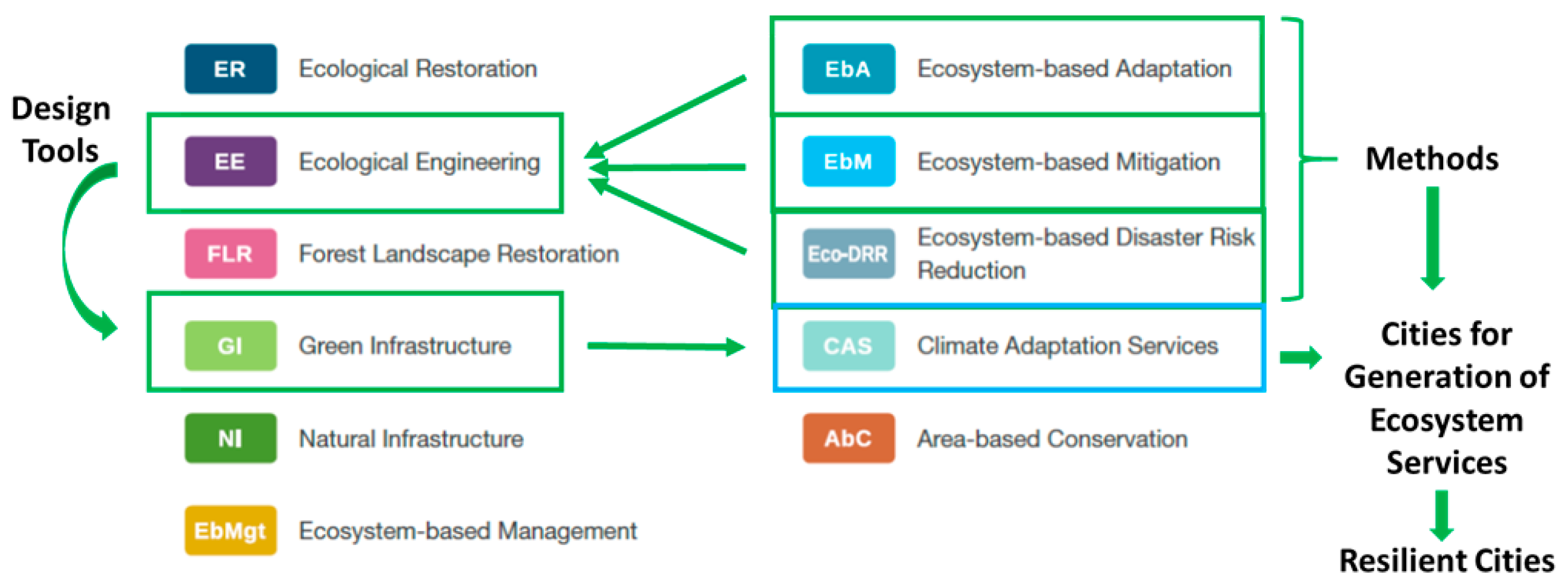
The Special Issue “Potential for Nature-Based Solutions in Urban Green Infrastructure” is published within the section Urban Contexts and Urban–Rural Interactions and focuses on the increasing importance of ecological engineering (EE) and nature-based solutions (NbS) for shaping sustainable urban and peri-urban landscapes. EE, understood as the integration of ecological principles into engineering design and planning [
1,
2,
3,
4,
5], has become increasingly relevant in addressing the complex challenges associated with urbanization, climate change, and land-use transformation [
6,
7]. At its core, it focuses on the design, restoration, and management of ecosystems that are strongly influenced by human activity, with the aim of ensuring their long-term functionality, resilience, and societal benefit [
5,
8]. Within this framework, NbS provide a key operational and conceptual foundation for developing adaptive and multifunctional green infrastructure systems that simultaneously support ecological processes and human well-being [
8].
This perspective builds on ecological and ecosystem science, including principles of resource-efficient system design, reduced material and energy inputs, and optimized nutrient and water cycling [
3,
9,
10]. Equally important is the development of spatially integrated approaches that emphasize multifunctionality, cross-scale connectivity, and the establishment of coherent green and blue infrastructure networks [
4,
10,
11]. These systems rely on decentralized and redundant structures that enhance robustness and adaptability while applying ecologically sound construction and management principles [
10,
11].
According to [
11], ecological engineering provides an umbrella for a range of established and emerging concepts, including nature-based solutions, constructed wetlands and vegetated soil filters, greening of buildings (including roofs, facades, cooling systems, indoor climate, and energy supply), the biosphere, circular systems, and water reuse mechanisms, among others. The emphasis on integrating ecological principles and functions into adaptive engineering design, with the aim of fostering the development of robust, sustainable systems, distinguishes ecological engineering from other disciplines.
The overarching objective of ecological engineering is to ensure sustainability, thereby enabling the designed ecosystem to function effectively and enduringly for the benefit of both society and the environment. This entails the application of insights derived from ecology and ecosystem research, specifically, a holistic approach, the management of internal nutrient cycles with minimal material loss, the minimization of technical energy inputs, and the efficient utilization of energy and materials. Furthermore, the aim is to achieve multifunctional land use, the integration of various spatial scales and the creation of networks, and the establishment of decentralized and redundant decision-making structures, all while simultaneously employing the most ecologically sound construction methods and treatment processes available. Central to this endeavor is the sustainable integration of human-induced modifications into the surrounding ecosystems. Ecological engineering design is thus conceived and executed as an integral component of an ecosystem.
Against this background, EE applies NbS to the planning and development of coherent networks of green and blue infrastructure in both rural and urban contexts. These interconnected systems aim not only to strengthen ecological functions but also to enhance the livability, resilience, and sustainability of human settlements. Building on these considerations, this Special Issue brings together contributions that explore the potential of NbS in urban green infrastructure across different spatial scales and thematic dimensions. Key topics include sustainable settlement ecosystems and urban green infrastructure, multifunctional structural elements implemented as NbS, strategies to promote urban biodiversity, sustainable landscape development in rural areas, circular green and blue systems, and approaches to land recycling and land conversion.
2. Materials and Methods
The contributions included in this Special Issue were selected through a standard double-blind peer-review process in accordance with the editorial policies of the journal Land (MDPI). All submitted manuscripts were first subject to an initial editorial assessment to ensure relevance to the scope of the Special Issue, followed by external peer review by independent experts in the respective fields. Based on reviewers’ recommendations and editorial judgment, manuscripts were either accepted, revised, or rejected.
The editorial process aimed to ensure scientific quality, methodological rigor, and thematic coherence with the overarching focus on NbS in urban green infrastructure. Particular attention was given to the relevance of each contribution to ecological engineering approaches, multifunctional landscape design, and urban–rural sustainability transitions.
For the purpose of this Editorial, the published contributions were further analyzed and structured into thematic groups reflecting the key dimensions of the Special Issue. This synthesis approach allows for an integrative overview of the diverse methodological perspectives, spatial scales, and application domains addressed by the individual papers.
Rather than providing a simple summary of each contribution, the Results section synthesizes the findings across papers in order to identify cross-cutting themes, shared methodological approaches, and emerging research directions in the field of NbS and urban green infrastructure. The synthesis focuses on identifying recurring patterns related to (i) social and environmental equity, (ii) governance and participatory processes, (iii) technical design and performance of NbS, (iv) microclimatic and morphological influences, (v) policy implementation and institutional frameworks, (vi) experiential and perceptual dimensions of urban nature, (vii) geotechnical and landscape-scale stabilization processes, and (viii) economic valuation of urban green infrastructure.
4. Results of the Special Issue (Synthesis of Contributions)
The contributions included in this Special Issue address NbS in urban green infrastructure from a wide range of disciplinary and methodological perspectives, spanning social, ecological, governance, climatic, technical, morphological, policy implementation, experiential, geotechnical, and economic dimensions. Across the papers, several interlinked thematic strands emerge, including environmental justice and social vulnerability, participatory governance and planning processes, the design and performance of urban blue-green infrastructure systems, enabling and constraining implementation conditions, the influence of urban form on microclimatic and human thermal experience, policy translation into practice, perceptual and experiential relationships with urban nature, geotechnical stabilization and landscape restoration, and the economic valuation of urban green infrastructure within land and property markets.
A first group of studies emphasizes the social and perceptual dimensions of urban green infrastructure and highlights the importance of equity-oriented planning approaches. In this context, Walter et al. (2025) (Contribution 1) examined housing conditions, perceptions of green space, and climate-related stress in Polish cities using a cluster analysis based on a survey of 963 respondents. Their findings reveal distinct population groups with varying sensitivities to heat waves, levels of environmental awareness, and access to urban green spaces. Notably, one group exhibits high tolerance to heat stress despite unfavorable housing conditions, illustrating the complex and non-linear relationship between vulnerability and lived experience. The study further demonstrated that the use and appreciation of green spaces are strongly influenced by their spatial accessibility and distribution within neighborhoods. This underscores that NbS in urban contexts cannot be understood solely as ecological interventions, but must also address environmental justice, housing inequality, and differentiated exposure to climate risks.
Complementing this perspective, Plüschke-Altof et al. (2025) (Contribution 2) investigated the role of public participation in NbS implementation processes in Northern European cities, focusing on experiences from seven urban planning cases. Their qualitative analysis identified several key tensions that shape participatory NbS planning, including trade-offs between open-ended environmental and participatory objectives, constraints arising from the time-intensive nature of participatory processes within project-based planning frameworks, and differing roles and expectations regarding expert and lay knowledge. These tensions can complicate both the implementation of NbS projects and the achievement of broader sustainability goals, while also pointing toward more adaptive and inclusive governance approaches.
Expanding into the technical dimension of urban NbS, Moeller et al. (2025) (Contribution 3) presented a four-year monitoring study of tree infiltration trenches in Leipzig as a form of decentralized stormwater management. The study evaluated three differently designed systems, highlighting how design variations in retention layers and construction materials influence hydrological performance and tree vitality. The results showed that systems with clay-based retention layers achieve superior water storage capacity and improved vegetation performance, while design refinements in inlet structures are identified as key for future optimization. These findings underlined the importance of integrating long-term monitoring into NbS planning to ensure functional reliability and adaptive improvement.
At a complementary spatial scale, Breulmann et al. (2025) (Contribution 4) investigated the performance of green roofs under extreme rainfall conditions, focusing on stormwater retention and evapotranspiration processes across different substrate configurations. Their lysimeter-based experiments demonstrated that retention performance is highly dynamic and strongly dependent on the saturation state of the system. While fully saturated systems behave similarly to conventional roofs with limited retention capacity, systems with available storage can retain up to 99% of rainfall. The study further highlighted trade-offs between substrate depth, evapotranspiration, and water storage, showing that deeper substrates may reduce immediate evaporation rates but enhance long-term water availability for plant transpiration and overall system functioning. These results emphasized the importance of adaptive design strategies for green roofs to increase urban resilience under increasingly extreme precipitation regimes.
Moving from individual technologies to broader implementation frameworks, Zarei & Shahab (2025) (Contribution 5) provided a systematic review and bibliometric analysis of 90 peer-reviewed studies on NbS in urban green infrastructure. Their work identified key success factors and persistent barriers to implementation, including financial, technical, social, and political constraints. The analysis highlighted the importance of enabling conditions such as spatial justice, governance integration, financial viability, and institutional capacity. It also emphasized the roles of diverse stakeholders, including local governments, private actors, and communities, in the planning, execution, and maintenance of NbS projects. Overall, the study revealed both conceptual convergence and contextual variability in NbS implementation, underscoring the need for context-sensitive and integrated approaches to urban green infrastructure development.
Extending the focus to the interface between urban form, microclimate, and human experience, Qian et al. (2025) (Contribution 6) investigated how multidimensional urban morphology influences thermal sensation in Shanghai. Using a combined framework of thermal sensing feedback and land surface temperature, the study integrates both objective climatic indicators and subjective human thermal perception data. The results demonstrated that key morphological variables, including vegetation density, building density, floor area ratio, impervious surface characteristics, and sky view factor, significantly influence perceived thermal conditions, with seasonal variations revealing contrasting effects between summer and winter. Importantly, the study highlighted that certain urban form parameters exert differing influences on thermal sensation compared to land surface temperature, reinforcing the need for human-centered approaches in urban climate research. These findings contribute to a more nuanced understanding of how urban morphology shapes both physical and perceived thermal environments, with direct implications for the design of climate-sensitive and thermally comfortable urban spaces.
Positioned at the interface between national policy implementation and local urban forestry practice, Magliocco & Sabbion (2025) (Contribution 7) examined the advancement of urban and extra-urban afforestation within the framework of the Italian National Urban Forestry Plan, using the Metropolitan City of Genoa as a case study. Against the backdrop of Italy’s National Ecological Transition Plan, the study explored how afforestation initiatives funded through the National Recovery and Resilience Plan contribute to climate mitigation, biodiversity restoration, ecological connectivity, and the broader promotion of NbS in urban regions. The authors identified three central dimensions shaping the effectiveness of urban forestry implementation: ecological planning and site selection, citizen engagement and communication strategies, and the monitoring of environmental impacts. By combining spatial and policy-oriented analysis with quantitative assessments of CO2 sequestration potential, the study demonstrated both the opportunities and contextual limitations associated with large-scale urban greening programs in densely structured metropolitan environments. The findings further highlighted that the long-term success of afforestation strategies depends not only on planting efforts themselves, but equally on adaptive governance structures, public participation, and transparent evaluation frameworks capable of assessing ecological and social co-benefits over time. In this way, the study contributes to a deeper understanding of how national NbS policies can be operationalized at the metropolitan scale while addressing the complexities of urban ecological transformation.
The experiential dimension of urban nature is further expanded by Liu & Green (2025) (Contribution 8), who explored children’s perceptions of nature within urban landscapes in Beijing. Through interviews with children aged 8 to 12 and a photo-based Q-sort methodology, the study identifies three primary ways in which urban nature is conceptualized: ecological, emotional, and visual. The findings highlighted that children’s understanding of nature is shaped by a combination of personal experience, education, media exposure, and innate perceptual tendencies. Importantly, the results suggested that urban nature is not perceived uniformly, but is instead interpreted through multiple cognitive and affective lenses. These insights provide valuable implications for urban design and environmental education, emphasizing the need to create urban environments that are both accessible and meaningful to younger populations, thereby fostering early connections with nature in cities.
Extending the scope into geotechnical and large-scale landscape systems, Zedek et al. (2025) (Contribution 9) demonstrated how NbS can be incorporated into slope stability assessment in post-mining landscapes. Using the KurZeS method, the study integrated vegetation-based root reinforcement into spatially explicit stability modeling across large areas. The approach was validated against established geotechnical simulations and empirical land-use data from a former open-cast mining region in Lusatia, Germany. The results showed that vegetation significantly contributes to slope stability, highlighting the potential of NbS to function as measurable stabilizing agents in degraded and reconfigured landscapes. This expands the application domain of NbS from urban infrastructure into large-scale land restoration and hazard mitigation contexts.
Finally, Fauk & Schneider (2025) (Contribution 10) investigated the relationship between urban green infrastructure and land and property values in Magdeburg, Germany. Their econometric analysis identified significant correlations between green infrastructure characteristics, such as tree density and proximity to allotment gardens, and standard land reference values. The results suggested that green infrastructure can exert both positive and context-dependent effects on property valuation, although broader market-driven factors remain dominant. The study highlighted the need for more consistent valuation frameworks that better integrate ecological and spatial planning considerations into land market assessments, as well as improved training and methodological alignment in ecologically informed land valuation practices.
Taken together, these studies illustrate that the successful implementation of NbS in urban green infrastructure and related landscape systems depends not only on ecological design and spatial planning, but equally on social acceptance, governance frameworks, technical performance, enabling institutional conditions, policy translation, urban form dynamics, perceptual and experiential relationships with urban nature, geotechnical stabilization processes, and economic valuation mechanisms across multiple spatial, temporal, and systemic scales.
5. Conclusions
This Special Issue highlights the broad and multidimensional nature of NbS in urban green infrastructure and related landscape systems. Rather than functioning solely as ecological design interventions, NbS emerge as integrated socio-ecological and technical systems shaped by governance structures, planning practices, social perceptions, institutional frameworks, and economic valuation mechanisms. The contributions assembled here demonstrate their applicability across multiple spatial scales, ranging from building- and neighborhood-level interventions to urban-regional systems and large-scale post-mining landscapes.
A central insight is that the effectiveness of NbS depends on the interaction of multiple interdependent dimensions. Social equity, environmental perception, and lived experience influence access to and valuation of urban green infrastructure, while governance and participatory planning frameworks shape implementation processes and long-term management. In parallel, technical design parameters determine the functional performance of NbS, particularly in relation to stormwater regulation, climate adaptation, and ecosystem service provision. These dimensions are further embedded in institutional and policy contexts, as well as in economic valuation systems that increasingly guide land-use decisions. Importantly, the contributions underscore the need to consider the human–environment interface more explicitly. Urban morphology and microclimatic conditions shape both physical environmental conditions and subjective thermal perception, while early-life interactions with urban nature influence long-term environmental awareness and engagement. Extending beyond urban contexts, the application of NbS in geotechnical stabilization and landscape restoration demonstrates their relevance for addressing large-scale environmental degradation and risk mitigation.
Despite the diversity of approaches, several cross-cutting challenges emerge. These include the need for stronger interdisciplinary integration, persistent gaps between planning concepts and implementation practice, and limited comparability in the assessment and valuation of co-benefits. Addressing these challenges requires improved methodological alignment, enhanced institutional coordination, and more adaptive, context-sensitive governance approaches. Future research should therefore focus on systemic integration of NbS across sectors and scales, the development of long-term monitoring frameworks, and the refinement of participatory planning and governance models. Equally important is the advancement of robust approaches to quantify and communicate ecological, social, climatic, and economic co-benefits in support of evidence-based decision-making.
Overall, this Special Issue demonstrates that NbS represent a transformative planning and design paradigm for urban and landscape development. Realizing their full potential requires sustained interdisciplinary collaboration and stronger alignment between research, planning practice, and policy implementation frameworks.