Article

The Impact of Rural Public Expenditure on Agricultural Economic Resilience in 30 Provinces of China—An Analysis of Absorption Capacity from a Cultural–Geographical Perspective

School of Public Administration, Central China Normal University, Wuhan 430079, China
*
Author to whom correspondence should be addressed.
Land 2026, 15(6), 955; https://doi.org/10.3390/land15060955
Submission received: 14 April 2026 / Revised: 21 May 2026 / Accepted: 27 May 2026 / Published: 31 May 2026

Abstract

Whether rural public expenditure can be effectively absorbed and transformed into agricultural economic resilience at the local level is a critical issue affecting the long-term stable development of agriculture. From a cultural–geographical perspective, this study constructs a Rural Public Expenditure Absorption Capacity Index (ACI) encompassing three dimensions—geographical location, sociocultural structure, and institutional environment. Using panel data from 30 provinces in China covering the period 2011–2023, and employing a two-way fixed-effects model, a moderating effect model, and a Geographically and Temporally Weighted Regression (GTWR) model, this study systematically investigates the effects and underlying mechanisms of rural public expenditure on agricultural economic resilience. The results indicate that: (1) rural public expenditure is significantly and positively associated with agricultural economic resilience, and this finding remains robust after a series of robustness and endogeneity tests; (2) the resilience effects of rural public expenditure exhibit significant regional and structural heterogeneity, with significant effects observed only in eastern China and major grain-consuming regions. Across different expenditure categories, all types of expenditure promote agricultural economic resilience except science and technology expenditure, which exhibits a negative effect; (3) the moderating effect of absorption capacity demonstrates clear structural heterogeneity. Specifically, a significant positive matching effect exists between medical and health expenditure and absorption capacity, whereas education expenditure exhibits a negative moderating relationship; and (4) the GTWR results further reveal significant spatiotemporal heterogeneity in the interaction effects between rural public expenditure and absorption capacity, displaying an overall dynamic evolution pattern characterized by “synergistic enhancement—regional differentiation.” From a cultural–geographical perspective, this study provides empirical evidence on the local embeddedness mechanisms through which rural public expenditure influences agricultural economic resilience. It also offers policy implications for optimizing the structure of rural public expenditure, improving local fiscal resource absorption capacity, and promoting the sustainable development of the agricultural economy.

1. Introduction

Agriculture, as a foundational and strategic sector of the national economy, plays a vital role in ensuring national food security and advancing comprehensive rural revitalization. In recent years, agricultural development has faced growing uncertainty due to the combined effects of increasingly frequent extreme weather events caused by global climate change [1], intensified volatility in international agricultural supply chains [2], rural labor outmigration [3], and rising factor costs. Against this backdrop, how agricultural economic systems maintain stable operations, mitigate external shocks, and sustain long-term development under external disturbances has become a critical issue in safeguarding food security and promoting agricultural modernization. The concept of resilience originated in ecology and engineering and refers to a system’s capacity to maintain functional stability, absorb shocks, and sustain continuous operation under external disturbances. This framework provides a new perspective for understanding how agricultural economic systems respond to uncertainty and risk. In recent years, resilience theory has been increasingly applied in agricultural economics research [4,5]. Accordingly, Agricultural economic resilience has emerged as an important concept for evaluating the stability and sustainable growth capacity of agricultural economies. Enhancing agricultural economic resilience is not only an inherent requirement for ensuring national food security and advancing agricultural and rural modernization, but also a critical safeguard against various risks and uncertainties in an increasingly volatile era.
As the world’s largest developing country and an agricultural powerhouse, China has consistently prioritized the “three rural issues”—agriculture, rural areas, and farmers—in its governance agenda. Following the historic eradication of absolute poverty and the establishment of a moderately prosperous society in all respects by 2021, China’s focus has shifted toward advancing rural revitalization. The report of the 20th National Congress of the Communist Party of China explicitly called for “accelerating the construction of a strong agricultural nation” and “consolidating the foundations of food security in all respects,” highlighting the need to strengthen the resilience and security of industrial and supply chains. In the face of an increasingly complex domestic and international environment, the risks and uncertainties confronting agricultural development have markedly increased. These challenges range from the direct impact of frequent extreme weather events on agricultural production to the indirect effects of fluctuations in international commodity prices transmitted via trade channels, alongside shifts in rural factors driven by domestic economic restructuring. Collectively, these factors place greater demands on the stability and sustainability of China’s agricultural economy. Consequently, exploring effective policy instruments and implementation strategies to enhance agricultural economic resilience is of profound theoretical and practical importance.
Current research on the determinants of agricultural economic resilience have examined various factors, including digital inclusive finance, insurance penetration, industrial structure, and technological innovation [6,7,8]. In comparison, fiscal intervention represented by rural public expenditure has received increasing attention as an important policy instrument affecting agricultural economic performance due to its roles in resource allocation, public service provision, and risk mitigation [9,10]. Over the past decades, the Chinese government has continuously increased fiscal investment in rural infrastructure, agricultural technology, education, healthcare, and social security, achieving substantial progress in improving agricultural production conditions and promoting rural development. For instance, infrastructure programs such as the “Village-to-Village Connectivity Project” significantly improved transportation accessibility in remote areas and generated positive effects on regional economic growth and poverty reduction [11]. However, as the scale of fiscal investment continues to expand, a more fundamental question has emerged: why do similar types of rural public expenditure produce substantially different policy outcomes across regions? Some regions are able to effectively transform fiscal resources into stable agricultural growth and stronger shock-buffering capacity, whereas others experience low fund utilization efficiency, limited policy effectiveness, or even resource misallocation. These differences suggest that rural public expenditure does not automatically translate into improvements in agricultural economic stability. Instead, its effects exhibit significant regional heterogeneity. Therefore, explaining why “similar fiscal inputs generate divergent outcomes” has become a key issue in understanding differences in fiscal policy effectiveness.
Existing literature has predominantly examined the socioeconomic effects of public spending through the dual lenses of expenditure scale and structure, offering valuable insights into the impact of rural public spending on agricultural economic resilience. Regarding expenditure scale, there is a general consensus that sustained growth in rural public investment is crucial for stabilizing agricultural production and increasing farm household income [12]. In terms of expenditure structure, most studies agree that investments in education, infrastructure, and social security play a positive role in agricultural growth and the enhancement of farmers’ livelihoods. For example, research shows that investment in agricultural infrastructure significantly boosts agricultural productivity and farmers’ income [13,14]. Additionally, agricultural science and technology funding, by fostering technological progress, serves as a core driver of long-term agricultural growth [15]. Similarly, rural education and healthcare expenditure have a profound impact on economic development by improving human capital levels [16,17,18]. However, some studies highlight issues such as low efficiency of public spending, structural imbalances, and regional misallocation, suggesting that the socioeconomic effects of rural public spending may not be as pronounced as expected [19,20]. For instance, Wedgwood, in his study of basic education in Tanzania, found that without adequate educational quality and institutional safeguards, expanded education spending did not significantly alleviate poverty and may have exacerbated inequality due to resource misallocation [21]. Similarly, Zhang et al. in their study of rural transformation in Lingbao City, Henan Province, observed that infrastructure investment had a significant negative impact on rural transformation at the village level [22]. As a result, whether fiscal resources can be effectively transformed into drivers of stable agricultural development depends not only on the scale of investment itself, but also on local capacities to absorb and utilize public resources effectively [23,24].
Based on this perspective, some studies have introduced the concept of “absorption capacity” into public expenditure research, providing a new analytical framework for explaining why expanding public expenditure does not necessarily lead to efficient outcomes [25,26]. Using data from over 100 countries between 1970 and 2007, Presbitero found that in wealthier countries with stronger policies, institutions, and higher public capital stock relative to GDP, the negative correlation between accelerated public investment and the success of investment projects was more pronounced [27]. This is due to limited absorptive capacity, where the marginal returns on capital investment diminish, making it difficult to translate additional public spending into sustained output growth—particularly in less developed countries or regions [28], where “supply bottlenecks” in factors such as technology, labor, and institutions often exist. Li et al. characterized absorptive capacity through three dimensions—human capital, social capital, and government capacity—and found that absorptive capacity explains at least 50% of the efficiency in utilizing transfer payment funds, further supporting its relevance to rural public expenditure [29]. However, existing studies have several shortcomings. First, most research either focuses on the economic growth effects of public expenditure or investigates the determinants of agricultural economic resilience, without effectively linking the two. There is a lack of systematic analysis on how rural public expenditure contributes to agricultural resilience. Second, the underlying mechanisms remain insufficiently explored. Existing research has not provided in-depth theoretical or empirical analyses on how public funds translate into resilience or what factors constrain this process. Public expenditure is not isolated; it is shaped by specific geographical contexts, making local “absorption capacity” a critical variable influencing its effectiveness [28]. Yet, this factor has often been overlooked in previous studies.
To address the above research gaps, the primary contribution of this study is to reinterpret the absorption capacity of rural public expenditure and its underlying mechanisms from a cultural–geographical perspective, while further examining its “structural matching effect” in the process through which rural public expenditure influences agricultural economic resilience. Unlike conventional regional economic analyses that mainly emphasize spatial differences in economic variables such as capital, technology, and industrial structure, the cultural–geographical perspective focuses on the spatial embeddedness of the “human–land–institution” relationship underlying economic activities. It highlights how natural geographical conditions, local sociocultural structures, and institutional contexts jointly shape regional development trajectories and policy outcomes. More specifically, the cultural–geographical perspective does not merely introduce “cultural factors” into economic analysis. Rather, it emphasizes the place-based nature of regional development processes. Particularly in rural areas, public resource allocation and policy implementation do not occur within an abstract market space; instead, they are deeply embedded in specific geographical conditions, social networks, and grassroots governance structures. Rural societies are typically characterized by acquaintance-based social relations, limited spatial mobility, and substantial institutional disparities. As a result, regions differ significantly in their capacities to receive, organize, and transform fiscal resources. Consequently, even identical scales and structures of public expenditure may generate substantially different policy outcomes across regions.
A region’s absorption capacity for rural public expenditure is therefore not purely an economic or technical concept, but rather a comprehensive capability jointly shaped by its cultural and geographical environment. Specifically, it consists of three dimensions. First, the geographical dimension includes topography, landform characteristics, and transportation accessibility, which constitute spatial constraints on project implementation costs and factor mobility [30,31]. Second, the sociocultural dimension involves human capital, information diffusion efficiency, the degree of social organization, and local social networks. These “soft conditions” determine rural communities’ capacity to accept and transform public resources, new technologies, and institutional arrangements [32]. Third, the institutional dimension includes the level of marketization, grassroots governance capacity, and public service delivery mechanisms, all of which affect resource allocation efficiency and policy implementation effectiveness [33,34]. Together, these three dimensions constitute the fundamental logic of regional absorption capacity. Compared with traditional regional economic analyses that primarily focus on whether resource inputs are sufficient, the cultural–geographical perspective further emphasizes whether such inputs can be effectively absorbed and transformed by local societies. Accordingly, the effectiveness of public expenditure depends not solely on the scale of investment, but also on the degree of compatibility between fiscal resources and the local cultural–geographical environment.
Furthermore, the current state of rural development in China, coupled with its institutional context, provides an ideal setting for testing this research. China is characterized by significant regional disparities in natural endowments, cultural traditions, and institutional environments, leading to spatial heterogeneity in agricultural development. Yet, China’s fiscal system and macroeconomic policies exhibit a high degree of uniformity, reducing the confounding effects of institutional differences and enabling interregional variations to better reflect the role of local absorptive capacity. Additionally, China is transitioning from a “production-oriented” to a “resilience-oriented” approach, and with rural public expenditure continuing to rise and its structure improving, this offers valuable empirical and policy context for examining the relationship between public expenditure and agricultural economic resilience. These insights may also prove beneficial to other developing countries seeking to enhance agricultural resilience.
The marginal contributions of this paper are twofold: First, the theoretical perspective is innovative. This study introduces the analytical framework of cultural geography—”human-land relations—social structure—institutional environment”—to assess rural public expenditure efficiency. It develops a multidimensional “Rural Public Expenditure Absorption Capacity Index,” expanding the discussion of fiscal effectiveness beyond economic considerations to include social, cultural, and spatial contexts, thereby deepening our understanding of fiscal policy heterogeneity. Second, the research content is deepened. This study examines not only the direct impact of rural public expenditure on agricultural economic resilience but also the “structural matching effect” between the two, investigating the moderating role of absorption capacity. By testing the interaction effects between different types of public expenditure (e.g., infrastructure, science and technology, healthcare) and absorption capacity, the study highlights structural imbalances and mismatches between fiscal investments and local endowments, offering precise empirical evidence for optimizing expenditure structures.
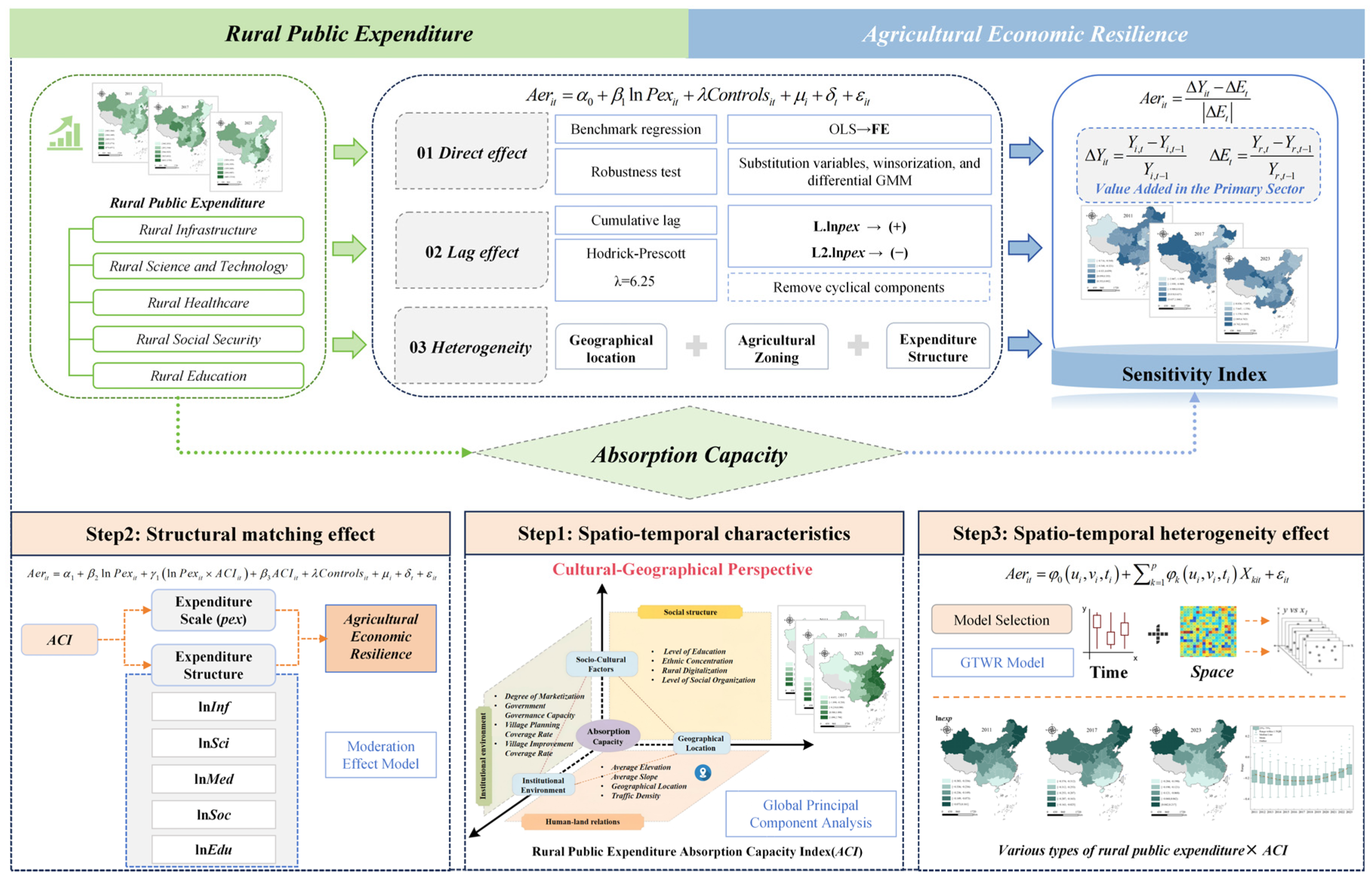
The paper is structured as follows: Section 2 presents the theoretical analysis and research hypotheses; Section 3 outlines the research design, including variable selection, model construction, and data sources; Section 4 provides empirical results and analysis, including baseline regression, robustness tests, cumulative lag effects, and heterogeneity analysis; Section 5 offers further analysis from a cultural–geographical perspective, exploring the structural matching effects of absorptive capacity and its spatiotemporal heterogeneity; and Section 6 concludes with findings and discussion (Figure 1).

2. Theoretical Analysis and Research Hypotheses

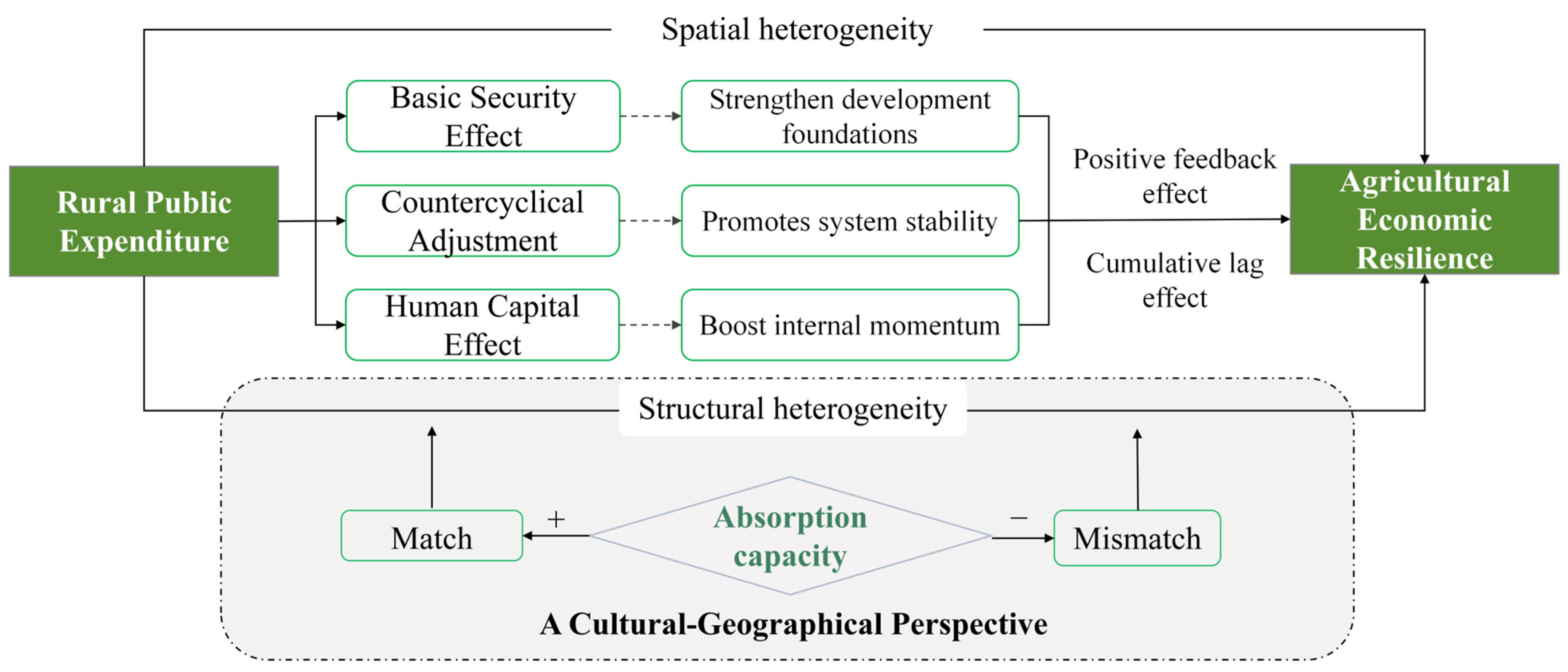
The agricultural economic system is not an isolated economic entity, but a complex social-ecological system embedded within natural environments, social structures, and institutional contexts. Agricultural economic resilience is reflected not only in agricultural output growth, but also in the capacity of the agricultural system to maintain stable operation, absorb shocks, and achieve sustainable development when facing natural disasters, market fluctuations, and external risks. See Figure 2 for the detailed theoretical analytical framework.

2.1. The Direct Impact of Rural Public Expenditure on Agricultural Economic Resilience

The role of rural public expenditure extends beyond promoting agricultural growth. More importantly, it enhances agricultural economic resilience by improving production conditions, optimizing resource allocation, and strengthening human capital, thereby reducing the vulnerability of agricultural systems and enhancing their capacity for sustained operation [23,24].
First, rural public expenditure generates a foundational support effect by strengthening the material basis of agricultural economic resilience. Key components of agricultural production, such as farmland irrigation infrastructure, agricultural meteorological early-warning systems, pest and disease control networks, and basic agricultural research, exhibit clear public or quasi-public goods characteristics. The private sector often lacks sufficient incentives to invest in these areas, resulting in underprovision. Through fiscal investment and subsidy mechanisms, governments can ensure the effective provision of these critical infrastructures and public services, thereby providing essential support for agricultural systems to cope with natural and market risks. In addition, agricultural production involves significant externalities. For example, green production practices generate positive ecological effects, whereas excessive use of fertilizers and pesticides produces negative environmental externalities. Rural public expenditure can guide resources toward sustainable agricultural transformation through green subsidies, ecological governance, and environmental regulation, thereby enhancing the long-term stability of agricultural systems [35].
Second, from the perspective of short-term adjustment mechanisms, Keynesian public expenditure theory suggests that government spending performs a counter-cyclical regulatory function. When agricultural economies experience external shocks such as natural disasters or price fluctuations, fiscal measures including disaster relief, price subsidies, and agricultural insurance subsidies [35,36] can inject liquidity into agricultural systems in a timely manner, stabilize farmers’ income expectations and production investment, and mitigate risk transmission and systemic contraction. To some extent, such fiscal intervention functions as a “social stabilizer” and helps strengthen the shock resistance capacity of agricultural systems.
Finally, from the perspective of long-term development mechanisms, endogenous growth theory suggests that rural public expenditure, particularly productive expenditure, plays a key role in promoting endogenous agricultural growth and enhancing long-term adaptive and transformational capacity. On the one hand, government fiscal support for agricultural research, technology extension, and digital agriculture development facilitates the diffusion of agricultural knowledge and technology, promotes the adoption of resilient crop varieties, water-saving irrigation, and precision agriculture technologies, and improves resource utilization efficiency and environmental adaptability [37]. On the other hand, expenditures on rural education, vocational training, and public health contribute to improving labor quality and risk-response capacity, thereby strengthening farmers’ ability to adapt to market changes and technological innovation [38]. These factors provide endogenous momentum for the long-term transformation and upgrading of the agricultural economic system.
Hypothesis 1:
Rural public expenditure has a positive effect on agricultural economic resilience.

2.2. The Lagging Effects of Rural Public Expenditure on Resilience

The effects of public spending may not be immediate, and its benefits often unfold over time [39]. This delay arises from the development cycles of “hard capital” and “soft capital.” Infrastructure projects, such as large-scale water conservancy, farmland upgrades, and transportation networks, require considerable time to plan, invest, complete, and begin operation. Once completed, their effects—such as enhanced agricultural efficiency, reduced logistics costs, and expanded market access—continue to unfold over the following years. For instance, the construction of a highway today will have long-term effects on the sales of agricultural products in the future. This cumulative impact suggests that current infrastructure spending not only influences immediate resilience but also shapes resilience levels in subsequent years.
Similarly, the development of human and social capital is a gradual process. The effects of education spending, which improve workers’ knowledge and skills, are realized over a full educational cycle, and their contributions to agricultural productivity and innovation capacity emerge only years later. The impact of science and technology investments is even more delayed: from basic research to applied research, and then to the diffusion and adoption of technologies by farmers, each step requires time before macro-level effects can be realized regionally. Thus, agricultural resilience in the present is influenced not only by current public expenditure but also by the lagged effects of past investments [40].
Hypothesis 2:
The impact of rural public expenditure on agricultural economic resilience exhibits a lagged effect.

2.3. The Structural Matching Effects of Rural Public Expenditure on Absorption Capacity

According to absorptive capacity theory [41], the effectiveness of external resource inputs depends on a region’s ability to identify, assimilate, transform, and apply new knowledge or capital. Unlike conventional analyses of regional heterogeneity, which treat regional differences merely as exogenous factors, the cultural geography perspective emphasizes that these differences themselves influence the transmission pathways and conversion efficiency of policy resources through local social structures and spatial environments. Specifically, absorptive capacity can be decomposed into three dimensions: geographic location, sociocultural factors, and the institutional environment. Together, these factors determine the efficiency with which public expenditures are converted from “inputs” into “resilient outcomes”.
First, a region’s absorptive capacity positively moderates the effect of public expenditure. When a region has geographical advantages, a skilled labor force (e.g., high levels of educational attainment), and effective institutional capacities (e.g., fiscal oversight and project coordination), public expenditure can be rapidly internalized as productive capital. High absorptive capacity and high public expenditure create a “matching-enhancement” mechanism, resulting in synergistic effects [27]: The marginal return on fiscal investments increases, and the effectiveness of expenditure on infrastructure and technology is amplified, thereby enhancing the resilience, recovery, and adaptability of the agricultural economy.
Second, a mismatch between absorption capacity and public expenditure can weaken or even reverse the effects of such spending [28]. The alignment between resource supply and regional absorption capacity is key to determining policy effectiveness. For example, in the sociocultural dimension, a lack of trust and cooperation traditions may hinder participation in cooperatives or collective projects funded by public expenditure, resulting in idle resources and misallocation. These mismatches may crowd out more suitable types of public expenditure, thus negatively impacting agricultural resilience. Therefore, the moderating effect of absorptive capacity is directional: the better the match, the stronger the positive moderation; the poorer the match, the weaker or even negative the effect.
Hypothesis 3:
The absorptive capacity of rural public expenditure plays a moderating role in the process by which rural public expenditure influences agricultural economic resilience. Specifically, the higher the alignment between absorptive capacity and public expenditure, the stronger the positive effect of public expenditure on agricultural economic resilience.

3. Research Design

3.1. Variable Selection

3.1.1. Explained Variable

The explained variable in this study is agricultural economic resilience (Aer). Existing research on measuring agricultural economic resilience primarily utilizes two methods: one based on a comprehensive evaluation system using multiple indicators [42,43], and the other using sensitivity measurements based on core economic variables [44]. In comparison, traditional multidimensional indicator systems can comprehensively reflect system characteristics, but they inevitably involve a certain degree of subjectivity in indicator selection and weight assignment, while also facing difficulties in capturing the dynamic response process of systems under external shocks. By contrast, the core-variable approach, particularly the method proposed by Martin and Gardiner, directly examines resilience from a “dynamic response” perspective. Specifically, it characterizes a system’s resistance and recovery capacity by comparing actual regional performance with a counterfactual benchmark under a hypothetical “no-shock” scenario, thereby providing a measurement framework that is more consistent with the concept of “developmental resilience [44]. ”The underlying logic is that if a region experiences a relatively small deviation between actual output and the output predicted based on historical trends and national average performance after a nationwide or industry-wide shock, or if it can recover to the expected level within a relatively short period, then the region can be considered to possess stronger economic resilience.
Following this classical approach, and considering that the value added of the primary industry most comprehensively reflects regional agricultural production activities and the overall operating conditions of the agricultural economy, while also exhibiting strong statistical continuity and cross-regional comparability, this study constructs the measurement formula for agricultural economic resilience as follows:
Δ Y i t = Y i , t Y i , t 1 Y i , t 1
Δ E t = Y r , t Y r , t 1 Y r , t 1
A e r i t = Δ Y i t Δ E t Δ E t
In Equations (1)–(3), Yi,t denotes the added value of the primary industry in province i in year t, while Yr,t represents the aggregate added value of the primary industry across all provinces in year t. ΔYit refers to the growth rate of the added value of the primary industry in province i from year t−1 to year t, capturing changes in the regional agricultural economy at the provincial level. ΔEt denotes the overall growth rate of the added value of the primary industry across all provinces over the same period, reflecting the general trend of agricultural economic development. When the value of Aerit is greater than 0, the agricultural economic resilience of province i in year t is considered to be above the overall average level, indicating a stronger capacity to withstand external shocks; conversely, a lower value implies weaker resilience1.

3.1.2. Explanatory Variable

The core explanatory variable is per capita rural public expenditure (pex). Given the multidimensional nature of rural public expenditure, this study aggregates five categories of expenditure—namely, infrastructure (Inf), science and technology (Sci), healthcare (Med), social security (Soc), and education (Edu)—to serve as a comprehensive measure. To ensure comparability across provinces and eliminate the influence of population size, the total expenditure is divided by the rural permanent resident population of each province, yielding per capita rural public expenditure [45].
The specific measurements are as follows: ① Rural Infrastructure Expenditure: Aggregated expenditure for water supply, gas, heating, roads, bridges, drainage, landscaping, and environmental sanitation at the town, township, and village levels. ② Rural Science and Technology Expenditure: Calculated by multiplying internal R&D expenditure by the ratio of the general budget to agricultural, forestry, and water affairs expenditure. ③ Rural Healthcare Expenditure: Measured as the ratio of government healthcare expenditure to total healthcare expenditure, adjusted by GDP [46]. ④ Rural Social Security Expenditure: Theoretically, this covers pensions, minimum living allowances, social relief, and disaster assistance; and in line with existing research, per capita disposable transfer income of rural residents is used as a proxy indicator [47] to directly reflect the actual implementation of transfer payments to rural residents by the government and society. ⑤ Rural Education Expenditure: Aggregated funding for all levels of education, including vocational high schools, high schools, junior high schools, elementary schools, and kindergartens.

3.1.3. Mediating Variable

The moderating variable is rural public expenditure absorption capacity (ACI). From a cultural–geographical perspective, rural public expenditure absorption capacity is not determined solely by economic conditions, but is embedded within specific natural geographical environments, sociocultural structures, and institutional contexts. It manifests as the varying transformative capabilities of different regions in the processes of resource acquisition, technology diffusion, and institutional implementation. Therefore, this paper defines rural public expenditure absorption capacity as: the comprehensive ability of rural areas to effectively transform fiscal inputs into public service provision and development performance within specific geo-cultural contexts, the essence of which reflects the efficiency of resource allocation under spatial heterogeneity constraints. Consequently, based on the cultural geography analytical framework of “human-land relations—social structure—institutional environment,” an indicator system comprising three dimensions—geographical location, sociocultural factors, and institutional environment—is constructed (see Table 1).
First, the geographic location dimension emphasizes the fundamental constraints that natural endowments and spatial accessibility impose on development pathways [48]. High-altitude, steep-sloped, and remote areas often face higher construction costs and greater resistance to factor mobility, thereby weakening the absorption efficiency of public expenditure. Second, the socio-cultural dimension focuses on human capital, information access, and the level of social organization [32,49]. Regions with higher levels of education demonstrate greater capacity to adopt new technologies; ethnic clustering may influence collective action through specific social capital networks. The level of informatization determines the speed and scope of knowledge diffusion; meanwhile, the degree of social organization affects the ability of public projects to effectively mobilize and organize farmer participation. These factors collectively shape the pathways through which public resources are transformed. Third, the institutional environment dimension reflects differences in institutional provision and grassroots governance capacity. In regions with a high degree of marketization, resource allocation is more efficient; in regions with strong government governance capacity, policy enforcement and transparency in fund usage are higher, effectively reducing rent-seeking and waste. Meanwhile, the coverage of village planning and improvement initiatives directly reflects the grassroots government’s capacity to guide orderly rural development and improve the living environment. In terms of specific measurement, the selection of indicators balances theoretical explanatory power with data availability. To construct a rural public expenditure absorption capacity index that allows for comparisons across time and regions, this study builds a three-dimensional panel data matrix based on traditional principal component analysis (PCA) and employs global principal component analysis (GPCA) to perform dimensionality reduction and weighted integration of the multidimensional indicators. Standardization was performed prior to calculation to eliminate differences in units and enhance the robustness of the measurement results.

3.1.4. Control Variables

The impact of rural public expenditure on agricultural economic resilience is influenced not only by fiscal investment but also by socioeconomic development and environmental conditions. To mitigate omitted variable bias, following existing studies [50,51,52], control variables are classified into socioeconomic and climatic factors.
(1)
Socioeconomic factors: ① Level of economic development (pgdp): Measured by per capita GDP, reflecting the stage of regional economic development and resource allocation capacity. ② Urban–rural income gap (Gap): The ratio of urban to rural per capita income, indicating the imbalance between urban and rural development. ③ Rural residents’ standard of living (Eng): Measured by the Engel coefficient, indicating rural residents’ consumption structure [53]. ④ Rural residents’ developmental consumption (Liv): Measured by the proportion of expenditure on education, culture, and entertainment relative to total consumption expenditure, this indicator indirectly measures public service provision. ⑤ Rural human capital (Tea): Proportion of full-time teachers with a bachelor’s degree or higher in rural compulsory education, reflecting human capital accumulation. ⑥ Degree of agricultural openness (Open): The ratio of agricultural imports to primary sector value added, indicating the influence of external factors on agriculture.
(2)
Climatic and environmental factors: To mitigate the direct impact of extreme weather events—which have become increasingly frequent in recent years—on agricultural production, a series of climate and disaster variables have been introduced. ① Number of days with extreme low temperatures (LTD), ② Number of days with extreme high temperatures (HTD), ③ Number of days with extreme rainfall (ERD), and ④ Number of days with extreme drought (EDD): These are used to characterize the frequency of impacts from extreme climate events. Extreme temperatures and precipitation can directly damage crop growth, leading to reduced yields or even total crop failure, and are among the primary exogenous sources of shock affecting agricultural economic stability [54]. ⑤ Proportion of affected area (Dis): The ratio of area affected by crop damage, representing the severity of natural disaster impacts [55].

3.2. Model Construction

3.2.1. Baseline Regression Model

To examine the overall effect of rural public expenditure on agricultural economic resilience, the following two-way fixed-effects model is constructed:
A e r i t = α 0 + β 1 ln P e x i t + λ C o n t r o l s i t + μ i + δ t + ε i t
In Equation (4), where i and t represent the province and year, respectively. Aerit denotes agricultural economic resilience, lnPexit is the logarithm of per capita rural public expenditure, β1 is the core coefficient to be estimated; Controlsit represents a set of control variables; λ is the corresponding vector of coefficients to be estimated; α0 is the constant term; μi and δt denote individual fixed effects and time fixed effects, respectively; and εit represents the random error term.

3.2.2. Moderation Effect Model

To assess the moderating effect of absorption capacity, the interaction term (lnPexit × ACIit) between per capita rural public expenditure and absorption capacity is added to the baseline model, thereby constructing the following moderating effects model:
A e r i t = α 1 + β 2 ln P e x i t + γ 1 ln P e x i t × A C I i t + β 3 A C I i t + λ C o n t r o l s i t + μ i + δ t + ε i t
In Equation (5), ACIit represents the rural public expenditure absorption capacity index, β3 represents the estimated coefficient of the moderating variable, and γ1 is the key coefficient to be estimated. If γ1 is significantly positive, it indicates that absorption capacity plays a positive moderating role in the relationship between rural public expenditure and agricultural economic resilience; that is, in regions with stronger absorption capacity, the resilience-enhancing effect of public expenditure is more pronounced, and the two exhibit a synergistic “matching effect.” If γ1 is significantly negative, this indicates a negative moderating “mismatch effect.” To avoid multicollinearity, in the actual estimation, we have centralized both lnPexit and ACIit; the definitions of the remaining variables remain the same.

3.2.3. Spatiotemporal Geographically Weighted Regression Model

Traditional global regression models (such as fixed-effects models) assume that regression coefficients are homogeneous and constant across the entire study area, which fails to capture the variability of policy effects across different geographic units. Given China’s vast territory and the starkly different cultural and geographical contexts across provinces, the impact of rural public expenditure and its matching effects with absorption capacity on agricultural economic resilience is likely to exhibit significant spatial non-stationarity. To thoroughly uncover these spatiotemporal heterogeneity characteristics, this paper further introduces the spatiotemporal geographically weighted regression (GTWR) model. By incorporating both spatial and temporal coordinates into the regression to construct a spatiotemporal joint weight matrix, the GTWR allows the coefficients of each variable to be dynamically adjusted according to changes in geographic location and time. This enables us to obtain specific regression coefficients for each province in each year, thereby providing a detailed depiction of the spatiotemporal evolution of relationships among variables [56]. The basic form of the GTWR model is specified as follows:
A e r i t = φ 0 u i , v i , t i + k = 1 p φ k u i , v i , t i X k i t + ε i t
In Equation (6), Aerit represents the agricultural economic resilience of province i in year t; (ui, vi) denotes the center of mass coordinates of province i; ti represents the year; φ0 (ui, vi, ti) is the spatio-temporal intercept term; and φk (ui, vi, ti) is the spatio-temporal coefficient of the kth explanatory variable, whose value varies with geographic location and time; Xkit is the vector of explanatory variables. We sequentially incorporate per capita rural public expenditure, its five expenditure subcategories, and their interaction terms with absorption capacity into the GTWR model. This approach aims to intuitively and dynamically reveal the differentiated spatiotemporal patterns of how the matching effects between different types of expenditure and local absorption capacity influence agricultural economic resilience across various cultural and geographical contexts.

3.3. Data Sources and Processing

Socioeconomic variable data are primarily derived from the China Statistical Yearbook, China Rural Statistical Yearbook, China Urban–Rural Construction Statistical Yearbook, China Science and Technology Statistical Yearbook, China Regional Economic Statistical Yearbook, China Health Statistical Yearbook, China Educational Finance Statistical Yearbook, China Ethnic Statistical Yearbook, and China Population and Employment Statistics Yearbook over the years. In addition, some data are supplemented and cross-validated through provincial statistical yearbooks (of provinces, municipalities, and autonomous regions), the Wind database, the China Economic and Social Big Data Research Platform, and the official website of the National Bureau of Statistics. For geospatial data, provincial average elevation and average slope data are derived from the 30 m resolution Digital Elevation Model (DEM) data released by NASA, with spatial analysis and extraction performed using ArcGIS 10.8 software. Location data such as distance to ports are also calculated using ArcGIS. Extreme climate environment data are sourced from the publicly available global climate physical risk dataset published by Guo et al. [54].
Regarding sample selection, considering data continuity and availability, 30 Chinese provinces (excluding Tibet, Hong Kong, Macau, and Taiwan) from 2011 to 2023 are selected as the research sample. For data processing, missing values in individual regions are supplemented using linear interpolation to ensure sample completeness and comparability. To eliminate the influence of price factors, monetary variables are deflated using 2011 as the base year. To mitigate heteroscedasticity, the main numerical variables are log-transformed or scaled. To test the validity of the model specification, multicollinearity tests are conducted on the relevant variables. The results show that the Variance Inflation Factor (VIF) for each variable is far below 10, with an average VIF of 2.35, indicating no severe multicollinearity issues and a reasonable model specification. Definitions and descriptive statistics of the variables are presented in Table 2.

4. Estimation Results and Interpretation

4.1. Spatio-Temporal Evolution Characteristics

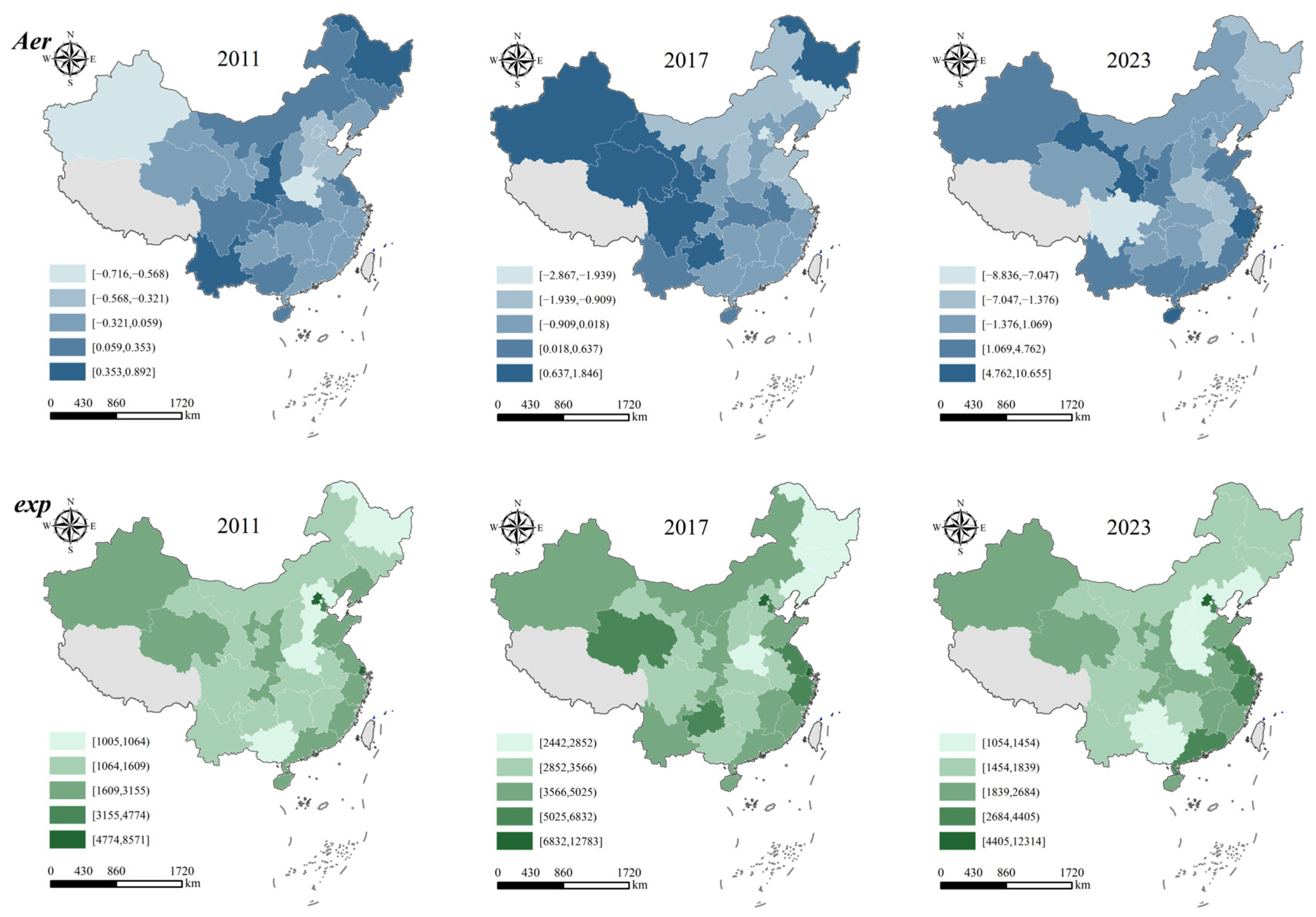
Figure 3 illustrates the spatial distribution and dynamic evolution of China’s agricultural economic resilience and per capita rural public expenditure from 2011 to 2023. In 2011, agricultural economic resilience displayed a pattern of “higher in the south, lower in the north; higher in the east, lower in the west.” High-resilience areas were concentrated in South China, Southwest China, and parts of Northeast China, where favorable agricultural conditions and strong risk resilience prevailed. Low-resilience regions, primarily located in Northwest China, North China, and some central provinces, exhibited relatively unstable agricultural systems. By 2017, resilience levels improved overall, with high-resilience areas expanding into central and southwestern regions, while resilience also increased in Northeast and North China. By 2023, resilience levels further improved, though regional disparities intensified. High-resilience zones, particularly in the major grain-producing regions of Northeast and North China, formed contiguous high-resilience belts. However, resilience growth in some southern provinces slowed, indicating a new pattern of “strong in the north, slow in the south,” reflecting the growing resilience advantage of major grain-producing regions in alignment with national food security priorities.
Regarding per capita rural public expenditure, high-value zones in 2011 were concentrated in the eastern coastal and northwestern provinces, while the central regions exhibited lower expenditure levels, highlighting significant regional disparities. By 2017, expenditure had risen substantially across the country, with high-value zones expanding into central and southwestern regions. The rapid increase in expenditure in central and western provinces narrowed regional disparities, demonstrating the effectiveness of fiscal policies that prioritized underdeveloped regions. By 2023, expenditure levels continued to rise, with high-expenditure zones concentrating further in the eastern and southern regions, forming a stable pattern of “high in the southeast, low in the northwest.” Simultaneously, expenditure in the major grain-producing regions of Northeast and North China increased, corresponding spatially with the high-resilience zones in agricultural economic performance.

4.2. Baseline Regression

Table 3 presents the baseline regression results on the impact of per capita rural public expenditure on agricultural economic resilience. Columns (1) through (3) show ordinary least squares (OLS) estimates, while Columns (4) through (6) present fixed-effects (FE) model estimates. The fixed-effects model was ultimately selected for regression analysis based on two key considerations: first, the consistency of macroeconomic policies, particularly agriculture-related policies, across provinces, given the use of provincial panel data; and second, the Hausman test result of 27.73 with a p-value below 0.01, which significantly rejected the null hypothesis, further justifying the choice of the fixed-effects model.
From the regression results, Column (1), which includes only the core explanatory variable, shows that the regression coefficient of per capita rural public expenditure (lnpex) is −0.263, significantly negative at the 5% level. This indicates that, without controlling for regional heterogeneity and other related factors, there appears to be a superficial negative relationship between rural public expenditure and agricultural economic resilience. As socioeconomic factors and climate-environmental variables are gradually incorporated into the model, the coefficients of the core explanatory variable in Columns (2) and (3) turn from negative to positive (0.050 and 0.067, respectively), although they remain statistically insignificant. This suggests that omitted variables may bias the OLS estimation results.
After controlling for both province fixed effects and year fixed effects, Column (4) shows that the coefficient of the core explanatory variable lnpex becomes significantly positive (0.919). Furthermore, as socioeconomic and climate-environmental control variables are progressively added in Columns (5)–(6), the coefficient of the core explanatory variable continues to increase steadily and its statistical significance is further strengthened, while the overall model fit also becomes more stable. The final specification in Column (6) indicates that the coefficient of per capita rural public expenditure (lnpex) is 1.306 and significantly positive at the 1% level. This finding demonstrates that rural public expenditure can effectively enhance agricultural economic resilience, thereby supporting Hypothesis 1. The reason may be that rural public expenditure improves agricultural production conditions and resource allocation efficiency through investments in farmland irrigation, agricultural infrastructure, and public service systems. At the same time, it strengthens the stability and sustainability of agricultural production, thereby enhancing the stable operation and long-term resilience of the agricultural economic system.

4.3. Robustness Tests

To further validate the robustness of the baseline regression results, several robustness tests were conducted, including variable substitution, trimming, and addressing endogeneity.
First, the dependent variable was replaced. ① Indicator-system approach. Following the approach of existing relevant studies [6,57], a new agricultural economic resilience proxy was constructed by aggregating 22 indicators across four dimensions: Resistance, Recovery, Adaptation, and Transformation. A new proxy variable for agricultural economic resilience was then calculated using the entropy weighting method and subsequently incorporated into the baseline regression model. As reported in Column (1) of Table 4, the regression coefficient of lnpex is 0.028 and remains significant at the 1% level, indicating that the main findings are robust. Owing to space limitations, the reconstructed indicator system is not reported in detail in the main text.
The regression results for the subdivided dimensions in Columns (2)–(5) of Table 4 further reveal that rural public expenditure exerts heterogeneous effects across different dimensions of agricultural economic resilience. Specifically, the coefficient of lnpex on Resistance is −0.010, which is significant at the 1% level, suggesting that rural public expenditure has a relatively limited direct effect on enhancing the short-term capacity of agricultural systems to withstand external shocks. One possible explanation is that resistance capacity depends more heavily on exogenous conditions such as natural resource endowments, climatic conditions, and the existing agricultural production foundation, whereas the effects of public expenditure are often characterized by time lags and may not immediately translate into shock-resistance capacity in the short run.
By contrast, although the estimated coefficient of lnpex on Recovery is negative, it does not pass the significance test, indicating that rural public expenditure has not yet exerted a statistically significant effect on the rapid recovery capacity of agricultural systems following external shocks. Furthermore, rural public expenditure exhibits significant positive effects on both Adaptation and Transformation, with regression coefficients of 0.007 and 0.032, respectively, both significant at the 1% level. Among these, the promoting effect on Transformation is the most pronounced, indicating that rural public expenditure primarily enhances agricultural economic resilience through improvements in agricultural infrastructure, agricultural technology extension, rural informatization, and public service provision. These measures help optimize agricultural resource allocation and industrial development conditions, thereby strengthening the adaptability and long-term development capacity of the agricultural economic system in response to external environmental changes. This finding also suggests that the role of rural public expenditure is reflected more in facilitating the transition of agricultural systems from traditional production models toward modernized and sustainable development models, rather than merely improving short-term risk resistance. Overall, the robustness test results consistently demonstrate that rural public expenditure significantly enhances agricultural economic resilience, with its effects being concentrated primarily in the dimensions of adaptive adjustment and transformational development.
② Replacement of the core measurement variable. To further ensure the robustness of the conclusions, we replaced the “value added of the primary sector” with the “real gross output value of agriculture, forestry, animal husbandry, and fishery” to remeasure agricultural economic resilience and re-estimated the model. The results are reported in Column (1) of Table 5. As shown, the coefficient of the core explanatory variable lnpex is 1.087 and remains significant at the 1% level, which is consistent with the baseline regression results.
Second, trimming was applied to address potential outliers. All continuous variables were trimmed by 1% and 5% from the top and bottom, respectively. The regression coefficients, detailed in Columns (2) and (3) of Table 5, are 1.036 (significant at the 1% level) and 0.526 (significant at the 5% level), respectively. These results confirm the robustness of the core conclusions.
Third, endogeneity was tested using a first-order lag of agricultural economic resilience and the system GMM method to mitigate potential omitted-variable bias and bidirectional causality issues. The AR(1) test was significant, while the AR(2) test was not, supporting the assumption of uncorrelated disturbances. The Hansen test p-value exceeded 0.1, indicating valid instrument selection. The regression result shows that the coefficient for lnpex is 0.192, significant at the 10% level in Column (4) of Table 5, which is consistent with the baseline regression conclusions.

4.4. Cumulative Lag Effect Analysis

The potential cumulative lag effect of rural public expenditure on agricultural economic resilience is explored in this section. Given the cyclical nature of agricultural development, the impact of current rural public investment may persist in subsequent periods. To verify the existence of this lag effect, lagged per capita rural public expenditure (L.lnpex and L2.lnpex) was used as the core explanatory variable in regression analysis. The Hodrick-Prescott (HP) filter was applied to remove cyclical fluctuations and isolate the core trend of agricultural economic resilience [58]. Given that this study uses annual panel data, the HP filter smoothing parameter λ is set to 6.25.
Table 6 shows the results of the cumulative lag effect test. In Column (1), the coefficient for one-period lagged per capita rural public expenditure (L.lnpex) is 1.141, significant at the 10% level. In Column (2), the coefficient for the HP-filtered variable is 0.136, significant at the 1% level. This indicates that prior rural public expenditure has a persistent positive impact on agricultural economic resilience. The coefficient for per capita rural public expenditure lagged by two periods (L2.lnpex) is −0.016 in Column (1) and does not pass the significance test. After HP filtering, the coefficient in Column (2) is −0.131, significantly negative at the 1% level, suggesting a diminishing long-term lag effect. This supports research hypothesis 2, showing that short-term lagged effects are significant, but the long-term impact weakens over time.

4.5. Heterogeneity Analysis

The previous empirical analysis confirms the positive impact of per capita rural public expenditure on agricultural economic resilience. However, given China’s regional disparities, agricultural production variations, and diverse fiscal expenditure structures, the effects of rural public expenditure are likely heterogeneous. This section conducts a heterogeneity analysis across three dimensions: geographic location, agricultural functional zones, and public expenditure structure.
(1)
Geographic Location Heterogeneity: The scale and effectiveness of rural public spending vary by region, influencing its impact on agricultural resilience. The sample is divided into three regional subsamples: eastern, central, and western2. The results in Table 7 (Columns 1–3) show that per capita rural public expenditure significantly enhances resilience in the eastern region (coefficient = 1.786, significant at 5%), but no significant effects are observed in the central and western regions. The eastern region benefits from a strong economic foundation and high-efficiency fund utilization, leading to rapid improvements in agricultural infrastructure and production. In contrast, the central and western regions face challenges such as limited public funding and longer cycles for public expenditure to yield effects.
(2)
Agricultural Functional Zones Heterogeneity: Differences in agricultural development goals and fiscal investment priorities across regions contribute to variations in the impact of rural public expenditure. This study conducted group regression based on the classification criteria for agricultural functional zones3, with the corresponding results shown in Columns (4) to (6) of Table 7. The results indicate that the coefficient for per capita rural public expenditure (lnpex) in grain-consuming regions is 2.781, which is highly significant at the 1% level, while coefficients for balanced production-consumption and major grain-producing regions are not significant. The core reason for this disparity lies in the fact that agricultural production in major grain-consuming regions tends toward high-value-added, modernized models, allowing rural public expenditure to precisely align with the needs for improving agricultural quality and efficiency, thereby rapidly helping agriculture withstand risks and enhance resilience; in contrast, major grain-producing regions focus primarily on large-scale grain production, with public expenditure largely directed toward basic production safeguards, resulting in a weaker effect of leveraging funds to enhance resilience; In balanced production and consumption regions, the positioning of agricultural development is unclear, and public expenditure is dispersed, making it difficult to generate a concentrated enabling effect.
(3)
Public Expenditure Structure Heterogeneity: The five major categories of rural public expenditure—infrastructure, science and technology, healthcare, social security, and education—have differing impacts on agricultural economic resilience. Table 8 shows that infrastructure expenditure (lnInf), healthcare expenditure (lnMed), social security expenditure (lnSoc), and education expenditure (lnEdu) are all significantly positive, with values of 0.505, 1.177, 0.761, and 1.075, respectively. Each category of expenditure directly improves the foundation for agricultural production and rural development by enhancing agricultural production infrastructure, ensuring rural livelihood security, and raising the quality of the labor force. Through synergistic effects across multiple dimensions—including “material foundation, social security, and capacity building”—these expenditures significantly enhance the resilience of the agricultural economy. In contrast, the coefficient for science and technology expenditure (lnSci) is −0.957, which is significantly negative at the 10% level. The reasons for this are twofold: on the one hand, agricultural R&D and the commercialization of research outcomes typically involve long cycles, making it difficult to translate them into actual productive capacity in the short term; in fact, they may even create a “crowding-out effect” on current agricultural production due to resource reallocation, thereby manifesting as a temporary negative impact. On the other hand, there is uncertainty regarding the efficiency of converting science and technology expenditure. In some regions, there is a disconnect between research investment and agricultural production needs; channels for the commercialization of scientific and technological achievements are obstructed, and extension systems are inadequate, resulting in investments failing to effectively translate into enhanced agricultural resilience.

5. Further: The Moderating Role of Absorptive Capacity from a Cultural–Geographical Perspective

5.1. Spatio-Temporal Distribution of Rural Public Expenditure Absorption Capacity

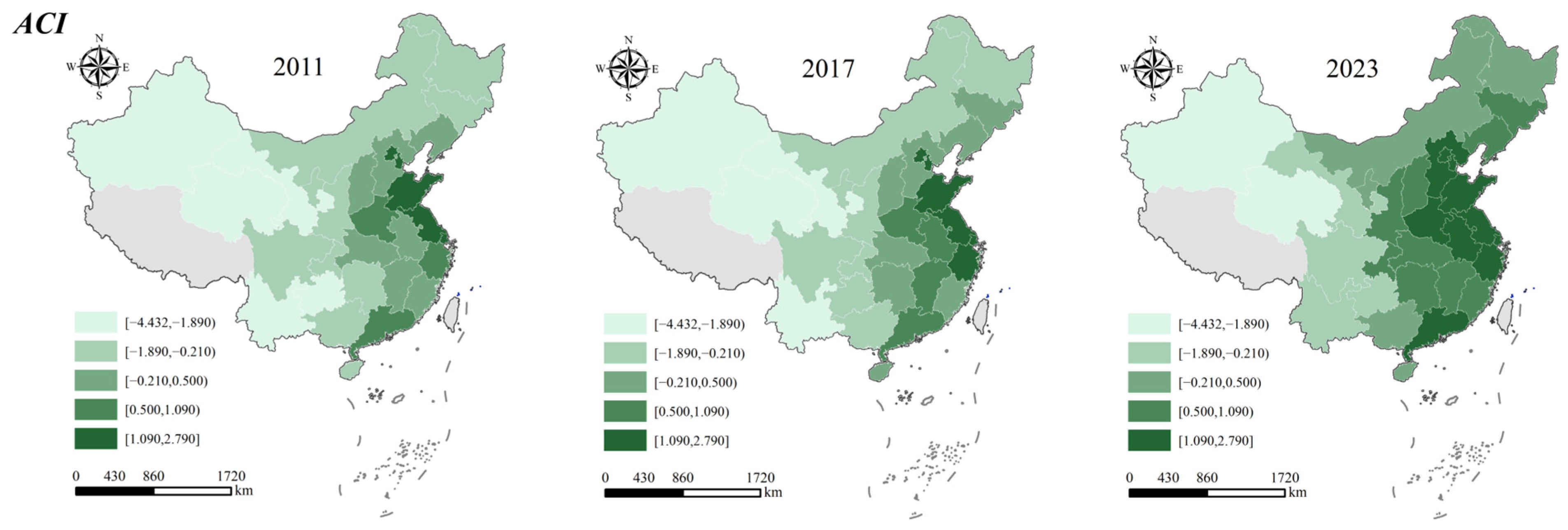
To explore the impact of rural public expenditure absorption capacity (ACI), we first analyze its spatiotemporal evolution, as shown in Figure 4. Overall, absorption capacity follows a clear “high in the east, low in the west” pattern. In 2011, high-value areas were concentrated in the eastern coastal provinces, characterized by a well-developed institutional environment, efficient factor allocation, and a strong capacity to absorb and utilize fiscal funds. In contrast, absorption capacity was relatively low in the central, western, and northeastern regions, with some provinces in the northwest showing low values. By 2017, absorption capacity had improved overall, with high-value zones expanding into central and northeastern regions, narrowing the national disparity. This reflects the positive effects of optimized institutional environments and improved policy implementation in less-developed regions. In 2023, absorption capacity continued to rise, with the eastern coastal region remaining the core high-value zone, central provinces showing significant improvement, and western provinces gradually enhancing their absorption capacity.

5.2. Analysis of Structural Matching Effects

The empowering effect of rural public expenditure on agricultural economic resilience depends not only on the scale and structure of fiscal investment, but also on a region’s capacity to absorb and transform public fiscal resources. When regions are able to effectively integrate fiscal resources, improve policy implementation efficiency, and facilitate the transformation of resources into agricultural production systems, the pro-agriculture effects of rural public expenditure are more likely to materialize. Conversely, even with increased fiscal investment, policy effectiveness may be weakened by resource misallocation, institutional constraints, or insufficient grassroots governance capacity. Based on this premise, this study introduces the Absorption Capacity Index (ACI) of rural public expenditure as a moderating variable. By constructing the interaction term between rural public expenditure and absorption capacity (lnpex × ACI), Equation (5) is employed to test their structural matching effect. The empirical results are reported in Table 9. The coefficients of various categories of rural public expenditure remain consistent with the previous heterogeneity analysis, confirming the robustness of the results. However, the interaction coefficients differ substantially across expenditure categories, indicating significant structural heterogeneity in the moderating effect of absorption capacity.
From the overall regression results, Column (1) reports the matching effect of total per capita rural public expenditure. The coefficient of per capita rural public expenditure (lnpex) is 1.072 and significantly positive at the 5% level, indicating that overall rural public expenditure effectively enhances agricultural economic resilience. However, the coefficient of the interaction term (lnpex × ACI) is −0.212 and statistically insignificant, suggesting that the moderating effect of absorption capacity remains weak at the aggregate level, and that a stable and effective matching relationship has not yet been established.
Regarding the matching effects across different expenditure categories, substantial heterogeneity is observed in the interaction between expenditure types and absorption capacity. In Column (2), the coefficient of infrastructure expenditure (lnInf) is 0.457 and significantly positive at the 10% level, while the interaction term (lnInf × ACI) is negative but insignificant, indicating that absorption capacity has not yet significantly strengthened the resilience effect of infrastructure expenditure. In Column (3), the coefficient of science and technology expenditure (lnSci) is −0.996 and significantly negative at the 10% level, whereas the interaction coefficient (lnSci × ACI) is extremely small and statistically insignificant. This suggests that regional absorption capacity remains insufficient to offset the short-term lag effects and long conversion cycles associated with technology investment. In Column (4), the coefficient of healthcare expenditure (lnMed) is 1.329 and significantly positive at the 5% level. The interaction term (lnMed × ACI) is 0.220 and significant at the 10% level, indicating that higher absorption capacity effectively strengthens the positive effect of healthcare expenditure on agricultural economic resilience, thereby generating a significant matching effect. In Column (5), the coefficient of social security expenditure (lnSoc) is 0.876 and significantly positive at the 5% level, but the interaction term (lnSoc × ACI) is statistically insignificant, suggesting that its matching effect remains unstable. In Column (6), although the coefficient of education expenditure (lnEdu) is positive, it is not statistically significant. Moreover, the interaction term (lnEdu × ACI) is −0.204 and significantly negative at the 1% level, implying a possible mismatch between education expenditure and regional absorption capacity, as well as insufficient resource transformation efficiency, which may weaken its contribution to agricultural economic resilience.
In summary, the moderating effect of rural public expenditure absorption capacity exhibits substantial structural heterogeneity. A significant positive matching effect is observed only in the healthcare expenditure category, whereas the compatibility between absorption capacity and other expenditure categories remains limited. These findings suggest that further enhancing the agricultural benefits of rural public expenditure requires not only optimizing the structure of fiscal expenditure, but also improving regional capacities for fiscal resource absorption and grassroots governance, thereby achieving more effective coordination between fiscal investment and local development conditions.

5.3. Analysis of Spatio-Temporal Heterogeneity Effects

5.3.1. GTWR Model Testing

Based on Equation (6), the spatiotemporal heterogeneity characteristics were analyzed using the GTWR analysis module in ArcGIS. The OLS, GWR, and TWR models were employed as benchmark models, and their fitting performances were compared under the same variable settings. The results indicate that the GTWR model achieved R2 and adjusted R2 values of 0.3474 and 0.3423, respectively, which are higher than those of the OLS, GWR, and TWR models. This suggests that the GTWR model possesses stronger explanatory power. In addition, the AICc and RSS values represent the Akaike Information Criterion and the residual sum of squares, respectively. Smaller values of these indicators imply a closer fit between the model and the observed data. As shown in Table 10, both the AICc and RSS values of the GTWR model are lower than those of the OLS, GWR, and TWR models, further confirming the superior fitting performance of the GTWR model. Regarding parameter specification, the bandwidth was automatically selected by minimizing the AICc value. Specifically, the bandwidth corresponding to the minimum AICc value was identified as the optimal bandwidth, with the final bandwidth value determined as 0.1250.
The results of the bivariate spatial autocorrelation test show that the Moran’s (I) values between agricultural economic resilience and per capita rural public expenditure are negative in most years, with several years passing the significance test, indicating an overall negative spatial association between the two variables. To further verify the effectiveness of the GTWR model in capturing spatial effects and to examine whether spatial lag or spatial error information had been omitted, spatial autocorrelation tests were conducted on the yearly regression residuals of the GTWR model. The results are reported in Table 11. During the study period, Moran’s (I) indices of the GTWR residuals remained at relatively low levels across all years, and most of them failed to pass the significance test. These findings indicate that the GTWR model is robust and that there is no need to further introduce spatial lag or spatial error terms.

5.3.2. Spatio-Temporal Variations: Total Public Expenditure

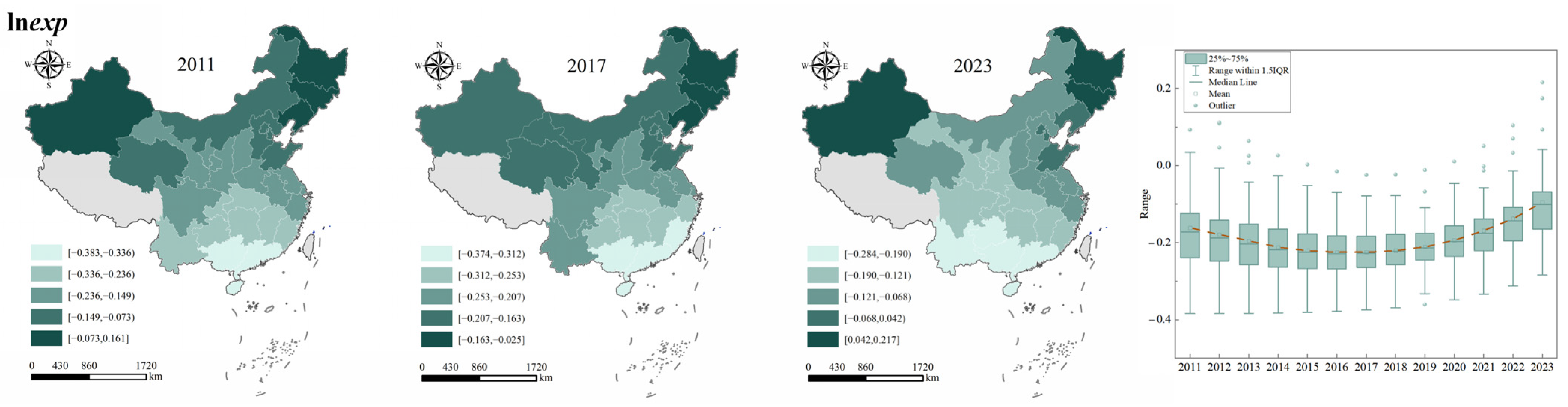
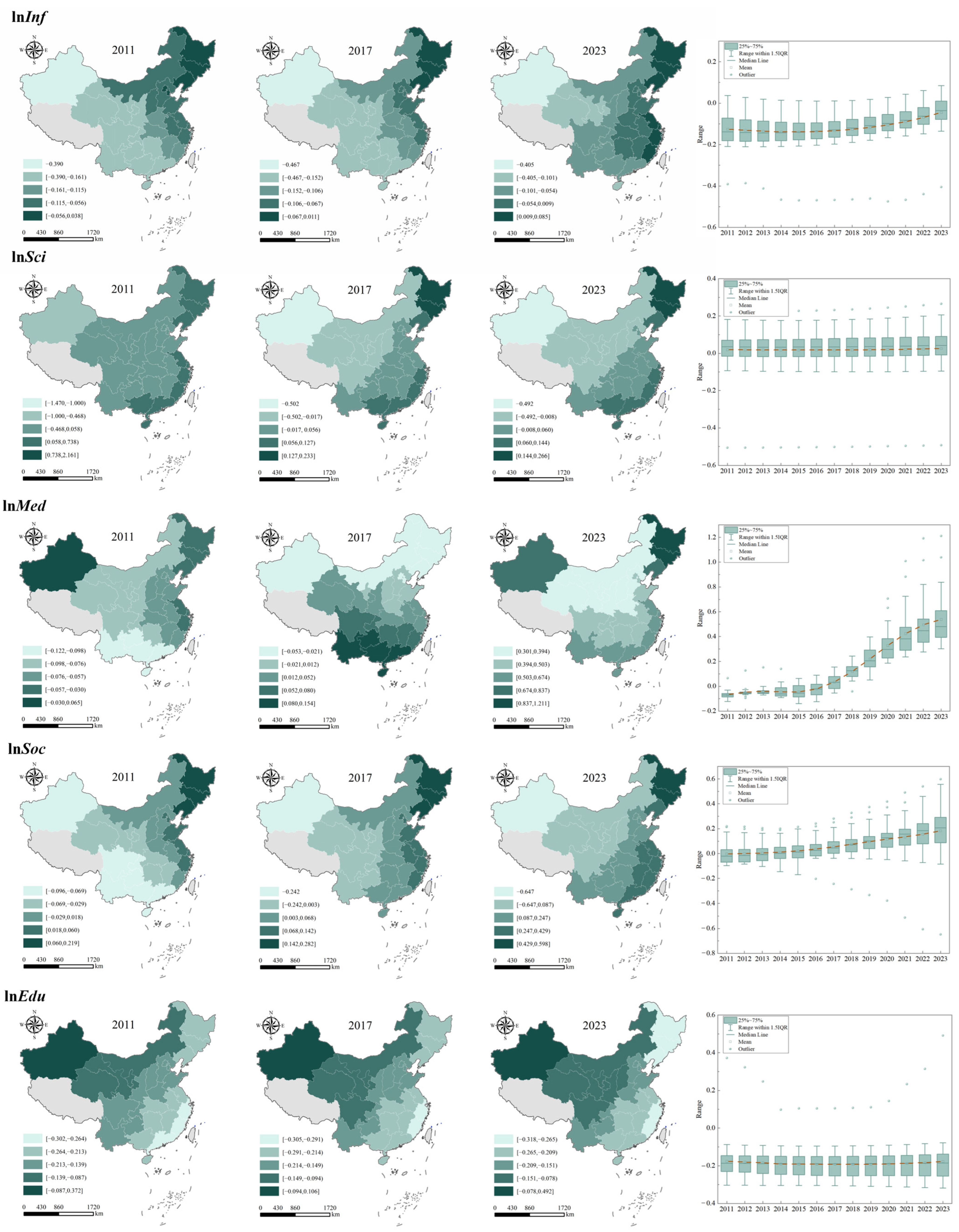
Spatio-temporal visualization based on the GTWR model reveals that the interaction between per capita rural public expenditure—including its five expenditure categories—and ACI on agricultural economic resilience exhibits significant spatial heterogeneity and phased evolution. This relationship is dynamic, characterized by a path of “synergistic enhancement—regional differentiation—diminishing returns,” reflecting the dependence of fiscal investment efficiency on local absorption capacity and the institutional environment.
The interaction term between per capita rural public expenditure and ACI (lnpex × ACI) (Figure 5) shows a positive effect in 2011, primarily concentrated in the Northeast and parts of the Northwest, indicating that in regions with weak agricultural foundations but strong policy support, fiscal investment and local absorption capacity initially synergized. By 2017, the interaction coefficient converged, with central regions such as Henan, Hubei, and Anhui becoming clusters of high values. By 2023, the interaction coefficient had risen overall, but regional divergence intensified, presenting a “strong north, weak south” pattern. This reflects that in major grain-producing regions, fiscal investment and absorption capacity continued to strengthen, while in southern regions, industrial restructuring and rural outmigration weakened fiscal support for agricultural resilience. This evolutionary process reveals a shift in the effectiveness of public expenditure from “enhanced universality” to “regional adaptability constraints”.
To verify the robustness of the research findings, we further conducted a bandwidth sensitivity analysis to assess the stability of the model estimation results under different bandwidth specifications. Specifically, Column (1) of Table 12 reports the baseline GTWR results obtained using the AICc criterion for bandwidth selection (Bandwidth = 0.1250). Column (2), by contrast, adopts the Cross-Validation (CV) method to re-identify the optimal bandwidth (Bandwidth = 0.1404) and re-estimates the model accordingly. The results indicate that the estimated signs and directional effects of the core variables remain highly consistent across different bandwidth settings. Specifically, the coefficient of rural public expenditure (lnpex) remains positive, while the coefficients of absorption capacity (ACI) and the interaction term (lnpex × ACI) remain negative. Moreover, all key coefficients retain statistical significance at relatively high proportions. These findings further confirm the robustness and reliability of the GTWR model estimation results.

5.3.3. Spatio-Temporal Differentiation Characteristics: Structural Segmentation

Further, as shown in Figure 6, the spatiotemporal evolution of the interaction term between per capita rural infrastructure expenditure and ACI (lnInf × ACI) illustrates a pattern of “initial strengthening followed by differentiation.” In 2011, synergistic effects were strongest in the eastern coastal and northeastern regions, indicating that early infrastructure development in transportation, water conservancy, and other sectors played a crucial supporting role in factor agglomeration and market connectivity, thereby enhancing the stability and resilience of the agricultural system. By 2017, the interaction coefficient declined overall, and spatial disparities narrowed, reflecting diminished marginal contributions of infrastructure to agricultural resilience as levels improved nationwide. By 2023, the coefficient exhibited divergent patterns, with positive values in eastern coastal and central regions and relatively low levels in the west. This suggests that, following the gradual improvement of infrastructure, its impact on agricultural economic resilience depends on the institutional environment and the efficiency of factor allocation. That is, only in regions with strong absorption capacity can infrastructure investment continuously enhance resilience by reducing transaction costs and promoting factor mobility and industrial integration; whereas in regions with insufficient absorption capacity, efficiency losses characterized by “high input—low conversion” may occur.
The interaction term between science and technology expenditure and absorption capacity (lnSci × ACI) follows an evolutionary pattern of “local positive effects—overall weakening—regional divergence.” In 2011, positive effects were concentrated in the east and parts of the central regions. By 2017, the coefficient declined nationwide, and negative effects emerged in some areas, indicating that nationwide, science and technology investment faced issues of “conversion lag” and “supply-demand mismatch,” failing to effectively translate into agricultural production capacity in the short term. By 2023, the divergence increased, with the Northeast and eastern regions showing positive values, while the western regions remained negative, highlighting the threshold and long-term effects of science and technology investment.
Regarding healthcare expenditure (lnMed × ACI), the role in enhancing agricultural resilience follows a dynamic process of “generally negative—local improvements—regional restructuring.” In 2011, the interaction coefficient was negative in most regions, indicating that early healthcare investments were primarily focused on basic coverage and provided limited direct support for agricultural production resilience. By 2017, positive trends emerged in the south, reflecting how the advancement of the new healthcare reform and policies promoting equitable public health services began to translate improvements in labor force health into enhanced stability in agricultural production. By 2023, the effect was strongest in eastern and central regions, showing the lagging yet positive influence of healthcare reform on agricultural resilience.
Social security expenditure (lnSoc × ACI) initially showed negative effects, especially in the west in 2011. This indicates that, in the early stages, social security expenditure was primarily manifested as “transfer payments” and provided limited direct support to the agricultural production system. By 2017, positive effects began to emerge in the central and southern regions, suggesting that as the system improved and coverage expanded, social security gradually enhanced the agricultural system’s resilience to shocks by reducing farmers’ risk exposure and stabilizing income expectations. However, by 2023, positive effects emerged in the central and southern regions, reflecting the stabilizing impact of social security on agricultural resilience as the system matured.
Finally, the interaction term for education expenditure (lnEdu × ACI) exhibited a stable “high in the west, low in the east” pattern. In 2011, it was high in the west, reflecting the importance of education investment in areas with limited resources. By 2017, this pattern had further intensified, with the western regions forming a continuous zone of high values, reflecting the prominent role of educational investment in “capacity compensation.” By 2023, the coefficient dropped significantly in the east, indicating that in economically developed areas, educational investment is increasingly directed toward the non-agricultural sector and urban systems, weakening its direct support for agricultural resilience and revealing certain phenomena of “factor spillover” and “target deviation”.
Overall, the interactive effects between different types of public expenditure and absorption capacity demonstrate that enhancing agricultural economic resilience depends not only on fiscal investment but also on the alignment between expenditure types, absorption capacity, and transformation pathways. Basic security expenditure, such as infrastructure and social security, generates positive effects in the short to medium term, while capacity-building expenditure, such as science and technology and education, exhibits regional thresholds and long-term lags. Consequently, policy design should focus on targeted measures that enhance technological capabilities and institutional efficiency, particularly in central and western regions, while preventing the “de-agriculturalization” of public resources in the east. This approach will maximize the synergistic effects of fiscal expenditure in strengthening agricultural economic resilience.

6. Conclusions and Discussion

6.1. Conclusions

Using provincial panel data from 30 provinces in China spanning the period 2011–2023, this study adopts a cultural–geographical perspective and employs two-way fixed-effects models, moderating effect models, and GTWR models to systematically examine the effects and underlying mechanisms of rural public expenditure on agricultural economic resilience. The main conclusions are as follows.
First, rural public expenditure is significantly and positively associated with agricultural economic resilience, and this relationship remains robust after a series of robustness and endogeneity tests. Benchmark regression results indicate that, after controlling for socioeconomic and climatic factors, per capita rural public expenditure exerts a significant positive effect on agricultural economic resilience. Furthermore, lag-effect analysis shows that rural public expenditure exhibits a notable cumulative lag effect, suggesting that the policy effects of public investment are characterized by gradual release and long-term persistence. This implies that rural public expenditure contributes not only to improving current agricultural development conditions, but also to strengthening the long-term stable operation and sustainable development capacity of the agricultural economic system.
Second, the resilience effects of rural public expenditure exhibit significant regional and structural heterogeneity. From a regional perspective, the positive effects of rural public expenditure are mainly concentrated in eastern China and major grain-consuming regions, whereas the effects are not significant in central and western China, major grain-producing regions, and balanced production-consumption regions. This finding suggests that the effectiveness of rural public expenditure is closely related to regional development foundations and local resource allocation conditions. From the perspective of expenditure structure, infrastructure expenditure, medical and health expenditure, social security expenditure, and education expenditure all exert significant positive effects on agricultural economic resilience, while science and technology expenditure exhibits a negative effect. This may reflect the long transformation cycle and lagged realization of technology investment benefits in the agricultural sector.
Third, the moderating effect of absorption capacity demonstrates significant structural heterogeneity. The interaction between the Rural Public Expenditure Absorption Capacity Index (ACI) and total rural public expenditure is not statistically significant, indicating that the overall matching degree between fiscal resource allocation and local absorption capacity remains insufficient. However, significant differences emerge across expenditure categories. Specifically, medical and health expenditure exhibits a significant positive matching effect with absorption capacity, suggesting that regions with stronger resource absorption and transformation capacity can more effectively convert healthcare investment into labor quality improvement and agricultural development support. By contrast, education expenditure exhibits a significant negative moderating effect. This indicates that in regions with relatively high absorption capacity, especially those with higher levels of marketization and urbanization, educational investment may accelerate the outflow of rural human capital and weaken the stable development foundation of the agricultural economy. Overall, the findings imply that the policy effects of rural public expenditure depend not only on expenditure scale and structure, but also on the degree of compatibility between fiscal investment and local absorption conditions.
Fourth, the interaction effects between rural public expenditure and absorption capacity exhibit significant spatiotemporal heterogeneity and dynamic evolutionary characteristics. GTWR results reveal that the interaction effects generally follow a dynamic evolution pattern characterized by “synergistic enhancement—regional differentiation.” In the early stage, the interaction effects of various expenditures and absorption capacity mainly exhibit positive synergy; however, with the gradual differentiation of regional economic development levels, industrial structures, and institutional environments, regional heterogeneity becomes increasingly pronounced over time. Among different expenditure categories, the interaction effects of education expenditure display a clear “higher in the west and lower in the east” spatial pattern, and the negative effects in eastern regions continue to intensify over time. This further confirms that under conditions of rapid marketization and urbanization, educational investment may accelerate rural talent outflow and weaken agricultural economic resilience in developed regions.

6.2. Discussion

The findings of this study provide a novel perspective on the complex relationship between public finance and agricultural development in China. First, the study confirms the positive role of rural public expenditure, consistent with the conclusions of previous research [45]. At the same time, the robustness test results based on the indicator-system approach for measuring Agricultural Economic Resilience also suggest that future rural public expenditure policies should not only focus on improving agricultural production conditions and fostering long-term development capacity, but also further strengthen agricultural risk early-warning systems, post-disaster recovery mechanisms, and emergency governance capacity, thereby achieving a more comprehensive enhancement of Agricultural Economic Resilience. However, this study stands out by introducing “absorption capacity” as a moderating variable, revealing the “conditional” nature of public expenditure effectiveness. This aligns with recent academic trends focusing on the efficiency of government investment in relation to local governance capacity. Our finding—that public expenditure alone does not guarantee resilience, but rather the key lies in how public funds are integrated with local capacity—offers an explanation, from a cultural–geographical perspective, for the “high input, low output” dilemma that has long confronted policymakers. In particular, the negative interaction between education expenditure and absorption capacity provides robust empirical evidence for the real-world issue of “brain drain,” deepening our understanding of the potential conflict between human capital investment and industry development.
Second, the dynamic evolutionary pathways revealed by the GTWR model extend beyond traditional heterogeneity analysis, which typically relies on static group comparisons. Our findings suggest that the “drift” phenomenon in regions with high policy effects may be associated with adjustments in national regional development strategies (e.g., “Rise of the Central Region” and “Revitalization of the Northeast”), industrial gradient transfer, and changes in how local governments allocate fiscal funds over time. For instance, the infrastructure advantages experienced by eastern regions in the early stages may later be replicated by central regions. However, by the later stage, when infrastructure is well-developed, diminishing marginal returns make institutional and technological innovation more prominent.
Based on the above conclusions, this paper offers two key policy recommendations to enhance the resilience of the agricultural economy through more effective utilization of rural public expenditure:
First, policymakers should shift focus from “expanding total expenditure” to “structural optimization and targeted support,” aligning fiscal investments with regional endowments. The internal structure of rural public expenditure must be optimized. Specifically, for technology expenditure that exhibits short-term negative effects, policymakers should focus on resolving challenges in “transformation and implementation.” Collaboration between research institutions and agricultural operators should be strengthened, and applied technology funds should be established to expedite the realization of benefits through synergies with educational, training, and information services. Additionally, a differentiated regional investment strategy should be adopted. In eastern regions, the focus should shift from infrastructure construction to supporting agricultural technological innovation, green development, and industrial chain extension. Simultaneously, mechanisms to retain and attract human capital enhanced by education investments should be explored. For central and western regions, the priority should remain on addressing infrastructure and public service gaps. However, these regions should not blindly replicate the eastern model but select more cost-effective, adaptable technologies and projects suited to their unique ecological and socio-cultural contexts.
Second, the focus should shift from “input” to “capacity,” placing equal emphasis on cultivating and enhancing local absorption capacity. The core insight of this study is that the efficiency of fiscal funds is enhanced when local absorption capacity is improved. This shift requires expanding the policy toolkit beyond financial transfers. Specifically, the following steps should be taken: (1) optimizing the institutional environment by deepening market-oriented reforms, removing barriers to the free flow of factors between urban and rural areas, and enhancing local government capacity for fiscal management; (2) investing in human and social capital by continuing to increase investments in rural education and vocational training while integrating these efforts with industrial development plans and promoting “order-based” training; (3) bridging digital and geographic divides by accelerating the development of digital villages in regions with unfavorable natural conditions. E-commerce, distance education, and smart agriculture can help overcome physical barriers and reduce information asymmetry, thus improving public resource utilization.
While this study offers valuable insights, it does have certain limitations that suggest avenues for future research. First, the use of provincial-level data obscures intra-provincial variations. Future research may further employ quasi-natural experiments, policy shocks, or finer-scale data for causal identification, which would allow for a more accurate examination of the matching relationship between public expenditure and absorption capacity and provide more operational policy implications for local governments. Second, measurement issues related to rural public expenditure components and absorption capacity may introduce some error. Future work could explore more precise data and methods for measuring agricultural economic resilience. Third, the underlying mechanisms of absorption capacity require further investigation, particularly how different dimensions (geographical, social, and institutional) moderate various types of public expenditure. Fourth, the political economy dimension warrants further exploration. In practice, the allocation and utilization efficiency of public expenditure are also influenced by political economy factors such as local government behavior and official incentives [59]. Political economy factors, such as local government behavior and fiscal decentralization, should be incorporated into the analysis to improve the study’s explanatory power.


Author Contributions

Conceptualization, J.Q. (Jingjing Qin) and C.L. (Chongming Li); methodology, J.Q. (Jingjing Qin), X.L. (Xiang Luo) and C.L. (Chongming Li); software, J.Q. (Jingjing Qin); validation, J.Q. (Jingjing Qin), X.L. (Xiang Luo) and X.L. (Xin Li); formal analysis, J.Q. (Jingjing Qin) and X.L. (Xiang Luo); resources, X.L. (Xiang Luo), X.L. (Xin Li) and C.L. (Chongming Li); data curation, C.L. (Chongming Li); writing—original draft preparation, J.Q. (Jingjing Qin) and X.L. (Xiang Luo); writing—review and editing, J.Q. (Jingjing Qin), X.L. (Xiang Luo), X.L. (Xin Li) and C.L. (Chongming Li); visualization, C.L. (Chongming Li); supervision, X.L. (Xiang Luo), X.L. (Xin Li) and C.L. (Chongming Li); funding acquisition, X.L. (Xiang Luo) and C.L. (Chongming Li). All authors have read and agreed to the published version of the manuscript.

Funding

This research was financially supported by the National Natural Science Foundation of China (42171286; 71974071).

Data Availability Statement

Data will be made available on request.

Conflicts of Interest

The authors declare no conflicts of interest.

Notes

1
For instance, suppose that the growth rate of the added value of the primary industry in a given province between years t − 1 and t is 2%, while the corresponding national growth rate is 5%. The calculated Aerit would then be −0.6, suggesting that the province experienced relatively greater adverse impacts from external shocks and therefore exhibited lower agricultural economic resilience.
2
Based on the classification criteria established by the National Bureau of Statistics in 2003, the eastern, central, and western regions are defined as follows: The eastern region includes Beijing, Tianjin, Hebei, Shanghai, Jiangsu, Zhejiang, Fujian, Shandong, Guangdong, and Hainan; The Central Region includes Shanxi, Anhui, Jiangxi, Henan, Hubei, Hunan, Liaoning, Jilin, and Heilongjiang; the Western Region includes Inner Mongolia, Guangxi, Sichuan, Chongqing, Guizhou, Yunnan, Tibet, Shaanxi, Gansu, Qinghai, Ningxia, and Xinjiang.
3
Since the Ministry of Finance’s “Opinions on Reforming and Improving Several Policy Measures for Comprehensive Agricultural Development” was formally established in 2003, the 13 major grain-producing regions—Hebei, Inner Mongolia, Jilin, Heilongjiang, Liaoning, Jiangsu, Anhui, Jiangxi, Shandong, Henan, Hubei, Hunan, and Sichuan—have served as the core areas of national grain production, accounting for approximately 78% of the country’s total grain output. The major grain-consuming regions (7): Beijing, Tianjin, Shanghai, Zhejiang, Fujian, Guangdong, and Hainan. These regions are economically developed and densely populated, with a significant gap between grain production and demand. They rely on grain imports from outside to meet local consumption, resulting in a low grain self-sufficiency rate. The grain production-consumption balanced regions (11): Shanxi, Guangxi, Guizhou, Yunnan, Chongqing, Tibet, Shaanxi, Gansu, Qinghai, Ningxia, and Xinjiang. Grain production in these regions accounts for a relatively small proportion of the national total.

References

  1. Cui, X.; Zhong, Z. Climate change, cropland adjustments, and food security: Evidence from China. J. Dev. Econ. 2024, 167, 103245. [Google Scholar] [CrossRef]
  2. Liu, X.; Zhang, Y.; Lan, X.; Si, W. Can reducing agricultural trade costs foster the transformation of the agrifood system? Evidence from China. China Econ. Rev. 2025, 91, 102406. [Google Scholar] [CrossRef]
  3. Zhang, Q.; Cao, Z. Unveiling rural transformation mechanisms: Quantitative evidence from 460 villages in China. Habitat Int. 2026, 168, 103678. [Google Scholar] [CrossRef]
  4. Cui, Z.; Li, E.; Li, Y.; Deng, Q.; Shahtahmassebi, A. The impact of poverty alleviation policies on rural economic resilience in impoverished areas: A case study of Lankao County, China. J. Rural Stud. 2023, 99, 92–106. [Google Scholar] [CrossRef]
  5. Liu, Y.; Pu, X.; Zhang, G. Spatial heterogeneity of grain production resilience and its influencing factors in China: Based on geographically weighted regression analysis. Humanit. Soc. Sci. Commun. 2025, 12, 1952. [Google Scholar] [CrossRef]
  6. Gao, Q.; Sun, M.; Chen, L. The impact of digital inclusive finance on agricultural economic resilience. Financ. Res. Lett. 2024, 66, 105679. [Google Scholar] [CrossRef]
  7. Chen, T.; Zhang, L.; Wen, M.; Yuan, W.; Lin, W. Can the development of agricultural insurance promote the resilience of agricultural economy? The dynamic mechanisms of the digital economy development. Int. Rev. Econ. Financ. 2025, 103, 104386. [Google Scholar] [CrossRef]
  8. Luo, Y.; Liu, S.; Zhang, Y.; Zeng, M.; Zhao, D. Digital pathways to resilience: Assessing the impact of digitalization on agricultural production resilience in China. China Econ. Rev. 2025, 90, 102375. [Google Scholar] [CrossRef]
  9. Mueller, J.T.; Gasteyer, S. The ethnically and racially uneven role of water infrastructure spending in rural economic development. Nat. Water 2023, 1, 74–82. [Google Scholar] [CrossRef]
  10. Dai, S.; Gong, B.; Hu, P.; Wei, X. Rural pension, factor reallocation and agricultural productivity: Evidence from China. J. Dev. Econ. 2025, 179, 103653. [Google Scholar] [CrossRef]
  11. Lu, H.; Zhao, P.; Hu, H.; Yan, J.; Chen, X. Exploring the heterogeneous impact of road infrastructure on rural residents’ income: Evidence from nationwide panel data in China. Transp. Policy 2023, 134, 155–166. [Google Scholar] [CrossRef]
  12. Hidalgo-Hidalgo, M.; Iturbe-Ormaetxe, I. Long-run effects of public expenditure on poverty. J. Econ. Inequal. 2018, 16, 1–22. [Google Scholar] [CrossRef]
  13. Dinlersoz, E.M.; Fu, Z. Infrastructure investment and growth in China: A quantitative assessment. J. Dev. Econ. 2022, 158, 102916. [Google Scholar] [CrossRef]
  14. Liang, C.; Zhou, Y. Unlocking rural vitality: Assessing the multidimensional impacts of land consolidation on rural comprehensive development capacity in post-poverty China. J. Rural Stud. 2025, 120, 103870. [Google Scholar] [CrossRef]
  15. Adetutu, M.O.; Ajayi, V. The impact of domestic and foreign R&D on agricultural productivity in sub-Saharan Africa. World Dev. 2020, 125, 104690. [Google Scholar] [CrossRef]
  16. Wang, W.; Lan, Y.; Wang, X. Impact of livelihood capital endowment on poverty alleviation of households under rural land consolidation. Land Use Policy 2021, 109, 105608. [Google Scholar] [CrossRef]
  17. Sahoo, P.; Biswas, D.; Thakurata, S.G. Is growth pro-poor among the states of India? A poverty decomposition exercise during the 2000s. Soc. Indic. Res. 2023, 165, 107–133. [Google Scholar] [CrossRef]
  18. Ngounou, B.A.; Wang, M.; Zhu, D. Does energy poverty undermine health spending in Africa? A comparative analysis of public and private healthcare spending. Renew. Energy 2025, 239, 121987. [Google Scholar] [CrossRef]
  19. Zhang, H.; Xu, Z.; Wu, K.; Zhou, D.; Wei, G. Multi-dimensional poverty measurement for photovoltaic poverty alleviation areas: Evidence from pilot counties in China. J. Clean. Prod. 2019, 241, 118382. [Google Scholar] [CrossRef]
  20. Hasanujzaman, M.; Omar, M.A. Household and non-household factors influencing multidimensional energy poverty in Bangladesh: Demographics, urbanization and regional differentiation via a multilevel modeling approach. Energy Res. Soc. Sci. 2022, 92, 102803. [Google Scholar] [CrossRef]
  21. Wedgwood, R. Education and poverty reduction in Tanzania. Int. J. Educ. Dev. 2007, 27, 383–396. [Google Scholar] [CrossRef]
  22. Zhang, Q.; Cao, Z.; Liu, Y. Assessing rural revitalization potential through rural transformation degree and sustainability: A quantitative study of 460 case villages in Lingbao, China. Habitat Int. 2024, 153, 103194. [Google Scholar] [CrossRef]
  23. Fan, Y.; Cong, S. Fiscal transfer payments and farmers’ livelihood resilience: “Driving” or “Constraining”? Chin. Rural Econ. 2024, 1, 125–148. [Google Scholar] [CrossRef]
  24. Du, J.; Liu, Q.; Gu, Q. Does fiscal support for agriculture enhance the resilience of agricultural development? A study based on the static Verdoorn’s law perspective. Stat. Res. 2025, 42, 99–111. [Google Scholar] [CrossRef]
  25. Van der Ploeg, F. Bottlenecks in ramping up public investment. Int. Tax Public Financ. 2012, 19, 509–538. [Google Scholar] [CrossRef]
  26. Richmond, C.; Yackovlev, I.; Yang, S.C.S. Investing volatile resource revenues in capital-scarce economies. Pac. Econ. Rev. 2015, 20, 193–221. [Google Scholar] [CrossRef]
  27. Presbitero, A.F. Too much and too fast? Public investment scaling-up and absorptive capacity. J. Dev. Econ. 2016, 120, 17–31. [Google Scholar] [CrossRef]
  28. Guillaumont, P.; Jeanneney, S.G. Big push versus absorptive capacity: How to reconcile the two approaches. In Foreign Aid for Development: Issues, Challenges, and the New Agenda; Oxford Academic: Oxford, UK, 2007; pp. 297–322. [Google Scholar] [CrossRef]
  29. Li, Z.; Li, H.; Liu, J.; Cai, Z. Absorptive capacity of transfer payment from the perspective of targeted poverty alleviation: Evidence from national-level poverty counties. Financ. Trade Res. 2017, 28, 87–102. [Google Scholar] [CrossRef]
  30. Bird, K.; Shepherd, A. Livelihoods and chronic poverty in semi-arid Zimbabwe. World Dev. 2003, 31, 591–610. [Google Scholar] [CrossRef]
  31. Kam, S.P.; Hossain, M.; Bose, M.L.; Villano, L.S. Spatial patterns of rural poverty and their relationship with welfare-influencing factors in Bangladesh. Food Policy 2005, 30, 551–567. [Google Scholar] [CrossRef]
  32. Epprecht, M.; Müller, D.; Minot, N. How remote are Vietnam’s ethnic minorities? An analysis of spatial patterns of poverty and inequality. Ann. Reg. Sci. 2011, 46, 349–368. [Google Scholar] [CrossRef]
  33. Abrar, S.; Morrissey, O.; Rayner, T. Crop-level supply response by agro-climatic region in Ethiopia. J. Agric. Econ. 2004, 55, 289–311. [Google Scholar] [CrossRef]
  34. Acemoglu, D.; García-Jimeno, C.; Robinson, J.A. State capacity and economic development: A network approach. Am. Econ. Rev. 2015, 105, 2364–2409. [Google Scholar] [CrossRef]
  35. Hu, M.; Yi, F.; Zhou, H.; Yan, F. The more the better? Reconsidering the welfare effect of crop insurance premium subsidy. Agriculture 2024, 14, 2050. [Google Scholar] [CrossRef]
  36. Wang, W.; Zhong, Y. Can agricultural insurance play a protective role? Evidence from China’s agriculture. Humanit. Soc. Sci. Commun. 2025, 12, 951. [Google Scholar] [CrossRef]
  37. He, C.; Zhou, C.; Wen, H. Improving the consumer welfare of rural residents through public support policies: A study on old revolutionary areas in China. Socio-Econ. Plan. Sci. 2024, 91, 101767. [Google Scholar] [CrossRef]
  38. Gai, Q.; Guo, N.; Li, B.; Shi, Q.; Zhu, X. Rural pensions, labor reallocation, and aggregate income: An empirical and quantitative analysis of China. Econometrica 2025, 93, 1663–1696. [Google Scholar] [CrossRef]
  39. Luo, X.; Qin, J.; Wan, Q.; Jin, G. Expenditure fluctuation and consumption loss: Rural spatial poverty in China. Technol. Econ. Dev. Econ. 2021, 27, 1357–1382. [Google Scholar] [CrossRef]
  40. Angelopoulos, K.; Philippopoulos, A.; Tsionas, E. Does public sector efficiency matter? Revisiting the relation between fiscal size and economic growth in a world sample. Public Choice 2008, 137, 245–278. [Google Scholar] [CrossRef]
  41. Cohen, W.M.; Levinthal, D.A. Absorptive capacity: A new perspective on learning and innovation. Adm. Sci. Q. 1990, 35, 128–152. [Google Scholar] [CrossRef]
  42. Yang, Y.; Feng, P.; Guo, J. How does agricultural resilience in China vary by region? Ecol. Indic. 2025, 174, 113513. [Google Scholar] [CrossRef]
  43. Liu, N.A.; Yang, C.; Cheng, Y. Digital rural development, insurance investment, and agricultural economic resilience. Financ. Res. Lett. 2025, 86, 108712. [Google Scholar] [CrossRef]
  44. Martin, R.; Gardiner, B. The resilience of cities to economic shocks: A tale of four recessions (and the challenge of Brexit). Pap. Reg. Sci. 2019, 98, 1801–1833. [Google Scholar] [CrossRef]
  45. Zheng, F.; Bai, Y.; Hu, M.; Liou, J. Fiscal decentralization and rural public services: A new structural economics perspective. Financ. Res. Lett. 2025, 83, 107614. [Google Scholar] [CrossRef]
  46. Liu, Y.; Rao, K.; Hsiao, W.C. Medical expenditure and rural impoverishment in China. J. Health Popul. Nutr. 2003, 21, 216–222. [Google Scholar] [PubMed]
  47. Tu, Y. A research on rural social security expenditure to farmers’ consumption demand. Econ. Surv. 2012, 4, 36–40. [Google Scholar] [CrossRef]
  48. Wu, M.; Jiang, R.; Liu, Y. Spatializing urban infrastructure investment in China: Cadre tenure, political competition, and uneven geography of government-pays public-private partnerships. Cities 2024, 155, 105404. [Google Scholar] [CrossRef]
  49. Rupasingha, A.; Goetz, S.J. Social and political forces as determinants of poverty: A spatial analysis. J. Socio-Econ. 2007, 36, 650–671. [Google Scholar] [CrossRef]
  50. Luo, X.; Lu, X.; Zhang, Z.; Pan, Y. Regional differences and rural public expenditure cyclicality: Evidence from transitory and persistent shocks in China. Ann. Reg. Sci. 2020, 65, 281–318. [Google Scholar] [CrossRef]
  51. Luo, X.; Wan, Q.; Jin, G.; Zhu, L. Fluctuation and spillover: Poverty reduction effect of rural public expenditure scale based on spatial poverty. Appl. Spat. Anal. Policy 2021, 14, 247–272. [Google Scholar] [CrossRef]
  52. Wang, Y.; Shi, S.; Xu, H.; Zhao, Y.; Gu, F. Government economic subsidies or credit risk mitigation: Incentive contracts and resilience assessment in low-carbon agricultural supply chains. Expert Syst. Appl. 2026, 299, 130329. [Google Scholar] [CrossRef]
  53. Yu, X. Engel curve, farmer welfare and food consumption in 40 years of rural China. China Agric. Econ. Rev. 2018, 10, 65–77. [Google Scholar] [CrossRef]
  54. Guo, K.; Ji, Q.; Zhang, D. A dataset to measure global climate physical risk. Data Brief 2024, 54, 110502. [Google Scholar] [CrossRef]
  55. Li, Y.; Gao, G.; Wen, J.; Zhao, N.; Du, G.; Stanny, M. The measurement of agricultural disaster vulnerability in China and implications for land-supported agricultural resilience building. Land Use Policy 2025, 148, 107400. [Google Scholar] [CrossRef]
  56. Huang, B.; Wu, B.; Barry, M. Geographically and temporally weighted regression for modeling spatio-temporal variation in house prices. Int. J. Geogr. Inf. Sci. 2010, 24, 383–401. [Google Scholar] [CrossRef]
  57. Yang, Z.; Li, Y.; Wu, C. Population aging, fintech, and agricultural economic resilience. Int. Rev. Econ. Financ. 2025, 97, 103756. [Google Scholar] [CrossRef]
  58. Hodrick, R.J.; Prescott, E.C. Postwar US business cycles: An empirical investigation. J. Money Credit Bank. 1997, 29, 1–16. [Google Scholar] [CrossRef]
  59. Helpap, D.J. Providing public goods in rural America: The role of the professional public administrator. Public Adm. Q. 2022, 46, 110–128. [Google Scholar] [CrossRef]
Figure 1. Workflow of this study.
Land 15 00955 g001
Figure 2. Theoretical analysis framework.
Land 15 00955 g002
Figure 3. Spatio-temporal patterns of agricultural economic resilience and per capita rural public expenditure.
Land 15 00955 g003
Figure 4. Spatio-temporal patterns of rural public expenditure absorption capacity from a cultural–geographical perspective.
Land 15 00955 g004
Figure 5. Results of spatio-temporal geographically weighted regression: per capita rural public expenditure.
Land 15 00955 g005
Figure 6. Results of spatio-temporal geographically weighted regression: Structural breakdown of rural public expenditure.
Land 15 00955 g006
Table 1. Development of indicators for rural public expenditure absorption capacity.
Primary IndicatorsSecondary IndicatorsDefinitions and Explanations
Geographical LocationAverage ElevationAverage elevation within each province (m)
Average SlopeAverage surface slope within each province (%)
Geographical LocationSpherical average distance from the center of gravity of each district or county to the nearest major port (km)
Traffic Density(Railway mileage + Highway mileage)/Administrative area (km/km2)
Socio-Cultural ContextLevel of Education(Number of people with primary school education × 6 + Number of people with junior high school education × 9 + Number of people with senior high school and technical secondary school education × 12 + Number of people with college and higher education × 16)/Total population aged 6 and above
Ethnic ConcentrationProportion of the rural ethnic minority population in the total rural population (%)
Rural DigitalizationProportion of administrative villages with broadband Internet access services among all administrative villages (%)
Level of Social OrganizationTotal number of new agricultural business entities (including various types of farmers’ professional cooperatives, family farms, and leading agricultural industrialization enterprises)/Total number of rural households
Institutional EnvironmentDegree of MarketizationOverall Marketization Index from the China Marketization Index Report by Province
Government Governance CapacityProportion of local general budget expenditure to GDP (%)
Village Planning Coverage RateProportion of administrative villages with village planning in place (%)
Village Improvement Coverage RateProportion of administrative villages where village improvement projects have been implemented (%)
Table 2. Descriptive statistics of variables.
TypeVariablesVariable DescriptionMeanStdMinMax
Explained variableAerAgricultural Economic Resilience0.0421.390−8.83610.655
Explanatory variableslnpexPer capita rural public expenditure (logarithm)7.9020.5706.8339.769
lnInfPer capita rural infrastructure expenditure (logarithm)6.5370.7554.8009.052
lnSciPer capita rural science and technology expenditure (logarithm)5.4781.0922.9928.877
lnMedPer capita rural health care expenditure (logarithm)5.2520.8513.4868.080
lnSocPer capita rural social security expenditure (logarithm)−1.5560.749−3.3190.214
lnEduPer capita rural education expenditure (logarithm)6.9740.9015.1418.556
Moderating variableACIRural public expenditure absorption capacity0.0001.408−4.4882.788
Socioeconomic control variableslnpgdpLevel of economic development (logarithm)10.9030.4709.68212.207
GapUrban–rural income gap2.5160.3871.7183.672
engRural residents’ standard of living33.0774.81423.80050.459
LivRural residents’ developmental consumption10.7623.5354.45723.424
TeaRural human capital54.20918.6249.84595.695
OpenDegree of agricultural openness0.9073.1900.00023.337
Climatic and environmental control variablesLTDNumber of days with extremely low temperatures40.92918.1102.468100.000
HTDNumber of days with extremely high temperatures64.66014.81522.687119.581
ERDNumber of days with extreme rainfall44.40624.2680.000190.534
EEDNumber of days with extreme drought34.89114.8184.36787.342
DisPercentage of affected area0.4530.1570.0000.913
Table 3. Benchmark regression results.
Variables(1)(2)(3)(4)(5)(6)
OLSOLSOLSFEFEFE
lnpex−0.263 **0.0500.0670.919 **1.236 ***1.306 ***
(−2.13)(0.30)(0.37)(2.17)(2.66)(2.78)
Constant2.119 **−7.981 **−7.500 **−6.882 **−8.236−8.743
(2.17)(−2.32)(−2.11)(−2.17)(−0.49)(−0.50)
Obs390390390390390390
R-squared0.0120.0920.0990.0350.0830.089
Hausman test result27.73 ***
Social factorsNoYesYesNoYesYes
Climatic factorsNoNoYesNoNoYes
Province FENoNoNoYesYesYes
Year FENoNoNoYesYesYes
Note: (1) *** and ** stand for the significance at the 1% and 5% levels; the t-statistics are shown in parentheses. (2) It should be particularly noted that the overall R2 values reported in Table 3 are relatively low. This may be attributed to several reasons. First, the dependent variable—agricultural economic resilience measured based on the value added of the primary sector—is inherently dynamic and heterogeneous, and is therefore highly susceptible to random shocks such as natural disasters, market fluctuations, and policy adjustments. Second, this study employs both province and year fixed effects, meaning that a substantial proportion of cross-sectional differences and temporal trends has already been absorbed by the fixed effects. Consequently, the reported within-R2 reflects only the explanatory power for the remaining within-individual variation, which is typically lower in fixed-effects panel models. In addition, as control variables are gradually incorporated into the regressions, the R2 values exhibit a steady upward trend, while the coefficient of the core explanatory variable remains stable and statistically significant throughout. This indicates that the overall model specification is robust and appropriate. (3) Regressions were all performed using Stata 18.
Table 4. Robustness tests I.
Variables(1)(2)(3)(4)(5)
Replace the Explained VariableResistanceRecoveryAdaptationTransformation
lnpex0.028 ***−0.010 ***−0.0010.007 ***0.032 ***
(2.95)(−3.33)(−0.21)(3.15)(5.43)
Constant−0.4280.032−0.152−0.117−0.191
(−1.21)(0.29)(−0.85)(−1.43)(−0.86)
Obs390390390390390
R-squared0.7670.4430.2350.8300.696
Social factorsYesYesYesYesYes
Climatic factorsYesYesYesYesYes
Province FEYesYesYesYesYes
Year FEYesYesYesYesYes
Note: *** stands for the significance at the 1% levels; the t-statistics are shown in parentheses.
Table 5. Robustness tests II.
Variables(1)(2)(3)(4)
Replace the Explained VariableTrailing 1%Trailing 5%System GMM
L.Aer 1.018 ***
(5.76)
lnpex1.087 ***1.036 ***0.526 **0.192 *
(3.35)(2.77)(2.04)(1.85)
Constant−13.9920.5985.324−4.366 **
(−1.15)(0.04)(0.71)(−2.48)
Obs390390390360
AR(1)-P 0.000
AR(2)-P 0.174
Hansen P 0.704
Social factorsYesYesYesYes
Climatic factorsYesYesYesYes
Province FEYesYesYesYes
Year FEYesYesYesYes
Note: ***, ** and * stand for the significance at the 1%, 5% and 10% levels; the t-statistics is shown in parenthesis.
Table 6. Test of cumulative lagging effects.
Variables(1)(2)
Cumulative Lag EffectHodrick-Prescott (λ = 6.25)
L.lnpex1.141 *0.136 ***
(1.77)(3.24)
L2.lnpex−0.016−0.131 ***
(−0.03)(−3.24)
Constant−17.618−1.660
(−0.73)(−1.05)
Obs330330
R-squared0.1020.792
Social factorsYesYes
Climatic factorsYesYes
Province FEYesYes
Year FEYesYes
Note: *** and * stand for the significance at the 1% and 10% levels; the t-statistics is shown in parenthesis.
Table 7. Results of heterogeneity analysis I.
Variables(1)(2)(3)(4)(5)(6)
Eastern RegionCentral RegionWestern RegionMajor Grain-Producing RegionsMajor Grain-Consuming RegionsRegions with Balanced Production and Consumption
lnpex1.786 **−0.5750.500−0.3522.781 ***1.350
(2.41)(−0.54)(0.49)(−0.46)(2.72)(1.30)
Constant4.922−60.771 **26.570−39.79424.308−10.339
(0.15)(−2.21)(0.71)(−1.63)(0.30)(−0.40)
Obs14310414316991130
R-squared0.4020.4670.2660.2450.5190.402
Social factorsYesYesYesYesYesYes
Climatic factorsYesYesYesYesYesYes
Province FEYesYesYesYesYesYes
Year FEYesYesYesYesYesYes
Note: *** and ** stand for the significance at the 1% and 5% levels; the t-statistics are shown in parentheses.
Table 8. Results of heterogeneity analysis II.
Variables(1)(2)(3)(4)(5)
lnInf0.505 **
(2.16)
lnSci −0.957 *
(−1.84)
lnMed 1.177 **
(2.26)
lnSoc 0.761 **
(2.10)
lnEdu 1.075 *
(1.90)
Constant−9.572−22.589−25.140−2.153−13.488
(−0.54)(−1.21)(−1.35)(−0.12)(−0.76)
Obs390390390390390
R-squared0.0810.0770.0820.0800.078
Social factorsYesYesYesYesYes
Climatic factorsYesYesYesYesYes
Province FEYesYesYesYesYes
Year FEYesYesYesYesYes
Note: ** and * stand for the significance at the 5% and 10% levels; the t-statistics is shown in parenthesis.
Table 9. Results of the overall matching effect test.
Variables(1)(2)(3)(4)(5)(6)
lnpex1.072 **
(2.14)
lnpex × ACI−0.212
(−1.34)
lnInf 0.457 *
(1.85)
lnInf × ACI −0.093
(−0.61)
lnSci −0.996 *
(−1.89)
lnSci × ACI 0.009
(0.07)
lnMed 1.329 **
(2.52)
lnMed × ACI 0.220 *
(1.73)
lnSoc 0.876 **
(2.28)
lnSoc × ACI −0.093
(−0.80)
lnEdu 0.880
(1.55)
lnEdu × ACI −0.204 ***
(−2.82)
ACI−0.058−0.0240.2270.3640.0690.112
(−0.15)(−0.06)(0.51)(0.90)(0.16)(0.29)
Constant−7.614−11.214−20.448−24.0630.293−6.722
(−0.42)(−0.60)(−1.07)(−1.27)(0.02)(−0.37)
Obs390390390390390390
R-squared0.0940.0820.0780.0910.0830.099
Social factorsYesYesYesYesYesYes
Climatic factorsYesYesYesYesYesYes
Province FEYesYesYesYesYesYes
Year FEYesYesYesYesYesYes
Note: ***, ** and * stand for the significance at the 1%, 5% and 10% levels; the t-statistics is shown in parenthesis.
Table 10. Comparison of model parameters.
Model Evaluation IndicatorsOLSGWRTWRGTWR
R20.06290.21370.10680.3474
Adjusted R2/0.20760.09990.3423
AICc1345.221334.571340.711313.01
Residual Squares704.17592.41672.92491.68
Sigma/1.23251.31361.1228
Bandwidth/0.11500.31680.1250
Table 11. Results of spatial autocorrelation tests.
YearBivariate Spatial Auto CorrelationSpatial Autocorrelation of GTWR Model Residuals
IZp-ValueIZp-Value
2011−0.277−3.01920.0060.25142.33710.0194
2012−0.206−2.35710.0130.16481.63430.1022
2013−0.170−1.87780.033−0.01040.19850.8427
2014−0.201−2.24580.010−0.1202−0.98750.3234
2015−0.090−1.10250.137−0.0501−0.14380.8857
20160.0130.06990.4780.30952.86210.0042
2017−0.005−0.19180.408−0.1416−0.89750.3695
2018−0.144−1.68280.0570.18771.81210.0700
2019−0.190−2.20410.015−0.1343−0.80970.4181
2020−0.247−2.74140.0040.09411.12380.2611
2021−0.036−0.49240.2970.05140.76250.4458
2022−0.264−2.95270.004−0.0540−0.16120.8719
20230.2212.32760.013−0.01490.16610.8681
Table 12. GTWR model estimation results.
Variables(1)(2)
MeanSignificanceMeanSignificance
lnpex0.14397.18%0.21896.41%
ACI−0.22898.72%−0.17897.69%
lnpex × ACI−0.18897.18%−0.09796.41%
Constant−9.268100%−7.631100%
ControlYESYES
Bandwidth0.12500.1404
Obs390390
R-squared0.34740.3117
Note: Significance refers to the proportion of regression coefficients with p < 0.05.
Disclaimer/Publisher’s Note: The statements, opinions and data contained in all publications are solely those of the individual author(s) and contributor(s) and not of MDPI and/or the editor(s). MDPI and/or the editor(s) disclaim responsibility for any injury to people or property resulting from any ideas, methods, instructions or products referred to in the content.