Understanding Economic Resilience Using New Quality Productivity Across Multi-Scale Spatial Locations: Machine-Based Spatio-Temporal Effects


Abstract
1. Introduction
2. Literature Review
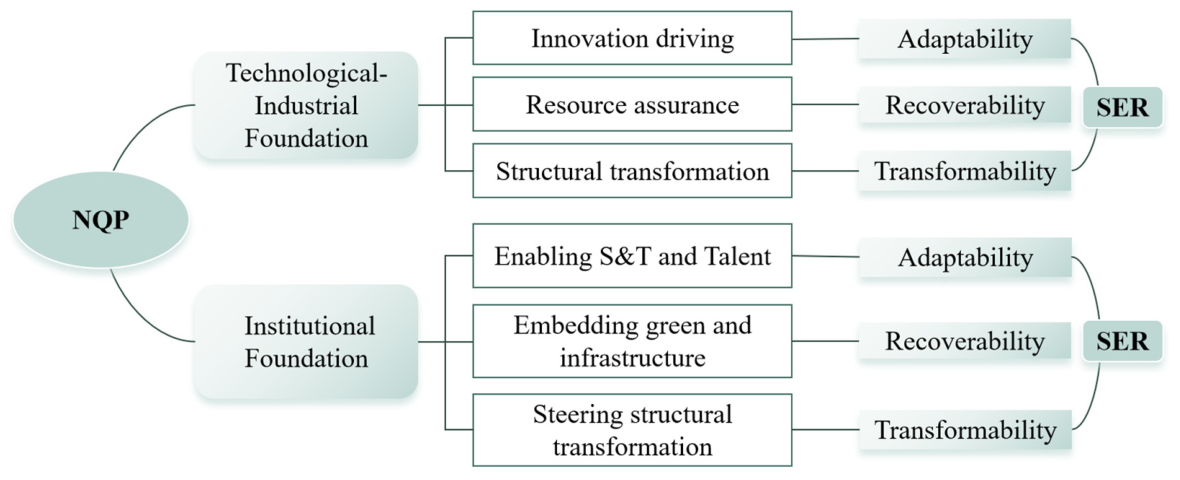
2.1. Understanding of Multi-Dimensional SER-Oriented NQP
2.1.1. NQP as the Technological–Industrial Foundation of SER
2.1.2. NQP as the Institutional Foundation of SER
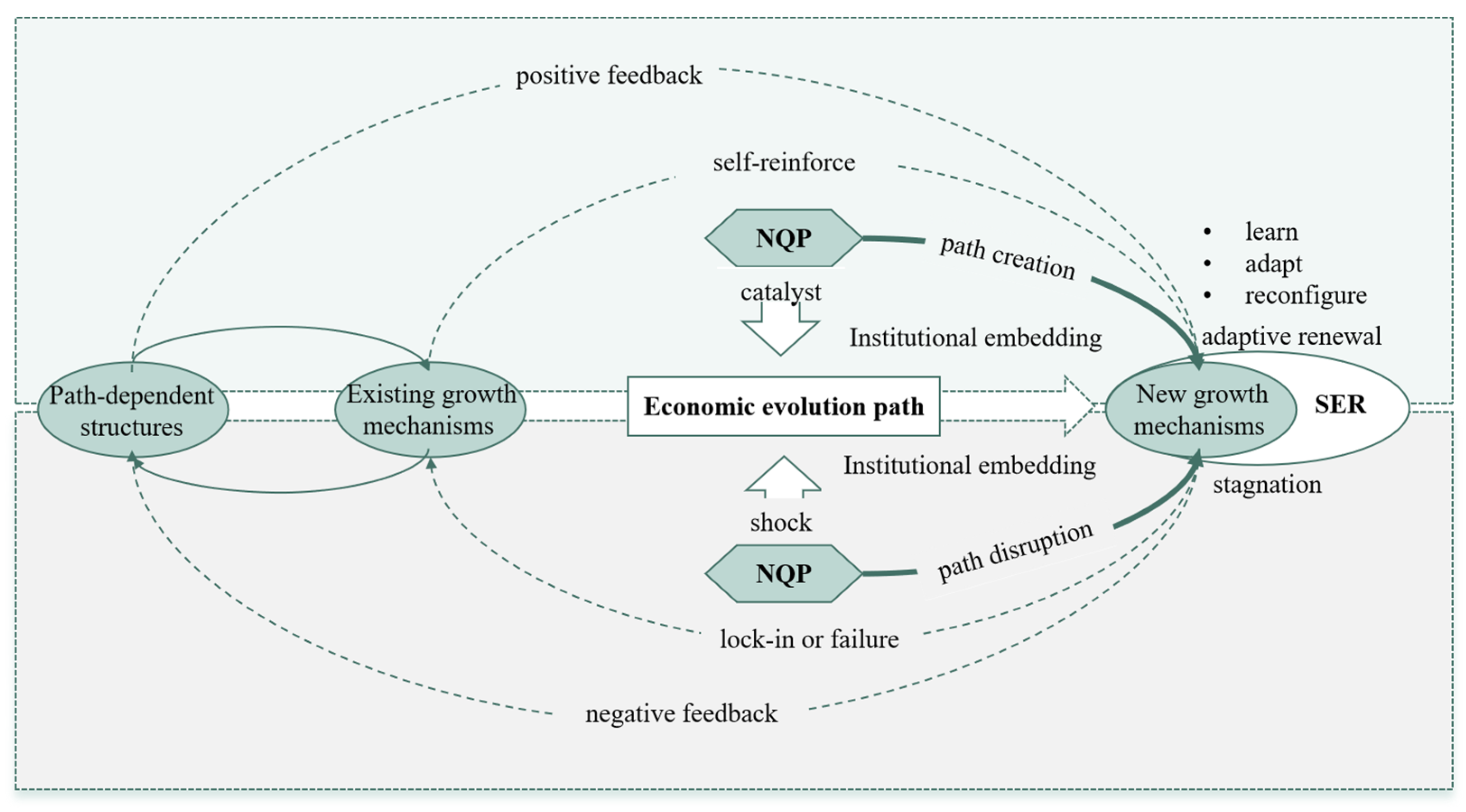
2.2. A Framework Linking NQP with SER from a Spatio-Temporal Perspective
3. Methodology
3.1. Data and Variables
3.2. Method
4. Results and Discussion
4.1. The Multi-Dimensional Associations of NQP with SER
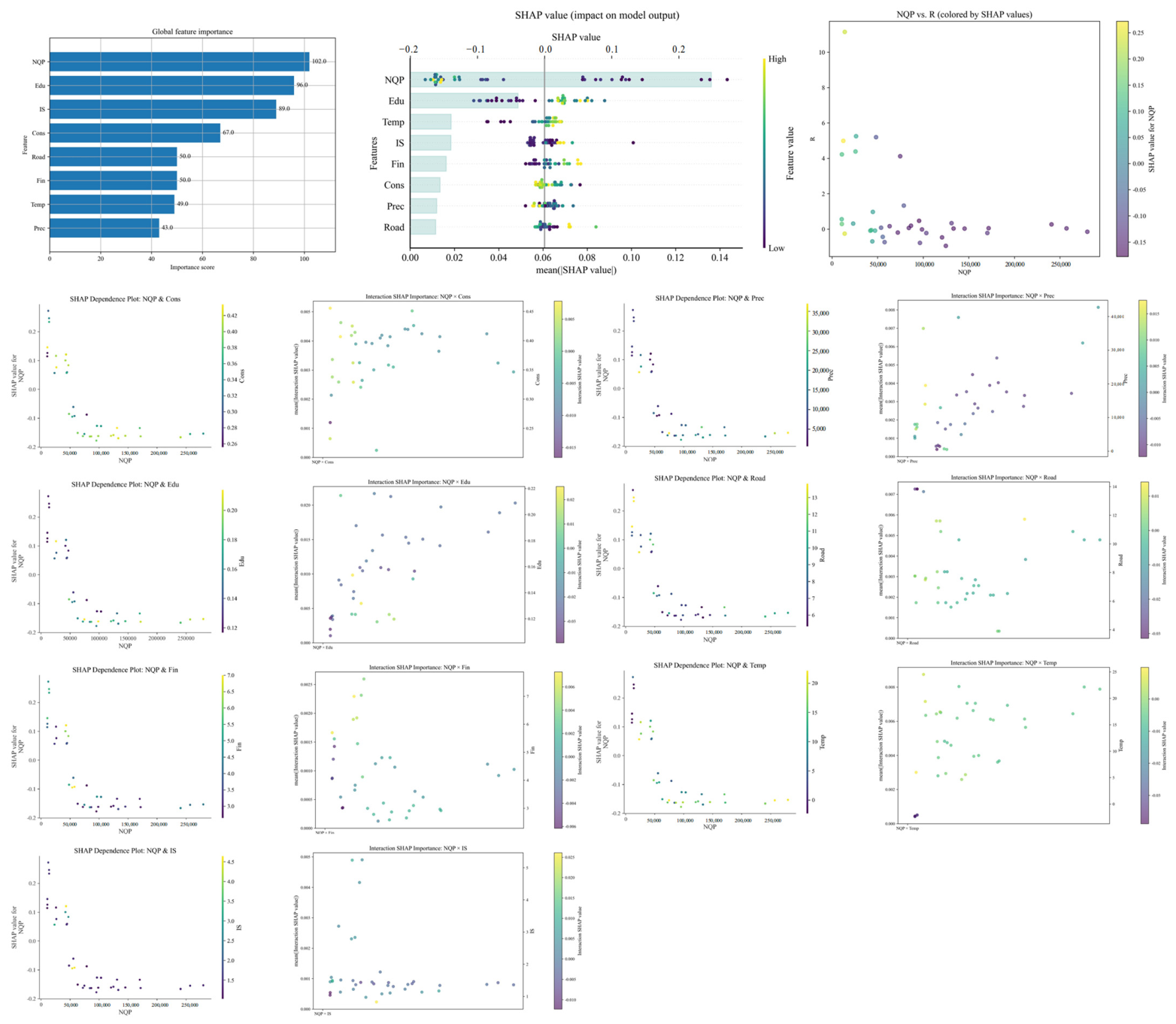
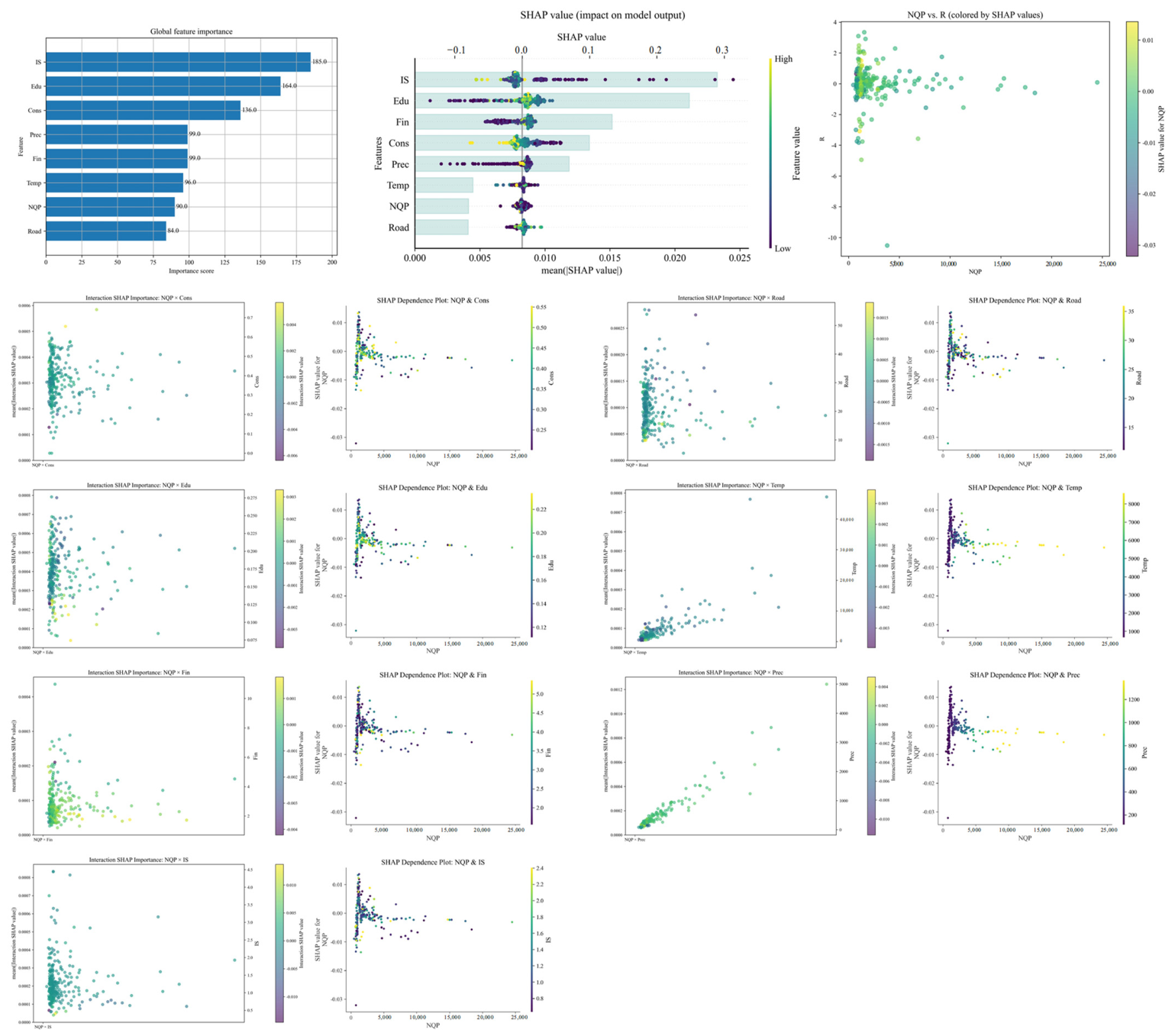
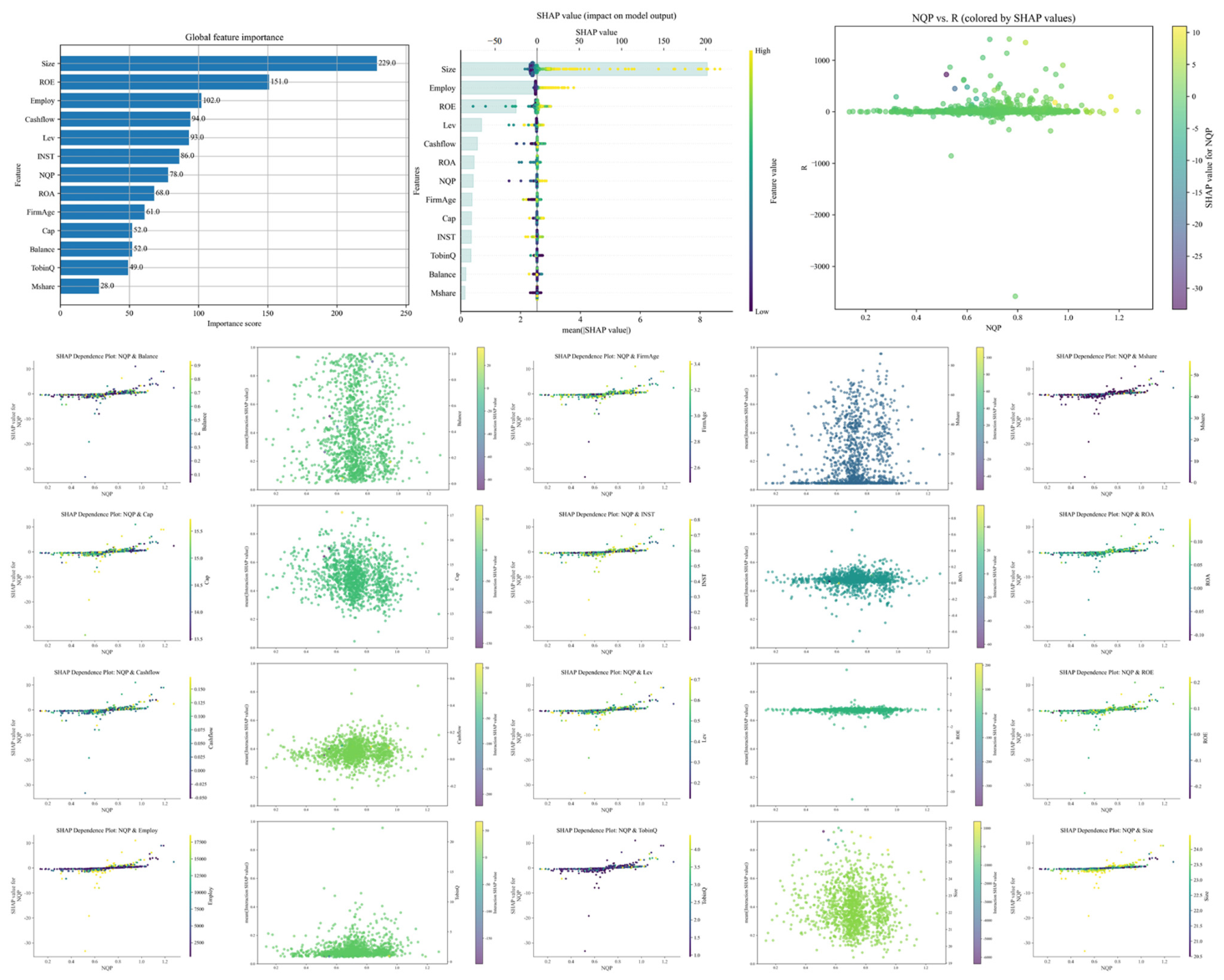
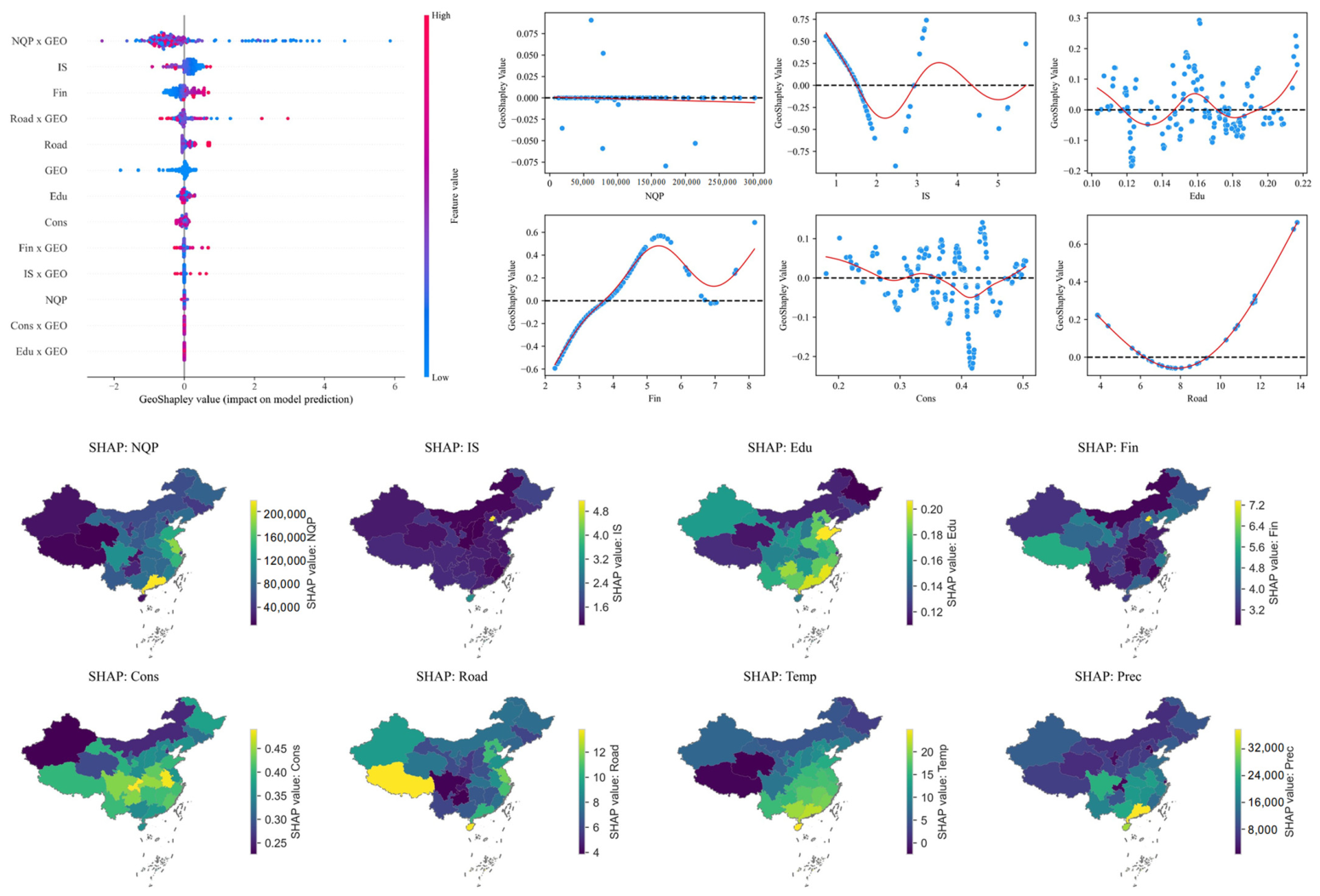
4.1.1. The Technology–Industrial Dimension: Considering Nonlinearity and Small Sample
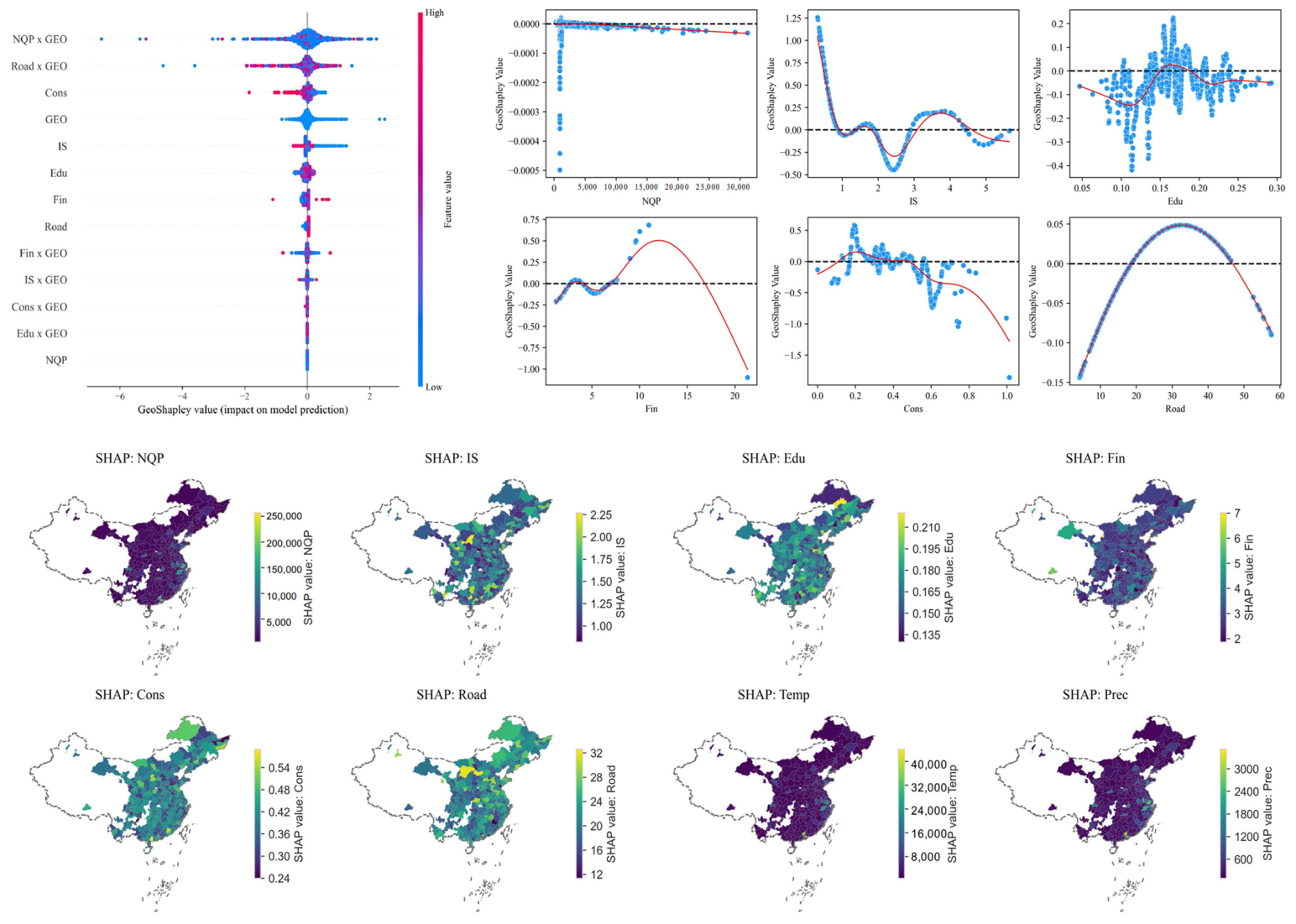
4.1.2. The Institutional Dimension: Considering Spatial Spillover Effect
4.1.3. Robustness and Validity Checks
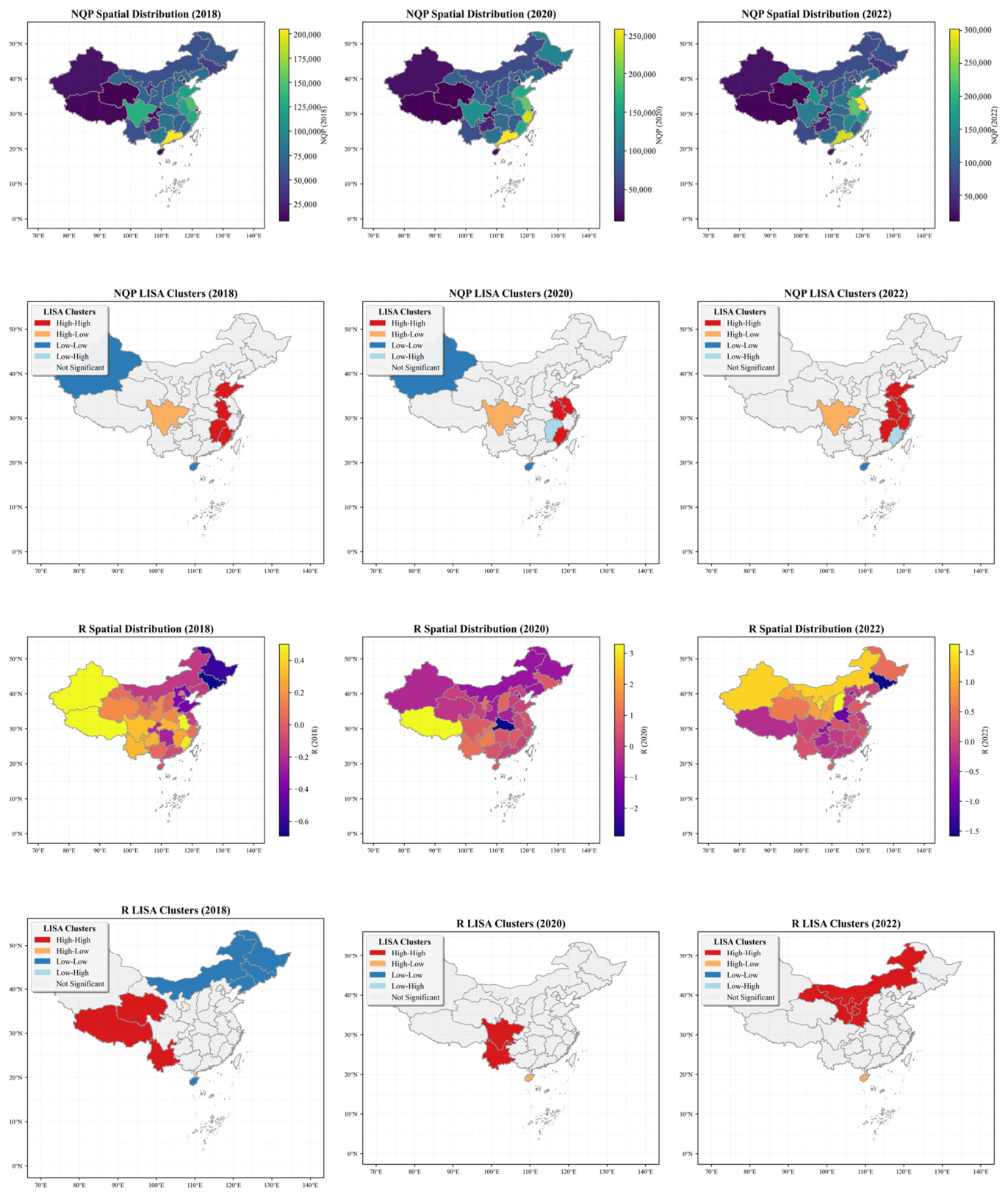
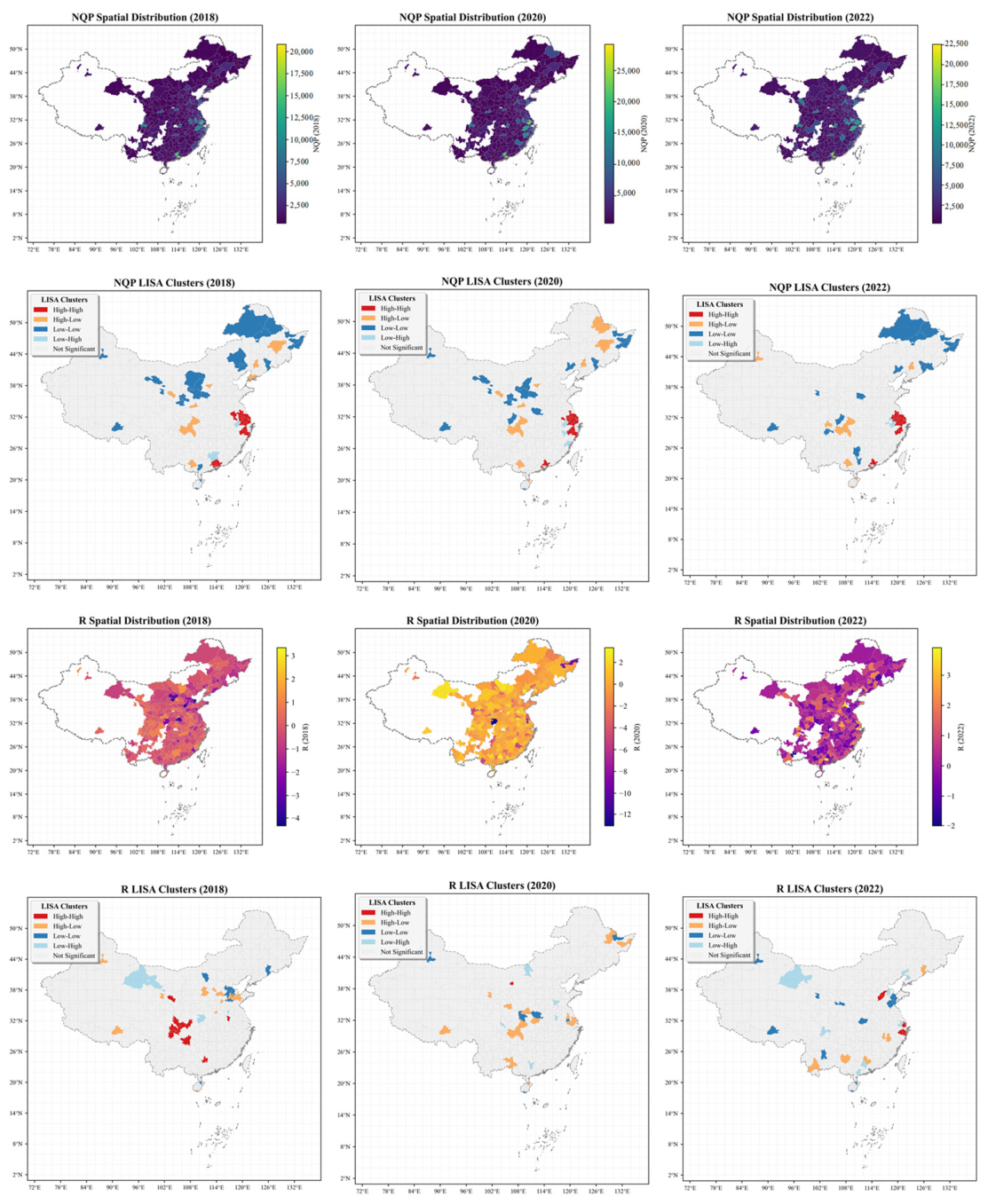
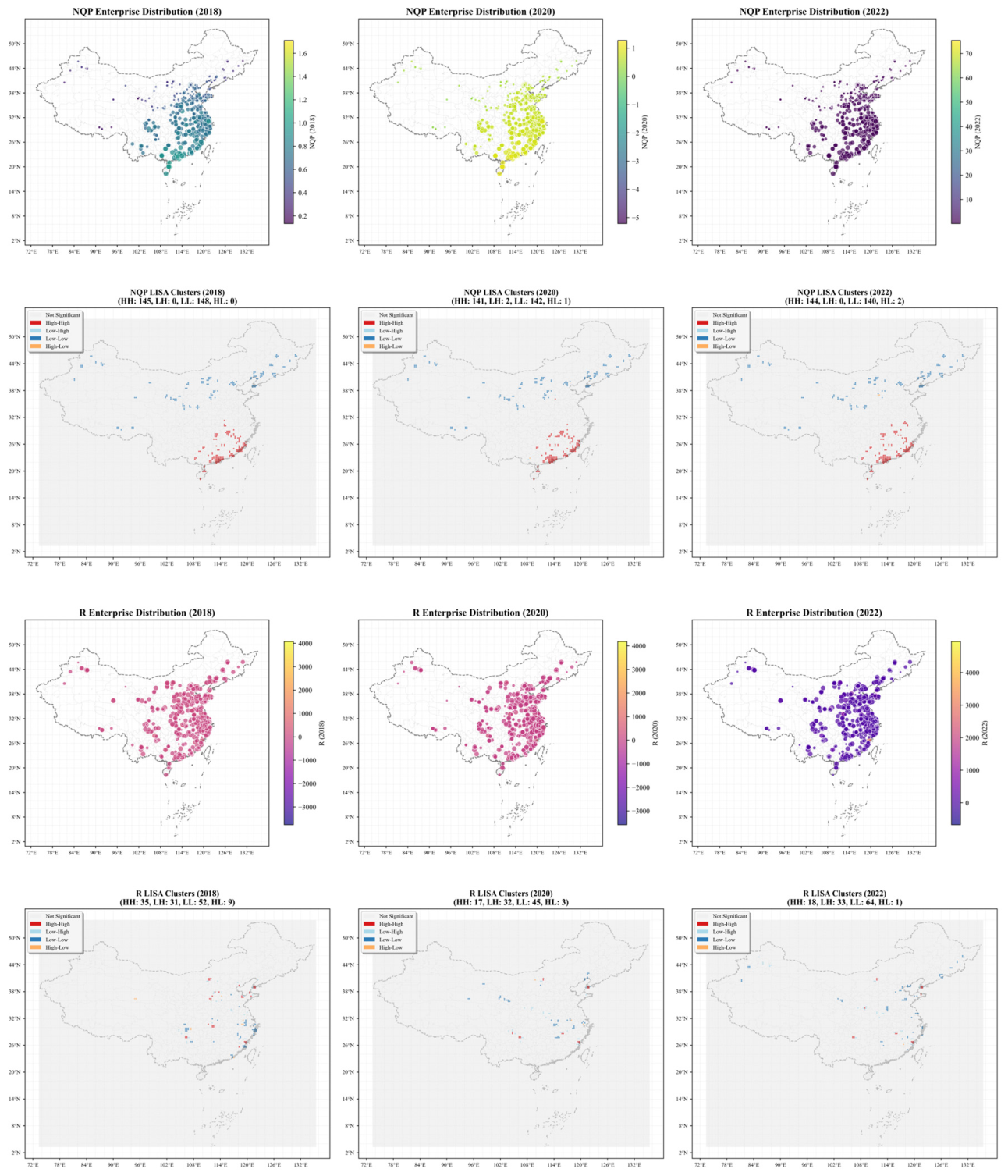
4.2. Spatial Patterns of NQP’s Associations with SER
5. Conclusions
Author Contributions
Funding
Data Availability Statement
Conflicts of Interest
References
- Campbell-Lendrum, D.; Neville, T.; Schweizer, C.; Neira, M. Climate change and health: Three grand challenges. Nat. Med. 2023, 29, 1631–1638. [Google Scholar] [CrossRef] [PubMed]
- Kotz, M.; Levermann, A.; Wenz, L. The economic commitment of climate change. Nature 2024, 628, 551–557. [Google Scholar] [CrossRef] [PubMed]
- Holton, R. Global inequality and global poverty. In Challenges of Globalization and Prospects for an Inter-Civilizational World Order; Rossi, I., Ed.; Springer: Cham, Switzerland, 2020; pp. 355–373. [Google Scholar]
- Çalışkan, H.K. Technological Change and Economic Growth. Procedia Soc. Behav. Sci. 2015, 195, 649–654. [Google Scholar] [CrossRef]
- Huo, J.; Peng, C. Depletion of natural resources and environmental quality: Prospects of energy use, energy imports, and economic growth hindrances. Resour. Policy 2023, 86, 104049. [Google Scholar] [CrossRef]
- United Nations. The Sustainable Development Goals Report 2020; United Nations: New York, NY, USA, 2020.
- Filho, W.L.; Lovren, V.O.; Will, M.; Salvia, A.L.; Frankenberger, F. Poverty: A central barrier to the implementation of the UN Sustainable Development Goals. Environ. Sci. Policy 2021, 125, 96–104. [Google Scholar] [CrossRef]
- Morton, S.; Pencheon, D.; Squires, N. Sustainable Development Goals (SDGs), and their implementation: A national global framework for health, development and equity needs a systems approach at every level. Br. Med. Bull. 2017, 124, 81–90. [Google Scholar]
- Hassink, R. Regional resilience: A promising concept to explain differences in regional economic adaptability? Camb. J. Reg. Econ. Soc. 2010, 3, 45–58. [Google Scholar] [CrossRef]
- Davoudi, S. Planning as practice of knowing. Plan. Theory 2015, 14, 316–331. [Google Scholar] [CrossRef]
- Xu, L.; Marinova, D.; Guo, X. Resilience thinking: A renewed system approach for sustainability science. Sustain. Sci. 2015, 10, 123–138. [Google Scholar] [CrossRef]
- Yang, X.; Li, H.; Zhang, J.; Niu, S.; Miao, M. Urban economic resilience within the Yangtze River Delta urban agglomeration: Exploring spatially correlated network and spatial heterogeneity. Sustain. Cities Soc. 2024, 103, 105270. [Google Scholar] [CrossRef]
- Zhang, J.; Wang, T.; Gou, Y.M.; He, P.; Hua, L. The effects of long-term policies on urban resilience: A dynamic assessment framework. Cities 2024, 153, 105294. [Google Scholar] [CrossRef]
- Mazzucato, M.; Semieniuk, G. Financing renewable energy: Who is financing what and why it matters. Technol. Forecast. Soc. Change 2018, 127, 8–22. [Google Scholar] [CrossRef]
- Opiyo, F.E.O.; Wasonga, O.V.; Nyangito, M.M. Climate change adaptation strategies and livelihood diversification in dryland Kenya. Land Use Policy 2020, 95, 104618. [Google Scholar]
- Shu, Y.; Deng, N.; Wu, Y.; Bao, S.; Bie, A. Urban Governance and Sustainable Development: The Effect of Smart City on Carbon Emission in China. Technol. Forecast. Soc. Change 2023, 193, 122643. [Google Scholar] [CrossRef]
- Bristow, G.; Healy, A. Regional resilience: An agency perspective. Reg. Stud. 2014, 48, 923–935. [Google Scholar] [CrossRef]
- Christopherson, S.; Michie, J.; Tyler, P. Regional resilience: Theoretical and empirical perspectives. Camb. J. Reg. Econ. Soc. 2010, 3, 3–10. [Google Scholar] [CrossRef]
- Lagravinese, R. Economic crisis and rising gaps North-South: Evidence from the Italian regions. Camb. J. Reg. Econ. Soc. 2015, 8, 331–342. [Google Scholar] [CrossRef]
- Guan, Z.; Pan, P. New quality productive forces and new-type urbanization: Analysis of coupling coordination and influencing factors in China. Land Use Policy 2025, 158, 107724. [Google Scholar] [CrossRef]
- Xie, F.S.; Kuang, X. Towards an accurate understanding of “new quality productive forces”. Econ. Political Stud. 2024, 13, 1–15. (In Chinese) [Google Scholar] [CrossRef]
- Shao, C.; Dong, H.; Gao, Y. New quality Productivity and Industrial Structure in China: The Moderating Effect of Environmental Regulation. Sustainability 2024, 16, 6796. [Google Scholar] [CrossRef]
- Martin, R.; Sunley, P. On the notion of regional economic resilience: Conceptualization and explanation. J. Econ. Geogr. 2015, 15, 1–42. [Google Scholar] [CrossRef]
- Hassink, R. Advancing the Understanding of Regional Economic Adaptability in a Non-Western Context: An Introduction to the Special Issue. Growth Change 2017, 48, 194–200. [Google Scholar] [CrossRef]
- Pike, A.; Birch, K.; Cumbers, A.; MacKinnon, D.; McMaster, R. A Geographical Political Economy of Evolution in Economic Geography. Econ. Geogr. 2009, 85, 175–182. [Google Scholar] [CrossRef]
- Liu, Y.; He, Z. Synergistic industrial agglomeration, new quality productive forces and high-quality development of the manufacturing industry. Int. Rev. Econ. Financ. 2024, 94, 103373. [Google Scholar] [CrossRef]
- Chu, H.; Niu, X.; Li, M.; Wei, L. Research on the impact of new quality productivity on enterprise ESG performance. Int. Rev. Econ. Financ. 2025, 99, 104009. [Google Scholar] [CrossRef]
- Shi, Y.T.; Wang, X.D.; Chen, K.X. New quality productivity and urban economic resilience: Theoretical logic and empirical evidence. J. Chongqing Univ. (Soc. Sci. Ed.) 2024, 30, 29–45. (In Chinese) [Google Scholar]
- Yao, S.; Li, H.; Deng, Z. The impact of land leasing strategies on industrial green total factor productivity: Insights from Chinese cities. Land Use Policy 2025, 156, 107607. [Google Scholar] [CrossRef]
- Frenken, K.; Van Oort, F.; Verburg, T. Related variety, unrelated variety and regional economic growth. Reg. Stud. 2007, 41, 685–697. [Google Scholar] [CrossRef]
- Nelson, R.; Winter, S. An Evolutionary Theory of Economic Change; Harvard University Press: Cambridge, MA, USA, 1982; pp. 259–263. [Google Scholar]
- Balland, P.A.; Boschma, R.; Crespo, J.; Rigby, D.L. Smart specialization policy in the European Union: Relatedness, knowledge complexity and regional diversification. Reg. Stud. 2018, 53, 1252–1268. [Google Scholar] [CrossRef]
- Martin, R.; Sunley, P. Path dependence and regional economic evolution. J. Econ. Geogr. 2006, 6, 395–437. [Google Scholar] [CrossRef]
- Boschma, R.; Frenken, K. Why is economic geography not an evolutionary science? Towards an evolutionary economic geography. J. Econ. Geogr. 2006, 6, 273–302. [Google Scholar] [CrossRef]
- Grillitsch, M.; Asheim, B.; Trippl, M. Unrelated knowledge combinations: The unexplored potential for regional industrial path development. Camb. J. Reg. Econ. Soc. 2018, 11, 257–274. [Google Scholar] [CrossRef]
- Hassink, R.; Isaksen, A.; Trippl, M. Towards a comprehensive understanding of new regional industrial path development. Reg. Stud. 2019, 53, 1636–1645. [Google Scholar] [CrossRef]
- Battilana, J.; Leca, B.; Boxenbaum, E. How actors change institutions: Towards a theory of institutional entrepreneurship. Acad. Manag. Ann. 2009, 3, 65–107. [Google Scholar] [CrossRef]
- Gertler, M.S. Rules of the game: The place of institutions in regional economic change. Reg. Stud. 2010, 44, 1–15. [Google Scholar] [CrossRef]
- Simmie, J.; Martin, R. The economic resilience of regions: Towards an evolutionary approach. Camb. J. Reg. Econ. Soc. 2010, 3, 27–43. [Google Scholar] [CrossRef]
- Carolan, M. Acting like an algorithm: Digital farming platforms and the trajectories they (need not) lock-in. In Social Innovation and Sustainability Transition; Springer Nature: Cham, Switzerland, 2022; pp. 107–119. [Google Scholar]
- Boschma, R. Relatedness as driver of regional diversification: A research agenda. Reg. Stud. 2017, 51, 351–364. [Google Scholar] [CrossRef]
- Tödtling, F.; Trippl, M. One size fits all? Towards a differentiated regional innovation policy approach. Res. Policy 2005, 34, 1203–1219. [Google Scholar] [CrossRef]
- Martin, R. Regional economic resilience, hysteresis and recessionary shocks. J. Econ. Geogr. 2012, 12, 1–32. [Google Scholar] [CrossRef]
- Boschma, R. Proximity and innovation: A critical assessment. Reg. Stud. 2005, 39, 61–74. [Google Scholar] [CrossRef]
- Tödtling, F.; Trippl, M. Regional innovation policies for new path development—Beyond neo-liberal and traditional systemic views. Eur. Plan. Stud. 2018, 26, 1779–1795. [Google Scholar] [CrossRef]
- Martin, R. Rethinking regional path dependence: Beyond lock-in to evolution. Pap. Evol. Econ. Geogr. (PEEG) 2009, 86, 1–27. [Google Scholar]
- Apajalahti, E.L.; Kungl, G. Path dependence and path break-out in the electricity sector. Environ. Innov. Soc. Transit. 2022, 43, 220–236. [Google Scholar] [CrossRef]
- Rodríguez-Pose, A. Do institutions matter for regional development? Reg. Stud. 2013, 47, 1034–1047. [Google Scholar] [CrossRef]
- Boschma, R. Towards an Evolutionary Perspective on Regional Resilience. Reg. Stud. 2014, 49, 733–751. [Google Scholar] [CrossRef]
- Pike, A.; Dawley, S.; Tomaney, J. Resilience, adaptation and adaptability. Camb. J. Reg. Econ. Soc. 2010, 3, 59–70. [Google Scholar] [CrossRef]
- Fingleton, B.; Garretsen, H.; Martin, R. Recessionary shocks and regional employment: Evidence on the resilience of U.K. regions. J. Reg. Sci. 2012, 52, 109–133. [Google Scholar] [CrossRef]
- Di Caro, P. Testing and explaining economic resilience with an application to Italian regions. Pap. Reg. Sci. 2017, 96, 93–113. [Google Scholar] [CrossRef]
- Asheim, B.T.; Boschma, R.; Cooke, P. Constructing regional advantage: Platform policies based on related variety and differentiated knowledge bases. Reg. Stud. 2011, 45, 893–904. [Google Scholar] [CrossRef]
- Malerba, F. Sectoral systems of innovation and production. Res. Policy 2002, 31, 247–264. [Google Scholar] [CrossRef]
- Arthur, W.B. Competing technologies, increasing returns, and lock-in by historical events. Econ. J. 1989, 99, 116–131. [Google Scholar] [CrossRef]



| Dimensions | Scales | 1-Level Indicators | 2-Level Indicators | Definition | Orient of SER |
|---|---|---|---|---|---|
| Technological–industrial foundation | Province & City | Innovation Driving | employee competence | Average salary of employees (RMB yuan) | Adaptability |
| Educated level of staff | Number of Colleges and Universities | ||||
| Resource Assurance | New quality infrastructure | Internet broadband access subscribers (103) | Recoverability | ||
| Total value of telecommunications services | |||||
| Pollution Control | Environmental pollution control investment (108 RMB yuan) | ||||
| Harmless treatment rate of domestic waste (%) | |||||
| Structural Transformation | Innovative outputs | Proportion of scientific expenditure in local fiscal expenditure (%) | Transformability | ||
| Number of invention patents applied for in the current year | |||||
| Number of utility model patents applied for in the current year | |||||
| Intelligent level Green development | Number of AI companies | ||||
| Number of green invention patents applied for in the current year | |||||
| Number of green utility model patents applied for in the current year | |||||
| Data factors | Number of data trading platforms | ||||
| Enterprise | Innovation Driving | R&D salary | Proportion of R&D salary on operating income (%) | Adaptability | |
| R&D person | Proportion of R&D personnel (%) | ||||
| Educated level of staff | Proportion of employees with bachelor’s degree or above (%) | ||||
| Resource Assurance | Fixed asset | Proportion of fixed asset on total asset (%) | Recoverability | ||
| Manufacturing expenses | Proportion of manufacturing expenses on total cost (%) | ||||
| Structural Transformation | Hard technology | Proportion of R&D depreciation amortization (%) | Transformability | ||
| Proportion of R&D leasing costs (%) | |||||
| Proportion of R&D direct input (%) | |||||
| Soft technology | Proportion of intangible assets (%) | ||||
| Total asset turnover rate (%) | |||||
| Reciprocal of the equity multiplier | |||||
| Institutional foundation | Province | Institutional Support for S&T and Talent | Technology leadership | Reflects policy support for scientific leadership and talent-driven innovation, facilitating rapid regional adaptation | Adaptability |
| Talent & innovation | |||||
| Institutional Support for Green and Infrastructure | Environmental governance | Reflects institutional support for environmental resilience and digital infrastructure, ensuring system-wide recovery | Recoverability | ||
| Infrastructure support | |||||
| Institutional Guidance for Structural Transformation | Industrial upgrading | Captures how policies guide regional economies toward future-oriented industries and technological trajectories | Transformability | ||
| Technological shift |
| Scale | Variables | Definitions |
|---|---|---|
| Province and city | IS | Ratio of secondary industry added value to tertiary industry added value |
| Edu | Share of education expenditure in general fiscal budget expenditure | |
| Fin | Ratio of the sum of deposit balances and loan balances in financial institutions to GDP | |
| Cons | Ratio of total retail sales of consumer goods to GDP | |
| Road | The area of roads per capita | |
| Temp | Average annual temperature of a region | |
| Prec | Annual precipitation of a region (mm) | |
| Enterprise | Size | Natural logarithm of total assets |
| Lev | Total liabilities divided by total assets (Debt-to-asset ratio) | |
| ROA | Net profit divided by total assets (Return on assets) | |
| ROE | Net profit divided by shareholders’ equity (Return on equity) | |
| Cashflow | Operating cash flow divided by total assets | |
| Balance | Current ratio: current assets divided by current liabilities | |
| TobinQ | Market value of firm divided by replacement cost of assets (Tobin’s Q) | |
| FirmAge | Years since establishment of the firm | |
| INST | Institutional ownership share (%) | |
| Mshare | Management ownership share (%) | |
| Employ | Number of employees (logged) | |
| Cap | Capital intensity: ratio of fixed assets to total assets |
| (1) | (2) | (3) | (4) | (5) | (6) | (7) | |
|---|---|---|---|---|---|---|---|
| VARIABLES | Main | Wx | Total | Direct | Indirect | Spatial | Variance |
| DID | −0.802 *** | −1.410 *** | −2.341 *** | −0.819 *** | −1.522 *** | ||
| (0.189) | (0.488) | (0.579) | (0.191) | (0.528) | |||
| NQP | −0.231 * | −0.798 *** | 0–1.089 *** | −0.241 * | −0.848 *** | ||
| (0.124) | (0.300) | (0.351) | (0.128) | (0.316) | |||
| IS | −0.290 | −1.702 *** | −2.109 *** | −0.241 * | −0.848 *** | ||
| (0.207) | (0.300) | (0.664) | (0.206) | (0.613) | |||
| Edu | 0.063 | 2.467 | 2.678 | 0.093 | 2.585 | ||
| (3.959) | (11.76) | (13.717) | (3.991) | (12.860) | |||
| Fin | 0.105 | 1.078 *** | 1.252 *** | 0.118 | 1.134 *** | ||
| (0.152) | (0.391) | (0.453) | (0.152) | (0.408) | |||
| Cons | −0.090 | −1.502 | −1.685 | −0.108 | −1.577 | ||
| (1.800) | (3.123) | (3.860) | (1.807) | (3.380) | |||
| Road | 0.111 ** | −0.243 ** | −0.140 | 0.108 ** | −0.248 ** | ||
| (0.000) | (0.110) | (0.129) | (0.046) | (0.120) | |||
| Temp | 0.039 | 0.104 | 0.151 * | 0.040 | 0.111 | ||
| (0.036) | (0.068) | (0.085) | (0.036) | (0.074) | |||
| Prec | −0.000 * | 0.000 | −0.000 | −0.000 * | 0.000 | ||
| (0.000) | (0.000) | (0.000) | (0.000) | (0.000) | |||
| rho | 0.055 | ||||||
| (0.067) | |||||||
| sigma2_e | 0.737 ** | ||||||
| Observations | 186 | 186 | 186 | 186 | 186 | 186 | 186 |
| R-squared | 0.788 | 0.788 | 0.788 | 0.788 | 0.788 | 0.788 | 0.788 |
| Number of code | 31 | 31 | 31 | 31 | 31 | 31 | 31 |
| Province FE | Yes | Yes | Yes | Yes | Yes | Yes | Yes |
| Year FE | Yes | Yes | Yes | Yes | Yes | Yes | Yes |
Disclaimer/Publisher’s Note: The statements, opinions and data contained in all publications are solely those of the individual author(s) and contributor(s) and not of MDPI and/or the editor(s). MDPI and/or the editor(s) disclaim responsibility for any injury to people or property resulting from any ideas, methods, instructions or products referred to in the content. |
© 2026 by the authors. Licensee MDPI, Basel, Switzerland. This article is an open access article distributed under the terms and conditions of the Creative Commons Attribution (CC BY) license.
Share and Cite
Chen, Q.; Zhong, H.; Wang, H.; Gao, X. Understanding Economic Resilience Using New Quality Productivity Across Multi-Scale Spatial Locations: Machine-Based Spatio-Temporal Effects. Land 2026, 15, 959. https://doi.org/10.3390/land15060959
Chen Q, Zhong H, Wang H, Gao X. Understanding Economic Resilience Using New Quality Productivity Across Multi-Scale Spatial Locations: Machine-Based Spatio-Temporal Effects. Land. 2026; 15(6):959. https://doi.org/10.3390/land15060959
Chicago/Turabian StyleChen, Qi, Huibo Zhong, Huizi Wang, and Xing Gao. 2026. "Understanding Economic Resilience Using New Quality Productivity Across Multi-Scale Spatial Locations: Machine-Based Spatio-Temporal Effects" Land 15, no. 6: 959. https://doi.org/10.3390/land15060959
APA StyleChen, Q., Zhong, H., Wang, H., & Gao, X. (2026). Understanding Economic Resilience Using New Quality Productivity Across Multi-Scale Spatial Locations: Machine-Based Spatio-Temporal Effects. Land, 15(6), 959. https://doi.org/10.3390/land15060959