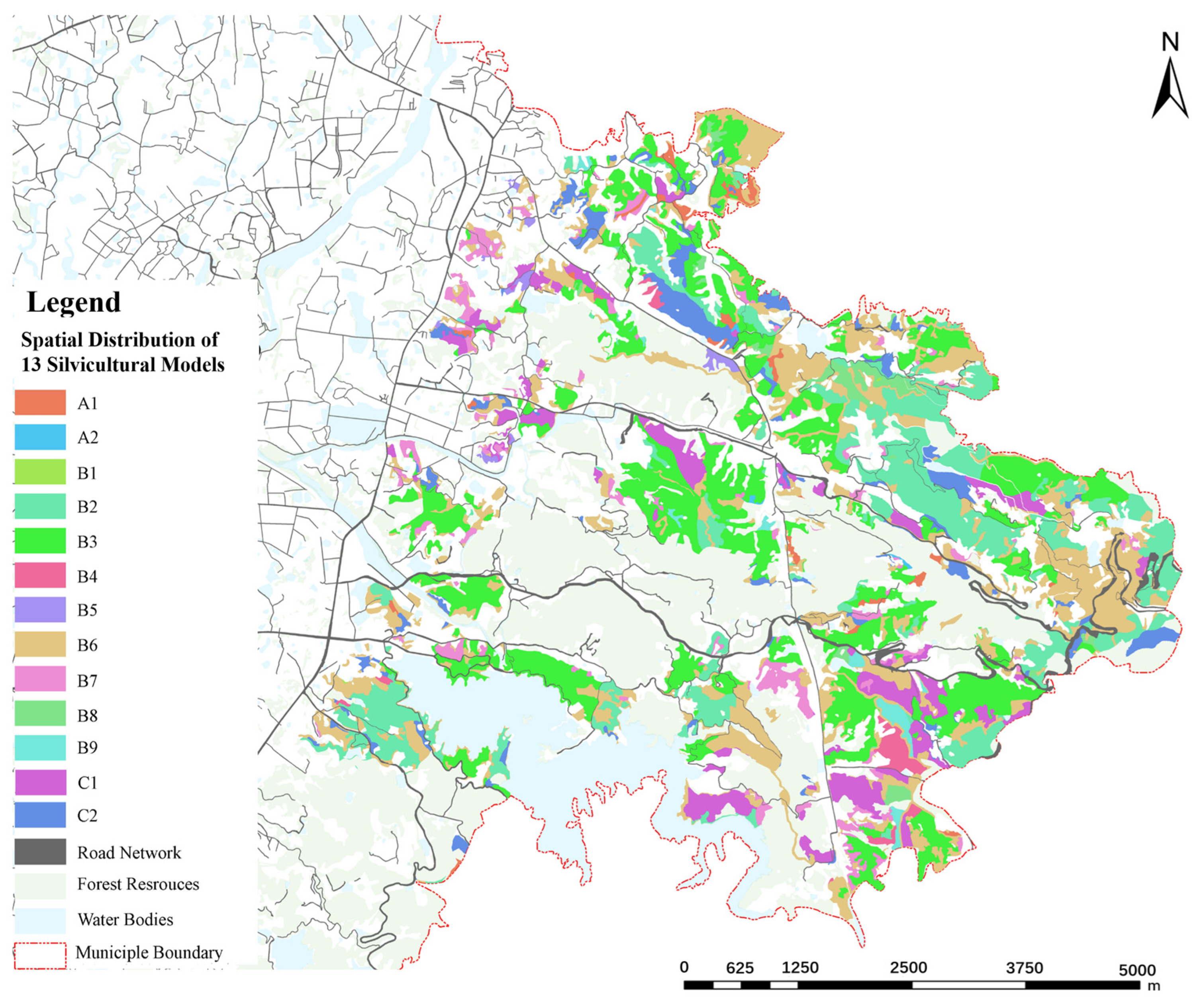
Prospective Carbon Sequestration Assessment of National Reserve Forest Restoration Using Biomass Expansion Factor-Based Accounting


Abstract
1. Introduction
2. Materials and Methods
2.1. Study Area and Project Context
2.2. Carbon Accounting Framework, Growth Assumptions, and Sensitivity Analysis
2.3. Harvested Wood Products and Baseline Adjustment
2.4. Economic Valuation of Carbon Sequestration
3. Results
4. Discussion
5. Conclusions
Author Contributions
Funding
Data Availability Statement
Acknowledgments
Conflicts of Interest
References
- Yu, G.; Zhu, J.; Xu, L.; He, N. Technological approaches to enhance ecosystem carbon sink in China: Nature-based solutions. Bull. Chin. Acad. Sci. (Chin. Version) 2022, 37, 490–501. [Google Scholar] [CrossRef]
- Liu, S.; Cheng, L.; Gong, Y. The evaluation of forest carbon sequestration potential value of national parks and its promotion path. Natl. Park 2024, 2, 763–769. [Google Scholar] [CrossRef]
- Homolák, M.; Gömöryová, E.; Pichler, V. Can soil electrical resistivity measurements aid the identification of forest areas prone to windthrow disturbance? Forests 2020, 11, 234. [Google Scholar] [CrossRef]
- Wiegant, D.; van Oel, P.; Dewulf, A. Scale-Sensitive Governance in Forest and Landscape Restoration: A Systematic Review. Reg. Environ. Change 2022, 22, 25. [Google Scholar] [CrossRef]
- Abrams, J.; Greiner, M.; Schultz, C.; Evans, A.; Huber-Stearns, H. Can Forest Managers Plan for Resilient Landscapes? Lessons from the United States National Forest Plan Revision Process. Environ. Manag. 2021, 67, 574–588. [Google Scholar] [CrossRef]
- Doerfler, I.; Cadotte, M.W.; Weisser, W.W.; Müller, J.; Gossner, M.M.; Heibl, C.; Bässler, C.; Thorn, S.; Seibold, S. Restoration-Oriented Forest Management Affects Community Assembly Patterns of Deadwood-Dependent Organisms. J. Appl. Ecol. 2020, 57, 2429–2440. [Google Scholar] [CrossRef]
- Paquette, A.; Messier, C. Managing Tree Plantations as Complex Adaptive Systems. In Managing Forests as Complex Adaptive Systems; Routledge: Abingdon, UK, 2013. [Google Scholar]
- Baskent, E.Z.; Kašpar, J.; Baskent, H. Implications of Carbon Management with Forest Plantation on Understocked, Degraded and Bare Forests: Simulated Long-Term Dynamics between Timber Production and Carbon Sequestration. Renew. Energy 2025, 242, 122437. [Google Scholar] [CrossRef]
- La Rosa, D.; Geneletti, D.; Spyra, M.; Albert, C.; Fürst, C. Sustainable Planning for Peri-Urban Landscapes. In Ecosystem Services from Forest Landscapes: Broadscale Considerations; Perera, A.H., Peterson, U., Pastur, G.M., Iverson, L.R., Eds.; Springer International Publishing: Cham, Switzerland, 2018; pp. 89–126. [Google Scholar] [CrossRef]
- Gomes, E.; Banos, A.; Abrantes, P.; Rocha, J.; Schläpfer, M. Future Land Use Changes in a Peri-Urban Context: Local Stakeholder Views. Sci. Total Environ. 2020, 718, 137381. [Google Scholar] [CrossRef]
- Tavares, A.O.; Pato, R.L.; Magalhães, M.C. Spatial and Temporal Land Use Change and Occupation over the Last Half Century in a Peri-Urban Area. Appl. Geogr. 2012, 34, 432–444. [Google Scholar] [CrossRef]
- Livesley, S.J.; Escobedo, F.J.; Morgenroth, J. The Biodiversity of Urban and Peri-Urban Forests and the Diverse Ecosystem Services They Provide as Socio-Ecological Systems. Forests 2016, 7, 291. [Google Scholar] [CrossRef]
- Salbitano, F. Guidelines on Urban and Peri-Urban Forestry; ITA: Amsterdam, The Netherlands, 2016. [Google Scholar]
- Konijnendijk, C.C.; Sadio, S.; Randrup, T.B.; Schipperijn, J. Urban and Peri-Urban Forestry in a Development Context—Strategy and Implementation. Arboric. Urban For. (AUF) 2004, 30, 269–276. [Google Scholar] [CrossRef]
- Chen, G.; Shan, Y.; Hu, Y.; Tong, K.; Wiedmann, T.; Ramaswami, A.; Guan, D.; Shi, L.; Wang, Y. Review on City-Level Carbon Accounting. Environ. Sci. Technol. 2019, 53, 5545–5558. [Google Scholar] [CrossRef]
- Schaltegger, S.; Csutora, M. Carbon Accounting for Sustainability and Management. Status Quo and Challenges. J. Clean. Prod. 2012, 36, 1–16. [Google Scholar] [CrossRef]
- Wuhan Municipal Bureau of Landscaping and Forestry. Wuhan National Reserve Forest Construction Plan (2023–2035); Wuhan Municipal Bureau of Landscaping and Forestry: Wuhan, China, 2023. [Google Scholar]
- Fang, J.; Chen, A.; Peng, C.; Zhao, S.; Ci, L. Changes in forest biomass carbon storage in China between 1949 and 1998. Science 2001, 292, 2320–2322. [Google Scholar] [CrossRef]
- Hubei Academy of Forestry. Methodology for Forest Quality Improvement and Carbon Incentive Mechanisms in Hubei Province; Hubei Academy of Forestry: Wuhan, China, 2025. [Google Scholar]
- Hubei Provincial Forestry Bureau. Guidelines for the Development of “Hubei Forest Carbon Certificates” (Trial); Hubei Provincial Forestry Bureau: Wuhan, China, 2025. [Google Scholar]
- Tan, C.; Nie, W.; Liu, Y. Tree growth model and bark thickness model of three Quercus species based on trunk analysis. J. Zhejiang AF Univ. 2023, 40, 589–597. [Google Scholar] [CrossRef]
- Hubei Carbon Emissions Trading Center. Available online: https://www.hbets.cn/ (accessed on 30 November 2025).
- Hubei Provincial Department of Ecology and Environment. Implementation Plan for Synergistic Reduction of Pollution and Carbon Emissions in Hubei Province (EHF [2022] No. 33); Hubei Provincial Department of Ecology and Environment: Wuhan, China, 2022. [Google Scholar]
- China GHG Voluntary Emission Reduction Trading System. 2025. Available online: https://www.ccer.com.cn/wcm/ccer/html/index.html (accessed on 1 May 2026).
- Qin, F.; Guo, T.; Liu, Z.; Song, M. Literature review of researches on Pistacia chinensis Bunge. Non-Wood For. Res. 2007, 4, 90–96. [Google Scholar]
- Song, C.; Wang, Y.; Zhang, L.; Zheng, M.; Ren, Z.; He, Z.; Fan, S.; Lin, K. Determination of the initial thinning period of Chinese fir plantations based on large-diameter timber cultivation. J. Beijing For. Univ. 2022, 44, 45–54. [Google Scholar] [CrossRef]
- Zhang, L.; Chen, N.; Luo, S.; Gao, X.; Wu, P. Growth characteristics of slash pine (Pinus elliottii) plantations based on stem analysis. China For. Sci. Technol. 2022, S1, 32–34. [Google Scholar]
- Chen, X.; Tu, S.; Song, X.; Liu, Z.; Hu, Z.; Xiao, F. Variation and selection of seedling growth traits among Cyclobalanopsis glauca provenances and families. J. Southwest For. Univ. 2023, 43, 1–7. [Google Scholar] [CrossRef]
- D’Amato, A.W.; Bradford, J.B.; Fraver, S.; Palik, B.J. Forest Management for Mitigation and Adaptation to Climate Change: Insights from Long-Term Silviculture Experiments. For. Ecol. Manag. 2011, 262, 803–816. [Google Scholar] [CrossRef]
- Ganatsas, P.; Tsakaldimi, M.; Karydopoulos, T.; Papaemannuil, A.; Papadopoulos, S. Long-Term Effect of Different Forest Thinning Intensity on Carbon Sequestration Rates and Potential Uses in Climate Change Mitigation Actions. Mitig. Adapt. Strateg. Glob. Change 2024, 29, 3. [Google Scholar] [CrossRef]
- Kadioğullari, A.İ.; Sayin, M.A.; Çelįk, D.A.; Borucu, S.; Çįl, B.; Bulut, S. Analysing Land Cover Changes for Understanding of Forest Dynamics Using Temporal Forest Management Plans. Environ. Monit. Assess. 2014, 186, 2089–2110. [Google Scholar] [CrossRef]
- Senf, C.; Seidl, R. Natural Disturbances Are Spatially Diverse but Temporally Synchronized across Temperate Forest Landscapes in Europe. Glob. Change Biol. 2018, 24, 1201–1211. [Google Scholar] [CrossRef] [PubMed]
- Tonteri, T.; Salemaa, M.; Rautio, P.; Hallikainen, V.; Korpela, L.; Merilä, P. Forest Management Regulates Temporal Change in the Cover of Boreal Plant Species. For. Ecol. Manag. 2016, 381, 115–124. [Google Scholar] [CrossRef]
- Levasseur, A.; Lesage, P.; Margni, M.; Brandão, M.; Samson, R. Assessing Temporary Carbon Sequestration and Storage Projects through Land Use, Land-Use Change and Forestry: Comparison of Dynamic Life Cycle Assessment with Ton-Year Approaches. Clim. Chang. 2012, 115, 759–776. [Google Scholar] [CrossRef]
- Goetz, S.J.; Bond-Lamberty, B.; Law, B.E.; Hicke, J.A.; Huang, C.; Houghton, R.A.; McNulty, S.; O’Halloran, T.; Harmon, M.; Meddens, A.J.H.; et al. Observations and Assessment of Forest Carbon Dynamics Following Disturbance in North America. J. Geophys. Res. Biogeosci. 2012, 117, G02022. [Google Scholar] [CrossRef]
- Ameray, A.; Bergeron, Y.; Valeria, O.; Montoro Girona, M.; Cavard, X. Forest Carbon Management: A Review of Silvicultural Practices and Management Strategies across Boreal, Temperate and Tropical Forests. Curr. For. Rep. 2021, 7, 245–266. [Google Scholar] [CrossRef]
- Acuña-Coll, N.; Sánchez-Silva, M. Integrating Systems Thinking and Flexibility in Infrastructure Management. Innov. Infrastruct. Solut. 2023, 8, 144. [Google Scholar] [CrossRef]
- Werners, S.E.; Wise, R.M.; Butler, J.R.A.; Totin, E.; Vincent, K. Adaptation Pathways: A Review of Approaches and a Learning Framework. Environ. Sci. Policy 2021, 116, 266–275. [Google Scholar] [CrossRef]
- Tilahun, D.; Gashu, K.; Shiferaw, G.T. Effects of Agricultural Land and Urban Expansion on Peri-Urban Forest Degradation and Implications on Sustainable Environmental Management in Southern Ethiopia. Sustainability 2022, 14, 16527. [Google Scholar] [CrossRef]
- Seifollahi-Aghmiuni, S.; Kalantari, Z.; Egidi, G.; Gaburova, L.; Salvati, L. Urbanisation-Driven Land Degradation and Socioeconomic Challenges in Peri-Urban Areas: Insights from Southern Europe. Ambio 2022, 51, 1446–1458. [Google Scholar] [CrossRef] [PubMed]
- Imbrenda, V.; Quaranta, G.; Salvia, R.; Egidi, G.; Salvati, L.; Prokopovà, M.; Coluzzi, R.; Lanfredi, M. Land Degradation and Metropolitan Expansion in a Peri-Urban Environment. Geomat. Nat. Hazards Risk 2021, 12, 1797–1818. [Google Scholar] [CrossRef]
- Edmunds, D.S.; Wollenberg, E.K. Local Forest Management: The Impacts of Devolution Policies; Routledge: Abingdon, UK, 2013. [Google Scholar]
- Schultz, C.A.; Mclntyre, K.B.; Cyphers, L.; Kooistra, C.; Ellison, A.; Moseley, C. Policy Design to Support Forest Restoration: The Value of Focused Investment and Collaboration. Forests 2018, 9, 512. [Google Scholar] [CrossRef]


| Model Code | Silvicultural Model | Management Category | Planned Area (ha) | Site Suitability Conditions | Planting Species |
|---|---|---|---|---|---|
| A1 | Sassafras tzumu + Cunninghamia lanceolata medium–short rotation large-diameter timber plantation | Afforestation (Intensive plantation) | 386.1 | Shrubland and harvested sites on sunny slopes | Sassafras tzumu, Cunninghamia lanceolata |
| A2 | Cinnamomum camphora + Cunninghamia lanceolata medium–short rotation large-diameter timber plantation | Afforestation (Intensive plantation) | 347.5 | Shrubland and harvested sites on shaded slopes | Cinnamomum camphora, Cunninghamia lanceolata |
| B1 | Pinus massoniana stand transformation—species replacement | Transformation of existing forest | 155.2 | Canopy closure ≤ 0.3; Pinus massoniana forests affected by pests and diseases | Sassafras tzumu, Liquidambar formosana |
| B2 | Pinus massoniana stand transformation—thinning & enrichment planting A | Transformation of existing forest | 3012.8 | 0.3 < canopy closure < 0.7; pest- and disease-affected Pinus massoniana forests | Liquidambar formosana, Quercus acutissima |
| B3 | Pinus massoniana stand transformation—thinning & enrichment planting B | Transformation of existing forest | 4286.1 | Canopy closure ≥ 0.7; pest- and disease-affected Pinus massoniana forests | Castanopsis sclerophylla, Liquidambar formosana |
| B4 | Slash pine (Pinus elliottii) mixed-conifer–broadleaf enrichment plantation—thinning & enrichment A | Transformation of existing forest | 575.2 | Canopy closure < 0.7; drought-stressed stands with unreasonable species structure | Quercus variabilis, Liquidambar formosana |
| B5 | Slash pine (Pinus elliottii) mixed-conifer–broadleaf enrichment plantation—thinning & enrichment B | Transformation of existing forest | 998.94 | Canopy closure ≥ 0.7; excessively dense slash pine plantations | Cinnamomum camphora, Cyclobalanopsis glauca |
| B6 | Oak mixed-species multi-storied uneven-aged restoration for large-diameter timber | Transformation of existing forest | 11,230.83 | 0.3 ≤ canopy closure < 0.7; oak mixed stands with poor natural regeneration | Celtis sinensis, Pistacia chinensis |
| B7 | Oak mixed-species multi-storied uneven-aged quality improvement management | Transformation of existing forest | 1533.55 | Canopy closure ≥ 0.7; oak mixed forests with overall good growth conditions | Castanopsis sclerophylla, Cyclobalanopsis glauca |
| B8 | Oak–Pinus massoniana mixed uneven-aged forest restoration for large-diameter timber | Transformation of existing forest | 619.91 | 0.3 ≤ canopy closure < 0.7; pest- and disease-affected conifer–broadleaf mixed forests | Liquidambar formosana, Quercus acutissima |
| B9 | Oak–Pinus massoniana mixed uneven-aged forest quality improvement management | Transformation of existing forest | 340.75 | Canopy closure ≥ 0.7; mixed forests with overall good growth conditions | Castanopsis sclerophylla, Liquidambar formosana |
| C1 | Young-stand tending model A | Tending | 3745.11 | Young stands; canopy closure < 0.7 | Cinnamomum camphora, Sassafras tzumu |
| C2 | Young-stand tending model B | Tending | 2794.15 | Young stands; canopy closure ≥ 0.7 | Cinnamomum camphora, Castanopsis sclerophylla |
| Dominant Species Group | BEF | Basic Wood Density (t d.m. m−3) | Root–Shoot Ratio | Carbon Fraction |
|---|---|---|---|---|
| Pinus massoniana | 1.294 | 0.4482 | 0.173 | 0.5271 |
| Pinus elliottii | 1.378 | 0.3590 | 0.268 | 0.5311 |
| Cunninghamia lanceolata | 1.299 | 0.3071 | 0.203 | 0.5127 |
| Oak species group | 1.288 | 0.6119 | 0.289 | 0.4798 |
| Liquidambar formosana | 1.286 | 0.4860 | 0.337 | 0.4803 |
| Cinnamomum camphora | 1.249 | 0.4649 | 0.258 | 0.4916 |
| Other hard broadleaf species | 1.385 | 0.6062 | 0.241 | 0.4901 |
| Other soft broadleaf species | 1.273 | 0.4222 | 0.215 | 0.4502 |
| Mixed conifer species | 1.3646 | 0.3902 | 0.2086 | 0.5168 |
| Mixed broadleaf species | 1.2815 | 0.5222 | 0.2351 | 0.4796 |
| Mixed conifer–broadleaf species | 1.3230 | 0.4754 | 0.2218 | 0.4893 |
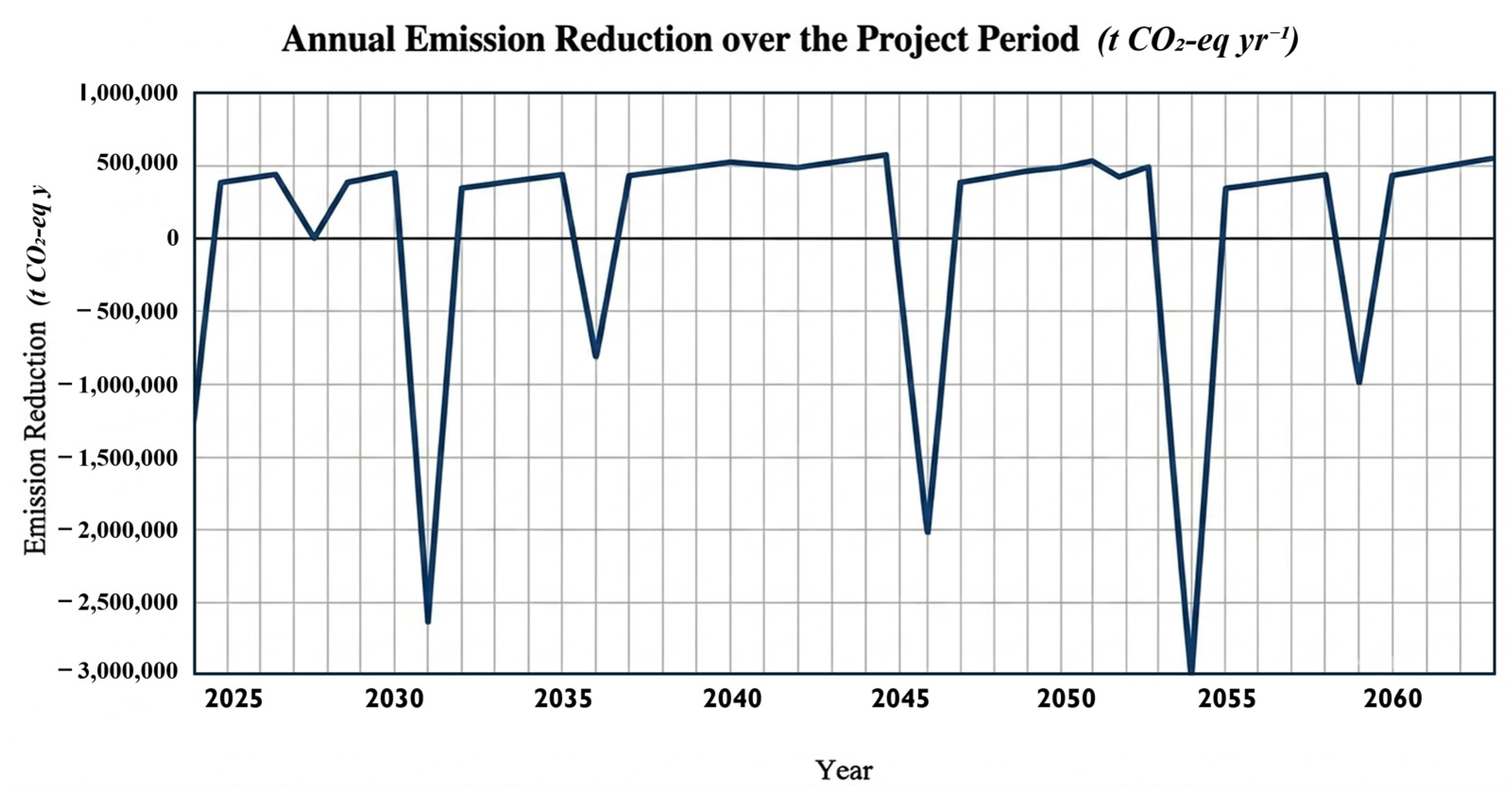
| Silvicultural Model | Annual Carbon Sequestration per Hectare (Year 1) | Annual Carbon Sequestration per Hectare (Year 40) | Area (ha) | Total Model Carbon Sequestration | Carbon Storage in Harvested Wood Products (HWP) | Baseline Carbon Sequestration | Net Emission Reduction |
|---|---|---|---|---|---|---|---|
| A1 | 0.24 | 21.62 | 386.13 | 8254.94 | 27,612.12 | 0.00 | 35,867.05 |
| A2 | 0.67 | 43.78 | 347.51 | 14,982.23 | 34,841.65 | 0.00 | 49,823.89 |
| B1 | 21.31 | 528.29 | 155.22 | 78,691.19 | 11,180.96 | 15,738.24 | 74,133.91 |
| B2 | 108.26 | 188.05 | 3012.84 | 240,402.64 | 560,297.26 | 48,080.53 | 752,619.37 |
| B3 | 98.00 | 540.82 | 4286.13 | 1,897,979.86 | 547,609.37 | 379,595.97 | 2,065,993.26 |
| B4 | 115.77 | 491.99 | 575.19 | 216,396.80 | 85,134.08 | 43,279.36 | 258,251.52 |
| B5 | 92.12 | 436.47 | 998.94 | 343,982.66 | 123,680.33 | 68,796.53 | 398,866.46 |
| B6 | 64.15 | 455.76 | 11,230.83 | 4,398,021.96 | 976,522.50 | 879,604.39 | 4,494,940.06 |
| B7 | 76.34 | 204.21 | 1533.55 | 196,093.58 | 67,682.99 | 39,218.72 | 224,557.85 |
| B8 | 51.43 | 483.37 | 619.91 | 267,763.03 | 57,103.62 | 53,552.61 | 271,314.04 |
| B9 | 89.50 | 397.21 | 340.75 | 104,854.91 | 23,483.44 | 20,970.98 | 107,367.36 |
| C1 | 91.90 | 435.66 | 3745.11 | 1,287,447.18 | 260,981.76 | 257,489.44 | 1,290,939.50 |
| C2 | 134.72 | 310.57 | 2794.15 | 491,326.05 | 229,977.38 | 98,265.21 | 623,038.22 |
| Total | 30,026.26 | 9,546,197.03 | 3,006,107.44 | 1,904,591.97 | 10,647,712.49 | ||
| Silvicultural Pathway | Area (ha) | Total Carbon Sequestration | Net Emission Reduction |
|---|---|---|---|
| Pathway A (Intensive plantation) | 734 | 23,237.17 | 85,690.94 |
| Pathway B (Transformation of existing forests) | 22,754 | 7,744,186.63 | 8,648,043.83 |
| Pathway C (Tending of young and middle-aged stands) | 6539 | 1,778,773.23 | 1,913,977.72 |
| Total | 30,027 | 9,546,197.03 | 10,647,712.49 |
| Model | Baseline Sequestration | BEF +20% | BEF −20% | Growth Rate +20% | Growth Rate −20% | Baseline Carbon +20% | Baseline Carbon −20% |
|---|---|---|---|---|---|---|---|
| A1 | 35,867.05 | 43,040.47 | 28,693.64 | 56,210.43 | 20,523.96 | 35,867.05 | 35,867.05 |
| A2 | 49,823.89 | 59,788.66 | 39,859.11 | 77,145.89 | 28,961.11 | 49,823.89 | 49,823.89 |
| B1 | 74,133.91 | 88,960.69 | 59,307.13 | 109,894.08 | 45,506.95 | 70,986.26 | 77,281.56 |
| B2 | 752,619.37 | 903,143.24 | 602,095.50 | 1,130,211.74 | 442,669.90 | 743,003.26 | 762,235.48 |
| B3 | 2,065,993.26 | 2,479,191.91 | 1,652,794.61 | 2,904,477.80 | 1,366,219.23 | 1,990,074.06 | 2,141,912.45 |
| B4 | 258,251.52 | 309,901.82 | 206,601.22 | 339,285.07 | 190,207.37 | 249,595.65 | 266,907.39 |
| B5 | 398,866.46 | 478,639.75 | 319,093.17 | 562,528.08 | 262,842.29 | 385,107.15 | 412,625.77 |
| B6 | 4,494,940.06 | 5,393,928.07 | 3,595,952.05 | 6,487,546.92 | 2,868,839.65 | 4,319,019.18 | 4,670,860.94 |
| B7 | 224,557.85 | 269,469.42 | 179,646.28 | 307,967.04 | 151,820.15 | 216,714.11 | 232,401.59 |
| B8 | 271,314.04 | 325,576.85 | 217,051.23 | 387,432.76 | 175,863.29 | 260,603.52 | 282,024.56 |
| B9 | 107,367.36 | 128,840.84 | 85,893.89 | 148,002.92 | 72,631.64 | 103,173.17 | 111,561.56 |
| C1 | 1,290,939.50 | 1,549,127.40 | 1,032,751.60 | 1,834,966.16 | 839,110.05 | 1,239,441.61 | 1,342,437.39 |
| C2 | 510,184.41 | 612,221.30 | 408,147.53 | 734,284.27 | 318,686.67 | 494,698.53 | 525,670.29 |
| Total | 10,534,858.69 | 12,641,830.43 | 8,427,886.95 | 15,079,953.16 | 6,783,882.25 | 10,158,107.46 | 10,911,609.92 |
Disclaimer/Publisher’s Note: The statements, opinions and data contained in all publications are solely those of the individual author(s) and contributor(s) and not of MDPI and/or the editor(s). MDPI and/or the editor(s) disclaim responsibility for any injury to people or property resulting from any ideas, methods, instructions or products referred to in the content. |
© 2026 by the authors. Licensee MDPI, Basel, Switzerland. This article is an open access article distributed under the terms and conditions of the Creative Commons Attribution (CC BY) license.
Share and Cite
Zhu, L.; Song, B.; Kong, J. Prospective Carbon Sequestration Assessment of National Reserve Forest Restoration Using Biomass Expansion Factor-Based Accounting. Land 2026, 15, 911. https://doi.org/10.3390/land15060911
Zhu L, Song B, Kong J. Prospective Carbon Sequestration Assessment of National Reserve Forest Restoration Using Biomass Expansion Factor-Based Accounting. Land. 2026; 15(6):911. https://doi.org/10.3390/land15060911
Chicago/Turabian StyleZhu, Liqing, Benyun Song, and Jie Kong. 2026. "Prospective Carbon Sequestration Assessment of National Reserve Forest Restoration Using Biomass Expansion Factor-Based Accounting" Land 15, no. 6: 911. https://doi.org/10.3390/land15060911
APA StyleZhu, L., Song, B., & Kong, J. (2026). Prospective Carbon Sequestration Assessment of National Reserve Forest Restoration Using Biomass Expansion Factor-Based Accounting. Land, 15(6), 911. https://doi.org/10.3390/land15060911