Article

Spatial Distribution and Influencing Factors of Intangible Cultural Heritage Based on Four-Level Data: A Case Study of Ningxia Hui Autonomous Region


1
School of Human Settlements, North China University of Water Resources and Electric Power, Zhengzhou 450046, China
2
College of Surveying and Geo-Informatics, North China University of Water Resources and Electric Power, Zhengzhou 450046, China
*
Author to whom correspondence should be addressed.
Land 2026, 15(6), 1087; https://doi.org/10.3390/land15061087 (registering DOI)
Submission received: 19 May 2026 / Revised: 15 June 2026 / Accepted: 18 June 2026 / Published: 19 June 2026
(This article belongs to the Section Land Use, Impact Assessment and Sustainability)

Abstract

Intangible cultural heritage (ICH) embodies national memory. China has established a four-level ICH protection system covering national, provincial/autonomous regional, municipal, and county levels. The Ningxia Hui Autonomous Region possesses abundant ICH resources formed by intensive cultural integration. However, existing studies have mostly focused on the national and provincial levels and paid insufficient attention to county-level ICH, which restricts detailed analysis of its spatial characteristics. Based on 1546 four-level ICH items, this study employs GIS spatial analysis and the geodetector method to investigate the spatial distribution characteristics and driving factors of ICH. The results indicate that ICH quantity is the highest in Yinchuan (372) and the lowest in Shizuishan (163). Traditional skills (763) are predominant, while Quyi (15) is the rarest. The imbalance index ( s = 0.1553) and the geographic concentration index ( G = 46.1) demonstrate that ICH is unevenly distributed and clustered at the municipal scale, showing a pattern of high density in the north and low density in the south. The Hui population ( q = 0.5639), cultural industry employees ( q = 0.4835), and annual precipitation ( q = 0.3809) are the main driving factors, with significant multi-factor interactions. This research provides a theoretical reference and practical paradigm for balanced ICH protection and living heritage in Ningxia.

1. Introduction

Intangible cultural heritage (ICH) represents invaluable cultural resources generated through daily social practice, carrying distinctive ethnic memory and playing a vital role in strengthening cultural confidence [1]. Since China ratified the UNESCO Convention for the Safeguarding of the ICH in 2004, the country has intensified ICH inventory surveys and gradually standardized protection systems. A four-level ICH management system has been formally established, covering national, provincial/autonomous regional, municipal, and county levels. With the continuous improvement of institutional protection, ICH research has developed rapidly, shifting from single-disciplinary description toward multidisciplinary integration. Early studies mainly focus on traditional disciplines such as folklore and anthropology, emphasizing ICH documentation, classification, and inheritor interviews, with relatively limited perspectives. In recent years, theories and methods from geography, tourism, and ethnology have been widely introduced, promoting more in-depth and extensive ICH research. Geography provides a spatial perspective for ICH research, enabling investigations to explore regional differentiation and spatial agglomeration patterns. Tourism studies concentrate on the adaptive utilization of ICH and the pathways of cultural tourism integration. The ethnological perspective offers important insights into understanding the ethnic identity and cultural functions of minority ICH. Multidisciplinary integration has significantly enhanced the depth and scope of ICH research.
To date, scholars have made rich achievements across multiple research fields. First, digital technologies, including VR, metaverse, 3D scanning, and big data, have been applied to ICH restoration [2,3], immersive presentation technologies [4,5], and digital archiving [6,7], supporting the living heritage transmission of ICH. Second, in the field of ICH tourism development and cultural tourism integration, studies have explored tourist experiences and consumption capacity [8,9,10], authenticity and alienation issues [11,12], and the role of ICH in rural revitalization [13,14,15], promoting industrial transformation of ICH resources. Third, in the field of rural landscape ICH research, studies on rural cultural heritage from the perspectives of vernacular dwellings [16,17], watermills [18,19], traditional settlements [20,21], community memory [22], and agricultural culture [23] highlight the regional dependency of ICH and its close links with daily production and living environments. Fourth, in terms of methodologies, bibliometric analysis [24], analytic hierarchy process (AHP), and the minimum cumulative resistance (MCR) model have been applied to assess ICH value, protection effectiveness, and tourism potential [25,26]. GIS-based spatial analysis, including average nearest neighbor index, kernel density analysis, standard deviation ellipse, and Moran’s I, has become a mainstream tool for examining spatiotemporal distribution characteristics [27,28,29]. The geodetector method has also been integrated to quantify driving forces of spatial differentiation [30,31]. Fifth, regarding research scales and objects, most studies focus on national- and provincial-level ICH [32,33,34], with only a few studies addressing municipal-level items [35]. Research objects range from holistic analyses of all ICH types in specific regions [32,36,37,38,39] to targeted investigations of traditional skills or folk customs [40,41,42].
Along with expanding research, ICH of ethnic minorities has gradually attracted academic attention. As a multi-ethnic country, China nurtures diverse cultural traditions. Minority ICH is not only an important component of regional culture but also a key carrier of cultural diversity and ethnic identity [43,44,45]. Given the unique transmission mechanisms of minority ICH and cultural functions, systematic research on minority ICH holds significant theoretical and practical significance.
Despite the widespread application of spatial analysis methods in ICH research, most studies use national and provincial ICH, with county-level data remaining underutilized. County-level ICH features abundant quantities and diverse types, with strong locality and authenticity, making it essential for revealing the actual spatial distribution pattern of ICH. However, county-level ICH items are independently registered by each county, leading to inconsistent classification standards. Some items do not align with the national ten-category framework (e.g., traditional skills are sometimes subdivided into traditional handicrafts and traditional production techniques), and the same item, such as Errenzhuan (folk performance), may be classified as traditional dance in one county but traditional opera in another. This lack of standardization limits the usability of the data and explains why previous studies have rarely included county-level ICH. The absence of county-level ICH data not only reduces the sample size, but may also lead to misjudgments of spatial patterns, scale effects, and density distributions. A multi-scale analysis in Fujian province [38] finds that the explanatory power of influencing factors varies with spatial scale, with human factors dominating at municipal scales and natural factors becoming more significant at the county analytical scale. However, this study uses only national and provincial ICH, excluding county-level items. It therefore remains unknown whether the observed scale effects persist if the full range of county-level ICH is incorporated. Municipal- and county-level ICH constitute the majority of regional ICH resources, while national-level ICH accounts for a very small proportion [46]. Nevertheless, existing spatial analyses focus on national and provincial ICH, excluding county-level ICH data. This constrains the investigation of how county-level ICH influences regional ICH density and clustering patterns. In general, previous studies have relied on ICH data at the municipal level and above and have not revealed the actual role of county-level ICH in shaping overall spatial patterns, scale effects, and driving mechanisms.
Therefore, systematically investigating the spatial distribution characteristics and influencing factors of the four-level ICH constitutes an important basis for improving county-level ICH spatial analysis and deepening the research system on ICH in minority regions. This study integrates national-, autonomous regional-, municipal-, and county-level ICH into a unified spatial analytical framework. Using 1546 ICH items in the Ningxia Hui Autonomous Region, GIS spatial analysis and the geodetector method are applied to reveal spatial distribution characteristics and driving mechanisms. This study improves the completeness of ICH spatial analysis at the county level, deepens understanding of ICH patterns in ethnic minority areas, and provides a scientific basis for optimizing conservation layouts, developing targeted transmission strategies, and enhancing the overall effectiveness of ICH protection. This study aims to address the following two research questions: (1) What are the spatial distribution characteristics and agglomeration patterns of four-level ICH resources across Ningxia? (2) What are the core natural and human factors that dominate the spatial differentiation of ICH, and how do these factors interact with each other?

2. Materials and Methods

2.1. Study Area

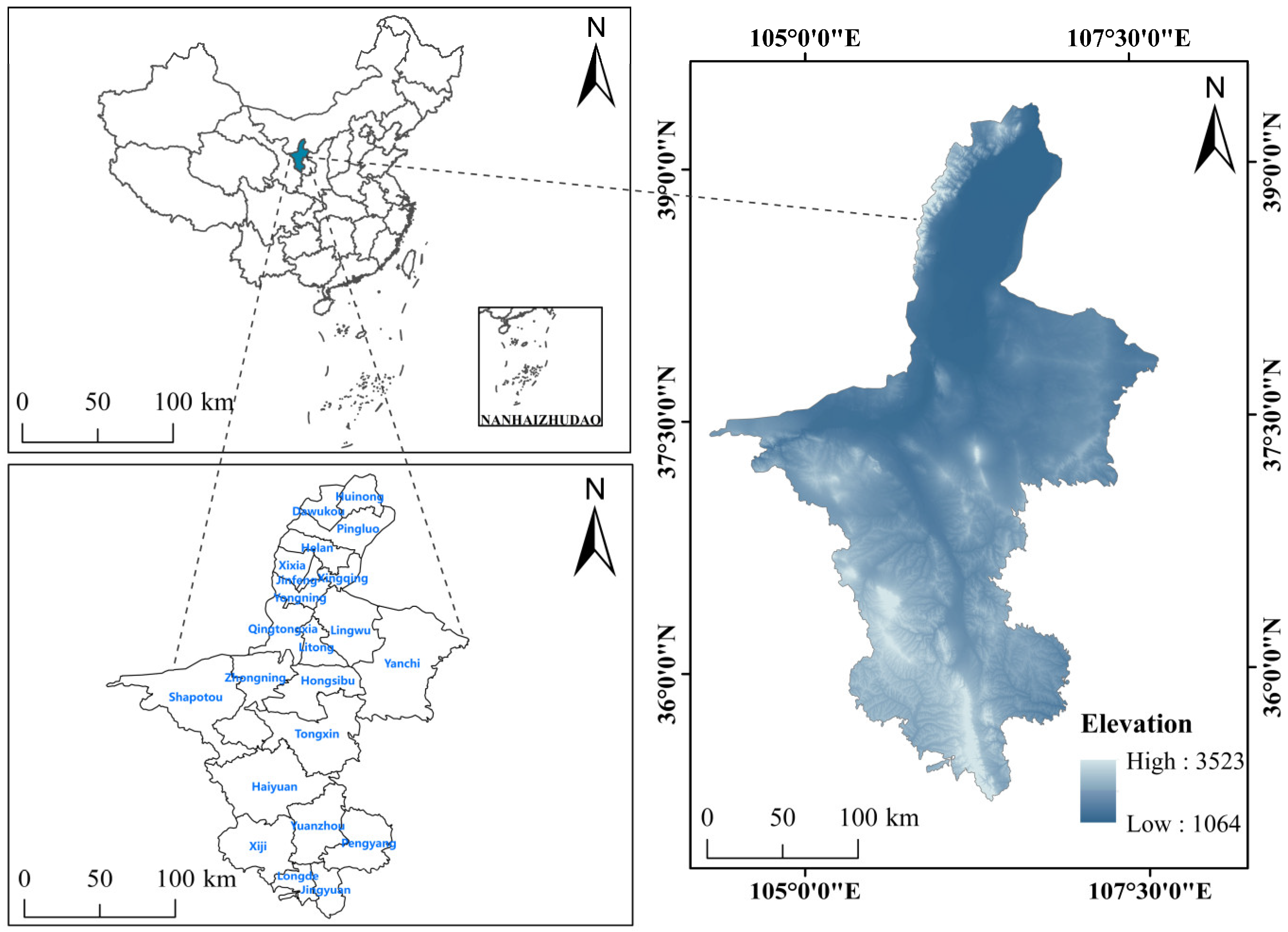
The Ningxia Hui Autonomous Region (Ningxia) is located in northwestern China, with geographical coordinates ranging from 104°17′ E to 107°39′ E and 35°14′ N to 39°23′ N. It covers a total area of 66,400 km2 and administers 5 prefecture-level cities, 2 county-level cities, 9 municipal districts, and 11 counties (Figure 1). As the only autonomous-level region in China situated entirely within the Yellow River Basin, Ningxia features a diverse natural environment and distinctive cultural characteristics, which provide a geographical foundation for the formation and inheritance of local ICH. The Yellow River enters the region through Zhongwei, flows through the Weining Plain and the Yinchuan Plain, and exits at Shizuishan, creating a typical oasis agricultural landscape. The terrain relief of Ningxia slopes downward from south to north, and the north–south differentiation in topography, water resources, and temperature provides a natural basis for the formation of different types of ICH. Ningxia is the largest Hui ethnic settlement area in China, with the Hui population accounting for approximately 36% of the total population. Historically, Ningxia lay at the intersection of agricultural and nomadic civilizations and served as an important node on the eastern section of the ancient Silk Road. The integration of Yellow River civilization, Hui culture, and Western Xia culture provides a unique natural and cultural environment for the nurturing of ICH, making Ningxia highly representative for studying ethnic ICH spatial patterns. As a transitional zone between arid and semi-arid regions, Ningxia features fragile yet diverse ecosystems that have shaped local production modes and lifestyles. Restricted by water availability and topography, human activities have long concentrated along the Yellow River irrigation zone. This human–environment interaction has nurtured diverse ICH types and strengthened their spatial attachment to specific geographical and ethnic settings, making Ningxia an ideal context for examining how natural constraints and ethnic cultures jointly influence ICH spatial distribution.

2.2. Research Framework

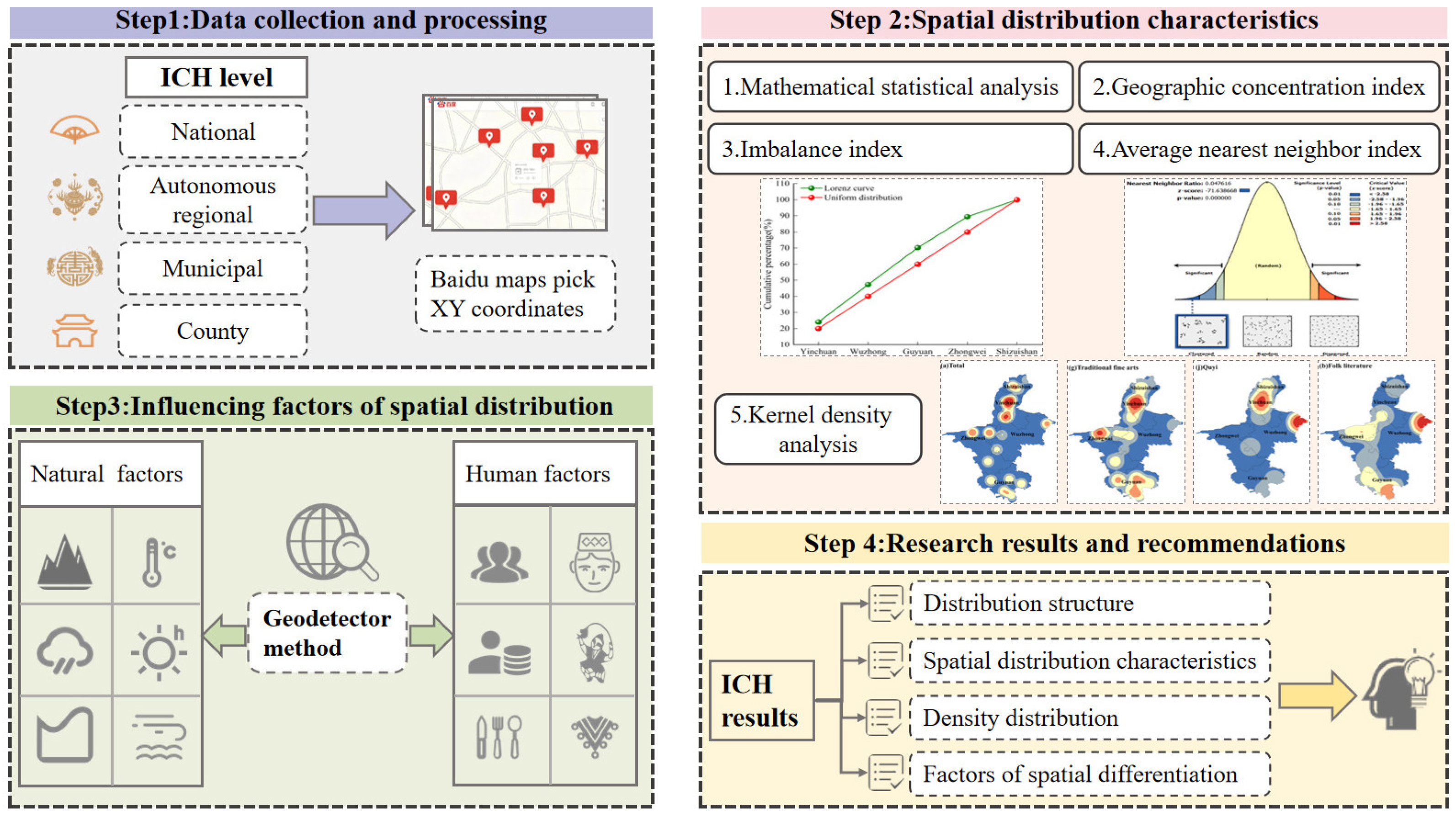
To address the limited attention paid to county-level ICH in previous spatial analyses, this study integrates four-level ICH data into a unified framework. The research consists of four steps. First, data collection and geocoding are performed using the Baidu Maps API. Second, spatial analysis methods reveal the distribution patterns and agglomeration characteristics of ICH. Third, the geodetector method quantifies the effects of natural and human factors. Fourth, policy implications for optimizing ICH protection are proposed (Figure 2).

2.3. Data Collection

The research objects of this study mainly include national-, autonomous regional-, municipal-, and county-level ICH in Ningxia. National-level data are retrieved from the China Intangible Cultural Heritage Network (https://www.ihchina.cn/). Autonomous regional-level data are sourced from the People’s Government of the Ningxia Hui Autonomous Region (https://www.nx.gov.cn/). Municipal- and county-level data are collected from local government announcements. All ICH data are current as of 1 December 2025. To further improve the accuracy and operability, ICH items jointly declared by multiple locations are split and counted according to the number of declaring locations, and the statistics included extended ICH items. The precise locations of ICH sites are acquired via Baidu Maps according to the addresses of ICH items and their protection units. These coordinates are converted to the WGS-84 coordinate system using projection tools in ArcGIS 10.8 prior to spatial analysis. For ICH items with ambiguous or multiple associated locations, priority is given to the location of the primary protection unit listed in official documents. When protection units are not explicitly designated, the geographic center of the declaring administrative unit is used as the reference point. Terrain relief and elevation data are sourced from the Geospatial Data Cloud Platform (https://www.gscloud.cn/). Socioeconomic statistical data are extracted from the 2025 Ningxia Statistical Yearbook (https://www.nx.gov.cn/). All influencing factors are aggregated for each of the 22 county-level administrative units in Ningxia.

2.4. Research Methods

2.4.1. Mathematical Statistical Analysis

Mathematical statistical analysis shows the basic composition and distribution of four-level ICH by calculating item counts and proportions across cities and categories.

2.4.2. Spatial Distribution Characteristics Analysis

(1)
Imbalance index
The imbalance index [39] reflects the degree of uniformity of ICH distribution and is typically calculated using the Lorenz curve method. The calculation formula is
s = i = 1 n Y i 50 n + 1 100 n 50 n + 1
where s is the imbalance index (0 ≤ s ≤ 1), n is the number of prefecture-level cities, and Y i represents the cumulative proportion of ICH items after sorting cities in descending order. s = 0 indicates even distribution across cities, while s = 1 means complete concentration in a single city.
(2)
Geographic concentration index
The geographic concentration index [47] is used to analyze the degree of concentration in the distribution of ICH sites. It is expressed as
G = 100 i = 1 n x i T 2
where x i represents the number of ICH items in the i -th prefecture-level city, T is total number of ICH items, and n is the number of prefecture-level cities. To determine the difference between the actual distribution and a uniform distribution, the theoretical uniform distribution value G 0 is introduced, expressed as
G 0 = 100 × 1 n
If the ICH items are evenly distributed across the region, G = G 0 . G > G 0 means a concentrated distribution, while G < G 0 represents a dispersed distribution.
(3)
Average nearest neighbor index
The average nearest neighbor index [48] is used to analyze the spatial distribution characteristics of ICH items. The calculation formula is
R = D ¯ D ¯ i
where R is the nearest neighbor index ( R > 1 , dispersed; R < 1 , clustered; R = 1 , random), D ¯ is the observed mean nearest neighbor distance, and D ¯ i represents the expected mean nearest neighbor distance.

2.4.3. Kernel Density Analysis

Kernel density analysis [49] is used to identify spatial clustering of ICH sites. The calculation is
f x = 1 n h i = 1 n k x x i h
where f x is the kernel density value, k x x i h represents the kernel density function, h is the bandwidth, n is the number of ICH points, and x x i denotes the distance from the estimation point x to the event point x i .

2.4.4. Influencing Factor Analysis

(1)
Geodetector method
The geodetector method [50] is used to detect factor effects on spatial patterns. It is expressed as
q = 1 h = 1 L N h σ h 2 N σ 2
where q represents the explanatory power; L is factor strata count; N h and N denote units in stratum h and the total units; and σ h 2 and N σ 2 represent variance of the dependent variable in stratum h and across the whole region.
(2)
Selection of influencing factors
The emergence, development, and preservation of ICH in Ningxia are closely related to the local natural environment and human factors. Referring to relevant studies [33,34,51,52] and considering the actual conditions of Ningxia, this study selects six natural factors and six human factors to construct an indicator system, as shown in Table 1.
(3)
Data processing
The collected data are input into the geodetector to quantify factor influences on ICH spatial distribution. The analysis is conducted at the county level, with 22 county-level administrative units (9 municipal districts, 2 county-level cities, and 11 counties) as spatial units. Before analysis, each factor is discretized into six categories using the Natural Breaks method in ArcGIS to meet the geodetector requirements. This ensures sufficient sample size per stratum and avoids unstable results.

3. Results

3.1. Distribution Structure of ICH

According to the official classification standards for ICH in China, ICH is divided into ten types, i.e., folk literature; traditional music; traditional skills; traditional medicine; traditional opera; traditional fine arts; traditional dance; traditional sports, recreation and acrobatics; Quyi (traditional performing arts); and folk customs. The statistical results for national-, autonomous regional-, municipal-, and county-level ICH in each city of Ningxia are presented in Table 2. At the municipal level, Yinchuan has the largest number of ICH items, accounting for 24.1% of the total, while Shizuishan has the smallest, accounting for only 10.5%. Regarding type structure, traditional skills account for the largest proportion, at 49.4%, while Quyi accounts for the smallest, at only 0.9%. The type distribution across most cities shows a clear pattern, in that the top three ICH types in Ningxia are traditional skills; traditional fine arts; and traditional sports, recreation and acrobatics. At the administrative level, county-level ICH has the highest share (41.8%), forming the main body of regional ICH resources, followed by municipal, autonomous regional, and national ICH, in descending order (Table 3).

3.2. Spatial Distribution Characteristics of ICH

3.2.1. Unevenness and Concentration at the Municipal Level

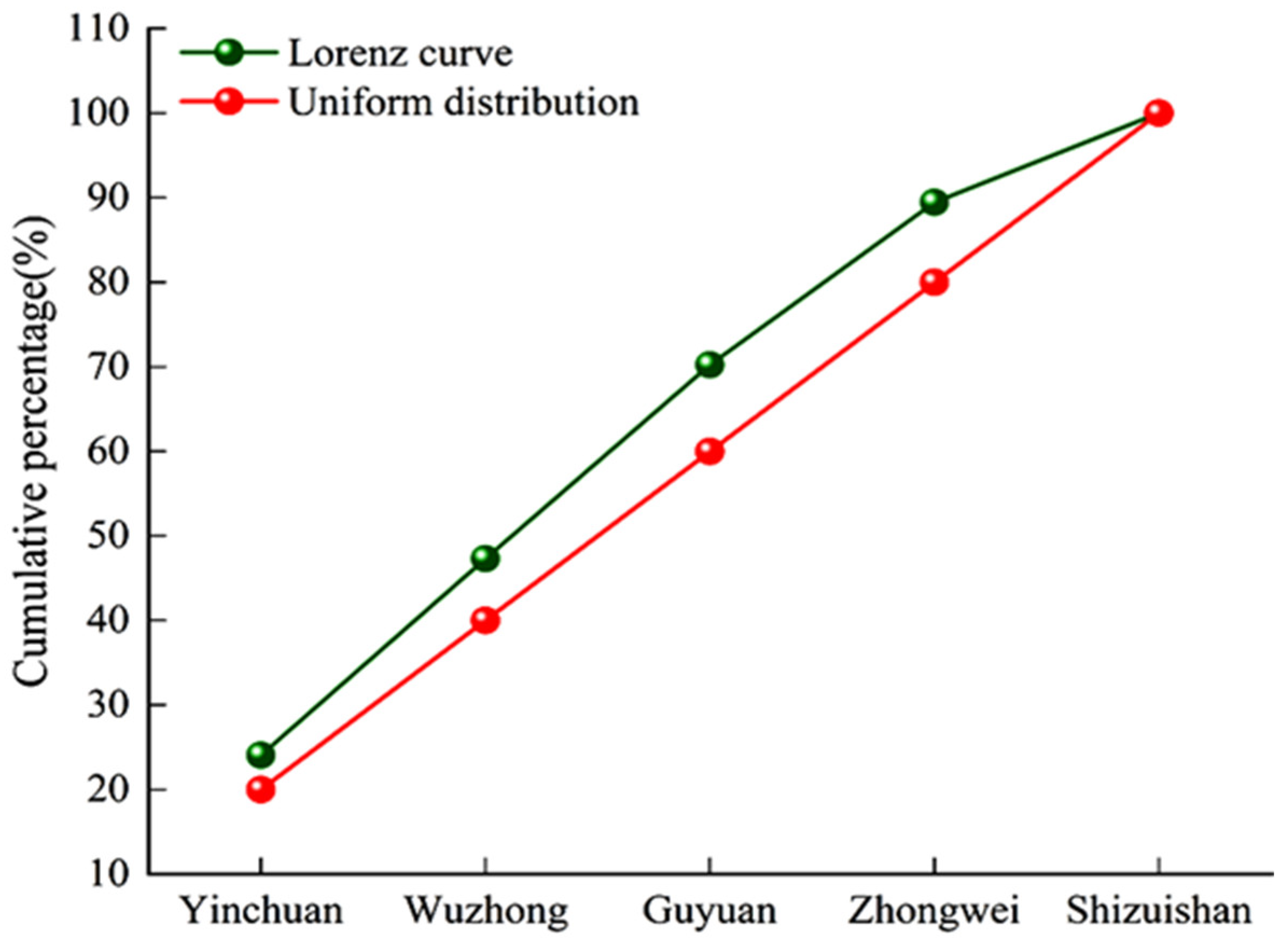
The imbalance index is calculated as s = 0.1553. As shown in Figure 3, the Lorenz curve is convex and lies above the uniform distribution, indicating a certain degree of unevenness in the distribution of ICH items among cities. The geographic concentration index is G = 46.1, which is higher than the theoretical value for a perfectly uniform distribution G 0 = 44.7, suggesting that ICH resources tend to concentrate in certain cities. Collectively, these results reveal a certain degree of unevenness and a tendency toward concentration in the regional distribution of ICH.

3.2.2. Overall Agglomeration and Type-Specific Differences

The average nearest neighbor index is computed for both the entire ICH dataset and each ICH type. As shown in Table 4, for the whole set of ICH items, the average nearest neighbor index R = 0.0476, indicating a clustered spatial pattern. All ten ICH categories exhibit clustered distributions, albeit with considerable variation in intensity. Traditional sports, recreation and acrobatics shows the highest degree of clustering. These practices are deeply rooted in local environmental conditions and ethnic lifestyles. Typical examples include Damuqiu (a recreational activity that evolved from herding in the southern mountainous area) and Tajiao (a traditional Hui martial art developed from folk offensive and defensive skills). Such ICH forms originate in specific living environments and have been transmitted steadily within ethnic settlements, which explains their high spatial concentration. Traditional fine arts and traditional skills display moderate clustering. These categories are closely tied to everyday production and daily life, which facilitates local transmission through material carriers. In contrast, traditional music, folk customs, traditional opera, traditional medicine, folk literature, and traditional dance have relatively lower nearest neighbor indices, indicating a more dispersed distribution. Quyi exhibits the weakest clustering. Most Quyi items are introduced by migrant populations and lack a local cultural foundation. Their transmission relies on the cross-regional mobility of performers rather than on place-based community participation, resulting in a scattered distribution pattern.

3.3. Density Distribution of ICH

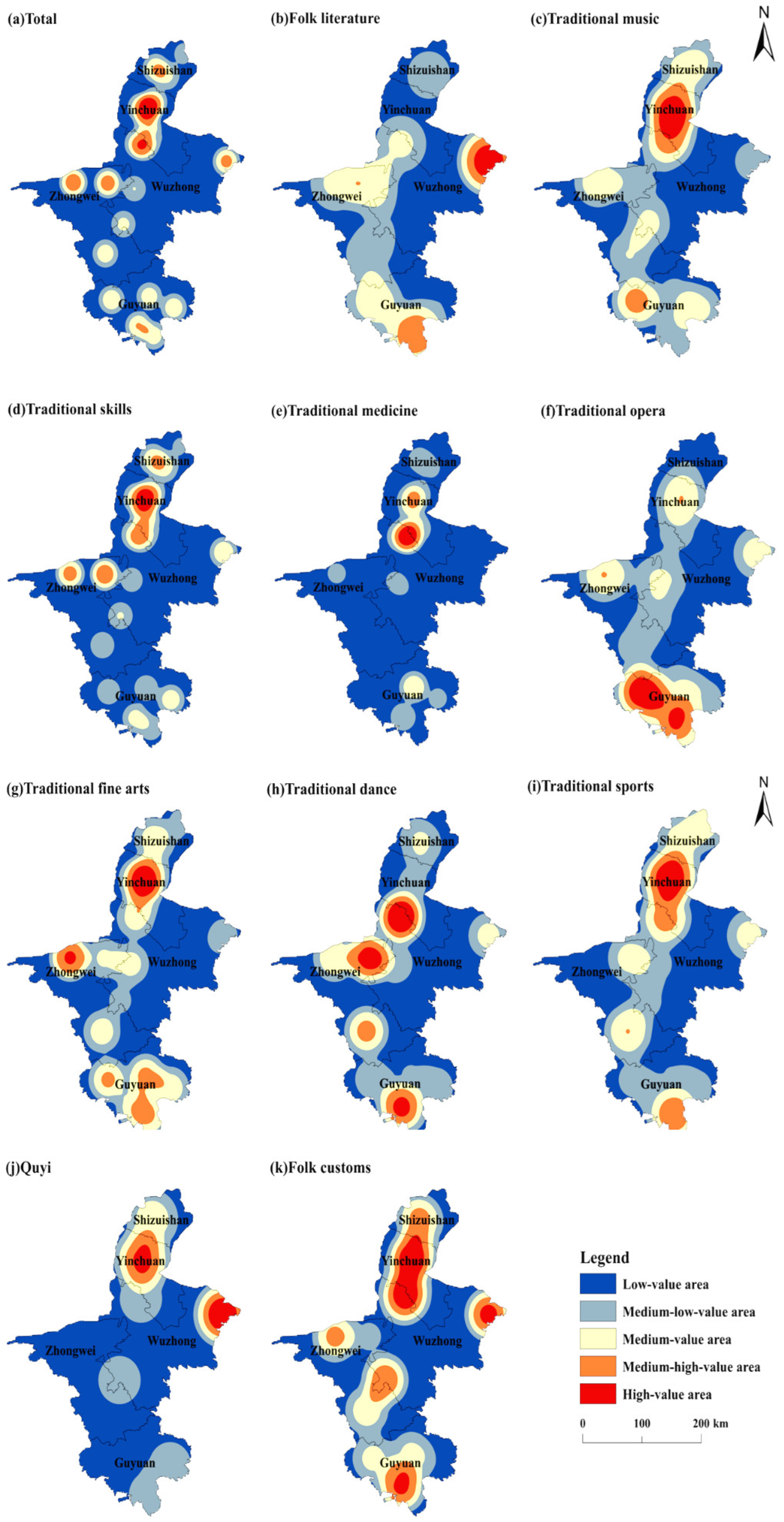
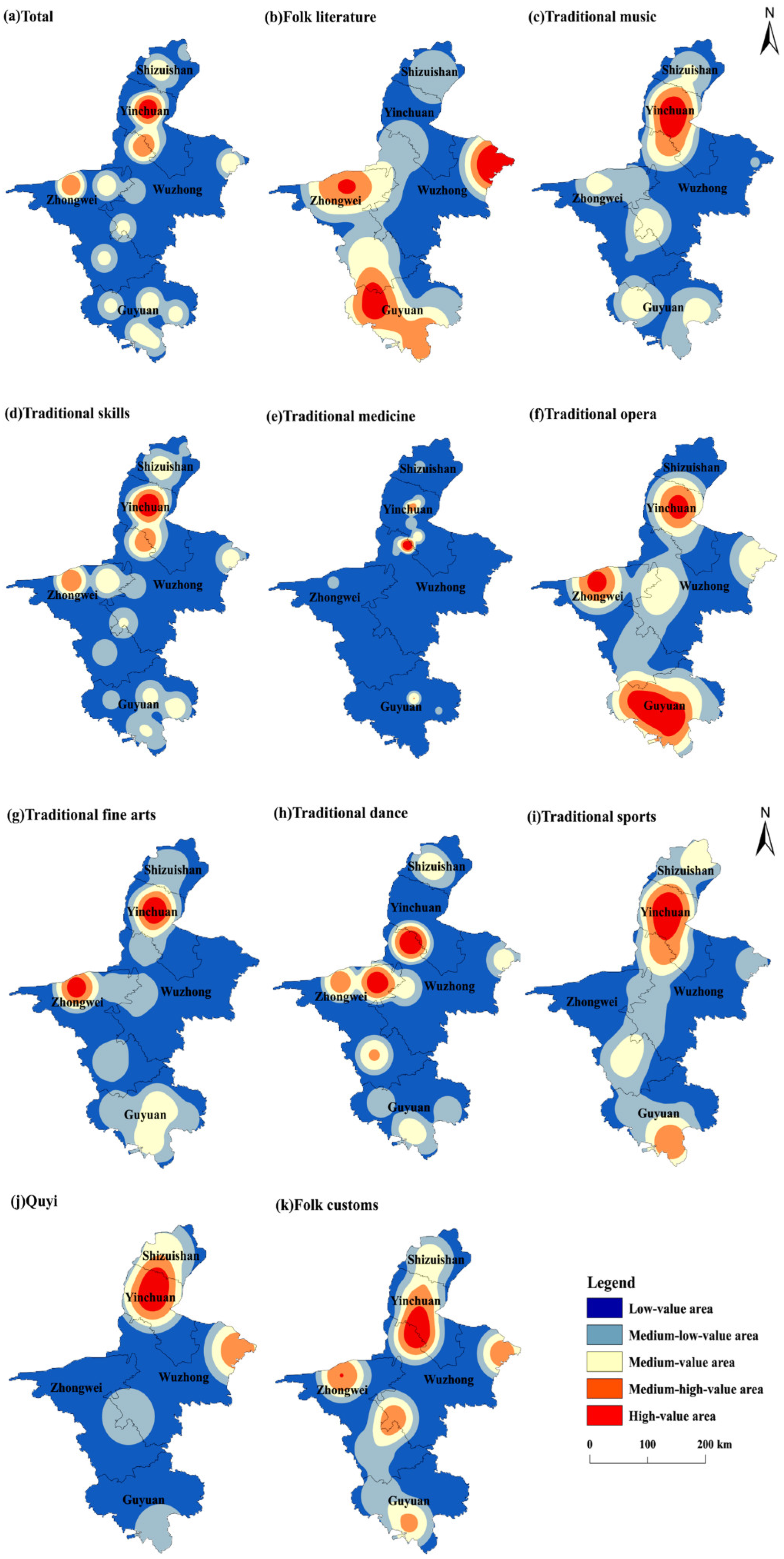
The kernel density analysis reveals a clear north-high and south-low density pattern (Figure 4a). Yinchuan forms the highest-value core area, and Qingtongxia district in Wuzhong constitutes another high-density center alongside Yinchuan, together forming two major high-density agglomeration cores. Secondary high-value areas are found in Shizuishan, Zhongwei, and Yanchi County in Wuzhong. In contrast, most parts of Guyuan fall within medium-value and medium-low-value zones, with markedly lower kernel density. The density disparity between the north and the south is substantial.
Based on the kernel density distribution patterns, the ten ICH types can be summarized into four spatial patterns. (1) Single-core agglomeration type. This type is characterized by a single high-value core radiating to the surrounding areas. Folk literature (Figure 4b) forms a high-value core in Yanchi, with medium-value areas spreading in the northeast-southwest direction around the core. The high-value zone of traditional medicine (Figure 4e) is concentrated in Wuzhong, radiating toward Yinchuan. Quyi (Figure 4j) forms a single-core agglomeration in two locations: Yinchuan and Yanchi. (2) Multi-core dispersed type. Two or more independent high-value areas. Traditional dance (Figure 4h) exhibits a three-core dispersed pattern, with high-value areas located in Wuzhong, Zhongwei, and Guyuan. Medium-value zones form intermittent connections among the three cores. (3) Belt-shaped extension type. A continuous distribution belt along a specific direction. Traditional opera (Figure 4f) presents a long north–south belt, with its high-value area in Guyuan, extending northward to form a long belt across the entire region. Traditional music (Figure 4c) also exhibits a belt-shaped distribution, with its high-value area in Yinchuan, forming a north–south continuous belt. (4) Core-radiation type. Distribution diffuses from Yinchuan as the core to the whole region. Traditional fine arts (Figure 4g) and traditional sports, recreation and acrobatics (Figure 4i) have similar distributions, with high-value areas both located in Yinchuan. Traditional skills (Figure 4d), although generally dispersed, still extends from Yinchuan toward Shizuishan and Qingtongxia in Wuzhong. Folk customs (Figure 4k) forms two north–south belts. The northern belt runs through Shizuishan, Yinchuan, and Wuzhong, while the southern belt runs through Zhongwei and Guyuan, with high-value areas located in Yinchuan, Wuzhong, and Guyuan.

3.4. Factors Influencing the Spatial Differentiation of ICH

Based on the factor detection results of the geodetector method (Table 5), the spatial distribution of ICH is driven by a combination of natural and human factors. The explanatory power of the 12 influencing factors is ranked as Hui population (0.5639) > cultural industry employees (0.4835) > annual precipitation (0.3809) > accommodation and catering revenue (0.3403) > distance from the Yellow River (0.3329) > per capita GDP (0.3241) > elevation (0.2780) > terrain relief (0.2681) > mean annual temperature (0.2468) > population of other ethnic minorities (0.1496) > total population (0.1316) > annual sunshine duration (0.1312). Overall, human factors show significantly higher explanatory power for the spatial differentiation of ICH than natural factors.

3.4.1. Human Factors

Human factors are the core drivers shaping the spatial patterns of ICH, among which the Hui population has the strongest explanatory power. Ningxia is the largest Hui settlement area in China, with the Hui population accounting for 36% of the total population. High-density Hui communities have formed in Wuzhong, Guyuan, and the surrounding areas. Over their long history of production and daily life, the Hui people have developed ICH items with distinctive ethnic characteristics, including clothing, musical instruments (Niwawu, a wind instrument; Kouxian, a plucked instrument), martial arts (Yuweijian, a sword skill; Tajiao), marriage customs, and halal food craftsmanship. These ICH items are closely linked to the daily life, religious beliefs, and festival rituals of the Hui people and have been inherited through communities and passed down through generations within residential settlements. The spatial distribution of the Hui population forms a concentric pattern centered on settlements and radiating outward. Its transmission depends on specific social networks and cultural environments, making it difficult to spread widely in areas with sparse Hui populations. The consistent spatial matching between Hui residential distribution and ICH agglomeration further reveals that Hui population agglomeration not only constrains the spatial layout of ICH, but also constitutes a stable cultural carrier and inheritance foundation for regional characteristic heritage.
Cultural industry employees rank second in explanatory power and show a significant spatial coupling and synergistic driving effect with ICH distribution. On the one hand, regions with more cultural industry employees are often accompanied by the spatial allocation of cultural institutions (performing arts, libraries, mass culture, and cultural relics), which support ICH investigation, documentation, exhibition, and inheritance. On the other hand, areas with abundant ICH resources are more likely to attract cultural industry employees to carry out ICH transmission and protection, forming a positive agglomeration effect. Areas such as Qingtongxia (235 persons), Helan County (196 persons), Xiji County (178 persons), and Yuanzhou District (175 persons) have a relatively large number of cultural industry employees and coincide with ICH-rich zones. In contrast, areas such as Shapotou District (34 persons), Dawukou District (52 persons), and Jingyuan County (56 persons) have weak cultural industries and a smaller number of cultural industry employees, resulting in insufficient ICH resources and relatively weak protection capacity. This interactive correlation reveals that cultural industry employees not only act as an important auxiliary driving force for ICH spatial distribution but also provide professional support and organizational guarantee for the sustainable inheritance and optimal layout of regional ICH resources.
Accommodation and catering revenue and per capita GDP also show relatively strong explanatory power, reflecting the supporting roles of the tourism economy and economic development level in ICH transmission and transformation. In the economically developed northern areas along the Yellow River, the prosperous accommodation and catering industry has driven the market-oriented transmission and promotion of food-related ICH such as Babao tea and Haozi noodles. In contrast, the southern areas maintain a higher degree of ICH authenticity with weaker commercialization, and ICH transmission still primarily follows the traditional master–apprentice system. Total population and population of other ethnic minorities show relatively weak explanatory power, indicating that the formation of ICH spatial distribution is dominated by the ethnic and cultural characteristics of the Hui population, rather than sheer population size. Different from the point that total population size determines the distribution of cultural resources, this study finds that total population has low explanatory power. All counties and districts in Ningxia have a permanent population of over 80,000, meeting the basic threshold for ICH transmission. Population size is therefore no longer a limiting factor for ICH development, and total population cannot explain ICH spatial differentiation. In contrast, the Hui population varies markedly across counties, with some counties having a high concentration of Hui residents, while others have very few. Hui-related ICH items are embedded in ethnic settlements, and their spatial distribution closely follows the pattern of Hui population concentration. Consequently, the Hui population becomes the core factor shaping the spatial pattern of ICH. Other ethnic minorities have a limited impact on the overall ICH pattern due to their small population size.

3.4.2. Natural Factors

Natural factors provide an important foundation for the spatial distribution of ICH, indirectly influencing its formation and spatial arrangement by shaping regional agricultural production, population agglomeration, and residential lifestyles. Their explanatory power is generally lower than human factors. Annual precipitation is the most influential natural factor, profoundly affecting both the type composition and spatial layout of ICH. Annual precipitation in Ningxia shows a spatial pattern of higher values in the south and lower values in the north. The southern mountainous areas receive abundant precipitation, which is suitable for agricultural production. This has given rise to ICH items closely related to farming culture, such as Guanguan tea (tea boiled in a small jar)-making craftsmanship and wheat straw weaving. The northern plain receives less precipitation, but stable agricultural settlements have been formed through Yellow River irrigation, nurturing ICH items related to water conservancy technology and farming customs, such as waterwheel-making craftsmanship. Regional precipitation differences drive the differentiation of agricultural production modes and residents’ lifestyles, thereby forming unique natural background conditions for the spatial divergence of ICH in Ningxia.
Distance from the Yellow River ranks second among natural factors, highlighting the key role of the Yellow River in shaping ICH distribution. The Yellow River is the core water source for production and daily life in Ningxia. Areas along the Yellow River have superior water and soil conditions, high population density, and diverse production and lifestyle, providing a favorable natural foundation for the formation and agglomeration of ICH. These areas have also become the core agglomeration belt for ICH related to food, water conservancy, and farming. Therefore, distance from the Yellow River acts as a crucial natural geographic condition that shapes the hierarchical distribution and agglomeration pattern of regional ICH.
Elevation, terrain relief, and mean annual temperature show moderate explanatory power. These factors indirectly influence ICH distribution by affecting population distribution and production layout. The northern plain has low elevation and flat terrain, with dense population and efficient land use, offering spatial carriers for ICH agglomeration. The southern mountainous area has high elevation and rugged terrain, with dispersed population and village-based settlement patterns, where ICH is mostly transmitted on a small scale within traditional villages. Mean annual temperature indirectly affects farming-related ICH types by influencing crop types and agricultural rhythms. Annual sunshine duration has the weakest explanatory power among all factors. Sunshine resources are sufficiently available throughout Ningxia, with little regional disparity across counties. Homogeneous light conditions fail to form distinct local environmental differences and accordingly cannot generate restrictive conditions for the spatial divergence of ICH, which ultimately leads to its low explanatory capacity.

3.4.3. Interaction Factors

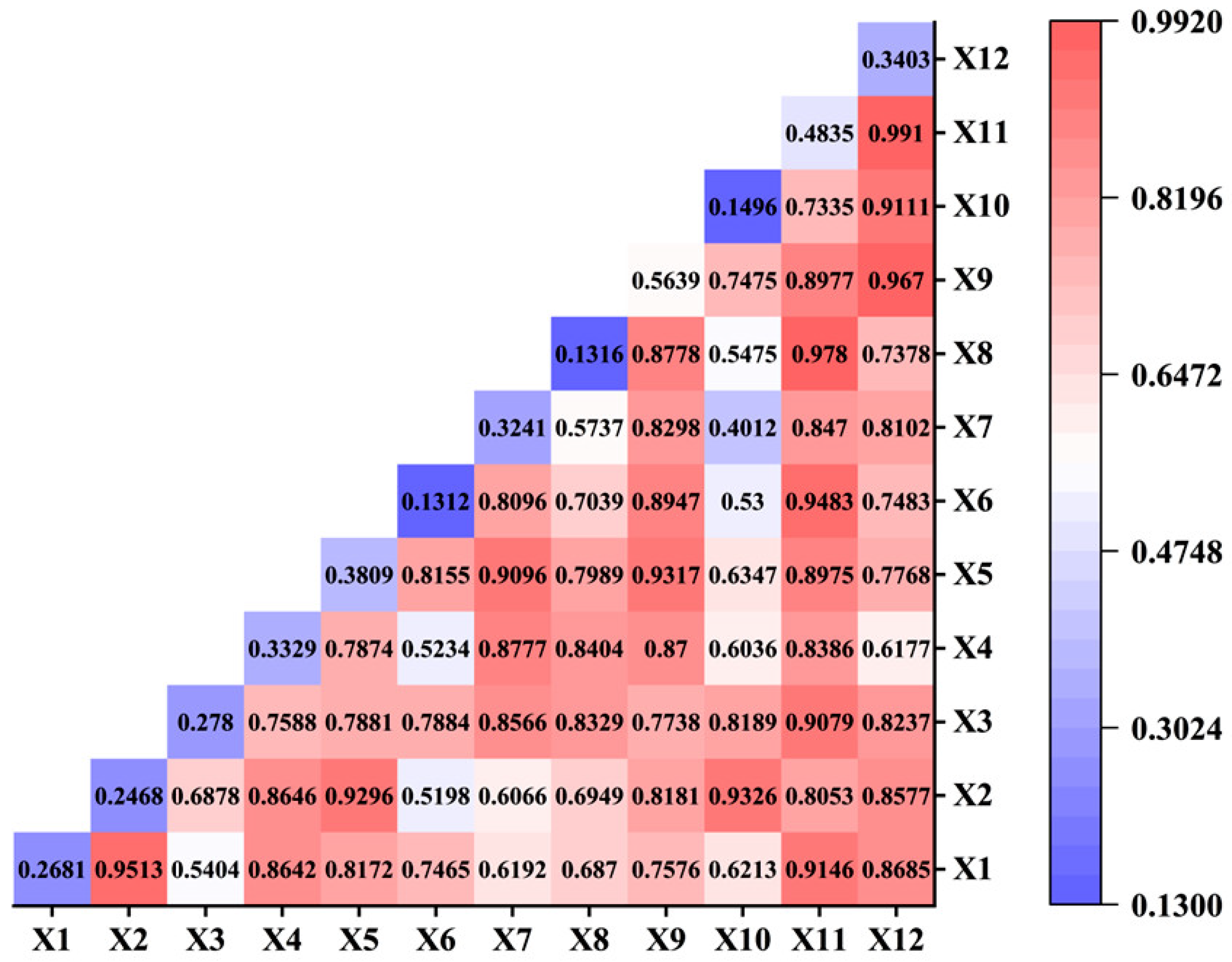
Based on the interaction detection results of the geodetector method (Figure 5), the explanatory power of all pairwise combinations of factors is higher than that of any single factor, indicating that the spatial distribution of ICH is driven by the synergistic interaction of natural and human factors. The interaction between cultural industry employees and accommodation and catering revenue reveals a reinforcement mechanism. Cultural industry professionals provide specialized capabilities for ICH documentation, performance organization, and creative innovation, while the accommodation and catering sector converts ICH into experiential and consumable tourism products through supporting services. These two factors mutually reinforce each other, forming a positive feedback loop of talent support and market transformation. This coupling effect is particularly prominent in tourism-developed regions such as Yinchuan and Qingtongxia, driving high-density ICH agglomeration in these areas.
The strong interaction between the Hui population and accommodation and catering revenue is rooted in the distinctive consumption attributes of Hui culture. Hui-related ICH items naturally align with catering, festivals, and tourism. Hui settlement areas provide differentiated cultural content for the accommodation and catering industry, while the prosperity of the hospitality sector, in turn, expands the space for the performance and dissemination of Hui ICH, creating two-way empowerment between ethnic culture and tourism consumption. However, this synergistic effect is constrained by the size of the market. Tongxin County has a Hui population of 293,000 (the second highest in the region) but only 52 ICH items. This is because its accommodation and catering revenue is only 13.4 million yuan. The narrow tourism consumption market provides few opportunities for ICH to be displayed and generates little economic return, leaving some folk customs confined to the community level and unregistered in official ICH inventories.
The interaction between the Hui population and cultural industry employees reflects the complementarity between resource endowment and professional capacity. Hui settlement areas serve as the native soil for cultural resources, carrying abundant ICH materials such as folk customs, skills, and festivals. However, without the professional documentation, recording, and transformation provided by cultural industry employees, these resources remain largely invisible to public cultural awareness and official protection systems.
The coupling effects of annual precipitation and distance from the Yellow River with human factors are pronounced, while the interactions of natural factors such as elevation and terrain relief with human variables are relatively weak. Precipitation shapes the human living environment and thereby influences population distribution. The rainy southern mountains are suitable for settlement, while the northern areas, relying on Yellow River irrigation, concentrate industrial and agricultural populations. These two types of environments nurture different types of ICH. The water and soil conditions near the Yellow River are favorable, and the overlapping of economic development with Hui settlement patterns has created a dense ICH belt along the river. In contrast, factors such as terrain and temperature tend to constrain human settlement patterns independently and are less able to amplify their effects through interaction with human conditions.
Overall, these interaction results confirm that the spatial distribution of ICH in Ningxia arises from the synergistic coupling of natural and human factors, rather than any single driver. Natural conditions provide the environmental foundation for ICH formation, while human factors, particularly distribution of the Hui population, determine the direction and intensity of spatial agglomeration. This explanatory enhancement underscores the complexity of ICH spatial differentiation mechanisms.

4. Discussion

4.1. Spatial Distribution Patterns of ICH

ICH conservation not only preserves the fine cultures of various ethnic groups and maintains ethnic identity but also promotes regional economic development and enhances national cultural soft power through industrialization and the integration of culture and tourism. Ningxia possesses abundant and diverse ICH resources, characterized by distinctive regional features and prominent ethnic cultural potential. However, several challenges remain in the inheritance and protection of these heritage resources.

4.1.1. Imbalance in the Type Structure of ICH

The marked typological imbalance, with traditional skills dominating while Quyi is extremely scarce, reflects not merely generic transmission barriers but the specific logic of ICH recognition in ethnic minority regions. In Ningxia, traditional skills such as Hui halal food preparation and Helan inkstone carving serve dual functions: they preserve ethnic identity while generating tangible economic value through cultural tourism and e-commerce. This aligns with the living inheritance paradigm of the state, which prioritizes ICH categories amenable to industrialization and poverty alleviation. Consequently, these categories receive policy attention and funding.
Quyi, however, faces a disadvantage against this background. First, its performance often involves Han Chinese narrative traditions (Shizuishan xuanjuan) that have limited appeal in Hui communities, where religious norms restrict certain entertainment forms. Second, unlike traditional skills, Quyi depends on live oral performance rather than material production, limiting its potential for commodification. Third, the long-term master–apprentice training conflicts with younger generations’ labor market participation, particularly in southern Ningxia, where out-migration for wage work is prevalent.
This imbalance shows a problem in the protection policies for ethnic minority ICH. Overemphasis on productive heritage types may unintentionally speed up the disappearance of performing arts, which are less profitable but still very important for cultural diversity.

4.1.2. Unevenness and Spatial Agglomeration in Municipal Distribution

The uneven distribution and spatial agglomeration of ICH in Ningxia are shaped by cultural investment, ethnic settlement characteristics, and inheritance mechanisms of different ICH types.
As the political, economic, and cultural center of Ningxia, Yinchuan not only gathers sufficient funds and platforms for ICH protection but also serves as a key area for the integration and display of Hui and Han cultures. Most ethnic and traditional ICH items gain official recognition here, which further concentrates ICH resources in Yinchuan. Shizuishan shows a relatively low number of ICH items mainly because it has long been dominated by coal industry development. This does not mean it lacks cultural heritage. Cultural protection investment is insufficient, and its industrial techniques and miners’ traditions are difficult to include in the current ICH system, which focuses on ethnic and traditional categories.
The difference in agglomeration degrees among ICH types is closely related to their dependence on specific places. Traditional sports, recreation and acrobatics are deeply integrated with the life of the Hui people and require specific venues and community participation, so it is highly clustered. However, Quyi is mostly introduced by mobile performers and thus spreads through market-oriented activities rather than fixed regional inheritance. Therefore, Quyi presents a weakly clustered and scattered spatial pattern.

4.1.3. Kernel Density Distribution Patterns of ICH

The kernel density pattern of ICH is shaped by cultural radiation, geographic connectivity, and spatial transmission rules, rather than simply depending on the total number of ICH items. The observed density pattern is primarily driven by transportation accessibility, terrain, and cultural radiation. The northern Yellow River belt features convenient transport and frequent population exchanges, facilitating the spread and integration of ICH. By comparison, the fragmented terrain in the southern loess hilly areas hinders agglomeration and diffusion of heritage items. Different ICH types present four distinct spatial patterns, which are closely linked to their inheritance carriers and dissemination paths. Heritage tied to historical sites and ethnic communities mostly forms single-core or multi-core agglomerations to sustain its authenticity and local features. Those distributed along rivers and transport routes generally show zonal distribution, while open and widely applicable categories such as traditional fine arts and skills form a core-radiation pattern led by central cities. These findings indicate that, in addition to natural geographical conditions, inherent inheritance attributes and cultural dissemination rules act as key drivers shaping ICH spatial distribution.

4.2. Contribution of County-Level ICH

To quantify the contribution of county-level ICH data, this section compares the data composition and spatial patterns. As shown in Table 3, county-level ICH accounts for 41.8% of the total four-level ICH, representing the largest share of all ICH resources. If county-level ICH is omitted and only three-level data (national, autonomous regional, and municipal) are used, the results are shown in Figure 6. In terms of overall kernel density distribution, the four-level ICH exhibits a pattern with two high-value cores (Yinchuan and Qingtongxia) and a north-high, south-low gradient. In contrast, the three-level ICH retains only one high-value core (Yinchuan), with the density of Qingtongxia declining and the medium-high-value areas in southern Guyuan largely disappearing. At the type level, after excluding county-level data, the kernel density distributions of the ten ICH types show three changes. First, density in the south declines markedly. High-value or medium-high-value areas in the southern region, represented by Guyuan, generally decline to medium-low-value areas. Second, multi-core patterns degenerate into single-core patterns, and secondary cores around Yinchuan (Qingtongxia, Shizuishan) are generally weakened. Third, the extent of clustering expands for some types; for example, the high-value area of traditional sports, recreation and acrobatics in the three-level dataset becomes larger than that in the four-level dataset. The average nearest neighbor index further confirms that the R value of the three-level ICH (0.0251) is lower than that of the four-level ICH (0.0476), indicating that excluding county-level data leads to an overestimation of clustering intensity.
These findings demonstrate that county administrative units act as the primary venues for ICH preservation and propagation. County-level datasets not only expand the sample pool but also capture the authentic spatial distribution of ICH. Reliance solely on data at the municipal level and above would lead to misinterpretation of spatial characteristics. Hence, county-level data is essential for ICH spatial research.

4.3. Implications for ICH Protection

4.3.1. Optimizing the Typological Structure of ICH

A quality improvement project is recommended for dominant ICH types. To address the problems of serious homogenization and insufficient refinement in traditional skills, an ICH skills transmission and innovation center may be established, with unified brand identity and quality standards. The production techniques of Ermopi (a type of ethnic fur product), Babao tea, and goji berries require deep integration with culture and tourism. High-end cultural and creative product lines need to be developed to enhance cultural added value, thereby enabling a transformation from quantity-oriented production with uneven quality to quality-oriented development with brand enhancement.
An emergency protection mechanism is urgently needed for endangered ICH types. Given that Quyi accounts for only 0.9% of the total, protection requires a shift from documentation to reactivation. For items that exist only in specific areas, such as Shizuishan xuanjuan and Ningxia xiaoqu, systematic investigation should first identify whether performance contexts (weddings, funerals, market days) still exist and then rebuild audience chains through targeted intervention rather than merely recording inheritors. ICH education needs to be introduced to schools, with elective modules in Quyi performance added in vocational colleges to cultivate potential audiences and reserve talent.
Cross-type integration and innovation should be promoted. The combination of traditional skills and folk literature can be encouraged, supporting inheritors to transform Hui folk tales into sources for Helan inkstone carving, clay sculpture, and paper cutting. This will help develop narrative ICH products and enhance the visual communication of folk literature.

4.3.2. Promoting Spatial Balance and Coordinated Development of ICH

First, targeted improvements are needed to address the uneven municipal distribution of ICH quantities. (1) For Shizuishan, which has the lowest number of ICH items, efforts can focus on promoting deep integration of industrial culture with ICH resources. A special survey on industry-related ICH is recommended, taking advantage of the transformation of coal city industrial heritage. Prioritizing coal mining techniques and industrial building construction techniques for documentation would enrich the types and quantity of regional ICH resources. Establishing a Shizuishan industrial ICH exhibition hall could transform industrial sites into spaces for living ICH transmission and display, achieving both cultural revitalization of industrial heritage and local cultivation of ICH resources. (2) For Zhongwei, leveraging its location at the intersection of Yellow River and Silk Road cultures allows optimization of water conservancy and transportation ICH projects, such as sheepskin rafts and Yellow River waterwheels.
Second, the spatial agglomeration pattern should be optimized to address the challenges posed by concentration. (1) Yinchuan, as the core area with concentrated ICH resources, can systematically extend the production and skill popularization of some ICH items to Shizuishan, Zhongwei, and the southern areas. While playing a core driving role, this would also enhance the development level of ICH in surrounding areas. (2) A cross-regional ICH cooperation platform is needed to facilitate the flow of inheritors, skills, and related resources between core and peripheral areas. Encouraging mature ICH projects in Yinchuan to expand to Shizuishan and south central areas would achieve spatial optimization of ICH resources and overall coordinated development.
Third, differentiated protection depends on the agglomeration characteristics of different ICH types. (1) For traditional sports, recreation and acrobatics, which show a high degree of agglomeration and are deeply embedded in the regional environment, designating core transmission spaces in Hui settlement areas such as Wuzhong and Guyuan is recommended. Incorporating performance venues for items such as Tajiao and Damuqiu into village planning and protection schemes, establishing community-based transmission networks, organizing regular performance activities, and strengthening community participation through folk festivals and celebrations would help prevent cultural distortion caused by excessive diffusion. (2) For Quyi, with its low degree of agglomeration and dispersed transmission, issuing mobile performance permits for troupes operating across municipal boundaries and establishing a digital tipping platform would allow dispersed audiences to support itinerant performers. Promoting content and format innovation for Quyi, incorporating local elements such as Yellow River culture and Hui folk customs, and expanding dissemination through new media platforms could attract younger audiences.

4.3.3. Targeted Strategies Based on Spatial Density Distribution Patterns

To address the overall north-high, south-low density pattern of ICH in Ningxia and the four differentiated spatial patterns of density distribution among the ten ICH types, targeted strategies should be implemented. First, for Guyuan, where ICH items are abundant but dispersed with low density, policy support needs to focus on improving connectivity rather than forcing physical agglomeration. Given the geographical constraints of the loess plateau, digital infrastructure such as broadband networks enabling remote mentoring between northern experts and local inheritors can help overcome isolation without disrupting community-based transmission. Meanwhile, establishing mobile documentation teams that travel between dispersed villages would help record and support ICH inheritance, reducing the burden on local inheritors to travel to urban centers.
Second, differentiated development strategies should be implemented for the four spatial patterns of density distribution. (1) For the single-core agglomeration type (folk literature, traditional medicine), priority lies in protecting original transmission spaces, designating core transmission protection zones, and collecting and organizing oral historical materials and medical formulas to avoid cultural distortion. Exploring and transforming their cultural connotations into products suitable for dissemination would help achieve wide distribution of cultural value while preserving the advantages of a single core. (2) For the multi-core dispersed type (traditional dance), preserving the uniqueness of dance forms in Wuzhong, Zhongwei, and Guyuan is essential. Establishing a cross-regional exchange platform and organizing regular performance and skill exchange activities would promote mutual learning among inheritors, forming a multi-core pattern characterized by distinct features and coordinated development. (3) For the belt-shaped extension type (traditional opera, traditional music), given the north–south transmission corridor along the Yellow River, integrating ICH resources along this corridor and applying for a cultural ecological protection zone is necessary. Constructing dedicated platforms for ICH inheritance and exhibition in key cities along the route, along with developing distinctive cultural tourism routes, would allow transmission corridors to act as connectors linking various inheritance nodes, coordinate cultural and tourism resources, and foster the innovative development of ICH and tourism. (4) For the core-radiation type (traditional fine arts, traditional skills), strengthening the resource agglomeration and radiation capacity of the Yinchuan core area is critical. Improving platforms for transmission and innovation, cultivating high-quality inheritors and ICH brands, and optimizing radiation channels through the north–south linkage mechanism would promote targeted radiation of such ICH to weak areas in the southern region. Establishing branch transmission sites in the south, conducting skill training and practical activities, and expanding radiation coverage would reinforce the pattern of the core driving the surrounding areas.

4.4. Comparison with Related Regional Studies

Consistent with existing research on ICH in Northwest China and the Yellow River Basin, this study uses methods such as the average nearest neighbor index and kernel density estimation to reveal the spatial distribution and formation mechanisms of ICH in Ningxia. Similar to Zhang et al. [45], it finds an overall clustered distribution yet presents a higher agglomeration degree. This study includes 1546 ICH items from national to county levels, while Zhang et al. only focus on national-level ICH. This comprehensive coverage effectively avoids misjudgment caused by limited data and deepens understanding of understudied county-level ICH resources.
Like Yellow River Basin studies involving Ningxia [53,54], this study confirms physical geography, socio-economy, and ethnic distribution as key drivers, as well as the typological regularity of stronger clustering for life-related ICH (traditional skills) and weaker clustering for Quyi. However, basin-scale studies treat Ningxia as a sample, failing to reveal its unique patterns, whereas this study identifies four spatial patterns and spatial imbalance by focusing on the entire region.
Compared with Southwest China minority ICH research [55], both find ICH agglomeration in ethnic areas, but differences exist, as Southwest ICH is more influenced by mountains and migration, showing patchy agglomeration. In contrast, this study highlights the impact of Hui settlements in Ningxia, with ICH forming a concentric circle pattern around Hui areas.

4.5. Limitations and Strengths of the Methods and Data

The data collection encounters two challenges. First, some early county-level ICH records differ from the current national ten-category standard and are reclassified according to their practical attributes. Second, most county-level ICH protection locations are uniformly registered at county governments or cultural centers without precise town or village scale information, which may cause minor spatial aggregation deviations in fine-scale analysis. Several methodological limitations exist in this study. Spatial analysis and the geodetector model capture only static patterns and statistical correlations rather than dynamic inheritance processes. In addition, the dataset is limited to official ICH lists, excluding unregistered folk heritage. Despite these limitations, this study offers several advantages. It systematically integrates four-level ICH data and demonstrates that excluding county-level data leads to misjudgments of spatial patterns. Combining GIS spatial analysis with the geodetector method, this research identifies four spatial distribution patterns of ICH in Ningxia and quantifies the effects of individual factors and their interactions on ICH spatial distribution, thereby effectively revealing its overall spatial characteristics and formation mechanisms.

4.6. Future Research

This study focuses on the spatial distribution characteristics of ICH. Due to the lack of long-term serial data, the dynamic evolution and temporal characteristics of ICH have not been explored, which to some extent limits comprehensive understanding of ICH development trajectories. In addition, restricted by data availability, some factors, such as the number of ICH inheritors and the distribution of traditional villages, are not included in the detection system. To improve the accuracy and comprehensiveness of the analysis, future research can determine the temporal information of relevant ICH through local archives, interviews with inheritors, and other methods to further investigate the temporal distribution characteristics of ICH and its influencing factors.

5. Conclusions

Based on 1546 ICH items spanning national, autonomous regional, municipal, and county levels in Ningxia, this study employs GIS spatial analysis, including the imbalance index, geographic concentration index, average nearest neighbor index, and kernel density estimation, together with the geodetector method to systematically investigate the spatial distribution characteristics and driving factors of ICH. The main findings are summarized as follows.
(1)
ICH in Ningxia exhibits imbalances in both municipal distribution and type structure. At the municipal level, Yinchuan has the largest number of ICH items, while Shizuishan has the smallest, with significant inter-municipal differences. ICH related to production and daily life, represented by traditional skills, accounts for a relatively high proportion, while performing arts such as Quyi are scarce, presenting a clear structural imbalance.
(2)
ICH in Ningxia shows an uneven and concentrated distribution pattern in space. The distribution deviates from an equilibrium state, with resources systematically concentrated in a small number of cities, forming a clear core–periphery structure.
(3)
ICH in Ningxia presents a north-high, south-low density distribution pattern. Yinchuan and Qingtongxia serve as the two major high-density agglomeration centers. Shizuishan, Zhongwei, and Yanchi form secondary high-value areas, while the southern Ningxia region, represented by Guyuan, generally has a lower density. The ten ICH types can be summarized into four spatial patterns: single-core agglomeration, multi-core dispersion, belt-shaped extension, and core-radiation.
(4)
The spatial distribution of ICH in Ningxia is driven by the synergistic interaction of natural and human factors. The Hui population, cultural industry employees, and annual precipitation are the three single factors with the strongest explanatory power. Among these, the distribution of the Hui population has the most prominent impact on the spatial pattern of ICH. The explanatory power of multi-factor interactions is higher than that of single factors, with the interaction between cultural industry employees and accommodation and catering revenue being particularly significant.
The theoretical contributions of this study are mainly reflected in the following aspects. First, this study proposes and validates the empirical evidence that county-level ICH data are indispensable. Previous spatial studies on ICH have mostly relied on national and provincial data to reflect overall spatial patterns. By comparing the four-level dataset with the three-level dataset (excluding county-level ICH), this study finds that omitting county-level data would affect identification of spatial patterns. This finding provides an empirical basis for constructing a data framework in ICH spatial analysis. Second, this study summarizes the spatial distribution of ICH into four spatial patterns, which differs from previous studies that only reported a binary conclusion of clustered or dispersed. These patterns reflect the differentiated dependence of various ICH types on geographical environment and transmission mechanisms and enrich the classification framework of ICH spatial analysis. In addition, this study offers practical implications for ICH conservation in Ningxia, including region-specific strategies tailored to different spatial patterns.
In addition to the above contributions, this study also provides a reference for related research in other minority regions. Xinjiang, as a multi-ethnic area, is home to multiple ethnic groups, such as Uyghur and Kazakh interweaving. Its ICH spatial pattern is jointly shaped by factors such as the multicultural environment and ethnic distribution, with the unique traditional culture and customs of ethnic minorities constituting an important foundation for local ICH resources. Inner Mongolia is dominated by the Mongol ethnic group, along with other minorities such as Daur and Ewenki. Cultural factors and urbanization processes are the main drivers, and folk customs and traditional skills are closely related to traditional Mongol activities and handicrafts. These comparisons indicate that the driving effect of ethnic population on ICH spatial distribution is closely related to the specific ethnic composition and settlement patterns of each region. Therefore, future cross-regional comparative studies should pay attention to differences in ethnic composition and settlement patterns across different minority regions.

Author Contributions

Conceptualization, methodology, funding acquisition, supervision, and writing—review and editing: J.S.; software, data curation, formal analysis, visualization, investigation, and writing—original draft preparation: D.M. All authors have read and agreed to the published version of the manuscript.

Funding

This study is funded by the National Natural Science Foundation of China (Nos. 42401319 and 52109155), the Science and Technology Key Project of Henan Province (No. 262102320049), the Natural Science Foundation of Henan Province (No. 262300420052), the Open Research Fund Program of National Key Laboratory of Water Disaster Prevention (No. 2024491911), and the Postgraduate Education Reform and Quality Improvement Project of Henan Province (No. YJS2026ALPY01).

Data Availability Statement

Data are available from the corresponding author upon reasonable request. No custom code was developed in this study.

Conflicts of Interest

The authors declare that they have no competing interests.

References

  1. Li, N.; Li, X.; Xiao, W. Intangible Cultural Heritage Threatened-Level Categories and Criteria. Humanit. Soc. Sci. Commun. 2025, 12, 271. [Google Scholar] [CrossRef]
  2. Dolcetti, F.; Perry, S.; Di Franco, P.D. Values-Led Digital Design for the Post-Disaster Recovery of Heritage and Sense of Place. ACM J. Comput. Cult. Herit. 2025, 18, 72. [Google Scholar] [CrossRef]
  3. Wu, S.; Liu, J.; Zou, H.; Yu, T.; Jiang, Z. Visual Storytelling in Digital Libraries: Design Strategies for Preserving and Accessing Intangible Cultural Heritage. Afr. J. Libr. Arch. Inf. Sci. 2025, 35, 85–97. [Google Scholar]
  4. Zhang, B.; Shi, H.; Wang, C.; Gu, M. Application of Immersive VR in the Digital Preservation of Cultural Heritage. Period. Mineral. 2025, 94, 53–66. [Google Scholar]
  5. Zhang, X.; Yang, D.; Yow, C.H.; Huang, L.; Wu, X.; Huang, X.; Guo, J.; Zhou, S.; Cai, Y. Metaverse for Cultural Heritages. Electronics 2022, 11, 3730. [Google Scholar] [CrossRef]
  6. Provost, S.; Jones, T.; Marshall, M.; Wesley, D.; Rangi, N.; Di Franco, A. Contextualising Digital Cultural Heritage: Bininj GIS and 3D Modelling for Conservation at Ubirr Rock Art Complex, Kakadu National Park, Australia. Int. J. Herit. Stud. 2025, 31, 1440–1469. [Google Scholar] [CrossRef]
  7. Liu, Y. Application of Digital Technology in Intangible Cultural Heritage Protection. Mob. Inf. Syst. 2022, 2022, 7471121. [Google Scholar] [CrossRef]
  8. Zuo, Y.; Lan, T.; Liu, S.; Zeng, H. The Post-Effects of the Authenticity of Rural Intangible Cultural Heritage and Tourists’ Engagement. Behav. Sci. 2024, 14, 302. [Google Scholar] [CrossRef] [PubMed]
  9. Esfehani, M.H.; Albrecht, J.N. Planning for Intangible Cultural Heritage in Tourism: Challenges and Implications. J. Hosp. Tour. Res. 2019, 43, 980–1001. [Google Scholar] [CrossRef]
  10. Duan, Z.; Tan, S.; Choon, S.W.; Zhang, M. Crafting a Place-Based Souvenir for Sustaining Cultural Heritage. Heliyon 2023, 9, e15761. [Google Scholar] [CrossRef] [PubMed]
  11. Feizizadeh, B.; Fathi, S.; Ghasmeizad Gonbad, Z.; Ghasmei, M.; Makki, M. A Multiple Geospatial Approach for Intangible Cultural Heritage Tourism Potentiality Mapping in Iran. Sustainability 2023, 15, 16659. [Google Scholar] [CrossRef]
  12. Zhang, Y.; Zheng, Q.; Huang, L.; Lee, T.J.; Hyun, S.S. Alienation and Authenticity in Intangible Cultural Heritage Tourism. J. Sustain. Tour. 2024, 32, 2459–2478. [Google Scholar] [CrossRef]
  13. Sun, L.; Li, J.; Wang, Z.; Liu, W.; Zhang, S.; Wu, J. Research on the Redesign of China’s Intangible Cultural Heritage Based on Sustainable Livelihood: The Case of Luanzhou Shadow Play Empowering Its Rural Development. Sustainability 2024, 16, 4555. [Google Scholar] [CrossRef]
  14. Candeloro, G.; Tartari, M. Heritage-Led Sustainable Development in Rural Areas: The Case of Vivi Calascio Community-Based Cooperative. Cities 2025, 161, 105920. [Google Scholar] [CrossRef]
  15. Giamporcaro, G.; Sgroi, F.; Baviera-Puig, A.; Modica, F. Promoting Rural Development Through Gastronomic Heritage: The Case of the Cerda Artichoke in Northwestern Sicily. Int. J. Gastron. Food Sci. 2025, 41, 101246. [Google Scholar] [CrossRef]
  16. Sonkoly, G. From Tangible to Intangible Heritage: Hollókő, the “World-Protected Village”. Ethnologies 2019, 41, 3–20. [Google Scholar]
  17. Zambrano, R.V.H.; Milanes, C.B.; Montero, O.P.; Mestanza-Ramón, C.; Bolivar, L.O.N.; Loor, D.C.; De Válgaz, R.G.G.F.; Cuker, B. A Sustainable Proposal for a Cultural Heritage Declaration in Ecuador: Vernacular Housing of Portoviejo. Sustainability 2023, 15, 1115. [Google Scholar] [CrossRef]
  18. Bakels, J.; Bisschop, C. Intangible Heritage to Strengthen Local Water Management. Blue Pap. 2023, 2, 46–55. [Google Scholar] [CrossRef]
  19. Dragan, A.; Crețan, R.; Terian, M.I. Landscapes of Watermills: A Rural Cultural Heritage Perspective in an East-Central European Context. Heritage 2024, 7, 4790–4813. [Google Scholar] [CrossRef]
  20. Cittati, V.-M.; Balest, J.; Exner, D. What Is the Relationship between Collective Memory and the Commoning Process in Historical Building Renovation Projects? The Case of the Mas di Sabe, Northern Italy. Sustainability 2022, 14, 11870. [Google Scholar] [CrossRef]
  21. Pascu, M.; Pătru-Stupariu, I. The Assessment of the Authenticity and Conservation Status of Cultural Landscapes in Southern Transylvania (Romania). Geographies 2021, 1, 3–21. [Google Scholar] [CrossRef]
  22. Udo, F.J.; Naidu, M. African Indigenous Performances, Collective Memory, and Identity in Post-apartheid uMlazi Township, South Africa. J. Asian Afr. Stud. 2026, 61, 3424–3441. [Google Scholar]
  23. Shakya, M.; Vagnarelli, G. Creating Value from Intangible Cultural Heritage—The Role of Innovation for Sustainable Tourism and Regional Rural Development. Eur. J. Cult. Manag. Policy 2024, 14, 12057. [Google Scholar] [CrossRef]
  24. Su, X.; Li, X.; Kang, Y. A Bibliometric Analysis of Research on Intangible Cultural Heritage Using CiteSpace. Sage Open 2019, 9, 2158244019840119. [Google Scholar] [CrossRef]
  25. Arı Akman, N.G.; Çelebi Karakök, M.E. A Fuzzy–AHP Model for Quantifying Authenticity Loss in Adaptive Reuse: A Sustainable Heritage Approach Based on Traditional Houses in Alanya. Sustainability 2025, 17, 10519. [Google Scholar] [CrossRef]
  26. Li, X.; Zhu, R.; Shi, C.; Yang, X.; Chen, L.; Wei, K. Research on the Construction of Intangible Cultural Heritage Corridors in the Yellow River Basin Based on Geographic Information System (GIS) Technology and the Minimum Cumulative Resistance (MCR) Model. Herit. Sci. 2024, 12, 271. [Google Scholar] [CrossRef]
  27. Cheng, C.; Pu, L. The Characteristics of Spatial and Temporal Distribution and Influencing Factors of Intangible Cultural Heritage in Northwestern China. Sci. Rep. 2025, 15, 9968. [Google Scholar] [CrossRef] [PubMed]
  28. Zhang, Z.; Cui, Z.; Fan, T.; Ruan, S.; Wu, J. Spatial Distribution of Intangible Cultural Heritage Resources in China and Its Influencing Factors. Sci. Rep. 2024, 14, 4960. [Google Scholar] [CrossRef] [PubMed]
  29. Wu, L.; Yang, G.; Chen, X. Spatial Distribution Characteristics and Influencing Factors of Intangible Cultural Heritage in the Yunnan, Guangxi, and Guizhou Rocky Desertification Area. Sustainability 2024, 16, 4722. [Google Scholar] [CrossRef]
  30. Shi, G.; Feng, Z.; Zhang, J.; Xu, J.; Chen, Y.; Liu, J.; Wang, Y. An Analysis of the Spatiotemporal Distribution and Influencing Factors of National Intangible Cultural Heritage Along the Grand Canal of China. Sustainability 2024, 16, 9138. [Google Scholar] [CrossRef]
  31. Pang, L.; Wu, L. Distribution Characteristics and Influencing Factors of Intangible Cultural Heritage in Beijing-Tianjin-Hebei. Herit. Sci. 2023, 11, 19. [Google Scholar] [CrossRef]
  32. Gu, Y.; Zhang, Y.; Akihara, M.; Zhang, Y.; Huang, H. The Spatial and Temporal Characteristics and Influencing Factors of Intangible Cultural Heritage in Fujian Province. Land 2025, 14, 2319. [Google Scholar] [CrossRef]
  33. Gu, Y.; Zhang, Y.; Hou, Y.; Yu, S.; Li, G.; Huang, H.; Su, D. The Spatio-Temporal Characteristics and Influencing Factors of Intangible Cultural Heritage in Jiang-Zhe-Hu Region, China. Sustainability 2025, 18, 35. [Google Scholar] [CrossRef]
  34. Zhao, L.; Liu, M.; Zhang, S.; Yan, X. Spatial Distribution Characteristics and Influencing Factors of Intangible Cultural Heritage in Shanxi Province, China. Front. Earth Sci. 2026, 13, 1632434. [Google Scholar] [CrossRef]
  35. Zhang, C.; Zeng, Y.; Wu, W.; Xiao, L. Spatial Distribution Patterns and Influencing Factors of Intangible Cultural Heritage in Guangdong Province of China. Sustainability 2025, 17, 10594. [Google Scholar] [CrossRef]
  36. Li, J.; Yang, X.; Gao, Y.; Gao, C. Spatial and Temporal Distribution Characteristics and Influencing Factors of Cultural Heritage: A Case of the Grand Canal (East Zhejiang section)-Maritime Silk Road. PLoS ONE 2025, 20, e0318529. [Google Scholar] [CrossRef] [PubMed]
  37. Wang, X.; Zhang, T.; Duan, L.; Liritzis, I.; Li, J. Spatial Distribution Characteristics and Influencing Factors of Intangible Cultural Heritage in the Yellow River Basin. J. Cult. Herit. 2024, 66, 254–264. [Google Scholar] [CrossRef]
  38. Han, Q.; Tao, F.; Hong, Z.; Qin, G.; Wei, Y.; Chen, Y.; Zhou, T. Research on the Spatiotemporal Distribution and Factors Influencing Intangible Cultural Heritage in Fujian Province from a Multiscale Perspective. Herit. Sci. 2024, 12, 239. [Google Scholar] [CrossRef]
  39. Ren, K.; Li, C.; Zhan, J.H.; Lam, J.F.I. Spatiotemporal Distribution and Influencing Factors of Intangible Cultural Heritage in the Guangdong-Hong Kong-Macao Region. npj Herit. Sci. 2025, 13, 407. [Google Scholar] [CrossRef]
  40. Mo, B.C.; Zhang, X.; Chen, W.; Zhou, R.; Zhang, J. Research on the Spatial Distribution Characteristics and Influencing Factors of Sports Intangible Cultural Heritage in the Guangdong-Hong Kong-Macao Greater Bay Area. Sci. Rep. 2025, 15, 27147. [Google Scholar] [CrossRef] [PubMed]
  41. Zou, L.; Tai, P.; Wang, C.; Jiao, J.; Wang, Y. Study on the Spatial and Temporal Differentiation of Intangible Cultural Heritage and Its Influencing Factors in Shandong Province. Sci. Rep. 2025, 15, 24792. [Google Scholar] [CrossRef] [PubMed]
  42. Cai, Z.; Cai, K.; Huang, T.; Zhang, G.; Chen, R. Spatial Distribution Characteristics and Sustainable Inheritance Strategies of National Traditional Fine Arts Intangible Cultural Heritage in China. Sustainability 2024, 16, 4488. [Google Scholar] [CrossRef]
  43. Hung, N.T.V.; Hien, L.T.; Ly, N.T. Sustaining the Performance Environment of Intangible Cultural Heritage of Ethnic Minorities in Vietnam in the Contemporary Context: The Case of the “Khap Thai” in Thanh Hoa Province. Int. J. Soc. Sci. Res. 2025, 2, 293–305. [Google Scholar] [CrossRef]
  44. Liu, X. Contemporary Northeast Chinese Shamanism in the Interaction Between Public Heritage and Private Belief. Religions 2025, 16, 706. [Google Scholar] [CrossRef]
  45. Zhang, Y.; Ren, G.; Zhang, Y.; Zhang, H. Spatiotemporal Distribution Pattern and Evolution Characteristics of Intangible Cultural Heritage in Northwest China. Geocarto Int. 2025, 40, 2567951. [Google Scholar] [CrossRef]
  46. Wang, X.; Zhan, S. Exploring the Spatial Distribution of ICH by Geographic Information System (GIS). Mob. Inf. Syst. 2022, 2022, 8689113. [Google Scholar] [CrossRef]
  47. Zhang, Y.; Li, W.; Li, Z.; Yang, M.; Zhai, F.; Li, Z.; Yao, H.; Li, H. Spatial Distribution Characteristics and Influencing Factors of Key Rural Tourism Villages in China. Sustainability 2022, 14, 14064. [Google Scholar] [CrossRef]
  48. Jin, L.; Wang, Z.; Chen, X. Spatial Distribution Characteristics and Influencing Factors of Traditional Villages on the Tibetan Plateau in China. Int. J. Environ. Res. Public Health 2022, 19, 13170. [Google Scholar] [CrossRef] [PubMed]
  49. Chen, Y.; Hu, Y.; Lai, L. Demography-Oriented Urban Spatial Matching of Service Facilities: Case Study of Changchun, China. Land 2022, 11, 1660. [Google Scholar] [CrossRef]
  50. Wang, J.; Xu, C. Geographical Detector: Principle and Prospect. Acta Geogr. Sin. 2017, 72, 116–134. [Google Scholar]
  51. Liu, H.; Cao, Y.; Li, X. Spatiotemporal Patterns and Influencing Factors of Intangible Cultural Heritage in the Yangtze River Delta. Sustainability 2026, 18, 1885. [Google Scholar] [CrossRef]
  52. Chen, Y.; Zhao, J.; Zhao, X.; Wang, Z.; Xu, Z.; Li, S.; Liu, W. Study on the Spatial Distribution Characteristics and Influencing Factors of Intangible Cultural Heritage Along the Great Wall of Hebei Province. Sustainability 2025, 17, 6962. [Google Scholar] [CrossRef]
  53. Chang, B.; Ding, X.; Xi, J.; Zhang, R.; Lv, X. Spatial-Temporal Distribution Pattern and Tourism Utilization Potential of Intangible Cultural Heritage Resources in the Yellow River Basin. Sustainability 2023, 15, 2611. [Google Scholar] [CrossRef]
  54. Xue, Q.; Huang, Y. The Spatial Relationship and Influence Mechanism of Traditional Villages and Intangible Cultural Heritage: A Case Study of the Upper Reaches of the Yellow River Basin. Humanit. Soc. Sci. Commun. 2025, 12, 142. [Google Scholar] [CrossRef]
  55. Li, C.; Qian, Y.; Li, Z.; Tong, T. Identifying Factors Influencing the Spatial Distribution of Minority Cultural Heritage in Southwest China. Herit. Sci. 2024, 12, 117. [Google Scholar] [CrossRef]
Figure 1. Location of the study area.
Land 15 01087 g001
Figure 2. Research framework.
Land 15 01087 g002
Figure 3. Lorenz curve of ICH distribution in Ningxia.
Land 15 01087 g003
Figure 4. Kernel density distribution of ICH.
Land 15 01087 g004
Figure 5. Interaction detection results of influencing factors (X1: terrain relief; X2: mean annual temperature; X3: elevation; X4: distance from the Yellow River; X5: annual precipitation; X6: annual sunshine duration; X7: per capita GDP; X8: total population; X9: Hui population; X10: population of other ethnic minorities; X11: cultural industry employees; X12: accommodation and catering revenue).
Land 15 01087 g005
Figure 6. Kernel density distribution of three-level ICH (excluding county-level ICH).
Land 15 01087 g006
Table 1. Factors influencing spatial distribution of ICH.
Primary IndicatorSecondary IndicatorData Source
Natural factorsElevationGeospatial Data Cloud Platform
Mean annual temperatureNingxia Statistical Yearbook
Annual precipitationNingxia Statistical Yearbook
Annual sunshine durationNingxia Statistical Yearbook
Terrain reliefGeospatial Data Cloud Platform
Distance from the Yellow RiverGeospatial Data Cloud Platform
Human factorsTotal populationNingxia Statistical Yearbook
Hui populationNingxia Statistical Yearbook
Per capita GDPNingxia Statistical Yearbook
Cultural industry employeesNingxia Statistical Yearbook
Accommodation and catering revenueNingxia Statistical Yearbook
Population of other ethnic minoritiesNingxia Statistical Yearbook
Table 2. Quantity of ICH in various cities of Ningxia.
TypeYCSZSWZGYZWTotalProportion
Folk literature0214129372.4%
Traditional music2110162114825.3%
Traditional skills2119416513515876349.4%
Traditional medicine21531152744.8%
Traditional opera6110248493.2%
Traditional fine arts572241855626116.9%
Traditional dance23151317503.2%
Traditional sports30152625171137.3%
Quyi42720150.9%
Folk customs2093423161026.6%
Total3721633593552971546
Proportion24.1%10.5%23.2%23%19.2%
Note: YC is Yinchuan, SZS is Shizuishan, WZ is Wuzhong, GY is Guyuan, and ZW is Zhongwei.
Table 3. Number and proportion of ICH items by administrative level.
YCSZSWZGYZWTotalProportion
National111763281.8%
Autonomous regional722777637331220.2%
Municipal1604412911910856036.2%
County1299114616711364641.8%
Table 4. Average nearest neighbor index of various types of ICH.
TypeZ-Valuep-Value R
Folk literature−9.669700.1690
Traditional music−15.890700.0827
Traditional skills−50.045500.0530
Traditional medicine−13.716300.1665
Traditional opera−11.230600.1614
Traditional fine arts−29.372100.0496
Traditional dance−11.185800.1731
Traditional sports−19.484100.0419
Quyi−2.38150.01720.6786
Folk customs−17.696900.0841
Total−71.638700.0476
Note: R is the average nearest neighbor index.
Table 5. Detection results of influencing factors by the geodetector.
Influencing Factor q -ValueRank
Elevation0.2780 ***7
Mean annual temperature0.2468 ***9
Annual precipitation0.3809 ***3
Annual sunshine duration0.1312 ***12
Terrain relief0.2681 ***8
Distance from the Yellow River0.3329 ***5
Total population0.1316 ***11
Hui population0.5639 ***1
Per capita GDP0.3241 ***6
Cultural industry employees0.4835 ***2
Accommodation and catering revenue0.3403 ***4
Population of other ethnic minorities0.1496 ***10
Note: The q -value represents the explanatory power of the geodetector, and *** indicates significance at the 1% confidence level.
Disclaimer/Publisher’s Note: The statements, opinions and data contained in all publications are solely those of the individual author(s) and contributor(s) and not of MDPI and/or the editor(s). MDPI and/or the editor(s) disclaim responsibility for any injury to people or property resulting from any ideas, methods, instructions or products referred to in the content.